Copyright &
Fair Use in
Digital Projects
Office of Scholarly
Communication Services
Rachael Samberg
Mar. 7, 2019
Reflecting on why
you’re here
Using other
people’s
content?
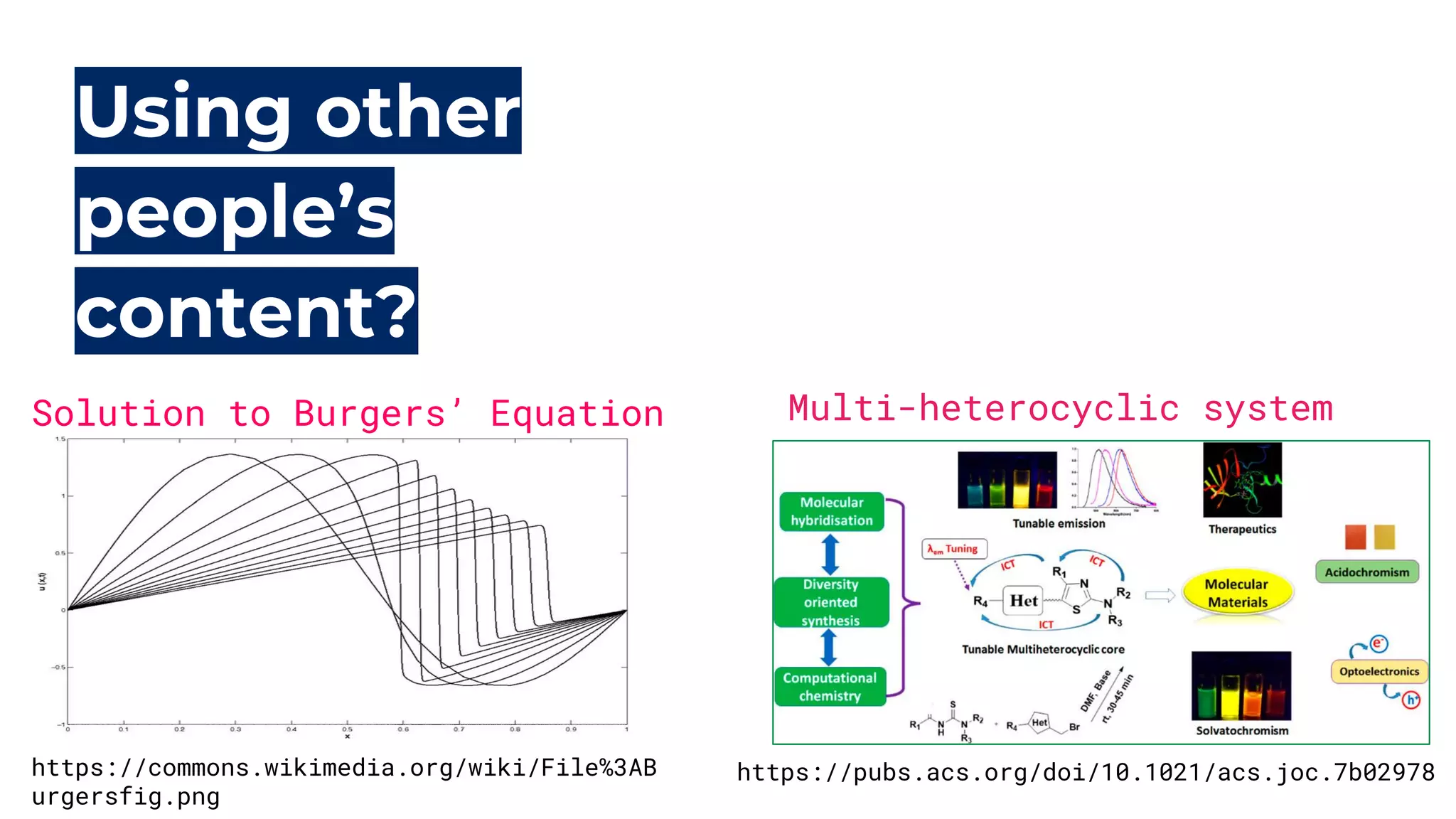
Solution to Burgers’ Equation Multi-heterocyclic system
https://pubs.acs.org/doi/10.1021/acs.joc.7b02978https://commons.wikimedia.org/wiki/File%3AB
urgersfig.png
Using other
people’s
content?
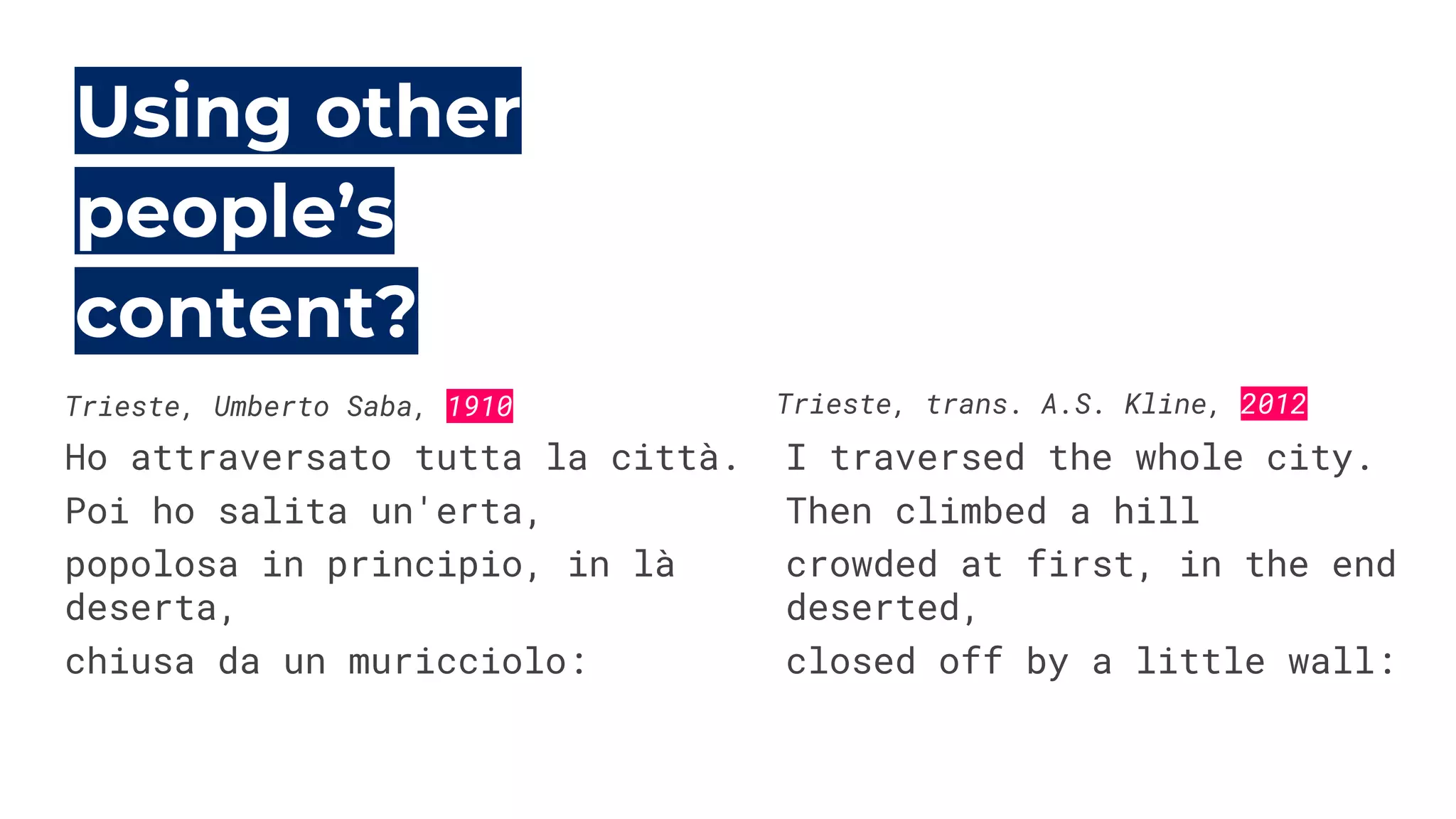
Ho attraversato tutta la città.
Poi ho salita un'erta,
popolosa in principio, in là
deserta,
chiusa da un muricciolo:
I traversed the whole city.
Then climbed a hill
crowded at first, in the end
deserted,
closed off by a little wall:
Trieste, Umberto Saba, 1910 Trieste, trans. A.S. Kline, 2012
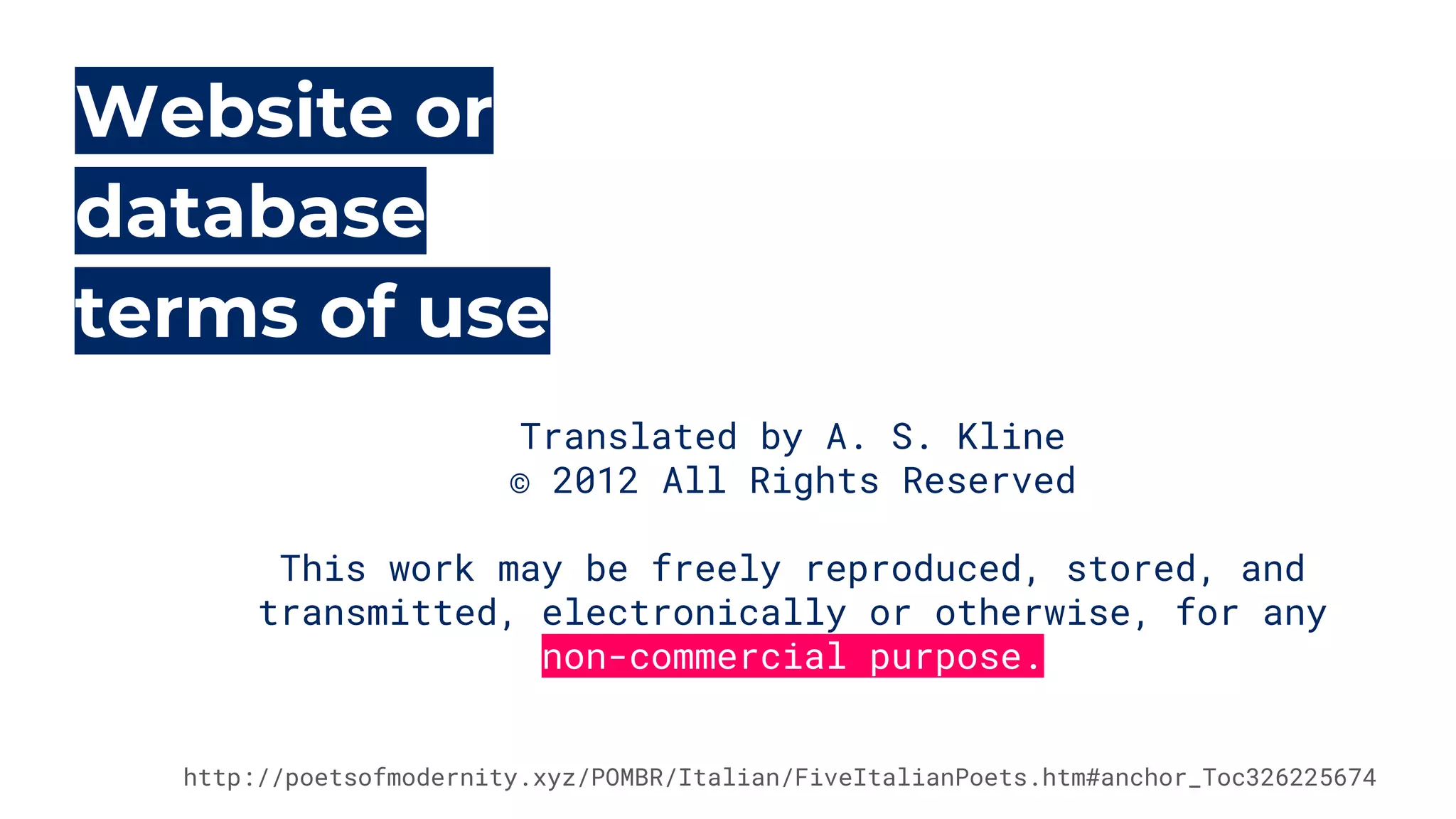
Website or
database
terms of use
Translated by A. S. Kline
© 2012 All Rights Reserved
 
This work may be freely reproduced, stored, and
transmitted, electronically or otherwise, for any
non-commercial purpose.
http://poetsofmodernity.xyz/POMBR/Italian/FiveItalianPoets.htm#anchor_Toc326225674
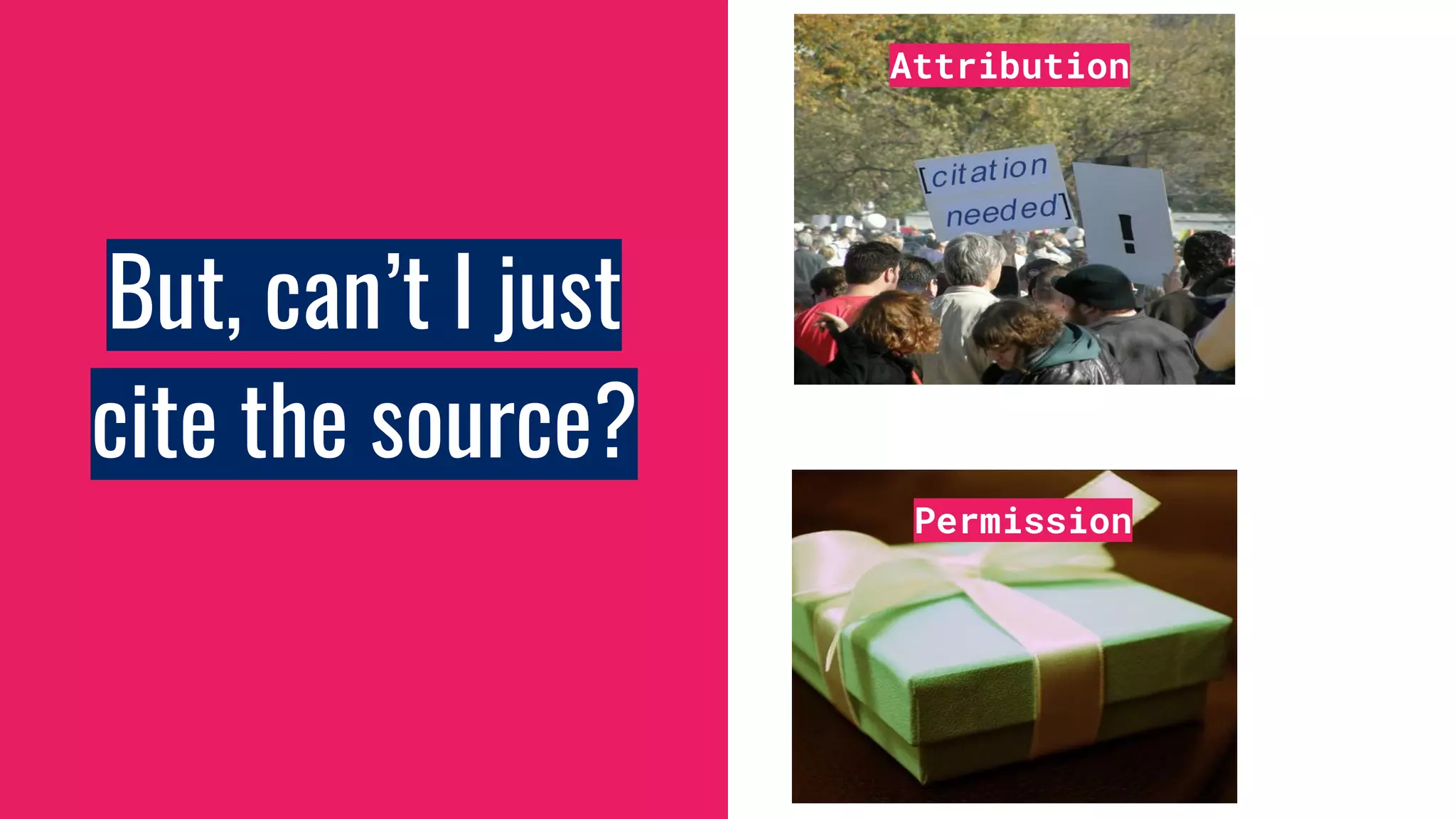
But, can’t I just
cite the source?
Attribution
Permission
You’re an author.
You have decisions
to make.
What is copyright?
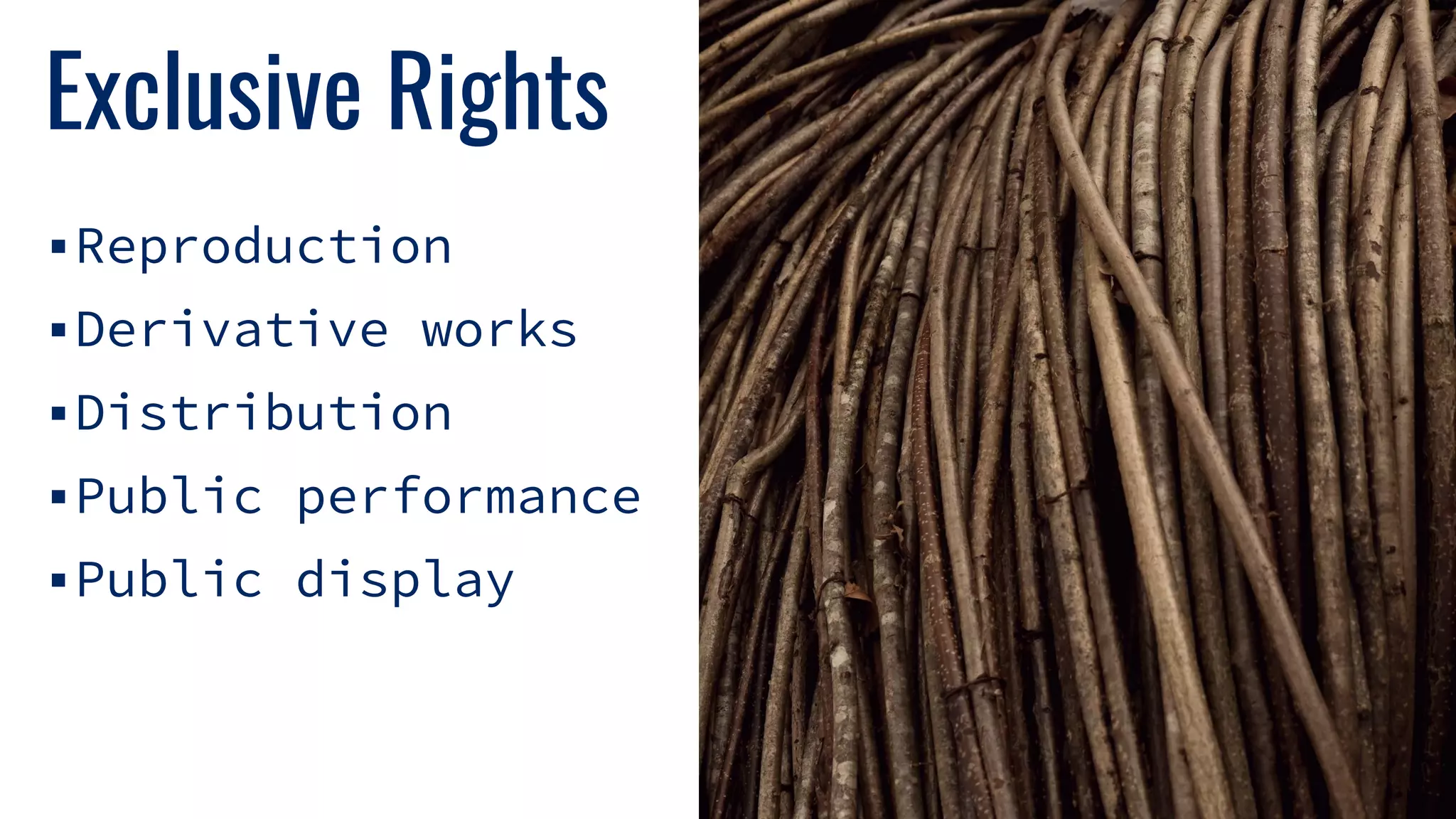
Exclusive rights to make
certain uses
of original expression
for limited period of time
Exclusive Rights
▪Reproduction
▪Derivative works
▪Distribution
▪Public performance
▪Public display
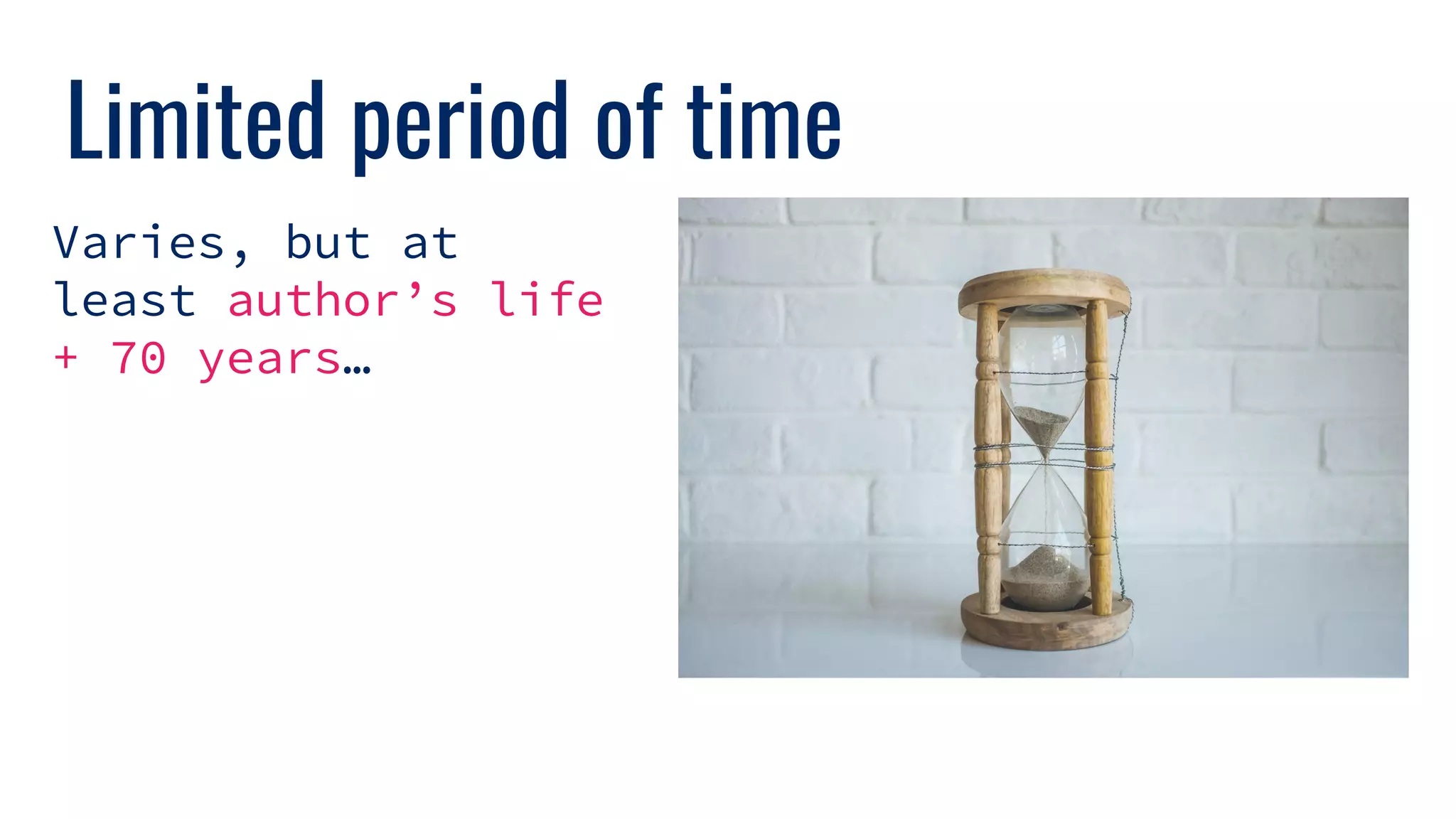
Limited period of time
Varies, but at
least author’s life
+ 70 years…
Limitations
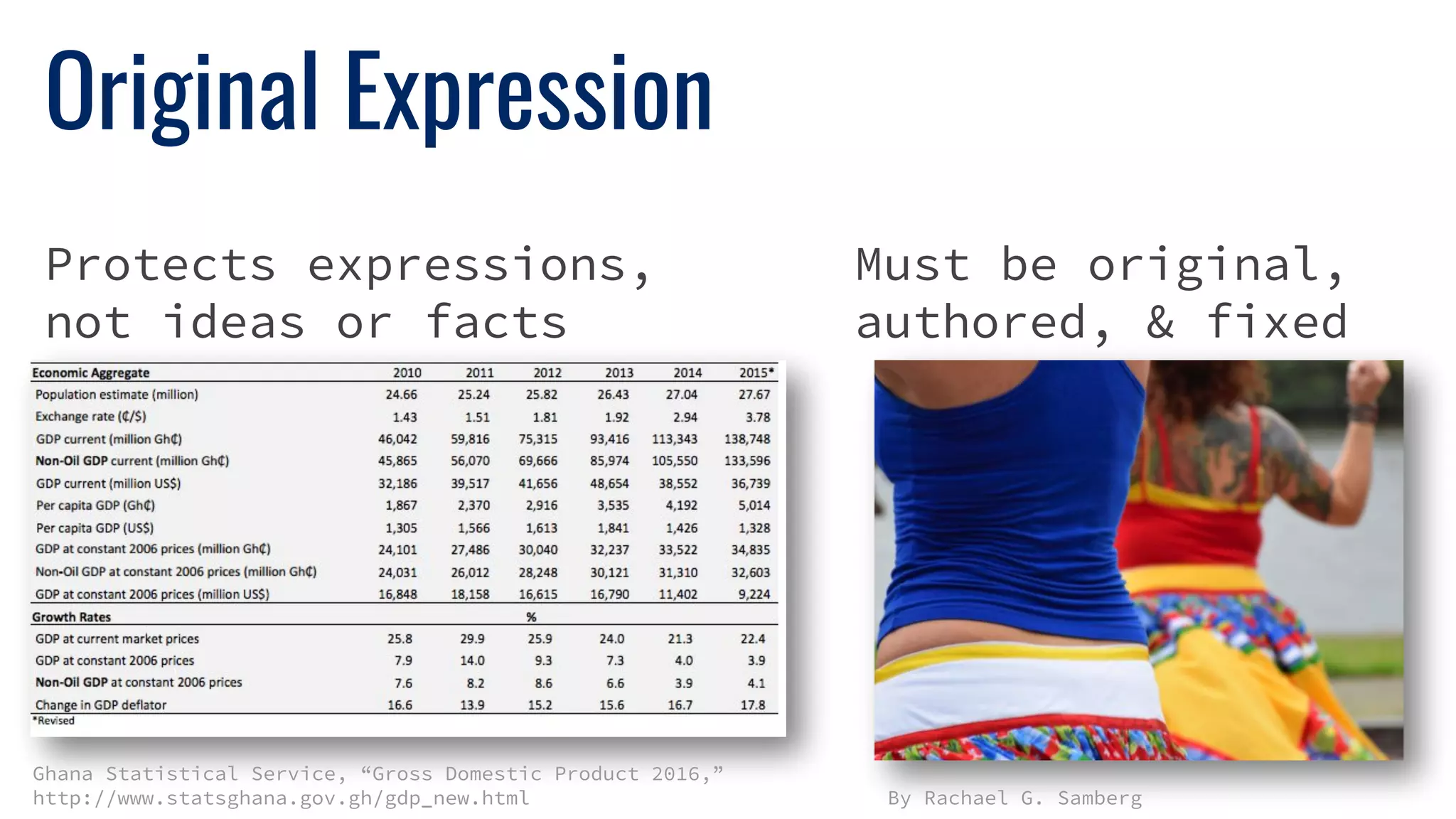
Original Expression
Protects expressions,
not ideas or facts
Must be original,
authored, & fixed
Ghana Statistical Service, “Gross Domestic Product 2016,”
http://www.statsghana.gov.gh/gdp_new.html By Rachael G. Samberg
Public Domain
CDC reportMartin Droeshout [Public domain]
Within “protected” period,
author’s permission needed
to reproduce, display,
perform, etc., but there are
exceptions
Fair Use
17 U.S.C.§ 107
“The fair use of a
copyrighted work…for
purposes such as
criticism, comment,
news reporting,
teaching…, scholarship,
or research, is not an
infringement of
copyright.”
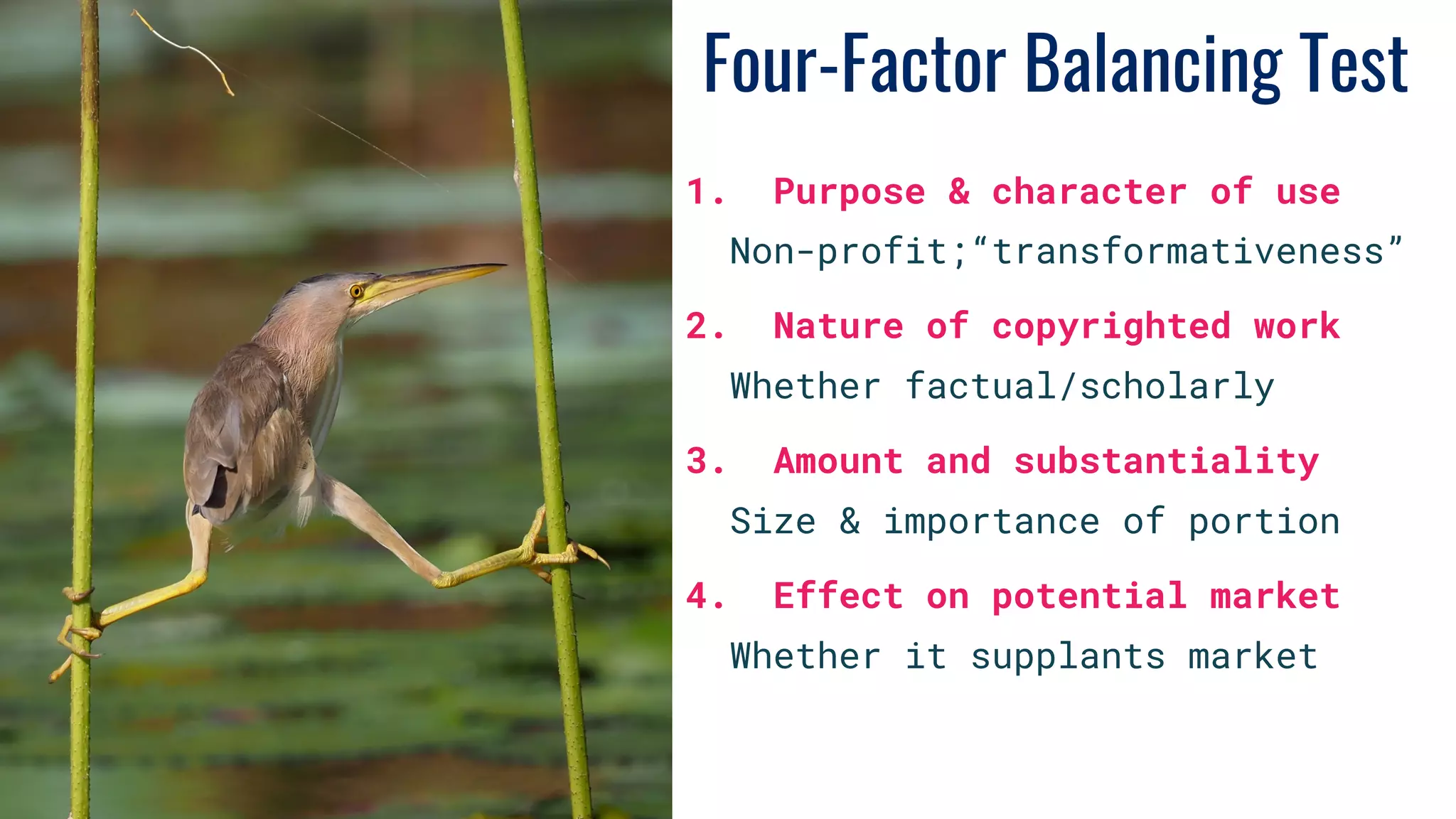
Four-Factor Balancing Test
1. Purpose & character of use
Non-profit;“transformativeness”
2. Nature of copyrighted work
Whether factual/scholarly
3. Amount and substantiality
Size & importance of portion
4. Effect on potential market
Whether it supplants market
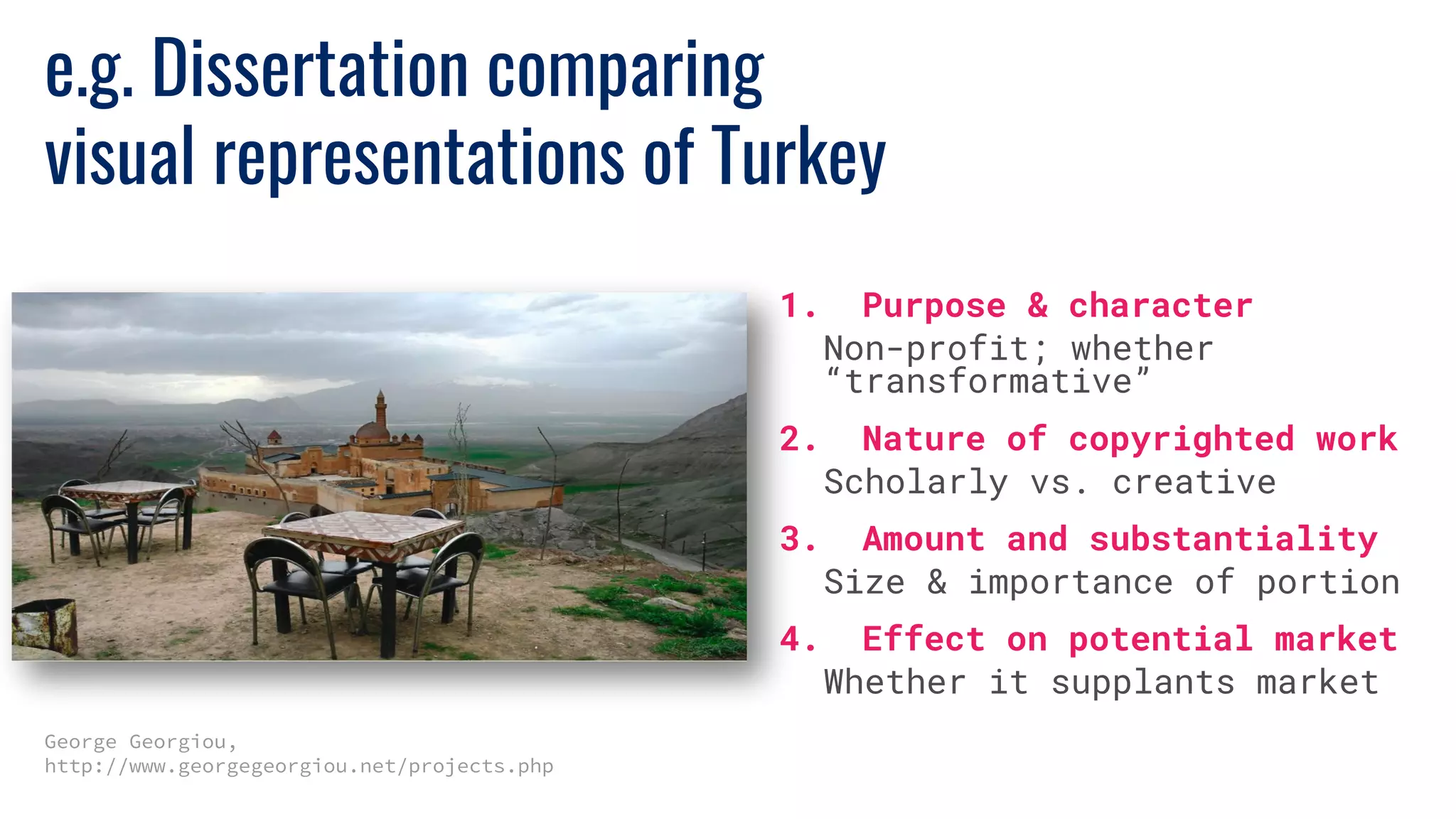
e.g. Dissertation comparing
visual representations of Turkey
George Georgiou,
http://www.georgegeorgiou.net/projects.php
1. Purpose & character
Non-profit; whether
“transformative”
2. Nature of copyrighted work
Scholarly vs. creative
3. Amount and substantiality
Size & importance of portion
4. Effect on potential market
Whether it supplants market
Is use fair?
● All four factors
● No bright line rule
● No 10% rule
● Okay to link to lawful
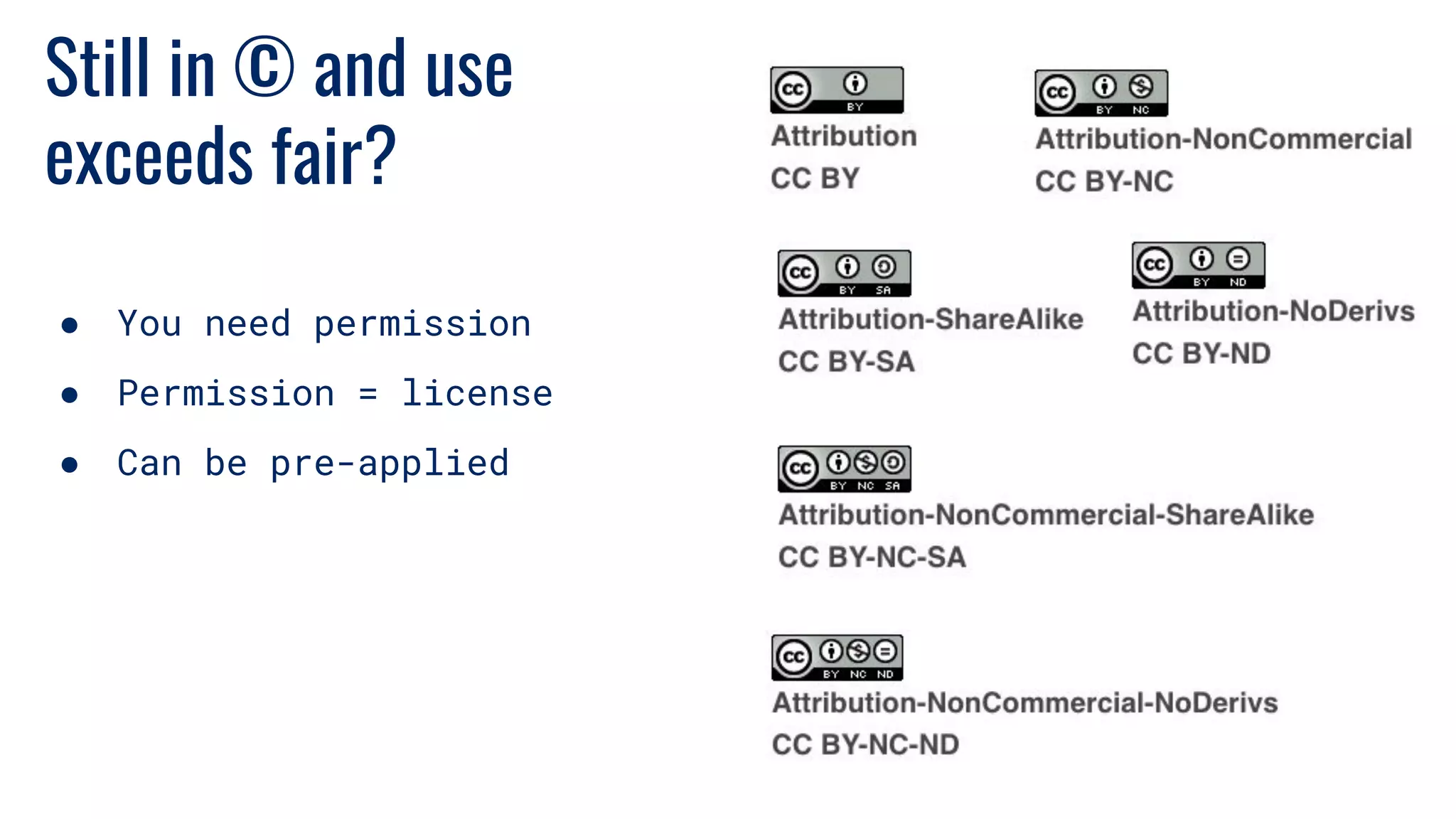
Still in © and use
exceeds fair?
● You need permission
● Permission = license
● Can be pre-applied
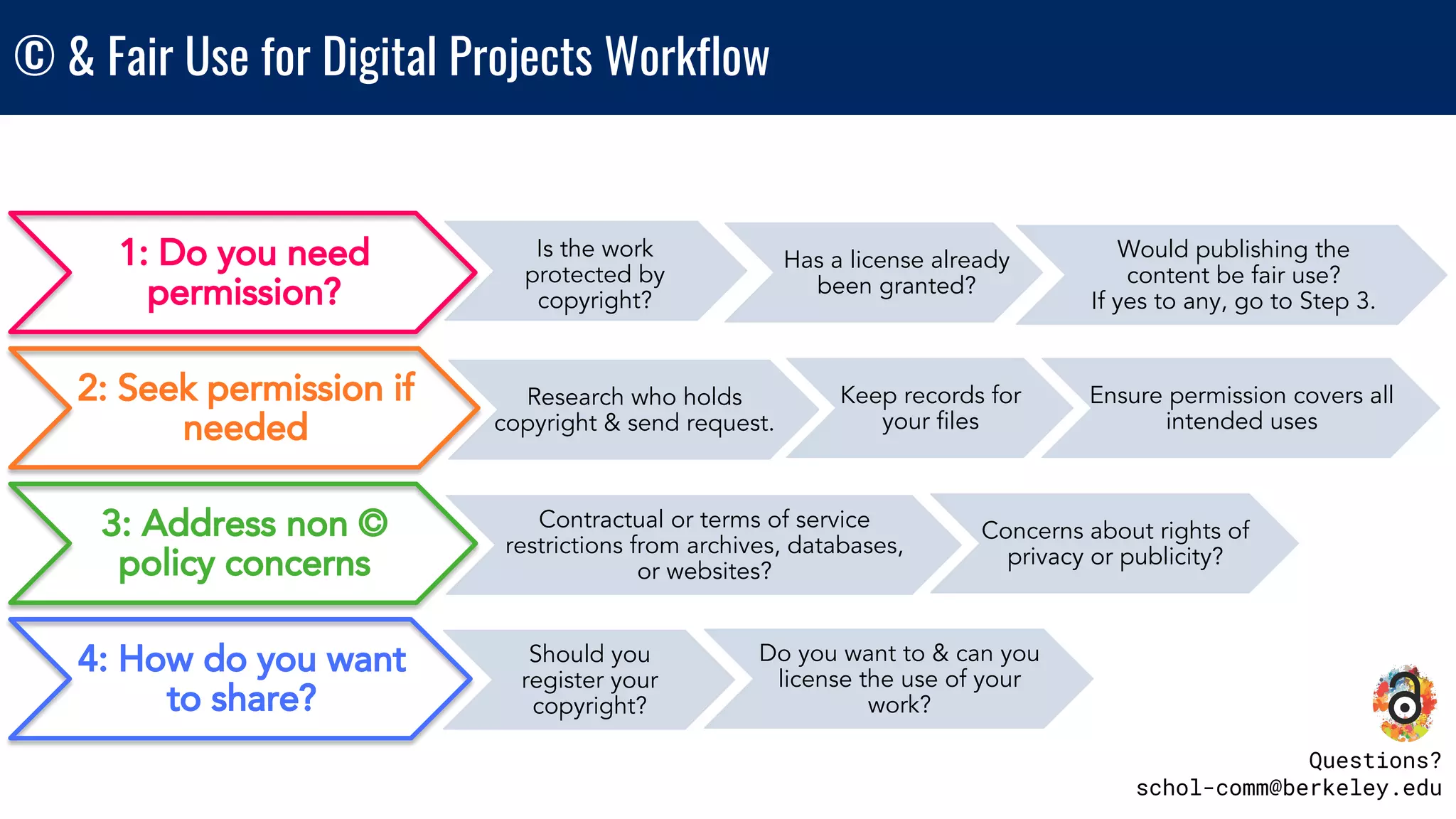
© & Fair Use for Digital Projects Workflow
1: Do you need
permission?
Has a license already
been granted?
Is the work
protected by
copyright?
Would publishing the
content be fair use?
If yes to any, go to Step 3.
2: Seek permission if
needed
Research who holds
copyright & send request.
Keep records for
your files
Ensure permission covers all
intended uses
3: Address non ©
policy concerns
Contractual or terms of service
restrictions from archives, databases,
or websites?
Concerns about rights of
privacy or publicity?
Should you
register your
copyright?
Do you want to & can you
license the use of your
work?
4: How do you want
to share?
Questions?
schol-comm@berkeley.edu
Step 1:
Do you need
permission?
Do you need permission?
1. Is it protected by copyright?
2. Is there a license?
3. Is your use fair use, or meet
another exception?
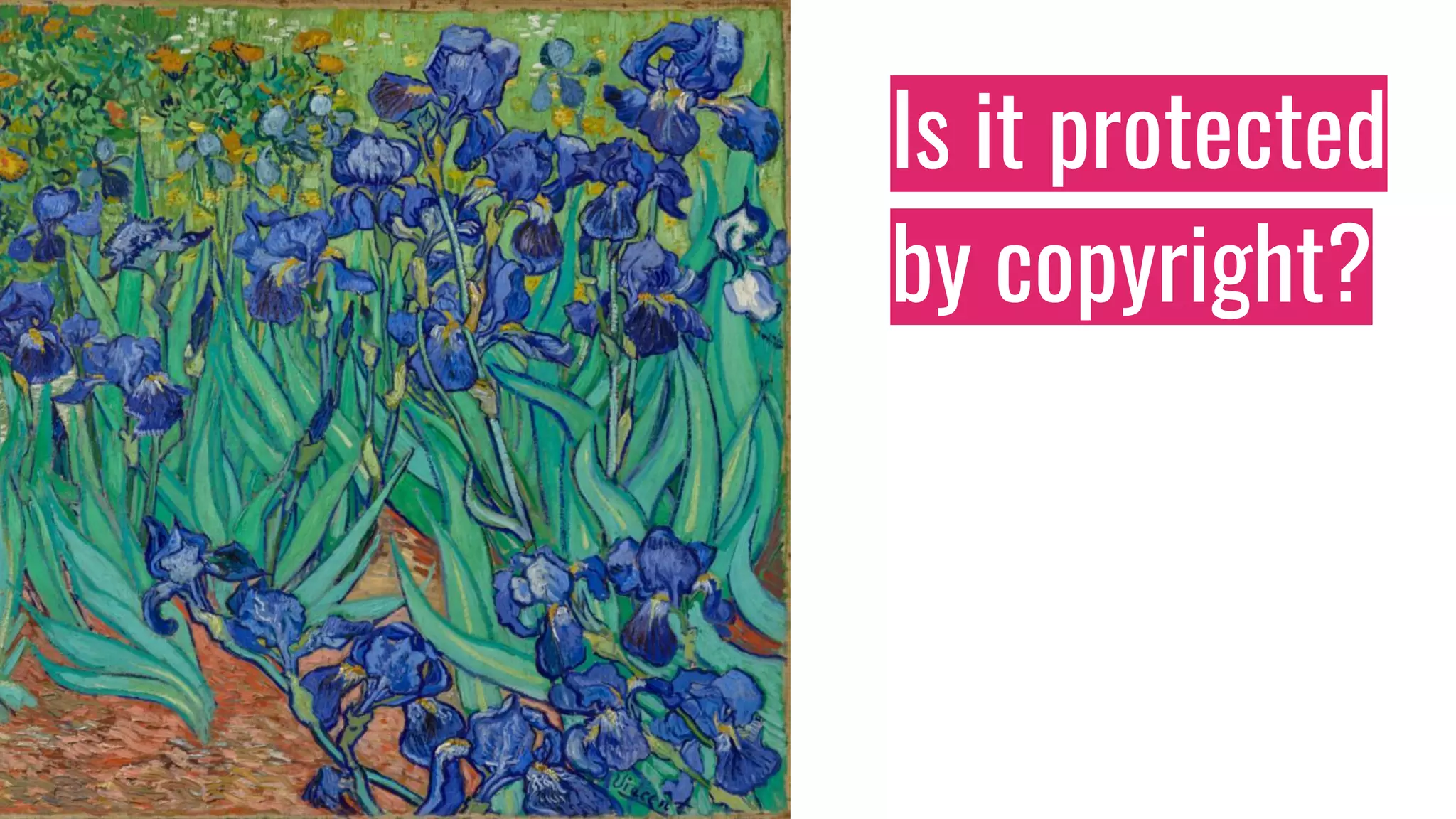
Is it protected
by copyright?
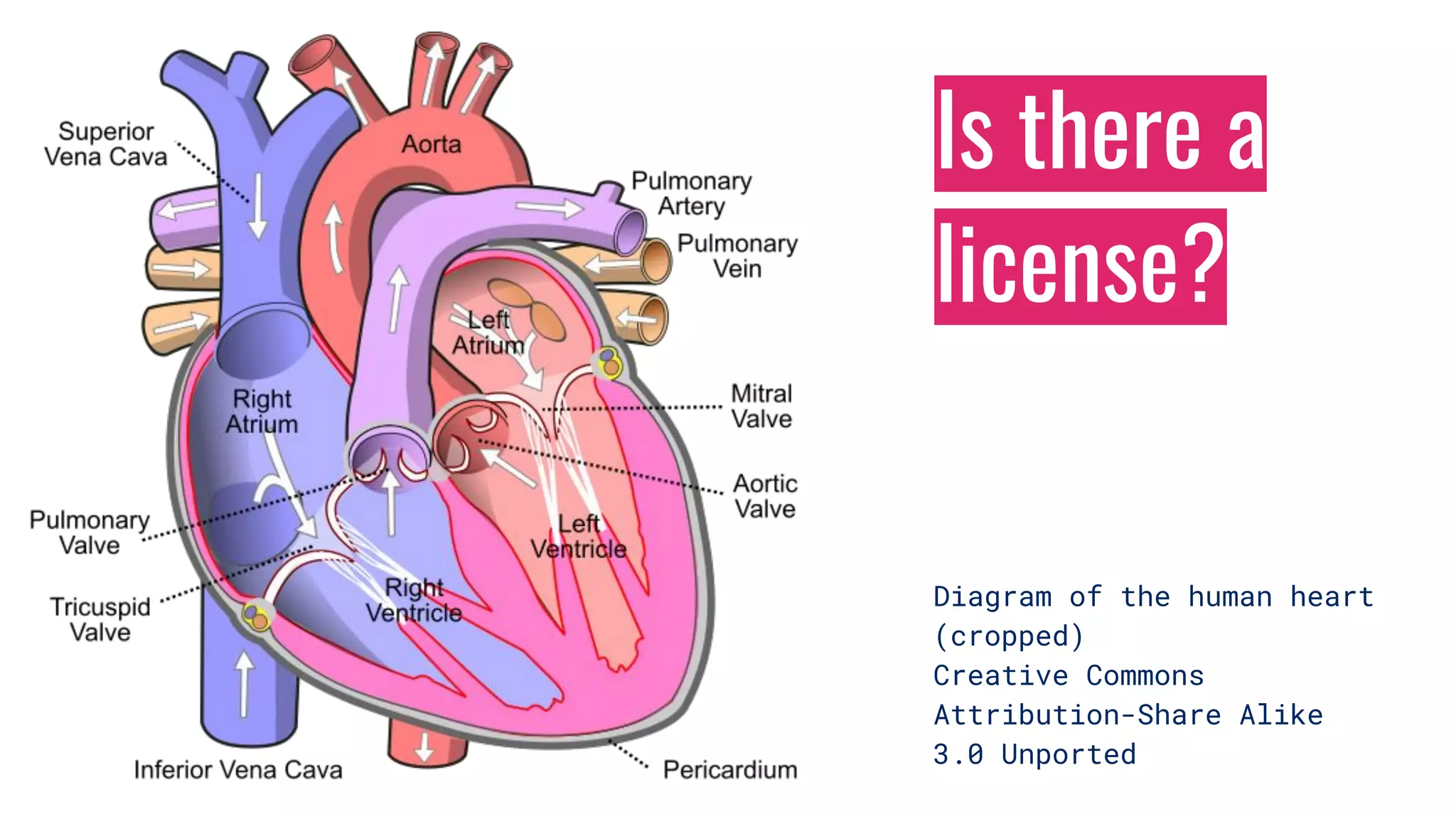
Is there a
license?
Diagram of the human heart
(cropped)
Creative Commons
Attribution-Share Alike
3.0 Unported
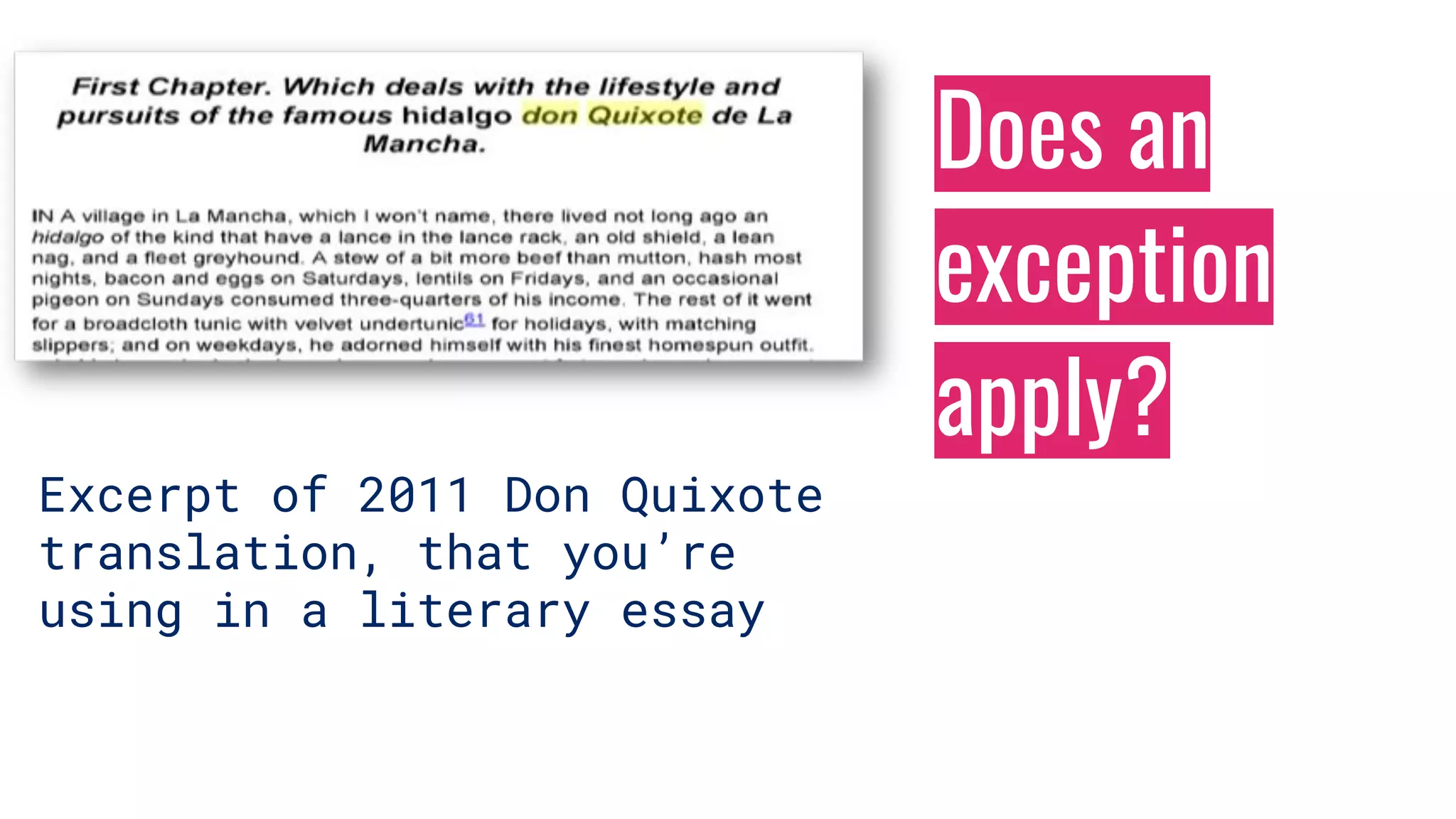
Does an
exception
apply?
Excerpt of 2011 Don Quixote
translation, that you’re
using in a literary essay
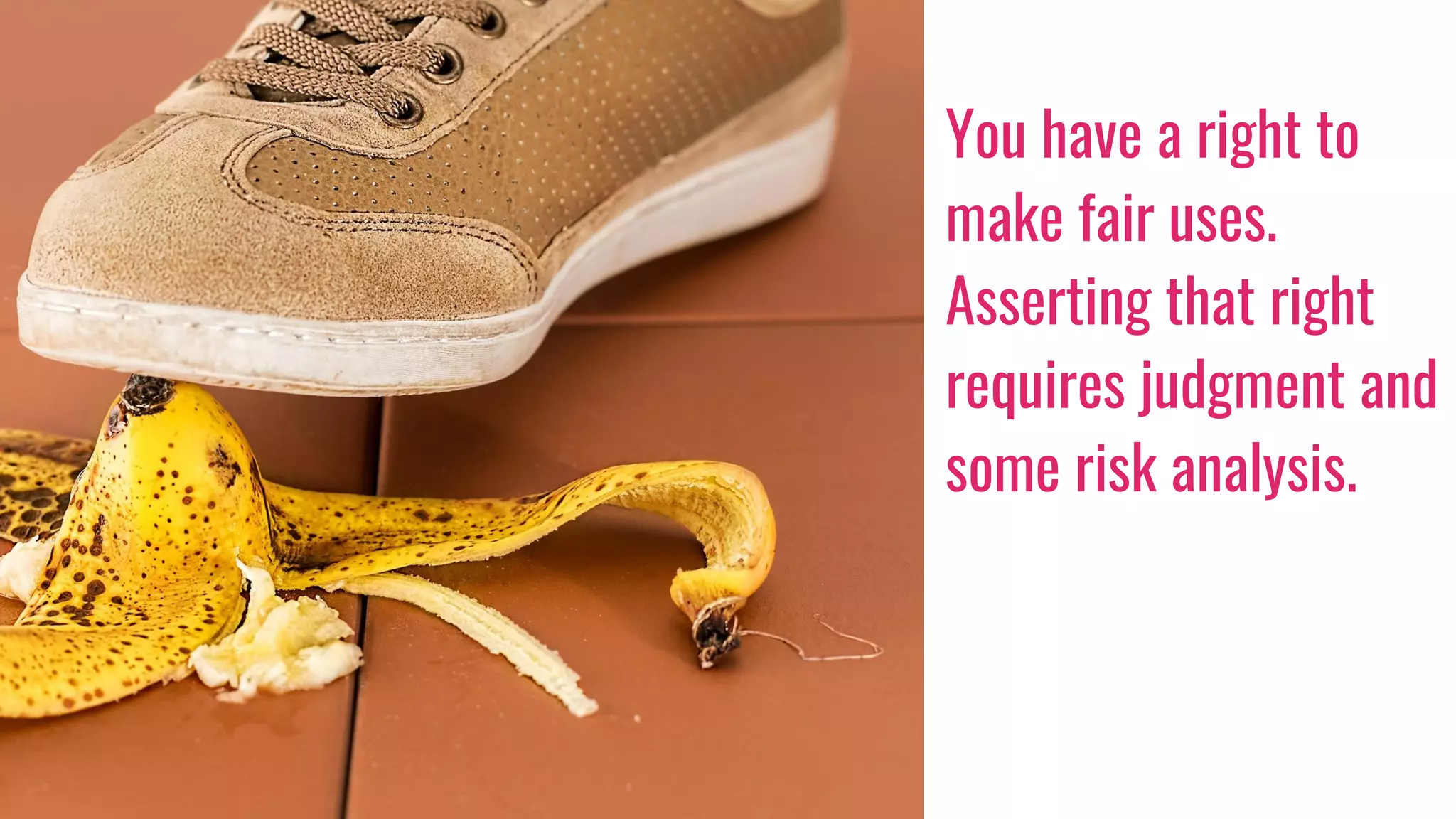
You have a right to
make fair uses.
Asserting that right
requires judgment and
some risk analysis.
Step 2:
Seek permission
if needed
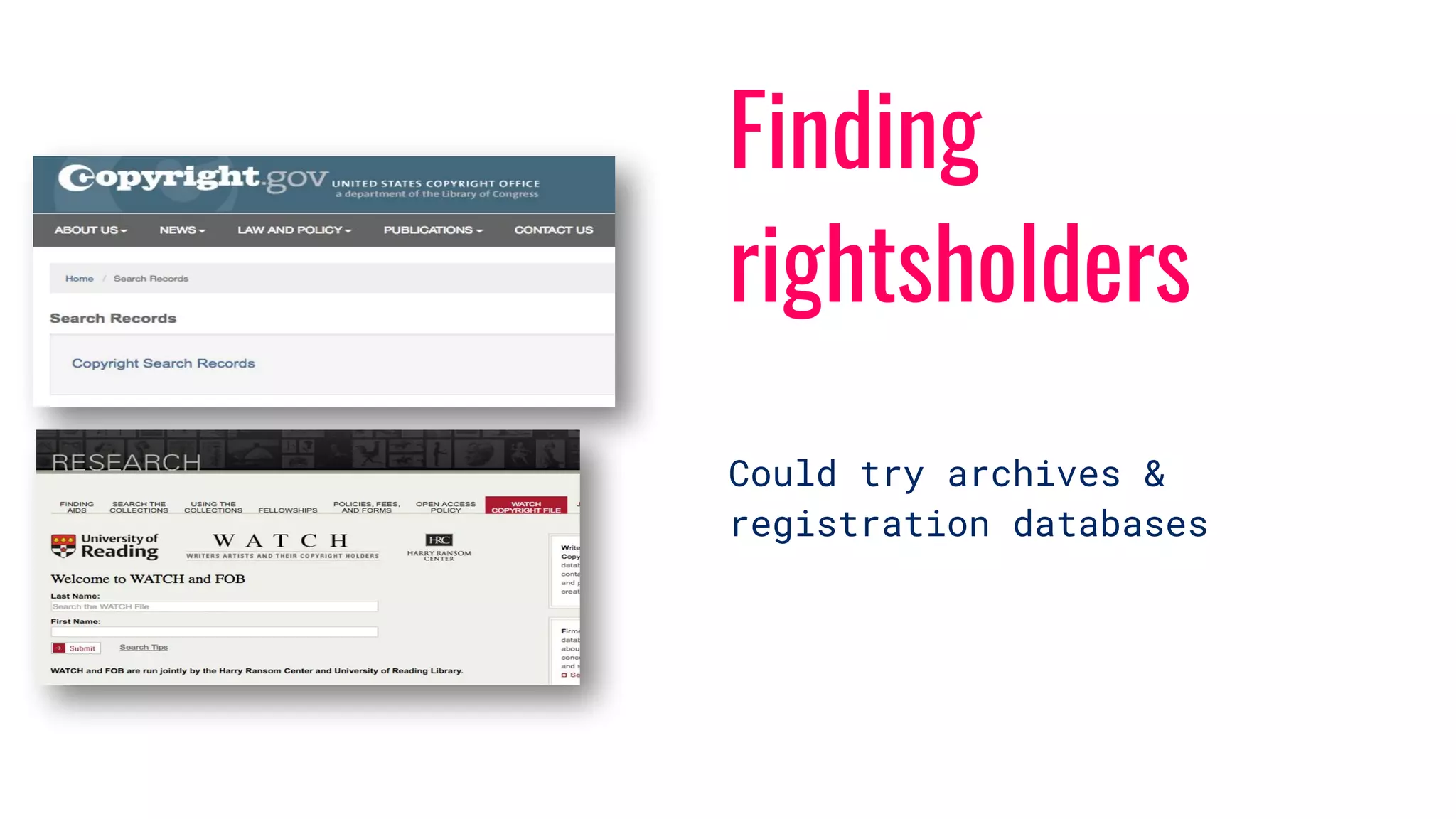
Finding
rightsholders
Could try archives &
registration databases
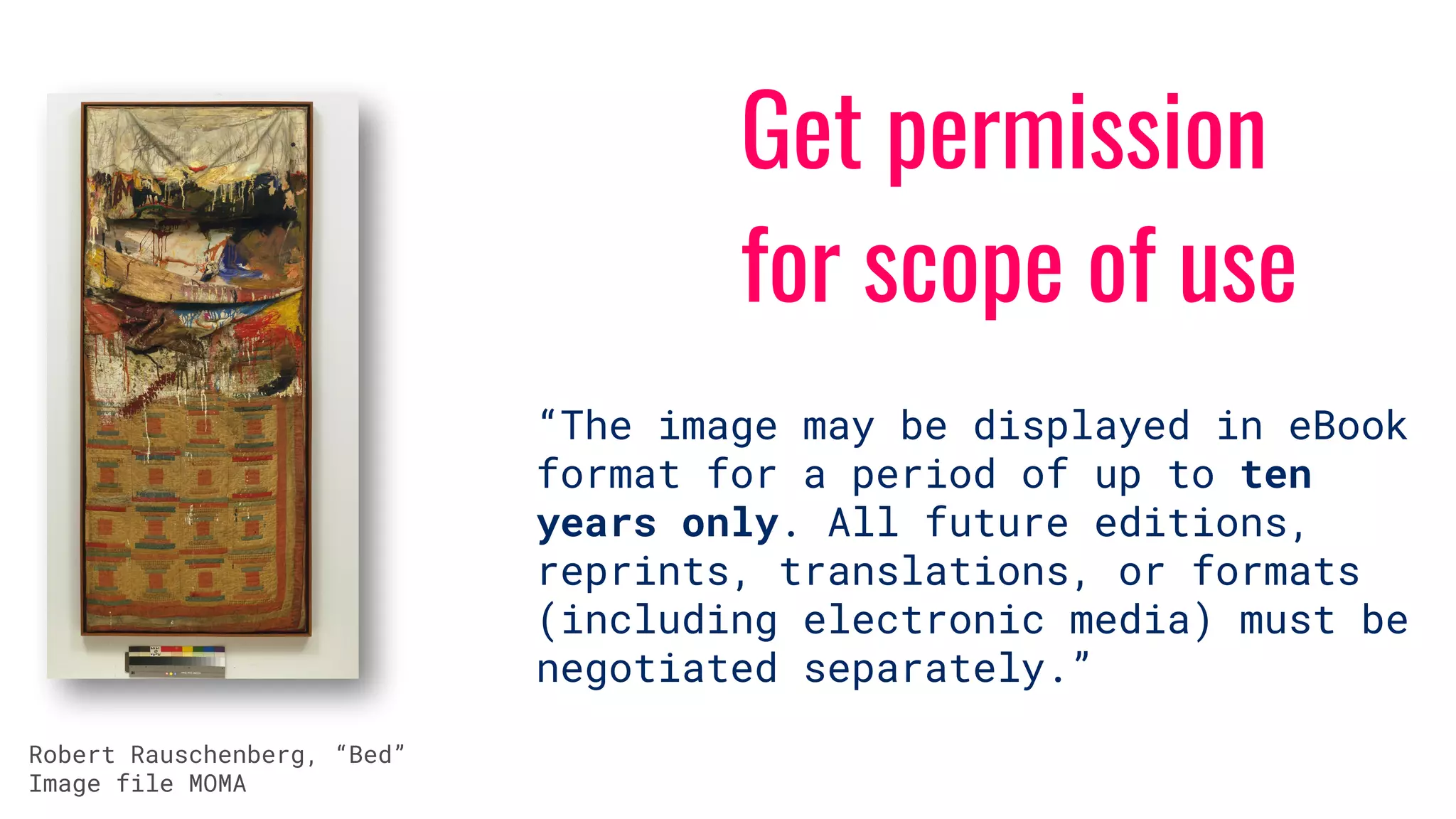
Get permission
for scope of use
Robert Rauschenberg, “Bed”
Image file MOMA
“The image may be displayed in eBook
format for a period of up to ten
years only. All future editions,
reprints, translations, or formats
(including electronic media) must be
negotiated separately.”
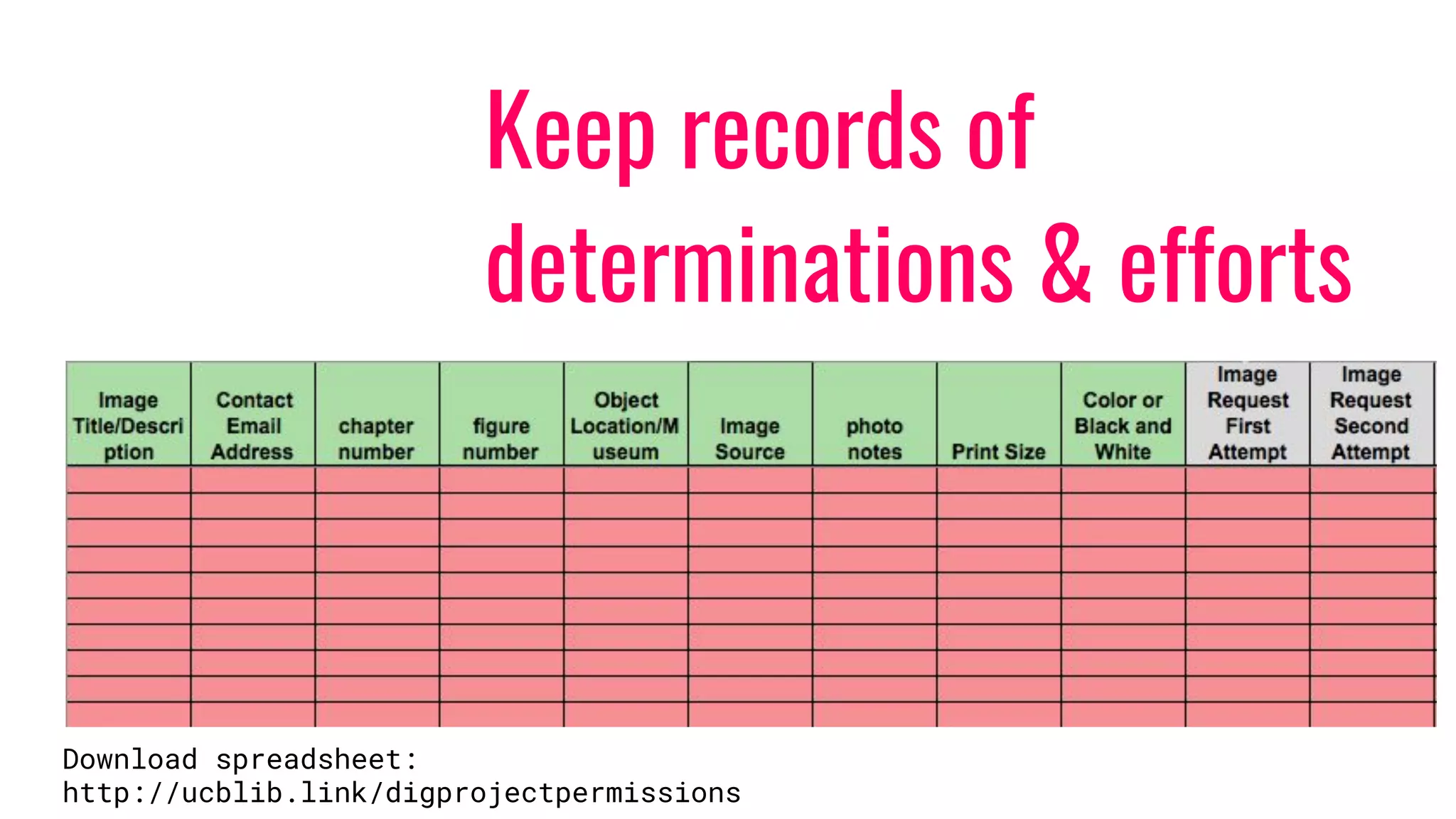
Keep records of
determinations & efforts
Download spreadsheet:
http://ucblib.link/digprojectpermissions
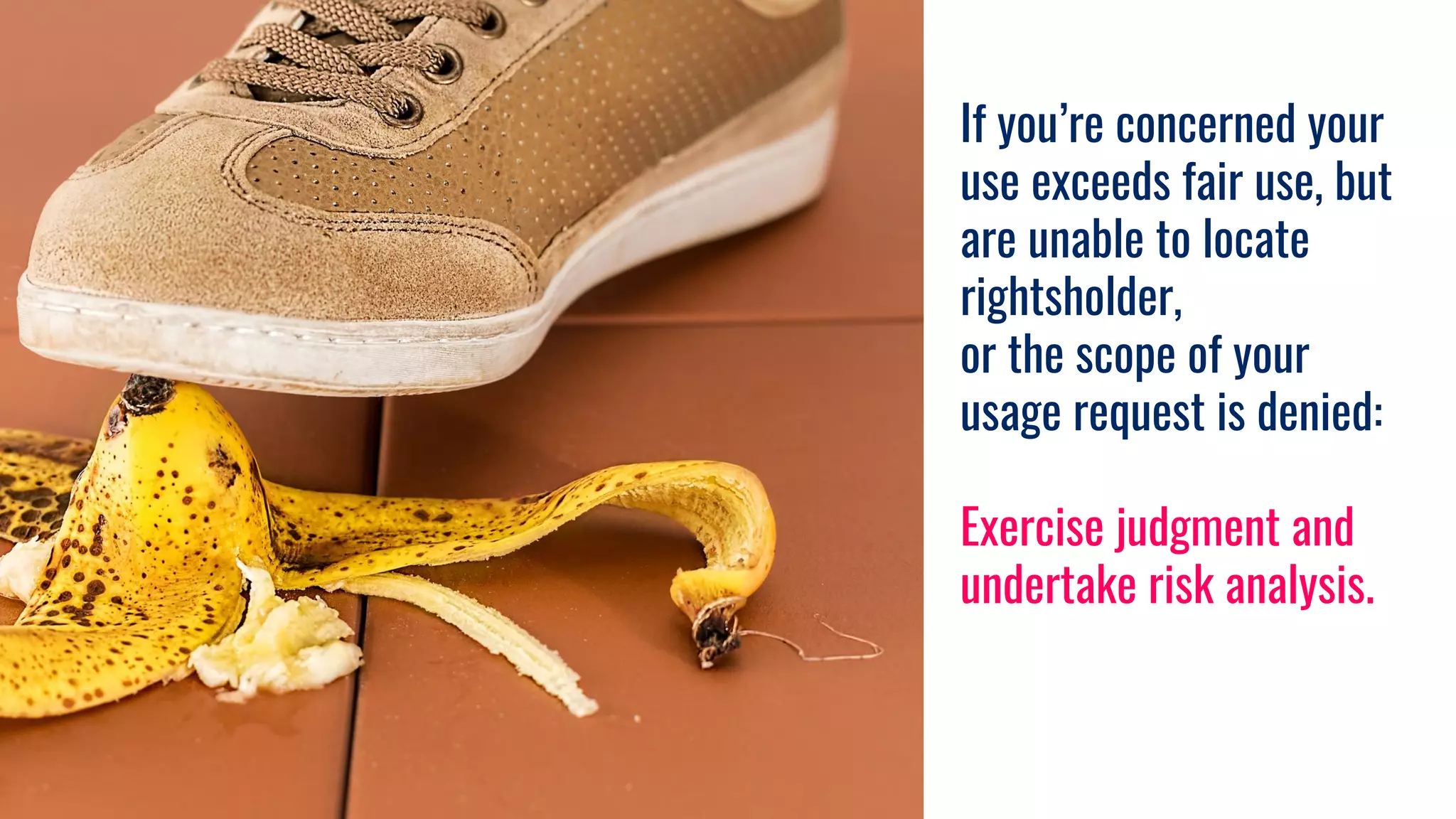
If you’re concerned your
use exceeds fair use, but
are unable to locate
rightsholder,
or the scope of your
usage request is denied:
Exercise judgment and
undertake risk analysis.
Step 3:
Address other
legal & policy
issues
Archives
Agreement
“I understand that permission
to publish, or otherwise
publicly use, materials . . .
must be [granted by library]
I understand further that the
University makes no
representation that it is the
owner of the copyright... and
that permission to publish must
also be obtained from the owner
of the copyright.”
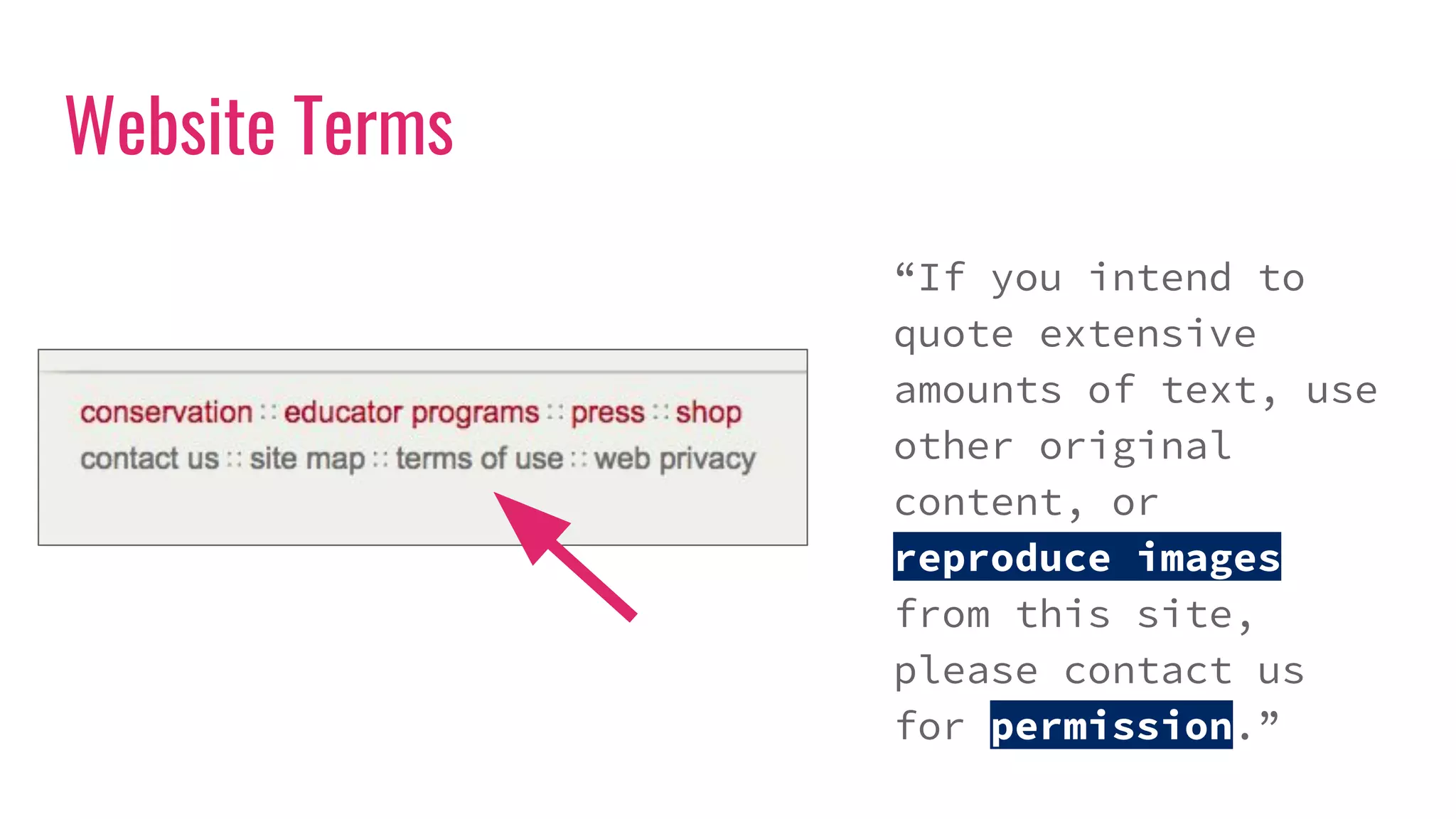
Website Terms
“If you intend to
quote extensive
amounts of text, use
other original
content, or
reproduce images
from this site,
please contact us
for permission.”
Database Agreements
Challenges:
- Terms
- Visibility
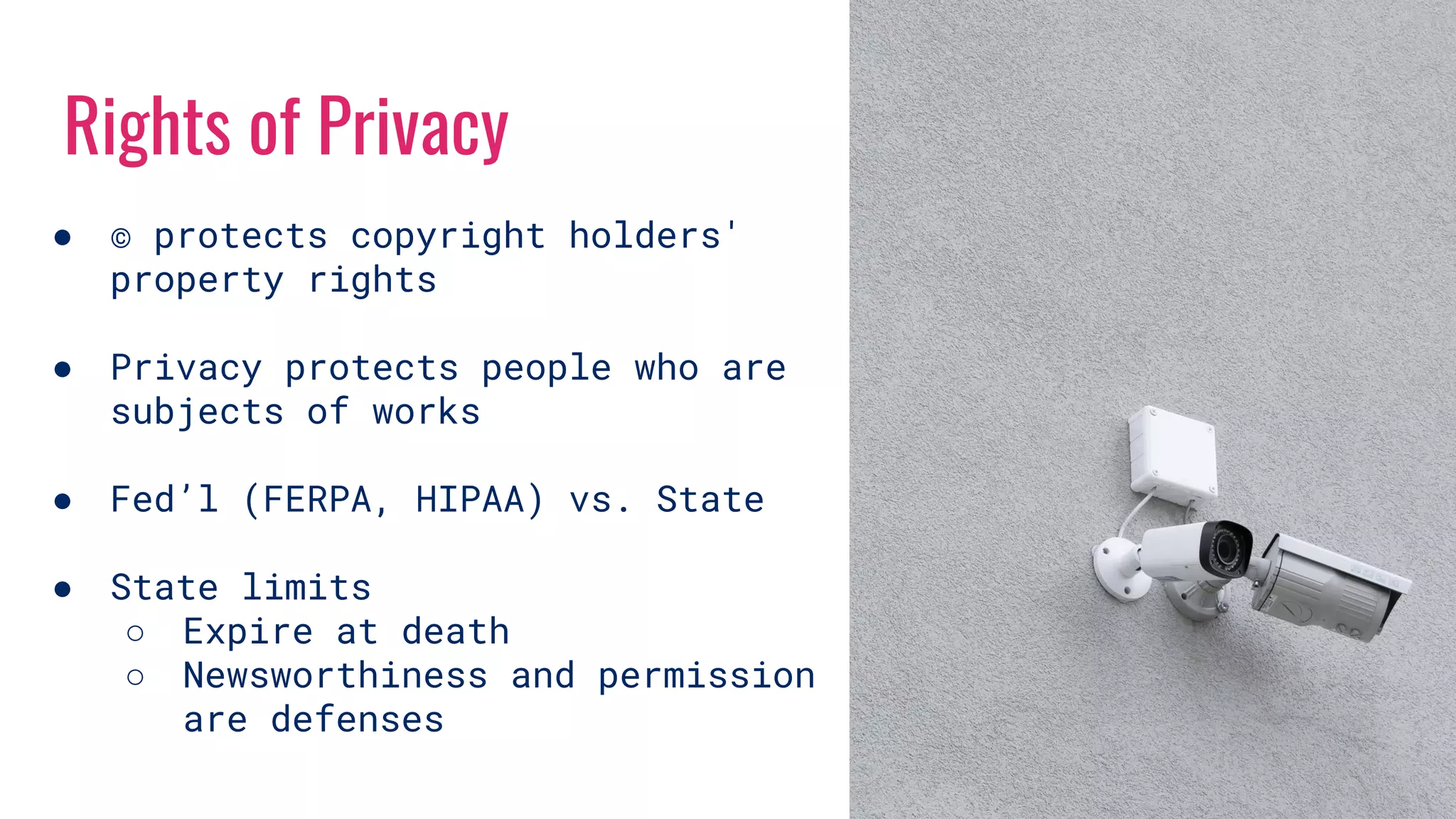
Rights of Privacy
● © protects copyright holders'
property rights
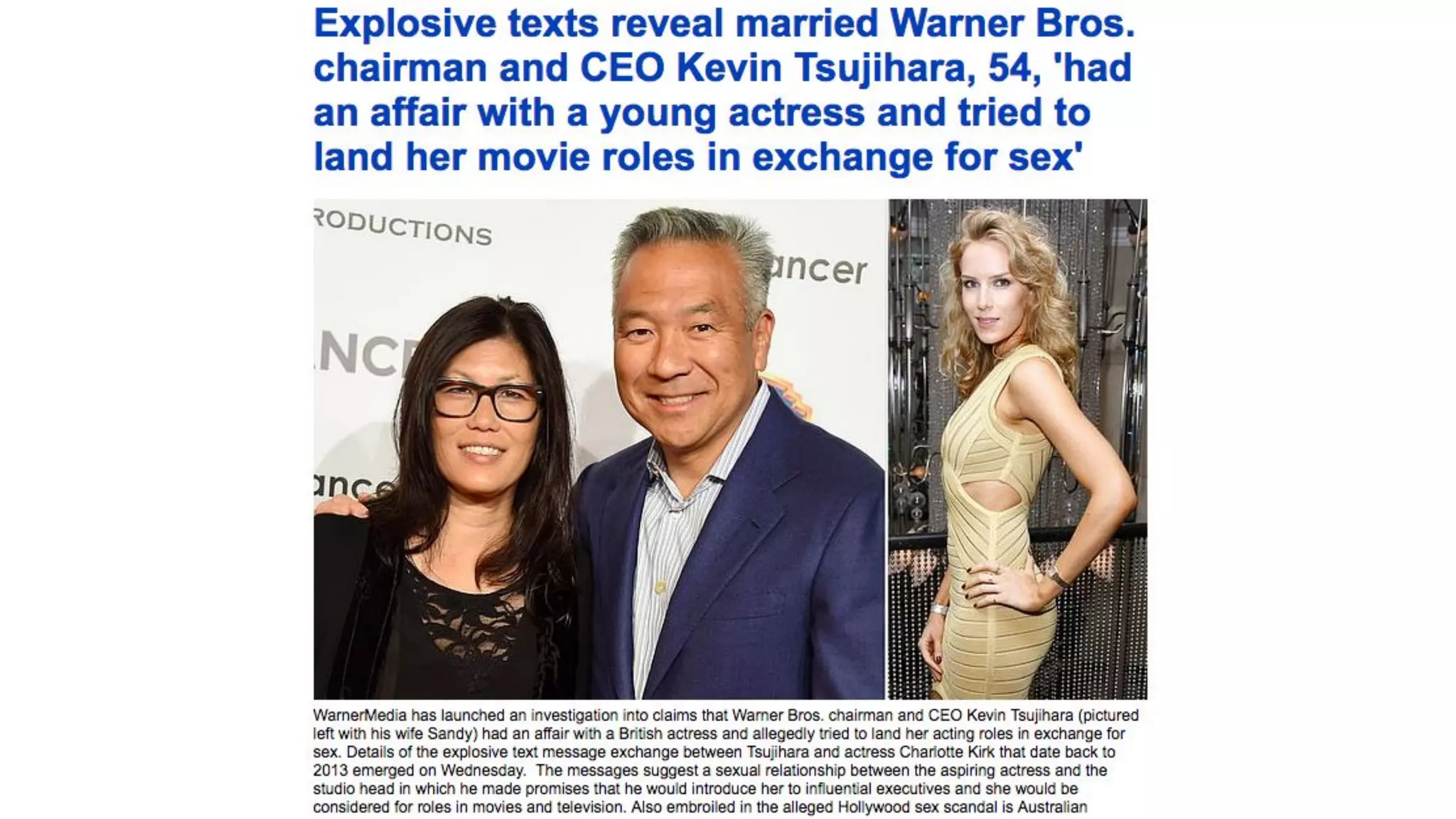
● Privacy protects people who are
subjects of works
● Fed’l (FERPA, HIPAA) vs. State
● State limits
○ Expire at death
○ Newsworthiness and permission
are defenses
Rights of Publicity
● Right to control commercial
use of identity
● Survive death
● Usually applicable only if
commercial use
Step 4:
Consider your
rights as author
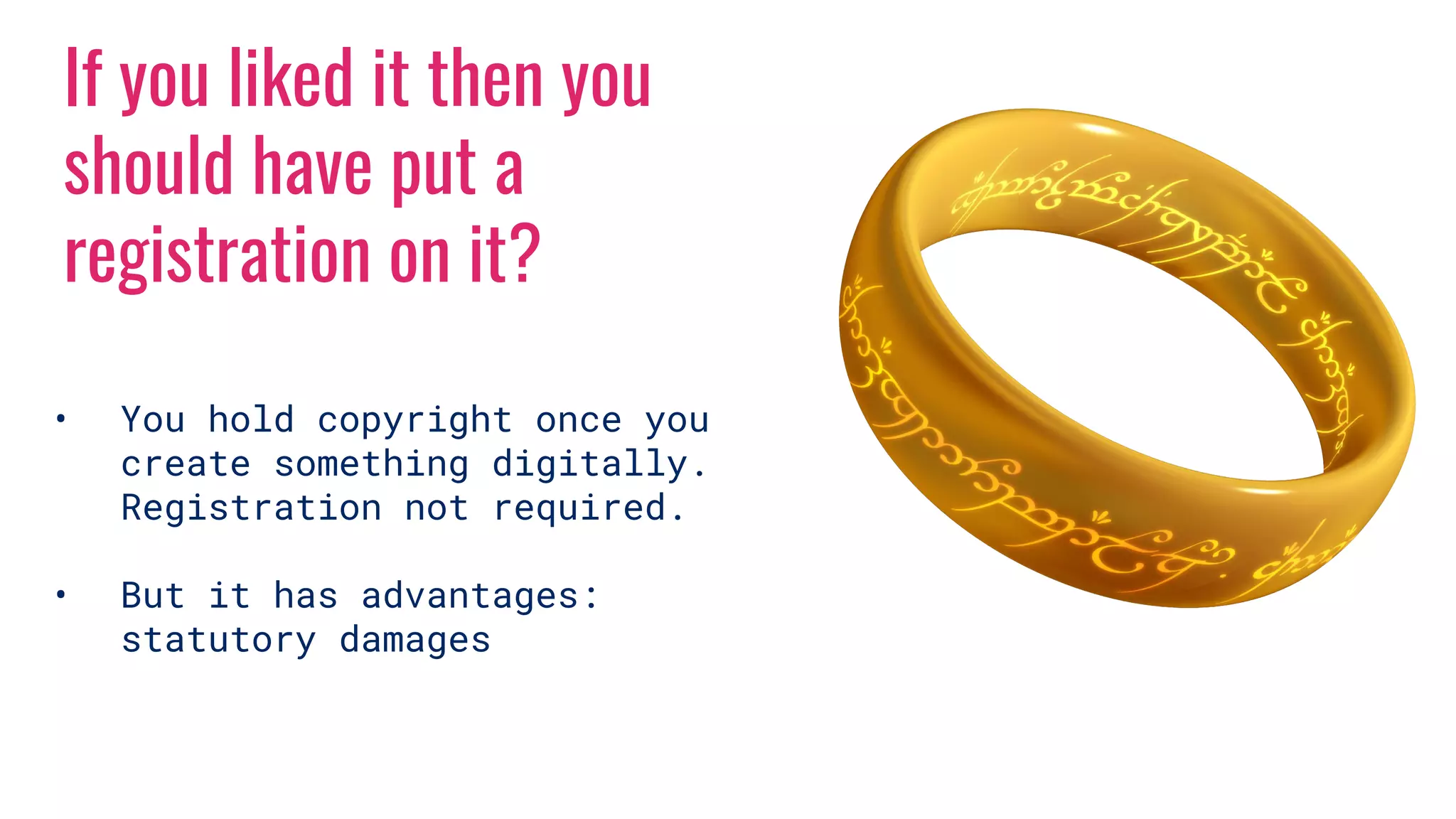
If you liked it then you
should have put a
registration on it?
• You hold copyright once you
create something digitally.
Registration not required.
• But it has advantages:
statutory damages
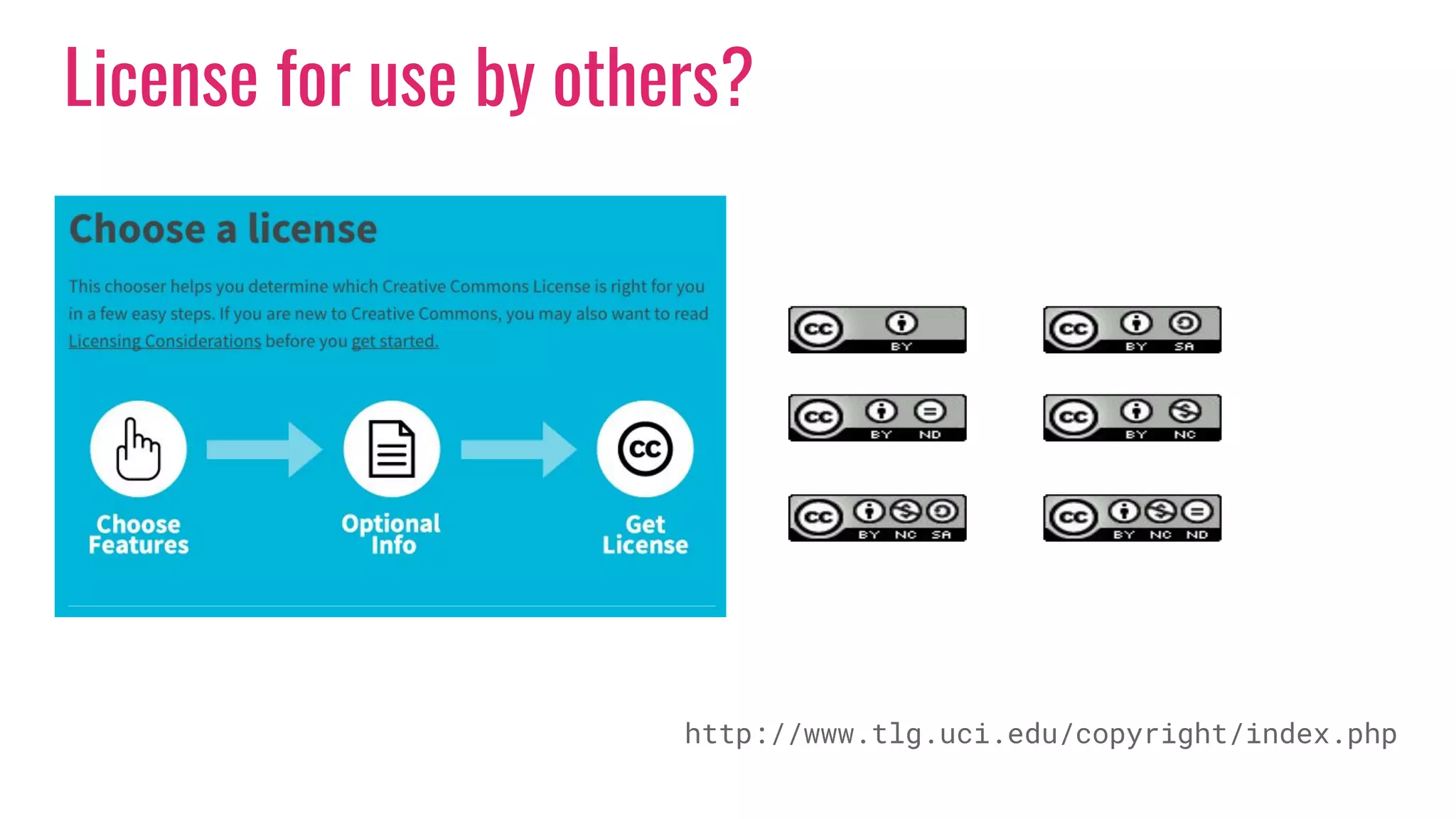
License for use by others?
http://www.tlg.uci.edu/copyright/index.php
Questions?
Office of Scholarly
Communication Services
schol-comm@berkeley.edu
lib.berkeley.edu/scholcomm
@UCB_scholcomm

Copyright & Fair Use for Digital Projects

  • 1.
    Copyright & Fair Usein Digital Projects Office of Scholarly Communication Services Rachael Samberg Mar. 7, 2019
  • 2.
  • 3.
    Using other people’s content? Solution toBurgers’ Equation Multi-heterocyclic system https://pubs.acs.org/doi/10.1021/acs.joc.7b02978https://commons.wikimedia.org/wiki/File%3AB urgersfig.png
  • 4.
    Using other people’s content? Ho attraversatotutta la città. Poi ho salita un'erta, popolosa in principio, in là deserta, chiusa da un muricciolo: I traversed the whole city. Then climbed a hill crowded at first, in the end deserted, closed off by a little wall: Trieste, Umberto Saba, 1910 Trieste, trans. A.S. Kline, 2012
  • 5.
    Website or database terms ofuse Translated by A. S. Kline © 2012 All Rights Reserved   This work may be freely reproduced, stored, and transmitted, electronically or otherwise, for any non-commercial purpose. http://poetsofmodernity.xyz/POMBR/Italian/FiveItalianPoets.htm#anchor_Toc326225674
  • 6.
    But, can’t Ijust cite the source? Attribution Permission
  • 7.
    You’re an author. Youhave decisions to make.
  • 8.
    What is copyright? Exclusiverights to make certain uses of original expression for limited period of time
  • 9.
  • 10.
    Limited period oftime Varies, but at least author’s life + 70 years…
  • 11.
  • 12.
    Original Expression Protects expressions, notideas or facts Must be original, authored, & fixed Ghana Statistical Service, “Gross Domestic Product 2016,” http://www.statsghana.gov.gh/gdp_new.html By Rachael G. Samberg
  • 13.
    Public Domain CDC reportMartinDroeshout [Public domain]
  • 14.
    Within “protected” period, author’spermission needed to reproduce, display, perform, etc., but there are exceptions
  • 15.
    Fair Use 17 U.S.C.§107 “The fair use of a copyrighted work…for purposes such as criticism, comment, news reporting, teaching…, scholarship, or research, is not an infringement of copyright.”
  • 16.
    Four-Factor Balancing Test 1.Purpose & character of use Non-profit;“transformativeness” 2. Nature of copyrighted work Whether factual/scholarly 3. Amount and substantiality Size & importance of portion 4. Effect on potential market Whether it supplants market
  • 17.
    e.g. Dissertation comparing visualrepresentations of Turkey George Georgiou, http://www.georgegeorgiou.net/projects.php 1. Purpose & character Non-profit; whether “transformative” 2. Nature of copyrighted work Scholarly vs. creative 3. Amount and substantiality Size & importance of portion 4. Effect on potential market Whether it supplants market
  • 18.
    Is use fair? ●All four factors ● No bright line rule ● No 10% rule ● Okay to link to lawful
  • 19.
    Still in ©and use exceeds fair? ● You need permission ● Permission = license ● Can be pre-applied
  • 20.
    © & FairUse for Digital Projects Workflow 1: Do you need permission? Has a license already been granted? Is the work protected by copyright? Would publishing the content be fair use? If yes to any, go to Step 3. 2: Seek permission if needed Research who holds copyright & send request. Keep records for your files Ensure permission covers all intended uses 3: Address non © policy concerns Contractual or terms of service restrictions from archives, databases, or websites? Concerns about rights of privacy or publicity? Should you register your copyright? Do you want to & can you license the use of your work? 4: How do you want to share? Questions? schol-comm@berkeley.edu
  • 21.
    Step 1: Do youneed permission?
  • 22.
    Do you needpermission? 1. Is it protected by copyright? 2. Is there a license? 3. Is your use fair use, or meet another exception?
  • 23.
  • 24.
    Is there a license? Diagramof the human heart (cropped) Creative Commons Attribution-Share Alike 3.0 Unported
  • 25.
    Does an exception apply? Excerpt of2011 Don Quixote translation, that you’re using in a literary essay
  • 26.
    You have aright to make fair uses. Asserting that right requires judgment and some risk analysis.
  • 27.
  • 28.
  • 29.
    Get permission for scopeof use Robert Rauschenberg, “Bed” Image file MOMA “The image may be displayed in eBook format for a period of up to ten years only. All future editions, reprints, translations, or formats (including electronic media) must be negotiated separately.”
  • 30.
    Keep records of determinations& efforts Download spreadsheet: http://ucblib.link/digprojectpermissions
  • 31.
    If you’re concernedyour use exceeds fair use, but are unable to locate rightsholder, or the scope of your usage request is denied: Exercise judgment and undertake risk analysis.
  • 32.
  • 33.
    Archives Agreement “I understand thatpermission to publish, or otherwise publicly use, materials . . . must be [granted by library] I understand further that the University makes no representation that it is the owner of the copyright... and that permission to publish must also be obtained from the owner of the copyright.”
  • 34.
    Website Terms “If youintend to quote extensive amounts of text, use other original content, or reproduce images from this site, please contact us for permission.”
  • 35.
  • 36.
    Rights of Privacy ●© protects copyright holders' property rights ● Privacy protects people who are subjects of works ● Fed’l (FERPA, HIPAA) vs. State ● State limits ○ Expire at death ○ Newsworthiness and permission are defenses
  • 38.
    Rights of Publicity ●Right to control commercial use of identity ● Survive death ● Usually applicable only if commercial use
  • 39.
  • 40.
    If you likedit then you should have put a registration on it? • You hold copyright once you create something digitally. Registration not required. • But it has advantages: statutory damages
  • 41.
    License for useby others? http://www.tlg.uci.edu/copyright/index.php
  • 42.
    Questions? Office of Scholarly CommunicationServices schol-comm@berkeley.edu lib.berkeley.edu/scholcomm @UCB_scholcomm