Copyright & Fair Use for Digital Projects
Copyright &
Your Dissertation
Office of Scholarly
Communication Services
Berkeley Library
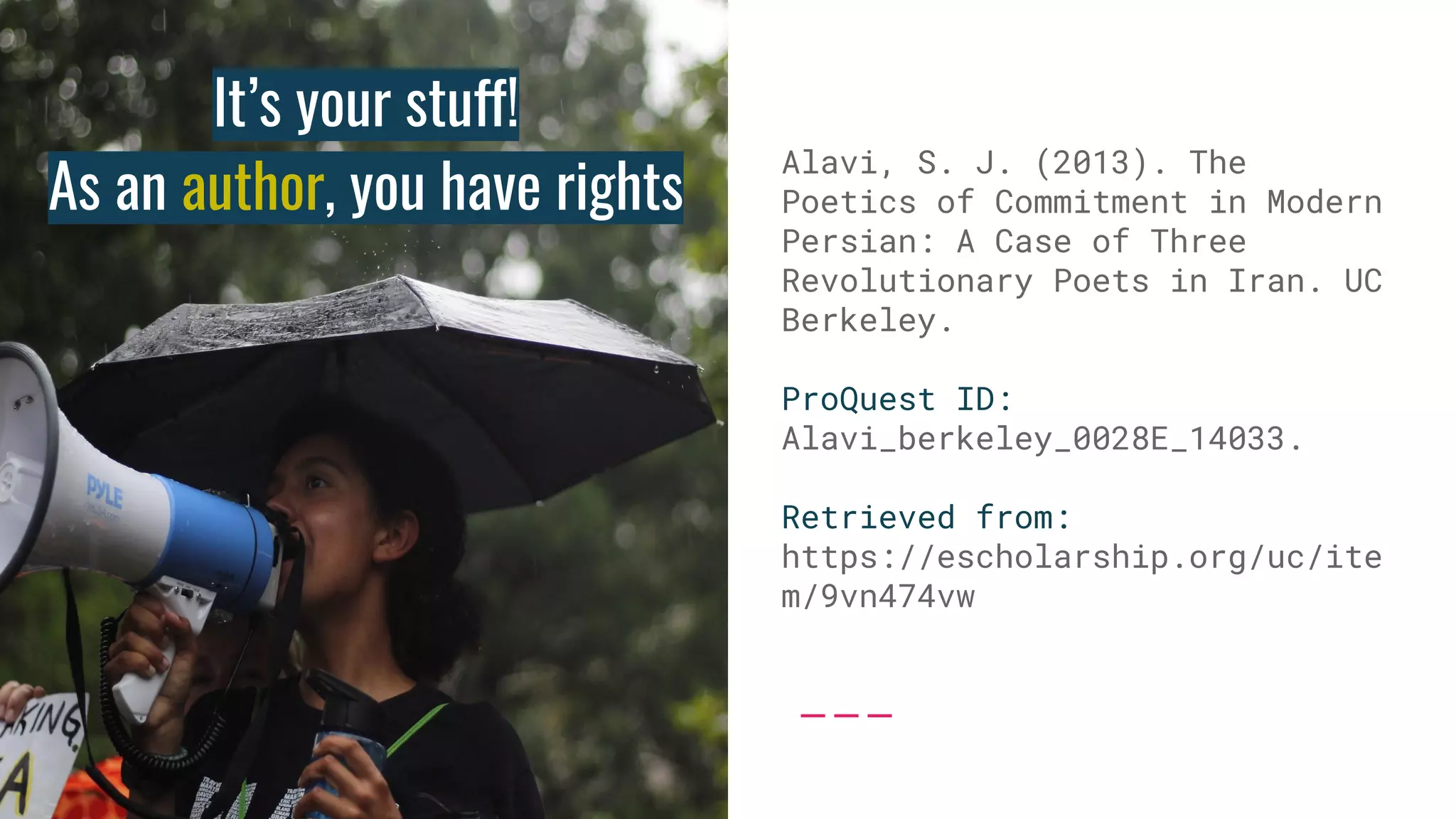
It’s your stuff!
As an author, you have rights
Alavi, S. J. (2013). The
Poetics of Commitment in Modern
Persian: A Case of Three
Revolutionary Poets in Iran. UC
Berkeley.
ProQuest ID:
Alavi_berkeley_0028E_14033.
Retrieved from:
https://escholarship.org/uc/ite
m/9vn474vw
We’ll help you
think about
other people’s
stuff
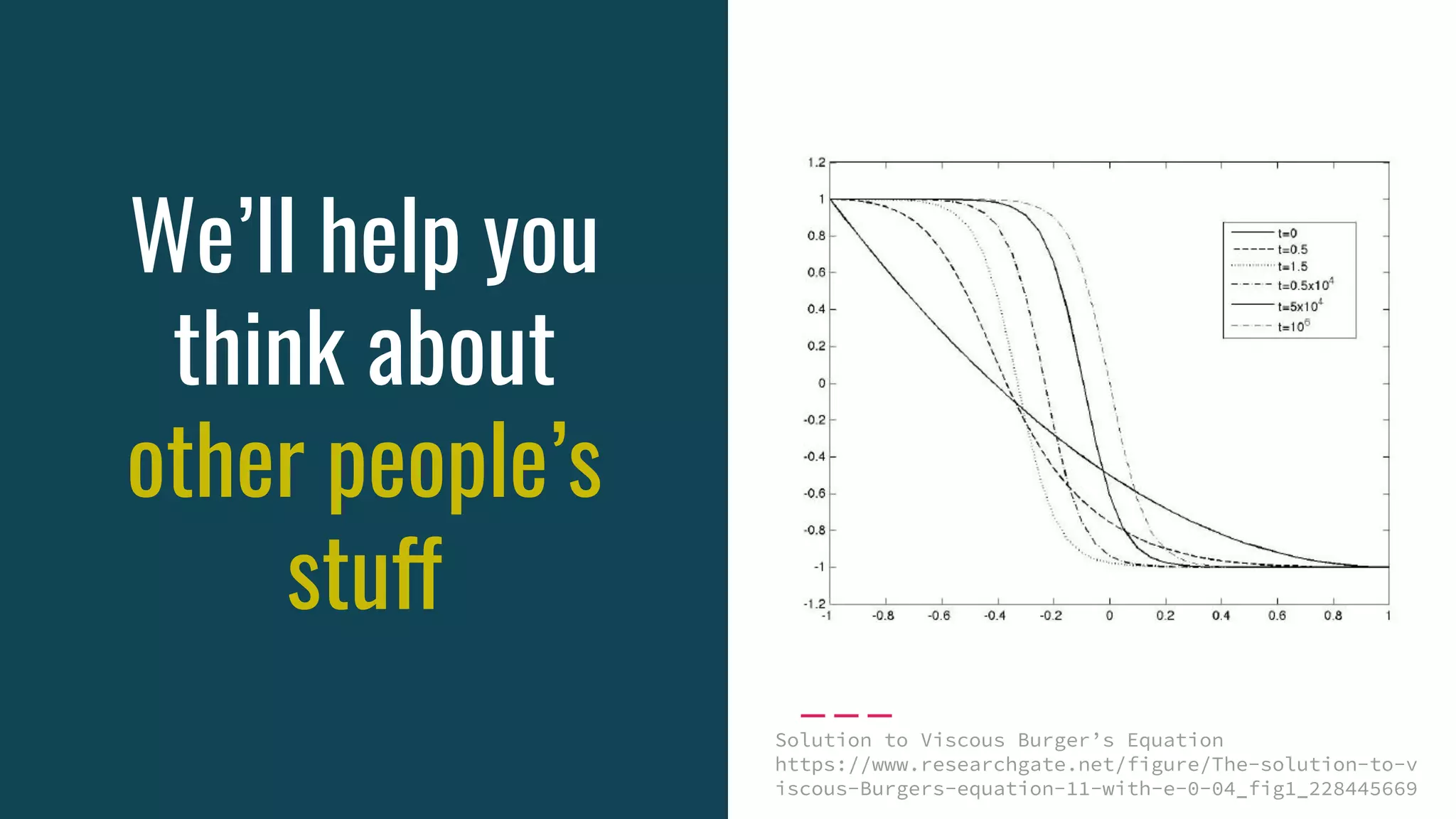
Solution to Viscous Burger’s Equation
https://www.researchgate.net/figure/The-solution-to-v
iscous-Burgers-equation-11-with-e-0-04_fig1_228445669
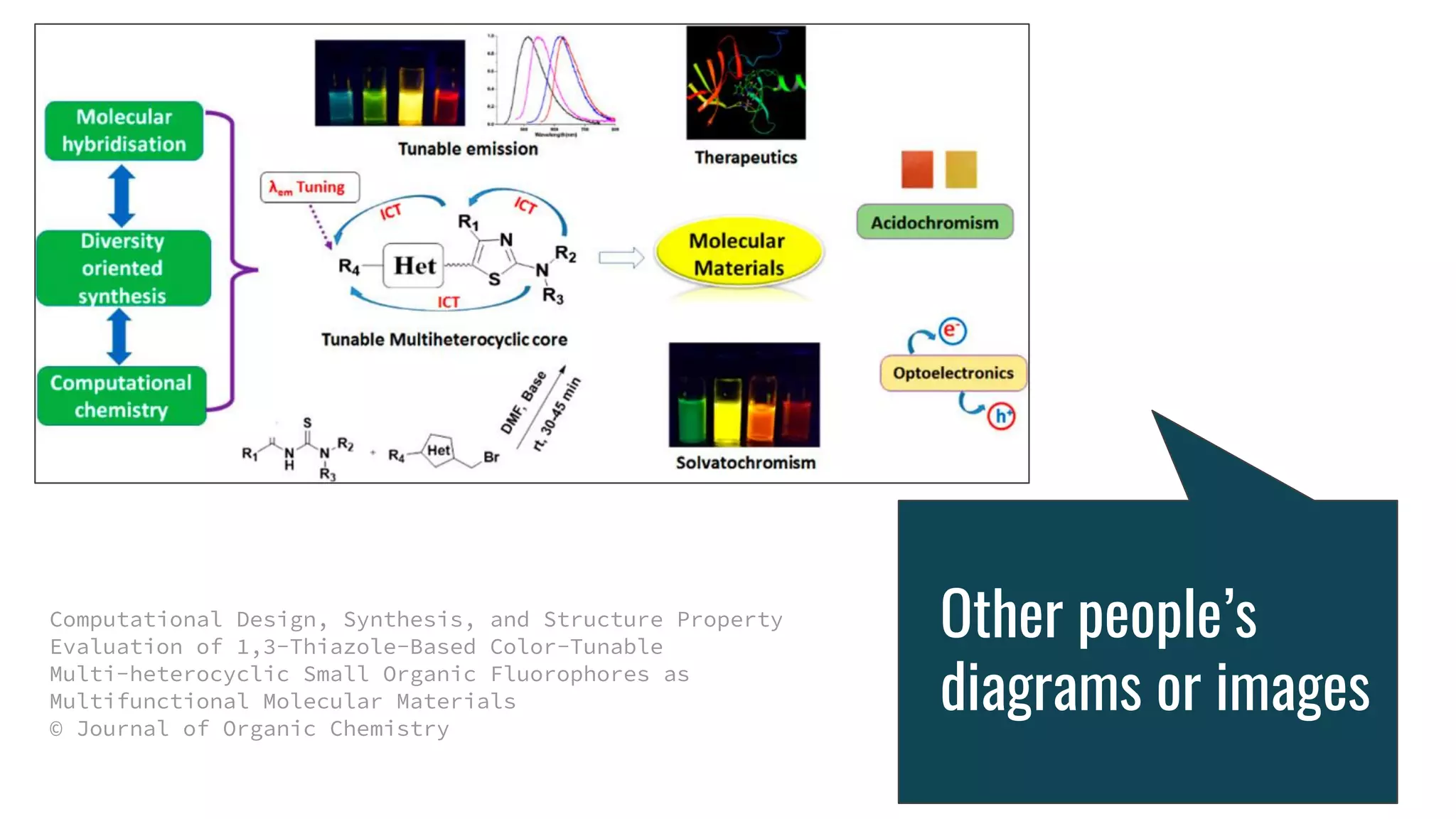
Computational Design, Synthesis, and Structure Property
Evaluation of 1,3-Thiazole-Based Color-Tunable
Multi-heterocyclic Small Organic Fluorophores as
Multifunctional Molecular Materials
© Journal of Organic Chemistry
Other people’s
diagrams or images
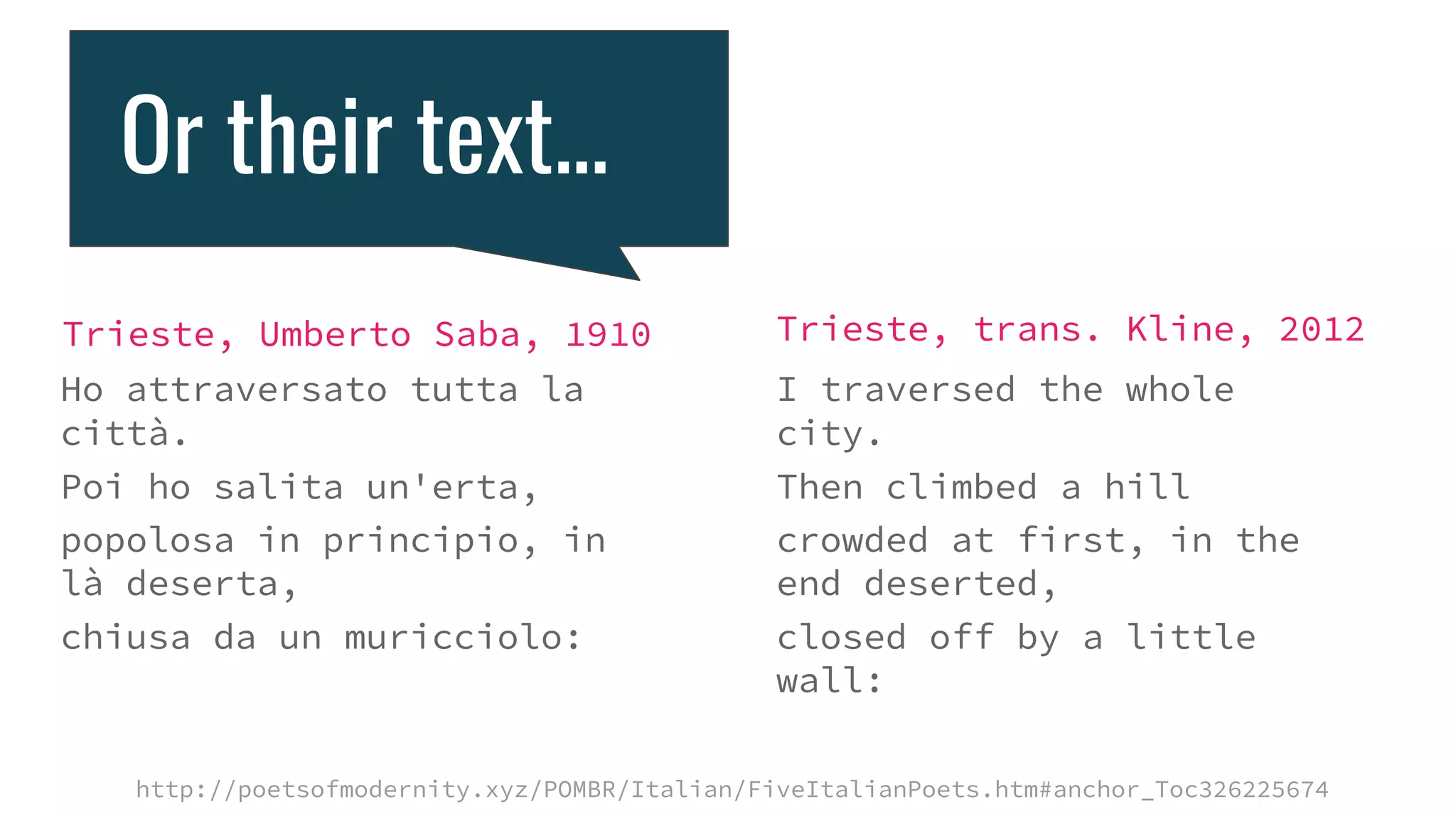
Trieste, Umberto Saba, 1910
Ho attraversato tutta la
città.
Poi ho salita un'erta,
popolosa in principio, in
là deserta,
chiusa da un muricciolo:
Trieste, trans. Kline, 2012
I traversed the whole
city.
Then climbed a hill
crowded at first, in the
end deserted,
closed off by a little
wall:
http://poetsofmodernity.xyz/POMBR/Italian/FiveItalianPoets.htm#anchor_Toc326225674
Or their text...
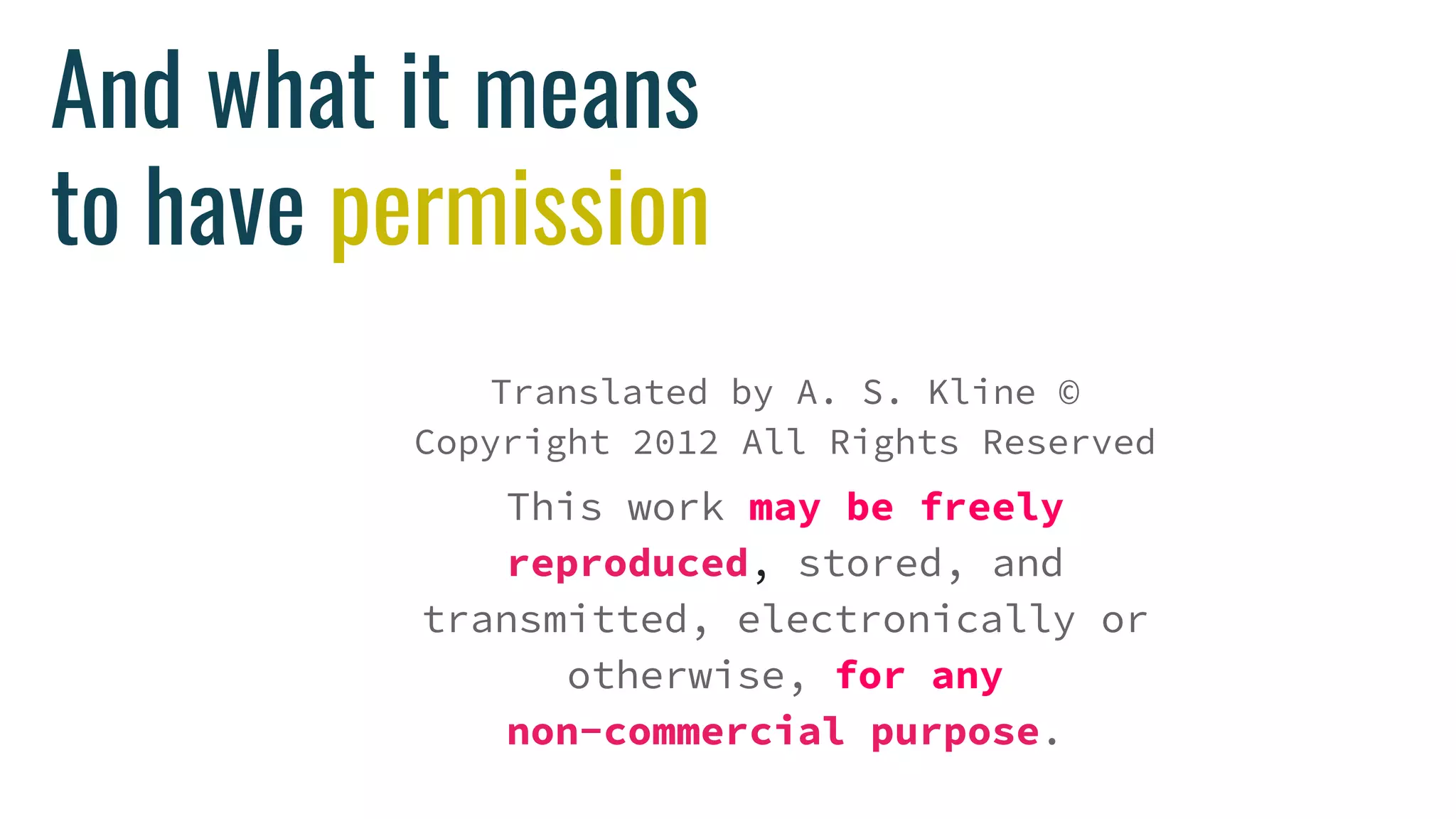
And what it means
to have permission
Translated by A. S. Kline ©
Copyright 2012 All Rights Reserved
This work may be freely
reproduced, stored, and
transmitted, electronically or
otherwise, for any
non-commercial purpose.
WE’LL TEACH YOU A
WORKFLOW
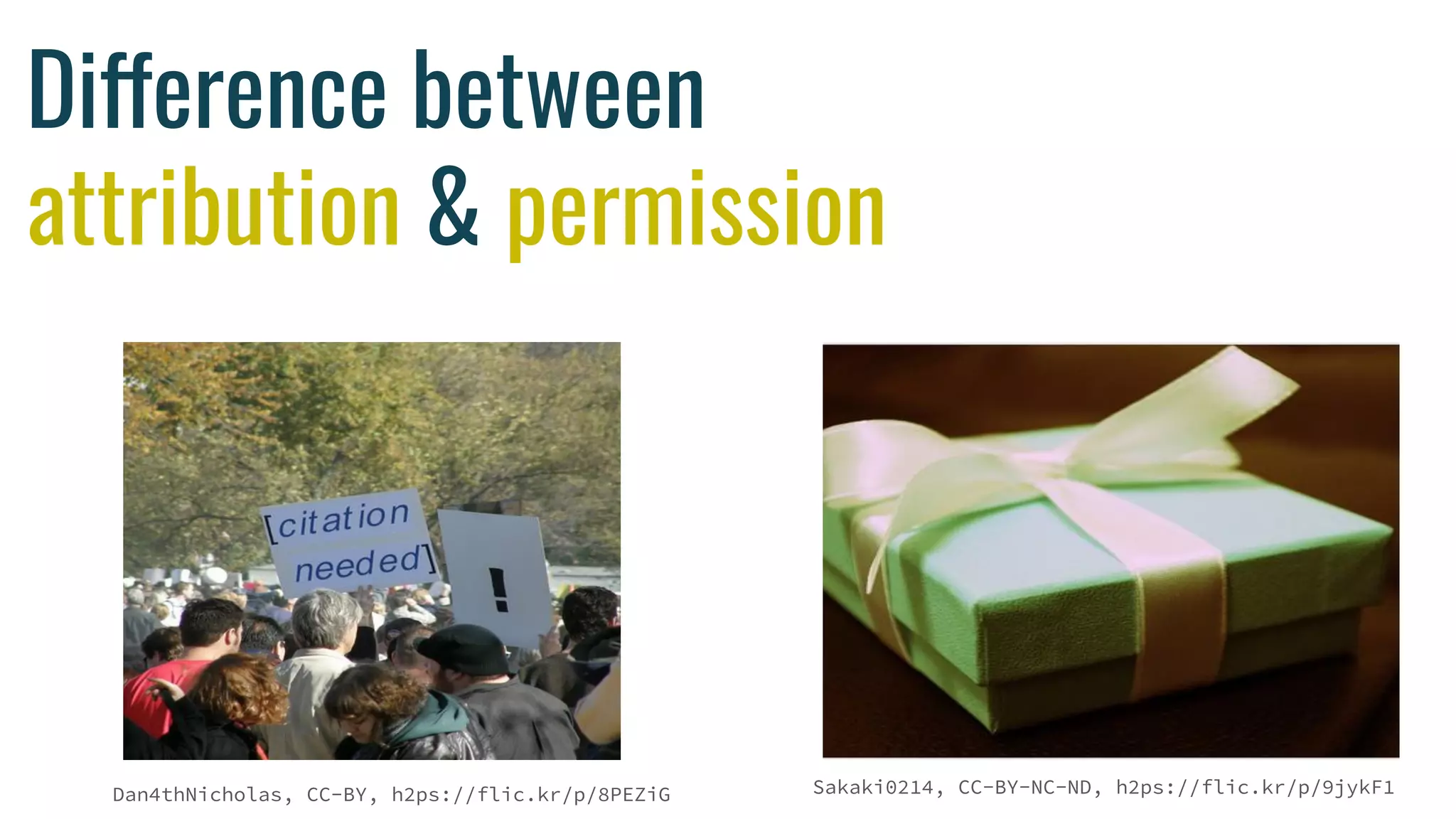
“ I already cite
my sources!”
Difference between
attribution & permission
Dan4thNicholas, CC-BY, h2ps://flic.kr/p/8PEZiG Sakaki0214, CC-BY-NC-ND, h2ps://flic.kr/p/9jykF1
To flow, we have to know:
What is COPYRIGHT?
Exclusive rights to make
certain uses of
original expression
for limited period
of time
Photo by Luis Alfonso Orellana on Unsplash
Egypt, Lee Friedlander (1983)
Exclusive Rights
● Reproduction
● Derivative works
● Distribution
● Public performance
● Public display
Egypt, Lee Friedlander (1983)
Not invoking any exclusive
rights by providing links to
lawfully-uploaded content:
● Reproduction
● Derivative works
● Distribution
● Public performance
● Public display
Three horizontal rusted chains
crossed by two poles
https://unsplash.com/photos/TcFq4-ulczU
Linking Exclusive Right
That’s why it’s always okay
to link to lawful.
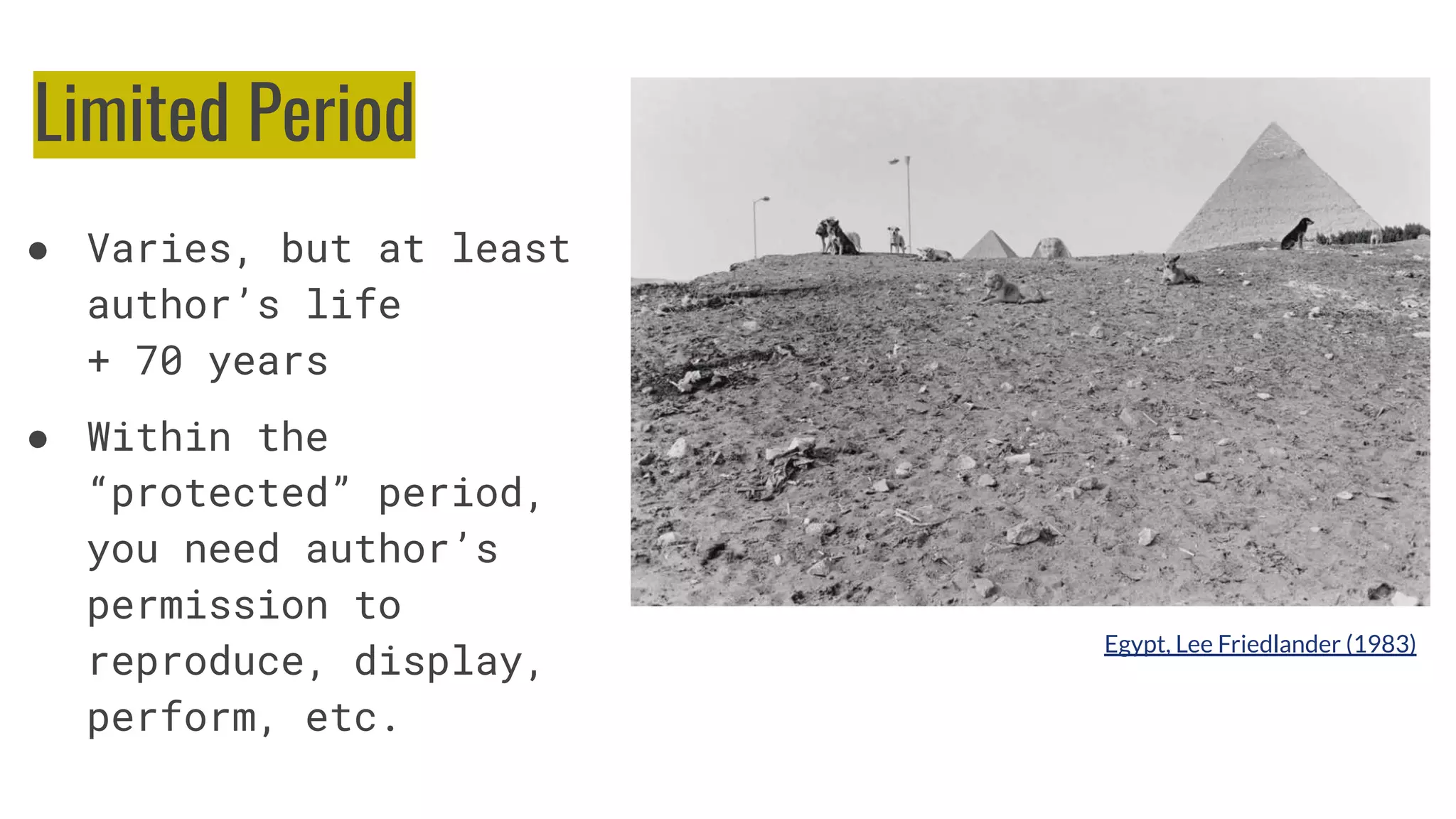
Limited Period
● Varies, but at least
author’s life
+ 70 years
● Within the
“protected” period,
you need author’s
permission to
reproduce, display,
perform, etc.
Egypt, Lee Friedlander (1983)
If copyright gives authors
exclusive rights for so
long, how can we ever use
anything?
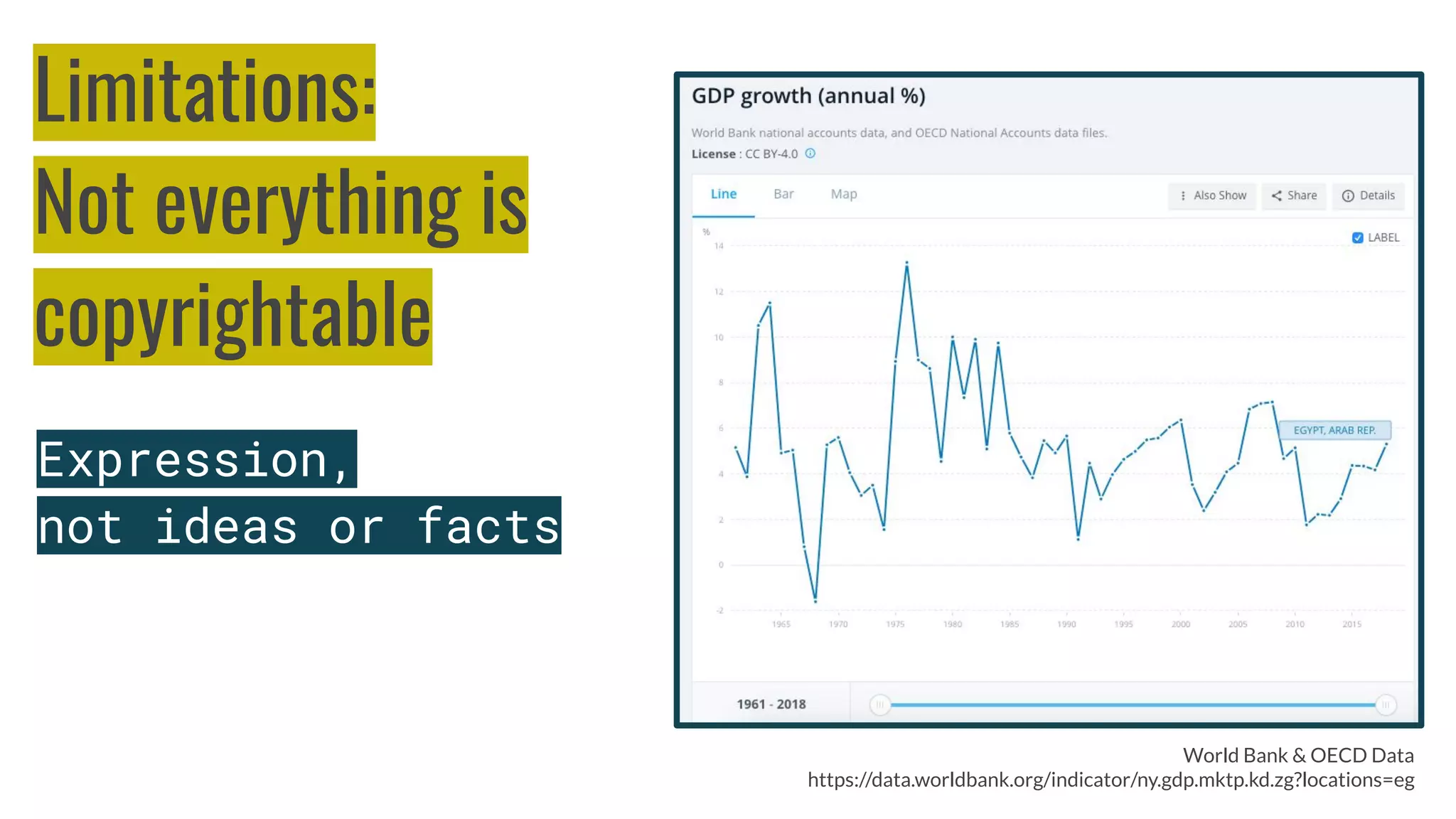
Limitations:
Not everything is
copyrightable
Expression,
not ideas or facts
World Bank & OECD Data
https://data.worldbank.org/indicator/ny.gdp.mktp.kd.zg?locations=eg
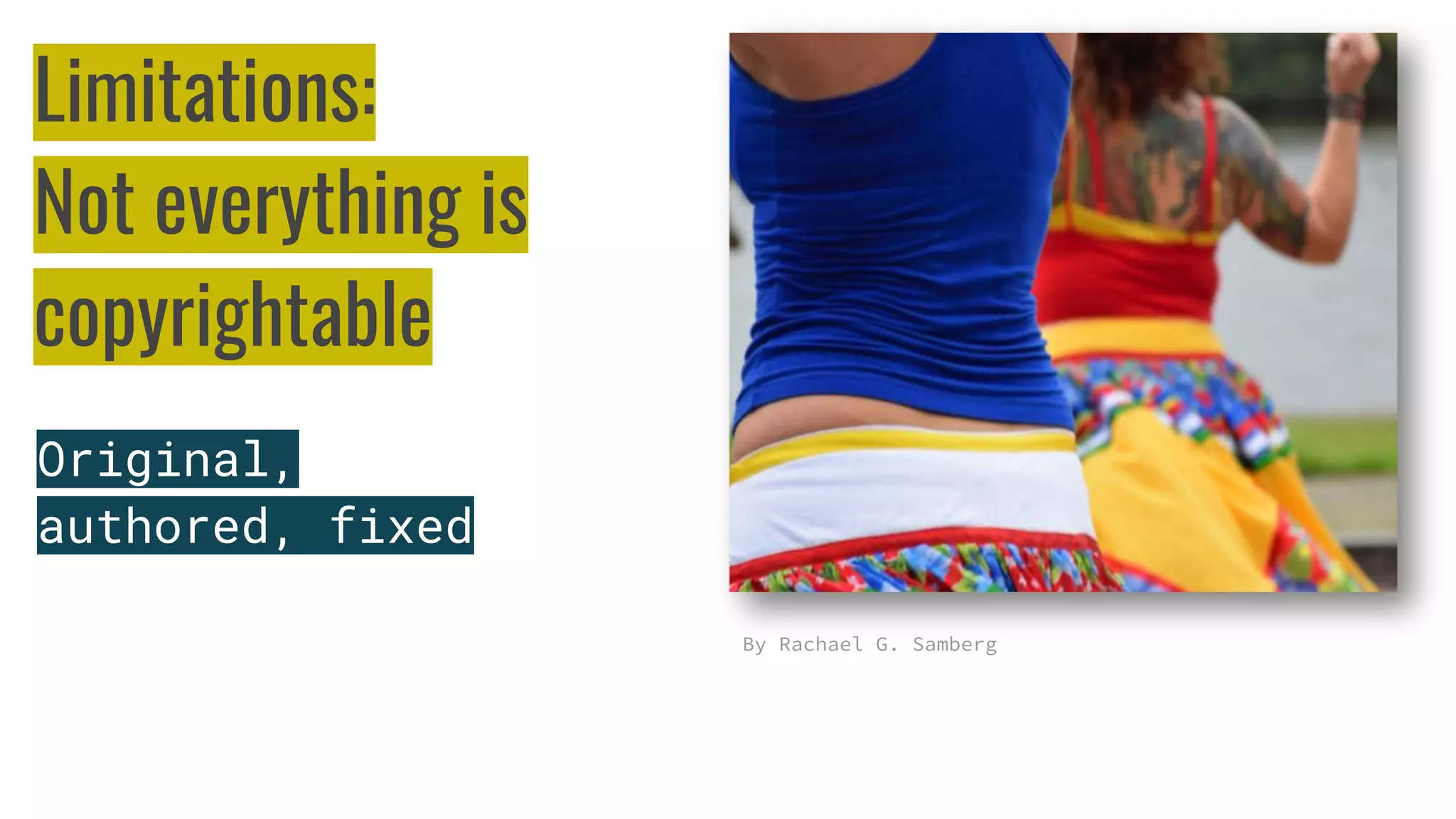
Limitations:
Not everything is
copyrightable
Original,
authored, fixed
By Rachael G. Samberg
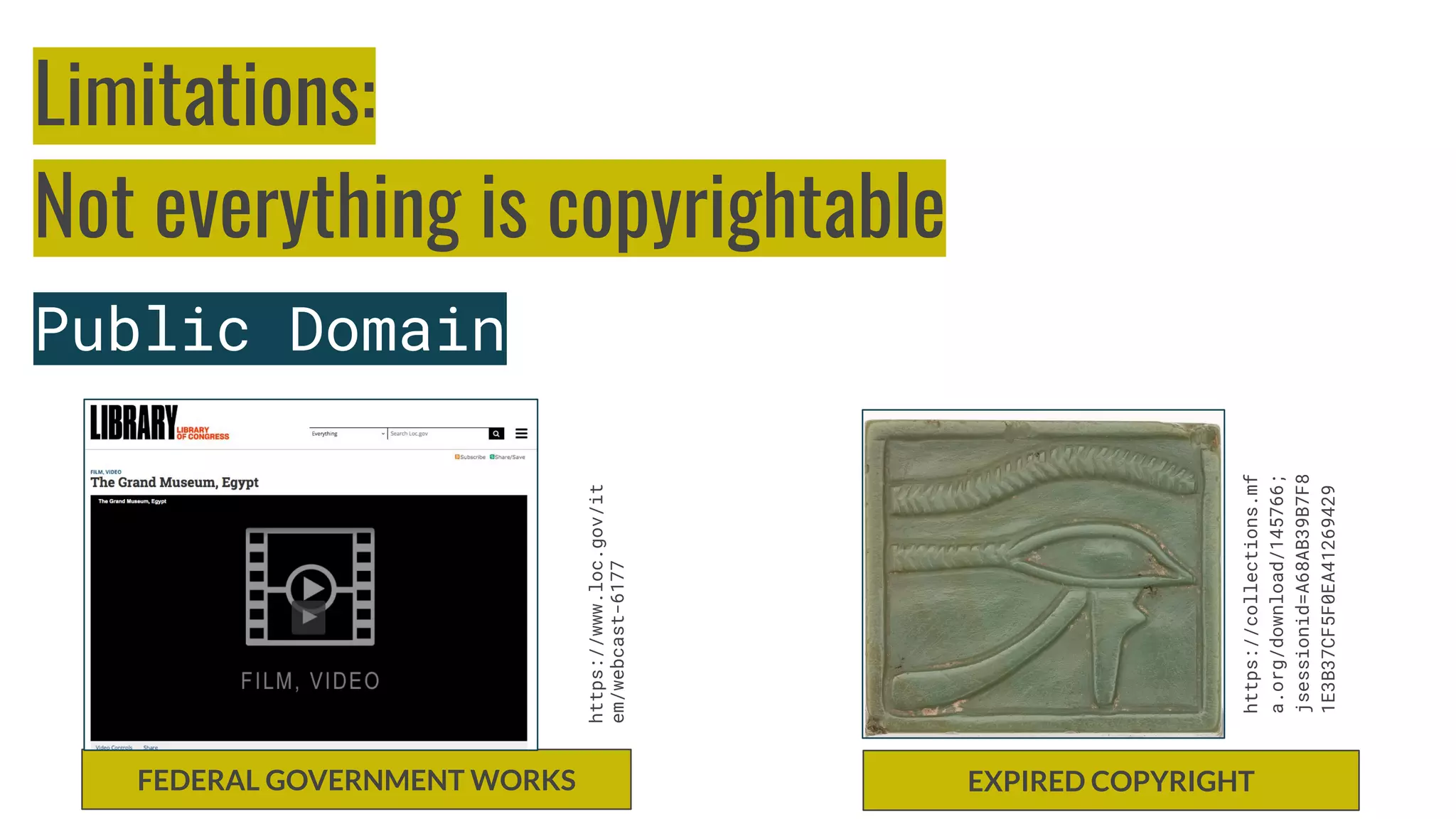
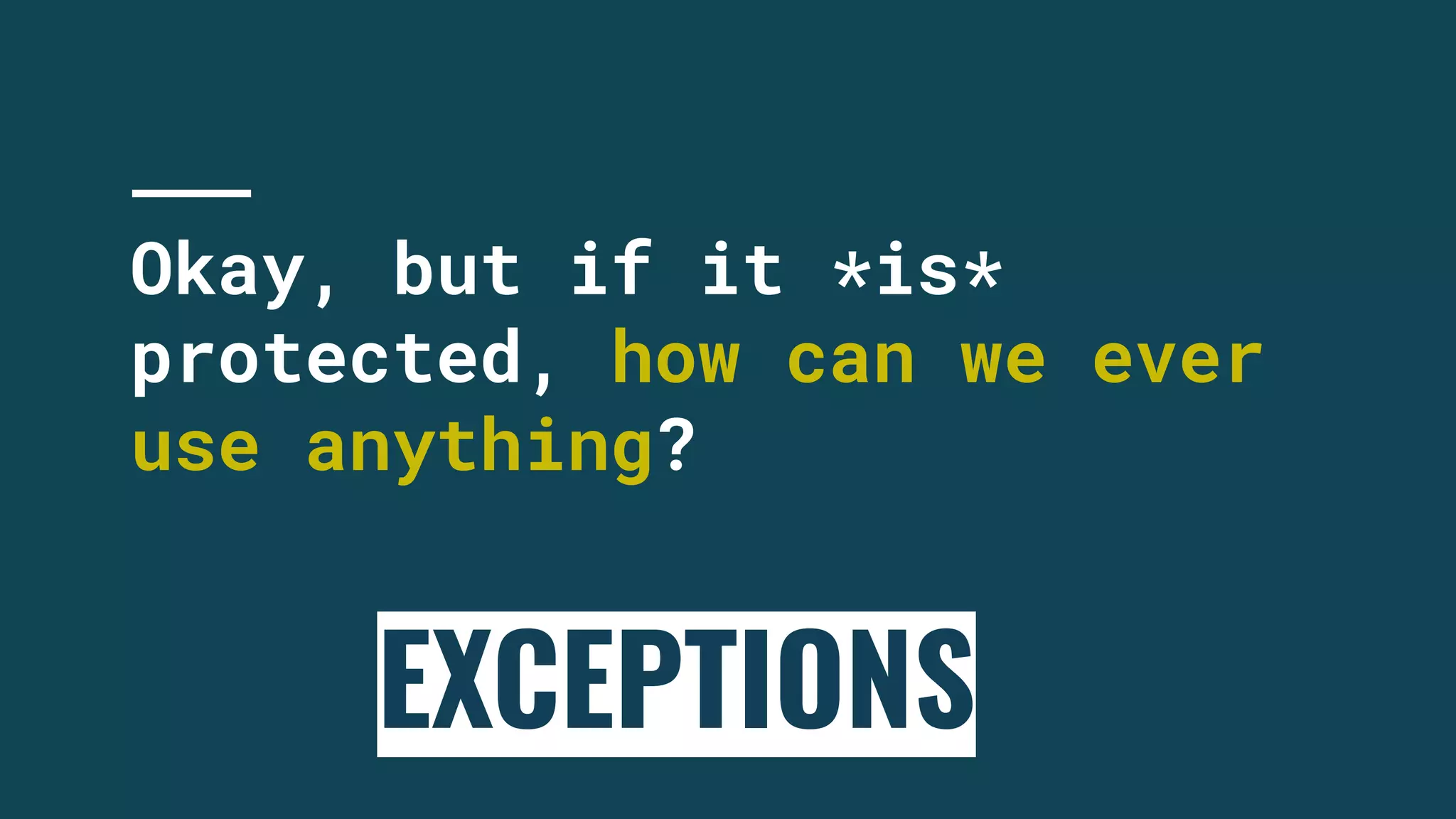
FEDERAL GOVERNMENT WORKS EXPIRED COPYRIGHT
https://collections.mf
a.org/download/145766;
jsessionid=A68AB39B7F8
1E3B37CF5F0EA41269429
https://www.loc.gov/it
em/webcast-6177
Limitations:
Not everything is copyrightable
Public Domain
Okay, but if it *is*
protected, how can we ever
use anything?
EXCEPTIONS
Fair Use
17 U.S.C. § 107
The fair use of a
copyrighted work…for
purposes such as criticism,
comment, news reporting,
teaching…, scholarship, or
research, is not an
infringement of copyright.
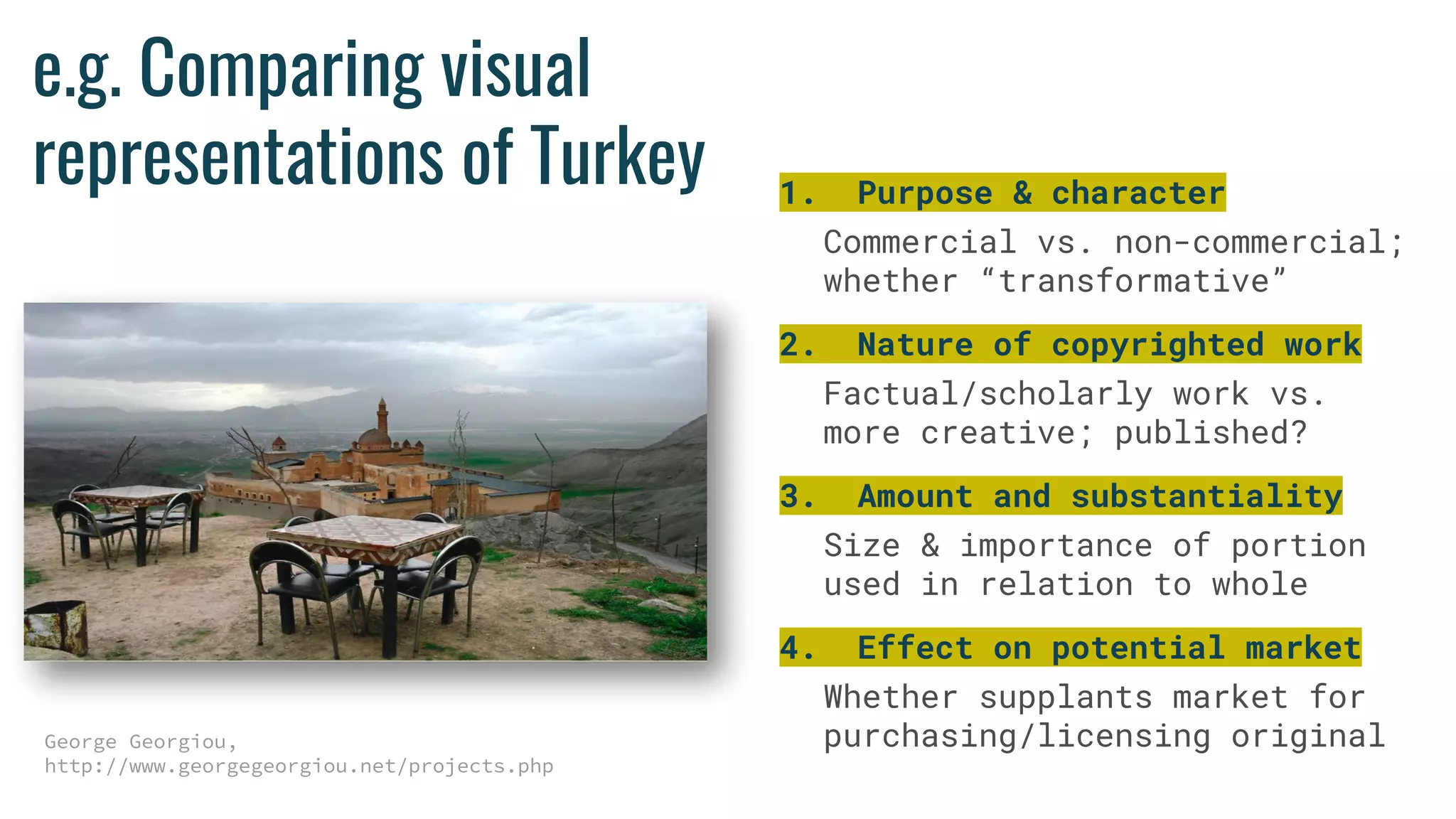
e.g. Comparing visual
representations of Turkey
George Georgiou,
http://www.georgegeorgiou.net/projects.php
1. Purpose & character
Commercial vs. non-commercial;
whether “transformative”
2. Nature of copyrighted work
Factual/scholarly work vs.
more creative; published?
3. Amount and substantiality
Size & importance of portion
used in relation to whole
4. Effect on potential market
Whether supplants market for
purchasing/licensing original
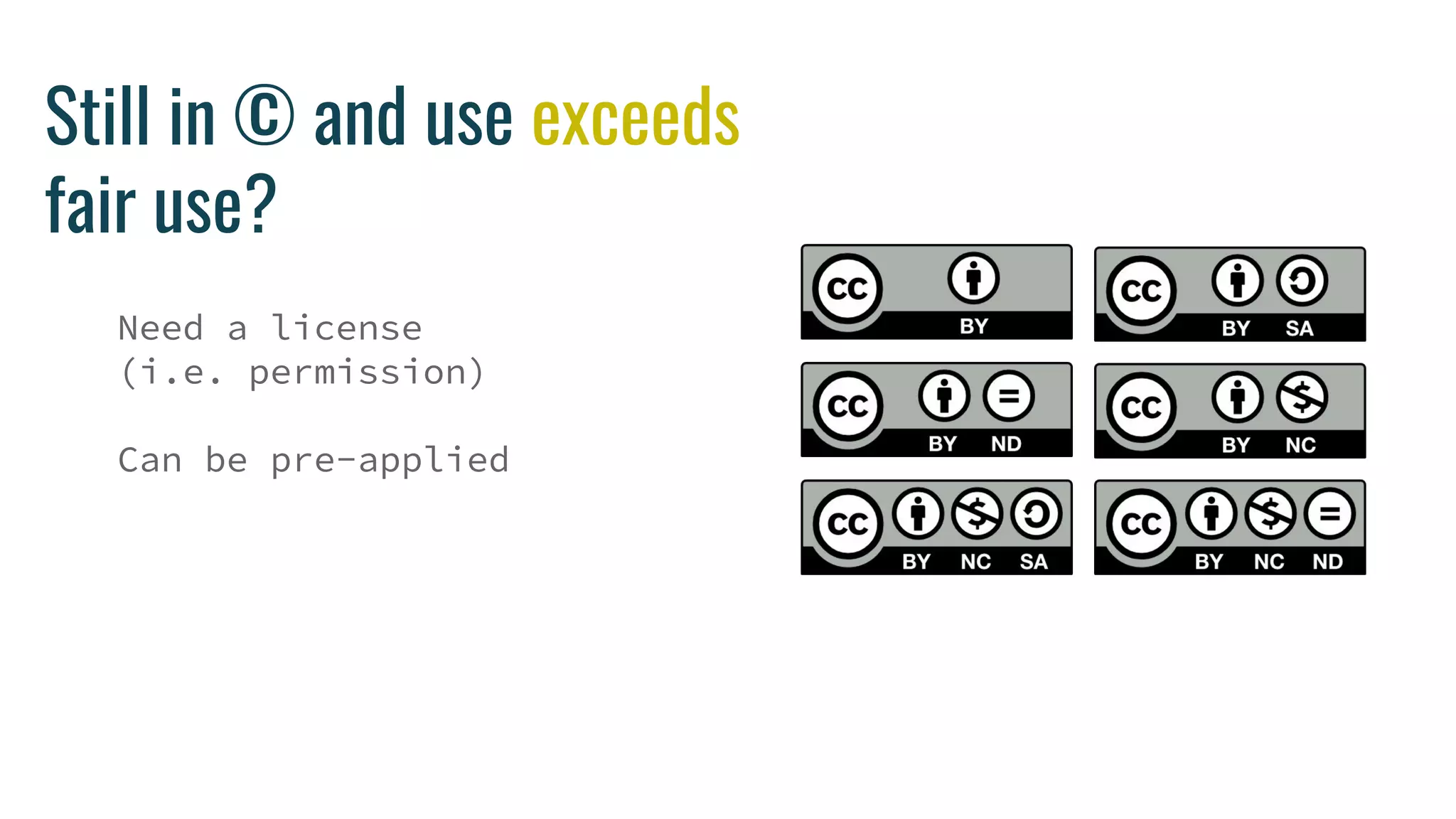
Still in © and use exceeds
fair use?
Need a license
(i.e. permission)
Can be pre-applied
The Flow
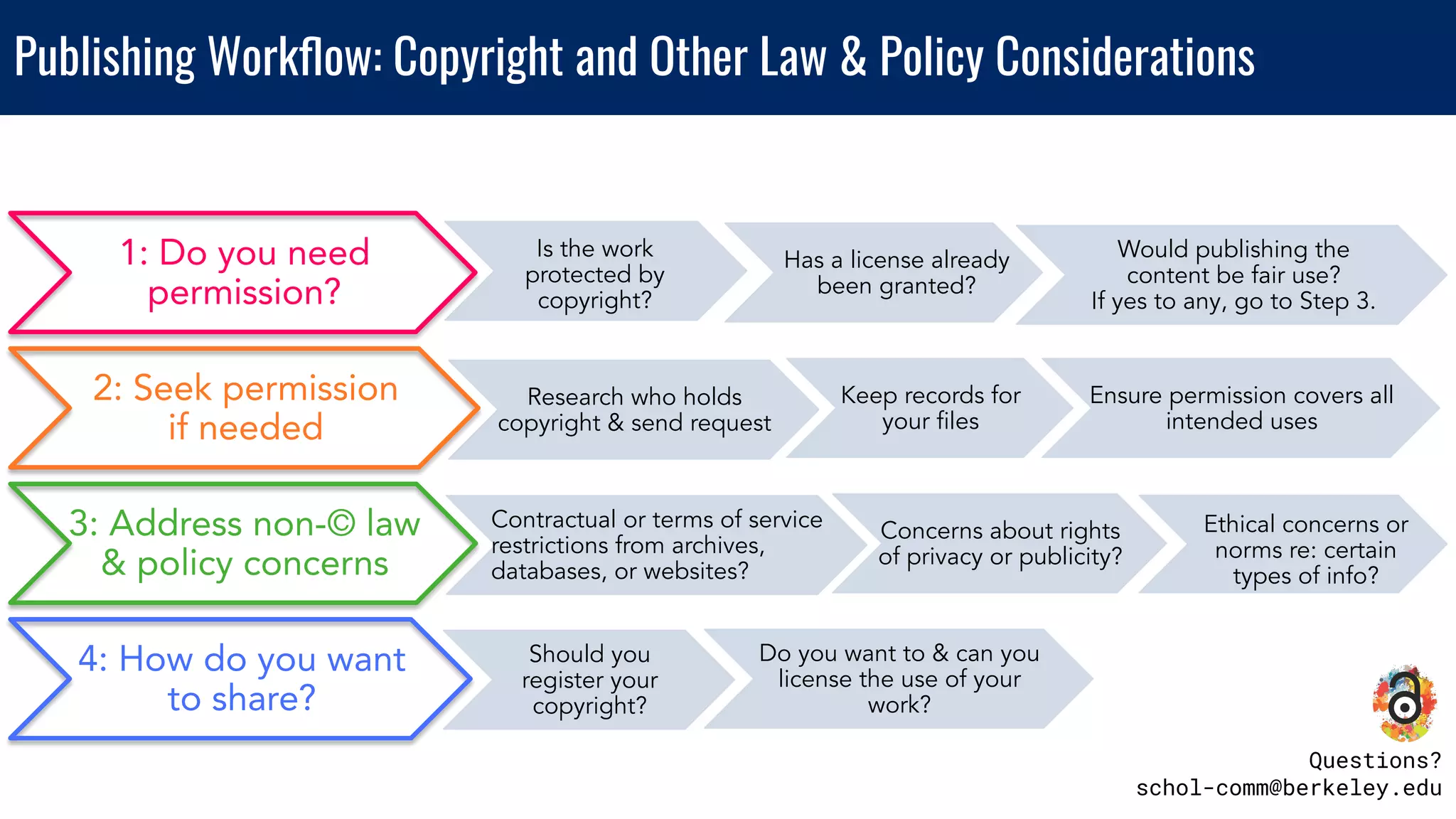
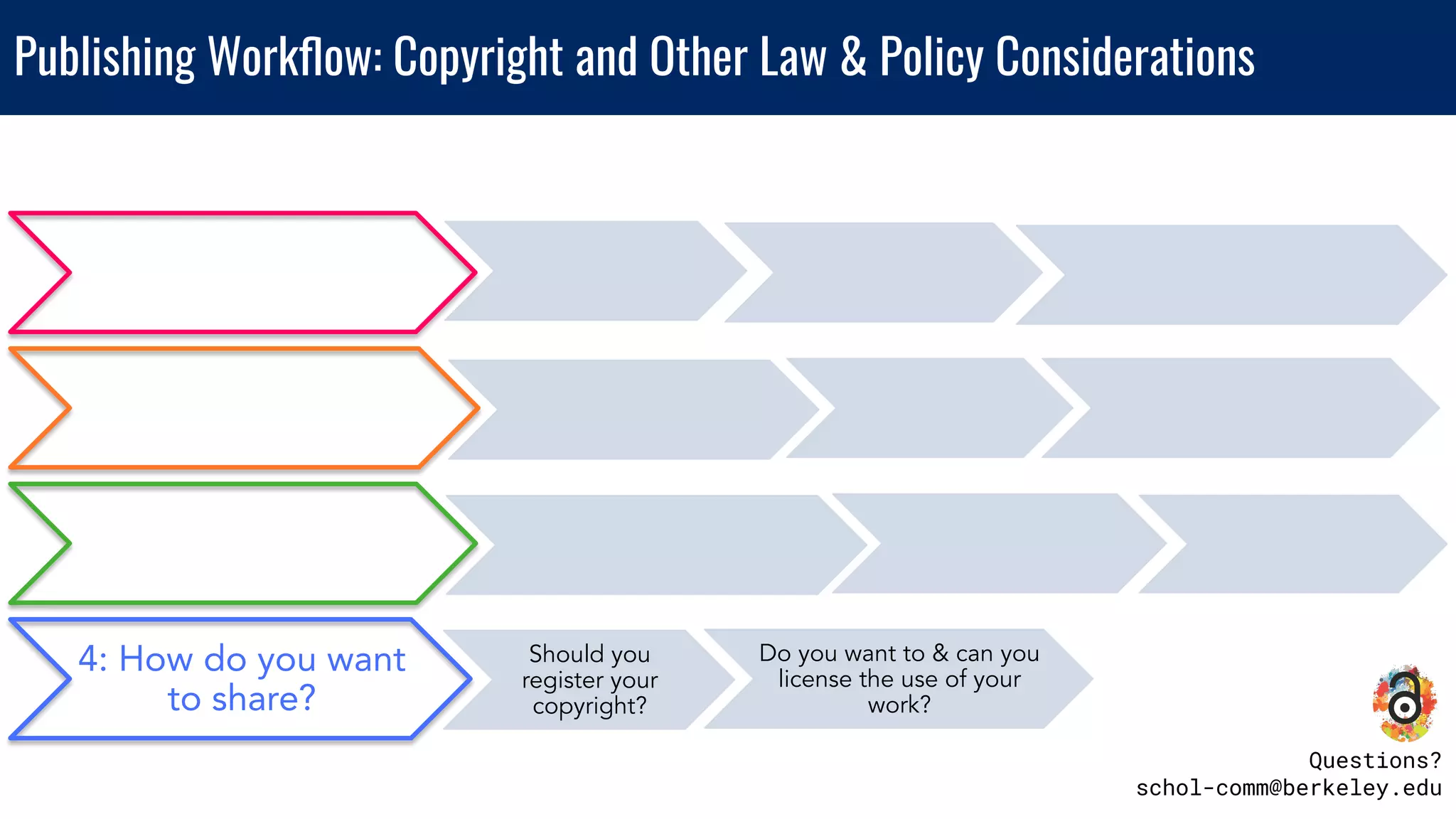
Publishing Workflow: Copyright and Other Law & Policy Considerations
1: Do you need
permission?
Has a license already
been granted?
Is the work
protected by
copyright?
Would publishing the
content be fair use?
If yes to any, go to Step 3.
2: Seek permission
if needed
Research who holds
copyright & send request
Keep records for
your files
Ensure permission covers all
intended uses
3: Address non-© law
& policy concerns
Contractual or terms of service
restrictions from archives,
databases, or websites?
Concerns about rights
of privacy or publicity?
Should you
register your
copyright?
Do you want to & can you
license the use of your
work?
4: How do you want
to share?
Questions?
schol-comm@berkeley.edu
Ethical concerns or
norms re: certain
types of info?
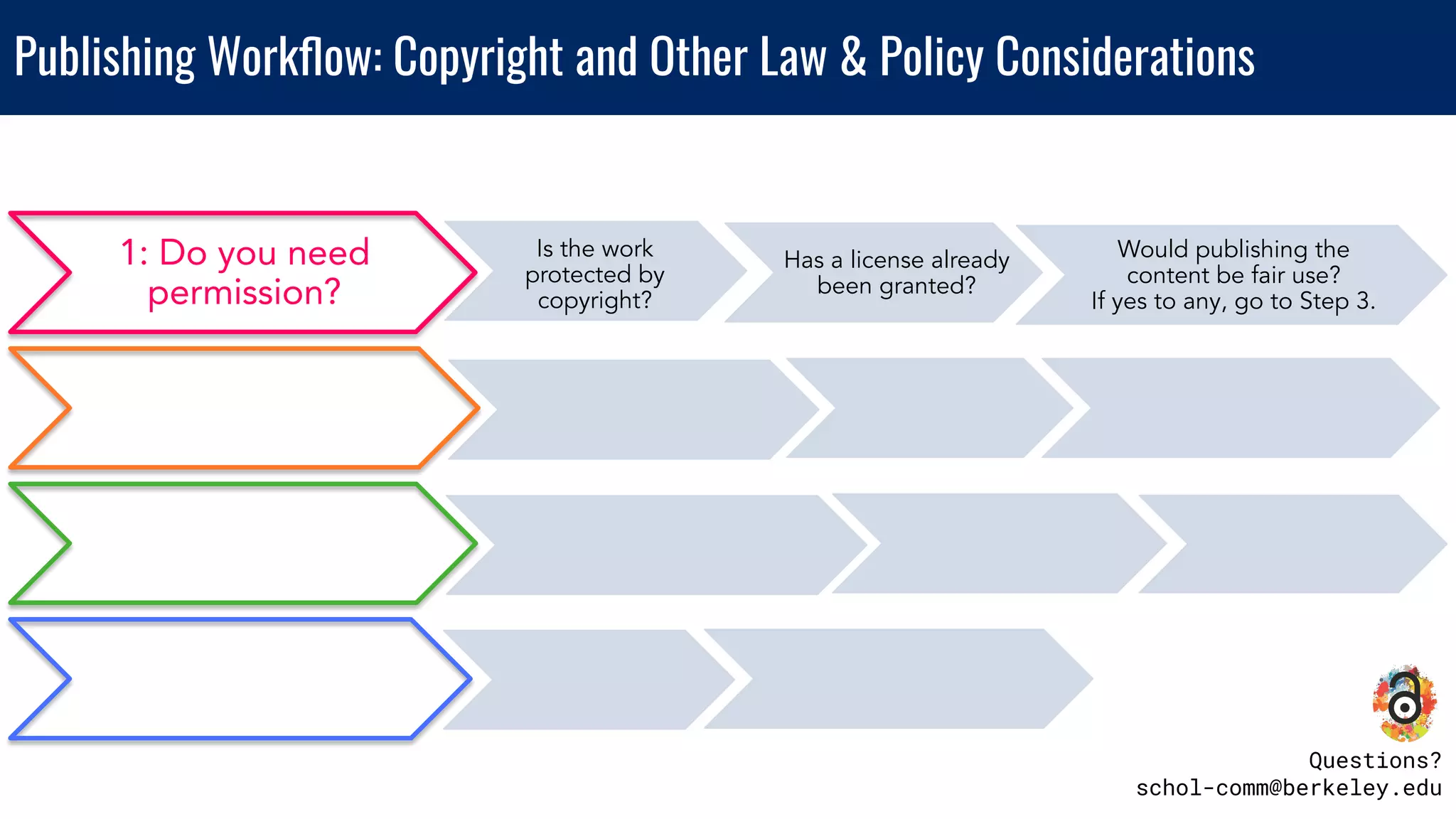
Publishing Workflow: Copyright and Other Law & Policy Considerations
Questions?
schol-comm@berkeley.edu
1: Do you need
permission?
Has a license already
been granted?
Is the work
protected by
copyright?
Would publishing the
content be fair use?
If yes to any, go to Step 3.
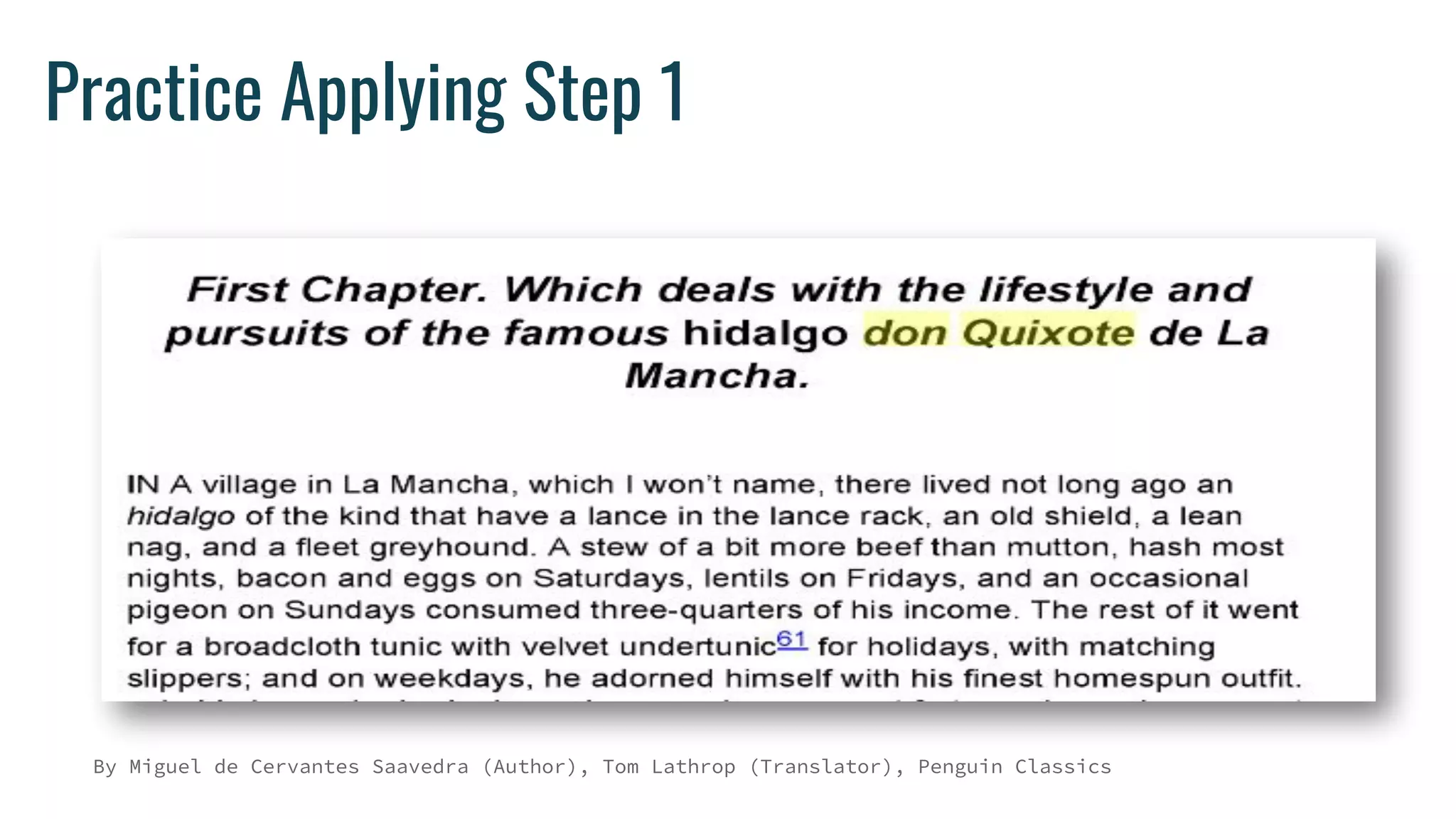
Practice Applying Step 1
By Miguel de Cervantes Saavedra (Author), Tom Lathrop (Translator), Penguin Classics
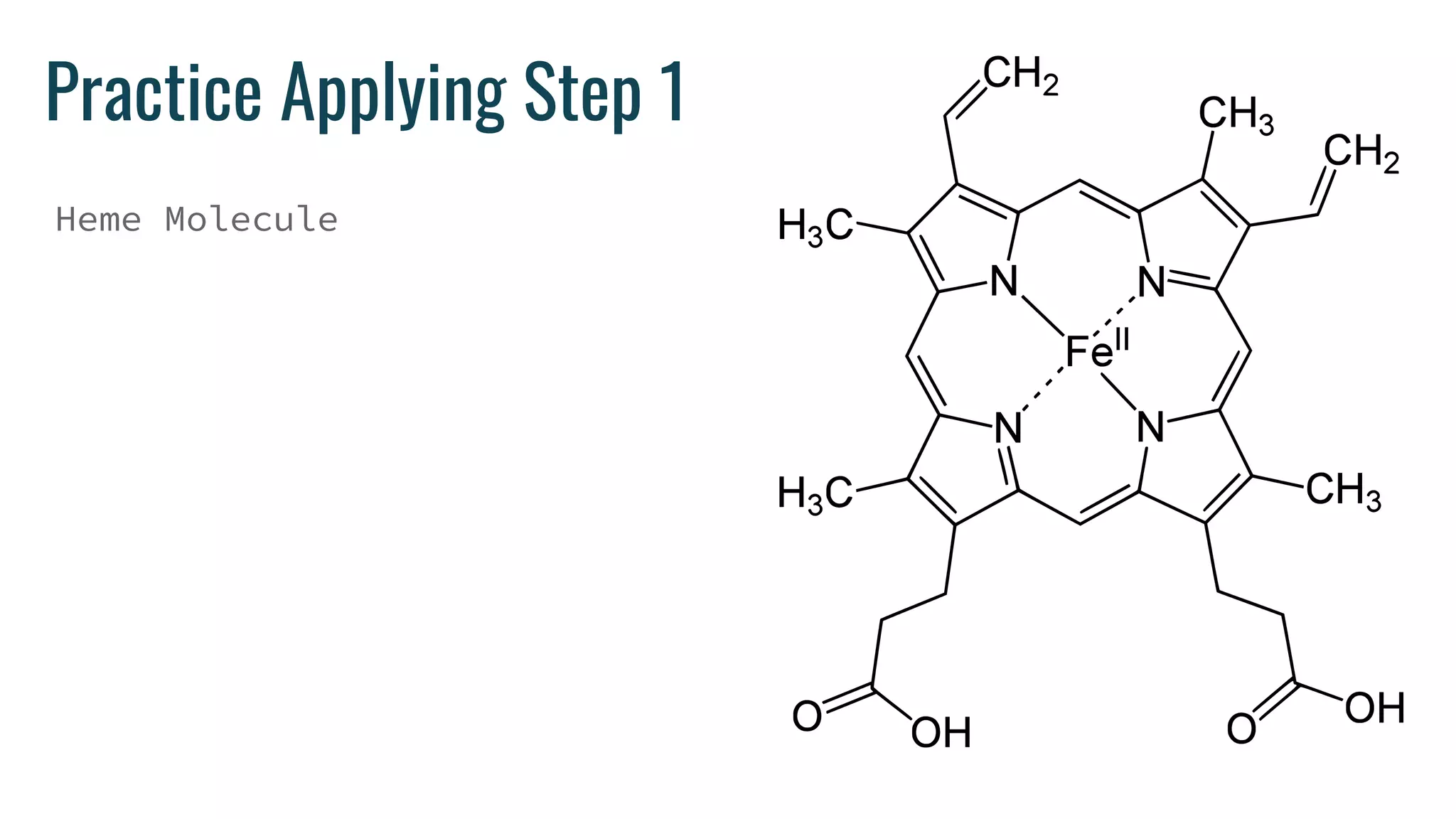
Practice Applying Step 1
Heme Molecule
Practice Applying Step 1
Heart
By Tvanbr (Own work) [Public domain], via Wikimedia Commons
https://commons.wikimedia.org/wiki/File%3AAnatomy_Heart_Latin_Tiesworks.jpg
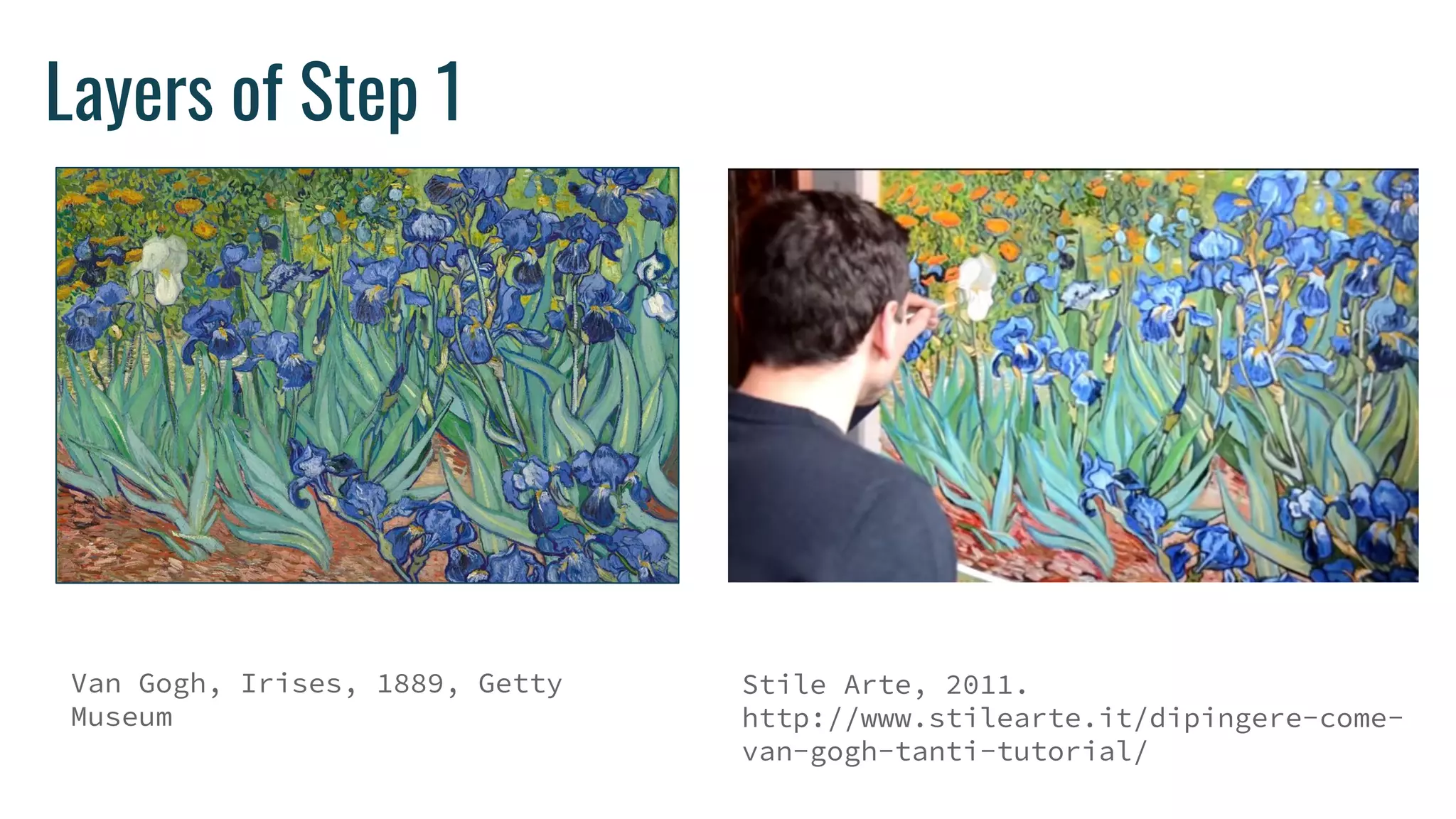
Layers of Step 1
Van Gogh, Irises, 1889, Getty
Museum
Stile Arte, 2011.
http://www.stilearte.it/dipingere-come-
van-gogh-tanti-tutorial/
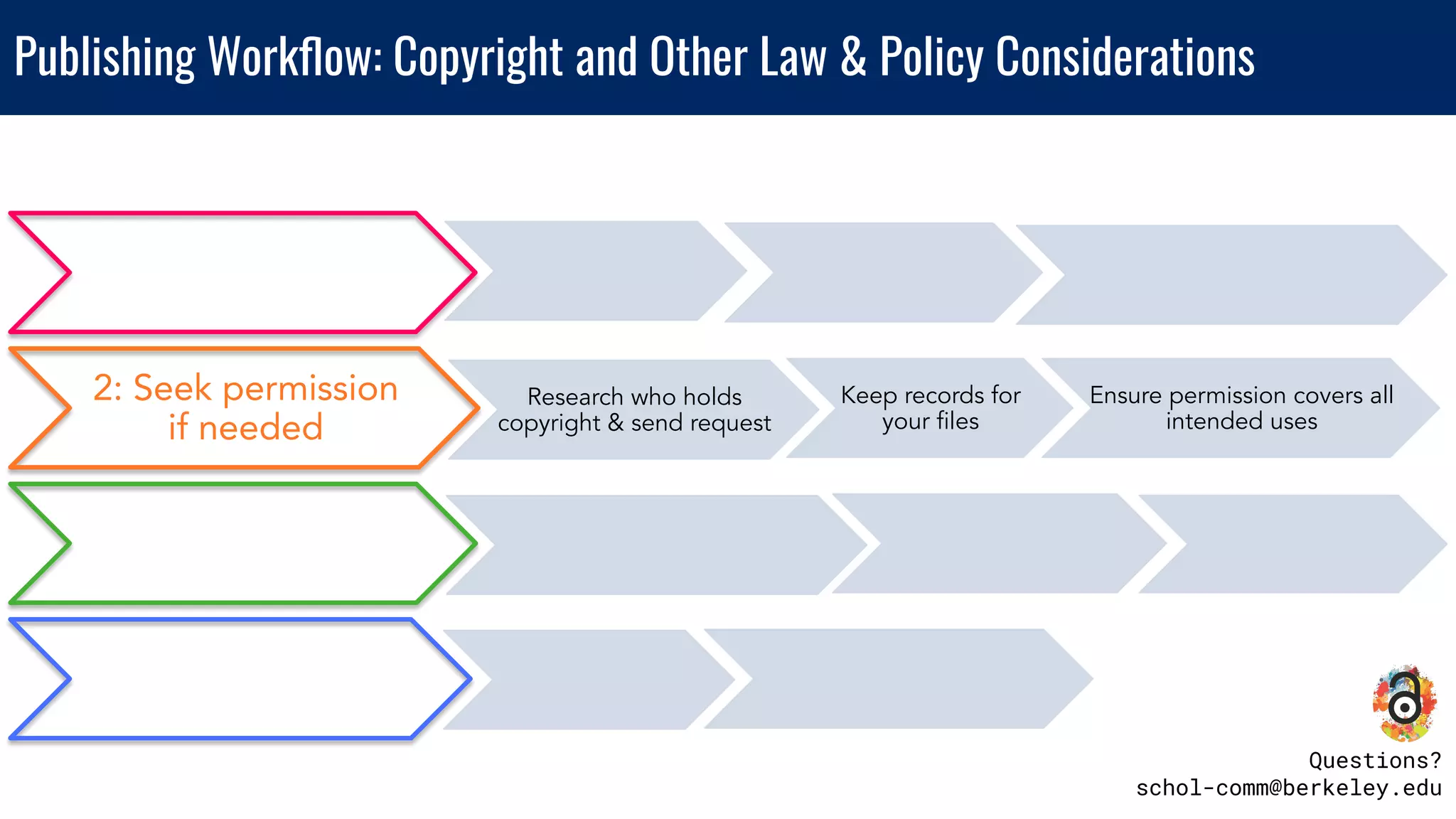
Publishing Workflow: Copyright and Other Law & Policy Considerations
2: Seek permission
if needed
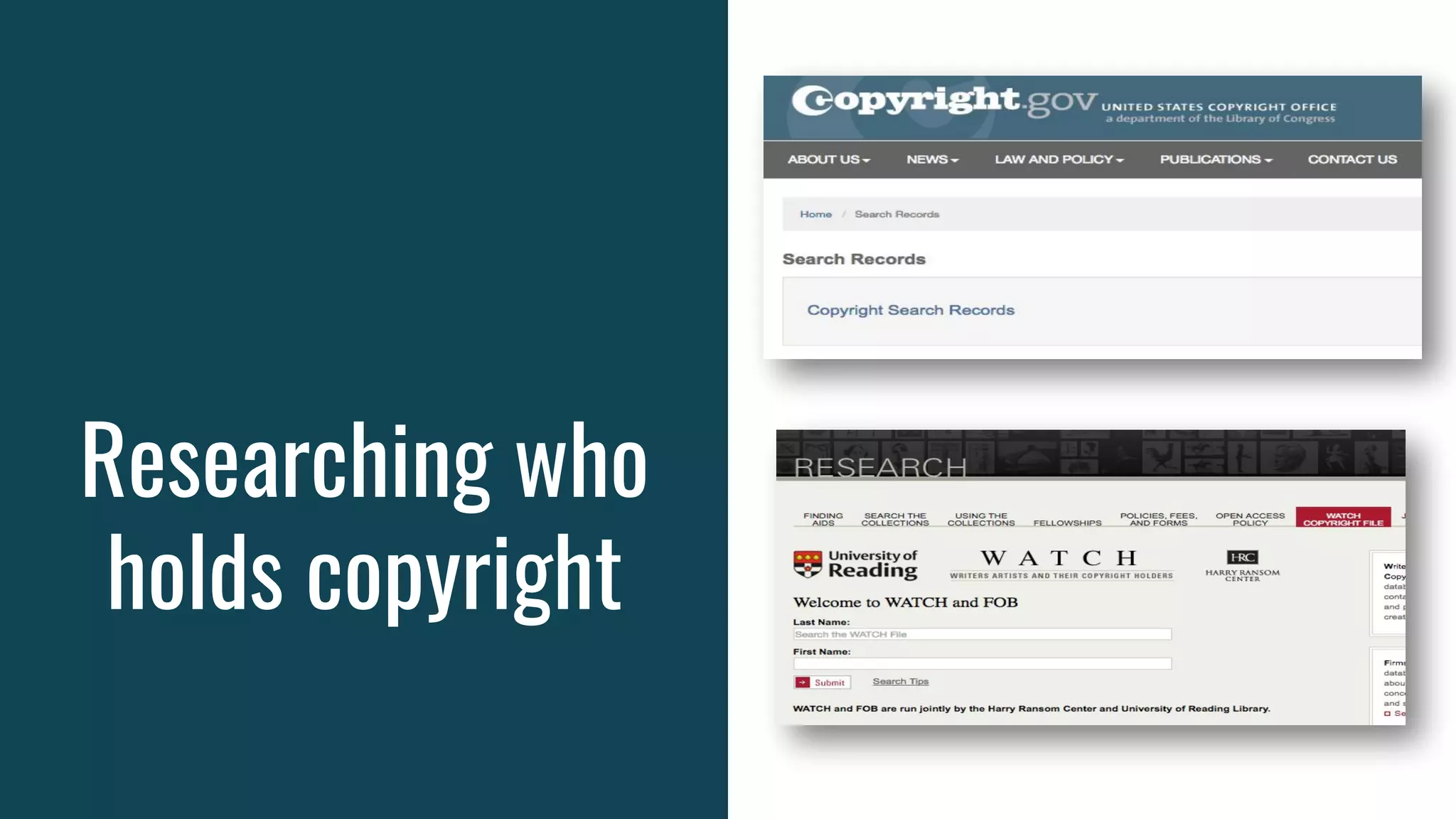
Research who holds
copyright & send request
Keep records for
your files
Ensure permission covers all
intended uses
Questions?
schol-comm@berkeley.edu
Researching who
holds copyright
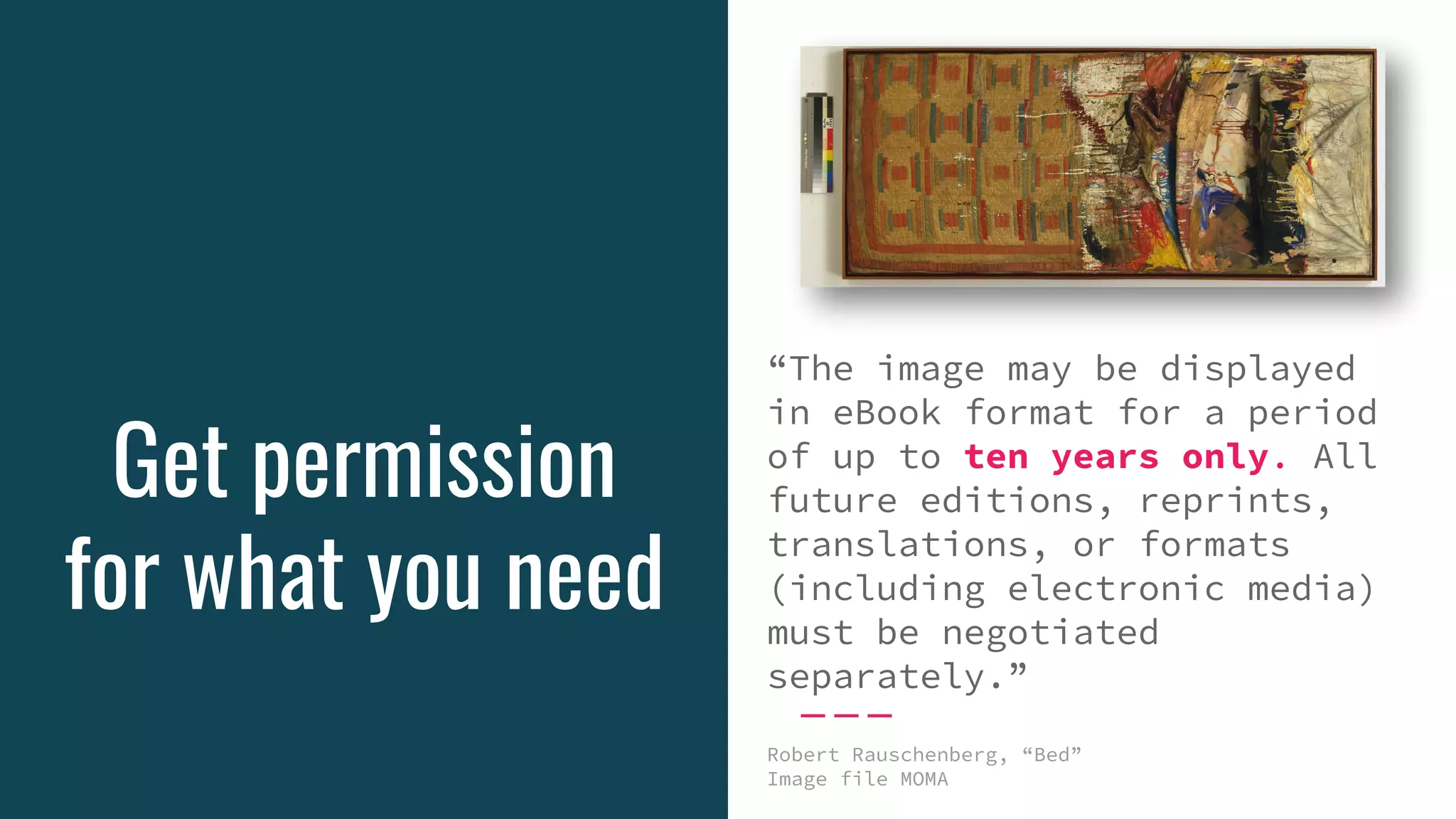
Get permission
for what you need
“The image may be displayed
in eBook format for a period
of up to ten years only. All
future editions, reprints,
translations, or formats
(including electronic media)
must be negotiated
separately.”
Robert Rauschenberg, “Bed”
Image file MOMA
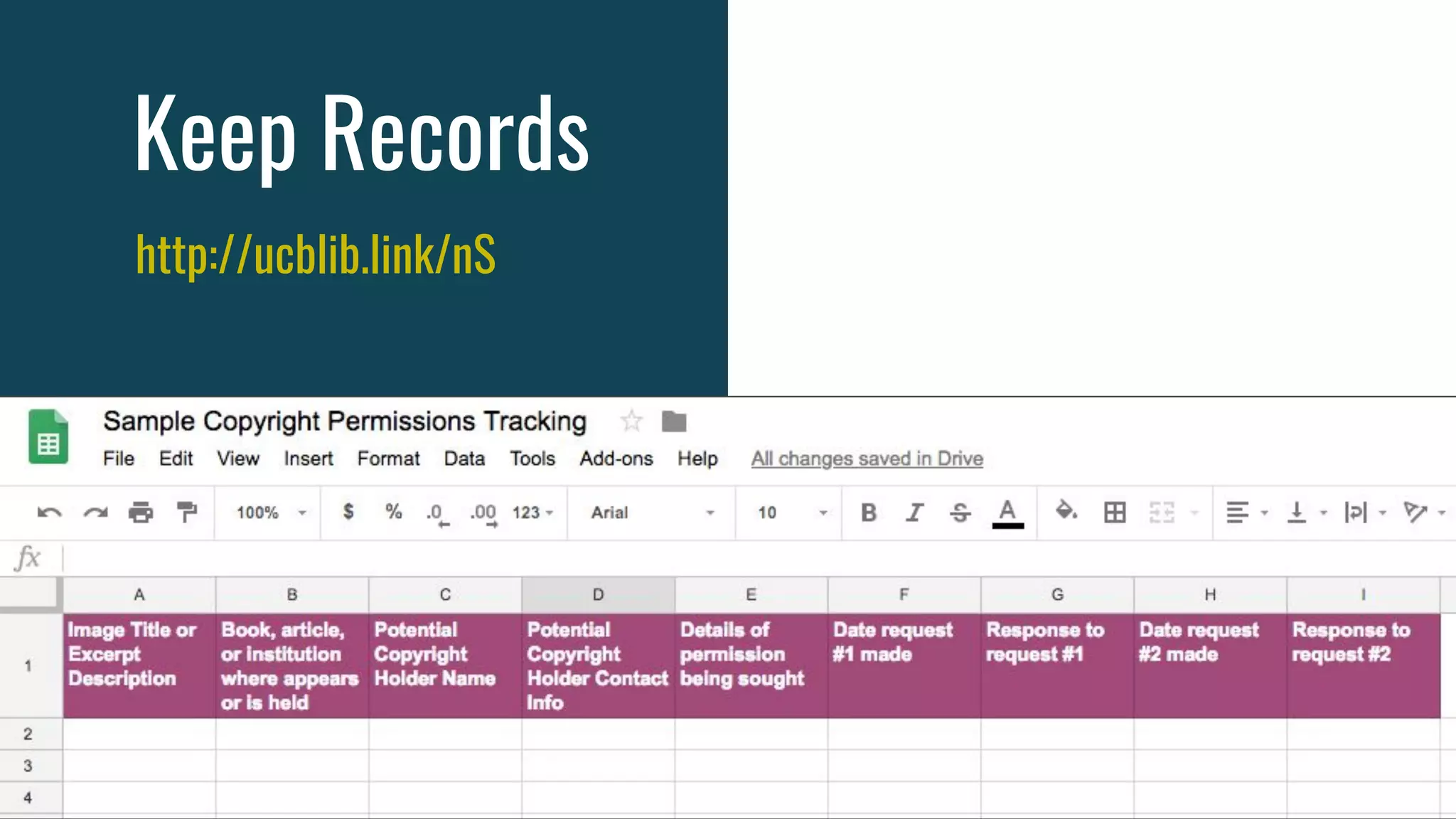
Keep Records
http://ucblib.link/nS
Publishing Workflow: Copyright and Other Law & Policy Considerations
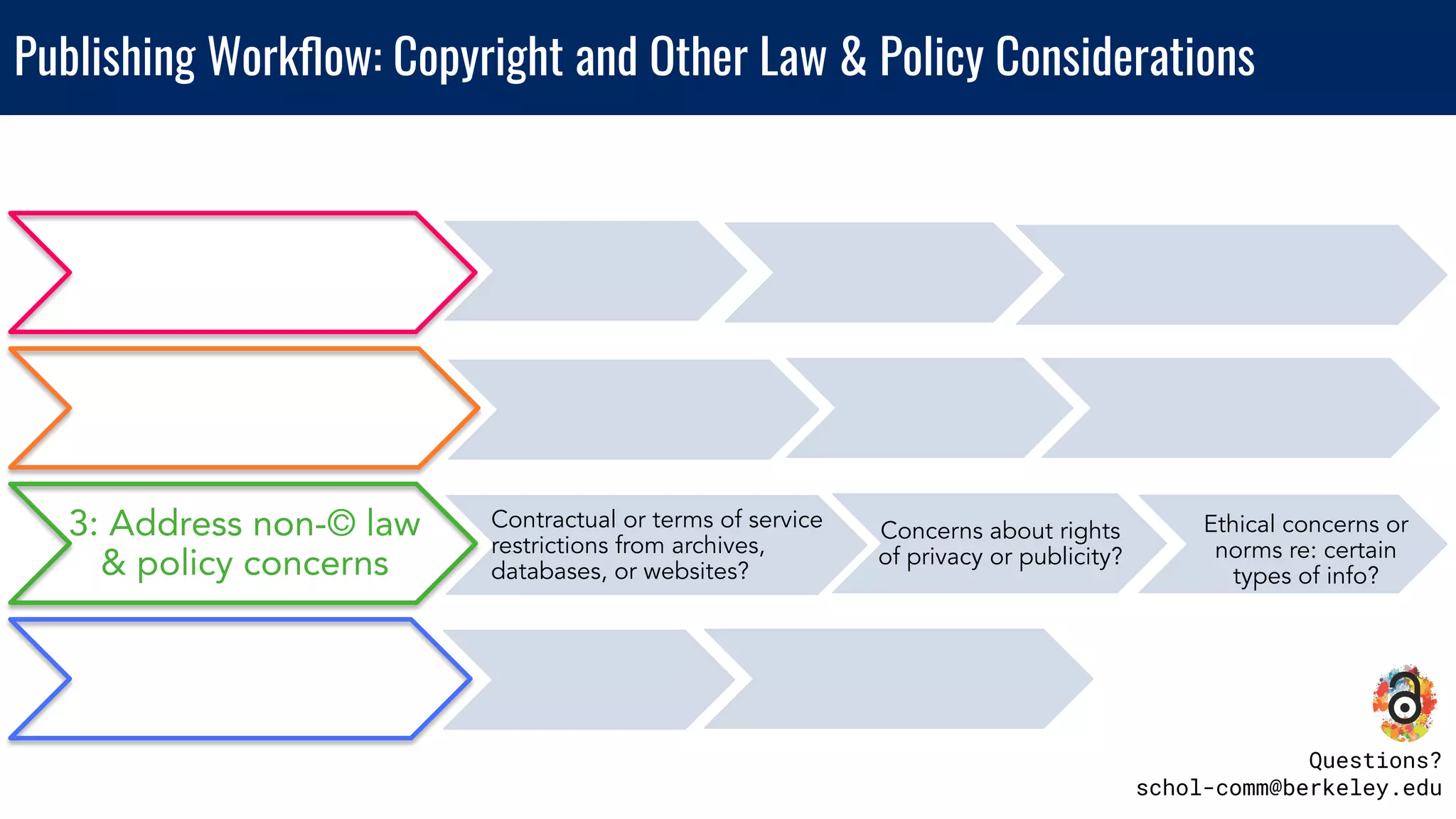
3: Address non-© law
& policy concerns
Contractual or terms of service
restrictions from archives,
databases, or websites?
Concerns about rights
of privacy or publicity?
Questions?
schol-comm@berkeley.edu
Ethical concerns or
norms re: certain
types of info?
Contracts:
Databases
Library License
Agreements:
EbscoHost
ProQuest
JSTOR
ScienceDirect
etc.
Archives
I understand that permission
to publish, or otherwise
publicly use, materials...must
be [granted by library]
I understand further that the
University makes no
representation that it is the
owner of the copyright... and
that permission to publish
must also be obtained from the
owner of the copyright.
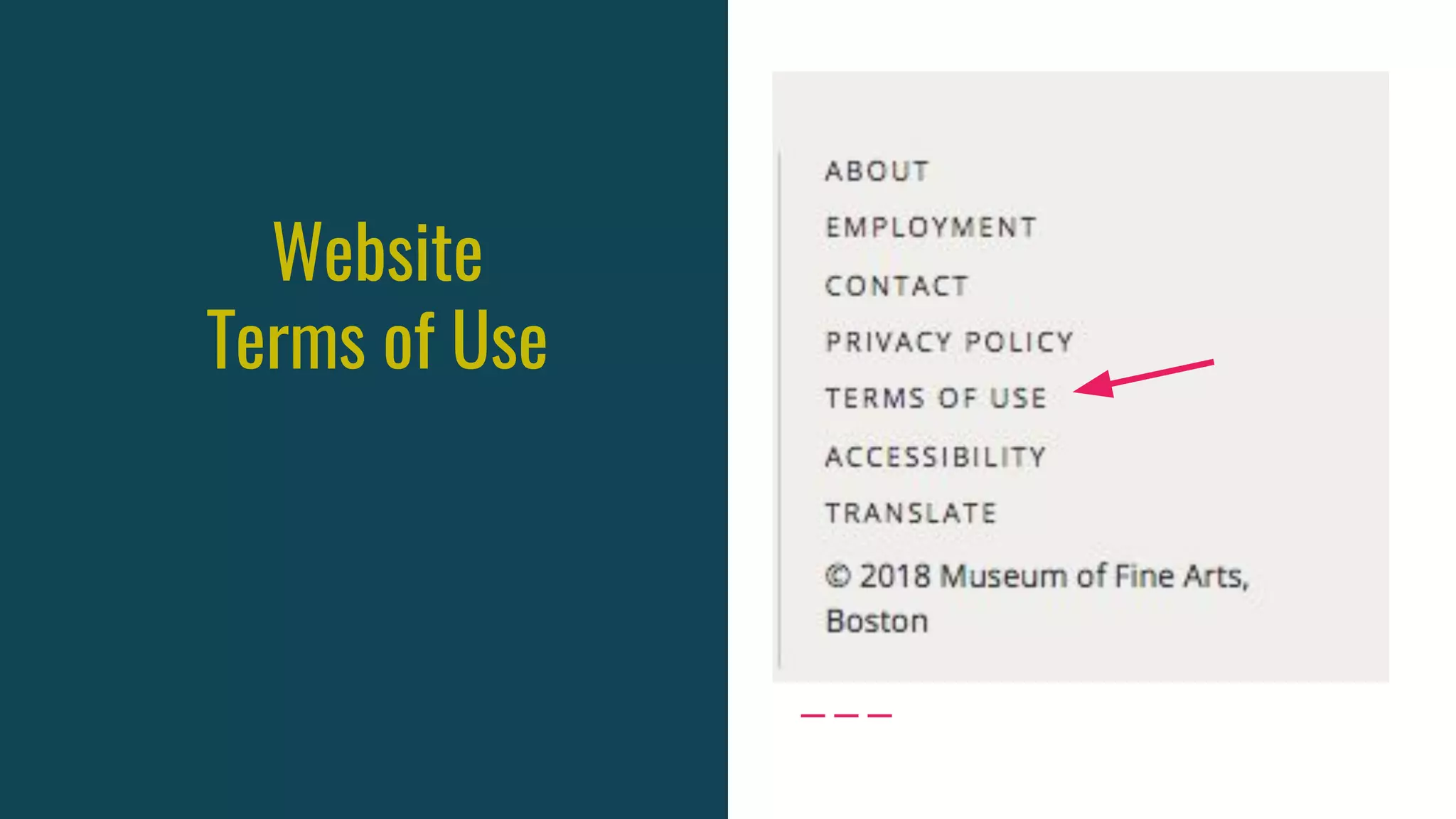
Website
Terms of Use
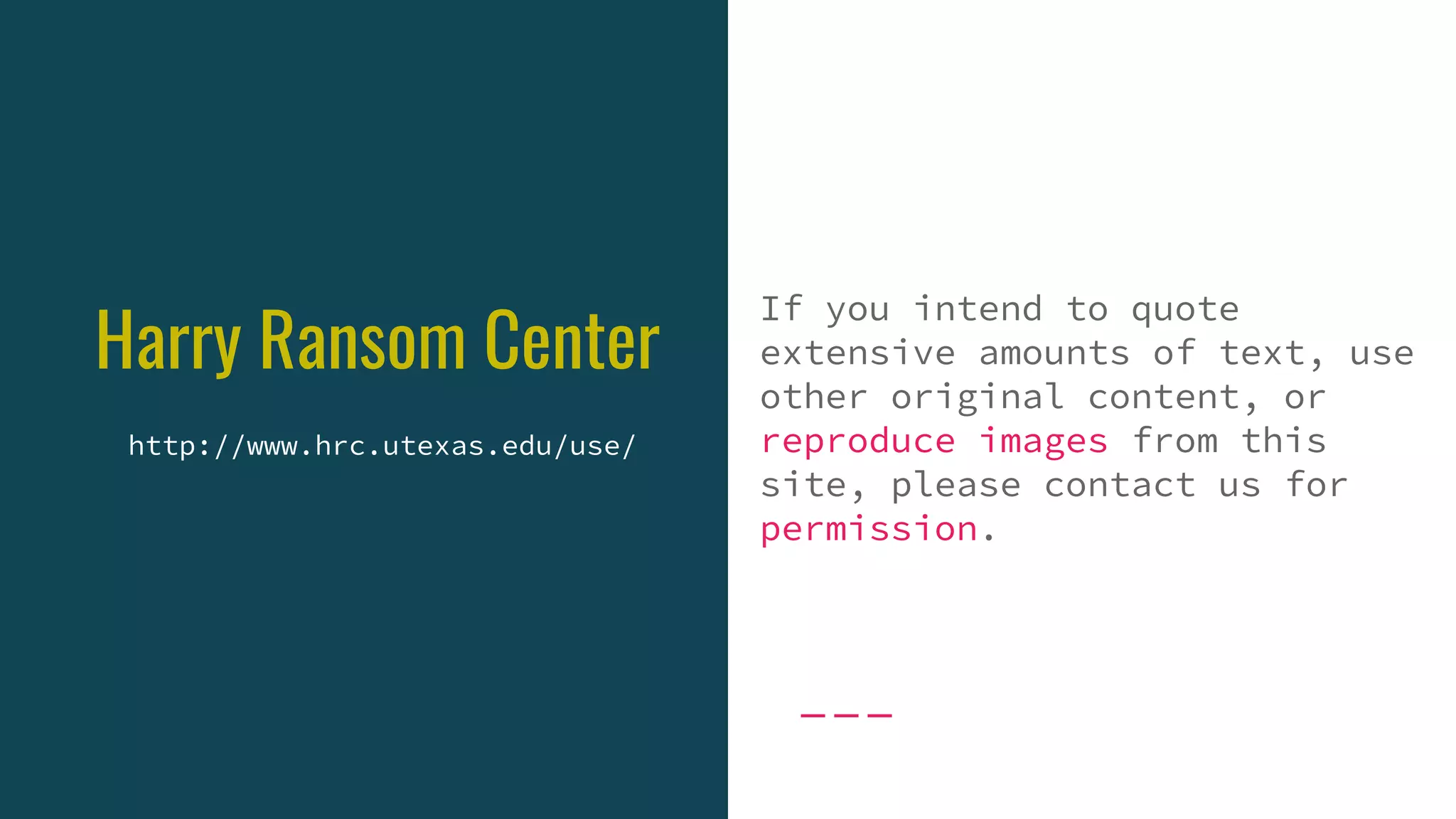
Harry Ransom Center
If you intend to quote
extensive amounts of text, use
other original content, or
reproduce images from this
site, please contact us for
permission.
http://www.hrc.utexas.edu/use/
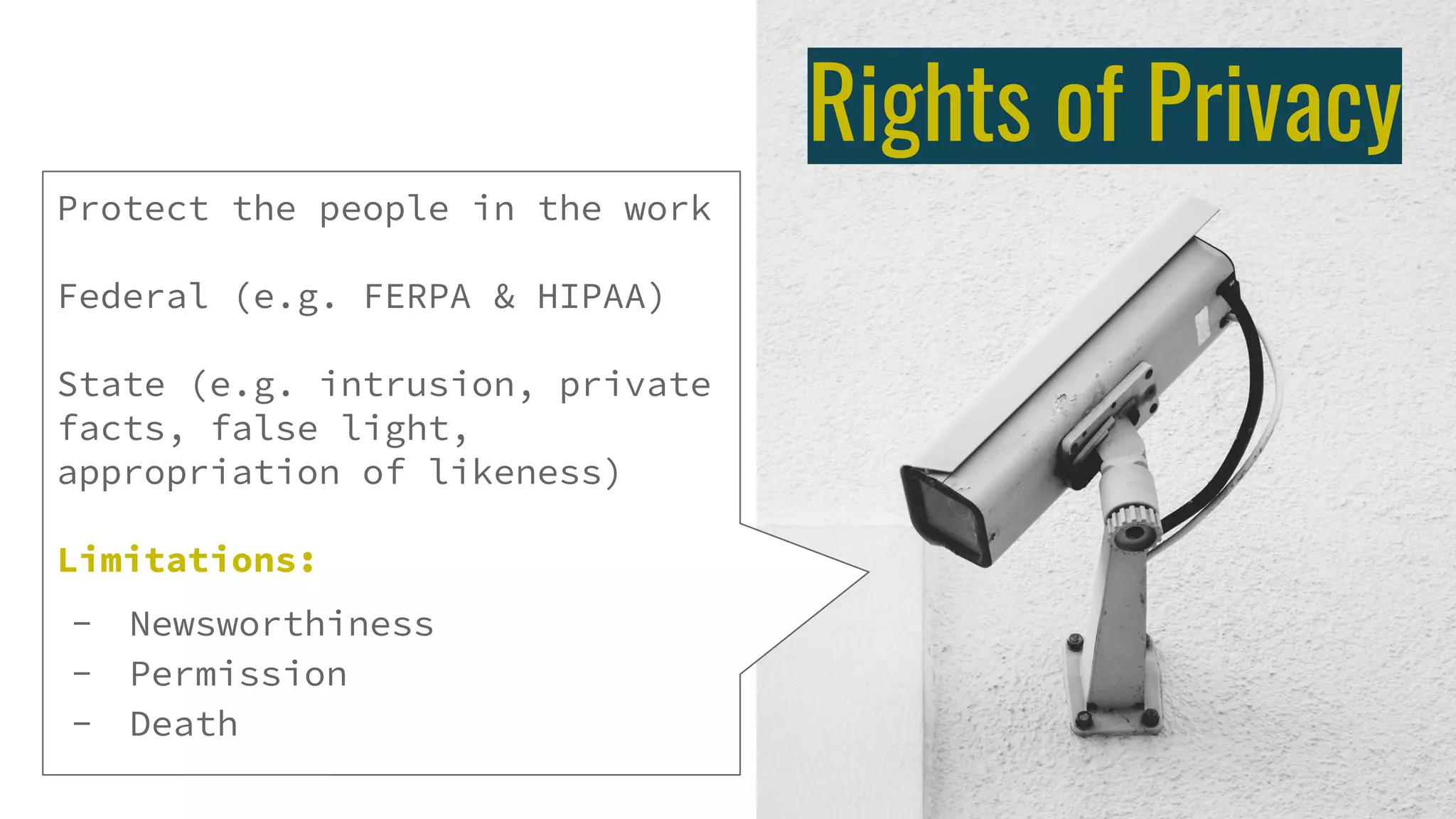
Rights of Privacy
Protect the people in the work
Federal (e.g. FERPA & HIPAA)
State (e.g. intrusion, private
facts, false light,
appropriation of likeness)
Limitations:
- Newsworthiness
- Permission
- Death
Publishing Workflow: Copyright and Other Law & Policy Considerations
Should you
register your
copyright?
Do you want to & can you
license the use of your
work?
4: How do you want
to share?
Questions?
schol-comm@berkeley.edu
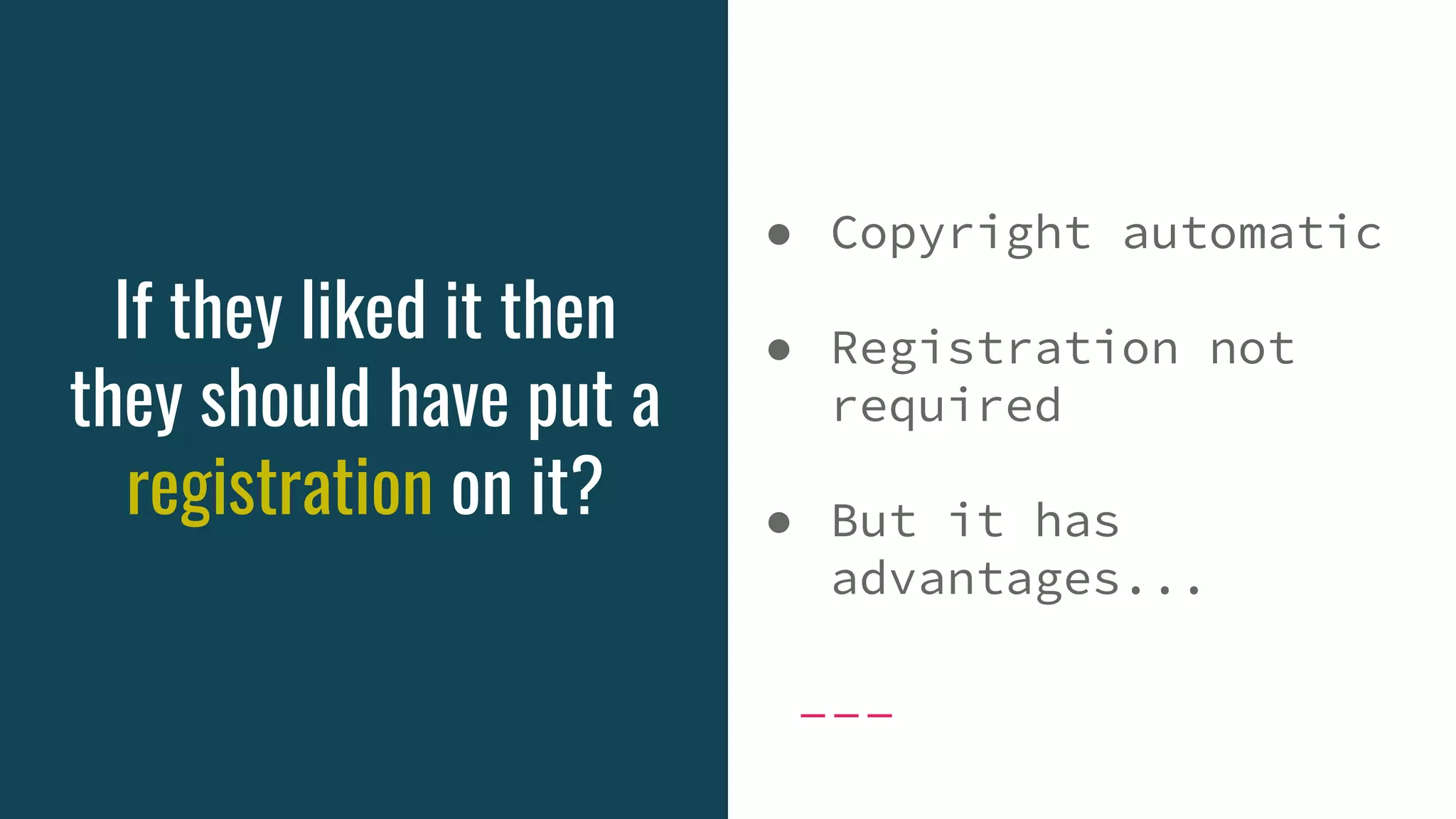
If they liked it then
they should have put a
registration on it?
● Copyright automatic
● Registration not
required
● But it has
advantages...
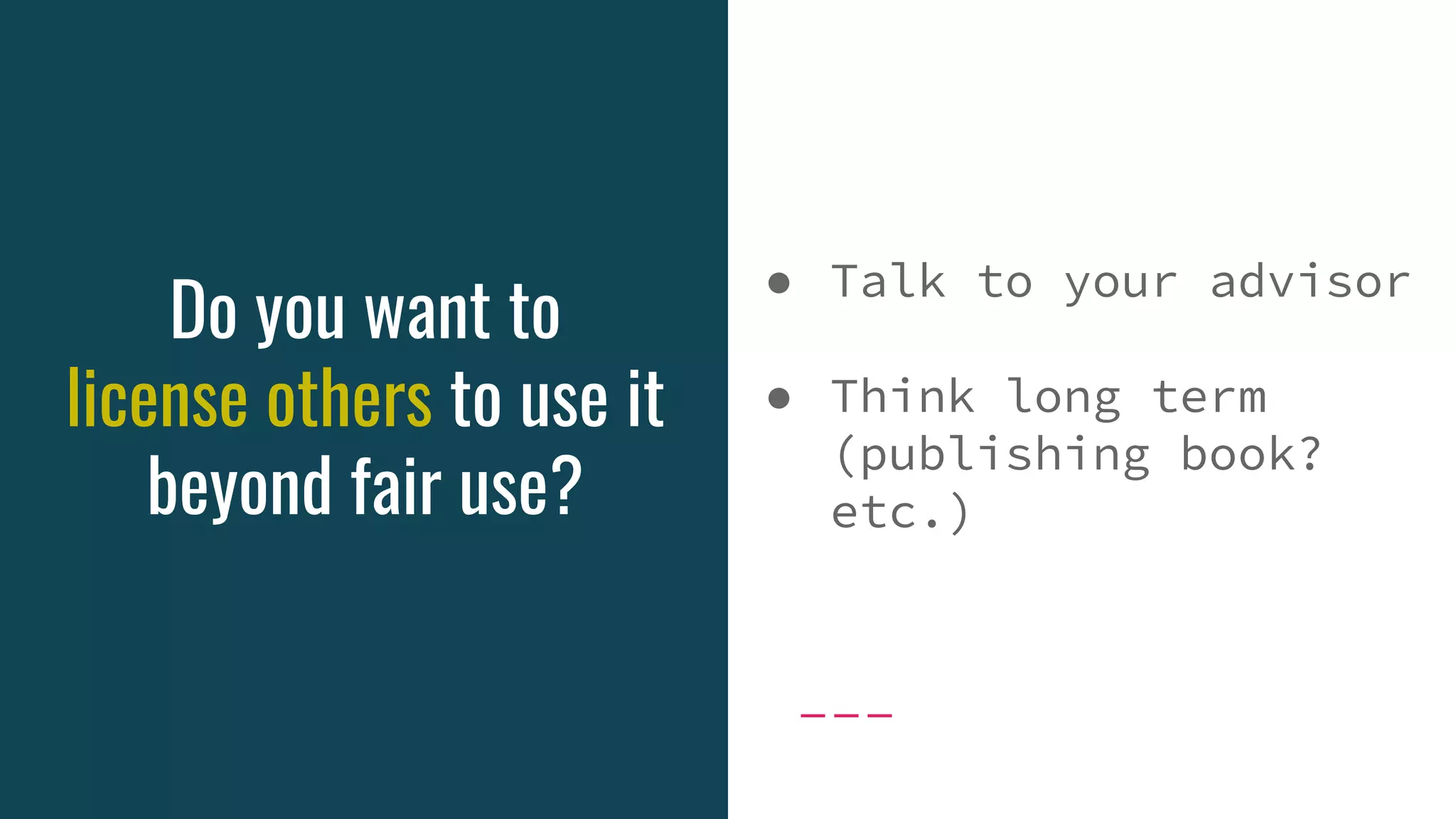
Do you want to
license others to use it
beyond fair use?
● Talk to your advisor
● Think long term
(publishing book?
etc.)
What would you
like to discuss?
Copyright & Fair Use for Digital Projects
THANK YOU!
Let’s talk more…
E-mail:
schol-comm@berkeley.edu
Twitter: @UCB_scholcomm

Copyright (and More) & Your Dissertation

  • 1.
    Copyright & FairUse for Digital Projects Copyright & Your Dissertation Office of Scholarly Communication Services Berkeley Library
  • 2.
    It’s your stuff! Asan author, you have rights Alavi, S. J. (2013). The Poetics of Commitment in Modern Persian: A Case of Three Revolutionary Poets in Iran. UC Berkeley. ProQuest ID: Alavi_berkeley_0028E_14033. Retrieved from: https://escholarship.org/uc/ite m/9vn474vw
  • 3.
    We’ll help you thinkabout other people’s stuff Solution to Viscous Burger’s Equation https://www.researchgate.net/figure/The-solution-to-v iscous-Burgers-equation-11-with-e-0-04_fig1_228445669
  • 4.
    Computational Design, Synthesis,and Structure Property Evaluation of 1,3-Thiazole-Based Color-Tunable Multi-heterocyclic Small Organic Fluorophores as Multifunctional Molecular Materials © Journal of Organic Chemistry Other people’s diagrams or images
  • 5.
    Trieste, Umberto Saba,1910 Ho attraversato tutta la città. Poi ho salita un'erta, popolosa in principio, in là deserta, chiusa da un muricciolo: Trieste, trans. Kline, 2012 I traversed the whole city. Then climbed a hill crowded at first, in the end deserted, closed off by a little wall: http://poetsofmodernity.xyz/POMBR/Italian/FiveItalianPoets.htm#anchor_Toc326225674 Or their text...
  • 6.
    And what itmeans to have permission Translated by A. S. Kline © Copyright 2012 All Rights Reserved This work may be freely reproduced, stored, and transmitted, electronically or otherwise, for any non-commercial purpose.
  • 7.
  • 8.
    “ I alreadycite my sources!”
  • 9.
    Difference between attribution &permission Dan4thNicholas, CC-BY, h2ps://flic.kr/p/8PEZiG Sakaki0214, CC-BY-NC-ND, h2ps://flic.kr/p/9jykF1
  • 10.
    To flow, wehave to know: What is COPYRIGHT? Exclusive rights to make certain uses of original expression for limited period of time Photo by Luis Alfonso Orellana on Unsplash Egypt, Lee Friedlander (1983)
  • 11.
    Exclusive Rights ● Reproduction ●Derivative works ● Distribution ● Public performance ● Public display Egypt, Lee Friedlander (1983)
  • 12.
    Not invoking anyexclusive rights by providing links to lawfully-uploaded content: ● Reproduction ● Derivative works ● Distribution ● Public performance ● Public display Three horizontal rusted chains crossed by two poles https://unsplash.com/photos/TcFq4-ulczU Linking Exclusive Right That’s why it’s always okay to link to lawful.
  • 13.
    Limited Period ● Varies,but at least author’s life + 70 years ● Within the “protected” period, you need author’s permission to reproduce, display, perform, etc. Egypt, Lee Friedlander (1983)
  • 14.
    If copyright givesauthors exclusive rights for so long, how can we ever use anything?
  • 15.
    Limitations: Not everything is copyrightable Expression, notideas or facts World Bank & OECD Data https://data.worldbank.org/indicator/ny.gdp.mktp.kd.zg?locations=eg
  • 16.
  • 17.
    FEDERAL GOVERNMENT WORKSEXPIRED COPYRIGHT https://collections.mf a.org/download/145766; jsessionid=A68AB39B7F8 1E3B37CF5F0EA41269429 https://www.loc.gov/it em/webcast-6177 Limitations: Not everything is copyrightable Public Domain
  • 18.
    Okay, but ifit *is* protected, how can we ever use anything? EXCEPTIONS
  • 19.
    Fair Use 17 U.S.C.§ 107 The fair use of a copyrighted work…for purposes such as criticism, comment, news reporting, teaching…, scholarship, or research, is not an infringement of copyright.
  • 20.
    e.g. Comparing visual representationsof Turkey George Georgiou, http://www.georgegeorgiou.net/projects.php 1. Purpose & character Commercial vs. non-commercial; whether “transformative” 2. Nature of copyrighted work Factual/scholarly work vs. more creative; published? 3. Amount and substantiality Size & importance of portion used in relation to whole 4. Effect on potential market Whether supplants market for purchasing/licensing original
  • 21.
    Still in ©and use exceeds fair use? Need a license (i.e. permission) Can be pre-applied
  • 22.
  • 23.
    Publishing Workflow: Copyrightand Other Law & Policy Considerations 1: Do you need permission? Has a license already been granted? Is the work protected by copyright? Would publishing the content be fair use? If yes to any, go to Step 3. 2: Seek permission if needed Research who holds copyright & send request Keep records for your files Ensure permission covers all intended uses 3: Address non-© law & policy concerns Contractual or terms of service restrictions from archives, databases, or websites? Concerns about rights of privacy or publicity? Should you register your copyright? Do you want to & can you license the use of your work? 4: How do you want to share? Questions? schol-comm@berkeley.edu Ethical concerns or norms re: certain types of info?
  • 24.
    Publishing Workflow: Copyrightand Other Law & Policy Considerations Questions? schol-comm@berkeley.edu 1: Do you need permission? Has a license already been granted? Is the work protected by copyright? Would publishing the content be fair use? If yes to any, go to Step 3.
  • 25.
    Practice Applying Step1 By Miguel de Cervantes Saavedra (Author), Tom Lathrop (Translator), Penguin Classics
  • 26.
    Practice Applying Step1 Heme Molecule
  • 27.
    Practice Applying Step1 Heart By Tvanbr (Own work) [Public domain], via Wikimedia Commons https://commons.wikimedia.org/wiki/File%3AAnatomy_Heart_Latin_Tiesworks.jpg
  • 28.
    Layers of Step1 Van Gogh, Irises, 1889, Getty Museum Stile Arte, 2011. http://www.stilearte.it/dipingere-come- van-gogh-tanti-tutorial/
  • 29.
    Publishing Workflow: Copyrightand Other Law & Policy Considerations 2: Seek permission if needed Research who holds copyright & send request Keep records for your files Ensure permission covers all intended uses Questions? schol-comm@berkeley.edu
  • 30.
  • 31.
    Get permission for whatyou need “The image may be displayed in eBook format for a period of up to ten years only. All future editions, reprints, translations, or formats (including electronic media) must be negotiated separately.” Robert Rauschenberg, “Bed” Image file MOMA
  • 32.
  • 33.
    Publishing Workflow: Copyrightand Other Law & Policy Considerations 3: Address non-© law & policy concerns Contractual or terms of service restrictions from archives, databases, or websites? Concerns about rights of privacy or publicity? Questions? schol-comm@berkeley.edu Ethical concerns or norms re: certain types of info?
  • 34.
  • 35.
    Archives I understand thatpermission to publish, or otherwise publicly use, materials...must be [granted by library] I understand further that the University makes no representation that it is the owner of the copyright... and that permission to publish must also be obtained from the owner of the copyright.
  • 36.
  • 37.
    Harry Ransom Center Ifyou intend to quote extensive amounts of text, use other original content, or reproduce images from this site, please contact us for permission. http://www.hrc.utexas.edu/use/
  • 38.
    Rights of Privacy Protectthe people in the work Federal (e.g. FERPA & HIPAA) State (e.g. intrusion, private facts, false light, appropriation of likeness) Limitations: - Newsworthiness - Permission - Death
  • 39.
    Publishing Workflow: Copyrightand Other Law & Policy Considerations Should you register your copyright? Do you want to & can you license the use of your work? 4: How do you want to share? Questions? schol-comm@berkeley.edu
  • 40.
    If they likedit then they should have put a registration on it? ● Copyright automatic ● Registration not required ● But it has advantages...
  • 41.
    Do you wantto license others to use it beyond fair use? ● Talk to your advisor ● Think long term (publishing book? etc.)
  • 42.
  • 43.
    Copyright & FairUse for Digital Projects THANK YOU! Let’s talk more… E-mail: schol-comm@berkeley.edu Twitter: @UCB_scholcomm