Licensing
Research Data
for Reuse
Rachael G. Samberg, JD, MLIS
Framing
Problems
Legal interoperability of
research data:
Principles and
implementation
guidelines.
RDA-CODATA, 2016
An individual researcher may produce original data,
but the rights are controlled by the employing
institution.
A researcher may combine many data sources, but one
or more of those data sources have restrictions placed
on them…and make the derivative dataset subject to
the restrictions of the most restrictive data source.
We’ll Discuss
▪ Do we own our data? Can we share it?
▪ What can we use & publish from other people?
▪ How do we license our data for use by others?
▪ A workflow for answering these questions
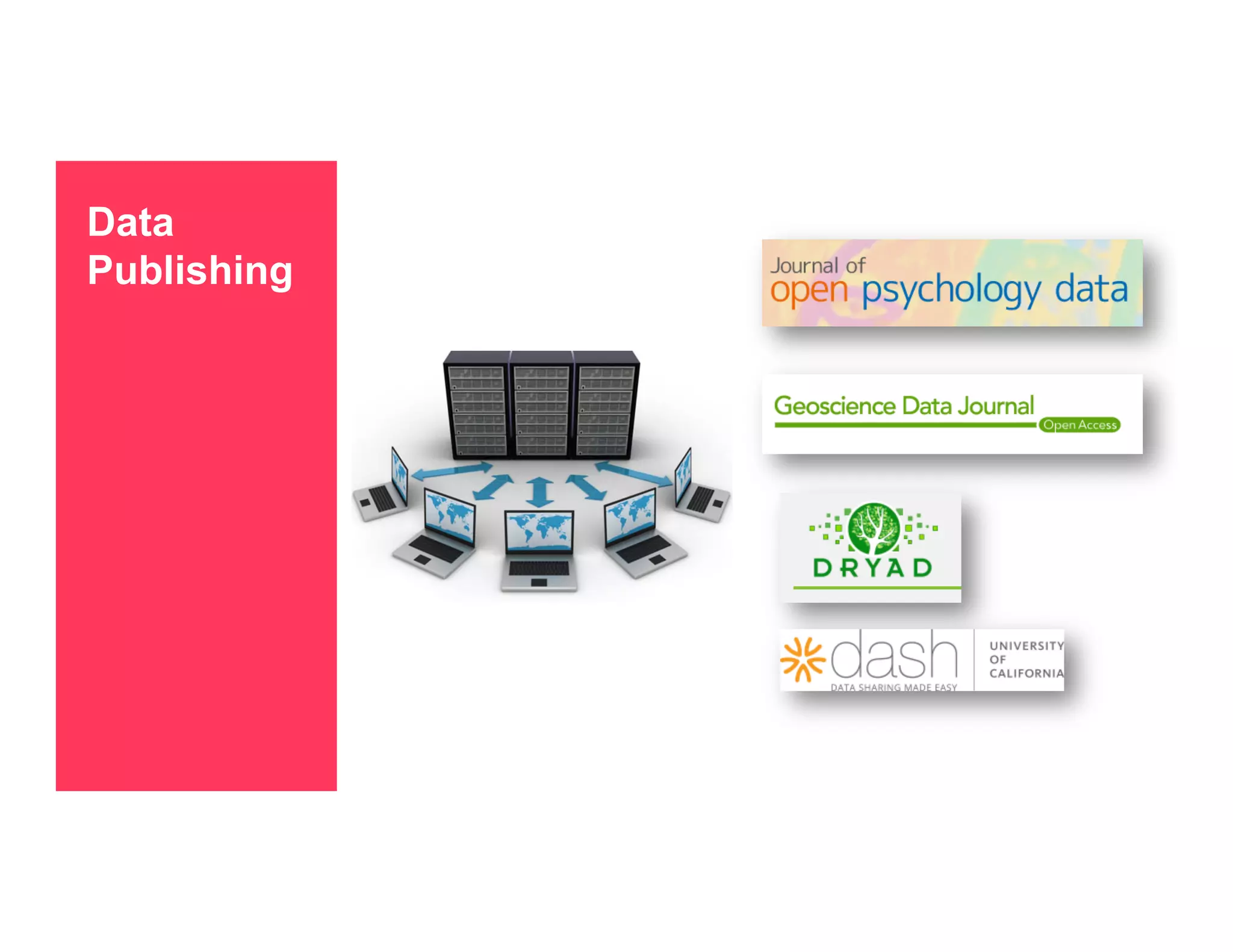
Data Publishing vs.
Data Licensing
Data
Publishing
Data
Licensing
“ Can’t I just cite data I’m using,
or can’t someone just cite
mine?
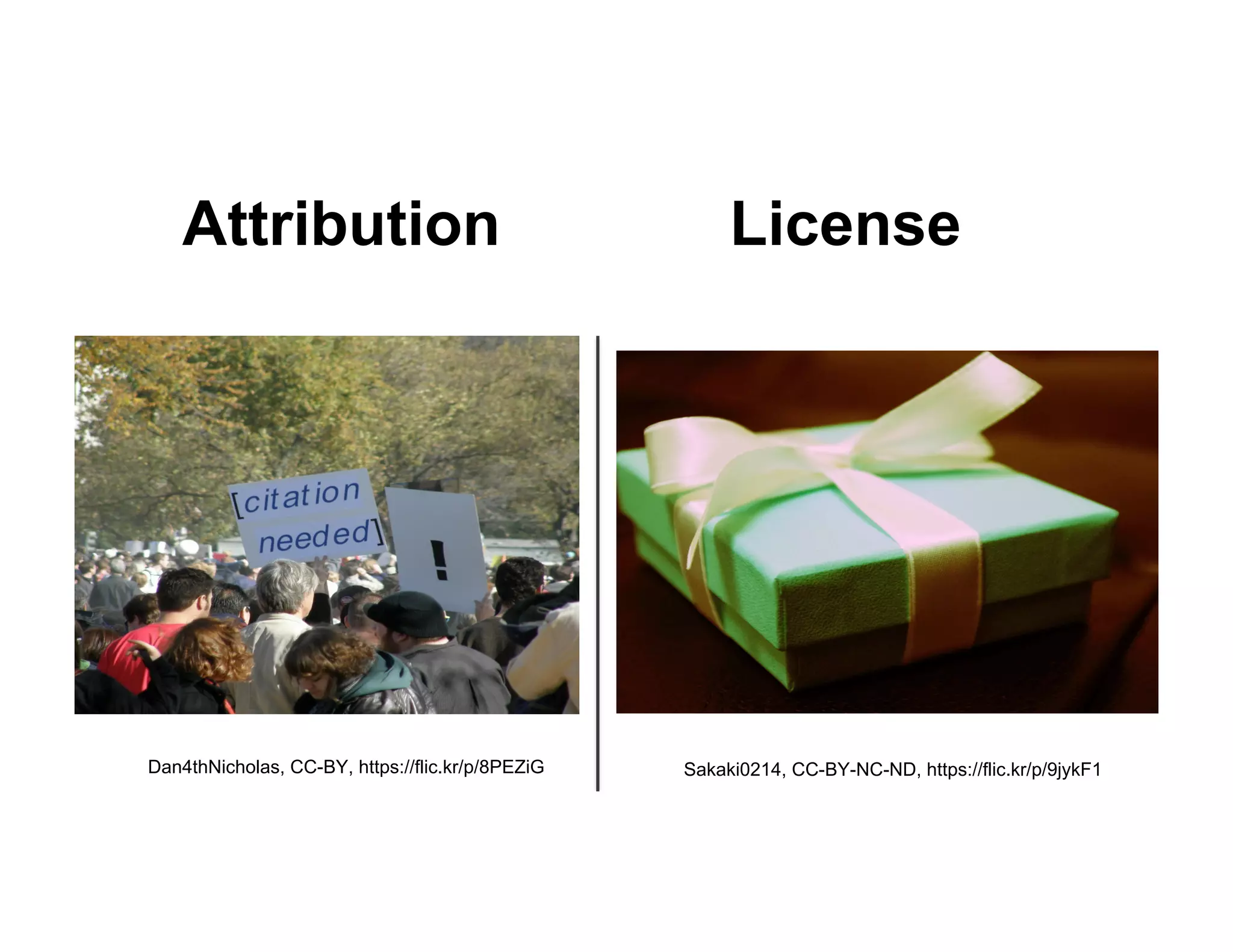
Attribution License
Dan4thNicholas, CC-BY, https://flic.kr/p/8PEZiG Sakaki0214, CC-BY-NC-ND, https://flic.kr/p/9jykF1
Why do we license?
▪ Funder mandates
▪ Transparency & reproducibility
▪ Increase scholarly impact
▪ Downstream innovation
▪ Support the commons
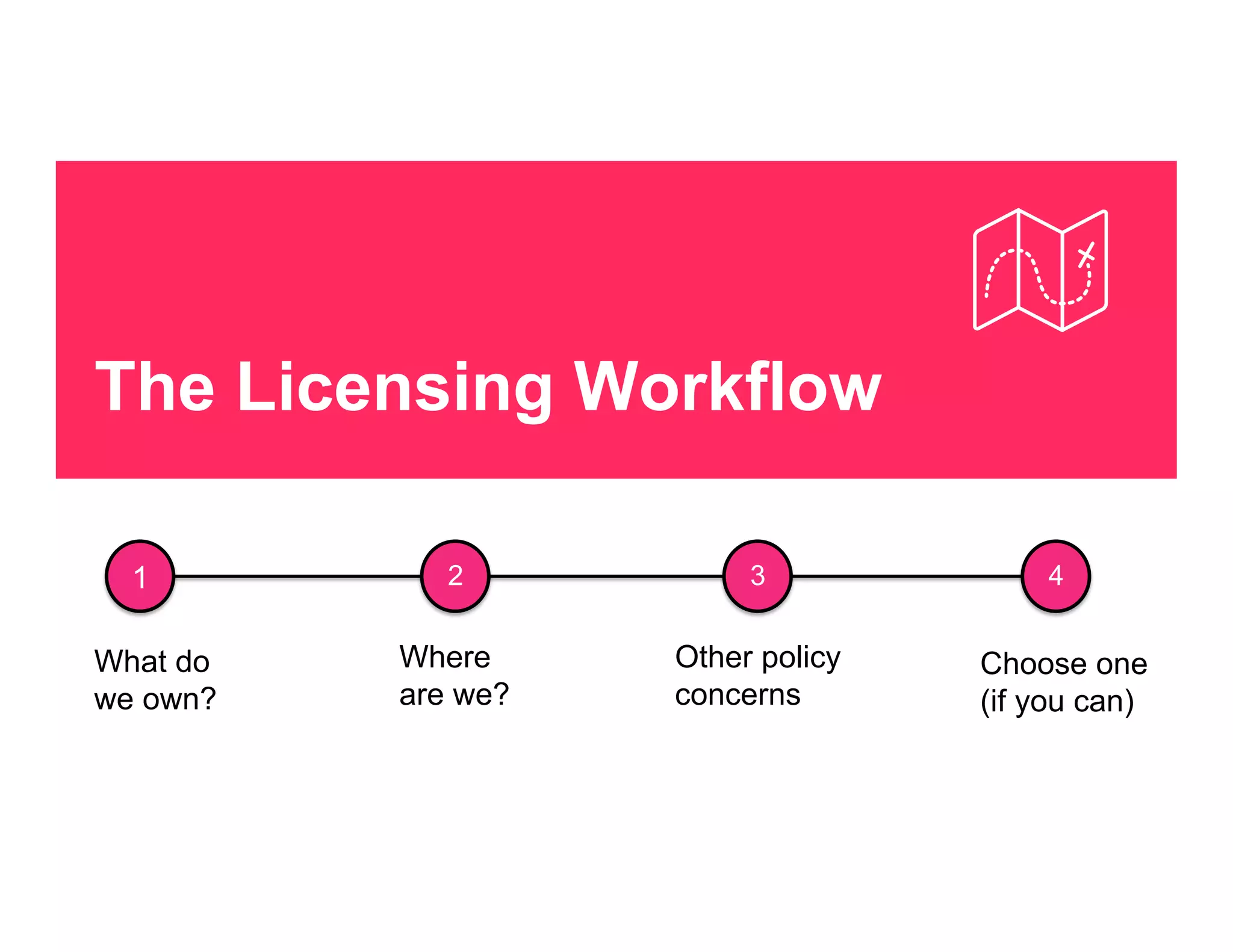
The Licensing Workflow
1 2 3
What do
we own?
Where
are we?
Other policy
concerns
4
Choose one
(if you can)
1. What do we own?
1
1a. Copyright
Exclusive rights to make certain uses
for limited period of time
What is copyright?
Reward of
Exclusive Rights
▪ Reproduction
▪ Derivative works
▪ Distribution
▪ Public performance
▪ Public display
…for limited
periods of time
Varies, but at least author’s life + 70 years
Within “protected” period,
author’s permission needed to
reproduce, display, perform, etc.
A Few Other © Prerequisites
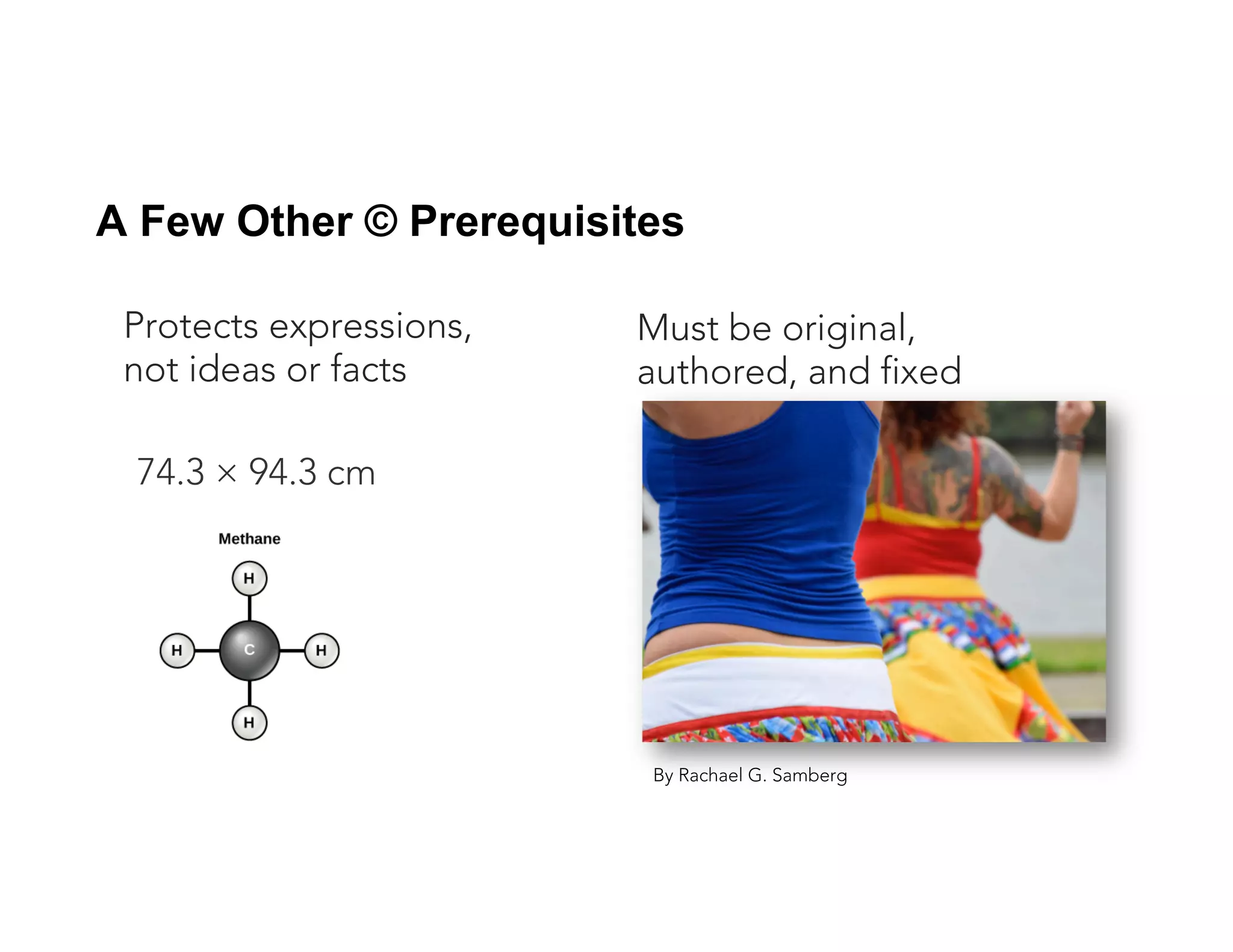
Protects expressions,
not ideas or facts
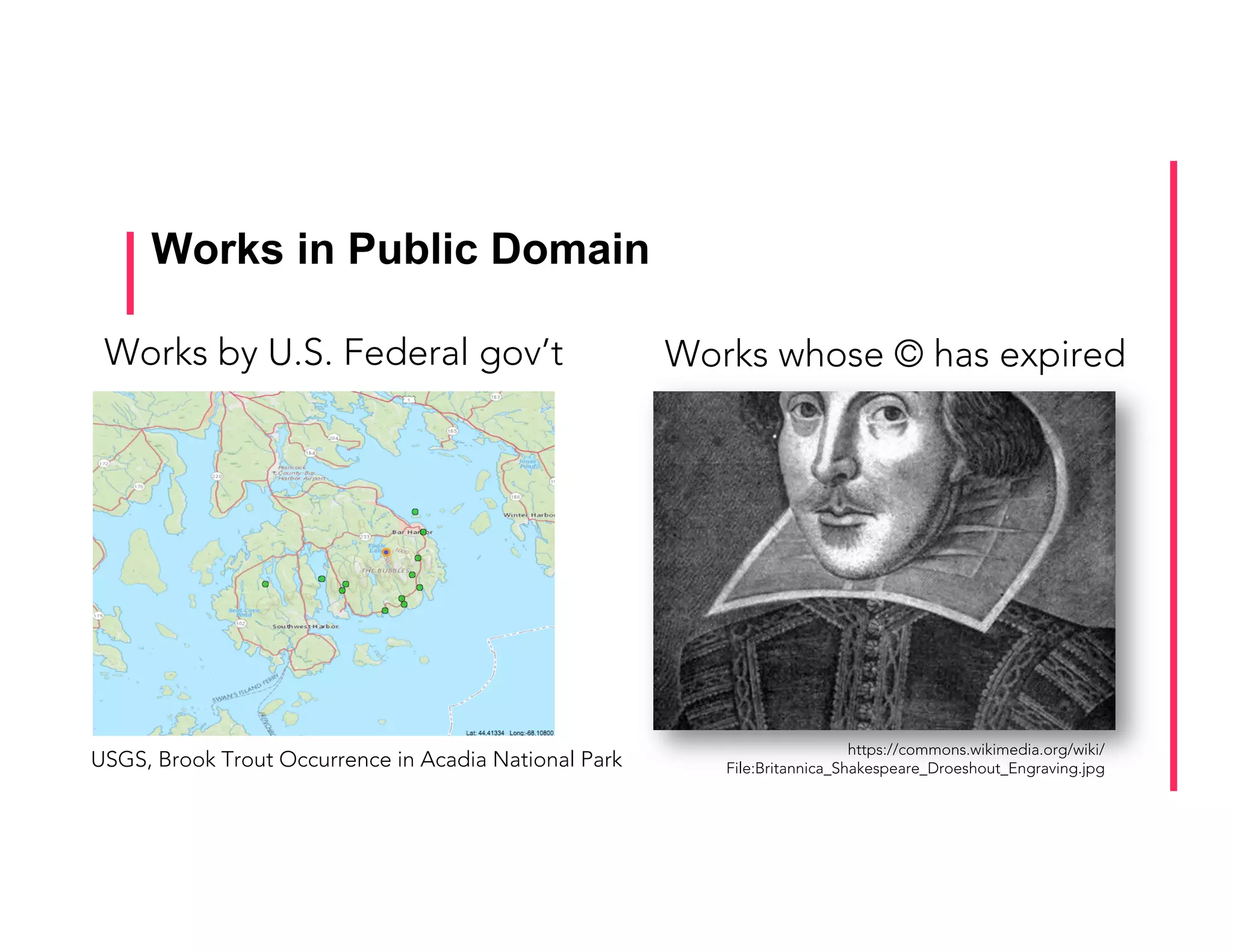
Must be original,
authored, and fixed
By Rachael G. Samberg
74.3 × 94.3 cm
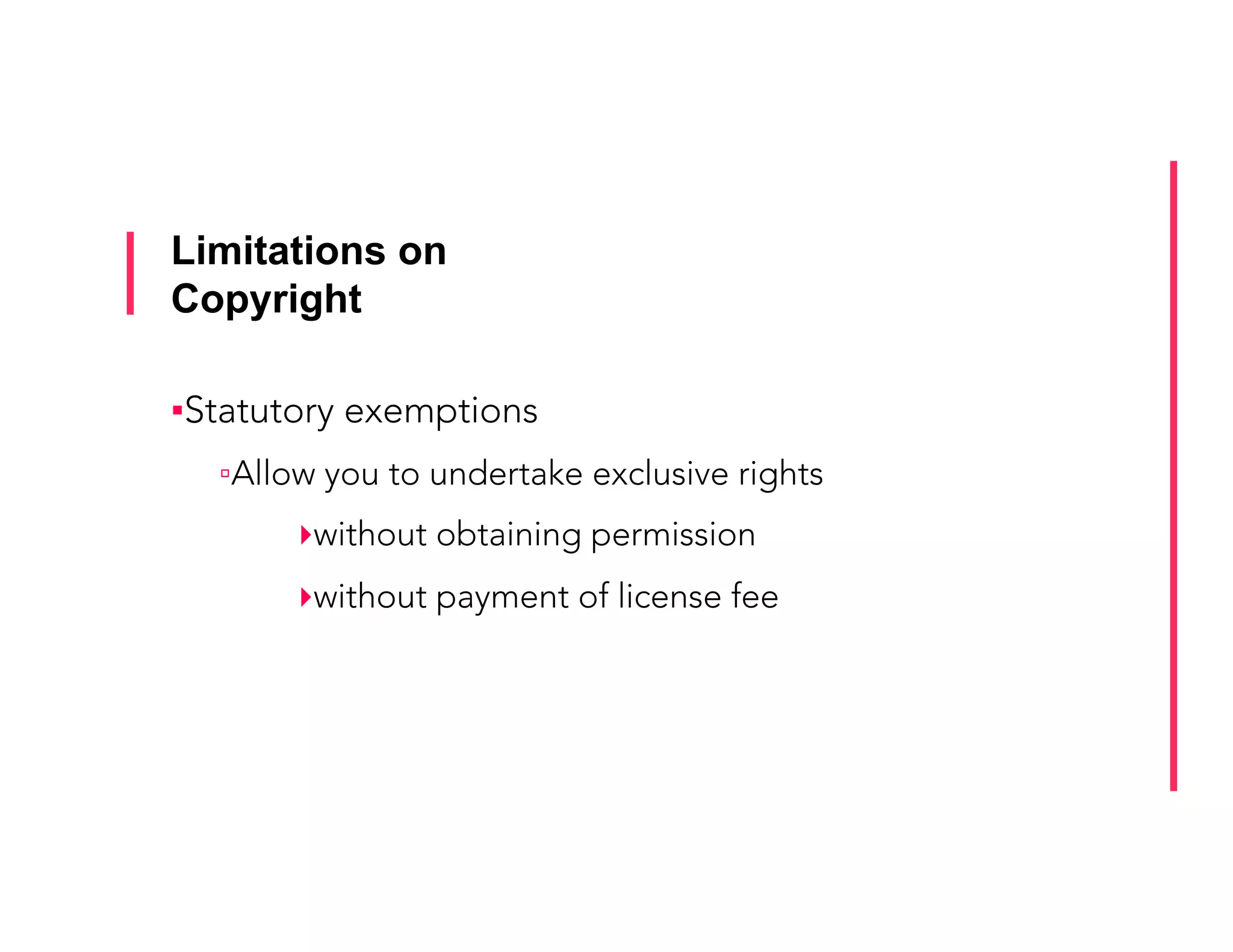
Works in Public Domain
https://commons.wikimedia.org/wiki/
File:Britannica_Shakespeare_Droeshout_Engraving.jpg
Works whose © has expiredWorks by U.S. Federal gov’t
USGS, Brook Trout Occurrence in Acadia National Park
Limitations on
Copyright
▪ Statutory exemptions
▫ Allow you to undertake exclusive rights
▸ without obtaining permission
▸ without payment of license fee
Statutory Exemption: Fair Use
1. Purpose & character of use
(commercial purposes less likely fair than
nonprofit educational; whether use is
“transformative” often dominates)
2. Nature of copyrighted work
(more likely fair if you’re using factual/
scholarly work)
3. Amount and substantiality
(size & importance of portion used in
relation to whole)
4. Effect on potential market
(less likely fair if use is substitute for
purchasing original)By Rachael G. Samberg
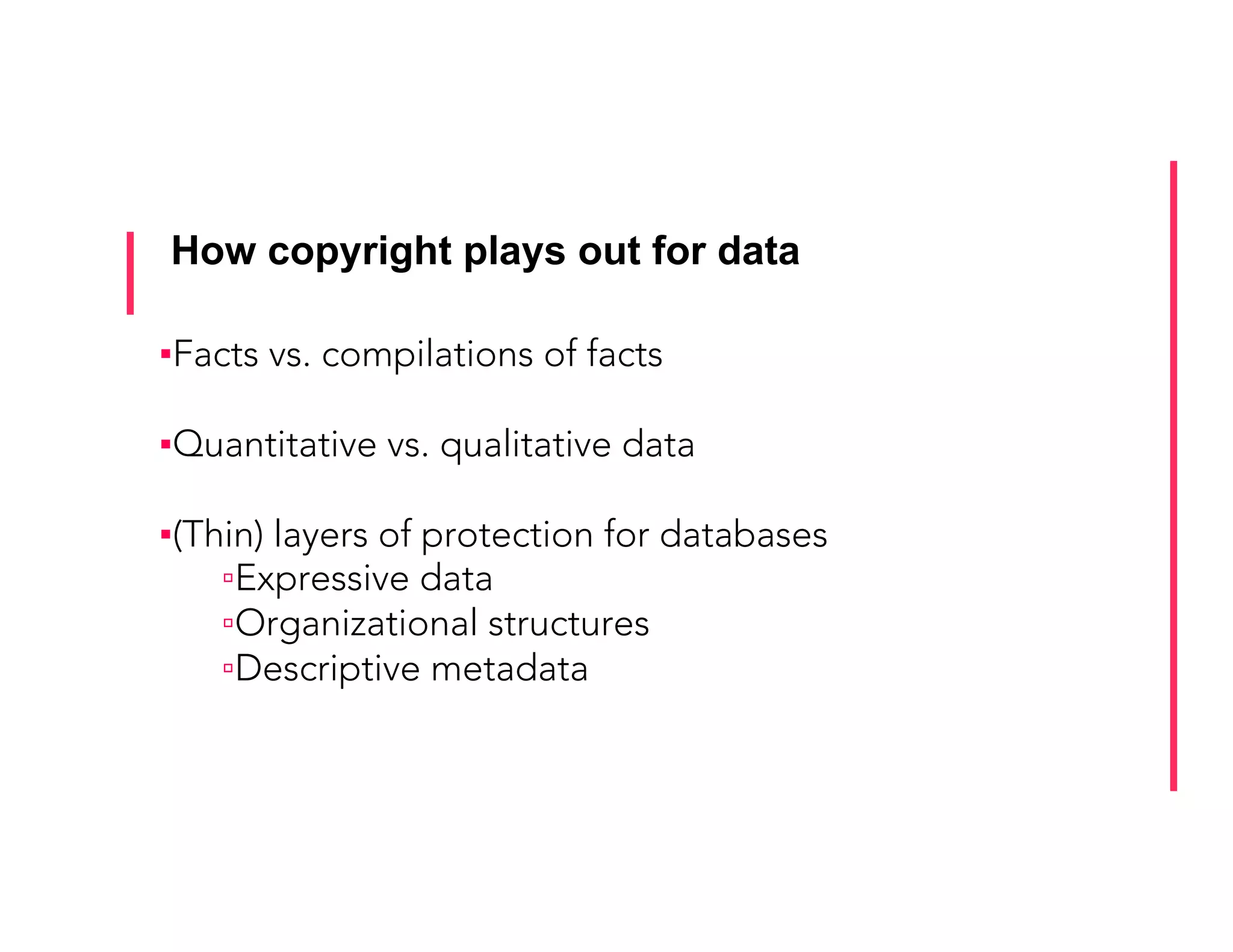
How copyright plays out for data
▪ Facts vs. compilations of facts
▪ Quantitative vs. qualitative data
▪ (Thin) layers of protection for databases
▫ Expressive data
▫ Organizational structures
▫ Descriptive metadata
1b. What
agreements have we
entered into?
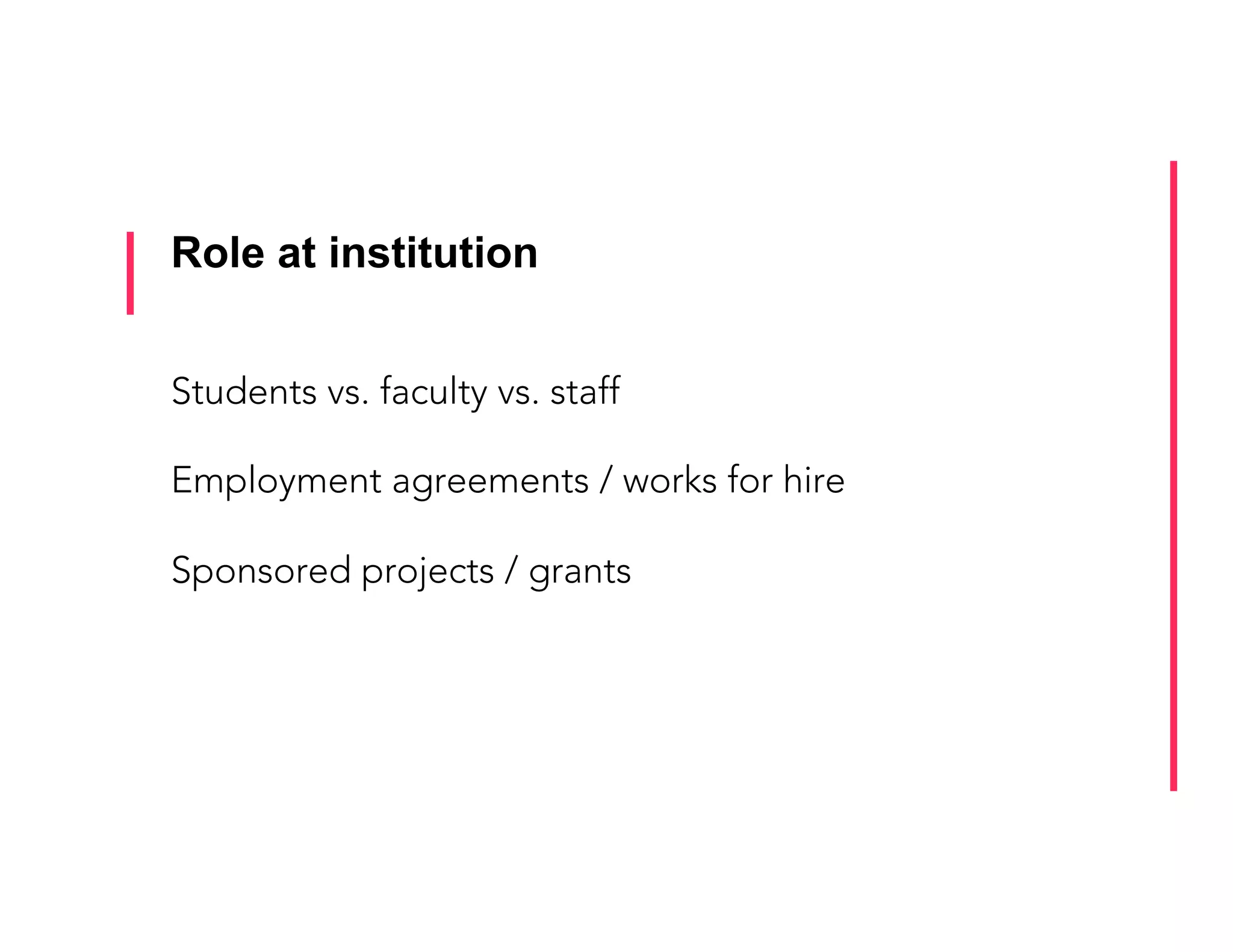
Role at institution
Students vs. faculty vs. staff
Employment agreements / works for hire
Sponsored projects / grants
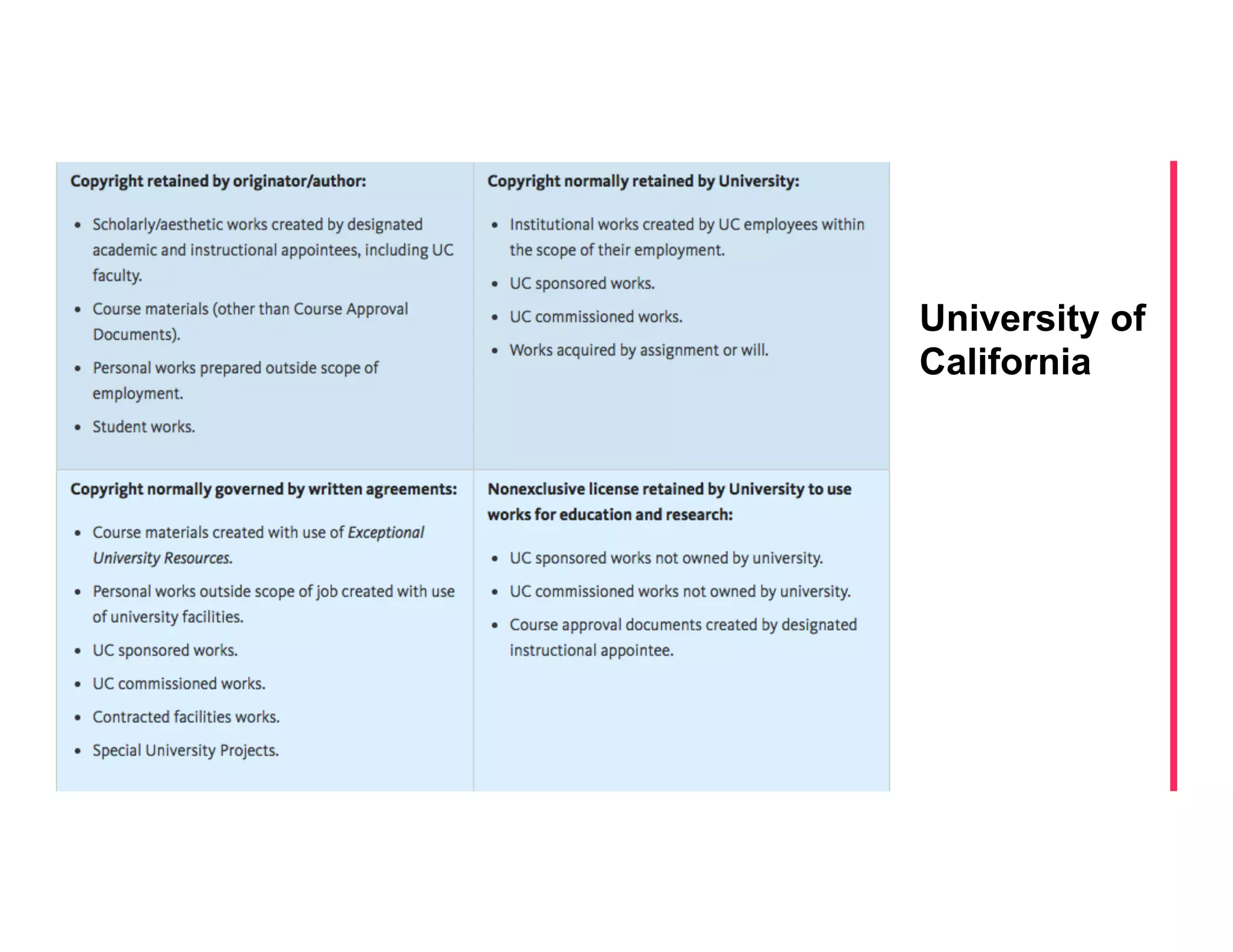
University of
California
Source of Data
Website or repository terms of use
Database license agreement signed by institution
Permission from other researchers
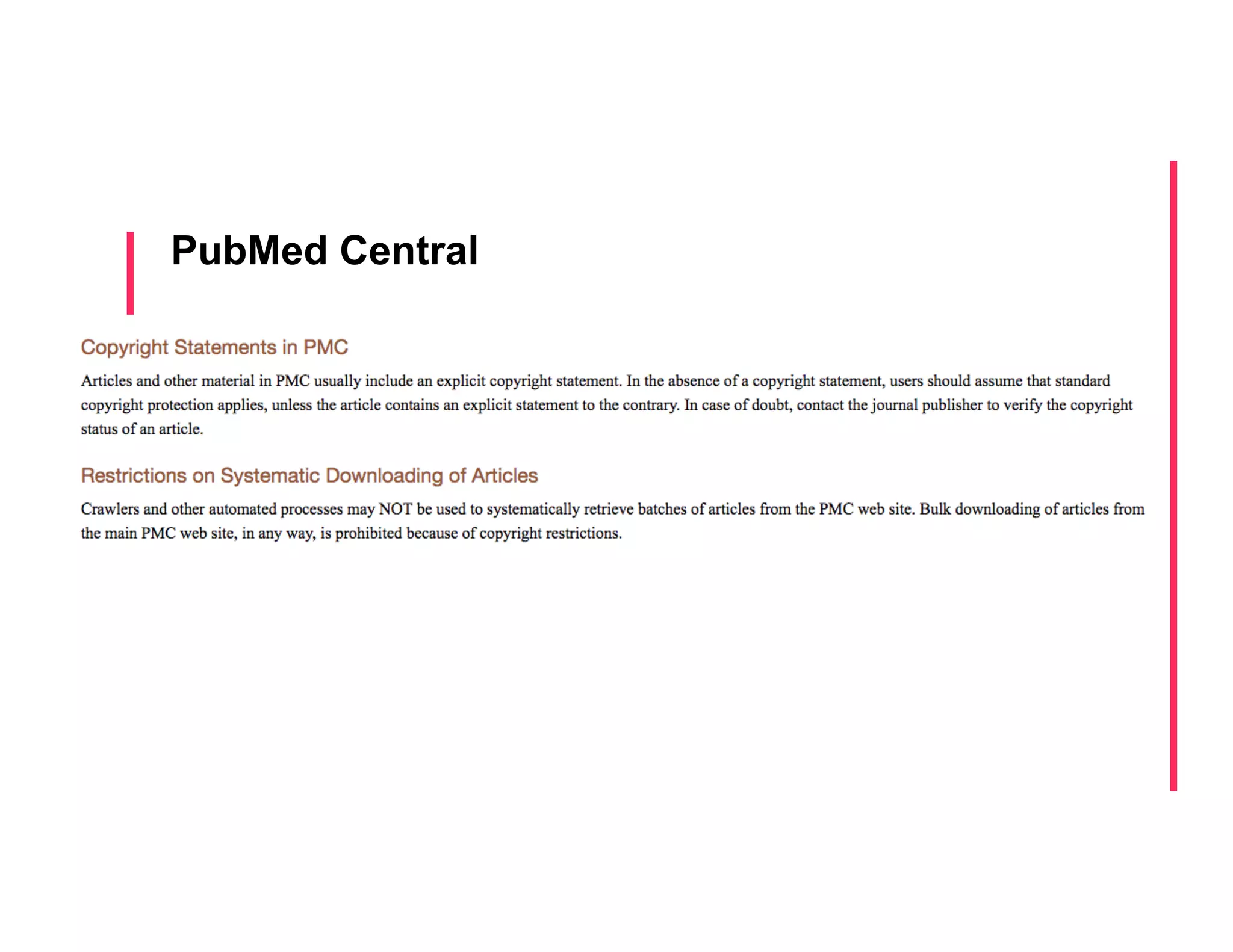
PubMed Central
2. Where are we?
2
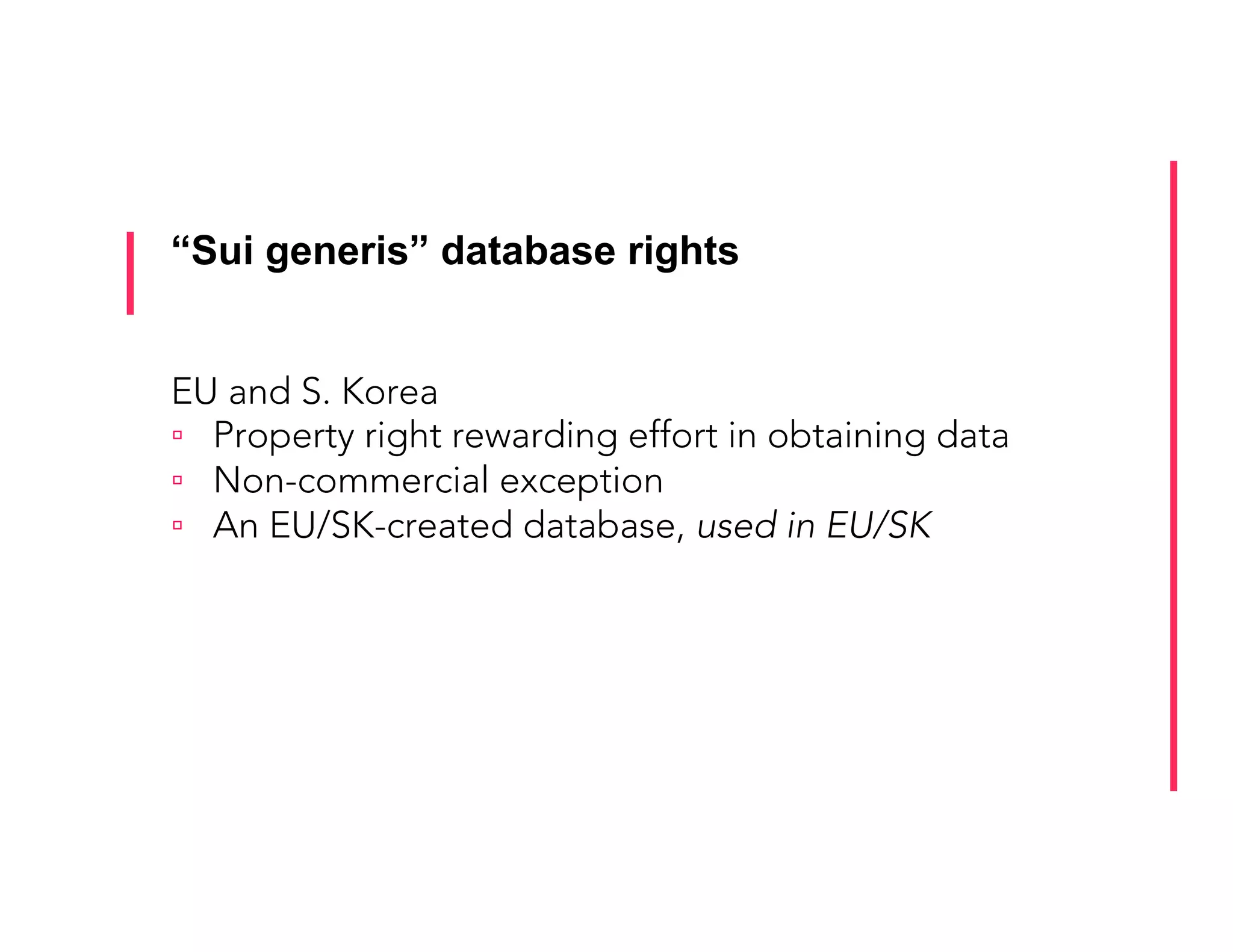
“Sui generis” database rights
EU and S. Korea
▫  Property right rewarding effort in obtaining data
▫  Non-commercial exception
▫  An EU/SK-created database, used in EU/SK
3. Other policy concerns
3
3a.
Personal Privacy
& Confidential
Information
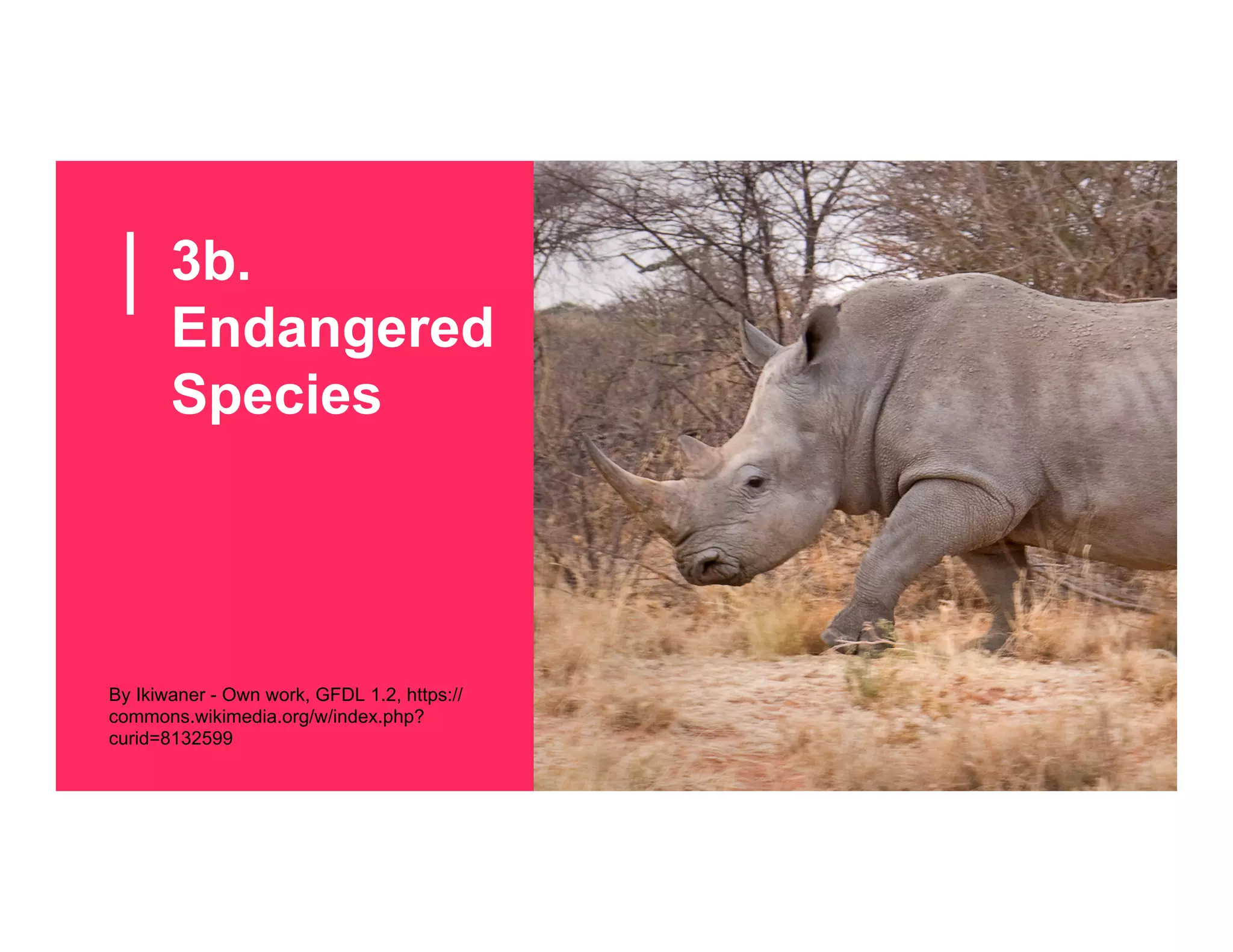
3b.
Endangered
Species
By Ikiwaner - Own work, GFDL 1.2, https://
commons.wikimedia.org/w/index.php?
curid=8132599
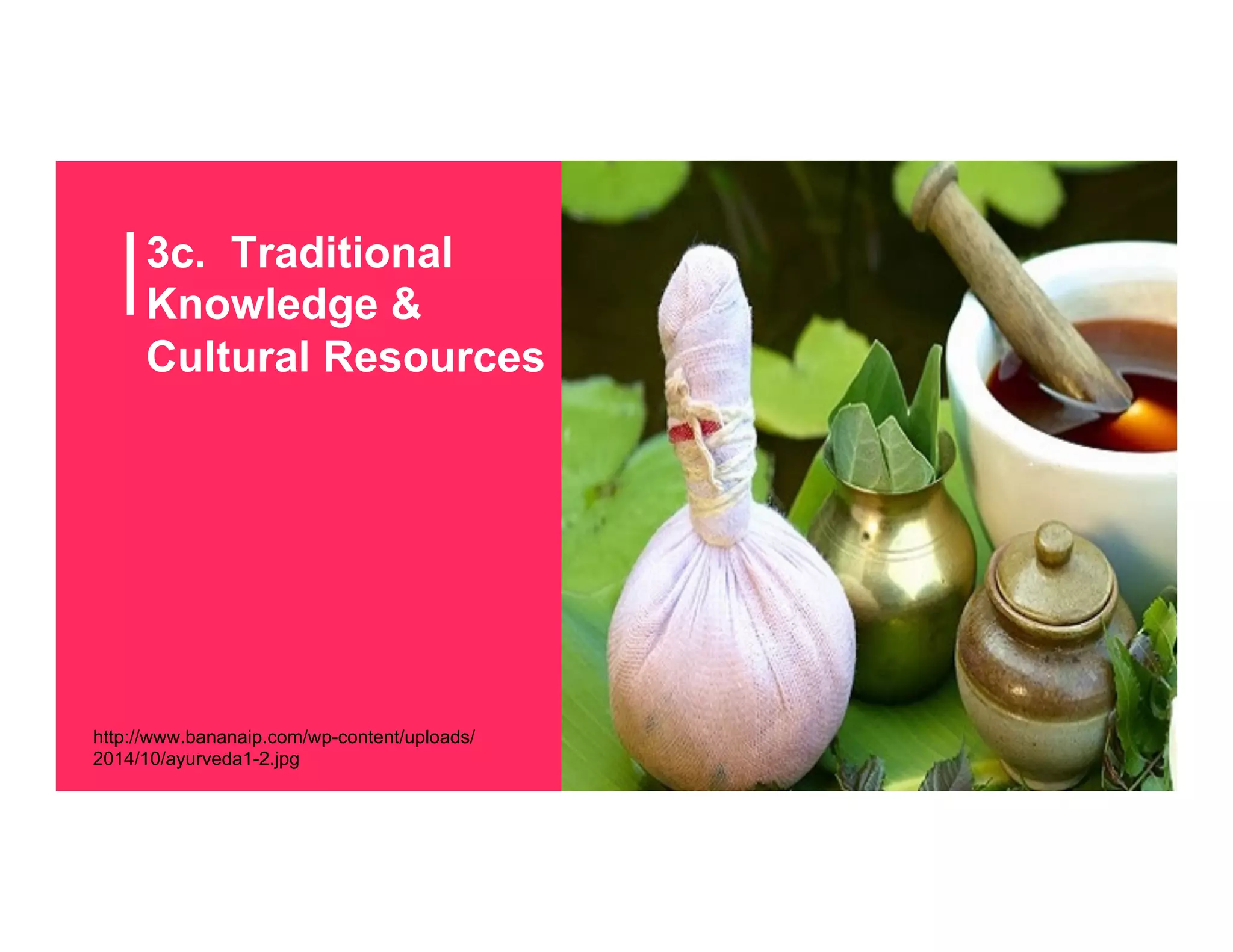
3c. Traditional
Knowledge &
Cultural Resources
http://www.bananaip.com/wp-content/uploads/
2014/10/ayurveda1-2.jpg
3d. Embargoes
4. Choosing Licenses
4
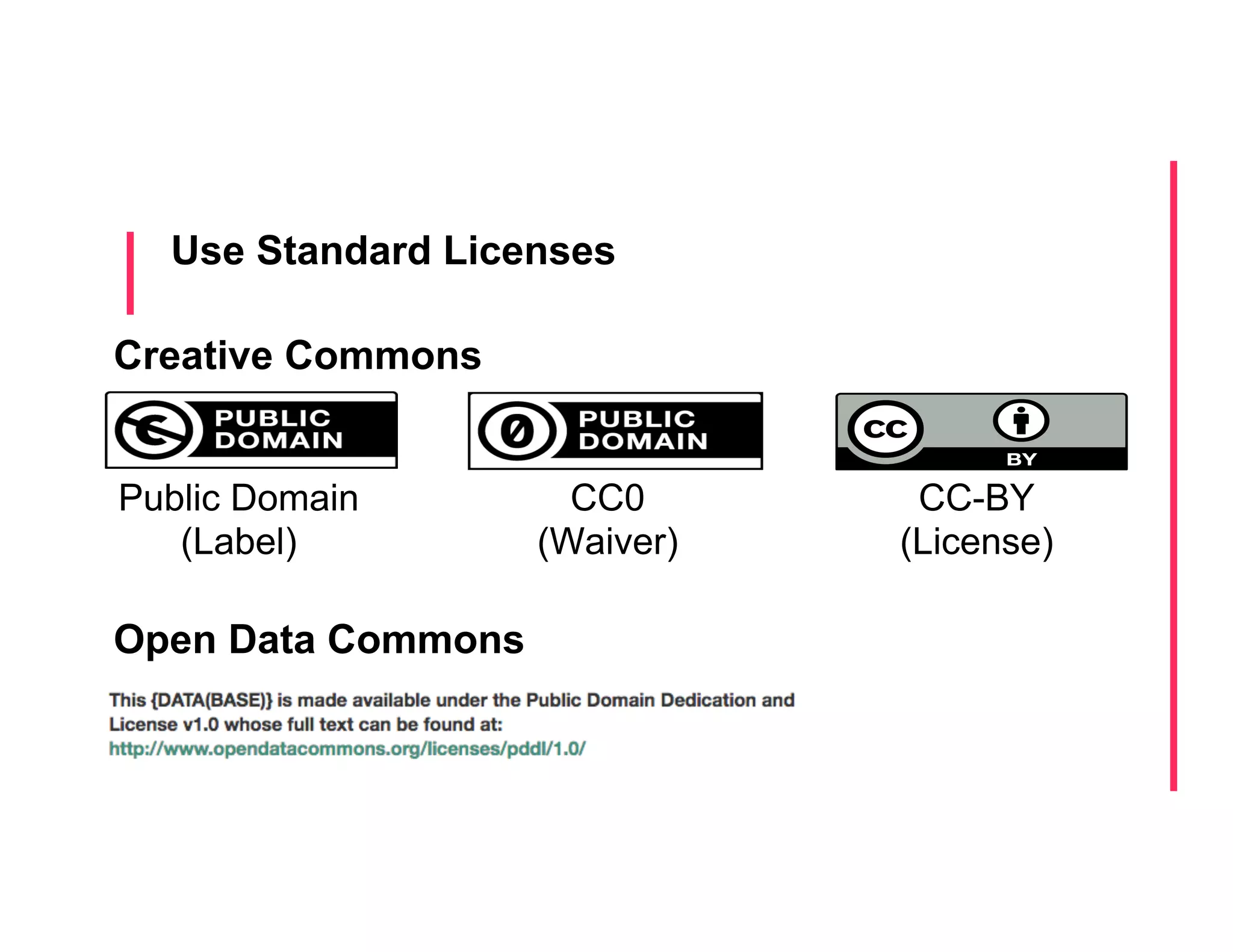
CC0
(Waiver)
Public Domain
(Label)
CC-BY
(License)
Use Standard Licenses
Open Data Commons
Creative Commons
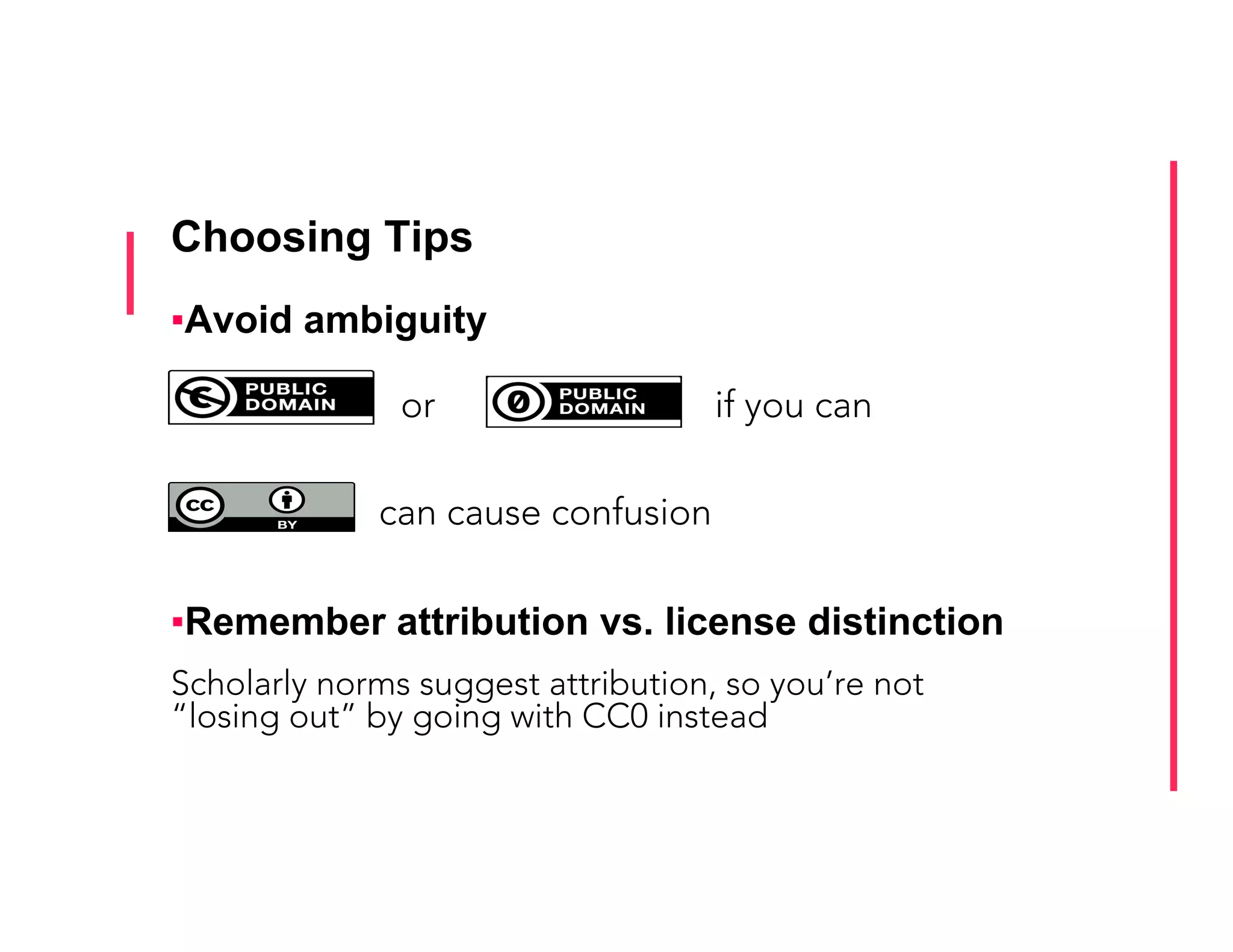
Choosing Tips
▪ Avoid ambiguity
or if you can
can cause confusion
▪ Remember attribution vs. license distinction
Scholarly norms suggest attribution, so you’re not
“losing out” by going with CC0 instead
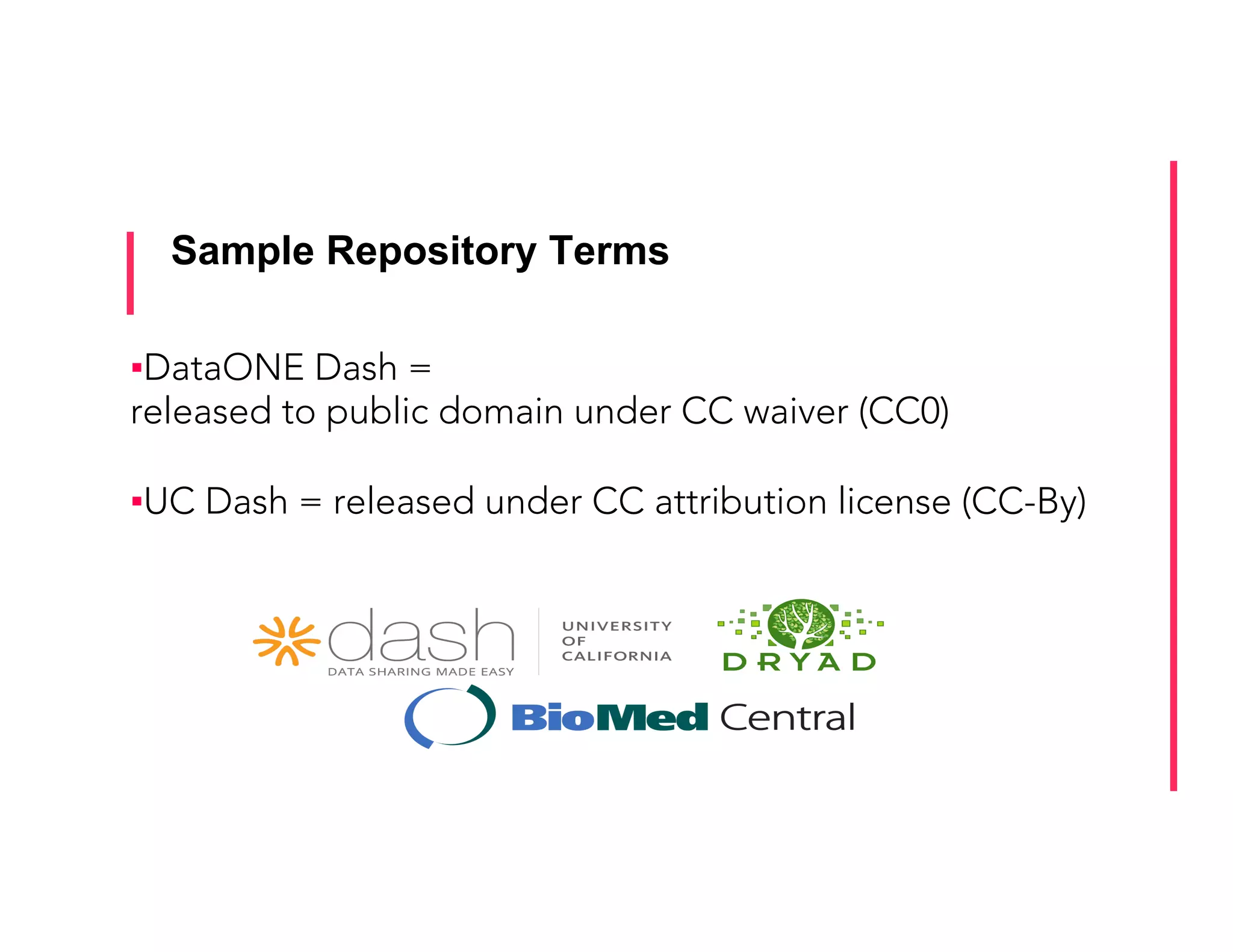
Sample Repository Terms
▪ DataONE Dash =
released to public domain under CC waiver (CC0)
▪ UC Dash = released under CC attribution license (CC-By)
Exercise
http://bit.ly/LRD0803
Thanks!
!!
More
http://www.lib.berkeley.edu/scholarly-communication/
publishing/lifecycle/your-data
Sources
BioMed Central (2016). Policies – Open Data. Available at https://www.biomedcentral.com/about/policies/open-data.
Briney, K., Goben, A., & Zilinski, L. (2015) Do you have an institutional data policy? A review of the current landscape of library
data services and institutional data policies. Journal of Librarianship and Scholarly Communication, 3(2), eP1232,
http://dx.doi.org/10.7710/2162-3309.1232.
Carroll, M.W. (2015). Sharing research data and intellectual property law: A primer. PLOS Biol, 13(8): e1002235. doi: 10.1371/
journal.pbiol.1002235.
Fortney, K. (2016, Sep 8). Who ‘owns’ your data? Office of Scholarly Communication Blog, available at
http://osc.universityofcalifornia.edu/2016/09/who-owns-your-data/.
Fortney, K. (2016, Sep 15). CC By & data: Not always a good fit. Office of Scholarly Communication Blog, available at
http://osc.universityofcalifornia.edu/2016/09/who-owns-your-data/.
Levine, M. (2014). Copyright, open data, and the availability-usability gap, in Research Data Management: Practical Strategies for
Information Professionals (J.M. Ray, ed.), Purdue, In.: Purdue University Press.
Nimmer et al. (2015). Nimmer on Copyright, 8-4, Section 102.
Open Data Commons (n.d.) Public domain dedication and license. Available at https://opendatacommons.org/licenses/pddl/
Open Knowledge Foundation (n.d.) Why open data? Available at https://okfn.org/opendata/why-open-data/.
RDA-CODATA Legal Interoperability Interest Group (2016 Oct 20). Legal interoperability of research data: Principles and
implementation guidelines. Available at https://zenodo.org/record/162241#.WBNkluErKL8
Smith M. (2014). Data governance: Where technology and policy collide, in Research Data Management: Practical Strategies for
Information Professionals (J.M. Ray, ed.), Purdue, In.: Purdue University Press.

08.03.17 licensing research data for reuse

  • 1.
  • 2.
    Framing Problems Legal interoperability of researchdata: Principles and implementation guidelines. RDA-CODATA, 2016 An individual researcher may produce original data, but the rights are controlled by the employing institution. A researcher may combine many data sources, but one or more of those data sources have restrictions placed on them…and make the derivative dataset subject to the restrictions of the most restrictive data source.
  • 3.
    We’ll Discuss ▪ Do weown our data? Can we share it? ▪ What can we use & publish from other people? ▪ How do we license our data for use by others? ▪ A workflow for answering these questions
  • 4.
  • 5.
  • 6.
  • 7.
    “ Can’t Ijust cite data I’m using, or can’t someone just cite mine?
  • 8.
    Attribution License Dan4thNicholas, CC-BY,https://flic.kr/p/8PEZiG Sakaki0214, CC-BY-NC-ND, https://flic.kr/p/9jykF1
  • 9.
    Why do welicense?
  • 10.
    ▪ Funder mandates ▪ Transparency &reproducibility ▪ Increase scholarly impact ▪ Downstream innovation ▪ Support the commons
  • 11.
    The Licensing Workflow 12 3 What do we own? Where are we? Other policy concerns 4 Choose one (if you can)
  • 12.
    1. What dowe own? 1
  • 13.
  • 14.
    Exclusive rights tomake certain uses for limited period of time What is copyright?
  • 15.
    Reward of Exclusive Rights ▪ Reproduction ▪ Derivativeworks ▪ Distribution ▪ Public performance ▪ Public display
  • 16.
    …for limited periods oftime Varies, but at least author’s life + 70 years Within “protected” period, author’s permission needed to reproduce, display, perform, etc.
  • 17.
    A Few Other© Prerequisites Protects expressions, not ideas or facts Must be original, authored, and fixed By Rachael G. Samberg 74.3 × 94.3 cm
  • 18.
    Works in PublicDomain https://commons.wikimedia.org/wiki/ File:Britannica_Shakespeare_Droeshout_Engraving.jpg Works whose © has expiredWorks by U.S. Federal gov’t USGS, Brook Trout Occurrence in Acadia National Park
  • 19.
    Limitations on Copyright ▪ Statutory exemptions ▫ Allowyou to undertake exclusive rights ▸ without obtaining permission ▸ without payment of license fee
  • 20.
    Statutory Exemption: FairUse 1. Purpose & character of use (commercial purposes less likely fair than nonprofit educational; whether use is “transformative” often dominates) 2. Nature of copyrighted work (more likely fair if you’re using factual/ scholarly work) 3. Amount and substantiality (size & importance of portion used in relation to whole) 4. Effect on potential market (less likely fair if use is substitute for purchasing original)By Rachael G. Samberg
  • 21.
    How copyright playsout for data ▪ Facts vs. compilations of facts ▪ Quantitative vs. qualitative data ▪ (Thin) layers of protection for databases ▫ Expressive data ▫ Organizational structures ▫ Descriptive metadata
  • 22.
    1b. What agreements havewe entered into?
  • 23.
    Role at institution Studentsvs. faculty vs. staff Employment agreements / works for hire Sponsored projects / grants
  • 24.
  • 25.
    Source of Data Websiteor repository terms of use Database license agreement signed by institution Permission from other researchers
  • 26.
  • 27.
  • 28.
    “Sui generis” databaserights EU and S. Korea ▫  Property right rewarding effort in obtaining data ▫  Non-commercial exception ▫  An EU/SK-created database, used in EU/SK
  • 29.
    3. Other policyconcerns 3
  • 30.
  • 31.
    3b. Endangered Species By Ikiwaner -Own work, GFDL 1.2, https:// commons.wikimedia.org/w/index.php? curid=8132599
  • 32.
    3c. Traditional Knowledge & CulturalResources http://www.bananaip.com/wp-content/uploads/ 2014/10/ayurveda1-2.jpg
  • 33.
  • 34.
  • 35.
    CC0 (Waiver) Public Domain (Label) CC-BY (License) Use StandardLicenses Open Data Commons Creative Commons
  • 36.
    Choosing Tips ▪ Avoid ambiguity orif you can can cause confusion ▪ Remember attribution vs. license distinction Scholarly norms suggest attribution, so you’re not “losing out” by going with CC0 instead
  • 37.
    Sample Repository Terms ▪ DataONEDash = released to public domain under CC waiver (CC0) ▪ UC Dash = released under CC attribution license (CC-By)
  • 38.
  • 39.
  • 40.
    Sources BioMed Central (2016).Policies – Open Data. Available at https://www.biomedcentral.com/about/policies/open-data. Briney, K., Goben, A., & Zilinski, L. (2015) Do you have an institutional data policy? A review of the current landscape of library data services and institutional data policies. Journal of Librarianship and Scholarly Communication, 3(2), eP1232, http://dx.doi.org/10.7710/2162-3309.1232. Carroll, M.W. (2015). Sharing research data and intellectual property law: A primer. PLOS Biol, 13(8): e1002235. doi: 10.1371/ journal.pbiol.1002235. Fortney, K. (2016, Sep 8). Who ‘owns’ your data? Office of Scholarly Communication Blog, available at http://osc.universityofcalifornia.edu/2016/09/who-owns-your-data/. Fortney, K. (2016, Sep 15). CC By & data: Not always a good fit. Office of Scholarly Communication Blog, available at http://osc.universityofcalifornia.edu/2016/09/who-owns-your-data/. Levine, M. (2014). Copyright, open data, and the availability-usability gap, in Research Data Management: Practical Strategies for Information Professionals (J.M. Ray, ed.), Purdue, In.: Purdue University Press. Nimmer et al. (2015). Nimmer on Copyright, 8-4, Section 102. Open Data Commons (n.d.) Public domain dedication and license. Available at https://opendatacommons.org/licenses/pddl/ Open Knowledge Foundation (n.d.) Why open data? Available at https://okfn.org/opendata/why-open-data/. RDA-CODATA Legal Interoperability Interest Group (2016 Oct 20). Legal interoperability of research data: Principles and implementation guidelines. Available at https://zenodo.org/record/162241#.WBNkluErKL8 Smith M. (2014). Data governance: Where technology and policy collide, in Research Data Management: Practical Strategies for Information Professionals (J.M. Ray, ed.), Purdue, In.: Purdue University Press.