INTEGRATIVE PROGRAMMING
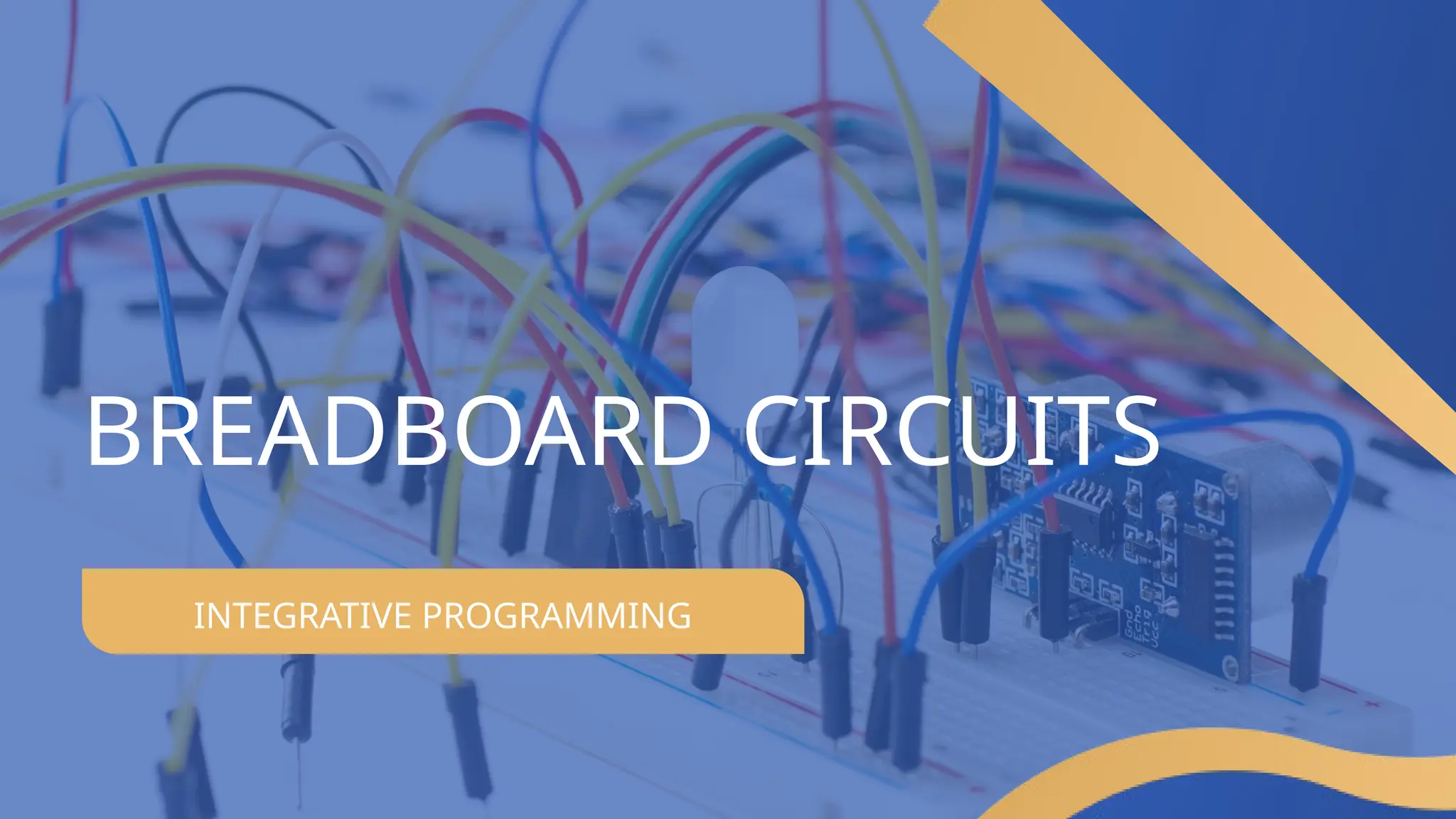
BREADBOARD CIRCUITS
BREADBOARD
• sometimes called a plugblock is used for
building temporary circuits. It is useful to
designers because it allows components to be
removed and replaced easily. It is useful to the
person who wants to build a circuit to
demonstrate its action, then to reuse the
components in another circuit.
This final Quarter, we will be focusing on
understanding what breadboard and its
components are, practically use breadboard to
see its potential as an IT student.
INTEGRATIVE PROGRAMMING
HISTORY OF BREADBOARD
HISTORY
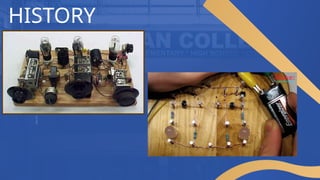
Breadboards have a captivating history that dates
back to the early days of electronics. The name
“breadboard” originated from a time when people
would actually use wooden bread cutting boards
to build their electronic circuits. They would place
components like resistors, capacitors, and
transistors on the wooden surface and connect
them with wires.
HISTORY
HISTORY
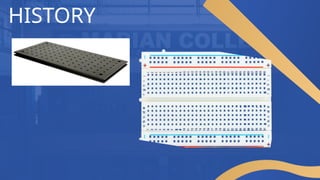
The modern breadboard, made of plastic and
metal, was invented in the 1960s. It was designed
to provide a reusable platform for rapid
prototyping and testing of electronic circuits.
Since then, breadboards have become an
essential tool for electronics hobbyists, students,
and professionals.
HISTORY
INTEGRATIVE PROGRAMMING
HOW BREADBOARD
WORKS
HOW IT WORK?
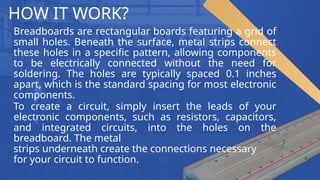
Breadboards are rectangular boards featuring a grid of
small holes. Beneath the surface, metal strips connect
these holes in a specific pattern, allowing components
to be electrically connected without the need for
soldering. The holes are typically spaced 0.1 inches
apart, which is the standard spacing for most electronic
components.
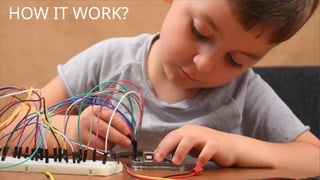
To create a circuit, simply insert the leads of your
electronic components, such as resistors, capacitors,
and integrated circuits, into the holes on the
breadboard. The metal
strips underneath create the connections necessary
for your circuit to function.
HOW IT WORK?
INTEGRATIVE PROGRAMMING
PERIPHERAL PARTS OF
BREADBOARD
BREADBOARD POWER
SUPPLY
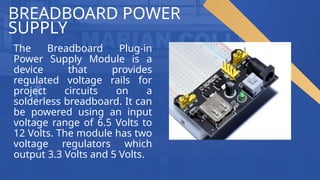
The Breadboard Plug-in
Power Supply Module is a
device that provides
regulated voltage rails for
project circuits on a
solderless breadboard. It can
be powered using an input
voltage range of 6.5 Volts to
12 Volts. The module has two
voltage regulators which
output 3.3 Volts and 5 Volts.
JUMPER WIRES
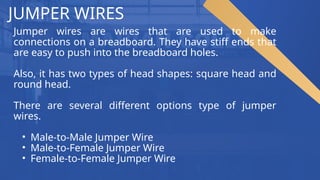
Jumper wires are wires that are used to make
connections on a breadboard. They have stiff ends that
are easy to push into the breadboard holes.
Also, it has two types of head shapes: square head and
round head.
There are several different options type of jumper
wires.
• Male-to-Male Jumper Wire
• Male-to-Female Jumper Wire
• Female-to-Female Jumper Wire
JUMPER WIRES
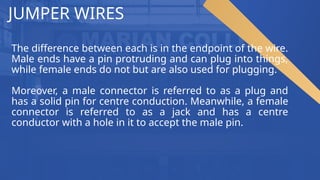
The difference between each is in the endpoint of the wire.
Male ends have a pin protruding and can plug into things,
while female ends do not but are also used for plugging.
Moreover, a male connector is referred to as a plug and
has a solid pin for centre conduction. Meanwhile, a female
connector is referred to as a jack and has a centre
conductor with a hole in it to accept the male pin.
JUMPER WIRES
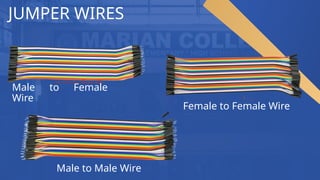
Male to Female
Wire
Female to Female Wire
Male to Male Wire
SOLID-CORE HOOKUP WIRE
Although this has the same usage
as the Jumper Wire, this is much
easier to use as you can
customized the length of the wire.
You may also purchase a fixed
Hookup Wires as this will give you
more options and less time to cut
the wire yourself.
Also, this is only available as your
substitute male to male wire.
RESISTOR
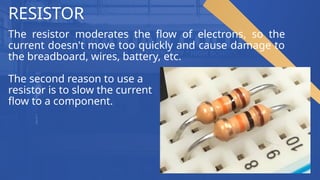
The resistor moderates the flow of electrons, so the
current doesn't move too quickly and cause damage to
the breadboard, wires, battery, etc.
The second reason to use a
resistor is to slow the current
flow to a component.
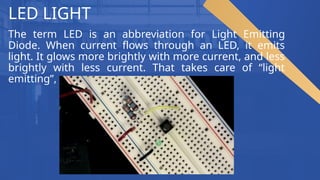
LED LIGHT
The term LED is an abbreviation for Light Emitting
Diode. When current flows through an LED, it emits
light. It glows more brightly with more current, and less
brightly with less current. That takes care of “light
emitting”,
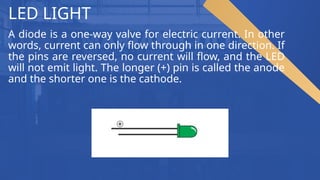
A diode is a one-way valve for electric current. In other
words, current can only flow through in one direction. If
the pins are reversed, no current will flow, and the LED
will not emit light. The longer (+) pin is called the anode
and the shorter one is the cathode.
LED LIGHT
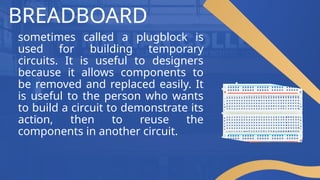
BREADBOARD
sometimes called a plugblock is
used for building temporary
circuits. It is useful to designers
because it allows components to
be removed and replaced easily. It
is useful to the person who wants
to build a circuit to demonstrate its
action, then to reuse the
components in another circuit.
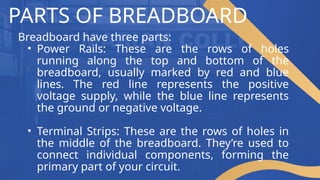
PARTS OF BREADBOARD
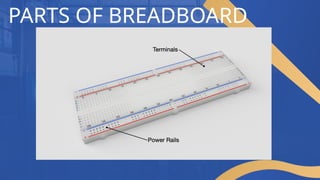
Breadboard have three parts:
• Power Rails: These are the rows of holes
running along the top and bottom of the
breadboard, usually marked by red and blue
lines. The red line represents the positive
voltage supply, while the blue line represents
the ground or negative voltage.
• Terminal Strips: These are the rows of holes in
the middle of the breadboard. They’re used to
connect individual components, forming the
primary part of your circuit.
PARTS OF BREADBOARD
PARTS OF BREADBOARD
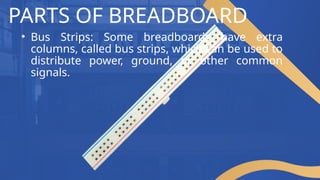
• Bus Strips: Some breadboards have extra
columns, called bus strips, which can be used to
distribute power, ground, or other common
signals.
QUESTION?
GIVE ME ONE
PERIPHERAL PARTS OF
BREADBOARD
INTEGRATIVE PROGRAMMING
WHY DO WE NEED TO
UNDERSTAND HOW TO
BREADBOARD WORKS?
WHY
Understanding Hardware Prototyping: While IT
primarily focuses on software, understanding
hardware prototyping is crucial for developing
critical thinking and doing holistic solutions.
This will allow you as an IT students to experiment
with and prototype electronic circuits, which can be
essential in various IT applications such as IoT
(Internet of Things) devices or embedded systems.
WHY
Collaboration with Hardware Engineers: In the ICT
Industry, IT professionals often collaborate with
hardware engineers. Understanding breadboarding
allows IT students to communicate effectively with
hardware engineers, facilitating teamwork and
project collaboration.
WHY
Pursuing different field as Advanced Studies: For IT
Students who take interest in pursuing different
field s, this will help you to start up your
understanding embedded systems, robotics, or
hardware-centric IT specializations, proficiency in
breadboarding serves as a foundational skill.
WHY
Integration with Software: Many IT projects require
integration between hardware and software
components. Knowing how to use a breadboard
allows students to interface hardware components
with software applications they develop, providing
a deeper understanding of how the two interact.
QUESTION?
ACTIVITY
ACTIVITY
Create a group of 3 to be your groupmates until the
final practical exam.
After that, look for three breadboard projects using
the internet and send it to me via Microsoft Word.
Format would be:
ACTIVITY
Your group name:
Leader:
Member:
Top 3 Projects sourced:
LINK
LINK
LINK

Copy of 5. INTEGRATIVE PROGRAMMING IT.pptx

  • 1.
  • 2.
    BREADBOARD • sometimes calleda plugblock is used for building temporary circuits. It is useful to designers because it allows components to be removed and replaced easily. It is useful to the person who wants to build a circuit to demonstrate its action, then to reuse the components in another circuit. This final Quarter, we will be focusing on understanding what breadboard and its components are, practically use breadboard to see its potential as an IT student.
  • 3.
  • 4.
    HISTORY Breadboards have acaptivating history that dates back to the early days of electronics. The name “breadboard” originated from a time when people would actually use wooden bread cutting boards to build their electronic circuits. They would place components like resistors, capacitors, and transistors on the wooden surface and connect them with wires.
  • 5.
  • 6.
    HISTORY The modern breadboard,made of plastic and metal, was invented in the 1960s. It was designed to provide a reusable platform for rapid prototyping and testing of electronic circuits. Since then, breadboards have become an essential tool for electronics hobbyists, students, and professionals.
  • 7.
  • 8.
  • 9.
    HOW IT WORK? Breadboardsare rectangular boards featuring a grid of small holes. Beneath the surface, metal strips connect these holes in a specific pattern, allowing components to be electrically connected without the need for soldering. The holes are typically spaced 0.1 inches apart, which is the standard spacing for most electronic components. To create a circuit, simply insert the leads of your electronic components, such as resistors, capacitors, and integrated circuits, into the holes on the breadboard. The metal strips underneath create the connections necessary for your circuit to function.
  • 10.
  • 11.
  • 12.
    BREADBOARD POWER SUPPLY The BreadboardPlug-in Power Supply Module is a device that provides regulated voltage rails for project circuits on a solderless breadboard. It can be powered using an input voltage range of 6.5 Volts to 12 Volts. The module has two voltage regulators which output 3.3 Volts and 5 Volts.
  • 13.
    JUMPER WIRES Jumper wiresare wires that are used to make connections on a breadboard. They have stiff ends that are easy to push into the breadboard holes. Also, it has two types of head shapes: square head and round head. There are several different options type of jumper wires. • Male-to-Male Jumper Wire • Male-to-Female Jumper Wire • Female-to-Female Jumper Wire
  • 14.
    JUMPER WIRES The differencebetween each is in the endpoint of the wire. Male ends have a pin protruding and can plug into things, while female ends do not but are also used for plugging. Moreover, a male connector is referred to as a plug and has a solid pin for centre conduction. Meanwhile, a female connector is referred to as a jack and has a centre conductor with a hole in it to accept the male pin.
  • 15.
    JUMPER WIRES Male toFemale Wire Female to Female Wire Male to Male Wire
  • 16.
    SOLID-CORE HOOKUP WIRE Althoughthis has the same usage as the Jumper Wire, this is much easier to use as you can customized the length of the wire. You may also purchase a fixed Hookup Wires as this will give you more options and less time to cut the wire yourself. Also, this is only available as your substitute male to male wire.
  • 17.
    RESISTOR The resistor moderatesthe flow of electrons, so the current doesn't move too quickly and cause damage to the breadboard, wires, battery, etc. The second reason to use a resistor is to slow the current flow to a component.
  • 18.
    LED LIGHT The termLED is an abbreviation for Light Emitting Diode. When current flows through an LED, it emits light. It glows more brightly with more current, and less brightly with less current. That takes care of “light emitting”,
  • 19.
    A diode isa one-way valve for electric current. In other words, current can only flow through in one direction. If the pins are reversed, no current will flow, and the LED will not emit light. The longer (+) pin is called the anode and the shorter one is the cathode. LED LIGHT
  • 20.
    BREADBOARD sometimes called aplugblock is used for building temporary circuits. It is useful to designers because it allows components to be removed and replaced easily. It is useful to the person who wants to build a circuit to demonstrate its action, then to reuse the components in another circuit.
  • 21.
    PARTS OF BREADBOARD Breadboardhave three parts: • Power Rails: These are the rows of holes running along the top and bottom of the breadboard, usually marked by red and blue lines. The red line represents the positive voltage supply, while the blue line represents the ground or negative voltage. • Terminal Strips: These are the rows of holes in the middle of the breadboard. They’re used to connect individual components, forming the primary part of your circuit.
  • 22.
  • 23.
    PARTS OF BREADBOARD •Bus Strips: Some breadboards have extra columns, called bus strips, which can be used to distribute power, ground, or other common signals.
  • 24.
  • 25.
    GIVE ME ONE PERIPHERALPARTS OF BREADBOARD
  • 26.
    INTEGRATIVE PROGRAMMING WHY DOWE NEED TO UNDERSTAND HOW TO BREADBOARD WORKS?
  • 27.
    WHY Understanding Hardware Prototyping:While IT primarily focuses on software, understanding hardware prototyping is crucial for developing critical thinking and doing holistic solutions. This will allow you as an IT students to experiment with and prototype electronic circuits, which can be essential in various IT applications such as IoT (Internet of Things) devices or embedded systems.
  • 28.
    WHY Collaboration with HardwareEngineers: In the ICT Industry, IT professionals often collaborate with hardware engineers. Understanding breadboarding allows IT students to communicate effectively with hardware engineers, facilitating teamwork and project collaboration.
  • 29.
    WHY Pursuing different fieldas Advanced Studies: For IT Students who take interest in pursuing different field s, this will help you to start up your understanding embedded systems, robotics, or hardware-centric IT specializations, proficiency in breadboarding serves as a foundational skill.
  • 30.
    WHY Integration with Software:Many IT projects require integration between hardware and software components. Knowing how to use a breadboard allows students to interface hardware components with software applications they develop, providing a deeper understanding of how the two interact.
  • 31.
  • 32.
  • 33.
    ACTIVITY Create a groupof 3 to be your groupmates until the final practical exam. After that, look for three breadboard projects using the internet and send it to me via Microsoft Word. Format would be:
  • 34.
    ACTIVITY Your group name: Leader: Member: Top3 Projects sourced: LINK LINK LINK