COOKING RECIPE RATING
Prepared By - Sneha Nandanwar
Guided by –
Pranay Patel , Asst. Prof. CP Dept.
Birla Vishvakarma Mahavidyalaya
Seminar (CP602 )
CONTENTS
 Introduction
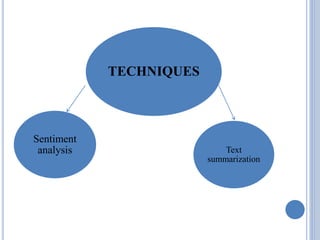
 Techniques
 Sentimental analysis
 Text mining
 Conclusion
WHERE WORDS FAIL,
FOOD SPEAKS.
INTRODUCTION
 In order to get right recipes, recipes must be
rated by the user.
 Recipes are rated and commented by the visitors.
 This saves time of the users searching for the
best recipe.
 Review that has the highest score was ranked at
 first position and so on.
TECHNIQUES
Text
summarization
Sentiment
analysis
TECHNIQUES
SENTIMENT ANALYSIS
 Sentiment analysis, or so called opinion mining.
 It involves natural language processing, text analytics
and computational linguistics.
Basic objective
Extract useful information Classify the polarity
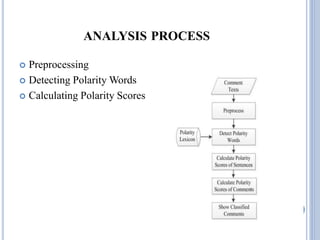
ANALYSIS PROCESS
 Preprocessing
 Detecting Polarity Words
 Calculating Polarity Scores
 Sentiment Analysis is challenging, as it doesn’t work well
with basic lexical-based classification.
 For example: suppose someone has posted a review about a
recipe say “Mexican Pizza”.
 Sentiment Analysis is classified as:-
a. Machine learning approach
b. Lexicon- based approach
 In accordance to Latent Aspect Rating Analysis [LARA]
Model, the words from reviews are given some weights.
 For example:
“I loved the recipe. Tomato in the recipe made it
more delicious.”
TEXT MINING
 Text data is everywhere – books ,news ,blogs , social
networking , etc.
 According to estimate,80% of world’s data is in unstructured
text format.
 We need to extract, summarize and analyze useful information
from unstructured/text data.
 So text mining can be used .
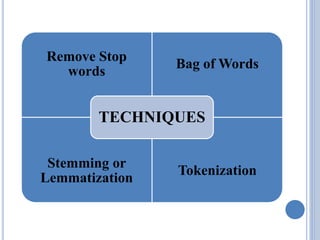
Remove Stop
words
Bag of Words
Stemming or
Lemmatization
Tokenization
TECHNIQUES
CONCLUSION
 This saves time of the users searching for the best recipe
for a particular ingredient.
 A bag of positive and negative words like “delicious”,
“bad” etc. were used to rate the reviews.
 The recipe authors can gain information that how many
peoples like or dislike the recipes.
THANK YOU……
13

Cooking

  • 1.
    COOKING RECIPE RATING PreparedBy - Sneha Nandanwar Guided by – Pranay Patel , Asst. Prof. CP Dept. Birla Vishvakarma Mahavidyalaya Seminar (CP602 )
  • 2.
    CONTENTS  Introduction  Techniques Sentimental analysis  Text mining  Conclusion
  • 3.
  • 4.
    INTRODUCTION  In orderto get right recipes, recipes must be rated by the user.  Recipes are rated and commented by the visitors.  This saves time of the users searching for the best recipe.  Review that has the highest score was ranked at  first position and so on.
  • 5.
  • 6.
    SENTIMENT ANALYSIS  Sentimentanalysis, or so called opinion mining.  It involves natural language processing, text analytics and computational linguistics. Basic objective Extract useful information Classify the polarity
  • 7.
    ANALYSIS PROCESS  Preprocessing Detecting Polarity Words  Calculating Polarity Scores
  • 8.
     Sentiment Analysisis challenging, as it doesn’t work well with basic lexical-based classification.  For example: suppose someone has posted a review about a recipe say “Mexican Pizza”.
  • 9.
     Sentiment Analysisis classified as:- a. Machine learning approach b. Lexicon- based approach  In accordance to Latent Aspect Rating Analysis [LARA] Model, the words from reviews are given some weights.  For example: “I loved the recipe. Tomato in the recipe made it more delicious.”
  • 10.
    TEXT MINING  Textdata is everywhere – books ,news ,blogs , social networking , etc.  According to estimate,80% of world’s data is in unstructured text format.  We need to extract, summarize and analyze useful information from unstructured/text data.  So text mining can be used .
  • 11.
    Remove Stop words Bag ofWords Stemming or Lemmatization Tokenization TECHNIQUES
  • 12.
    CONCLUSION  This savestime of the users searching for the best recipe for a particular ingredient.  A bag of positive and negative words like “delicious”, “bad” etc. were used to rate the reviews.  The recipe authors can gain information that how many peoples like or dislike the recipes.
  • 13.