Conversations About
             Books
Facilitators present sample books and discussion methods
they offer in the New Hampshire Humanities Council‟s Adult
Literacy Program, Connections.
Pumpkins by Ken Robbins
  photo essay presented in beginning level ESOL class
Themes: Food, New England, Planting the Earth, Seasons


                          A great book for a mixed level ESOL
                          class as well as beginners, Pumpkins
                          gives beautiful, seasonal images
                          inviting identification, conversation,
                          and interpretation.

                                           - Susan Bartlett
Pumpkins


Sequencing a Narrative: with Beginning Level Readers
                      and Speakers
After reading the book, we divided the class into three
groups. Each group received a series of photographs
from the 2010 Connecticut River “Pumpkin Flood” when
rising waters swept 100,000 pumpkins off several fields.
The photos show volunteers fishing pumpkins out of the
river. The class groups are asked to sequence the photos
so that they tell a story and then explain their reasoning
to the whole class. When we did this exercise in Laconia,
we had three different stories! After we discussed all the
possibilities, we looked at the article in the Valley News
to find out what really happened. We also talked about
what pictures were missing from the selection that
would have helped to better tell the true story. A similar
exercise could be used with many books, and there are
endless possibilities for writing practice. - Susan Bartlett
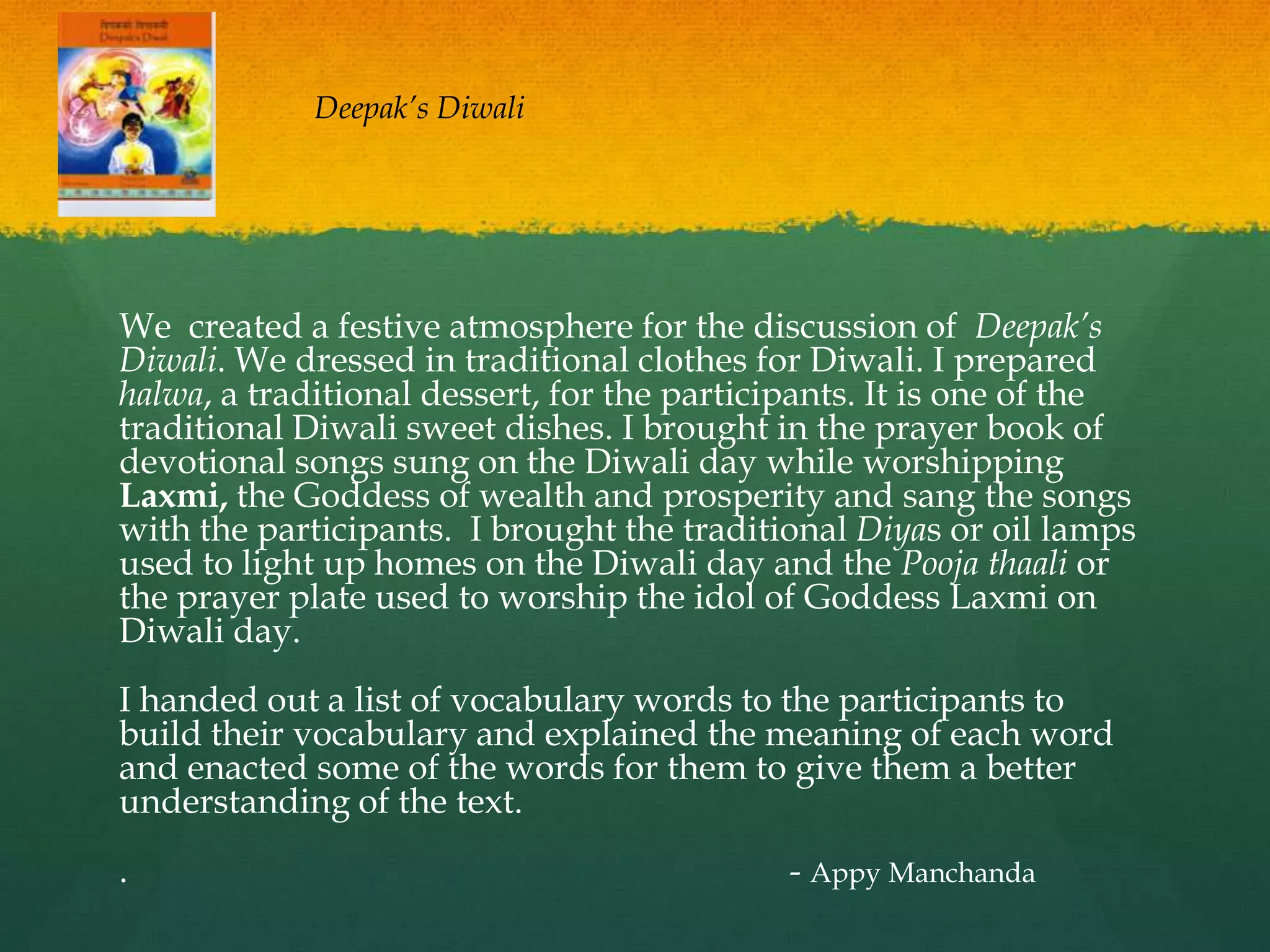
Deepak’s Diwali by Divya Karwal, illus. by
                         Doreen Lang
        a picture book about the celebration of the Hindu
 Festival of Lights, presented with a beginning level ESOL class.
            Themes: Holidays, Family, Religions, Food.
Deepak’s Diwali


We created a festive atmosphere for the discussion of Deepak’s
Diwali. We dressed in traditional clothes for Diwali. I prepared
halwa, a traditional dessert, for the participants. It is one of the
traditional Diwali sweet dishes. I brought in the prayer book of
devotional songs sung on the Diwali day while worshipping
Laxmi, the Goddess of wealth and prosperity and sang the songs
with the participants. I brought the traditional Diyas or oil lamps
used to light up homes on the Diwali day and the Pooja thaali or
the prayer plate used to worship the idol of Goddess Laxmi on
Diwali day.
I handed out a list of vocabulary words to the participants to
build their vocabulary and explained the meaning of each word
and enacted some of the words for them to give them a better
understanding of the text.
.                                           - Appy Manchanda
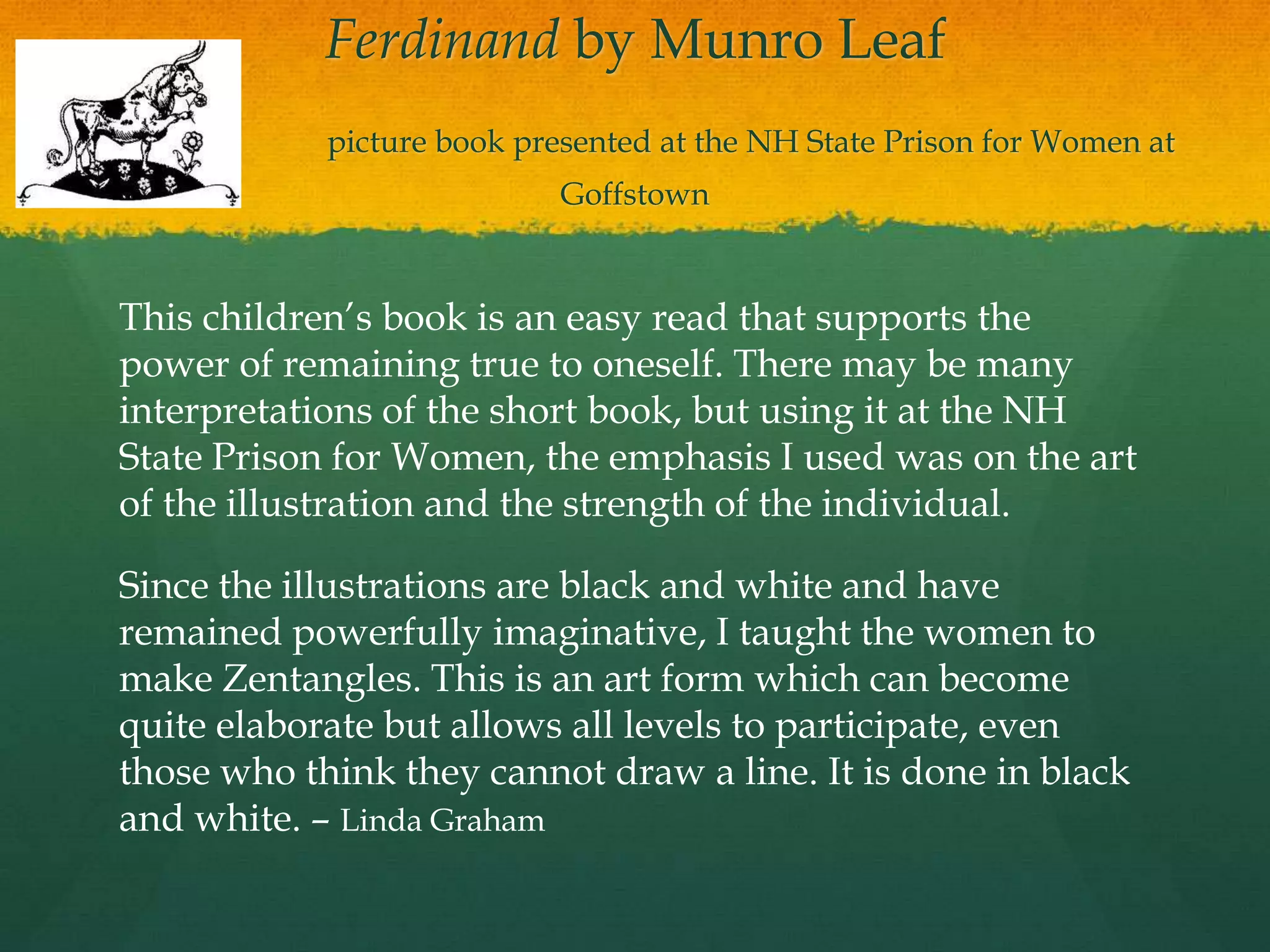
Ferdinand by Munro Leaf
            picture book presented at the NH State Prison for Women at
                           Goffstown


This children‟s book is an easy read that supports the
power of remaining true to oneself. There may be many
interpretations of the short book, but using it at the NH
State Prison for Women, the emphasis I used was on the art
of the illustration and the strength of the individual.

Since the illustrations are black and white and have
remained powerfully imaginative, I taught the women to
make Zentangles. This is an art form which can become
quite elaborate but allows all levels to participate, even
those who think they cannot draw a line. It is done in black
and white. – Linda Graham
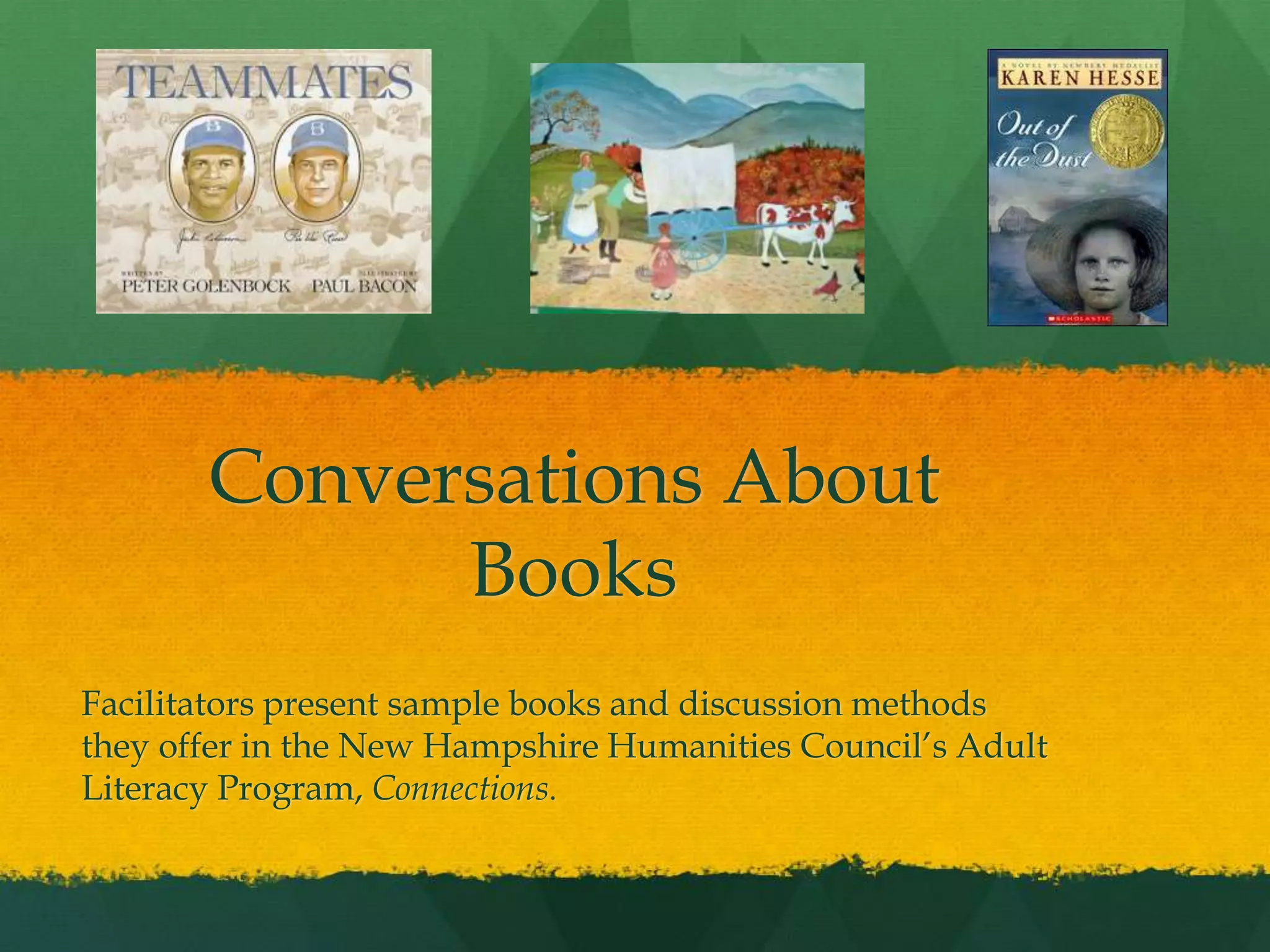
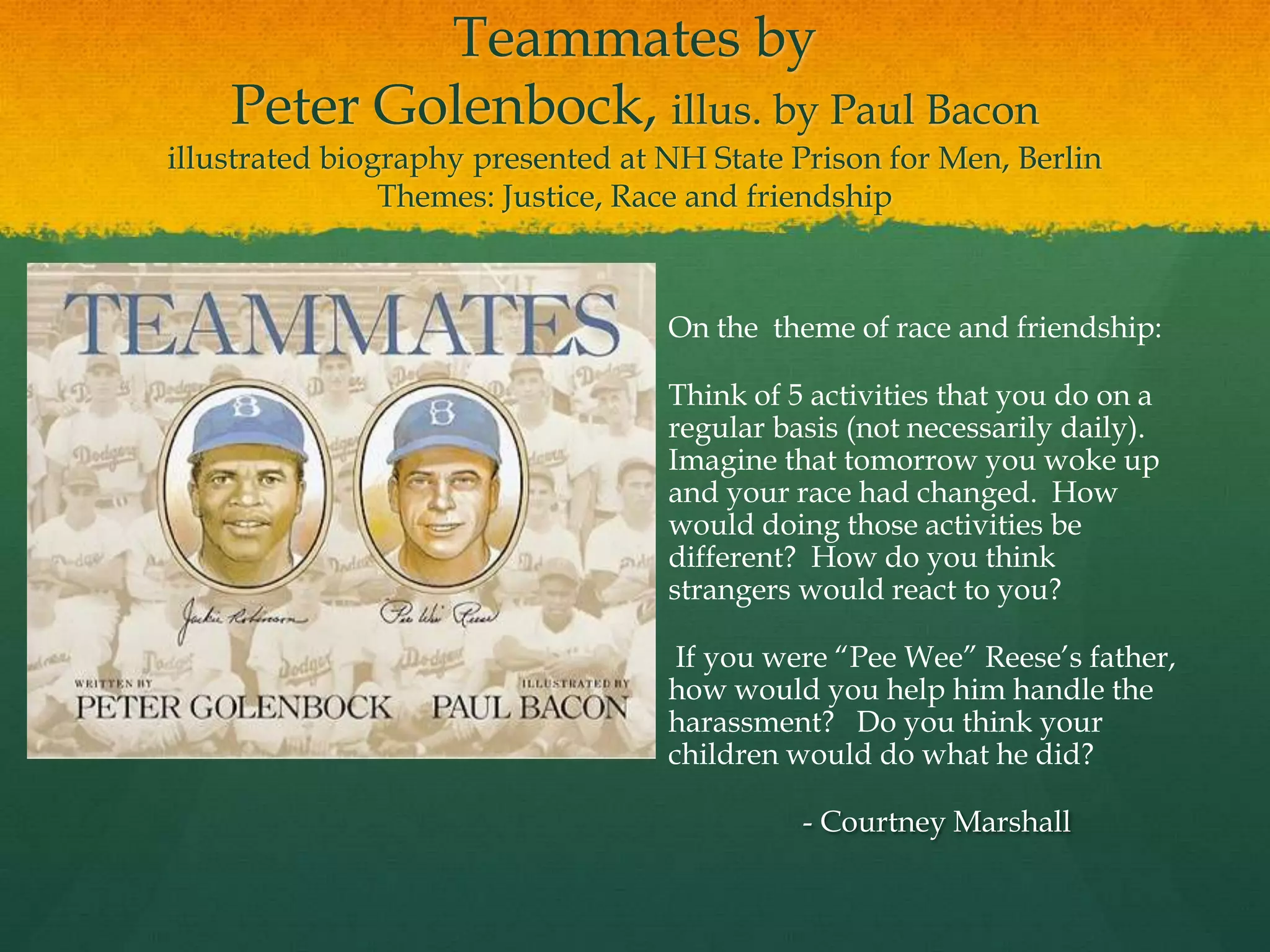
Teammates by
    Peter Golenbock, illus. by Paul Bacon
illustrated biography presented at NH State Prison for Men, Berlin
                Themes: Justice, Race and friendship


                                   On the theme of race and friendship:

                                   Think of 5 activities that you do on a
                                   regular basis (not necessarily daily).
                                   Imagine that tomorrow you woke up
                                   and your race had changed. How
                                   would doing those activities be
                                   different? How do you think
                                   strangers would react to you?

                                    If you were “Pee Wee” Reese‟s father,
                                   how would you help him handle the
                                   harassment? Do you think your
                                   children would do what he did?

                                             - Courtney Marshall
A Chair for My Mother by Vera Williams
 a picture book presented with a mixed level ESOL class. Themes:
 Saving, Overcoming hardships, Community, Family, Mothers &
                           daughters


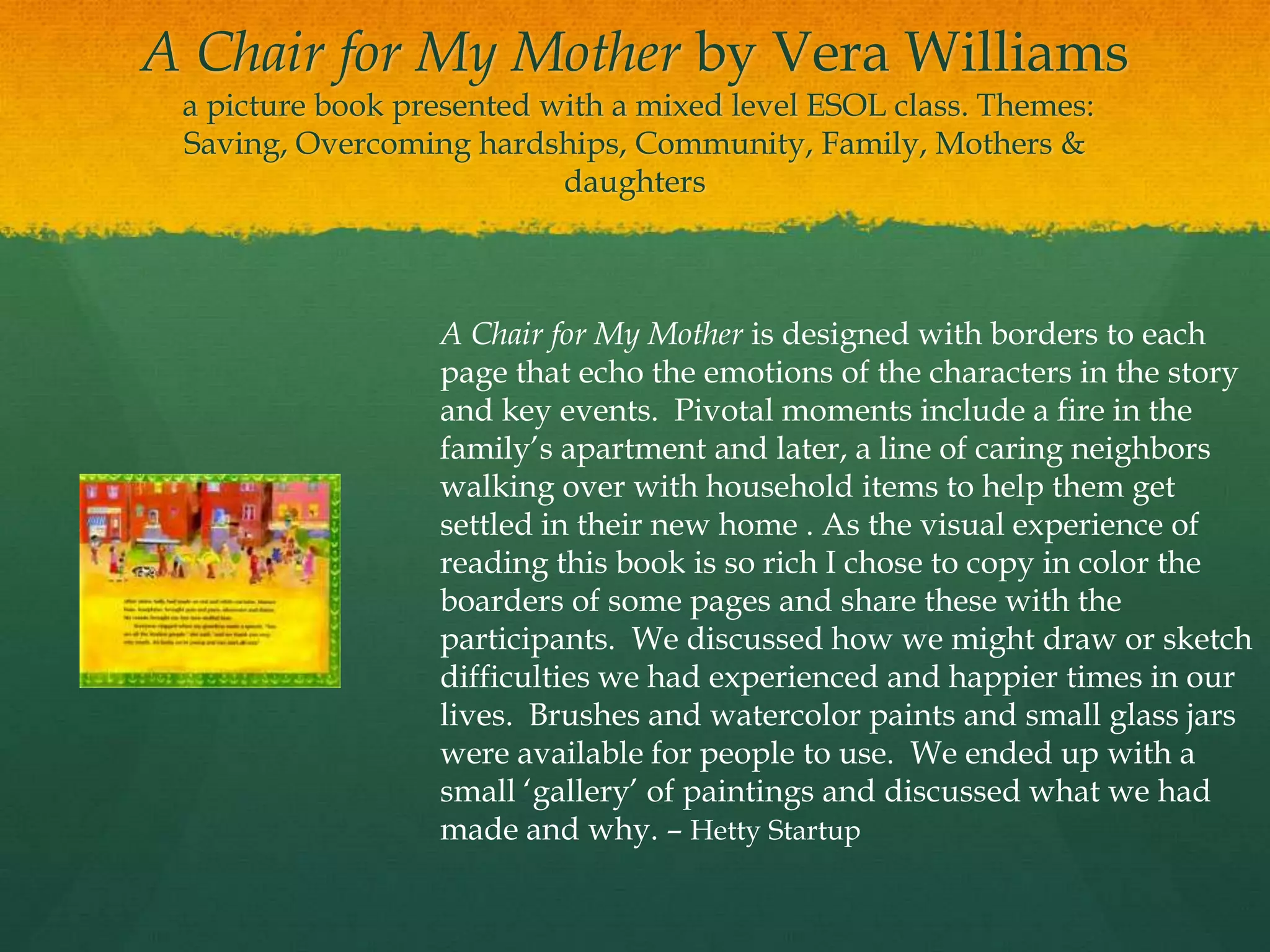
                  A Chair for My Mother is designed with borders to each
                  page that echo the emotions of the characters in the story
                  and key events. Pivotal moments include a fire in the
                  family‟s apartment and later, a line of caring neighbors
                  walking over with household items to help them get
                  settled in their new home . As the visual experience of
                  reading this book is so rich I chose to copy in color the
                  boarders of some pages and share these with the
                  participants. We discussed how we might draw or sketch
                  difficulties we had experienced and happier times in our
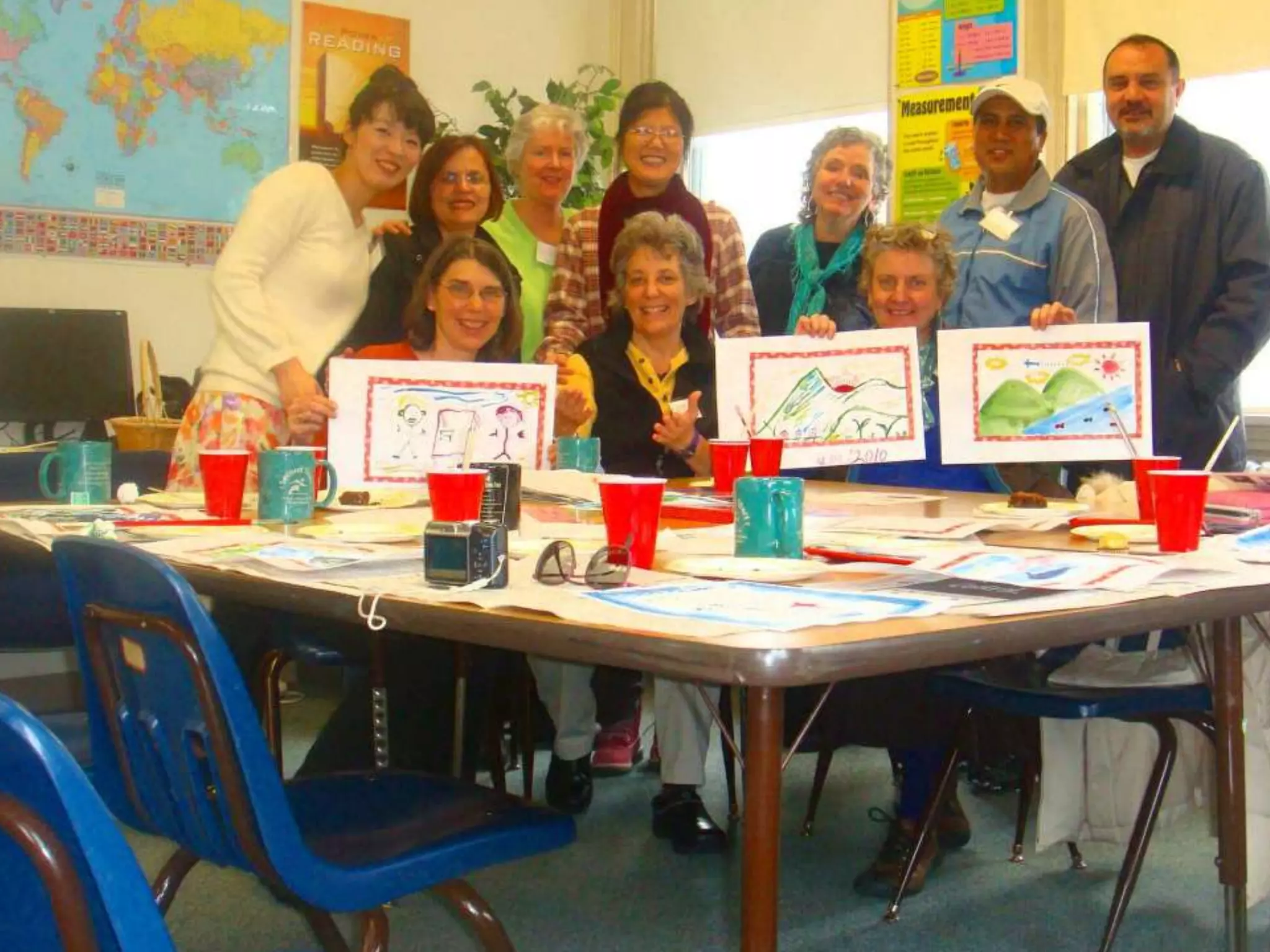
                  lives. Brushes and watercolor paints and small glass jars
                  were available for people to use. We ended up with a
                  small „gallery‟ of paintings and discussed what we had
                  made and why. – Hetty Startup
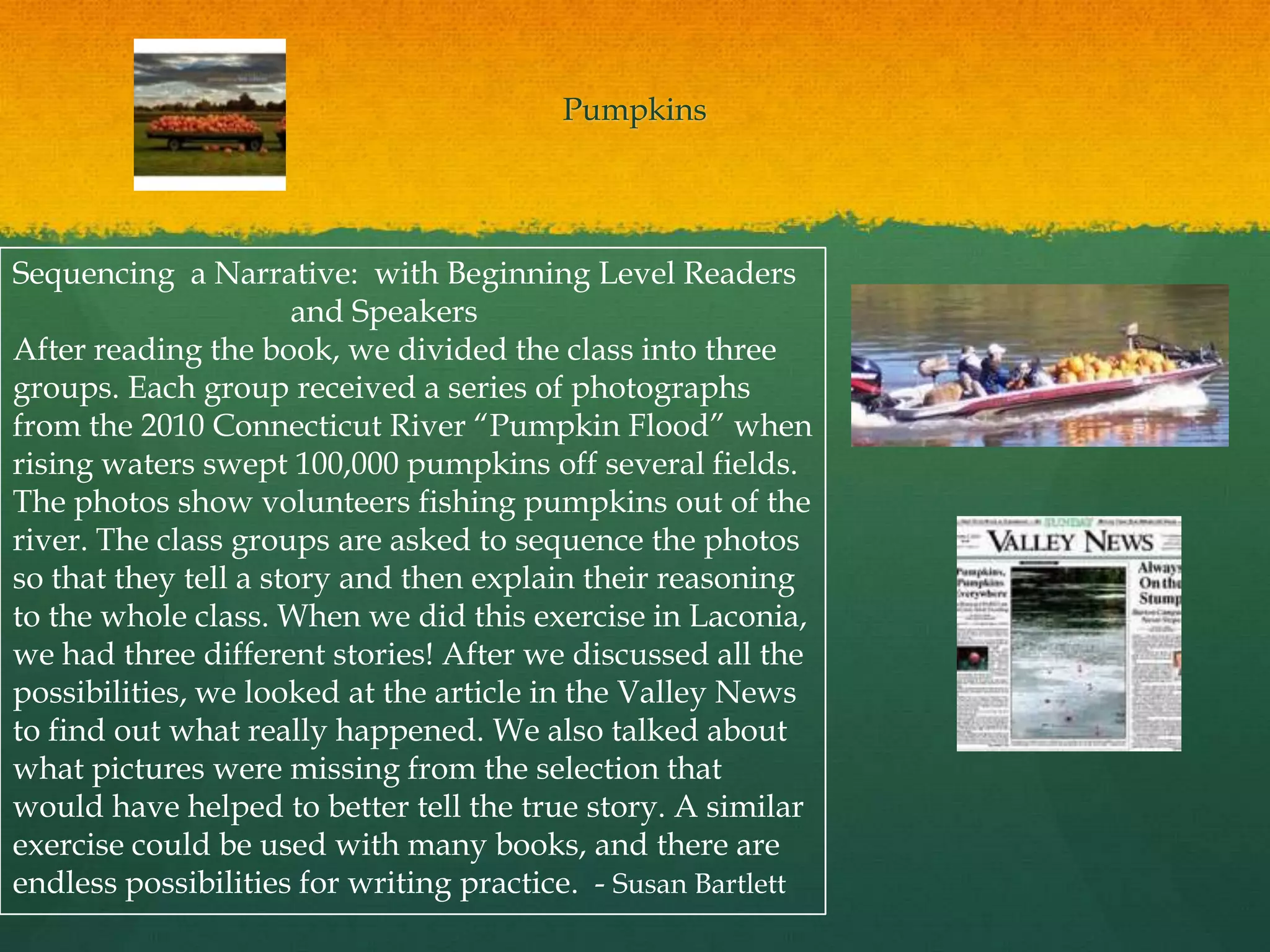
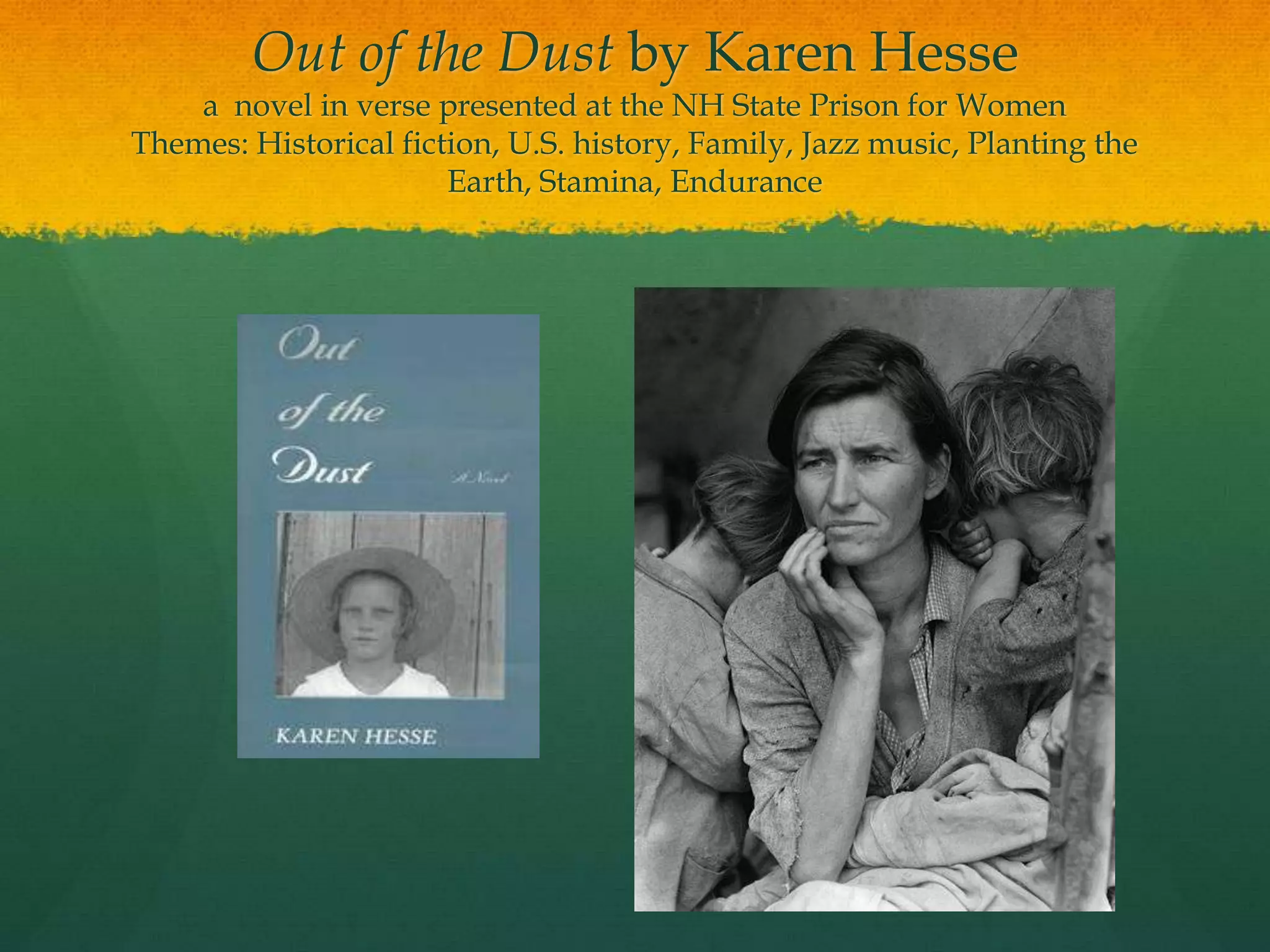
Out of the Dust by Karen Hesse
    a novel in verse presented at the NH State Prison for Women
Themes: Historical fiction, U.S. history, Family, Jazz music, Planting the
                       Earth, Stamina, Endurance
Out of the Dust


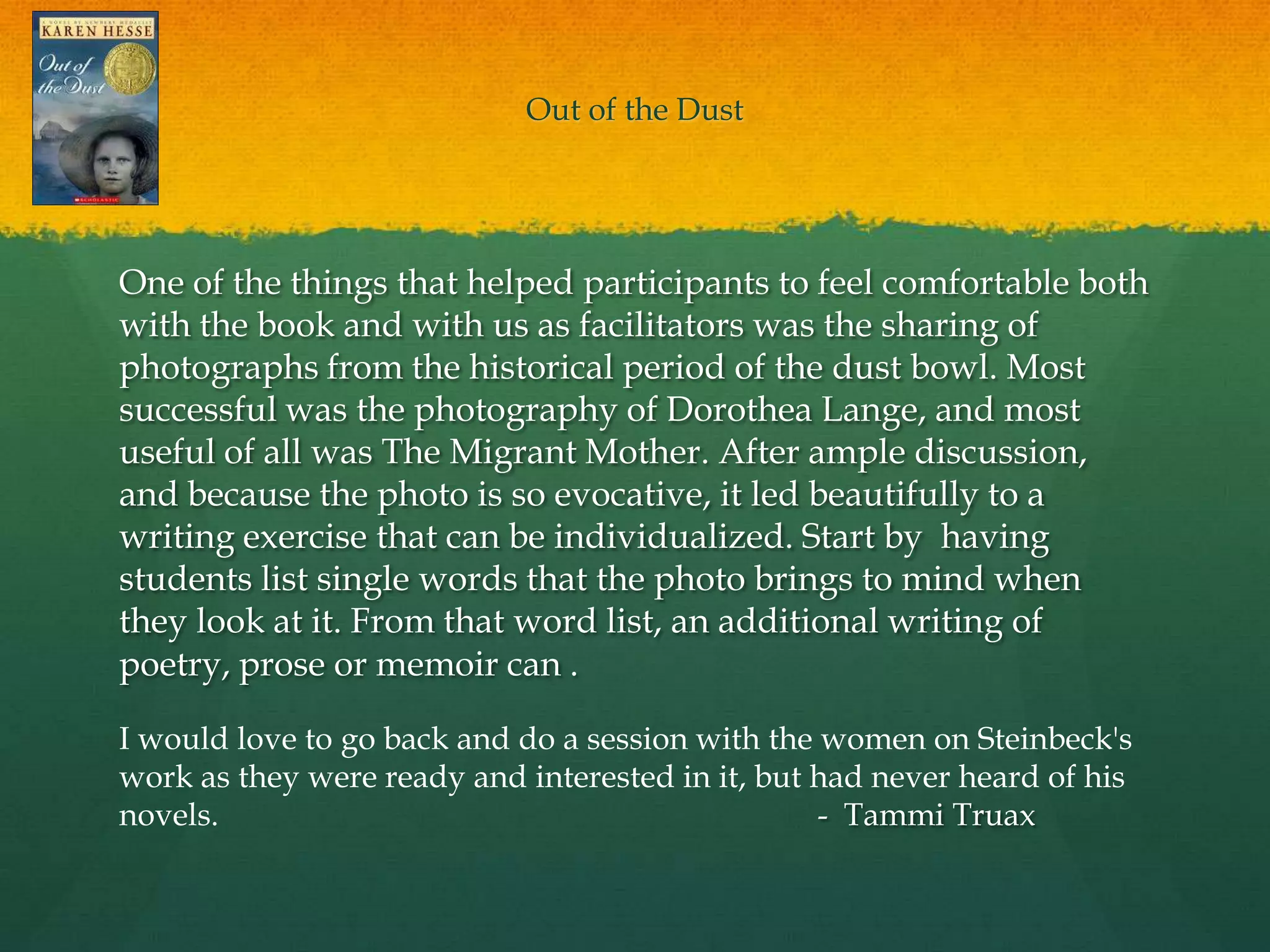
One of the things that helped participants to feel comfortable both
with the book and with us as facilitators was the sharing of
photographs from the historical period of the dust bowl. Most
successful was the photography of Dorothea Lange, and most
useful of all was The Migrant Mother. After ample discussion,
and because the photo is so evocative, it led beautifully to a
writing exercise that can be individualized. Start by having
students list single words that the photo brings to mind when
they look at it. From that word list, an additional writing of
poetry, prose or memoir can .


I would love to go back and do a session with the women on Steinbeck's
work as they were ready and interested in it, but had never heard of his
novels.                                           - Tammi Truax
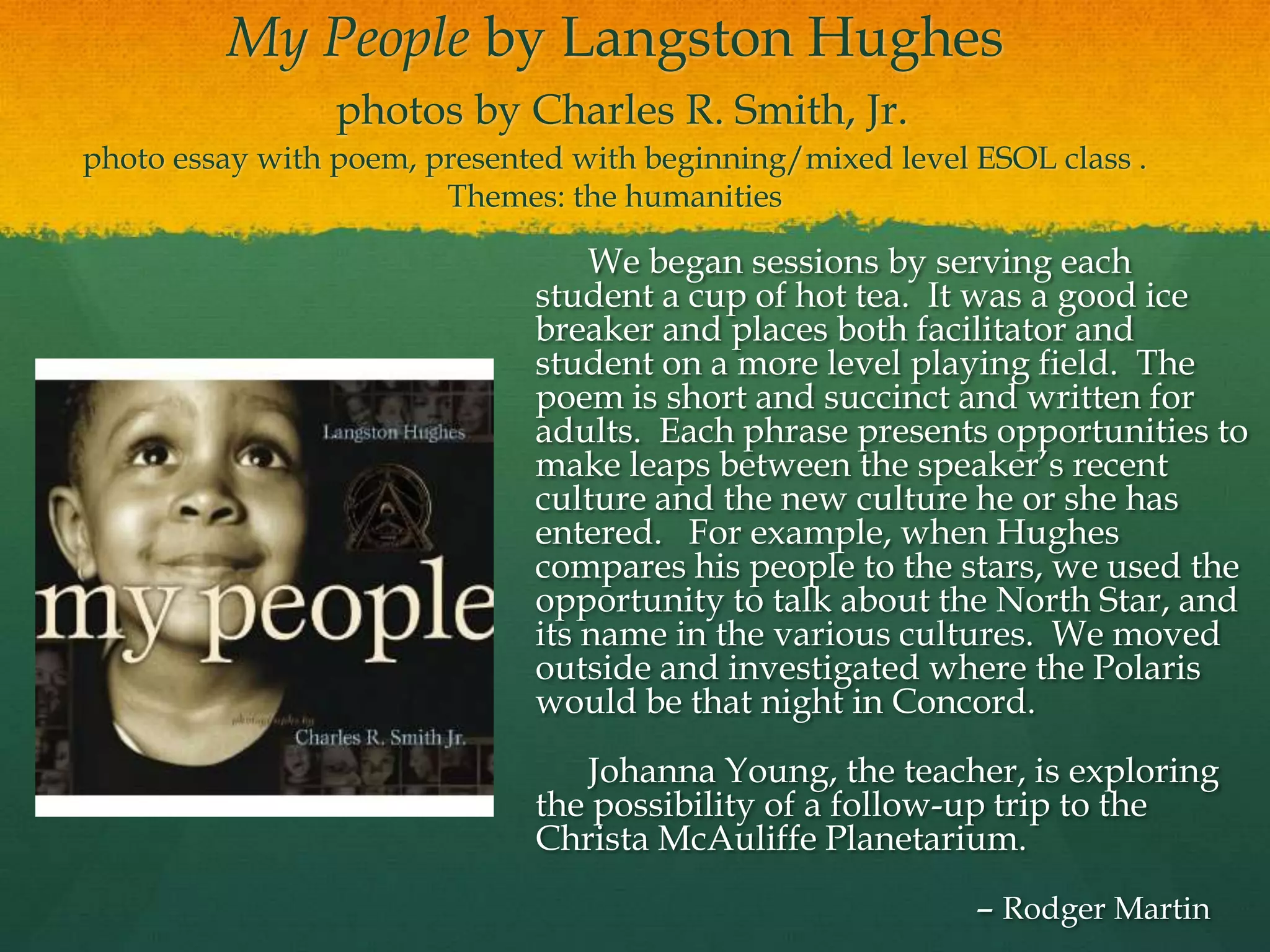
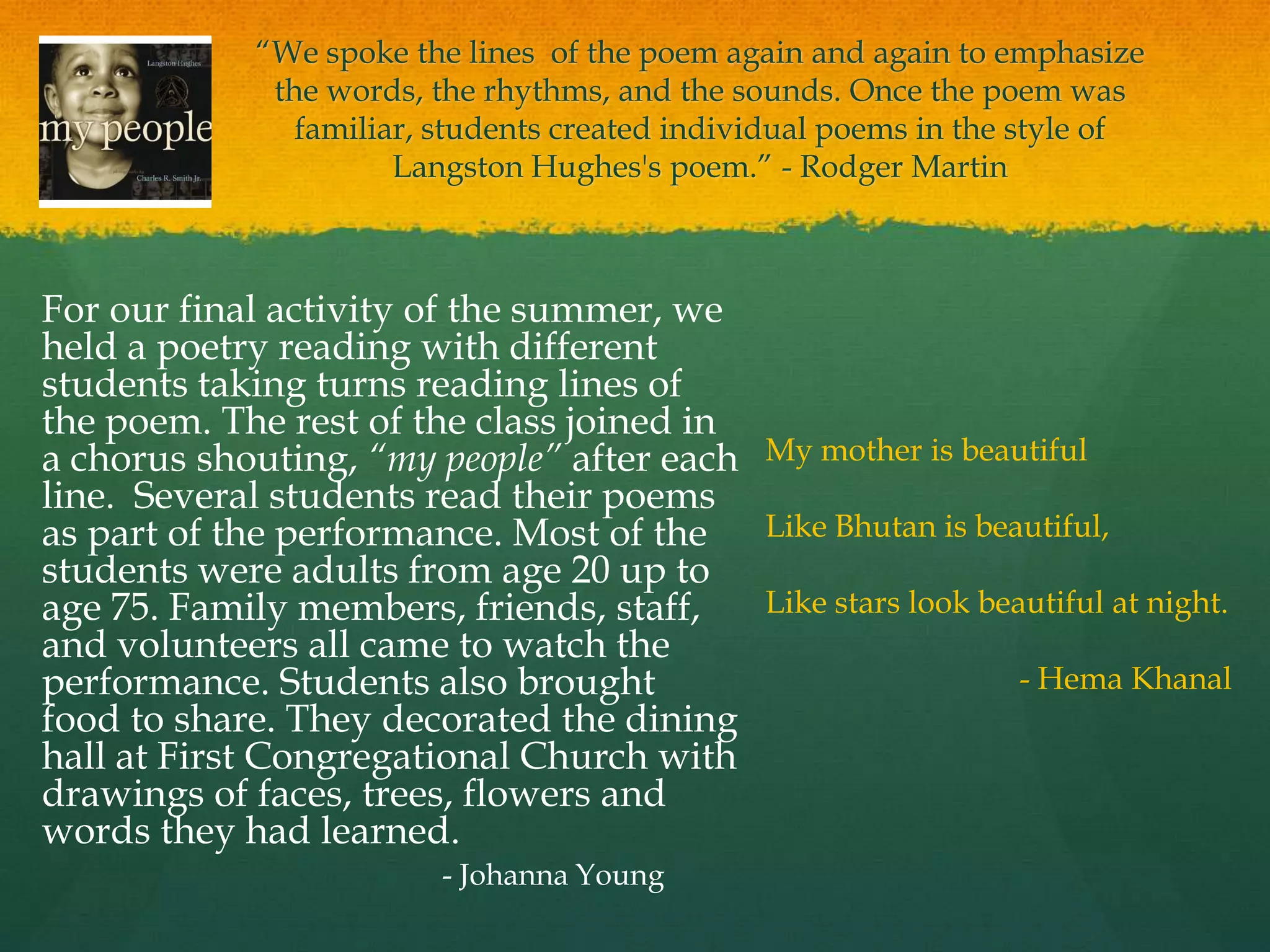
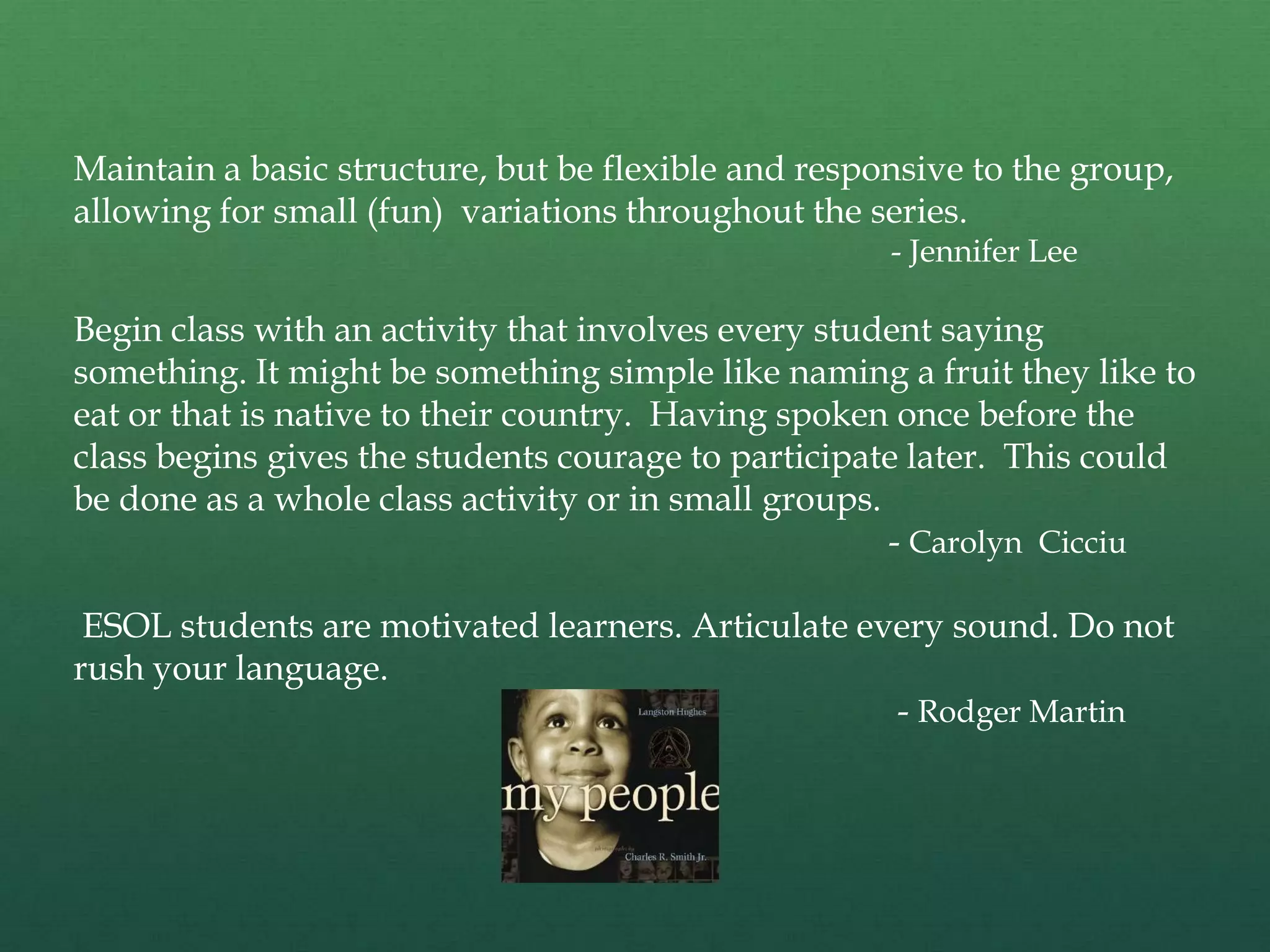
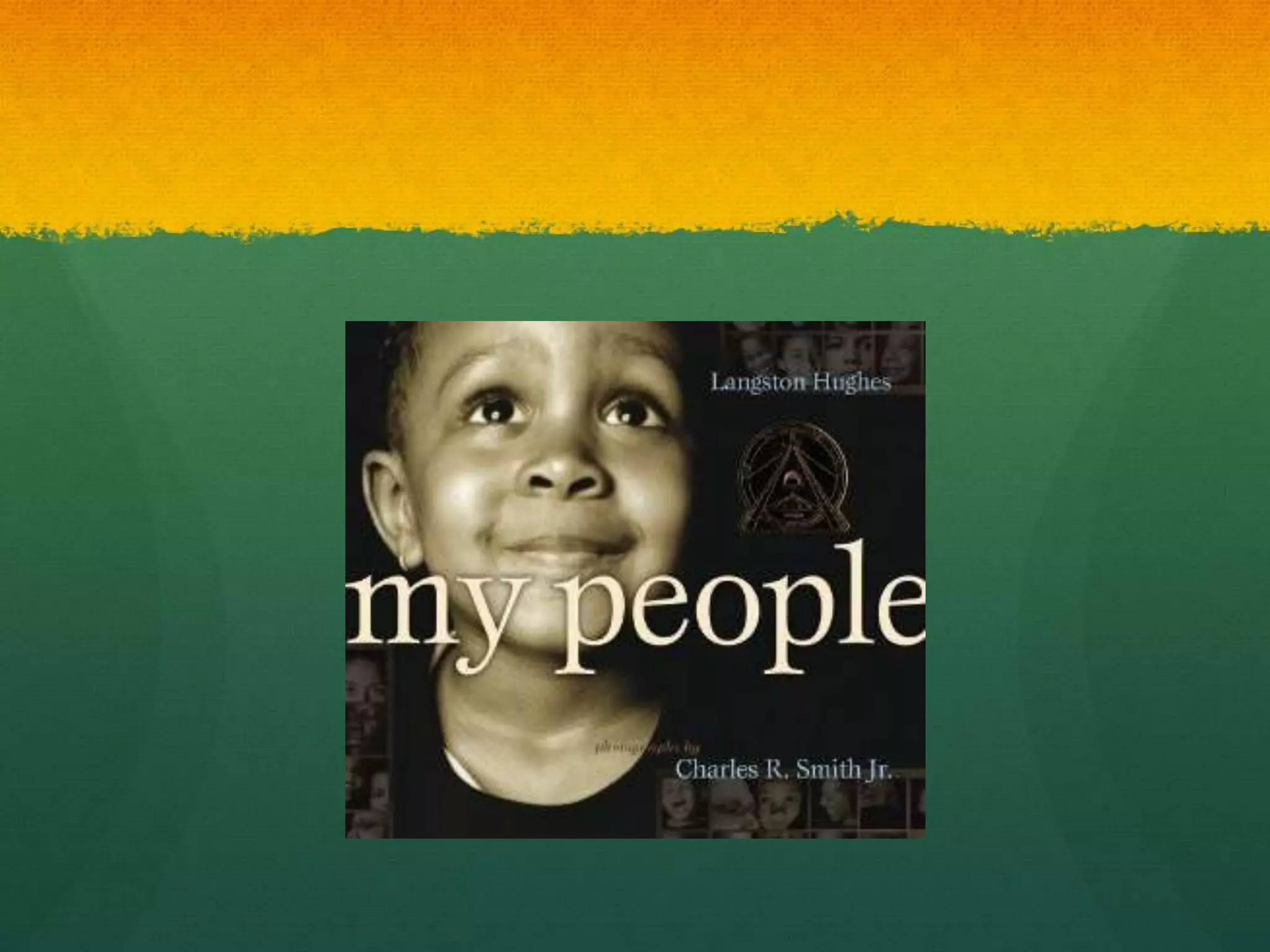
My People by Langston Hughes
                 photos by Charles R. Smith, Jr.
photo essay with poem, presented with beginning/mixed level ESOL class .
                        Themes: the humanities

                              
   We began sessions by serving each
                              student a cup of hot tea. It was a good ice
                              breaker and places both facilitator and
                              student on a more level playing field. The
                              poem is short and succinct and written for
                              adults. Each phrase presents opportunities to
                              make leaps between the speaker‟s recent
                              culture and the new culture he or she has
                              entered. For example, when Hughes
                              compares his people to the stars, we used the
                              opportunity to talk about the North Star, and
                              its name in the various cultures. We moved
                              outside and investigated where the Polaris
                              would be that night in Concord.
                                 Johanna Young, the teacher, is exploring
                              the possibility of a follow-up trip to the
                              Christa McAuliffe Planetarium.
                                                            – Rodger Martin
“We spoke the lines of the poem again and again to emphasize
              the words, the rhythms, and the sounds. Once the poem was
                familiar, students created individual poems in the style of
                       Langston Hughes's poem.” - Rodger Martin


For our final activity of the summer, we
held a poetry reading with different
students taking turns reading lines of
the poem. The rest of the class joined in
a chorus shouting, “my people” after each My mother is beautiful
line. Several students read their poems
as part of the performance. Most of the   Like Bhutan is beautiful,
students were adults from age 20 up to
age 75. Family members, friends, staff,   Like stars look beautiful at night.
and volunteers all came to watch the
performance. Students also brought                           - Hema Khanal
food to share. They decorated the dining
hall at First Congregational Church with
drawings of faces, trees, flowers and
words they had learned.
                          - Johanna Young
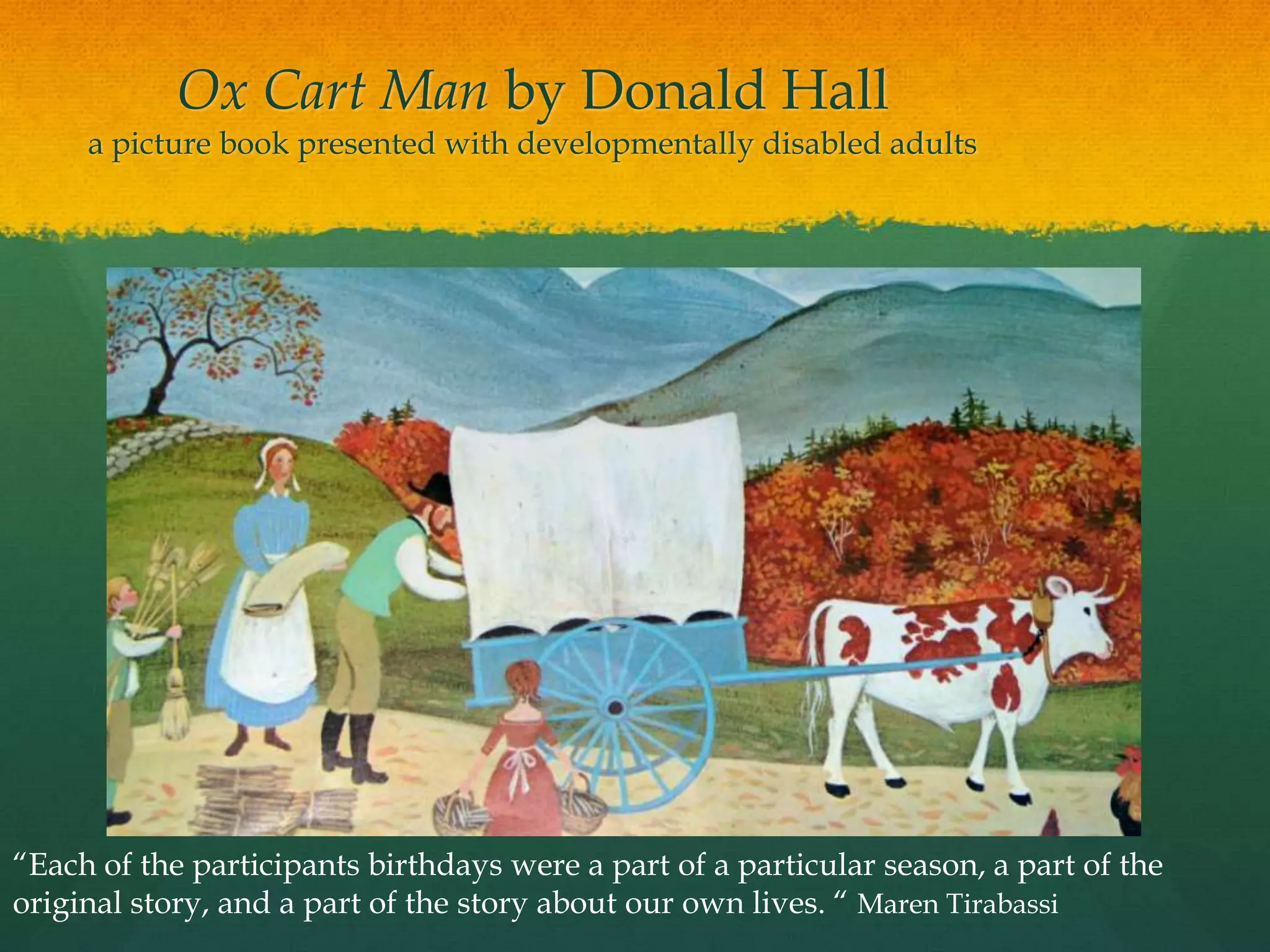
Ox Cart Man by Donald Hall
     a picture book presented with developmentally disabled adults


“Each of the participants birthdays were a part of a particular season, a part of the
original story, and a part of the story about our own lives. “ Maren Tirabassi
Ox Cart Man


   The community building activity at our session for Ox Cart Man was extremely
energizing for this non-reading group, and I can extrapolate that it would work very
well in an ESOL setting as well. A long sheet of table-covering white paper was divided
into blocks for the twelve months of the year. The participants brainstormed what
weather, what activities, what work and what fun they experience in each of these
months. We then noted everyone‟s birthdays so that individuals could identify with a
particular month.

Ox Cart Man begins in October when the father of the family packs his wagon for
Portsmouth market. The story of the family continues through a full year. We slowly
read the pages contrasting life in the two eras. The importance of contributions from
each family member in Donald Hall‟s story was compared to the importance of
contributions from different members of the contemporary family unit and other forms
of community, such as Community Partners. - Maren Tirabassi
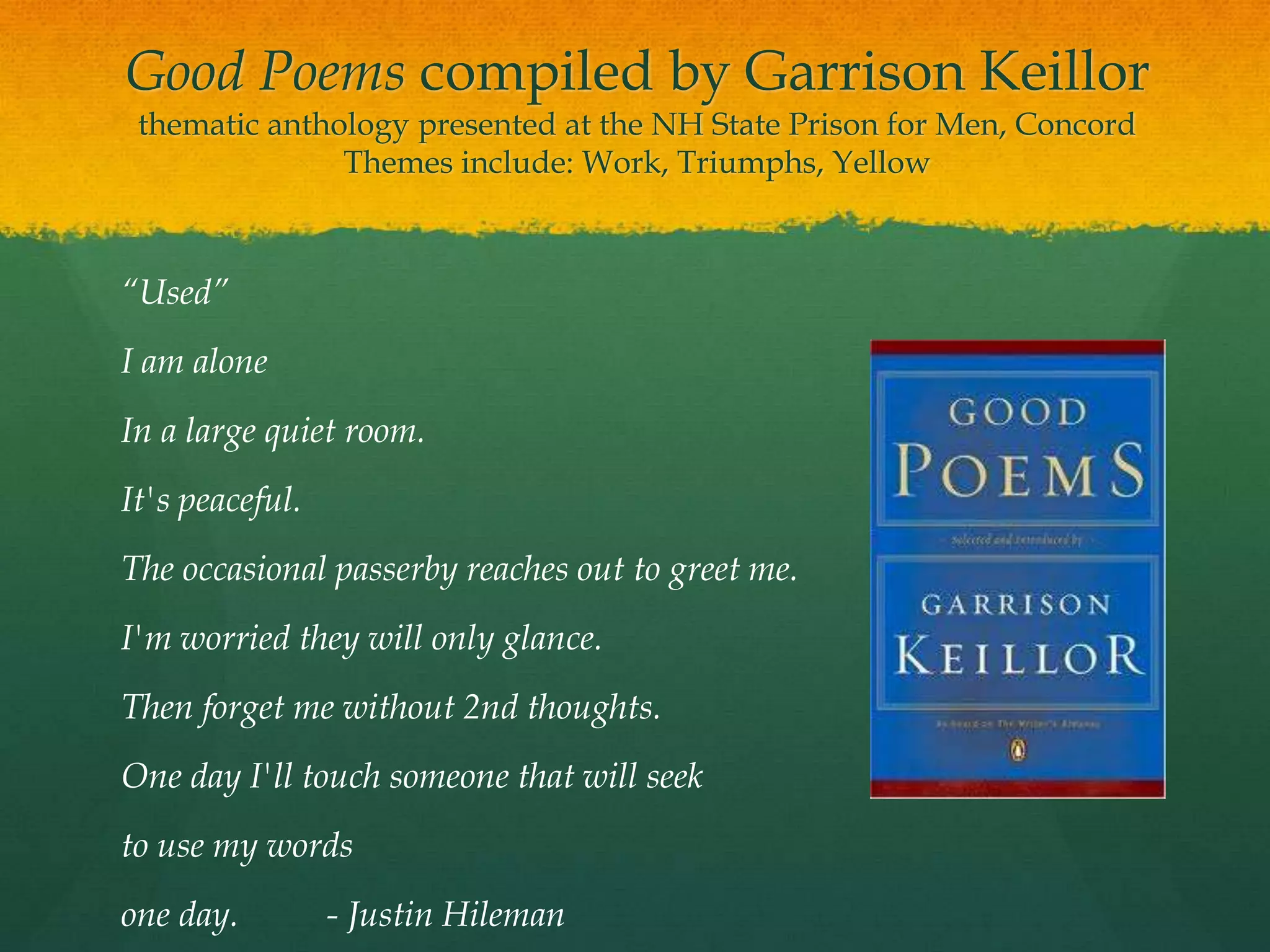
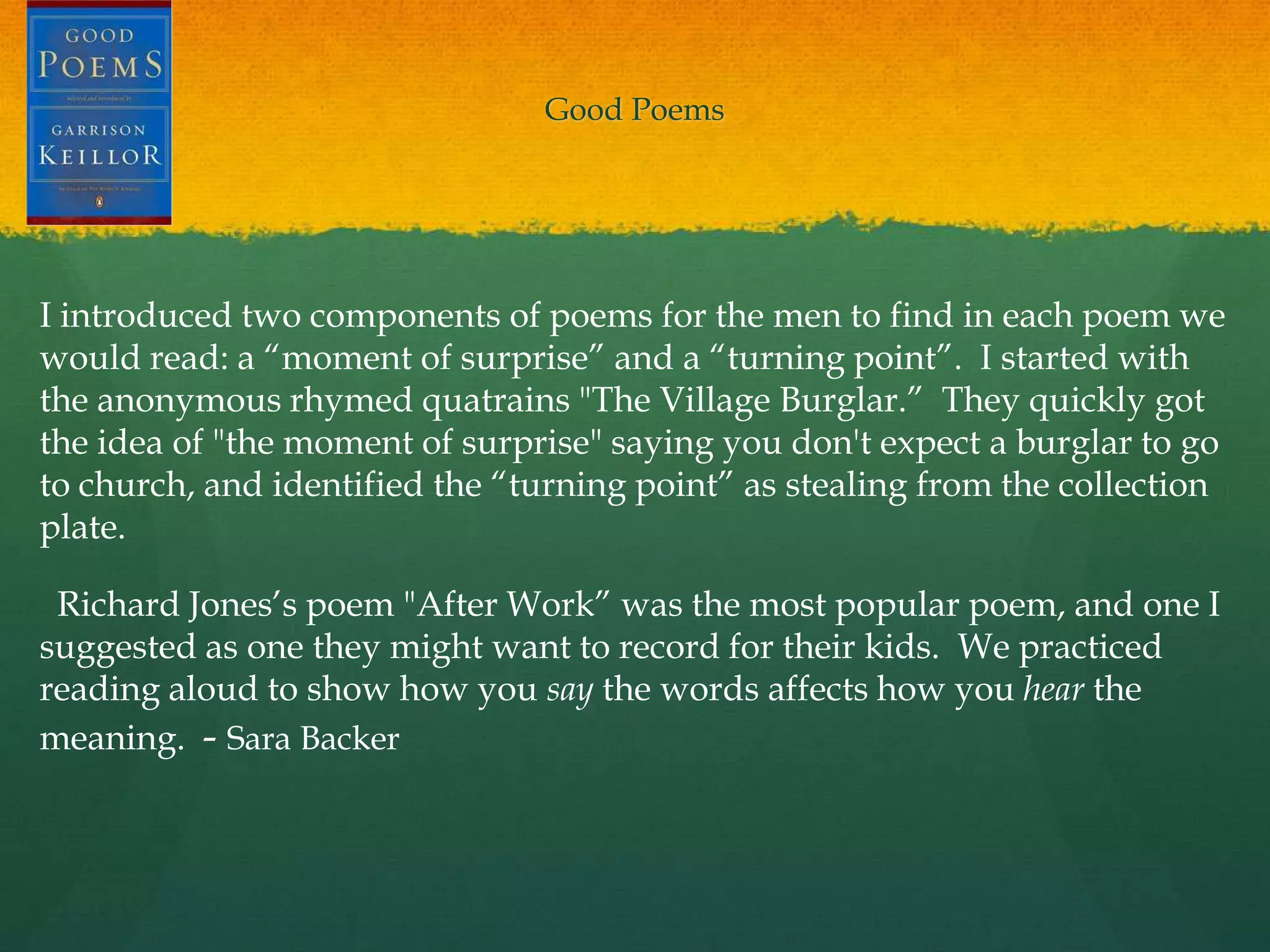
Good Poems compiled by Garrison Keillor
 thematic anthology presented at the NH State Prison for Men, Concord
               Themes include: Work, Triumphs, Yellow


“Used”
I am alone
In a large quiet room.
It's peaceful.
The occasional passerby reaches out to greet me.
I'm worried they will only glance.
Then forget me without 2nd thoughts.
One day I'll touch someone that will seek
to use my words
one day.         - Justin Hileman
Good Poems


I introduced two components of poems for the men to find in each poem we
would read: a “moment of surprise” and a “turning point”. I started with
the anonymous rhymed quatrains "The Village Burglar.” They quickly got
the idea of "the moment of surprise" saying you don't expect a burglar to go
to church, and identified the “turning point” as stealing from the collection
plate.

 Richard Jones‟s poem "After Work” was the most popular poem, and one I
suggested as one they might want to record for their kids. We practiced
reading aloud to show how you say the words affects how you hear the
meaning. - Sara Backer
Stone Fox by John Reynolds Gardiner
 short novel read in Adult Basic Education group of tutors and students
                            Theme: Courage


What is courage?
Close your eyes and think of a time you have had courage. We
won‟t share these experiences, we will just remember them
silently – the situation, the feelings, what you saw, heard. Silence
(give your students time). Now say one word connected with
that experience. For example, my word would be “doorway.”
(Write the words on the board and ask someone else to record
them for you.) From these words, we‟ll keep in our minds these
experiences of courage. - Maggie Moore
The use of the theme of courage


So often, when beginning readers start a book, they perhaps
approach the book with trepidation: Will I understand the words,
the story? Will I get to the end? Will I “get it”? They think of the
book as an object separate from themselves; the reading is
“bookcentric.”

Talking about courage brings them - who they are - to the book.
They know about courage. Talking together about the theme
gives readers confidence in their own knowledge and shows
respect for their intelligence and experience. The discussion also
helps them access the book in an individual and personal way.
They see another reason for reading.      - Maggie Moore
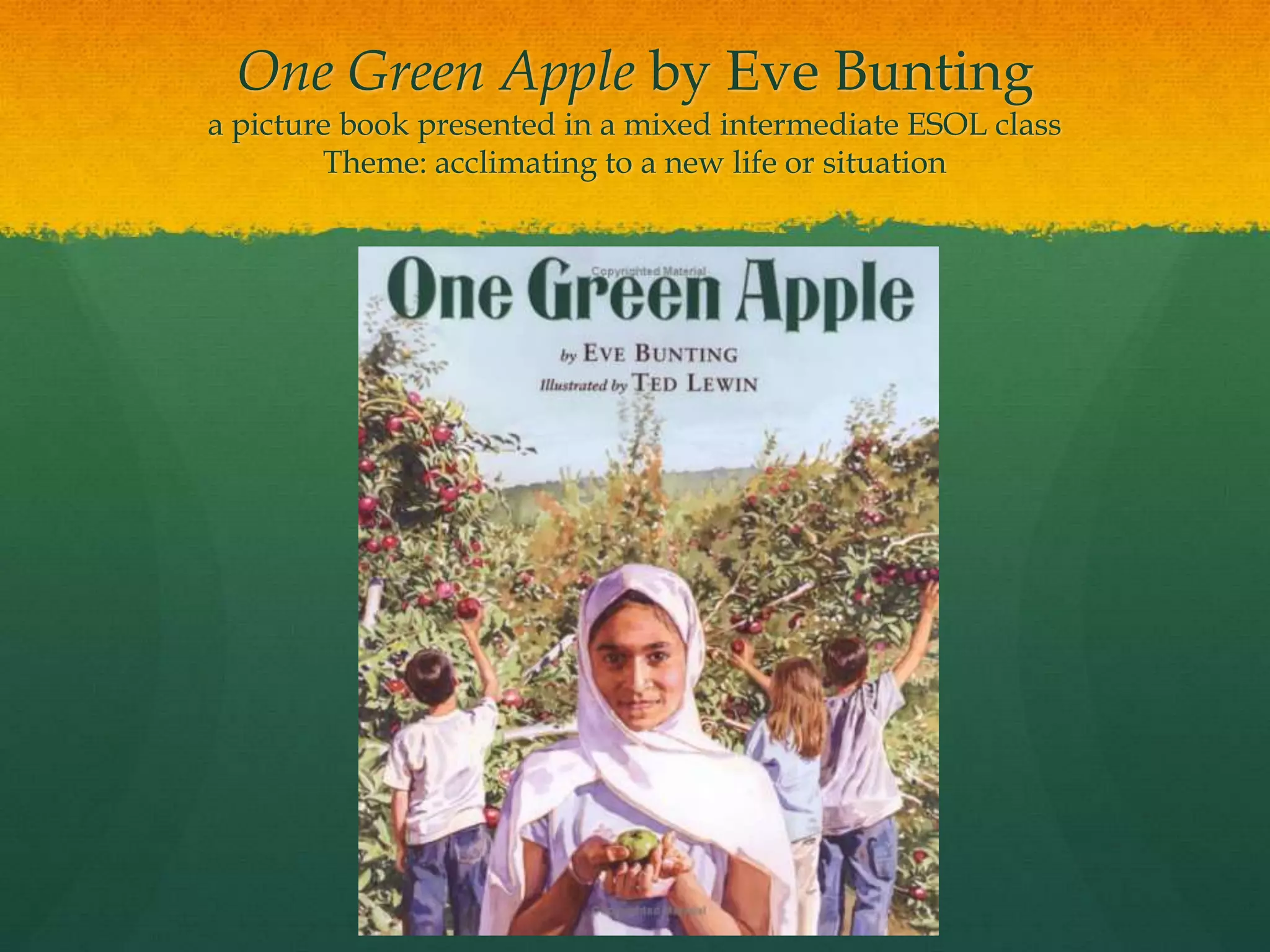
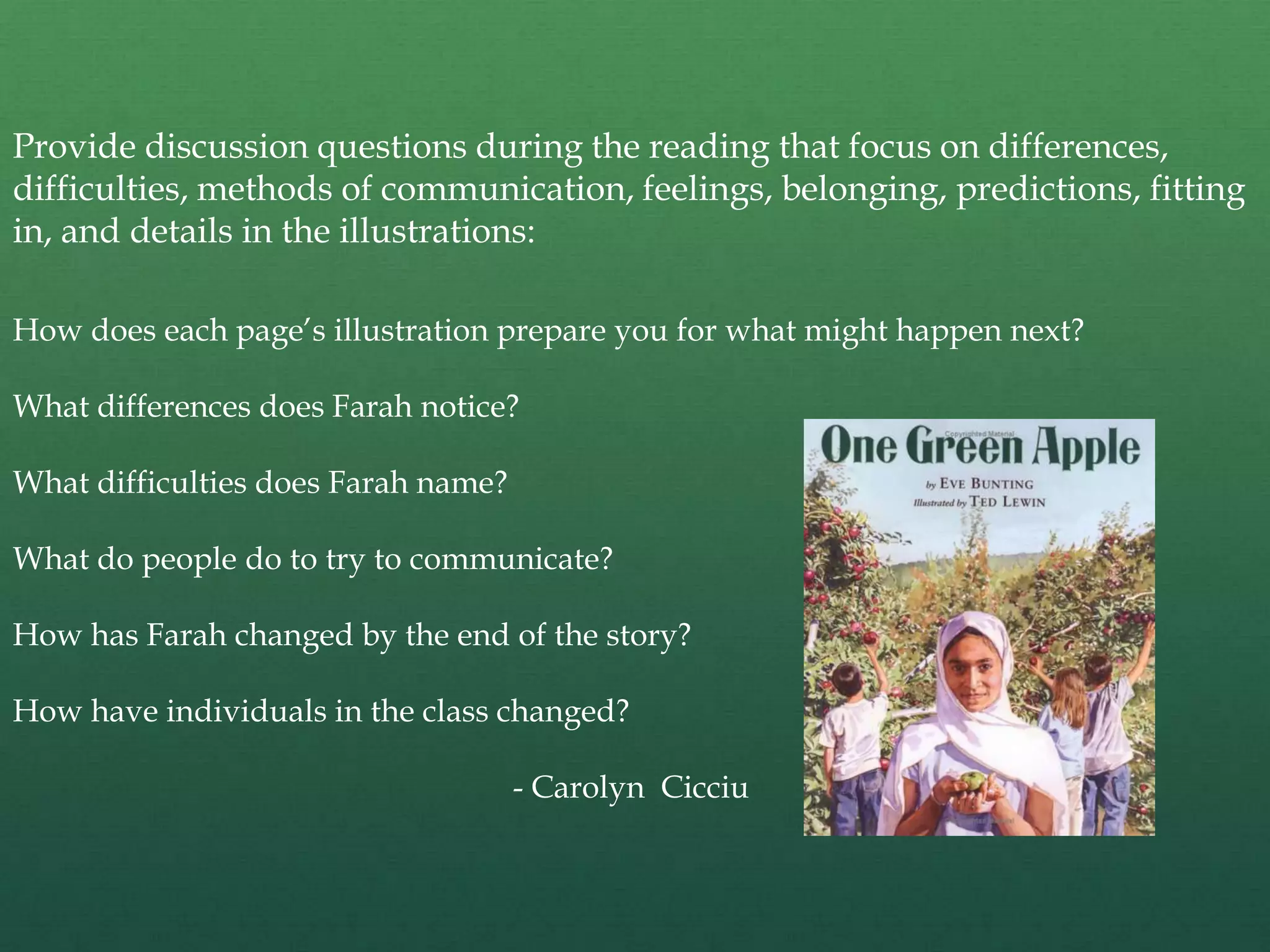
One Green Apple by Eve Bunting
a picture book presented in a mixed intermediate ESOL class
        Theme: acclimating to a new life or situation
Provide discussion questions during the reading that focus on differences,
difficulties, methods of communication, feelings, belonging, predictions, fitting
in, and details in the illustrations:

How does each page‟s illustration prepare you for what might happen next?

What differences does Farah notice?

What difficulties does Farah name?

What do people do to try to communicate?

How has Farah changed by the end of the story?

How have individuals in the class changed?

                                     - Carolyn Cicciu
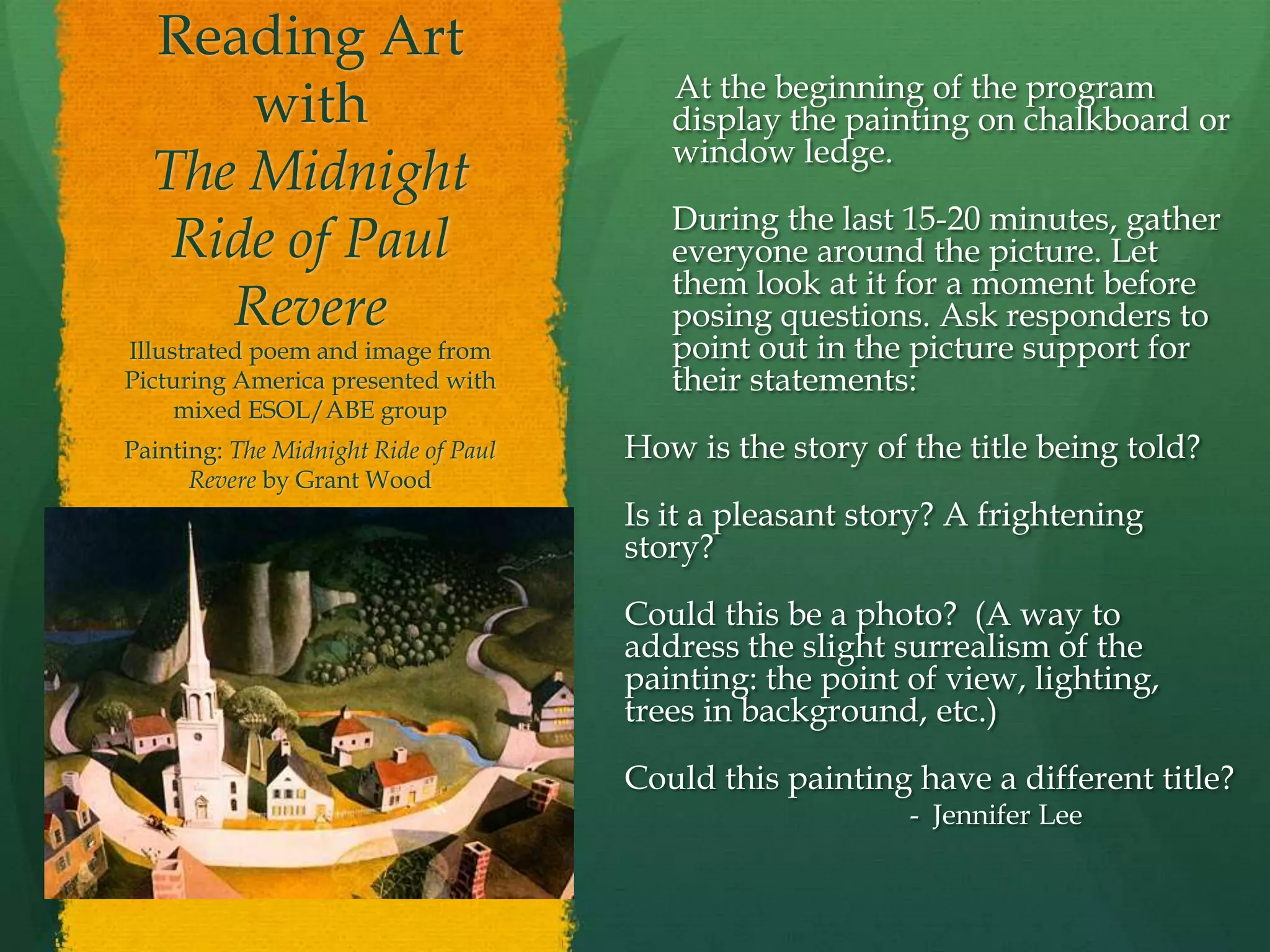
Reading Art
                                         At the beginning of the program
      with                               display the painting on chalkboard or
                                         window ledge.
  The Midnight
                                         During the last 15-20 minutes, gather
   Ride of Paul                          everyone around the picture. Let
                                         them look at it for a moment before
     Revere                              posing questions. Ask responders to
Illustrated poem and image from          point out in the picture support for
Picturing America presented with         their statements:
     mixed ESOL/ABE group
Painting: The Midnight Ride of Paul   How is the story of the title being told?
      Revere by Grant Wood
                                      Is it a pleasant story? A frightening
                                      story?

                                      Could this be a photo? (A way to
                                      address the slight surrealism of the
                                      painting: the point of view, lighting,
                                      trees in background, etc.)

                                      Could this painting have a different title?
                                                          - Jennifer Lee
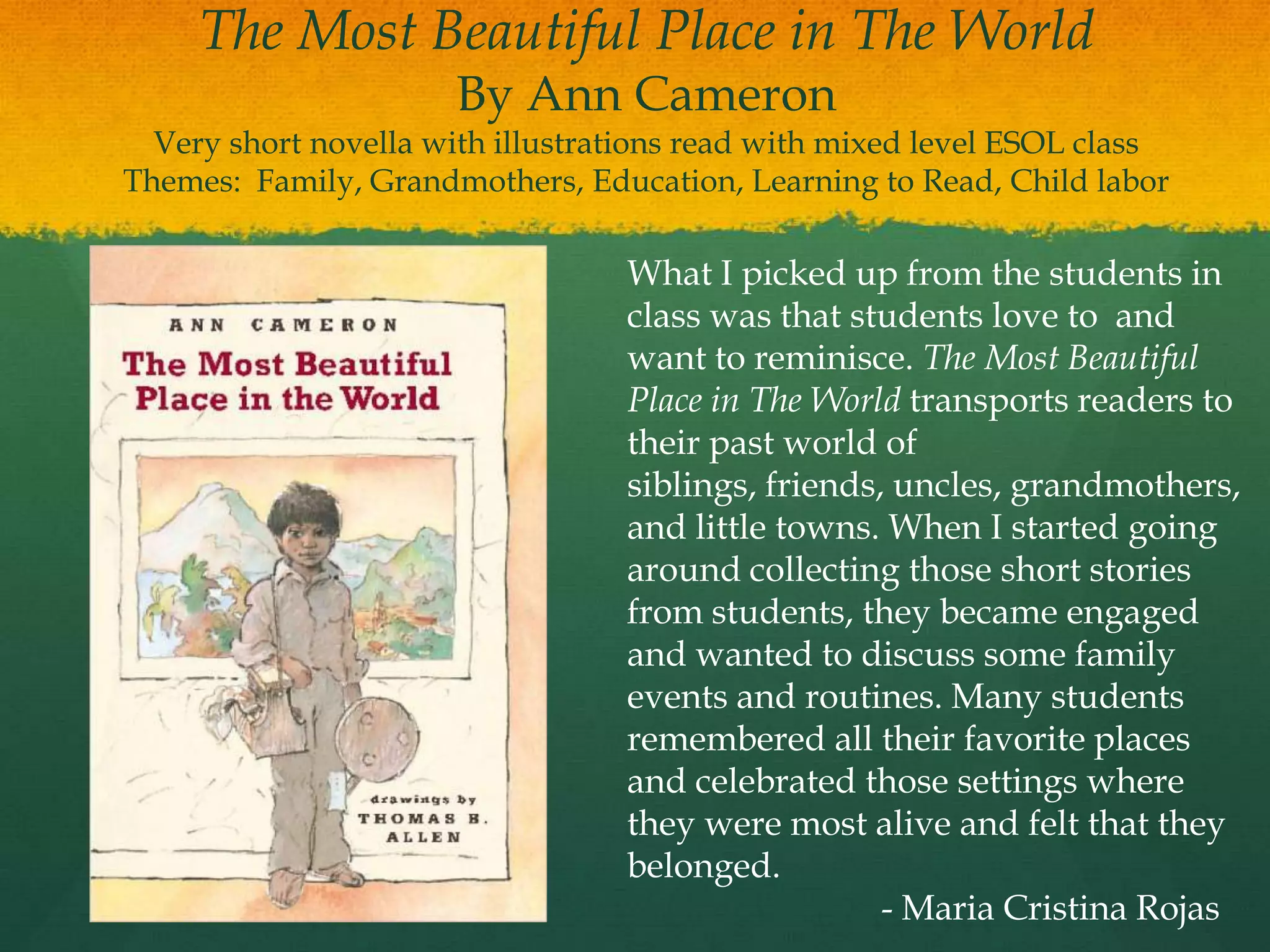
The Most Beautiful Place in The World
                      By Ann Cameron
  Very short novella with illustrations read with mixed level ESOL class
Themes: Family, Grandmothers, Education, Learning to Read, Child labor

                                  What I picked up from the students in
                                  class was that students love to and
                                  want to reminisce. The Most Beautiful
                                  Place in The World transports readers to
                                  their past world of
                                  siblings, friends, uncles, grandmothers,
                                  and little towns. When I started going
                                  around collecting those short stories
                                  from students, they became engaged
                                  and wanted to discuss some family
                                  events and routines. Many students
                                  remembered all their favorite places
                                  and celebrated those settings where
                                  they were most alive and felt that they
                                  belonged.
                                                    - Maria Cristina Rojas
Facilitators’ Tips for Successful Book
                 Discussions

It seems that the most successful group discussions were the ones in which I
took a risk in suggesting a meaning that was unexpected.

                                            - Linda Graham

Build a rapport with the participants, invite them to relate to the text with their
own life experiences, and summarize the story at the end of each discussion.

                                           - Appy Manchanda

By introducing different ways of telling (painting and drawing) there are
affirmations for different kinds of talents. Make sure to say that the art work is
not being graded in any way.

                                            - Hetty Startup
Food is both a big draw, and a good ice breaker and equalizer, and can
always be somehow connected to every reading. Participants at the
Goffstown Prison wished that we could have incorporated food into the
program at least once.
                                                - Tammi Truax

In Community Partners and in ESOL classes as well, offering a personal
connection with the story creates the atmosphere for good discussion and
counterbalances any drawbacks of a particular book.
                                                - Maren Tirabassi

At the start of each week, I briefly review highlights of the discussion from
the week before.
                                                   - Maggie Moore

Bring joyful energy into the room and express gratitude for everyone‟s
willingness to “play with books.”
                                                - Courtney Marshall
Maintain a basic structure, but be flexible and responsive to the group,
allowing for small (fun) variations throughout the series.
                                                     - Jennifer Lee

Begin class with an activity that involves every student saying
something. It might be something simple like naming a fruit they like to
eat or that is native to their country. Having spoken once before the
class begins gives the students courage to participate later. This could
be done as a whole class activity or in small groups.
                                                      - Carolyn Cicciu

 ESOL students are motivated learners. Articulate every sound. Do not
rush your language.
                                                    - Rodger Martin
Conversations About books

Conversations About books

  • 1.
    Conversations About Books Facilitators present sample books and discussion methods they offer in the New Hampshire Humanities Council‟s Adult Literacy Program, Connections.
  • 2.
    Pumpkins by KenRobbins photo essay presented in beginning level ESOL class Themes: Food, New England, Planting the Earth, Seasons A great book for a mixed level ESOL class as well as beginners, Pumpkins gives beautiful, seasonal images inviting identification, conversation, and interpretation. - Susan Bartlett
  • 3.
    Pumpkins Sequencing a Narrative:with Beginning Level Readers and Speakers After reading the book, we divided the class into three groups. Each group received a series of photographs from the 2010 Connecticut River “Pumpkin Flood” when rising waters swept 100,000 pumpkins off several fields. The photos show volunteers fishing pumpkins out of the river. The class groups are asked to sequence the photos so that they tell a story and then explain their reasoning to the whole class. When we did this exercise in Laconia, we had three different stories! After we discussed all the possibilities, we looked at the article in the Valley News to find out what really happened. We also talked about what pictures were missing from the selection that would have helped to better tell the true story. A similar exercise could be used with many books, and there are endless possibilities for writing practice. - Susan Bartlett
  • 4.
    Deepak’s Diwali byDivya Karwal, illus. by Doreen Lang a picture book about the celebration of the Hindu Festival of Lights, presented with a beginning level ESOL class. Themes: Holidays, Family, Religions, Food.
  • 5.
    Deepak’s Diwali We createda festive atmosphere for the discussion of Deepak’s Diwali. We dressed in traditional clothes for Diwali. I prepared halwa, a traditional dessert, for the participants. It is one of the traditional Diwali sweet dishes. I brought in the prayer book of devotional songs sung on the Diwali day while worshipping Laxmi, the Goddess of wealth and prosperity and sang the songs with the participants. I brought the traditional Diyas or oil lamps used to light up homes on the Diwali day and the Pooja thaali or the prayer plate used to worship the idol of Goddess Laxmi on Diwali day. I handed out a list of vocabulary words to the participants to build their vocabulary and explained the meaning of each word and enacted some of the words for them to give them a better understanding of the text. . - Appy Manchanda
  • 6.
    Ferdinand by MunroLeaf picture book presented at the NH State Prison for Women at Goffstown This children‟s book is an easy read that supports the power of remaining true to oneself. There may be many interpretations of the short book, but using it at the NH State Prison for Women, the emphasis I used was on the art of the illustration and the strength of the individual. Since the illustrations are black and white and have remained powerfully imaginative, I taught the women to make Zentangles. This is an art form which can become quite elaborate but allows all levels to participate, even those who think they cannot draw a line. It is done in black and white. – Linda Graham
  • 7.
    Teammates by Peter Golenbock, illus. by Paul Bacon illustrated biography presented at NH State Prison for Men, Berlin Themes: Justice, Race and friendship On the theme of race and friendship: Think of 5 activities that you do on a regular basis (not necessarily daily). Imagine that tomorrow you woke up and your race had changed. How would doing those activities be different? How do you think strangers would react to you? If you were “Pee Wee” Reese‟s father, how would you help him handle the harassment? Do you think your children would do what he did? - Courtney Marshall
  • 8.
    A Chair forMy Mother by Vera Williams a picture book presented with a mixed level ESOL class. Themes: Saving, Overcoming hardships, Community, Family, Mothers & daughters A Chair for My Mother is designed with borders to each page that echo the emotions of the characters in the story and key events. Pivotal moments include a fire in the family‟s apartment and later, a line of caring neighbors walking over with household items to help them get settled in their new home . As the visual experience of reading this book is so rich I chose to copy in color the boarders of some pages and share these with the participants. We discussed how we might draw or sketch difficulties we had experienced and happier times in our lives. Brushes and watercolor paints and small glass jars were available for people to use. We ended up with a small „gallery‟ of paintings and discussed what we had made and why. – Hetty Startup
  • 10.
    Out of theDust by Karen Hesse a novel in verse presented at the NH State Prison for Women Themes: Historical fiction, U.S. history, Family, Jazz music, Planting the Earth, Stamina, Endurance
  • 11.
    Out of theDust One of the things that helped participants to feel comfortable both with the book and with us as facilitators was the sharing of photographs from the historical period of the dust bowl. Most successful was the photography of Dorothea Lange, and most useful of all was The Migrant Mother. After ample discussion, and because the photo is so evocative, it led beautifully to a writing exercise that can be individualized. Start by having students list single words that the photo brings to mind when they look at it. From that word list, an additional writing of poetry, prose or memoir can .
 I would love to go back and do a session with the women on Steinbeck's work as they were ready and interested in it, but had never heard of his novels. - Tammi Truax
  • 12.
    My People byLangston Hughes photos by Charles R. Smith, Jr. photo essay with poem, presented with beginning/mixed level ESOL class . Themes: the humanities 
 We began sessions by serving each student a cup of hot tea. It was a good ice breaker and places both facilitator and student on a more level playing field. The poem is short and succinct and written for adults. Each phrase presents opportunities to make leaps between the speaker‟s recent culture and the new culture he or she has entered. For example, when Hughes compares his people to the stars, we used the opportunity to talk about the North Star, and its name in the various cultures. We moved outside and investigated where the Polaris would be that night in Concord. Johanna Young, the teacher, is exploring the possibility of a follow-up trip to the Christa McAuliffe Planetarium. – Rodger Martin
  • 13.
    “We spoke thelines of the poem again and again to emphasize the words, the rhythms, and the sounds. Once the poem was familiar, students created individual poems in the style of Langston Hughes's poem.” - Rodger Martin For our final activity of the summer, we held a poetry reading with different students taking turns reading lines of the poem. The rest of the class joined in a chorus shouting, “my people” after each My mother is beautiful line. Several students read their poems as part of the performance. Most of the Like Bhutan is beautiful, students were adults from age 20 up to age 75. Family members, friends, staff, Like stars look beautiful at night. and volunteers all came to watch the performance. Students also brought - Hema Khanal food to share. They decorated the dining hall at First Congregational Church with drawings of faces, trees, flowers and words they had learned. - Johanna Young
  • 14.
    Ox Cart Manby Donald Hall a picture book presented with developmentally disabled adults “Each of the participants birthdays were a part of a particular season, a part of the original story, and a part of the story about our own lives. “ Maren Tirabassi
  • 15.
    Ox Cart Man The community building activity at our session for Ox Cart Man was extremely energizing for this non-reading group, and I can extrapolate that it would work very well in an ESOL setting as well. A long sheet of table-covering white paper was divided into blocks for the twelve months of the year. The participants brainstormed what weather, what activities, what work and what fun they experience in each of these months. We then noted everyone‟s birthdays so that individuals could identify with a particular month. Ox Cart Man begins in October when the father of the family packs his wagon for Portsmouth market. The story of the family continues through a full year. We slowly read the pages contrasting life in the two eras. The importance of contributions from each family member in Donald Hall‟s story was compared to the importance of contributions from different members of the contemporary family unit and other forms of community, such as Community Partners. - Maren Tirabassi
  • 16.
    Good Poems compiledby Garrison Keillor thematic anthology presented at the NH State Prison for Men, Concord Themes include: Work, Triumphs, Yellow “Used” I am alone In a large quiet room. It's peaceful. The occasional passerby reaches out to greet me. I'm worried they will only glance. Then forget me without 2nd thoughts. One day I'll touch someone that will seek to use my words one day. - Justin Hileman
  • 17.
    Good Poems I introducedtwo components of poems for the men to find in each poem we would read: a “moment of surprise” and a “turning point”. I started with the anonymous rhymed quatrains "The Village Burglar.” They quickly got the idea of "the moment of surprise" saying you don't expect a burglar to go to church, and identified the “turning point” as stealing from the collection plate. Richard Jones‟s poem "After Work” was the most popular poem, and one I suggested as one they might want to record for their kids. We practiced reading aloud to show how you say the words affects how you hear the meaning. - Sara Backer
  • 18.
    Stone Fox byJohn Reynolds Gardiner short novel read in Adult Basic Education group of tutors and students Theme: Courage What is courage? Close your eyes and think of a time you have had courage. We won‟t share these experiences, we will just remember them silently – the situation, the feelings, what you saw, heard. Silence (give your students time). Now say one word connected with that experience. For example, my word would be “doorway.” (Write the words on the board and ask someone else to record them for you.) From these words, we‟ll keep in our minds these experiences of courage. - Maggie Moore
  • 19.
    The use ofthe theme of courage So often, when beginning readers start a book, they perhaps approach the book with trepidation: Will I understand the words, the story? Will I get to the end? Will I “get it”? They think of the book as an object separate from themselves; the reading is “bookcentric.” Talking about courage brings them - who they are - to the book. They know about courage. Talking together about the theme gives readers confidence in their own knowledge and shows respect for their intelligence and experience. The discussion also helps them access the book in an individual and personal way. They see another reason for reading. - Maggie Moore
  • 20.
    One Green Appleby Eve Bunting a picture book presented in a mixed intermediate ESOL class Theme: acclimating to a new life or situation
  • 21.
    Provide discussion questionsduring the reading that focus on differences, difficulties, methods of communication, feelings, belonging, predictions, fitting in, and details in the illustrations: How does each page‟s illustration prepare you for what might happen next? What differences does Farah notice? What difficulties does Farah name? What do people do to try to communicate? How has Farah changed by the end of the story? How have individuals in the class changed? - Carolyn Cicciu
  • 22.
    Reading Art At the beginning of the program with display the painting on chalkboard or window ledge. The Midnight During the last 15-20 minutes, gather Ride of Paul everyone around the picture. Let them look at it for a moment before Revere posing questions. Ask responders to Illustrated poem and image from point out in the picture support for Picturing America presented with their statements: mixed ESOL/ABE group Painting: The Midnight Ride of Paul How is the story of the title being told? Revere by Grant Wood Is it a pleasant story? A frightening story? Could this be a photo? (A way to address the slight surrealism of the painting: the point of view, lighting, trees in background, etc.) Could this painting have a different title? - Jennifer Lee
  • 23.
    The Most BeautifulPlace in The World By Ann Cameron Very short novella with illustrations read with mixed level ESOL class Themes: Family, Grandmothers, Education, Learning to Read, Child labor What I picked up from the students in class was that students love to and want to reminisce. The Most Beautiful Place in The World transports readers to their past world of siblings, friends, uncles, grandmothers, and little towns. When I started going around collecting those short stories from students, they became engaged and wanted to discuss some family events and routines. Many students remembered all their favorite places and celebrated those settings where they were most alive and felt that they belonged. - Maria Cristina Rojas
  • 24.
    Facilitators’ Tips forSuccessful Book Discussions It seems that the most successful group discussions were the ones in which I took a risk in suggesting a meaning that was unexpected. - Linda Graham Build a rapport with the participants, invite them to relate to the text with their own life experiences, and summarize the story at the end of each discussion. - Appy Manchanda By introducing different ways of telling (painting and drawing) there are affirmations for different kinds of talents. Make sure to say that the art work is not being graded in any way. - Hetty Startup
  • 25.
    Food is botha big draw, and a good ice breaker and equalizer, and can always be somehow connected to every reading. Participants at the Goffstown Prison wished that we could have incorporated food into the program at least once. - Tammi Truax In Community Partners and in ESOL classes as well, offering a personal connection with the story creates the atmosphere for good discussion and counterbalances any drawbacks of a particular book. - Maren Tirabassi At the start of each week, I briefly review highlights of the discussion from the week before. - Maggie Moore Bring joyful energy into the room and express gratitude for everyone‟s willingness to “play with books.” - Courtney Marshall
  • 26.
    Maintain a basicstructure, but be flexible and responsive to the group, allowing for small (fun) variations throughout the series. - Jennifer Lee Begin class with an activity that involves every student saying something. It might be something simple like naming a fruit they like to eat or that is native to their country. Having spoken once before the class begins gives the students courage to participate later. This could be done as a whole class activity or in small groups. - Carolyn Cicciu ESOL students are motivated learners. Articulate every sound. Do not rush your language. - Rodger Martin