Control Charts For Semiconductor Defect Management


                                     Stuart L. Riley
                               slriley@valaddsoft.com
                          Member American Society for Quality


January 20, 2009                       Copyright Stuart L. Riley        1
Copyright Statement


Original work by Stuart L. Riley: Copyright 2010

Rights reserved.

This document may be downloaded for personal use.

Users are forbidden to reproduce, republish, redistribute, or resell any materials
from this document as their original work.

All references to this document, any quotation, or figures should be made to the
author.

Questions or comments can be addressed to Stuart L. Riley, at
slriley@valaddsoft.com or slriley0207@gmail.com


January 20, 2009                   Copyright Stuart L. Riley                     2
Introduction

• We will briefly explore a few ways to create control charts based
  on in-line defect inspection data
• Several examples are shown using real defect data


January 20, 2009            Copyright Stuart L. Riley             3
Types of Control Charts For Defect Data
• Individuals: XmR Charts
         –     Continuous data – defect density, defect-limited yield (dly)1
         –     Used when data cannot be grouped into rational subgroups
         –     The process distribution may be very skewed or bounded (non-normal)
         –     May be applied to data with outliers
         –     Each observation represents the process at a given point in time
         –     The data is time-ordered and entered in the sequence which it was generated
• C-Chart
         –     Discrete data - typically used for defect count data2
         –     Can have problems with outlier data
         –     Plot the number of defectives (per batch, per day, per machine, etc.)
         –     Control limits in this chart are computed based on the Poisson distribution
        1: http://www.valaddsoft.com/Documents/Semiconductor-Defect-Management---Separating-the-Vital-Few-From-the-Trival-Many.pdf
        2: http://www.itl.nist.gov/div898/handbook/pmc/section3/pmc331.htm
January 20, 2009                                           Copyright Stuart L. Riley                                                 4
Types of Control Charts For Defect Data

• Run Charts
         –     Sometimes used when there is insufficient data to apply SPC charts
         –     Lacks the benefits of control charts
         –     Upward and downward trends, cycles, and large aberrations may be spotted
         –     Can be used to track improvements that have been put into place
         –     Average centerline can be added to see movement about the average
         –     The data is time-ordered and entered in the sequence which it was generated
         –     Try not to depend on these types of charts, unless you really need them


January 20, 2009                           Copyright Stuart L. Riley                         5
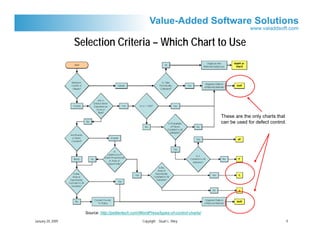
Selection Criteria – Which Chart to Use


                                                                                         These are the only charts that
                                                                                         can be used for defect control.


                     Source: http://peltiertech.com/WordPress/types-of-control-charts/

January 20, 2009                                     Copyright Stuart L. Riley                                             6
Individuals (XmR) Chart Control Limits

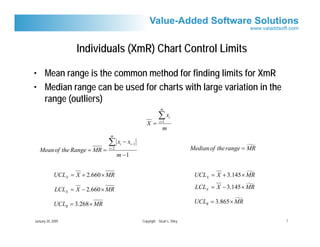
• Mean range is the common method for finding limits for XmR
• Median range can be used for charts with large variation in the
  range (outliers)
                                                                  m

                                                                 ∑x      i
                                                         X=       i =1
                                                                    m
                                  m

                                 ∑ x −x  i     i −1
   Mean of the Range = MR =      i =2                                             Median of the range = MR
                                        m −1


             UCLX = X + 2.660 × MR                                                 UCLX = X + 3.145 × MR

             LCLX = X − 2.660 × MR                                                 LCLX = X − 3.145 × MR

             UCLR = 3.268 × MR                                                     UCLR = 3.865 × MR


January 20, 2009                                      Copyright Stuart L. Riley                              7
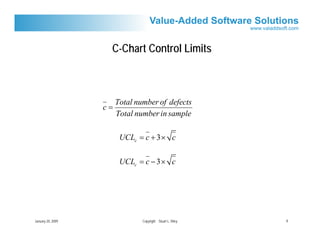
C-Chart Control Limits


                        Total number of defects
                   c=
                        Total number in sample

                         UCLc = c + 3 × c

                         UCLc = c − 3 × c


January 20, 2009                Copyright Stuart L. Riley   8
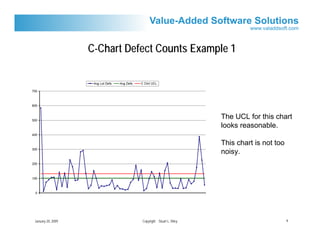
C-Chart Defect Counts Example 1


                                                          The UCL for this chart
                                                          looks reasonable.

                                                          This chart is not too
                                                          noisy.


January 20, 2009              Copyright Stuart L. Riley                           9
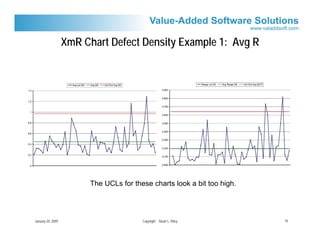
XmR Chart Defect Density Example 1: Avg R


                         The UCLs for these charts look a bit too high.


January 20, 2009                         Copyright Stuart L. Riley        10
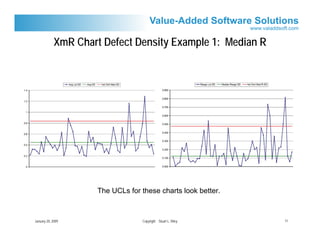
XmR Chart Defect Density Example 1: Median R


                      The UCLs for these charts look better.


January 20, 2009                   Copyright Stuart L. Riley   11
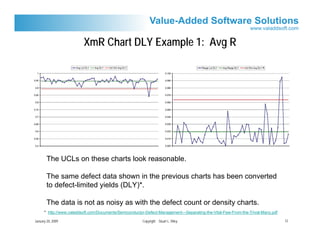
XmR Chart DLY Example 1: Avg R


        The UCLs on these charts look reasonable.

        The same defect data shown in the previous charts has been converted
        to defect-limited yields (DLY)*.

        The data is not as noisy as with the defect count or density charts.
      * http://www.valaddsoft.com/Documents/Semiconductor-Defect-Management---Separating-the-Vital-Few-From-the-Trival-Many.pdf

January 20, 2009                                         Copyright Stuart L. Riley                                                12
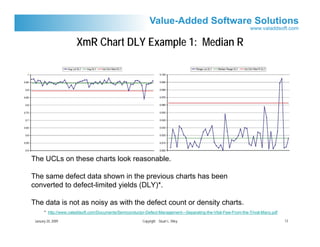
XmR Chart DLY Example 1: Median R


The UCLs on these charts look reasonable.

The same defect data shown in the previous charts has been
converted to defect-limited yields (DLY)*.

The data is not as noisy as with the defect count or density charts.
       * http://www.valaddsoft.com/Documents/Semiconductor-Defect-Management---Separating-the-Vital-Few-From-the-Trival-Many.pdf

 January 20, 2009                                         Copyright Stuart L. Riley                                                13
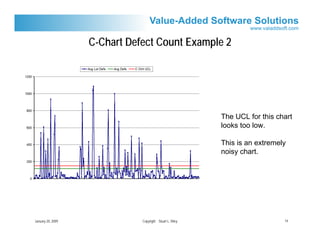
C-Chart Defect Count Example 2


                                                          The UCL for this chart
                                                          looks too low.

                                                          This is an extremely
                                                          noisy chart.


January 20, 2009              Copyright Stuart L. Riley                      14
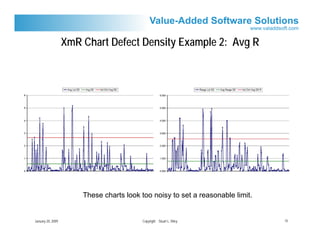
XmR Chart Defect Density Example 2: Avg R


                       These charts look too noisy to set a reasonable limit.


January 20, 2009                          Copyright Stuart L. Riley             15
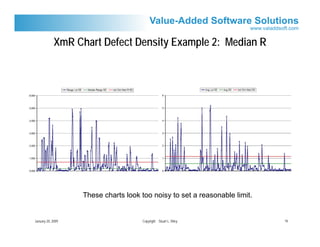
XmR Chart Defect Density Example 2: Median R


                   These charts look too noisy to set a reasonable limit.


January 20, 2009                      Copyright Stuart L. Riley             16
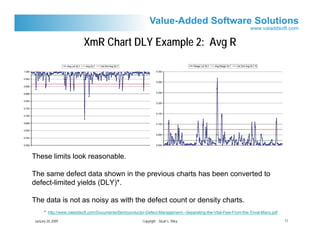
XmR Chart DLY Example 2: Avg R


These limits look reasonable.

The same defect data shown in the previous charts has been converted to
defect-limited yields (DLY)*.

The data is not as noisy as with the defect count or density charts.
      * http://www.valaddsoft.com/Documents/Semiconductor-Defect-Management---Separating-the-Vital-Few-From-the-Trival-Many.pdf

January 20, 2009                                         Copyright Stuart L. Riley                                                17
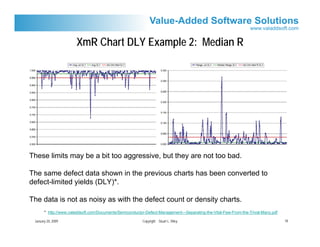
XmR Chart DLY Example 2: Median R


These limits may be a bit too aggressive, but they are not too bad.

The same defect data shown in the previous charts has been converted to
defect-limited yields (DLY)*.

The data is not as noisy as with the defect count or density charts.
       * http://www.valaddsoft.com/Documents/Semiconductor-Defect-Management---Separating-the-Vital-Few-From-the-Trival-Many.pdf

 January 20, 2009                                         Copyright Stuart L. Riley                                                18
Summary

• XmR charts are the typically the best choice for defect control
  charts
• C-Charts rarely work well for noisy data, so they should be
  avoided
• If the data is too noisy, you can always use a run chart, but you
  will loose the benefits of control charts
• The best solution is to use defect-limited yield* control charts
         – It is the appropriate metric to track the yield impact of defects on wafers
         – It tends to smooth out the noise to focus attention to real issues
         – It makes setting up defect control charts much easier

      * http://www.valaddsoft.com/Documents/Semiconductor-Defect-Management---Separating-the-Vital-Few-From-the-Trival-Many.pdf


January 20, 2009                                         Copyright Stuart L. Riley                                                19

Control Charts For Semiconductor Defect Management

  • 1.
    Control Charts ForSemiconductor Defect Management Stuart L. Riley slriley@valaddsoft.com Member American Society for Quality January 20, 2009 Copyright Stuart L. Riley 1
  • 2.
    Copyright Statement Original workby Stuart L. Riley: Copyright 2010 Rights reserved. This document may be downloaded for personal use. Users are forbidden to reproduce, republish, redistribute, or resell any materials from this document as their original work. All references to this document, any quotation, or figures should be made to the author. Questions or comments can be addressed to Stuart L. Riley, at slriley@valaddsoft.com or slriley0207@gmail.com January 20, 2009 Copyright Stuart L. Riley 2
  • 3.
    Introduction • We willbriefly explore a few ways to create control charts based on in-line defect inspection data • Several examples are shown using real defect data January 20, 2009 Copyright Stuart L. Riley 3
  • 4.
    Types of ControlCharts For Defect Data • Individuals: XmR Charts – Continuous data – defect density, defect-limited yield (dly)1 – Used when data cannot be grouped into rational subgroups – The process distribution may be very skewed or bounded (non-normal) – May be applied to data with outliers – Each observation represents the process at a given point in time – The data is time-ordered and entered in the sequence which it was generated • C-Chart – Discrete data - typically used for defect count data2 – Can have problems with outlier data – Plot the number of defectives (per batch, per day, per machine, etc.) – Control limits in this chart are computed based on the Poisson distribution 1: http://www.valaddsoft.com/Documents/Semiconductor-Defect-Management---Separating-the-Vital-Few-From-the-Trival-Many.pdf 2: http://www.itl.nist.gov/div898/handbook/pmc/section3/pmc331.htm January 20, 2009 Copyright Stuart L. Riley 4
  • 5.
    Types of ControlCharts For Defect Data • Run Charts – Sometimes used when there is insufficient data to apply SPC charts – Lacks the benefits of control charts – Upward and downward trends, cycles, and large aberrations may be spotted – Can be used to track improvements that have been put into place – Average centerline can be added to see movement about the average – The data is time-ordered and entered in the sequence which it was generated – Try not to depend on these types of charts, unless you really need them January 20, 2009 Copyright Stuart L. Riley 5
  • 6.
    Selection Criteria –Which Chart to Use These are the only charts that can be used for defect control. Source: http://peltiertech.com/WordPress/types-of-control-charts/ January 20, 2009 Copyright Stuart L. Riley 6
  • 7.
    Individuals (XmR) ChartControl Limits • Mean range is the common method for finding limits for XmR • Median range can be used for charts with large variation in the range (outliers) m ∑x i X= i =1 m m ∑ x −x i i −1 Mean of the Range = MR = i =2 Median of the range = MR m −1 UCLX = X + 2.660 × MR UCLX = X + 3.145 × MR LCLX = X − 2.660 × MR LCLX = X − 3.145 × MR UCLR = 3.268 × MR UCLR = 3.865 × MR January 20, 2009 Copyright Stuart L. Riley 7
  • 8.
    C-Chart Control Limits Total number of defects c= Total number in sample UCLc = c + 3 × c UCLc = c − 3 × c January 20, 2009 Copyright Stuart L. Riley 8
  • 9.
    C-Chart Defect CountsExample 1 The UCL for this chart looks reasonable. This chart is not too noisy. January 20, 2009 Copyright Stuart L. Riley 9
  • 10.
    XmR Chart DefectDensity Example 1: Avg R The UCLs for these charts look a bit too high. January 20, 2009 Copyright Stuart L. Riley 10
  • 11.
    XmR Chart DefectDensity Example 1: Median R The UCLs for these charts look better. January 20, 2009 Copyright Stuart L. Riley 11
  • 12.
    XmR Chart DLYExample 1: Avg R The UCLs on these charts look reasonable. The same defect data shown in the previous charts has been converted to defect-limited yields (DLY)*. The data is not as noisy as with the defect count or density charts. * http://www.valaddsoft.com/Documents/Semiconductor-Defect-Management---Separating-the-Vital-Few-From-the-Trival-Many.pdf January 20, 2009 Copyright Stuart L. Riley 12
  • 13.
    XmR Chart DLYExample 1: Median R The UCLs on these charts look reasonable. The same defect data shown in the previous charts has been converted to defect-limited yields (DLY)*. The data is not as noisy as with the defect count or density charts. * http://www.valaddsoft.com/Documents/Semiconductor-Defect-Management---Separating-the-Vital-Few-From-the-Trival-Many.pdf January 20, 2009 Copyright Stuart L. Riley 13
  • 14.
    C-Chart Defect CountExample 2 The UCL for this chart looks too low. This is an extremely noisy chart. January 20, 2009 Copyright Stuart L. Riley 14
  • 15.
    XmR Chart DefectDensity Example 2: Avg R These charts look too noisy to set a reasonable limit. January 20, 2009 Copyright Stuart L. Riley 15
  • 16.
    XmR Chart DefectDensity Example 2: Median R These charts look too noisy to set a reasonable limit. January 20, 2009 Copyright Stuart L. Riley 16
  • 17.
    XmR Chart DLYExample 2: Avg R These limits look reasonable. The same defect data shown in the previous charts has been converted to defect-limited yields (DLY)*. The data is not as noisy as with the defect count or density charts. * http://www.valaddsoft.com/Documents/Semiconductor-Defect-Management---Separating-the-Vital-Few-From-the-Trival-Many.pdf January 20, 2009 Copyright Stuart L. Riley 17
  • 18.
    XmR Chart DLYExample 2: Median R These limits may be a bit too aggressive, but they are not too bad. The same defect data shown in the previous charts has been converted to defect-limited yields (DLY)*. The data is not as noisy as with the defect count or density charts. * http://www.valaddsoft.com/Documents/Semiconductor-Defect-Management---Separating-the-Vital-Few-From-the-Trival-Many.pdf January 20, 2009 Copyright Stuart L. Riley 18
  • 19.
    Summary • XmR chartsare the typically the best choice for defect control charts • C-Charts rarely work well for noisy data, so they should be avoided • If the data is too noisy, you can always use a run chart, but you will loose the benefits of control charts • The best solution is to use defect-limited yield* control charts – It is the appropriate metric to track the yield impact of defects on wafers – It tends to smooth out the noise to focus attention to real issues – It makes setting up defect control charts much easier * http://www.valaddsoft.com/Documents/Semiconductor-Defect-Management---Separating-the-Vital-Few-From-the-Trival-Many.pdf January 20, 2009 Copyright Stuart L. Riley 19