ACCEPTANCE CASEs
 {business law}
        PRESENTED BY:-
         Pradeep singha
                    dsbs
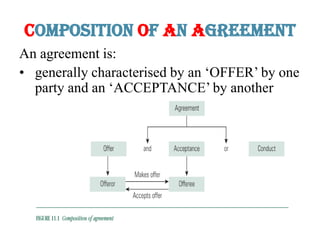
Composition Of An Agreement
An agreement is:
• generally characterised by an ‘OFFER’ by one
  party and an ‘ACCEPTANCE’ by another
Has An Offer Been Made?
• Facts:

•    Smith owns an organic farm.

•    Jones wants to buy Smith’s farm.

•    Jones emails Smith asking: “Will you sell me your   farm? Let me
    know your lowest price.”

•    Smith emails back saying: “The lowest price for my farm is
    $350,000.”

•    Jones then responds by saying: “I agree to buy your farm for the
    sum of $350,000 asked by you.”
What Are The Legal Issues?
  ISSUE:

• Did one party (the offeror) make an offer?

• Did the other party (the offeree) accept that
  offer?
Case:1
 Heathcote Ball v Barry [2000] EWCA
         Civ 235 (Auctions)
• The claimant had submitted the highest (and
  only) bids at an auction stated to be without
  reserve. The items were two Alan Smart engine
  analysers which were worth £14,000. The
  claimant had submitted bids of £200 each. The
  auctioneer refused to sell them at that price. The
  claimant brought an action for breach of contract
  claiming damages of £27,600.
Judgement
• The claimant was entitled to damages. Where
  an auction takes place without reserve the
  auctioneer makes a unilateral offer which is
  accepted by submitting the highest bid. There
  was thus a binding contract and the claimant
  entitled to damages covering the loss of
  bargain.
Case:2
Thornton v Shoe Lane Parking [1971] 2 WLR 585
         Court of Appeal (Machines)
• The claimant was injured in a car park partly due to
  the defendant's negligence. The claimant was given a
  ticket on entering the car park after putting money
  into a machine. The ticket stated the contract of
  parking was subject to terms and conditions which
  were displayed on the inside of the car park. One of
  the terms excluded liability for personal injuries
  arising through negligence. The question for the court
  was whether the term was incorporated into the
  contract ie had the defendant brought it to the
  attention of the claimant before or at the time the
  contract was made. This question depended upon
  where the offer and acceptance took place in
  relation to the machine.
Judgement
• The machine itself constituted the offer. The
  acceptance was by putting the money into the
  machine. The ticket was dispensed after the
  acceptance took place and therefore the
  clause was not incorporated into the contract.
Case:3
  Entorres v Miles Far East [1955] 2 QB 327 Court of
                        Appeal
• The claimant sent a telex message from England
  offering to purchase 100 tons of Cathodes from
  the defendants in Holland. The defendant sent
  back a telex from Holland to the London office
  accepting that offer. The question for the court
  was at what point the contract came into
  existence. If the acceptance was effective from
  the time the telex was sent the contract was
  made in Holland and Dutch law would apply. If
  the acceptance took place when the telex was
  received in London then the contract would be
  governed by English law.
Judgement
• To amount to an effective acceptance the
  acceptance needed to be communicated to
  the offeree. Therefore the contract was made
  in England.
Case:4
 Butler Machine Tool v Ex-Cell-O Corporation [1979] 1
              WLR 401 Court of Appeal
• Ex-Cell-O wished to purchase a machine from
  Butler. Butler sent out a quotation of £75,535
  along with a copy of their standard terms of sale.
  The terms included a price variation clause and a
  term that the seller's terms would prevail over
  any terms submitted by a purchaser. The machine
  would be delivered in 10 months. Ex-Cell-O put in
  an order for the machine at the stated price and
  sent a set of their terms which did not include the
  price variation clause.
Contd…
• The order contained an acknowledgement slip
  which required a signature by Butler and was
  to be returned to Ex-Cell-O. This slip stated
  that the contract would be subject to the
  terms stated overleaf. Butler duly signed the
  slip and returned it. The machines were then
  delivered and Butler sought to enforce the
  price variation clause and demanded an extra
  £2,893. Ex-Cell-O refused to pay.
Judgement
• The offer to sell the machine on terms provided
  by Butler was destroyed by the counter offer
  made by Ex-Cell-O. Therefore the price variation
  clause was not part of the contract. The contract
  was concluded on Ex-Cell-O's terms since Butler
  signed the acknowledgement slip accepting those
  terms. Where there is a battle of the forms
  whereby each party submits their own terms the
  last shot rule applies whereby a contract is
  concluded on the terms submitted by the party
  who is the last to communicate those terms
  before performance of the contract commences.
Case :5
 Holwell Securities v Hughes [1974] 1 WLR 155
• Dr Hughes granted Holwell Securities an
  option to purchase his house for £45,000. The
  option was to be exercisable 'by notice in
  writing' within 6 months. Five days before the
  expiry, Holwell posted a letter exercising the
  option. This letter was never received by
  Hughes. Holwell sought to enforce the option
  relying on the postal rule stating the
  acceptance took place before the expiry of the
  option.
Judgement
• By requiring 'notice in writing', Dr Hughes had
  specified that he had to actually receive the
  communication and had therefore excluded
  the postal rule.
Case:6
Pharmaceutical Society of Great Britain v/s Boots Cash Chemists
                        (Southern) Ltd [1953]

• Boots Cash Chemists had just a new method for
  its customers to buy certain medicines. The
  company would let shoppers pick drugs off the
  shelves in the chemist and then pay for them at
  the till. Before then, all medicines had to be
  gotten behind a counter and an assistant had to
  get what was requested. The Pharmaceutical
  Society of Great Britain objected and argued that
  under the Pharmacy and Poisons Act 1933, that
  was an unlawful practice.
Contd..
Under s 18(1), a pharmacist needed to supervise at
 the point where "the sale is effected" when the
 product was one listed on the 1933 Act's
 schedule of poisons. The Society argued that
 displays of goods were an "offer" and when a
 shopper selected and put the drugs into their
 shopping basket, that was an "acceptance".
 Therefore because no pharmacist had supervised
 the transaction at this point, Boots was in breach
 of the Act. Boots argued that the sale was
 affected only at the till.
Judgement
• Both the Queen's Bench Division of the High
  Court and the Court of Appeal sided with Boots.
  They held that the display of goods was not an
  offer. Rather, by placing the goods into the
  basket, it was the customer that made the offer
  to buy the goods. This offer could be either
  accepted or rejected by the pharmacist at the
  cash desk. The moment of the completion of
  contract was at the cash desk, in the presence of
  the supervising pharmacist. Therefore, there was
  no violation of the Act.
Case:7
 Sudbrook Trading Estate v Eggleton [1983] AC AC 444
                   House of Lords
• A lease gave the tenant an option to purchase
  the freehold of the property at a price to be
  agreed by two surveyors one appointed by the
  tenant and one appointed by the landlord.
  The tenant sought to exercise the option but
  the landlord refused to appoint a surveyor.
  The landlord claimed that the clause was too
  vague to be enforceable as it did not specify a
  price.
Judgement
• The clause was not too vague to be
  enforceable as it put in place a mechanism to
  ascertain the price.
• The agreement must be certain.
Case:8
      Carlill v Carbolic Smoke Ball Company
• The Carbolic Smoke Ball Company made a
  product called the "smoke ball". It claimed to be a
  cure for influenza and a number of other
  diseases, in the context of the 1889-1890 flu
  pandemic (estimated to have killed 1 million
  people). The smoke ball was a rubber ball with a
  tube attached. It was filled with carbolic acid (or
  phenol). The tube would be inserted into a user's
  nose and squeezed at the bottom to release
  the vapours. The nose would run, ostensibly
  flushing out viral infections.
Contd..
• The Company published advertisements in the Pall Mall
  Gazette and other newspapers on November 13, 1891,
  claiming that it would pay £100 to anyone who got sick with
  influenza after using its product according to the instructions
  set out in the advertisement.
• £100[1] reward will be paid by the Carbolic Smoke Ball
  Company to any person who contracts the increasing
  epidemic influenza colds, or any disease caused by taking
  cold, after having used the ball three times daily for two
  weeks, according to the printed directions supplied with each
  ball.
Facts
• Mrs Louisa Elizabeth Carlill saw the advertisement, bought one of
  the balls and used it three times daily for nearly two months until
  she contracted the flu on 17 January 1892. She claimed £100 from
  the Carbolic Smoke Ball Company. They ignored two letters from
  her husband, a solicitor. On a third request for her reward, they
  replied with an anonymous letter that if it is used properly the
  company had complete confidence in the smoke ball's efficacy, but
  "to protect themselves against all fraudulent claims" they would
  need her to come to their office to use the ball each day and be
  checked by the secretary. Mrs Carlill brought a claim to court. The
  barristers representing her argued that the advertisement and her
  reliance on it was a contract between her and the company, and so
  they ought to pay. The company argued it was not a serious
  contract.
Judgement
• The Carbolic Smoke Ball Company, despite being represented by HH
  Asquith, lost its argument at the Queen's Bench. It appealed
  straight away. The Court of Appeal unanimously rejected the
  company's arguments and held that there was a fully binding
  contract for £100 with Mrs Carlill. Among the reasons given by the
  three judges were:
• (1) That the advert was a unilateral offer to all the world
• (2) That satisfying conditions for using the smoke ball constituted
  acceptance of the offer
• (3) That purchasing or merely using the smoke ball constituted good
  consideration, because it was a distinct detriment incurred at the
  behest of the company and, furthermore, more people buying
  smoke balls by relying on the advert was a clear benefit to Carbolic
• (4) That the company's claim that £1000 was deposited at the
  Alliance Bank showed the serious intention to be legally bound.
Case:9
                  Hyde v Wrench
• Wrench offered to sell his farm in Luddenham to Hyde
  for £1200, an offer which Hyde declined. On 6 June
  1840 Wrench wrote to Hyde's agent offering to sell the
  farm for £1000, stating that it was the final offer and
  that he would not alter from it.
• [1] Hyde offered £950 in his letter by 8 June, and after
  examining the offer Wrench refused to accept, and
  informed Hyde of this on 27 June.
• [2] On the 29th Hyde agreed to buy the farm for £1000
  without any additional agreement from Wrench, and
  after Wrench refused to sell the farm to him he sued
  for breach of contract.
Judgement
• Under the circumstances stated in this bill, I think there
  exists no valid binding contract between the parties for
  the purchase of this property. The defendant offered to
  sell it for £1000, and if that had been at once
  unconditionally accepted there would undoubtedly
  have been a perfect binding contract; instead of that,
  the plaintiff made an offer of his own, to purchase the
  property for £950, and he thereby rejected the offer
  previously made by the defendant. I think that it was
  not afterwards competent for him to revive the
  proposal of the defendant, by tendering an acceptance
  of it; and that, therefore, there exists no obligation of
  any sort between the parties.
Acceptance case

Acceptance case

  • 1.
    ACCEPTANCE CASEs {businesslaw} PRESENTED BY:- Pradeep singha dsbs
  • 2.
    Composition Of AnAgreement An agreement is: • generally characterised by an ‘OFFER’ by one party and an ‘ACCEPTANCE’ by another
  • 3.
    Has An OfferBeen Made? • Facts: • Smith owns an organic farm. • Jones wants to buy Smith’s farm. • Jones emails Smith asking: “Will you sell me your farm? Let me know your lowest price.” • Smith emails back saying: “The lowest price for my farm is $350,000.” • Jones then responds by saying: “I agree to buy your farm for the sum of $350,000 asked by you.”
  • 4.
    What Are TheLegal Issues? ISSUE: • Did one party (the offeror) make an offer? • Did the other party (the offeree) accept that offer?
  • 5.
    Case:1 Heathcote Ballv Barry [2000] EWCA Civ 235 (Auctions) • The claimant had submitted the highest (and only) bids at an auction stated to be without reserve. The items were two Alan Smart engine analysers which were worth £14,000. The claimant had submitted bids of £200 each. The auctioneer refused to sell them at that price. The claimant brought an action for breach of contract claiming damages of £27,600.
  • 6.
    Judgement • The claimantwas entitled to damages. Where an auction takes place without reserve the auctioneer makes a unilateral offer which is accepted by submitting the highest bid. There was thus a binding contract and the claimant entitled to damages covering the loss of bargain.
  • 7.
    Case:2 Thornton v ShoeLane Parking [1971] 2 WLR 585 Court of Appeal (Machines) • The claimant was injured in a car park partly due to the defendant's negligence. The claimant was given a ticket on entering the car park after putting money into a machine. The ticket stated the contract of parking was subject to terms and conditions which were displayed on the inside of the car park. One of the terms excluded liability for personal injuries arising through negligence. The question for the court was whether the term was incorporated into the contract ie had the defendant brought it to the attention of the claimant before or at the time the contract was made. This question depended upon where the offer and acceptance took place in relation to the machine.
  • 8.
    Judgement • The machineitself constituted the offer. The acceptance was by putting the money into the machine. The ticket was dispensed after the acceptance took place and therefore the clause was not incorporated into the contract.
  • 9.
    Case:3 Entorresv Miles Far East [1955] 2 QB 327 Court of Appeal • The claimant sent a telex message from England offering to purchase 100 tons of Cathodes from the defendants in Holland. The defendant sent back a telex from Holland to the London office accepting that offer. The question for the court was at what point the contract came into existence. If the acceptance was effective from the time the telex was sent the contract was made in Holland and Dutch law would apply. If the acceptance took place when the telex was received in London then the contract would be governed by English law.
  • 10.
    Judgement • To amountto an effective acceptance the acceptance needed to be communicated to the offeree. Therefore the contract was made in England.
  • 11.
    Case:4 Butler MachineTool v Ex-Cell-O Corporation [1979] 1 WLR 401 Court of Appeal • Ex-Cell-O wished to purchase a machine from Butler. Butler sent out a quotation of £75,535 along with a copy of their standard terms of sale. The terms included a price variation clause and a term that the seller's terms would prevail over any terms submitted by a purchaser. The machine would be delivered in 10 months. Ex-Cell-O put in an order for the machine at the stated price and sent a set of their terms which did not include the price variation clause.
  • 12.
    Contd… • The ordercontained an acknowledgement slip which required a signature by Butler and was to be returned to Ex-Cell-O. This slip stated that the contract would be subject to the terms stated overleaf. Butler duly signed the slip and returned it. The machines were then delivered and Butler sought to enforce the price variation clause and demanded an extra £2,893. Ex-Cell-O refused to pay.
  • 13.
    Judgement • The offerto sell the machine on terms provided by Butler was destroyed by the counter offer made by Ex-Cell-O. Therefore the price variation clause was not part of the contract. The contract was concluded on Ex-Cell-O's terms since Butler signed the acknowledgement slip accepting those terms. Where there is a battle of the forms whereby each party submits their own terms the last shot rule applies whereby a contract is concluded on the terms submitted by the party who is the last to communicate those terms before performance of the contract commences.
  • 14.
    Case :5 HolwellSecurities v Hughes [1974] 1 WLR 155 • Dr Hughes granted Holwell Securities an option to purchase his house for £45,000. The option was to be exercisable 'by notice in writing' within 6 months. Five days before the expiry, Holwell posted a letter exercising the option. This letter was never received by Hughes. Holwell sought to enforce the option relying on the postal rule stating the acceptance took place before the expiry of the option.
  • 15.
    Judgement • By requiring'notice in writing', Dr Hughes had specified that he had to actually receive the communication and had therefore excluded the postal rule.
  • 16.
    Case:6 Pharmaceutical Society ofGreat Britain v/s Boots Cash Chemists (Southern) Ltd [1953] • Boots Cash Chemists had just a new method for its customers to buy certain medicines. The company would let shoppers pick drugs off the shelves in the chemist and then pay for them at the till. Before then, all medicines had to be gotten behind a counter and an assistant had to get what was requested. The Pharmaceutical Society of Great Britain objected and argued that under the Pharmacy and Poisons Act 1933, that was an unlawful practice.
  • 17.
    Contd.. Under s 18(1),a pharmacist needed to supervise at the point where "the sale is effected" when the product was one listed on the 1933 Act's schedule of poisons. The Society argued that displays of goods were an "offer" and when a shopper selected and put the drugs into their shopping basket, that was an "acceptance". Therefore because no pharmacist had supervised the transaction at this point, Boots was in breach of the Act. Boots argued that the sale was affected only at the till.
  • 18.
    Judgement • Both theQueen's Bench Division of the High Court and the Court of Appeal sided with Boots. They held that the display of goods was not an offer. Rather, by placing the goods into the basket, it was the customer that made the offer to buy the goods. This offer could be either accepted or rejected by the pharmacist at the cash desk. The moment of the completion of contract was at the cash desk, in the presence of the supervising pharmacist. Therefore, there was no violation of the Act.
  • 19.
    Case:7 Sudbrook TradingEstate v Eggleton [1983] AC AC 444 House of Lords • A lease gave the tenant an option to purchase the freehold of the property at a price to be agreed by two surveyors one appointed by the tenant and one appointed by the landlord. The tenant sought to exercise the option but the landlord refused to appoint a surveyor. The landlord claimed that the clause was too vague to be enforceable as it did not specify a price.
  • 20.
    Judgement • The clausewas not too vague to be enforceable as it put in place a mechanism to ascertain the price. • The agreement must be certain.
  • 21.
    Case:8 Carlill v Carbolic Smoke Ball Company • The Carbolic Smoke Ball Company made a product called the "smoke ball". It claimed to be a cure for influenza and a number of other diseases, in the context of the 1889-1890 flu pandemic (estimated to have killed 1 million people). The smoke ball was a rubber ball with a tube attached. It was filled with carbolic acid (or phenol). The tube would be inserted into a user's nose and squeezed at the bottom to release the vapours. The nose would run, ostensibly flushing out viral infections.
  • 22.
    Contd.. • The Companypublished advertisements in the Pall Mall Gazette and other newspapers on November 13, 1891, claiming that it would pay £100 to anyone who got sick with influenza after using its product according to the instructions set out in the advertisement. • £100[1] reward will be paid by the Carbolic Smoke Ball Company to any person who contracts the increasing epidemic influenza colds, or any disease caused by taking cold, after having used the ball three times daily for two weeks, according to the printed directions supplied with each ball.
  • 23.
    Facts • Mrs LouisaElizabeth Carlill saw the advertisement, bought one of the balls and used it three times daily for nearly two months until she contracted the flu on 17 January 1892. She claimed £100 from the Carbolic Smoke Ball Company. They ignored two letters from her husband, a solicitor. On a third request for her reward, they replied with an anonymous letter that if it is used properly the company had complete confidence in the smoke ball's efficacy, but "to protect themselves against all fraudulent claims" they would need her to come to their office to use the ball each day and be checked by the secretary. Mrs Carlill brought a claim to court. The barristers representing her argued that the advertisement and her reliance on it was a contract between her and the company, and so they ought to pay. The company argued it was not a serious contract.
  • 24.
    Judgement • The CarbolicSmoke Ball Company, despite being represented by HH Asquith, lost its argument at the Queen's Bench. It appealed straight away. The Court of Appeal unanimously rejected the company's arguments and held that there was a fully binding contract for £100 with Mrs Carlill. Among the reasons given by the three judges were: • (1) That the advert was a unilateral offer to all the world • (2) That satisfying conditions for using the smoke ball constituted acceptance of the offer • (3) That purchasing or merely using the smoke ball constituted good consideration, because it was a distinct detriment incurred at the behest of the company and, furthermore, more people buying smoke balls by relying on the advert was a clear benefit to Carbolic • (4) That the company's claim that £1000 was deposited at the Alliance Bank showed the serious intention to be legally bound.
  • 25.
    Case:9 Hyde v Wrench • Wrench offered to sell his farm in Luddenham to Hyde for £1200, an offer which Hyde declined. On 6 June 1840 Wrench wrote to Hyde's agent offering to sell the farm for £1000, stating that it was the final offer and that he would not alter from it. • [1] Hyde offered £950 in his letter by 8 June, and after examining the offer Wrench refused to accept, and informed Hyde of this on 27 June. • [2] On the 29th Hyde agreed to buy the farm for £1000 without any additional agreement from Wrench, and after Wrench refused to sell the farm to him he sued for breach of contract.
  • 26.
    Judgement • Under thecircumstances stated in this bill, I think there exists no valid binding contract between the parties for the purchase of this property. The defendant offered to sell it for £1000, and if that had been at once unconditionally accepted there would undoubtedly have been a perfect binding contract; instead of that, the plaintiff made an offer of his own, to purchase the property for £950, and he thereby rejected the offer previously made by the defendant. I think that it was not afterwards competent for him to revive the proposal of the defendant, by tendering an acceptance of it; and that, therefore, there exists no obligation of any sort between the parties.