CONTEXT CLUES
agenda
TYPES OF CONTEXT CLUES
DEFINITION
1.
SYNONYM
2
ANATONYM
3
EXAMPLES
4
EXPLANATION
5
CONTEXTCLUES
Context clues in poetry are hints or
pieces of information within the
poem that help
readers understand the meaning
of difficult words or phrases.
These clues can
come from the words and
sentences surrounding the
unfamiliar word, helping
readers figure out its meaning
without needing to look it up
TYPES OF CONTEXT
CLUES
DEFINITION CLUES:
•Sometimes the poem will provide a
definition for a difficult word right in
the next line or within the same line.
•(e.g., The night was somber, dark
and gloomy).
5
SYNONYM CLUES:
•The poem might use a word that
means the same thing as the
difficult word to help explain it.
• (e.g., The child was elated, filled
with joy and happiness).
6
ANTONYM CLUES:
•An opposite word or phrase is
used to show what the difficult
word means by contrast
•(e.g., Unlike the vibrant spring,
the winter was dreary and dull).
7
EXAMPLE CLUES:
•The poem gives examples that help
explain the difficult word.
• (e.g., The meadow was teeming
with wildlife: rabbits, deer, and birds
were everywhere).
8
EXPLANATION CLUES:
•The poem explains the difficult word in
more detail within the surrounding lines
•(e.g., The ancient tree, a giant oak with
sprawling branches, stood as a sentinel
in the forest).
9
HOW TO USE CONTEXT CLUES
ENHANCING YOUR PRESENTATION
HOW TO USE CONTEXT CLUES
1.Read the Surrounding Lines. Look at the
lines before and after the unfamiliar
word.
2.Look for Synonyms or Antonyms. Check
if the poem uses similar or opposite
words to explain the difficult word.
11
HOW TO USE CONTEXT CLUES
3. Check for Examples. See if the poem
provides examples that illustrate what
the word means.
4. Find Definitions or Explanations. Look
for a definition or a detailed description
within the poem.
12
Practice Example
Poem Excerpt: "The old mansion was eerie, with its
creaking floors and ghostly shadows."
Context Clue: The phrase "creaking floors and
ghostly shadows" gives a hint about what "eerie"
means.
Meaning: Based on these clues, "eerie" likely means
something spooky or creepy..
13
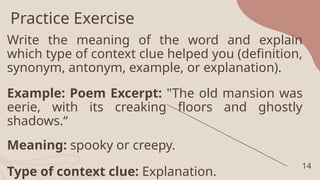
Practice Exercise
Write the meaning of the word and explain
which type of context clue helped you (definition,
synonym, antonym, example, or explanation).
Example: Poem Excerpt: "The old mansion was
eerie, with its creaking floors and ghostly
shadows.“
Meaning: spooky or creepy.
Type of context clue: Explanation.
14
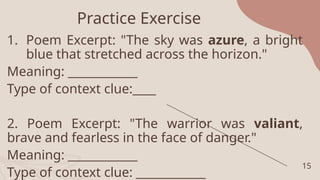
Practice Exercise
1. Poem Excerpt: "The sky was azure, a bright
blue that stretched across the horizon."
Meaning: ____________
Type of context clue:____
2. Poem Excerpt: "The warrior was valiant,
brave and fearless in the face of danger."
Meaning: ____________
Type of context clue: ____________
15
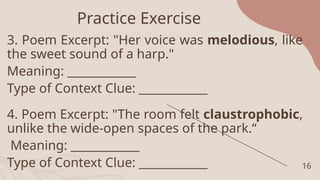
Practice Exercise
3. Poem Excerpt: "Her voice was melodious, like
the sweet sound of a harp."
Meaning: ____________
Type of Context Clue: ____________
4. Poem Excerpt: "The room felt claustrophobic,
unlike the wide-open spaces of the park.“
Meaning: ____________
Type of Context Clue: ____________ 16
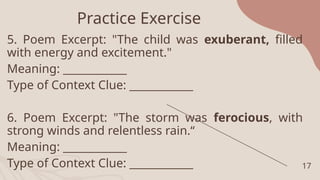
Practice Exercise
5. Poem Excerpt: "The child was exuberant, filled
with energy and excitement."
Meaning: ____________
Type of Context Clue: ____________
6. Poem Excerpt: "The storm was ferocious, with
strong winds and relentless rain.“
Meaning: ____________
Type of Context Clue: ____________ 17
Assignment: Direction: Carefully read the following lines and
identify the clues to uncover their meanings. Circle your answers
from the provided choices.
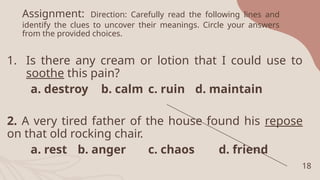
1. Is there any cream or lotion that I could use to
soothe this pain?
a. destroy b. calm c. ruin d. maintain
2. A very tired father of the house found his repose
on that old rocking chair.
a. rest b. anger c. chaos d. friend
18
Assignment: Direction: Carefully read the following lines and
identify the clues to uncover their meanings. Circle your answers
from the provided choices.
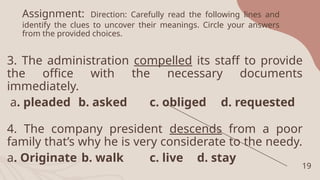
3. The administration compelled its staff to provide
the office with the necessary documents
immediately.
a. pleaded b. asked c. obliged d. requested
4. The company president descends from a poor
family that’s why he is very considerate to the needy.
a. Originate b. walk c. live d. stay
19
Assignment: Direction: Carefully read the following lines and
identify the clues to uncover their meanings. Circle your answers
from the provided choices.
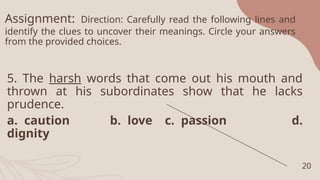
5. The harsh words that come out his mouth and
thrown at his subordinates show that he lacks
prudence.
a. caution b. love c. passion d.
dignity
20
Who is an author
● An author is a person who creates or
produces written, spoken, or visual works.
● The term "author" is commonly associated
with writers of books, articles, poems, and
essays, but it also applies to creators of
speeches, scripts, screenplays, artwork, music,
and other forms of creative expression.
● Authors bring creativity, expression,
perspective, and communication skills to their
work.
Who is an author
● Authors bring their individual perspectives and
viewpoints to their work, shaping how they
interpret and represent the world around them.
● Authors have the potential to influence and
inspire others through their work. They can spark
conversations, challenge perceptions, evoke
emotions, and prompt reflection.
● Authors use language, imagery, symbolism,
and storytelling techniques to engage audiences,
convey messages, evoke emotions, and spark
thought. Through their creations, authors leave a
lasting impact on culture, society, and the human
experience
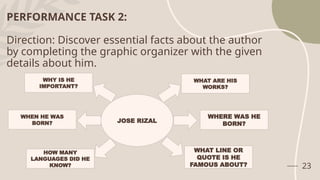
PERFORMANCE TASK 2:
Direction: Discover essential facts about the author
by completing the graphic organizer with the given
details about him.
23
JOSE RIZAL
WHY IS HE
IMPORTANT?
WHEN HE WAS
BORN?
HOW MANY
LANGUAGES DID HE
KNOW?
WHAT ARE HIS
WORKS?
WHERE WAS HE
BORN?
WHAT LINE OR
QUOTE IS HE
FAMOUS ABOUT?
24
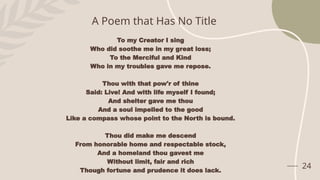
A Poem that Has No Title
To my Creator I sing
Who did soothe me in my great loss;
To the Merciful and Kind
Who in my troubles gave me repose.
Thou with that pow'r of thine
Said: Live! And with life myself I found;
And shelter gave me thou
And a soul impelled to the good
Like a compass whose point to the North is bound.
Thou did make me descend
From honorable home and respectable stock,
And a homeland thou gavest me
Without limit, fair and rich
Though fortune and prudence it does lack.
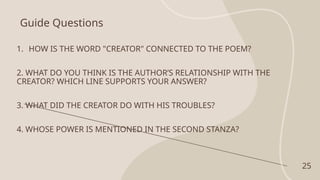
Guide Questions
1. HOW IS THE WORD "CREATOR" CONNECTED TO THE POEM?
2. WHAT DO YOU THINK IS THE AUTHOR’S RELATIONSHIP WITH THE
CREATOR? WHICH LINE SUPPORTS YOUR ANSWER?
3. WHAT DID THE CREATOR DO WITH HIS TROUBLES?
4. WHOSE POWER IS MENTIONED IN THE SECOND STANZA?
25
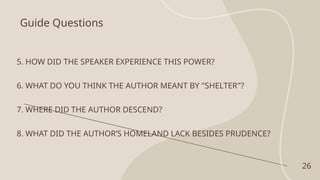
Guide Questions
5. HOW DID THE SPEAKER EXPERIENCE THIS POWER?
6. WHAT DO YOU THINK THE AUTHOR MEANT BY "SHELTER"?
7. WHERE DID THE AUTHOR DESCEND?
8. WHAT DID THE AUTHOR’S HOMELAND LACK BESIDES PRUDENCE?
26
Learners’ Takeaways Exit Slip: 3, 2 1
27
On a piece of paper, ask the student to
provide what is being asked for:
● Write three things you learned from this
lesson.
● List down two things you want to learn
more about.
● Ask one question about the lesson.
thank you
BRITA TAMM
502-555-0152
brita@firstupconsultants.com
www.firstupconsultants.com

CONTEXT CLUES a presentation in English 7

  • 1.
  • 2.
    agenda TYPES OF CONTEXTCLUES DEFINITION 1. SYNONYM 2 ANATONYM 3 EXAMPLES 4 EXPLANATION 5
  • 3.
    CONTEXTCLUES Context clues inpoetry are hints or pieces of information within the poem that help readers understand the meaning of difficult words or phrases. These clues can come from the words and sentences surrounding the unfamiliar word, helping readers figure out its meaning without needing to look it up
  • 4.
  • 5.
    DEFINITION CLUES: •Sometimes thepoem will provide a definition for a difficult word right in the next line or within the same line. •(e.g., The night was somber, dark and gloomy). 5
  • 6.
    SYNONYM CLUES: •The poemmight use a word that means the same thing as the difficult word to help explain it. • (e.g., The child was elated, filled with joy and happiness). 6
  • 7.
    ANTONYM CLUES: •An oppositeword or phrase is used to show what the difficult word means by contrast •(e.g., Unlike the vibrant spring, the winter was dreary and dull). 7
  • 8.
    EXAMPLE CLUES: •The poemgives examples that help explain the difficult word. • (e.g., The meadow was teeming with wildlife: rabbits, deer, and birds were everywhere). 8
  • 9.
    EXPLANATION CLUES: •The poemexplains the difficult word in more detail within the surrounding lines •(e.g., The ancient tree, a giant oak with sprawling branches, stood as a sentinel in the forest). 9
  • 10.
    HOW TO USECONTEXT CLUES ENHANCING YOUR PRESENTATION
  • 11.
    HOW TO USECONTEXT CLUES 1.Read the Surrounding Lines. Look at the lines before and after the unfamiliar word. 2.Look for Synonyms or Antonyms. Check if the poem uses similar or opposite words to explain the difficult word. 11
  • 12.
    HOW TO USECONTEXT CLUES 3. Check for Examples. See if the poem provides examples that illustrate what the word means. 4. Find Definitions or Explanations. Look for a definition or a detailed description within the poem. 12
  • 13.
    Practice Example Poem Excerpt:"The old mansion was eerie, with its creaking floors and ghostly shadows." Context Clue: The phrase "creaking floors and ghostly shadows" gives a hint about what "eerie" means. Meaning: Based on these clues, "eerie" likely means something spooky or creepy.. 13
  • 14.
    Practice Exercise Write themeaning of the word and explain which type of context clue helped you (definition, synonym, antonym, example, or explanation). Example: Poem Excerpt: "The old mansion was eerie, with its creaking floors and ghostly shadows.“ Meaning: spooky or creepy. Type of context clue: Explanation. 14
  • 15.
    Practice Exercise 1. PoemExcerpt: "The sky was azure, a bright blue that stretched across the horizon." Meaning: ____________ Type of context clue:____ 2. Poem Excerpt: "The warrior was valiant, brave and fearless in the face of danger." Meaning: ____________ Type of context clue: ____________ 15
  • 16.
    Practice Exercise 3. PoemExcerpt: "Her voice was melodious, like the sweet sound of a harp." Meaning: ____________ Type of Context Clue: ____________ 4. Poem Excerpt: "The room felt claustrophobic, unlike the wide-open spaces of the park.“ Meaning: ____________ Type of Context Clue: ____________ 16
  • 17.
    Practice Exercise 5. PoemExcerpt: "The child was exuberant, filled with energy and excitement." Meaning: ____________ Type of Context Clue: ____________ 6. Poem Excerpt: "The storm was ferocious, with strong winds and relentless rain.“ Meaning: ____________ Type of Context Clue: ____________ 17
  • 18.
    Assignment: Direction: Carefullyread the following lines and identify the clues to uncover their meanings. Circle your answers from the provided choices. 1. Is there any cream or lotion that I could use to soothe this pain? a. destroy b. calm c. ruin d. maintain 2. A very tired father of the house found his repose on that old rocking chair. a. rest b. anger c. chaos d. friend 18
  • 19.
    Assignment: Direction: Carefullyread the following lines and identify the clues to uncover their meanings. Circle your answers from the provided choices. 3. The administration compelled its staff to provide the office with the necessary documents immediately. a. pleaded b. asked c. obliged d. requested 4. The company president descends from a poor family that’s why he is very considerate to the needy. a. Originate b. walk c. live d. stay 19
  • 20.
    Assignment: Direction: Carefullyread the following lines and identify the clues to uncover their meanings. Circle your answers from the provided choices. 5. The harsh words that come out his mouth and thrown at his subordinates show that he lacks prudence. a. caution b. love c. passion d. dignity 20
  • 21.
    Who is anauthor ● An author is a person who creates or produces written, spoken, or visual works. ● The term "author" is commonly associated with writers of books, articles, poems, and essays, but it also applies to creators of speeches, scripts, screenplays, artwork, music, and other forms of creative expression. ● Authors bring creativity, expression, perspective, and communication skills to their work.
  • 22.
    Who is anauthor ● Authors bring their individual perspectives and viewpoints to their work, shaping how they interpret and represent the world around them. ● Authors have the potential to influence and inspire others through their work. They can spark conversations, challenge perceptions, evoke emotions, and prompt reflection. ● Authors use language, imagery, symbolism, and storytelling techniques to engage audiences, convey messages, evoke emotions, and spark thought. Through their creations, authors leave a lasting impact on culture, society, and the human experience
  • 23.
    PERFORMANCE TASK 2: Direction:Discover essential facts about the author by completing the graphic organizer with the given details about him. 23 JOSE RIZAL WHY IS HE IMPORTANT? WHEN HE WAS BORN? HOW MANY LANGUAGES DID HE KNOW? WHAT ARE HIS WORKS? WHERE WAS HE BORN? WHAT LINE OR QUOTE IS HE FAMOUS ABOUT?
  • 24.
    24 A Poem thatHas No Title To my Creator I sing Who did soothe me in my great loss; To the Merciful and Kind Who in my troubles gave me repose. Thou with that pow'r of thine Said: Live! And with life myself I found; And shelter gave me thou And a soul impelled to the good Like a compass whose point to the North is bound. Thou did make me descend From honorable home and respectable stock, And a homeland thou gavest me Without limit, fair and rich Though fortune and prudence it does lack.
  • 25.
    Guide Questions 1. HOWIS THE WORD "CREATOR" CONNECTED TO THE POEM? 2. WHAT DO YOU THINK IS THE AUTHOR’S RELATIONSHIP WITH THE CREATOR? WHICH LINE SUPPORTS YOUR ANSWER? 3. WHAT DID THE CREATOR DO WITH HIS TROUBLES? 4. WHOSE POWER IS MENTIONED IN THE SECOND STANZA? 25
  • 26.
    Guide Questions 5. HOWDID THE SPEAKER EXPERIENCE THIS POWER? 6. WHAT DO YOU THINK THE AUTHOR MEANT BY "SHELTER"? 7. WHERE DID THE AUTHOR DESCEND? 8. WHAT DID THE AUTHOR’S HOMELAND LACK BESIDES PRUDENCE? 26
  • 27.
    Learners’ Takeaways ExitSlip: 3, 2 1 27 On a piece of paper, ask the student to provide what is being asked for: ● Write three things you learned from this lesson. ● List down two things you want to learn more about. ● Ask one question about the lesson.
  • 28.