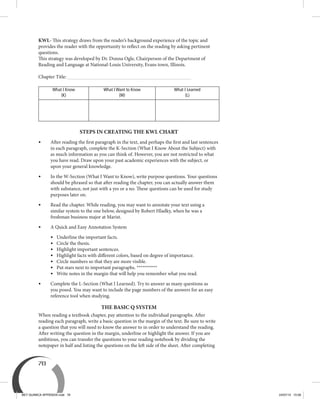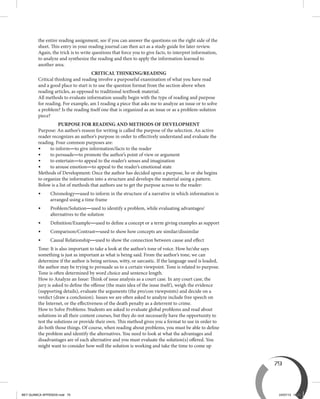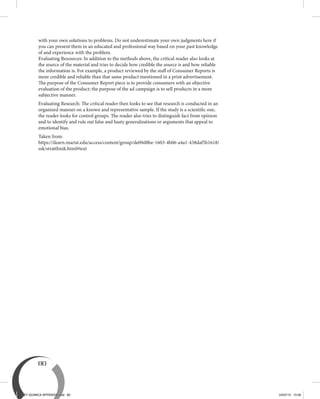





Lic. en Educ. Ángel Adrián Argüelles García
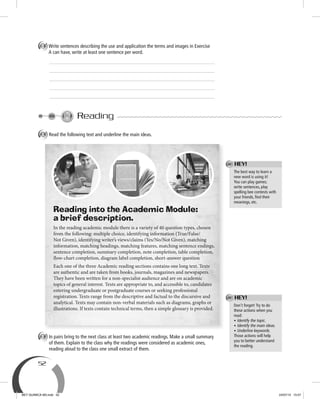
Lic. en L.I. Lolina Marisol Pérez López
Lengua Adicional al Español
00 BEY QUIMICA preliminares.indd 1 24/07/13 15:56
Todos los derechos reservados
Editora:	 Jaquelin A. Camizao Betanzos
	 e-mail: jaquelin.camizao@pearson.com
Editora de desarrollo: 	 Diana Mathes
Supervisor de producción: 	 Aristeo Redondo
Photo and Illustration credits: Thinkstock.com, Action Teens
PRIMERA EDICIÓN, 2014
D.R. © 2014 por Pearson Educación de México, S.A. de C.V.
	 Atlacomulco 500-5° Piso
	 Industrial Atoto
	 53519 Naucalpan de Juárez, Estado de México
Cámara Nacional de la Industria Editorial Mexicana Reg. Núm. 1031
Reservados todos los derechos. Ni la totalidad ni parte de esta publicación pueden
reproducirse, registrarse o transmitirse, por un sistema de recuperación de información,
en ninguna forma ni por ningún medio, sea electrónico, mecánico, fotoquímico,
magnético o electroóptico, por fotocopia, grabación o cualquier otro, sin permiso
previo por escrito del editor.
El préstamo, alquiler o cualquier otra forma de cesión de uso de este ejemplar
requerirá también la autorización del editor o de sus representantes.
ISBN: 978-607-32-2262-4
Impreso en México. Printed in Mexico.
1 2 3 4 5 6 7 8 9 0 – 17 16 15 14
Acknowledgements
The publishers and author(s) would like to thank the following people and istitutions
for their feedback and comments during the development of the material.
Every effort has been made to trace the copyright holders and we apologize
for any unintentional omissions. We would be pleased to inset the appropriate
acknowledgements in any subsequent edition of this publication.
www.pearsonenespañol.com
Datos de catalogación bibliográfica
Argüelles García, Ángel Adrián;
Pérez López, Lolina Marisol
Lengua Adicional al Español
PEARSON EDUCACIÓN, México, 2014
ISBN: 978-607-32-2262-4
Área: Humanidades
Formato: 20 25.5 cm 	 Páginas: 88
00 BEY QUIMICA preliminares.indd 2 24/07/13 16:18
iii
Rolando Rodrigo Zapata Bello
GOBERNADOR CONSTITUCIONAL
DEL ESTADO DE YUCATÁN
Raúl Humberto Godoy Montañez
SECRETARIO DE EDUCACIÓN
Gabriela Zapata Villalobos
DIRECTORA DE EDUCACIÓN MEDIA SUPERIOR
Alejandro Salazar Ortega
JEFE DEL DEPARTAMENTO DE PREPARATORIAS ESTATALES
00 BEY QUIMICA preliminares.indd 3 24/07/13 15:56
iv
Estudiante del Mayab:
La necesidad por parte del Gobierno del Estado de Yucatán para brindar y
garantizar una educación de calidad a los jóvenes yucatecos del nivel Medio
Superior, se refrenda y consolida mediante acciones concretas, sustentadas en
procesos de actualización, consenso y diálogo permanentes. La publicación de
este libro de texto es el resultado del esfuerzo para integrar diversos puntos de
referencia fundamentados en estrategias de aprendizaje, habilidades y destrezas,
en el marco del modelo de estudio con enfoque socioformativo basado en
competencias, que acompañarán a nuestros jóvenes yucatecos durante su etapa
de formación. En nuestro Yucatán es tiempo de comenzar a entregar resultados
y cumplir la palabra empeñada, donde no sólo basten las buenas intenciones
o simples propuestas. Hoy, refrendamos nuestro compromiso para continuar
formando jóvenes capaces de competir en el mundo globalizado, por ello, le
apostamos a la educación, como pilar fundamental de cualquier sociedad que
aspire a elevar su nivel de bienestar.
ROLANDO RODRIGO ZAPATA BELLO
Gobernador Constitucional del Estado de Yucatán
Una de las vías de la política educativa del Gobierno de Yucatán es trabajar como
equipo para llegar a una misma meta: hacer de Yucatán una tierra con futuro
exitoso para todos.
Las escuelas preparatorias de la entidad, unidas en un sistema estatal de
bachillerato, han transitado por un largo camino de transformación
para ingresar al Sistema Nacional de Bachillerato.
La transformación de planes y programas enfocados al modelo socio-
formativo en competencias, ha dado como fruto el libro que hoy tienes
en tus manos y que fue preparado especialmente para ti, que hoy en día
demandas una formación integral, que incluya actitudes y valores, así como
aprendizajes que te permitan desarrollar una vida personal y social satisfactoria.
Este libro es la mejor herramienta para lograr que las alumnas y los alumnos
adquieran las competencias necesarias que les permitan aprender a aprender,
aprender a convivir y aprender a ser.
Sólo el desarrollo de capacidades y habilidades de nuestros jóvenes van a
transformar de fondo nuestro estado, nuestro país, nuestro mundo.
RAÚL HUMBERTO GODOY MONTAÑEZ
Secretario de Educación
00 BEY QUIMICA preliminares.indd 4 24/07/13 15:56
v
El presente libro de texto tiene como intención fomentar el desarrollo de las competencias
disciplinares del área de comunicación, enfatisando el desarrollo de las habilidades de
producción oral y escrita. Las competencias disciplinares ejes son:
• Se comunica en una lengua extranjera mediante un discurso lógico, oral o escrito,
congruente con la situación comunicativa.
• Identifica e interpreta la idea general y posible desarrollo de un mensaje oral o escrito en
una segunda lengua, recurriendo a conocimientos previos, elementos no verbales y contexto
cultural.
Por tanto, como estudiante desarrollarás competencias disciplinares que te permitan leer
críticamente, te comuniques y argumentes ideas de manera efectiva y con claridad oralmente y
por escrito.
Por otra parte, esta asignatura es un curso introductorio que pretende prepararte en tu
camino a la certificación del idioma inglés, siguiendo la normatividad y las particularidades del
International English Language Testing System (IELTS) de la Universidad de Cambridge. En el
bloque uno, se presentan una diversidad de temas que te permitirán establecer estrategias
para aumentar tu vocabulario y trabajar en diversos ejercicios de lectura y redacción con dicha
variedad de temas. En el bloque dos, se pretende que te concentres en desarrollar conceptos
subsidiarios relacionados a un tema integrador específico. En el bloque tres, se realiza una
introducción al formato de interpretación de información académica para que puedas construir
textos del mismo índole.
En relación a los niveles de desempeño, se esperan los establecidos en el Marco Común
Europea de Referencia para las Lenguas:
Producción Oral
El estudiante es capaz de hacer una presentación breve y preparada
sobre un tema dentro de su especialidad con la suficiente claridad
como para que pueda seguir sin dificultad la mayor parte del tiempo y
cutas ideas principales están explicadas con una razonable precisión.
Es capaz de responder a preguntas complementarias, pero puede
que tenga que pedir que se las repitan si se habla con rapidez.
Producción Escrita
El estudiante escrite redacciones sencillas y detalladas sobre una serie
de temas cotidianos dentro de su especialidad. Escribe relaciones
de experiencias describiendo sentimientos y reacciones en textos
sencillos y estructurados. Es capaz de escribir una descripción de
un hecho determinado, un viaje reciente, real o imaginario. Puede
narrar una historia.
Esperando que los contenidos representen un reto académico y un acercamiento a material
académico preuniviersitario, deseamos que este curso de utilidad para tu crecimiento
académico.
LIC. EN EDUC. ÁNGEL ADRIÁN ARGÜELLES GARCÍA
Autor,
00 BEY QUIMICA preliminares.indd 5 24/07/13 15:56
vi
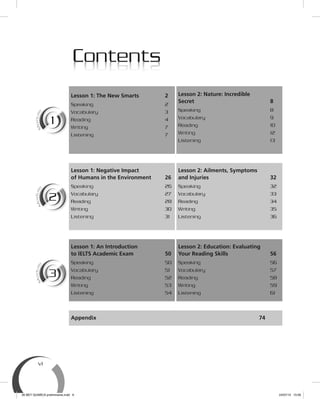
ContentsContents
Lesson 1: The New Smarts 2
Speaking 2
Vocabulary 3
Reading 4
Writing 7
Listening 7
Lesson 2: Nature: Incredible
Secret 8
Speaking 8
Vocabulary 9
Reading 10
Writing 12
Listening 13
Lesson 1: Negative Impact
of Humans in the Environment 26
Speaking 26
Vocabulary 27
Reading 28
Writing 30
Listening 31
Lesson 2: Ailments, Symptoms
and Injuries 32
Speaking 32
Vocabulary 33
Reading 34
Writing 35
Listening 36
Lesson 1: An Introduction
to IELTS Academic Exam 50
Speaking 50
Vocabulary 51
Reading 52
Writing 53
Listening 54
Lesson 2: Education: Evaluating
Your Reading Skills 56
Speaking 56
Vocabulary 57
Reading 58
Writing 59
Listening 61
Appendix 74
M
odule
1
M
oule
1
M
odule
2
M
oule
2
M
odule
3
M
oule
3
00 BEY QUIMICA preliminares.indd 6 24/07/13 15:56
vii
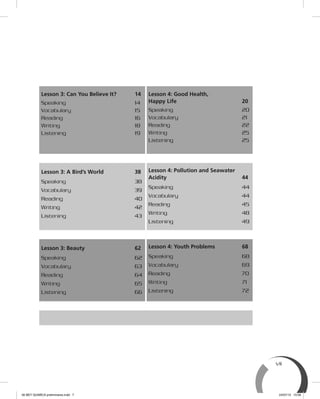
Lesson 3: Can You Believe It? 14
Speaking 14
Vocabulary 15
Reading 16
Writing 18
Listening 19
Lesson 4: Good Health,
Happy Life 20
Speaking 20
Vocabulary 21
Reading 22
Writing 25
Listening 25
Lesson 3: A Bird’s World 38
Speaking 38
Vocabulary 39
Reading 40
Writing 42
Listening 43
Lesson 4: Pollution and Seawater
Acidity 44
Speaking 44
Vocabulary 44
Reading 45
Writing 48
Listening 49
Lesson 3: Beauty 62
Speaking 62
Vocabulary 63
Reading 64
Writing 65
Listening 66
Lesson 4: Youth Problems 68
Speaking 68
Vocabulary 69
Reading 70
Writing 71
Listening 72
00 BEY QUIMICA preliminares.indd 7 24/07/13 15:56
00 BEY QUIMICA preliminares.indd 8 24/07/13 15:56
ix
PresentaciónPresentación
Grandes desequilibrios y oportunidades mueven el mundo de hoy. Formar personas
competentes que actúen en estos nuevos escenarios, y al mismo tiempo conformen
sociedades más equilibradas, es el nuevo reto educativo actual. Por lo tanto, debe-
mos construir una educación cuyo proceso permita el desarrollo humano, que se
oriente a nuevos y mejores modos de pensar y actuar. El objetivo es erigir una socie-
dad competente, que sabe hacer las cosas y sabe actuar con los demás, comprende
lo que hace y asume de manera responsable las consecuencias de sus actos.
El libro que tienes en tus manos está centrado en el desarrollo de las competen-
cias señaladas en el Marco Curricular Común de la Reforma Integral de la Educación
Media Superior.
Este enfoque de aprendizaje te permitirá atender los retos en el contexto y cir-
cunstancias del mundo actual, las cuales demandan personas capaces de aplicar sus
conocimientos, habilidades y actitudes en situaciones cada vez más complejas.
En el enfoque socioformativo por competencias se considera que los conocimien-
tos por sí mismos no son lo más importante, sino el uso que se hace de ellos en
situaciones específicas de la vida personal, social y profesional.
El Marco Curricular Común de la Reforma Integral de la Educación Media Superior
es-tablece que el conocimiento es más significativo para el individuo si cobra sentido
a partir de la práctica; es decir, si el aprendizaje se procura en una situación específica
de la vida.
Te invitamos a iniciar este viaje por el fascinante mundo del conocimiento. Estamos
seguros de que motivará tu deseo de aprender, de manera que puedas dar respuesta
a las demandas del mundo actual que requiere individuos con un pensamiento flexi-
ble, creativo, imaginativo y abierto al cambio.
¡Bienvenido!
C.D. GABRIELA ZAPATA VILLALOBOS
Directora de Educación Media Superior y Superior
00 BEY QUIMICA preliminares.indd 9 24/07/13 15:56
2
M
odule
1M
ule
1
Speaking
A How many objects do you know? Match the names below with the following pictures.
B Ask to your teachers and friends the following questions, take notes of the answers.
Ask at least 10 people.
1. Do you know why they are called “smart” objects?
2. Do you have any kind of smart object?
3. Why did you choose it?
4. How helpful has it been?
5. How expensive was it?
6. How old is it and how fast did it become old?
7. What other smart thing do you have?
8. Do you think that we can live without smart things?
C Share and compare the answers with your classmates, after that, all together make a
graphic with the information and display it in a public place of your school.
Lesson 1
The New Smarts
If you don’t know about
an object, you can ask for
information about it using
some of the following
questions:
• Could you describe it?
• What does it do?
• What’s it used for?
Don’t be afraid to ask!
Just by asking we are
able to know more.
HEY!
1. Smart TV
2. Smart clothes
3. Smart phone
4. Smart shoes
5. Smart car
6. Smart camera
7. Smart credit card
8. Smart tablet
BEY QUIMICA M1.indd 2 24/07/13 15:57
3
Vocabulary
A Put the letters in the correct order, use the clues to discover the words.
1. E – A – A – I – B – C – T – R
2. C – M – A – O – U – E – A – F –L – G
3. G – M – S – O
4. C – X – I – O – T
5. R – R – D – A – O – W – E – B
6. C – B – A – F – I – R
7. I – I – E – N – F – C – T – N – O
8. F – B – R – C – A – A – T – I – E
9. I – I – I – N – S – C – T – E – E – C – D
10. T – T – E – M – P – U – E – R – A – R – E
B Write the words from the box below the pictures that represent them better.
yarn / infirm / textile / prohibit / universal serial bus / fiber / antibiotic / solar energy
C Write sentences using the words in Exercise B, write at least one sentence per word.
The best way to learn a
new word is using it!
You can play games;
write sentences, play
spelling bee contests with
your friends, find their
meanings, etc.
HEY!
Don’t forget that you can
use a dictionary if there
are words that you don’t
know.You can also try free
web pages that help you
with the pronunciation.
HEY!
Single-celled organisms found in every ecosystem on Earth.
Tactic that organisms use to disguise their appearance,
usually to blend in with their surroundings.
Type of air pollution.
Poisonous.
Collection of clothing belonging to one person.
Cloth.
Contamination or invasion by harmful organisms,
such as a virus.
To make or construct.
Chemical substance used to kill insects.
Degree of hotness or coldness measured by a
thermometer with a numerical scale.
BEY QUIMICA M1.indd 3 24/07/13 15:57
4
Reading
A Read the following text and underline the main ideas.
Try to do these actions
when you read:
• Identify the topic.
• Identify the main ideas.
• Underline keywords.
These actions will help
you to better understand
the reading.
HEY!
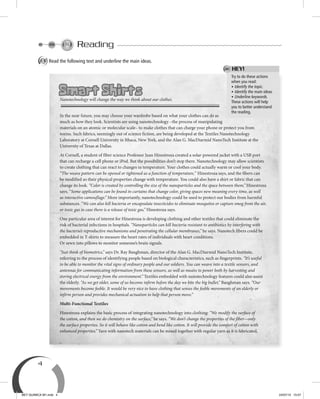
Smart Shirts
Nanotechnology will change the way we think about our clothes.
In the near future, you may choose your wardrobe based on what your clothes can do as
much as how they look. Scientists are using nanotechnology –the process of manipulating
materials on an atomic or molecular scale– to make clothes that can charge your phone or protect you from
toxins. Such fabrics, seemingly out of science fiction, are being developed at the Textiles Nanotechnology
Laboratory at Cornell University in Ithaca, New York, and the Alan G. MacDiarmid NanoTech Institute at the
University of Texas at Dallas.
At Cornell, a student of fiber science Professor Juan Hinestroza created a solar-powered jacket with a USB port
that can recharge a cell phone or iPod. But the possibilities don’t stop there. Nanotechnology may allow scientists
to create clothing that can react to changes in temperature. Your clothes could actually warm or cool your body.
“The weave pattern can be opened or tightened as a function of temperature,” Hinestroza says, and the fibers can
be modified so their physical properties change with temperature. You could also have a shirt or fabric that can
change its look. “Color is created by controlling the size of the nanoparticles and the space between them,” Hinestroza
says. “Some applications can be found in curtains that change color, giving spaces new meaning every time, as well
as interactive camouflage.” More importantly, nanotechnology could be used to protect our bodies from harmful
substances. “We can also kill bacteria or encapsulate insecticides to eliminate mosquitos or capture smog from the air,
or toxic gas in case there is a release of toxic gas,” Hinestroza says.
One particular area of interest for Hinestroza is developing clothing and other textiles that could eliminate the
risk of bacterial infections in hospitals. “Nanoparticles can kill bacteria resistant to antibiotics by interfering with
the bacteria’s reproductive mechanisms and penetrating the cellular membranes,” he says. Nanotech fibers could be
embedded in T-shirts to measure the heart rates of individuals with heart conditions.
Or sewn into pillows to monitor someone’s brain signals.
“Just think of biometrics,” says Dr. Ray Baughman, director of the Alan G. MacDiarmid NanoTech Institute,
referring to the process of identifying people based on biological characteristics, such as fingerprints. “It’s useful
to be able to monitor the vital signs of ordinary people and our soldiers. You can weave into a textile sensors, and
antennas for communicating information from these sensors, as well as means to power both by harvesting and
storing electrical energy from the environment.” Textiles embedded with nanotechnology features could also assist
the elderly. “As we get older, some of us become infirm before the day we bite the big bullet,” Baughman says. “Our
movements become feeble. It would be very nice to have clothing that senses the feeble movements of an elderly or
infirm person and provides mechanical actuation to help that person move.”
Multi-Functional Textiles
Hinestroza explains the basic process of integrating nanotechnology into clothing: “We modify the surface of
the cotton, and then we do chemistry on the surface,” he says. “We don’t change the properties of the fiber—only
the surface properties. So it will behave like cotton and bend like cotton. It will provide the comfort of cotton with
enhanced properties.” Yarn with nanotech materials can be mixed together with regular yarn as it is fabricated,
BEY QUIMICA M1.indd 4 24/07/13 15:57
5
Remember!
We skim a text when we
are looking for a general
idea or quickly overview
the information.
We scan a text when we
are looking for key words
or a particular answer.
HEY!
B Underline the correct answer to complete each statement.
1. Nanotechnology will change
A. the way we look in clothes.
B. the way we think about our clothes.
C. the way we use our clothes.
2. Nanotechnology may allow scientists to create
A. clothing that can react to changes in temperature.
B. clothing that can change our temperature.
C. clothing that can read our feelings.
3. Nanotechnology could be used to
A. protect our bodies from harmful bugs and virus.
B. protect our bodies from harmful weapons.
C. protect our bodies from harmful substances.
4. The modified cotton
A. feels harder and rougher.
B. feels the same as usual.
C. feels softer and nicer.
5. Yarn with nanotech materials can be mixed with
A. the same kind of yarn.
B. with regular yarn.
C. with nothing else.
Baughman says. “Clothing woven from these yarns can then exploit
these new properties for such purposes as sensing, energy harvesting and
energy storage.” “ These nanotech yarns are multi-functional,” he says.
“Ordinary fibers for textiles are functional,” he says. “They provide for the
comfort and classical needs of textiles so no one is walking around naked.
Now if you are going to have more broadly useful textiles—in the sense
of being multi-functional—you need multi-functional yarns that can be
woven into a textile.”
Baughman explains the capabilities of these new textiles: “For example,
in the area of energy harvesting, we would like to have textiles that harvest
solar energy and convert it to electrical energy,” he says. “Or textiles that
can use the small temperature difference between the body and the outside
world to power wireless sensors.” Currently, the cost of producing some of
these items is too expensive to be practical on a large scale.
“The cost of producing clothing containing solely nanofiber yarns is
presently prohibitive,” Baughman says. “However, production costs will
decrease as yarn production is up-scaled, and even a small amount
of these special yarns can now be sewn into clothing to provide useful
performance.”
From www.nationalgeographis.com/EDUCATION
BEY QUIMICA M1.indd 5 24/07/13 15:57
6
C Do the following statements agree with the information in the reading passage? Write,
TRUE if the statement agrees with the information, FALSE if the statement contradicts
the information given, and NOT GIVEN if there is no information on this.
1. Nanotechnology is the process of manipulating materials on an atomic or
molecular scale.
2. With the use of nanotechnology our clothes will be able to warm or cool our
bodies.
3. Professor Juan Hinestroza works in biometrics applications on fabrics.
4. Hinestroza discovered the basic process of integrating nanotechnology
into clothing.
5. The nanotech yarns are multifunctional.
D Which paragraph contains the following information? Number the paragraphs in the text,
find the information and write the number of the paragraph in the spaces below.
1. In a not so far away future, we will be able to choose our wardrobe based on what
the clothes do as much as how they look.
2. Nanoparticles can kill bacteria resistant to antibiotics.
3. It will be able to have fabrics that can change its color.
4. Multi-functional yarns woven into textiles will give more broadly useful
textiles.
5. The cost of producing clothing containing solely nanofiber yarns is presently
prohibitive.
BEY QUIMICA M1.indd 6 24/07/13 15:57
7
Don’t forget that an essay
has three parts:
1. Beginning: where you
talk about the topic.
2. Middle: where you
support your ideas.
3. Ending: where you give
the conclusions of your
ideas.
HEY!Writing
A Search the Internet for information about nanotechnology in other areas.Take notes of
the information and the web sites you visit.Write an essay with that information and
make a mind map. Present both to your classmates.
B Ok… So, you already looked up about nanotechnology but, what do you know about
the people who works in the field? Let’s begin with the author of the text you read before:
Stuart Thornton. Go over the text again and look for the names of the scientists,
investigators, and all the people involved in the development of this new technology.
You can begin your search at www.nationalgeographic.com
With the information you will find, give a presentation to your class. Use all kind of resources you want like illustrations,
pictures, images, power point presentations, etc.Work in teams of 4 people.
Listening
Have you ever wondered how it is like working in the field of technology? Would you like to work with Computers or Tablets?
Why or why not?
A Listen to the conversation.Answer the questions. Track 1
1. What professions and/or occupations do the students talk about?
2. Which one do they think has the best job?
B Listen again and complete the chart. Track 2
Professions / Occupations Tasks / Jobs Working hours
1.
2.
3.
4.
C Listen to the following sentences. Notice the rising and falling intonation. Listen again
and repeat. Track 3
I’m playing video games . Do you want to come over ?
What do you want to do ? Go running or watch TV ?
BEY QUIMICA M1.indd 7 24/07/13 15:57
8
Speaking
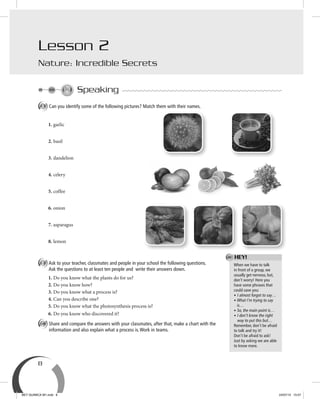
A Can you identify some of the following pictures? Match them with their names.
B Ask to your teacher, classmates and people in your school the following questions.
Ask the questions to at least ten people and write their answers down.
1. Do you know what the plants do for us?
2. Do you know how?
3. Do you know what a process is?
4. Can you describe one?
5. Do you know what the photosynthesis process is?
6. Do you know who discovered it?
C Share and compare the answers with your classmates, after that, make a chart with the
information and also explain what a process is.Work in teams.
Lesson 2
Nature: Incredible Secrets
When we have to talk
in front of a group, we
usually get nervous, but,
don’t worry! Here you
have some phrases that
could save you:
• I almost forgot to say…
• What I’m trying to say
is…
• So, the main point is…
• I don’t know the right
way to put this but…
Remember, don’t be afraid
to talk and try it!
Don’t be afraid to ask!
Just by asking we are able
to know more.
HEY!
1. garlic
2. basil
3. dandelion
4. celery
5. coffee
6. onion
7. asparagus
8. lemon
BEY QUIMICA M1.indd 8 24/07/13 15:57
9
Don’t forget you can
help yourself consulting
a dictionary if there are
words that you don’t
know.You can also try free
web pages that help you
with the pronunciation.
HEY!
The best way to learn a
new word is using it!
You can play games; write
sentences, play spelling
contests with your friends,
find their meanings, etc.
HEY!
Vocabulary
A Choose from the box the word that completes the sentences.
genetic modification global warming solar energy solar panel chemistry
adequate herbivore nutrient fructose glucose
1. is the increase in the average temperature of the Earth’s air
and oceans.
2. An organism that eats mainly plants is an .
3. The is the chemical produced by many plants during photosynthesis.
4. A is a substance that an organism needs for energy, growth, and life.
5. The radiation from the sun is also called .
6. A is a group of cells that converts sunlight into electricity.
7. The is a sweet type of sugar found in many fruits and honey.
8. The process of altering the genes of an organism is known as .
9. When something is suitable or good enough it is also .
10. is the study of the atoms and molecules that make up different substances.
B Word search. Find the following words in the letter box.
C Find the meaning of the words in exercise B, compare your results with your classmates,
after that, find an image that represents each word and its definition.
A S S Q W E R T Y U I R G O P A S F
Q L U C M F G H E S T A E G R T O R
T E G D E R T S V U U D D B E P E P
E D A A T E F C O J G I F N Z V O B
D G R Q E Q W E R Y U O T S I L L V
I T A F V B S R G H K A Y K L T O C
O Y H R N V X D R R U C O U I R B D
N U J T A D S F G J K T T G T E E U
M O L E C U L E F O P I A A R S R L
A B T Z C A T R E S O V S T E D A O
Y J R P Z X C V B N G E T R F A S Y
U I E H Q W E R T Y U I O A S D F T
P Y S Y P L A N T E S T G U I K D F
L T A E A S D F G H J K I O L P M B
F S C D B I O C H E M I S T E R D U
G P O U Y T R E W Q A S D F G H J D
R E N E W A B L E R E S O U R C E R
Q S D F T H J I K L O P C A D F M Y
A F C O N T R A P T I O N Z L O U H
Z X C V B N M K J U H Y R E A S D G
1. algae
2. biochemist
3. sugar
4. renewable resource
5. plant
6. radioactive
7. pollution
8. molecule
9. fertilizer
10. contraption
BEY QUIMICA M1.indd 9 24/07/13 15:57
10
Reading
A Read the following text and underline the main ideas and key words.
Don’t forget! Try to do
these actions when you
read:
• Identify the topic.
• Identify the main ideas.
• Underline keywords.
Those actions will help
you to better understand
the reading.
HEY!
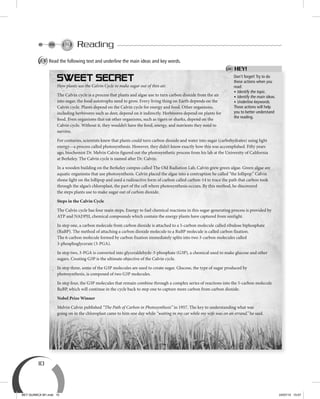
How plants use the Calvin Cycle to make sugar out of thin air.
The Calvin cycle is a process that plants and algae use to turn carbon dioxide from the air
into sugar, the food autotrophs need to grow. Every living thing on Earth depends on the
Calvin cycle. Plants depend on the Calvin cycle for energy and food. Other organisms,
including herbivores such as deer, depend on it indirectly. Herbivores depend on plants for
food. Even organisms that eat other organisms, such as tigers or sharks, depend on the
Calvin cycle. Without it, they wouldn’t have the food, energy, and nutrients they need to
survive.
For centuries, scientists knew that plants could turn carbon dioxide and water into sugar (carbohydrates) using light
energy—a process called photosynthesis. However, they didn’t know exactly how this was accomplished. Fifty years
ago, biochemist Dr. Melvin Calvin figured out the photosynthetic process from his lab at the University of California
at Berkeley. The Calvin cycle is named after Dr. Calvin.
In a wooden building on the Berkeley campus called The Old Radiation Lab, Calvin grew green algae. Green algae are
aquatic organisms that use photosynthesis. Calvin placed the algae into a contraption he called “the lollipop.” Calvin
shone light on the lollipop and used a radioactive form of carbon called carbon-14 to trace the path that carbon took
through the algae’s chloroplast, the part of the cell where photosynthesis occurs. By this method, he discovered
the steps plants use to make sugar out of carbon dioxide.
Steps in the Calvin Cycle
The Calvin cycle has four main steps. Energy to fuel chemical reactions in this sugar-generating process is provided by
ATP and NADPH, chemical compounds which contain the energy plants have captured from sunlight.
In step one, a carbon molecule from carbon dioxide is attached to a 5-carbon molecule called ribulose biphosphate
(RuBP). The method of attaching a carbon dioxide molecule to a RuBP molecule is called carbon fixation.
The 6-carbon molecule formed by carbon fixation immediately splits into two 3-carbon molecules called
3-phosphoglycerate (3-PGA).
In step two, 3-PGA is converted into glyceraldehyde-3-phosphate (G3P), a chemical used to make glucose and other
sugars. Creating G3P is the ultimate objective of the Calvin cycle.
In step three, some of the G3P molecules are used to create sugar. Glucose, the type of sugar produced by
photosynthesis, is composed of two G3P molecules.
In step four, the G3P molecules that remain combine through a complex series of reactions into the 5-carbon molecule
RuBP, which will continue in the cycle back to step one to capture more carbon from carbon dioxide.
Nobel Prize Winner
Melvin Calvin published “The Path of Carbon in Photosynthesis” in 1957. The key to understanding what was
going on in the chloroplast came to him one day while “waiting in my car while my wife was on an errand,” he said.
BEY QUIMICA M1.indd 10 24/07/13 15:57
11
Remember!
We skim a text when we
are looking for a general
idea or quickly overview
the information.
We scan a text when we
are looking for key words
or a particular answer.
HEY!
B Choose the correct ending for the following sentences.
is called chloroplast
turn carbon dioxide from the air into sugar
carbon dioxide and water into sugar
make sugar out of carbon dioxide
food, energy, and nutrients they need to survive
use photosynthesis
carbon fixation
1. The Calvin Cycle is a process that plants use to .
2. Without the Calvin Cycle plants wouldn’t have the .
3. Plants could turn .
4. Green algae are aquatic organisms that .
5. The part of the cell where photosynthesis occurs .
6. With the Carbon-14 method the steps plants use to
were discovered.
7. The method of attaching a carbon dioxide molecule to a RuBP molecule is called
.
Calvin realized the way in which plants turn carbon dioxide into sugar wasn’t a
straightforward one. Instead, it worked in a circular pattern. For discovering how
plants turn carbon dioxide into sugar, Melvin Calvin was awarded the Nobel Prize
for chemistry in 1961. Time magazine nicknamed him “Mr. Photosynthesis.” Calvin
received the National Medal of Science from President George H. W. Bush in 1989.
He published his autobiography, “Following the Trail of Light,” in 1992. He died on
January 8, 1997, in Berkeley, California.
Understanding the Calvin Cycle
Understanding how the Calvin cycle works is important to science in several ways.
“If you know how to make chemical or electrical energy out of solar energy the way
plants do it—without going through a heat engine—that is certainly a trick,” Calvin
once said. “And I’m sure we can do it. It’s just a question of how long it will take to solve the technical question.” Melvin Calvin’s
research into photosynthesis sparked the U.S. government’s interest in developing solar energy as a renewable resource.
Today, the U.S. Department of Energy researches the uses of photovoltaic cells, concentrated solar energy, and solar water
heaters. Photovoltaic cells are made of semiconductors that convert sunlight into electricity. Photovoltaic cells are often grouped
together to form large solar panels. Solar panels can help provide electrical energy for homes and businesses. Concentrated solar
power focuses the sun’s heat to run generators that produce electricity. Solar water heaters provide hot water and space heating
for homes and businesses. Scientists are also developing ways to increase carbon fixation, the first step in the Calvin cycle.
They are doing so mostly by genetic modification. Increasing carbon fixation removes excess greenhouse gases—mostly
carbon—from the atmosphere. Greenhouse gases contribute to global warming. Understanding photosynthesis could also
increase the crop yields for many plants.
“Our understanding of photosynthesis, and the factors that increase it, such as the length of a growing season and adequate plant
access to water in the soil, guides our development of perennial versions of grain crops,” says Jerry Glover of the Land Institute in
Salina, Kansas. Perennial plants come back year after year, while annual plants last only one growing season. Glover’s research
shows that perennial grains are more environmentally friendly than annual grain crops. They use less water and fertilizer, and
their deeper root systems mean they hold onto the soil better. This leads to less runoff and less pollution into lakes and streams.
BEY QUIMICA M1.indd 11 24/07/13 15:57
12
C Underline the correct answer.
1. Is the type of sugar produced by photosynthesis:
A. glucose B. fructose C. sucrose
2. Melvin Calvin published “The Path of Carbon in Photosynthesis” in:
A. 1961 B. 1957 C. 1976
3. M. Calvin was awarded the Nobel Prize for Chemistry in:
A. 1961 B. 1957 C. 1976
4. In 1989 “Mr. Photosynthesis” received the:
A. Following the Trail of Light Prize B. Nobel Prize for Science C. National Medal of Science
5. Photovoltaic cells are made of:
A. sunlight B. electricity conductor C. semiconductor
Writing
A Look out the steps in the Calvin Cycle and illustrate them. Present your work to your class.
B Underline all the new words that you learn in the reading “Sweet Secret,” find their
definitions, compare your words with your classmates and make a glossary from the
reading. Put it in your classroom.
C Do the following statements agree with the information in the reading passage? Write, YES if the statement agrees with
the information, NO if the statement contradicts with the information, and NOT GIVEN if it is impossible to know it with
the information in the reading passage.
1. No one who diets is fit, because dieting hurts your metabolism.
2. Diets make us gain weight.
3. A person’s highest weight is called set-point weight.
4. Being thin is a risk for health.
5. Being fat causes diabetes and hypertension.
6. Health at Every Size focuses on weight and health.
7. Make exercise is an excellent option to get health.
8. Intuitive eating means learning to listen to your body when you’re hungry and when you’re full.
Remember:A cycle is a
process that repeats itself
over and over again.
HEY!
BEY QUIMICA M1.indd 12 24/07/13 15:57
13
D Go online and research about another process that you find amazing.Take notes and write down your source, such as
the website.Work in teams of four. Using your notes, prepare a presentation. Don't forget to illustrate your presentations
with images or you can either prepare a Power Point presentation.You can begin here: www.nationalgeographic.com
Listening
In the last pages, you have read about scientific and health matters. In this section, you will learn the correct pronunciation of
new vocabulary related to these topics.
A Check the words that are similar to words in Spanish.Then listen and repeat. Track 4
challenge collaboration convention creativity
development effectivity idea implementation
problem process solution strategy
B Now, look up the meaning of the words above in the dictionary. Listen again and write
the words as you hear them.
1. something that ends a problem successfully
2. to work with others to achieve something
3. a difficult task
4. a thought, plan, or suggestion
5. a clever plan or method to achieve a goal
6. a series of steps to achieve a specific goal
7. producing a desired result
8. the process of growing or causing something to improve
9. something that is difficult to deal with
10. an approved way of doing things
11. when something is put to use or work
12. the ability to think new ideas and make new things
C Write at least five sentences using the vocabulary mentioned in the recording.
BEY QUIMICA M1.indd 13 24/07/13 15:57
14
Speaking
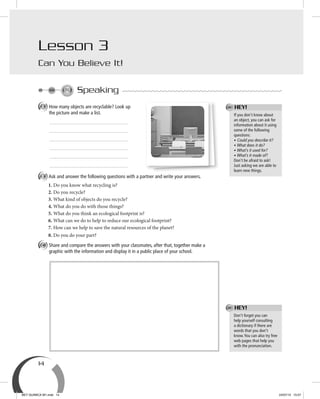
A How many objects are recyclable? Look up
the picture and make a list.
B Ask and answer the following questions with a partner and write your answers.
1. Do you know what recycling is?
2. Do you recycle?
3. What kind of objects do you recycle?
4. What do you do with those things?
5. What do you think an ecological footprint is?
6. What can we do to help to reduce our ecological footprint?
7. How can we help to save the natural resources of the planet?
8. Do you do your part?
C Share and compare the answers with your classmates, after that, together make a
graphic with the information and display it in a public place of your school.
Don’t forget you can
help yourself consulting
a dictionary if there are
words that you don’t
know.You can also try free
web pages that help you
with the pronunciation.
HEY!
If you don’t know about
an object, you can ask for
information about it using
some of the following
questions:
• Could you describe it?
• What does it do?
• What’s it used for?
• What’s it made of?
Don’t be afraid to ask!
Just asking we are able to
learn new things.
HEY!
Lesson 3
Can You Believe It!
BEY QUIMICA M1.indd 14 24/07/13 15:57
15
Vocabulary
A Link the words with their correct meaning.
1. Aquifer a. large building used for storing goods.
2. Ingenious b. resource that can replenish itself at a similar rate to its use by people.
3. Mineral c. composed of living or once-living material.
4. Organic d. very clever or smart.
5. Conservation e. a building or room that serves a specific function.
6. Engine f. an underground layer of rock or Earth which holds groundwater.
7. Facility g. inorganic material, such as a rock, that has characteristic chemical
composition and specific crystal structure.
8. Renewable resource h. machine that converts energy into power or motion.
9. Treated sewage i. management of a natural resource to prevent exploitation,
destruction, or neglect.
10. Warehouse j. wastewater that has had most toxic materials removed by physical and
chemical processes. Treated sewage is not safe to drink or bathe in.
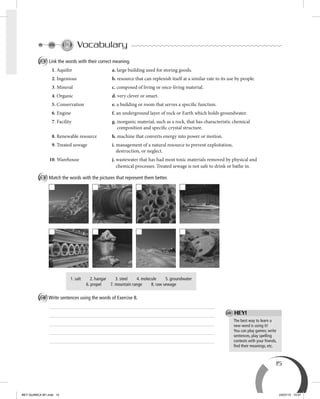
B Match the words with the pictures that represent them better.
1. salt 2. hangar 3. steel 4. molecule 5. groundwater
6. propel 7. mountain range 8. raw sewage
C Write sentences using the words of Exercise B.
The best way to learn a
new word is using it!
You can play games; write
sentences, play spelling
contests with your friends,
find their meanings, etc.
HEY!
BEY QUIMICA M1.indd 15 24/07/13 15:57
16
Reading
A Read the following text, underline the main ideas and key words.
Don’t forget! Try to do
these actions when you
read:
• Identify the topic.
• Identify the main ideas.
• Underline keywords.
Those actions will help
you to better understand
the reading.
HEY!
From Toilet to Tap
System transforms sewer water into drinking water.
Holding a plastic cup within the Orange County Water District’s Groundwater Replenishment System
(GWRS), program manager Shivaji Deshmukh announces a fact that might make some people’s
stomachs turn. “An hour and a half ago, this was treated sewage,” he says. “A day ago, it was raw sewage.”
Having complete faith in the project and its end result, Deshmukh then downs the water without
blinking. An ingenious method to fight California’s water shortage, the GWRS takes an unlikely
resource—sewage flushed down the toilets in Southern California’s Orange County—and transforms it
into drinking water that exceeds all state and federal drinking water standards.
Before taking the gulp of refreshing purified water, Deshmukh led me on tour of the facility, which took
about an hour, the approximate amount of time it takes the treated sewer water to pass through three
processes before becoming drinkable. Costing $480 million to construct, the state-of-the-art water
purification project has been up and running since January 2008. The Groundwater Replenishment
System is in an ideal location: just feet away from the Orange County Sanitation District (OCSD), where
the sewage from north and central Orange County is treated. Every day, OCSD sends a third of their
water over to the GWRS through a half-mile long, 96-inch pipe. Orange County Sanitation District
public affairs manager Michael Gold explains the kind of water his neighboring facility receives: “When
it comes in [to the OCSD], it’s dirty,” he says. “It’s smelly. It’s full of viruses and junk. As it comes out of our
plant, it looks clean, but it’s not clean enough to swim and bathe in.”
Currently, OCSD sends about 70 million gallons of treated sewer water over to the GWRS every day.
Gold says that amount of water is roughly enough to fill up nearby Anaheim Stadium, home to Major
League Baseball’s Los Angeles Angels of Anaheim.
Three Processes
After OCSD sends treated water to the GWRS, it undergoes three processes to make it drinkable:
microfiltration, reverse osmosis, and ultraviolet disinfection. The first process is microfiltration.
Deshmukh said this gets rid of bacteria, protozoa, and suspended solids in the liquid by pushing it
through a series of fiber membranes filled with tiny, hollow tubes. He compared it to drinking iced soda
through a straw. The pollutants are like the ice, which is too large to be drawn up through the straw.
The water is propelled through the microfiltration membranes with giant, 600-horsepower engines.
BEY QUIMICA M1.indd 16 24/07/13 15:57
17
Following microfiltration, the water sits in a large holding tank shaped like a rocket ship.
Standing outside a sleek, modern building that resembles an airplane hangar, Deshmukh looked toward
the structure, which was marked with large lettering: Reverse Osmosis. “This R.O. plant is one of the biggest
in the world,” Deshmukh said. Inside, the facility looks like a warehouse filled with stacks of plastic pipes.
“The water we get here has been microfiltered, but now we have to take the organics, the pharmaceuticals, the
viruses and salts out of the water,” Deshmukh said. During reverse osmosis, specially made plastic sheets
allow the passage of water while harmful material as small as a molecule is separated out. “This is the heart
of the treatment process,” Deshmukh explained. “This allows us to make the water potable.”
In reverse osmosis, the water is pushed through the plastic sheets by 1,000-horsepower engines. The
program manager insists that the energy used in treating the water is worthwhile when compared to other
methods of supplying Orange County with water. One popular method is shipping water from northern
California. “Reverse osmosis uses a lot of energy, but when you compare it to pumping water over a mountain
range [the Sierra Nevada], it’s less,” he said.
After Deshmukh taught me about the reverse osmosis process, we stepped outside into the Orange County
sun and walked towards the final stage the former sewer water had to be put through. We stopped at a
series of steel cylinders that are filled with ultraviolet light bulbs. Ultraviolet disinfection destroys any of
the water’s remaining viruses. “This is the last step,” Deshmukh said. “After this, we actually add minerals
back to the water.”
Aquifers
It’s here where Deshmukh and I tip back our plastic cups filled with the newly treated water and drink in a
liquid that may have been swirling around a toilet bowl just a day ago. But this water actually has months
to go before it will flow out of any of Orange County’s taps. Half of the water treated by GWRS is injected
into Orange County’s seawater barrier. The barrier, a series of wells that function like a dam, helps keep
the region’s aquifers, or underground freshwater supply, from being overtaken by seawater from the nearby
Pacific Ocean. The other half of the water is pumped thirteen and a half miles up into Anaheim, where
it is discharged into several lakes. From there, it joins the region’s rainwater and settles into aquifers as
groundwater. In approximately six months, the groundwater is chlorinated by the cities of Orange County
and sent to taps for personal and business use. Currently, Orange County Water District treats 70 million
gallons of water every day. This amount of high-quality water can meet the annual water needs of 500,000
people.
In addition to creating a renewable source of fresh water for the area’s growing population, another benefit
is that the GWRS reduces the amount of treated wastewater discharged in the Pacific Ocean. Though
the initial idea of drinking reclaimed water might make some stomachs turn, the success of Orange
County’s Groundwater Replenishment System has caused a turn in California’s thinking about the idea of
transforming sewer water into drinking water. This change has resulted in a series of proposals for similar
facilities across the state.
BEY QUIMICA M1.indd 17 24/07/13 15:57
18
Remember!
A cycle is a process that
repeats itself over and
over again.
HEY!
B Which paragraph contains the following information? Find the information and number
the paragraph in the text in order to give your answer.
1. The approximate amount of time it takes the treated sewer water to pass through
three processes before becoming drinkable is 1 hour.
2. OCSD sends about 70 million gallons of treated sewer water every day.
3. Microfiltration, reverse osmosis and ultraviolet disinfections are the three
processes to make the water drinkable.
4. The heart of the treatment process is reverse osmosis.
5. The last step in the process is ultraviolet disinfection.
C Do the following statements agree with the information in the reading passage? Write,
TRUE if the statement agrees with the information, FALSE if the statement contradicts
the information, and NOT GIVEN if there is no information on this.
1. The O.C. Water District’s Water Factory 21 was the first facility to
use reverse osmosis to make municipal sewer water into purified
drinking water.
2. The first step of the process is microfiltration.
3. Shivaji Deshmukh is the inventor of the process.
4. GWRS means Groundwater Replenishment System.
5. The clean and treated water goes directly to the Orange
County’s taps.
6. Orange County District consumes 70 million gallons of water
every day.
8. The GWRS reduces the amount of treated wastewater discharged in the Pacific
Ocean.
9. The Groundwater Replenishment System will begin processing treated sewer
water in January 2018.
Writing
A Look through the text again and write down the information on the three steps of the
process and illustrate them. Present your work to your class and explain the process.
B Do you know who Shivaji Deshmukh is? Work in groups of four.
Go to www.nationalgeographic.com and get some information about him. Find out how
many cities are using technology and how Mexico could benefit from using technology.
With the information found, give a presentation to your class. Remember to illustrate your
presentation.
Remember!
We skim a text when we
are looking for a general
idea or quickly overview
the information.
We scan a text when we
are looking for key words
or a particular answer.
HEY!
BEY QUIMICA M1.indd 18 24/07/13 15:57
19
Listening
Have you been abroad? What is your favorite place in the world? If not, what is your favorite place in your country? Did you
know that all those beautiful places are in serious danger? Recycling can be the solution to all these places in risk.
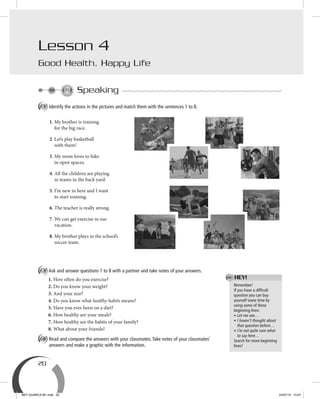
A Listen to the conversation.What places do the speakers want to visit? Number the pictures
in the order you hear the name of the places where you can see these sights. Track 5
B Listen again and match the questions to the answers. Track 6
1. Why does Ines want to visit New York? a. Because he likes sports and adventure.
2. Why does Carlos want to visit Rome? b. Because he likes pizza and spaghetti.
3. Why does Tere want to visit London? c. Because she likes wild animals.
4. Why does Amalia want to visit Africa? d. Because he likes science.
5. Why does Nacho want to visit Australia? e. Because she likes economics.
6. Why does Oscar want to visit Antarctica? f. Because she likes shopping and theater.
C Listen for the short /i/ sound.What sound do you hear in each word? Check the
correct column. Track 7
long e sound short i sound
this
these
he’s
his
ship
sheep
meet
mitt
STATUE OF LIBERTY ANTARCTICAULURU (AYERS ROCK)
AFRICAN SAVANNAHBIG BENCOLOSSEUM
BEY QUIMICA M1.indd 19 24/07/13 15:57
20
Speaking
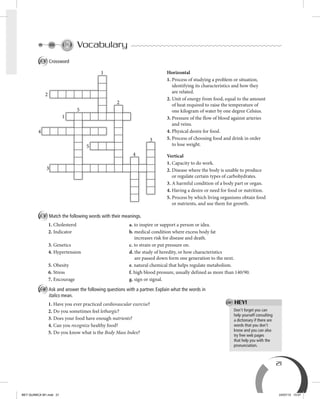
A Identify the actions in the pictures and match them with the sentences 1 to 8.
B Ask and answer questions 1 to 8 with a partner and take notes of your answers.
1. How often do you exercise?
2. Do you know your weight?
3. And your size?
4. Do you know what healthy habits means?
5. Have you ever been on a diet?
6. How healthy are your meals?
7. How healthy are the habits of your family?
8. What about your friends?
C Read and compare the answers with your classmates.Take notes of your classmates’
answers and make a graphic with the information.
Remember!
If you have a difficult
question you can buy
yourself some time by
using some of these
beginning lines:
• Let me see…
• I haven’t thought about
that question before…
• I’m not quite sure what
to say here…
Search for more beginning
lines!
HEY!
1. My brother is training
for the big race.
2. Let’s play basketball
with them!
3. My mom loves to hike
in open spaces.
4. All the children are playing
in teams in the back yard.
5. I’m new in here and I want
to start training.
6. The teacher is really strong.
7. We can get exercise in our
vacation.
8. My brother plays in the school’s
soccer team.
Lesson 4
Good Health, Happy Life
BEY QUIMICA M1.indd 20 24/07/13 15:57
21
Don’t forget you can
help yourself consulting
a dictionary if there are
words that you don’t
know and you can also
try free web pages
that help you with the
pronunciation.
HEY!
Vocabulary
A Crossword
B Match the following words with their meanings.
1. Cholesterol a. to inspire or support a person or idea.
2. Indicator b. medical condition where excess body fat
increases risk for disease and death.
3. Genetics c. to strain or put pressure on.
4. Hypertension d. the study of heredity, or how characteristics
are passed down form one generation to the next.
5. Obesity e. natural chemical that helps regulate metabolism.
6. Stress f. high blood pressure, usually defined as more than 140/90.
7. Encourage g. sign or signal.
C Ask and answer the following questions with a partner. Explain what the words in
italics mean.
1. Have you ever practiced cardiovascular exercise?
2. Do you sometimes feel lethargic?
3. Does your food have enough nutrients?
4. Can you recognize healthy food?
5. Do you know what is the Body Mass Index?
Horizontal
1. Process of studying a problem or situation,
identifying its characteristics and how they
are related.
2. Unit of energy from food, equal to the amount
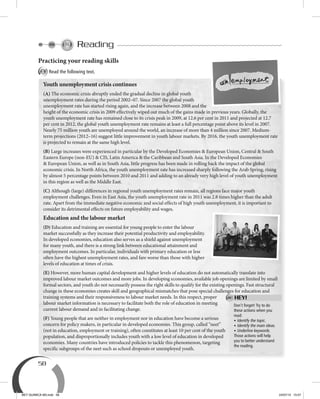
of heat required to raise the temperature of
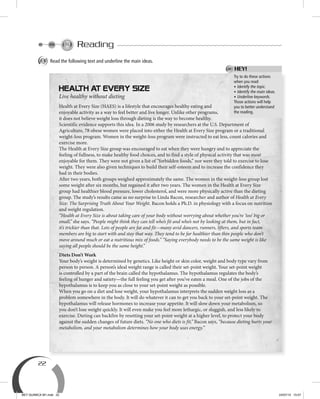
one kilogram of water by one degree Celsius.
3. Pressure of the flow of blood against arteries
and veins.
4. Physical desire for food.
5. Process of choosing food and drink in order
to lose weight.
Vertical
1. Capacity to do work.
2. Disease where the body is unable to produce
or regulate certain types of carbohydrates.
3. A harmful condition of a body part or organ.
4. Having a desire or need for food or nutrition.
5. Process by which living organisms obtain food
or nutrients, and use them for growth.
2
1
2
5
1
4
3
5
4
3
BEY QUIMICA M1.indd 21 24/07/13 15:57
22
Reading
A Read the following text and underline the main ideas.
Try to do these actions
when you read:
• Identify the topic.
• Identify the main ideas.
• Underline keywords.
Those actions will help
you to better understand
the reading.
HEY!
Live healthy without dieting
Health at Every Size (HAES) is a lifestyle that encourages healthy eating and
enjoyable activity as a way to feel better and live longer. Unlike other programs,
it does not believe weight loss through dieting is the way to become healthy.
Scientific evidence supports this idea. In a 2006 study by researchers at the U.S. Department of
Agriculture, 78 obese women were placed into either the Health at Every Size program or a traditional
weight-loss program. Women in the weight-loss program were instructed to eat less, count calories and
exercise more.
The Health at Every Size group was encouraged to eat when they were hungry and to appreciate the
feeling of fullness, to make healthy food choices, and to find a style of physical activity that was most
enjoyable for them. They were not given a list of “forbidden foods,” nor were they told to exercise to lose
weight. They were also given techniques to build their self-esteem and to increase the confidence they
had in their bodies.
After two years, both groups weighed approximately the same. The women in the weight-loss group lost
some weight after six months, but regained it after two years. The women in the Health at Every Size
group had healthier blood pressure, lower cholesterol, and were more physically active than the dieting
group. The study’s results came as no surprise to Linda Bacon, researcher and author of Health at Every
Size: The Surprising Truth About Your Weight. Bacon holds a Ph.D. in physiology with a focus on nutrition
and weight regulation.
“Health at Every Size is about taking care of your body without worrying about whether you’re ‘too’ big or
small,” she says. “People might think they can tell who’s fit and who’s not by looking at them, but in fact,
it’s trickier than that. Lots of people are fat and fit—many avid dancers, runners, lifters, and sports team
members are big to start with and stay that way. They tend to be far healthier than thin people who don’t
move around much or eat a nutritious mix of foods.” “Saying everybody needs to be the same weight is like
saying all people should be the same height.”
Diets Don’t Work
Your body’s weight is determined by genetics. Like height or skin color, weight and body type vary from
person to person. A person’s ideal weight range is called their set-point weight. Your set-point weight
is controlled by a part of the brain called the hypothalamus. The hypothalamus regulates the body’s
feeling of hunger and satiety—the full feeling you get after you’ve eaten a meal. One of the jobs of the
hypothalamus is to keep you as close to your set-point weight as possible.
When you go on a diet and lose weight, your hypothalamus interprets the sudden weight loss as a
problem somewhere in the body. It will do whatever it can to get you back to your set-point weight. The
hypothalamus will release hormones to increase your appetite. It will slow down your metabolism, so
you don’t lose weight quickly. It will even make you feel more lethargic, or sluggish, and less likely to
exercise. Dieting can backfire by resetting your set-point weight at a higher level, to protect your body
against the sudden changes of future diets. “No one who diets is fit,” Bacon says, “because dieting hurts your
metabolism, and your metabolism determines how your body uses energy.”
BEY QUIMICA M1.indd 22 24/07/13 15:57
23
“But diets not only don’t work—they’re making us fat. Scientific studies show that if your weight ‘yo-yos,’ if it
goes up and down a lot, that leads to long-term weight gain, especially when you’re young. Teens’ and preteens’
metabolisms are trying to figure out what their adult pattern will be. Diets interfere with that. People with stable
weights, even high ones, often enjoy better health than dieters and ex-dieters.”
Fat Isn’t the Problem
In 2004, the Journal of the American Medical Association reported that 400,000 obese and overweight
Americans die every year. That’s the information it got from the Centers for Disease Control and Prevention
(CDC).
However, the CDC later learned that the methods by which it got those numbers were faulty. When it re-did
the report with better methods and new data, just 26,000 overweight or obese people a year died—fewer
than the number who died due to guns, alcohol, or car accidents. The deaths were typically from people who
had a body mass index (BMI)—a measure of body fat based on height and weight—greater than 35. Most
overweight people are in the lower range, from 30 to 35.
In fact, life expectancy in the United States has risen—along with the obesity rate—from 70.8 years in 1970
to 78.2 in 2009. In its revised study, the CDC found that overweight people actually live longer, with 86,000
fewer deaths in the overweight category than in the normal weight category. And underweight people died
more often than either overweight or obese people, suggesting that the thinnest people in the U.S. may be at a
greater health risk.
In Health at Every Size, Bacon writes, “Many well-meaning scientists and medical practitioners are misled about
the ill effects of being heavy. There is clearly a correlation between obesity and certain diseases and conditions,
like diabetes or hypertension, but that doesn’t mean being fat causes these conditions. It may be that whatever
causes the diabetes also causes people to gain weight.”
“To help explain this, one example I like deals with bald men and heart disease: Influential studies show that
men with hair loss are more likely to have heart attacks. Does that mean going bald causes heart attacks?
And can keeping your hair (or getting hair transplants) protect against cardiovascular disease? Well, of course
not! After research and analysis, the baldness-heart risk association still isn’t totally clear, but it appears that
testosterone—which can cause both baldness and heart problems—is a likely culprit. In other words, fat isn’t the
problem. When we see diseases that are more common in fatter people, it’s more about what they’re doing, than
they’re fat. So the key is to make healthy changes in what you do and stop worrying so much about weight.”
Health at Every Size
Health at Every Size focuses on health, not weight, as an indicator of your overall well-being. But if weight
isn’t a measurement of our overall health, how do we know we’re healthy? Bacon says, “Weight distracts us,
and this focus results in poor medical care for everyone. ‘Normal weight’ people—who may have poor health
habits and disease—don’t get good diagnoses or support for changing habits, which may catch up with them.
People in the overweight and obese categories get stigmatized, encouraged in restrictive eating—even if they
may actually have great health habits to begin with. Perhaps this could be a better focus for medical care—
interviewing people about whether they have social support and manage stress well, whether they are regularly
active, if they eat well.”
“What’s good for thin kids, fat kids and everyone in between, it turns out, is moving their bodies and a healthy
mix of foods that taste good and nourish our bodies. Finding activity you enjoy might mean sports or workouts,
but it could also be walking, jumping rope with friends, or dancing.”
“With eating, Health at Every Size calls for intuitive eating. This means learning to listen to your body so you can
recognize when you’re hungry and when you’re full, and what foods satisfy you. You don’t get as many nutrients
from food when you don’t enjoy it, so do take care to choose foods you love. Sugar and candy can taste great, but
they don’t give you other nutrients your body needs, and you’ll find that you can get grumpy, tired, and don’t do
so well in school if that’s all you eat. And if you skip the fruit and veggies, you’ll probably find yourself struggling
in the bathroom too long, so you don’t want to avoid those. So mix it up and get a range of nutrients in you to
keep your body function best and to keep you most alert and in a good mood. Experiment with food to see which
ones make you feel best.”
BEY QUIMICA M1.indd 23 24/07/13 15:57
24
Looking out for
information?
Skim the text if you are
looking for a general idea
or quickly overview the
information.
Scan the text if you are
looking for key words or a
particular answer.
HEY!
B Complete each sentence with the correct ending.
1. Health at Every Size is a program that encourages a. but how healthy you are in your own size.
2. In Health at Every Size the women were instructed to b. and not by how much you eat or what
you eat.
3. In HAES it is not important how much weight you lose, c. your metabolism slows down.
4. Your body’s weight is determined by genetics d. eat healthy and practice physical activity and
they were not given a list of forbidden foods.
5. When you go on a diet and lose weight, e. healthy eating and enjoyable physical activity
in order to live longer and feel better.
6. The Health at Every Size plan doesn’t f. they’ll lead us to a healthy mix of foods
and signal when we’ve had enough.
7. If we trust our bodies and learn to listen to our appetites, g. put restrictions on the foods a person eats.
C Which paragraph contains the following information? Find the information and number
the paragraph in the text in order to give your answer.
1. Health at Every Size is about taking care of your body without worrying about
whether you’re too big or small.
2. When you go on a diet and lose weight, your hypothalamus interprets the sudden
weight loss as a problem somewhere in the body.
3. The life expectancy in the United States has risen.
4. The key is to make healthy changes in what you do and stop worrying so much
about weight.
5. Weight distracts us, and this focus results in poor medical care for
everyone.
6. You don’t get as many nutrients from food when you don’t enjoy it.
7. Sugar and candy can taste great, buy they don’t give you other nutrients your body needs.
Bacon also recommends trying a range of foods to find ones that you enjoy. “What I find even more interesting is
that research supports that people actually absorb more nutrients from meals that appeal to them than from meals
they find less appetizing.” “In one interesting study, researchers fed a traditional Thai meal of rice and vegetables spiked
with chili paste, fish sauce, and coconut cream to two groups of women, one Swedish and one Thai. The Thai women,
who presumably liked the meal better than the Swedish women, absorbed 50 percent more iron from the same food
than the Swedish women. And when the meal was blended together and turned to an unfamiliar and unpalatable
paste, the Thai women’s absorption of iron from the meal decreased by 70 percent! So choking down the plate of
steamed broccoli (if you hate steamed broccoli) is not likely to do you as much good as you think. Enjoying your food is
an important nutritional practice.”
The Health at Every Size plan doesn’t put restrictions on the foods a person eats. Rather, it places more trust in the
person to select foods that are right for them, and to stop eating when they feel full. Bacon says, “Have you ever
noticed that, when you hear you can’t have something—like ice cream, say, or chips—you want it all the more? Health
at Every Size gets rid of ‘in’ and ‘out’ lists for food. If we trust our bodies and learn to listen to our appetites, they’ll lead
us to a healthy mix of foods and signal when we’ve had enough. When you can eat what you want and need, cravings
and the munchies aren’t such a problem, and you’re no longer in danger of eating out of control.” Bacon writes, “What
no one needs, at any size, is to feel bad about how they look or what they weigh. People who live by Health at Every Size
ideas tend to feel better about themselves, and that can lead to better health, too, with less stress and disordered eating.”
BEY QUIMICA M1.indd 24 24/07/13 15:57
25
Writing
A What were the results of the 2006 study made by the U.S. Department of Agriculture? What was the study about? What was
reported by the Journal American Medical Association in 2004? Has that information changed? Using these questions as a
beginning, check the information about those studies and explain them to your class using one or more graphs that show
the information.
B Search for information about the HAES programs at: http://www.haescommunity.org.Then make a similar program to
apply in your school.With the information you get, prepare a presentation as a group. Present this program to your
Principal, authorities and all the people in your school. Use all kind of resources you want (illustrations, pictures, images,
Power Point presentations, etc.) in order to convince them to apply it.
Listening
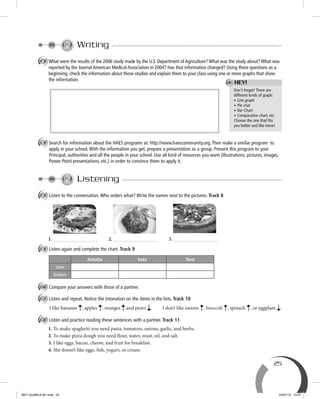
A Listen to the conversation.Who orders what? Write the names next to the pictures. Track 8
1. 2. 3.
B Listen again and complete the chart. Track 9
Amalia Inés Tere
Likes
Dislikes
C Compare your answers with those of a partner.
D Listen and repeat. Notice the intonation on the items in the lists. Track 10
I like bananas , apples , oranges ,and pears . I don’t like onions , broccoli , spinach , or eggplant .
E Listen and practice reading these sentences with a partner. Track 11
1. To make spaghetti you need pasta, tomatoes, onions, garlic, and herbs.
2. To make pizza dough you need flour, water, yeast, oil, and salt.
3. I like eggs, bacon, cheese, and fruit for breakfast.
4. She doesn’t like eggs, fish, yogurt, or cream.
Don’t forget! There are
different kinds of graph:
• Line graph
• Pie chat
• Bar Chart
• Comparative chart, etc.
Choose the one that fits
you better and like more!
HEY!
BEY QUIMICA M1.indd 25 24/07/13 15:57
26
M
odule
2M
ule
2
How to Express Your Own Ideas
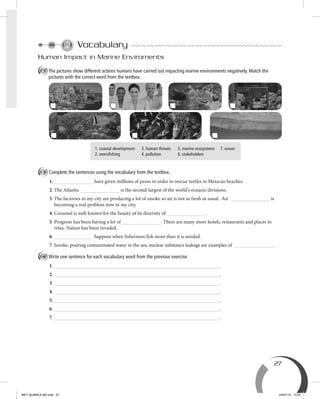
A Look at the questions and think how you can express your ideas. Focus on answering
and debating the questions with two classmates.
1. What are the most common human threats you have lived / seen in your
community? Explain them.
2. Is overfishing a problem in your community? Have you recently heard of any
specific fish species that has been overfished?
3. What species are not allowed to be hunted or fished in your community? Why?
How do you think it happened?
4. What kind of pollution is your community living? Give some consequences of it.
5. Who are the most famous stakeholders you know that protect animals? How do
they contribute to save nature? Give some examples of stakeholders that work in
pro of animal or nature in your community.
B In groups of three, prepare a presentation.You have up to 10 minutes to talk about
a human threat explaining what it is, how it is caused and how it can be prevented
or controlled.
Lesson 1
Negative Impact of Humans
in the Environment
If you want to express
your ideas you could use
one of these sentences:
• In my opinion, I think
that…
• In first instance I can say
that…
• In my own words, I
would say that…
• Personally, I think …
• I want to start saying
that…
HEY!
Speaking
BEY QUIMICA M2.indd 26 24/07/13 15:57
27
Vocabulary
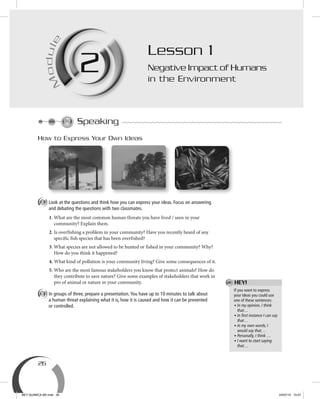
Human Impact in Marine Enviroments
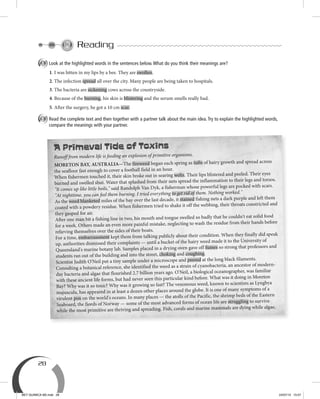
A The pictures show different actions humans have carried out impacting marine environments negatively. Match the
pictures with the correct word from the textbox.
1. coastal development 3. human threats 5. marine ecosystems 7. ocean
2. oversfishing 4. pollution 6. stakeholders
B Complete the sentences using the vocabulary from the textbox.
1. have given millions of pesos in order to rescue turtles in Mexican beaches.
2. The Atlantic is the second-largest of the world's oceanic divisions.
3. The factories in my city are producing a lot of smoke so air is not as fresh as usual. Air is
becoming a real problem now in my city.
4. Cozumel is well-known for the beauty of its diversity of .
5. Progreso has been having a lot of . There are many more hotels, restaurants and places to
relax. Nature has been invaded.
6. happens when fishermen fish more than it is needed.
7. Smoke, pouring contaminated water in the sea, nuclear substance leakage are examples of .
C Write one sentence for each vocabulary word from the previous exercise.
1. .
2. .
3. .
4. .
5. .
6. .
7. .
BEY QUIMICA M2.indd 27 24/07/13 15:57
28
Reading
A Look at the highlighted words in the sentences below.What do you think their meanings are?
1. I was bitten in my lips by a bee. They are swollen.
2. The infection spread all over the city. Many people are being taken to hospitals.
3. The bacteria are sickening cows across the countryside.
4. Because of the burning, his skin is blistering and the serum smells really bad.
5. After the surgery, he got a 10 cm scar.
B Read the complete text and then together with a partner talk about the main idea.Try to explain the highlighted words,
compare the meanings with your partner.
A Primeval Tide of Toxins
Runoff from modern life is feeding an explosion of primitive organisms.
MORETON BAY, AUSTRALIA—The fireweed began each spring as tufts of hairy growth and spread across
the seafloor fast enough to cover a football field in an hour.
When fishermen touched it, their skin broke out in searing welts. Their lips blistered and peeled. Their eyes
burned and swelled shut. Water that splashed from their nets spread the inflammation to their legs and torsos.
"It comes up like little boils," said Randolph Van Dyk, a fisherman whose powerful legs are pocked with scars.
"At nighttime, you can feel them burning. I tried everything to get rid of them. Nothing worked."
As the weed blanketed miles of the bay over the last decade, it stained fishing nets a dark purple and left them
coated with a powdery residue. When fishermen tried to shake it off the webbing, their throats constricted and
they gasped for air.
After one man bit a fishing line in two, his mouth and tongue swelled so badly that he couldn't eat solid food
for a week. Others made an even more painful mistake, neglecting to wash the residue from their hands before
relieving themselves over the sides of their boats.
For a time, embarrassment kept them from talking publicly about their condition. When they finally did speak
up, authorities dismissed their complaints — until a bucket of the hairy weed made it to the University of
Queensland's marine botany lab. Samples placed in a drying oven gave off fumes so strong that professors and
students ran out of the building and into the street, choking and coughing.
Scientist Judith O'Neil put a tiny sample under a microscope and peered at the long black filaments.
Consulting a botanical reference, she identified the weed as a strain of cyanobacteria, an ancestor of modern-
day bacteria and algae that flourished 2.7 billion years ago. O'Neil, a biological oceanographer, was familiar
with these ancient life forms, but had never seen this particular kind before. What was it doing in Moreton
Bay? Why was it so toxic? Why was it growing so fast? The venomous weed, known to scientists as Lyngbya
majuscula, has appeared in at least a dozen other places around the globe. It is one of many symptoms of a
virulent pox on the world's oceans. In many places — the atolls of the Pacific, the shrimp beds of the Eastern
Seaboard, the fiords of Norway — some of the most advanced forms of ocean life are struggling to survive
while the most primitive are thriving and spreading. Fish, corals and marine mammals are dying while algae,
BEY QUIMICA M2.indd 28 24/07/13 15:57
29
C Look at the definitions and match them with the correct words.
1. slime
2. tuft
3. welt
4. peel
5. fireweed
6. get rid of
7. blanket
8. fume
9. choke
10. cough
11. pox
12. struggle
13. peer
D Look at the words in the first column of exercise C and classify them into nouns and verbs. Complete the table below.
Nouns Verbs
a) a plant that springs up on burned land.
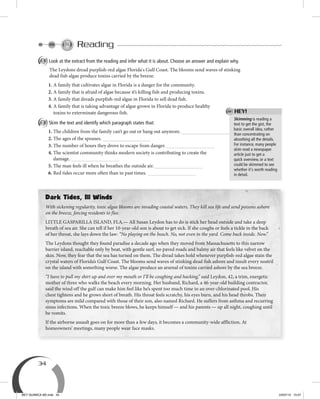
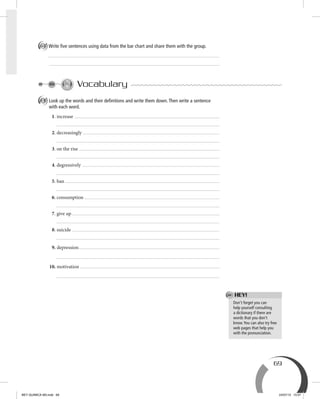
b)look keenly or with difficulty at someone or something.
c) any of several viral diseases producing a rash of pimples that become
pus-filled and leave pockmarks on healing.
d)cover completely with a thick layer of something.
e) a moist, soft, and slippery substance, typically regarded as repulsive.
f) expel air from the lungs with a sudden sharp sound.
g) lose parts of its outer layer or covering in small strips or pieces.

h)make forceful or violent efforts to get free of restraint or constriction.
i) have severe difficulty in breathing because of a constricted or obstructed
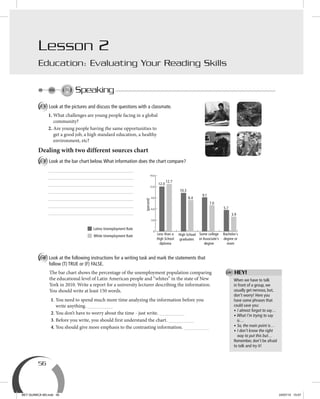
throat or a lack of air.
j) take action so as to be free of (a troublesome or unwanted person or thing).
k)a red, swollen mark left on flesh by a blow or pressure.
l) gas, smoke, or vapor that smells strongly or is dangerous to inhale.
m)a bunch or collection of something, typically threads, grass, or hair, held or
growing together at the base.
n)gas, smoke, or vapor that smells strongly or is dangerous to inhale.
bacteria and jellyfish are growing unchecked. Where this pattern is most pronounced, scientists evoke a
scenario of evolution running in reverse, returning to the primeval seas of hundreds of millions of years ago.
Jeremy B.C. Jackson, a marine ecologist and paleontologist at the Scripps Institution of Oceanography in La
Jolla, says we are witnessing "the rise of slime."
For many years, it was assumed that the oceans were too vast for humanity to damage in any lasting way. "Man
marks the Earth with ruin," wrote the 19th century poet Lord Byron. "His control stops with the shore."
Even in modern times, when oil spills, chemical discharges and other industrial accidents heightened
awareness of man's capacity to injure sea life, the damage was often regarded as temporary.
But over time, the accumulation of environmental pressures has altered the basic chemistry of the seas. The
causes are varied, but collectively they have made the ocean more hospitable to primitive organisms by putting
too much food into the water. Industrial society is overdosing the oceans with basic nutrients — the nitrogen,
carbon, iron and phosphorous compounds that curl out of smokestacks and tailpipes, wash into the sea from
fertilized lawns and cropland, seep out of septic tanks and gush from sewer pipes.
From: www.latimes.com/news/la-me-ocean30jul30,0,818347.story
BEY QUIMICA M2.indd 29 24/07/13 15:57
30
Writing
A Look at the paragraphs at the table. Identify the causes and the consequences.
Reading extract Cause Consequence
As the weed blanketed miles of the bay over the
last decade, it stained fishing nets a dark purple
and left them coated with a powdery residue.
When fishermen tried to shake it off the webbing,
their throats constricted and they gasped for air.
His mouth and tongue swelled so badly that he
couldn't eat solid food for a week.
When fishermen tried to shake it off the webbing,
their throats constricted and they gasped for air.
Samples placed in a drying oven gave off fumes
so strong that professors and students ran out
of the building and into the street, choking and
coughing.
Samples placed in a drying oven gave off fumes
so strong that professors and students ran out of
the building and into the street.
Negative Impact of Human Environment
B The bar graph below shows the number of perceived Causes of Pollution in Virginia's
Bay Basin and Southern Rivers Region. Summarise the information by selecting and
reporting the main features, and make comparisons where relevant.
0
10
20
30
40
50
41
34
37
35
43
26
23
15
13
9
Southern Rivers
Industrial
Waste
Litter
Garbage
Urban
Runoff
Logging Mining
Bay basin When we read and we are
trying to distinguish between
causes and consequences.
Example:
The fireweed began each spring
as tufts of hairy growth and
spread across the seafloor fast
enough to cover a football field
in an hour.When fishermen
touched it, their skin broke
out in searing welts.Their lips
blistered and peeled.Their eyes
burned and swelled shut.Water
that splashed from their nets
spread the inflammation to
their legs and torsos.
Cause: The fishermen touched
the fireweed
Consequences: fishermen
got sick.Their skin broke out
in searing welts.Their lips
blistered and peeled.Their eyes
burned and swelled shut.
HEY!
BEY QUIMICA M2.indd 30 24/07/13 15:57
31
Listening
A Listen to the following narration. Track 12
Almost a quarter of the world’s population of 7 billion live in cities. In the last 60
years there has been a rapid growth in both the number and the size of cities. In 1950
there were less than 100 cities with 1 million people or less, whereas today there
are as many as 600. According to statistics 180,000 people move to a city every day.
In developing countries, in Asia and Africa in particular, cities are appearing and
growing at a dramatic rate. The population of these two regions alone is expected to
double over the next two decades.
This expansion of urban populations has given rise to the megacity, a city which has
10 million inhabitants or more. In 1950 New York and Tokyo were considered to be
the only two megacites, but today there are 23 in the world. (The largest is Tokyo
which has a population of over 36 million!)
The United Nations predicts that there will be 37 megacities by 2025, with most of
the new ones in Asia. More and more people are drawn to big cities because of the
opportunities, services, and facilities which they provide. In megacities there are
many benefits to modern urban living. There is work, housing, education, health
care, entertainment, sanitation, access to food and water, and power (such as gas
and electricity).
Yet this massive migration to megacities brings significant problems. Overcrowding,
pollution, crime, and traffic congestion are huge challenges which face megacities, as
well as other serious social issues like the number of slums, the homeless, and
poverty in general. The location of some megacities like Mexico City or New Dehli
makes them vulnerable to earthquakes, where major tremors would have devastating
effects, possibly killing thousands of people.
B Now, listen again and write T for TRUE if the statement agrees with the information given or F for FALSE if it doesn't.
1. Forty-five percent of the world’s population live in cities.
2. 180 thousand people move to a city every day.
3. The first two megacities were New York and Tokyo.
4. Today there are thirty seven megacities.
5. People want to live in cities for the services and benefits.
6. Megacities have solved the problems of modern urban living.
BEY QUIMICA M2.indd 31 24/07/13 15:57
32
Speaking
A Which of the following ailments, symptoms and injuries do you know? Match the pictures with the words.
B Answer the questions with a partner.
1. When was the last time you didn’t feel well? What happened?
2. What are the symptoms of a diarrhea? A heart problem?
3. When you usually feel ill, you present some symptoms or when you are injured
you have some pain reactions. Have you ever been injured? What happened?
C Look at the questions and think about the last time you felt ill, remember the symptoms
you had and try to think about what caused that ailment.
1. When was the last time you felt:
a) a stomach ache? b) a headache? c) a fever?
2. What were your symptoms?
3. How do you think you got it?
D Talk with a classmate. Using the words in exercise A, talk about how the people in the pictures are feeling.
Lesson 2
Ailments, Symptoms and Injuries
1. headache
2. stomach ache
3. sore throat
4. fever
5. cold
6. cough
7. infection
8. rash
9. runny nose
10. bloody nose
11. diarrhea
12. burn
13. chest
14. pain
15. fain
16. dizzy
17. nauseous
18. vomit
19. bleed
20. twist
21. sprain
22. dislocate
23. scratch
24. scrape
25. bruise
BEY QUIMICA M2.indd 32 24/07/13 15:57
33
E Look at the words in exercise A and decide which of them are ailments, symptoms or injuries.
Classify them into the box.
Ailments Symptoms Injuries
Vocabulary
A Find the hidden vocabulary words in the puzzle below. Complete the sentences to know which word is the correct one.
1. Last weekend I got a terrible because I got completely wet in the rain.
2. My mother can’t stand people . She immediately . She is scare of blood.
3. I my wrist while I was playing basketball.
4. I usually get a after work. I need to take two aspirins.
5. After the plane took off, I got a . I couldn’t believe how much blood I had in my face.
6. The tacos made me feel two hours after eating. Just a second before I realised I had a terrible
.
7. I shouldn’t have eaten so much chilli I am burping a lot. I think I have a .
8. I myself playing with matches. I shouldn’t have done it.
9. Oh my gosh! My shoulder just . I need a physician desperately.
10. I think I am allergic to this kind of fabric. I got a all over my chest and arms.
11. This makes me feel uncomfortable. I can’t stand this runny nose and this .
12. My dog my arm with his sharp nails.
13. I my knees when I fell on the floor.
X E E I S X P G S V A I N L O
F H Y L U S R E X N C U C W Q
N C X P G I U S Q A D M C H X
X A A G Z D H O R C R A G M Z
S H F Q S R I N E P F D N Q B
V C Y E A L N Y T S I W T S N
S A R J V K B D T S U V J A K
L M N A A E C O L D U A Y L J
S O R E T H R O A T S A N R A
Q T U B M C C L U C N O M T Q
G S B L E A H B R T X I X A Y
L C G E T D I A R R H E A E D
I B N E X A P A T T Q G J F A
U F H D Y E S H I L E P S N I
F B L G U H H A V E A H U L E
BEY QUIMICA M2.indd 33 24/07/13 15:57
34
Reading
A Look at the extract from the reading and infer what it is about. Choose an answer and explain why.
The Leydons dread purplish-red algae Florida's Gulf Coast. The blooms send waves of stinking
dead fish algae produce toxins carried by the breeze.
1. A family that cultivates algae in Florida is a danger for the community.
2. A family that is afraid of algae because it’s killing fish and producing toxins.
3. A family that dreads purplish-red algae in Florida to sell dead fish.
4. A family that is taking advantage of algae grown in Florida to produce healthy
toxins to exterminate dangerous fish.
B Skim the text and identify which paragraph states that:
1. The children from the family can’t go out or hang out anymore.
2. The ages of the spouses.
3. The number of hours they drove to escape from danger.
4. The scientist community thinks modern society is contributing to create the
damage.
5. The man feels ill when he breathes the outside air.
6. Red tides occur more often than in past times.
Skimming is reading a
text to get the gist, the
basic overall idea, rather
than concentrating on
absorbing all the details.
For instance, many people
skim read a newspaper
article just to get a
quick overview, or a text
could be skimmed to see
whether it's worth reading
in detail.
Dark Tides, Ill Winds
With sickening regularity, toxic algae blooms are invading coastal waters. They kill sea life and send poisons ashore
on the breeze, forcing residents to flee.
LITTLE GASPARILLA ISLAND, FLA.— All Susan Leydon has to do is stick her head outside and take a deep
breath of sea air. She can tell if her 10-year-old son is about to get sick. If she coughs or feels a tickle in the back
of her throat, she lays down the law: “No playing on the beach. No, not even in the yard. Come back inside. Now.”
The Leydons thought they found paradise a decade ago when they moved from Massachusetts to this narrow
barrier island, reachable only by boat, with gentle surf, no paved roads and balmy air that feels like velvet on the
skin. Now, they fear that the sea has turned on them. The dread takes hold whenever purplish-red algae stain the
crystal waters of Florida’s Gulf Coast. The blooms send waves of stinking dead fish ashore and insult every nostril
on the island with something worse. The algae produce an arsenal of toxins carried ashore by the sea breeze.
“I have to pull my shirt up and over my mouth or I’ll be coughing and hacking,” said Leydon, 42, a trim, energetic
mother of three who walks the beach every morning. Her husband, Richard, a 46-year-old building contractor,
said the wind off the gulf can make him feel like he’s spent too much time in an over-chlorinated pool. His
chest tightens and he grows short of breath. His throat feels scratchy, his eyes burn, and his head throbs. Their
symptoms are mild compared with those of their son, also named Richard. He suffers from asthma and recurring
sinus infections. When the toxic breeze blows, he keeps himself — and his parents — up all night, coughing until
he vomits.
If the airborne assault goes on for more than a few days, it becomes a community-wide affliction. At
homeowners’ meetings, many people wear face masks.
HEY!
BEY QUIMICA M2.indd 34 24/07/13 15:57
35
Writing can be easy and
even fun!
Get some more ideas on
how to do it!
Go to http://www.ehow.
com/how_5593721_write-
composition-paper.html
on How to Write a
Composition!
Writing
A Write about the following topic, give reasons for your answer and include any relevant
examples from your own knowledge or experience. Write at least 250 words.
1. A company has announced that it wishes to build a large factory near
your community.
2. Discuss the advantages and disadvantages of this new influence on
your community.
3. Do you support or oppose the factory? Explain your position.
On weekends, the Leydons escape inland. They drive three hours to Orlando so their son
can play outside without getting sick. They go to a Walt Disney World resort with water
slides, machine-generated currents and an imported white sand beach.
“It’s a shame to leave this beautiful place and go to a water park,” Richard Leydon said.
“But we don’t have much choice. We have to get away from it.”
Harmful algae blooms have occurred for ages. Some scientists theorize that a toxic
bloom inspired the biblical passage in Exodus: “ … all the water in the Nile turned into
blood. And the fish in the Nile died, and the Nile stank, so that the Egyptians could not drink
water from the Nile. There was blood throughout all the land of Egypt.”
What was once a freak of nature has become commonplace. These outbreaks, often called red tides, are
occurring more often worldwide, showing up in new places, lasting longer and intensifying.
They are distress signals from an unhealthy ocean. Overfishing, destruction of wetlands, industrial pollution and
climate change have made the seas inhospitable for fish and more advanced forms of life and freed the lowliest —
algae and bacteria — to flourish.
A scientific consensus is emerging that commercial agriculture and coastal development, in particular, promote
the spread of harmful algae. They generate runoff rich in nitrogen, phosphorous and other nutrients that sustain
these microscopic aquatic plants. In essence, researchers say, modern society is force-feeding the oceans with
the basic ingredients of Miracle-Gro. Yet there is debate among Florida scientists over the precise causes of local
outbreaks. Red tides date back at least 150 years, before the state became one of the nation’s
most populous. Some scientists say their increased intensity is part of a natural cycle.
People who have spent many years on Little Gasparilla Island and in other Florida Gulf
Coast communities say red tides used to show up once in a decade. Now, they occur
almost every year and persist for months.
From http://www.latimes.com/news/la-me-ocean1aug01,0,1194537,full.story
On weekends, the Leydons escape inland. They drive three hours to Orlando so their son
can play outside without getting sick. They go to a Walt Disney World resort with water
blood. And the fish in the Nile died, and the Nile stank, so that the Egyptians could not drink
outbreaks. Red tides date back at least 150 years, before the state became one of the nation’s
most populous. Some scientists say their increased intensity is part of a natural cycle.
People who have spent many years on Little Gasparilla Island and in other Florida Gulf
Coast communities say red tides used to show up once in a decade. Now, they occur
almost every year and persist for months.
HEY!
BEY QUIMICA M2.indd 35 24/07/13 15:57
36
Listening
A Listen and match the pictures to the conversations. Track 13
B Listen again and complete the statements. Track 14
1. Tere probably just has a .
2. Tere needs to go home and .
3. Tere should go back to the doctor if she .
4. Oscar hurt himself when he .
5. The nurse bandaged his .
6. Oscar needs to go to the for an .
C Listen and repeat. Track 15
should shouldn’t
You should come back in a few days.
You shouldn’t go to school like that.
D Listen and circle the form of should that you hear in each sentence. Track 16
1. The doctor said you should / shouldn’t stay in bed.
2. Should / shouldn’t you go to see a dentist?
3. You should / shouldn’t really study for your exams.
4. Sam should / shouldn’t move in with you.
5. Children should / shouldn’t watch TV all day.
BEY QUIMICA M2.indd 36 24/07/13 15:57
37
BEY QUIMICA M2.indd 37 24/07/13 15:57
38
Speaking
A Look at the pictures and name each bird with the words from the box below.Work with a classmate.
B Answer the questions.
1. Are there any birds in your neighborhood?
2. What kind of birds have you seen in the city?
3. Do you know what kind of birds live by the ocean?
4. Do you know what kind of birds live in a forest?
Don’t forget you can
help yourself consulting
a dictionary if there are
words that you don’t
know.You can also try free
web pages that help you
with the pronunciation.
Lesson 3
A Bird’s World
1. Robin 2. Cardinal 3. Hummingbird 4. Pheasant 5. Crow 6. Seagull 7. Sparrow 8.Woodpecker 9. Pigeon 10. Owl
11. Hawk 12. Eagle 13. Canary 14. Cockatoo 15. Parrot 16. Duck 17. Goose 18. Swan 19. Pelican 20. Peacock
HEY!
BEY QUIMICA M2.indd 38 24/07/13 15:57
39
Vocabulary
A Correct the spelling for each bird kind.
1. Robbin
2. Kardinal
3. Phisant
4. Humingbird
5. Pigeion
6. Canari
7. Parroth
8. Guuse
9. Swam
10. Pinguen
B Complete the sentences using the vocabulary given in the pictures. Use a dictionary.
1. Look at the tree. There is a with many bird eggs.
2. I would like to have in order to be able to fly.
3. The peacock has the most beautiful .
4. The woodpecker pecks with his and the duck eats
with his .
5. The eagle has very sharp .
The best way to learn a
new word is using it!
You can play games;
write sentences, play
spelling bee contests with
your friends, find their
meanings, etc.
beak nest wings
peak claws feathers
HEY!
BEY QUIMICA M2.indd 39 24/07/13 15:57
40
Reading
A These are three extracts from the reading on page 41. Skim them and say what they are about.
B Scan the text on the following page and answer these questions, work with a classmate.
1. How long does it take an albatross to be completely feathered?
2. What does an albatross do when he sees a visitor?
3. How does pollution kill albatross?
4. Who discovered that albatross eat all the junk that floats in the sea?
5. Which state is used to compare the dimension of water pollution?
6. What is the reaction of an albatross chick at the moment of being born?
7. How big is an albatross chick after six months of having been born?
8. Why does an atoll get polluted?
9. What do you think are the causes of albatross choking?
10. Is the choking and tangling problem exclusive of albatross? Yes/no, why?
Midway, an atoll halfway between
North America and Japan, has no
industrial centers, no fast-food
joints with overflowing trash cans,
and only a few dozen people.
Albatross are by no means the only victims.An
estimated 1 million seabirds choke or get tangled in
plastic nets or other debris every year.About 100,000
seals, sea lions, whales, dolphins, other marine
mammals and sea turtles suffer the same fate.
The albatross chick jumped to its
feet, eyes alert and focused.At
5 months, it stood 18 inches tall
and was fully feathered except
for the fuzz that fringed its head.
Remember!
We skim a text when we
are looking for a general
idea or quickly overview
the information.
We scan a text when we
are looking for key words
or a particular answer.
HEY!
BEY QUIMICA M2.indd 40 24/07/13 15:57
41
Plague of Plastic Chokes the Seas
1 On Midway Atoll, 40% of albatross chicks die, their bellies full of trash. Swirling masses of drifting debris pollute
remote beaches and snare wildlife.
The albatross chick jumped to its feet, eyes alert and focused. At 5 months, it stood 18 inches
tall and was fully feathered except for the fuzz that fringed its head.
5 All attitude, the chick straightened up and clacked its beak at a visitor, then rocked
back and dangled webbed feet in the air to cool them in the afternoon breeze.
The next afternoon, the chick ignored passers by. The bird was flopped on its belly, its
legs splayed awkwardly. Its wings drooped in the hot sun. A few hours later, the chick
was dead.
John Klavitter, a wildlife biologist, turned the bird over and cut it open with a knife.
Probing its innards with a gloved hand, he pulled out a yellowish sac — its stomach.
Out tumbled a collection of red, blue and orange bottle caps, a black spray nozzle, part of a
green comb, a white golf tee and a clump of tiny dark squid beaks ensnared in a tangle of
fishing line.
“This is pretty typical,” said Klavitter, who is stationed at the atoll for the U.S. Fish
and Wildlife Service. “We often find cigarette lighters, bucket handles, toothbrushes,
syringes, toy soldiers — anything made out of plastic.”
It’s all part of a tide of plastic debris that has spread throughout the world’s oceans,
posing a lethal hazard to wildlife, even here, more than 1,000 miles from the nearest
city.
Midway, an atoll halfway between North America and Japan, has no industrial centers, no fast-
food joints with overflowing trash cans, and only a few dozen people.
Its isolation would seem to make it an ideal rookery for seabirds, especially Laysan
albatross, which lay their eggs and hatch their young here each winter. For their first
six months of life, the chicks depend entirely on their parents for nourishment. The
adults forage at sea and bring back high-calorie takeout: a slurry of partly digested
squid and flying-fish eggs.
As they scour the ocean surface for this sustenance, albatross encounter vast expanses
of floating junk. They pick up all manner of plastic debris, mistaking it for food.
As a result, the regurgitated payload flowing down their chicks’ gullets now includes Lego
blocks, clothespins, fishing lures and other pieces of plastic that can perforate the stomach or block the
gizzard or esophagus. The sheer volume of plastic inside a chick can leave little room for food and liquid.
Of the 500,000 albatross chicks born here each year, about 200,000 die, mostly from dehydration or
starvation. A two-year study funded by the U.S. Environmental Protection Agency showed that chicks that
died from those causes had twice as much plastic in their stomachs as those that died for other reasons.
The atoll is littered with decomposing remains, grisly wreaths of feathers and bone surrounding colorful
piles of bottle caps, plastic dinosaurs, checkers, highlighter pens, perfume bottles, fishing line and small
Styrofoam balls. Klavitter has calculated that albatross feed their chicks about 5 tons of plastic a year at
Midway.
Albatross fly hundreds of miles in their search for food for their young. Their flight paths from Midway
often take them over what is perhaps the world’s largest dump: a slowly rotating mass of trash-laden water
about twice the size of Texas.
The albatross chick jumped to its feet, eyes alert and focused. At 5 months, it stood 18 inches
Out tumbled a collection of red, blue and orange bottle caps, a black spray nozzle, part of aOut tumbled a collection of red, blue and orange bottle caps, a black spray nozzle, part of a
green comb, a white golf tee and a clump of tiny dark squid beaks ensnared in a tangle of
Midway, an atoll halfway between North America and Japan, has no industrial centers, no fast-
Out tumbled a collection of red, blue and orange bottle caps, a black spray nozzle, part of a
Midway, an atoll halfway between North America and Japan, has no industrial centers, no fast-
As a result, the regurgitated payload flowing down their chicks’ gullets now includes Lego
blocks, clothespins, fishing lures and other pieces of plastic that can perforate the stomach or block the
Midway, an atoll halfway between North America and Japan, has no industrial centers, no fast-
15
20
25
30
35
40
10
BEY QUIMICA M2.indd 41 24/07/13 15:57
42
C Practising strategies. Scan the text again and identify in which line(s) you can find the following information.
1. The description of the albatross dying process caused by pollution.
2. A description of how junk and animals get trapped in a web.
3. A testimony that plastic junk is found in an atoll.
4. The season when the birds hatch with their babies.
5. Percentage of plastic junk that floats on the sea.
6. The plastic as the cause of death of baby albatross.
7. The brand of tennis shoes that were disgorged by a ship.
Writing
A Write a five-page essay about how pollution is damaging the environment or how it is affecting life on Earth.You should
define a specific topic to work on.
This is known as the Eastern Garbage Patch, part of a system of currents called the North Pacific subtropical
gyre. Located halfway between San Francisco and Hawaii, the garbage patch is an area of slack winds and sluggish
currents where flotsam collects from around the Pacific, much like foam piling up in the calm center of a hot tub.
Curtis Ebbesmeyer has been studying the clockwise swirl of plastic debris so long, he talks about it as if he were
tracking a beast.
“It moves around like a big animal without a leash,” said Ebbesmeyer, an oceanographer in Seattle and leading
expert on currents and marine debris. “When it gets close to an island, the garbage patch barfs, and you get a beach
covered with this confetti of plastic.”
Some oceanic trash washes ashore at Midway — laundry baskets, television tubes, beach sandals, soccer balls and
other discards.
Nearly 90% of floating marine litter is plastic — supple, durable materials such as polyethylene and polypropylene,
Styrofoam, nylon and saran.
About four-fifths of marine trash comes from land, swept by wind or washed by rain off highways and city streets,
down streams and rivers, and out to sea.
The rest comes from ships. Much of it consists of synthetic floats and other gear that is jettisoned illegally to avoid
the cost of proper disposal in port.
In addition, thousands of cargo containers fall overboard in stormy seas each year, spilling their contents. One ship
heading from Los Angeles to Tacoma, Wash., disgorged 33,000 blue-and-white Nike basketball shoes in 2002.
Other loads lost at sea include 34,000 hockey gloves and 29,000 yellow rubber ducks and other bathtub toys.
The debris can spin for decades in one of a dozen or more gigantic gyres around the globe, only to be spat out and
carried by currents to distant lands. The U.N. Environment Program estimates that 46,000 pieces of plastic litter
are floating on every square mile of the oceans. About 70% will eventually sink.
Albatross are by no means the only victims. An estimated 1 million seabirds choke or get tangled in plastic nets
or other debris every year. About 100,000 seals, sea lions, whales, dolphins, other marine mammals and sea turtles
suffer the same fate.
FROM http://www.latimes.com/news/la-me-ocean2aug02,0,2177579,full.story
45
50
55
60
65
BEY QUIMICA M2.indd 42 24/07/13 15:57
43
Listening
A Listen to the conversation and answer the questions. Track 17
1. What disease are the students talking about?
2. Which continent did they mention is especially at risk?
3. What population suffers the most?
4. What three solutions are mentioned?
5. What problem is mentioned to eradicate the disease?
B Listen again and complete the chart. Track 18
Average number of deaths per year Treatment Prevention
C Work with a partner. Decide which of the preventive measures against malaria that you
have read and heard about in this lesson is the best solution.
D Listen to the following questions. Notice the rising and falling intonation. Listen again
and repeat. Track 19
Can they get rid of malaria ? Permanently ?
Hasn’t anyone found a cure for it yet ?
E Listen to the following statements and questions. Mark the rising and falling intonations
you hear . Track 20
1. Did you know millions of people die every year because of it?
2. Well, yes and no–in some cases mosquitoes have developed a resistance to the chemicals.
3. So what do they do about it?
4. People use special nets and indoor sprays mostly.
F Practice reading the questions with a partner.
BEY QUIMICA M2.indd 43 24/07/13 15:57
44
Speaking
A Do you think people take care of the environment? Why or why not?
Look at the pictures and think about why people behave the way they do.
B Work in groups of three.Take turns to choose a picture and talk about it.
Express your point of view for at least one minute.
C Work in groups of three and carry out the following activities.
1. Identify three different ways in which people are polluting the world.
Find the causes and the consequences and the way we can fight against
those causes.
2. Each of you will be responsible for presenting one specific topic to
the whole group.
3. Share one of the topics with the whole group; let them give their point
of view in order to identify similarities and differences.
4. Debate with the whole class.
Vocabulary
A Match the words with their definitions.
1. wipe out
2. stare
3. glide
4. take someone aback
5. swirl
6. seal
7. brittle
8. shell
Lesson 4
Pollution and Seawater Acidity
a. hard but liable to break or shatter easily.
b. fly through the air with very little movement of the wings.
c. look fixedly or vacantly at someone or something with one's eyes wide open.
d. the hard protective outer case of a mollusk or crustacean.
e. prevent something from escaping by closing a container or opening.
f. move in a twisting or spiraling pattern.
g. eliminate something completely.
h. shock or surprise someone.
You can use one of these phrases as a
starter:
• As we can see in the picture…
• As we can appreciate…
• The picture shows people ing.
• I think people should avoid
ing.
• I can’t imagine myself ing
, as we see in the picture…
Remember, don’t be afraid to talk and
try it!
HEY!
BEY QUIMICA M2.indd 44 24/07/13 15:57
45
Reading
Part 1
A Scan the text, identify in which line you can find the following elements and write it down.
1. Victoria Fabry 8. Acidified seawater
2. Greenhouse gas 9. PH Scale
3. Ocean acidity 10. Richard Feely
4. Oceans as natural sponges 11. Jim Barry
5. Molecular diffusion 12. Polar Oceans
6. Carbonic acid 13. Acidification victims
7. Calcium carbonated 14. Chris Langdon
A Chemical Imbalance
Growing seawater acidity threatens to wipe out coral, fish and other crucial species worldwide.
1 As she stared down into a wide-mouthed plastic jar aboard the R/V Discoverer, Victoria Fabry peered into
the future.
The marine snails she was studying — graceful creatures with wing-like feet that help them glide through
the water — had started to dissolve.
5 Fabry was taken aback. The button-sized snails, called pteropods, are hardy animals that swirl in dense
patches in some of the world’s coldest seas. In 20 years of studying the snails, a vital ingredient in the polar
food supply, the marine biologist from Cal State San Marcos had never seen such damage.
In a brief experiment aboard the federal research vessel plowing through rough Alaskan seas, the
pteropods were sealed in jars. The carbon dioxide they exhaled made the water inside more acidic.
Though slight, this change in water chemistry ravaged the snails’ translucent shells. After 36 hours, they
were pitted and covered with white spots.
The one-liter jars of seawater were a microcosm of change now occurring invisibly throughout the world’s
vast, open seas.
As industrial activity pumps massive amounts of carbon dioxide into the environment, more of the gas is
being absorbed by the oceans. As a result, seawater is becoming more acidic, and a variety of sea creatures
await the same dismal fate as Fabry’s pteropods.
The greenhouse gas, best known for accumulating in the atmosphere and heating the planet, is entering the
ocean at a rate of nearly 1 million tons per hour — 10 times the natural rate.
Scientists report that the seas are more acidic today than they have been in at least 650,000 years. At the current
rate of increase, ocean acidity is expected, by the end of this century, to be 2 1/2 times what it was before the
Industrial Revolution began 200 years ago. Such a change would devastate many species of fish and other
animals that have thrived in chemically stable seawater for millions of years.
Less likely to be harmed are algae, bacteria and other primitive forms of life that are already proliferating at the
expense of fish, marine mammals and corals.
In a matter of decades, the world’s remaining coral reefs could be too brittle to withstand pounding waves.
Shells could become too fragile to protect their occupants. By the end of the century, much of the polar ocean is
expected to be as acidified as the water that did such damage to the pteropods aboard the Discoverer.
10
15
20
25
BEY QUIMICA M2.indd 45 24/07/13 15:57
46
Some marine biologists predict that altered acid levels will disrupt fisheries by melting away the bottom rungs of the
food chain — tiny planktonic plants and animals that provide the basic nutrition for all living things in the sea.
Fabry, who recently testified on the issue before the U. S. Senate, told policymakers that the effects on marine life
could be “direct and profound.”
“The potential is there to have a devastating impact,” Fabry said, “for the oceans to be very, very different in the near
future than they are today.”
The oceans have been a natural sponge for carbon dioxide from time immemorial. Especially after calamities such
as asteroid strikes, they have acted as a global safety valve, soaking up excess CO2
and preventing catastrophic
overheating of the planet.
If not for the oceans, the Earth would have warmed by 2 degrees instead of 1 over the last century, scientists say.
Glaciers would be disappearing faster than they are, droughts would be more widespread and rising sea levels would
be more pronounced.
When carbon dioxide is added to the ocean gradually, it does little harm. Some of it is taken up during
photosynthesis by microscopic plants called phytoplankton. Some of it is used by microorganisms to build shells.
After their inhabitants die, the empty shells rain down on the seafloor in a kind of biological snow. The famed white
cliffs of Dover are made of this material.
Today, however, the addition of carbon dioxide to the seas is anything but gradual.
Scientists estimate that nearly 500 billion tons of the gas have been absorbed by the oceans since the start of the
Industrial Revolution. That is more than a fourth of all the CO2
that humanity has emitted into the atmosphere.
Eventually, 80% of all human-generated carbon dioxide is expected to find its way into the sea.
Carbon dioxide moves freely between air and sea in a process known as molecular diffusion. The exchange occurs in
a film of water at the surface. Carbon dioxide travels wherever concentrations are lowest. If levels in the atmosphere
are high, the gas goes into the ocean. If they are higher in the sea, as they have been for much of the past, the gas
leaves the water and enters the air.
If not for the CO2
pumped into the skies in the last century, more of the gas would leave the sea than would enter it.
“We have reversed that direction,” said Ken Caldeira, an expert on ocean chemistry and carbon dioxide at the
Carnegie Institution’s department of global ecology, based at Stanford University.
When carbon dioxide mixes with seawater, it creates carbonic acid, the weak acid in carbonated drinks. Increased
acidity reduces the abundance of the right chemical forms of a mineral called calcium carbonate, which corals and
other sea animals need to build shells and skeletons. It also slows the growth of the animals within those shells.
Even slightly acidified seawater is toxic to the eggs and larvae of some fish species. In others, including amberjack
and halibut, it can cause heart attacks, experiments show. Acidified waters also tend to asphyxiate animals that
require a lot of oxygen, such as fast-swimming squid.
The pH scale, a measure of how acidic or alkaline a substance is, ranges from 1 to 14, with 7 being neutral. The lower
the pH, the greater the acidity. Each number represents a tenfold change in acidity or alkalinity.
For more than a decade, teams led by Richard Feely, a chemical oceanographer at the National Oceanic Atmospheric
Administration’s Pacific Marine Environmental Laboratory in Seattle, have traveled from Antarctica to the Aleutian
Islands, taking tens of thousands of water samples to gauge how the ocean’s acidity is changing.
By comparing these measurements to past levels of carbon dioxide preserved in ice cores, the researchers determined
that the average pH of the ocean surface has declined since the beginning of the Industrial Revolution by 0.1 units,
from 8.16 to 8.05.
35
40
45
50
55
60
65
30
BEY QUIMICA M2.indd 46 24/07/13 15:57
47
Geological records show that such a change has not occurred in 650,000 years, Feely said.
In April, Feely returned from a cruise to the North Pacific, where he took pH measurements at locations the team first
sampled in 1991. This time, Feely’s group found that the average pH in surface waters had dropped an additional 0.025
units in 15 years — a relatively large change for such a short time.
The measurements confirm those taken in the 1990s and indicate that forecasts of increased acidity are on target, Feely said.
If CO2
emissions continue at their current pace, the pH of the ocean is expected to dip to 7.9 or lower by the end of the
century — a 150% change.
Thelasttimeoceanchemistryunderwentsucharadicaltransformation,Caldeirasaid,“waswhenthedinosaurswentextinct.”
Until recently, the ocean was seen as a potential reservoir for greenhouse gases. Scientists explored the possibility that
carbon dioxide could be trapped in smokestacks, compressed into a gooey liquid and piped directly into the deep sea.
Then the results of Jim Barry’s experiments started trickling in. A biologist at the Monterey Bay Aquarium Research
Institute, Barry wanted to know what would happen to sea creatures in the vicinity of a large dose of carbon dioxide.
He anchored a set of small plastic rings onto the seafloor to create an enclosure and sent a robot down to squirt liquid
carbon dioxide into the surrounding water. Then he waited to see what would happen to animals in the enclosures
and those that happened to swim through the CO2
cloud. Sea stars, sea cucumbers and sea urchins died immediately.
Eighty percent of animals within three feet of the carbon dioxide died. Animals 15 feet away also perished in large
numbers.
“When they were adjacent to the CO2
plume, pretty much, it killed everything,” Barry said.
Experiments in Germany, Norway and Japan produced similar results. The evidence persuaded the U.S. Department of
Energy which had spent $22 million on such research, including Barry’s, to pull the plug . Instead, the department will
study the possibility of storing carbon dioxide in the ground and on decreasing emissions at their source.
Scientists say the acidification of the oceans won’t be arrested unless the output of CO2
from factories, power
plants and automobiles is substantially reduced. Even now, the problem may be irreversible.
“One thing we know for certain is it’s not going to be a good thing for the ocean,” Barry said. “We just don’t know
how bad it will be.”
Scientists predict the effect will be felt first in the polar oceans and at lower depths, because cold water absorbs
more carbon dioxide than warm water. One area of immediate concern is the Bering Sea and other waters around
Alaska, home to half of the commercial U.S. fish and shellfish catch.
Because of acidification, waters in the Bering Sea about 280 feet down are running short of the materials that corals and
other animals need to grow shells and skeletons. These chemical building blocks are normally abundant at such depths.
In coming decades, the impoverished zone is expected to reach closer to the surface. A great quantity of sea life would
then be affected.
“I’m getting nervous about that,” Feely said.
The first victims of acidification are likely to be cold-water corals that provide food, shelter and reproductive grounds
for hundreds of species, including commercially valuable ones such as sea bass, snapper, ocean perch and rock shrimp.
By the end of the century, 70% of cold-water corals will be exposed to waters stripped of the chemicals required for
sturdy skeletons, said John Guinotte, an expert on corals at the nonprofit Marine Conservation Biology Institute in
Bellevue, Wash.
“I liken it to osteoporosis in humans,” Guinotte said. “You just can’t build a strong structure without the right materials.”
Cold-water corals, which thrive in waters as deep as three miles, were discovered only two decades ago. They harbor
sponges, which show promise as powerful anti-cancer and antiviral agents; the AIDS drug AZT was formulated using
clues from a coral sponge. Scientists fear that these unique ecosystems may be obliterated before they can be fully
utilized or appreciated.
70
80
85
90
95
110
100
105
75
BEY QUIMICA M2.indd 47 24/07/13 15:57
48
B Using the information in the previous exercise as a guide, write a 250-word
composition about the effect of acidification in seawater and how it can be fought.
Writing
A Answer the questions given in the box.You need to use the information from the reading.
Task Answer
Describe Victoria Fabry's experiment.
What was her contribution?
Describe Richard Feely's experiment.
What was his contribution?
Describe Jim Barry's experiment.
What was his contribution?
Describe Chris Langdon's experiment.
What was his contribution?
What is it referred with 'Greenhouse gas'?
How is Molecular diffusion formed?
How is Carbonic acid formed?
What is Calcium carbonated?
How does Acidified seawater affect living being in the ocean?
Explain what is and how is understood the PH Scale
Explain the effect of acidification in Polar Oceans
Mention to the Acidification victims
Writing can be easy and even fun!
Get some more ideas on how to
do it! Go to http://www.ehow.
com/how_5593721_write-
composition-paper html on How
to Write a Composition!
Tropical corals will not be affected as quickly because they live in warmer waters that do not absorb as much carbon
dioxide. But in 100 years, large tropical reefs — called rain forests of the sea because of their biodiversity — may
survive only in patches near the equator. “Twenty-five percent of all species in the ocean live part of their life cycle on
coral reefs. We’re afraid we’re going to lose these habitats and these species,” said Chris Langdon, a coral expert at the
University of Miami who has conducted experiments showing that corals grow more slowly when exposed to acidified
waters. Warm-water corals are already dying at high rates as global warming heats oceans and causes corals to “bleach”
— lose or expel the symbiotic algae that provide vivid color and nutrients necessary for survival. Pollution, trampling
by tourists and dynamiting by fishermen also take a devastating toll. An estimated 20% of the world’s corals have
disappeared since 1980. “Corals are getting squeezed from both ends,” said Joanie Kleypas, a marine ecologist and coral
expert at the National Center for Atmospheric Research in Boulder, Colo.
The question for scientists is whether living things will adapt to acidification. Will some animals migrate to warmer
waters that don’t lose shell-building minerals as quickly? Will some survive despite the new chemistry? Will complex
marine food chains be harmed?
HEY!
115
120
BEY QUIMICA M2.indd 48 24/07/13 15:57
49
Listening
A Listen to the following narration. Track 21
B Listen again.Then write T for TRUE and F for FALSE.
1. The Three Gorges Dam was built to supply China with more electric power.
2. Before the dam was built the area suffered from both flooding and droughts.
3. The source of power of the Three Gorges Dam comes from the artificial lake that collects rainwater.
4. The electric current is produced inside the turbine.
5. Toxic waste from the submerged factories and mines are contaminating the region.
The Three Gorges Dam in China is part of the largest hydroelectric power plant in
the world. It is situated on the Yangtze River in the Hubei Province and took over
ten years to build. Construction began in 1994 and was completed in 2006, costing
approximately $30 billion. It was created to solve serious flooding problems, and
to store and supply water in dry periods of the year. China also desperately needed
a new source of electricity to power its rapidly growing economy.
How a dam works
Dams are created for hydroelectric power plants, which harness the powerful force
of high volumes of falling water. Dams are used to hold back water in giant lakes
or reservoirs, and when gates are opened, water runs down pipelines, turning
blades inside giant turbines. These are connected to a generator where magnets
rotate past copper coils to produce an electric current. Transformers turn this into
a higher voltage current which is sent to towns and cities by means of power lines.
Turbines can weigh over 150 tons and turn at about 90 times per minute.
The Three Gorges Dam contains 32 turbine generators and has an output similar
to 15 nuclear reactors. When water is released, it can flow at a rate of 43,000 cubic
meters per second.
Problems
The Three Gorges Dam, however, is not without its problems and controversy.
Over 1.4 million people were moved from their homes to make way for it. When the dam was finished, the
enormous reservoir covered 403 square miles and stretched 360 miles long, submerging over 1,000 towns and
villages. Many more thousands of people still have to move, and a lot of people have still not received sufficient
help or support.
The effect on the environment has been devastating, as so much wildlife and vegetation were destroyed. There
is also the constant problem of water pollution. Millions of tons of human or industrial waste are trapped by the
dam, which also flooded over 1,000 abandoned factories, mines, dumps, and all their toxic waste.
Moreover, it is believed that hundreds of areas around the reservoir are unstable or damaged due to the constant
rise and flow of water; thousands more danger points are being monitored and landslides are not uncommon. It
is also feared that the massive weight of the water could cause earth tremors as the reservoir was built in an area
with geological fault lines.
BEY QUIMICA M2.indd 49 24/07/13 15:57
50
M
odule
3M
ule
3
Speaking
A Work in teams and search on the internet, identify what are the differences between the
reading in the academic module and the reading in the general module.
B Mark each of these statements (T) true or (F) false for the Academic Modules.
1. They are taken by students who want to continue their university
studies.
2. The passages are taken from newspapers, local magazines, etc.
3. The written topics are focused on specific academic topics.
4. In the academic module, you need to prove that you possess a wide
vocabulary.
5. Grammatical structures are the most important.
6. You don’t need to follow a specific writing structure.
7. Academic skills are more complex than those needed in the general
module.
C Share and compare the answers with your classmates, after that, all together make
a graphic with the information and display it in a public place of your school.
Lesson 1
An Introduction to IELTS
Academic Exam
Don’t forget! If you don’t
know about an object, you
can ask for information
about it using some of the
following questions:
1. Could you describe it?
2.What does it do?
3.What’s it used for?
Don’t be afraid to ask!
Just by asking we are able
to know more.
HEY!
BEY QUIMICA M3.indd 50 24/07/13 15:57
51
Vocabulary
A A Match the words in the box with the figures below.
a) table b) bar chart c) flow chart d) line graph e) pie chart
Sample
No.
Thickness
(cm)
Temperature
(ºC)
Concentration
(g/L)
1 2.1740228 82 0.066
2
3
1.8774501
1.8774704
77
77
0.071
0.072
4 1.9762727 79 0.069
5
6
2.0266303
2.0994529
80
81
0.071
0.066
7 1.9468132 78 0.067
8
9
10
1.8972298
1.9169798
2.0692626
77
77
80
0.071
0.07
0.066
11 2.1292363 82 0.067
12 2.0479427 80 0.067
13 2.0479598 80 0.069
14
15
1.8972463
1.8774795
77
77
0.071
0.066
80º Other
Beef 150º
Vegetarian
40º Pork
0
100
200
300
400
500
600
700
800
United
States
Japan
Australia
Canada
Europe(average)
SouthAfrica
Russia
28
27
26
25
21
22
23
24
0
18
19
20
Lamp doesn´t work
Plug in lamp
Repair lamp
Bulb burned out?
Lamp plugged in?
Replace bulb
Sun Mon
Yes
Yes
No
No
Tues Wed Thurs Fri Sat
BEY QUIMICA M3.indd 51 24/07/13 15:57
52
B Write sentences describing the use and application the terms and images in Exercise
A can have, write at least one sentence per word.
Reading
A Read the following text and underline the main ideas.
B In pairs bring to the next class at least two academic readings. Make a small summary
of them. Explain to the class why the readings were considered as academic ones,
reading aloud to the class one small extract of them.
Reading into the Academic Module:
a brief description.
In the reading academic module there is a variety of 40 question types, chosen
from the following: multiple choice, identifying information (True/False/
Not Given), identifying writer’s views/claims (Yes/No/Not Given), matching
information, matching headings, matching features, matching sentence endings,
sentence completion, summary completion, note completion, table completion,
flow-chart completion, diagram label completion, short-answer question
Each one of the three Academic reading sections contains one long text. Texts
are authentic and are taken from books, journals, magazines and newspapers.
They have been written for a non-specialist audience and are on academic
topics of general interest. Texts are appropriate to, and accessible to, candidates
entering undergraduate or postgraduate courses or seeking professional
registration. Texts range from the descriptive and factual to the discursive and
analytical. Texts may contain non-verbal materials such as diagrams, graphs or
illustrations. If texts contain technical terms, then a simple glossary is provided.
Don’t forget! Try to do
these actions when you
read:
• Identify the topic.
• Identify the main ideas.
• Underline keywords.
Those actions will help
you to better understand
the reading.
The best way to learn a
new word is using it!
You can play games;
write sentences, play
spelling bee contests with
your friends, find their
meanings, etc.
HEY!
HEY!
BEY QUIMICA M3.indd 52 24/07/13 15:57
53
Don’t forget that an essay
has three parts:
• Beginning: where you
talk about the topic.
• Middle: where you
support your ideas.
• Ending: where you give
the conclusions of your
ideas.
Writing
Writing into the Academic Module:A Brief Description
A Analyze the following text. Underline the main ideas.
The writing section is divided into two.
In Task 1
Candidates are presented with a graph, table, chart or diagram and are asked to describe,
summarise or explain the information in their own words. They may be asked to describe
and explain data, describe the stages of a process, how something works or describes an
object or event. The assessment of this task depends on the task type, candidates are
assessed on their ability to organise, present and possibly compare data; to describe the
stages of a process or procedure; to describe an object or event or sequence of events; to
explain how something works.
In Task 2
Candidates are asked to write an essay in response to a point of view, argument or problem.
The issues raised are of general interest to, suitable for and easily understood by candidates
entering undergraduate or postgraduate studies or seeking professional registration.
Responses to Task 1 and Task 2 should be written in a formal style. The assessment of this
task depends on the task type, candidates are assessed on their ability to present a solution
to a problem; to present and justify an opinion; to compare and contrast evidence,
opinions and implications; to evaluate and challenge ideas, evidence or an argument.
B Write an essay about what an Academic Module is and its application.
HEY!
BEY QUIMICA M3.indd 53 24/07/13 15:57
54
Listening
B Now, listen again and write T for TRUE if the statement agrees with the information given or F for FALSE if it doesn't.
1. Admission at the movies for adults and children is the same.
2. The writer thinks candy and ice cream are expensive at movie
theaters.
3. The cost of gas has more than doubled in eight years.
4. It’s more expensive to buy your tickets online than at the theater.
5. People used to buy water at the store.
6. The writer thinks that it’s worth the extra price to make reservations on
the phone.
The Cost of Living
Last week I went to the movies with my wife and three
children to see one of the premiers, and the whole thing
came to almost $65! Admission for one adult is about
$12.50 these days and over $7 for a child. Forty years ago,
you could go to the movies to see a film for less than 50
cents. Candy and ice cream were no more than 10 cents,
but now they are over $3!
In 1974 when I was a boy, I used to get the bus home from
school which took 15 minutes, and I remember paying only
5¢. One nickel! And my parents used to think that was a lot.
When it went up to 10¢ I was shocked. I think that bus ride now
costs about $1.50. Of course, I have a car now, but that’s not good
news either. A gallon of gas now is about $3.60, but it used to be just
half that eight years ago.
Part of the cost, of course, is buying drinks, candy, popcorn, and ice cream.This was always the case, but now
there is so much more you can buy, and so much more temptation. Even when you just see a fi lm you sometimes
have to pay for 3D glasses, a reservation fee (if you purchase tickets online or by phone instead of at the box
office) or extra cost if you upgrade your seat.
Forget drinks. How much do we pay for water these days? You never went into a store to buy water when I was a
kid. Never!
In the past things were cheaper, but people earned less money. Now things are more expensive, but we earn
more. The problem these days is choice. There is so much more we can buy now, so our money doesn’t go as far.
Identifying either the general idea or specific details in an oral text, requires certain strategies, which strategies do you use?
A Listen to the following narration. Track 22
BEY QUIMICA M3.indd 54 24/07/13 15:57
55
BEY QUIMICA M3.indd 55 24/07/13 15:57
56
Speaking
A Look at the pictures and discuss the questions with a classmate.
1. What challenges are young people facing in a global
community?
2. Are young people having the same opportunities to
get a good job, a high standard education, a healthy
environment, etc?
Dealing with two different sources chart
B Look at the bar chart below.What information does the chart compare?
C Look at the following instructions for a writing task and mark the statements that
follow (T) TRUE or (F) FALSE.
The bar chart shows the percentage of the unemployment population comparing
the educational level of Latin American people and “whites” in the state of New
York in 2010. Write a report for a university lecturer describing the information.
You should write at least 150 words.
1. You need to spend much more time analyzing the information before you
write anything.
2. You don’t have to worry about the time - just write.
3. Before you write, you should first understand the chart.
4. You should give more emphasis to the contrasting information.
Lesson 2
Education: Evaluating Your Reading Skills
When we have to talk
in front of a group, we
usually get nervous, but,
don’t worry! Here you
have some phrases that
could save you:
• I almost forgot to say…
• What I’m trying to say
is…
• So, the main point is…
• I don’t know the right
way to put this but…
Remember, don’t be afraid
to talk and try it!
(percent)
0
3.0
6.0
9.0
12.0
14.0
Less than a
High School
diploma
12.0
12.7
10.3
8.4
9.1
7.0
5.7
3.9
High School
graduates
Some college
or Associate´s
degree
Bachelor´s
degree or
more
Latino Unemployment Rate
White Unemployment Rate
HEY!
BEY QUIMICA M3.indd 56 24/07/13 15:57
57
5. You should only write. You don’t need to follow an organizational writing
model.
6. You should give some examples.
7. You need to write the report in a formal style.
8. If you are reporting the information chart, you should write in
past tense.
9. You should be able to describe the chart in a 150-word report.
10. You need to have a conclusion
D Working in pairs, write an opening sentence for the chart above.
E As a class, share you opening sentence and decide which would be more appropriate.
Vocabulary
A Work with a partner and check the meaning of the following words.Write one sentence
using each word.
B Check the highlighted words and mark the statements (T) TRUE or (F) FALSE.
1. The percentage of Latinos decreased in higher education levels.
2. The percentage of unemployed people increased as much as their poor
education.
3. There was a dramatic difference between Latinos and whites with less than a
high school diploma.
4. The percentage of whites with less than a high school diploma was four times
larger compared with the whites with Bachelor’s degree or more.
5. There was a slight difference between whites and Latinos who graduated from
high school.
C Find the meaning of a word in exercise B, compare your results with your classmates;
after that, find an image that represents the word and its definition.
The best way to learn a
new word is using it!
You can play games; write
sentences, play spelling
contests with your friends,
find their meanings, etc.
Don’t forget you can
help yourself consulting
a dictionary if there are
words that you don’t
know.You can also try free
web pages that help you
with the pronunciation.
Economic crisis decline rate rise increase peak decrease
HEY!
HEY!
BEY QUIMICA M3.indd 57 24/07/13 15:57
58
Reading
Practicing your reading skills
A Read the following text.
(A) The economic crisis abruptly ended the gradual decline in global youth
unemployment rates during the period 2002–07. Since 2007 the global youth
unemployment rate has started rising again, and the increase between 2008 and the
height of the economic crisis in 2009 effectively wiped out much of the gains made in previous years. Globally, the
youth unemployment rate has remained close to its crisis peak in 2009, at 12.6 per cent in 2011 and projected at 12.7
per cent in 2012, the global youth unemployment rate remains at least a full percentage point above its level in 2007.
Nearly 75 million youth are unemployed around the world, an increase of more than 4 million since 2007. Medium-
term projections (2012–16) suggest little improvement in youth labour markets. By 2016, the youth unemployment rate
is projected to remain at the same high level.
(B) Large increases were experienced in particular by the Developed Economies & European Union, Central & South
Eastern Europe (non-EU) & CIS, Latin America & the Caribbean and South Asia. In the Developed Economies
& European Union, as well as in South Asia, little progress has been made in rolling back the impact of the global
economic crisis. In North Africa, the youth unemployment rate has increased sharply following the Arab Spring, rising
by almost 5 percentage points between 2010 and 2011 and adding to an already very high level of youth unemployment
in this region as well as the Middle East.
(C) Although (large) differences in regional youth unemployment rates remain, all regions face major youth
employment challenges. Even in East Asia, the youth unemployment rate in 2011 was 2.8 times higher than the adult
rate. Apart from the immediate negative economic and social effects of high youth unemployment, it is important to
consider its detrimental effects on future employability and wages.
Education and the labour market
(D) Education and training are essential for young people to enter the labour
market successfully as they increase their potential productivity and employability.
In developed economies, education also serves as a shield against unemployment
for many youth, and there is a strong link between educational attainment and
employment outcomes. In particular, individuals with primary education or less
often have the highest unemployment rates, and fare worse than those with higher
levels of education at times of crisis.
(E) However, more human capital development and higher levels of education do not automatically translate into
improved labour market outcomes and more jobs. In developing economies, available job openings are limited by small
formal sectors, and youth do not necessarily possess the right skills to qualify for the existing openings. Fast structural
change in these economies creates skill and geographical mismatches that pose special challenges for education and
training systems and their responsiveness to labour market needs. In this respect, proper
labour market information is necessary to facilitate both the role of education in meeting
current labour demand and in facilitating change.
(F) Young people that are neither in employment nor in education have become a serious
concern for policy makers, in particular in developed economies. This group, called “neet”
(not in education, employment or training), often constitutes at least 10 per cent of the youth
population, and disproportionally includes youth with a low level of education in developed
economies. Many countries have introduced policies to tackle this phenomenon, targeting
specific subgroups of the neet such as school dropouts or unemployed youth.
Don’t forget! Try to do
these actions when you
read:
• Identify the topic.
• Identify the main ideas.
• Underline keywords.
Those actions will help
you to better understand
the reading.
HEY!
BEY QUIMICA M3.indd 58 24/07/13 15:57
59
B Matching the headings with the paragraph that contains the corresponding information.
Write the letter as your answer.
1. The economical crisis is affecting youth more.
2. Helping youth to get jobs.
3. Youth needs working experience.
4. The happy relaxed unstressed youth.
5. An uncertain working future for youth.
6. Youth: the next new generation.
7. The impact of education in a personal employment crisis.
8. It’s a global crisis.
C Write (T) TRUE or (F) FALSE, if the following statements agree or not with the information
given in the reading.
1. In four years the youth unemployment will increase to four million job positions
less.
2. European countries are the least affected with the global crisis.
3. Acquiring more skills may be a solution to conclude with the self’s
unemployment.
4. People with the highest education have the highest unemployment
rates.
5. The neet youth are considered very productive people in the
community.
Writing
Interpreting and describing bar charts
A Look at the chart below and identify the horizontal and the vertical axis.
0
5
10
15
20
25
7
4.2
9.7
10.8
7.1
5.6 4.9
7.6
25
14
12.4
Global unemployment rates
Source: CIA World FactBook
Brazil
China
Egypt
Indonesia
India
M
éxico
Nigeria
RussiaSouthAfrica
Tunisia
Turkey
* The vertical axis is represented in millions of people.
BEY QUIMICA M3.indd 59 24/07/13 15:57
60
B Work with a partner to answer the following questions.
1. What information does the bar chart show?
2. What does the horizontal axis represent?
3. What does the vertical axis represent?
C Complete the sentences about the information in the bar chart with the words in the box.
lower higher lowest highest more fewer
1. People are unemployed in Tunisia than in China.
2. A percentage of people are unemployed in China
and Nigeria.
3. People are unemployed in Indonesia comparing it
with Russia.
4. The percentage of unemployment are in South Africa
5. A percentage of unemployed people is in Turkey
than in the Mexico.
6. The percentage of unemployment is in China.
D Mark the statements TRUE (T) or FALSE (F).
1. A much/far percentage of unemployed people is seen in
south Africa.
2. Far fewer people are unemployed in China than in Turkey.
3. A slightly higher percentage of people are unemployed in Nigeria than
in China.
4. Far more people are unemployed in Mexico than in Turkey.
E Write at least five more sentences comparing the countries in the bar chart.
F Using the information from the bar chart in exercise A and the reading, write a 150
word composition.
More can be used
with countable and
uncountable nouns.
Fewer only with
countable and less with
uncountable nouns. If
you want to compare
uncountable nouns,
you should use much
more and much less.
If you want to compare
countable nouns, you
should use far more and
far fewer.
Remember!
BEY QUIMICA M3.indd 60 24/07/13 15:57
61
Listening
A Read the text and choose the best option to complete the statements. Track 23
1. Credit cards have been used for fifty / sixty years.
2. Banks / The government issue(s) credit cards and loan(s ) / collect(s) money from
the users.
3. It’s easy / difficult to get out of debt when using credit cards.
4. Some purchases and reservations can only be made in cash / with a credit card.
5. Credit card fraud is a major / minor problem.
Credit Cards
Credit cards have been in circulation since the 1950s. Issued by banks, these small
plastic cards allow the consumer to buy goods and services on credit and repay the
bank later. When card users make purchases, they sign a receipt or enter a personal
identifi cation number (PIN). This is to prevent fraud.
Credit card acounts have credit limits which vary and are set by the bank. Every
month, the bank sends the account holder a statement which shows all the month’s
transactions and the balance of the total amount owed. The card user has to pay
off the full balance at the end of every month, otherwise interest is added to the
balance and the debt increases. In some cases there are also late payment penalties.
If the card user reaches the credit limit, then he or she cannot use the card again
until they pay the minimum amount. About 25% of credit card holders in the USA
never pay off their balance.
Credit cards are a very convenient means of payment, because you don’t have to
carry too much cash if you use a card. They are also essential these days when
buying or booking anything online. However, it is so easy for people to spend more
than they actually have and therefore get deeper and deeper into debt. If the bank
allows too much credit and the card user does not make payments to bring the
balance back to zero, then large debts can accumulate. Annual Percentage Interest
(APR) rates on different credit cards also vary and can be very high. In the USA,
the average APR is about 13%.
Most card holders have more than one card and the average credit card debt per
household is about $16,000. In the USA, there are almost 200 million card holders,
and the total debt is approximately $800 billion. In the last decade or so, credit
card fraud has become a huge problem, due to card theft and particularly due to
personal information being stolen online. In 2011 in the USA, credit card theft was
estimated to be $900 million.
BEY QUIMICA M3.indd 61 24/07/13 15:57
62
Lesson 3
Beauty
Speaking
A Discuss with a partner.
1. Do women spend a lot of money buying clothes, accessories, shoes, etc? Why?
2. Do you know a woman who spends tons of money in her appearance? Describe her.
B Now look at the pictures and write the corresponding letter from the vocabulary box below.
a) hair salon b) jewellery c) shoe store d) clothing store e) spa
f) nail specialist g) make up salon h) make up store
i) perfume store j) underwear store
C Look at the pie charts and in pairs, answer the following questions.
1. Do women have more surgeries than men? Yes/No, why? What kinds
of surgeries are more popular among men and women?
2. Are women’s surgeries more expensive than men’s?
Women’s surgeries in
New York state in 2012
Men’s surgeries in
New York State in 2012
Don’t forget you can
help yourself consulting
a dictionary if there are
words that you don’t
know.You can also try free
web pages that help you
with the pronunciation.
HEY!
5%
38%
24%
9%
10%
14%
nose
ears
gut
eyes
No-surgery
breast
nose
breast
ears
eyes
gut
armpit
BEY QUIMICA M3.indd 62 24/07/13 15:57
63
Vocabulary
A Look at the table, research the different types of body features in the internet and make
a list of words and their interpretation.
The Components of Feminine Beauty and Their Relative Importance
Category Sub-Category Importance Contollability Attention Deserved
Weight & Fitness Weight & Fitness 30% 30% 85% 42%
Facial Structure Facial Structure 20% 20% 5% 2%
Clothes
Quality of Clothes 1%
10%
30% 30%
Color of Clothes 2% 30% 30%
Fit of Clothes 3% 30% 30%
Nakedness* 2% 30% 30%
Heels 2% 30% 30%
Body Shape
Butt Size & Shape 2%
13%
20% 1%
Breast Size & Shape 2% 35% 1%
Hip-to-Waist Radio 3% 10% 0%
Posture 3% 100% 5%
Height 2% 8% 0%
Leg-to-Body Ratio 1% 0% 0%
Gronning
Eyebrows 2%
12%
85% 3%
Body Hair 3% 100% 3%
Hairstyle 7% 90% 10%
Nails 1% 100% 2%
Cosmetics &
Jewelwry
Makeup 5%
6%
100% 8%
Jewelery 1% 100% 2%
Skin, Eyes,
Hair & Teeth
Teeth 3%
9%
80% 4%
Eyes 2% 10% 0%
Eyelashes 2% 25% 1%
Hair Quality 1% 30% 0%
Skin Quality 1% 50% 1%
* Bare cleavage, short skirt, etc. Total 100% 100%
B Do you agree with the information in the chart? Yes/No why? If you are a man discuss it
with a woman in order to know her opinion.
C Interview your female and male classmates, ask them their opinion about the importance
of the features mentioned above and write their percentages, differences in points of
view and conclusions.
D Look at the pie chart and complete the sentences with the words and phrases.
majority minority most not many
1. women got a nose surgery.
2. The of women decided to have a breast surgery.
3. A of women had a gut surgery.
4. women had an ears’ surgery.
nose
breast
ears
eyes
gut
armpit
BEY QUIMICA M3.indd 63 24/07/13 15:57
64
E Comparing. Match the comparative forms with their use.
1. Not as ...(adjective)...as ... a) We use it when we notice the difference is extreme.
2. Not as many as ... b) We use it to compare things.
3. Not as much as... c) We use it to compare a quantity of countable nouns.
4. Not nearly as ... d) We use it to compare a quantity of uncountable nouns.
5. The number of ... e) We use it to make groups of uncountable nouns.
6. The amount of… f) We use it to make groups of countable nouns.
Reading
Feminine beauty is highly controlable
(1) Advice abounds for women looking to score a guy, and some sources actually have
solid suggestions. But while these sources tell women all kinds of strategies for being
approachable or meeting new people, none of them address the most important matter,
which everyone acknowledges is appearance. A number of the articles I've read have
promising titles or sub-tittles, but they qualify the initial admonition to "look good" with
so many caveats and clarifications that by the end they've essentially told the reader to
"be herself" - which is nothing more than a waste of her time.
(2) The topic is avoided because women do not realize how controllable their appearance
is. This is understandable, because if female beauty were not controllable, telling a woman
she could attract more men if she would just improve her looks would be no more useful
than suggesting a paraplegic man "just" learn how to dunk a basketball to impress women.
On top of providing no worthwhile advice, it would serve as a painful reminder of her
inadequacies. However, the notion that a woman's attractiveness is anything less than
highly controllable is patently false.
(3) Time and time again, I see the same thing: the women who aren't getting attention
from men fall almost entirely into two categories:
1. Women that are unfit.
2. Women that do not present themselves well.
(4) Hopefully you noticed something important about this list: it does not include
women who have "ugly" faces, or even deformities. Obviously natural good looks cannot
be overlooked, but they are given far more credit than they deserve. It is the height of
hyperbole – you might even say a myth - that women are either born attractive or not.
(5) To drive this point home, I spent entirely too much time identifying the various components of feminine
beauty and quantifying the importance of each one. I want to highlight one main point: notice how controllable
the most important aspects of female beauty are. To wit:
(6) 18% of feminine beauty is more than 100% controllable. This means that if a girl is not opting to do these
things, she is missing out on 1.8 points out to ten due to ignorance or a personal decision. Included in this 18 %
are simple things like wearing heels and jewelry or removing excess body hair.
Don’t forget! Try to do
these actions when you
read:
1. Identify the topic.
2. Identify the main
ideas.
3. Underline keywords.
Those actions will help you
to better understand the
reading.
HEY!
BEY QUIMICA M3.indd 64 24/07/13 15:57
65
(7) 63% of feminine beauty is more than 80% controllable. This is the driving point behind this
"analysis," expressed numerically. If you take nothing else away from this post, remember
this. It means that you are in control of your appearance far more than you think. It means
that the time and effort you put into your appearance will produce results. Do not worry
if your gut tells you otherwise; your gut is informed by beauty pagents and "100 Hottest
Women" lists, and a thousand other influences that both reinforce and reflect the notion that
beauty is a matter of winning the genetic gene pool – i.e. a matter of 'haves' vs. 'have-nots.' This
notion is bullshit. That 63% of beauty is at least 80% controllable means that no girl needs to be
less than a five on the ten scale (0.80x63%=5.0). If you present yourself well and get in great shape, you will be
above average. And for those of you that are naturally about average, the sky's your limit.
(8) Only 32% of feminine beauty is less than 30% controllable. In other words, there is very little about your
appearance that cannot be improved.
From: http://www.therulesrevisited.com/2011/09/feminine-beauty-is-highly-controllable.html
A Scan the text below. How fast can you find the required information?
1. Minimum percentage of things a girl has to take into consideration when
spending money.
2. In how many categories does the author classify women who are not getting
men’s attention?
3. Percentage of things that cannot be improved in one’s
appearance.
4. Percentage of things a woman can control in order to improve her
appearance.
Writing
A Create a 150 words story about a woman’s shopping day.
B Write a report about the surgeries that men and women go through.
You need to write at least 150 words.
C Using the information given in the two pie charts on page 72.Answer the
following questions.
1. Is the information in the pie charts easy to understand?
2. What information can be emphasized?
3. What are the biggest differences between both pie charts?
4. What are the simmilarities between both pie charts?
D Write a report about the surgeries that men and women go through.You need to
write at least 150 words.
Remember!
We skim a text when we
are looking for a general
idea or quickly overview
the information.
We scan a text when we
are looking for key words
or a particular answer.
HEY!
BEY QUIMICA M3.indd 65 24/07/13 15:57
66
The tallest man in the world
ever, was Robert Wadlow from
the USA. He was 272 cm (8 feet
11.1 inches) tall and lived
from 1918 to 1940.When he
was young, he was also the
tallest teenager in the world.
He still holds that record, too!
The tallest man in the world
today, Sultan Kosen, is just over
250 cm (8 ft).That’s 11 cm
shorter!
Gentle Giant
Who: Robert Pershing Wadlow
What: Tallest person in
medical history
Where: Alton, Illinois, United
States
When: June 27, 1940
Tall with a ball!
The tallest basketball player
in the world was Suleiman
Ali Nashnush from Libya. He
played for his national team
in 1962. He was 228.6 cm (7
ft 6 in) tall when he played
basketball before he had
reached his full height of 246
cm (8 ft 1 in).The American
NBA lists only 20 players that
have been 7 ft 3 in or taller.
Who: Suleiman Ali Nashnush
What: Tallest basketball player
Where: Libya
When: January 1, 1962
Girl Power!
Sharan Alexander from England is currently the heaviest
competing woman in sports. She is an amateur sumo wrestler,
and in 2011 she weighed 203.21 kg (448 lb).
Who: Sharan Alexander
What: Heaviest woman athlete
Where: London, England
When: September 19, 2012
Someone to watch
over me
According to research, the people of Nauru in the South Pacific
have the heaviest citizens.They have a Body Mass Index (BMI)
of 34.4. BMI is calculated by dividing a person’s body weight
by the square of his or her height.The lightest citizens are in
Bangladesh, whose average BMI is 20.4.
Nations: the heaviest & lightest
In 2008, the woman with the
longest legs in the world
met the smallest man in
the world. It was an event to
promote the 2009 edition of
the Guinness’ Book of Records.
Although she was not the
tallest woman in the world,
Svetlana Pankratova from
Russia had the longest legs
(132 cm!).The shortest man
was He Pingping, from China
at 2 ft 5 in.
Who: Svetlana Pankratova
and He Pingping
What: Longest female legs
and shortest man
Where: Trafalgar Square,
London, England
When: September 2008
Who holds
the world’s record?
A Listen and follow the reading.
BEY QUIMICA M3.indd 66 24/07/13 15:57
67
B Listen again and write T for TRUE or F for FALSE. Track 24
1. Svetlana Pankratova was the tallest woman in the world in 2008.
2. The world’s tallest teenager in the world ever was American.
3. The country with the world’s shortest citizens is Bangladesh.
4. The world’s shortest man met the woman with the longest legs.
5. The world’s heaviest sportswoman is English.
C Use information from the recording to complete the chart.
Name Characteristic Measurement Nationality
(1) tallest (4) (7)
(2) heaviest (5) (8)
(3) shortest (6) (9)
BEY QUIMICA M3.indd 67 24/07/13 15:57
68
Lesson 4
Youth Problems
Speaking
a) graffiti b) depression c) addiction d) alcoholic e) gangs fighting f) drug trade
A Look at the pictures.What problems or behaviour do you see in young people, discuss
with a classmate and match the pictures with the correct word.
B Check the highlighted words in the next questions. In pairs, answer them.
1. Do you think the percentage of criminal young people in the world is
increasing or decreasing?
2. Do you think the consumption of drugs in your country is increasing
of decreasing?
3. Where in the world do you think drugs are declining?
4. Are there any places in your country where vandalism is on the rise?
5. Do you think a smoking ban in public places makes people give up smoking?
6. Do you think a ban on graffiti has an effect on the number of those who
graffiti-spray?
C Look at the bar graph.What does it tell you? Write five sentences and share them with
the group.
Being noisy
in street
Graffiti or
vandalism
Being drunk
in public
Using drugs
in public
Behaving
threateningly
30
50
60
49
36
47
19
25
16
6
11
17
8
20
10
40
You can use one of these
phrases as a starter:
• As we can see in the
graph…
• As we can appreciate…
• The chart shows people
ing.
• I think people should
avoid ing.
• I can’t imagine myself
ing , as
we see in the graph…
• Remember, don’t be
afraid to talk and try it!
HEY!
% say very/fairly common
% affected great deal/quite a lot
BEY QUIMICA M3.indd 68 24/07/13 15:57
69
D Write five sentences using data from the bar chart and share them with the group.
Vocabulary
A Look up the words and their definitions and write them down.Then write a sentence
with each word.
1. increase
2. decreasingly
3. on the rise
4. degressively
5. ban
6. consumption
7. give up
8. suicide
9. depression
10. motivation
Don’t forget you can
help yourself consulting
a dictionary if there are
words that you don’t
know.You can also try free
web pages that help you
with the pronunciation.
HEY!
BEY QUIMICA M3.indd 69 24/07/13 15:57
70
Reading
A Read paragraphs 3 and 6 and complete the percentage of adolescents that:
1. Will experience teen depression before reaching adulthood. %
2. Will experience some symptoms of depression at any time. %
3. Will experience major depression. %
4. Will experience some episode of depression at least one time in a two years period. %
5. Will experience some episode of depression at least one time after adulthood. %
Troubled Teens Statistics
(1) In this article, we would like to discuss some of the troubled teen statistics for depression,
suicide and outcome measures for placement into wilderness programs and therapeutic
boarding schools.
(2) The most prevalent mental disorder among adolescents and adults is depression. Along
with depression there are many other risk factors to be aware of such as substance abuse,
lack of motivation in all aspects of life, low-self esteem and suicide risk.
(3) Teenage Depression statistics demonstrate that adolescent depression is a common
problem:
• About 20 per cent of adolescents will experience teen depression prior to reaching
adulthood
• Between 10 to 15 per cent of teenagers experience at least some symptoms of depression
at any given time
• About 5 per cent of adolescents are suffering from major depression at any given time
• Up to 8.3 per cent of adolescents suffer from symptoms of depression for at least a year at a
time
• Most teens will suffer from more than one episode of depression. About 20 to 40 per cent
of teens will experience more than one episode within a period of two years, and 70 per
cent of troubled teens will experience another episode before adulthood. The average
episode of teen depression lasts about eight months.
(4) Teen depression seems to strike regardless of demographics such as: gender, social
background, income level, race, school or other achievements. Although, teenage girls report suffering from
depression more often than teenage boys. This may be due to the fact that teenage girls tend to be more open
about their feelings whereas teenage boys seem to be less communicative in discussing how they feel.
(5) Risk factors that may increase the chances of an episode of teenage depression include:
•Prior experience of teen depression
• Experiencing abuse or trauma
• Family history of depression; between 20 to 50 per cent of teens who suffer from depression have a family member
with depression
• About two thirds of teenagers who are experiencing symptoms of depression also suffer from another mental
disorder, addiction to alcohol or drugs, oppositional defiant disorder or anxiety.
(6) According to the National Conference of State Legislatures, teenagers suffering from symptoms of depression is
at a higher risk of other complications such as suicide:
• Up to 8.3 per cent of adolescents suffer from symptoms of depression for at least a year at a
BEY QUIMICA M3.indd 70 24/07/13 15:57
71
• 19.3 percent of high school age teenagers have seriously considered killing themselves
• 14.5 percent of high school aged teens have made actual plans for committing suicide
• Over 900,000 troubled teens planned their suicides during an episode of major depression.
(7) According to www.kidshealth.com, suicide is the third leading cause of death for teenagers ages 14 and up. The
only other two causes of death that rank higher than suicide is vehicular accidents and teenage cancer.
Gender differences in teen suicide
(8) Teenage statistics for suicide demonstrate two very different approaches in handling this despairing act. For
example, girls are twice as likely to think about committing suicide while teenage boys are four times as likely to
actually die from suicide attempts.
(9) Parents must take teenage depression seriously as it can literally be the difference between life and death. A teen
who is experiencing symptoms of depression should be provided with professional help immediately.
For parents, some options may include adolescent psychiatric centers, residential treatment centers, or
therapeutic boarding schools.
From: http://parentresources.hubpages.com/hub/Troubled-Teens-Statistics
Writing
A Are the statements (T) TRUE, (F) FALSE or (M) MAYBE:
1. All teenagers at some point in their lives have to go through a depressive
experience.
2. Depression and suicide are closely related.
3. Lack of motivation and low self-esteem do not contribute to
depression.
4. A depressive fact in young people’s lives cannot dramatically change their
self-esteem.
5. Girls suffer more from depression than boys.
6. A teen episode of depression may last almost a year.
7. Teen depression is related to family members’ depression.
8. Two out of ten teenagers have considered committing suicide.
9. Suicide is one of the three causes of teenagers’ death.
10. Boys have a double risk of dying by suicide than girls.
B Using the next bar graph, write a report using at least 250 words.
225.0
75.0
Substance
abuse
Man
Number in miles of teenagers phychologically nursed
Woman
Lack of motivation Bulimia Anorexia
150.0
300.0
0
Writing can be easy and
even fun!
Get some more ideas on
how to do it!
Go to http://www.ehow.
com/how_5093184_
write-short-report.html
on How to Write a
Short Report!
HEY!
BEY QUIMICA M3.indd 71 24/07/13 15:57
72
Listening
Did you know that exercising reduces teen depression?
A Listen to the narration. Track 25
Prosthetic running blades, first made famous by
South African Paralympian Oscar Pistorious, are
made from a strong, light carbon-fiber material.
There is no electronic or computer technology
involved, and so these prostheses are not bionic
legs. The blades are shaped and tailor-made for
each individual and their own running style.
Socks and pads at the top of the blades help to
protect the socket from causing blisters. When the
foot strikes the ground, the blade bends a little
and springs back to push the athlete forward. They
copy the action of a real leg and foot, but they are
not as efficient. There is no ankle movement, so
the runner has to use different muscles
to run and turn. However, the blades
have caused controversy, as some
believe that they give disabled
runners an advantage over
able-bodied runners.
Runner
Blade
People ask me if I wish I had two normal legs, but
I don’t know any different. In fact, I’ve always felt
quite special. When I was only eighteen months
old I nearly died in a house fire. My legs were so
badly burned that they were amputated below the
knee. Believe it or not, that’s actually good news! To
have the use of my knee joints is a huge advantage,
especially as a runner, and my prosthetic limbs work
very well.
When I was younger my artificial legs were not
very flexible or comfortable. These days, advanced
techniques have made prosthetic limbs lighter and
more adaptable. As an adult now, I’ve got several
different pairs for different activities. For example,
I’ve got everyday legs (and a spare pair of these in
case), swimming legs (which are pretty cool), and, of
course , my running blades. They’re very high tech,
and some of my friends are even jealous!
Athletics is my life. If I didn’t run, I would go insane,
I think. It gives me something to aim for––new
events, new records. And I’ve met so many fantastic
people. If I win my next race, I’ll be able to compete
in the qualifying heats for the next Paralympics. I
remember the first time I tried the blades. They felt
very weird. I was quite scared, but my parents have
always been there for me and taught me to take
things one step at a time––literally!
How
Running Blades Work
Blade
A Read.Write T for TRUE or F for FALSE.
*1. Prosthetic legs work better when there is a knee joint.
2. The writer is a teenager who is training as a runner.
*3. The writer wants to participate in the Paralympics.
4. Running blades require computer technology.
*5. Every pair of running blades is unique.
*6. It’s been proven that a runner with running blades is faster than an
able-bodied runner.
Critical thinking
Do you think
mechanical
running
blades can be
considered a
technological
advancement?
Why or why
not?
*These are inference
questions. You need to
draw a conclusion based on
information from the text.
BEY QUIMICA M3.indd 72 24/07/13 15:57
73
BEY QUIMICA M3.indd 73 24/07/13 15:57
74
Reading Strategies and Critical Thinking
This section focuses on some quick reading tips necessary for college success. Reading
concentration Do’s and Don’ts are highlighted, along with effective summary writing,
vocabulary development, speed-reading and critical thinking techniques. Various
strategies on how to read effectively are also included.
The Do’s and Don’ts for Improving Reading Comprehension
DO’S
• Be sure to have a pen or pencil available because you will need it during the
preview stage to reading. Just as you preview an upcoming movie when you go
to the theater in order to get an indication of what the film is about, you preview
what a piece of reading is about to understand the main idea of the selection. A
few previewing strategies are described below. All involve some skimming and
scanning techniques, which also are described below.
• While reading, build in a little time management. Previewing also involves taking
a look at how the text is organized. Use those headings as time markers, especially
if the reading assignment is a long one. So after a reasonable length of time,
approximately 20-30 minutes, before tackling another section, get up, stretch, or
get a glass of water. Don’t disappear though. You still have more reading to do.
The big reward does NOT come until after you have completed the entire reading
assignment.
• Try something new. Mark the margins as you read instead of highlighting
everything you see. Highlighting is a great system to point out main ideas, but
sometimes the reader has a tendency to highlight everything. Instead, use some
sort of margin notation that corresponds to an item in the text in order to draw
your eye to that information. For example, use an asterisk to indicate that a
particular sentence contains a vocabulary word whose definition you must know
in order to understand the language of the course. Use a triangle to indicate that
a particular sentence contains a statement of opinion, as opposed to fact, that will
help you later on when you have to write an argument paper. Whatever system you
use, be sure to write it down on an index card or in your notebook so that you will
consistently use these annotations in the future. If annotating is a bit too involved
for you, incorporate highlighting with underlining instead. For example, highlight
the main ideas, underline the details and circle the key words.
• Use speed-reading techniques —glancing, skimming, and scanning— in order to
prepare for tests: Glancing is a device used to assess the overall reading assignment
itself. It is a technique that the reader uses to get a general idea of the layout of
the text and the location of information. Glancing can be used to evaluate entire
textbooks as well as chapters. In this case, after looking through the textbook itself,
you might want to get a general idea of how the chapter is laid out. Glance at the
outline that precedes the chapter and read the abstract if one is provided. Read the
bold headings; look for checklists or visuals; note the exercise and any summary
that closes the chapter. And of course, do not forget to count the pages so that you
can use time management skills to plan your reading sessions.
Appendix
BEY QUIMICA APPENDIX.indd 74 24/07/13 15:58
75
•	Skimming is a device used to locate main ideas during the preview stages of
reading. Previewing is not a substitute for reading. It is a technique used as a
preparation for a more thorough reading of the material. Yes, that’s right. An
active reader goes through the text twice in order to have a better understanding
of the information being presented. A simple way to practice skimming is to read,
as quickly as possible, the first few sentences of every paragraph and the last few
sentences of every paragraph. The more you practice this method, the easier it
will become because you will find yourself looking for key verbs and nouns. After
skimming, try to formulate a main idea sentence, right in the text, or in your
reading notebook.
•	Scanning is a device used to locate details—specific answers to specific questions
that may be asked at the end of the assignment. In order to practice this technique
you must know how information is arranged in a reading. For example, if you are
working on a history assignment, you should be aware that historical information
is often arranged in chronological order or as a cause-effect relationship. When
trying to answer questions that begin with the word WHEN, the reader would
look in the text for sentences containing words dealing with time markers: before,
next, later, prior; or words that suggest a specific timeframe, for example, years,
months, or time periods. When trying to answer WHY questions, the reader looks
for words that suggest a casual relationship—because, for that reason, as a result,
consequently. Again, by reviewing the questions before reading the text, you will
have some idea of what you will be learning during that more thorough reading.
Remember to use those margin marks to record the location of the answer to the
question. In your reading notebook, you might want to begin a chart of questions
and answers to be used as a study guide before tests. You, as the reader are doing
a great deal of work preparing for a test in the early stages of the course, but the
reader definitely saves time during midterms. Instead of cramming and spot-
reading material, the active reader can just open that reading notebook and review
material, not learn it for the first time during exam week.
•	Keep a reading notebook. A reading notebook organizes your reading materials
for you and helps you find information quickly when you need to study for a test
or to write a paper. An inexpensive way to create a reading notebook is to use the
very notebook you have already purchased for class notes. Just start at the back
and work your way forward until your reading notes meet your class notes. In class
then, you will always have your reading notebook with you so you can refer to
the assigned readings and connect them with your class notes. In fact, as you are
taking class notes, you can make annotations there that correspond to the reading
work you completed the previous evening. What type of material can you include
in your reading notebook? If you followed the directions above, you should already
have a main idea statement and some review questions and answers. In addition,
you may want to include a purpose for reading: I am reading this selection to
learn . Simply fill in the blank and you have the beginnings of a main
idea statement that you can develop further following the reading. Your reading
notebook might also include a statement concerning background knowledge.
In what course or during what period of my life did I come across this material?
What do I already know about this topic? Never under estimate the importance
of background experience. Prior subject knowledge serves as a building block to
learning new material. You have a frame of reference. Be sure to use it. Your reading
notebook might also include an outline of the chapter, as well as information
gained through glancing. It might also include a summary of what you have read.
BEY QUIMICA APPENDIX.indd 75 24/07/13 15:58
76
DON’TS
As the DO’s mentioned above help you to focus on material, the DON’TS deal with
eliminating distractions. The major DON’TS concern is a conscientious effort on your
part to avoid situations that interfere with your concentration. If a blaring TV or radio
does not enhance your study habits, move to a quieter environment. In fact, moving to a
more professional setting may increase your concentration and perhaps total study time.
Avoid your room and that comfortable bed that invites sleep rather than reading. And
DON’T be dishonest with yourself as a reader. Try not to work longer than your realistic
time limit. Try not to work longer than your attention span.
Strategy 1: Summary Writing
Whether or not your professors require you to write formal summaries, this reading-to-
writing skill is an important one even for personal study goals. Summaries written after
every long reading assignment become study guides to be used for midterms or final
exams, or for final papers. And you already should have a built-in organized place to
keep all these summaries for all your courses—Collect them in that reading notebook
mentioned above.
Summary writing incorporates the skills mentioned in the DO’S: annotating, skimming
and scanning for main ideas and details.
Steps to Effective Summary Writing
Highlight the chapter title and rewrite it in the form of a goal question.
Answer the question; this answer should encompass the main idea of the chapter. State
the answer as a main idea statement—IN ONE SENTENCE ONLY!
Review the heading and subheadings that correspond to the sections. Write a main idea
sentence for each. Begin leaving spaces as you will want to fill in details under each main
idea. Yes, we have begun an outline.
Use those scanning skills to pick out important details and list them under the main idea
sentence you have formulated above in step 3. Try arranging them in order of appearance
in the text. You might want to indicate the page number next to each one since you are
compressing information and you can use these numbers at a later date for referral for
more information if needed.
While filling in the details on the outline, look for patterns of information. Group items
together; delete repetitive information.
You might want to type up a revised copy of this summary at a later point, in order to
have a clear study tool. If so, use a general rule: The revised summary should be one-
quarter in length of the original chapter.
Try reading your summary into a tape recorder and making summary tapes. This way,
while walking across campus you can review your notes by listening to a cassette of the
information you need to know. Try listening to the tape right before class or right before
bed in order to increase your memory skills.
Strategy 2: Vocabulary Development
Learning new vocabulary is a chore most students hope not to have to do past junior high
school, but vocabulary development is intrinsic to each course. A Spanish student must
know his Spanish words in order to speak, read, and write in Spanish. The psychology
student must know his psychology words in order to speak, read, and write for
psychology. The student MUST learn the language of the course in order to be proficient
in the course itself.
Yet, stopping every minute to look up a word in a dictionary can hinder our reading
rather than improve the concentration we have been trying to establish. The first place
BEY QUIMICA APPENDIX.indd 76 24/07/13 15:58
77
to start learning unfamiliar technical words is in the textbook itself. If new words are not
written in boldface, pick up that pen and circle them yourself. Put stars in the margins
or the word definitions to indicate that you need to know the terms in order to clearly
understand the material. Instead of heading for that 50-pound dictionary of general
definitions, you may want to use your textbook. Look to see if the word is defined at the
end of the chapter or in the glossary at the end of the textbook. These definitions are more
suitable for study use, since they have been narrowed down to reflect the meaning of the
word in that field of study.
Suppose on the remote chance your text does not have a glossary or you do not own
a dictionary—(That should be the first DO!)—how can we learn new words without
exerting too much physical effort, but lots of mental effort?
WAYS TO LEARN NEEDED VOCABULARY WITHOUT USING
A DICTIONARY
Look for the definition right in the sentence. This technique is called context clues:
	 •	Sometimes the author will define the word using a synonym, or word that means
the same, surrounded by commas.
	 •	Sometimes the author will define the word using an antonym, or word that means
the opposite. This type of context clue implies a contrast and the author may use
contrast clue words—but, or, although, however.
	 •	Sometimes the author will define the word while giving examples, as illustrations,
and will place them close to the unfamiliar word, cueing the reader with the words
like or as.
	 •	Sometimes the author will define the word indirectly by associating the
unfamiliar word with a more familiar situation. Here you are expected to use your
background knowledge to help define the item. Context clues of this type often
draw upon the reader’s perception of material and his or her extensive reading
framework.
METHODS TO EFFECTIVELY READ A TEXTBOOK
Following are four methods, which have been developed by reading specialists over the
years. All four methods use the basic principle of previewing material as mentioned above
in the speed-reading section. You might want to practice a different technique for every
reading assignment you are given. Then decide on the one method that works best for you
and adapt it to fit the needs of that course.
SQ4R- Survey, Question read, (w)Rite, recite, review
Survey the layout of the chapter, making particular note of boldfaced items, subtitles,
outlines, or summary information.
Questions can be created from the subtitles or topic sentences of each section and written
in either the margins of the text or in your reading notebook.
Read the chapter, taking note of the answers to the questions you have written above.
(w)Rite the answers to each question in your reading notebook.
Recite the questions and answers after reading the chapter in detail.
Review all the material before every quiz or test.
PRWR- For a less involved strategy, you may want to try this one:
Preview the material as in the survey above.
Read the material as in read above.
Write a summary of the information read.
Review the material as in review above.
BEY QUIMICA APPENDIX.indd 77 24/07/13 15:58
78
KWL- This strategy draws from the reader’s background experience of the topic and
provides the reader with the opportunity to reflect on the reading by asking pertinent
questions.
This strategy was developed by Dr. Donna Ogle, Chairperson of the Department of
Reading and Language at National-Louis University, Evans town, Illinois.
 
Chapter Title:
What I Know
(K)
What I Want to Know
(W)
What I Learned
(L)
STEPS IN CREATING THE KWL CHART
•	After reading the first paragraph in the text, and perhaps the first and last sentences
in each paragraph, complete the K-Section (What I Know About the Subject) with
as much information as you can think of. However, you are not restricted to what
you have read. Draw upon your past academic experiences with the subject, or
upon your general knowledge.
•	In the W-Section (What I Want to Know), write purpose questions. Your questions
should be phrased so that after reading the chapter, you can actually answer them
with substance, not just with a yes or a no. These questions can be used for study
purposes later on.
•	Read the chapter. While reading, you may want to annotate your text using a
similar system to the one below, designed by Robert Hladky, when he was a
freshman business major at Marist.
•	 A Quick and Easy Annotation System
•	 Underline the important facts.
•	 Circle the thesis.
•	 Highlight important sentences.
•	 Highlight facts with different colors, based on degree of importance.
•	 Circle numbers so that they are more visible.
•	 Put stars next to important paragraphs. **********
•	 Write notes in the margin that will help you remember what you read.
•	Complete the L-Section (What I Learned). Try to answer as many questions as
you posed. You may want to include the page numbers of the answers for an easy
reference tool when studying.
THE BASIC Q SYSTEM
When reading a textbook chapter, pay attention to the individual paragraphs. After
reading each paragraph, write a basic question in the margin of the text. Be sure to write
a question that you will need to know the answer to in order to understand the reading.
After writing the question in the margin, underline or highlight the answer. If you are
ambitious, you can transfer the questions to your reading notebook by dividing the
notepaper in half and listing the questions on the left side of the sheet. After completing
BEY QUIMICA APPENDIX.indd 78 24/07/13 15:58
79
the entire reading assignment, see if you can answer the questions on the right side of the
sheet. This entry in your reading journal can then act as a study guide for later review.
Again, the trick is to write questions that force you to give facts, to interpret information,
to analyze and synthesize the reading and then to apply the information learned to
another area.
CRITICAL THINKING/READING
Critical thinking and reading involve a purposeful examination of what you have read
and a good place to start is to use the question format from the section above when
reading articles, as opposed to traditional textbook material.
All methods to evaluate information usually begin with the type of reading and purpose
for reading. For example, am I reading a piece that asks me to analyze an issue or to solve
a problem? Is the reading itself one that is organized as an issue or as a problem-solution
piece?
PURPOSE FOR READING AND METHODS OF DEVELOPMENT
Purpose: An author’s reason for writing is called the purpose of the selection. An active
reader recognizes an author’s purpose in order to effectively understand and evaluate the
reading. Four common purposes are:
•	 to inform—to give information/facts to the reader
•	 to persuade—to promote the author’s point of view or argument
•	 to entertain—to appeal to the reader’s senses and imagination
•	 to arouse emotion—to appeal to the reader’s emotional state  
Methods of Development: Once the author has decided upon a purpose, he or she begins
to organize the information into a structure and develops the material using a pattern.
Below is a list of methods that authors use to get the purpose across to the reader:
•	Chronology—used to inform in the structure of a narrative in which information is
arranged using a time frame
•	Problem/Solution—used to identify a problem, while evaluating advantages/
alternatives to the solution
•	 Definition/Example—used to define a concept or a term giving examples as support
•	 Comparison/Contrast—used to show how concepts are similar/dissimilar
•	 Causal Relationship—used to show the connection between cause and effect
Tone: It is also important to take a look at the author’s tone of voice. How he/she says
something is just as important as what is being said. From the author’s tone, we can
determine if the author is being serious, witty, or sarcastic. If the language used is loaded,
the author may be trying to persuade us to a certain viewpoint. Tone is related to purpose.
Tone is often determined by word choice and sentence length.
How to Analyze an Issue: Think of issue analysis as a court case. In any court case, the
jury is asked to define the offense (the main idea of the issue itself), weigh the evidence
(supporting details), evaluate the arguments (the pro/con viewpoints) and decide on a
verdict (draw a conclusion). Issues we are often asked to analyze include free speech on
the Internet, or the effectiveness of the death penalty as a deterrent to crime.
How to Solve Problems: Students are asked to evaluate global problems and read about
solutions in all their content courses, but they do not necessarily have the opportunity to
test the solutions or provide their own. This method gives you a format to use in order to
do both those things. Of course, when reading about problems, you must be able to define
the problem and identify the alternatives. You need to look at what the advantages and
disadvantages are of each alternative and you must evaluate the solution(s) offered. You
might want to consider how well the solution is working and take the time to come up
BEY QUIMICA APPENDIX.indd 79 24/07/13 15:58
80
with your own solutions to problems. Do not underestimate your own judgments here if
you can present them in an educated and professional way based on your past knowledge
of and experience with the problem.
Evaluating Resources: In addition to the methods above, the critical reader also looks at
the source of the material and tries to decide how credible the source is and how reliable
the information is. For example, a product reviewed by the staff of Consumer Reports is
more credible and reliable than that same product mentioned in a print advertisement.
The purpose of the Consumer Report piece is to provide consumers with an objective
evaluation of the product; the purpose of the ad campaign is to sell products in a more
subjective manner.
Evaluating Research: The critical reader then looks to see that research is conducted in an
organized manner on a known and representative sample. If the study is a scientific one,
the reader looks for control groups. The reader also tries to distinguish fact from opinion
and to identify and rule out false and hasty generalizations or arguments that appeal to
emotional bias.
Taken from:
https://ilearn.marist.edu/access/content/group/de09d8be-1603-4b06-a4a1-438daf5b1618/
ssk/stratthink.html#text
BEY QUIMICA APPENDIX.indd 80 24/07/13 15:58

IELTS for Bachillerato en Yucatán

  • 1.
    Lic. en Educ.Ángel Adrián Argüelles García Lic. en L.I. Lolina Marisol Pérez López Lengua Adicional al Español 00 BEY QUIMICA preliminares.indd 1 24/07/13 15:56
  • 2.
    Todos los derechosreservados Editora: Jaquelin A. Camizao Betanzos e-mail: jaquelin.camizao@pearson.com Editora de desarrollo: Diana Mathes Supervisor de producción: Aristeo Redondo Photo and Illustration credits: Thinkstock.com, Action Teens PRIMERA EDICIÓN, 2014 D.R. © 2014 por Pearson Educación de México, S.A. de C.V. Atlacomulco 500-5° Piso Industrial Atoto 53519 Naucalpan de Juárez, Estado de México Cámara Nacional de la Industria Editorial Mexicana Reg. Núm. 1031 Reservados todos los derechos. Ni la totalidad ni parte de esta publicación pueden reproducirse, registrarse o transmitirse, por un sistema de recuperación de información, en ninguna forma ni por ningún medio, sea electrónico, mecánico, fotoquímico, magnético o electroóptico, por fotocopia, grabación o cualquier otro, sin permiso previo por escrito del editor. El préstamo, alquiler o cualquier otra forma de cesión de uso de este ejemplar requerirá también la autorización del editor o de sus representantes. ISBN: 978-607-32-2262-4 Impreso en México. Printed in Mexico. 1 2 3 4 5 6 7 8 9 0 – 17 16 15 14 Acknowledgements The publishers and author(s) would like to thank the following people and istitutions for their feedback and comments during the development of the material. Every effort has been made to trace the copyright holders and we apologize for any unintentional omissions. We would be pleased to inset the appropriate acknowledgements in any subsequent edition of this publication. www.pearsonenespañol.com Datos de catalogación bibliográfica Argüelles García, Ángel Adrián; Pérez López, Lolina Marisol Lengua Adicional al Español PEARSON EDUCACIÓN, México, 2014 ISBN: 978-607-32-2262-4 Área: Humanidades Formato: 20 25.5 cm Páginas: 88 00 BEY QUIMICA preliminares.indd 2 24/07/13 16:18
  • 3.
    iii Rolando Rodrigo ZapataBello GOBERNADOR CONSTITUCIONAL DEL ESTADO DE YUCATÁN Raúl Humberto Godoy Montañez SECRETARIO DE EDUCACIÓN Gabriela Zapata Villalobos DIRECTORA DE EDUCACIÓN MEDIA SUPERIOR Alejandro Salazar Ortega JEFE DEL DEPARTAMENTO DE PREPARATORIAS ESTATALES 00 BEY QUIMICA preliminares.indd 3 24/07/13 15:56
  • 4.
    iv Estudiante del Mayab: Lanecesidad por parte del Gobierno del Estado de Yucatán para brindar y garantizar una educación de calidad a los jóvenes yucatecos del nivel Medio Superior, se refrenda y consolida mediante acciones concretas, sustentadas en procesos de actualización, consenso y diálogo permanentes. La publicación de este libro de texto es el resultado del esfuerzo para integrar diversos puntos de referencia fundamentados en estrategias de aprendizaje, habilidades y destrezas, en el marco del modelo de estudio con enfoque socioformativo basado en competencias, que acompañarán a nuestros jóvenes yucatecos durante su etapa de formación. En nuestro Yucatán es tiempo de comenzar a entregar resultados y cumplir la palabra empeñada, donde no sólo basten las buenas intenciones o simples propuestas. Hoy, refrendamos nuestro compromiso para continuar formando jóvenes capaces de competir en el mundo globalizado, por ello, le apostamos a la educación, como pilar fundamental de cualquier sociedad que aspire a elevar su nivel de bienestar. ROLANDO RODRIGO ZAPATA BELLO Gobernador Constitucional del Estado de Yucatán Una de las vías de la política educativa del Gobierno de Yucatán es trabajar como equipo para llegar a una misma meta: hacer de Yucatán una tierra con futuro exitoso para todos. Las escuelas preparatorias de la entidad, unidas en un sistema estatal de bachillerato, han transitado por un largo camino de transformación para ingresar al Sistema Nacional de Bachillerato. La transformación de planes y programas enfocados al modelo socio- formativo en competencias, ha dado como fruto el libro que hoy tienes en tus manos y que fue preparado especialmente para ti, que hoy en día demandas una formación integral, que incluya actitudes y valores, así como aprendizajes que te permitan desarrollar una vida personal y social satisfactoria. Este libro es la mejor herramienta para lograr que las alumnas y los alumnos adquieran las competencias necesarias que les permitan aprender a aprender, aprender a convivir y aprender a ser. Sólo el desarrollo de capacidades y habilidades de nuestros jóvenes van a transformar de fondo nuestro estado, nuestro país, nuestro mundo. RAÚL HUMBERTO GODOY MONTAÑEZ Secretario de Educación 00 BEY QUIMICA preliminares.indd 4 24/07/13 15:56
  • 5.
    v El presente librode texto tiene como intención fomentar el desarrollo de las competencias disciplinares del área de comunicación, enfatisando el desarrollo de las habilidades de producción oral y escrita. Las competencias disciplinares ejes son: • Se comunica en una lengua extranjera mediante un discurso lógico, oral o escrito, congruente con la situación comunicativa. • Identifica e interpreta la idea general y posible desarrollo de un mensaje oral o escrito en una segunda lengua, recurriendo a conocimientos previos, elementos no verbales y contexto cultural. Por tanto, como estudiante desarrollarás competencias disciplinares que te permitan leer críticamente, te comuniques y argumentes ideas de manera efectiva y con claridad oralmente y por escrito. Por otra parte, esta asignatura es un curso introductorio que pretende prepararte en tu camino a la certificación del idioma inglés, siguiendo la normatividad y las particularidades del International English Language Testing System (IELTS) de la Universidad de Cambridge. En el bloque uno, se presentan una diversidad de temas que te permitirán establecer estrategias para aumentar tu vocabulario y trabajar en diversos ejercicios de lectura y redacción con dicha variedad de temas. En el bloque dos, se pretende que te concentres en desarrollar conceptos subsidiarios relacionados a un tema integrador específico. En el bloque tres, se realiza una introducción al formato de interpretación de información académica para que puedas construir textos del mismo índole. En relación a los niveles de desempeño, se esperan los establecidos en el Marco Común Europea de Referencia para las Lenguas: Producción Oral El estudiante es capaz de hacer una presentación breve y preparada sobre un tema dentro de su especialidad con la suficiente claridad como para que pueda seguir sin dificultad la mayor parte del tiempo y cutas ideas principales están explicadas con una razonable precisión. Es capaz de responder a preguntas complementarias, pero puede que tenga que pedir que se las repitan si se habla con rapidez. Producción Escrita El estudiante escrite redacciones sencillas y detalladas sobre una serie de temas cotidianos dentro de su especialidad. Escribe relaciones de experiencias describiendo sentimientos y reacciones en textos sencillos y estructurados. Es capaz de escribir una descripción de un hecho determinado, un viaje reciente, real o imaginario. Puede narrar una historia. Esperando que los contenidos representen un reto académico y un acercamiento a material académico preuniviersitario, deseamos que este curso de utilidad para tu crecimiento académico. LIC. EN EDUC. ÁNGEL ADRIÁN ARGÜELLES GARCÍA Autor, 00 BEY QUIMICA preliminares.indd 5 24/07/13 15:56
  • 6.
    vi ContentsContents Lesson 1: TheNew Smarts 2 Speaking 2 Vocabulary 3 Reading 4 Writing 7 Listening 7 Lesson 2: Nature: Incredible Secret 8 Speaking 8 Vocabulary 9 Reading 10 Writing 12 Listening 13 Lesson 1: Negative Impact of Humans in the Environment 26 Speaking 26 Vocabulary 27 Reading 28 Writing 30 Listening 31 Lesson 2: Ailments, Symptoms and Injuries 32 Speaking 32 Vocabulary 33 Reading 34 Writing 35 Listening 36 Lesson 1: An Introduction to IELTS Academic Exam 50 Speaking 50 Vocabulary 51 Reading 52 Writing 53 Listening 54 Lesson 2: Education: Evaluating Your Reading Skills 56 Speaking 56 Vocabulary 57 Reading 58 Writing 59 Listening 61 Appendix 74 M odule 1 M oule 1 M odule 2 M oule 2 M odule 3 M oule 3 00 BEY QUIMICA preliminares.indd 6 24/07/13 15:56
  • 7.
    vii Lesson 3: CanYou Believe It? 14 Speaking 14 Vocabulary 15 Reading 16 Writing 18 Listening 19 Lesson 4: Good Health, Happy Life 20 Speaking 20 Vocabulary 21 Reading 22 Writing 25 Listening 25 Lesson 3: A Bird’s World 38 Speaking 38 Vocabulary 39 Reading 40 Writing 42 Listening 43 Lesson 4: Pollution and Seawater Acidity 44 Speaking 44 Vocabulary 44 Reading 45 Writing 48 Listening 49 Lesson 3: Beauty 62 Speaking 62 Vocabulary 63 Reading 64 Writing 65 Listening 66 Lesson 4: Youth Problems 68 Speaking 68 Vocabulary 69 Reading 70 Writing 71 Listening 72 00 BEY QUIMICA preliminares.indd 7 24/07/13 15:56
  • 8.
    00 BEY QUIMICApreliminares.indd 8 24/07/13 15:56
  • 9.
    ix PresentaciónPresentación Grandes desequilibrios yoportunidades mueven el mundo de hoy. Formar personas competentes que actúen en estos nuevos escenarios, y al mismo tiempo conformen sociedades más equilibradas, es el nuevo reto educativo actual. Por lo tanto, debe- mos construir una educación cuyo proceso permita el desarrollo humano, que se oriente a nuevos y mejores modos de pensar y actuar. El objetivo es erigir una socie- dad competente, que sabe hacer las cosas y sabe actuar con los demás, comprende lo que hace y asume de manera responsable las consecuencias de sus actos. El libro que tienes en tus manos está centrado en el desarrollo de las competen- cias señaladas en el Marco Curricular Común de la Reforma Integral de la Educación Media Superior. Este enfoque de aprendizaje te permitirá atender los retos en el contexto y cir- cunstancias del mundo actual, las cuales demandan personas capaces de aplicar sus conocimientos, habilidades y actitudes en situaciones cada vez más complejas. En el enfoque socioformativo por competencias se considera que los conocimien- tos por sí mismos no son lo más importante, sino el uso que se hace de ellos en situaciones específicas de la vida personal, social y profesional. El Marco Curricular Común de la Reforma Integral de la Educación Media Superior es-tablece que el conocimiento es más significativo para el individuo si cobra sentido a partir de la práctica; es decir, si el aprendizaje se procura en una situación específica de la vida. Te invitamos a iniciar este viaje por el fascinante mundo del conocimiento. Estamos seguros de que motivará tu deseo de aprender, de manera que puedas dar respuesta a las demandas del mundo actual que requiere individuos con un pensamiento flexi- ble, creativo, imaginativo y abierto al cambio. ¡Bienvenido! C.D. GABRIELA ZAPATA VILLALOBOS Directora de Educación Media Superior y Superior 00 BEY QUIMICA preliminares.indd 9 24/07/13 15:56
  • 10.
    2 M odule 1M ule 1 Speaking A How manyobjects do you know? Match the names below with the following pictures. B Ask to your teachers and friends the following questions, take notes of the answers. Ask at least 10 people. 1. Do you know why they are called “smart” objects? 2. Do you have any kind of smart object? 3. Why did you choose it? 4. How helpful has it been? 5. How expensive was it? 6. How old is it and how fast did it become old? 7. What other smart thing do you have? 8. Do you think that we can live without smart things? C Share and compare the answers with your classmates, after that, all together make a graphic with the information and display it in a public place of your school. Lesson 1 The New Smarts If you don’t know about an object, you can ask for information about it using some of the following questions: • Could you describe it? • What does it do? • What’s it used for? Don’t be afraid to ask! Just by asking we are able to know more. HEY! 1. Smart TV 2. Smart clothes 3. Smart phone 4. Smart shoes 5. Smart car 6. Smart camera 7. Smart credit card 8. Smart tablet BEY QUIMICA M1.indd 2 24/07/13 15:57
  • 11.
    3 Vocabulary A Put theletters in the correct order, use the clues to discover the words. 1. E – A – A – I – B – C – T – R 2. C – M – A – O – U – E – A – F –L – G 3. G – M – S – O 4. C – X – I – O – T 5. R – R – D – A – O – W – E – B 6. C – B – A – F – I – R 7. I – I – E – N – F – C – T – N – O 8. F – B – R – C – A – A – T – I – E 9. I – I – I – N – S – C – T – E – E – C – D 10. T – T – E – M – P – U – E – R – A – R – E B Write the words from the box below the pictures that represent them better. yarn / infirm / textile / prohibit / universal serial bus / fiber / antibiotic / solar energy C Write sentences using the words in Exercise B, write at least one sentence per word. The best way to learn a new word is using it! You can play games; write sentences, play spelling bee contests with your friends, find their meanings, etc. HEY! Don’t forget that you can use a dictionary if there are words that you don’t know.You can also try free web pages that help you with the pronunciation. HEY! Single-celled organisms found in every ecosystem on Earth. Tactic that organisms use to disguise their appearance, usually to blend in with their surroundings. Type of air pollution. Poisonous. Collection of clothing belonging to one person. Cloth. Contamination or invasion by harmful organisms, such as a virus. To make or construct. Chemical substance used to kill insects. Degree of hotness or coldness measured by a thermometer with a numerical scale. BEY QUIMICA M1.indd 3 24/07/13 15:57
  • 12.
    4 Reading A Read thefollowing text and underline the main ideas. Try to do these actions when you read: • Identify the topic. • Identify the main ideas. • Underline keywords. These actions will help you to better understand the reading. HEY! Smart Shirts Nanotechnology will change the way we think about our clothes. In the near future, you may choose your wardrobe based on what your clothes can do as much as how they look. Scientists are using nanotechnology –the process of manipulating materials on an atomic or molecular scale– to make clothes that can charge your phone or protect you from toxins. Such fabrics, seemingly out of science fiction, are being developed at the Textiles Nanotechnology Laboratory at Cornell University in Ithaca, New York, and the Alan G. MacDiarmid NanoTech Institute at the University of Texas at Dallas. At Cornell, a student of fiber science Professor Juan Hinestroza created a solar-powered jacket with a USB port that can recharge a cell phone or iPod. But the possibilities don’t stop there. Nanotechnology may allow scientists to create clothing that can react to changes in temperature. Your clothes could actually warm or cool your body. “The weave pattern can be opened or tightened as a function of temperature,” Hinestroza says, and the fibers can be modified so their physical properties change with temperature. You could also have a shirt or fabric that can change its look. “Color is created by controlling the size of the nanoparticles and the space between them,” Hinestroza says. “Some applications can be found in curtains that change color, giving spaces new meaning every time, as well as interactive camouflage.” More importantly, nanotechnology could be used to protect our bodies from harmful substances. “We can also kill bacteria or encapsulate insecticides to eliminate mosquitos or capture smog from the air, or toxic gas in case there is a release of toxic gas,” Hinestroza says. One particular area of interest for Hinestroza is developing clothing and other textiles that could eliminate the risk of bacterial infections in hospitals. “Nanoparticles can kill bacteria resistant to antibiotics by interfering with the bacteria’s reproductive mechanisms and penetrating the cellular membranes,” he says. Nanotech fibers could be embedded in T-shirts to measure the heart rates of individuals with heart conditions. Or sewn into pillows to monitor someone’s brain signals. “Just think of biometrics,” says Dr. Ray Baughman, director of the Alan G. MacDiarmid NanoTech Institute, referring to the process of identifying people based on biological characteristics, such as fingerprints. “It’s useful to be able to monitor the vital signs of ordinary people and our soldiers. You can weave into a textile sensors, and antennas for communicating information from these sensors, as well as means to power both by harvesting and storing electrical energy from the environment.” Textiles embedded with nanotechnology features could also assist the elderly. “As we get older, some of us become infirm before the day we bite the big bullet,” Baughman says. “Our movements become feeble. It would be very nice to have clothing that senses the feeble movements of an elderly or infirm person and provides mechanical actuation to help that person move.” Multi-Functional Textiles Hinestroza explains the basic process of integrating nanotechnology into clothing: “We modify the surface of the cotton, and then we do chemistry on the surface,” he says. “We don’t change the properties of the fiber—only the surface properties. So it will behave like cotton and bend like cotton. It will provide the comfort of cotton with enhanced properties.” Yarn with nanotech materials can be mixed together with regular yarn as it is fabricated, BEY QUIMICA M1.indd 4 24/07/13 15:57
  • 13.
    5 Remember! We skim atext when we are looking for a general idea or quickly overview the information. We scan a text when we are looking for key words or a particular answer. HEY! B Underline the correct answer to complete each statement. 1. Nanotechnology will change A. the way we look in clothes. B. the way we think about our clothes. C. the way we use our clothes. 2. Nanotechnology may allow scientists to create A. clothing that can react to changes in temperature. B. clothing that can change our temperature. C. clothing that can read our feelings. 3. Nanotechnology could be used to A. protect our bodies from harmful bugs and virus. B. protect our bodies from harmful weapons. C. protect our bodies from harmful substances. 4. The modified cotton A. feels harder and rougher. B. feels the same as usual. C. feels softer and nicer. 5. Yarn with nanotech materials can be mixed with A. the same kind of yarn. B. with regular yarn. C. with nothing else. Baughman says. “Clothing woven from these yarns can then exploit these new properties for such purposes as sensing, energy harvesting and energy storage.” “ These nanotech yarns are multi-functional,” he says. “Ordinary fibers for textiles are functional,” he says. “They provide for the comfort and classical needs of textiles so no one is walking around naked. Now if you are going to have more broadly useful textiles—in the sense of being multi-functional—you need multi-functional yarns that can be woven into a textile.” Baughman explains the capabilities of these new textiles: “For example, in the area of energy harvesting, we would like to have textiles that harvest solar energy and convert it to electrical energy,” he says. “Or textiles that can use the small temperature difference between the body and the outside world to power wireless sensors.” Currently, the cost of producing some of these items is too expensive to be practical on a large scale. “The cost of producing clothing containing solely nanofiber yarns is presently prohibitive,” Baughman says. “However, production costs will decrease as yarn production is up-scaled, and even a small amount of these special yarns can now be sewn into clothing to provide useful performance.” From www.nationalgeographis.com/EDUCATION BEY QUIMICA M1.indd 5 24/07/13 15:57
  • 14.
    6 C Do thefollowing statements agree with the information in the reading passage? Write, TRUE if the statement agrees with the information, FALSE if the statement contradicts the information given, and NOT GIVEN if there is no information on this. 1. Nanotechnology is the process of manipulating materials on an atomic or molecular scale. 2. With the use of nanotechnology our clothes will be able to warm or cool our bodies. 3. Professor Juan Hinestroza works in biometrics applications on fabrics. 4. Hinestroza discovered the basic process of integrating nanotechnology into clothing. 5. The nanotech yarns are multifunctional. D Which paragraph contains the following information? Number the paragraphs in the text, find the information and write the number of the paragraph in the spaces below. 1. In a not so far away future, we will be able to choose our wardrobe based on what the clothes do as much as how they look. 2. Nanoparticles can kill bacteria resistant to antibiotics. 3. It will be able to have fabrics that can change its color. 4. Multi-functional yarns woven into textiles will give more broadly useful textiles. 5. The cost of producing clothing containing solely nanofiber yarns is presently prohibitive. BEY QUIMICA M1.indd 6 24/07/13 15:57
  • 15.
    7 Don’t forget thatan essay has three parts: 1. Beginning: where you talk about the topic. 2. Middle: where you support your ideas. 3. Ending: where you give the conclusions of your ideas. HEY!Writing A Search the Internet for information about nanotechnology in other areas.Take notes of the information and the web sites you visit.Write an essay with that information and make a mind map. Present both to your classmates. B Ok… So, you already looked up about nanotechnology but, what do you know about the people who works in the field? Let’s begin with the author of the text you read before: Stuart Thornton. Go over the text again and look for the names of the scientists, investigators, and all the people involved in the development of this new technology. You can begin your search at www.nationalgeographic.com With the information you will find, give a presentation to your class. Use all kind of resources you want like illustrations, pictures, images, power point presentations, etc.Work in teams of 4 people. Listening Have you ever wondered how it is like working in the field of technology? Would you like to work with Computers or Tablets? Why or why not? A Listen to the conversation.Answer the questions. Track 1 1. What professions and/or occupations do the students talk about? 2. Which one do they think has the best job? B Listen again and complete the chart. Track 2 Professions / Occupations Tasks / Jobs Working hours 1. 2. 3. 4. C Listen to the following sentences. Notice the rising and falling intonation. Listen again and repeat. Track 3 I’m playing video games . Do you want to come over ? What do you want to do ? Go running or watch TV ? BEY QUIMICA M1.indd 7 24/07/13 15:57
  • 16.
    8 Speaking A Can youidentify some of the following pictures? Match them with their names. B Ask to your teacher, classmates and people in your school the following questions. Ask the questions to at least ten people and write their answers down. 1. Do you know what the plants do for us? 2. Do you know how? 3. Do you know what a process is? 4. Can you describe one? 5. Do you know what the photosynthesis process is? 6. Do you know who discovered it? C Share and compare the answers with your classmates, after that, make a chart with the information and also explain what a process is.Work in teams. Lesson 2 Nature: Incredible Secrets When we have to talk in front of a group, we usually get nervous, but, don’t worry! Here you have some phrases that could save you: • I almost forgot to say… • What I’m trying to say is… • So, the main point is… • I don’t know the right way to put this but… Remember, don’t be afraid to talk and try it! Don’t be afraid to ask! Just by asking we are able to know more. HEY! 1. garlic 2. basil 3. dandelion 4. celery 5. coffee 6. onion 7. asparagus 8. lemon BEY QUIMICA M1.indd 8 24/07/13 15:57
  • 17.
    9 Don’t forget youcan help yourself consulting a dictionary if there are words that you don’t know.You can also try free web pages that help you with the pronunciation. HEY! The best way to learn a new word is using it! You can play games; write sentences, play spelling contests with your friends, find their meanings, etc. HEY! Vocabulary A Choose from the box the word that completes the sentences. genetic modification global warming solar energy solar panel chemistry adequate herbivore nutrient fructose glucose 1. is the increase in the average temperature of the Earth’s air and oceans. 2. An organism that eats mainly plants is an . 3. The is the chemical produced by many plants during photosynthesis. 4. A is a substance that an organism needs for energy, growth, and life. 5. The radiation from the sun is also called . 6. A is a group of cells that converts sunlight into electricity. 7. The is a sweet type of sugar found in many fruits and honey. 8. The process of altering the genes of an organism is known as . 9. When something is suitable or good enough it is also . 10. is the study of the atoms and molecules that make up different substances. B Word search. Find the following words in the letter box. C Find the meaning of the words in exercise B, compare your results with your classmates, after that, find an image that represents each word and its definition. A S S Q W E R T Y U I R G O P A S F Q L U C M F G H E S T A E G R T O R T E G D E R T S V U U D D B E P E P E D A A T E F C O J G I F N Z V O B D G R Q E Q W E R Y U O T S I L L V I T A F V B S R G H K A Y K L T O C O Y H R N V X D R R U C O U I R B D N U J T A D S F G J K T T G T E E U M O L E C U L E F O P I A A R S R L A B T Z C A T R E S O V S T E D A O Y J R P Z X C V B N G E T R F A S Y U I E H Q W E R T Y U I O A S D F T P Y S Y P L A N T E S T G U I K D F L T A E A S D F G H J K I O L P M B F S C D B I O C H E M I S T E R D U G P O U Y T R E W Q A S D F G H J D R E N E W A B L E R E S O U R C E R Q S D F T H J I K L O P C A D F M Y A F C O N T R A P T I O N Z L O U H Z X C V B N M K J U H Y R E A S D G 1. algae 2. biochemist 3. sugar 4. renewable resource 5. plant 6. radioactive 7. pollution 8. molecule 9. fertilizer 10. contraption BEY QUIMICA M1.indd 9 24/07/13 15:57
  • 18.
    10 Reading A Read thefollowing text and underline the main ideas and key words. Don’t forget! Try to do these actions when you read: • Identify the topic. • Identify the main ideas. • Underline keywords. Those actions will help you to better understand the reading. HEY! How plants use the Calvin Cycle to make sugar out of thin air. The Calvin cycle is a process that plants and algae use to turn carbon dioxide from the air into sugar, the food autotrophs need to grow. Every living thing on Earth depends on the Calvin cycle. Plants depend on the Calvin cycle for energy and food. Other organisms, including herbivores such as deer, depend on it indirectly. Herbivores depend on plants for food. Even organisms that eat other organisms, such as tigers or sharks, depend on the Calvin cycle. Without it, they wouldn’t have the food, energy, and nutrients they need to survive. For centuries, scientists knew that plants could turn carbon dioxide and water into sugar (carbohydrates) using light energy—a process called photosynthesis. However, they didn’t know exactly how this was accomplished. Fifty years ago, biochemist Dr. Melvin Calvin figured out the photosynthetic process from his lab at the University of California at Berkeley. The Calvin cycle is named after Dr. Calvin. In a wooden building on the Berkeley campus called The Old Radiation Lab, Calvin grew green algae. Green algae are aquatic organisms that use photosynthesis. Calvin placed the algae into a contraption he called “the lollipop.” Calvin shone light on the lollipop and used a radioactive form of carbon called carbon-14 to trace the path that carbon took through the algae’s chloroplast, the part of the cell where photosynthesis occurs. By this method, he discovered the steps plants use to make sugar out of carbon dioxide. Steps in the Calvin Cycle The Calvin cycle has four main steps. Energy to fuel chemical reactions in this sugar-generating process is provided by ATP and NADPH, chemical compounds which contain the energy plants have captured from sunlight. In step one, a carbon molecule from carbon dioxide is attached to a 5-carbon molecule called ribulose biphosphate (RuBP). The method of attaching a carbon dioxide molecule to a RuBP molecule is called carbon fixation. The 6-carbon molecule formed by carbon fixation immediately splits into two 3-carbon molecules called 3-phosphoglycerate (3-PGA). In step two, 3-PGA is converted into glyceraldehyde-3-phosphate (G3P), a chemical used to make glucose and other sugars. Creating G3P is the ultimate objective of the Calvin cycle. In step three, some of the G3P molecules are used to create sugar. Glucose, the type of sugar produced by photosynthesis, is composed of two G3P molecules. In step four, the G3P molecules that remain combine through a complex series of reactions into the 5-carbon molecule RuBP, which will continue in the cycle back to step one to capture more carbon from carbon dioxide. Nobel Prize Winner Melvin Calvin published “The Path of Carbon in Photosynthesis” in 1957. The key to understanding what was going on in the chloroplast came to him one day while “waiting in my car while my wife was on an errand,” he said. BEY QUIMICA M1.indd 10 24/07/13 15:57
  • 19.
    11 Remember! We skim atext when we are looking for a general idea or quickly overview the information. We scan a text when we are looking for key words or a particular answer. HEY! B Choose the correct ending for the following sentences. is called chloroplast turn carbon dioxide from the air into sugar carbon dioxide and water into sugar make sugar out of carbon dioxide food, energy, and nutrients they need to survive use photosynthesis carbon fixation 1. The Calvin Cycle is a process that plants use to . 2. Without the Calvin Cycle plants wouldn’t have the . 3. Plants could turn . 4. Green algae are aquatic organisms that . 5. The part of the cell where photosynthesis occurs . 6. With the Carbon-14 method the steps plants use to were discovered. 7. The method of attaching a carbon dioxide molecule to a RuBP molecule is called . Calvin realized the way in which plants turn carbon dioxide into sugar wasn’t a straightforward one. Instead, it worked in a circular pattern. For discovering how plants turn carbon dioxide into sugar, Melvin Calvin was awarded the Nobel Prize for chemistry in 1961. Time magazine nicknamed him “Mr. Photosynthesis.” Calvin received the National Medal of Science from President George H. W. Bush in 1989. He published his autobiography, “Following the Trail of Light,” in 1992. He died on January 8, 1997, in Berkeley, California. Understanding the Calvin Cycle Understanding how the Calvin cycle works is important to science in several ways. “If you know how to make chemical or electrical energy out of solar energy the way plants do it—without going through a heat engine—that is certainly a trick,” Calvin once said. “And I’m sure we can do it. It’s just a question of how long it will take to solve the technical question.” Melvin Calvin’s research into photosynthesis sparked the U.S. government’s interest in developing solar energy as a renewable resource. Today, the U.S. Department of Energy researches the uses of photovoltaic cells, concentrated solar energy, and solar water heaters. Photovoltaic cells are made of semiconductors that convert sunlight into electricity. Photovoltaic cells are often grouped together to form large solar panels. Solar panels can help provide electrical energy for homes and businesses. Concentrated solar power focuses the sun’s heat to run generators that produce electricity. Solar water heaters provide hot water and space heating for homes and businesses. Scientists are also developing ways to increase carbon fixation, the first step in the Calvin cycle. They are doing so mostly by genetic modification. Increasing carbon fixation removes excess greenhouse gases—mostly carbon—from the atmosphere. Greenhouse gases contribute to global warming. Understanding photosynthesis could also increase the crop yields for many plants. “Our understanding of photosynthesis, and the factors that increase it, such as the length of a growing season and adequate plant access to water in the soil, guides our development of perennial versions of grain crops,” says Jerry Glover of the Land Institute in Salina, Kansas. Perennial plants come back year after year, while annual plants last only one growing season. Glover’s research shows that perennial grains are more environmentally friendly than annual grain crops. They use less water and fertilizer, and their deeper root systems mean they hold onto the soil better. This leads to less runoff and less pollution into lakes and streams. BEY QUIMICA M1.indd 11 24/07/13 15:57
  • 20.
    12 C Underline thecorrect answer. 1. Is the type of sugar produced by photosynthesis: A. glucose B. fructose C. sucrose 2. Melvin Calvin published “The Path of Carbon in Photosynthesis” in: A. 1961 B. 1957 C. 1976 3. M. Calvin was awarded the Nobel Prize for Chemistry in: A. 1961 B. 1957 C. 1976 4. In 1989 “Mr. Photosynthesis” received the: A. Following the Trail of Light Prize B. Nobel Prize for Science C. National Medal of Science 5. Photovoltaic cells are made of: A. sunlight B. electricity conductor C. semiconductor Writing A Look out the steps in the Calvin Cycle and illustrate them. Present your work to your class. B Underline all the new words that you learn in the reading “Sweet Secret,” find their definitions, compare your words with your classmates and make a glossary from the reading. Put it in your classroom. C Do the following statements agree with the information in the reading passage? Write, YES if the statement agrees with the information, NO if the statement contradicts with the information, and NOT GIVEN if it is impossible to know it with the information in the reading passage. 1. No one who diets is fit, because dieting hurts your metabolism. 2. Diets make us gain weight. 3. A person’s highest weight is called set-point weight. 4. Being thin is a risk for health. 5. Being fat causes diabetes and hypertension. 6. Health at Every Size focuses on weight and health. 7. Make exercise is an excellent option to get health. 8. Intuitive eating means learning to listen to your body when you’re hungry and when you’re full. Remember:A cycle is a process that repeats itself over and over again. HEY! BEY QUIMICA M1.indd 12 24/07/13 15:57
  • 21.
    13 D Go onlineand research about another process that you find amazing.Take notes and write down your source, such as the website.Work in teams of four. Using your notes, prepare a presentation. Don't forget to illustrate your presentations with images or you can either prepare a Power Point presentation.You can begin here: www.nationalgeographic.com Listening In the last pages, you have read about scientific and health matters. In this section, you will learn the correct pronunciation of new vocabulary related to these topics. A Check the words that are similar to words in Spanish.Then listen and repeat. Track 4 challenge collaboration convention creativity development effectivity idea implementation problem process solution strategy B Now, look up the meaning of the words above in the dictionary. Listen again and write the words as you hear them. 1. something that ends a problem successfully 2. to work with others to achieve something 3. a difficult task 4. a thought, plan, or suggestion 5. a clever plan or method to achieve a goal 6. a series of steps to achieve a specific goal 7. producing a desired result 8. the process of growing or causing something to improve 9. something that is difficult to deal with 10. an approved way of doing things 11. when something is put to use or work 12. the ability to think new ideas and make new things C Write at least five sentences using the vocabulary mentioned in the recording. BEY QUIMICA M1.indd 13 24/07/13 15:57
  • 22.
    14 Speaking A How manyobjects are recyclable? Look up the picture and make a list. B Ask and answer the following questions with a partner and write your answers. 1. Do you know what recycling is? 2. Do you recycle? 3. What kind of objects do you recycle? 4. What do you do with those things? 5. What do you think an ecological footprint is? 6. What can we do to help to reduce our ecological footprint? 7. How can we help to save the natural resources of the planet? 8. Do you do your part? C Share and compare the answers with your classmates, after that, together make a graphic with the information and display it in a public place of your school. Don’t forget you can help yourself consulting a dictionary if there are words that you don’t know.You can also try free web pages that help you with the pronunciation. HEY! If you don’t know about an object, you can ask for information about it using some of the following questions: • Could you describe it? • What does it do? • What’s it used for? • What’s it made of? Don’t be afraid to ask! Just asking we are able to learn new things. HEY! Lesson 3 Can You Believe It! BEY QUIMICA M1.indd 14 24/07/13 15:57
  • 23.
    15 Vocabulary A Link thewords with their correct meaning. 1. Aquifer a. large building used for storing goods. 2. Ingenious b. resource that can replenish itself at a similar rate to its use by people. 3. Mineral c. composed of living or once-living material. 4. Organic d. very clever or smart. 5. Conservation e. a building or room that serves a specific function. 6. Engine f. an underground layer of rock or Earth which holds groundwater. 7. Facility g. inorganic material, such as a rock, that has characteristic chemical composition and specific crystal structure. 8. Renewable resource h. machine that converts energy into power or motion. 9. Treated sewage i. management of a natural resource to prevent exploitation, destruction, or neglect. 10. Warehouse j. wastewater that has had most toxic materials removed by physical and chemical processes. Treated sewage is not safe to drink or bathe in. B Match the words with the pictures that represent them better. 1. salt 2. hangar 3. steel 4. molecule 5. groundwater 6. propel 7. mountain range 8. raw sewage C Write sentences using the words of Exercise B. The best way to learn a new word is using it! You can play games; write sentences, play spelling contests with your friends, find their meanings, etc. HEY! BEY QUIMICA M1.indd 15 24/07/13 15:57
  • 24.
    16 Reading A Read thefollowing text, underline the main ideas and key words. Don’t forget! Try to do these actions when you read: • Identify the topic. • Identify the main ideas. • Underline keywords. Those actions will help you to better understand the reading. HEY! From Toilet to Tap System transforms sewer water into drinking water. Holding a plastic cup within the Orange County Water District’s Groundwater Replenishment System (GWRS), program manager Shivaji Deshmukh announces a fact that might make some people’s stomachs turn. “An hour and a half ago, this was treated sewage,” he says. “A day ago, it was raw sewage.” Having complete faith in the project and its end result, Deshmukh then downs the water without blinking. An ingenious method to fight California’s water shortage, the GWRS takes an unlikely resource—sewage flushed down the toilets in Southern California’s Orange County—and transforms it into drinking water that exceeds all state and federal drinking water standards. Before taking the gulp of refreshing purified water, Deshmukh led me on tour of the facility, which took about an hour, the approximate amount of time it takes the treated sewer water to pass through three processes before becoming drinkable. Costing $480 million to construct, the state-of-the-art water purification project has been up and running since January 2008. The Groundwater Replenishment System is in an ideal location: just feet away from the Orange County Sanitation District (OCSD), where the sewage from north and central Orange County is treated. Every day, OCSD sends a third of their water over to the GWRS through a half-mile long, 96-inch pipe. Orange County Sanitation District public affairs manager Michael Gold explains the kind of water his neighboring facility receives: “When it comes in [to the OCSD], it’s dirty,” he says. “It’s smelly. It’s full of viruses and junk. As it comes out of our plant, it looks clean, but it’s not clean enough to swim and bathe in.” Currently, OCSD sends about 70 million gallons of treated sewer water over to the GWRS every day. Gold says that amount of water is roughly enough to fill up nearby Anaheim Stadium, home to Major League Baseball’s Los Angeles Angels of Anaheim. Three Processes After OCSD sends treated water to the GWRS, it undergoes three processes to make it drinkable: microfiltration, reverse osmosis, and ultraviolet disinfection. The first process is microfiltration. Deshmukh said this gets rid of bacteria, protozoa, and suspended solids in the liquid by pushing it through a series of fiber membranes filled with tiny, hollow tubes. He compared it to drinking iced soda through a straw. The pollutants are like the ice, which is too large to be drawn up through the straw. The water is propelled through the microfiltration membranes with giant, 600-horsepower engines. BEY QUIMICA M1.indd 16 24/07/13 15:57
  • 25.
    17 Following microfiltration, thewater sits in a large holding tank shaped like a rocket ship. Standing outside a sleek, modern building that resembles an airplane hangar, Deshmukh looked toward the structure, which was marked with large lettering: Reverse Osmosis. “This R.O. plant is one of the biggest in the world,” Deshmukh said. Inside, the facility looks like a warehouse filled with stacks of plastic pipes. “The water we get here has been microfiltered, but now we have to take the organics, the pharmaceuticals, the viruses and salts out of the water,” Deshmukh said. During reverse osmosis, specially made plastic sheets allow the passage of water while harmful material as small as a molecule is separated out. “This is the heart of the treatment process,” Deshmukh explained. “This allows us to make the water potable.” In reverse osmosis, the water is pushed through the plastic sheets by 1,000-horsepower engines. The program manager insists that the energy used in treating the water is worthwhile when compared to other methods of supplying Orange County with water. One popular method is shipping water from northern California. “Reverse osmosis uses a lot of energy, but when you compare it to pumping water over a mountain range [the Sierra Nevada], it’s less,” he said. After Deshmukh taught me about the reverse osmosis process, we stepped outside into the Orange County sun and walked towards the final stage the former sewer water had to be put through. We stopped at a series of steel cylinders that are filled with ultraviolet light bulbs. Ultraviolet disinfection destroys any of the water’s remaining viruses. “This is the last step,” Deshmukh said. “After this, we actually add minerals back to the water.” Aquifers It’s here where Deshmukh and I tip back our plastic cups filled with the newly treated water and drink in a liquid that may have been swirling around a toilet bowl just a day ago. But this water actually has months to go before it will flow out of any of Orange County’s taps. Half of the water treated by GWRS is injected into Orange County’s seawater barrier. The barrier, a series of wells that function like a dam, helps keep the region’s aquifers, or underground freshwater supply, from being overtaken by seawater from the nearby Pacific Ocean. The other half of the water is pumped thirteen and a half miles up into Anaheim, where it is discharged into several lakes. From there, it joins the region’s rainwater and settles into aquifers as groundwater. In approximately six months, the groundwater is chlorinated by the cities of Orange County and sent to taps for personal and business use. Currently, Orange County Water District treats 70 million gallons of water every day. This amount of high-quality water can meet the annual water needs of 500,000 people. In addition to creating a renewable source of fresh water for the area’s growing population, another benefit is that the GWRS reduces the amount of treated wastewater discharged in the Pacific Ocean. Though the initial idea of drinking reclaimed water might make some stomachs turn, the success of Orange County’s Groundwater Replenishment System has caused a turn in California’s thinking about the idea of transforming sewer water into drinking water. This change has resulted in a series of proposals for similar facilities across the state. BEY QUIMICA M1.indd 17 24/07/13 15:57
  • 26.
    18 Remember! A cycle isa process that repeats itself over and over again. HEY! B Which paragraph contains the following information? Find the information and number the paragraph in the text in order to give your answer. 1. The approximate amount of time it takes the treated sewer water to pass through three processes before becoming drinkable is 1 hour. 2. OCSD sends about 70 million gallons of treated sewer water every day. 3. Microfiltration, reverse osmosis and ultraviolet disinfections are the three processes to make the water drinkable. 4. The heart of the treatment process is reverse osmosis. 5. The last step in the process is ultraviolet disinfection. C Do the following statements agree with the information in the reading passage? Write, TRUE if the statement agrees with the information, FALSE if the statement contradicts the information, and NOT GIVEN if there is no information on this. 1. The O.C. Water District’s Water Factory 21 was the first facility to use reverse osmosis to make municipal sewer water into purified drinking water. 2. The first step of the process is microfiltration. 3. Shivaji Deshmukh is the inventor of the process. 4. GWRS means Groundwater Replenishment System. 5. The clean and treated water goes directly to the Orange County’s taps. 6. Orange County District consumes 70 million gallons of water every day. 8. The GWRS reduces the amount of treated wastewater discharged in the Pacific Ocean. 9. The Groundwater Replenishment System will begin processing treated sewer water in January 2018. Writing A Look through the text again and write down the information on the three steps of the process and illustrate them. Present your work to your class and explain the process. B Do you know who Shivaji Deshmukh is? Work in groups of four. Go to www.nationalgeographic.com and get some information about him. Find out how many cities are using technology and how Mexico could benefit from using technology. With the information found, give a presentation to your class. Remember to illustrate your presentation. Remember! We skim a text when we are looking for a general idea or quickly overview the information. We scan a text when we are looking for key words or a particular answer. HEY! BEY QUIMICA M1.indd 18 24/07/13 15:57
  • 27.
    19 Listening Have you beenabroad? What is your favorite place in the world? If not, what is your favorite place in your country? Did you know that all those beautiful places are in serious danger? Recycling can be the solution to all these places in risk. A Listen to the conversation.What places do the speakers want to visit? Number the pictures in the order you hear the name of the places where you can see these sights. Track 5 B Listen again and match the questions to the answers. Track 6 1. Why does Ines want to visit New York? a. Because he likes sports and adventure. 2. Why does Carlos want to visit Rome? b. Because he likes pizza and spaghetti. 3. Why does Tere want to visit London? c. Because she likes wild animals. 4. Why does Amalia want to visit Africa? d. Because he likes science. 5. Why does Nacho want to visit Australia? e. Because she likes economics. 6. Why does Oscar want to visit Antarctica? f. Because she likes shopping and theater. C Listen for the short /i/ sound.What sound do you hear in each word? Check the correct column. Track 7 long e sound short i sound this these he’s his ship sheep meet mitt STATUE OF LIBERTY ANTARCTICAULURU (AYERS ROCK) AFRICAN SAVANNAHBIG BENCOLOSSEUM BEY QUIMICA M1.indd 19 24/07/13 15:57
  • 28.
    20 Speaking A Identify theactions in the pictures and match them with the sentences 1 to 8. B Ask and answer questions 1 to 8 with a partner and take notes of your answers. 1. How often do you exercise? 2. Do you know your weight? 3. And your size? 4. Do you know what healthy habits means? 5. Have you ever been on a diet? 6. How healthy are your meals? 7. How healthy are the habits of your family? 8. What about your friends? C Read and compare the answers with your classmates.Take notes of your classmates’ answers and make a graphic with the information. Remember! If you have a difficult question you can buy yourself some time by using some of these beginning lines: • Let me see… • I haven’t thought about that question before… • I’m not quite sure what to say here… Search for more beginning lines! HEY! 1. My brother is training for the big race. 2. Let’s play basketball with them! 3. My mom loves to hike in open spaces. 4. All the children are playing in teams in the back yard. 5. I’m new in here and I want to start training. 6. The teacher is really strong. 7. We can get exercise in our vacation. 8. My brother plays in the school’s soccer team. Lesson 4 Good Health, Happy Life BEY QUIMICA M1.indd 20 24/07/13 15:57
  • 29.
    21 Don’t forget youcan help yourself consulting a dictionary if there are words that you don’t know and you can also try free web pages that help you with the pronunciation. HEY! Vocabulary A Crossword B Match the following words with their meanings. 1. Cholesterol a. to inspire or support a person or idea. 2. Indicator b. medical condition where excess body fat increases risk for disease and death. 3. Genetics c. to strain or put pressure on. 4. Hypertension d. the study of heredity, or how characteristics are passed down form one generation to the next. 5. Obesity e. natural chemical that helps regulate metabolism. 6. Stress f. high blood pressure, usually defined as more than 140/90. 7. Encourage g. sign or signal. C Ask and answer the following questions with a partner. Explain what the words in italics mean. 1. Have you ever practiced cardiovascular exercise? 2. Do you sometimes feel lethargic? 3. Does your food have enough nutrients? 4. Can you recognize healthy food? 5. Do you know what is the Body Mass Index? Horizontal 1. Process of studying a problem or situation, identifying its characteristics and how they are related. 2. Unit of energy from food, equal to the amount of heat required to raise the temperature of one kilogram of water by one degree Celsius. 3. Pressure of the flow of blood against arteries and veins. 4. Physical desire for food. 5. Process of choosing food and drink in order to lose weight. Vertical 1. Capacity to do work. 2. Disease where the body is unable to produce or regulate certain types of carbohydrates. 3. A harmful condition of a body part or organ. 4. Having a desire or need for food or nutrition. 5. Process by which living organisms obtain food or nutrients, and use them for growth. 2 1 2 5 1 4 3 5 4 3 BEY QUIMICA M1.indd 21 24/07/13 15:57
  • 30.
    22 Reading A Read thefollowing text and underline the main ideas. Try to do these actions when you read: • Identify the topic. • Identify the main ideas. • Underline keywords. Those actions will help you to better understand the reading. HEY! Live healthy without dieting Health at Every Size (HAES) is a lifestyle that encourages healthy eating and enjoyable activity as a way to feel better and live longer. Unlike other programs, it does not believe weight loss through dieting is the way to become healthy. Scientific evidence supports this idea. In a 2006 study by researchers at the U.S. Department of Agriculture, 78 obese women were placed into either the Health at Every Size program or a traditional weight-loss program. Women in the weight-loss program were instructed to eat less, count calories and exercise more. The Health at Every Size group was encouraged to eat when they were hungry and to appreciate the feeling of fullness, to make healthy food choices, and to find a style of physical activity that was most enjoyable for them. They were not given a list of “forbidden foods,” nor were they told to exercise to lose weight. They were also given techniques to build their self-esteem and to increase the confidence they had in their bodies. After two years, both groups weighed approximately the same. The women in the weight-loss group lost some weight after six months, but regained it after two years. The women in the Health at Every Size group had healthier blood pressure, lower cholesterol, and were more physically active than the dieting group. The study’s results came as no surprise to Linda Bacon, researcher and author of Health at Every Size: The Surprising Truth About Your Weight. Bacon holds a Ph.D. in physiology with a focus on nutrition and weight regulation. “Health at Every Size is about taking care of your body without worrying about whether you’re ‘too’ big or small,” she says. “People might think they can tell who’s fit and who’s not by looking at them, but in fact, it’s trickier than that. Lots of people are fat and fit—many avid dancers, runners, lifters, and sports team members are big to start with and stay that way. They tend to be far healthier than thin people who don’t move around much or eat a nutritious mix of foods.” “Saying everybody needs to be the same weight is like saying all people should be the same height.” Diets Don’t Work Your body’s weight is determined by genetics. Like height or skin color, weight and body type vary from person to person. A person’s ideal weight range is called their set-point weight. Your set-point weight is controlled by a part of the brain called the hypothalamus. The hypothalamus regulates the body’s feeling of hunger and satiety—the full feeling you get after you’ve eaten a meal. One of the jobs of the hypothalamus is to keep you as close to your set-point weight as possible. When you go on a diet and lose weight, your hypothalamus interprets the sudden weight loss as a problem somewhere in the body. It will do whatever it can to get you back to your set-point weight. The hypothalamus will release hormones to increase your appetite. It will slow down your metabolism, so you don’t lose weight quickly. It will even make you feel more lethargic, or sluggish, and less likely to exercise. Dieting can backfire by resetting your set-point weight at a higher level, to protect your body against the sudden changes of future diets. “No one who diets is fit,” Bacon says, “because dieting hurts your metabolism, and your metabolism determines how your body uses energy.” BEY QUIMICA M1.indd 22 24/07/13 15:57
  • 31.
    23 “But diets notonly don’t work—they’re making us fat. Scientific studies show that if your weight ‘yo-yos,’ if it goes up and down a lot, that leads to long-term weight gain, especially when you’re young. Teens’ and preteens’ metabolisms are trying to figure out what their adult pattern will be. Diets interfere with that. People with stable weights, even high ones, often enjoy better health than dieters and ex-dieters.” Fat Isn’t the Problem In 2004, the Journal of the American Medical Association reported that 400,000 obese and overweight Americans die every year. That’s the information it got from the Centers for Disease Control and Prevention (CDC). However, the CDC later learned that the methods by which it got those numbers were faulty. When it re-did the report with better methods and new data, just 26,000 overweight or obese people a year died—fewer than the number who died due to guns, alcohol, or car accidents. The deaths were typically from people who had a body mass index (BMI)—a measure of body fat based on height and weight—greater than 35. Most overweight people are in the lower range, from 30 to 35. In fact, life expectancy in the United States has risen—along with the obesity rate—from 70.8 years in 1970 to 78.2 in 2009. In its revised study, the CDC found that overweight people actually live longer, with 86,000 fewer deaths in the overweight category than in the normal weight category. And underweight people died more often than either overweight or obese people, suggesting that the thinnest people in the U.S. may be at a greater health risk. In Health at Every Size, Bacon writes, “Many well-meaning scientists and medical practitioners are misled about the ill effects of being heavy. There is clearly a correlation between obesity and certain diseases and conditions, like diabetes or hypertension, but that doesn’t mean being fat causes these conditions. It may be that whatever causes the diabetes also causes people to gain weight.” “To help explain this, one example I like deals with bald men and heart disease: Influential studies show that men with hair loss are more likely to have heart attacks. Does that mean going bald causes heart attacks? And can keeping your hair (or getting hair transplants) protect against cardiovascular disease? Well, of course not! After research and analysis, the baldness-heart risk association still isn’t totally clear, but it appears that testosterone—which can cause both baldness and heart problems—is a likely culprit. In other words, fat isn’t the problem. When we see diseases that are more common in fatter people, it’s more about what they’re doing, than they’re fat. So the key is to make healthy changes in what you do and stop worrying so much about weight.” Health at Every Size Health at Every Size focuses on health, not weight, as an indicator of your overall well-being. But if weight isn’t a measurement of our overall health, how do we know we’re healthy? Bacon says, “Weight distracts us, and this focus results in poor medical care for everyone. ‘Normal weight’ people—who may have poor health habits and disease—don’t get good diagnoses or support for changing habits, which may catch up with them. People in the overweight and obese categories get stigmatized, encouraged in restrictive eating—even if they may actually have great health habits to begin with. Perhaps this could be a better focus for medical care— interviewing people about whether they have social support and manage stress well, whether they are regularly active, if they eat well.” “What’s good for thin kids, fat kids and everyone in between, it turns out, is moving their bodies and a healthy mix of foods that taste good and nourish our bodies. Finding activity you enjoy might mean sports or workouts, but it could also be walking, jumping rope with friends, or dancing.” “With eating, Health at Every Size calls for intuitive eating. This means learning to listen to your body so you can recognize when you’re hungry and when you’re full, and what foods satisfy you. You don’t get as many nutrients from food when you don’t enjoy it, so do take care to choose foods you love. Sugar and candy can taste great, but they don’t give you other nutrients your body needs, and you’ll find that you can get grumpy, tired, and don’t do so well in school if that’s all you eat. And if you skip the fruit and veggies, you’ll probably find yourself struggling in the bathroom too long, so you don’t want to avoid those. So mix it up and get a range of nutrients in you to keep your body function best and to keep you most alert and in a good mood. Experiment with food to see which ones make you feel best.” BEY QUIMICA M1.indd 23 24/07/13 15:57
  • 32.
    24 Looking out for information? Skimthe text if you are looking for a general idea or quickly overview the information. Scan the text if you are looking for key words or a particular answer. HEY! B Complete each sentence with the correct ending. 1. Health at Every Size is a program that encourages a. but how healthy you are in your own size. 2. In Health at Every Size the women were instructed to b. and not by how much you eat or what you eat. 3. In HAES it is not important how much weight you lose, c. your metabolism slows down. 4. Your body’s weight is determined by genetics d. eat healthy and practice physical activity and they were not given a list of forbidden foods. 5. When you go on a diet and lose weight, e. healthy eating and enjoyable physical activity in order to live longer and feel better. 6. The Health at Every Size plan doesn’t f. they’ll lead us to a healthy mix of foods and signal when we’ve had enough. 7. If we trust our bodies and learn to listen to our appetites, g. put restrictions on the foods a person eats. C Which paragraph contains the following information? Find the information and number the paragraph in the text in order to give your answer. 1. Health at Every Size is about taking care of your body without worrying about whether you’re too big or small. 2. When you go on a diet and lose weight, your hypothalamus interprets the sudden weight loss as a problem somewhere in the body. 3. The life expectancy in the United States has risen. 4. The key is to make healthy changes in what you do and stop worrying so much about weight. 5. Weight distracts us, and this focus results in poor medical care for everyone. 6. You don’t get as many nutrients from food when you don’t enjoy it. 7. Sugar and candy can taste great, buy they don’t give you other nutrients your body needs. Bacon also recommends trying a range of foods to find ones that you enjoy. “What I find even more interesting is that research supports that people actually absorb more nutrients from meals that appeal to them than from meals they find less appetizing.” “In one interesting study, researchers fed a traditional Thai meal of rice and vegetables spiked with chili paste, fish sauce, and coconut cream to two groups of women, one Swedish and one Thai. The Thai women, who presumably liked the meal better than the Swedish women, absorbed 50 percent more iron from the same food than the Swedish women. And when the meal was blended together and turned to an unfamiliar and unpalatable paste, the Thai women’s absorption of iron from the meal decreased by 70 percent! So choking down the plate of steamed broccoli (if you hate steamed broccoli) is not likely to do you as much good as you think. Enjoying your food is an important nutritional practice.” The Health at Every Size plan doesn’t put restrictions on the foods a person eats. Rather, it places more trust in the person to select foods that are right for them, and to stop eating when they feel full. Bacon says, “Have you ever noticed that, when you hear you can’t have something—like ice cream, say, or chips—you want it all the more? Health at Every Size gets rid of ‘in’ and ‘out’ lists for food. If we trust our bodies and learn to listen to our appetites, they’ll lead us to a healthy mix of foods and signal when we’ve had enough. When you can eat what you want and need, cravings and the munchies aren’t such a problem, and you’re no longer in danger of eating out of control.” Bacon writes, “What no one needs, at any size, is to feel bad about how they look or what they weigh. People who live by Health at Every Size ideas tend to feel better about themselves, and that can lead to better health, too, with less stress and disordered eating.” BEY QUIMICA M1.indd 24 24/07/13 15:57
  • 33.
    25 Writing A What werethe results of the 2006 study made by the U.S. Department of Agriculture? What was the study about? What was reported by the Journal American Medical Association in 2004? Has that information changed? Using these questions as a beginning, check the information about those studies and explain them to your class using one or more graphs that show the information. B Search for information about the HAES programs at: http://www.haescommunity.org.Then make a similar program to apply in your school.With the information you get, prepare a presentation as a group. Present this program to your Principal, authorities and all the people in your school. Use all kind of resources you want (illustrations, pictures, images, Power Point presentations, etc.) in order to convince them to apply it. Listening A Listen to the conversation.Who orders what? Write the names next to the pictures. Track 8 1. 2. 3. B Listen again and complete the chart. Track 9 Amalia Inés Tere Likes Dislikes C Compare your answers with those of a partner. D Listen and repeat. Notice the intonation on the items in the lists. Track 10 I like bananas , apples , oranges ,and pears . I don’t like onions , broccoli , spinach , or eggplant . E Listen and practice reading these sentences with a partner. Track 11 1. To make spaghetti you need pasta, tomatoes, onions, garlic, and herbs. 2. To make pizza dough you need flour, water, yeast, oil, and salt. 3. I like eggs, bacon, cheese, and fruit for breakfast. 4. She doesn’t like eggs, fish, yogurt, or cream. Don’t forget! There are different kinds of graph: • Line graph • Pie chat • Bar Chart • Comparative chart, etc. Choose the one that fits you better and like more! HEY! BEY QUIMICA M1.indd 25 24/07/13 15:57
  • 34.
    26 M odule 2M ule 2 How to ExpressYour Own Ideas A Look at the questions and think how you can express your ideas. Focus on answering and debating the questions with two classmates. 1. What are the most common human threats you have lived / seen in your community? Explain them. 2. Is overfishing a problem in your community? Have you recently heard of any specific fish species that has been overfished? 3. What species are not allowed to be hunted or fished in your community? Why? How do you think it happened? 4. What kind of pollution is your community living? Give some consequences of it. 5. Who are the most famous stakeholders you know that protect animals? How do they contribute to save nature? Give some examples of stakeholders that work in pro of animal or nature in your community. B In groups of three, prepare a presentation.You have up to 10 minutes to talk about a human threat explaining what it is, how it is caused and how it can be prevented or controlled. Lesson 1 Negative Impact of Humans in the Environment If you want to express your ideas you could use one of these sentences: • In my opinion, I think that… • In first instance I can say that… • In my own words, I would say that… • Personally, I think … • I want to start saying that… HEY! Speaking BEY QUIMICA M2.indd 26 24/07/13 15:57
  • 35.
    27 Vocabulary Human Impact inMarine Enviroments A The pictures show different actions humans have carried out impacting marine environments negatively. Match the pictures with the correct word from the textbox. 1. coastal development 3. human threats 5. marine ecosystems 7. ocean 2. oversfishing 4. pollution 6. stakeholders B Complete the sentences using the vocabulary from the textbox. 1. have given millions of pesos in order to rescue turtles in Mexican beaches. 2. The Atlantic is the second-largest of the world's oceanic divisions. 3. The factories in my city are producing a lot of smoke so air is not as fresh as usual. Air is becoming a real problem now in my city. 4. Cozumel is well-known for the beauty of its diversity of . 5. Progreso has been having a lot of . There are many more hotels, restaurants and places to relax. Nature has been invaded. 6. happens when fishermen fish more than it is needed. 7. Smoke, pouring contaminated water in the sea, nuclear substance leakage are examples of . C Write one sentence for each vocabulary word from the previous exercise. 1. . 2. . 3. . 4. . 5. . 6. . 7. . BEY QUIMICA M2.indd 27 24/07/13 15:57
  • 36.
    28 Reading A Look atthe highlighted words in the sentences below.What do you think their meanings are? 1. I was bitten in my lips by a bee. They are swollen. 2. The infection spread all over the city. Many people are being taken to hospitals. 3. The bacteria are sickening cows across the countryside. 4. Because of the burning, his skin is blistering and the serum smells really bad. 5. After the surgery, he got a 10 cm scar. B Read the complete text and then together with a partner talk about the main idea.Try to explain the highlighted words, compare the meanings with your partner. A Primeval Tide of Toxins Runoff from modern life is feeding an explosion of primitive organisms. MORETON BAY, AUSTRALIA—The fireweed began each spring as tufts of hairy growth and spread across the seafloor fast enough to cover a football field in an hour. When fishermen touched it, their skin broke out in searing welts. Their lips blistered and peeled. Their eyes burned and swelled shut. Water that splashed from their nets spread the inflammation to their legs and torsos. "It comes up like little boils," said Randolph Van Dyk, a fisherman whose powerful legs are pocked with scars. "At nighttime, you can feel them burning. I tried everything to get rid of them. Nothing worked." As the weed blanketed miles of the bay over the last decade, it stained fishing nets a dark purple and left them coated with a powdery residue. When fishermen tried to shake it off the webbing, their throats constricted and they gasped for air. After one man bit a fishing line in two, his mouth and tongue swelled so badly that he couldn't eat solid food for a week. Others made an even more painful mistake, neglecting to wash the residue from their hands before relieving themselves over the sides of their boats. For a time, embarrassment kept them from talking publicly about their condition. When they finally did speak up, authorities dismissed their complaints — until a bucket of the hairy weed made it to the University of Queensland's marine botany lab. Samples placed in a drying oven gave off fumes so strong that professors and students ran out of the building and into the street, choking and coughing. Scientist Judith O'Neil put a tiny sample under a microscope and peered at the long black filaments. Consulting a botanical reference, she identified the weed as a strain of cyanobacteria, an ancestor of modern- day bacteria and algae that flourished 2.7 billion years ago. O'Neil, a biological oceanographer, was familiar with these ancient life forms, but had never seen this particular kind before. What was it doing in Moreton Bay? Why was it so toxic? Why was it growing so fast? The venomous weed, known to scientists as Lyngbya majuscula, has appeared in at least a dozen other places around the globe. It is one of many symptoms of a virulent pox on the world's oceans. In many places — the atolls of the Pacific, the shrimp beds of the Eastern Seaboard, the fiords of Norway — some of the most advanced forms of ocean life are struggling to survive while the most primitive are thriving and spreading. Fish, corals and marine mammals are dying while algae, BEY QUIMICA M2.indd 28 24/07/13 15:57
  • 37.
    29 C Look atthe definitions and match them with the correct words. 1. slime 2. tuft 3. welt 4. peel 5. fireweed 6. get rid of 7. blanket 8. fume 9. choke 10. cough 11. pox 12. struggle 13. peer D Look at the words in the first column of exercise C and classify them into nouns and verbs. Complete the table below. Nouns Verbs a) a plant that springs up on burned land. b)look keenly or with difficulty at someone or something. c) any of several viral diseases producing a rash of pimples that become pus-filled and leave pockmarks on healing. d)cover completely with a thick layer of something. e) a moist, soft, and slippery substance, typically regarded as repulsive. f) expel air from the lungs with a sudden sharp sound. g) lose parts of its outer layer or covering in small strips or pieces. h)make forceful or violent efforts to get free of restraint or constriction. i) have severe difficulty in breathing because of a constricted or obstructed throat or a lack of air. j) take action so as to be free of (a troublesome or unwanted person or thing). k)a red, swollen mark left on flesh by a blow or pressure. l) gas, smoke, or vapor that smells strongly or is dangerous to inhale. m)a bunch or collection of something, typically threads, grass, or hair, held or growing together at the base. n)gas, smoke, or vapor that smells strongly or is dangerous to inhale. bacteria and jellyfish are growing unchecked. Where this pattern is most pronounced, scientists evoke a scenario of evolution running in reverse, returning to the primeval seas of hundreds of millions of years ago. Jeremy B.C. Jackson, a marine ecologist and paleontologist at the Scripps Institution of Oceanography in La Jolla, says we are witnessing "the rise of slime." For many years, it was assumed that the oceans were too vast for humanity to damage in any lasting way. "Man marks the Earth with ruin," wrote the 19th century poet Lord Byron. "His control stops with the shore." Even in modern times, when oil spills, chemical discharges and other industrial accidents heightened awareness of man's capacity to injure sea life, the damage was often regarded as temporary. But over time, the accumulation of environmental pressures has altered the basic chemistry of the seas. The causes are varied, but collectively they have made the ocean more hospitable to primitive organisms by putting too much food into the water. Industrial society is overdosing the oceans with basic nutrients — the nitrogen, carbon, iron and phosphorous compounds that curl out of smokestacks and tailpipes, wash into the sea from fertilized lawns and cropland, seep out of septic tanks and gush from sewer pipes. From: www.latimes.com/news/la-me-ocean30jul30,0,818347.story BEY QUIMICA M2.indd 29 24/07/13 15:57
  • 38.
    30 Writing A Look atthe paragraphs at the table. Identify the causes and the consequences. Reading extract Cause Consequence As the weed blanketed miles of the bay over the last decade, it stained fishing nets a dark purple and left them coated with a powdery residue. When fishermen tried to shake it off the webbing, their throats constricted and they gasped for air. His mouth and tongue swelled so badly that he couldn't eat solid food for a week. When fishermen tried to shake it off the webbing, their throats constricted and they gasped for air. Samples placed in a drying oven gave off fumes so strong that professors and students ran out of the building and into the street, choking and coughing. Samples placed in a drying oven gave off fumes so strong that professors and students ran out of the building and into the street. Negative Impact of Human Environment B The bar graph below shows the number of perceived Causes of Pollution in Virginia's Bay Basin and Southern Rivers Region. Summarise the information by selecting and reporting the main features, and make comparisons where relevant. 0 10 20 30 40 50 41 34 37 35 43 26 23 15 13 9 Southern Rivers Industrial Waste Litter Garbage Urban Runoff Logging Mining Bay basin When we read and we are trying to distinguish between causes and consequences. Example: The fireweed began each spring as tufts of hairy growth and spread across the seafloor fast enough to cover a football field in an hour.When fishermen touched it, their skin broke out in searing welts.Their lips blistered and peeled.Their eyes burned and swelled shut.Water that splashed from their nets spread the inflammation to their legs and torsos. Cause: The fishermen touched the fireweed Consequences: fishermen got sick.Their skin broke out in searing welts.Their lips blistered and peeled.Their eyes burned and swelled shut. HEY! BEY QUIMICA M2.indd 30 24/07/13 15:57
  • 39.
    31 Listening A Listen tothe following narration. Track 12 Almost a quarter of the world’s population of 7 billion live in cities. In the last 60 years there has been a rapid growth in both the number and the size of cities. In 1950 there were less than 100 cities with 1 million people or less, whereas today there are as many as 600. According to statistics 180,000 people move to a city every day. In developing countries, in Asia and Africa in particular, cities are appearing and growing at a dramatic rate. The population of these two regions alone is expected to double over the next two decades. This expansion of urban populations has given rise to the megacity, a city which has 10 million inhabitants or more. In 1950 New York and Tokyo were considered to be the only two megacites, but today there are 23 in the world. (The largest is Tokyo which has a population of over 36 million!) The United Nations predicts that there will be 37 megacities by 2025, with most of the new ones in Asia. More and more people are drawn to big cities because of the opportunities, services, and facilities which they provide. In megacities there are many benefits to modern urban living. There is work, housing, education, health care, entertainment, sanitation, access to food and water, and power (such as gas and electricity). Yet this massive migration to megacities brings significant problems. Overcrowding, pollution, crime, and traffic congestion are huge challenges which face megacities, as well as other serious social issues like the number of slums, the homeless, and poverty in general. The location of some megacities like Mexico City or New Dehli makes them vulnerable to earthquakes, where major tremors would have devastating effects, possibly killing thousands of people. B Now, listen again and write T for TRUE if the statement agrees with the information given or F for FALSE if it doesn't. 1. Forty-five percent of the world’s population live in cities. 2. 180 thousand people move to a city every day. 3. The first two megacities were New York and Tokyo. 4. Today there are thirty seven megacities. 5. People want to live in cities for the services and benefits. 6. Megacities have solved the problems of modern urban living. BEY QUIMICA M2.indd 31 24/07/13 15:57
  • 40.
    32 Speaking A Which ofthe following ailments, symptoms and injuries do you know? Match the pictures with the words. B Answer the questions with a partner. 1. When was the last time you didn’t feel well? What happened? 2. What are the symptoms of a diarrhea? A heart problem? 3. When you usually feel ill, you present some symptoms or when you are injured you have some pain reactions. Have you ever been injured? What happened? C Look at the questions and think about the last time you felt ill, remember the symptoms you had and try to think about what caused that ailment. 1. When was the last time you felt: a) a stomach ache? b) a headache? c) a fever? 2. What were your symptoms? 3. How do you think you got it? D Talk with a classmate. Using the words in exercise A, talk about how the people in the pictures are feeling. Lesson 2 Ailments, Symptoms and Injuries 1. headache 2. stomach ache 3. sore throat 4. fever 5. cold 6. cough 7. infection 8. rash 9. runny nose 10. bloody nose 11. diarrhea 12. burn 13. chest 14. pain 15. fain 16. dizzy 17. nauseous 18. vomit 19. bleed 20. twist 21. sprain 22. dislocate 23. scratch 24. scrape 25. bruise BEY QUIMICA M2.indd 32 24/07/13 15:57
  • 41.
    33 E Look atthe words in exercise A and decide which of them are ailments, symptoms or injuries. Classify them into the box. Ailments Symptoms Injuries Vocabulary A Find the hidden vocabulary words in the puzzle below. Complete the sentences to know which word is the correct one. 1. Last weekend I got a terrible because I got completely wet in the rain. 2. My mother can’t stand people . She immediately . She is scare of blood. 3. I my wrist while I was playing basketball. 4. I usually get a after work. I need to take two aspirins. 5. After the plane took off, I got a . I couldn’t believe how much blood I had in my face. 6. The tacos made me feel two hours after eating. Just a second before I realised I had a terrible . 7. I shouldn’t have eaten so much chilli I am burping a lot. I think I have a . 8. I myself playing with matches. I shouldn’t have done it. 9. Oh my gosh! My shoulder just . I need a physician desperately. 10. I think I am allergic to this kind of fabric. I got a all over my chest and arms. 11. This makes me feel uncomfortable. I can’t stand this runny nose and this . 12. My dog my arm with his sharp nails. 13. I my knees when I fell on the floor. X E E I S X P G S V A I N L O F H Y L U S R E X N C U C W Q N C X P G I U S Q A D M C H X X A A G Z D H O R C R A G M Z S H F Q S R I N E P F D N Q B V C Y E A L N Y T S I W T S N S A R J V K B D T S U V J A K L M N A A E C O L D U A Y L J S O R E T H R O A T S A N R A Q T U B M C C L U C N O M T Q G S B L E A H B R T X I X A Y L C G E T D I A R R H E A E D I B N E X A P A T T Q G J F A U F H D Y E S H I L E P S N I F B L G U H H A V E A H U L E BEY QUIMICA M2.indd 33 24/07/13 15:57
  • 42.
    34 Reading A Look atthe extract from the reading and infer what it is about. Choose an answer and explain why. The Leydons dread purplish-red algae Florida's Gulf Coast. The blooms send waves of stinking dead fish algae produce toxins carried by the breeze. 1. A family that cultivates algae in Florida is a danger for the community. 2. A family that is afraid of algae because it’s killing fish and producing toxins. 3. A family that dreads purplish-red algae in Florida to sell dead fish. 4. A family that is taking advantage of algae grown in Florida to produce healthy toxins to exterminate dangerous fish. B Skim the text and identify which paragraph states that: 1. The children from the family can’t go out or hang out anymore. 2. The ages of the spouses. 3. The number of hours they drove to escape from danger. 4. The scientist community thinks modern society is contributing to create the damage. 5. The man feels ill when he breathes the outside air. 6. Red tides occur more often than in past times. Skimming is reading a text to get the gist, the basic overall idea, rather than concentrating on absorbing all the details. For instance, many people skim read a newspaper article just to get a quick overview, or a text could be skimmed to see whether it's worth reading in detail. Dark Tides, Ill Winds With sickening regularity, toxic algae blooms are invading coastal waters. They kill sea life and send poisons ashore on the breeze, forcing residents to flee. LITTLE GASPARILLA ISLAND, FLA.— All Susan Leydon has to do is stick her head outside and take a deep breath of sea air. She can tell if her 10-year-old son is about to get sick. If she coughs or feels a tickle in the back of her throat, she lays down the law: “No playing on the beach. No, not even in the yard. Come back inside. Now.” The Leydons thought they found paradise a decade ago when they moved from Massachusetts to this narrow barrier island, reachable only by boat, with gentle surf, no paved roads and balmy air that feels like velvet on the skin. Now, they fear that the sea has turned on them. The dread takes hold whenever purplish-red algae stain the crystal waters of Florida’s Gulf Coast. The blooms send waves of stinking dead fish ashore and insult every nostril on the island with something worse. The algae produce an arsenal of toxins carried ashore by the sea breeze. “I have to pull my shirt up and over my mouth or I’ll be coughing and hacking,” said Leydon, 42, a trim, energetic mother of three who walks the beach every morning. Her husband, Richard, a 46-year-old building contractor, said the wind off the gulf can make him feel like he’s spent too much time in an over-chlorinated pool. His chest tightens and he grows short of breath. His throat feels scratchy, his eyes burn, and his head throbs. Their symptoms are mild compared with those of their son, also named Richard. He suffers from asthma and recurring sinus infections. When the toxic breeze blows, he keeps himself — and his parents — up all night, coughing until he vomits. If the airborne assault goes on for more than a few days, it becomes a community-wide affliction. At homeowners’ meetings, many people wear face masks. HEY! BEY QUIMICA M2.indd 34 24/07/13 15:57
  • 43.
    35 Writing can beeasy and even fun! Get some more ideas on how to do it! Go to http://www.ehow. com/how_5593721_write- composition-paper.html on How to Write a Composition! Writing A Write about the following topic, give reasons for your answer and include any relevant examples from your own knowledge or experience. Write at least 250 words. 1. A company has announced that it wishes to build a large factory near your community. 2. Discuss the advantages and disadvantages of this new influence on your community. 3. Do you support or oppose the factory? Explain your position. On weekends, the Leydons escape inland. They drive three hours to Orlando so their son can play outside without getting sick. They go to a Walt Disney World resort with water slides, machine-generated currents and an imported white sand beach. “It’s a shame to leave this beautiful place and go to a water park,” Richard Leydon said. “But we don’t have much choice. We have to get away from it.” Harmful algae blooms have occurred for ages. Some scientists theorize that a toxic bloom inspired the biblical passage in Exodus: “ … all the water in the Nile turned into blood. And the fish in the Nile died, and the Nile stank, so that the Egyptians could not drink water from the Nile. There was blood throughout all the land of Egypt.” What was once a freak of nature has become commonplace. These outbreaks, often called red tides, are occurring more often worldwide, showing up in new places, lasting longer and intensifying. They are distress signals from an unhealthy ocean. Overfishing, destruction of wetlands, industrial pollution and climate change have made the seas inhospitable for fish and more advanced forms of life and freed the lowliest — algae and bacteria — to flourish. A scientific consensus is emerging that commercial agriculture and coastal development, in particular, promote the spread of harmful algae. They generate runoff rich in nitrogen, phosphorous and other nutrients that sustain these microscopic aquatic plants. In essence, researchers say, modern society is force-feeding the oceans with the basic ingredients of Miracle-Gro. Yet there is debate among Florida scientists over the precise causes of local outbreaks. Red tides date back at least 150 years, before the state became one of the nation’s most populous. Some scientists say their increased intensity is part of a natural cycle. People who have spent many years on Little Gasparilla Island and in other Florida Gulf Coast communities say red tides used to show up once in a decade. Now, they occur almost every year and persist for months. From http://www.latimes.com/news/la-me-ocean1aug01,0,1194537,full.story On weekends, the Leydons escape inland. They drive three hours to Orlando so their son can play outside without getting sick. They go to a Walt Disney World resort with water blood. And the fish in the Nile died, and the Nile stank, so that the Egyptians could not drink outbreaks. Red tides date back at least 150 years, before the state became one of the nation’s most populous. Some scientists say their increased intensity is part of a natural cycle. People who have spent many years on Little Gasparilla Island and in other Florida Gulf Coast communities say red tides used to show up once in a decade. Now, they occur almost every year and persist for months. HEY! BEY QUIMICA M2.indd 35 24/07/13 15:57
  • 44.
    36 Listening A Listen andmatch the pictures to the conversations. Track 13 B Listen again and complete the statements. Track 14 1. Tere probably just has a . 2. Tere needs to go home and . 3. Tere should go back to the doctor if she . 4. Oscar hurt himself when he . 5. The nurse bandaged his . 6. Oscar needs to go to the for an . C Listen and repeat. Track 15 should shouldn’t You should come back in a few days. You shouldn’t go to school like that. D Listen and circle the form of should that you hear in each sentence. Track 16 1. The doctor said you should / shouldn’t stay in bed. 2. Should / shouldn’t you go to see a dentist? 3. You should / shouldn’t really study for your exams. 4. Sam should / shouldn’t move in with you. 5. Children should / shouldn’t watch TV all day. BEY QUIMICA M2.indd 36 24/07/13 15:57
  • 45.
    37 BEY QUIMICA M2.indd37 24/07/13 15:57
  • 46.
    38 Speaking A Look atthe pictures and name each bird with the words from the box below.Work with a classmate. B Answer the questions. 1. Are there any birds in your neighborhood? 2. What kind of birds have you seen in the city? 3. Do you know what kind of birds live by the ocean? 4. Do you know what kind of birds live in a forest? Don’t forget you can help yourself consulting a dictionary if there are words that you don’t know.You can also try free web pages that help you with the pronunciation. Lesson 3 A Bird’s World 1. Robin 2. Cardinal 3. Hummingbird 4. Pheasant 5. Crow 6. Seagull 7. Sparrow 8.Woodpecker 9. Pigeon 10. Owl 11. Hawk 12. Eagle 13. Canary 14. Cockatoo 15. Parrot 16. Duck 17. Goose 18. Swan 19. Pelican 20. Peacock HEY! BEY QUIMICA M2.indd 38 24/07/13 15:57
  • 47.
    39 Vocabulary A Correct thespelling for each bird kind. 1. Robbin 2. Kardinal 3. Phisant 4. Humingbird 5. Pigeion 6. Canari 7. Parroth 8. Guuse 9. Swam 10. Pinguen B Complete the sentences using the vocabulary given in the pictures. Use a dictionary. 1. Look at the tree. There is a with many bird eggs. 2. I would like to have in order to be able to fly. 3. The peacock has the most beautiful . 4. The woodpecker pecks with his and the duck eats with his . 5. The eagle has very sharp . The best way to learn a new word is using it! You can play games; write sentences, play spelling bee contests with your friends, find their meanings, etc. beak nest wings peak claws feathers HEY! BEY QUIMICA M2.indd 39 24/07/13 15:57
  • 48.
    40 Reading A These arethree extracts from the reading on page 41. Skim them and say what they are about. B Scan the text on the following page and answer these questions, work with a classmate. 1. How long does it take an albatross to be completely feathered? 2. What does an albatross do when he sees a visitor? 3. How does pollution kill albatross? 4. Who discovered that albatross eat all the junk that floats in the sea? 5. Which state is used to compare the dimension of water pollution? 6. What is the reaction of an albatross chick at the moment of being born? 7. How big is an albatross chick after six months of having been born? 8. Why does an atoll get polluted? 9. What do you think are the causes of albatross choking? 10. Is the choking and tangling problem exclusive of albatross? Yes/no, why? Midway, an atoll halfway between North America and Japan, has no industrial centers, no fast-food joints with overflowing trash cans, and only a few dozen people. Albatross are by no means the only victims.An estimated 1 million seabirds choke or get tangled in plastic nets or other debris every year.About 100,000 seals, sea lions, whales, dolphins, other marine mammals and sea turtles suffer the same fate. The albatross chick jumped to its feet, eyes alert and focused.At 5 months, it stood 18 inches tall and was fully feathered except for the fuzz that fringed its head. Remember! We skim a text when we are looking for a general idea or quickly overview the information. We scan a text when we are looking for key words or a particular answer. HEY! BEY QUIMICA M2.indd 40 24/07/13 15:57
  • 49.
    41 Plague of PlasticChokes the Seas 1 On Midway Atoll, 40% of albatross chicks die, their bellies full of trash. Swirling masses of drifting debris pollute remote beaches and snare wildlife. The albatross chick jumped to its feet, eyes alert and focused. At 5 months, it stood 18 inches tall and was fully feathered except for the fuzz that fringed its head. 5 All attitude, the chick straightened up and clacked its beak at a visitor, then rocked back and dangled webbed feet in the air to cool them in the afternoon breeze. The next afternoon, the chick ignored passers by. The bird was flopped on its belly, its legs splayed awkwardly. Its wings drooped in the hot sun. A few hours later, the chick was dead. John Klavitter, a wildlife biologist, turned the bird over and cut it open with a knife. Probing its innards with a gloved hand, he pulled out a yellowish sac — its stomach. Out tumbled a collection of red, blue and orange bottle caps, a black spray nozzle, part of a green comb, a white golf tee and a clump of tiny dark squid beaks ensnared in a tangle of fishing line. “This is pretty typical,” said Klavitter, who is stationed at the atoll for the U.S. Fish and Wildlife Service. “We often find cigarette lighters, bucket handles, toothbrushes, syringes, toy soldiers — anything made out of plastic.” It’s all part of a tide of plastic debris that has spread throughout the world’s oceans, posing a lethal hazard to wildlife, even here, more than 1,000 miles from the nearest city. Midway, an atoll halfway between North America and Japan, has no industrial centers, no fast- food joints with overflowing trash cans, and only a few dozen people. Its isolation would seem to make it an ideal rookery for seabirds, especially Laysan albatross, which lay their eggs and hatch their young here each winter. For their first six months of life, the chicks depend entirely on their parents for nourishment. The adults forage at sea and bring back high-calorie takeout: a slurry of partly digested squid and flying-fish eggs. As they scour the ocean surface for this sustenance, albatross encounter vast expanses of floating junk. They pick up all manner of plastic debris, mistaking it for food. As a result, the regurgitated payload flowing down their chicks’ gullets now includes Lego blocks, clothespins, fishing lures and other pieces of plastic that can perforate the stomach or block the gizzard or esophagus. The sheer volume of plastic inside a chick can leave little room for food and liquid. Of the 500,000 albatross chicks born here each year, about 200,000 die, mostly from dehydration or starvation. A two-year study funded by the U.S. Environmental Protection Agency showed that chicks that died from those causes had twice as much plastic in their stomachs as those that died for other reasons. The atoll is littered with decomposing remains, grisly wreaths of feathers and bone surrounding colorful piles of bottle caps, plastic dinosaurs, checkers, highlighter pens, perfume bottles, fishing line and small Styrofoam balls. Klavitter has calculated that albatross feed their chicks about 5 tons of plastic a year at Midway. Albatross fly hundreds of miles in their search for food for their young. Their flight paths from Midway often take them over what is perhaps the world’s largest dump: a slowly rotating mass of trash-laden water about twice the size of Texas. The albatross chick jumped to its feet, eyes alert and focused. At 5 months, it stood 18 inches Out tumbled a collection of red, blue and orange bottle caps, a black spray nozzle, part of aOut tumbled a collection of red, blue and orange bottle caps, a black spray nozzle, part of a green comb, a white golf tee and a clump of tiny dark squid beaks ensnared in a tangle of Midway, an atoll halfway between North America and Japan, has no industrial centers, no fast- Out tumbled a collection of red, blue and orange bottle caps, a black spray nozzle, part of a Midway, an atoll halfway between North America and Japan, has no industrial centers, no fast- As a result, the regurgitated payload flowing down their chicks’ gullets now includes Lego blocks, clothespins, fishing lures and other pieces of plastic that can perforate the stomach or block the Midway, an atoll halfway between North America and Japan, has no industrial centers, no fast- 15 20 25 30 35 40 10 BEY QUIMICA M2.indd 41 24/07/13 15:57
  • 50.
    42 C Practising strategies.Scan the text again and identify in which line(s) you can find the following information. 1. The description of the albatross dying process caused by pollution. 2. A description of how junk and animals get trapped in a web. 3. A testimony that plastic junk is found in an atoll. 4. The season when the birds hatch with their babies. 5. Percentage of plastic junk that floats on the sea. 6. The plastic as the cause of death of baby albatross. 7. The brand of tennis shoes that were disgorged by a ship. Writing A Write a five-page essay about how pollution is damaging the environment or how it is affecting life on Earth.You should define a specific topic to work on. This is known as the Eastern Garbage Patch, part of a system of currents called the North Pacific subtropical gyre. Located halfway between San Francisco and Hawaii, the garbage patch is an area of slack winds and sluggish currents where flotsam collects from around the Pacific, much like foam piling up in the calm center of a hot tub. Curtis Ebbesmeyer has been studying the clockwise swirl of plastic debris so long, he talks about it as if he were tracking a beast. “It moves around like a big animal without a leash,” said Ebbesmeyer, an oceanographer in Seattle and leading expert on currents and marine debris. “When it gets close to an island, the garbage patch barfs, and you get a beach covered with this confetti of plastic.” Some oceanic trash washes ashore at Midway — laundry baskets, television tubes, beach sandals, soccer balls and other discards. Nearly 90% of floating marine litter is plastic — supple, durable materials such as polyethylene and polypropylene, Styrofoam, nylon and saran. About four-fifths of marine trash comes from land, swept by wind or washed by rain off highways and city streets, down streams and rivers, and out to sea. The rest comes from ships. Much of it consists of synthetic floats and other gear that is jettisoned illegally to avoid the cost of proper disposal in port. In addition, thousands of cargo containers fall overboard in stormy seas each year, spilling their contents. One ship heading from Los Angeles to Tacoma, Wash., disgorged 33,000 blue-and-white Nike basketball shoes in 2002. Other loads lost at sea include 34,000 hockey gloves and 29,000 yellow rubber ducks and other bathtub toys. The debris can spin for decades in one of a dozen or more gigantic gyres around the globe, only to be spat out and carried by currents to distant lands. The U.N. Environment Program estimates that 46,000 pieces of plastic litter are floating on every square mile of the oceans. About 70% will eventually sink. Albatross are by no means the only victims. An estimated 1 million seabirds choke or get tangled in plastic nets or other debris every year. About 100,000 seals, sea lions, whales, dolphins, other marine mammals and sea turtles suffer the same fate. FROM http://www.latimes.com/news/la-me-ocean2aug02,0,2177579,full.story 45 50 55 60 65 BEY QUIMICA M2.indd 42 24/07/13 15:57
  • 51.
    43 Listening A Listen tothe conversation and answer the questions. Track 17 1. What disease are the students talking about? 2. Which continent did they mention is especially at risk? 3. What population suffers the most? 4. What three solutions are mentioned? 5. What problem is mentioned to eradicate the disease? B Listen again and complete the chart. Track 18 Average number of deaths per year Treatment Prevention C Work with a partner. Decide which of the preventive measures against malaria that you have read and heard about in this lesson is the best solution. D Listen to the following questions. Notice the rising and falling intonation. Listen again and repeat. Track 19 Can they get rid of malaria ? Permanently ? Hasn’t anyone found a cure for it yet ? E Listen to the following statements and questions. Mark the rising and falling intonations you hear . Track 20 1. Did you know millions of people die every year because of it? 2. Well, yes and no–in some cases mosquitoes have developed a resistance to the chemicals. 3. So what do they do about it? 4. People use special nets and indoor sprays mostly. F Practice reading the questions with a partner. BEY QUIMICA M2.indd 43 24/07/13 15:57
  • 52.
    44 Speaking A Do youthink people take care of the environment? Why or why not? Look at the pictures and think about why people behave the way they do. B Work in groups of three.Take turns to choose a picture and talk about it. Express your point of view for at least one minute. C Work in groups of three and carry out the following activities. 1. Identify three different ways in which people are polluting the world. Find the causes and the consequences and the way we can fight against those causes. 2. Each of you will be responsible for presenting one specific topic to the whole group. 3. Share one of the topics with the whole group; let them give their point of view in order to identify similarities and differences. 4. Debate with the whole class. Vocabulary A Match the words with their definitions. 1. wipe out 2. stare 3. glide 4. take someone aback 5. swirl 6. seal 7. brittle 8. shell Lesson 4 Pollution and Seawater Acidity a. hard but liable to break or shatter easily. b. fly through the air with very little movement of the wings. c. look fixedly or vacantly at someone or something with one's eyes wide open. d. the hard protective outer case of a mollusk or crustacean. e. prevent something from escaping by closing a container or opening. f. move in a twisting or spiraling pattern. g. eliminate something completely. h. shock or surprise someone. You can use one of these phrases as a starter: • As we can see in the picture… • As we can appreciate… • The picture shows people ing. • I think people should avoid ing. • I can’t imagine myself ing , as we see in the picture… Remember, don’t be afraid to talk and try it! HEY! BEY QUIMICA M2.indd 44 24/07/13 15:57
  • 53.
    45 Reading Part 1 A Scanthe text, identify in which line you can find the following elements and write it down. 1. Victoria Fabry 8. Acidified seawater 2. Greenhouse gas 9. PH Scale 3. Ocean acidity 10. Richard Feely 4. Oceans as natural sponges 11. Jim Barry 5. Molecular diffusion 12. Polar Oceans 6. Carbonic acid 13. Acidification victims 7. Calcium carbonated 14. Chris Langdon A Chemical Imbalance Growing seawater acidity threatens to wipe out coral, fish and other crucial species worldwide. 1 As she stared down into a wide-mouthed plastic jar aboard the R/V Discoverer, Victoria Fabry peered into the future. The marine snails she was studying — graceful creatures with wing-like feet that help them glide through the water — had started to dissolve. 5 Fabry was taken aback. The button-sized snails, called pteropods, are hardy animals that swirl in dense patches in some of the world’s coldest seas. In 20 years of studying the snails, a vital ingredient in the polar food supply, the marine biologist from Cal State San Marcos had never seen such damage. In a brief experiment aboard the federal research vessel plowing through rough Alaskan seas, the pteropods were sealed in jars. The carbon dioxide they exhaled made the water inside more acidic. Though slight, this change in water chemistry ravaged the snails’ translucent shells. After 36 hours, they were pitted and covered with white spots. The one-liter jars of seawater were a microcosm of change now occurring invisibly throughout the world’s vast, open seas. As industrial activity pumps massive amounts of carbon dioxide into the environment, more of the gas is being absorbed by the oceans. As a result, seawater is becoming more acidic, and a variety of sea creatures await the same dismal fate as Fabry’s pteropods. The greenhouse gas, best known for accumulating in the atmosphere and heating the planet, is entering the ocean at a rate of nearly 1 million tons per hour — 10 times the natural rate. Scientists report that the seas are more acidic today than they have been in at least 650,000 years. At the current rate of increase, ocean acidity is expected, by the end of this century, to be 2 1/2 times what it was before the Industrial Revolution began 200 years ago. Such a change would devastate many species of fish and other animals that have thrived in chemically stable seawater for millions of years. Less likely to be harmed are algae, bacteria and other primitive forms of life that are already proliferating at the expense of fish, marine mammals and corals. In a matter of decades, the world’s remaining coral reefs could be too brittle to withstand pounding waves. Shells could become too fragile to protect their occupants. By the end of the century, much of the polar ocean is expected to be as acidified as the water that did such damage to the pteropods aboard the Discoverer. 10 15 20 25 BEY QUIMICA M2.indd 45 24/07/13 15:57
  • 54.
    46 Some marine biologistspredict that altered acid levels will disrupt fisheries by melting away the bottom rungs of the food chain — tiny planktonic plants and animals that provide the basic nutrition for all living things in the sea. Fabry, who recently testified on the issue before the U. S. Senate, told policymakers that the effects on marine life could be “direct and profound.” “The potential is there to have a devastating impact,” Fabry said, “for the oceans to be very, very different in the near future than they are today.” The oceans have been a natural sponge for carbon dioxide from time immemorial. Especially after calamities such as asteroid strikes, they have acted as a global safety valve, soaking up excess CO2 and preventing catastrophic overheating of the planet. If not for the oceans, the Earth would have warmed by 2 degrees instead of 1 over the last century, scientists say. Glaciers would be disappearing faster than they are, droughts would be more widespread and rising sea levels would be more pronounced. When carbon dioxide is added to the ocean gradually, it does little harm. Some of it is taken up during photosynthesis by microscopic plants called phytoplankton. Some of it is used by microorganisms to build shells. After their inhabitants die, the empty shells rain down on the seafloor in a kind of biological snow. The famed white cliffs of Dover are made of this material. Today, however, the addition of carbon dioxide to the seas is anything but gradual. Scientists estimate that nearly 500 billion tons of the gas have been absorbed by the oceans since the start of the Industrial Revolution. That is more than a fourth of all the CO2 that humanity has emitted into the atmosphere. Eventually, 80% of all human-generated carbon dioxide is expected to find its way into the sea. Carbon dioxide moves freely between air and sea in a process known as molecular diffusion. The exchange occurs in a film of water at the surface. Carbon dioxide travels wherever concentrations are lowest. If levels in the atmosphere are high, the gas goes into the ocean. If they are higher in the sea, as they have been for much of the past, the gas leaves the water and enters the air. If not for the CO2 pumped into the skies in the last century, more of the gas would leave the sea than would enter it. “We have reversed that direction,” said Ken Caldeira, an expert on ocean chemistry and carbon dioxide at the Carnegie Institution’s department of global ecology, based at Stanford University. When carbon dioxide mixes with seawater, it creates carbonic acid, the weak acid in carbonated drinks. Increased acidity reduces the abundance of the right chemical forms of a mineral called calcium carbonate, which corals and other sea animals need to build shells and skeletons. It also slows the growth of the animals within those shells. Even slightly acidified seawater is toxic to the eggs and larvae of some fish species. In others, including amberjack and halibut, it can cause heart attacks, experiments show. Acidified waters also tend to asphyxiate animals that require a lot of oxygen, such as fast-swimming squid. The pH scale, a measure of how acidic or alkaline a substance is, ranges from 1 to 14, with 7 being neutral. The lower the pH, the greater the acidity. Each number represents a tenfold change in acidity or alkalinity. For more than a decade, teams led by Richard Feely, a chemical oceanographer at the National Oceanic Atmospheric Administration’s Pacific Marine Environmental Laboratory in Seattle, have traveled from Antarctica to the Aleutian Islands, taking tens of thousands of water samples to gauge how the ocean’s acidity is changing. By comparing these measurements to past levels of carbon dioxide preserved in ice cores, the researchers determined that the average pH of the ocean surface has declined since the beginning of the Industrial Revolution by 0.1 units, from 8.16 to 8.05. 35 40 45 50 55 60 65 30 BEY QUIMICA M2.indd 46 24/07/13 15:57
  • 55.
    47 Geological records showthat such a change has not occurred in 650,000 years, Feely said. In April, Feely returned from a cruise to the North Pacific, where he took pH measurements at locations the team first sampled in 1991. This time, Feely’s group found that the average pH in surface waters had dropped an additional 0.025 units in 15 years — a relatively large change for such a short time. The measurements confirm those taken in the 1990s and indicate that forecasts of increased acidity are on target, Feely said. If CO2 emissions continue at their current pace, the pH of the ocean is expected to dip to 7.9 or lower by the end of the century — a 150% change. Thelasttimeoceanchemistryunderwentsucharadicaltransformation,Caldeirasaid,“waswhenthedinosaurswentextinct.” Until recently, the ocean was seen as a potential reservoir for greenhouse gases. Scientists explored the possibility that carbon dioxide could be trapped in smokestacks, compressed into a gooey liquid and piped directly into the deep sea. Then the results of Jim Barry’s experiments started trickling in. A biologist at the Monterey Bay Aquarium Research Institute, Barry wanted to know what would happen to sea creatures in the vicinity of a large dose of carbon dioxide. He anchored a set of small plastic rings onto the seafloor to create an enclosure and sent a robot down to squirt liquid carbon dioxide into the surrounding water. Then he waited to see what would happen to animals in the enclosures and those that happened to swim through the CO2 cloud. Sea stars, sea cucumbers and sea urchins died immediately. Eighty percent of animals within three feet of the carbon dioxide died. Animals 15 feet away also perished in large numbers. “When they were adjacent to the CO2 plume, pretty much, it killed everything,” Barry said. Experiments in Germany, Norway and Japan produced similar results. The evidence persuaded the U.S. Department of Energy which had spent $22 million on such research, including Barry’s, to pull the plug . Instead, the department will study the possibility of storing carbon dioxide in the ground and on decreasing emissions at their source. Scientists say the acidification of the oceans won’t be arrested unless the output of CO2 from factories, power plants and automobiles is substantially reduced. Even now, the problem may be irreversible. “One thing we know for certain is it’s not going to be a good thing for the ocean,” Barry said. “We just don’t know how bad it will be.” Scientists predict the effect will be felt first in the polar oceans and at lower depths, because cold water absorbs more carbon dioxide than warm water. One area of immediate concern is the Bering Sea and other waters around Alaska, home to half of the commercial U.S. fish and shellfish catch. Because of acidification, waters in the Bering Sea about 280 feet down are running short of the materials that corals and other animals need to grow shells and skeletons. These chemical building blocks are normally abundant at such depths. In coming decades, the impoverished zone is expected to reach closer to the surface. A great quantity of sea life would then be affected. “I’m getting nervous about that,” Feely said. The first victims of acidification are likely to be cold-water corals that provide food, shelter and reproductive grounds for hundreds of species, including commercially valuable ones such as sea bass, snapper, ocean perch and rock shrimp. By the end of the century, 70% of cold-water corals will be exposed to waters stripped of the chemicals required for sturdy skeletons, said John Guinotte, an expert on corals at the nonprofit Marine Conservation Biology Institute in Bellevue, Wash. “I liken it to osteoporosis in humans,” Guinotte said. “You just can’t build a strong structure without the right materials.” Cold-water corals, which thrive in waters as deep as three miles, were discovered only two decades ago. They harbor sponges, which show promise as powerful anti-cancer and antiviral agents; the AIDS drug AZT was formulated using clues from a coral sponge. Scientists fear that these unique ecosystems may be obliterated before they can be fully utilized or appreciated. 70 80 85 90 95 110 100 105 75 BEY QUIMICA M2.indd 47 24/07/13 15:57
  • 56.
    48 B Using theinformation in the previous exercise as a guide, write a 250-word composition about the effect of acidification in seawater and how it can be fought. Writing A Answer the questions given in the box.You need to use the information from the reading. Task Answer Describe Victoria Fabry's experiment. What was her contribution? Describe Richard Feely's experiment. What was his contribution? Describe Jim Barry's experiment. What was his contribution? Describe Chris Langdon's experiment. What was his contribution? What is it referred with 'Greenhouse gas'? How is Molecular diffusion formed? How is Carbonic acid formed? What is Calcium carbonated? How does Acidified seawater affect living being in the ocean? Explain what is and how is understood the PH Scale Explain the effect of acidification in Polar Oceans Mention to the Acidification victims Writing can be easy and even fun! Get some more ideas on how to do it! Go to http://www.ehow. com/how_5593721_write- composition-paper html on How to Write a Composition! Tropical corals will not be affected as quickly because they live in warmer waters that do not absorb as much carbon dioxide. But in 100 years, large tropical reefs — called rain forests of the sea because of their biodiversity — may survive only in patches near the equator. “Twenty-five percent of all species in the ocean live part of their life cycle on coral reefs. We’re afraid we’re going to lose these habitats and these species,” said Chris Langdon, a coral expert at the University of Miami who has conducted experiments showing that corals grow more slowly when exposed to acidified waters. Warm-water corals are already dying at high rates as global warming heats oceans and causes corals to “bleach” — lose or expel the symbiotic algae that provide vivid color and nutrients necessary for survival. Pollution, trampling by tourists and dynamiting by fishermen also take a devastating toll. An estimated 20% of the world’s corals have disappeared since 1980. “Corals are getting squeezed from both ends,” said Joanie Kleypas, a marine ecologist and coral expert at the National Center for Atmospheric Research in Boulder, Colo. The question for scientists is whether living things will adapt to acidification. Will some animals migrate to warmer waters that don’t lose shell-building minerals as quickly? Will some survive despite the new chemistry? Will complex marine food chains be harmed? HEY! 115 120 BEY QUIMICA M2.indd 48 24/07/13 15:57
  • 57.
    49 Listening A Listen tothe following narration. Track 21 B Listen again.Then write T for TRUE and F for FALSE. 1. The Three Gorges Dam was built to supply China with more electric power. 2. Before the dam was built the area suffered from both flooding and droughts. 3. The source of power of the Three Gorges Dam comes from the artificial lake that collects rainwater. 4. The electric current is produced inside the turbine. 5. Toxic waste from the submerged factories and mines are contaminating the region. The Three Gorges Dam in China is part of the largest hydroelectric power plant in the world. It is situated on the Yangtze River in the Hubei Province and took over ten years to build. Construction began in 1994 and was completed in 2006, costing approximately $30 billion. It was created to solve serious flooding problems, and to store and supply water in dry periods of the year. China also desperately needed a new source of electricity to power its rapidly growing economy. How a dam works Dams are created for hydroelectric power plants, which harness the powerful force of high volumes of falling water. Dams are used to hold back water in giant lakes or reservoirs, and when gates are opened, water runs down pipelines, turning blades inside giant turbines. These are connected to a generator where magnets rotate past copper coils to produce an electric current. Transformers turn this into a higher voltage current which is sent to towns and cities by means of power lines. Turbines can weigh over 150 tons and turn at about 90 times per minute. The Three Gorges Dam contains 32 turbine generators and has an output similar to 15 nuclear reactors. When water is released, it can flow at a rate of 43,000 cubic meters per second. Problems The Three Gorges Dam, however, is not without its problems and controversy. Over 1.4 million people were moved from their homes to make way for it. When the dam was finished, the enormous reservoir covered 403 square miles and stretched 360 miles long, submerging over 1,000 towns and villages. Many more thousands of people still have to move, and a lot of people have still not received sufficient help or support. The effect on the environment has been devastating, as so much wildlife and vegetation were destroyed. There is also the constant problem of water pollution. Millions of tons of human or industrial waste are trapped by the dam, which also flooded over 1,000 abandoned factories, mines, dumps, and all their toxic waste. Moreover, it is believed that hundreds of areas around the reservoir are unstable or damaged due to the constant rise and flow of water; thousands more danger points are being monitored and landslides are not uncommon. It is also feared that the massive weight of the water could cause earth tremors as the reservoir was built in an area with geological fault lines. BEY QUIMICA M2.indd 49 24/07/13 15:57
  • 58.
    50 M odule 3M ule 3 Speaking A Work inteams and search on the internet, identify what are the differences between the reading in the academic module and the reading in the general module. B Mark each of these statements (T) true or (F) false for the Academic Modules. 1. They are taken by students who want to continue their university studies. 2. The passages are taken from newspapers, local magazines, etc. 3. The written topics are focused on specific academic topics. 4. In the academic module, you need to prove that you possess a wide vocabulary. 5. Grammatical structures are the most important. 6. You don’t need to follow a specific writing structure. 7. Academic skills are more complex than those needed in the general module. C Share and compare the answers with your classmates, after that, all together make a graphic with the information and display it in a public place of your school. Lesson 1 An Introduction to IELTS Academic Exam Don’t forget! If you don’t know about an object, you can ask for information about it using some of the following questions: 1. Could you describe it? 2.What does it do? 3.What’s it used for? Don’t be afraid to ask! Just by asking we are able to know more. HEY! BEY QUIMICA M3.indd 50 24/07/13 15:57
  • 59.
    51 Vocabulary A A Matchthe words in the box with the figures below. a) table b) bar chart c) flow chart d) line graph e) pie chart Sample No. Thickness (cm) Temperature (ºC) Concentration (g/L) 1 2.1740228 82 0.066 2 3 1.8774501 1.8774704 77 77 0.071 0.072 4 1.9762727 79 0.069 5 6 2.0266303 2.0994529 80 81 0.071 0.066 7 1.9468132 78 0.067 8 9 10 1.8972298 1.9169798 2.0692626 77 77 80 0.071 0.07 0.066 11 2.1292363 82 0.067 12 2.0479427 80 0.067 13 2.0479598 80 0.069 14 15 1.8972463 1.8774795 77 77 0.071 0.066 80º Other Beef 150º Vegetarian 40º Pork 0 100 200 300 400 500 600 700 800 United States Japan Australia Canada Europe(average) SouthAfrica Russia 28 27 26 25 21 22 23 24 0 18 19 20 Lamp doesn´t work Plug in lamp Repair lamp Bulb burned out? Lamp plugged in? Replace bulb Sun Mon Yes Yes No No Tues Wed Thurs Fri Sat BEY QUIMICA M3.indd 51 24/07/13 15:57
  • 60.
    52 B Write sentencesdescribing the use and application the terms and images in Exercise A can have, write at least one sentence per word. Reading A Read the following text and underline the main ideas. B In pairs bring to the next class at least two academic readings. Make a small summary of them. Explain to the class why the readings were considered as academic ones, reading aloud to the class one small extract of them. Reading into the Academic Module: a brief description. In the reading academic module there is a variety of 40 question types, chosen from the following: multiple choice, identifying information (True/False/ Not Given), identifying writer’s views/claims (Yes/No/Not Given), matching information, matching headings, matching features, matching sentence endings, sentence completion, summary completion, note completion, table completion, flow-chart completion, diagram label completion, short-answer question Each one of the three Academic reading sections contains one long text. Texts are authentic and are taken from books, journals, magazines and newspapers. They have been written for a non-specialist audience and are on academic topics of general interest. Texts are appropriate to, and accessible to, candidates entering undergraduate or postgraduate courses or seeking professional registration. Texts range from the descriptive and factual to the discursive and analytical. Texts may contain non-verbal materials such as diagrams, graphs or illustrations. If texts contain technical terms, then a simple glossary is provided. Don’t forget! Try to do these actions when you read: • Identify the topic. • Identify the main ideas. • Underline keywords. Those actions will help you to better understand the reading. The best way to learn a new word is using it! You can play games; write sentences, play spelling bee contests with your friends, find their meanings, etc. HEY! HEY! BEY QUIMICA M3.indd 52 24/07/13 15:57
  • 61.
    53 Don’t forget thatan essay has three parts: • Beginning: where you talk about the topic. • Middle: where you support your ideas. • Ending: where you give the conclusions of your ideas. Writing Writing into the Academic Module:A Brief Description A Analyze the following text. Underline the main ideas. The writing section is divided into two. In Task 1 Candidates are presented with a graph, table, chart or diagram and are asked to describe, summarise or explain the information in their own words. They may be asked to describe and explain data, describe the stages of a process, how something works or describes an object or event. The assessment of this task depends on the task type, candidates are assessed on their ability to organise, present and possibly compare data; to describe the stages of a process or procedure; to describe an object or event or sequence of events; to explain how something works. In Task 2 Candidates are asked to write an essay in response to a point of view, argument or problem. The issues raised are of general interest to, suitable for and easily understood by candidates entering undergraduate or postgraduate studies or seeking professional registration. Responses to Task 1 and Task 2 should be written in a formal style. The assessment of this task depends on the task type, candidates are assessed on their ability to present a solution to a problem; to present and justify an opinion; to compare and contrast evidence, opinions and implications; to evaluate and challenge ideas, evidence or an argument. B Write an essay about what an Academic Module is and its application. HEY! BEY QUIMICA M3.indd 53 24/07/13 15:57
  • 62.
    54 Listening B Now, listenagain and write T for TRUE if the statement agrees with the information given or F for FALSE if it doesn't. 1. Admission at the movies for adults and children is the same. 2. The writer thinks candy and ice cream are expensive at movie theaters. 3. The cost of gas has more than doubled in eight years. 4. It’s more expensive to buy your tickets online than at the theater. 5. People used to buy water at the store. 6. The writer thinks that it’s worth the extra price to make reservations on the phone. The Cost of Living Last week I went to the movies with my wife and three children to see one of the premiers, and the whole thing came to almost $65! Admission for one adult is about $12.50 these days and over $7 for a child. Forty years ago, you could go to the movies to see a film for less than 50 cents. Candy and ice cream were no more than 10 cents, but now they are over $3! In 1974 when I was a boy, I used to get the bus home from school which took 15 minutes, and I remember paying only 5¢. One nickel! And my parents used to think that was a lot. When it went up to 10¢ I was shocked. I think that bus ride now costs about $1.50. Of course, I have a car now, but that’s not good news either. A gallon of gas now is about $3.60, but it used to be just half that eight years ago. Part of the cost, of course, is buying drinks, candy, popcorn, and ice cream.This was always the case, but now there is so much more you can buy, and so much more temptation. Even when you just see a fi lm you sometimes have to pay for 3D glasses, a reservation fee (if you purchase tickets online or by phone instead of at the box office) or extra cost if you upgrade your seat. Forget drinks. How much do we pay for water these days? You never went into a store to buy water when I was a kid. Never! In the past things were cheaper, but people earned less money. Now things are more expensive, but we earn more. The problem these days is choice. There is so much more we can buy now, so our money doesn’t go as far. Identifying either the general idea or specific details in an oral text, requires certain strategies, which strategies do you use? A Listen to the following narration. Track 22 BEY QUIMICA M3.indd 54 24/07/13 15:57
  • 63.
    55 BEY QUIMICA M3.indd55 24/07/13 15:57
  • 64.
    56 Speaking A Look atthe pictures and discuss the questions with a classmate. 1. What challenges are young people facing in a global community? 2. Are young people having the same opportunities to get a good job, a high standard education, a healthy environment, etc? Dealing with two different sources chart B Look at the bar chart below.What information does the chart compare? C Look at the following instructions for a writing task and mark the statements that follow (T) TRUE or (F) FALSE. The bar chart shows the percentage of the unemployment population comparing the educational level of Latin American people and “whites” in the state of New York in 2010. Write a report for a university lecturer describing the information. You should write at least 150 words. 1. You need to spend much more time analyzing the information before you write anything. 2. You don’t have to worry about the time - just write. 3. Before you write, you should first understand the chart. 4. You should give more emphasis to the contrasting information. Lesson 2 Education: Evaluating Your Reading Skills When we have to talk in front of a group, we usually get nervous, but, don’t worry! Here you have some phrases that could save you: • I almost forgot to say… • What I’m trying to say is… • So, the main point is… • I don’t know the right way to put this but… Remember, don’t be afraid to talk and try it! (percent) 0 3.0 6.0 9.0 12.0 14.0 Less than a High School diploma 12.0 12.7 10.3 8.4 9.1 7.0 5.7 3.9 High School graduates Some college or Associate´s degree Bachelor´s degree or more Latino Unemployment Rate White Unemployment Rate HEY! BEY QUIMICA M3.indd 56 24/07/13 15:57
  • 65.
    57 5. You shouldonly write. You don’t need to follow an organizational writing model. 6. You should give some examples. 7. You need to write the report in a formal style. 8. If you are reporting the information chart, you should write in past tense. 9. You should be able to describe the chart in a 150-word report. 10. You need to have a conclusion D Working in pairs, write an opening sentence for the chart above. E As a class, share you opening sentence and decide which would be more appropriate. Vocabulary A Work with a partner and check the meaning of the following words.Write one sentence using each word. B Check the highlighted words and mark the statements (T) TRUE or (F) FALSE. 1. The percentage of Latinos decreased in higher education levels. 2. The percentage of unemployed people increased as much as their poor education. 3. There was a dramatic difference between Latinos and whites with less than a high school diploma. 4. The percentage of whites with less than a high school diploma was four times larger compared with the whites with Bachelor’s degree or more. 5. There was a slight difference between whites and Latinos who graduated from high school. C Find the meaning of a word in exercise B, compare your results with your classmates; after that, find an image that represents the word and its definition. The best way to learn a new word is using it! You can play games; write sentences, play spelling contests with your friends, find their meanings, etc. Don’t forget you can help yourself consulting a dictionary if there are words that you don’t know.You can also try free web pages that help you with the pronunciation. Economic crisis decline rate rise increase peak decrease HEY! HEY! BEY QUIMICA M3.indd 57 24/07/13 15:57
  • 66.
    58 Reading Practicing your readingskills A Read the following text. (A) The economic crisis abruptly ended the gradual decline in global youth unemployment rates during the period 2002–07. Since 2007 the global youth unemployment rate has started rising again, and the increase between 2008 and the height of the economic crisis in 2009 effectively wiped out much of the gains made in previous years. Globally, the youth unemployment rate has remained close to its crisis peak in 2009, at 12.6 per cent in 2011 and projected at 12.7 per cent in 2012, the global youth unemployment rate remains at least a full percentage point above its level in 2007. Nearly 75 million youth are unemployed around the world, an increase of more than 4 million since 2007. Medium- term projections (2012–16) suggest little improvement in youth labour markets. By 2016, the youth unemployment rate is projected to remain at the same high level. (B) Large increases were experienced in particular by the Developed Economies & European Union, Central & South Eastern Europe (non-EU) & CIS, Latin America & the Caribbean and South Asia. In the Developed Economies & European Union, as well as in South Asia, little progress has been made in rolling back the impact of the global economic crisis. In North Africa, the youth unemployment rate has increased sharply following the Arab Spring, rising by almost 5 percentage points between 2010 and 2011 and adding to an already very high level of youth unemployment in this region as well as the Middle East. (C) Although (large) differences in regional youth unemployment rates remain, all regions face major youth employment challenges. Even in East Asia, the youth unemployment rate in 2011 was 2.8 times higher than the adult rate. Apart from the immediate negative economic and social effects of high youth unemployment, it is important to consider its detrimental effects on future employability and wages. Education and the labour market (D) Education and training are essential for young people to enter the labour market successfully as they increase their potential productivity and employability. In developed economies, education also serves as a shield against unemployment for many youth, and there is a strong link between educational attainment and employment outcomes. In particular, individuals with primary education or less often have the highest unemployment rates, and fare worse than those with higher levels of education at times of crisis. (E) However, more human capital development and higher levels of education do not automatically translate into improved labour market outcomes and more jobs. In developing economies, available job openings are limited by small formal sectors, and youth do not necessarily possess the right skills to qualify for the existing openings. Fast structural change in these economies creates skill and geographical mismatches that pose special challenges for education and training systems and their responsiveness to labour market needs. In this respect, proper labour market information is necessary to facilitate both the role of education in meeting current labour demand and in facilitating change. (F) Young people that are neither in employment nor in education have become a serious concern for policy makers, in particular in developed economies. This group, called “neet” (not in education, employment or training), often constitutes at least 10 per cent of the youth population, and disproportionally includes youth with a low level of education in developed economies. Many countries have introduced policies to tackle this phenomenon, targeting specific subgroups of the neet such as school dropouts or unemployed youth. Don’t forget! Try to do these actions when you read: • Identify the topic. • Identify the main ideas. • Underline keywords. Those actions will help you to better understand the reading. HEY! BEY QUIMICA M3.indd 58 24/07/13 15:57
  • 67.
    59 B Matching theheadings with the paragraph that contains the corresponding information. Write the letter as your answer. 1. The economical crisis is affecting youth more. 2. Helping youth to get jobs. 3. Youth needs working experience. 4. The happy relaxed unstressed youth. 5. An uncertain working future for youth. 6. Youth: the next new generation. 7. The impact of education in a personal employment crisis. 8. It’s a global crisis. C Write (T) TRUE or (F) FALSE, if the following statements agree or not with the information given in the reading. 1. In four years the youth unemployment will increase to four million job positions less. 2. European countries are the least affected with the global crisis. 3. Acquiring more skills may be a solution to conclude with the self’s unemployment. 4. People with the highest education have the highest unemployment rates. 5. The neet youth are considered very productive people in the community. Writing Interpreting and describing bar charts A Look at the chart below and identify the horizontal and the vertical axis. 0 5 10 15 20 25 7 4.2 9.7 10.8 7.1 5.6 4.9 7.6 25 14 12.4 Global unemployment rates Source: CIA World FactBook Brazil China Egypt Indonesia India M éxico Nigeria RussiaSouthAfrica Tunisia Turkey * The vertical axis is represented in millions of people. BEY QUIMICA M3.indd 59 24/07/13 15:57
  • 68.
    60 B Work witha partner to answer the following questions. 1. What information does the bar chart show? 2. What does the horizontal axis represent? 3. What does the vertical axis represent? C Complete the sentences about the information in the bar chart with the words in the box. lower higher lowest highest more fewer 1. People are unemployed in Tunisia than in China. 2. A percentage of people are unemployed in China and Nigeria. 3. People are unemployed in Indonesia comparing it with Russia. 4. The percentage of unemployment are in South Africa 5. A percentage of unemployed people is in Turkey than in the Mexico. 6. The percentage of unemployment is in China. D Mark the statements TRUE (T) or FALSE (F). 1. A much/far percentage of unemployed people is seen in south Africa. 2. Far fewer people are unemployed in China than in Turkey. 3. A slightly higher percentage of people are unemployed in Nigeria than in China. 4. Far more people are unemployed in Mexico than in Turkey. E Write at least five more sentences comparing the countries in the bar chart. F Using the information from the bar chart in exercise A and the reading, write a 150 word composition. More can be used with countable and uncountable nouns. Fewer only with countable and less with uncountable nouns. If you want to compare uncountable nouns, you should use much more and much less. If you want to compare countable nouns, you should use far more and far fewer. Remember! BEY QUIMICA M3.indd 60 24/07/13 15:57
  • 69.
    61 Listening A Read thetext and choose the best option to complete the statements. Track 23 1. Credit cards have been used for fifty / sixty years. 2. Banks / The government issue(s) credit cards and loan(s ) / collect(s) money from the users. 3. It’s easy / difficult to get out of debt when using credit cards. 4. Some purchases and reservations can only be made in cash / with a credit card. 5. Credit card fraud is a major / minor problem. Credit Cards Credit cards have been in circulation since the 1950s. Issued by banks, these small plastic cards allow the consumer to buy goods and services on credit and repay the bank later. When card users make purchases, they sign a receipt or enter a personal identifi cation number (PIN). This is to prevent fraud. Credit card acounts have credit limits which vary and are set by the bank. Every month, the bank sends the account holder a statement which shows all the month’s transactions and the balance of the total amount owed. The card user has to pay off the full balance at the end of every month, otherwise interest is added to the balance and the debt increases. In some cases there are also late payment penalties. If the card user reaches the credit limit, then he or she cannot use the card again until they pay the minimum amount. About 25% of credit card holders in the USA never pay off their balance. Credit cards are a very convenient means of payment, because you don’t have to carry too much cash if you use a card. They are also essential these days when buying or booking anything online. However, it is so easy for people to spend more than they actually have and therefore get deeper and deeper into debt. If the bank allows too much credit and the card user does not make payments to bring the balance back to zero, then large debts can accumulate. Annual Percentage Interest (APR) rates on different credit cards also vary and can be very high. In the USA, the average APR is about 13%. Most card holders have more than one card and the average credit card debt per household is about $16,000. In the USA, there are almost 200 million card holders, and the total debt is approximately $800 billion. In the last decade or so, credit card fraud has become a huge problem, due to card theft and particularly due to personal information being stolen online. In 2011 in the USA, credit card theft was estimated to be $900 million. BEY QUIMICA M3.indd 61 24/07/13 15:57
  • 70.
    62 Lesson 3 Beauty Speaking A Discusswith a partner. 1. Do women spend a lot of money buying clothes, accessories, shoes, etc? Why? 2. Do you know a woman who spends tons of money in her appearance? Describe her. B Now look at the pictures and write the corresponding letter from the vocabulary box below. a) hair salon b) jewellery c) shoe store d) clothing store e) spa f) nail specialist g) make up salon h) make up store i) perfume store j) underwear store C Look at the pie charts and in pairs, answer the following questions. 1. Do women have more surgeries than men? Yes/No, why? What kinds of surgeries are more popular among men and women? 2. Are women’s surgeries more expensive than men’s? Women’s surgeries in New York state in 2012 Men’s surgeries in New York State in 2012 Don’t forget you can help yourself consulting a dictionary if there are words that you don’t know.You can also try free web pages that help you with the pronunciation. HEY! 5% 38% 24% 9% 10% 14% nose ears gut eyes No-surgery breast nose breast ears eyes gut armpit BEY QUIMICA M3.indd 62 24/07/13 15:57
  • 71.
    63 Vocabulary A Look atthe table, research the different types of body features in the internet and make a list of words and their interpretation. The Components of Feminine Beauty and Their Relative Importance Category Sub-Category Importance Contollability Attention Deserved Weight & Fitness Weight & Fitness 30% 30% 85% 42% Facial Structure Facial Structure 20% 20% 5% 2% Clothes Quality of Clothes 1% 10% 30% 30% Color of Clothes 2% 30% 30% Fit of Clothes 3% 30% 30% Nakedness* 2% 30% 30% Heels 2% 30% 30% Body Shape Butt Size & Shape 2% 13% 20% 1% Breast Size & Shape 2% 35% 1% Hip-to-Waist Radio 3% 10% 0% Posture 3% 100% 5% Height 2% 8% 0% Leg-to-Body Ratio 1% 0% 0% Gronning Eyebrows 2% 12% 85% 3% Body Hair 3% 100% 3% Hairstyle 7% 90% 10% Nails 1% 100% 2% Cosmetics & Jewelwry Makeup 5% 6% 100% 8% Jewelery 1% 100% 2% Skin, Eyes, Hair & Teeth Teeth 3% 9% 80% 4% Eyes 2% 10% 0% Eyelashes 2% 25% 1% Hair Quality 1% 30% 0% Skin Quality 1% 50% 1% * Bare cleavage, short skirt, etc. Total 100% 100% B Do you agree with the information in the chart? Yes/No why? If you are a man discuss it with a woman in order to know her opinion. C Interview your female and male classmates, ask them their opinion about the importance of the features mentioned above and write their percentages, differences in points of view and conclusions. D Look at the pie chart and complete the sentences with the words and phrases. majority minority most not many 1. women got a nose surgery. 2. The of women decided to have a breast surgery. 3. A of women had a gut surgery. 4. women had an ears’ surgery. nose breast ears eyes gut armpit BEY QUIMICA M3.indd 63 24/07/13 15:57
  • 72.
    64 E Comparing. Matchthe comparative forms with their use. 1. Not as ...(adjective)...as ... a) We use it when we notice the difference is extreme. 2. Not as many as ... b) We use it to compare things. 3. Not as much as... c) We use it to compare a quantity of countable nouns. 4. Not nearly as ... d) We use it to compare a quantity of uncountable nouns. 5. The number of ... e) We use it to make groups of uncountable nouns. 6. The amount of… f) We use it to make groups of countable nouns. Reading Feminine beauty is highly controlable (1) Advice abounds for women looking to score a guy, and some sources actually have solid suggestions. But while these sources tell women all kinds of strategies for being approachable or meeting new people, none of them address the most important matter, which everyone acknowledges is appearance. A number of the articles I've read have promising titles or sub-tittles, but they qualify the initial admonition to "look good" with so many caveats and clarifications that by the end they've essentially told the reader to "be herself" - which is nothing more than a waste of her time. (2) The topic is avoided because women do not realize how controllable their appearance is. This is understandable, because if female beauty were not controllable, telling a woman she could attract more men if she would just improve her looks would be no more useful than suggesting a paraplegic man "just" learn how to dunk a basketball to impress women. On top of providing no worthwhile advice, it would serve as a painful reminder of her inadequacies. However, the notion that a woman's attractiveness is anything less than highly controllable is patently false. (3) Time and time again, I see the same thing: the women who aren't getting attention from men fall almost entirely into two categories: 1. Women that are unfit. 2. Women that do not present themselves well. (4) Hopefully you noticed something important about this list: it does not include women who have "ugly" faces, or even deformities. Obviously natural good looks cannot be overlooked, but they are given far more credit than they deserve. It is the height of hyperbole – you might even say a myth - that women are either born attractive or not. (5) To drive this point home, I spent entirely too much time identifying the various components of feminine beauty and quantifying the importance of each one. I want to highlight one main point: notice how controllable the most important aspects of female beauty are. To wit: (6) 18% of feminine beauty is more than 100% controllable. This means that if a girl is not opting to do these things, she is missing out on 1.8 points out to ten due to ignorance or a personal decision. Included in this 18 % are simple things like wearing heels and jewelry or removing excess body hair. Don’t forget! Try to do these actions when you read: 1. Identify the topic. 2. Identify the main ideas. 3. Underline keywords. Those actions will help you to better understand the reading. HEY! BEY QUIMICA M3.indd 64 24/07/13 15:57
  • 73.
    65 (7) 63% offeminine beauty is more than 80% controllable. This is the driving point behind this "analysis," expressed numerically. If you take nothing else away from this post, remember this. It means that you are in control of your appearance far more than you think. It means that the time and effort you put into your appearance will produce results. Do not worry if your gut tells you otherwise; your gut is informed by beauty pagents and "100 Hottest Women" lists, and a thousand other influences that both reinforce and reflect the notion that beauty is a matter of winning the genetic gene pool – i.e. a matter of 'haves' vs. 'have-nots.' This notion is bullshit. That 63% of beauty is at least 80% controllable means that no girl needs to be less than a five on the ten scale (0.80x63%=5.0). If you present yourself well and get in great shape, you will be above average. And for those of you that are naturally about average, the sky's your limit. (8) Only 32% of feminine beauty is less than 30% controllable. In other words, there is very little about your appearance that cannot be improved. From: http://www.therulesrevisited.com/2011/09/feminine-beauty-is-highly-controllable.html A Scan the text below. How fast can you find the required information? 1. Minimum percentage of things a girl has to take into consideration when spending money. 2. In how many categories does the author classify women who are not getting men’s attention? 3. Percentage of things that cannot be improved in one’s appearance. 4. Percentage of things a woman can control in order to improve her appearance. Writing A Create a 150 words story about a woman’s shopping day. B Write a report about the surgeries that men and women go through. You need to write at least 150 words. C Using the information given in the two pie charts on page 72.Answer the following questions. 1. Is the information in the pie charts easy to understand? 2. What information can be emphasized? 3. What are the biggest differences between both pie charts? 4. What are the simmilarities between both pie charts? D Write a report about the surgeries that men and women go through.You need to write at least 150 words. Remember! We skim a text when we are looking for a general idea or quickly overview the information. We scan a text when we are looking for key words or a particular answer. HEY! BEY QUIMICA M3.indd 65 24/07/13 15:57
  • 74.
    66 The tallest manin the world ever, was Robert Wadlow from the USA. He was 272 cm (8 feet 11.1 inches) tall and lived from 1918 to 1940.When he was young, he was also the tallest teenager in the world. He still holds that record, too! The tallest man in the world today, Sultan Kosen, is just over 250 cm (8 ft).That’s 11 cm shorter! Gentle Giant Who: Robert Pershing Wadlow What: Tallest person in medical history Where: Alton, Illinois, United States When: June 27, 1940 Tall with a ball! The tallest basketball player in the world was Suleiman Ali Nashnush from Libya. He played for his national team in 1962. He was 228.6 cm (7 ft 6 in) tall when he played basketball before he had reached his full height of 246 cm (8 ft 1 in).The American NBA lists only 20 players that have been 7 ft 3 in or taller. Who: Suleiman Ali Nashnush What: Tallest basketball player Where: Libya When: January 1, 1962 Girl Power! Sharan Alexander from England is currently the heaviest competing woman in sports. She is an amateur sumo wrestler, and in 2011 she weighed 203.21 kg (448 lb). Who: Sharan Alexander What: Heaviest woman athlete Where: London, England When: September 19, 2012 Someone to watch over me According to research, the people of Nauru in the South Pacific have the heaviest citizens.They have a Body Mass Index (BMI) of 34.4. BMI is calculated by dividing a person’s body weight by the square of his or her height.The lightest citizens are in Bangladesh, whose average BMI is 20.4. Nations: the heaviest & lightest In 2008, the woman with the longest legs in the world met the smallest man in the world. It was an event to promote the 2009 edition of the Guinness’ Book of Records. Although she was not the tallest woman in the world, Svetlana Pankratova from Russia had the longest legs (132 cm!).The shortest man was He Pingping, from China at 2 ft 5 in. Who: Svetlana Pankratova and He Pingping What: Longest female legs and shortest man Where: Trafalgar Square, London, England When: September 2008 Who holds the world’s record? A Listen and follow the reading. BEY QUIMICA M3.indd 66 24/07/13 15:57
  • 75.
    67 B Listen againand write T for TRUE or F for FALSE. Track 24 1. Svetlana Pankratova was the tallest woman in the world in 2008. 2. The world’s tallest teenager in the world ever was American. 3. The country with the world’s shortest citizens is Bangladesh. 4. The world’s shortest man met the woman with the longest legs. 5. The world’s heaviest sportswoman is English. C Use information from the recording to complete the chart. Name Characteristic Measurement Nationality (1) tallest (4) (7) (2) heaviest (5) (8) (3) shortest (6) (9) BEY QUIMICA M3.indd 67 24/07/13 15:57
  • 76.
    68 Lesson 4 Youth Problems Speaking a)graffiti b) depression c) addiction d) alcoholic e) gangs fighting f) drug trade A Look at the pictures.What problems or behaviour do you see in young people, discuss with a classmate and match the pictures with the correct word. B Check the highlighted words in the next questions. In pairs, answer them. 1. Do you think the percentage of criminal young people in the world is increasing or decreasing? 2. Do you think the consumption of drugs in your country is increasing of decreasing? 3. Where in the world do you think drugs are declining? 4. Are there any places in your country where vandalism is on the rise? 5. Do you think a smoking ban in public places makes people give up smoking? 6. Do you think a ban on graffiti has an effect on the number of those who graffiti-spray? C Look at the bar graph.What does it tell you? Write five sentences and share them with the group. Being noisy in street Graffiti or vandalism Being drunk in public Using drugs in public Behaving threateningly 30 50 60 49 36 47 19 25 16 6 11 17 8 20 10 40 You can use one of these phrases as a starter: • As we can see in the graph… • As we can appreciate… • The chart shows people ing. • I think people should avoid ing. • I can’t imagine myself ing , as we see in the graph… • Remember, don’t be afraid to talk and try it! HEY! % say very/fairly common % affected great deal/quite a lot BEY QUIMICA M3.indd 68 24/07/13 15:57
  • 77.
    69 D Write fivesentences using data from the bar chart and share them with the group. Vocabulary A Look up the words and their definitions and write them down.Then write a sentence with each word. 1. increase 2. decreasingly 3. on the rise 4. degressively 5. ban 6. consumption 7. give up 8. suicide 9. depression 10. motivation Don’t forget you can help yourself consulting a dictionary if there are words that you don’t know.You can also try free web pages that help you with the pronunciation. HEY! BEY QUIMICA M3.indd 69 24/07/13 15:57
  • 78.
    70 Reading A Read paragraphs3 and 6 and complete the percentage of adolescents that: 1. Will experience teen depression before reaching adulthood. % 2. Will experience some symptoms of depression at any time. % 3. Will experience major depression. % 4. Will experience some episode of depression at least one time in a two years period. % 5. Will experience some episode of depression at least one time after adulthood. % Troubled Teens Statistics (1) In this article, we would like to discuss some of the troubled teen statistics for depression, suicide and outcome measures for placement into wilderness programs and therapeutic boarding schools. (2) The most prevalent mental disorder among adolescents and adults is depression. Along with depression there are many other risk factors to be aware of such as substance abuse, lack of motivation in all aspects of life, low-self esteem and suicide risk. (3) Teenage Depression statistics demonstrate that adolescent depression is a common problem: • About 20 per cent of adolescents will experience teen depression prior to reaching adulthood • Between 10 to 15 per cent of teenagers experience at least some symptoms of depression at any given time • About 5 per cent of adolescents are suffering from major depression at any given time • Up to 8.3 per cent of adolescents suffer from symptoms of depression for at least a year at a time • Most teens will suffer from more than one episode of depression. About 20 to 40 per cent of teens will experience more than one episode within a period of two years, and 70 per cent of troubled teens will experience another episode before adulthood. The average episode of teen depression lasts about eight months. (4) Teen depression seems to strike regardless of demographics such as: gender, social background, income level, race, school or other achievements. Although, teenage girls report suffering from depression more often than teenage boys. This may be due to the fact that teenage girls tend to be more open about their feelings whereas teenage boys seem to be less communicative in discussing how they feel. (5) Risk factors that may increase the chances of an episode of teenage depression include: •Prior experience of teen depression • Experiencing abuse or trauma • Family history of depression; between 20 to 50 per cent of teens who suffer from depression have a family member with depression • About two thirds of teenagers who are experiencing symptoms of depression also suffer from another mental disorder, addiction to alcohol or drugs, oppositional defiant disorder or anxiety. (6) According to the National Conference of State Legislatures, teenagers suffering from symptoms of depression is at a higher risk of other complications such as suicide: • Up to 8.3 per cent of adolescents suffer from symptoms of depression for at least a year at a BEY QUIMICA M3.indd 70 24/07/13 15:57
  • 79.
    71 • 19.3 percentof high school age teenagers have seriously considered killing themselves • 14.5 percent of high school aged teens have made actual plans for committing suicide • Over 900,000 troubled teens planned their suicides during an episode of major depression. (7) According to www.kidshealth.com, suicide is the third leading cause of death for teenagers ages 14 and up. The only other two causes of death that rank higher than suicide is vehicular accidents and teenage cancer. Gender differences in teen suicide (8) Teenage statistics for suicide demonstrate two very different approaches in handling this despairing act. For example, girls are twice as likely to think about committing suicide while teenage boys are four times as likely to actually die from suicide attempts. (9) Parents must take teenage depression seriously as it can literally be the difference between life and death. A teen who is experiencing symptoms of depression should be provided with professional help immediately. For parents, some options may include adolescent psychiatric centers, residential treatment centers, or therapeutic boarding schools. From: http://parentresources.hubpages.com/hub/Troubled-Teens-Statistics Writing A Are the statements (T) TRUE, (F) FALSE or (M) MAYBE: 1. All teenagers at some point in their lives have to go through a depressive experience. 2. Depression and suicide are closely related. 3. Lack of motivation and low self-esteem do not contribute to depression. 4. A depressive fact in young people’s lives cannot dramatically change their self-esteem. 5. Girls suffer more from depression than boys. 6. A teen episode of depression may last almost a year. 7. Teen depression is related to family members’ depression. 8. Two out of ten teenagers have considered committing suicide. 9. Suicide is one of the three causes of teenagers’ death. 10. Boys have a double risk of dying by suicide than girls. B Using the next bar graph, write a report using at least 250 words. 225.0 75.0 Substance abuse Man Number in miles of teenagers phychologically nursed Woman Lack of motivation Bulimia Anorexia 150.0 300.0 0 Writing can be easy and even fun! Get some more ideas on how to do it! Go to http://www.ehow. com/how_5093184_ write-short-report.html on How to Write a Short Report! HEY! BEY QUIMICA M3.indd 71 24/07/13 15:57
  • 80.
    72 Listening Did you knowthat exercising reduces teen depression? A Listen to the narration. Track 25 Prosthetic running blades, first made famous by South African Paralympian Oscar Pistorious, are made from a strong, light carbon-fiber material. There is no electronic or computer technology involved, and so these prostheses are not bionic legs. The blades are shaped and tailor-made for each individual and their own running style. Socks and pads at the top of the blades help to protect the socket from causing blisters. When the foot strikes the ground, the blade bends a little and springs back to push the athlete forward. They copy the action of a real leg and foot, but they are not as efficient. There is no ankle movement, so the runner has to use different muscles to run and turn. However, the blades have caused controversy, as some believe that they give disabled runners an advantage over able-bodied runners. Runner Blade People ask me if I wish I had two normal legs, but I don’t know any different. In fact, I’ve always felt quite special. When I was only eighteen months old I nearly died in a house fire. My legs were so badly burned that they were amputated below the knee. Believe it or not, that’s actually good news! To have the use of my knee joints is a huge advantage, especially as a runner, and my prosthetic limbs work very well. When I was younger my artificial legs were not very flexible or comfortable. These days, advanced techniques have made prosthetic limbs lighter and more adaptable. As an adult now, I’ve got several different pairs for different activities. For example, I’ve got everyday legs (and a spare pair of these in case), swimming legs (which are pretty cool), and, of course , my running blades. They’re very high tech, and some of my friends are even jealous! Athletics is my life. If I didn’t run, I would go insane, I think. It gives me something to aim for––new events, new records. And I’ve met so many fantastic people. If I win my next race, I’ll be able to compete in the qualifying heats for the next Paralympics. I remember the first time I tried the blades. They felt very weird. I was quite scared, but my parents have always been there for me and taught me to take things one step at a time––literally! How Running Blades Work Blade A Read.Write T for TRUE or F for FALSE. *1. Prosthetic legs work better when there is a knee joint. 2. The writer is a teenager who is training as a runner. *3. The writer wants to participate in the Paralympics. 4. Running blades require computer technology. *5. Every pair of running blades is unique. *6. It’s been proven that a runner with running blades is faster than an able-bodied runner. Critical thinking Do you think mechanical running blades can be considered a technological advancement? Why or why not? *These are inference questions. You need to draw a conclusion based on information from the text. BEY QUIMICA M3.indd 72 24/07/13 15:57
  • 81.
    73 BEY QUIMICA M3.indd73 24/07/13 15:57
  • 82.
    74 Reading Strategies andCritical Thinking This section focuses on some quick reading tips necessary for college success. Reading concentration Do’s and Don’ts are highlighted, along with effective summary writing, vocabulary development, speed-reading and critical thinking techniques. Various strategies on how to read effectively are also included. The Do’s and Don’ts for Improving Reading Comprehension DO’S • Be sure to have a pen or pencil available because you will need it during the preview stage to reading. Just as you preview an upcoming movie when you go to the theater in order to get an indication of what the film is about, you preview what a piece of reading is about to understand the main idea of the selection. A few previewing strategies are described below. All involve some skimming and scanning techniques, which also are described below. • While reading, build in a little time management. Previewing also involves taking a look at how the text is organized. Use those headings as time markers, especially if the reading assignment is a long one. So after a reasonable length of time, approximately 20-30 minutes, before tackling another section, get up, stretch, or get a glass of water. Don’t disappear though. You still have more reading to do. The big reward does NOT come until after you have completed the entire reading assignment. • Try something new. Mark the margins as you read instead of highlighting everything you see. Highlighting is a great system to point out main ideas, but sometimes the reader has a tendency to highlight everything. Instead, use some sort of margin notation that corresponds to an item in the text in order to draw your eye to that information. For example, use an asterisk to indicate that a particular sentence contains a vocabulary word whose definition you must know in order to understand the language of the course. Use a triangle to indicate that a particular sentence contains a statement of opinion, as opposed to fact, that will help you later on when you have to write an argument paper. Whatever system you use, be sure to write it down on an index card or in your notebook so that you will consistently use these annotations in the future. If annotating is a bit too involved for you, incorporate highlighting with underlining instead. For example, highlight the main ideas, underline the details and circle the key words. • Use speed-reading techniques —glancing, skimming, and scanning— in order to prepare for tests: Glancing is a device used to assess the overall reading assignment itself. It is a technique that the reader uses to get a general idea of the layout of the text and the location of information. Glancing can be used to evaluate entire textbooks as well as chapters. In this case, after looking through the textbook itself, you might want to get a general idea of how the chapter is laid out. Glance at the outline that precedes the chapter and read the abstract if one is provided. Read the bold headings; look for checklists or visuals; note the exercise and any summary that closes the chapter. And of course, do not forget to count the pages so that you can use time management skills to plan your reading sessions. Appendix BEY QUIMICA APPENDIX.indd 74 24/07/13 15:58
  • 83.
    75 • Skimming is adevice used to locate main ideas during the preview stages of reading. Previewing is not a substitute for reading. It is a technique used as a preparation for a more thorough reading of the material. Yes, that’s right. An active reader goes through the text twice in order to have a better understanding of the information being presented. A simple way to practice skimming is to read, as quickly as possible, the first few sentences of every paragraph and the last few sentences of every paragraph. The more you practice this method, the easier it will become because you will find yourself looking for key verbs and nouns. After skimming, try to formulate a main idea sentence, right in the text, or in your reading notebook. • Scanning is a device used to locate details—specific answers to specific questions that may be asked at the end of the assignment. In order to practice this technique you must know how information is arranged in a reading. For example, if you are working on a history assignment, you should be aware that historical information is often arranged in chronological order or as a cause-effect relationship. When trying to answer questions that begin with the word WHEN, the reader would look in the text for sentences containing words dealing with time markers: before, next, later, prior; or words that suggest a specific timeframe, for example, years, months, or time periods. When trying to answer WHY questions, the reader looks for words that suggest a casual relationship—because, for that reason, as a result, consequently. Again, by reviewing the questions before reading the text, you will have some idea of what you will be learning during that more thorough reading. Remember to use those margin marks to record the location of the answer to the question. In your reading notebook, you might want to begin a chart of questions and answers to be used as a study guide before tests. You, as the reader are doing a great deal of work preparing for a test in the early stages of the course, but the reader definitely saves time during midterms. Instead of cramming and spot- reading material, the active reader can just open that reading notebook and review material, not learn it for the first time during exam week. • Keep a reading notebook. A reading notebook organizes your reading materials for you and helps you find information quickly when you need to study for a test or to write a paper. An inexpensive way to create a reading notebook is to use the very notebook you have already purchased for class notes. Just start at the back and work your way forward until your reading notes meet your class notes. In class then, you will always have your reading notebook with you so you can refer to the assigned readings and connect them with your class notes. In fact, as you are taking class notes, you can make annotations there that correspond to the reading work you completed the previous evening. What type of material can you include in your reading notebook? If you followed the directions above, you should already have a main idea statement and some review questions and answers. In addition, you may want to include a purpose for reading: I am reading this selection to learn . Simply fill in the blank and you have the beginnings of a main idea statement that you can develop further following the reading. Your reading notebook might also include a statement concerning background knowledge. In what course or during what period of my life did I come across this material? What do I already know about this topic? Never under estimate the importance of background experience. Prior subject knowledge serves as a building block to learning new material. You have a frame of reference. Be sure to use it. Your reading notebook might also include an outline of the chapter, as well as information gained through glancing. It might also include a summary of what you have read. BEY QUIMICA APPENDIX.indd 75 24/07/13 15:58
  • 84.
    76 DON’TS As the DO’smentioned above help you to focus on material, the DON’TS deal with eliminating distractions. The major DON’TS concern is a conscientious effort on your part to avoid situations that interfere with your concentration. If a blaring TV or radio does not enhance your study habits, move to a quieter environment. In fact, moving to a more professional setting may increase your concentration and perhaps total study time. Avoid your room and that comfortable bed that invites sleep rather than reading. And DON’T be dishonest with yourself as a reader. Try not to work longer than your realistic time limit. Try not to work longer than your attention span. Strategy 1: Summary Writing Whether or not your professors require you to write formal summaries, this reading-to- writing skill is an important one even for personal study goals. Summaries written after every long reading assignment become study guides to be used for midterms or final exams, or for final papers. And you already should have a built-in organized place to keep all these summaries for all your courses—Collect them in that reading notebook mentioned above. Summary writing incorporates the skills mentioned in the DO’S: annotating, skimming and scanning for main ideas and details. Steps to Effective Summary Writing Highlight the chapter title and rewrite it in the form of a goal question. Answer the question; this answer should encompass the main idea of the chapter. State the answer as a main idea statement—IN ONE SENTENCE ONLY! Review the heading and subheadings that correspond to the sections. Write a main idea sentence for each. Begin leaving spaces as you will want to fill in details under each main idea. Yes, we have begun an outline. Use those scanning skills to pick out important details and list them under the main idea sentence you have formulated above in step 3. Try arranging them in order of appearance in the text. You might want to indicate the page number next to each one since you are compressing information and you can use these numbers at a later date for referral for more information if needed. While filling in the details on the outline, look for patterns of information. Group items together; delete repetitive information. You might want to type up a revised copy of this summary at a later point, in order to have a clear study tool. If so, use a general rule: The revised summary should be one- quarter in length of the original chapter. Try reading your summary into a tape recorder and making summary tapes. This way, while walking across campus you can review your notes by listening to a cassette of the information you need to know. Try listening to the tape right before class or right before bed in order to increase your memory skills. Strategy 2: Vocabulary Development Learning new vocabulary is a chore most students hope not to have to do past junior high school, but vocabulary development is intrinsic to each course. A Spanish student must know his Spanish words in order to speak, read, and write in Spanish. The psychology student must know his psychology words in order to speak, read, and write for psychology. The student MUST learn the language of the course in order to be proficient in the course itself. Yet, stopping every minute to look up a word in a dictionary can hinder our reading rather than improve the concentration we have been trying to establish. The first place BEY QUIMICA APPENDIX.indd 76 24/07/13 15:58
  • 85.
    77 to start learningunfamiliar technical words is in the textbook itself. If new words are not written in boldface, pick up that pen and circle them yourself. Put stars in the margins or the word definitions to indicate that you need to know the terms in order to clearly understand the material. Instead of heading for that 50-pound dictionary of general definitions, you may want to use your textbook. Look to see if the word is defined at the end of the chapter or in the glossary at the end of the textbook. These definitions are more suitable for study use, since they have been narrowed down to reflect the meaning of the word in that field of study. Suppose on the remote chance your text does not have a glossary or you do not own a dictionary—(That should be the first DO!)—how can we learn new words without exerting too much physical effort, but lots of mental effort? WAYS TO LEARN NEEDED VOCABULARY WITHOUT USING A DICTIONARY Look for the definition right in the sentence. This technique is called context clues: • Sometimes the author will define the word using a synonym, or word that means the same, surrounded by commas. • Sometimes the author will define the word using an antonym, or word that means the opposite. This type of context clue implies a contrast and the author may use contrast clue words—but, or, although, however. • Sometimes the author will define the word while giving examples, as illustrations, and will place them close to the unfamiliar word, cueing the reader with the words like or as. • Sometimes the author will define the word indirectly by associating the unfamiliar word with a more familiar situation. Here you are expected to use your background knowledge to help define the item. Context clues of this type often draw upon the reader’s perception of material and his or her extensive reading framework. METHODS TO EFFECTIVELY READ A TEXTBOOK Following are four methods, which have been developed by reading specialists over the years. All four methods use the basic principle of previewing material as mentioned above in the speed-reading section. You might want to practice a different technique for every reading assignment you are given. Then decide on the one method that works best for you and adapt it to fit the needs of that course. SQ4R- Survey, Question read, (w)Rite, recite, review Survey the layout of the chapter, making particular note of boldfaced items, subtitles, outlines, or summary information. Questions can be created from the subtitles or topic sentences of each section and written in either the margins of the text or in your reading notebook. Read the chapter, taking note of the answers to the questions you have written above. (w)Rite the answers to each question in your reading notebook. Recite the questions and answers after reading the chapter in detail. Review all the material before every quiz or test. PRWR- For a less involved strategy, you may want to try this one: Preview the material as in the survey above. Read the material as in read above. Write a summary of the information read. Review the material as in review above. BEY QUIMICA APPENDIX.indd 77 24/07/13 15:58
  • 86.
    78 KWL- This strategydraws from the reader’s background experience of the topic and provides the reader with the opportunity to reflect on the reading by asking pertinent questions. This strategy was developed by Dr. Donna Ogle, Chairperson of the Department of Reading and Language at National-Louis University, Evans town, Illinois.   Chapter Title: What I Know (K) What I Want to Know (W) What I Learned (L) STEPS IN CREATING THE KWL CHART • After reading the first paragraph in the text, and perhaps the first and last sentences in each paragraph, complete the K-Section (What I Know About the Subject) with as much information as you can think of. However, you are not restricted to what you have read. Draw upon your past academic experiences with the subject, or upon your general knowledge. • In the W-Section (What I Want to Know), write purpose questions. Your questions should be phrased so that after reading the chapter, you can actually answer them with substance, not just with a yes or a no. These questions can be used for study purposes later on. • Read the chapter. While reading, you may want to annotate your text using a similar system to the one below, designed by Robert Hladky, when he was a freshman business major at Marist. • A Quick and Easy Annotation System • Underline the important facts. • Circle the thesis. • Highlight important sentences. • Highlight facts with different colors, based on degree of importance. • Circle numbers so that they are more visible. • Put stars next to important paragraphs. ********** • Write notes in the margin that will help you remember what you read. • Complete the L-Section (What I Learned). Try to answer as many questions as you posed. You may want to include the page numbers of the answers for an easy reference tool when studying. THE BASIC Q SYSTEM When reading a textbook chapter, pay attention to the individual paragraphs. After reading each paragraph, write a basic question in the margin of the text. Be sure to write a question that you will need to know the answer to in order to understand the reading. After writing the question in the margin, underline or highlight the answer. If you are ambitious, you can transfer the questions to your reading notebook by dividing the notepaper in half and listing the questions on the left side of the sheet. After completing BEY QUIMICA APPENDIX.indd 78 24/07/13 15:58
  • 87.
    79 the entire readingassignment, see if you can answer the questions on the right side of the sheet. This entry in your reading journal can then act as a study guide for later review. Again, the trick is to write questions that force you to give facts, to interpret information, to analyze and synthesize the reading and then to apply the information learned to another area. CRITICAL THINKING/READING Critical thinking and reading involve a purposeful examination of what you have read and a good place to start is to use the question format from the section above when reading articles, as opposed to traditional textbook material. All methods to evaluate information usually begin with the type of reading and purpose for reading. For example, am I reading a piece that asks me to analyze an issue or to solve a problem? Is the reading itself one that is organized as an issue or as a problem-solution piece? PURPOSE FOR READING AND METHODS OF DEVELOPMENT Purpose: An author’s reason for writing is called the purpose of the selection. An active reader recognizes an author’s purpose in order to effectively understand and evaluate the reading. Four common purposes are: • to inform—to give information/facts to the reader • to persuade—to promote the author’s point of view or argument • to entertain—to appeal to the reader’s senses and imagination • to arouse emotion—to appeal to the reader’s emotional state   Methods of Development: Once the author has decided upon a purpose, he or she begins to organize the information into a structure and develops the material using a pattern. Below is a list of methods that authors use to get the purpose across to the reader: • Chronology—used to inform in the structure of a narrative in which information is arranged using a time frame • Problem/Solution—used to identify a problem, while evaluating advantages/ alternatives to the solution • Definition/Example—used to define a concept or a term giving examples as support • Comparison/Contrast—used to show how concepts are similar/dissimilar • Causal Relationship—used to show the connection between cause and effect Tone: It is also important to take a look at the author’s tone of voice. How he/she says something is just as important as what is being said. From the author’s tone, we can determine if the author is being serious, witty, or sarcastic. If the language used is loaded, the author may be trying to persuade us to a certain viewpoint. Tone is related to purpose. Tone is often determined by word choice and sentence length. How to Analyze an Issue: Think of issue analysis as a court case. In any court case, the jury is asked to define the offense (the main idea of the issue itself), weigh the evidence (supporting details), evaluate the arguments (the pro/con viewpoints) and decide on a verdict (draw a conclusion). Issues we are often asked to analyze include free speech on the Internet, or the effectiveness of the death penalty as a deterrent to crime. How to Solve Problems: Students are asked to evaluate global problems and read about solutions in all their content courses, but they do not necessarily have the opportunity to test the solutions or provide their own. This method gives you a format to use in order to do both those things. Of course, when reading about problems, you must be able to define the problem and identify the alternatives. You need to look at what the advantages and disadvantages are of each alternative and you must evaluate the solution(s) offered. You might want to consider how well the solution is working and take the time to come up BEY QUIMICA APPENDIX.indd 79 24/07/13 15:58
  • 88.
    80 with your ownsolutions to problems. Do not underestimate your own judgments here if you can present them in an educated and professional way based on your past knowledge of and experience with the problem. Evaluating Resources: In addition to the methods above, the critical reader also looks at the source of the material and tries to decide how credible the source is and how reliable the information is. For example, a product reviewed by the staff of Consumer Reports is more credible and reliable than that same product mentioned in a print advertisement. The purpose of the Consumer Report piece is to provide consumers with an objective evaluation of the product; the purpose of the ad campaign is to sell products in a more subjective manner. Evaluating Research: The critical reader then looks to see that research is conducted in an organized manner on a known and representative sample. If the study is a scientific one, the reader looks for control groups. The reader also tries to distinguish fact from opinion and to identify and rule out false and hasty generalizations or arguments that appeal to emotional bias. Taken from: https://ilearn.marist.edu/access/content/group/de09d8be-1603-4b06-a4a1-438daf5b1618/ ssk/stratthink.html#text BEY QUIMICA APPENDIX.indd 80 24/07/13 15:58