Contemporary
Health Issues
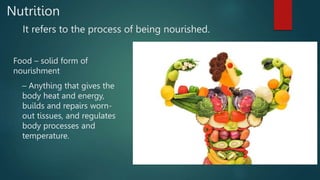
Nutrition
It refers to the process of being nourished.
Food – solid form of
nourishment
– Anything that gives the
body heat and energy,
builds and repairs worn-
out tissues, and regulates
body processes and
temperature.
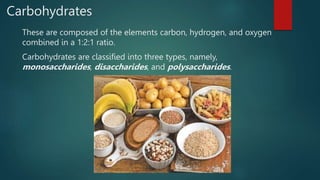
Carbohydrates
These are composed of the elements carbon, hydrogen, and oxygen
combined in a 1:2:1 ratio.
Carbohydrates are classified into three types, namely,
monosaccharides, disaccharides, and polysaccharides.
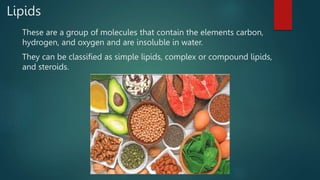
Lipids
These are a group of molecules that contain the elements carbon,
hydrogen, and oxygen and are insoluble in water.
They can be classified as simple lipids, complex or compound lipids,
and steroids.
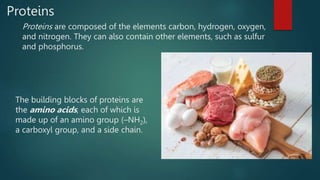
Proteins
Proteins are composed of the elements carbon, hydrogen, oxygen,
and nitrogen. They can also contain other elements, such as sulfur
and phosphorus.
The building blocks of proteins are
the amino acids, each of which is
made up of an amino group (–NH2),
a carboxyl group, and a side chain.
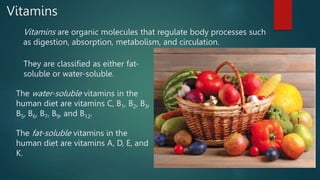
Vitamins
Vitamins are organic molecules that regulate body processes such
as digestion, absorption, metabolism, and circulation.
They are classified as either fat-
soluble or water-soluble.
The water-soluble vitamins in the
human diet are vitamins C, B1, B2, B3,
B5, B6, B7, B9, and B12.
The fat-soluble vitamins in the
human diet are vitamins A, D, E, and
K.
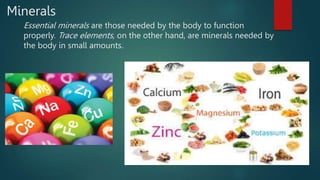
Minerals
Essential minerals are those needed by the body to function
properly. Trace elements, on the other hand, are minerals needed by
the body in small amounts.
Wellness
It is the state of being healthy.
The World Health Organization (WHO) refers to health as not merely the
absence of a disease or infirmity, but the complete physical, mental,
emotional, and social well-being of a person.
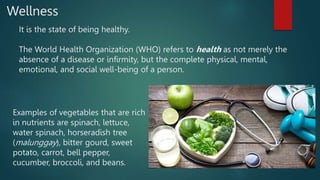
Examples of vegetables that are rich
in nutrients are spinach, lettuce,
water spinach, horseradish tree
(malunggay), bitter gourd, sweet
potato, carrot, bell pepper,
cucumber, broccoli, and beans.
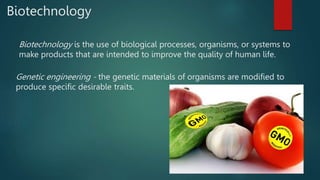
Biotechnology
Biotechnology is the use of biological processes, organisms, or systems to
make products that are intended to improve the quality of human life.
Genetic engineering - the genetic materials of organisms are modified to
produce specific desirable traits.
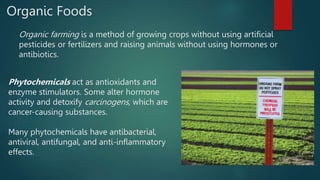
Organic Foods
Organic farming is a method of growing crops without using artificial
pesticides or fertilizers and raising animals without using hormones or
antibiotics.
Phytochemicals act as antioxidants and
enzyme stimulators. Some alter hormone
activity and detoxify carcinogens, which are
cancer-causing substances.
Many phytochemicals have antibacterial,
antiviral, antifungal, and anti-inflammatory
effects.
QUIZ na!!!

Contemporary Health Issues.pptx

  • 1.
  • 2.
    Nutrition It refers tothe process of being nourished. Food – solid form of nourishment – Anything that gives the body heat and energy, builds and repairs worn- out tissues, and regulates body processes and temperature.
  • 3.
    Carbohydrates These are composedof the elements carbon, hydrogen, and oxygen combined in a 1:2:1 ratio. Carbohydrates are classified into three types, namely, monosaccharides, disaccharides, and polysaccharides.
  • 4.
    Lipids These are agroup of molecules that contain the elements carbon, hydrogen, and oxygen and are insoluble in water. They can be classified as simple lipids, complex or compound lipids, and steroids.
  • 5.
    Proteins Proteins are composedof the elements carbon, hydrogen, oxygen, and nitrogen. They can also contain other elements, such as sulfur and phosphorus. The building blocks of proteins are the amino acids, each of which is made up of an amino group (–NH2), a carboxyl group, and a side chain.
  • 6.
    Vitamins Vitamins are organicmolecules that regulate body processes such as digestion, absorption, metabolism, and circulation. They are classified as either fat- soluble or water-soluble. The water-soluble vitamins in the human diet are vitamins C, B1, B2, B3, B5, B6, B7, B9, and B12. The fat-soluble vitamins in the human diet are vitamins A, D, E, and K.
  • 7.
    Minerals Essential minerals arethose needed by the body to function properly. Trace elements, on the other hand, are minerals needed by the body in small amounts.
  • 8.
    Wellness It is thestate of being healthy. The World Health Organization (WHO) refers to health as not merely the absence of a disease or infirmity, but the complete physical, mental, emotional, and social well-being of a person. Examples of vegetables that are rich in nutrients are spinach, lettuce, water spinach, horseradish tree (malunggay), bitter gourd, sweet potato, carrot, bell pepper, cucumber, broccoli, and beans.
  • 9.
    Biotechnology Biotechnology is theuse of biological processes, organisms, or systems to make products that are intended to improve the quality of human life. Genetic engineering - the genetic materials of organisms are modified to produce specific desirable traits.
  • 10.
    Organic Foods Organic farmingis a method of growing crops without using artificial pesticides or fertilizers and raising animals without using hormones or antibiotics. Phytochemicals act as antioxidants and enzyme stimulators. Some alter hormone activity and detoxify carcinogens, which are cancer-causing substances. Many phytochemicals have antibacterial, antiviral, antifungal, and anti-inflammatory effects.
  • 11.

Editor's Notes

  • #4 Monosaccharides are simple sugars with the formula (CH2O)n, where n is 3 or greater. Examples of monosaccharides are glucose, galactose, and fructose.  Disaccharides are composed of two monosaccharides. Examples of disaccharides are sucrose, maltose, and lactose. Polysaccharides are complex sugars with the formula (C6H10O5)n, where n is between 40 and 3000. Examples of polysaccharides are starch, glycogen, and cellulose. Starch is a plant carbohydrate reserve made of the polysaccharides amylose and amylopectin.  Glycogen is the energy storage molecule in animal tissues that provides the body with readily available energy when levels of blood glucose decrease.  Cellulose is the fibrous structural material that gives plant cells strength and rigidity.
  • #5 Simple lipids contain glycerol and fatty acids. Complex or compound lipids are simple lipids that are combined with other substances. Phospholipids in the cell membranes of animal cells are examples of complex or compound lipids. Steroids are lipids that contain fused rings in their structure. Examples are hormones, bile acids, and cholesterol. Lipids function as fuel reserves and insulators and are important constituents of living cells
  • #6 The main functions of proteins are for growth and repair of muscles and other tissues. 
  • #7 Table 10.1 and 10.2 of your textbook pages 267-268 list down the water and fat soluble vitamins
  • #8 Table 10.1 and 10.2 of your textbook pages 267-268 list down the water and fat soluble vitamins
  • #9 Whole-grain foods such as brown rice and corn are also beneficial to the digestive system because of their high fiber content. The body should also be kept hydrated by drinking sufficient amounts of water. Eating on time should also be practiced.
  • #10 Whole-grain foods such as brown rice and corn are also beneficial to the digestive system because of their high fiber content. The body should also be kept hydrated by drinking sufficient amounts of water. Eating on time should also be practiced.
  • #11 Whole-grain foods such as brown rice and corn are also beneficial to the digestive system because of their high fiber content. The body should also be kept hydrated by drinking sufficient amounts of water. Eating on time should also be practiced.