4. Provision forcollaborative, as well as individual activities (so
children can learn from each other).The classroom teacher acts as a
learning guide who manages the activities and directs student learning but
who does this through activities that require students’ engagement in a
variety of ways – perhaps working in groups, or in teams, by pairs or
focusing independently at different times.
5. The teacher must encourage students to discuss, reflect, analyze,
understand and create things. Teachers must facilitate students by asking
queries, questions, and posing problems to solve; they must stimulate
students thinking by providing them with situations to create something ;
they should listen to them carefully as well as observing them minutely
and then trying to suggest new ways to learn better.
Piaget emphasized teaching through discovery, the learner is
challenged to use his abilities and concrete experiences. According to
Piaget, ideas and concepts cannot be communicated directly from
teacher to learner. Instead, the learner must construct his or her own
knowledge system that is derived from concrete experience. Piaget
viewed the teacher’s role essentially as a facilitative one and the teacher
must not be coercive or authoritative. (Semmar & Al-Thani, 2015).
3.
LEV VYGOTSKY Theoryon Language and Zone of
Proximal Development
Lev Vygotsky's theory of language development focused
on social learning and the zone of proximal development
(ZPD). The ZPD is a level of development obtained when
children engage in social interactions with others; it is the
distance between a child's potential to learn and the
actual learning that takes place.
4.
ZONE OF PROXIMALDEVELOPMENT (ZPD)
The zone of proximal development is a concept that was created by
influential psychologist Lev Vygotsky. According to him, the Zone of
Proximal Development is: "The distance between the actual
development level as determined by independent problem solving
and the level of potential development as determined through
problem-solving under adult guidance or in collaboration with more
capable peers." (Vygotsky, 1935). In the ZPD we have to consider the
Upper Limit which defines the level of additional responsibility the
child can accept with assistance of an able instructor and the Lower
Limit which is the level of problem solving reached on different tasks
by the child working alone. There are a few essential factors that are
critical to the success of this learning process:
The presence of someone with the knowledge and skills to guide the learner (‘more
knowledgeable other”)
Scaffolding, or supportive activities provided by the mentor or teacher that help
guide the learner through the ZPD
Social interactions that allow the learner to observe and practice their skills
5.
The "MoreKnowledgeable Other"
The concept of the "more knowledgeable other" is quite
simple and fairly self-explanatory. The more knowledgeable
other is someone who has a higher level of knowledge than
the learner. It is the more knowledgeable other who provides
critical guidance and instruction during the sensitive learning
period. While a child might not yet be capable of doing
something on their own, they are able to perform the task
with the assistance of a skilled instructor.
6.
Scaffolding
When childrenare in this zone of proximal development,
providing them with the appropriate assistance and tools
gives students what they need to accomplish the new task
or skill. These activities, instructions, tools, and resources
are known as scaffolding. Eventually, the scaffolding can
be removed and the student will be able to complete the
task independently. While scaffolding is now almost
synonymous with the zone of proximal development, it is
not a concept that was initially introduced by Vygotsky.
Instead, this component has been put forth by other
researchers who have expanded upon the original
theories.
7.
Social Interaction
This more knowledgeable other is often a parent, teacher, or
another adult, but this is not always the case. In many
instances, peers provide valuable assistance and instruction.
During certain periods of a child's life, they may even look to
peers more than they look to adults. The teen years, when
forming an identity and fitting in is so critical, is just one
example. Kids at this age often look to their peers for
information about how to act and how to dress. Vygotsky
believed that peer interaction was an essential part of the
learning process. In order for children to learn new skills, he
suggested pairing more competent students with less skilled
ones.
8.
Vygotsky’s OverallTeaching
Recommendations
Assess child’s Zone of Proximal Development
Provide just enough assistance
Use more skilled peers as teachers
Encourage private speech, self-regulation
9.
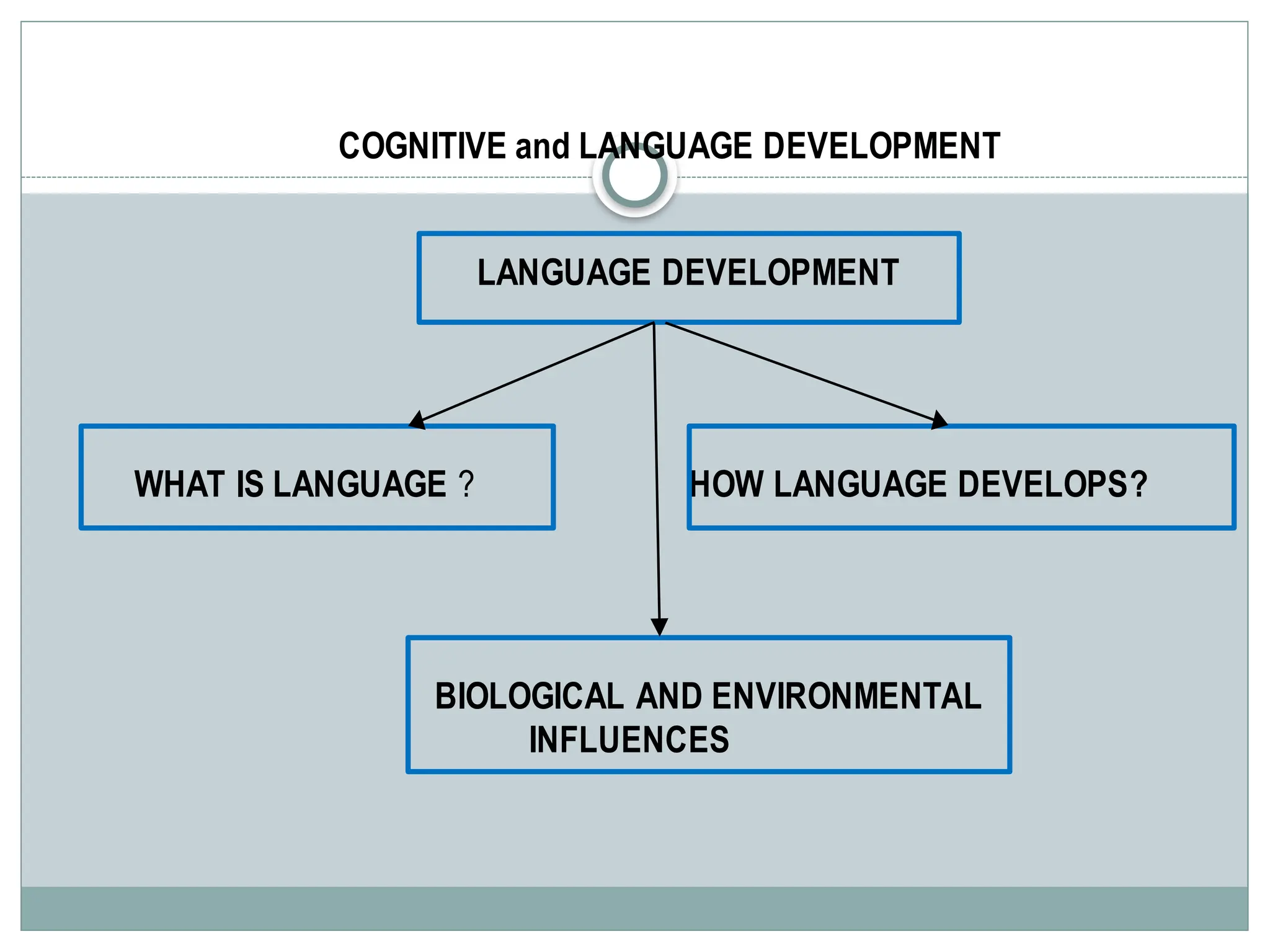
COGNITIVE and LANGUAGEDEVELOPMENT
LANGUAGE DEVELOPMENT
WHAT IS LANGUAGE ? HOW LANGUAGE DEVELOPS?
BIOLOGICAL AND ENVIRONMENTAL
INFLUENCES
10.
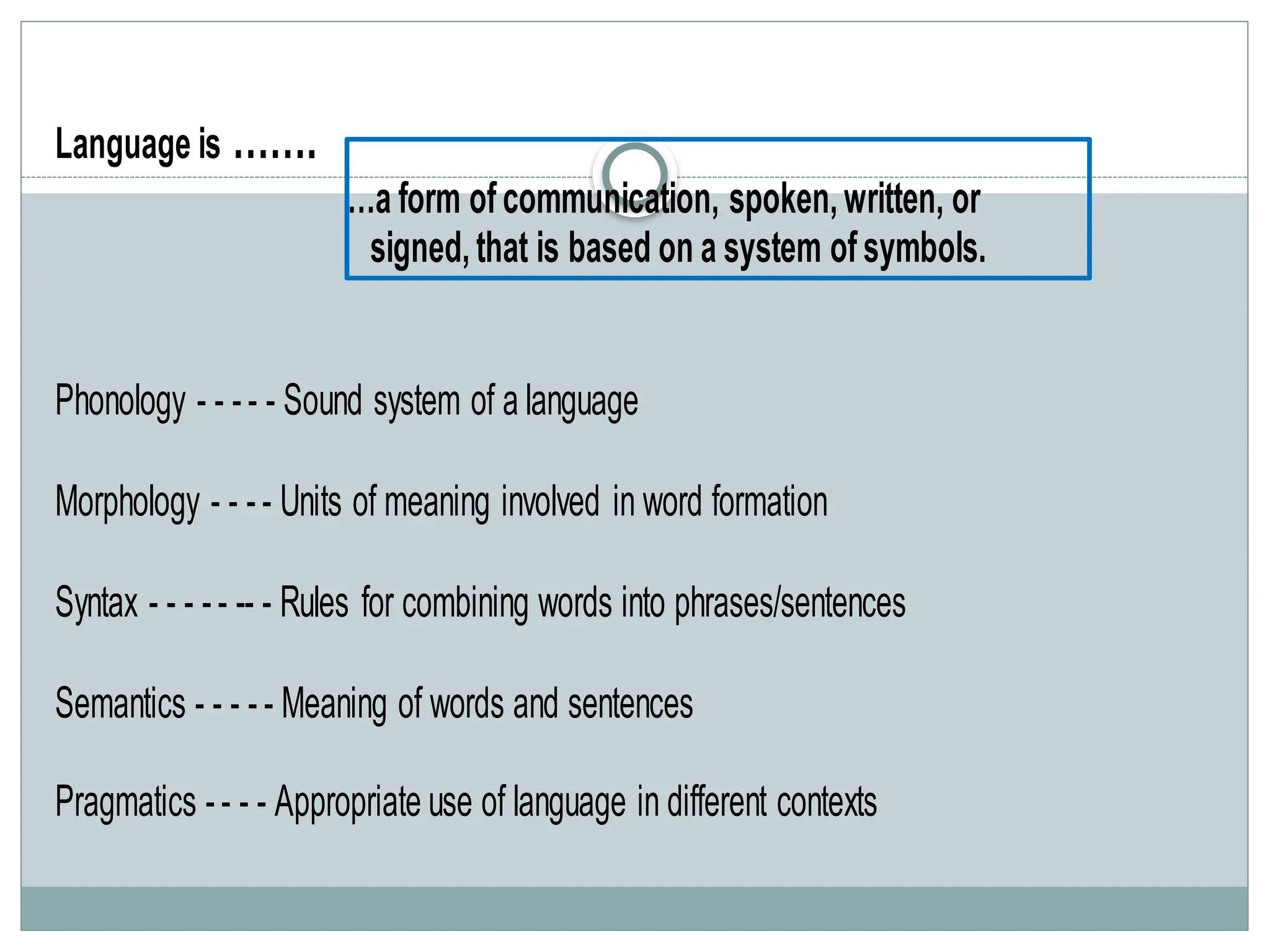
Language is …….
…aform ofcommunication, spoken,written, or
signed,that is based on a system ofsymbols.
Phonology - - -- - Sound system of a language
Morphology - - -- Units of meaning involved in word formation
Syntax - - - -- -- - Rules for combining words into phrases/sentences
Semantics - - - -- Meaning of words and sentences
Pragmatics -- - - Appropriate use of language in different contexts
11.
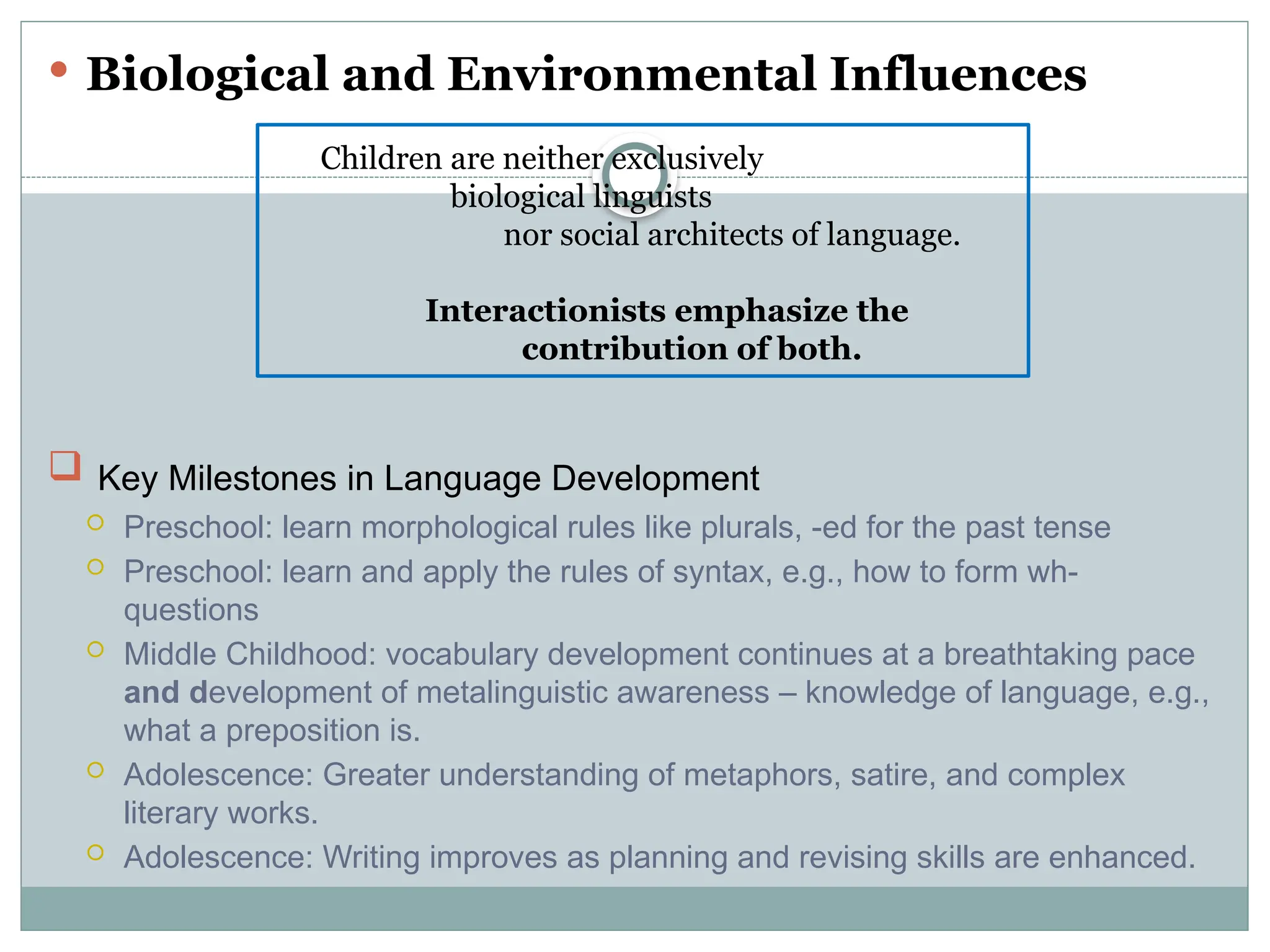
Biological andEnvironmental Influences
Key Milestones in Language Development
Preschool: learn morphological rules like plurals, -ed for the past tense
Preschool: learn and apply the rules of syntax, e.g., how to form wh-
questions
Middle Childhood: vocabulary development continues at a breathtaking pace
and development of metalinguistic awareness – knowledge of language, e.g.,
what a preposition is.
Adolescence: Greater understanding of metaphors, satire, and complex
literary works.
Adolescence: Writing improves as planning and revising skills are enhanced.
Children are neither exclusively
biological linguists
nor social architects of language.
Interactionists emphasize the
contribution of both.
12.
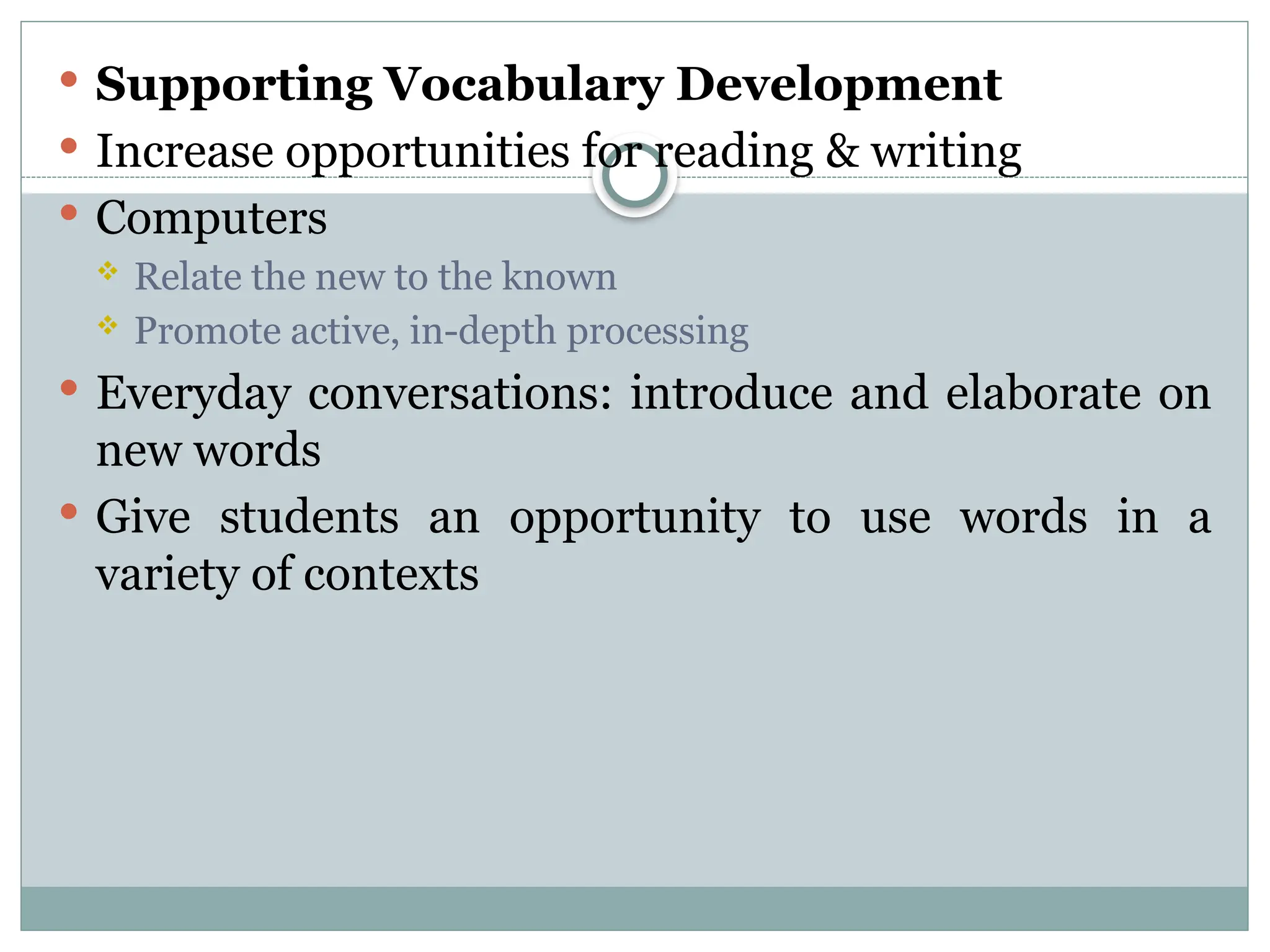
Supporting VocabularyDevelopment
Increase opportunities for reading & writing
Computers
Relate the new to the known
Promote active, in-depth processing
Everyday conversations: introduce and elaborate on
new words
Give students an opportunity to use words in a
variety of contexts
13.
LAWRENCE KOHLBERGLevels and Sub-
Stages of Moral Development
Lawrence Kohlberg (1958) agreed with Piaget's
(1932) theory of moral development in principle but
wanted to develop his ideas further. He used
Piaget’s storytelling technique to tell people stories
involving moral dilemmas. In each case, he
presented a choice to be considered, for example,
between the rights of some authority and the needs
of some deserving individual who is being unfairly
treated. One of the best known of Kohlberg’s (1958)
stories concerns a man called Heinz who lived
somewhere in Europe.
14.
Kohlberg's Stages ofMoral Development
Level 1 - Pre-conventional morality
At the pre-conventional level (most nine-year-olds and
younger, some over nine), we don’t have a personal code of
morality. Instead, our moral code is shaped by the standards of
adults and the consequences of following or breaking their
rules. Authority is outside the individual and reasoning is based
on the physical consequences of actions.
• Stage 1. Obedience and Punishment Orientation. The child/individual
is good in order to avoid being punished. If a person is punished, they
must have done wrong.
In the earliest stage of moral development, obedience, and punishment is
especially common in young children. At this stage, Kohlberg says,
children see rules as fixed and absolute (Cherry, 2018). The child
assumes that powerful authorities laid down a fixed set of rules which he
or she must follow and obey (Crain, 1985).
15.
Stage 2.Individualism and Exchange. At this stage,
children recognize that there is not just one right view that
is handed down by the authorities. Different individuals
have different viewpoints. They account for individual
points of view and judge actions based on how they serve
individual needs. It also focuses on self-reward. Moral
decisions in this stage are based on getting a reward that
is personally meaningful. For example, a child may think,
'I want a new dress, so I will help mom wash the dishes.’
Reciprocity is possible at this point in moral development,
but only if it serves one's own interests.
16.
Level 2- Conventional morality
At the conventional level (most adolescents and adults), we
begin to internalize the moral standards of valued adult role
models. Authority is internalized but not questioned, and
reasoning is based on the norms of the group to which the
person belongs. The emphasis is more on parental rules and
societal laws. Individuals base their decisions on what their
parents, authorities and/or law enforcers say is right.
Authority is internalized but not questioned, and reasoning is
based on the norms of the group to which the person belongs.
17.
Stage 3.Good Interpersonal Relationships
The child/individual is good in order to be seen as being a good person by others
(Niekerk, 2014). Therefore, answers relate to the approval of others. For example, a
student may think, 'Students who cheat on tests are bad, so I will not cheat.' During this
stage, children are entering their teensee morality as more than simple deals. They
believe that people should live up to the expectations of the family and society and
behave in "good" ways. Good behavior means having good motives and interpersonal
feelings such as love, empathy, trust, and concern for others.(Crain, 1985). Another
example, a child gives away her lunch to one of the street children because she thinks
doing so means being nice.
Stage 4. Maintaining the Social Order.
Niekerk (2014) noted that the individual is becoming more concerned with
society as a whole as well as with how important it is to maintain the social
order. This stage speaks about the rule, the law and order for everyone. The
individual is concerned about obeying the rules in order to uphold the law and to
avoid guilt (McLeod, 2013; Corpuz et.al. 2013). For example, someone may
think, “If I steal, I will break the law and breaking the law is wrong.”
18.
Level 3- Post-conventional morality
Individual judgment is based on self-chosen principles, and
moral reasoning is based on individual rights and justice.
According to Kohlberg this level of moral reasoning is as far as
most people get. Only 10-15% are capable of the kind of
abstract thinking necessary for stage 5 or 6 (post-conventional
morality). That is to say, most people take their moral views
from those around them and only a minority think through
ethical principles for themselves.
19.
Stage 4.Maintaining the Social Order.
Niekerk (2014) noted that the individual is becoming more
concerned with society as a whole as well as with how
important it is to maintain the social order. This stage speaks
about the rule, the law and order for everyone. The individual is
concerned about obeying the rules in order to uphold the law
and to avoid guilt (McLeod, 2013; Corpuz et.al. 2013). For
example, someone may think, “If I steal, I will break the law
and breaking the law is wrong.”
• Stage 5. Social Contract and Individual Rights.
The child/individual becomes aware that while rules/laws might
exist for the good of the greatest number, there are times when
they will work against the interest of particular individuals The
issues are not always clear-cut. For example, in Heinz’s dilemma,
the protection of life is more important than breaking the law
against stealing.
20.
• Stage6. Universal Principles. People at this stage have
developed their own set of moral guidelines which may or may
not fit the law (.(Sincero, 2012). The principles apply to
everyone. E.g.,human rights, justice, and equality. The person
will be prepared to act to defend these principles even if it means
going against the rest of society in the process and having to pay
the consequences of disapproval and or imprisonment. Kohlberg
doubted few people reached this stage.
Cherry (2018) stressed that Kohlberg’s final level of moral
reasoning is based on universal ethical principles and abstract
reasoning. At this stage, people follow these internalized
principles of justice, even if they conflict with laws and rules.
21.
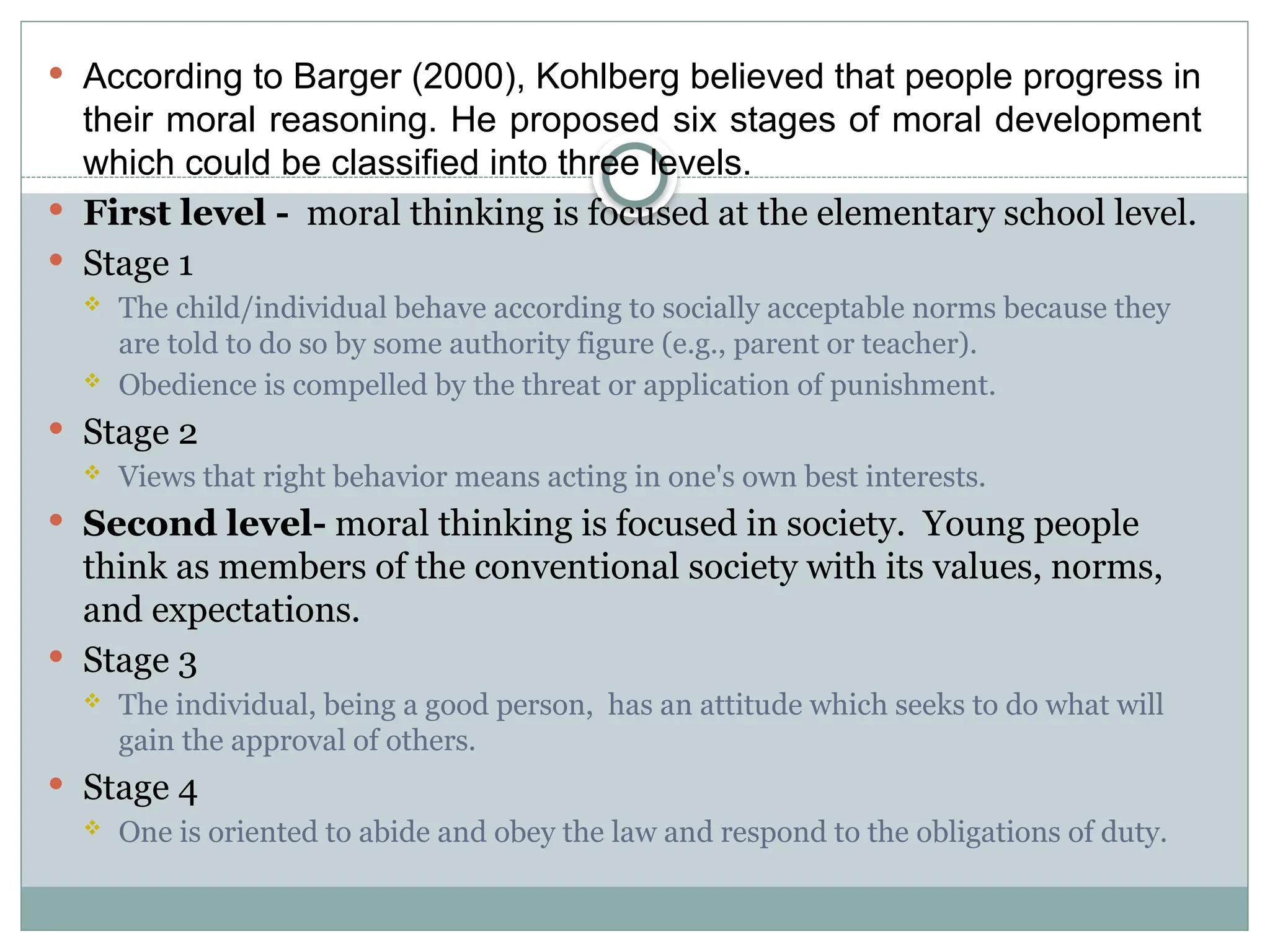
According toBarger (2000), Kohlberg believed that people progress in
their moral reasoning. He proposed six stages of moral development
which could be classified into three levels.
First level - moral thinking is focused at the elementary school level.
Stage 1
The child/individual behave according to socially acceptable norms because they
are told to do so by some authority figure (e.g., parent or teacher).
Obedience is compelled by the threat or application of punishment.
Stage 2
Views that right behavior means acting in one's own best interests.
Second level- moral thinking is focused in society. Young people
think as members of the conventional society with its values, norms,
and expectations.
Stage 3
The individual, being a good person, has an attitude which seeks to do what will
gain the approval of others.
Stage 4
One is oriented to abide and obey the law and respond to the obligations of duty.
22.
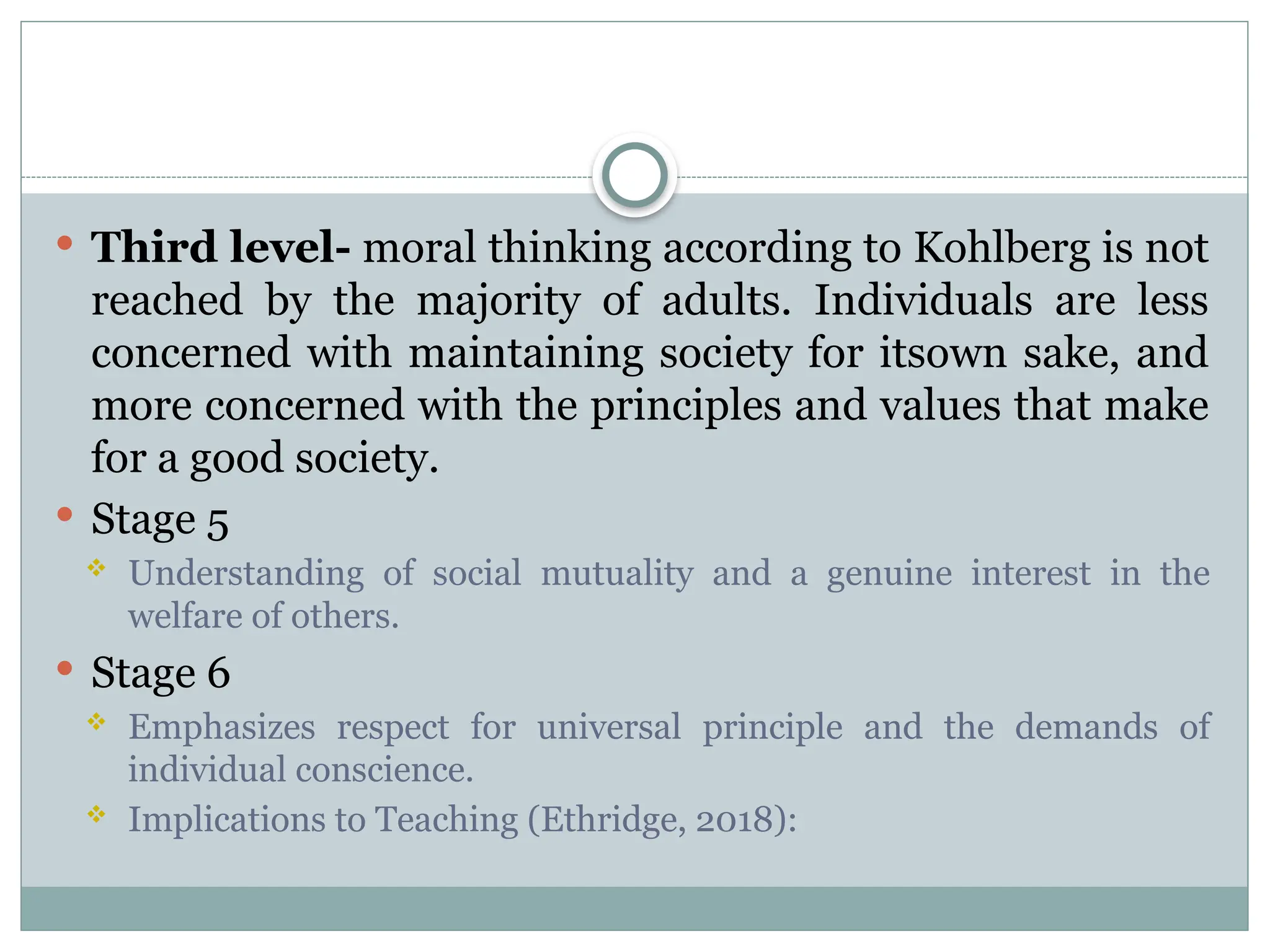
Third level-moral thinking according to Kohlberg is not
reached by the majority of adults. Individuals are less
concerned with maintaining society for itsown sake, and
more concerned with the principles and values that make
for a good society.
Stage 5
Understanding of social mutuality and a genuine interest in the
welfare of others.
Stage 6
Emphasizes respect for universal principle and the demands of
individual conscience.
Implications to Teaching (Ethridge, 2018):
23.
During stageone, children behave in order not to be
punished. At stage two, they become good boys and girls
to earn rewards. By stage three, children begin thinking
about the welfare of other people and caring about their
expectations. So, teachers should give students the
opportunity to help create a classroom code of conduct.
Through this, they will become responsible for the rules
that they set and follow them accordingly, rather than
blindly agreeing to standards set by school administrators
or other authorities. Some of the activities that may be
given to the learners are as follows:
24.
1. • Providegroup projects where students work together toward the
understanding of curriculum instead of sitting back and listening to the
teacher talk at them. Group activities encourage engagement.
2. • Give the students opportunities to hear different perspectives
especially in deciding what is right or wrong. Have discussions, forums,
debates, etc. about certain issues. This will be more meaningful if the
issues are related to the students' lives (Losabia, 2010).
3. • Discuss issues in a multicultural or global perspective. Present them
how are certain issues tackled in other cultures. Through this, students
can widen their understanding and learn to respect different views and
beliefs.
4. • Be an example to the students. We must walk our talk so to speak.
Values are caught than taught. So as teachers, we must present values
and attitudes worth emulating.