Constructive Cost Model
(COCOMO Model)
Presented By:-
Rishabh Singh
Course: B.Tech(C.S.E.)
Section:CS37
Roll. NO.: 1210432262
Constructive Cost Model
 Cocomo model was proposed by Barry Boehm in 1981.
Cocomo model is the most widely used software cost estimation
model.
Cocomo model is a regression based model , used for reliably
predicting the parameters associated with making a project such as
effort , cost , team size.
This model provides the value of parameters based on LOC i.e. number
of lines of code and various cost drivers.
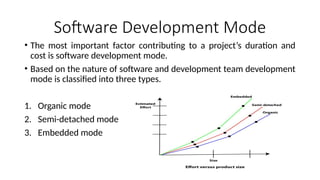
Software Development Mode
• The most important factor contributing to a project’s duration and
cost is software development mode.
• Based on the nature of software and development team development
mode is classified into three types.
1. Organic mode
2. Semi-detached mode
3. Embedded mode
Organic Mode
• Project team is small and have to work in familiar environment.
• Well understood application programs or similar to previously developed
programs are developed.
• Little innovation required.
• Only few constraints and deadline is not too strict.
Example:- Software for library management system.
Semi-detached mode
• Project team consist of mixture of experienced and inexperienced staff.
• Software of medium complexity are developed.
• Some creativity and innovation is required.
• Some constraints and deadline is moderate.
Example:- development of compiler system.
Embedded mode
• The software is strongly coupled with hardware.
• Team size is large.
• High level of creativity and innovation is required.
• Strict constraint and deadline.
Example:- ATM machine software
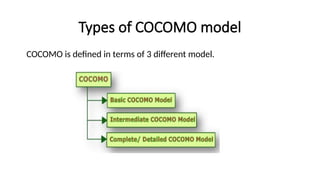
Types of COCOMO model
COCOMO is defined in terms of 3 different model.
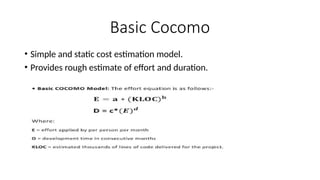
Basic Cocomo
• Simple and static cost estimation model.
• Provides rough estimate of effort and duration.
Continued…
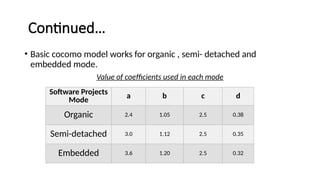
• Basic cocomo model works for organic , semi- detached and
embedded mode.
Value of coefficients used in each mode
Software Projects
Mode
a b c d
Organic 2.4 1.05 2.5 0.38
Semi-detached 3.0 1.12 2.5 0.35
Embedded 3.6 1.20 2.5 0.32
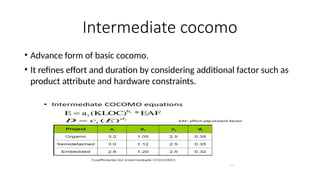
Intermediate cocomo
• Advance form of basic cocomo.
• It refines effort and duration by considering additional factor such as
product attribute and hardware constraints.
Detailed cocomo
• It is the most accurate model which divide whole project into multiple
modules.
• Estimates effort and duration for each module using intermediate
cocomo model and sums them up.
• It consider software reuse , hardware constraints in cost estimation.
• It is used in large project where high cost is involved.
Advantage of cocomo model
• Provides systematic way to estimate effort and cost.
• Helps in evaluating the feasibility of a software by estimating cost and
effort.
• Helps in identifying the factors which have greater impact on cost and
effort in software project.
Disadvantage of cocomo model
• It does not estimate precise result because it is based on assumptions
and averages.
• It uses size of software as the main factor for estimating effort and
cost , which may not always be the case.
THANK YOU

Constructive Cost Model.pptx presentation for software Engineering

  • 1.
    Constructive Cost Model (COCOMOModel) Presented By:- Rishabh Singh Course: B.Tech(C.S.E.) Section:CS37 Roll. NO.: 1210432262
  • 2.
    Constructive Cost Model Cocomo model was proposed by Barry Boehm in 1981. Cocomo model is the most widely used software cost estimation model. Cocomo model is a regression based model , used for reliably predicting the parameters associated with making a project such as effort , cost , team size. This model provides the value of parameters based on LOC i.e. number of lines of code and various cost drivers.
  • 3.
    Software Development Mode •The most important factor contributing to a project’s duration and cost is software development mode. • Based on the nature of software and development team development mode is classified into three types. 1. Organic mode 2. Semi-detached mode 3. Embedded mode
  • 4.
    Organic Mode • Projectteam is small and have to work in familiar environment. • Well understood application programs or similar to previously developed programs are developed. • Little innovation required. • Only few constraints and deadline is not too strict. Example:- Software for library management system.
  • 5.
    Semi-detached mode • Projectteam consist of mixture of experienced and inexperienced staff. • Software of medium complexity are developed. • Some creativity and innovation is required. • Some constraints and deadline is moderate. Example:- development of compiler system.
  • 6.
    Embedded mode • Thesoftware is strongly coupled with hardware. • Team size is large. • High level of creativity and innovation is required. • Strict constraint and deadline. Example:- ATM machine software
  • 7.
    Types of COCOMOmodel COCOMO is defined in terms of 3 different model.
  • 8.
    Basic Cocomo • Simpleand static cost estimation model. • Provides rough estimate of effort and duration.
  • 9.
    Continued… • Basic cocomomodel works for organic , semi- detached and embedded mode. Value of coefficients used in each mode Software Projects Mode a b c d Organic 2.4 1.05 2.5 0.38 Semi-detached 3.0 1.12 2.5 0.35 Embedded 3.6 1.20 2.5 0.32
  • 10.
    Intermediate cocomo • Advanceform of basic cocomo. • It refines effort and duration by considering additional factor such as product attribute and hardware constraints.
  • 11.
    Detailed cocomo • Itis the most accurate model which divide whole project into multiple modules. • Estimates effort and duration for each module using intermediate cocomo model and sums them up. • It consider software reuse , hardware constraints in cost estimation. • It is used in large project where high cost is involved.
  • 12.
    Advantage of cocomomodel • Provides systematic way to estimate effort and cost. • Helps in evaluating the feasibility of a software by estimating cost and effort. • Helps in identifying the factors which have greater impact on cost and effort in software project.
  • 13.
    Disadvantage of cocomomodel • It does not estimate precise result because it is based on assumptions and averages. • It uses size of software as the main factor for estimating effort and cost , which may not always be the case.
  • 14.