



Benin
Constitution
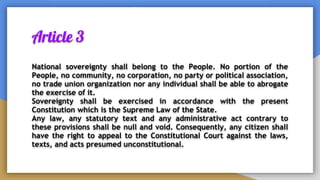
Article 3
National sovereignty shall belong to the People. No portion of the
People, no community, no corporation, no party or political association,
no trade union organization nor any individual shall be able to abrogate
the exercise of it.
Sovereignty shall be exercised in accordance with the present
Constitution which is the Supreme Law of the State.
Any law, any statutory text and any administrative act contrary to
these provisions shall be null and void. Consequently, any citizen shall
have the right to appeal to the Constitutional Court against the laws,
texts, and acts presumed unconstitutional.
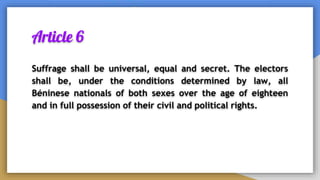
Article 6
Suffrage shall be universal, equal and secret. The electors
shall be, under the conditions determined by law, all
Béninese nationals of both sexes over the age of eighteen
and in full possession of their civil and political rights.
Article 10
Every person has a right to culture. The State has the duty to
safeguard and promote the national values of civilizations, as
much material as spiritual, as well as the cultural traditions.
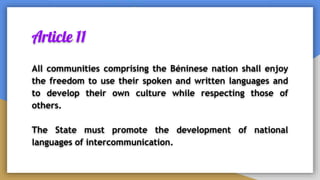
Article 11
All communities comprising the Béninese nation shall enjoy
the freedom to use their spoken and written languages and
to develop their own culture while respecting those of
others.
The State must promote the development of national
languages of intercommunication.
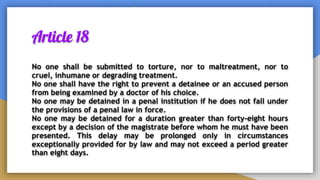
Article 18
No one shall be submitted to torture, nor to maltreatment, nor to
cruel, inhumane or degrading treatment.
No one shall have the right to prevent a detainee or an accused person
from being examined by a doctor of his choice.
No one may be detained in a penal institution if he does not fall under
the provisions of a penal law in force.
No one may be detained for a duration greater than forty-eight hours
except by a decision of the magistrate before whom he must have been
presented. This delay may be prolonged only in circumstances
exceptionally provided for by law and may not exceed a period greater
than eight days.
Article 28
The storage, handling, and removal of toxic wastes or
pollutants originating from factories and other industrial or
cottage industry units installed in the national territory shall
be regulated by law.
Article 29
The transportation, importation, storage, burying and the
discharging on the national territory of toxic wastes or
foreign pollutants and any agreement relating to it shall
constitute a crime against the Nation. The applicable
sanctions shall be defined by law.
Article 34
Each Béninese citizen, civilian or military, has the sacred
duty to respect, in all circumstances, the Constitution and
the established constitutional order as well as the laws and
regulations of the Republic.
Article 35
Citizens responsible for a public office or elected to a
political office have the duty to fulfil it with conscience,
competence, probity, devotion, and loyalty in the interest of
the common good.
Article 42
The President of the Republic shall be elected by direct
universal suffrage for a mandate of five years, renewable
only one time.
In any case, no one shall be able to exercise more than two
presidential mandates.
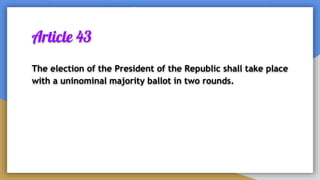
Article 43
The election of the President of the Republic shall take place
with a uninominal majority ballot in two rounds.
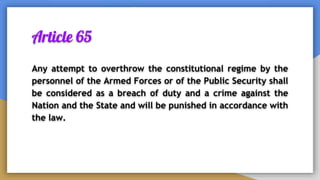
Article 65
Any attempt to overthrow the constitutional regime by the
personnel of the Armed Forces or of the Public Security shall
be considered as a breach of duty and a crime against the
Nation and the State and will be punished in accordance with
the law.
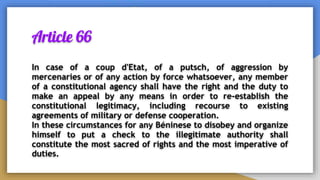
Article 66
In case of a coup d'Etat, of a putsch, of aggression by
mercenaries or of any action by force whatsoever, any member
of a constitutional agency shall have the right and the duty to
make an appeal by any means in order to re-establish the
constitutional legitimacy, including recourse to existing
agreements of military or defense cooperation.
In these circumstances for any Béninese to disobey and organize
himself to put a check to the illegitimate authority shall
constitute the most sacred of rights and the most imperative of
duties.
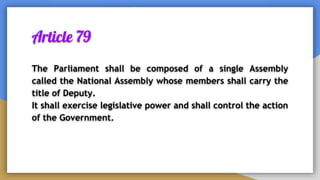
Article 79
The Parliament shall be composed of a single Assembly
called the National Assembly whose members shall carry the
title of Deputy.
It shall exercise legislative power and shall control the action
of the Government.
Article 80
The Deputies shall be elected by direct universal suffrage.
The duration of the mandate shall be four years. They may
be re-elected. Each Deputy shall be the representative of
the entire nation and any compulsory vote shall be void.
Article 86 (Part of it)
The entire report of the debates of the National Assembly
shall be published in the Official Journal.
Article 93
The right to vote of the Deputies shall be personal. The
Rules of Procedure of the National Assembly may authorize
in exceptional cases the delegation of a vote. In this
instance, no one may receive the delegation for more than
one term of office.
Dunilefra
www.dunilefra.com

Constitution of Benin

  • 1.
  • 2.
    Article 3 National sovereigntyshall belong to the People. No portion of the People, no community, no corporation, no party or political association, no trade union organization nor any individual shall be able to abrogate the exercise of it. Sovereignty shall be exercised in accordance with the present Constitution which is the Supreme Law of the State. Any law, any statutory text and any administrative act contrary to these provisions shall be null and void. Consequently, any citizen shall have the right to appeal to the Constitutional Court against the laws, texts, and acts presumed unconstitutional.
  • 3.
    Article 6 Suffrage shallbe universal, equal and secret. The electors shall be, under the conditions determined by law, all Béninese nationals of both sexes over the age of eighteen and in full possession of their civil and political rights.
  • 4.
    Article 10 Every personhas a right to culture. The State has the duty to safeguard and promote the national values of civilizations, as much material as spiritual, as well as the cultural traditions.
  • 5.
    Article 11 All communitiescomprising the Béninese nation shall enjoy the freedom to use their spoken and written languages and to develop their own culture while respecting those of others. The State must promote the development of national languages of intercommunication.
  • 6.
    Article 18 No oneshall be submitted to torture, nor to maltreatment, nor to cruel, inhumane or degrading treatment. No one shall have the right to prevent a detainee or an accused person from being examined by a doctor of his choice. No one may be detained in a penal institution if he does not fall under the provisions of a penal law in force. No one may be detained for a duration greater than forty-eight hours except by a decision of the magistrate before whom he must have been presented. This delay may be prolonged only in circumstances exceptionally provided for by law and may not exceed a period greater than eight days.
  • 7.
    Article 28 The storage,handling, and removal of toxic wastes or pollutants originating from factories and other industrial or cottage industry units installed in the national territory shall be regulated by law.
  • 8.
    Article 29 The transportation,importation, storage, burying and the discharging on the national territory of toxic wastes or foreign pollutants and any agreement relating to it shall constitute a crime against the Nation. The applicable sanctions shall be defined by law.
  • 9.
    Article 34 Each Béninesecitizen, civilian or military, has the sacred duty to respect, in all circumstances, the Constitution and the established constitutional order as well as the laws and regulations of the Republic.
  • 10.
    Article 35 Citizens responsiblefor a public office or elected to a political office have the duty to fulfil it with conscience, competence, probity, devotion, and loyalty in the interest of the common good.
  • 11.
    Article 42 The Presidentof the Republic shall be elected by direct universal suffrage for a mandate of five years, renewable only one time. In any case, no one shall be able to exercise more than two presidential mandates.
  • 12.
    Article 43 The electionof the President of the Republic shall take place with a uninominal majority ballot in two rounds.
  • 13.
    Article 65 Any attemptto overthrow the constitutional regime by the personnel of the Armed Forces or of the Public Security shall be considered as a breach of duty and a crime against the Nation and the State and will be punished in accordance with the law.
  • 14.
    Article 66 In caseof a coup d'Etat, of a putsch, of aggression by mercenaries or of any action by force whatsoever, any member of a constitutional agency shall have the right and the duty to make an appeal by any means in order to re-establish the constitutional legitimacy, including recourse to existing agreements of military or defense cooperation. In these circumstances for any Béninese to disobey and organize himself to put a check to the illegitimate authority shall constitute the most sacred of rights and the most imperative of duties.
  • 15.
    Article 79 The Parliamentshall be composed of a single Assembly called the National Assembly whose members shall carry the title of Deputy. It shall exercise legislative power and shall control the action of the Government.
  • 16.
    Article 80 The Deputiesshall be elected by direct universal suffrage. The duration of the mandate shall be four years. They may be re-elected. Each Deputy shall be the representative of the entire nation and any compulsory vote shall be void.
  • 17.
    Article 86 (Partof it) The entire report of the debates of the National Assembly shall be published in the Official Journal.
  • 18.
    Article 93 The rightto vote of the Deputies shall be personal. The Rules of Procedure of the National Assembly may authorize in exceptional cases the delegation of a vote. In this instance, no one may receive the delegation for more than one term of office.
  • 19.