





Cyprus
Constitution
Article 10
1. No person shall be held in slavery or servitude.
2. No person shall be required to perform forced or
compulsory labour.
3. For the purposes of this Article the term "forced or
compulsory labour" shall not include-
1. any work required to be done in the ordinary course of
detention imposed according to the provisions of Article 1I or
during conditional release from such detention;
Article 10
2. any service of a military character if imposed or, in case of
conscientious objectors, subject to their recognition by a law,
service exacted instead of compulsory military service;
3. any service exacted in case of an emergency or calamity
threatening the life or well-being of the inhabitants.
Article 11 (Part of it)
2. No person shall be deprived of his liberty save in the
following cases when and as provided by law:--
1. the detention of a person after conviction by a competent
court;
2. the arrest or detention of a person for non-compliance with
the lawful order of a court;
3. the arrest or detention of a person effected for the purpose of
bringing him before the competent legal authority on reasonable
suspicion of having committed an offence or when it is reasonably
considered necessary to prevent his committing an offence or
fleeing after having done so;
Article 11 (Part of it)
4. the detention of a minor by a lawful order for the purpose of
educational supervision or his lawful detention for the purpose of
bringing him before the competent legal authority;
5. the detention of persons for the prevention of spreading of
infectious diseases, of persons of unsound mind, alcoholics or drug
addicts or vagrants;
Article 11 (Part of it)
4. Every person arrested shall be informed at the time of his
arrest in a language which he understands of the reasons for
his arrest and shall be allowed to have the services of a
lawyer of his own choosing.
5. The person arrested shall, as soon as is practicable after
his arrest, and in any event not later than twenty-four hours
after the arrest, be brought before a judge, if not earlier
released.
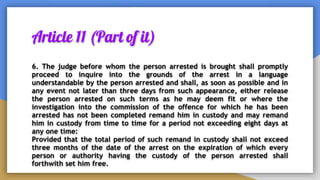
Article 11 (Part of it)
6. The judge before whom the person arrested is brought shall promptly
proceed to inquire into the grounds of the arrest in a language
understandable by the person arrested and shall, as soon as possible and in
any event not later than three days from such appearance, either release
the person arrested on such terms as he may deem fit or where the
investigation into the commission of the offence for which he has been
arrested has not been completed remand him in custody and may remand
him in custody from time to time for a period not exceeding eight days at
any one time:
Provided that the total period of such remand in custody shall not exceed
three months of the date of the arrest on the expiration of which every
person or authority having the custody of the person arrested shall
forthwith set him free.
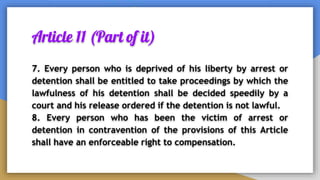
Article 11 (Part of it)
7. Every person who is deprived of his liberty by arrest or
detention shall be entitled to take proceedings by which the
lawfulness of his detention shall be decided speedily by a
court and his release ordered if the detention is not lawful.
8. Every person who has been the victim of arrest or
detention in contravention of the provisions of this Article
shall have an enforceable right to compensation.
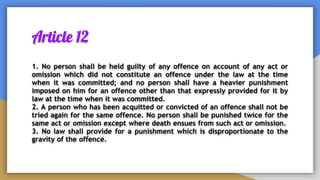
Article 12
1. No person shall be held guilty of any offence on account of any act or
omission which did not constitute an offence under the law at the time
when it was committed; and no person shall have a heavier punishment
imposed on him for an offence other than that expressly provided for it by
law at the time when it was committed.
2. A person who has been acquitted or convicted of an offence shall not be
tried again for the same offence. No person shall be punished twice for the
same act or omission except where death ensues from such act or omission.
3. No law shall provide for a punishment which is disproportionate to the
gravity of the offence.
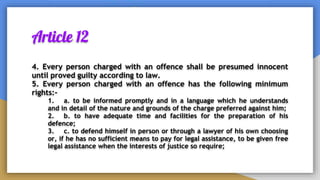
Article 12
4. Every person charged with an offence shall be presumed innocent
until proved guilty according to law.
5. Every person charged with an offence has the following minimum
rights:-
1. a. to be informed promptly and in a language which he understands
and in detail of the nature and grounds of the charge preferred against him;
2. b. to have adequate time and facilities for the preparation of his
defence;
3. c. to defend himself in person or through a lawyer of his own choosing
or, if he has no sufficient means to pay for legal assistance, to be given free
legal assistance when the interests of justice so require;
Article 12
4. d. to examine or have examined witnesses against him and
to obtain the attendance and examination of witnesses on his
behalf under the same conditions as witnesses against him;
5. e. to have the free assistance of an interpreter if he cannot
understand or speak the language used in court.
6. A punishment of general confiscation of property is
prohibited.
Article 18 (Part of it)
2. All religions whose doctrines or rites are not secret are free.
4. Every person is free and has the right to profess his faith and
to manifest his religion or belief, in worship, teaching, practice
or observance, either individually or collectively, in private or
in public, and to change his religion or belief.
5. The use of physical or moral compulsion for the purpose of
making a person change or preventing him from changing his
religion is prohibited.
Article 18 (Part of it)
6. Freedom to manifest one's religion or belief shall be subject only to
such limitations as are prescribed by law and are necessary in the
interests of the security of the Republic or the constitutional order or
the public safety or the public order or the public health or the public
morals or for the protection of the rights and liberties guaranteed by
this Constitution to any person.
7. Until a person attains the age of sixteen the decision as to the
religion to be professed by him shall be taken by the person having the
lawful guardianship of such person.
Article 19 (Part of it)
1. Every person has the right to freedom of speech and
expression in any form.
Article 23
1. Every person, alone or jointly with others, has the right to
acquire own, possess, enjoy or dispose of any movable or
immovable property and has the right to respect for such
right. The right of the Republic to underground water,
minerals and antiquities is reserved.
Article 24 (Part of it)
3. No tax, duty or rate of any kind whatsoever shall be
imposed with retrospective effect:
Article 27 (Part of it)
1. The right to strike is recognised and its exercise may be
regulated by law for the purposes only of safeguarding the
security of the Republic or the constitutional order or the
public order or the public safety or the maintenance of
supplies and services essential to the life of the inhabitants
or the protection of the rights and liberties guaranteed by
this Constitution to any person.
Article 28
1. All persons are equal before the law, the administration and
justice and are entitled to equal protection thereof and
treatment thereby.
2. Every person shall enjoy all the rights and liberties provided
for in this Constitution without any direct or indirect
discrimination against any person on the ground of his
community, race, religion, language, sex, political or other
convictions, national or social descent, birth, colour, wealth,
social class, or on any ground whatsoever, unless there is
express provision to the contrary in this Constitution.
Article 28
3. No citizen shall be entitled to use or enjoy any privilege
of any title of nobility or of social distinction within the
territorial limits of the Republic.
4. No title or nobility or other social distinction shall be
conferred by or recognised in the Republic.
Dunilefra
www.dunilefra.com

Constitution of Cyprus

  • 1.
  • 2.
    Article 10 1. Noperson shall be held in slavery or servitude. 2. No person shall be required to perform forced or compulsory labour. 3. For the purposes of this Article the term "forced or compulsory labour" shall not include- 1. any work required to be done in the ordinary course of detention imposed according to the provisions of Article 1I or during conditional release from such detention;
  • 3.
    Article 10 2. anyservice of a military character if imposed or, in case of conscientious objectors, subject to their recognition by a law, service exacted instead of compulsory military service; 3. any service exacted in case of an emergency or calamity threatening the life or well-being of the inhabitants.
  • 4.
    Article 11 (Partof it) 2. No person shall be deprived of his liberty save in the following cases when and as provided by law:-- 1. the detention of a person after conviction by a competent court; 2. the arrest or detention of a person for non-compliance with the lawful order of a court; 3. the arrest or detention of a person effected for the purpose of bringing him before the competent legal authority on reasonable suspicion of having committed an offence or when it is reasonably considered necessary to prevent his committing an offence or fleeing after having done so;
  • 5.
    Article 11 (Partof it) 4. the detention of a minor by a lawful order for the purpose of educational supervision or his lawful detention for the purpose of bringing him before the competent legal authority; 5. the detention of persons for the prevention of spreading of infectious diseases, of persons of unsound mind, alcoholics or drug addicts or vagrants;
  • 6.
    Article 11 (Partof it) 4. Every person arrested shall be informed at the time of his arrest in a language which he understands of the reasons for his arrest and shall be allowed to have the services of a lawyer of his own choosing. 5. The person arrested shall, as soon as is practicable after his arrest, and in any event not later than twenty-four hours after the arrest, be brought before a judge, if not earlier released.
  • 7.
    Article 11 (Partof it) 6. The judge before whom the person arrested is brought shall promptly proceed to inquire into the grounds of the arrest in a language understandable by the person arrested and shall, as soon as possible and in any event not later than three days from such appearance, either release the person arrested on such terms as he may deem fit or where the investigation into the commission of the offence for which he has been arrested has not been completed remand him in custody and may remand him in custody from time to time for a period not exceeding eight days at any one time: Provided that the total period of such remand in custody shall not exceed three months of the date of the arrest on the expiration of which every person or authority having the custody of the person arrested shall forthwith set him free.
  • 8.
    Article 11 (Partof it) 7. Every person who is deprived of his liberty by arrest or detention shall be entitled to take proceedings by which the lawfulness of his detention shall be decided speedily by a court and his release ordered if the detention is not lawful. 8. Every person who has been the victim of arrest or detention in contravention of the provisions of this Article shall have an enforceable right to compensation.
  • 9.
    Article 12 1. Noperson shall be held guilty of any offence on account of any act or omission which did not constitute an offence under the law at the time when it was committed; and no person shall have a heavier punishment imposed on him for an offence other than that expressly provided for it by law at the time when it was committed. 2. A person who has been acquitted or convicted of an offence shall not be tried again for the same offence. No person shall be punished twice for the same act or omission except where death ensues from such act or omission. 3. No law shall provide for a punishment which is disproportionate to the gravity of the offence.
  • 10.
    Article 12 4. Everyperson charged with an offence shall be presumed innocent until proved guilty according to law. 5. Every person charged with an offence has the following minimum rights:- 1. a. to be informed promptly and in a language which he understands and in detail of the nature and grounds of the charge preferred against him; 2. b. to have adequate time and facilities for the preparation of his defence; 3. c. to defend himself in person or through a lawyer of his own choosing or, if he has no sufficient means to pay for legal assistance, to be given free legal assistance when the interests of justice so require;
  • 11.
    Article 12 4. d.to examine or have examined witnesses against him and to obtain the attendance and examination of witnesses on his behalf under the same conditions as witnesses against him; 5. e. to have the free assistance of an interpreter if he cannot understand or speak the language used in court. 6. A punishment of general confiscation of property is prohibited.
  • 12.
    Article 18 (Partof it) 2. All religions whose doctrines or rites are not secret are free. 4. Every person is free and has the right to profess his faith and to manifest his religion or belief, in worship, teaching, practice or observance, either individually or collectively, in private or in public, and to change his religion or belief. 5. The use of physical or moral compulsion for the purpose of making a person change or preventing him from changing his religion is prohibited.
  • 13.
    Article 18 (Partof it) 6. Freedom to manifest one's religion or belief shall be subject only to such limitations as are prescribed by law and are necessary in the interests of the security of the Republic or the constitutional order or the public safety or the public order or the public health or the public morals or for the protection of the rights and liberties guaranteed by this Constitution to any person. 7. Until a person attains the age of sixteen the decision as to the religion to be professed by him shall be taken by the person having the lawful guardianship of such person.
  • 14.
    Article 19 (Partof it) 1. Every person has the right to freedom of speech and expression in any form.
  • 15.
    Article 23 1. Everyperson, alone or jointly with others, has the right to acquire own, possess, enjoy or dispose of any movable or immovable property and has the right to respect for such right. The right of the Republic to underground water, minerals and antiquities is reserved.
  • 16.
    Article 24 (Partof it) 3. No tax, duty or rate of any kind whatsoever shall be imposed with retrospective effect:
  • 17.
    Article 27 (Partof it) 1. The right to strike is recognised and its exercise may be regulated by law for the purposes only of safeguarding the security of the Republic or the constitutional order or the public order or the public safety or the maintenance of supplies and services essential to the life of the inhabitants or the protection of the rights and liberties guaranteed by this Constitution to any person.
  • 18.
    Article 28 1. Allpersons are equal before the law, the administration and justice and are entitled to equal protection thereof and treatment thereby. 2. Every person shall enjoy all the rights and liberties provided for in this Constitution without any direct or indirect discrimination against any person on the ground of his community, race, religion, language, sex, political or other convictions, national or social descent, birth, colour, wealth, social class, or on any ground whatsoever, unless there is express provision to the contrary in this Constitution.
  • 19.
    Article 28 3. Nocitizen shall be entitled to use or enjoy any privilege of any title of nobility or of social distinction within the territorial limits of the Republic. 4. No title or nobility or other social distinction shall be conferred by or recognised in the Republic.
  • 20.