CONSOLATION FOR THE BEREAVED
By REV. WILLIAM C. WILBOR, Ph.D.
Edited by Glenn Pease
PREFACE
MY apology for adding another book of conso-
lation to the number of like publications,
and of imitating such models as have before found
favor with the sorrowing, is twofold.
First, the wealth of such literature ever increases,
and, like the ripe harvest, ought to be gathered,
even though the granary seem already quite full.
Second, an important part of every true pastor's
labor is to comfort those that mourn. It is with
the devout hope that among the varied selections
here offered ministers may find some aid in cheering
the sorrowing that this little volume is sent forth.
To those whom I have sought to help in their be-
1
reavement these messages are affectionately dedi-
cated, with the earnest desire that among them
some words of blessing, comfort, faith, and hope
may be found. William C. Wilbor.
Olean, N. Y., December, 1895.
CONTENTS.
Comfort All that Mourn " 9
Deep Grief. — " Blessed are They that Mourn." —
Holy Ground. — The Beyond.
Infancy 15
The Deepest Grief.— The Pitcher of Tears.— The
Blossoms Fall. — Why the Baby Came. — Better
than Marble.
Childhood and Youth 23
2
Sorrow is World-wide. — The Mother of an Angel.
— Short Lives Not Fruitless. — A Year in Heaven.
— Questionings. — The Invisible Children. — Resig-
nation. — One Moment.
Maturity ._ 33
Soliloquy on Death. — Memory, Love, Hope. —
Compensation. — Messages. — A Little While. —
The Guests of God. — Appreciation for the Living. —
Love and Death. — Fold Ye the Ice-cold Hands. —
They Come No More.— Death of a Mother. —
Mother is Resting. — The Death of My Mother.—
The Tearless Land. — I Shall be Satisfied. — In
Shadow Land. — The Shore of Eternity. — Safe at
Home.
The Aged 55
Good Night. — Rest, Home, Life.— At the Last. —
The Flood of Years.— Only Waiting.— Final Vic-
tory.
3
INTRODUCTION.
WE must all die. We who are in the body must
leave it. And that is death. The law is
universal. For all we love best graves must open.
The earth claims our dust, and it takes but little
space to hide it. " The sea," as wild Walt Whit-
man says, "is full of ready-made graves."
But it is a glorious thing that graves on land or
at sea cannot hold us, for when they open below
gates open above, and we enter the other life.
Death is life. " Absent from the body," (poor, si-
lent, deaf, dead things that we leave!) "present
with the Lord ! "
Of course it is hard to die as we view death from
the one side — the earth side. We know so little.
We can know so little. Parting for a week almost
breaks a child's heart. And a strong man who
crosses the sea for a year brushes the tears from
his eyes when he says good-bye to his best beloved.
He goes so far! And why not the sense of loneli-
4
ness and bereavement when the soul weighs anchor
8 INTRODUCTION.
and crosses from the continent of Matter to the
mysterious shores of Reality?
If we knew too much and thought too much
about the land beyond we should be fitted for little
here. And we should not be missed at the parting.
Nor would a reunion be coveted greatly by those
we leave.
God has done well in that he has hidden so much;
seeing that he has revealed so much, and given us
hunger for immortality and hope and confidence !
The thoughts that console us at the time of tem-
porary separation are in this little volume wisely
and delicately compiled, that all classes of "those
who mourn " may have the comfort which the in-
spiration of God has given, both in his written word
5
and in the rich experience of souls who have come
under the spell and power of his Holy Spirit.
John H. Vincent.
Chautauqua, 1895.
COMFORT ALL THAT MOURN."
I heard a voice from heaven saying unto me, Write, Blessed are the
dead which die in the Lord from henceforth : Yea, saith the Spirit,
that they may rest from their labors ; and their works do follow them.
—Rev. 14. 13.
God will redeem my soul from the power of the grave : for he shall
receive me. — Psalm 49. 15.
We know that, if our earthly house of this tabernacle were dissolved,
we have a building of God, a house not made with hands, eternal in
6
the heavens. — 2 Cor. 5. 1.
It is better to go to the house of mourning, than to go to the house
of feasting : for that is the end of all men ; and the living will lay it
to his heart. — Eccl. 7. 2.
Blessed are they that mourn : for they shall be comforted.
—Matt. 5. 4.
Precious in the sight of the Lord is the death of his saints.
— Psalm 116. 15.
God shall wipe away all tears from their eyes. — Rev. 21. 4.
BEAUTY FOR ASHES
OR,
7
CONSOLATION FOR THE BEREAVED.
DEEP GRIEF.
O that they would not comfort me !
Deep grief cannot be reached;
Wisdom, to cure a broken heart,
Must not be wisdom preached.
Deep grief is better let alone;
Voices to it are swords;
A silent look will soothe it more
Than the tenderness of words.
8
Deep grief is not a past event;
It is a life, a state,
Which habit makes more terrible
And age more desolate.
But am I comfortless? O no!
Jesus this pathway trod;
And deeper in my soul than grief
Art thou, my dearest God ! — f. w. faber.
12 BEAUTY FOR ASHES.
"BLESSED ARE THEY THAT MOURN."
Deem not that they are blest alone
Whose days a peaceful tenor keep;
The anointed Son of God makes known
9
A blessing for the eyes that weep.
The light of smiles shall fill again
The lids that overflow with tears;
And weary hours of woe and pain
Are promises of happier years.
There is a day of sunny rest
For every dark and troubled night;
And grief may bide an evening guest,
But joy shall come with early light.
Nor let the good man's trust depart,
Though life its common gifts deny,
Though with a pierced and broken heart,
And spurned of men, he goes to die.
For God has marked each sorrowing day,
And numbered every secret tear;
10
And heaven's long age of bliss shall pay
For all his children suffer here.
WILLIAM CULLEN BRYANT.
Remember now and always that life is no idle
dream, but a solemn reality based upon eternity.
Find out your task; stand to it; the night cometh
when no man can work. — carlyle.
BEAUTY FOR ASHES. 13
HOLY GROUND.
Earth's holiest places are her graves. All that
is tender and sacred about the human affections
clusters about the burial places of those we have
loved. The resting place of the dead is of all the
fields of earth consecrated to God. As we enter
God's acre thoughts of the world, its cares and am-
bitions, its strifes and annoyances, are all shut out,
and we seem to be nearer to God because we are
11
near to the forms of those who have gone to be
with him. No wonder that the bereaved love to
place fresh flowers, the pledges of resurrection, upon
the grassy couches of those whom Christ when he
comes will bring with him.
THE BEYOND.
It seemeth such a little way to me,
Across to that strange country, the Beyond;
And yet not strange, for it has grown to be
The home of those of whom I am so fond;
They make it seem familiar and most dear,
As journeying friends bring distant countries near.
So close it lies that, when my sight is clear,
I think I see the brightly gleaming strand;
I know, I feel that those who've gone from here
Come near enough to touch my hand.
12
I often think, but for our veiled eyes,
We should find heaven round about us lies.
14 BEAUTY FOR ASHES.
I cannot make it seem a day to dread
When from this dear earth I shall journey out
To that still dearer country of the dead,
And join the lost ones so long dreamed about.
I love this world, yet shall I love to go
And meet the friends who wait for me, I know.
I never stand about a bier and see
The seal of death set on some well-loved face,
But that I think, one more to welcome me
13
When I shall cross the intervening space
Between this land and that one over there —
One more to make the strange beyond seem fair.
And so for me there is no sting to death,
And so the grave has lost its victory;
It is but crossing, with abated breath
And white, set face, a little strip of sea,
To find the loved ones waiting on the shore,
More beautiful, more precious than before.
— Anon.
Life is not a series of unconnected accidents,
but a great and solemn stewardship leading up to
judgment, to penalty or reward. — Joseph parker.
Behind the dim unknown
Standeth God within the shadow, keeping watch
above his own.
14
— JAMES RUSSELL LOWELL.
INFANCY.
Jesus called a little child unto him, and set him in the midst of
them, and said, Verily I say unto you, Except ye be converted, and
become as little children, ye shall not enter into the kingdom of
heaven.— Matt. 18. 2, 3.
Suffer the little children to come unto me, and forbid them not ;
for of such is the kingdom of God. . . . And he took them up in his
arms, put his hands upon them, and blessed them. — Mark 10. 14, 16.
Take heed that ye despise not one of these little ones ; for I say
unto you, That in heaven their angels do always behold the face of
my Father which is in heaven. — Matt. 18. 10.
It is not the will of your Father which is in heaven, that one of
these little ones should perish. — Matt. 18. 14.
15
Like as a father pitieth his children, so the Lord pitieth them that
fear him. — Psalm 103. 13.
BEAUTY FOR ASHES. 17
THE DEEPEST GRIEF.
There is many a Rachel mourning for her idol,
and many an empty pillow upon which a sweet baby
face once rested. And there is no grief so deep
and hard to keep from the memory as when the
loving child trips away with the angel throng. We
can better forget all other vanished forms, we can
hide away more cheerfully the white faces in the
churchyard, we can forget with less regret the
music of friendly voices, but the memory of the
little child clings to us like the undying fragrance
of heavenly flowers. We do not just know w
but suppose it must be because a child is a part of
heaven, and what is born of God can never die.
Heavenly things are so out of place in this world
16
that the Father in his loving mercy takes very often
the sinless child to himself.
There are so many things that we forget when
our little ones drift away from us into the silent life
that if not reminded of them we should sink be-
neath the load. If no one whispered in our ear the
story upon the bright side of the dark mystery
should become hard-hearted, and bitterness would
take the place of contrite submission. Blessed are
the lips which speak of the holier plane from which
we look at things that the world calls mysteries.
Blessed is the hand that leads the pale mour.tr
away from the grave of mourned hopes, and points
18 BEAUTY FOR ASHES.
to the eternal life in which every sweet baby spirit
that ever drifted from this world is found.
MRS. M. A. HOLT.
17
THE PITCHER OF TEARS.
The woman had closed her eyes,
A- weary with weeping;
She leaned on the empty cradle,
And sobbed in her sleeping.
Her breast, like the wave of the sea,
Was rising and falling;
Her heart, through the mist of sleep,
On her baby was calling.
Then her soul was lifted away
To the garden of heaven,
Where flowers shine like stars in the grass,
So smooth and so even;
And she saw where 'mid roses and May
An angel did wander,
With bright children, who looked in his face
18
To dream and to wonder.
Alone, and apart from the rest,
A little child tarried,
And in his small arms, soft and round,
A pitcher he carried.
His sweet eyes looked wistfully toward
His mates in the meadow;
Heaven's glory was bright, but his face
Bore the touch of earth's shadow.
BEAUTY FOR ASHES. 19
The woman knelt down where she stood.
" My own and my dearie,
Now why do you wander alone,
19
With little feet weary ?
If you cannot come back, come back,
To the arms of your mother,
'Tis your sweet hand the angel should hold,
And never another."
"O! mother, the pitcher of tears,
Your tears, I must carry;
So heavy it weighs, that behind
I linger and tarry.
O! mother, if you would smile,
And cease from your weeping,
My place by the angel's side
I'd gladly be keeping."
The woman waked by the cradle,
20
And smiled in the waking.
"My baby, the pitcher of tears
To my heart I am taking.
Go, frolic and sing with your mates;
My smiles shall be given
To make a new light round your head
In the garden of heaven."
— LAURA E. RICHARDS.
O, Rachel! cease thy weeping; they rest from pains
and cares.
Lord, grant us hearts as guileless, and crowns as
bright as theirs. — Anon.
20 BEAUTY FOR ASHES.
21
THE BLOSSOMS FALL.
How many blossoms fall from the orchard trees,
how few remain for full fruition ! Yet we are
thankful for the bright, fragrant blossoms that fall.
They serve a noble purpose. They lend to the
glad springtime so much of beauty and sweetness
that we cannot say they have bloomed in vain.
So, too, of the many children who come to glad-
den human homes, how few stay on earth to reach
maturity ! How many fall into springtime graves !
And they have not lived in vain; their blossom-forms
brought brightness and joy and blessing even though
they faded so quickly, and their memory is a pre-
cious legacy of the heart.
WHY THE BABY CAME.
Pillowed on flowers, with a half-open bud in his
tiny hand, the baby lay, a beautiful image of repose.
Nothing could be lovelier than the delicate face, the
little lips just parted, the white brow just shaded
by soft, silken curls. There was nothing of the re-
22
pulsion from death, which some people always suffer
beside a corpse, to be felt by the most sensitive
here. As beautiful now as he ever had been in his
brief, sweet life, the darling seemed to be asleep.
But it was a frozen sleep. The strong man, pale
with suppressed emotion, was one who had felt the
fountains of fatherhood stirred for the first time
BEAUTY FOR ASHES. 21
when the little one uttered his first feeble cry. The
mother, leaning on his strength now, because grief
had crushed all her own, had been thrilled with the
highest joy of womanhood when this nursling was
given her six months ago. Everything was over
now. The little garments must be folded up and
put away. There would be no need of waking in
the night to take care of baby. Baby was gone.
Why did the baby come, if it was so soon to be
taken ?
23
You may notice that you seldom hear this question
from the lips of a mother. She is glad, away down
to the profoundest depths of her wounded heart,
that she had the child, though it be removed from
her arms. She is glad to wear the mother's crown,
though it be a crown of thorns.
To the inquirer may this answer be made: The
baby came for two great reasons. One was that he
might broaden and enlarge the whole life-sweep of
all who loved him. Their care for him gave them
a comprehension of the mystery of childhood, and
a feeling of the fatherhood of God, that without
him they might never have possessed.
The other was that the little spirit, flying heaven-
ward, might draw by a slender silver thread, in-
visible but never slackening, the hearts of father
and mother to the land where He dwells, of whom
the whole family in heaven and earth is named.
The baby came not in vain. — Anon.
24
22 BEAUTY FOR ASHES.
BETTER THAN MARBLE.
It is related that a person on opening the grave
of an infant that had been dead several years, to
remove it to another cemetery, found that, by some
kindly chemistry, nature had changed the babe to
a beautiful statue of marble, retaining every part
and feature in such perfection that it might have
been used to adorn any parlor. O ye whose loved
ones still sleep in unopened graves, be of good cour-
age. The great Alchemist, Christ Jesus, shall by
and by come and speak the word of resurrection,
and the forms you so fondly cherish shall reappear,
not as beautiful statues of marble, but living, incor-
ruptible, glorious, to gladden your lives with sweet
companionship forever.
I feel that repeated afflictions come not as the
lightning on the scathed tree, blasting it yet more
and more, but as the strokes of the sculptor on the
marble block, forming it into the image of beauty
25
and loveliness. — h. w. beecher.
Measure thy life by loss instead of gain;
Not by the wine drunk, but by the wine poured
forth;
For love's strength standeth in love's sacrifice;
And who suffers most has most to give.
UGO BASSl'S SERMON.
CHILDHOOD AND YOUTH.
I would not have you to be ignorant, brethren, concerning them
which are asleep, that ye sorrow not, even as others which have no
hope. For if we believe that Jesus died and rose again, even so them
also which sleep in Jesus will God bring with him. — i Thess. 4. 13, 14.
Cast thy burden upon the Lord, and he shall sustain thee.
26
— Psalm 55. 22.
Come unto me, all ye that labor and are heavy laden, and I will
give you rest. — Matt. 11. 28.
I am the resurrection, and the life : he that believeth in me, though
he were dead, yet shall he live : and whosoever liveth and believeth in
me shall never die. — John 11. 25, 26.
As for me, I will behold thy face in righteousness : I shall be satis-
fied, when I awake, with thy likeness. — Psalm 17. 15.
I reckon that the sufferings of this present time are not worthy to
be compared with the glory which shall be revealed in us. — Rom. 8. 18.
BEAUTY FOR ASHES. » 25
SORROW IS WORLD-WIDE.
Bereavement, disappointment, loss, are univer-
sal experiences. In the oriental legend the young
27
mother brought her dead firstborn to the holy
Brahman and besought him to restore her child to
life. The good man bade her go from house to
house and ask this question: "Has sorrow ever
crossed this threshold ? " and when she found a
home into which no grief had ever come he would
restore her child to life. Eagerly the mother flew
from door to door, but always the same answer
came, with many tears and sobs, until she saw that
earth was full of sorrow — that she had not been
singled out for the sad affliction. And in the sympa-
thy which all this common woe aroused in her for
other sufferers, and in them for her, she read the
lesson the Brahman meant to teach, and returned to
bear with fortitude and resignation her own sorrow.
THE MOTHER OF AN ANGEL.
There is nothing, I think, in all the world that
can put the stimulus for higher and sweeter living
into the heart more surely than the proud conscious-
ness of a bereaved mother that she has been counted
worthy to become the mother of an angel ! What
falterings can be possible to one who has such a
28
prize at the end of the goal ? What backslidings or
unworthiness can clog the onward way of a mother
26 BEAUTY FOR ASHES.
who has a child in heaven to press onward to meet ?
Gone forever the aptitude for debasing things and
the desire for any gratifications of sense and caprice
when she knows that among the hidden throng who
watch and love in the shrouded skies there is one
little angel who is her very own, one whose glorified
face watches like a steadfast star for the drawing
near of her pilgrim feet to that mysterious gate
which only a dying breath shall waft ajar. — Anon.
SHORT LIVES NOT FRUITLESS.
To those who have lost dear friends in the bloom
of early life or in the opening career of usefulness
it is hard to understand the mystery of such appar-
ent waste of talent, culture, ability. But when we
reverently repeat the familiar phrase, "I believe in
29
the life everlasting," we catch a glimpse through the
soul-vision of possibilities beyond this limited sphere
of earthly life. Duration is not the measure of use-
fulness. Many brief lives are more full of labors
and results than other lives which round out a good
old age. Many who depart hence before full matu-
rity leave behind them more lasting influences to
bless mankind and shape human thought and life
than large numbers who reach the allotted time of
human expectation. Nothing has been lost to Chris-
tianity by the martyrdoms that have cut off the early
saints, who, by dying, have left behind them so hal-
BEAUTY FOR ASHES. 27
lowed an influence. Short lives are not fruitless,
because all the preparations for useful life here
surely go with them to the larger sphere of activity
in the limitless, endless realm of God.
A YEAR IN HEAVEN.
30
A year in heaven for her. What is she learning
Of holy things, of things divine and true ?
What glorious visions there are still unfolding
Which here she never knew ?
Did angel friends await her at her coming ?
Did angel faces greet her with a smile ?
Were all the dear ones eager to receive her
Whom she had lost awhile ?
A year on earth for us without her presence —
A year of loneliness and grief and pain;
But still we smile amid our tears in thinking
Our loss is but her gain.
We miss her in our joys and in our sorrows;
She was our life, our center, and our sun ;
And yet we would not call her back, but whisper,
31
"O God, thy will be done!"
For heaven and earth are very close together;
Though she is there, she is not far away;
She could not leave the dear ones, loved so fondly,
Even in heaven to stay!
28 BEAUTY FOR ASHES.
But still her spirit, like a guardian angel,
Is bending o'er us with her own fond care;
And sometimes she brings heaven so very near us
We almost think we're there.
A year in heaven for her, of rest and blessing;
For us a year on earth, with her above ;
But heaven and earth are both together blending,
32
And over all is Love ! — Anon.
QUESTIONINGS.
Why do the children leave us, O our Father,
The little children cradled on our breasts ?
Why do our doves fly upward in the morning
While other birdlings sleep within the nest ?
Can it be true that music up in heaven
Is sweeter when their voices join the hymn ?
Is richer light to realms of glory given
For that which fading left our homes so dim ?
And can the angels, who all day are giving
Care to the lambs within the shepherd's fold,
Need, as a mother needs amid her grieving,
The little ones at night to clasp and hold ?
When shall we see again the precious faces
33
That gave our homes such sunshine when they
smiled ?
O, what shall fill the heart's sad vacant places,
Or hush the tones that plead, "Give back the
child?"
BEAUTY FOR ASHES. 29
Why must we listen vainly for the patter
Of little feet at morning on the stair,
And miss the merry sound of childish laughter,
Or gentler tones saying the evening prayer
From lips that said their 4 ' Good night " at our knees?
O, He who made the mother-heart hath surely
No chiding in his own for thoughts like these.
In wrath or mercy ? Only he can tell.
34
Perhaps in some sweet way there may be written
Upon our hearts this record, "It is well."
Perhaps the broken harps that thrill and quiver
Through all the night, under the hand of pain,
May, in the morning of a glad forever,
Wake 'neath God's touch to melody again.
MARY LOWE DICKINSON.
THE INVISIBLE CHILDREN.
It is not when your children are with you, it is
not when you see them and hear them, that they are
most to you; it is when the sad assembly is gone;
it is when the daisies have resumed their growing
again in the place where the little form was laid; it
is when you have carried your children out, and said
farewell, and come home again, and day and night
are full of sweet memories; it is when summer and
winter are full of touches and suggestions of them;
it is when you cannot look up toward God without
35
thinking of them, nor look down toward yourself
30 BEAUTY FOR ASHES.
and not think of them; it is when they have gone
out of your arms, and are living to you only by the
power of the imagination, that they are the most to
you.
The invisible children are the realest children, the
sweetest children, the truest children, the children
that touch our hearts as no hands of flesh ever could
touch them. — h. w. beecher.
RESIGNATION.
She is not dead — the child of our affection —
But gone unto that school
Where she no longer needs our poor protection,
36
And Christ himself doth rule.
In that great cloister's stillness and seclusion,
By guardian angels led,
Safe from temptation, safe from sin's pollution,
She lives, whom we call dead.
Day after day we think what she is doing
In those bright realms of air;
Year after year, her tender steps pursuing,
Behold her grown more fair.
Thus do we walk with her, and keep unbroken
The bond which nature gives,
Thinking that our remembrance, though unspoken,
May reach her where she lives.
37
BEAUTY FOR ASHES. 31
Not as a child shall we again behold her;
For when, with raptures wild,
In our embraces we again enfold her
She will not be a child;
But a fair maiden, in her Father's mansion,
Clothed with celestial grace;
And beautiful with all the soul's expansion
Shall. we behold her face.
And though at times, impetuous with emotion
And anguish long suppressed,
The swelling heart heaves moaning like the ocean,
That cannot be at rest,
38
We will be patient, and assuage the feeling
We may not wholly stay;
By silence sanctifying, not concealing,
The grief that must have way.
We see but dimly through the mists and vapors;
Amid these earthly damps
What seems to us but sad, funereal tapers
May be heaven's distant lamps.
There is no death ! What seems so is transition.
This life of mortal breath
Is but a suburb of the life elysian,
Whose portals we call Death.
— H. W. LONGFELLOW.
39
32 BEAUTY FOR ASHES.
ONE MOMENT.
One moment, the sob of parting anguish ; the
next, the great, deep swell of the angels' song.
Never think, reader, that the dear ones you have
seen die had far to go to meet God after they parted
from you. Never think, parents, who have seen
your children die, that after they left you they had
to traverse a dark, solitary way, along which you
would^ have liked, if it had been possible, to lead
them by the hand, and bear them company till they
came into the presence of God. You did so if you
stood by them till the last breath was drawn. You
did bear them company into God's very presence if
you only stayed beside them till they died. The
moment they left you they were with him. The
slight pressure of the cold fingers lingered with you
yet, but the little child was with his Saviour.
COUNTRY PARSON.
40
O blessed sleep ! that will not break
For tears, nor prayers, nor love's sweet sake ;
O perfect rest! that knows no pain,
No throb, no thrill of heart or brain;
O life sublime beyond all speech,
That only the pure through dying reach !
God understands, and his ways are right;
Bid his beloved a fond good night. — Anon.
MATURITY
Thou earnest them away as with a flood ; they are as a sleep : in
41
the morning they are like grass which groweth up. In the morning
it flourisheth, and groweth up ; in the evening it is cut down, and
withereth. — Psalm 90. 5, 6.
The Lord will not cast off forever : but though he cause grief, yet
will he have compassion according to the multitude of his mercies.
—Lam. 3. 31, 32.
Beloved, think it not strange concerning the fiery trial which is to
try you, as though some strange thing happened unto you : but re-
joice, inasmuch as ye are partakers of Christ's sufferings ; that, when
his glory shall be revealed, ye may be glad also with exceeding joy.
— 1 Peter 4. 12, 13.
Thou hast been a strength to the poor, a strength to the needy in
his distress, a refuge from the storm, a shadow from the heat, when
die blast of the terrible ones is as a storm against the wall. — Isa. 25. 4.
Weeping may endure for a night, but joy cometh in the morning.
— Psalm 30. 5.
42
BEAUTY FOR ASHES. 35
SOLILOQUY ON DEATH.
How unexpected death always is until it comes
to one whom we have known. It seems like some-
thing strange and far away, something that lies
quite outside the range and circle of our lives. Yet
when death comes we know the separation is only
for a little while; that somewhere, somehow we shall
see the dear face again. God help those who, when
the loved form is carried out from the home, when
the words, the face of the dear one are nothing but
a memory, have no hope of a reunion; whose eyes
cannot look across the black gulf of death to the
bright shore of heaven ! If there is anything that
would make a doubting soul cling to the Christian
religion it is the promise that it gives of a life be-
yond this earth. Our hearts cannot give up our
dead. Something tells us that this is not all, that
the souls that we have known and loved we shall
know and love again. — t. b. l.
43
God would never let us long for our friends with
such a strong and holy love, if they were not wait-
ing for US. WILLIAM MOUNTFORD.
They that descend into the mines of suffering
find unbounded riches there.
Those who dive into the depths of grief find the
pearls of everlasting life within its caverns.
— SPURGEON.
36 BEAUTY FOR ASHES.
Our life is a dream; our time, as a stream,
Glides swiftly away,
And the fugitive moment refuses to stay.
The arrow is flown — the moment is gone;
The millennial year
44
Rushes on to our view, and eternity's here.
—CHARLES WESLEY.
MEMORY, LOVE, HOPE.
To those whose loved ones have been glorified
there is left an imperishable legacy of memory,
love, and hope.
Nothing can rob the heart of sweet recollection
of the happy years that have been wrought into
life's history. The loving words, the gentle deeds,
the sympathy and appreciation that have enriched
our experiences — these and other remembrances
are ours to cherish and cultivate. Love itself can-
not die while memory endures. They are our loved
ones still, though hid from our sight. Love is an
attribute of the soul, and readily enters the soul
realm and awaits with patience the reunited life
which hastens nearer with every setting sun.
45
Hope, too, holds out its promise of cheer and
confidence, not vain deceit or cruel disappointment,
but the promise that is sure and steadfast, and that
enters within the veil.
BEAUTY FOR ASHES. 37
COMPENSATION.
What though the kindly heart that loved so
fondly this home circle has ceased to beat? That
love, richer, deeper, unceasing, is yet the same in
the life which she now lives with never a throb of
pain. What though the hands which served others so
patiently and willingly are now quietly folded and
still? They will gladly serve the good Master in
that larger life of service without weariness. What
if the feet that were swift to run errands of kind-
ness and mercy will walk no more the dusty, dif-
ficult ways of earth? They will walk without wea-
riness the path of life, and roam unfettered the
fields of paradise. What though the soul-sense
46
that loved so passionately all that was true and
beautiful here, and the gifted mind that could so
highly appreciate the choicest of this world's bless-
ings, are here no longer? They will drink deeply
and forever in ecstasy of unwearied aspiration the
fulfillment of every longing desire of mind and
spirit in the realms of life eternal. She loved flow-
ers, and has gone to dwell forever amid the beauties
of the heavenly paradise and breathe the fragrance
of flowers that never die. She loved music, and
the voice that praised the Lord here will join un-
wearied in the chorus of the redeemed in glad
hallelujahs around the throne of God forever and
forever.
38 BEAUTY FOR ASHES.
MESSAGES.
We stood on the verge of the ocean and waved
farewell to our dearest friends and they sailed out
of sight. Day after day passed in silence. No
47
message came from the loved ones. But one night
across the wide sea came a brief cablegram con-
taining but two words from our friends: "Safe!
Well ! " They brought sweet assurance that the
stormy voyage was over and our friends were safe
at home.
So also, bereaved heart across the dark, wide,
stormy sea of death on which your loved ones sailed
away from you, if you will listen with the ear of
Christian faith, out of God's holy word will come the
same sweet message to your longing heart : ' ' Safe ! "
"They are before the throne of God, and serve
him day and night in his temple." "Well!" "The
inhabitant shall not say, I am sick." And there
shall be no more death, neither sorrow, nor crying,
neither shall there be any more pain."
A LITTLE WHILE.
We cheerfully consent to let our most cherished
friends go away from us with those they love, be-
cause it will increase their happiness. And so
we allow our children to accept the invitations of
48
our kindred to share the privilege of travel for long
periods of time in distant lands for their profit and
BEAUTY FOR ASHES. 39
improvement. Shall we not bear bravely our loss
and bereavement when our Saviour takes them to
be with him in paradise, and dry our tears and cease
our grieving when we remember that they are now
the guests of God?
THE GUESTS OF GOD.
Why should we wear black for the guests of God ? " — ruskin.
From the dust of the weary highway,
From the smart of sorrow's rod,
Into the royal presence
49
They are bidden as guests of God.
The veil from their eyes is taken,
Sweet mysteries they are shown,
Their doubts and fears are over,
For they know as they are known.
For them there should be rejoicing
And festival array,
As for the bride in her beauty
Whom love hath taken away.
Sweet hours of peaceful waiting,
Till the path that we have trod
Shall end at the Father's gateway, "
And we are the guests of God.
— MARY F. BUTTS.
50
40 BEAUTY FOR ASHES.
APPRECIATION FOR THE LIVING.
The time to bestow praise and tender words of
appreciation upon our friends is not only while we
are breathing the fragrance of the beautiful flowers
with which we deck their coffins, but while in the
stress and pain of human suffering and despair they
most crave our loving cheer and tender sympathy.
The time to lavish wreaths and crosses and crowns
of flowers upon them is when they are sorest pressed
with the crosses of life, and struggling amid temp-
tations and doubts to win the wreath-reward of the
race of life and the heavenly crown of victory at the
end of the strife with sin. Our praises and consola-
tions are to be spoken not only in the sweet hymns
of faith and hope and immortality which we sing over
their insensible remains, but when the burdened
heart is longing for sympathy, love, and apprecia-
tion, and while it can be comforted, refreshed, and
strengthened by our tenderness and consideration.
51
. . . O, YOU,
Earth's tender and impassioned few,
Take courage to intrust your love
To Him so named, who guards above
Its ends, and shall fulfill!
Breaking the narrow prayers, that may
Befit your narrow hearts, away
In his broad loving will.
— MRS. EROWNING.
BEAUTY FOR ASHES. 41
So long thy power has blest me, sure it still
Will lead me on
O'er moor and fen, o'er crag and torrent, till
The night is gone,
And with the morn those angel faces smile
Which I have loved long since, and lost awhile !
52
JOHN HENRY NEWMAN.
LOVE AND DEATH.
And they ? Do they, amid the host
That throng along the golden street,
A moment pause — in memory lost —
And listen for our coming feet
While angels all around rejoice ?
Remember they our earthly voice ?
O! can those pearly gates above
Shut out from them our yearning love ?
Or do they sometimes sit apart,
And ponder on the precious past ?
53
Remember they, with loving heart,
That trembling kiss — it was the last ?
They cannot sure forget its thrill;
Its presence lingers round them still,
For 'twas a soul — 'twas not a breath —
And Love is mightier than Death.
— jane t. h. cross.
42 BEAUTY FOR ASHES.
FOLD YE THE ICE-COLD HANDS.
Fold ye the ice-cold hands,
Calm on the troubled breast;
The toil of the summer day is o'er,
Now cometh the evening rest.
54
And the folded hands have nobly wrought
Through noontide's din and strife,
And the dauntless heart has bravely fought
In the ceaseless war of life.
Smooth ye the time-thinned hair,
Still on the marble brow;
No earthly cloud doth linger there
To mar its beauty now.
But brow and lip and darkened eye
Bear a shade of deep repose,
As twilight shadows softly lie
On the widespread winter snows.
No voice of discord wakes
The silence still and deep,
And the far-off sounds of worldly strife
55
Cannot break the dreamless sleep.
Welcome rest to heart long tossed
On the tide of hopes and fears;
To the feet that have wandered far and wide,
O'er the weary waste of years.
BEAUTY FOR ASHES. 43
From the gorgeous glare of day
Welcome the gentle night,
Fading the tranquil lines away,
Solemn and calm and bright.
Then tenderly fold the hands
In peace on the pulseless breast,
For the evening shadows come quickly on,
56
And sweet is the Christian's rest.
— W. S. STUDLEY, D.D.
THEY COME NO MORE.
Look where we may, the wide earth o'er,
Those lighted faces smile no more.
We tread the paths their feet have worn,
We sit beneath their orchard trees,
We hear like them the hum of bees
And rustle of the bladed corn ;
We turn the pages that they read,
Their written words we linger o'er,
But in the sun they cast no shade,
No voice is heard, no sign is made,
No step is on the conscious floor!
Yet Love will dream and Faith will trust
57
(Since He who knows our need is just),
That somehow, somewhere, meet we must.
Alas for him who never sees
The stars shine through his cypress trees!
44 BEAUTY FOR ASHES.
Who hopeless lays his dead away,
Nor looks to see the breaking day
Across the mournful marbles play!
Who hath not learned in hours of faith
The truth to flesh and sense unknown,
That Life is ever Lord of Death,
And Love can never lose its own.
JOHN G. WHITTIER.
DEATH OF A MOTHER.
It is my belief that, as a rule, a man never receives
from any human source a love so near divine as that
which comes to him from his mother. The love he
58
receives from his father is not likely to be so strong,
so intense, so tenacious. The love bestowed upon
him by the wife of his youth, however true and
fervent, will be less disinterested and imperishable
than that bestowed by his mother. It is his moth-
er's love that protects his infancy and blesses his
boyhood, and, go where he may in after life, or do
what he may, that same love follows him through all
his wanderings and abides with him through all the
fluctuations of fortune. If he succeeds, no other
will so proudly rejoice in his triumphs; if he fails, no
other will so truly sympathize. When a man, in
dashing against society and its laws, has totally
wrecked himself, and has fallen so low that all others
turn from him in scorn or loathing, his mother will
BEAUTY FOR ASHES. 45
still cling to him. Only the Son of God, who for
man's sake sounded all the depths of agony and
woe, can exceed — or even equal — a mother's love.
59
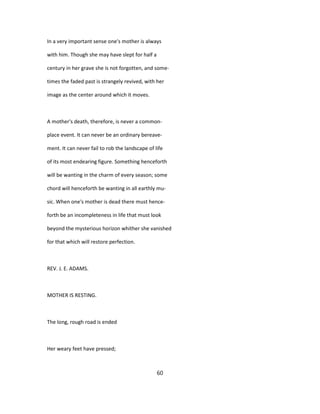
In a very important sense one's mother is always
with him. Though she may have slept for half a
century in her grave she is not forgotten, and some-
times the faded past is strangely revived, with her
image as the center around which it moves.
A mother's death, therefore, is never a common-
place event. It can never be an ordinary bereave-
ment. It can never fail to rob the landscape of life
of its most endearing figure. Something henceforth
will be wanting in the charm of every season; some
chord will henceforth be wanting in all earthly mu-
sic. When one's mother is dead there must hence-
forth be an incompleteness in life that must look
beyond the mysterious horizon whither she vanished
for that which will restore perfection.
REV. J. E. ADAMS.
MOTHER IS RESTING.
The long, rough road is ended
Her weary feet have pressed;
60
How rough to her weak footsteps,
Perhaps we never guessed;
But with the weary journey
She'll be no more distressed.
The face we bend and softly kiss
Bears no impress but that of bliss.
46 BEAUTY FOR ASHES.
We know that many pages
Within the book of years
She has perused with anguish,
Amid her falling tears;
That partings, change, and doubting
Have caused her many fears.
Forgotten now each pang of woe,
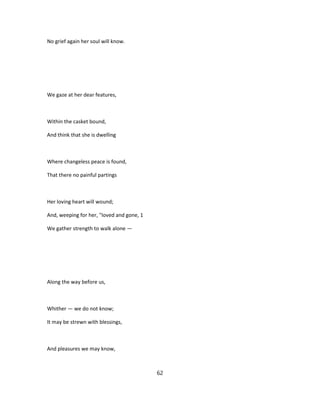
61
No grief again her soul will know.
We gaze at her dear features,
Within the casket bound,
And think that she is dwelling
Where changeless peace is found,
That there no painful partings
Her loving heart will wound;
And, weeping for her, "loved and gone, 1
We gather strength to walk alone —
Along the way before us,
Whither — we do not know;
It may be strewn with blessings,
And pleasures we may know,
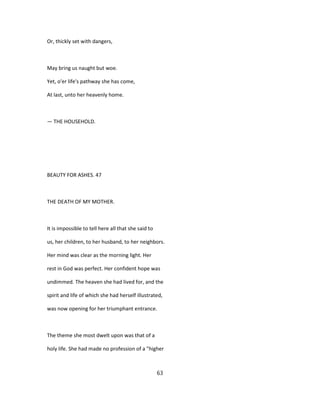
62
Or, thickly set with dangers,
May bring us naught but woe.
Yet, o'er life's pathway she has come,
At last, unto her heavenly home.
— THE HOUSEHOLD.
BEAUTY FOR ASHES. 47
THE DEATH OF MY MOTHER.
It is impossible to tell here all that she said to
us, her children, to her husband, to her neighbors.
Her mind was clear as the morning light. Her
rest in God was perfect. Her confident hope was
undimmed. The heaven she had lived for, and the
spirit and life of which she had herself illustrated,
was now opening for her triumphant entrance.
The theme she most dwelt upon was that of a
holy life. She had made no profession of a "higher
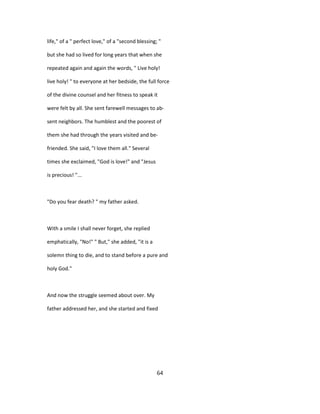
63
life," of a " perfect love," of a "second blessing; "
but she had so lived for long years that when she
repeated again and again the words, " Live holy!
live holy! " to everyone at her bedside, the full force
of the divine counsel and her fitness to speak it
were felt by all. She sent farewell messages to ab-
sent neighbors. The humblest and the poorest of
them she had through the years visited and be-
friended. She said, "I love them all." Several
times she exclaimed, "God is love!" and "Jesus
is precious! "...
"Do you fear death? " my father asked.
With a smile I shall never forget, she replied
emphatically, "No!" " But," she added, "it is a
solemn thing to die, and to stand before a pure and
holy God."
And now the struggle seemed about over. My
father addressed her, and she started and fixed
64
48 BEAUTY FOR ASHES.
her eyes on him. He asked, "Is Jesus still pre-
cious? " She did not appear to understand or hear
him. He repeated the question in a louder voice,
and then again. All at once her face became ra-
diant. Her old sweet smile came back. Her full
energy of life seemed to be restored. The flashing
of light from above seemed to transfigure her face,
and with emphasis she said, pronouncing every word
with great distinctness, " O, yes, Jesus is precious ! "
Then in a soft voice, but full of rapture, she said,
"Glory, glory, glory!"
With a smile on her dear lips, she said, as though
responding to invisible attendants, "Come, come,
come! " and thus my mother died — to live forever!
BISHOP VINCENT, IN " MY MOTHER."
THE TEARLESS LAND.
Our floral forget-me-nots blossom, and die
65
When the winds of the autumn sweep chillingly by;
But the heart's bright forget-me-nots never shall
fade
When under the white drifts our loved ones are laid;
And the days, as they fly o'er the dial of time,
Are bringing us nearer to that brighter clime
Where we shall again our best loved ones embrace
And the glories of home shall earth's sorrows efface.
We weave from fair blossoms a cross and a crown,
And on the cold coffin we lay them both down;
BEAUTY FOR ASHES. 49
Tis all we can do; we'll adorn the fair clay
Ere under the white drifts we lay it away.
But the days, as they fly o'er the dial of time,
Are bringing us nearer to that brighter clime
Where the crowns are not leaves that must wither
66
and mold,
But they sparkle with jewels and glisten with gold.
We sing our sweet hymns round the slumbering
clay
Ere under the white drifts we lay it away;
And we lift our dim eyes to the kingdom above,
Unto Him who chastiseth us only in love.
O ! the days, as they fly o'er the dial of time,
Are bringing us nearer to that brighter clime
Where the songs of the blest with the sainted we'll
sing
At the feet o£ our Prophet, our Priest, and our King.
We bury the dead we so love from our sight,
While a star beameth forth from the depths of our
night;
It comforts the heart, and dispeileth the gloom,
As we follow the dead to the rest of the tomb.
O ! the days, as they fly o'er the dial of time,
Are bringing us nearer to that brighter clime
67
Where "the King in his beauty," the Bethlehem
Star,
Shall cheer us forever in kingdoms afar.
—JOHN H. YATES.
SO BEAUTY FOR ASHES.
I SHALL BE SATISFIED.
When I shall wake in that fair morn of morns,
After whose dawning never night returns,
And with whose glory day eternal burns,
I shall be satisfied.
When I shall see thy glory face to face,
When in thine arms thou wilt thy child embrace,
When thou shalt open all thy stores of grace,
I shall be satisfied.
68
When I shall meet with those whom I have loved,
Clasp in my eager arms the long removed,
And find how faithful thou to me hast proved,
I shall be satisfied.
When this vile body shall arise again,
Purged by thy power from every taint and stain,
Delivered from all weakness and all pain,
I shall be satisfied.
When I shall gaze upon the face of Him
Who for me died, with eye no longer dim,
And praise him with the everlasting hymn,
I shall be satisfied.
When I shall call to mind the long, long past,
With clouds and storms and shadows overcast,
And know that I am blest and saved at last,
69
I shall be satisfied.
BEAUTY FOR ASHES. 51
When every enemy shall disappear,
The unbelief, the darkness, and the fear,
When thou shalt smooth the brow and wipe the tear,
I shall be satisfied.
When every vanity shall pass away,
And all be real, and all without decay,
In that sweet dawning of eternal day,
I shall be satisfied.
HORATIUS BONAR.
IN SHADOW LAND.
70
In shadow land I wander far,
Without the clasp of that dear hand
Whose mother-love was like a star
In shadow land.
Her soul has reached the shining strand,
Where waves that roll from death's dark bar
Lapse into light and music grand
In shadow land.
She dwells where darkness cannot mar
The hills of God, by glory spanned ;
/ roam where Grief's gray memories are,
In shadow land.
— WILLIAM H. HAYNE.
52 BEAUTY FOR ASHES.
THE SHORE OF ETERNITY.
71
Alone! to land alone upon that shore,
With no one sight that we have seen before;
Things of a different hue,
And the sounds all new,
And fragrances so sweet the soul may faint.
Alone! O, that first hour of being a saint!
Alone ! to land alone upon that shore,
On which no wavelets lisp, no billows roar,
Perhaps no shape of ground
Perhaps no sight or sound,
No forms of earth our fancies to arrange —
But to begin alone that mighty change !
Alone! to land alone upon that shore,
Knowing so well we can return no more;
No voice or face of friend,
None with us to attend
72
Our disembarking on that awful strand,
But to arrive alone in such a land !
Alone ! to land alone upon that shore !
To begin alone to live forevermore,
To have no one to teach
The manners or the speech
Of that new life, or put us at our ease —
O that we might die in pairs or companies !
BEAUTY FOR ASHES. 53
Alone? the God we know is on that shore,
The God of whose attractions we know more
Than of those who may appear
Nearest and dearest here;
O, is he not the lifelong friend we know
More privately than any friend below?
73
Alone ! the God we trust is on that shore,
The Faithful One whom we have trusted more,
In trials and in woes,
Than we have trusted those
On whom we leaned most in our earthly strife;
O ! we shall trust him more in that new life !
Alone ! the God we love is on that shore —
Love not enough, yet whom we love far more,
And whom we loved all through,
And with a love more true
Than other loves, yet now shall love him more.
True love of him begins upon that shore!
So not alone we land upon that shore;
'Twill be as though we had been there before;
74
We shall meet more we know
Than we can meet below,
And find our rest like some returning dove,
And be at home at once with our eternal love!
— F. W. FABER.
54 BEAUTY FOR ASHES.
SAFE AT HOME.
The world need never shed a tear for its sainted
dead. They are safe as the harvest is when the
farmer has bound it into sheaves and stored it, or
as the roses are when the gardener has wrapped
their roots in straw and housed them from the
storm. They are safe as larks are that fly sing-
ing from, the green earth out of reach of the hunts-
man's snare and the aim of the cruel sportsman.
They are safe as warriors are who march beneath
worn battle flags no more, but sit down with con-
75
querors to festivals of song and wine. They are
safe as young lambs are when shepherds fold them
from the blast and carry them over rough places in
tender arms. Weep for the living all you choose,
and let your tears be unstayed above the dying bed
where your darlings lie like wreaths of fading snow
beneath the glance of Death, but if you believe in
God and hold any faith in heaven never shed a tear
for the blessed and happy dead. Christianity gives
the lie to its belief when it garbs itself in sables and
mourns without comfort for those who have ex-
changed the inn for the palace, the wilderness for
the land of peace and plenty. — amber.
THE AGED
I am now ready to be offered, and the time of my departure is at
hand. I have fought a good fight, I have finished my course, I have
kept the faith : henceforth there is laid up for me a crown of right-
eousness, which the Lord, the righteous judge, shall give me at that
76
day : and not to me only, but unto all them also that love his ap-
pearing. — 2 Tim. 4. 6-8.
Thou shalt go to thy fathers in peace ; thou shalt be buried in a
good old age.— Gen. 15. 15.
Thou shalt come to thy grave in a full age, like as a shock of corn
cometh in in his season. — Job 5. 26.
I am in a strait betwixt two, having a desire to depart, and to be
with Christ ; which is far better.— Phil. 1. 23.
Here have we no continuing city, but we seek one to come.
— Heb. 13. 14.
Thine eyes shall see the King in his beauty : they shall behold the
land that is very far off. — Isa. 33. 17.
I know that my Redeemer liveth.— Job 19. 25.
BEAUTY FOR ASHES. 57
77
GOOD NIGHT.
Sleep on, beloved, sleep and take thy rest;
Lay down thy head upon thy Saviour's breast;
We love thee well, but Jesus loves thee best —
Good night! Good night! Good night!
Calm is thy slumber as an infant's sleep;
But thou shalt wake no more to toil and weep;
Thine is a perfect rest, secure and deep —
Good night! Good night! Good night!
Until the shadows from this earth are cast,
Until He gathers in his sheaves at last,
Until the twilight gloom be overpast —
Good night! Good night! Good night!
Until the Easter glory lights the skies,
Until the dead in Jesus shall arise,
And he shall come, but not in lowly guise —
Good night! Good night! Good night!
Until made beautiful by love divine,
78
Thou, in the likeness of thy Lord, shall shine,
And he shall bring that golden crown of thine —
Good night! Good night! Good night!
Only ' ' Good night, " beloved— not ' ' Farewell ! "
A little while, and all his saints shall dwell
In hallowed union indivisible —
Good night! Good night! Good night!
58 BEAUTY FOR ASHES.
Until we meet again before His throne,
Clothed in the spotless robe he gives his own,
Until we know even as we are known —
Good night! Good night! Good night!
— Anon.
With thy rude plowshare, Death, turn up the sod,
And spread the furrow for the seed we sow;
79
This is the field and acre of our God,
This is the place where human harvests grow!
The graves grow thicker, and life's ways more bare,
As years on years go by;
Nay, thou hast more green gardens in thy care,
And more stars in thy sky!
No jubilees, few gladsome, festive hours,
Form landmarks for my way,
But heaven and earth, and saints and friends and
flowers,
Keep resurrection day.
— LYRA MYSTICA.
Extraordinary afflictions are not always the
punishment of extraordinary sins, but sometimes
the trial of extraordinary graces.
80
MATTHEW HENRY.
An aged Christian wrote in his diary: "I praise
the Lord for every step of the way in which he has
led me, for every loss and cross, sorrow and trial,
BEAUTY FOR ASHES. 59
for every circumstance of my life, because by them
all he has brought me where I can trust him in all
things."
REST, HOME, LIFE.
Rest for the weary
In a land where toil shall cease,
Earth sad and dreary
Left for heaven's peace.
Rest from care and sadness,
81
Rest from pain and strife and woe;
There all joy and gladness
Spirits blest e'er know.
Home for the wayworn
On time's rough, tempestuous way,
Through glory's gates, borne
Up to endless day.
Home in heaven forever,
Home where wanderings all are o'er,
Where the ransomed never
Leave the Saviour more.
Life for the dying,
Whither death can never come,
Sorrow and sighing
Ne'er shall reach that home.
82
Life where tears shall vanish,
Life eternal, blissful, free;
Love all fears shall vanish,
God his saints shall see.
60 BEAUTY FOR ASHES.
AT THE LAST.
The stream is calmest when it nears the tide,
The flowers are sweetest at the eventide,
The birds most musical at close of day,
The saints divinest when they pass away.
Morning is holy, but a holier charm
Lies folded up in Evening's robe of balm;
And weary men must ever love her best,
For morning calls to toil, but night to rest.
She comes from heaven, and on her wings doth bear
83
A holy fragrance, like the breath of prayer;
Footsteps of angels follow in her trace,
To shut the weary eyes of Day in peace.
All things are hushed before her, as she throws
O'er earth and sky her mantle of repose.
There is a calmer beauty and a power
That morning knows not in the evening's hour.
Until the evening we must weep and toil —
Plow life's stern furrow and dig the woody soil,
Tread with sad feet the rough and thorny way,
And bear the heat and burden of the day.
O! when the sun is setting, may we glide
Like summer evening down the golden tide,
And leave behind us, as we pass away,
Sweet starry twilight round our sleeping clay.
— Anon.
BEAUTY FOR ASHES. 61
84
THE FLOOD OF YEARS.
Beyond
That belt of darkness still the years roll on
More gently, but with not less mighty sweep.
They gather up again and softly bear
All the sweet lives that late were overwhelmed
And lost to sight — all that in them was good,
Noble, and truly great and worthy of love —
The lives of infants and ingenuous youths,
Sages and saintly women who have made
Their households happy — ail are raised and borne
By that great current on its onward sweep,
Wandering and rippling with caressing waves
Around green islands, fragrant with the breath
Of flowers that never wither. So they pass,
From stage to stage, along the shining course
Of that fair river broadening like a sea.
As its smooth eddies curl along their way,
They bring old friends together; hands are clasped
In joy unspeakable; the mother's arms
Again are folded round the child she loved
And lost. Old sorrows are forgotten now,
85
Or but remembered to make sweet the hour
That overpays them; wounded hearts that bled
Or broke are healed forever. In the room
Of their grief-shadowed Present there shall be
A Present in whose reign no grief shall gnaw
The heart, and never shall a tender tie
62 BEAUTY FOR ASHES.
Be broken, in whose reign the eternal change
That waits on growth and action shall proceed
With everlasting Concord hand in hand.
WILLIAM CULLEN BRYANT.
So live, that when thy summons comes to join
The innumerable caravan which moves
To that mysterious realm where each shall take
His chamber in the silent halls of death,
Thou go not, like the quarry-slave at night,
Scourged to his dungeon, but, sustained and soothed
By an unfaltering trust, approach thy grave
86
Like one who wraps the drapery of his couch
About him and lies down to pleasant dreams.
WILLIAM CULLEN BRYANT.
ONLY WAITING.
Only waiting, till the shadows
Are a little longer grown ;
Only waiting, till the glimmer
Of the day's last beam is flown;
Till the night of earth is faded
From the hearts once full of day;
Till the stars of heaven are breaking
Through the twilight soft and gray.
Only waiting, till the reapers
Have the last sheaf gathered home;
For the summer time is faded,
87
And the autumn winds have come.
BEAUTY FOR ASHES. 63
Quickly, reapers, gather quickly
These last ripe hours of my heart,
For the bloom of life is withered,
And I hasten to depart.
FRANCES L. MACE.
FINAL VICTORY.
Behold, I show you a mystery; We shall not
all sleep, but we shall all be changed, in a moment,
in the twinkling of an eye, at the last trump: for
the trumpet shall sound, and the dead shall be
raised incorruptible, and we shall be changed. For
this corruptible must put on incorruption, and this
mortal must put on immortality. So when this cor-
ruptible shall have put on incorruption, and this
88
mortal shall have put on immortality, then shall be
brought to pass the saying that is written, Death is
swallowed up in victory. O death, where is thy
sting? O grave, where is thy victory? The sting
of death is sin; and the strength of sin is the law.
But thanks be to God, which giveth us the victory
through our Lord Jesus Christ.
Therefore, my beloved brethren, be ye steadfast,
unmovable, always abounding in the work of the
Lord, forasmuch as ye know that your labor is not
in vain in the Lord. — i cor. 15. 51-58.
89

Consolation for the bereaved

  • 1.
    CONSOLATION FOR THEBEREAVED By REV. WILLIAM C. WILBOR, Ph.D. Edited by Glenn Pease PREFACE MY apology for adding another book of conso- lation to the number of like publications, and of imitating such models as have before found favor with the sorrowing, is twofold. First, the wealth of such literature ever increases, and, like the ripe harvest, ought to be gathered, even though the granary seem already quite full. Second, an important part of every true pastor's labor is to comfort those that mourn. It is with the devout hope that among the varied selections here offered ministers may find some aid in cheering the sorrowing that this little volume is sent forth. To those whom I have sought to help in their be- 1
  • 2.
    reavement these messagesare affectionately dedi- cated, with the earnest desire that among them some words of blessing, comfort, faith, and hope may be found. William C. Wilbor. Olean, N. Y., December, 1895. CONTENTS. Comfort All that Mourn " 9 Deep Grief. — " Blessed are They that Mourn." — Holy Ground. — The Beyond. Infancy 15 The Deepest Grief.— The Pitcher of Tears.— The Blossoms Fall. — Why the Baby Came. — Better than Marble. Childhood and Youth 23 2
  • 3.
    Sorrow is World-wide.— The Mother of an Angel. — Short Lives Not Fruitless. — A Year in Heaven. — Questionings. — The Invisible Children. — Resig- nation. — One Moment. Maturity ._ 33 Soliloquy on Death. — Memory, Love, Hope. — Compensation. — Messages. — A Little While. — The Guests of God. — Appreciation for the Living. — Love and Death. — Fold Ye the Ice-cold Hands. — They Come No More.— Death of a Mother. — Mother is Resting. — The Death of My Mother.— The Tearless Land. — I Shall be Satisfied. — In Shadow Land. — The Shore of Eternity. — Safe at Home. The Aged 55 Good Night. — Rest, Home, Life.— At the Last. — The Flood of Years.— Only Waiting.— Final Vic- tory. 3
  • 4.
    INTRODUCTION. WE must alldie. We who are in the body must leave it. And that is death. The law is universal. For all we love best graves must open. The earth claims our dust, and it takes but little space to hide it. " The sea," as wild Walt Whit- man says, "is full of ready-made graves." But it is a glorious thing that graves on land or at sea cannot hold us, for when they open below gates open above, and we enter the other life. Death is life. " Absent from the body," (poor, si- lent, deaf, dead things that we leave!) "present with the Lord ! " Of course it is hard to die as we view death from the one side — the earth side. We know so little. We can know so little. Parting for a week almost breaks a child's heart. And a strong man who crosses the sea for a year brushes the tears from his eyes when he says good-bye to his best beloved. He goes so far! And why not the sense of loneli- 4
  • 5.
    ness and bereavementwhen the soul weighs anchor 8 INTRODUCTION. and crosses from the continent of Matter to the mysterious shores of Reality? If we knew too much and thought too much about the land beyond we should be fitted for little here. And we should not be missed at the parting. Nor would a reunion be coveted greatly by those we leave. God has done well in that he has hidden so much; seeing that he has revealed so much, and given us hunger for immortality and hope and confidence ! The thoughts that console us at the time of tem- porary separation are in this little volume wisely and delicately compiled, that all classes of "those who mourn " may have the comfort which the in- spiration of God has given, both in his written word 5
  • 6.
    and in therich experience of souls who have come under the spell and power of his Holy Spirit. John H. Vincent. Chautauqua, 1895. COMFORT ALL THAT MOURN." I heard a voice from heaven saying unto me, Write, Blessed are the dead which die in the Lord from henceforth : Yea, saith the Spirit, that they may rest from their labors ; and their works do follow them. —Rev. 14. 13. God will redeem my soul from the power of the grave : for he shall receive me. — Psalm 49. 15. We know that, if our earthly house of this tabernacle were dissolved, we have a building of God, a house not made with hands, eternal in 6
  • 7.
    the heavens. —2 Cor. 5. 1. It is better to go to the house of mourning, than to go to the house of feasting : for that is the end of all men ; and the living will lay it to his heart. — Eccl. 7. 2. Blessed are they that mourn : for they shall be comforted. —Matt. 5. 4. Precious in the sight of the Lord is the death of his saints. — Psalm 116. 15. God shall wipe away all tears from their eyes. — Rev. 21. 4. BEAUTY FOR ASHES OR, 7
  • 8.
    CONSOLATION FOR THEBEREAVED. DEEP GRIEF. O that they would not comfort me ! Deep grief cannot be reached; Wisdom, to cure a broken heart, Must not be wisdom preached. Deep grief is better let alone; Voices to it are swords; A silent look will soothe it more Than the tenderness of words. 8
  • 9.
    Deep grief isnot a past event; It is a life, a state, Which habit makes more terrible And age more desolate. But am I comfortless? O no! Jesus this pathway trod; And deeper in my soul than grief Art thou, my dearest God ! — f. w. faber. 12 BEAUTY FOR ASHES. "BLESSED ARE THEY THAT MOURN." Deem not that they are blest alone Whose days a peaceful tenor keep; The anointed Son of God makes known 9
  • 10.
    A blessing forthe eyes that weep. The light of smiles shall fill again The lids that overflow with tears; And weary hours of woe and pain Are promises of happier years. There is a day of sunny rest For every dark and troubled night; And grief may bide an evening guest, But joy shall come with early light. Nor let the good man's trust depart, Though life its common gifts deny, Though with a pierced and broken heart, And spurned of men, he goes to die. For God has marked each sorrowing day, And numbered every secret tear; 10
  • 11.
    And heaven's longage of bliss shall pay For all his children suffer here. WILLIAM CULLEN BRYANT. Remember now and always that life is no idle dream, but a solemn reality based upon eternity. Find out your task; stand to it; the night cometh when no man can work. — carlyle. BEAUTY FOR ASHES. 13 HOLY GROUND. Earth's holiest places are her graves. All that is tender and sacred about the human affections clusters about the burial places of those we have loved. The resting place of the dead is of all the fields of earth consecrated to God. As we enter God's acre thoughts of the world, its cares and am- bitions, its strifes and annoyances, are all shut out, and we seem to be nearer to God because we are 11
  • 12.
    near to theforms of those who have gone to be with him. No wonder that the bereaved love to place fresh flowers, the pledges of resurrection, upon the grassy couches of those whom Christ when he comes will bring with him. THE BEYOND. It seemeth such a little way to me, Across to that strange country, the Beyond; And yet not strange, for it has grown to be The home of those of whom I am so fond; They make it seem familiar and most dear, As journeying friends bring distant countries near. So close it lies that, when my sight is clear, I think I see the brightly gleaming strand; I know, I feel that those who've gone from here Come near enough to touch my hand. 12
  • 13.
    I often think,but for our veiled eyes, We should find heaven round about us lies. 14 BEAUTY FOR ASHES. I cannot make it seem a day to dread When from this dear earth I shall journey out To that still dearer country of the dead, And join the lost ones so long dreamed about. I love this world, yet shall I love to go And meet the friends who wait for me, I know. I never stand about a bier and see The seal of death set on some well-loved face, But that I think, one more to welcome me 13
  • 14.
    When I shallcross the intervening space Between this land and that one over there — One more to make the strange beyond seem fair. And so for me there is no sting to death, And so the grave has lost its victory; It is but crossing, with abated breath And white, set face, a little strip of sea, To find the loved ones waiting on the shore, More beautiful, more precious than before. — Anon. Life is not a series of unconnected accidents, but a great and solemn stewardship leading up to judgment, to penalty or reward. — Joseph parker. Behind the dim unknown Standeth God within the shadow, keeping watch above his own. 14
  • 15.
    — JAMES RUSSELLLOWELL. INFANCY. Jesus called a little child unto him, and set him in the midst of them, and said, Verily I say unto you, Except ye be converted, and become as little children, ye shall not enter into the kingdom of heaven.— Matt. 18. 2, 3. Suffer the little children to come unto me, and forbid them not ; for of such is the kingdom of God. . . . And he took them up in his arms, put his hands upon them, and blessed them. — Mark 10. 14, 16. Take heed that ye despise not one of these little ones ; for I say unto you, That in heaven their angels do always behold the face of my Father which is in heaven. — Matt. 18. 10. It is not the will of your Father which is in heaven, that one of these little ones should perish. — Matt. 18. 14. 15
  • 16.
    Like as afather pitieth his children, so the Lord pitieth them that fear him. — Psalm 103. 13. BEAUTY FOR ASHES. 17 THE DEEPEST GRIEF. There is many a Rachel mourning for her idol, and many an empty pillow upon which a sweet baby face once rested. And there is no grief so deep and hard to keep from the memory as when the loving child trips away with the angel throng. We can better forget all other vanished forms, we can hide away more cheerfully the white faces in the churchyard, we can forget with less regret the music of friendly voices, but the memory of the little child clings to us like the undying fragrance of heavenly flowers. We do not just know w but suppose it must be because a child is a part of heaven, and what is born of God can never die. Heavenly things are so out of place in this world 16
  • 17.
    that the Fatherin his loving mercy takes very often the sinless child to himself. There are so many things that we forget when our little ones drift away from us into the silent life that if not reminded of them we should sink be- neath the load. If no one whispered in our ear the story upon the bright side of the dark mystery should become hard-hearted, and bitterness would take the place of contrite submission. Blessed are the lips which speak of the holier plane from which we look at things that the world calls mysteries. Blessed is the hand that leads the pale mour.tr away from the grave of mourned hopes, and points 18 BEAUTY FOR ASHES. to the eternal life in which every sweet baby spirit that ever drifted from this world is found. MRS. M. A. HOLT. 17
  • 18.
    THE PITCHER OFTEARS. The woman had closed her eyes, A- weary with weeping; She leaned on the empty cradle, And sobbed in her sleeping. Her breast, like the wave of the sea, Was rising and falling; Her heart, through the mist of sleep, On her baby was calling. Then her soul was lifted away To the garden of heaven, Where flowers shine like stars in the grass, So smooth and so even; And she saw where 'mid roses and May An angel did wander, With bright children, who looked in his face 18
  • 19.
    To dream andto wonder. Alone, and apart from the rest, A little child tarried, And in his small arms, soft and round, A pitcher he carried. His sweet eyes looked wistfully toward His mates in the meadow; Heaven's glory was bright, but his face Bore the touch of earth's shadow. BEAUTY FOR ASHES. 19 The woman knelt down where she stood. " My own and my dearie, Now why do you wander alone, 19
  • 20.
    With little feetweary ? If you cannot come back, come back, To the arms of your mother, 'Tis your sweet hand the angel should hold, And never another." "O! mother, the pitcher of tears, Your tears, I must carry; So heavy it weighs, that behind I linger and tarry. O! mother, if you would smile, And cease from your weeping, My place by the angel's side I'd gladly be keeping." The woman waked by the cradle, 20
  • 21.
    And smiled inthe waking. "My baby, the pitcher of tears To my heart I am taking. Go, frolic and sing with your mates; My smiles shall be given To make a new light round your head In the garden of heaven." — LAURA E. RICHARDS. O, Rachel! cease thy weeping; they rest from pains and cares. Lord, grant us hearts as guileless, and crowns as bright as theirs. — Anon. 20 BEAUTY FOR ASHES. 21
  • 22.
    THE BLOSSOMS FALL. Howmany blossoms fall from the orchard trees, how few remain for full fruition ! Yet we are thankful for the bright, fragrant blossoms that fall. They serve a noble purpose. They lend to the glad springtime so much of beauty and sweetness that we cannot say they have bloomed in vain. So, too, of the many children who come to glad- den human homes, how few stay on earth to reach maturity ! How many fall into springtime graves ! And they have not lived in vain; their blossom-forms brought brightness and joy and blessing even though they faded so quickly, and their memory is a pre- cious legacy of the heart. WHY THE BABY CAME. Pillowed on flowers, with a half-open bud in his tiny hand, the baby lay, a beautiful image of repose. Nothing could be lovelier than the delicate face, the little lips just parted, the white brow just shaded by soft, silken curls. There was nothing of the re- 22
  • 23.
    pulsion from death,which some people always suffer beside a corpse, to be felt by the most sensitive here. As beautiful now as he ever had been in his brief, sweet life, the darling seemed to be asleep. But it was a frozen sleep. The strong man, pale with suppressed emotion, was one who had felt the fountains of fatherhood stirred for the first time BEAUTY FOR ASHES. 21 when the little one uttered his first feeble cry. The mother, leaning on his strength now, because grief had crushed all her own, had been thrilled with the highest joy of womanhood when this nursling was given her six months ago. Everything was over now. The little garments must be folded up and put away. There would be no need of waking in the night to take care of baby. Baby was gone. Why did the baby come, if it was so soon to be taken ? 23
  • 24.
    You may noticethat you seldom hear this question from the lips of a mother. She is glad, away down to the profoundest depths of her wounded heart, that she had the child, though it be removed from her arms. She is glad to wear the mother's crown, though it be a crown of thorns. To the inquirer may this answer be made: The baby came for two great reasons. One was that he might broaden and enlarge the whole life-sweep of all who loved him. Their care for him gave them a comprehension of the mystery of childhood, and a feeling of the fatherhood of God, that without him they might never have possessed. The other was that the little spirit, flying heaven- ward, might draw by a slender silver thread, in- visible but never slackening, the hearts of father and mother to the land where He dwells, of whom the whole family in heaven and earth is named. The baby came not in vain. — Anon. 24
  • 25.
    22 BEAUTY FORASHES. BETTER THAN MARBLE. It is related that a person on opening the grave of an infant that had been dead several years, to remove it to another cemetery, found that, by some kindly chemistry, nature had changed the babe to a beautiful statue of marble, retaining every part and feature in such perfection that it might have been used to adorn any parlor. O ye whose loved ones still sleep in unopened graves, be of good cour- age. The great Alchemist, Christ Jesus, shall by and by come and speak the word of resurrection, and the forms you so fondly cherish shall reappear, not as beautiful statues of marble, but living, incor- ruptible, glorious, to gladden your lives with sweet companionship forever. I feel that repeated afflictions come not as the lightning on the scathed tree, blasting it yet more and more, but as the strokes of the sculptor on the marble block, forming it into the image of beauty 25
  • 26.
    and loveliness. —h. w. beecher. Measure thy life by loss instead of gain; Not by the wine drunk, but by the wine poured forth; For love's strength standeth in love's sacrifice; And who suffers most has most to give. UGO BASSl'S SERMON. CHILDHOOD AND YOUTH. I would not have you to be ignorant, brethren, concerning them which are asleep, that ye sorrow not, even as others which have no hope. For if we believe that Jesus died and rose again, even so them also which sleep in Jesus will God bring with him. — i Thess. 4. 13, 14. Cast thy burden upon the Lord, and he shall sustain thee. 26
  • 27.
    — Psalm 55.22. Come unto me, all ye that labor and are heavy laden, and I will give you rest. — Matt. 11. 28. I am the resurrection, and the life : he that believeth in me, though he were dead, yet shall he live : and whosoever liveth and believeth in me shall never die. — John 11. 25, 26. As for me, I will behold thy face in righteousness : I shall be satis- fied, when I awake, with thy likeness. — Psalm 17. 15. I reckon that the sufferings of this present time are not worthy to be compared with the glory which shall be revealed in us. — Rom. 8. 18. BEAUTY FOR ASHES. » 25 SORROW IS WORLD-WIDE. Bereavement, disappointment, loss, are univer- sal experiences. In the oriental legend the young 27
  • 28.
    mother brought herdead firstborn to the holy Brahman and besought him to restore her child to life. The good man bade her go from house to house and ask this question: "Has sorrow ever crossed this threshold ? " and when she found a home into which no grief had ever come he would restore her child to life. Eagerly the mother flew from door to door, but always the same answer came, with many tears and sobs, until she saw that earth was full of sorrow — that she had not been singled out for the sad affliction. And in the sympa- thy which all this common woe aroused in her for other sufferers, and in them for her, she read the lesson the Brahman meant to teach, and returned to bear with fortitude and resignation her own sorrow. THE MOTHER OF AN ANGEL. There is nothing, I think, in all the world that can put the stimulus for higher and sweeter living into the heart more surely than the proud conscious- ness of a bereaved mother that she has been counted worthy to become the mother of an angel ! What falterings can be possible to one who has such a 28
  • 29.
    prize at theend of the goal ? What backslidings or unworthiness can clog the onward way of a mother 26 BEAUTY FOR ASHES. who has a child in heaven to press onward to meet ? Gone forever the aptitude for debasing things and the desire for any gratifications of sense and caprice when she knows that among the hidden throng who watch and love in the shrouded skies there is one little angel who is her very own, one whose glorified face watches like a steadfast star for the drawing near of her pilgrim feet to that mysterious gate which only a dying breath shall waft ajar. — Anon. SHORT LIVES NOT FRUITLESS. To those who have lost dear friends in the bloom of early life or in the opening career of usefulness it is hard to understand the mystery of such appar- ent waste of talent, culture, ability. But when we reverently repeat the familiar phrase, "I believe in 29
  • 30.
    the life everlasting,"we catch a glimpse through the soul-vision of possibilities beyond this limited sphere of earthly life. Duration is not the measure of use- fulness. Many brief lives are more full of labors and results than other lives which round out a good old age. Many who depart hence before full matu- rity leave behind them more lasting influences to bless mankind and shape human thought and life than large numbers who reach the allotted time of human expectation. Nothing has been lost to Chris- tianity by the martyrdoms that have cut off the early saints, who, by dying, have left behind them so hal- BEAUTY FOR ASHES. 27 lowed an influence. Short lives are not fruitless, because all the preparations for useful life here surely go with them to the larger sphere of activity in the limitless, endless realm of God. A YEAR IN HEAVEN. 30
  • 31.
    A year inheaven for her. What is she learning Of holy things, of things divine and true ? What glorious visions there are still unfolding Which here she never knew ? Did angel friends await her at her coming ? Did angel faces greet her with a smile ? Were all the dear ones eager to receive her Whom she had lost awhile ? A year on earth for us without her presence — A year of loneliness and grief and pain; But still we smile amid our tears in thinking Our loss is but her gain. We miss her in our joys and in our sorrows; She was our life, our center, and our sun ; And yet we would not call her back, but whisper, 31
  • 32.
    "O God, thywill be done!" For heaven and earth are very close together; Though she is there, she is not far away; She could not leave the dear ones, loved so fondly, Even in heaven to stay! 28 BEAUTY FOR ASHES. But still her spirit, like a guardian angel, Is bending o'er us with her own fond care; And sometimes she brings heaven so very near us We almost think we're there. A year in heaven for her, of rest and blessing; For us a year on earth, with her above ; But heaven and earth are both together blending, 32
  • 33.
    And over allis Love ! — Anon. QUESTIONINGS. Why do the children leave us, O our Father, The little children cradled on our breasts ? Why do our doves fly upward in the morning While other birdlings sleep within the nest ? Can it be true that music up in heaven Is sweeter when their voices join the hymn ? Is richer light to realms of glory given For that which fading left our homes so dim ? And can the angels, who all day are giving Care to the lambs within the shepherd's fold, Need, as a mother needs amid her grieving, The little ones at night to clasp and hold ? When shall we see again the precious faces 33
  • 34.
    That gave ourhomes such sunshine when they smiled ? O, what shall fill the heart's sad vacant places, Or hush the tones that plead, "Give back the child?" BEAUTY FOR ASHES. 29 Why must we listen vainly for the patter Of little feet at morning on the stair, And miss the merry sound of childish laughter, Or gentler tones saying the evening prayer From lips that said their 4 ' Good night " at our knees? O, He who made the mother-heart hath surely No chiding in his own for thoughts like these. In wrath or mercy ? Only he can tell. 34
  • 35.
    Perhaps in somesweet way there may be written Upon our hearts this record, "It is well." Perhaps the broken harps that thrill and quiver Through all the night, under the hand of pain, May, in the morning of a glad forever, Wake 'neath God's touch to melody again. MARY LOWE DICKINSON. THE INVISIBLE CHILDREN. It is not when your children are with you, it is not when you see them and hear them, that they are most to you; it is when the sad assembly is gone; it is when the daisies have resumed their growing again in the place where the little form was laid; it is when you have carried your children out, and said farewell, and come home again, and day and night are full of sweet memories; it is when summer and winter are full of touches and suggestions of them; it is when you cannot look up toward God without 35
  • 36.
    thinking of them,nor look down toward yourself 30 BEAUTY FOR ASHES. and not think of them; it is when they have gone out of your arms, and are living to you only by the power of the imagination, that they are the most to you. The invisible children are the realest children, the sweetest children, the truest children, the children that touch our hearts as no hands of flesh ever could touch them. — h. w. beecher. RESIGNATION. She is not dead — the child of our affection — But gone unto that school Where she no longer needs our poor protection, 36
  • 37.
    And Christ himselfdoth rule. In that great cloister's stillness and seclusion, By guardian angels led, Safe from temptation, safe from sin's pollution, She lives, whom we call dead. Day after day we think what she is doing In those bright realms of air; Year after year, her tender steps pursuing, Behold her grown more fair. Thus do we walk with her, and keep unbroken The bond which nature gives, Thinking that our remembrance, though unspoken, May reach her where she lives. 37
  • 38.
    BEAUTY FOR ASHES.31 Not as a child shall we again behold her; For when, with raptures wild, In our embraces we again enfold her She will not be a child; But a fair maiden, in her Father's mansion, Clothed with celestial grace; And beautiful with all the soul's expansion Shall. we behold her face. And though at times, impetuous with emotion And anguish long suppressed, The swelling heart heaves moaning like the ocean, That cannot be at rest, 38
  • 39.
    We will bepatient, and assuage the feeling We may not wholly stay; By silence sanctifying, not concealing, The grief that must have way. We see but dimly through the mists and vapors; Amid these earthly damps What seems to us but sad, funereal tapers May be heaven's distant lamps. There is no death ! What seems so is transition. This life of mortal breath Is but a suburb of the life elysian, Whose portals we call Death. — H. W. LONGFELLOW. 39
  • 40.
    32 BEAUTY FORASHES. ONE MOMENT. One moment, the sob of parting anguish ; the next, the great, deep swell of the angels' song. Never think, reader, that the dear ones you have seen die had far to go to meet God after they parted from you. Never think, parents, who have seen your children die, that after they left you they had to traverse a dark, solitary way, along which you would^ have liked, if it had been possible, to lead them by the hand, and bear them company till they came into the presence of God. You did so if you stood by them till the last breath was drawn. You did bear them company into God's very presence if you only stayed beside them till they died. The moment they left you they were with him. The slight pressure of the cold fingers lingered with you yet, but the little child was with his Saviour. COUNTRY PARSON. 40
  • 41.
    O blessed sleep! that will not break For tears, nor prayers, nor love's sweet sake ; O perfect rest! that knows no pain, No throb, no thrill of heart or brain; O life sublime beyond all speech, That only the pure through dying reach ! God understands, and his ways are right; Bid his beloved a fond good night. — Anon. MATURITY Thou earnest them away as with a flood ; they are as a sleep : in 41
  • 42.
    the morning theyare like grass which groweth up. In the morning it flourisheth, and groweth up ; in the evening it is cut down, and withereth. — Psalm 90. 5, 6. The Lord will not cast off forever : but though he cause grief, yet will he have compassion according to the multitude of his mercies. —Lam. 3. 31, 32. Beloved, think it not strange concerning the fiery trial which is to try you, as though some strange thing happened unto you : but re- joice, inasmuch as ye are partakers of Christ's sufferings ; that, when his glory shall be revealed, ye may be glad also with exceeding joy. — 1 Peter 4. 12, 13. Thou hast been a strength to the poor, a strength to the needy in his distress, a refuge from the storm, a shadow from the heat, when die blast of the terrible ones is as a storm against the wall. — Isa. 25. 4. Weeping may endure for a night, but joy cometh in the morning. — Psalm 30. 5. 42
  • 43.
    BEAUTY FOR ASHES.35 SOLILOQUY ON DEATH. How unexpected death always is until it comes to one whom we have known. It seems like some- thing strange and far away, something that lies quite outside the range and circle of our lives. Yet when death comes we know the separation is only for a little while; that somewhere, somehow we shall see the dear face again. God help those who, when the loved form is carried out from the home, when the words, the face of the dear one are nothing but a memory, have no hope of a reunion; whose eyes cannot look across the black gulf of death to the bright shore of heaven ! If there is anything that would make a doubting soul cling to the Christian religion it is the promise that it gives of a life be- yond this earth. Our hearts cannot give up our dead. Something tells us that this is not all, that the souls that we have known and loved we shall know and love again. — t. b. l. 43
  • 44.
    God would neverlet us long for our friends with such a strong and holy love, if they were not wait- ing for US. WILLIAM MOUNTFORD. They that descend into the mines of suffering find unbounded riches there. Those who dive into the depths of grief find the pearls of everlasting life within its caverns. — SPURGEON. 36 BEAUTY FOR ASHES. Our life is a dream; our time, as a stream, Glides swiftly away, And the fugitive moment refuses to stay. The arrow is flown — the moment is gone; The millennial year 44
  • 45.
    Rushes on toour view, and eternity's here. —CHARLES WESLEY. MEMORY, LOVE, HOPE. To those whose loved ones have been glorified there is left an imperishable legacy of memory, love, and hope. Nothing can rob the heart of sweet recollection of the happy years that have been wrought into life's history. The loving words, the gentle deeds, the sympathy and appreciation that have enriched our experiences — these and other remembrances are ours to cherish and cultivate. Love itself can- not die while memory endures. They are our loved ones still, though hid from our sight. Love is an attribute of the soul, and readily enters the soul realm and awaits with patience the reunited life which hastens nearer with every setting sun. 45
  • 46.
    Hope, too, holdsout its promise of cheer and confidence, not vain deceit or cruel disappointment, but the promise that is sure and steadfast, and that enters within the veil. BEAUTY FOR ASHES. 37 COMPENSATION. What though the kindly heart that loved so fondly this home circle has ceased to beat? That love, richer, deeper, unceasing, is yet the same in the life which she now lives with never a throb of pain. What though the hands which served others so patiently and willingly are now quietly folded and still? They will gladly serve the good Master in that larger life of service without weariness. What if the feet that were swift to run errands of kind- ness and mercy will walk no more the dusty, dif- ficult ways of earth? They will walk without wea- riness the path of life, and roam unfettered the fields of paradise. What though the soul-sense 46
  • 47.
    that loved sopassionately all that was true and beautiful here, and the gifted mind that could so highly appreciate the choicest of this world's bless- ings, are here no longer? They will drink deeply and forever in ecstasy of unwearied aspiration the fulfillment of every longing desire of mind and spirit in the realms of life eternal. She loved flow- ers, and has gone to dwell forever amid the beauties of the heavenly paradise and breathe the fragrance of flowers that never die. She loved music, and the voice that praised the Lord here will join un- wearied in the chorus of the redeemed in glad hallelujahs around the throne of God forever and forever. 38 BEAUTY FOR ASHES. MESSAGES. We stood on the verge of the ocean and waved farewell to our dearest friends and they sailed out of sight. Day after day passed in silence. No 47
  • 48.
    message came fromthe loved ones. But one night across the wide sea came a brief cablegram con- taining but two words from our friends: "Safe! Well ! " They brought sweet assurance that the stormy voyage was over and our friends were safe at home. So also, bereaved heart across the dark, wide, stormy sea of death on which your loved ones sailed away from you, if you will listen with the ear of Christian faith, out of God's holy word will come the same sweet message to your longing heart : ' ' Safe ! " "They are before the throne of God, and serve him day and night in his temple." "Well!" "The inhabitant shall not say, I am sick." And there shall be no more death, neither sorrow, nor crying, neither shall there be any more pain." A LITTLE WHILE. We cheerfully consent to let our most cherished friends go away from us with those they love, be- cause it will increase their happiness. And so we allow our children to accept the invitations of 48
  • 49.
    our kindred toshare the privilege of travel for long periods of time in distant lands for their profit and BEAUTY FOR ASHES. 39 improvement. Shall we not bear bravely our loss and bereavement when our Saviour takes them to be with him in paradise, and dry our tears and cease our grieving when we remember that they are now the guests of God? THE GUESTS OF GOD. Why should we wear black for the guests of God ? " — ruskin. From the dust of the weary highway, From the smart of sorrow's rod, Into the royal presence 49
  • 50.
    They are biddenas guests of God. The veil from their eyes is taken, Sweet mysteries they are shown, Their doubts and fears are over, For they know as they are known. For them there should be rejoicing And festival array, As for the bride in her beauty Whom love hath taken away. Sweet hours of peaceful waiting, Till the path that we have trod Shall end at the Father's gateway, " And we are the guests of God. — MARY F. BUTTS. 50
  • 51.
    40 BEAUTY FORASHES. APPRECIATION FOR THE LIVING. The time to bestow praise and tender words of appreciation upon our friends is not only while we are breathing the fragrance of the beautiful flowers with which we deck their coffins, but while in the stress and pain of human suffering and despair they most crave our loving cheer and tender sympathy. The time to lavish wreaths and crosses and crowns of flowers upon them is when they are sorest pressed with the crosses of life, and struggling amid temp- tations and doubts to win the wreath-reward of the race of life and the heavenly crown of victory at the end of the strife with sin. Our praises and consola- tions are to be spoken not only in the sweet hymns of faith and hope and immortality which we sing over their insensible remains, but when the burdened heart is longing for sympathy, love, and apprecia- tion, and while it can be comforted, refreshed, and strengthened by our tenderness and consideration. 51
  • 52.
    . . .O, YOU, Earth's tender and impassioned few, Take courage to intrust your love To Him so named, who guards above Its ends, and shall fulfill! Breaking the narrow prayers, that may Befit your narrow hearts, away In his broad loving will. — MRS. EROWNING. BEAUTY FOR ASHES. 41 So long thy power has blest me, sure it still Will lead me on O'er moor and fen, o'er crag and torrent, till The night is gone, And with the morn those angel faces smile Which I have loved long since, and lost awhile ! 52
  • 53.
    JOHN HENRY NEWMAN. LOVEAND DEATH. And they ? Do they, amid the host That throng along the golden street, A moment pause — in memory lost — And listen for our coming feet While angels all around rejoice ? Remember they our earthly voice ? O! can those pearly gates above Shut out from them our yearning love ? Or do they sometimes sit apart, And ponder on the precious past ? 53
  • 54.
    Remember they, withloving heart, That trembling kiss — it was the last ? They cannot sure forget its thrill; Its presence lingers round them still, For 'twas a soul — 'twas not a breath — And Love is mightier than Death. — jane t. h. cross. 42 BEAUTY FOR ASHES. FOLD YE THE ICE-COLD HANDS. Fold ye the ice-cold hands, Calm on the troubled breast; The toil of the summer day is o'er, Now cometh the evening rest. 54
  • 55.
    And the foldedhands have nobly wrought Through noontide's din and strife, And the dauntless heart has bravely fought In the ceaseless war of life. Smooth ye the time-thinned hair, Still on the marble brow; No earthly cloud doth linger there To mar its beauty now. But brow and lip and darkened eye Bear a shade of deep repose, As twilight shadows softly lie On the widespread winter snows. No voice of discord wakes The silence still and deep, And the far-off sounds of worldly strife 55
  • 56.
    Cannot break thedreamless sleep. Welcome rest to heart long tossed On the tide of hopes and fears; To the feet that have wandered far and wide, O'er the weary waste of years. BEAUTY FOR ASHES. 43 From the gorgeous glare of day Welcome the gentle night, Fading the tranquil lines away, Solemn and calm and bright. Then tenderly fold the hands In peace on the pulseless breast, For the evening shadows come quickly on, 56
  • 57.
    And sweet isthe Christian's rest. — W. S. STUDLEY, D.D. THEY COME NO MORE. Look where we may, the wide earth o'er, Those lighted faces smile no more. We tread the paths their feet have worn, We sit beneath their orchard trees, We hear like them the hum of bees And rustle of the bladed corn ; We turn the pages that they read, Their written words we linger o'er, But in the sun they cast no shade, No voice is heard, no sign is made, No step is on the conscious floor! Yet Love will dream and Faith will trust 57
  • 58.
    (Since He whoknows our need is just), That somehow, somewhere, meet we must. Alas for him who never sees The stars shine through his cypress trees! 44 BEAUTY FOR ASHES. Who hopeless lays his dead away, Nor looks to see the breaking day Across the mournful marbles play! Who hath not learned in hours of faith The truth to flesh and sense unknown, That Life is ever Lord of Death, And Love can never lose its own. JOHN G. WHITTIER. DEATH OF A MOTHER. It is my belief that, as a rule, a man never receives from any human source a love so near divine as that which comes to him from his mother. The love he 58
  • 59.
    receives from hisfather is not likely to be so strong, so intense, so tenacious. The love bestowed upon him by the wife of his youth, however true and fervent, will be less disinterested and imperishable than that bestowed by his mother. It is his moth- er's love that protects his infancy and blesses his boyhood, and, go where he may in after life, or do what he may, that same love follows him through all his wanderings and abides with him through all the fluctuations of fortune. If he succeeds, no other will so proudly rejoice in his triumphs; if he fails, no other will so truly sympathize. When a man, in dashing against society and its laws, has totally wrecked himself, and has fallen so low that all others turn from him in scorn or loathing, his mother will BEAUTY FOR ASHES. 45 still cling to him. Only the Son of God, who for man's sake sounded all the depths of agony and woe, can exceed — or even equal — a mother's love. 59
  • 60.
    In a veryimportant sense one's mother is always with him. Though she may have slept for half a century in her grave she is not forgotten, and some- times the faded past is strangely revived, with her image as the center around which it moves. A mother's death, therefore, is never a common- place event. It can never be an ordinary bereave- ment. It can never fail to rob the landscape of life of its most endearing figure. Something henceforth will be wanting in the charm of every season; some chord will henceforth be wanting in all earthly mu- sic. When one's mother is dead there must hence- forth be an incompleteness in life that must look beyond the mysterious horizon whither she vanished for that which will restore perfection. REV. J. E. ADAMS. MOTHER IS RESTING. The long, rough road is ended Her weary feet have pressed; 60
  • 61.
    How rough toher weak footsteps, Perhaps we never guessed; But with the weary journey She'll be no more distressed. The face we bend and softly kiss Bears no impress but that of bliss. 46 BEAUTY FOR ASHES. We know that many pages Within the book of years She has perused with anguish, Amid her falling tears; That partings, change, and doubting Have caused her many fears. Forgotten now each pang of woe, 61
  • 62.
    No grief againher soul will know. We gaze at her dear features, Within the casket bound, And think that she is dwelling Where changeless peace is found, That there no painful partings Her loving heart will wound; And, weeping for her, "loved and gone, 1 We gather strength to walk alone — Along the way before us, Whither — we do not know; It may be strewn with blessings, And pleasures we may know, 62
  • 63.
    Or, thickly setwith dangers, May bring us naught but woe. Yet, o'er life's pathway she has come, At last, unto her heavenly home. — THE HOUSEHOLD. BEAUTY FOR ASHES. 47 THE DEATH OF MY MOTHER. It is impossible to tell here all that she said to us, her children, to her husband, to her neighbors. Her mind was clear as the morning light. Her rest in God was perfect. Her confident hope was undimmed. The heaven she had lived for, and the spirit and life of which she had herself illustrated, was now opening for her triumphant entrance. The theme she most dwelt upon was that of a holy life. She had made no profession of a "higher 63
  • 64.
    life," of a" perfect love," of a "second blessing; " but she had so lived for long years that when she repeated again and again the words, " Live holy! live holy! " to everyone at her bedside, the full force of the divine counsel and her fitness to speak it were felt by all. She sent farewell messages to ab- sent neighbors. The humblest and the poorest of them she had through the years visited and be- friended. She said, "I love them all." Several times she exclaimed, "God is love!" and "Jesus is precious! "... "Do you fear death? " my father asked. With a smile I shall never forget, she replied emphatically, "No!" " But," she added, "it is a solemn thing to die, and to stand before a pure and holy God." And now the struggle seemed about over. My father addressed her, and she started and fixed 64
  • 65.
    48 BEAUTY FORASHES. her eyes on him. He asked, "Is Jesus still pre- cious? " She did not appear to understand or hear him. He repeated the question in a louder voice, and then again. All at once her face became ra- diant. Her old sweet smile came back. Her full energy of life seemed to be restored. The flashing of light from above seemed to transfigure her face, and with emphasis she said, pronouncing every word with great distinctness, " O, yes, Jesus is precious ! " Then in a soft voice, but full of rapture, she said, "Glory, glory, glory!" With a smile on her dear lips, she said, as though responding to invisible attendants, "Come, come, come! " and thus my mother died — to live forever! BISHOP VINCENT, IN " MY MOTHER." THE TEARLESS LAND. Our floral forget-me-nots blossom, and die 65
  • 66.
    When the windsof the autumn sweep chillingly by; But the heart's bright forget-me-nots never shall fade When under the white drifts our loved ones are laid; And the days, as they fly o'er the dial of time, Are bringing us nearer to that brighter clime Where we shall again our best loved ones embrace And the glories of home shall earth's sorrows efface. We weave from fair blossoms a cross and a crown, And on the cold coffin we lay them both down; BEAUTY FOR ASHES. 49 Tis all we can do; we'll adorn the fair clay Ere under the white drifts we lay it away. But the days, as they fly o'er the dial of time, Are bringing us nearer to that brighter clime Where the crowns are not leaves that must wither 66
  • 67.
    and mold, But theysparkle with jewels and glisten with gold. We sing our sweet hymns round the slumbering clay Ere under the white drifts we lay it away; And we lift our dim eyes to the kingdom above, Unto Him who chastiseth us only in love. O ! the days, as they fly o'er the dial of time, Are bringing us nearer to that brighter clime Where the songs of the blest with the sainted we'll sing At the feet o£ our Prophet, our Priest, and our King. We bury the dead we so love from our sight, While a star beameth forth from the depths of our night; It comforts the heart, and dispeileth the gloom, As we follow the dead to the rest of the tomb. O ! the days, as they fly o'er the dial of time, Are bringing us nearer to that brighter clime 67
  • 68.
    Where "the Kingin his beauty," the Bethlehem Star, Shall cheer us forever in kingdoms afar. —JOHN H. YATES. SO BEAUTY FOR ASHES. I SHALL BE SATISFIED. When I shall wake in that fair morn of morns, After whose dawning never night returns, And with whose glory day eternal burns, I shall be satisfied. When I shall see thy glory face to face, When in thine arms thou wilt thy child embrace, When thou shalt open all thy stores of grace, I shall be satisfied. 68
  • 69.
    When I shallmeet with those whom I have loved, Clasp in my eager arms the long removed, And find how faithful thou to me hast proved, I shall be satisfied. When this vile body shall arise again, Purged by thy power from every taint and stain, Delivered from all weakness and all pain, I shall be satisfied. When I shall gaze upon the face of Him Who for me died, with eye no longer dim, And praise him with the everlasting hymn, I shall be satisfied. When I shall call to mind the long, long past, With clouds and storms and shadows overcast, And know that I am blest and saved at last, 69
  • 70.
    I shall besatisfied. BEAUTY FOR ASHES. 51 When every enemy shall disappear, The unbelief, the darkness, and the fear, When thou shalt smooth the brow and wipe the tear, I shall be satisfied. When every vanity shall pass away, And all be real, and all without decay, In that sweet dawning of eternal day, I shall be satisfied. HORATIUS BONAR. IN SHADOW LAND. 70
  • 71.
    In shadow landI wander far, Without the clasp of that dear hand Whose mother-love was like a star In shadow land. Her soul has reached the shining strand, Where waves that roll from death's dark bar Lapse into light and music grand In shadow land. She dwells where darkness cannot mar The hills of God, by glory spanned ; / roam where Grief's gray memories are, In shadow land. — WILLIAM H. HAYNE. 52 BEAUTY FOR ASHES. THE SHORE OF ETERNITY. 71
  • 72.
    Alone! to landalone upon that shore, With no one sight that we have seen before; Things of a different hue, And the sounds all new, And fragrances so sweet the soul may faint. Alone! O, that first hour of being a saint! Alone ! to land alone upon that shore, On which no wavelets lisp, no billows roar, Perhaps no shape of ground Perhaps no sight or sound, No forms of earth our fancies to arrange — But to begin alone that mighty change ! Alone! to land alone upon that shore, Knowing so well we can return no more; No voice or face of friend, None with us to attend 72
  • 73.
    Our disembarking onthat awful strand, But to arrive alone in such a land ! Alone ! to land alone upon that shore ! To begin alone to live forevermore, To have no one to teach The manners or the speech Of that new life, or put us at our ease — O that we might die in pairs or companies ! BEAUTY FOR ASHES. 53 Alone? the God we know is on that shore, The God of whose attractions we know more Than of those who may appear Nearest and dearest here; O, is he not the lifelong friend we know More privately than any friend below? 73
  • 74.
    Alone ! theGod we trust is on that shore, The Faithful One whom we have trusted more, In trials and in woes, Than we have trusted those On whom we leaned most in our earthly strife; O ! we shall trust him more in that new life ! Alone ! the God we love is on that shore — Love not enough, yet whom we love far more, And whom we loved all through, And with a love more true Than other loves, yet now shall love him more. True love of him begins upon that shore! So not alone we land upon that shore; 'Twill be as though we had been there before; 74
  • 75.
    We shall meetmore we know Than we can meet below, And find our rest like some returning dove, And be at home at once with our eternal love! — F. W. FABER. 54 BEAUTY FOR ASHES. SAFE AT HOME. The world need never shed a tear for its sainted dead. They are safe as the harvest is when the farmer has bound it into sheaves and stored it, or as the roses are when the gardener has wrapped their roots in straw and housed them from the storm. They are safe as larks are that fly sing- ing from, the green earth out of reach of the hunts- man's snare and the aim of the cruel sportsman. They are safe as warriors are who march beneath worn battle flags no more, but sit down with con- 75
  • 76.
    querors to festivalsof song and wine. They are safe as young lambs are when shepherds fold them from the blast and carry them over rough places in tender arms. Weep for the living all you choose, and let your tears be unstayed above the dying bed where your darlings lie like wreaths of fading snow beneath the glance of Death, but if you believe in God and hold any faith in heaven never shed a tear for the blessed and happy dead. Christianity gives the lie to its belief when it garbs itself in sables and mourns without comfort for those who have ex- changed the inn for the palace, the wilderness for the land of peace and plenty. — amber. THE AGED I am now ready to be offered, and the time of my departure is at hand. I have fought a good fight, I have finished my course, I have kept the faith : henceforth there is laid up for me a crown of right- eousness, which the Lord, the righteous judge, shall give me at that 76
  • 77.
    day : andnot to me only, but unto all them also that love his ap- pearing. — 2 Tim. 4. 6-8. Thou shalt go to thy fathers in peace ; thou shalt be buried in a good old age.— Gen. 15. 15. Thou shalt come to thy grave in a full age, like as a shock of corn cometh in in his season. — Job 5. 26. I am in a strait betwixt two, having a desire to depart, and to be with Christ ; which is far better.— Phil. 1. 23. Here have we no continuing city, but we seek one to come. — Heb. 13. 14. Thine eyes shall see the King in his beauty : they shall behold the land that is very far off. — Isa. 33. 17. I know that my Redeemer liveth.— Job 19. 25. BEAUTY FOR ASHES. 57 77
  • 78.
    GOOD NIGHT. Sleep on,beloved, sleep and take thy rest; Lay down thy head upon thy Saviour's breast; We love thee well, but Jesus loves thee best — Good night! Good night! Good night! Calm is thy slumber as an infant's sleep; But thou shalt wake no more to toil and weep; Thine is a perfect rest, secure and deep — Good night! Good night! Good night! Until the shadows from this earth are cast, Until He gathers in his sheaves at last, Until the twilight gloom be overpast — Good night! Good night! Good night! Until the Easter glory lights the skies, Until the dead in Jesus shall arise, And he shall come, but not in lowly guise — Good night! Good night! Good night! Until made beautiful by love divine, 78
  • 79.
    Thou, in thelikeness of thy Lord, shall shine, And he shall bring that golden crown of thine — Good night! Good night! Good night! Only ' ' Good night, " beloved— not ' ' Farewell ! " A little while, and all his saints shall dwell In hallowed union indivisible — Good night! Good night! Good night! 58 BEAUTY FOR ASHES. Until we meet again before His throne, Clothed in the spotless robe he gives his own, Until we know even as we are known — Good night! Good night! Good night! — Anon. With thy rude plowshare, Death, turn up the sod, And spread the furrow for the seed we sow; 79
  • 80.
    This is thefield and acre of our God, This is the place where human harvests grow! The graves grow thicker, and life's ways more bare, As years on years go by; Nay, thou hast more green gardens in thy care, And more stars in thy sky! No jubilees, few gladsome, festive hours, Form landmarks for my way, But heaven and earth, and saints and friends and flowers, Keep resurrection day. — LYRA MYSTICA. Extraordinary afflictions are not always the punishment of extraordinary sins, but sometimes the trial of extraordinary graces. 80
  • 81.
    MATTHEW HENRY. An agedChristian wrote in his diary: "I praise the Lord for every step of the way in which he has led me, for every loss and cross, sorrow and trial, BEAUTY FOR ASHES. 59 for every circumstance of my life, because by them all he has brought me where I can trust him in all things." REST, HOME, LIFE. Rest for the weary In a land where toil shall cease, Earth sad and dreary Left for heaven's peace. Rest from care and sadness, 81
  • 82.
    Rest from painand strife and woe; There all joy and gladness Spirits blest e'er know. Home for the wayworn On time's rough, tempestuous way, Through glory's gates, borne Up to endless day. Home in heaven forever, Home where wanderings all are o'er, Where the ransomed never Leave the Saviour more. Life for the dying, Whither death can never come, Sorrow and sighing Ne'er shall reach that home. 82
  • 83.
    Life where tearsshall vanish, Life eternal, blissful, free; Love all fears shall vanish, God his saints shall see. 60 BEAUTY FOR ASHES. AT THE LAST. The stream is calmest when it nears the tide, The flowers are sweetest at the eventide, The birds most musical at close of day, The saints divinest when they pass away. Morning is holy, but a holier charm Lies folded up in Evening's robe of balm; And weary men must ever love her best, For morning calls to toil, but night to rest. She comes from heaven, and on her wings doth bear 83
  • 84.
    A holy fragrance,like the breath of prayer; Footsteps of angels follow in her trace, To shut the weary eyes of Day in peace. All things are hushed before her, as she throws O'er earth and sky her mantle of repose. There is a calmer beauty and a power That morning knows not in the evening's hour. Until the evening we must weep and toil — Plow life's stern furrow and dig the woody soil, Tread with sad feet the rough and thorny way, And bear the heat and burden of the day. O! when the sun is setting, may we glide Like summer evening down the golden tide, And leave behind us, as we pass away, Sweet starry twilight round our sleeping clay. — Anon. BEAUTY FOR ASHES. 61 84
  • 85.
    THE FLOOD OFYEARS. Beyond That belt of darkness still the years roll on More gently, but with not less mighty sweep. They gather up again and softly bear All the sweet lives that late were overwhelmed And lost to sight — all that in them was good, Noble, and truly great and worthy of love — The lives of infants and ingenuous youths, Sages and saintly women who have made Their households happy — ail are raised and borne By that great current on its onward sweep, Wandering and rippling with caressing waves Around green islands, fragrant with the breath Of flowers that never wither. So they pass, From stage to stage, along the shining course Of that fair river broadening like a sea. As its smooth eddies curl along their way, They bring old friends together; hands are clasped In joy unspeakable; the mother's arms Again are folded round the child she loved And lost. Old sorrows are forgotten now, 85
  • 86.
    Or but rememberedto make sweet the hour That overpays them; wounded hearts that bled Or broke are healed forever. In the room Of their grief-shadowed Present there shall be A Present in whose reign no grief shall gnaw The heart, and never shall a tender tie 62 BEAUTY FOR ASHES. Be broken, in whose reign the eternal change That waits on growth and action shall proceed With everlasting Concord hand in hand. WILLIAM CULLEN BRYANT. So live, that when thy summons comes to join The innumerable caravan which moves To that mysterious realm where each shall take His chamber in the silent halls of death, Thou go not, like the quarry-slave at night, Scourged to his dungeon, but, sustained and soothed By an unfaltering trust, approach thy grave 86
  • 87.
    Like one whowraps the drapery of his couch About him and lies down to pleasant dreams. WILLIAM CULLEN BRYANT. ONLY WAITING. Only waiting, till the shadows Are a little longer grown ; Only waiting, till the glimmer Of the day's last beam is flown; Till the night of earth is faded From the hearts once full of day; Till the stars of heaven are breaking Through the twilight soft and gray. Only waiting, till the reapers Have the last sheaf gathered home; For the summer time is faded, 87
  • 88.
    And the autumnwinds have come. BEAUTY FOR ASHES. 63 Quickly, reapers, gather quickly These last ripe hours of my heart, For the bloom of life is withered, And I hasten to depart. FRANCES L. MACE. FINAL VICTORY. Behold, I show you a mystery; We shall not all sleep, but we shall all be changed, in a moment, in the twinkling of an eye, at the last trump: for the trumpet shall sound, and the dead shall be raised incorruptible, and we shall be changed. For this corruptible must put on incorruption, and this mortal must put on immortality. So when this cor- ruptible shall have put on incorruption, and this 88
  • 89.
    mortal shall haveput on immortality, then shall be brought to pass the saying that is written, Death is swallowed up in victory. O death, where is thy sting? O grave, where is thy victory? The sting of death is sin; and the strength of sin is the law. But thanks be to God, which giveth us the victory through our Lord Jesus Christ. Therefore, my beloved brethren, be ye steadfast, unmovable, always abounding in the work of the Lord, forasmuch as ye know that your labor is not in vain in the Lord. — i cor. 15. 51-58. 89