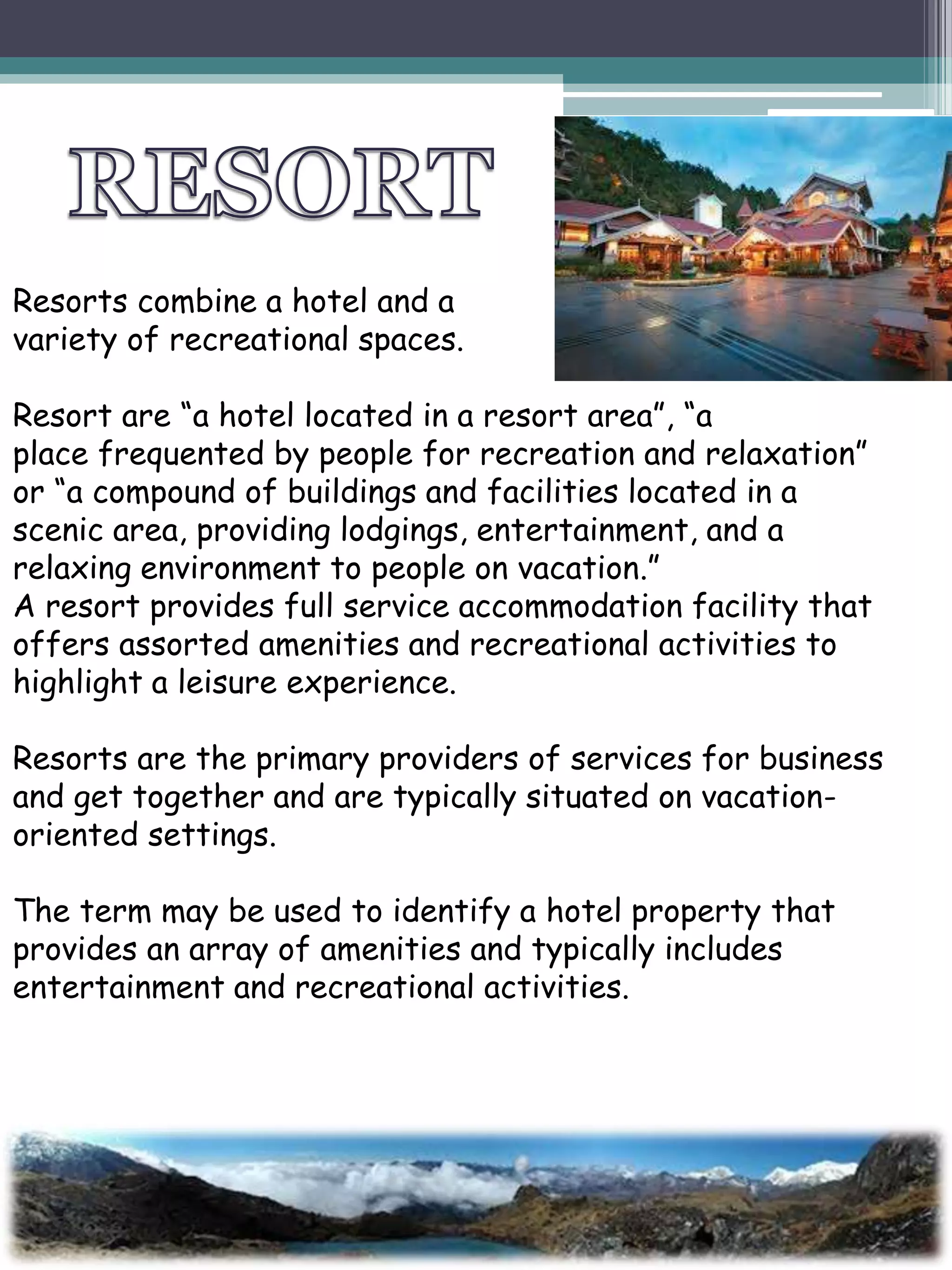
Resorts combine a hotel and a
variety of recreational spaces.
Resort are “a hotel located in a resort area”, “a
place frequented by people for recreation and relaxation”
or “a compound of buildings and facilities located in a
scenic area, providing lodgings, entertainment, and a
relaxing environment to people on vacation.”
A resort provides full service accommodation facility that
offers assorted amenities and recreational activities to
highlight a leisure experience.
Resorts are the primary providers of services for business
and get together and are typically situated on vacation-
oriented settings.
The term may be used to identify a hotel property that
provides an array of amenities and typically includes
entertainment and recreational activities.
The components of resorts are:
Accommodation spaces.
Administration spaces.
Sports complex.
Nature space .
Relaxing space.
Attraction point or views.
Shopping complex etc..
Resort Hotel
A Resort Hotel is a Hotel located in a resort
destination which typically offers some recreational
amenities which
are sometimes seen more as a necessary complement
to the basic lodging product rather than exploited as
a significant revenue generator and separate business
unit. These properties are often sub- categorized
depending on their location such as:
Beach Resort
Mountain Resort
Urban Resort
Golf Resort
Island Resort
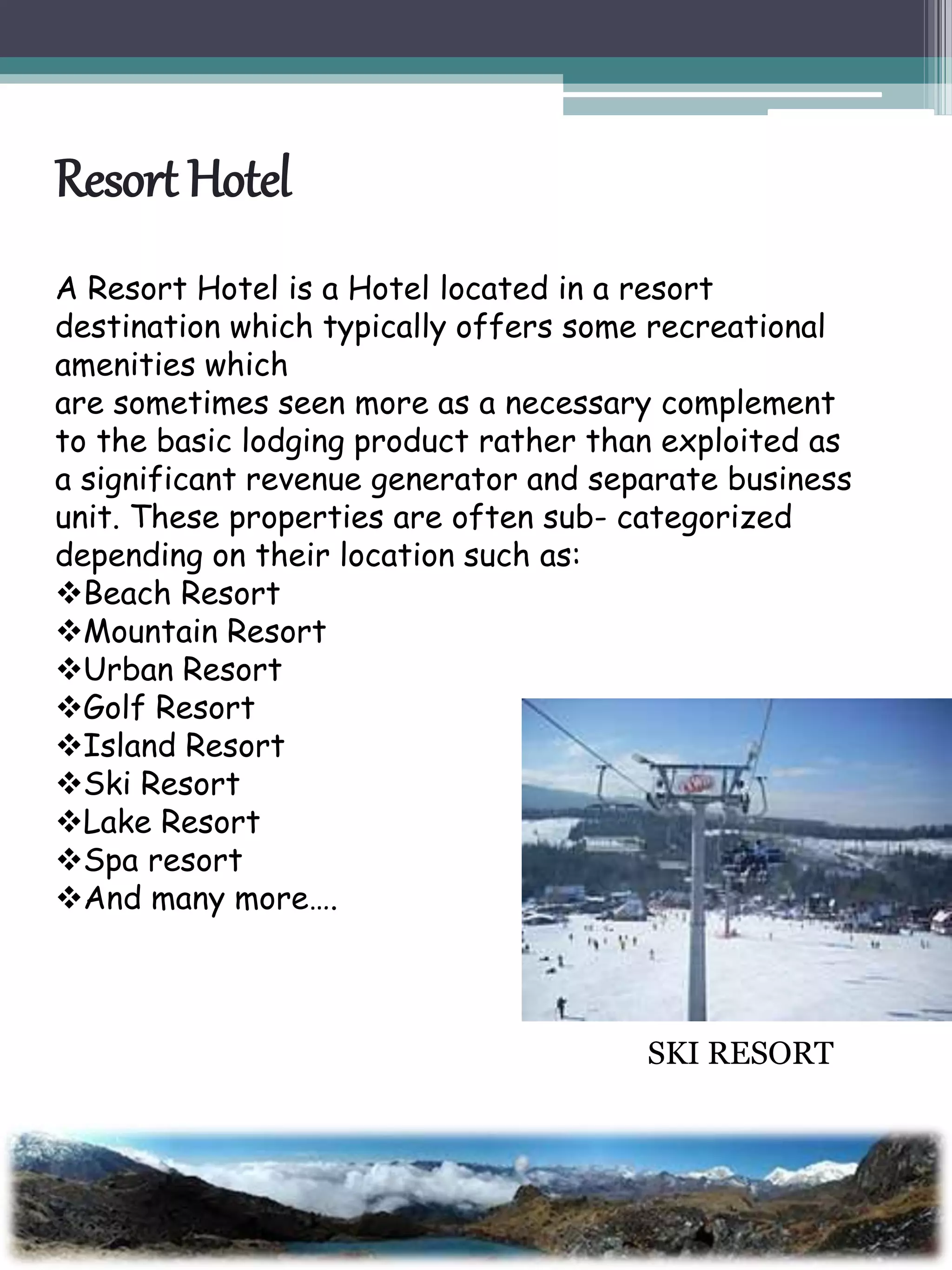
Ski Resort
Lake Resort
Spa resort
And many more….
SKI RESORT
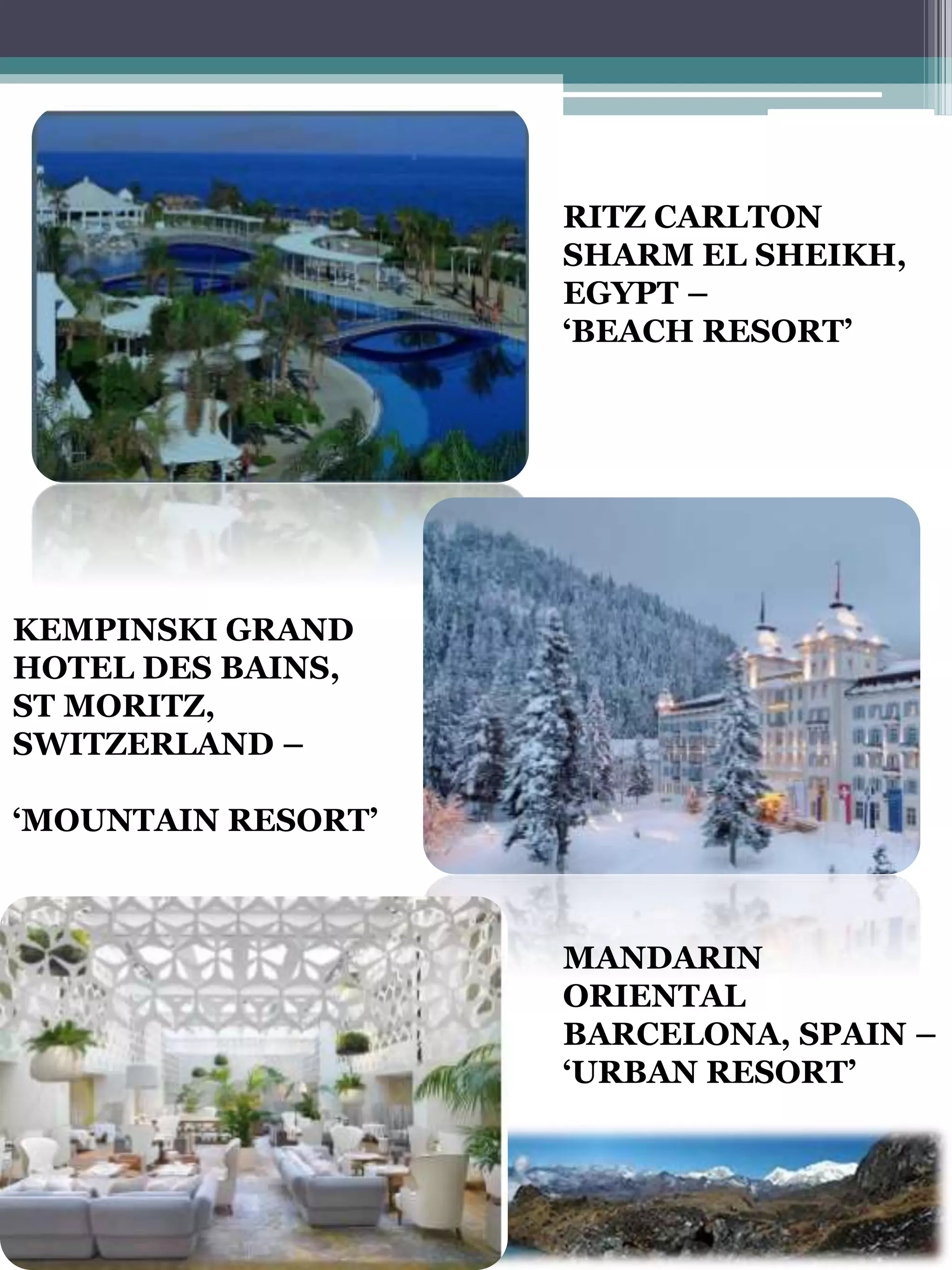
RITZ CARLTON
SHARM EL SHEIKH,
EGYPT –
‘BEACH RESORT’
KEMPINSKI GRAND
HOTEL DES BAINS,
ST MORITZ,
SWITZERLAND –
‘MOUNTAIN RESORT’
MANDARIN
ORIENTAL
BARCELONA, SPAIN –
‘URBAN RESORT’
MixedUse Resort
A Mixed Use Resort brings together, in a master-
planned integrated development, a number of
business models,
each of which is typically managed as a separate
business unit and which may have common or
separate
ownership.
Mixed Use business models include, but are not
limited to:
Hotel
Condo Hotel
Sale & Leaseback Holiday Homes
Vacation Ownership/Timeshare
Fractional Ownership/Private Residence Club
 Branded/Managed Residences
 Bars & Restaurants
Spa & Fitness Centre
Golf Courses & Academy
Casino
Marina
Equestrian Centre
§ Conference Centre/Events Arena
§ Sports Facilities
§ Retail & Offices
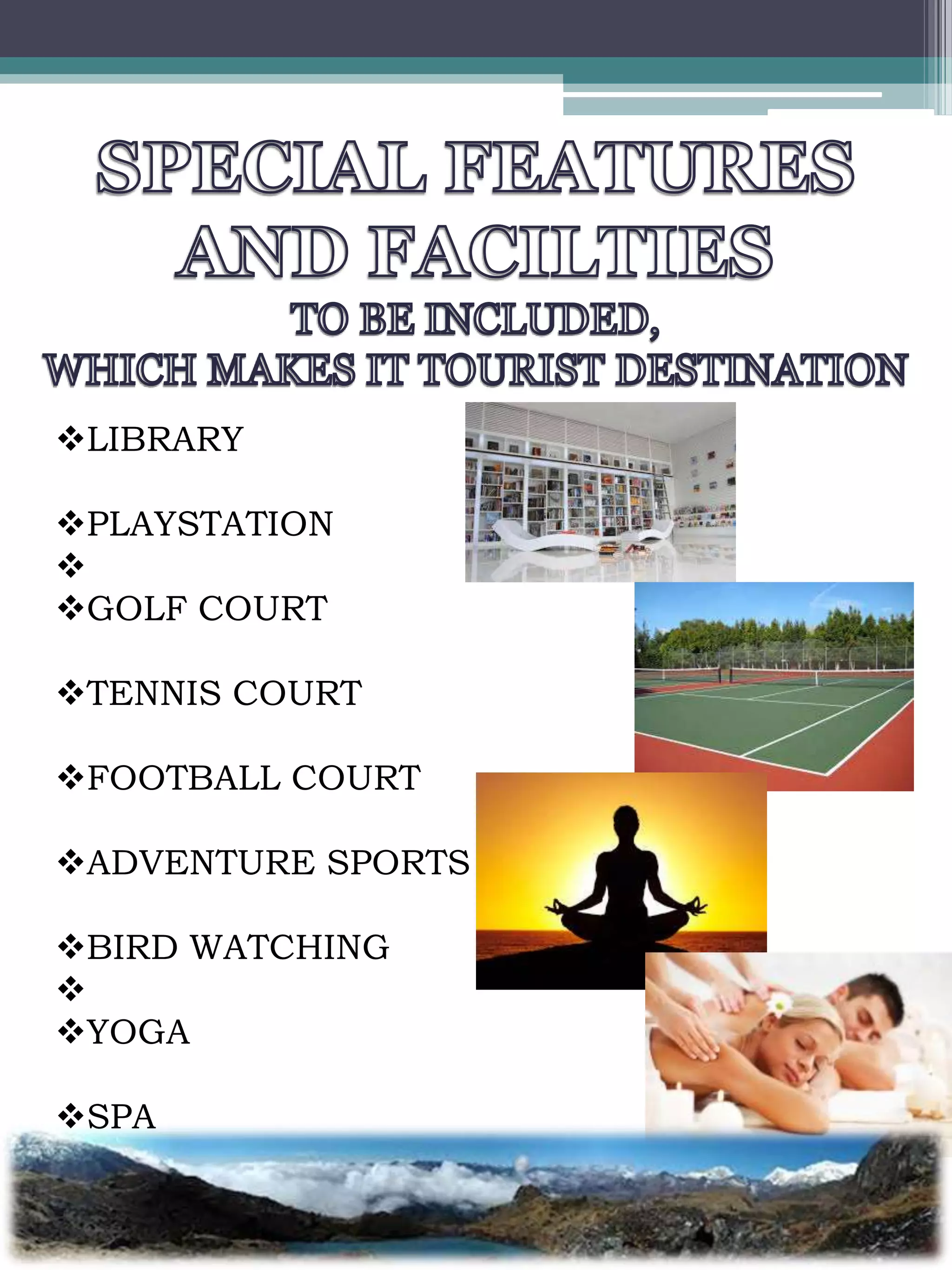
LIBRARY
PLAYSTATION

GOLF COURT
TENNIS COURT
FOOTBALL COURT
ADVENTURE SPORTS
BIRD WATCHING

YOGA
SPA
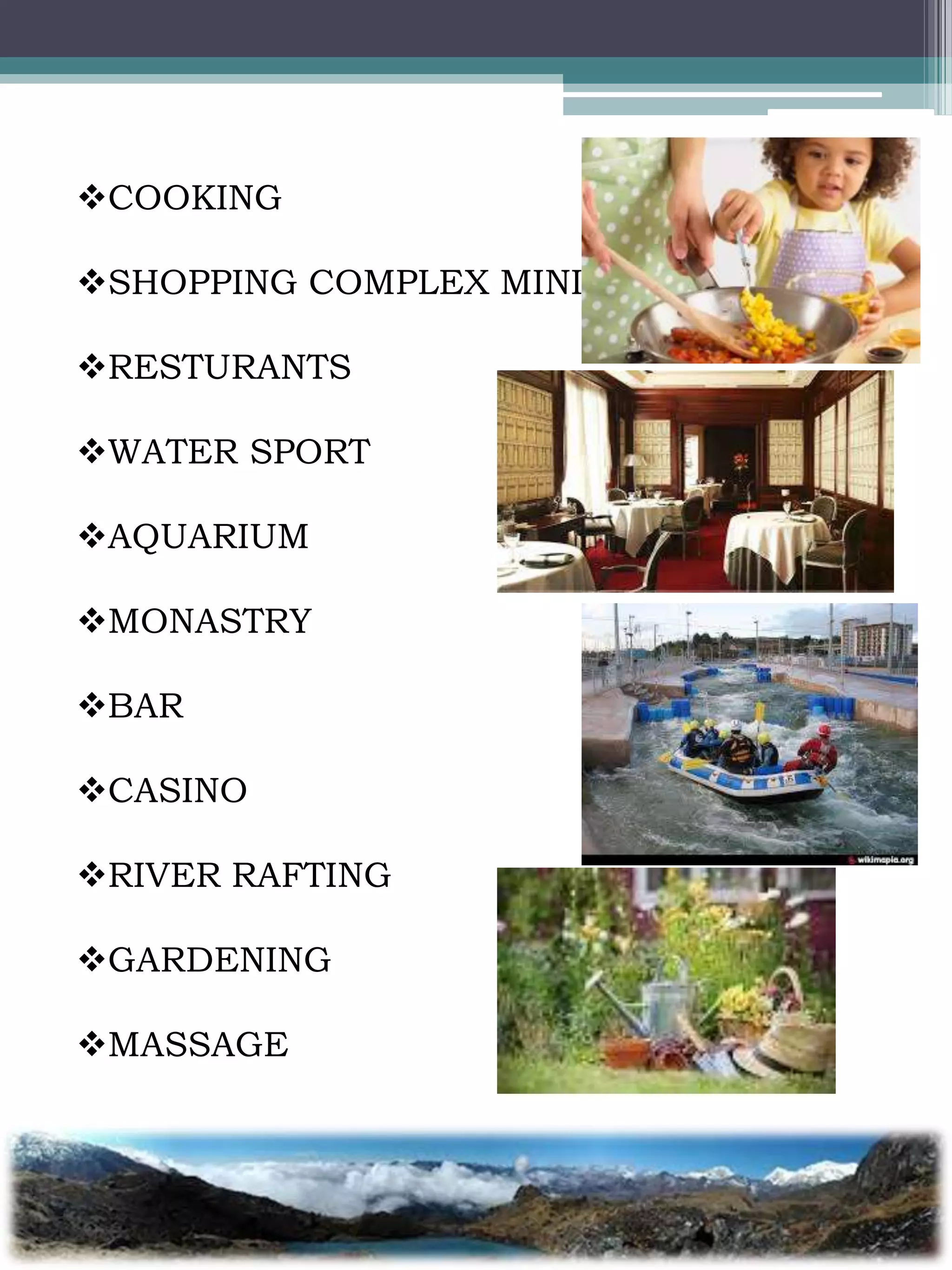
COOKING
SHOPPING COMPLEX MINI
RESTURANTS
WATER SPORT
AQUARIUM
MONASTRY
BAR
CASINO
RIVER RAFTING
GARDENING
MASSAGE
The various major challenges are:
•Frequent and seismic tremors.
•Problems of soil erosion and landslides.
•Suitable orientation on the hill slopes.
•Existence of tall shoddy trees and the dense
•forest area, which obstruct the winter sun required
for the buildings.
•Limitation of the heights of the building due to
earthquake risk.
•High cost involved in the site development due to
the cutting and the filling process.
•Non availability and transportation problems of
construction materials.
•Availability of excess of water.
•Fauna like algae etc.
•Construction of building
•Across deep gorges
•Rivers with boundary beds
•In extreme temperature zones
•Sharp turns on highways.
•Extreme temperature zones.
•Problematic labor procurement.
•Insufficient safety measures - Landslide or debris flow,
deep gorges.
•Ineffectual material transportation.
•Insubstantial waste deployment.
•Construction in hilly terrain is more expensive than
building on a flat area because of the cutting and filling
as the foundation has to go deeper up to the rocky part
so that the structure stands on a firm ground.
•The materials used when constructing on a hill are the
same: cement, reinforcement bars, sand and binding wire.
However, the quantity and quality of the materials is
much, much more. For example, the reinforcement bars
are bigger, increasing the total cost.
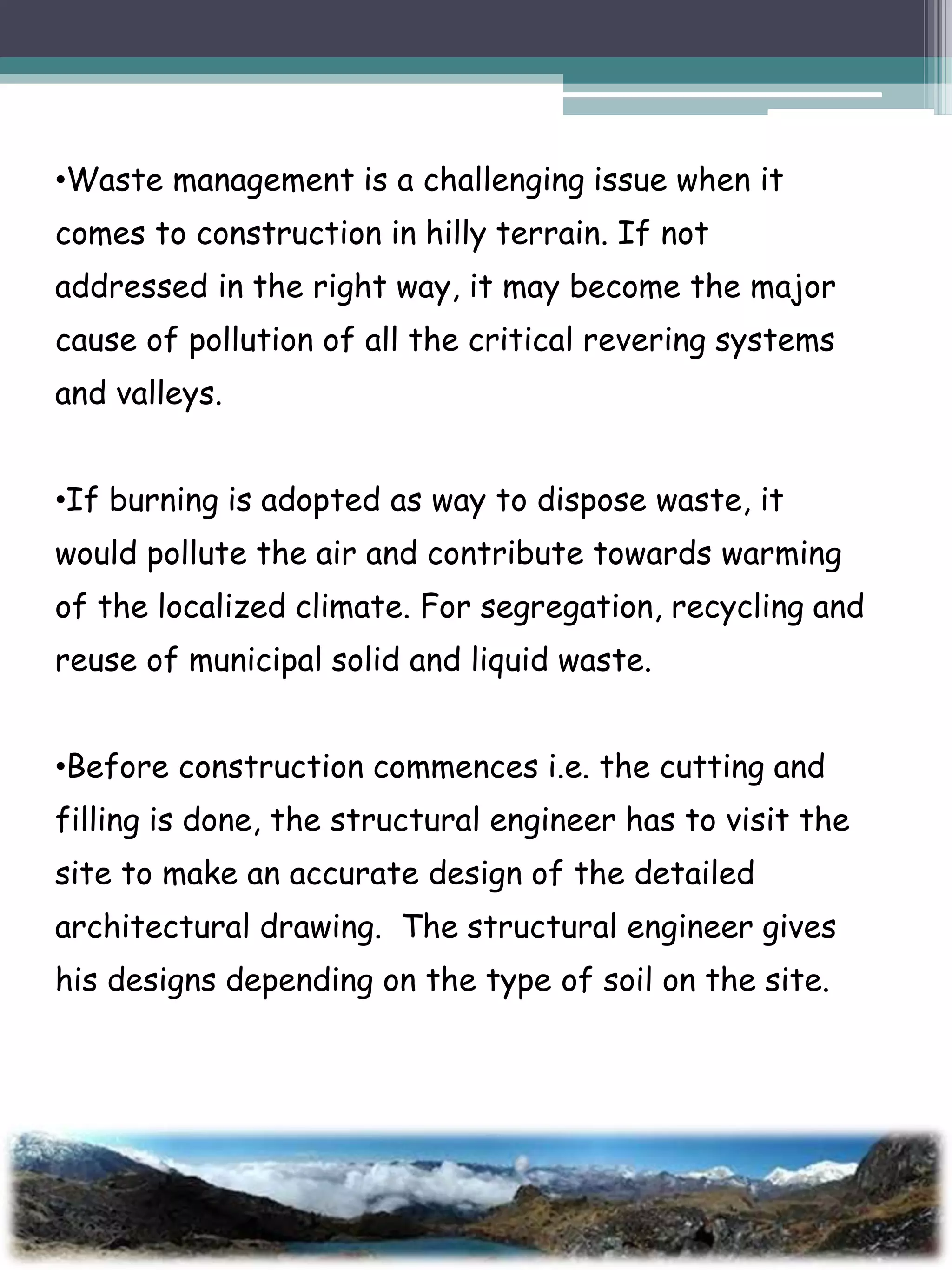
•Waste management is a challenging issue when it
comes to construction in hilly terrain. If not
addressed in the right way, it may become the major
cause of pollution of all the critical revering systems
and valleys.
•If burning is adopted as way to dispose waste, it
would pollute the air and contribute towards warming
of the localized climate. For segregation, recycling and
reuse of municipal solid and liquid waste.
•Before construction commences i.e. the cutting and
filling is done, the structural engineer has to visit the
site to make an accurate design of the detailed
architectural drawing. The structural engineer gives
his designs depending on the type of soil on the site.
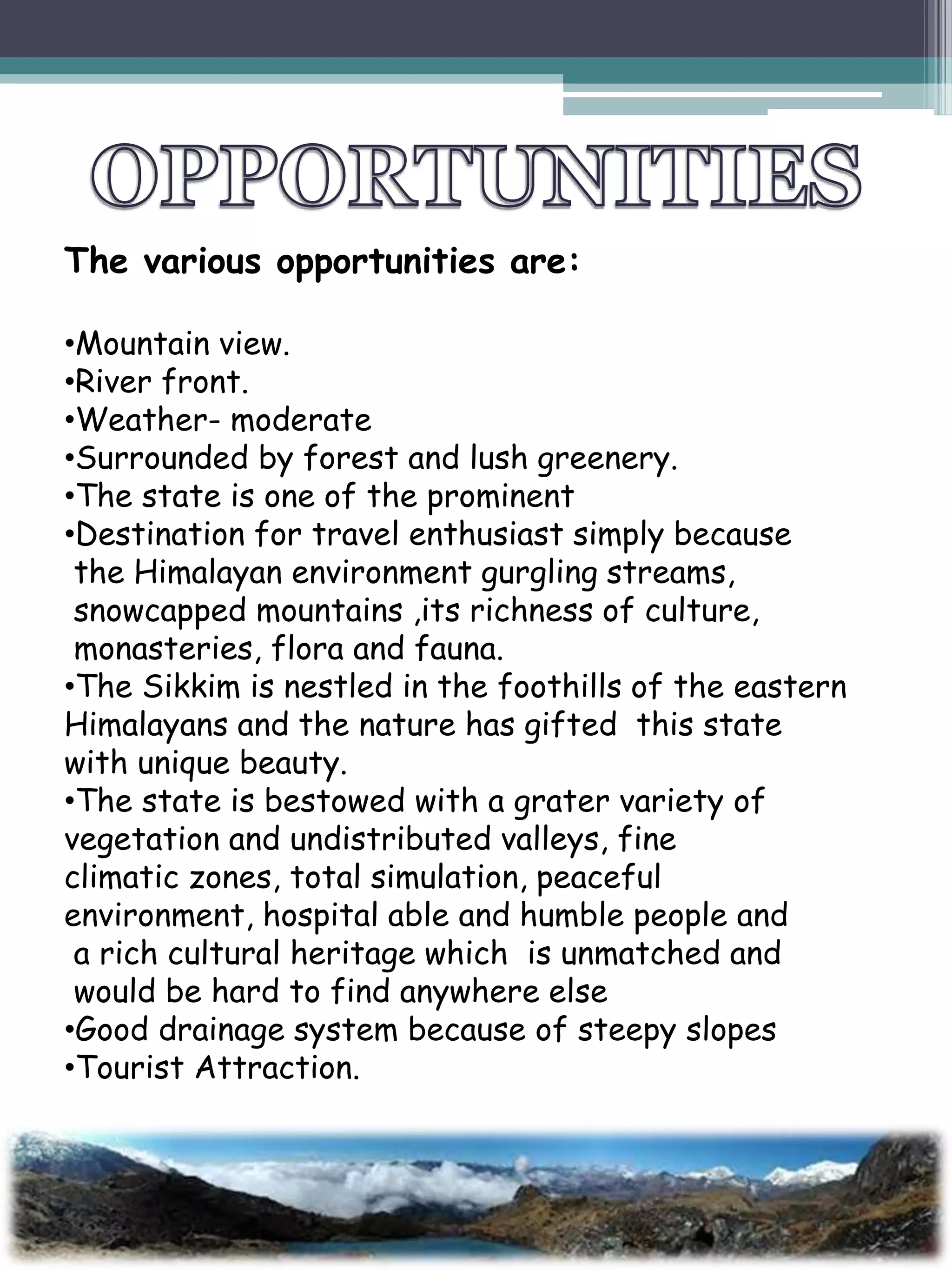
The various opportunities are:
•Mountain view.
•River front.
•Weather- moderate
•Surrounded by forest and lush greenery.
•The state is one of the prominent
•Destination for travel enthusiast simply because
the Himalayan environment gurgling streams,
snowcapped mountains ,its richness of culture,
monasteries, flora and fauna.
•The Sikkim is nestled in the foothills of the eastern
Himalayans and the nature has gifted this state
with unique beauty.
•The state is bestowed with a grater variety of
vegetation and undistributed valleys, fine
climatic zones, total simulation, peaceful
environment, hospital able and humble people and
a rich cultural heritage which is unmatched and
would be hard to find anywhere else
•Good drainage system because of steepy slopes
•Tourist Attraction.
HOW TO ACHIEVE
Landscape Design entails several key elements that are
universal to all design projects, regardless of if they are
for a home, business, or park.
These include –
•Focal Points
•Line
•Form
•Texture
Landscape design should be designed – a design should
not happen by accident but should be the result of
coordinated and intentional plantings and arrangements.
These elements should be considered, planned, and
evaluated prior to any actual work.
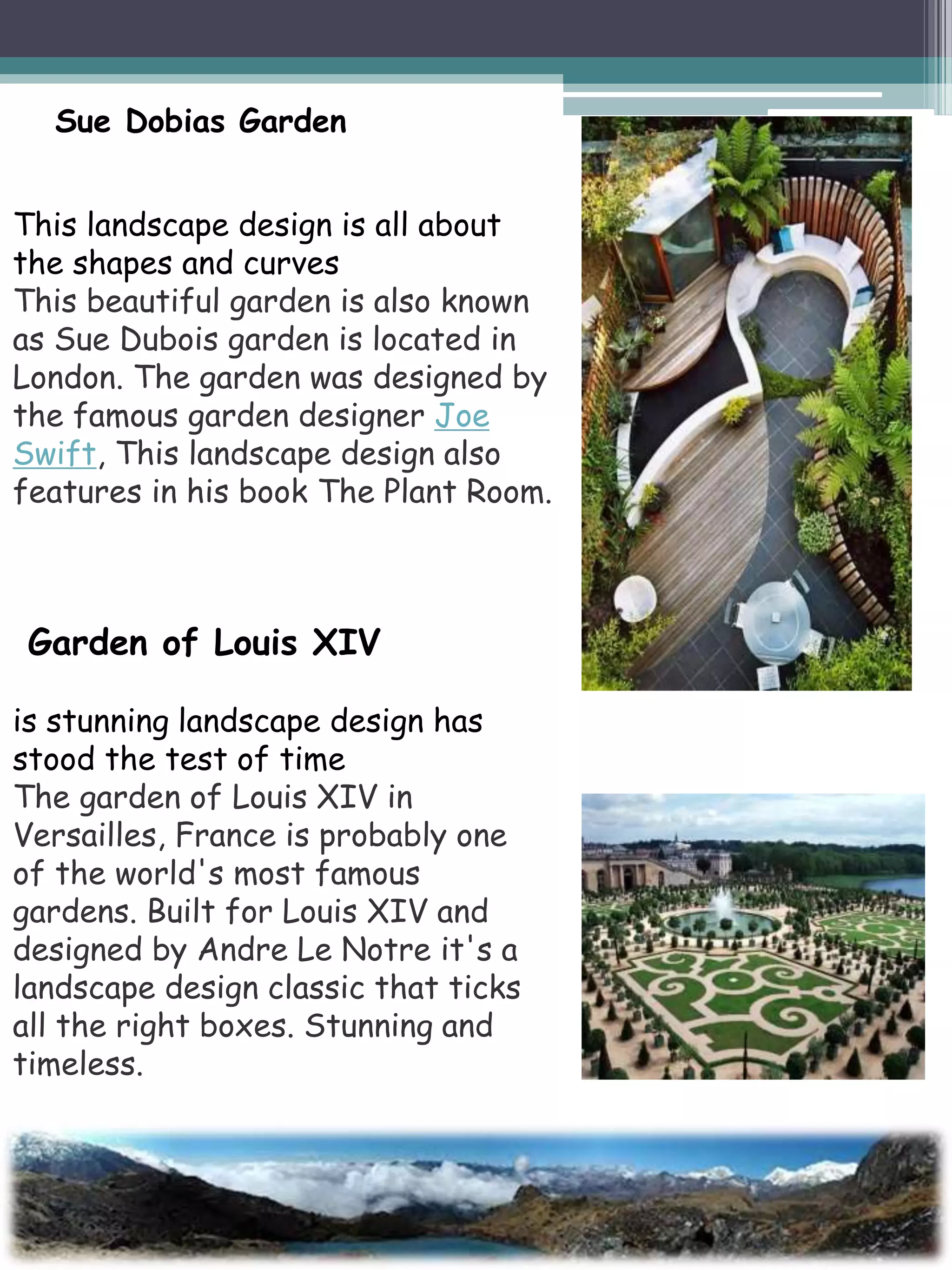
This landscape design is all about
the shapes and curves
This beautiful garden is also known
as Sue Dubois garden is located in
London. The garden was designed by
the famous garden designer Joe
Swift, This landscape design also
features in his book The Plant Room.
Sue Dobias Garden
Garden of Louis XIV
is stunning landscape design has
stood the test of time
The garden of Louis XIV in
Versailles, France is probably one
of the world's most famous
gardens. Built for Louis XIV and
designed by Andre Le Notre it's a
landscape design classic that ticks
all the right boxes. Stunning and
timeless.
RUPE HOUSE
This innovative design space makes the most of its
surroundings
Italian design house Bamboo Studio came up with this
innovative in-earth design space for a work currently
in progress. The hidden house makes the most of its
surroundings and becomes an integral part of this
beautiful landscape.
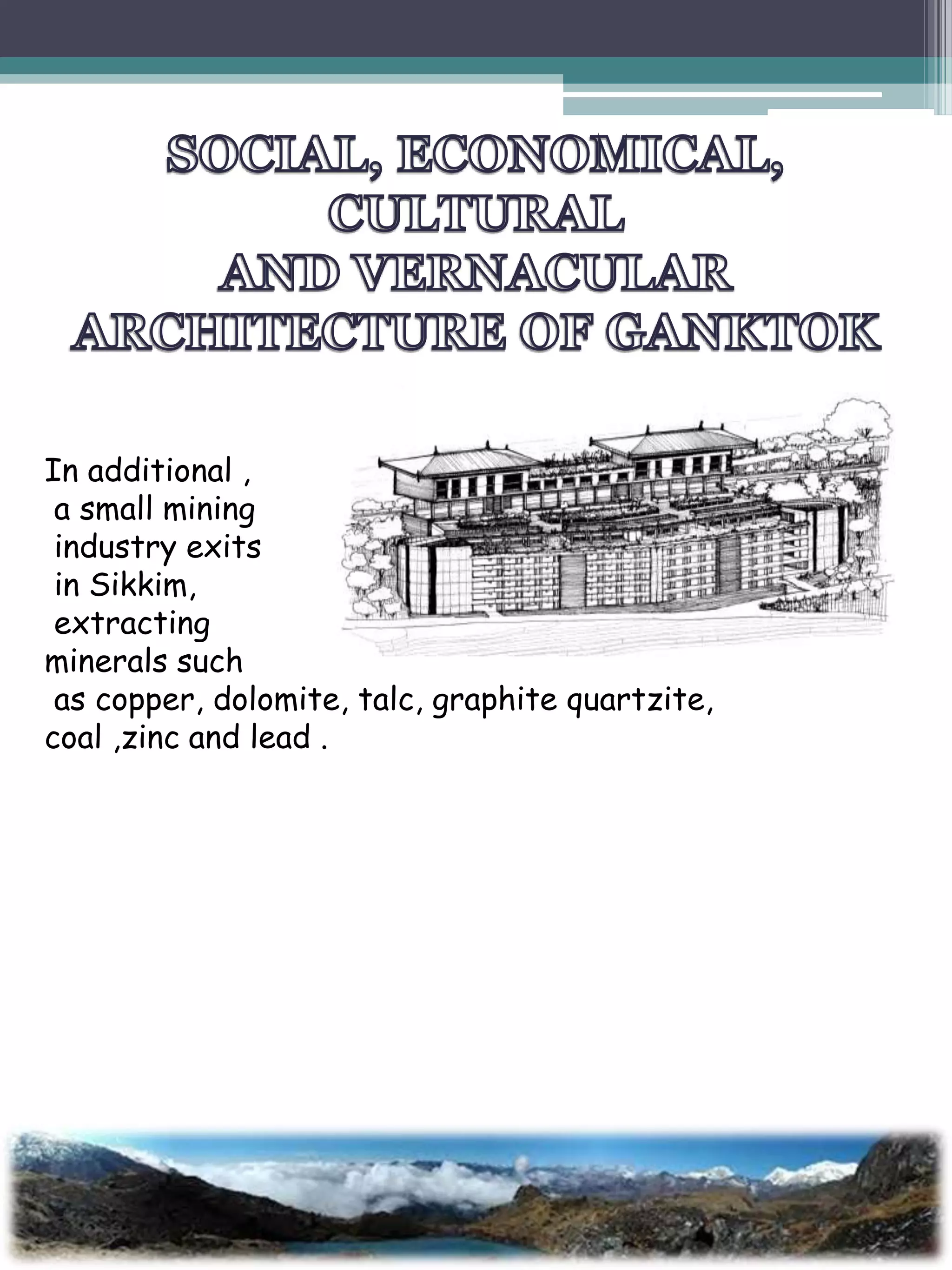
In additional ,
a small mining
industry exits
in Sikkim,
extracting
minerals such
as copper, dolomite, talc, graphite quartzite,
coal ,zinc and lead .
As in vernaculars houses used to be single storied with
place for animals in lower deck and upper deck as
residential with centrally heating hearth. Skilled in bamboo
crafts. So traditional houses have some component as
bamboo craft with exquisite colors.
Bhutia are the one who built villages in larger portions. A
bhutia house called “khim” is usually of rectangular shape .
The vernacular architecture of Sikkim has been influenced
by the socio-economic changes in the state and by the
state’s trade link with China, Nepal, Tibet and Bhutan.
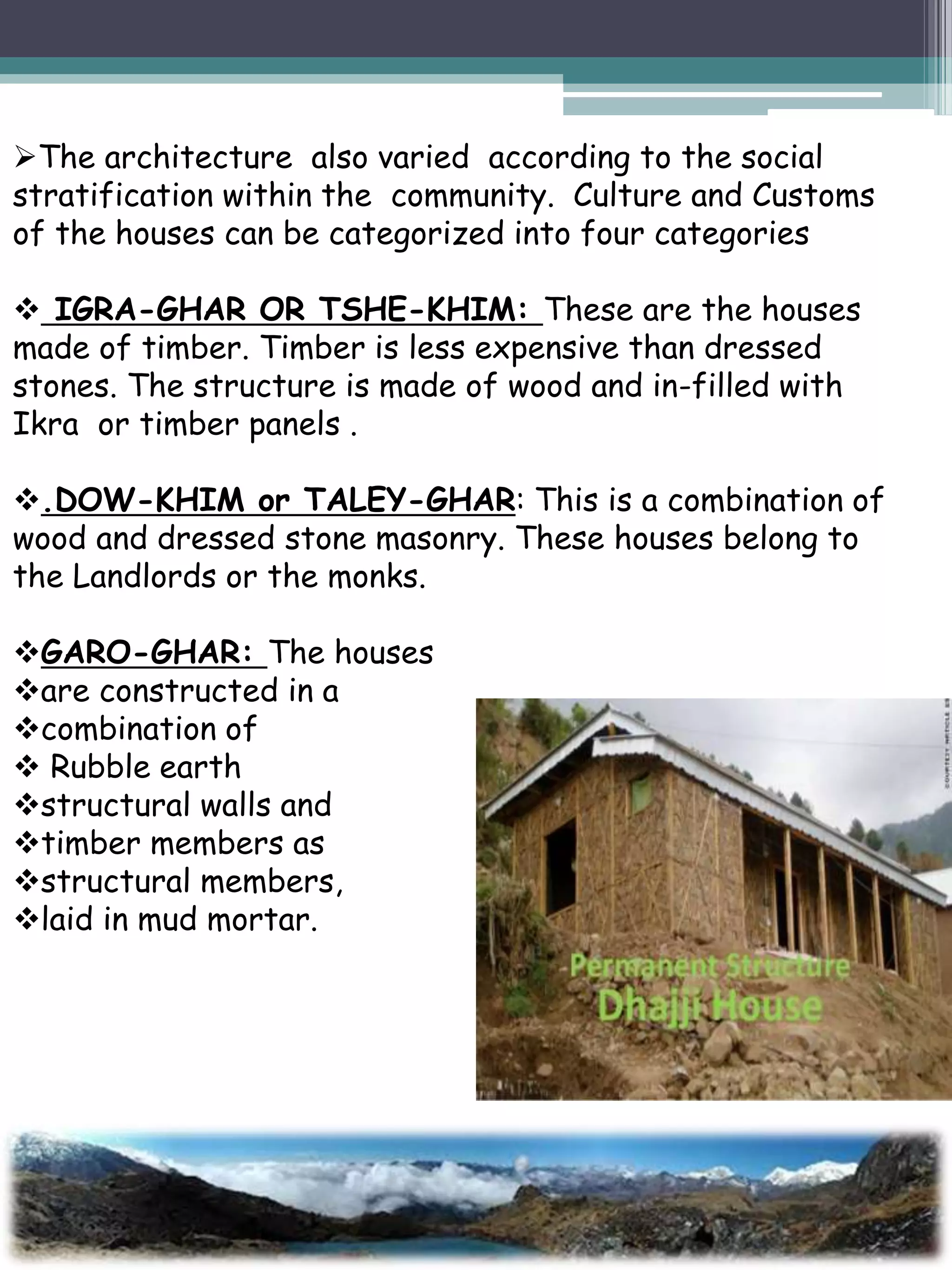
The architecture also varied according to the social
stratification within the community. Culture and Customs
of the houses can be categorized into four categories
 IGRA-GHAR OR TSHE-KHIM: These are the houses
made of timber. Timber is less expensive than dressed
stones. The structure is made of wood and in-filled with
Ikra or timber panels .
.DOW-KHIM or TALEY-GHAR: This is a combination of
wood and dressed stone masonry. These houses belong to
the Landlords or the monks.
GARO-GHAR: The houses
are constructed in a
combination of
 Rubble earth
structural walls and
timber members as
structural members,
laid in mud mortar.
CHIRTA KO GHAR: This is a combination
of bamboo framework with wattle walls. They
are mostly found in medium and lower
altitudes. The roof has
 regional variations - thatch or bamboo mats
or flat
stones are used for
roofing. The houses are
raised 4-6 feet above ground, to shelter
animals and cold, and as a storage space. The
limited availability of glass, influences the
size of windows.
The traditional Bukhari is a wood-burning stove, having a wide
cylindrical fire chamber, where wood or charcoal is burned,
and a narrow cylindrical pipe that acts as a chimney. It is
used extensively in the Himalayan belt, and has regional
variations. The Bukhari is the only source of heating in the
households, and each house has a single Bukhari in the L/D/K
space. In Sikkim, the
Thanks a lot

CONSIDERATION FOR BUILDING A RESORT IN SIKKIM

  • 1.
    Resorts combine ahotel and a variety of recreational spaces. Resort are “a hotel located in a resort area”, “a place frequented by people for recreation and relaxation” or “a compound of buildings and facilities located in a scenic area, providing lodgings, entertainment, and a relaxing environment to people on vacation.” A resort provides full service accommodation facility that offers assorted amenities and recreational activities to highlight a leisure experience. Resorts are the primary providers of services for business and get together and are typically situated on vacation- oriented settings. The term may be used to identify a hotel property that provides an array of amenities and typically includes entertainment and recreational activities.
  • 2.
    The components ofresorts are: Accommodation spaces. Administration spaces. Sports complex. Nature space . Relaxing space. Attraction point or views. Shopping complex etc..
  • 3.
    Resort Hotel A ResortHotel is a Hotel located in a resort destination which typically offers some recreational amenities which are sometimes seen more as a necessary complement to the basic lodging product rather than exploited as a significant revenue generator and separate business unit. These properties are often sub- categorized depending on their location such as: Beach Resort Mountain Resort Urban Resort Golf Resort Island Resort Ski Resort Lake Resort Spa resort And many more…. SKI RESORT
  • 4.
    RITZ CARLTON SHARM ELSHEIKH, EGYPT – ‘BEACH RESORT’ KEMPINSKI GRAND HOTEL DES BAINS, ST MORITZ, SWITZERLAND – ‘MOUNTAIN RESORT’ MANDARIN ORIENTAL BARCELONA, SPAIN – ‘URBAN RESORT’
  • 5.
    MixedUse Resort A MixedUse Resort brings together, in a master- planned integrated development, a number of business models, each of which is typically managed as a separate business unit and which may have common or separate ownership. Mixed Use business models include, but are not limited to: Hotel Condo Hotel Sale & Leaseback Holiday Homes Vacation Ownership/Timeshare Fractional Ownership/Private Residence Club  Branded/Managed Residences  Bars & Restaurants Spa & Fitness Centre Golf Courses & Academy Casino Marina Equestrian Centre § Conference Centre/Events Arena § Sports Facilities § Retail & Offices
  • 6.
    LIBRARY PLAYSTATION  GOLF COURT TENNIS COURT FOOTBALLCOURT ADVENTURE SPORTS BIRD WATCHING  YOGA SPA
  • 7.
    COOKING SHOPPING COMPLEX MINI RESTURANTS WATERSPORT AQUARIUM MONASTRY BAR CASINO RIVER RAFTING GARDENING MASSAGE
  • 8.
    The various majorchallenges are: •Frequent and seismic tremors. •Problems of soil erosion and landslides. •Suitable orientation on the hill slopes. •Existence of tall shoddy trees and the dense •forest area, which obstruct the winter sun required for the buildings. •Limitation of the heights of the building due to earthquake risk. •High cost involved in the site development due to the cutting and the filling process. •Non availability and transportation problems of construction materials. •Availability of excess of water. •Fauna like algae etc. •Construction of building •Across deep gorges •Rivers with boundary beds •In extreme temperature zones •Sharp turns on highways.
  • 9.
    •Extreme temperature zones. •Problematiclabor procurement. •Insufficient safety measures - Landslide or debris flow, deep gorges. •Ineffectual material transportation. •Insubstantial waste deployment. •Construction in hilly terrain is more expensive than building on a flat area because of the cutting and filling as the foundation has to go deeper up to the rocky part so that the structure stands on a firm ground. •The materials used when constructing on a hill are the same: cement, reinforcement bars, sand and binding wire. However, the quantity and quality of the materials is much, much more. For example, the reinforcement bars are bigger, increasing the total cost.
  • 10.
    •Waste management isa challenging issue when it comes to construction in hilly terrain. If not addressed in the right way, it may become the major cause of pollution of all the critical revering systems and valleys. •If burning is adopted as way to dispose waste, it would pollute the air and contribute towards warming of the localized climate. For segregation, recycling and reuse of municipal solid and liquid waste. •Before construction commences i.e. the cutting and filling is done, the structural engineer has to visit the site to make an accurate design of the detailed architectural drawing. The structural engineer gives his designs depending on the type of soil on the site.
  • 11.
    The various opportunitiesare: •Mountain view. •River front. •Weather- moderate •Surrounded by forest and lush greenery. •The state is one of the prominent •Destination for travel enthusiast simply because the Himalayan environment gurgling streams, snowcapped mountains ,its richness of culture, monasteries, flora and fauna. •The Sikkim is nestled in the foothills of the eastern Himalayans and the nature has gifted this state with unique beauty. •The state is bestowed with a grater variety of vegetation and undistributed valleys, fine climatic zones, total simulation, peaceful environment, hospital able and humble people and a rich cultural heritage which is unmatched and would be hard to find anywhere else •Good drainage system because of steepy slopes •Tourist Attraction.
  • 12.
    HOW TO ACHIEVE LandscapeDesign entails several key elements that are universal to all design projects, regardless of if they are for a home, business, or park. These include – •Focal Points •Line •Form •Texture Landscape design should be designed – a design should not happen by accident but should be the result of coordinated and intentional plantings and arrangements. These elements should be considered, planned, and evaluated prior to any actual work.
  • 13.
    This landscape designis all about the shapes and curves This beautiful garden is also known as Sue Dubois garden is located in London. The garden was designed by the famous garden designer Joe Swift, This landscape design also features in his book The Plant Room. Sue Dobias Garden Garden of Louis XIV is stunning landscape design has stood the test of time The garden of Louis XIV in Versailles, France is probably one of the world's most famous gardens. Built for Louis XIV and designed by Andre Le Notre it's a landscape design classic that ticks all the right boxes. Stunning and timeless.
  • 14.
    RUPE HOUSE This innovativedesign space makes the most of its surroundings Italian design house Bamboo Studio came up with this innovative in-earth design space for a work currently in progress. The hidden house makes the most of its surroundings and becomes an integral part of this beautiful landscape.
  • 15.
    In additional , asmall mining industry exits in Sikkim, extracting minerals such as copper, dolomite, talc, graphite quartzite, coal ,zinc and lead .
  • 16.
    As in vernacularshouses used to be single storied with place for animals in lower deck and upper deck as residential with centrally heating hearth. Skilled in bamboo crafts. So traditional houses have some component as bamboo craft with exquisite colors. Bhutia are the one who built villages in larger portions. A bhutia house called “khim” is usually of rectangular shape . The vernacular architecture of Sikkim has been influenced by the socio-economic changes in the state and by the state’s trade link with China, Nepal, Tibet and Bhutan.
  • 17.
    The architecture alsovaried according to the social stratification within the community. Culture and Customs of the houses can be categorized into four categories  IGRA-GHAR OR TSHE-KHIM: These are the houses made of timber. Timber is less expensive than dressed stones. The structure is made of wood and in-filled with Ikra or timber panels . .DOW-KHIM or TALEY-GHAR: This is a combination of wood and dressed stone masonry. These houses belong to the Landlords or the monks. GARO-GHAR: The houses are constructed in a combination of  Rubble earth structural walls and timber members as structural members, laid in mud mortar.
  • 18.
    CHIRTA KO GHAR:This is a combination of bamboo framework with wattle walls. They are mostly found in medium and lower altitudes. The roof has  regional variations - thatch or bamboo mats or flat stones are used for roofing. The houses are raised 4-6 feet above ground, to shelter animals and cold, and as a storage space. The limited availability of glass, influences the size of windows. The traditional Bukhari is a wood-burning stove, having a wide cylindrical fire chamber, where wood or charcoal is burned, and a narrow cylindrical pipe that acts as a chimney. It is used extensively in the Himalayan belt, and has regional variations. The Bukhari is the only source of heating in the households, and each house has a single Bukhari in the L/D/K space. In Sikkim, the
  • 19.