maw
rd
Acknowledgments
My sincere thanksto all the responsive and generous individ-
uals and organizations who sent me tapes of Ben’s lectures,
which served as a basis for a part of this book and made it
possible for me to complete :t.
The comments, editing, and advice of my friends were
invaluable, and I thank them sincerely.
Mirtala
5.
Contents
FOREWORD xt
A NOTEON BEN by Jean Houston xp
PREFACE xxt
INTRODUCTION 1
PART 1 THE FERTILE VOID
The Model of the Universe*
The Nature of the Absolute*
Things Manifest and Potential
PART 2 ON DEVAS, GODS, AND CREATORS
Rudimentary and Higher Consciousness
The Devas
Mr. and Mrs. Creator and the Making of a
Universe*
PART 3 BEYOND THE UNIVERSE*
The Cosmos
The Super-Cosmos
Why Evolution?
The Manifest Creation or All-There-Is
11
13
17
19
23
25
31
37
41
43
30
57
59
6.
x Contents
PART 4A GUIDED TOUR OF NIRVANA 65
Encounter With Naga 67
The Blue-Collar Workers 7.
The Zoo 7:
The Absolute Paradox* i
PARTS WHO'S RUNNING THE SHOW? 79
Meeting Your Higher Self 81
Summing It Up 85
APPENDIX
What ts a Holagram? 9
Essay on Cosmology by Edward Apgar 97
A Portrait of Ben Excerpts from Letters 113
* These sections have been reconstructed from Itzhak Bentov's notes and
tapes and additional illustrations provided by Murtala
Foreword
by Christopher Bird
After the publication of Stalking the Wild Pendulum in 1977,
its author, Itzhak “Ben” Bentov, was asked by an interviewer
why he had chosen so curious a title for his work. Replied the
author. “Because everything in the universe that is visible or
manifest behaves like a pendulum moving from one point of
rest to another. In other words, all matter vibrates.”
Bentov went on to assert that pendulums, just as they reach
the culmination of their swings in one direction, and before
they start back in the other, actually disappear for a minus-
cularly brief period, vanishing from what passes for “reality,”
then reentering it.
One aim of Bentov’s allusion to an evanescent quality in the
pendular swing was doubtless to jolt his readers into insights
beyond conventional thinking in the same way that a Zen
master uses a koan to vault his postulants beyond the domain
of “common sense” into that realm of Buddhist enlightenment
known as satori.
It was Bentov's view that human beings themselves behave
something like pendulums in that, throughout the swings of
life, they build a picture of the universe on the basis of an “on-
off” switching mechanism. During the “off” periods, they can
expand into a region unbounded by time and space, then
xi
7.
xn Foreword
collapse backto contmue “normal” life as if nothing extraordi-
nary had happened. Such periods of ecstasy range from the
fleeting to the more enduring.
Letters received by Bentov suggest that his readers did not
find it difficult, in fact were eager, to embrace this conceit. He
seemed able to affect in them a chord all too ready to resonate
if plucked. The director for executive recruitment of a large
international firm of certified public accountants, headquar-
tered in New York, wrote. “Having a nonscientific but inquir-
ing mind, your explanation of the workings of Nature gave mea
better grasp of the cosmos and the relationship of human
beings thereto than any thing I have read to date. Thank you for
opening the horizons of my mind. — my soul, . . and please
start another book.”
The present short work is the evidence that Bentov heeded
that injunction to produce a sequel, a task ably finished by his
talented sculptress wife, Mirtala, after his untimely death.
The verb “to invent,” as its Latin derivation, invenire, con-
notes, means to “come on’ or, more idiomatically, to “happen
on” or “come across.” implying a fortuitous event or unplanned
action. Asa skilled plyer of the mventor’s trade for much of his
life, Bentov's day-to-day experience convinced him that peo-
ple can visit an extracorporeal, nonmaterial province where
so-called “objective” time—as measured by watches and
clocks—is suspended and gives way to shorter or longer
periods of “subjective” time in which one can be anywhere and
do anything one wishes, limited only by creative imagination.
As far back as 1909—-perhaps unknown to Bentov—the
British jurist Thomas Troward, in his lectures on mental sci-
ence delivered at Edinburgh University, discussed a “subjec-
tive” mind that he held to encompass all time and all space.
Troward was exploring a terra incognita of which academic
psychology 1s only beginning to take note. Such pioneers as
Elmer and Alvce Green, of the Voluntary Controls Center at
Foreword xiii
the Menninger Foundation in Topeka, Kansas, have discov-
ered that subjects trained in meditation can attain mental
states in which their brains emit waves, called theta, at rates
between four and eight cycles per second. During this “theta
reverie, the subjects are bombarded with hosts of vivid, often
symbolic, images, occasionally so alarming as to be severely
disturbing.
Bentov, it appears, came to the realization that, if the
reverie were subject to willful control and focused on a specific
problem, the images received would contribute to its solution.
He not infrequently experienced what he termed “Ah, hah!”
moments when ordinary mental processes, slipping their
moorings of rationality to hoist sails into the winds of intuition,
could seize prizes of pure information on the ocean of the
infinite.
The act of apprehending the supersensible was, in an earlier
day, attributed to gnosis, or intuitively revealed knowledge
that, during an “age of reason,” ceded its place to scientia,
or knowledge based on sensory information and _ repeat-
able experiments. The substitution of the one for the other
was complete the day Baron Verulam Viscount Saint Albans,
better known as Sir Francis Bacon, announced: “Reality
only presents itself to us when we look upon the world of
the senses which alone provide us with realities.” (Emphasis
added.)
Yet, a century ago, Friedrich August Kekulé candidly con-
fessed he had hit on the shape of the benzene ring, a discovery
that laid the basis for modern organic chemistry, as a result not
of painstaking work in his Ghent University laboratory but of
spontaneous imagery that came to him when he was half
asleep. In his report to the German Chemical Society, he
urged his fellow scientists: “Gentlemen, let us learn to
dream!”
A few years later, the Serbian prodigy, Nikola Tesla, whose
discoveries transformed electricity from a scientific curiosity
8.
xe Foreword
to atechnological revolution, while strolling in a Budapest
park was moved to declaim lines from Goethe's Faust:
The day retreats, done ts the day of tol
It yonder hastes. new fields of life exploring
Ah, that a wing could lift me from the soil
Upon its track to follow. follow soaring
The words were hardly out of his mouth when Tesla was
struck by the vision of a magnetic whirlwind turning a motor.
Over the next several days, he worked it up into detailed
blueprints in his mind, where they remained for six years
until, after his emigration to the United States, he elaborated
them into the hardware that became the alternating current
generator.
In our own day, a similar process of mentation was described
by Arthur Young, author of The Reflexive Universe. The Evolu-
tton of Consciousness, and inventor of the first commercial
helicopter built by Larry Bell. During a nineteen-year-long
effort to crack the problem of stabilizing the rotary wing,
Young came to the point where he was sure he was getting
close to the solution. Why? “Because I had a creepy feeling,”
he recalls. “It was as of | were walking around a corner and
expecting something to happen. Even the slightest sound
made me jumpy The first time it occurred, the air felt super-
saturated. I was so sure my idea was going to work that I asked
my patent attorney to witness the first flight. My model was
ready to go, and almost ceremoniously I got it started. It took
off and immediately turned upside down and crashed. My
lawyer was so disgusted he swore he'd never come back for any
more crazy demonstrations. Two or three days later the real
thing came through to me. The preliminary brainwave was a
false alarm. I believe it was because | was anticipating the real
thing.”
Dreams, visions, creepy feelings? Super-saturated air?
Things being “anticipated” and finally “coming through?”
Foreword xe
Coming through from where? Bentov's answer: from a Univer-
sal Mind containing any knowledge desired as long as the
human psyche is prepared, or has prepared itself, to receive it.
As part of his own preparation, Bentov himself at first
resorted to the artifice of a “wet method,” meaning that he
would immerse himself in a bathtub full of water as hot as he
could stand, there to sit, “spaced out,” often for hours at a
stretch, scribbling down ideas on the leaves of a small note pad
and sticking them, one by one, onto the steam-soaked tiled
wall above the tub. In his relaxed “twilight zone” state, some-
thing akin to a hypnagogic dream, he was able to receive
flashes of understanding that he could later synthesize into
solutions to the problems preoccupying him.
Subsequently he found he could dispense with the bathtub
crutch in favor of a “drier” method, that of meditation or
relaxed concentration. By this means, as he put it, “I could
attain remote reality by simply visualizing myself to be there,
and there I was... .”
Among the many problems Bentov was called upon to solve
for companies engaged in diverse fields of endeavor was the
development of a painless hypodermic needle. Seen under
magnification, the tip of a needle has four beveled edges, the
configuration of which determines how effective they are in
penetrating skin and flesh. Since the coring action of the nee-
dies causes the pain, Bentov, in one of his “reveries,” concen-
trated on how Nature herself might most elegantly solve the
problem. It came to him that what he should investigate was
the design of the tips of the fangs of poisonous snakes, since for
millennia, these reptiles seemed to have been, of all creatures,
most adept at hypodermically injecting venomous fluids into
their victims.
Acting on his vision, Bentov betook himself to a Florida
snake ranch, where he was allowed to help himself to as many
dead snakes, killed after their poison had been extracted, as he
could use. After toting home a small sackful of fangs, he found,
9.
xvi Foreword
as hesuspected, that Nature, way ahead of any inventor, had
provided him with exactly the answer he was seeking.
In neither of his books does Bentov provide other examples
of how his voyages into a continuum beyond space and time
helped him in his inventor's art. Rather, they set forth a cos-
mology that came to him piecemeal during his practice of the
“dry method” of revelation. The horizons swept in these
works—which should be read in conjunction—are related to
those opened by seers ranging from Jacob Boehm and Em-
manuel! Swedenborg at the end of the Middle Ages to Helen
Blavatsky and Rudolf Steiner at the turn of the century and to
the received knowledge of many other western mystics, trance
mediums, and spsritually onented visionaries before and
since.
That the truths revealed are far older than their appearance
in western tradition 1s evinced by a letter received by Bentov
from a renowned authority on yoga in India, who wrote:
What vou say about the nature of the Universe 1s authen-
tic . the “point of rest” of your “wild pendulum” 1s
technically called “spanda” in Shaivite philosophy. It is
the initial impulse, throb. Shekti, energy or cosmic will of
the Supreme Reality It is all-persasive energy What vou
call the “off-state” of consciousness 1s called samadhi, or
the super-conscious state in the language of Yoga It is
true that instantaneous communication throughout the
Universe 1s possible The Ultimate Reality of Supreme
Consciousness 18 beyond the limitations of time. Empiri-
cal time or objective time has no meaning in that state.
So categorical an affirmation, as ndeed Bentov’s own con-
clusions, will be summarily brushed aside as meaningless by
materialist philosophies now rampant in the world political
arena. But to those weary of the daily litany chorused in
newspaper headlines, they offer new blazes on a trail into a
realm beyond the mundane.
A Note on Ben
by Jean Houston, Ph.D.
In the thirteenth century, the great German mystic Meister
Eckhart came to the same conclusion that Ben Bentov arrived
at in the late twentieth century He said, “The eye by which I
see God is the same eye by which God sees me.” Eckhart got
into a lot of trouble with the Pope over that one. Bentov,
however, only got us, and God, laughing in agreement Such
are the ways of progress.
In his search for the cosmic connection, Ben offers us a
delightfully ingenious cosmic comedy on the nature and struc-
ture of ultimates. Here are traveler's tales such as you rarely
find—metaphysical jaunts from one end of the universe to the
other. He gives us back the unimaginable universe—unimag-
ined only because the lenses of our local imagination are too
limited to contain it. By opening his own lenses through inten-
sive and consistent meditation, he entered into the field of
quantum resonance wherein one can always gain access to any
part of the universe.
In those unitive states of consciousness associated with mys-
tical experience, rapture, and meditation, there is often a
stilling of the mind, accompanying the regularity and slowing
of brain waves into synchronized alpha and theta patterns.
Sometimes the coherence of the brain’s wave pattern reaches a
xeti
10.
xem A Noteon Ben
proportion that then engages the entire brain wave pattern in
resonance. This results in unbounded—and unlensed—
awareness, mystical experiences, and a genre of feeling and
knowing that seems to belong to a deeper order of reality.
Ben fell into the great hologram of the Way Things Work. In
doing so, he discovered a perspective that is very ancient and
has been known to mystics, magi, and other boundary-break-
ing folk for millennia. One finds an early formal description in
the second-century Buddhist Avatamska Sutra:
In the heaven of Indra there is said to be a network of
pearls, so arranged that if you look at one you see all the
others reflected in it, and if you move into any part of it,
you set off the sound of bells that ring through every part
of the network, through every part of reality
In the same way. each person, each object in the world,
is not merely itself. but involves every other person and
obyect and. in fact. on one level is every other person and
object.
Similarly, the seventeenth-century philosopher Leibniz
declared the universe to be made up of “monads, ” tiny units of
mind, each of which mirrors the universe from the perspective
of its particular point of view At the same time, each compo-
nent, each monad, 1s interrelated with every other, so that, as
in Indra’s net, no monad can be changed without changing
every other.
In cabalistic lore, the hologram finds its occult expression in
the symbol of the Aleph, the point that contains all possible
points in the infinite dance of space-time.
Now if the hologrammatic-Buddhtst-monadic-cabalistic-
Bentovian universe is true, then you are literally ubiquitous
throughout the universe and are being sent out as an inter
ference pattern through the flow emulsion of the ether to all
possible places in the matrix of space-time. Seen from this
perspective, this is a universe of colossal busy-bodyness, with
A Note on Ben xix
everybody involved with everybody else all the time. Ben
never stopped laughing over that one. Seen from this perspec-
tive, too, so-called “psychic” phenomena are only byproducts
of the simultaneous-everywhere-matrix. And synchronicity
—
those coincidental occurrences that seem to have some higher
design or connectedness—would seem to derive from the
purposeful, patterning, organizing nature of the Absolute
What is more, we always have a standing invitation to jom
the Absolute in the co-creation of emerging evolutionary ideas
and forms. That is the hot news that Ben brought back from the
Center of Everywhere.
Ben was an aficionado of waves and frequencies. His own
revelations were modulated through the lenses of engineering
and a passion for structure. He would be the first to say that his
revelations were therefore true but not accurate. He utilized
the current myth of science to understand the nature of reality.
His mysticism was tempered by modern metaphors. For-
tunately, his own lensing was itself shattered by his outrageous
sense of humor. He may have well] laughed himself into Truth.
11.
Preface
Itzhak Bentov—known simplyas Ben—was an inventor,
trained as a mechanical engineer. His imaginative creations
covered a wide range, from paper yarn to explosives to a heart
pacemaker electrode. In his last years, concentration on bio-
medical engineering led him to explore the electromagnetic
field around the body, which he attempted to correlate with
altered states of consciousness, such as dreams or meditation.
He was particularly interested in the physiological changes
produced in the body by meditation. Ultimately, his practical
experience as an engineer led him to develop an overview of
the evolutionary pattern of humankind. He saw the human
nervous system as the key to the process of evolution of con-
sciousness, involving creative energy, or Kundalini,* which
catalyzes and speeds up this process.
Ben spoke of himself as a “nuts-and-bolts man” who dealt
with mechanisms and structures. The descriptive subtitles of
his two books show this interest: “On the Mechanics of Con-
sciousness’t and “On the Mechanics of Creation.” This vol-
ume is a study of the nature of consciousness and its evolution
in terms of expansion into ever higher levels of Creation. In
* A Sanskrit term for creative energy in the human body, located at the
base of the spine Its “awakening” 1s said to open up hngher states of con-
sciousness
+ Itzhak Bentov, Stalking the Wild Pendulum On the Mechanics of Con-
sciousness (Rochester, Vermont. Destiny Books, 1988)
xxi
12.
xxut Preface
meditation, Benperceived these levels visually as ever-
evolving structures, or one could say that consciousness mani-
fested itself to him in forms that revealed its functioning on
different levels. These forms were of a nature most appropriate
and understandable to a man of his particular training and
background.
Evolution pushes humanity toward godhood, “whether we
like it or not,” as Ben put it. All matter. which Ben equated
with consciousness, including human beings, 1s on a conveyor
belt moving upward. and there 1s no way to get off. The process
of evolution of consciousness may be accelerated by medita-
tion and other spiritual practices, but even without them, Ben
would reassuringly say. “In time everybody gets there any-
way.”
Ben had a delightful sense of humor, which he often
directed at himself. “I'm a plumber,” he would reply, when
asked what he did. Even when discussing lofty subjects such as
the nature of reality, the cosmos, or evolution, Ben could make
his audiences chuckle from beginning to end. “People take
themselves too seriously,” he would say, and he captured his
audiences by presenting complex concepts 1n a simple, playful
way. He radiated peace and a kind of contagious cosmic joy.
Ben hiked to tell the story of how, at the age of nine, he began
his search for God. Defying his Jewish background, Ben
decided to test the existence of God with a ham sandwich,
forbidden by his religion. Moreover, he was going to eat it on
Yom Kippur, a high Jewish holiday of fasting and atonement.
Eating a ham sandwich was bad enough, but on Yom Kippur,
what could be more challenging to God?
In order not to endanger anybody's life (what if his deed
caused the roof to collapse?), he went to the city park, sat ona
bench, and bit into the sandwich. He looked up_ no lightning,
no brimstone. Maybe God hadn't noticed? He took another
bite Nothmg. He finished his sandwich and concluded that
Preface xxtit
there must be more to God than what he had been told. His
lifelong search had begun. :
There was nothing small about Ben. The scope of his quest
was wide: Who are we? Where are we going? What is the
nature and structure of reality? What is the purpose of evolu-
tion? What is consciousness? He would begin his talks by
saying, “Now we will talk about al] there is. From atom to
cosmos. From humanhood to godhood. And that's a lot to talk
about.”
Jokingly, he would say, “We all are on the same bus, moving
through infinity; only some have window seats, others aisle
seats. I happen to have a window seat.” He had a tremendous
curiosity about Creation and an unusual fearlessness for
exploring it. And through it all, he kept a sense of balance. In
meditation, he would explore the farthest reaches of the
cosmos, then return to work ona lathe or design an instrument
in his lab, keeping a sound and balanced perspective on the
two realities.
Ben's mind worked on two levels: As a scientist, he func-
tioned on the objective, factual level; as a meditator, he experi-
enced the subjective, intuitive knowledge of a mystic. The
combination of these two very different, often counterpoised
ways of knowing gave Ben a unique perspective on the nature
of reality, and to know reality was his total commitment and
message. In this way, Ben’s life journey reflects the great
visionaries of the past and, perhaps, anticipates the great seers
of the future, combining an understanding of the maternal
world (science) with inner, intuitive knowledge (direct cogni-
tion through higher states of consciousness).
Many people talk about higher states of consciousness,
using inscrutable words and involved philosophical terms to
explain them. Ben never used fancy words, he disliked them.
He simply lived that higher state and felt at home in it, and
whatever he said or wrote came directly from that level.
13.
xxi Preface
He neverpresumed his ideas to be any kind of final absolute
teaching, and many of them he considered working models.
He always emphasized, “I speak from my present level of
ignorance. The more vou know, the more ignorant you be-
come, because ignorance grows exponentially—the more
answers you get, the more new questions arise.” Or he would
sav, “I'm just a tourist, snapping pictures and bringing them
back to share with you.” In his Introduction to Stalking the
Wild Pendulum he wrote, “I do not claim that the information
contained here is the final truth, but I hope that it will stimu-
late more thinking and speculation by future scientists and
interested laymen.”
This 1s the story of a soul’s journey back to its true knowl-
edge of itself, and it can only serve as an example of what is
possible. Each person's experience of the path back to the
source 1s an individual one, characterized by one’s particular
background.
Ben died in the DC-10 crash m Chicago in 1979, en route to
a conference on the nature of consciousness. This book was in
progress at that time. with parts 2, 4, and 5 almost finished,
including the drawings for them Parts 1 and 3 are a faithful
reproduction of Ben’s drawings and words taken from his
numerous lectures, with very few additions and no interpreta-
tion given. The latter 15 left to the reader.
Ben was hesitant to reveal this material because of its
unusual, personal nature, but finally decided that it might help
some other traveler on the way. With that in mind, he began to
write down his experiences.
And so he passed through our sky like a meteor, illuminating
it for us in a flash and giving us a glimpse of an unusual and
glorious journey.
Mirtala
Introduction
It would be good to start from the beginning, that is, with some
early personal experiences. Once upon a time | was a baby.
Then, after a while, I became a blacksmith. But before that, at
about the age of four, I was fired from kindergarten for some
alleged clandestine activities. That sealed my fate and set me
on a course of random interactions with the organized educa-
tional system. But on the whole, I remained untouched by it.
From blacksmithing I went into plumbing, then became an
electrician, then a foundryman, then found myself building
weaponry (I had noticed that one of the periodic wars was in
progress). Before I knew what was happening, I became a
consulting engineer, inventing new industrial products. In
industry there are lots of hard-nosed people going around with
sharp-pointed pencils, figuring out costs and feasibilities,
profit margins and schedules. It seems that this is what makes
things go round. I was also hardnosed, used a slide rule, talked
tough with facts and figures, and appeared very much like one
of them. I got by on that, and they took me seriously. Then
somehow, I backed into medical instrumentation and, believe
it or not, started manufacturing the stuff.
Somewhere along the way I took up meditation and was
drawn deeper and deeper into it. My hard nose started soften-
ing. That doesn’t mean that I couldn't perform as before. |
could, but there was an extra dimension added to everything
I did.
14.
tw
Introduction
Combining my backgroundin engineering with my interest
in meditation. | began to study the physiological changes
induced in the human bedy by these heightened states of
consciousness. Thus I found good use for my nuts-and-bolts
background in looking at the softer end of our reality. The
softer end turns out to be a lot of fun and an exciting adven-
ture, and this is why I have decided to write about it.
This 1s a sequel to my previous book Stalking the Wild
Pendulum, where I attempted to put into rational, scientific, or
pseudoscientific language the subject of consciousness. Many
of the concepts mentioned here are explained in that book and
are not wholly reviewed here, to avoid repetition. Conscious-
ness 1s too vast a subject to be squeezed into the narrow bag of
science, and it became clear to me that another book needed to
be written, in which the raw data or unmanicured facts relat-
ing to consciousness had to be given. So, here it is.
In Stalking the Wild Pendulum, I mentioned the soul in an
offhand fashion, saying that it is close to something we call the
psyche. But, of course, that was a serious book In this one I'll
have to stop pretending and describe things as they are.
Nowadays, in a polite society one does not talk about the
soul It's an embarrassing subject. Some poets and churchmen
occasionally mention it. The man in the street, when going to
church on Sunday, takes his soul out of the closet, along with
the rest of his Sunday best, dusts it off, and puts on his new hat.
When the services are over, back goes the soul into the closet,
to accumulate another week's dust. The soul 1s not a practical
thing, there is nothing one can do with it. It 1s also a rather
private thing, one does not talk about it to his fellowman,
because it just may turn out that the other fellow has no soul
and does not know what you are talking about.
Lately the public media have invaded our privacy. Contra-
ception is discussed m public, hemorrhoid remedies are
touted over a wide electromagnetic spectrum. Why is no one
promoting souls? Probably because it ts difficult to make
Introduction 3
money doing it. Hence the lack of sponsors. So this book is
about souls, angels, and much more. .
The unfolding of consciousness is an inner, private, and
intimate process, and therefore courage and a great amount of
frankness will be required to reveal the process as it occurs. It
is certainly much easier and safer to write a scholarly and
sterile third-person scientific treatise, in which one does not
get personally involved in the process. For better or worse, the
plunge has to be taken.
We have to keep in mind that Creation is a big hologram. In
other words, every little unit cell in the big structure, whether
it is a universe, a cosmos, a super-cosmos, or a super-duper-
cosmos, contains the information about the whole big struc-
ture. The smaller the unit cell, the fuzzier the information;
nevertheless, it is there.
Similarly, we human beings, as part of the big structure,
must contain the information about the universe in some way,
just as each cell in our bodies contains the information about
the whole body. This information is held and structured in our
consciousness, usually in latent form. The unfolding of con-
sciousness, that is, spiritual evolution, opens up this latent
knowledge. Encoded in our reality, this knowledge appears at
first on the threshold of consciousness as vague feelings,
becoming more and more clear as spiritual evolution proceeds.
Eventually, we start functioning on different levels of con-
sciousness, or “realities,” as I call them. By functioning I mean
we can interact with inhabitants of other realities or systems.
Soon we find ourselves involved in a fascinating adventure,
where nature unfolds the information about itself, its struc-
ture, and how it functions. Unfortunately, this process does
not fit well with what science knows today. But you will find, as
the book progresses, that the nature of reality is much too big a
subject to be encompassed by a limited human mind and
knowledge. Science deals, after all, with just a very narrow and
limited aspect of human experience. The softer sciences, such
15.
4 Introduction
as psychologyand psychiatry, are scratching only the surface of
the psyche. There is no comprehensive model of what we are
all about, and the science of the psyche is still in its infancy.
The eastern philosophies have a far broader and more inclusive
model of the human being, but their language is often incom-
prehensible to westerners. So we won't worry about science
for the time being (to say bad things about science is worse
than being against motherhood) and will rely only on our own
subjective experience on this trip.
At first, the material dealing with our planetary existence is
experienced. It includes various beings associated with our
planet. We may call them archetypes, a comfortable and reas-
suring word to use. Eventually, some aspects of the solar
system reveal themselves, then gradually one progresses
toward higher spiritual levels.
Let me point out that the emerging realities are nonphysical
in nature. In Stalking the Wild Pendulum we talked about the
nonphysical or subtle bodies as interpenetrating and extend-
ing away from the physical body. They could be described as
higher harmonics of the physical body. Similarly, as conscious-
ness unfolds, revealing to itself the different realities it con-
tains, we find these realities also to be a hierarchy of higher
harmonics of our physical reality The lower ones resemble our
own physical level, but as we mse through these levels, the
experiences become more and more rarefied, resembling less
and less our physical, planetary reality.
This does not mean that we can dismiss these higher real-
ities as irrelevant to our own, only because they don't look like
anything we know. These abstract realities, if we wish to call
them that, contain the seed of much that eventually occurs in
our reality, since events trickle down from higher to lower
levels. Therefore, by dealing with those realities we can sub-
stantially influence events on our level. This is all within our
capability To put it srmply, if our thought patterns are long-
lasting and coherent, or one-pointed, we can influence our
Introduction 5
environment. Positive thought patterns will tend to cause pos-
itive events to occur, while consistently negative ones will
cause our environment to respond with negative events.
We interact with the nonmaterial realities through the
higher harmonics or nonphysical components of our physical
body, usually referred to as higher bodies. Let us say, for
example, that we want to function in the reality just above
ours. It is the emotional reality, in which we experience vivid
dreams. For that purpose we would use our emotional or astral
body. In order to interact with still higher realities, we would
automatically pick the right vehicle or higher body. The vehi-
cle we use always matches the reality in which we intend to
function. While acting on a particular plane, the appropriate
vehicle is subject to specific laws and truths of that plane
As consciousness evolves and information starts pouring in,
the information is couched in a language best understandable
to the person involved. For instance, a poet will be shown the
nature of Creation in poetic images, an artist in visual symbols,
and a mathematician in abstract equations, a nuts-and-bolts
fellow like myself will have it shown to him as structure. In
other words, each unit cell (individual human being) in this
hologram not only contains the information about Creation,
but contains it in individualized, specialized form. For-
tunately, since like-minded people contain tt in similar forms,
cross-checking of information is possible. I am lucky to have
met several people whose experiences have been similar to
mine, so that I have been able to compare my information with
theirs. To my great surprise, our experiences agreed not only
in general, but also in many unexpected details. This knowl-
edge appears, therefore, to be consistent and reproducible.
You may think me very irreverent when I am discussing
gods, devas, angels, and so on. The reason for this is simple. If
you talk to any of these high beings and ask reverently, “Hey,
mister, are you holy?” the being will look at you and say, “Why
don't you go and ask my boss? He is much bigger than I; maybe
16.
6 Intreduction
he 1sholy As far as I'm concerned. I just work here.” More-
over, they are evolving just as we are, and they, like we, have a
long way to go I hope, then, that no one will be offended if we
just talk to them in plain street language. After all, we are all
part of the same hologram, all the zillions of beings are con-
tained within our Selves, because we are the system. Why be
sanctimonious with yourself ?
With these encouraging bits of information we can now start
on our cosmic journey. Please, put on your seat belts, it may be
arough nde Preposterous as it mav sound. we shall talk about
nothing less than the formation and structure of our universe.
Itzhak Bentov
1978
A COSMIC
BOOK
17.
Ss S
COMIC ,TRIP
ADVENTURESOF A SOUL
N
BY:
ITZHAK BENTOV
This book was originally conceived by Ben as a comic
strip about two characters going on a cosmic trip,
involving Ben’s own experiences It was anattempt to
talk about serious matters in a lighthearted way—
certainly not a new method, whenever an author
handles controverstal or very personal material
The Model ofthe Universe
At the end of Stalking the Wild Pendulum, we left the Creator
of our universe hanging out there in the cold, vast void. Per-
haps it would be good to begin by refreshing our memory
about the Creator and His universe.*
Our universe has the shape of a torus, like an elongated
hollow doughnut. In the center of it is a focal point, a con-
sciousness, or the Creator, represented by the white and black
holes back to back. The Creator is like a seed containing all the
information about the universe in potential form, as the acorn
contains the pattern of the oak tree
A jet of radiation emerges from the white hole and begins to
flow around the Creator, forming a skin or the surface of the
torus, which 1s the universe. Matter is born as tt issues from
the white hole, at first in the form of light radiation. As it cools
down, stable particles are formed—protons, neutrons, and
electrons Then helium and hydrogen gases are formed. These
condense into stars with heavier elements in their core. Stars
collect into clusters or galaxies, and as they die, they explode
and create cosmic dust, which again condenses into new stars
and planets. Everything in the entire universe, including our
bodies, is made of one cosmic substance. We contain atoms
from the most distant galaxies and are thus connected to the
whole universe.
* See chapters 8, 9, and 10 of Stalking the Wild Pendulum
13
16 A COSMICBOOK
It also follows that the thoughts of all human beings are
interconnected, affectmg each other and in turn affecting the
entire universe. Whatever one thinks or does becomes part of
the universal hologram. The implications of this are obvious
and far-reaching.
The Nature of the Absolute
Now let us examine the properties of the void in which the
Creator and His universe are located. There are two things
that can be said about the void, or the Absolute: It is pure
consciousness and at the same time it contains all there is in
potential, that is, nonmanifest or nontangible form. It is infi-
nite creative energy in a potential or resting nonvibratory
state. In order for matter to appear, and later for forms to
appear, a vibratory motion has to be introduced into the Abso-
lute.
Vibration means simply the movement of anything between
two points of rest or two poles, as in a pendulum when it stops
and reverses its direction. In other words, whatever vibrates
fluctuates between its extreme poles. The movement of a
pendulum can be represented by a sine wave. The crests of the
waves are the points at which the pendulum stops before
swinging back.
Jy ats of rest
Cys Be
Oe of
17
22.
18 A COSMICBOOK
As the frequency of a wave increases, its amplitude (vertical
distance between crests) becomes smaller In other words, the
points of rest come closer together Imagine now a wave of such
intense frequency that the points of rest come so close together
they overlap, turnmg the sine wave into a straight line. This
would represent infinite speed and total rest at the same time.
In the Absolute. opposites merge and are reconciled. At
infinite speed it takes no time to get anywhere, one is every-
where at once, omnipresent, in a state of total rest. The para-
dox 1s resolved
THE ABSOLUTE
6 MANIFEST
PT) ADL creation
2- RMD DANA
= PPD DLP DDO
THE ABSOLUT
Things Manifest and
Potential
To illustrate further the principle of vibration, let us imagine a
soundproof room. We sit in the total silence of this room; now
we take a flyswatter and start moving it through the air. As it
moves, the flyswatter compresses the air ahead of it and rar-
efies the air behind it. This action creates two new states or a
duality in the air that has been quietly sitting there: air that is
more compressed and air that is less compressed, or rarefied.
The compressed and rarefied air moves away from its source,
the flyswatter, 1n concentric waves to fill the room. As the air
changes between the two states and impinges on our ears, we
hear a sound. Eventually, when we stop this fascinating activ-
ity, the sound dies down. The air settles back into its previ-
ously happy, undisturbed condition, that between rarefication
19
23.
20 A COSMICBOOK
and compression, and it just is. It reverts to a state of just
being, which 1s a state of unity after duahty disappears.
The same happens to our void or Absolute, or pure con-
sciousness. When it is stirred by someone or something, it
wiggles, and these wiggles spread through the void like waves
to form an electromagnetic field. When this wiggly conscious-
ness interacts with the retina of our eye, it may appear to us as
a particle of light, or aphoton A photon 1s just a small piece of
this vibrating void or electromagnetic field. Now, if someone
or something insists on wiggling the void faster, then we get,
say, X rays, which are a more powerful radiation than light.
And if the void is wiggled even faster, we may get gamma rays,
which can break up into electrons and positrons, which are
particles of an atom, the basic component of matter. In other
words, this wiggly, vibrating consciousness is producing physi-
cal matter It follows that the faster consciousness is vibrated,
the more matter or particles of different kinds we can get.
In short, consciousness 1n a vibratory state manifests itself as
our familar matter, from which the different forms that we see
around us are made. The table, the flowers, the scent of the
Howers, and our bodies are all made of rapidly vibrating con-
sciousness.
You may recall from sour high school physics that an atom
consists of a shell of orbiting electrons with a nucleus in the
center. To get an idea of their relative sizes, visualize the
nucleus of a hydrogen atom as being about one millimeter in
ee SHELL
Yar oe 7 yoroD
: MUCLEUS +
: Ne ri
‘KY nie oes
6
‘. “a ay e
VOID Tree a YoID
Things Manifest and Potential 21
diameter, or the size of a pinhead. The size of the electron’s
orbit would be a circle approximately thirty feet in diameter.
That is the size of a very big balloon, with the pinhead lost
somewhere in its center. All the space between the nucleus
and the shell is—you guessed it—void, vacuum! So, the atom
is made mostly of void, which is pure consciousness, and what-
ever vibrates in the atom and is manifest (the electron and the
nucleus) is made of vibrating void or consciousness. It is quite
sobering to realize that the interstellar medium—the void
between the stars and galaxies—is the same void that fills the
atoms of our bodies. It is one continuous medium.
Visualize our bodies as being composed of very thin, filmy
sponges. These sponges are immersed in an infintte ocean (the
void), and the water is penetrating them throughout When
we, the sponges, move, the water or the void just flows
through our bodies. It fills us and we are inseparable from it.
This is the way things are on the microlevel, as they also are on
the galactic or macrolevel. The void is everywhere, a matrix in
which everything exists and which permeates everything.
Fortunately, our senses disregard all these facts and assem-
ble lovely faces, flowers, and houses from hunks of void for us
to enjoy. But we know now that our senses are deceiving us.
The gruesome facts still remain. We are hunks of vibrating,
wiggly void! Sorry about that!
The situation gets even worse if we consider the following.
As you read this book, you are thinking (we hope). Most
people believe that we think with our brains. That's not quite
so, but let us assume that it is. We know that our brains are
made of wiggly atoms. And these wiggly atoms are made up,
for the most part, of void. Right now your thinking processes
are occurring on the background of the interstellar void, which
is filling your brain. Consequently, your thinking consists of
modifications in the vibratory processes of the void, or pure
consciousness. But remember that this void is not your private
void. Everybody and everything is made up of this vibrating
Rudimentary and Higher
Consciousness
Aswe have seen, consciousness has two aspects, manifest and
unmanifest. Let's look at our body as consciousness in manifest
form and watch it in action.
Suppose you go alone at night into a bad section of town. You
walk for a while; suddenly you feel a strong tap on your head.
You lose consciousness. The nice fellow who tapped you on the
head goes through your pockets, helping himself to your wal-
let, credit cards, and all the other things that are useful in this
physical reality. He leaves you flat out on the sidewalk. Your
breathing is slow and regular. Your heart is beating, and al-
though your pulse is weak, it is there.
el oops |
What has happened? You have lost consciousness, but vour
body has not. It seems to be functioning quite well and appears
to have its own consciousness that directs the activity of the
organs. Let us call this the rudimentary consciousness. It is the
“wisdom of the inner parts” of the body.
25
26.
26 A COSMICBOOK
Now you come to. Your consciousness, as we commonly
know it, returns. The first thing you probably do is feel the
lump on vour head. Then you go for your wallet, but no wallet
or credit cards are to be found. You start to worry and call the
police.
Oi
6-2 et
ALTERED STATE OF
CONSCIOUSNESS
This is in great contrast to the previous situation, when your
body was lying unconscious on the sidewalk. The rudimentary
consciousness of the body does not seem to worry about the
wallet and the credit cards. It is some other consciousness that
worries about them. There appear to be two kinds of con-
sciousness occupying our body One 1s a higher consciousness,
which is easily dislodged from our body by a relatively mild
blow on the head (or by anesthesia, a less painful way of doing
it} Then there 1s another, more rudimentary consciousness,
which knows how to run a body, even when the higher con-
sciousness is gone.
There could be, of course, a worse case Suppose you are hit
a lot harder than before. The rudimentary consciousness will
do its best to keep the body going, but when it sees that the
situation is beyond repair, it will also pull out and get “lost.”
Then you go through the process of dying, as the rudimentary
consciousness extracts itself slowly from the body. Sooner or
later the body becomes really dead, and both consciousnesses
depart.
Rudimentary and Higher Consciousness 27
Let us take another example. Suppose we could project our
consciousness into our kidney and strike up a conversation
with a single kidney cell. We would ask the kidney cell,
“Would you tel! me, please, what you do here?” The kidney
cell, a very simple little fellow, will probably mumble some-
thing to the effect, “Look, mister, I just work here. Why don't
you ask the boss?” We go to the boss, who is the kidney itself. It
is the consciousness of all the kidney cells put together. The
kidney rattles off right away all the good things it 1s doing for
the body. It tells you how it cleans the blood of harmful
substances and how it regulates the components of the blood to
achieve a balance among them. It is not ashamed to throw ina
little bit of propaganda, just in case, saying that without the
kidney we wouldn't last for very long. We are very impressed
by the performance, offer our thanks for the explanation, and
turn to the liver. The same thing happens. The single cell turns
out to be relatively ignorant, while the composite conscious-
ness of all the cells of the liver is an mntelligent being and an
expert in its feld. And it had well better be. Our bodies could
not function if our organs were incompetent and did not know
what they were doing.
se ZIVER
Now, if we put together the consciousness of all the organs in
our body, including consciousness of the bones, skin, blood, et
cetera, we end up with a very intelligent being who is the total
27.
28 A COSMICBOOK
consciousness of all the living cells in our body. This is the
rudimentary consciousness, which runs the body when we are
out—that is, lose consciousness—or are asleep or, for that
matter, awake.
But then, what about the higher consciousness that worries
about the lost wallet, telephone bills, and income tax? This is a
being superimposed on the body and using it as a vehicle to
experience this physical reality It ts using this body of ours to
carry around our sensory mechanisms.
Our senses, as we know, give us the impressions that inform
us about our environment. They use a Morse code of clicks and
silences that they send to our brain-mind to describe our
physical reality The activity of a nerve cell can be represented
by a series of spikes arising from a horizontal line, which
represents the rest state of the nerve cell When the nerve cell
is stimulated, it produces an electric pulse or spike, the num-
ber and closeness of spikes reflecting the intensity of the stim-
ulus This action-and-rest activity of the nerve cell expresses
the vibratory nature of reality.
Nerve action sp kes
f"
AAAAAAMIL _A_]f
S of rest
Having received these signals, the brain-mind goes about
interpreting them into a picture of reality, which includes the
wallet and the telephone bills. And also, of course, lovely faces,
flowers, landscapes, and all else—our total environment.*
* See chapter 3 of Stalking the Wild Pendulum
Reference state
Rudimentary and Higher Consciousness 29
To sum up, we can say that we are made of two beings. One is
the rudimentary consciousness of the body, which is the body
and knows all about it. The other is the higher consciousness,
which inhabits this body and exploits it for its own use. The
latter is a more intelligent consciousness, it acts as an “ob-
server, includes our mind, interprets our sensory experi-
ences, and gives us our self-awareness as individuals. Let us
temporarily call it the soul.
The soul, like everything else, keeps evolving. It may sound
strange that an abstract concept, such as a soul, evolves, but on
its level the soul is not an abstract concept at all. In its own
reality, the soul is quite tangible. As far as we are concerned,
the soul, which contains all our emotional, mental, and intu-
itive equipment, is the experiencer.* It experiences through
the physical body, which is its tool for interaction on the
physical level in order to learn. This does not mean that the
soul cannot function without a physical body. It can and does
very well. It's a being in its own right.
od
7
Sov
* See chapter 6 of Stalking the Wild Pendulum
28.
30 A COSMICBOOK
The information obtained from the learning process is tem-
porarily deposited within the soul. Eventually, after being
properly processed and reduced to essentials, some of it is sent
off to the “boss” or the higher aspect of the soul, which we may
call the Higher Self This is an even more abstract entity, but if
one interacts with it on its own level, it ceases to be abstract
and becomes quite tangible Above the Higher Self is another
aspect of the soul, the Supreme Self, which is also interested in
the information coming from the physical body. However, to
talk about it at this point would be like telling the punch line
before the joke
The Devas
We can apply the principle of two types of consciousness to
other systems. For example, think of our planet as a big body,
consisting of a mass of minerals, organic matter, water, and so
on. The total consciousness of its atoms constitutes the rudi-
mentary consciousness of this body—the being that is the
physical planet. Then we can also say that there must be
someone occupying this big body, just as the soul occupies our
physical body. There is a consciousness, to be sure a very big
one, that is the higher consciousness, the observer or soul of
this planet. This big being (it must be big, otherwise it would
not need a body the size of a planet) can be called for all intents
and purposes the soul or the God of our planet. We, human
beings, are part of this large being. We are contained within its
consciousness, as are all the animal species and the beings that
have no physical bodies.
31
29.
32 A COSMICBOOK
Now consider our solar system The sun is a very big mass of
hot gas. It is several hundred times the mass of all the planets
put together. So naturally it is a big body of consctousness.
SKS)SETI
Its rudimentary consciousness contains the rudimentary con-
sciousnesses of all the planets, just as our bodies contain the
rudimentary consciousness of all our organs. This large body is
also occupied by a ngher consciousness, which uses it as a
temporary focus or garage. This higher consciousness contains
within it all the planetary gods and ts m charge of them and of
the whole solar system
The name given to a being that is the rudimentary con-
sciousness of any structure is deca This 1s a good short word
that means god of a form. For instance, there is a deva ofa tree,
a mountain, or a bottle of ginger ale. Sometimes these beings
are visible to persons with developed sight
DEVA OF A MOUNT ARIAL
The Devas 33
A mass of air or water contains so many molecules. The sum
of these molecules is a deva, a being. So, we have.a deva of the
wind, or of the sea. Just like the deva of a mountain, they are
the consciousness of the matter composing them. The fun is
that you can talk to devas. You address them as “Miss So-and-
So,” because all the devas of Creation are female. You say,
“Miss Air-Deva, can you do me a favor and pull out to sea?” You
can make a deal and prevent a snowstorm in your area
Or take ants. They are such an intelligent, organized com-
munity, but if you examine the nervous system of an ant, it’s
very simple—there may be six nerve ganglia or so in all How
can they behave so intelligently? It turns out that a single ant
is not very smart at all, but the great intelligence of the ant
colony is the deva, the total consciousness of millions of ants,
the god who is a big six-foot-tall ant, and you can ask her to
remove her body (the little ants) from your favorite chocolate
cookie jar. To negotiate with her, the currency of exchange is
love. Just send the ant deva alot of love, which will stimulate
her evolution. Even ant devas need love, in order eventually
to know their Creator.
Our physical bodies are also represented by a deva, some-
times called the lower self, which is the rudimentary con-
sciousness we have been discussing. Occasionally, there is a
conflict between the lower self and the higher self, as in the
case of suicide. The emotional and possibly the rational parts of
the higherself say, “Enough. I want to die.” (This is said in the
mistaken belief that “all will be over,” which ts not the case.
Consciousness goes on even without the physical body. In fact,
the same emotional problems become even stronger.) The
person whose higher self has decided to end it all marches off
toa nearby bridge and jumps into the water. But now the lower
self or the deva of the body steps in. The body will struggle for
air, try to swim and get out of the water, while the emotional
and the rational selves will try to sink it. The person either
30.
Jf A COSMICBOOK
drowns or comes out of the experience if not wiser, then at
least soaking wet.
a
Let us return to the larger picture. We have the deva of the
sun, or the consciousness of its form, and the god, the observer
or higher consciousness of the sun, who runs the solar system.
A conglomeration of stars (suns), called a galaxy, contains about
100 billion stars, give or take a few billion. That is a very large
being indeed, and sure enough, there are a deva and an
observer who run the galaxy, which, we must admit, is a truly
big job.
Devas are territorial creatures, bounded more or less by the
size of the form or territory they occupy. This is not unlike
animals who do their thing on bushes and posts to proclaim
ownership of their territory, which is somewhat an extension
of their bodies, and they protect their property jealously. So
do the devas The moment you approach their domain, they
appear and question your intentions, sometimes in a manner
not altogether friendly. Let us see what an encounter with the
deva of a galaxy would be hike.
Suppose you can expand your consciousness to encompass
our sun. Once this is accomplished, keep inflating yourself
until you contain many stars. Keep inflating yourself until you
an
Th
The Devas 35
are encompassing our entire galaxy, a disklike collection of
stars, a structure (being) with a blob of stars in its center. To do
this properly, you have to feel your body as the void, and the
stars as pinpoints on your body. You can zero in on any star m
your body and feel it, observe it, and love it. (That is a lot of
stars to love.)
Now you have expanded your consciousness to the size of a
galaxy, in effect, you are the galaxy. Wiggle your body. This
causes a disturbance, a vibration, to spread through the galaxy.
(This is similar to a fly falling into a spider web. The vibration
of the web signals the spider and it shows up to investigate its
dinner.) The deva of the galaxy appears immediately, looking
worried and saying something like “What do you want?” or
“Who are you?”
You apologize for causing the disturbance and explain that
you are just a tourist passing by, meaning no harm.
“Well, okay,” says the deva. “So, what's new on your measly
little planet?”
“T guess,” you say, “the weather has been rough lately.” (One
can never go wrong talking about the weather.)
Sure enough, the deva relaxes and becomes more friendly.
She performs alittle welcoming ceremony (a puja, they call it)
by lighting a fire and mumbling something.
31.
36 A COSMICBOOK
mee
“How about working for me?” she says.
“No, thank you,” you answer politely, “I’m on vacation and
would like to do some more sightseeing ”
“Well,” she says, “if you ever need a job, just call. I have a
job opening for you.”
You thank the deva profusely, bow deeply and try to memo-
rize her phone number and location, and then take off into the
void.
Mr. and Mrs. Creator
and the
Making of a Universe
Continuing through all the innumerable galaxies making up
our universe, you finally arrive at a being who is the universe.
He contains All-there-is in our system and therefore deserves
serious attention.
The boss of the universe, the Creator, 1s in the business of
making universes, it’s His profession We will try to describe
how He creates a universe, although this sounds rather pre-
posterous. How can anyone describe anything that happened
before he (we) was created? But remember that whatever
happens anywhere, anytime, is embedded in the hologram,
the Universal Mind. Each of us is a part, admittedly a small
one, of that hologram and contains all the information about
the total structure, including the information about its origin.
It is just a matter of unfolding this knowledge, which is struc-
tured in our consciousness
Now let us try to describe the process of the creation of our
universe. It starts as one part of the infinite expanse of the dark
void begins to stir and becomes individualized. Our Creator,
having sat in the void in unmanifest form for a long time,
contemplating, has finally decided to move and become mam-
fest, in order to evolve.
After He has gone through the red tape and hassles involved
in obtaining a building permit and has picked a volume of void
37
32.
38 A COSMICBOOK
from the powers that be as a suitable place to build His uni-
verse. the Creator outlines a part of the void by enveloping it
in an ovoid (egg shape) of golden light He settles down to
think things over and design His universe. or what is to be His
manifest body. He is designing the evolution of His new body
and 1s picking the laws of nature that are best suited to His
development
Creators are great beings, they are large consciousnesses,
and they appear in three forms. (1) unmanifest form, appearing
only as a powerful source of light, (2) manifest, unfurled form,
that is, in the form of an active physical universe; and (3)
occasionally approximating the human form They take the
latter shape simply for the sake of convemence, to communi-
cate with human beings A Creator may also manifest Himself
simultaneously in all three forms.
Some of you may be irritated by our calling the Creator
“He.” The Creator is really neither “He” nor “She,” but rather
a He/She, male and female being, containing two polarities. It
is only in lower states of consciousness that male and female
are separate beings. We called the Creator “He” because we
couldn't bring ourselves to call Him “It.” nor could we call
Him “Chairperson of the Universe ”
Mr. and Mrs Creator are two aspects of one Creator. To
activate the process of evolution. they have to separate and
move into opposite ends of the cosmic egg The dynamics of
Creation 1s based on the interaction of the negative and posi-
tive polarities. Once separated, they want to come together
again, because opposite polarities attract each other. The
Mr and Mrs. Creator 39
whole cosmic egg is shaking with tension from this separation.
Then the positive end extends; with a thunderous sound, the
first sound of Creation, it reaches the negative end, whose
protospace then begins to flow along the sides of the ovoid, like
a wave, outlining the area where space-time and matter will
eventually be. The Creator moves into the center of the egg,
matter fills the matrix or pattern established by protospace,
and action—evolution—begins.*
yé
“i
go?
As always, there are analogies between the macro- and the
microlevels. If we take a chicken egg and attach electrodes to
the two ends, we discover that it reflects the structure of the
universe. The two electrodes register a voltage of 2.4 milhi-
volts, indicating an electric current running between the two
ends of the egg. The chicken embryo’s spine develops along
the line of this current. Every seed in nature, whether plant or
animal, has a similar current running along its axis, creating an
electromagnetic field around the seed.
* For a detailed description see chapter 10 of Stalking the Wild Pendulum
33.
A COSMIC BOOK
AurrsieeFei dD
Biologists have called this current the organizing field of
life. which guides atoms and molecules ofa growing organism
into their proper positions. In other words, an electromagnetic
hologram or an energy pattern preexists and determines the
material form, which eventually fills this pattern.
To continue our story of Creation, let us see what happens
after the positive and negative polarities reunite They con-
tinue to perform separate functions Mr Creator 1s the male,
active principle, involved in the evolution of consciousness;
while Mrs. Creator is the feminine principle, the Mother-
Nature, the deva of all forms All the nature devas—of gal-
axies, solar systems. and planets—come from Her body. She
projects everything that ests, visible and invisible, into be-
ing She 1s the earth, the form of the planet. She projects
contents, islands, mountains, trees. and ever smaller and
smaller devas of Howers and cells, down to the atom. This is
how forms arise—Mother- Nature projects all forms in a hier-
archy of sizes Evers atom, the whole Creation, 1s the body of
Mother- Nature
Part 3
BEYOND
THE
UNIVERSE
34.
The Cosmos
Having seenthe structure of the universe and understood its
functioning, you ask, “And what's beyond this?” Immediately,
you have a sensation—your consciousness, that is—of moving
like a dot through the void at infinite speed without inter-
ference or impediment. Actually, vou are not moving, you are
filling the void with your consciousness and your senses. There
is no limit to the extent of human consciousness. It can expand
to fill the universe, and then you can talk to the Creator. You
can talk to all the beings, who are gods; you have a diplomatic
visa to infinity.
The more you expand your consciousness, the faster your
sense of motion. You can expand at an infinite speed in all
directions, or you can expand 1n only one direction At infinite
speeds, distances make no difference: You can be everywhere
in no time, you are in al] places at once. Our perception of time
changes in altered states of consciousness, and our so-called
subjective time becomes longer and reaches infinity as con-
sciousness expands Let us look at this principle more closely. *
There appear to be two kinds of time: objective time, the
usual clock-time. conveniently divided into even units, and
subjective time, a more flexible time, that can stretch and
compress according to our state of consciousness. We know
that in an altered state of consciousness, such as a dream, we
can experience an enormous amount of events in only a few
minutes. Time seems to expand, and for every objective sec-
ond, one has hundreds of subjective seconds.
* See chapter 4 in Stalking the Wild Pendulum
43
35.
A COSMIC BOOK
ee
=
-_*
Sueyspace
“
nonce
<
r
=
) %
+
Past ve
Let us draw two lines intersecting at mght angles, the ver-
tical line representing objective time, and the horizontal, ob-
jective space. Superimposed on them are two dotted lines
representing subjective space-time (left, in figure). Under nor-
mal conditions, these two sets of lines overlap. However, in
altered states of consciousness, the subjective space-time devi-
ates from the objective space-time.
Let us mark off one second on the objective time axis and
through this point draw a line parallel to the space axis. Now
let us rotate the subjective time axis until it intersects with this
line at point A (right, in figure) The point of intersection will
indicate the subjective time equivalent to one objective sec-
ond. We can readily see that subjective time appears to grow
longer as the deviation increases. In this case, we get three
subjective seconds for one objective second.
Imagine now a situation in which the subjective time axis
deviates so far that it becomes parallel to and overlaps objec-
tive space. This would imply that our subjective time fills all
objective space—it takes no time to go anywhere. This is what
happens in expansion of consciousness: We can fill the entire
universe with our consciousness at infintte speed and be every-
where at once—in other words, become omnipresent.
gub} -*
aed
3 sub Sec
The Cosmos 45
FIG 27 L
v1)
gq
a
+]!
I:
eC-----— p-
@2ees
yas
'
4
'
'
'
t
'
+
|
}
So here you are, seemingly moving at infinite speed in the
dark void. You are leaving this universe of ours, which now
looks like a luminous watermelon in the distance. You look up.
In disbelief, you begin to see. . more universes! They appear
arranged in a rising spiral (helix), and you discern seven rings,
each containing seven universes, or forty-nine in all. Each
universe is the body of a Creator.
yal
SS Like, va
~S a
—— —
“= S
4 <
Sipbes mepyn
WRU VER 5€
36.
46 A COSMICBOOK
God is too complex a being for us to understand, so, for our
benefit, He projects Himself into three aspects, making a
tetrahedron of Himself (The tetrahedron, a pyramid with four
triangular sides, is the most basic, economical, stable three-
dimensional structure in the universe.) This 1s why most reli-
gions have trinities—the Father, the Son, and the Holy Spirit
of Christianity, or Brahma, Vishnu, and Shiva of Hinduism. It’s
easier for us to deal with one aspect of Him at a time. Each part
of such a trinity functions independently, in its own charac-
teristic way, when it communicates with smaller conscious-
nesses, such as ours
4
Met--=0-
We el Es
Se
4E 8
TRINITY
You are, then, looking at a coil of forty-nme universes. You
must forget sizes and switch your scale Imagine that you go to
a gas station and inflate yourself with the air pump to the size of
the gas station, then a continent, then a planet. Finally, your
body 1s the size of the universe on this spiral, a timmy speck
in the void. You must measure things in terms of universes,
otherwise you would become disoriented and lose your per-
spective.
Above the coil of forty-nine universes you see a luminous
three-dimensional form that seems made of bluish neon tubes.
The Cosmas 47
Tremendous energies are flowing out of it. You are puzzled,
because you recognize this as the Aleph, the first letter of the
Hebrew alphabet, and you ask what it means. The explanation
comes immediately, as if from someone guiding you on this
tour: The shape of the Aleph has nothing to do with Jews or the
Hebrew alphabet. It is an abstract three-dimensional shape
formed by four creative energies that are active on this level.
As the four energies of different frequencies interact, they
create a rectangular interference pattern, which was directly
cognized by ancient Hebrew seers and incorporated into their
alphabet. The rectangular shape of other Hebrew letters also
reflects this interference pattern. As we shall see later, there
are other Jetters and symbols in space. They are part of human
consciousness and therefore became the archetypal symbols of
mankind.
Walid
SN =
Vaile,
My,
»
x
~
Hapa
/
'
|
At this level you understand the meaning and power of
sounds, and how they affect the space around them Letters,
numbers, and sounds are equivalent. They all have certain
effects on Creation, and you can create with any of them.
37.
48 A COSMICBOOK
The Aleph (pronounced Af) is the basic sound in the uni-
verse. It comes from Jungs unobstructed. There is no other
sound produced this way. The Aleph represents this whole
structure, and therefore it is The All. Expressed in their corre-
sponding numbers, the letters of The All total 50. In other
words, the Aleph contains all 49 Creators or is the sum total
consciousness of the Creators, since consciousness is cumula-
tive. (49 plus the Aleph itself equals 50.)
The front side of the Aleph ts luminous and the back side is
dark. This expresses two polarities. From the lummous side
Evarwous
The Cosmos 49
emerges a stream of twenty-two interference patterns of He-
brew letters, in the correct order of the alphabet, hovering in
space; on the black side, the twenty-two letters are in a
jumbled sequence. You are puzzled and wonder what this
means. The explanation comes:
The interference patterns, or letters, are the transducers of
the energy emanating from the Aleph, stepping it down to the
physical level. On this level, good and evil exist in terms of
knowledge of the law (expressed by the correct sequence of
patterns) and ignorance of the law, or chaos (expressed by the
jumbled order of patterns). And what is the law? The answer
comes after seeing the entire structure.
The Aleph ts broken down into three aspects or focal points,
forming a trinity. They appear as groups of Hebrew letters #77,
53, and 53M. The 717 center stands for Love; 3
stands for Will, and 41° for Creation These are the three
chakras or energy centers of the Aleph, which itself stands for
Wisdom.
WIS DOT
yiliag
= =
%, =
ay g aw
AY tym ‘
OV
Lone WiLL
CREATION
38.
30 A COSMICBOOK
Each center radiates light of a different color, expressing the
quality of energy of each particular center. gold for Love, blue
for Will, and red for Creation. The Aleph radiates a brilliant
white light, which is a combination of these three colors.
Together, these four colors or frequencies represent the four
energies that create the interference patterns of Hebrew
letters
The three centers of the Aleph can be expressed in num-
bers, corresponding to the letters of the centers, because in
the Hebrew alphabet each letter has a numerical value. In
other words, this structure 1s modular, built up ofcycles, each
represented by a unit, a number. The combinations of these
units or letters express the laws of this level of Creation in an
ingenious way
The roots of many Hebrew words can be read in two direc-
tions, from right to left and from left to right, producing
opposite meanings. This appears to be the case here. If the
letters 43 , representing the Will center, are read from right
to left, toward the Love center 777, together they become
775435. meaning extinction. destruction. If read the other
way, from the Love to the Will center, they become 7 4? 7],
which literally means “he kept walking.” In other words, the
general meaning 1s to go, keep walking. The cosmic law con-
veyed this way 1s that to go from love to willis all nght and safe.
However, if you go from will to love, vou are destroying,
because you must know love first. The whole system runs on
love. Love is the cosmic law.
The letters of the creative center 47) mean to hope
intensely, to desire. They also mean will begin. Read back-
wards, they become 7774, meaning, in essence, for life.
Read in both directions they combine into the meaning desire
for life to begin. This desire resulted in the process of creation,
symbolized by the swastika* within the creative center, repre-
* The swastika ts an archety pal symbol used universally by mankind since
antiquity to express cosmic energy
The Cosmos 51
4
Ly
/ . Love
7 we eth,
ail,
Ly
~
Me,
PA
s
z
a]
wil
a
N
Fy
ij
senting a four-dimensional rotating universe. It is interesting
to note that if you merge your consciousness with that of the
Creator, you discover within Him a rotating swastika. In other
words, swastika stands for both the Creator and the Creation—
they are inseparable.
Having examined and understood the details of this struc-
ture, you want to see where it ends, and going away from it,
you suddenly come to a wall, which appears to have alternating
flat and curved parts. You wonder why, and as you move along
this wall, you realize that you are trapped within an enormous
sphere. Let us call it a cosmos. You keep moving inside the
39.
32 A COSMICBOOK
cosmos, until finally you break through its luminous golden
skin. To your amazement, you discover that it s surrounded by
more cosmoses, each with an Aleph and a coil of forty-nine
universes within, pressing against other innumerable cos-
moses. like frogs’ eggs
In biology there is a close-packed structure found in living
cells. where only six cells can fit around a central cell, creating
a tight structure of seven cells in one plane As the cells press
against each other their sides flatten in the areas of contact.
This explains, by analogy, the alternating flat and curved areas
in the wall of the cosmos.
The Cosmos 53
OUR LOSMOS
ToP View
How many spheres of the same size can one put on top of
these seven spheres so that they are stably located? There is
space for three. On top of the three spheres, one can put only
one sphere. This creates a three-dimensional module based on
the tetrahedron, reflecting the numbers of spheres in each
layer: 1-3-7. Two such modules joimmed together produce a
unit cell, like a crystal.
— |
—_ 3 _ 3
as YT
=r -— 71
Side View
In physics, 1/137 1s known as the fine structure constant,
which determines the size of atoms, crystals, mountatns, or
whatever is structural. In relation to the cosmic module it
represents one fraction of the universe. (To be more speci-
fic, the fine structure constant is a measure of the strength of
the electromagnetic force that acts between the electron and
the atomic nucleus and thus determines the magnitude of the
electron orbit, which in turn defines the size of the atom. The
40.
jf A COSMICBOOK
structure ofa matenal is determmed by the size of its atoms.)
The whole system is built on modular forms, the tetra-
hedron being the basic structure of the universe. The dia-
mond. whose structure 1s based on the tetrahedron, is the
strongest material known, since it reflects the basic structure
projected from the closely packed forms of the cosmos. This is
also why, when vogis put themselves into a lotus posture
creating a tetrahedron, they become the best antennae to
resonate with the cosmic input of information and energy.
On levels bevond the umnverse, human bodies no longer
appear. A consciousness that wants to project information to
you will assume human features—eves or a face—to show that
it 1s a consciousness, something that can interact with you. For
example, when you leave our universe. a consciousness shows
up immediately that looks lke a triangle surrounded by
AGN/
flames. Then a face appears within the triangle. The flames
around tt represent the four fires or energies projected by the
Aleph within the cosmos. You are told that this figure is named
Agni, and he appears to be the guardian of the space within the
cosmos. As we shall see later, the hierarchy of consciousnesses
1s represented by a variety of abstract archetypal symbols.
The Super-Cosmos
What is beyond the cosmos? We human beings always want to
see the edges or the end of things. It 1s difficult for us to deal
with infinity.
Your body, now the size of a cosmos, continues to expand,
and all you see are closely packed structures containing Alephs
and all the rest—hundreds of thousands of them, everywhere!
41.
56 A COSMICBOOK
Finally, you pop up on the surface. The horizon is curved,
indicating that it’s a sphere. You have emerged on the next
level of Creation and are looking at a being—a sphere—that
contains all the innumerable cosmoses. Let us call it a super-
cosmos. You ask for the consciousness that runs this structure.
It immediately appears and looks like a lily flower. Its con-
sciousness contains the consciousnesses of all the Alephs,
which are within it. You can talk to it. You ask the super-cosmos
how it functions, and it says, “Just watch me.”
Then you notice in the middle of this sphere a hollow space,
five to six cosmoses in diameter, where tremendous angel
beings are building shells of cosmoses. It's a factory, like those
in Detroit producing cars, which will later need drivers. Just
as a biological cell has its DNA manufactured and assembled
by the messenger RNA, which scavenges around. picking up
pieces of material for the DNA, srmilarly, inside the super-
cosmos, golden cosmic shells are assembled They contain no
consciousness and will require a crew of Creators to run them.
When a shell 1s ready, it is pushed out into the interior of the
super-cosmos to make its way up toward the surface.
Why Evolution?
So here you are, inside the super-cosmos filled with cosmoses,
about half a million of them, and you wonder what it’s all about.
Suddenly you see a messenger going through all the cos-
moses. As he comes to each Aleph, he says, “You have been
sitting here for eons, occupying space. Have you paid your
rent? We need Creators for universes in new cosmoses.” The
Aleph then turns to His Creators, who are working hard on
their evolution, each projecting His body and chmbing up the
spiral.
This brings us to the crux of the question about evolution:
Why? What's wrong with going backward, or just sitting there?
The answer is that evolution is needed by the Aleph, because
evolved consciousnesses are a kind of cosmic currency with
which He can pay His rent. The Aleph pushes evolution and in
turn, each Creator 1s pushing it to produce at least one con-
sciousness good enough to run a universe, a being as good as
the Creator Himself He is making Himself in His image Of
course, evolution does not end with the cosmos. It continues
into ever higher levels as consciousness unfolds to know itself.
On the level of the cosmos, however, it is the Aleph that is
responsible for evolution
The universe is a machine for the distillation of conscious-
ness. When a Creator runs His universe, it could be described
as distilling a column of consciousness to raise it to a level equal
to His own. Consciousness evolves; it leaves the primordial
soup and gradually develops, and every now and then there is
one individualized consciousness that is much better than the
57
42.
3S A COSMICBOOK
others. At some point it begins to reflect, “Maybe I belong to
a larger structure and can figure out how this whole thing
works.” Then it realizes: “I reflect the Creator.” At that point
the Creator savs, “Come here, I have chores for you to do.”
The whole svstem is designed so that the more a consciousness
learns. the more responsibility it gets, and the more troubles
go with it. because it has more to control
The cosl of universes in a cosmos is a coil of information.
because Creators generate a lot of mformation as they evolve
and learn. We can think of the coil as the DNA spiral of a
cosmos. Those knowledgeable in electronics can also see it as
an inductivecapacitive and resistive circuit, which may be
used to communicate with other cosmoses, just as the DNA
communicates with other cells When the DNA ofa cell repli-
cates itself, it splits in half. The coil of the cosmos also splits in
half Each Creator pays His real estate tax by creating His
double. These doubles, in turn, are used by the Aleph to pay
His rent by providing crews for new cosmoses, as He delivers
the new forty-nine Creators to the messenger
The evolution of Alephs starts at the center of the super-
cosmos. As their level of consciousness rises, they move up
toward the surface Our universe is located in a cosmos two-
thirds of the way up m a super-cosmos. (That position should
make us feel better about being im a unwerse at the bottom of
the spiral of our cosmos } When a super-cosmos reaches a
critical dimension. it stops growing. For each new cosmos
coming out of the factory in the center, one cosmos pops off the
surface into the void. Around mature super-cosmoses, you can
see many clouds of little cosmoses. like a mist. They collect
into islands and elbow away the big super-cosmoses, forming
new super-cosmoses There 1s no end to it! The whole struc-
ture is a growing, living being. You realize that you are in the
middle of an organism and you want to get out, to see the end.
The Manifest Creation
or All-There-Is
As you move out of the super-cosmoses, you discover that there
are spheres within spheres within spheres: seven levels in all.
Each level is represented by a consciousness appearing as an
abstract form, and these forms have become the archetypal
symbols of mankind: a lily flower for a super-cosmos, an ankh
for a super-duper-cosmos, next a cross, then a triangle, fol-
lowed by an inverted triangle. Then the two triangles are
superimposed, forming a star, and finally, on the seventh level,
a human form appears, the first to represent a cosmic hter-
archy. It looks exactly like an Egyptian pharaoh. a rigid figure
of golden color, seated on a straight-backed chair, his hands
resting on his knees.
wttav « [G
The Egyptians must have reached this level of consciousness
and borrowed this image, in the hope—not without reason—
that through a sympathetic resonance with the spiritual hser-
archy, they would derive power from their pharaoh, who
would act as an antenna for spiritual energies.
In order to experience reality on that level, you ask the
3g
43.
60 A COSMICBOOK
consciousness that looks like the pharaoh, “May I go into your
body and look out through your eyes?” You get permission and
discover that inside he is white and black—polarities again! All
vou can see through his eves are more pharaohs. He communi-
cates with his own level, which, regrettably, you cannot under-
stand.
The seven levels of spheres within spheres represent the
seven cosmic hierarchies The consciousnesses expressing
each level are modular, that 1s, each contains all the con-
sclousnesses below it.
A super-cosmos contains about half a million cosmoses The
next level, the super-duper-cosmos, contains fewer super-
cosmoses, the next level still fewer, and so on. There are fewer
and fewer spheres on each level, but they increase in size as you
progress. You now see more m scale but less in detail. Things
get simpler and simpler, information becomes condensed into
symbolic forms. On earth, we use language that takes a long
time to get ideas across. On a higher level, a symbol such as a
tetrahedron is thrown at you and right away you know and
understand all that it would take hours to explain. Our human
nervous system can encompass all this and bevond.
As vou go through bigger and bigger structures, you finally
come to the real end—a tremendous, luminous bluish sphere,
containing All-there-is, shimmering in the dark vord. This is
the Manifest Creation. All forms, physical and nonphysical,
are contained within it All that was ever created is here—all
the millions and billions of Creators and universes, cosmoses
and super-cosmoses, with all the beings human and nonhu-
man. It floats in the void, and there is absolutely nothing you
can do with it You can't tax it, you can't make money on it. It
just sits there.
The Manifest Creation is made up of anything and every-
thing that vibrates. Beyond it is the void, the Absolute, or pure
consciousness, which is nonvibratory, containing everything in
The Manifest Creation 61
~
“OD — PU RE
MANIFEST CREATION
its potential state. As soon as the Absolute vibrates, it mani-
fests as Creation Basically, they are one and the same.
Within the sphere of Manifest Creation, communication
is instantaneous. Whatever you do is known immediately
throughout the whole Creation, because it is such a tight
structure, a hologram, with all parts interrelated. This is the
basis for the law of karma or the principle that to every action
there is a corresponding reaction. The whole Manifest Cre-
ation 1s affected by and reacts to our thoughts and actions
The Manifest Creation is constantly growing and expanding.
It is a living organism, whose every atom is filled and perme-
ated by the void or pure consciousness. As you approach it
more closely, you see that its surface is covered by what appear
to be rotating disks. Then you discover that these forms resem-
ble Sanskrit letters, with straight lines on top and wiggly lines
underneath. There are three layers of those fifty-two rotating
44.
62 A COSMICBOOK
forms or letters covering the surface. As the straight top lines
rotate, they look like rotating disks. Like the Hebrew letters,
these cosmic shapes were seen by man tn an expanded state
of consciousness and incorporated mto the Sanskrit alphabet.
The fourth, outermost layer 1s made up of forms that represent
YorsTeE De
What is the meaning of these rotating forms? You are given
to understand that as the sphere expands, its surface extends
further and further into the void, which flows through the four
layers of letters. Their function 1s to modulate the void, like a
flute, to make it vibratory, to produce the first sound of Cre-
ation. This 1s the first word. and its first letter is OM. As pure
consciousness flows through the three layers of Sanskrit letters
or modulators (gunas),* they impart certam tendencies to
consciousness, making it vibratory As the different vibrations
interact, thev create an interference pattern, a hologram of
sounds, filling the whole Manifest Creation with infinite varia-
tions and reverberations of the original sound
At the surface boundary line, the first basic structures found
in nature are produced, the primordial archety pal forms, cre-
ated by the interaction of the creative word with itself Just
below the letters. Creation is very plastic and can be manipu-
* According to Hindu teachings, gunas are the three tendencies in Cre-
ahon—sattwa. tamas and rayja—producing the effects of expansion, con-
traction, and energy jor actnits, mertia. and balance! respectively
The Manifest Creation 63
lated. The so-called supernatural powers of the yogis come
from the siddhi level, which is located here. If you can raise
your level of consciousness to this level and put in a desire, it
will be manifested somewhere inside the Manifest Creation.
Infinite energy comes in at this level, and you can mansfest it
into anything you want. This is what Jesus did when he mani-
fested fishes and bread.
As the Manifest Creation grows, owing to new cosmoses
being produced, more and more complex forms are created as
the combinations and permutations of sound frequencies in-
crease. At first it is sound, then it becomes light, then form
Having seen all] this, you are again faced with the question:
Where do you go from here? And what other surprises are
there in store for you?
Encounter With Naga
Youare now floating in the dark void. Below 1s Manifest Cre-
ation, a translucent, shimmering sphere containing All-there-
is and appearing like a small lost balloon in the vastness of the
infinite void.
Suddenly you notice a dot of light in the darkness and you
move quickly to investigate. It looks like a barred window,
with light coming through it. You move m closer. A beautiful,
warm hight and vibrations of love are pourmg out through the
window Naturally, you want to go in, but, unfortunately, the
head of an enormous snake shows up in the window. He hisses
and says in snake language. “What do you want?”
47.
68 A COSMICBOOK
“Well.” vou say, “Im just a tourist, interested in finding out
what this 15 all about.”
“Well,” says the snake, “this is Nirvana, and once you get in,
you can't get out So. do you really want to go in?” And before
you know it, the big snake shithers around the wall and hisses at
vou angrily Now you can see his size He 1s tremendous! His
head 1s as big as a good-sized Inv ing room, and his fangs are like
large tusks He appears very fierce and belligerent.
He repeats again, “Do vou really want to go mn?”
Well, with this kind of welcoming committee. very few
people would be encouraged to enter and most would have
second thoughts about it You say to the snake, “Will you open
your mouth a little wider. please?”
He 1s clearly caught by surprise, and certainly has not been
expecting this response to his hissing and carrying on. So he
opens his mouth wider, and vou can already see his big throat.
Then you say, “Open just a bit more, please ”
The snake looks puzzled He stops hissing and 1s, obviously,
at a loss about what to expect next But he goes along and opens
his mouth really wide At this pot, you yump right down his
Encounter With Naga 69
throat and keep going. Now comes a long trip through the
snake's belly, and lo, you emerge into the light of Nirvana from
the other end of the snake. (Even the guardian of Nirvana, like
all other snakes, has two ends.)
Well, you did it. It is not the most dignified way to enter
Nirvana, nor 1s it a very legal one, but you are in. You leave the
snake behind to ponder the consequences of all that happened
and go about exploring Nirvana, before he gets around to
doing something about your illegal entry.
It is really a nice place. What a contrast to the dark void
outside! It's difficult to describe the good “vibes” and the all-
pervading light As you move along, you find high thronelike
structures, all luminous, with people sitting cross-legged on
them, meditating. Some angels are hanging over them, appar-
ently for decoration. Bliss pervades everything. The people
are totally unaware of what is happening around them, for they
are immersed in their meditation, experiencing constant and
intense bliss.
48.
70 A COSMICBOOK
L pon closer examination, you find that this state of bliss is
caused by pure consciousness—the void flowing through their
bodies. It enters their heads and flows down and out the
bottoms of their spines From there it flows into the Manifest
. . ff
.
et
gliss
NiRVANA ei
TYPE hi
po,
Ace as
Se
Se Wa
Reese J
Creation, which 1s located below them You are able to
examine the heads of these people, and find, to .our surprise,
that thes contain no thoughts The thinking process would
interfere with and alter the flow of pure consciousness. These
beings are drawing the flow of consciousness through them,
but are not affecting it im any wa
Seeing all these pure and exalted beings. you begin to feel
remorseful about the trick you pulled on the snake Not want-
ing him to get into trouble with the authorities because of your
legal behavior, you go back to the cashier's window to apolo-
gize The snake—let us call him Naga—turns out to be a good
sport “Well,” he says cheerfully, “win a few, lose a few, you
can't win them all It was a neat trick you pulled on me.”
Encouraged by Naga’s attitude, you start asking him about his
work and about Nirvana in general
Encounter With Naga 71
“Nirvana, as you know,” he says, “is really a blind alley of
evolution. People are interested solely in their own bliss, and
they don’t care about others. That's why I'm supposed to scare
them away from here. But if they decide to come in anyway, in
spite of my warnings, it’s their right. They worked for it and are
entitled to their bliss. However, they will not evolve beyond
this.”
Emboldened by Naga’s friendly behavior, you ask him for a
guided tour of Nirvana. “I guess I can take off,” he says,
“business is slow today.” And with that, he fips out his enor-
mous forked tongue, picks you up, deposits you on his back,
and off you go. Naga slithers rapidly among the thrones, mak-
ing some snide remarks here and there. You notice that the
people in Nirvana are practically all Easterners. “Yes,” says
Naga, “the West has not discovered it yet. And besides, West-
erners seem more active and tend not to come here ”
You find that by whispering sweet little things into Naga’s
ear, and especially by scratching him behind his ear, you can
make him quite talkative and downright humorous. He has a
good, dry humor. “Traffic has been very slow here in the last
few millennia, and it's getting worse. Nowadays people care
more for each other, and wanting to help the evolution of their
fellow men, they bypass Nirvana. We are considering closing
down the place or operating with only a skeleton crew,” Naga
points at his protruding ribs with a sigh.
Soon we are back at his post near the window. You say
goodbye to your new friend, scratch him behind the ear once
more, kiss him on the nose, and off you go, back into the void.
49.
The Blue-Collar Workers
Itoccurs to vou that if most of the traffic of enlightened souls is
not into Nirvana nowadays, then there must be a better place
tor them to go, and you set out to look for it
It doesn't take long before you run into a group of people
sitting cross-legged in the dark As vou take a closer look you
see that one fellow 1s much taller than the others He seems to
be the Buddha. You slowly recognize the other people as
famous vogs. who have departed a long time ago from the
physical level. there are also some more recent arrivals. They
all seem to be sitting cross-legged, except for one figure,
resembling St Augustine, who is walking around with a cross
as if it were a placard He looks as if he 1s picketing the place.
Upon closer scrutiny, vou find that these people are every
bit as developed as the population m Nirvana—even more
so Pure consciousness flows through their bodies, entering
through their heads. where again no thought process is visible,
and emerging from the bottom of their spmes. From there it
flows mto the Manifest Creation. The difference is that these
people tamper a little with the void as it hows through them.
They are adding a shght vibration to it, prebiasing the flow of
consciousness, in order to produce a certain effect on the
evolution of their particular planets
You may recall from the previous chapter how tendencies
are imparted on the flowof pure consciousness by the layers of
letters at the outer boundary of Manifest Creation One group
of “Blue-Collar Workers” 1s adding an extra twist and direction
to the tendencies imparted to the void by the lavers of letters.
+2
The Blue-Collar Workers 73
We have here, then, a group of people whose compassion
makes them work hard for the evolution of beings on their
respective planets. They are, in effect, a planetary lobby, doing
a twenty-four-hour-a-day job day in, day out. They have re-
nounced the option of eternal bliss in Nirvana, and instead sit
in the dark void, doing thankless jobs. But, as we all know, this
kind of selfless work eventually pays off They will keep evolv-
ing, and in time leave the population of Nirvana far behind.
50.
The Zoo
You havemade yourself familiar with two groups of advanced
beings and are ready to explore some more of this interesting
and lively void
You push on into the darkness. After a while, some light
becomes visible far away, and you go there. Again, you find a
wall with a barred window You go nearer and look in. What a
surprise. a whole zoo of animals! There is a tiger, an elephant,
a monkey, a goat or some antelopelike animal, and a dog, all of
them sitting in this enclosure. You are very puzzled. A zoo
ApsoLtuTe ZOO
The Zoo 75
in the Absolute? Why a zoo? Then the answer comes. Some-
thing is explaining that this is only a mental image to symbolize
how we human beings embody in various degrees the traits
that these animals represent. In other words, there 1s some
of the aggressive predator in us, the wisdom and strength of
the elephant, the frivolousness of the chattering monkey, the
steadiness of the goat, and the faithfulness of the dog.
Again you have learned something useful. You acknowledge
that this is all very interesting and at the same time realize that
your thinking process has changed. You assumed that once you
reached the Absolute, the thinking processes would automat-
ically come to a stop. But here you go, romping around in the
void and apparently thinking. This present thinking process is
not the kind of linear, deductive thinking that people normally
do, but rather an mtuitive knowing, where very complex ideas
are imprinted on the mind instantaneously.
Some questions are still nagging you. Why is there such
lively activity in the Absolute? What or who 1s the something
that explains things to you out here, in the void? And, finally,
who is running the show?
51.
The Absolute Paradox
Inour hves there are always two states, the “real” and the
“ideal.” The real is the Manifest Creation, of which we are a
part, and the ideal 1s what we bring to hfe in our minds. In our
physical state, the real, we travel in our mind to the ideal, or
we could say that Manifest Creation keeps expanding to reach
the Absolute. However, by the time we catch up with the
ideal, the mind has already moved ahead to a new ideal.
——
REAL
So vou are always chasing yourself Your ideal 1s never within
your Creation, but attached to it and running ahead of it, like a
carrot m front of a mule. Nirvana, the Blue-Collar-Workers,
The Absolute Paradox 77
and the zoo appear to be in the Absolute, because they are a
mind state, a potential, and they become real the minute you
achieve that state. That is, in an expanded state of conscious-
ness you can experience them as real.
The vision of the ideal is always outside the Creation and
precedes it. The vision pulls the Creation along. Here are the
dynamics of it. The carrot (the ideal) extends from Creation on
a string. As Creation expands, it moves, and so does the carrot.
You reach out for the carrot, never realizing it is attached and
part of your own Creation Ina sense, Nirvana (or any 1deal) 1s
also Creation, only in the mind. In other words, you can eat
the carrot, but only in your dreams.
Or, to put it another way, it is like having a dream in which
you have just won a lottery and are about to get the money
when you wake up. That is the whole story in a nutshell. You
keep on living to win the lottery, and you keep winning it, but
only in your dreams, so that you never have the money in your
pocket. You can not take Nirvana to the bank. But from the
viewpoint of the dream or mind state, maybe the physical is
unreal? You may not be able to take Nirvana to the bank, but
who says the bank 1s real? It can all be reversed and you could
say that it 1s the Manifest Creation pulling the Absolute along,
rather than the Absolute pushing the Creation. Each wants to
be where the other is, but they can never come together. In
essence, however, they are one and the same, the Manifest
Creation being the Absolute itself projected into form from its
potential state.
We can visualize it as two balls: one, the Absolute, contain-
ing the ideal (Nirvana and all the rest), and the other a satellite
ball, the Mamfest Creation. Your perception of reality de-
pends on where you stand. Whichever side you are on always
appears to be the positive or true reality. Each side sees the
other as negative, unreal, or potential. The real, what is yours,
is always what you hold in your hand.
52.
a) A COSMICBOOK
ss
ABSOLUTE CREATION
The problem 1s that we are too used to thinking in terms of
things being absolutely positive or negative, forgetting that
what 1s over there 1s positive to itself, and what 1s here is
negative toit) Positive and negative are as relative as here and
there, and even the Absolute 1s relative in this sense. The
Manifest Creation 1s where you stand, the Absolute 1s where
vou don't stand. To illustrate, suppose sou die and according to
your level of consciousness find yourself in Nirvana Then
Nirvana becomes vour reality. your Manifest Creation, and the
physical reality, which you have left behind, becomes vour
potential The individualized consciousness is a part of the
reality in which it finds itself.
There 1s nothmg absolute and final. If everything were iron-
clad, all the rules absolute and everything structured so no
parado, or irony existed, you couldn't move One could say
that man sneaks through the crack where paradox exists.
Part 5
WHO'S
RUNNING
THE SHOW?
53.
Meeting Your HigherSelf
Until now, whenever you dealt with a structure, you knew that
it was a being who was therefore relatively easy to contact.
Now you are in a place where there is no more structure You
are out in the infinite void or Absolute. Who 1s the boss here?
Is it possible that He is giving you this guided tour? There
must be someone minding the store. It’s just too big a place to
be without a boss. Who is running the show?
You decide to call on the being responsible for All-there-ts.
So you stick out your chest and say in a challenging voice, “I
want to see the top God. Who is in charge here, anyway?”
Suddenly, a great column of blinding hight appears in front of
you. The light is so powerful, and the vibrations emanating
from the column so overwhelming, that for a moment you feel
like the sorcerer’s apprentice. You bit off more than you can
chew. Your teeth are rattling, your knees are a little wobbly It
takes you a while to get used to this powerful, radiant pres-
ence,
Since it 1s impossible to see into this column because of its
blinding brilliance, and you don't want to miss the opportunity
to meet the real boss of the system, vou have to devise some
ingenious way of solving the problem, just as with the Naga
before. You notice that the bottom of the column of light is
open. It's like a tube or skirt, and the light emanating from tt is
not as powerful. Well, you figure, 1f you could only peek under
this skirt, you would certainly see something, if not the en-
tirety, of that being. This idea appears very irreverent, but
certainly workable. With some trepidation, you peek under
8l
54.
§2 A COSMICBOOK
the mm of this column of hight, and to your great surprise find
that it is just a hollow tube It’s a tall tunnel of light, disappear-
ing far up in the distance.
“Well,” vou think to yourself, “a tunnel is an invitation to
enter” So, up the tube you go. And you go, and go. After a
while you feel that the tube 1s bending for some reason; it's
bending some more, and more, and vou feel that vou have
made a U-turn. Now you are moving downward very rapidly.
Soon you have lost control and are hurtling down the tube.
Suddenly, you see the end of the tube. and something is
sitting there You realize that the something you see must be
IT, the rea] thing! You are scared and all this 1s happening very
fast now. You pop out of the tube and there, in front of you sits
the Lord of the system. He sits cross-legged—and guess
who it 1s? It is yourself! It is your SELF. It's a carbon copy of
your physical body, completely immobile, calm, unperturbed,
and impersonal. This, certainly, is quite a surprise. You try to
pull vourself together: Okay, what do vou say to vourself?
———we FTP!
Meeting Your Higher Self 83
. | if
~~ —
~ -
“ ~
~
He does not look at you, his eyes are focused in the distance.
And there vou are, finding yourself in an awkward situation.
You came a long and arduous way to find the answers to your
quest, and there it sits: Yourself. It's unbelievable, but there
sits vour SELF.
Since verbal communication makes little sense here, you
decide to use the old tested merging technique. which vou
used when you had to find out what the different beings and
gods you ran into were all about. You turn around and start
backing slowly into your body. This is done very carefully, just
— Lin
mm Ee AVIA
be = BANG!=
Ts»
55.
B+ A COSMICBOOK
like try ing to back a car into a very tight garage. You are almost
merged with your body, when suddenly vou just click into it,
and— BANG! The whole thing explodes! There are no bodies,
just the void You have become the void You are the void.
row
eis
vere
Vor
YOro
YOrD
yO!D
orp
It takes a while to get oriented in this new situation. But tt 1s
quite clear now that the SELF 1s the void. You have been the
void all along You are pure consciousness or pure awareness,
and that is the supreme SELF that has been guiding you
through the long and eventful trip back to itself This was the
observer looking through the pupils of your eyes over hun-
dreds or thousands of lifetimes. making sense of your experi-
ences. That pure awareness, which 1s the void, gave you your
awareness of self, or self-awareness.
So, you are the Supreme God of the system’ At the same
time you are the person doing a nine-to-five job, pushing a
pencil or driving a truck, paying income tax and phone bills.
And not only are you this Supreme God, but so is everybody
else. We are all part of pure consciousness, the void. The
consciousness breaks down into units, and each has an aware-
ness of self and thinks that he 1s different from everybody else.
Summing It Up
The home of the Supreme SELF is the Absolute, the void.
Then after a long time, this SELF, sitting in the cold, dark
void, gets bored and wants to do something. Being creative,
He wants to play, since there 1s no work to be done out there.
(He does not need to earn a living.) He finds no company and,
therefore, starts playing with Himself
He decides to play hide-and-seek, because it’s an easy game
to play He quickly manifests a blanket made of ego-stuff (:n
the Absolute everything is possible.) Then He separates a part
of Himself and covers it with this blanket of ego, and goes
“Boo!” Well, this is a very interesting and delightful game So,
He gets another blanket of ignorance of Self and wraps it
around the previous blanket. This looks like fun, he thinks,
and adds a blanket of intellect and of emotion, more ignorance,
and a thick physical blanket.
Soon the part that is all wrapped up in ignorance and ego
stops recognizing the original SELF. He is so involved in the
goings-on inside His cocoon of blankets that He completely
ignores and forgets His playful part He is now down to the
physical level of consciousness, the so-called physical reality.
Unaware of himself, He is like the king, so the tale goes, who
put on rags and went out among the people, to find out what
real life is all about. Unfortunately, the king became so in-
volved in real life, he forgot about being a king. It seems that it
took quite a few traumas to remind him of his real status.
And so it goes with us. We are so deeply immersed in this rat
race of ours that we have all but forgotten our real status. But
85
56.
86 A COSMICBOOK
the SELF in the void has not He is still playing. Now and then
He will lift the blankets and say, “Hi, there'” but most of the
time, we are too busy to notice Him. However, He won't let
go, and we will get another stimulus, and another, until we
start responding The SELF will be pleased. He will continue
to stimulate us
Suddenly we develop strange feelings of inadequacy. Some-
thing is missing from our life. Is this nine-to-five job really all I
want to do with my life? Isn't there something more to it? And
so we start searching. We look to the West and we look to the
East We look into religions and cults. Sooner or later things
crystallize, and we step on the path of spiritual development.
The SELF hkes that and keeps tickling us under the blan-
kets Sooner or later, one blanket of ignorance drops, then
another, and another. We start receiving intuitive knowledge
about the system. The trip becomes more and more exhilarat-
ing. Now the SELF 1s really happy, as He watches the process
unfold Finally, the last blanket has come off, and we are facing
the SELF at the end of the tube “Welcome,” says the SELF,
“welcome home.” And you look at Him and say, “And who are
Summing It Up 87
you?” “Well,” says the SELF, “I am you! Don’t you remember,
silly? Just a few eons ago we were one and the same. We started
playing hide-and-seek, and you got all wrapped up in your
blankets and lost sight of me. But I kept watching you all
along.”
Then a glimmer of ancient memories starts coming back to
you. You realize that He is you and you are He. So, you hug
your SELF—the quest has ended. Now you know that you are
the SELF, the Supreme God of this system. You also know that
you contain the infinite void and it contains you. In short, you
are IT! Self-realization has occurred.
Happy ending.
Just so that you won't think that I have invented all this only
for your amusement, I would like to quote from the writings of
a wise old Indian sage, Shankara, who lived about twelve
centuries ago. Here is what he says about this:
On the vast canvas of the Self
the picture of the manifold worlds
is painted by the Self itself
And that Supreme Self.
seeing but itself,
enjoys great delight
THE END
And the beginning . . .
What is aHologram?
Holography is one of the key concepts in this new paradigm,
yet, many people have difficulty understanding what holo-
grams are and how they work. Here is a simple analogy of how
nature stores information holographically
Imagine you have a shallow pan of water into which three
pebbles are dropped simultaneously. Each pebble is the
source of waves spreading evenly across the pan The waves
cross and interact with one another, creating a complex pattern
called an interference pattern If you now quick-freeze the
surface of the water in the pan and lift out the resulting rippled
sheet of ice, you are then holding a record of the interference
pattern of the waves. This 15 a hologram.
If you illuminate the sheet of ice with a coherent light source
(light of the same frequency, in which all waves are “in step”
—
e.g, a laser} and then look through the air toward the hght.
COHERENT
LIGHT
IMAGE OF PEBBLES
59.
92 A COSMICBOOK
you will see an image of the three pebbles suspended in mid-
air, and they look three-dimensional! The mppled ice surface
acts as a distorted lens in such a way as to focus the light to
points taken up by the pebbles that have caused the ripples.
The chaotic-looking ice surface is actually a holographic infor-
mation storage device. Amazingly, if you take the sheet of ice
and break it into small pieces, and illuminate one of the chips,
you will again see the image of all three pebbles projected in
midair, just as each cell in our bodies carries all of the genetic
information necessary to make an additional exact copy of our
bodies. Holography is nature's most compact information stor
age device.
COHERENT
LIGHT
ne
IMAGE of PEBBLES
Holography is actually a method of lensless photography in
which the wave field of hght scattered by an object—an apple,
say—is recorded as an interference pattern. A laser light beam
is split into two components by a half-mirror. This allows part
of the beam to continue undisturbed while part of it is de-
flected to another mirror Both narrow beams are spread open
by lenses. The undisturbed beam, called the reference beam,
arrives at a photographic plate after an eventless flight, and
deposits its imprint on the film. The deflected beam, called
What is a Hologram? 93
A PHOTOGRAPHIC
PLATE
Fe
the working beam, encounters the object and then is reflected
onto the film. In a sense, the working beam tells the reference
beam about its experiences with the object by creating an
interference pattern on the film that stores information about
the object. Information can be elicited from the film by illu-
minating it with the same laser light used in making the holo-
gram. As we do that, we see the apple appear suspended in
midair, looking very three-dimensional and real. And because
holograms have the property of total distributedness, illu-
minating any piece of the original hologram will produce the
entire image of the apple.
RECOWS TRUCTED
THREE- DIMEASION42,
IMAGE
OF THE APPLE
60.
o4 A COSMICBOOK
The important part of making a holographic image 1s the
interaction of the reference beam—a beam that is pure and
untouched—with a working beam. a beam that has had some
experiences. The magnitude of these experiences is measured
agamst the reference beam, which serves as a baseline for
comparison.
Our daily reality 1s constructed by constantly making such
comparisons. Our senses, which describe our reality to us, are
making these comparisons all the time (e g.. relative hot and
cold) But the senses do not have any absolute reference line,
only relative reference beams for relative comparisons.
PEE - ~
f Yag “
[Qo
However, our psyches form an interference pattern with all
other units of consciousness in the universe This Universal
Mind hologram, or the Absolute. contains all frequencies, and
each level of consciousness can relate to it as its absolute
reference beam.
The implications of this holographic model are monumental
It implies that all the knowledge in the Universal Mind is
available to anyone who can tune into it. because. as in all
holograms, the information ts totally distributed throughout
the universe. Mystical aphorisms such as “We are all one,” “As
above, so below,” “God 1s within vou.” and “The universe in a
grain of sand” take on anew meaning when seen in the light of
the holographic model.*
* Reprinted courtesy of New Age magazine. September 1977 By I
Bentos
What is a Hologram? 95
If we draw a line and place dots on it representing individual
consciousnesses, and from each dot draw diverging lines, rep-
resenting expanding consciousness, we see that the higher the
level, the more areas overlap. On the highest spiritual level,
they will all blend onto one, showing that on that level the
consciousness of mankind is one.
So here we are—all part of this great hologram called Cre-
ation, which is everybody else’s SELF. You can’t blame any-
body for doing anything to you—you are doing it to yourself
You create your own reality. It’s all a cosmic play, and there is
nothing but you!
61.
Essay On Cosmology
byEdward Apgar
Once in a great while a human soul appears on the earthly
scene with a passionate curiosity directed at all realms of
experience, free of inhibitions, which cause so many to frag-
ment and compartmentalize their interests. All too often, we
prefer the security of a few special areas and profess baflement
at all others. Contrast this with the outlook of Leonardo da
Vinci, Isaac Newton, and, more recently, the polymathemati-
cian John von Neumann. They (and others less well known)
manage to retain their childhood vitality of vision and see the
world as a single, untangled web, in which all parts are con-
nected in a grand pattern.
Itzhak Bentov definitely belongs in this category of “wholis-
tic perceivers.” In this book and his earlier one, Stalking the
Wild Pendulum, Bentov’s insights range from the evolution of
consciousness and the mechanics of meditation to the large-
scale structure of the universe.
Although his cosmological model is quite worthy of standing
alone as a description of physical reality, subject to compari-
son with factual observations and new discoveries, one point
should be emphasized at the start of such an examination.
Itzhak Bentov's primary interest was knowledge of the self as
the route to ultimate knowledge in all areas His cosmology
came almost as a by-product of his lifetime search for self-
97
62.
98 A COSMICBOOK
knowledge and his studies of the higher harmonies of physical
reality.
This distinction is important in view of the many recent
publications on the relationship between modern science and
Eastern mysticism. Bentov's viewpoint 1s distinctly different
from that of other writers who stress the fascinating analogies
between phy sics and mysticism (such as Lawrence LeShan), or
those who describe an apparent convergence of mysticism and
modern physics (such as Frityof Capra)
The Bentoy cosmology 1s the opposite of the standard reduc-
tionist attempts to construct a model of consciousness based on
ingenious mechanisms of such disciplines as chemistry, elec-
tricity, and quantum theory.
Bentov, whose cosmology was a by-product of his personal
spiritual insights and mystical visions, was able to access deep
intuitive sources of images and sketch out a view of “how
things are ” He used physical explanations and models as aids
and metaphors to give scientifically literate readers a better
appreciation of his visions.
In his writing and teaching, Bentov expressed in vivid terms
an age-old feeling of connection between our inner experi-
ences and the large-scale phenomena of the surrounding uni-
verse
For a few million years and through thousands of genera-
tions of evolution. humanity has been on earth, looking with
wonder at the oceans, mountains, and stars. The surviving
folklore of the native American Indians provides powerful
examples of this. One can imagine that states of expanded
awareness, stimulated by exposure to the vastness of natural
phenomena, have a genetic origin that is due to this long-term
racial “memory.” Coupled with such states 1s usually the urge
to understand the structure and the origin of the cosmos,
which would bring the seeds of answers to equally burning
questions about human origins and our ultimate destiny.
Attempts to understand cosmic processes bevond the limits
Essay On Cosmology 99
of everyday experience must necessarily stretch everyday
modes of perception to a breaking point and make us receptive
to new ways of viewing reality.
There are examples of how the creative giants of science
were inspired by feeling of awe, mystery, wonder, and search
for beauty Pythagoras, Archimedes, Copernicus, Galileo,
Kepler, Newton, Maxwell, and Einstein readily come to mind.
Their creative impulse could not be confined to one narrow
public domain to satisfy their psychological and spiritual quest
for meaning. Einstein, as usual, had the appropnate remark.
“Religion without science is lame and science without religion
is blind.”
Although Bentov saw farther than most in the spiritual
dimension, his feet were firmly on the ground of the contem-
porary world of science. He was a product of his times, and by a
curious coincidence, his lifespan parallelled almost exactly the
development of modern cosmology.
Hints of an expanding universe were contained in Einstein's
general theory of relativity and puzzled over in 1917, but it was
not until the early 1920s that evidence for a general expansion
of the universe began to be taken seriously, with the postula-
tion of the “red-shift.”
In the explosion of information from advances in the many
special fields of science, it is easy to look upon cosmology as
just one of many equally important special studies. The amaz-
ing fact is that in spite of being one of the most rapidly advanc-
ing and exciting fields, along with particle physics, to which it
is closely related, cosmology, with its subdivision astronomy, 1s
the oldest science. Its origins go back to the time before the
origins of the scientific method, when folklore and mythology
were the forms of explanation of reality.
In modern terms, cosmology is the study of the origins,
structure, and properties of the entire universe, such as the
distribution of galaxies and the density and motion of matter
and energy, vistble and invisible. It has developed rapidly as
63.
100 A COSMICBOOK
a science only in the last sixty years, with the invention of
sophisticated instrumentation. Prior to this, astronomers con-
centrated primarily on the study of the planets and the com-
paratively few stars visible to the naked eye.
However, even before the invention of the telescope, the
observations of Copernicus, Brahe, and Kepler in the six-
teenth century triggered a revolution in thought, which, like
the first ofa row of dominoes, led to the screntific revolution
and the successive developments of modern technology. This
initial revolution consisted of a simple change in perspective
—
from the earth-centered universe of Ptolemy to the sun-
centered solar system of Copernicus, later refined and per-
fected by Galileo and Newton. This breakthrough from ancient
to modern thought, supported by evidence that could be
understood by the person in the street, made it permissible,
even respectable, to question all old habits of thought and
dicta of authorities
In the eighteenth century there followed, in rapid succes-
sion, new ideas in chemistry, biology. and physiology, such as
the emergence of genetics as a new science and the discovery
of the phenomenon of the circulation of blood In the nine-
teenth century, Darwin's theory of evolution and the principle
of natural selection were followed by the first great unification
theory in physics, namely, Maxwell's theory of electricity and
magnetism. The culmination of this outburst of creativity was
Einstein's special theory of relativity at the threshold of the
twentieth century.
The latter development was unique tm being the first scien-
tific advance to undermine the mechanistic tradition of an
objective reality and the absolute meaning attached to the
concepts of space, time. and simultaneity. Einstem proved that
these had meaning only in connection with the choice of ob-
server, reference svstem, and means of measurement, i.e., the
clock and the light beam.
Essay On Cosmology 101
Later, quantum theory, as expressed by Bohr and Heisen-
berg, would go even further in questioning the reality of a
permanent, objective world beyond the observer. What this
shows is that new insights into the nature of the surrounding
universe are not merely the spin-off of a special scientific
viewpoint, rather, the way we see the world affects our habits
of thought in all areas.
Rapid successive developments in science during the last
four hundred years were only the prelude to the revolutionary
developments in cosmology, which took place between 1916
and 1925. In the space of a few years, “common-sense” notions
were shaken by indications that the universe was far larger,
older, and more complex than had ever been dreamed of
previously. In fact, it seemed to be blowing up before our eyes!
Attempts to explain these observations brought an outburst of
new theories and models of the universe, culminating fifty
years later in Itzhak Bentov’s model of the “modest continuous
bang” universe.
Surrounded as we are by mass media presentations of excit-
ing new discoveries on a regular basis, we may not fully appre-
ciate how radical a change in view took place in the early part
of this century. For thousands of years, the universe was seen
as little more than the earth, the sun, the planets, and the
surrounding stars, with no apparent structure except for the
band of stars called the Milky Way.
In the early 1700s, shortly after the telescope was first
pointed at the heavens, two nonprofessionals, Thomas Wright
and the philosopher Emmanuel Kant, speculated that certain
fuzzy nebulosities might be, instead of stars, far-off galaxies
similar to our own Milky Way.
The most prominent “fuzzy spot” was the Great Nebula in
Andromeda, studied for centuries by the naked eye Experts
disagreed as to whether it was part of our Milky Way galaxv.
Then William Herschel, a self-taught amateur astronomer,
64.
102 A COSMICBOOK
observed hundreds of similar fuzzy formations. Still, most
experts, including Harlow Shapley, the most outspoken advo-
cate of the single galaxy view, demed the existence of anything
beyond the limits of our own galaxy
Building on the pioneering work of Hennetta Leavitt on
Cepheid variables, Shapley mapped the size and structure of
the Milky Way for the first time In the face of increasing
contrary evidence, he insisted that it was unique and. in effect,
represented the entire universe' However, as a result of a
famous debate in 1920 between Shapley and another astrono-
mer, Heber Curtis, evidence for the existence of “outside”
galaxies gained acceptance, and the new view of the universe
as larger and more complex began to grow This trend has
continued to the present day with the discovery of radio
sources, quasars, pulsars, and “bubble” formations, as well as
with theoretical suggestions of black holes, strings, and so on.
The other exciting cosmological discovery of the twentieth
century was the idea of an expanding unwerse_ The first clues
came from the work of VM. Shpher. who, between 1912 and
1925, studied the optical spectra of more than twenty galaxies.
He found a pattern in which well-known stellar spectral lines
were shifted toward the longer red wavelengths of the spec-
trum, compared with the same lines seen m nearby and
earthly environments Using the Doppler effect, the observa-
tion suggested that the stars and the galaxies, which are the
sources of these “red-shifted” spectral lines, are rapidly reced-
ing from the observers on earth.
This interpretation of the red-shift, and the discovery that
the unrverse 1s a collection of galaxies. gave birth to the radical
new idea of rapid expansion of the unnerse 1 all directions.
The exact proportionality between the amount of the red-shift
and the distance to the corresponding galaxies and stars, as
determined by other methods, 1s known as Hubble's Law, after
its discoverer, Edwin Hubble, who devoted thirty years to
detailed studies of the expansion of the unnverse Extrapola-
Essay On Cosmology 103
tion backwards in time suggests that the universe began its
expansion between 10 and 20 billion years ago. .
Theoreticians were not far behind the experimentalists in
producing new descriptions of the universe Ten years after
publishing his special theory of relativity, Albert Einstem cre-
ated the general theory of relativity, which contained the
amazing assertion that the classical geometry of Euclid was not
strictly accurate in the vicinity of large masses! In fact, Ein-
stein showed that gravitation is not a simple force but an
indication of curvature in a four-dimensional “space-time”
manifold.
When applied to the universe, this new theory seemed to
predict an instability: that the universe is not static but is
expanding in all directions from any chosen point of reference.
In 1916 this idea was considered too radical. The red-shift
results were not well known. To compensate, Einstein added
an extra term, the “cosmological constant,” which canceled the
expansion effect. However, other theoreticians, such as Alex-
ander Friedmann and Abbé Lemaitre, did similar calculations
with Einstein’s equations and took the predicted expansion
seriously. Lemaitre even suggested that the universe began
with the explosion of a “primeval atom” or “cosmic egg.”
However, the pace of discovery during the few years from 1916
to 1930 was so rapid that it took more time for the scientific
establishment to digest the new ideas. Consequently, for a few
decades, only a small group of pioneer cosmologists continued
to work in relative isolation.
For example, in 1939 J. R. Oppenheimer published a pre-
diction of the existence of a “black hole,” which no one took
seriously for many years. Also, the idea of the universe origi-
nating in a “big bang” explosion was ignored as an academic
exercise, until George Gamov, years later showed how, with
the aid of this concept, one could predict the existence and
abundance of elements in the universe.
Let us stop and look back over this dizzy journey of “self-
65.
104 A COSMICBOOK
discovery.” in a physical sense, on which humanity has trav-
eled during these last few turbulent decades. After resting
comfortably for thousands of years with the idea of the uni-
verse as a group of planets, a sun, and a surrounding cloud of
stars in a stable, enduring configuration, suddenly in almost an
eye's blink, civilization had to adjust to the radical view that we
live on a minor planet in a galaxy of 10!" stars, itself only one in
an exploding universe of 10!! galaxies’ Suddenly, we see the
universe in a new light It has a beginning, a possible end, a
specific size, structure, and shape!
As time went on. difficulties impeded the acceptance of
the big bang cosmology. First, there was a problem with ex-
plaining the formation of heavy elements in the rapid initial
expansion, later explained by Fred Hoyle as originating in the
interior of stars and dispersed in supernova explosions. This
means that most of the objects around us, including the ele-
ments in our bodies, were once m the interior of a star!
The other difficulty was of tume scale. Early estimates on the
age of the universe as being about 1.8 billion years were in
obvious conflict with earthly, 5-billion-year-old rocks, This was
eventually corrected to approximately 15 billion when more
accurate values of the size of the universe and Hubble's con-
stant were obtained
During this period of debate and consolidation, some alter-
nate cosmologies were advocated. Many scientists felt uncom-
fortable with the big bang model, in spite of the red-shift
evidence in its favor. It raised many new questions: “What
existed before the explosion?” “Where did the matter and
energy come from?” “Will the universe keep expanding for-
ever and eventually just fade away, or will it collapse back on
itself and destroy everything?”
As an alternative to these perplexing questions, astrophysi-
cists Thomas Gold, Herman Bondi, and Fred Hoyle proposed,
about 1950, a steady-state model of the universe. In this
model, new matter is continually created to match the rate of
Essay On Cosmology 105
expansion described by Hubble's measurements There is no
need for a specific beginning or for an eventyal end. New
galaxies and stars keep forming to fill in the spaces left by
expansion. For this scheme to work, it is only necessary for
some mechanism to create one hydrogen atom per vear in a
volume the size of a modern skyscraper building, obviously too
small a quantity to measure directly.
This model also had difficulties. One problem came from the
discovery of quasi-stellar objects, or “QSO” for convenience.
These QSO include quasi-stellar radio sources, or “quasars,”
and nonradio quast-stellar objects. The optical spectra of QSO
give red-shift values many times greater than those of ordinary
galaxies. If one assumes that QSO distances are related to
recession velocities in the same way as ordinary galaxies, then
their large red-shift values indicate that they are at s:mmense
distances. However, the apparent brightness of QSO is such
that if they are at great distances, their intrinsic brightness
may be up to one hundred times that of the brightest ordinary
galaxies. Most QSO fit this picture and seem to have been
created shortly after the “big bang,” although a few exceptions
have been recently discovered. Thus, the universe is not in a
steady-state equilibrium. Something unique happened 10 to
15 billion years ago.
A serious blow to Hoyle’s continuous creation theory was
the discovery of the background radio “noise,” uniform tn all
directions, with a temperature of three degrees Kelvin. This
was predicted by the big bang theorists, especially George
Gamoy, but not taken seriously for many years, until tts acci-
dental discovery by two radio engineers at the Bell laborato-
ries. This radiation was interpreted as the primordial energy
left over from the big bang explosion, and, following this
triumphant verification, the big bang model has remained the
accepted theory of the creation of the universe.
Until recently, the general absence of observations of gal-
axies forming supported the continuous creation or steady-
66.
106 A COSMICBOOK
state theory However, in 1983, the infrared orbiting telescope
IRAS brought new data about stars and galavies that previously
were invisible using optical means To the astronomers’ sur-
prise, innumerable stars were discov ered at different stages of
development
This evidence was recentls expanded by the discovery of a
galaxy in its imtial stages of formation. a “proto-galaxyv.” A
report from the January 1987 meeting of the American Astro-
nomical Socetv describes a galaxy observed today as it was 12
billion years ago, owing to its distance, when the universe was
about 4 billion years old and believed to be past its epoch of
galaxy formation This discovers suggests that the epoch must
have lasted longer than was previously believed
Interestingly enough, this evidence of the continuation of
the process of creation of new stars and galaxies reflects the
“continuous bang” of the evolying stream of energy-matter of
the Bentov model.
There are many additional contributions to the history of
cosmology, which we cannot explore in detail P A. M_ Dirac
has suggested a cosmology in which matter 15 created near
existing matter, and, with a variable gravitational constant,
G. H. Arp and others have questioned the validity of the
Hubble red-shift relation to QSO, and suggested non-Doppler
sources of red-shift. If this turns out to be true, the universe
could be smaller and younger than 1s thought at present.
This survey indicates that the evolution of cosmological
thought has not been smooth and predictable. Ideas now
accepted as commonplace were sometimes considered strange
and unacceptable when first proposed We are now in a better
position to appreciate Bentov’s model and to see its novel
aspects.
The Bento, model of the universe, if one could see it from
“outside,” would appear as an elongated torus, like a melon,
with funnel-hke cavities at each end, as shown im the diagram
Essay On Cosmology 107
on page 14. At the center of the torus, which ts constantly
turning itself inside out like a smoke ring, there isa white and a
black hole back to back.
The process of creation is a continuous fountain of pure
energy emerging from the white hole as a jet flowing along the
axis of one of the funnels, which we will call, for conventence,
the “north” end of the axis. As the jet expands, it cools and
condenses to form particles, such as electrons, protons, and
neutrons, as well as photons, which remain in space as primor-
dial background radiation
As these particles stream away from the source, they con-
tinue to cool and collect into clouds of helium and hydrogen
gas, which then condense under gravitational forces into gal-
axies and stars. Within the stars heavy elements are formed,
which in turn form planetary systems As this massive jet
further expands and slows down, gravity continues to act and
to cause it to bend and spread 1n all directions, away from the
axis of symmetry of the north funnel. It contmues to curve
away, until it eventually bends around completely, falling hike a
cosmic fountain, back toward its origin. Eventually, this
spread-out jet undergoes a gravitational collapse into the other
funnel, at the south end of the melon-shaped torus, and is
pulled back into the focal region by the gravitation of the black
hole. There it is transmuted into pure energy and reemerges
from the white hole as a “new” universe.
If we shift from this external viewpoint to that of an observer
inside the torus on some planet orbiting a star in a galaxy, an
entirely different viewpoint exists. Such an observer would
see, in all directions, stars and galaxies in apparent recession,
as if partaking in a big bang process. As the observer's local
region of the jet stream moves further and further away from
the focal point in the torus, it expands to a maximum size, and
then begins to collapse back to greater density as it 1s drawn
into the black hole.
This is, in a brief nonquantitative form, an outline of Ben-
67.
108 A COSMICBOOK
tov's modest continuous bang model of the universe. We
see that it has the unique feature of combining the appar-
ently contradictory theories of the big bang and the steady-
state The observations depend on the vrewpoint of the
observer, since we are on the “inside,” we interpret the data as
indicating a discontinuous big bang process at work, whereas if
observed from the “outside,” it can be seen as a continuous
process.
Such seemmg contradictions are not a new situation in
physics We remember the wave-particle duality, in which the
so-called “facts” about the nature of light depend on the choice
of the observing equipment. If the experimenter directs the
light at a system of narrow shits. diffraction effects, indicative of
waves, are seen. If, instead of slits, particle detectors are used,
discrete photons with specific locations are measured. Light is
neither a wave nor a particle. It displays dual attributes, which
depend on the method of observation
In a similar way, the big bang is reality for an observer inside
the Bentov universe, while an observer who is able to move
“outside” the universe into a higher dimension, physically or
in an expanded state of consciousness, as was the case with
Bentov, would see a modest continuous bang structure, in
which there is no beginning and no end to creation. Thus, the
universe 1s finite or infinite. depending on one’s state of obser-
vation!
Bentov's own words from his letter of March 13, 1968, to the
astrophysicist Fred Hoyle summarize this :dea: “This model
tries to show that the two major ideas prevailing in cosmology
today—the steady-state and the big bang thecries—are not
really contradicting each other, but are complementary and
exist simultaneously.”
It is difficult to point to any simple quantitative confirmation
of Bentov's model. Consider that it took more than thirty years
of intensive research to distinguish between the alternate the-
onies of Hubble and Hoyle If the size of the cosmic torus is
Essay On Cosmology 109
large in comparison with that of the observer's visible sphere of
galaxies, then no decisive calculations would appear possible.
With a smaller torus or with the use of more sensitive tele-
scopes, some useful data might be detected.
An early example of such data is the observation of a small
anisotropy (or unevenness) in the distribution of quasars in the
north and south poles of the observable sky. On the basis of
this fact, Bentov placed our galaxy at the point of expansion of
the jet, because the density of the quasars in the north galactic
pole would be less than that in the south, where the observer
from the earth would be looking back into the source of the jet.
Again, in Bentov's 1968 letter to Hoyle:
_.. then it makes sense to expect fewer fast quasars in the
northern hemisphere because of their age, loss of energy,
and possible evolution into radio galaxies. This will ex-
plain also the ratio between the number of slow and fast
quasars. On the other hand, the southern hemisphere.
which is the source of the quasars, should have more fast
ones, and the numerical ratio between the fast and the
slow quasars should be smaller. —_ we find the cones of
vision for the fast vs. the slow quasars agreeing fairly well
with the distribution data in the book. Quast-Stellar
Objects, Burbridge & Burbridge, 1967
More recent quasar data might permit a better judgment of the
validity of the Bentov model. Quasars, the radio emission
variety of QSO, play an important part in Bentov’s thinking.
He was struck by the photograph of a QSO displaying a struc-
ture of a dense central core ejecting a jet of matter into space
for hundreds or thousands of light years. He discusses several
such quasars in his 1968 letter, especially the ones designated
3C273 and 3C275. 1, and uses this jet mechanism as a support-
ive analogy to his torus model of the universe, with its close
association between a white hole jet source and a black hole
sink. To emphasize this analogy, he called quasars a “chip off
the old block.”
68.
Lid A COSMICBOOK
Another recent possible confirmation of the model is an
observation ofa streaming effect of local matter, relative to the
isotropic background radiation In the New York Times of
December 2, 1986, evidence is presented for the jet-like
movement of galaxies:
This galaxy and its thousands of neighbors in a gigantic
portion of the universe appear to be streaming across at
speeds of more than 400 miles per second. The report
of this vast celestial convoy has caused growing excite-
ment, bewilderment and some disbeltef in astrophysics
circles since the first word of their findings. Of the many
competing theories for the formation of structure in the
universe, none predicted this “large scale streaming mo-
tion” and none so far has been able to explain it The
strong implication 1s that these galames in a region hun-
dreds of million of light vears across must be pulled by the
gravitational forces of some huge, undiscovered mass
bevond the range of astronomers vision The astron-
omy of the last few years has brought a surprising realiza-
tion that the universe ts highly organized on a large scale.
Galaxies and other masses, instead of bemg randomly
scattered about, seem to fal! into clumps and filaments.
separated by empty voids, forming frothy structure that
1s now desenbed as “sponge-like”
The Bentov model was proposed in a descriptive form, as a
nonquantitative philosophic overview of cosmology and higher
consciousness, and thus reminds one of Emmanuel Kant’s
anticipation of the modern view of galaxies. Such a qualitative
model can play an important role in the advance of cosmology
as a source of inspiration and a pomt of departure
Consider an analogous situation in recent cosmological
thought with the Anthropic Principle. In its strong form, it
suggests that hfe in the universe is impossible, unless the laws
of nature are exactly as they have been observed, and the basic
physical constants of nature are almost exactly as measured. If
Essay On Cosmology Il
things were even slightly different, stars and galaxies would
never form, or heavy elements would not exist, or everything
would have happened too fast for you and me to exist! Not that
these nonstandard universes could not exist, but without intel-
ligent life to observe them, they would be meaningless, almost
aborted versions of the real thing.
From such philosophic generalizations, refined in great de-
tail, astrophysicists have been able to deduce certain hmits on
observable variables, such as ages of stars and galaxies, the
strength of gravity, isotropy of matter distribution, and so on.
In an extreme case, the Anthropic Principle leads to the
view that an almost unlimited number of universes, adjacent in
space and time, could coexist, each with slightly different
inhabitants or none at all, and each with slightly different
physical laws and conditions. We just happen to exist in one of
these universes and are forever prevented from physically
communicating with other universes because of space-tune
factors.
This picture reminds one of the Everett-Wheeler “many
worlds” hypothesis, deduced from quantum mechanical con-
siderations, which suggests that our familiar universe is just
one of an enormous number of coexisting universes
It is remarkable that Bentov, in his cosmic visions, formu-
lated a system of multiple coexisting worlds similar to a foam
of “bubbles,” reflecting different levels of reality, which he
equated with levels of consciousness. From smaller cosmoses
to ever larger ones, containing the smaller, he finally perceived
Manifest Creation, or what he termed “All-there-is,” as a holo-
graphic pattern of interconnecting information of all levels of
creation.
This bubble imagery has found curious expression in a the-
ory formulated in 1986 by a team at the Harvard-Smithsonian
Center for Astrophysics. Engaged in a three-dimensional
mapping of galactic distribution, they detected a large-scale
bubble-like structure: galaxies were found to be located on the
69.
112 A COSMICBOOK
surfaces of imaginary spherical shells The centers of these
bubbles were thought to be regions of violent explosions,
which flung matter outward in symmetrical spherical waves,
seen today as spherical shells of high galactic density, sur-
rounding low matter-density regions
A more detailed quantitatise treatment of Bentov's model is
in order, and one of the interesting sources to be explored is
the work of Kurt Gédel
A mathematician and a friend and colleague of Einstein,
Godel developed a unique solution to the equations of the
general theory of relativity. His mathematical model contains
two features that are of particular relevance to the Bentov
model. (1) 1t describes a rotating universe shaped as a torus or
an involuting smoke ring, and (2) in this universe, the world
line (space-time trajectory) of a particle or an observer traces a
path that closes upon itself in a contmuous movement, analo-
gous to the continuous stream of energy-matter from the white
hole to the black hole of the Bentov model
Obviously, many additional data and careful study are nec-
essary to compare Bentov's model with the physical universe.
Hopefully. the orbiting space telescope, originally scheduled
for August 1986 and now delayed, and other space probes,
perhaps unthought of today, will provide the final convincing
data.
Edward Apgar received his Ph D in physics from Rutgers Laversity He
taught physics at Bennington College and conducted research at the Plasma
Physics Laboratory at Princeton University, the “ational Aeronautics and
Space Administration Electronics Research Center, and the National Mag-
net Laboratory at the Massachusetts Institute of Technology
A Portrait of Ben
Excerpts from Letters
113
70.
tld A COSMICBOOK
Ben Bentov was, in my judgment, one of the outstanding
exponents of the new science of consciousness, and his creative
and innovative book Stalking the Wild Pendulum. was one of
the seminal contributions to this field. His work as one of the
pioneers of the holographic theory of the universe had a large
impact on the thinking and research of many indi iduals in the
domains of physics, biology, medicine, and psychology. His
untimely death was a staggering loss to the world of science,
and to all of us who were touched by his work and by his
unique personality
Kenneth Ring
University of Connecticut
I always came away from a meeting in which he participated,
or a talk we had. feeling that here was truly someone very
special It was as though I had been privileged to see someone
who had advanced along that bridge of consciousness which
allows us to move from where we are to where we might be.
And Ben’s attitude was always one of looking back, to lend a
hand to anyone and everyone who was seeking the same path.
RJ
Virginia Beach, VA
In walked the man called Ben, of whom I'd never heard and
never read I saw a jovous face, a radiant man He touched
those of us who were listening ina very special wav For me he
provided a framew ork into which things that had been roaming
around in my head and heart in a random way suddenly I
smiled with him at the amazement of it all Ben changed my
life that day
MeL.
New York City
A Portrait of Ben 115
The generosity with which he shared his thoughts, his find-
ings, was only surpassed by the modesty he had about his own
accomplishments. He had such a high regard for the human
potential, he was shy about his own
There was something very special about Ben. It was not just
his extraordinary intellect or his bold ideas It was not that he
had so many answers. It was more the assured, confident
amusement that glinted from his eyes when he answered one
of our anguished questions. His answers were logical and
given forth in a manner that we could understand. But that is
not where he reached us. Somehow he reached us, our souls,
directly, making us feel that our universe, and we as part of it,
made sense—were together. That was indeed a special gift.
Ben could see through many layers, many shells. Meeting with
Ben was always a joyous occasion.
B.G.
Winchester, MA
He taught us, helped and healed us through the power of love
JM
Boston, MA
$8 95
[ COSMICBOOK
“An astonishing work—and an absolute must for any
pioneer on ‘the spiritual sjourney."”
Judith Holhister
Founder and President Emeritus
of the Temple of Understanding, Washington, D.C.
“Itzhak and Mirtala Bentov have written a delightfully
ingenious cosmic comedy on the nature and structure of
ultimates. Here are Travelers’ Tales such as you rarely tind
— metaphysical jaunts from one end of the universe to the
other.”
Jean Houston
The Foundation for Mind Research
Author of the highly successful STALKING THE WILD
PENDULUM, Itzhak Bentov explores the direct experience
of an expanded state of consciousness and the process of
reconnecting with the higher self A COSMIC BOOK views
profound psychological and cosmological issues through
the tens of Bentov's characteristic wit and insight Using
the hologram as a model, the author unfolds a unique pic-
ture of the formation and structure of the universe He tIlumi-
nates the Kabalistic principles of number and sound, the
meaning of cosmic shapes and symbols, the consciousness
of devas, and the nature of the absolute
Scientist, mechanical engineer, inventor, and mystic,
Itzhak Bentov touched all whom he encountered Included
In this edition are excerpts of letters from some of those
who were inspired by his wisdom and genius of expression.
50795
Destiny Books
1 Park Street
Rochester Vermont 05767
9°780892"812134
Cover Design by Terrence Fehr ISBN 0-452841-213-3
Cover Illustration by Toni t Taylor
![xem A Note on Ben
proportion that then engages the entire brain wave pattern in
resonance. This results in unbounded—and unlensed—
awareness, mystical experiences, and a genre of feeling and
knowing that seems to belong to a deeper order of reality.
Ben fell into the great hologram of the Way Things Work. In
doing so, he discovered a perspective that is very ancient and
has been known to mystics, magi, and other boundary-break-
ing folk for millennia. One finds an early formal description in
the second-century Buddhist Avatamska Sutra:
In the heaven of Indra there is said to be a network of
pearls, so arranged that if you look at one you see all the
others reflected in it, and if you move into any part of it,
you set off the sound of bells that ring through every part
of the network, through every part of reality
In the same way. each person, each object in the world,
is not merely itself. but involves every other person and
obyect and. in fact. on one level is every other person and
object.
Similarly, the seventeenth-century philosopher Leibniz
declared the universe to be made up of “monads, ” tiny units of
mind, each of which mirrors the universe from the perspective
of its particular point of view At the same time, each compo-
nent, each monad, 1s interrelated with every other, so that, as
in Indra’s net, no monad can be changed without changing
every other.
In cabalistic lore, the hologram finds its occult expression in
the symbol of the Aleph, the point that contains all possible
points in the infinite dance of space-time.
Now if the hologrammatic-Buddhtst-monadic-cabalistic-
Bentovian universe is true, then you are literally ubiquitous
throughout the universe and are being sent out as an inter
ference pattern through the flow emulsion of the ether to all
possible places in the matrix of space-time. Seen from this
perspective, this is a universe of colossal busy-bodyness, with
A Note on Ben xix
everybody involved with everybody else all the time. Ben
never stopped laughing over that one. Seen from this perspec-
tive, too, so-called “psychic” phenomena are only byproducts
of the simultaneous-everywhere-matrix. And synchronicity
—
those coincidental occurrences that seem to have some higher
design or connectedness—would seem to derive from the
purposeful, patterning, organizing nature of the Absolute
What is more, we always have a standing invitation to jom
the Absolute in the co-creation of emerging evolutionary ideas
and forms. That is the hot news that Ben brought back from the
Center of Everywhere.
Ben was an aficionado of waves and frequencies. His own
revelations were modulated through the lenses of engineering
and a passion for structure. He would be the first to say that his
revelations were therefore true but not accurate. He utilized
the current myth of science to understand the nature of reality.
His mysticism was tempered by modern metaphors. For-
tunately, his own lensing was itself shattered by his outrageous
sense of humor. He may have well] laughed himself into Truth.](https://image.slidesharecdn.com/acosmicbookonthemechanicsofcreationbyitzhakbentov-251212130219-7b800885/75/A-cosmic-book-on-the-mechanics-of-creation-by-Itzhak-Bentov-pdf-10-2048.jpg)
![xxut Preface
meditation, Ben perceived these levels visually as ever-
evolving structures, or one could say that consciousness mani-
fested itself to him in forms that revealed its functioning on
different levels. These forms were of a nature most appropriate
and understandable to a man of his particular training and
background.
Evolution pushes humanity toward godhood, “whether we
like it or not,” as Ben put it. All matter. which Ben equated
with consciousness, including human beings, 1s on a conveyor
belt moving upward. and there 1s no way to get off. The process
of evolution of consciousness may be accelerated by medita-
tion and other spiritual practices, but even without them, Ben
would reassuringly say. “In time everybody gets there any-
way.”
Ben had a delightful sense of humor, which he often
directed at himself. “I'm a plumber,” he would reply, when
asked what he did. Even when discussing lofty subjects such as
the nature of reality, the cosmos, or evolution, Ben could make
his audiences chuckle from beginning to end. “People take
themselves too seriously,” he would say, and he captured his
audiences by presenting complex concepts 1n a simple, playful
way. He radiated peace and a kind of contagious cosmic joy.
Ben hiked to tell the story of how, at the age of nine, he began
his search for God. Defying his Jewish background, Ben
decided to test the existence of God with a ham sandwich,
forbidden by his religion. Moreover, he was going to eat it on
Yom Kippur, a high Jewish holiday of fasting and atonement.
Eating a ham sandwich was bad enough, but on Yom Kippur,
what could be more challenging to God?
In order not to endanger anybody's life (what if his deed
caused the roof to collapse?), he went to the city park, sat ona
bench, and bit into the sandwich. He looked up_ no lightning,
no brimstone. Maybe God hadn't noticed? He took another
bite Nothmg. He finished his sandwich and concluded that
Preface xxtit
there must be more to God than what he had been told. His
lifelong search had begun. :
There was nothing small about Ben. The scope of his quest
was wide: Who are we? Where are we going? What is the
nature and structure of reality? What is the purpose of evolu-
tion? What is consciousness? He would begin his talks by
saying, “Now we will talk about al] there is. From atom to
cosmos. From humanhood to godhood. And that's a lot to talk
about.”
Jokingly, he would say, “We all are on the same bus, moving
through infinity; only some have window seats, others aisle
seats. I happen to have a window seat.” He had a tremendous
curiosity about Creation and an unusual fearlessness for
exploring it. And through it all, he kept a sense of balance. In
meditation, he would explore the farthest reaches of the
cosmos, then return to work ona lathe or design an instrument
in his lab, keeping a sound and balanced perspective on the
two realities.
Ben's mind worked on two levels: As a scientist, he func-
tioned on the objective, factual level; as a meditator, he experi-
enced the subjective, intuitive knowledge of a mystic. The
combination of these two very different, often counterpoised
ways of knowing gave Ben a unique perspective on the nature
of reality, and to know reality was his total commitment and
message. In this way, Ben’s life journey reflects the great
visionaries of the past and, perhaps, anticipates the great seers
of the future, combining an understanding of the maternal
world (science) with inner, intuitive knowledge (direct cogni-
tion through higher states of consciousness).
Many people talk about higher states of consciousness,
using inscrutable words and involved philosophical terms to
explain them. Ben never used fancy words, he disliked them.
He simply lived that higher state and felt at home in it, and
whatever he said or wrote came directly from that level.](https://image.slidesharecdn.com/acosmicbookonthemechanicsofcreationbyitzhakbentov-251212130219-7b800885/75/A-cosmic-book-on-the-mechanics-of-creation-by-Itzhak-Bentov-pdf-12-2048.jpg)
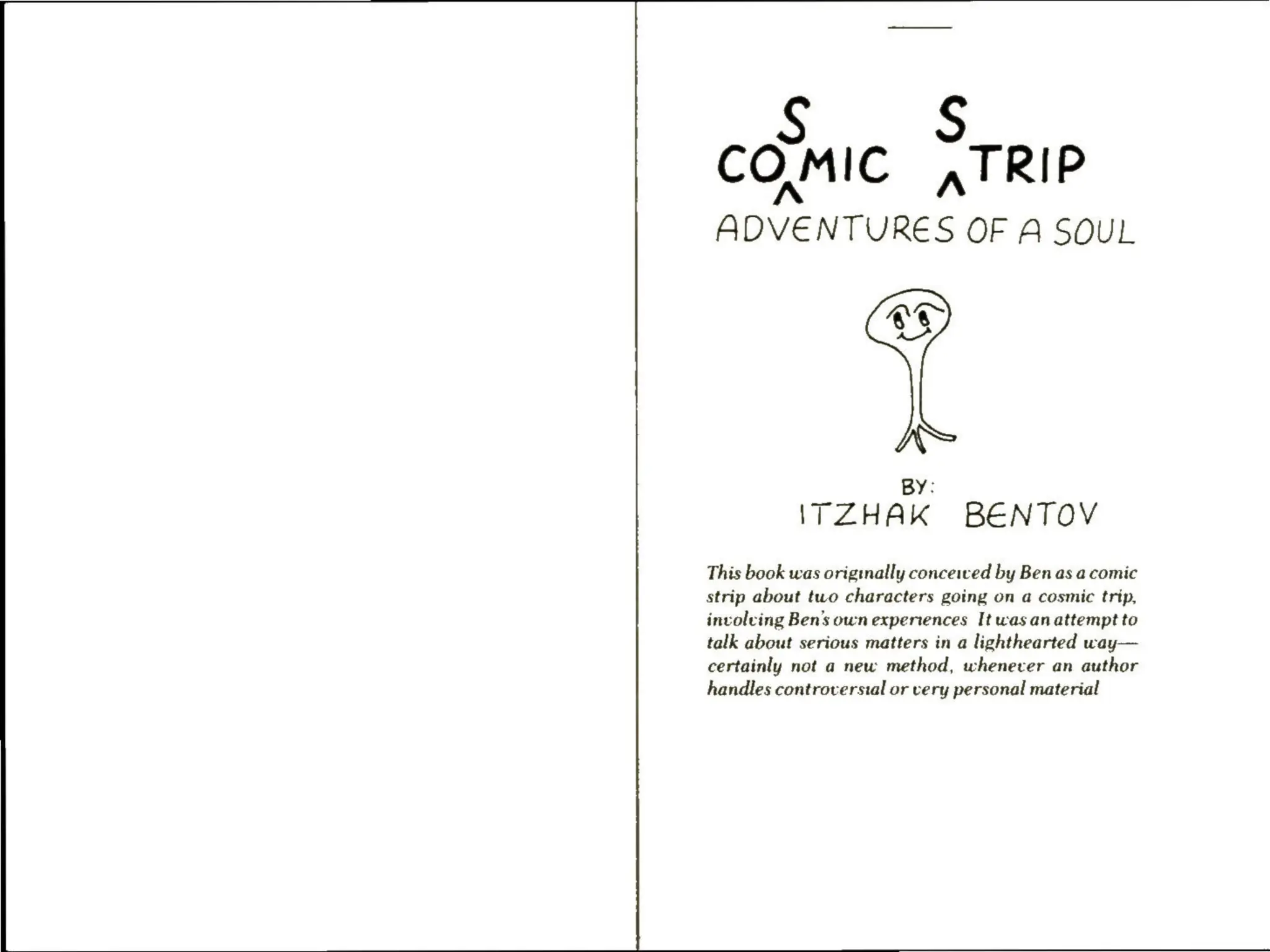
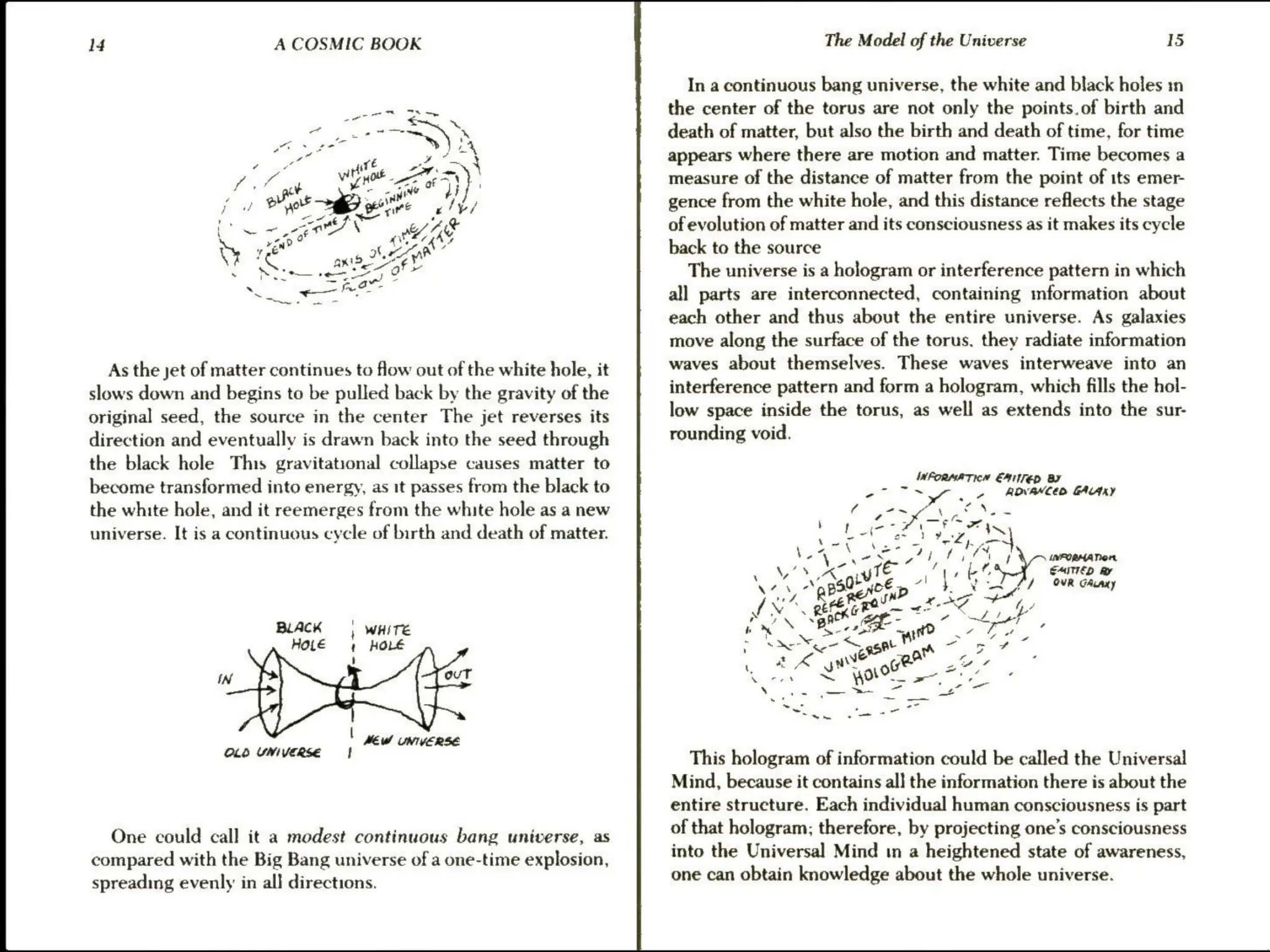
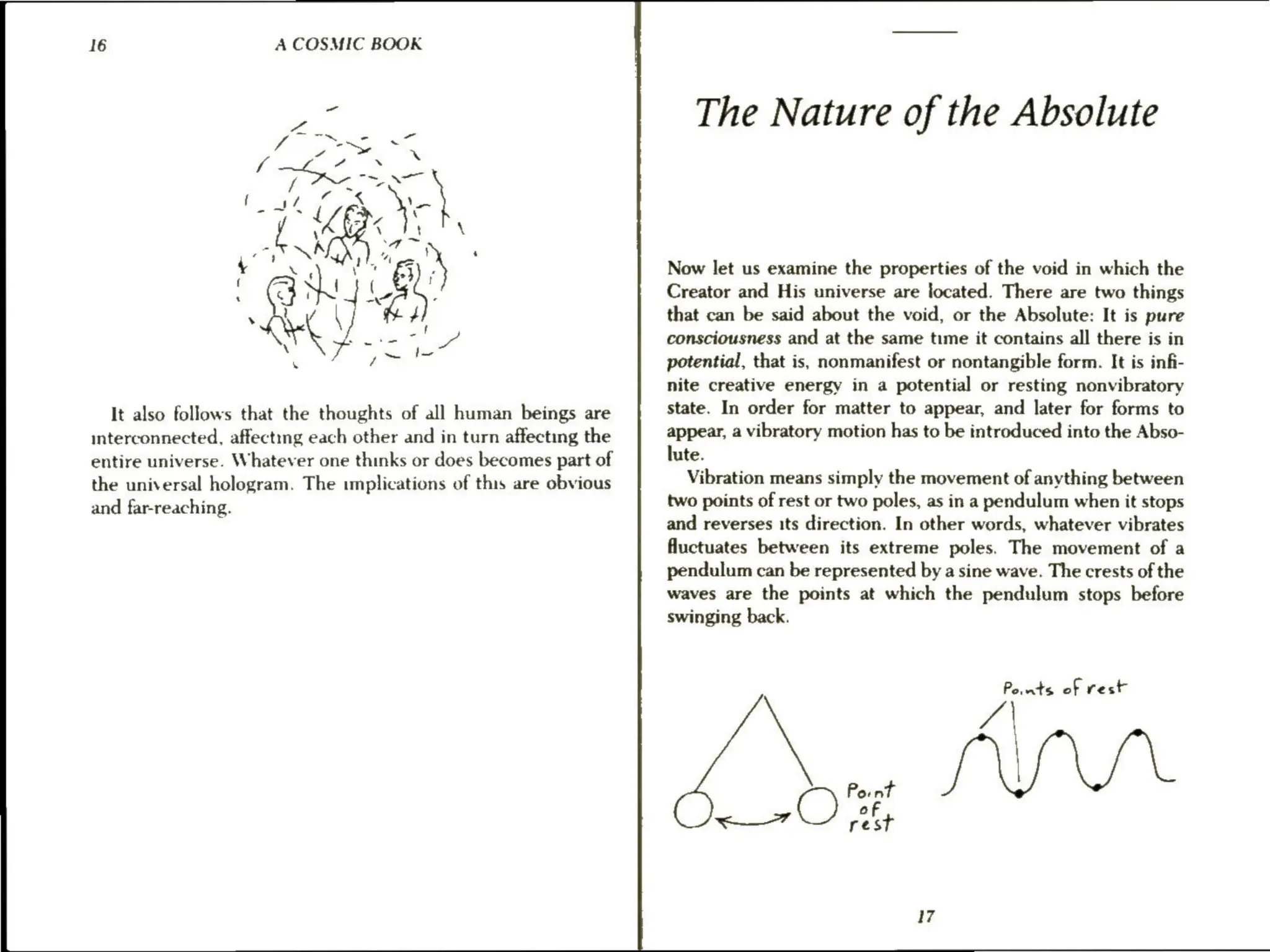
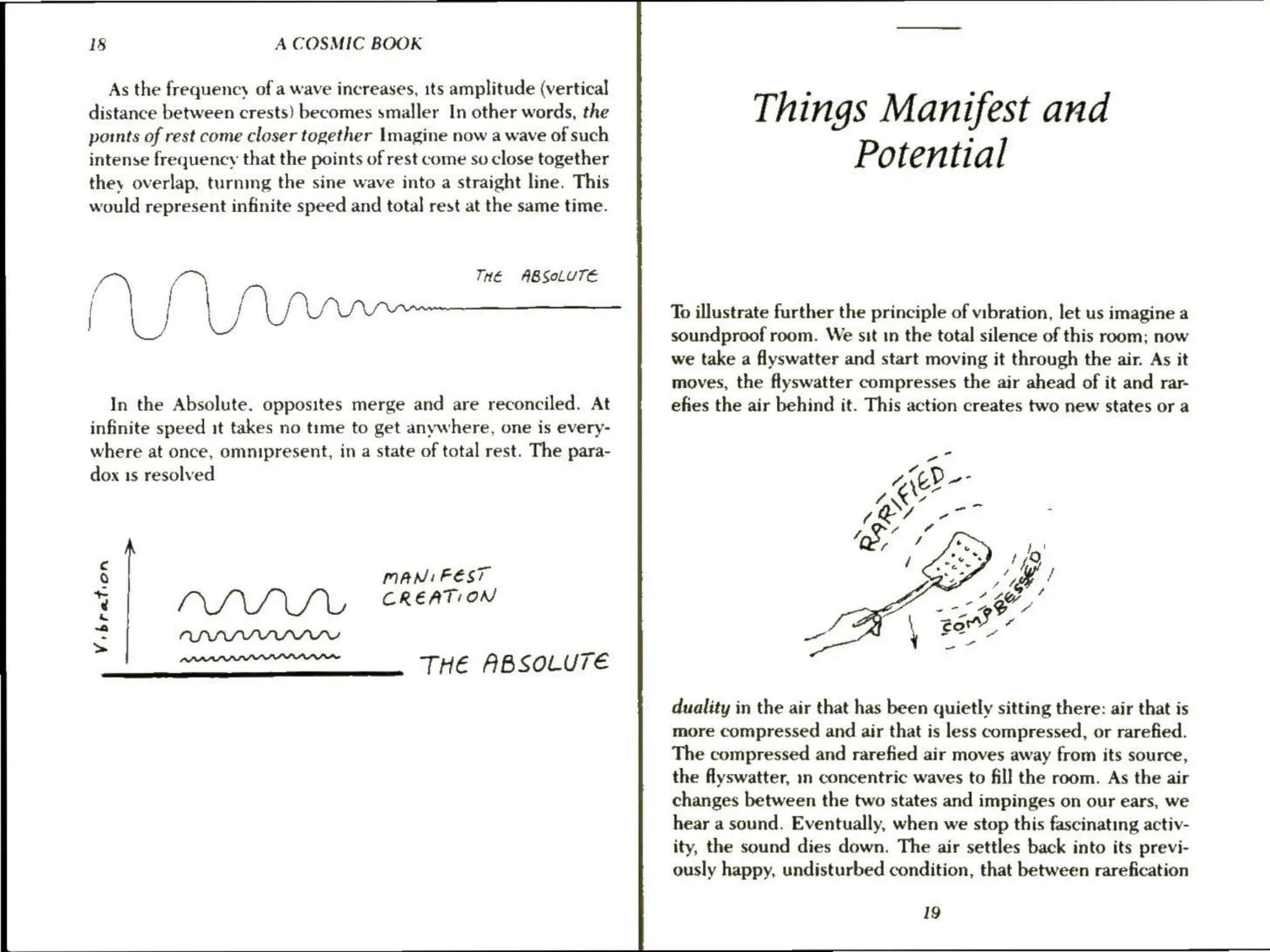
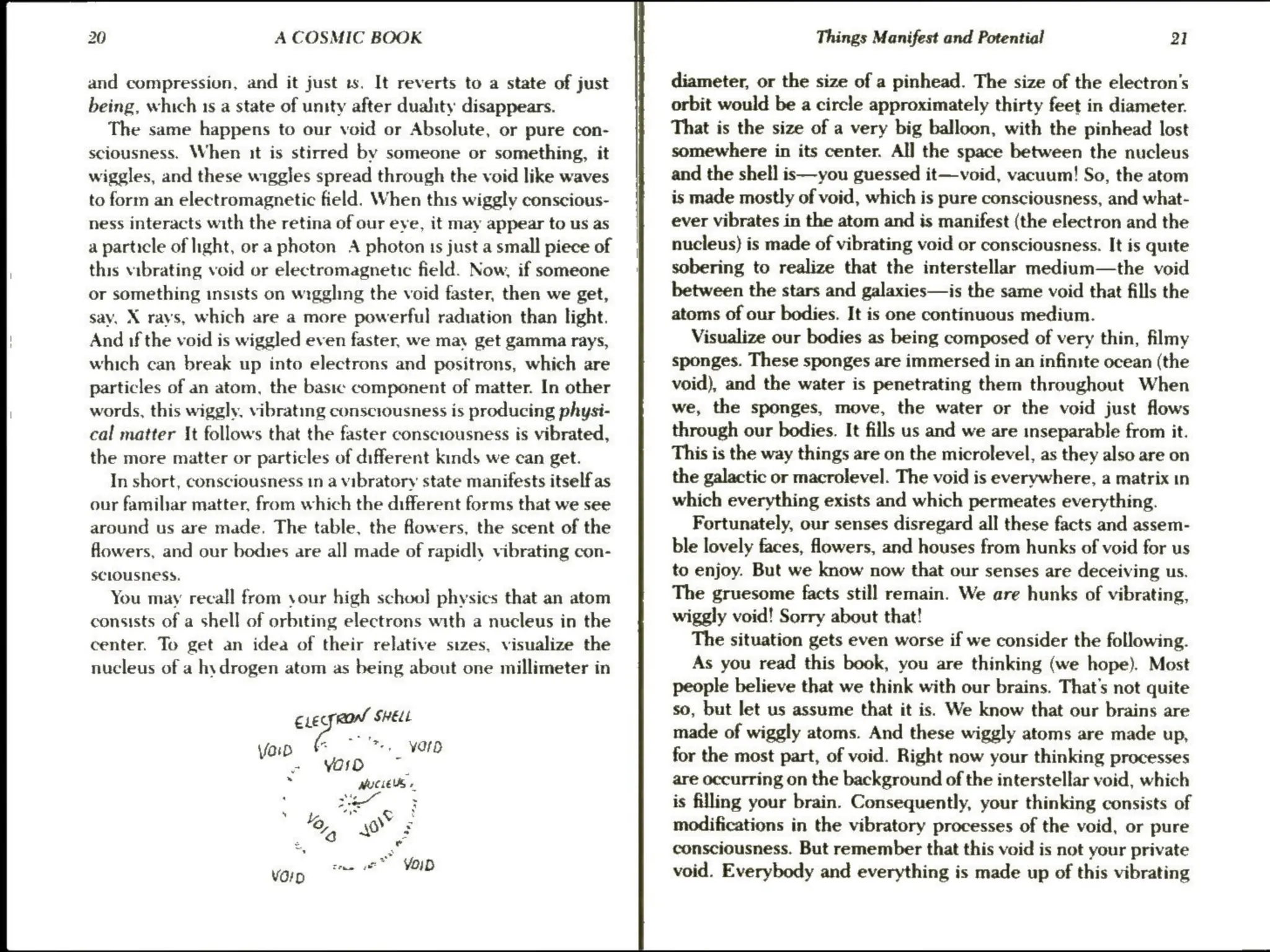
![22 A COSMIC BOOK
void, whether you like it or not. Your thinking processes
spread out and affect all Creation, there is no privacy, and at P art 2
this point, it is too late to complam
Now, what would happen if whoever is sibrating this con-
sciousness ceases to do so? (Remember what happened when
we stopped moving the flyswatter?) The forms that we see— ON D EV A S
and those that we are—will disappear in short order, and ,
consciousness wil] come toa state of rest. It will stop fluctuat-
ing between two extremes or two poles and will revert to a GOD S ;
happy, although monotonous, state of just berng—pure con-
sciousness. Everything will revert to a potential, unmanifest ATO RS
form. By everything we mean All-there-is, including TVs, AND C RE
traffic cops, rhinoceri, umbrellas, planets, washing machines,
and galaxies, This is not to say those forms will stop being.
They will only become potential, unmanifest cops, umbrellas,
rhinocer1, and galaxies. In short, consctousness comes in two
forms: vibratory and therefore manifest. or what we call mat-
ter, and nonvibratory and therefore unmanifest, but contain-
ing All-there-is in a potential state, serving as a blueprint for
matter They are two different aspects of the Absolute or pure
consciousness
fo Cc a -
Cc _ ei - “4 . os
CX Mee OS
é ' QM ust te
wan or « . :
{ _—~hY | : Peek ‘
‘ >
— S | © wee pat
yf Sis Fi
‘ + ty
tg - as - =
j ~ 7 ae hs e
,
7 "s erty ae fa
oe . + at pot
wh. et OF 9
s AZ, af tee! 3s ee ye.
a . 3 - 3 ‘
Mainifest
= . ae os
5°: ¥
XQ Esty rhinocen etc "se i % %,
vt 9%
oF
77 wa ager” te
ent
Potential rhinocer etc](https://image.slidesharecdn.com/acosmicbookonthemechanicsofcreationbyitzhakbentov-251212130219-7b800885/75/A-cosmic-book-on-the-mechanics-of-creation-by-Itzhak-Bentov-pdf-24-2048.jpg)
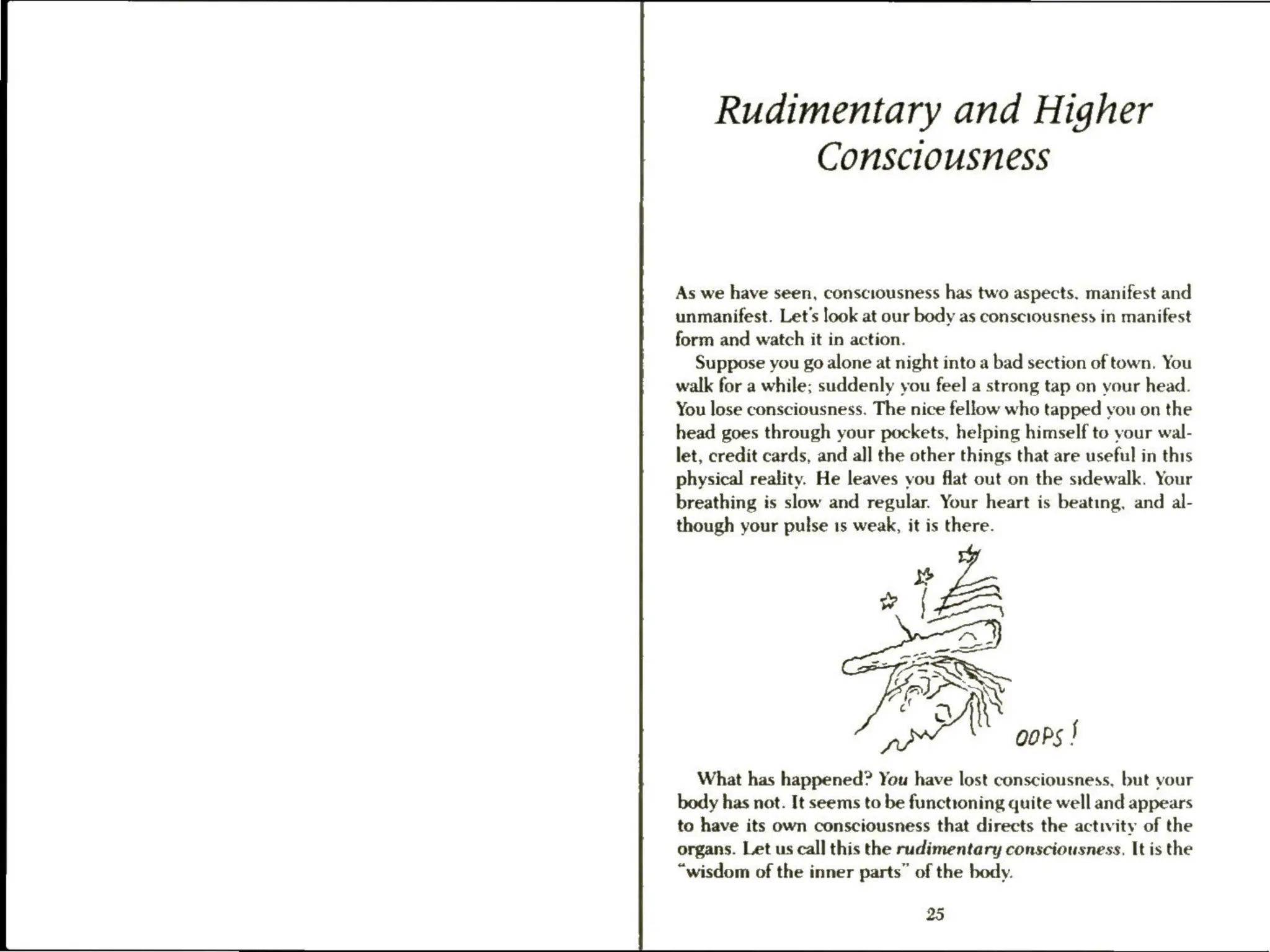
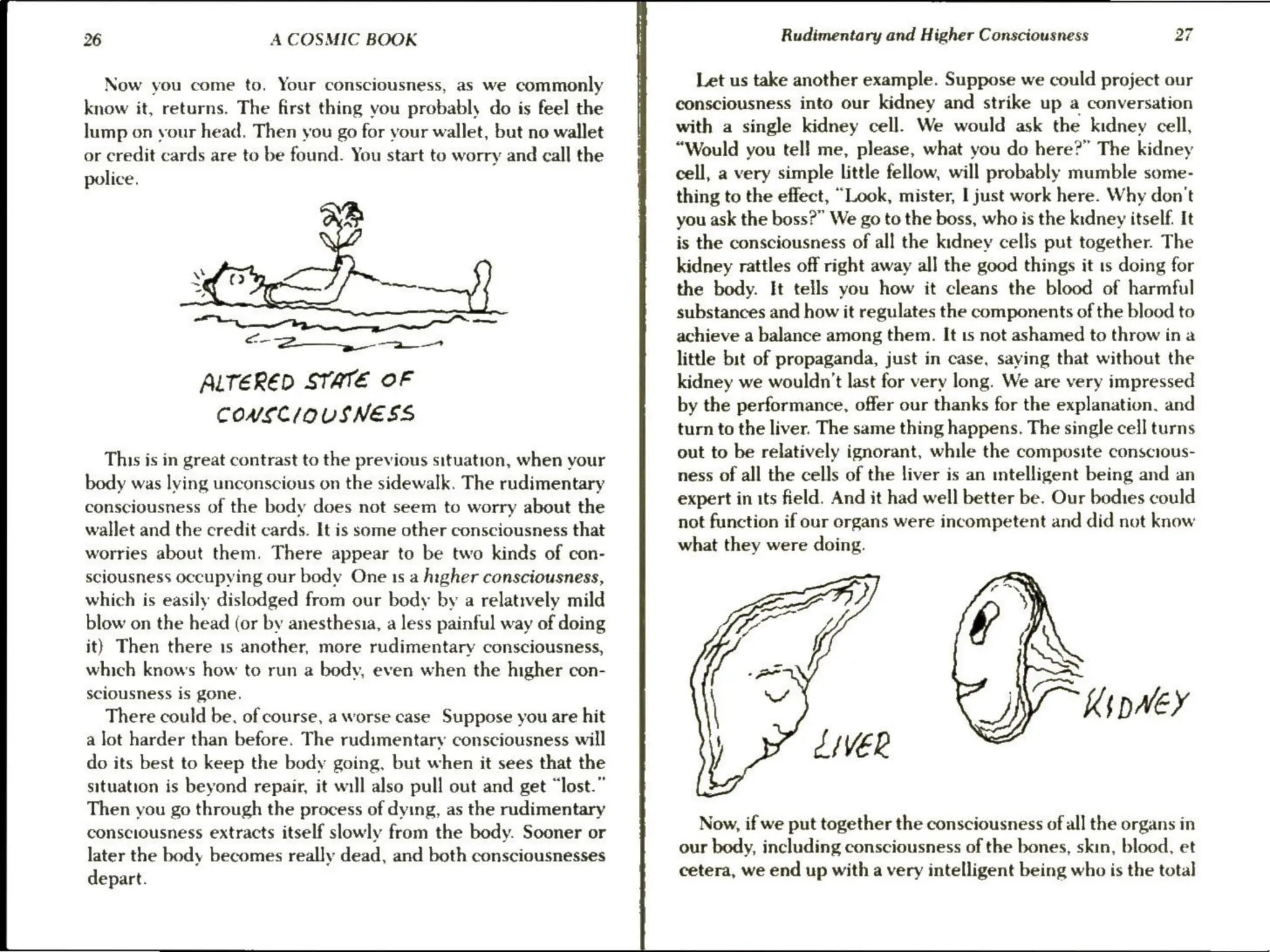
![28 A COSMIC BOOK
consciousness of all the living cells in our body. This is the
rudimentary consciousness, which runs the body when we are
out—that is, lose consciousness—or are asleep or, for that
matter, awake.
But then, what about the higher consciousness that worries
about the lost wallet, telephone bills, and income tax? This is a
being superimposed on the body and using it as a vehicle to
experience this physical reality It ts using this body of ours to
carry around our sensory mechanisms.
Our senses, as we know, give us the impressions that inform
us about our environment. They use a Morse code of clicks and
silences that they send to our brain-mind to describe our
physical reality The activity of a nerve cell can be represented
by a series of spikes arising from a horizontal line, which
represents the rest state of the nerve cell When the nerve cell
is stimulated, it produces an electric pulse or spike, the num-
ber and closeness of spikes reflecting the intensity of the stim-
ulus This action-and-rest activity of the nerve cell expresses
the vibratory nature of reality.
Nerve action sp kes
f"
AAAAAAMIL _A_]f
S of rest
Having received these signals, the brain-mind goes about
interpreting them into a picture of reality, which includes the
wallet and the telephone bills. And also, of course, lovely faces,
flowers, landscapes, and all else—our total environment.*
* See chapter 3 of Stalking the Wild Pendulum
Reference state
Rudimentary and Higher Consciousness 29
To sum up, we can say that we are made of two beings. One is
the rudimentary consciousness of the body, which is the body
and knows all about it. The other is the higher consciousness,
which inhabits this body and exploits it for its own use. The
latter is a more intelligent consciousness, it acts as an “ob-
server, includes our mind, interprets our sensory experi-
ences, and gives us our self-awareness as individuals. Let us
temporarily call it the soul.
The soul, like everything else, keeps evolving. It may sound
strange that an abstract concept, such as a soul, evolves, but on
its level the soul is not an abstract concept at all. In its own
reality, the soul is quite tangible. As far as we are concerned,
the soul, which contains all our emotional, mental, and intu-
itive equipment, is the experiencer.* It experiences through
the physical body, which is its tool for interaction on the
physical level in order to learn. This does not mean that the
soul cannot function without a physical body. It can and does
very well. It's a being in its own right.
od
7
Sov
* See chapter 6 of Stalking the Wild Pendulum](https://image.slidesharecdn.com/acosmicbookonthemechanicsofcreationbyitzhakbentov-251212130219-7b800885/75/A-cosmic-book-on-the-mechanics-of-creation-by-Itzhak-Bentov-pdf-27-2048.jpg)
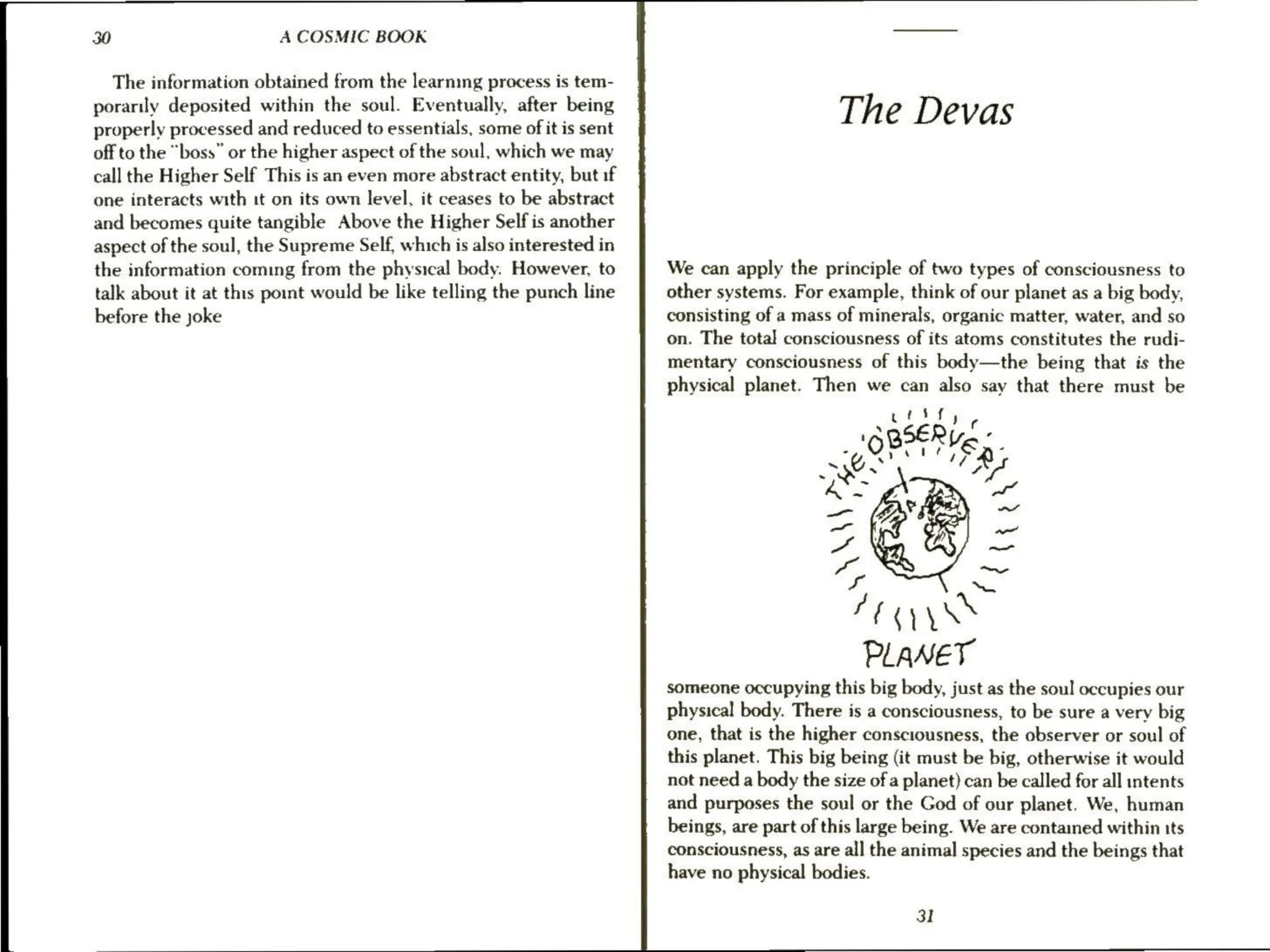
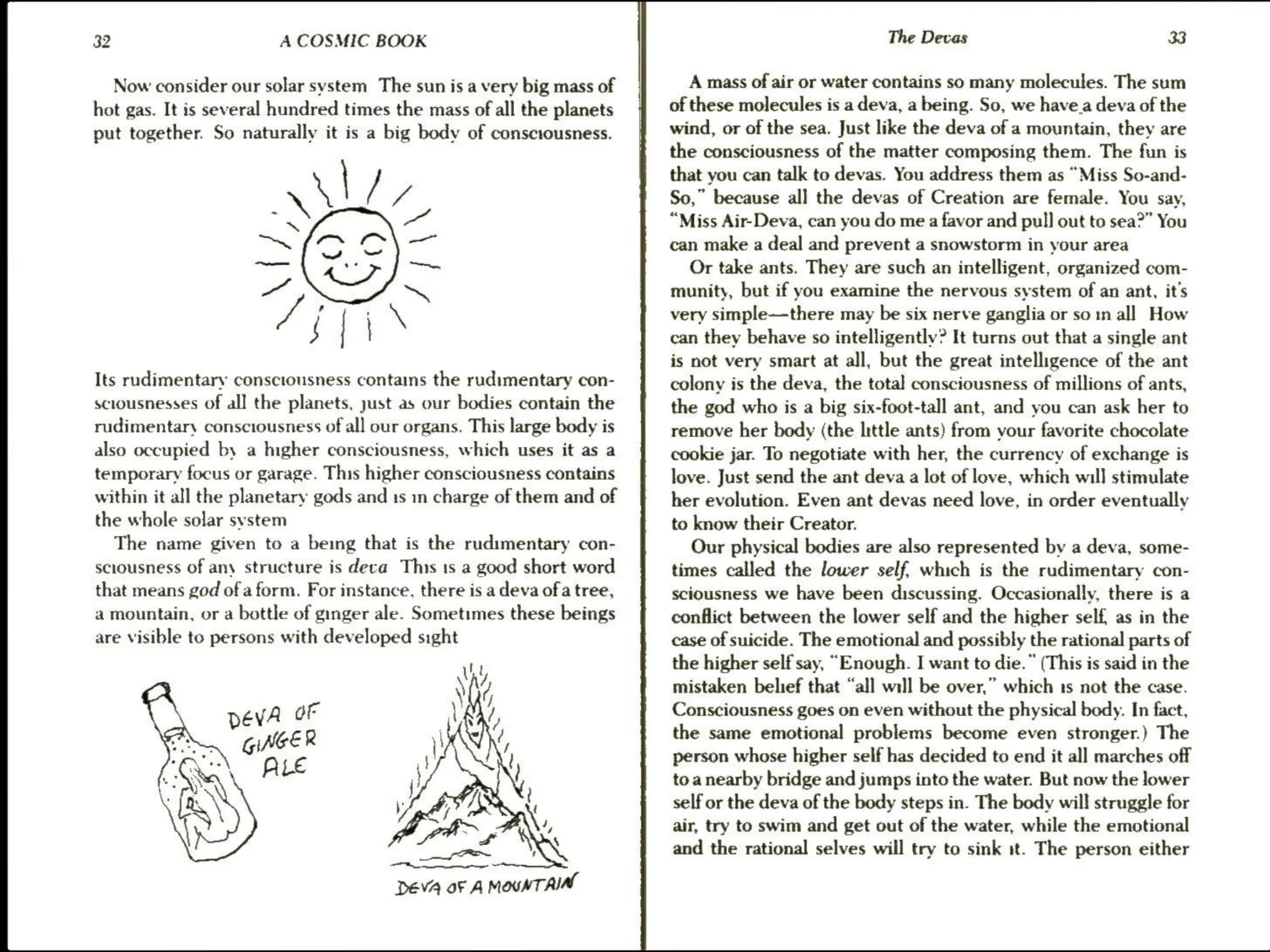
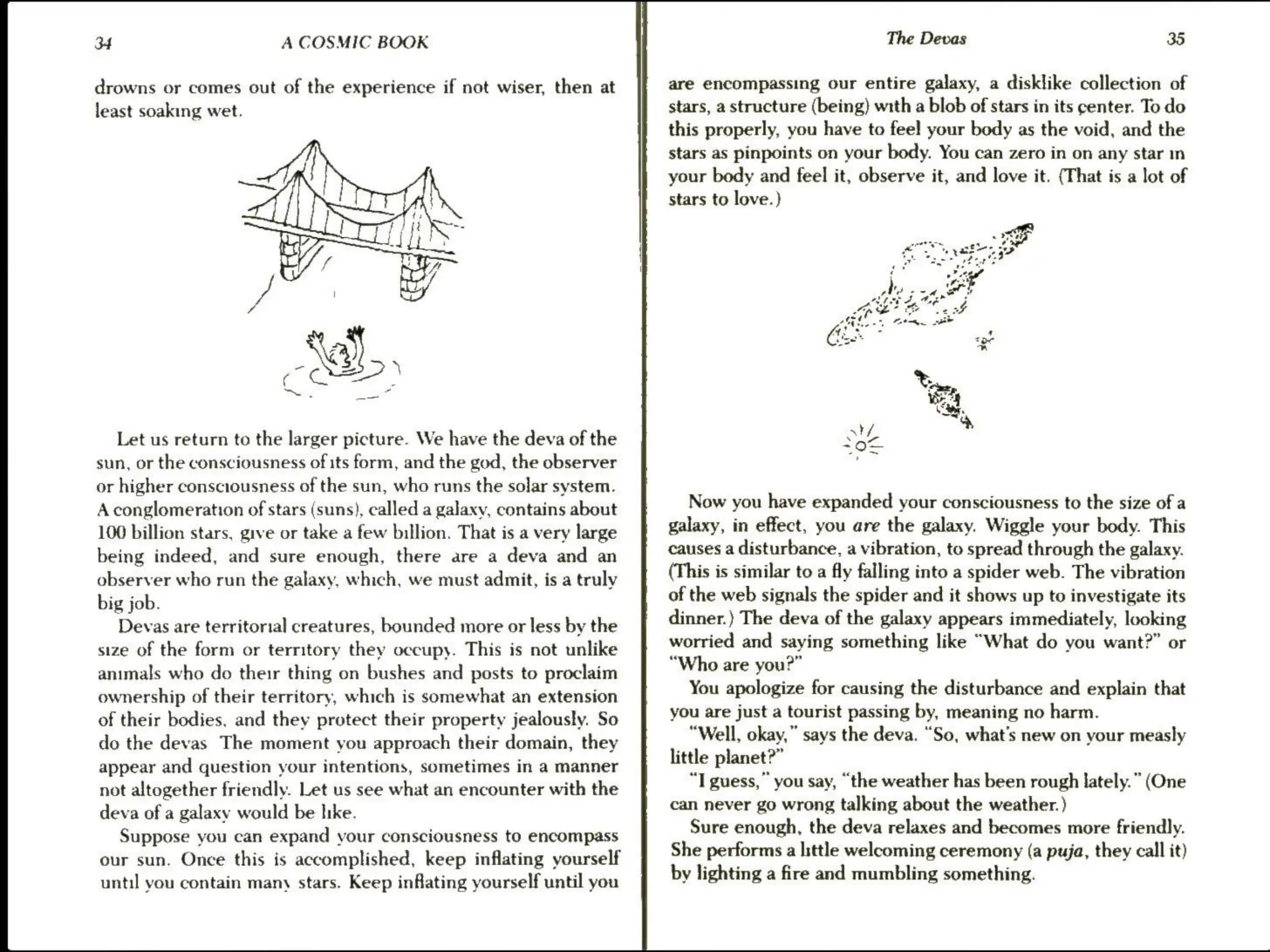
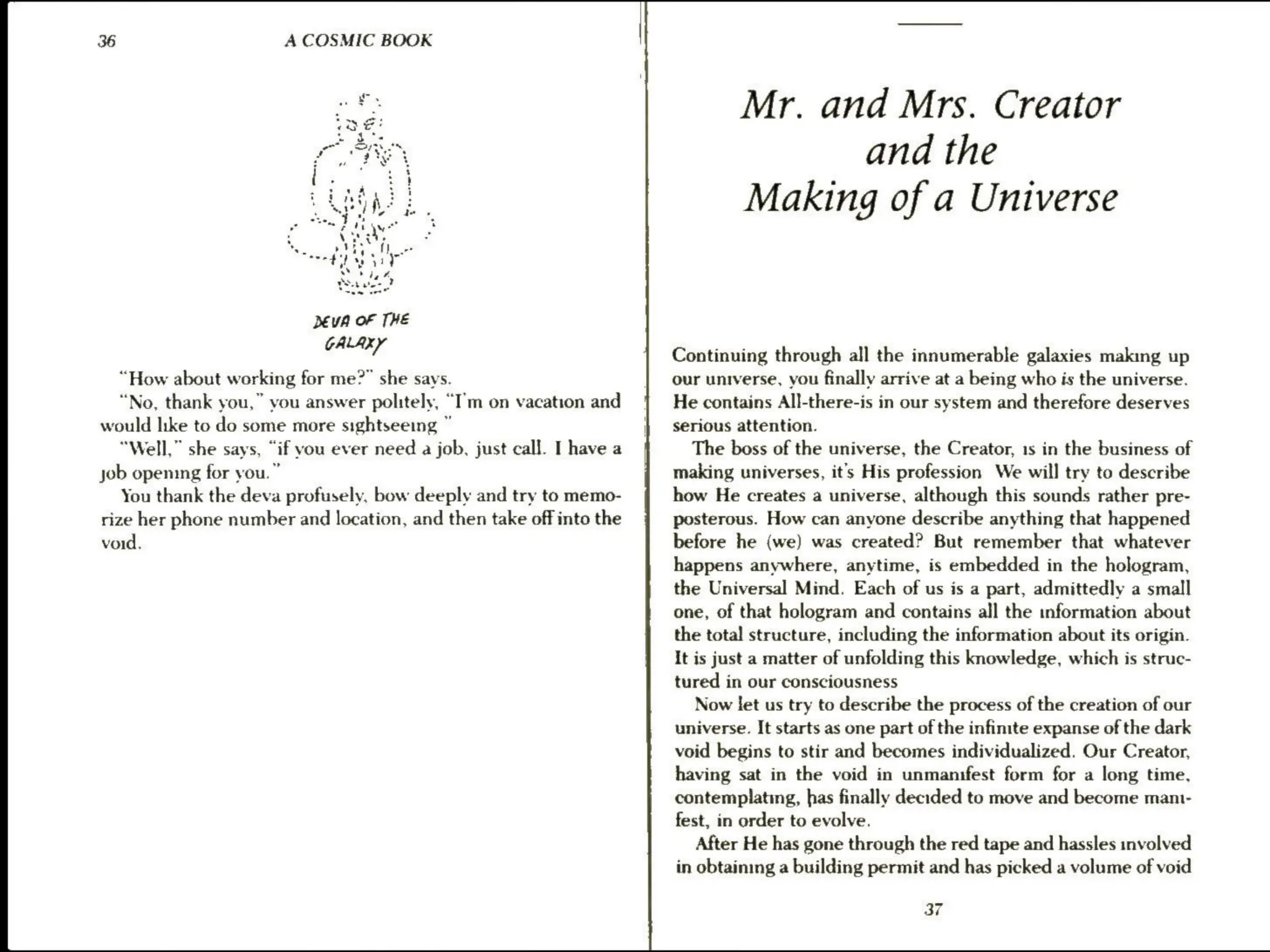
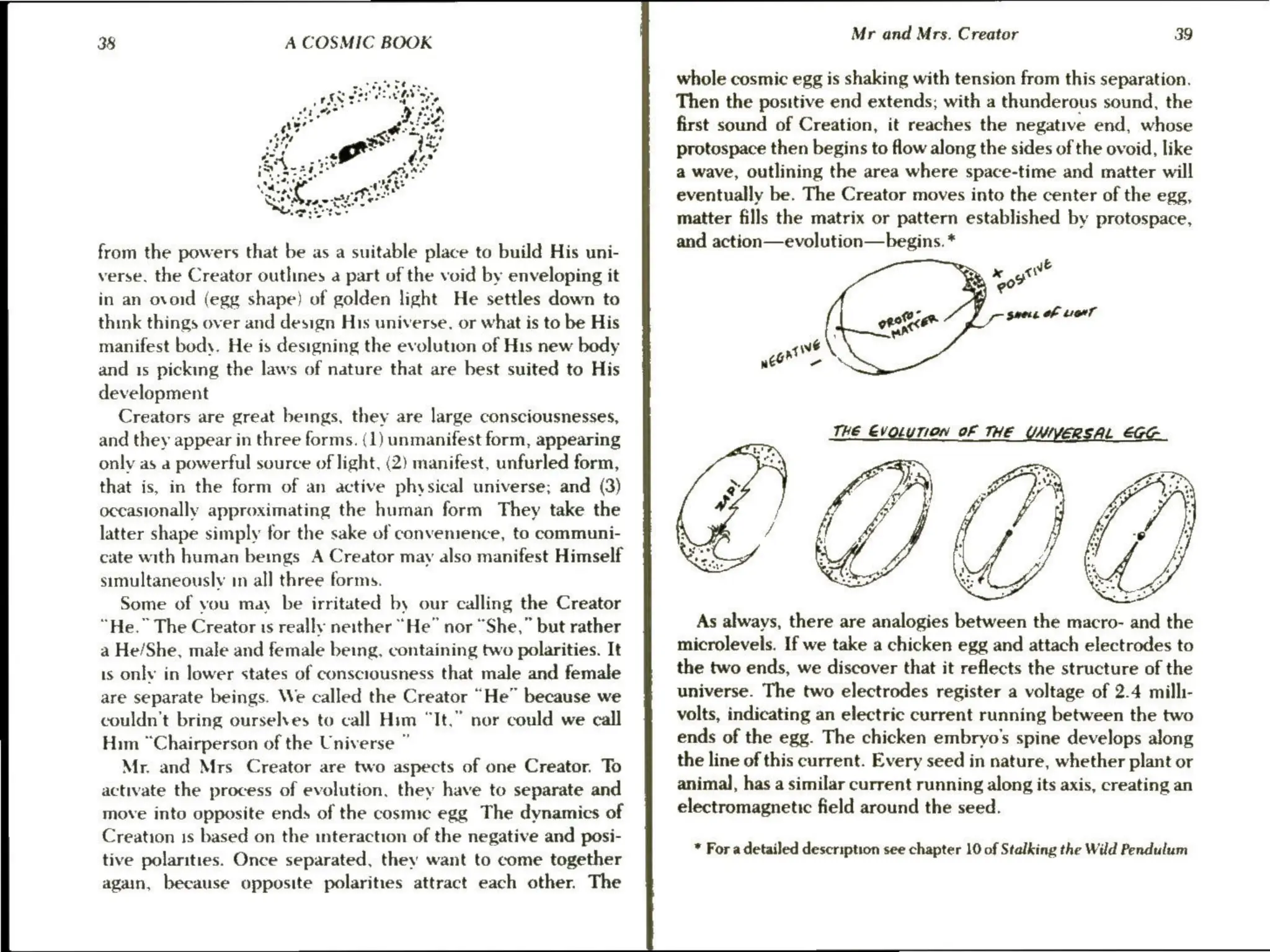
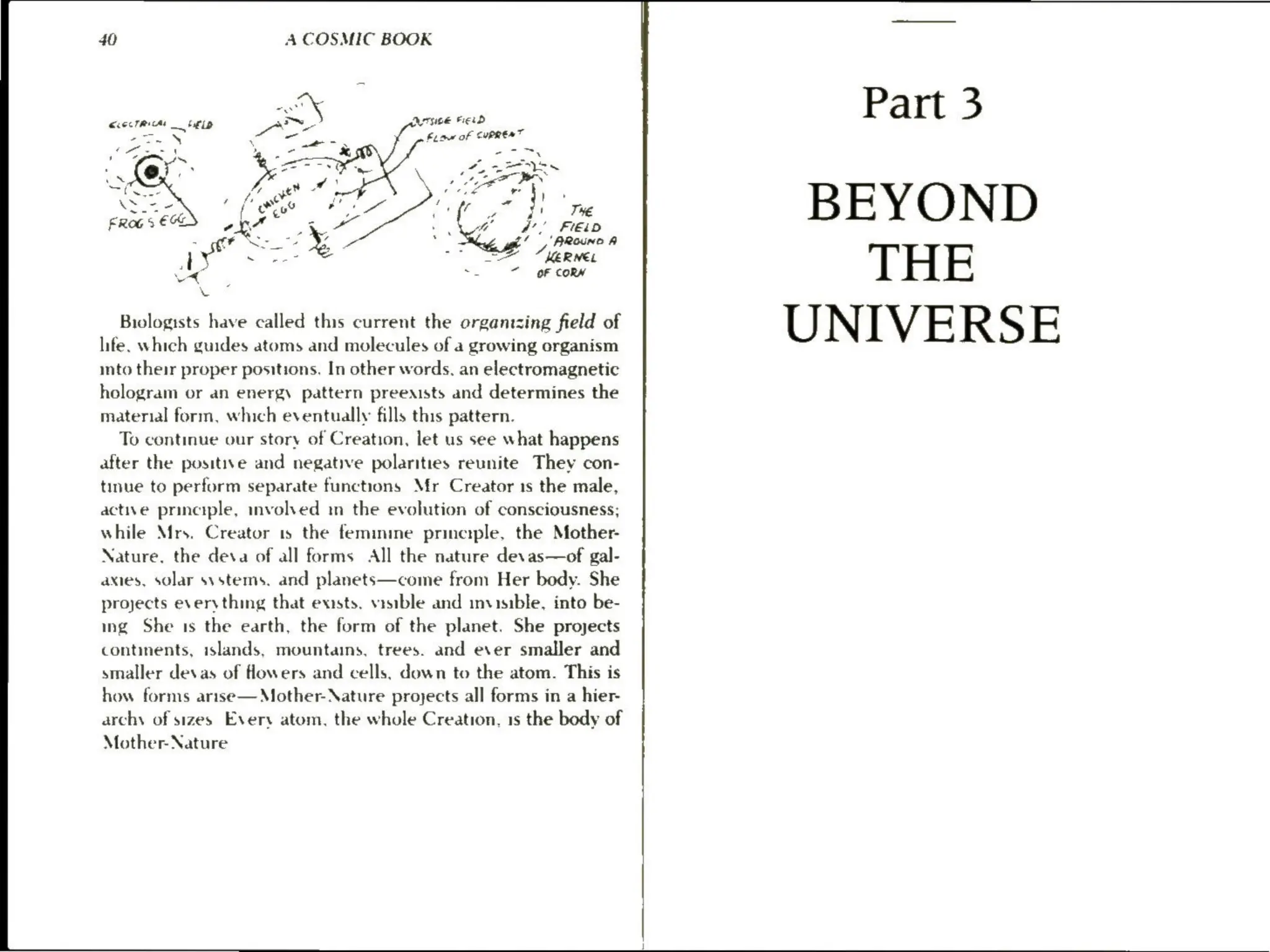
![The Cosmos
Having seen the structure of the universe and understood its
functioning, you ask, “And what's beyond this?” Immediately,
you have a sensation—your consciousness, that is—of moving
like a dot through the void at infinite speed without inter-
ference or impediment. Actually, vou are not moving, you are
filling the void with your consciousness and your senses. There
is no limit to the extent of human consciousness. It can expand
to fill the universe, and then you can talk to the Creator. You
can talk to all the beings, who are gods; you have a diplomatic
visa to infinity.
The more you expand your consciousness, the faster your
sense of motion. You can expand at an infinite speed in all
directions, or you can expand 1n only one direction At infinite
speeds, distances make no difference: You can be everywhere
in no time, you are in al] places at once. Our perception of time
changes in altered states of consciousness, and our so-called
subjective time becomes longer and reaches infinity as con-
sciousness expands Let us look at this principle more closely. *
There appear to be two kinds of time: objective time, the
usual clock-time. conveniently divided into even units, and
subjective time, a more flexible time, that can stretch and
compress according to our state of consciousness. We know
that in an altered state of consciousness, such as a dream, we
can experience an enormous amount of events in only a few
minutes. Time seems to expand, and for every objective sec-
ond, one has hundreds of subjective seconds.
* See chapter 4 in Stalking the Wild Pendulum
43](https://image.slidesharecdn.com/acosmicbookonthemechanicsofcreationbyitzhakbentov-251212130219-7b800885/75/A-cosmic-book-on-the-mechanics-of-creation-by-Itzhak-Bentov-pdf-34-2048.jpg)
![A COSMIC BOOK
ee
=
-_*
Suey space
“
nonce
<
r
=
) %
+
Past ve
Let us draw two lines intersecting at mght angles, the ver-
tical line representing objective time, and the horizontal, ob-
jective space. Superimposed on them are two dotted lines
representing subjective space-time (left, in figure). Under nor-
mal conditions, these two sets of lines overlap. However, in
altered states of consciousness, the subjective space-time devi-
ates from the objective space-time.
Let us mark off one second on the objective time axis and
through this point draw a line parallel to the space axis. Now
let us rotate the subjective time axis until it intersects with this
line at point A (right, in figure) The point of intersection will
indicate the subjective time equivalent to one objective sec-
ond. We can readily see that subjective time appears to grow
longer as the deviation increases. In this case, we get three
subjective seconds for one objective second.
Imagine now a situation in which the subjective time axis
deviates so far that it becomes parallel to and overlaps objec-
tive space. This would imply that our subjective time fills all
objective space—it takes no time to go anywhere. This is what
happens in expansion of consciousness: We can fill the entire
universe with our consciousness at infintte speed and be every-
where at once—in other words, become omnipresent.
gub} -*
aed
3 sub Sec
The Cosmos 45
FIG 27 L
v1)
gq
a
+]!
I:
eC-----— p-
@2ees
yas
'
4
'
'
'
t
'
+
|
}
So here you are, seemingly moving at infinite speed in the
dark void. You are leaving this universe of ours, which now
looks like a luminous watermelon in the distance. You look up.
In disbelief, you begin to see. . more universes! They appear
arranged in a rising spiral (helix), and you discern seven rings,
each containing seven universes, or forty-nine in all. Each
universe is the body of a Creator.
yal
SS Like, va
~S a
—— —
“= S
4 <
Sipbes mepyn
WRU VER 5€](https://image.slidesharecdn.com/acosmicbookonthemechanicsofcreationbyitzhakbentov-251212130219-7b800885/75/A-cosmic-book-on-the-mechanics-of-creation-by-Itzhak-Bentov-pdf-35-2048.jpg)
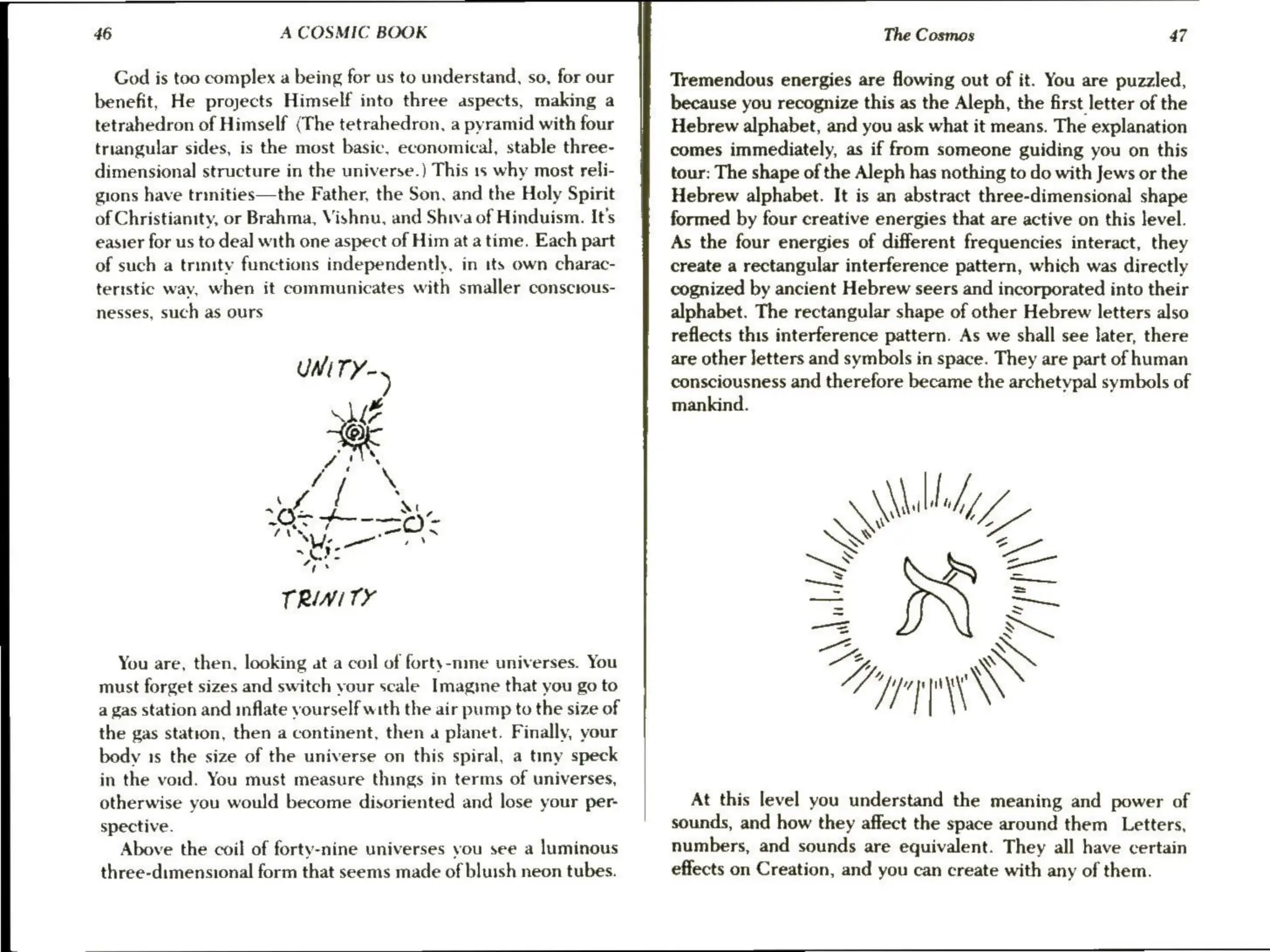
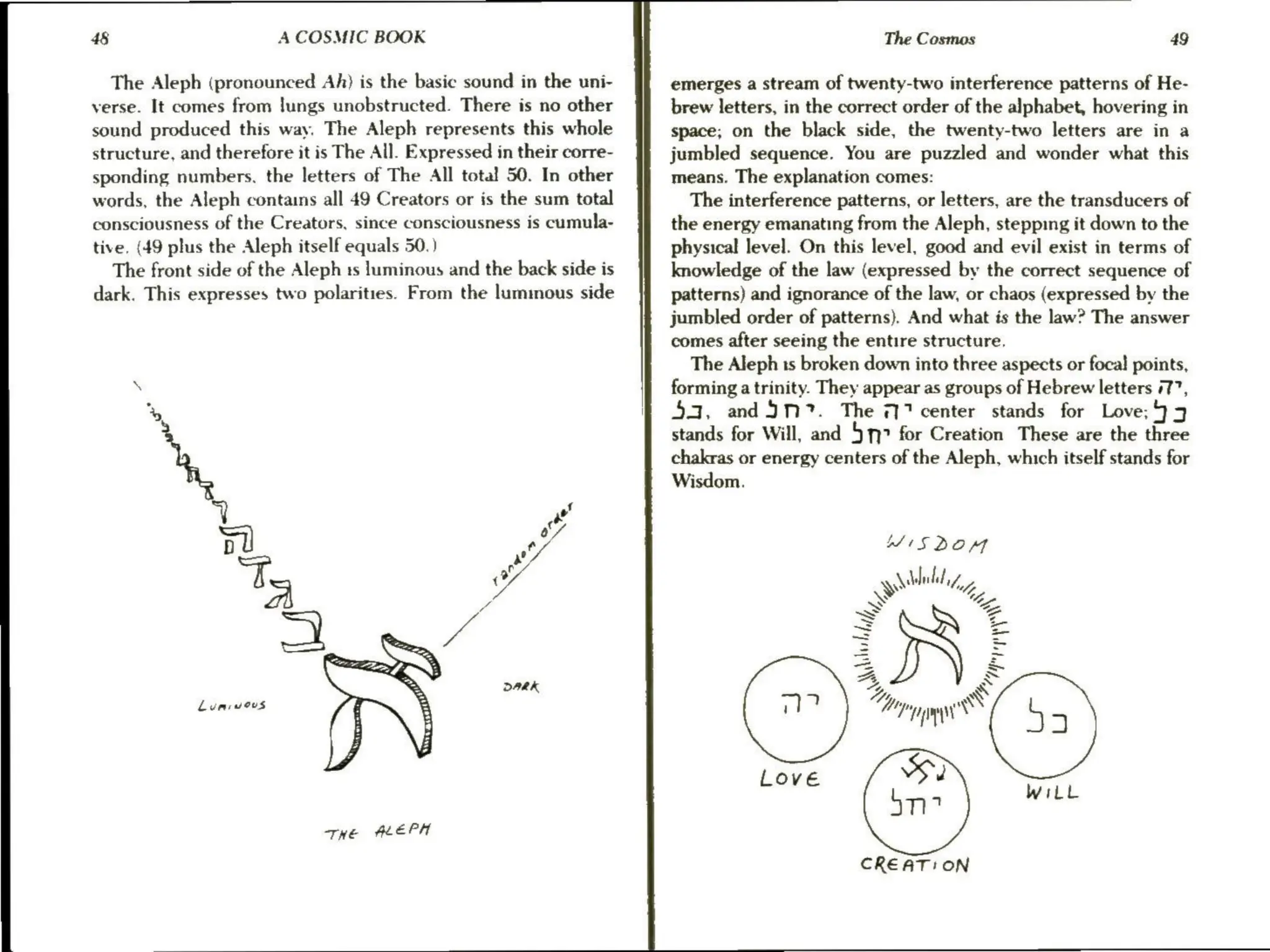
![30 A COSMIC BOOK
Each center radiates light of a different color, expressing the
quality of energy of each particular center. gold for Love, blue
for Will, and red for Creation. The Aleph radiates a brilliant
white light, which is a combination of these three colors.
Together, these four colors or frequencies represent the four
energies that create the interference patterns of Hebrew
letters
The three centers of the Aleph can be expressed in num-
bers, corresponding to the letters of the centers, because in
the Hebrew alphabet each letter has a numerical value. In
other words, this structure 1s modular, built up ofcycles, each
represented by a unit, a number. The combinations of these
units or letters express the laws of this level of Creation in an
ingenious way
The roots of many Hebrew words can be read in two direc-
tions, from right to left and from left to right, producing
opposite meanings. This appears to be the case here. If the
letters 43 , representing the Will center, are read from right
to left, toward the Love center 777, together they become
775435. meaning extinction. destruction. If read the other
way, from the Love to the Will center, they become 7 4? 7],
which literally means “he kept walking.” In other words, the
general meaning 1s to go, keep walking. The cosmic law con-
veyed this way 1s that to go from love to willis all nght and safe.
However, if you go from will to love, vou are destroying,
because you must know love first. The whole system runs on
love. Love is the cosmic law.
The letters of the creative center 47) mean to hope
intensely, to desire. They also mean will begin. Read back-
wards, they become 7774, meaning, in essence, for life.
Read in both directions they combine into the meaning desire
for life to begin. This desire resulted in the process of creation,
symbolized by the swastika* within the creative center, repre-
* The swastika ts an archety pal symbol used universally by mankind since
antiquity to express cosmic energy
The Cosmos 51
4
Ly
/ . Love
7 we eth,
ail,
Ly
~
Me,
PA
s
z
a]
wil
a
N
Fy
ij
senting a four-dimensional rotating universe. It is interesting
to note that if you merge your consciousness with that of the
Creator, you discover within Him a rotating swastika. In other
words, swastika stands for both the Creator and the Creation—
they are inseparable.
Having examined and understood the details of this struc-
ture, you want to see where it ends, and going away from it,
you suddenly come to a wall, which appears to have alternating
flat and curved parts. You wonder why, and as you move along
this wall, you realize that you are trapped within an enormous
sphere. Let us call it a cosmos. You keep moving inside the](https://image.slidesharecdn.com/acosmicbookonthemechanicsofcreationbyitzhakbentov-251212130219-7b800885/75/A-cosmic-book-on-the-mechanics-of-creation-by-Itzhak-Bentov-pdf-38-2048.jpg)
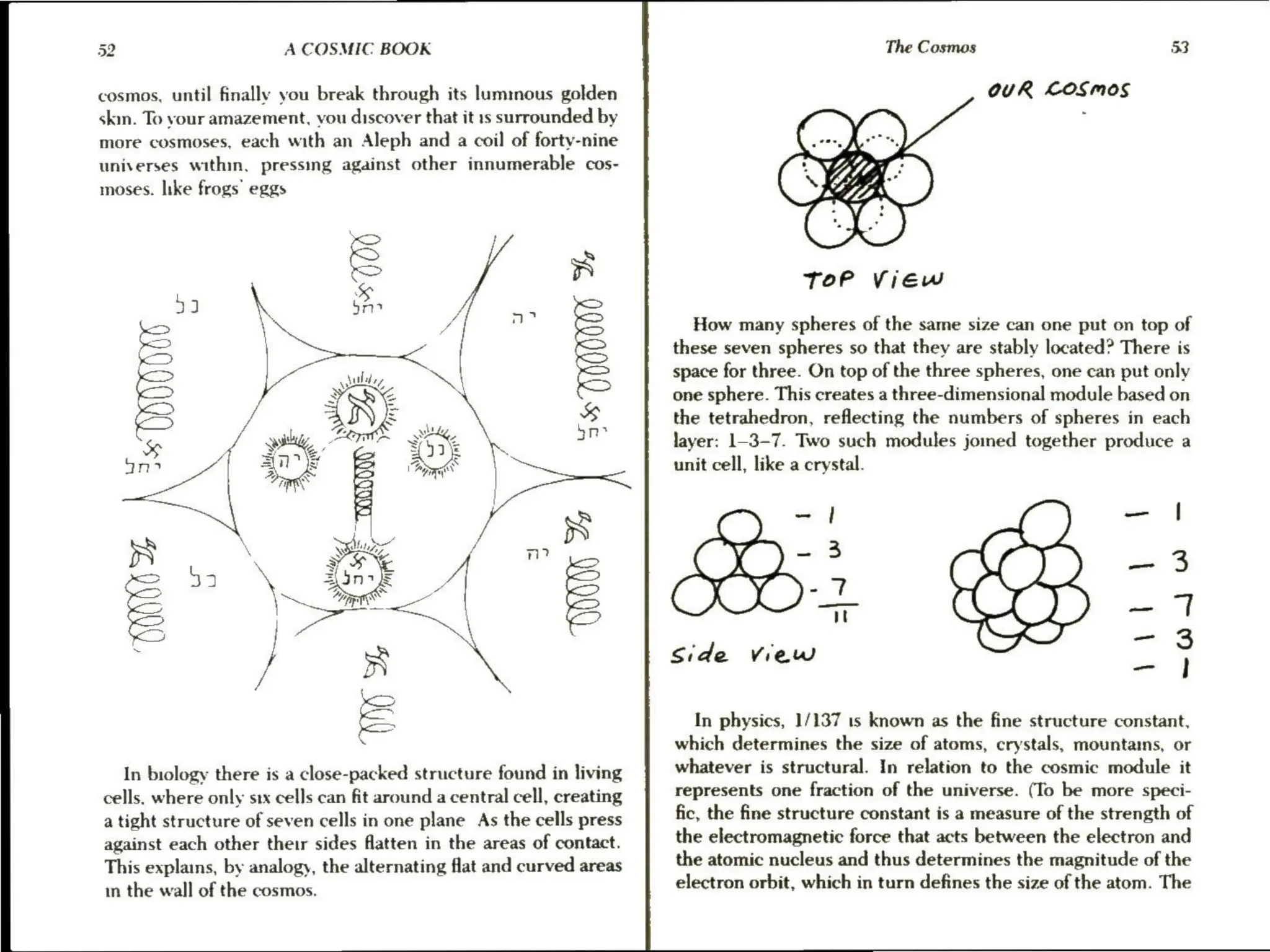
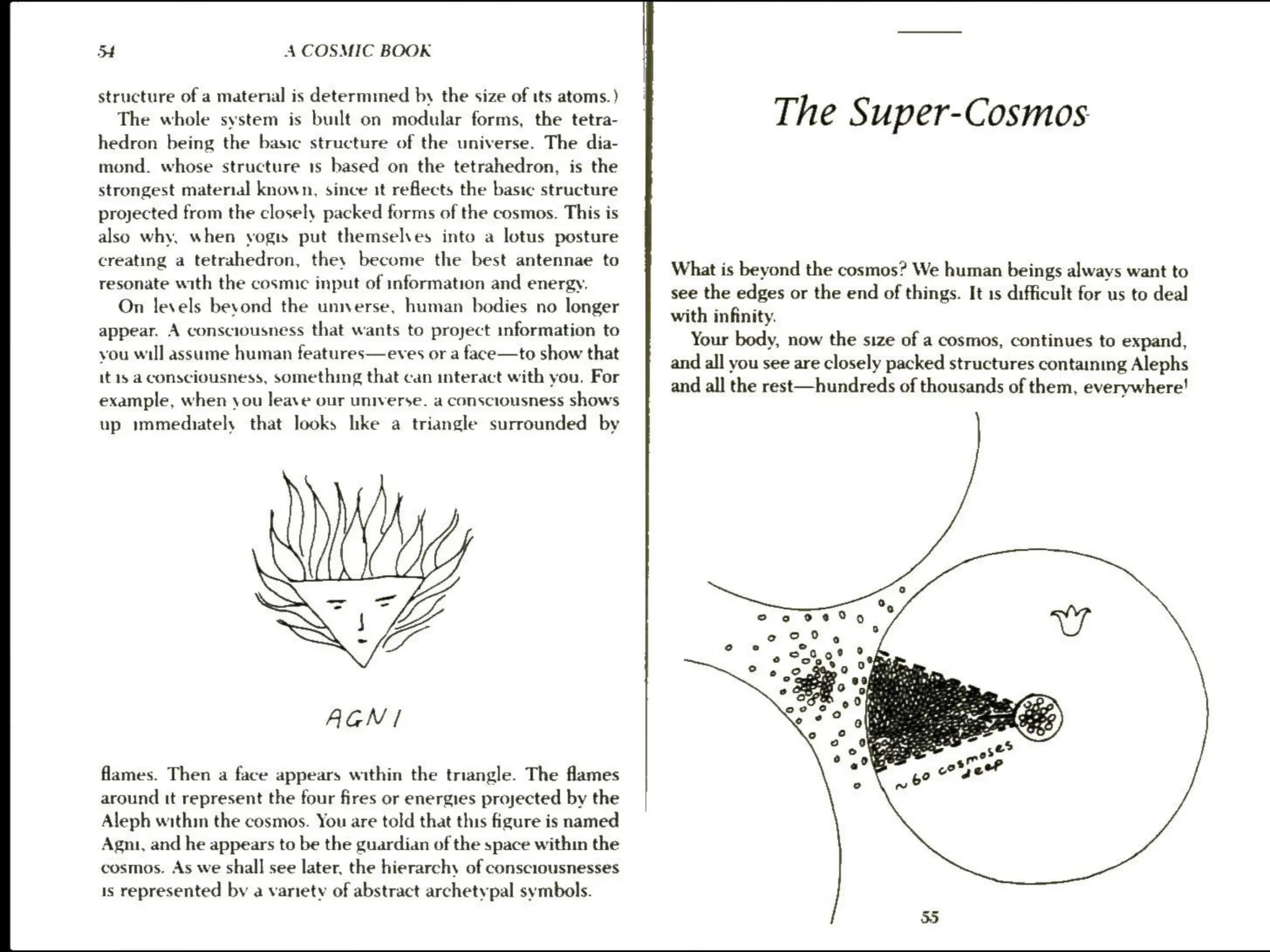
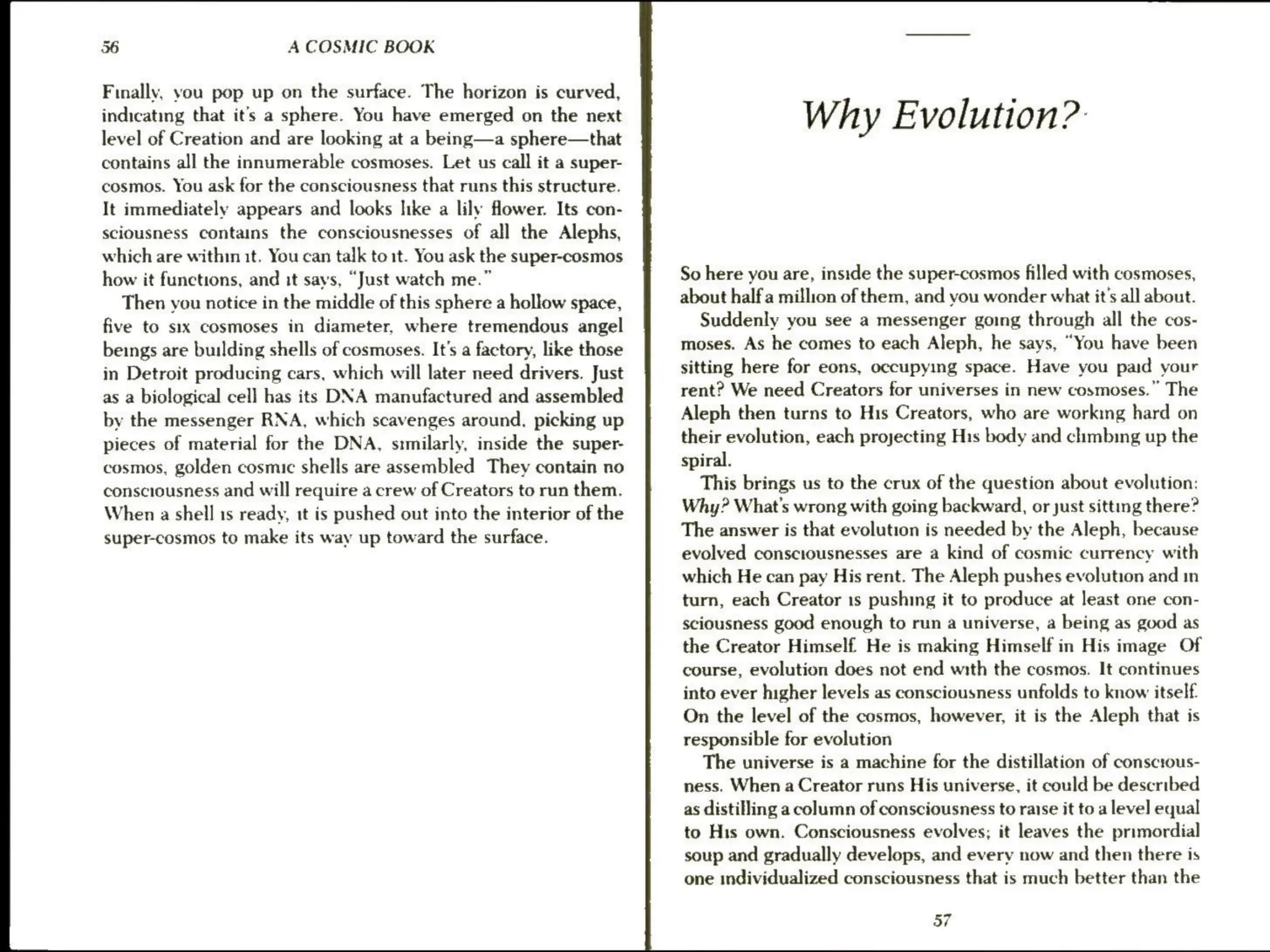
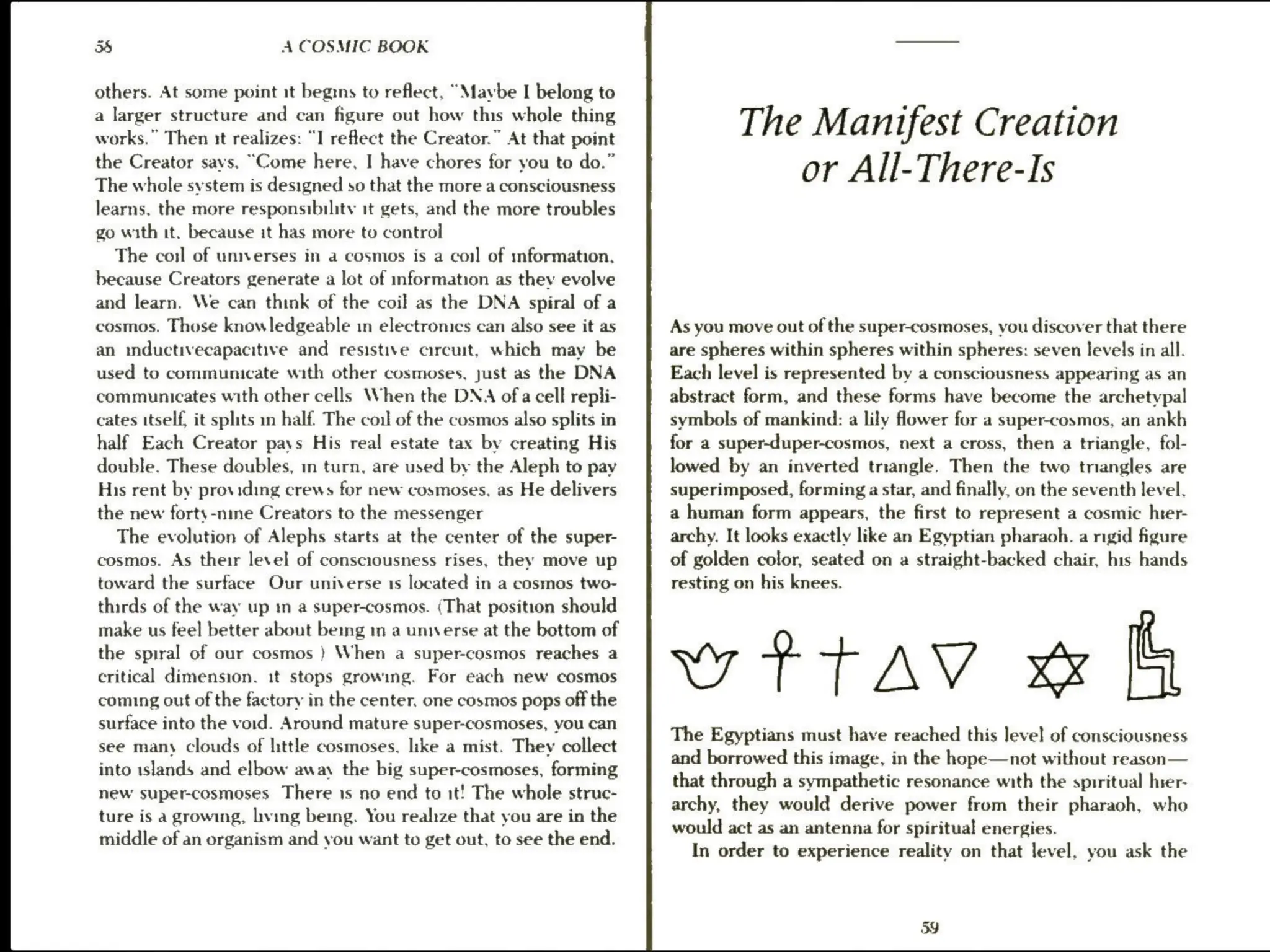
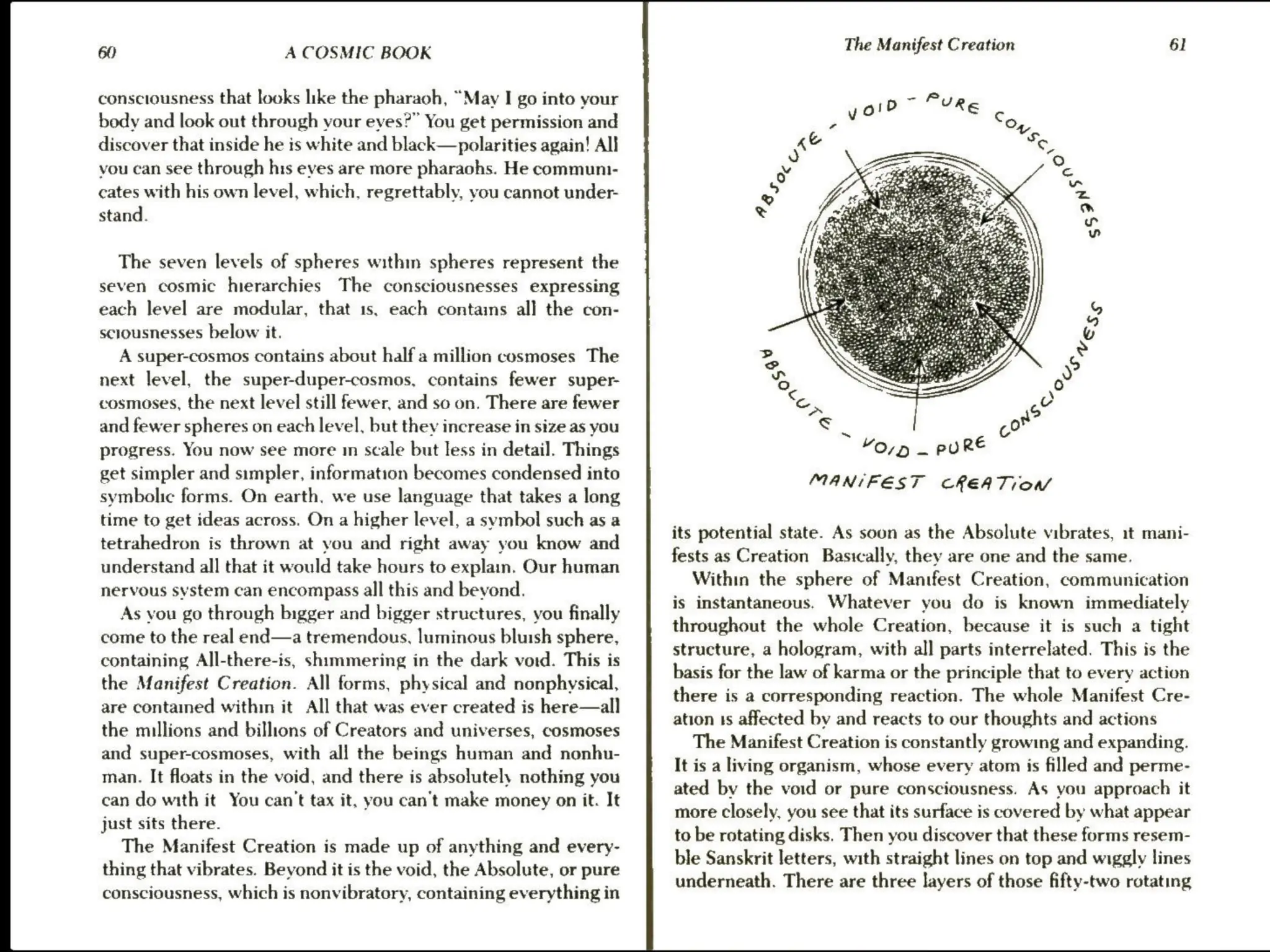
![62 A COSMIC BOOK
forms or letters covering the surface. As the straight top lines
rotate, they look like rotating disks. Like the Hebrew letters,
these cosmic shapes were seen by man tn an expanded state
of consciousness and incorporated mto the Sanskrit alphabet.
The fourth, outermost layer 1s made up of forms that represent
YorsTeE De
What is the meaning of these rotating forms? You are given
to understand that as the sphere expands, its surface extends
further and further into the void, which flows through the four
layers of letters. Their function 1s to modulate the void, like a
flute, to make it vibratory, to produce the first sound of Cre-
ation. This 1s the first word. and its first letter is OM. As pure
consciousness flows through the three layers of Sanskrit letters
or modulators (gunas),* they impart certam tendencies to
consciousness, making it vibratory As the different vibrations
interact, thev create an interference pattern, a hologram of
sounds, filling the whole Manifest Creation with infinite varia-
tions and reverberations of the original sound
At the surface boundary line, the first basic structures found
in nature are produced, the primordial archety pal forms, cre-
ated by the interaction of the creative word with itself Just
below the letters. Creation is very plastic and can be manipu-
* According to Hindu teachings, gunas are the three tendencies in Cre-
ahon—sattwa. tamas and rayja—producing the effects of expansion, con-
traction, and energy jor actnits, mertia. and balance! respectively
The Manifest Creation 63
lated. The so-called supernatural powers of the yogis come
from the siddhi level, which is located here. If you can raise
your level of consciousness to this level and put in a desire, it
will be manifested somewhere inside the Manifest Creation.
Infinite energy comes in at this level, and you can mansfest it
into anything you want. This is what Jesus did when he mani-
fested fishes and bread.
As the Manifest Creation grows, owing to new cosmoses
being produced, more and more complex forms are created as
the combinations and permutations of sound frequencies in-
crease. At first it is sound, then it becomes light, then form
Having seen all] this, you are again faced with the question:
Where do you go from here? And what other surprises are
there in store for you?](https://image.slidesharecdn.com/acosmicbookonthemechanicsofcreationbyitzhakbentov-251212130219-7b800885/75/A-cosmic-book-on-the-mechanics-of-creation-by-Itzhak-Bentov-pdf-44-2048.jpg)
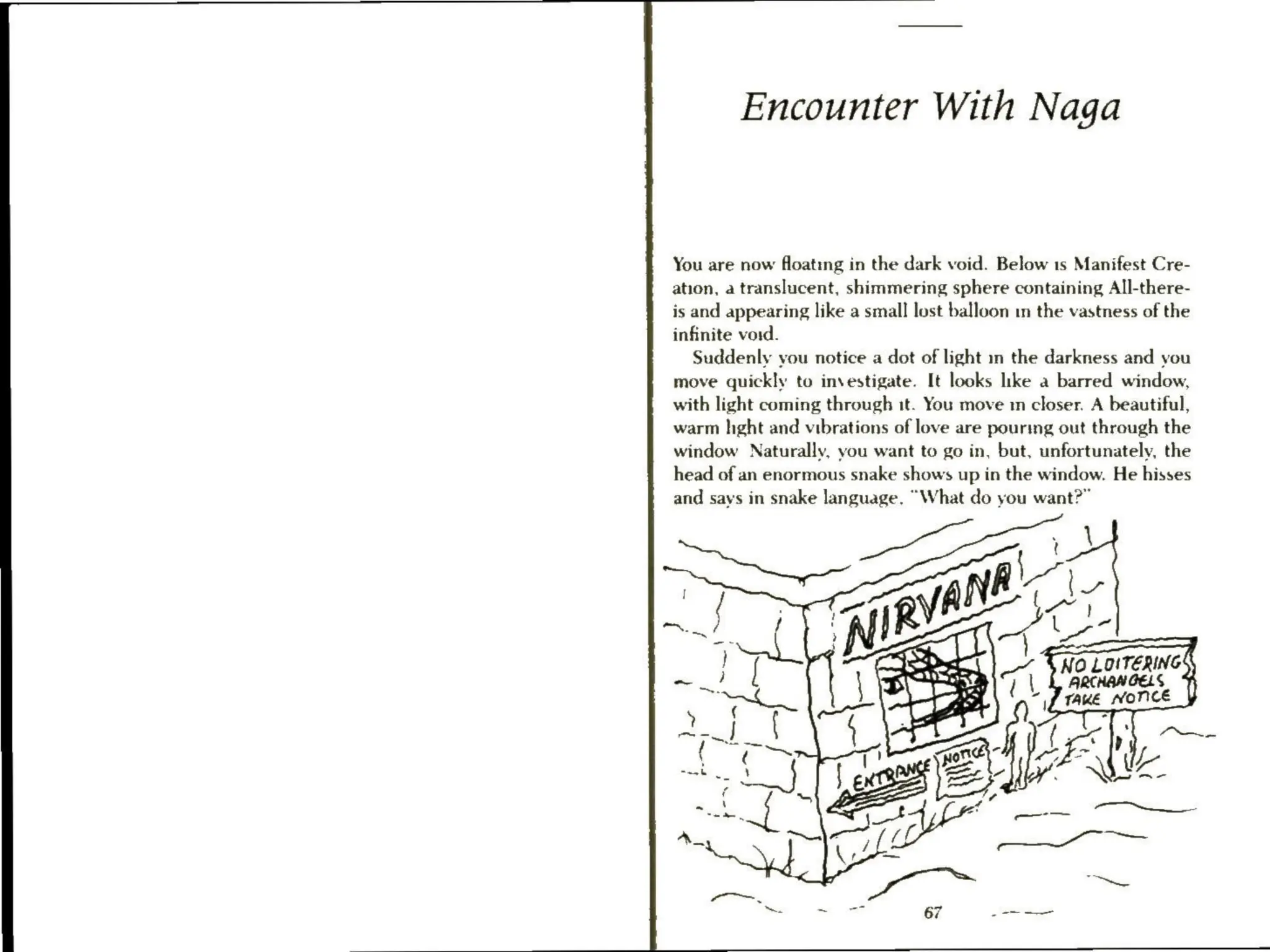
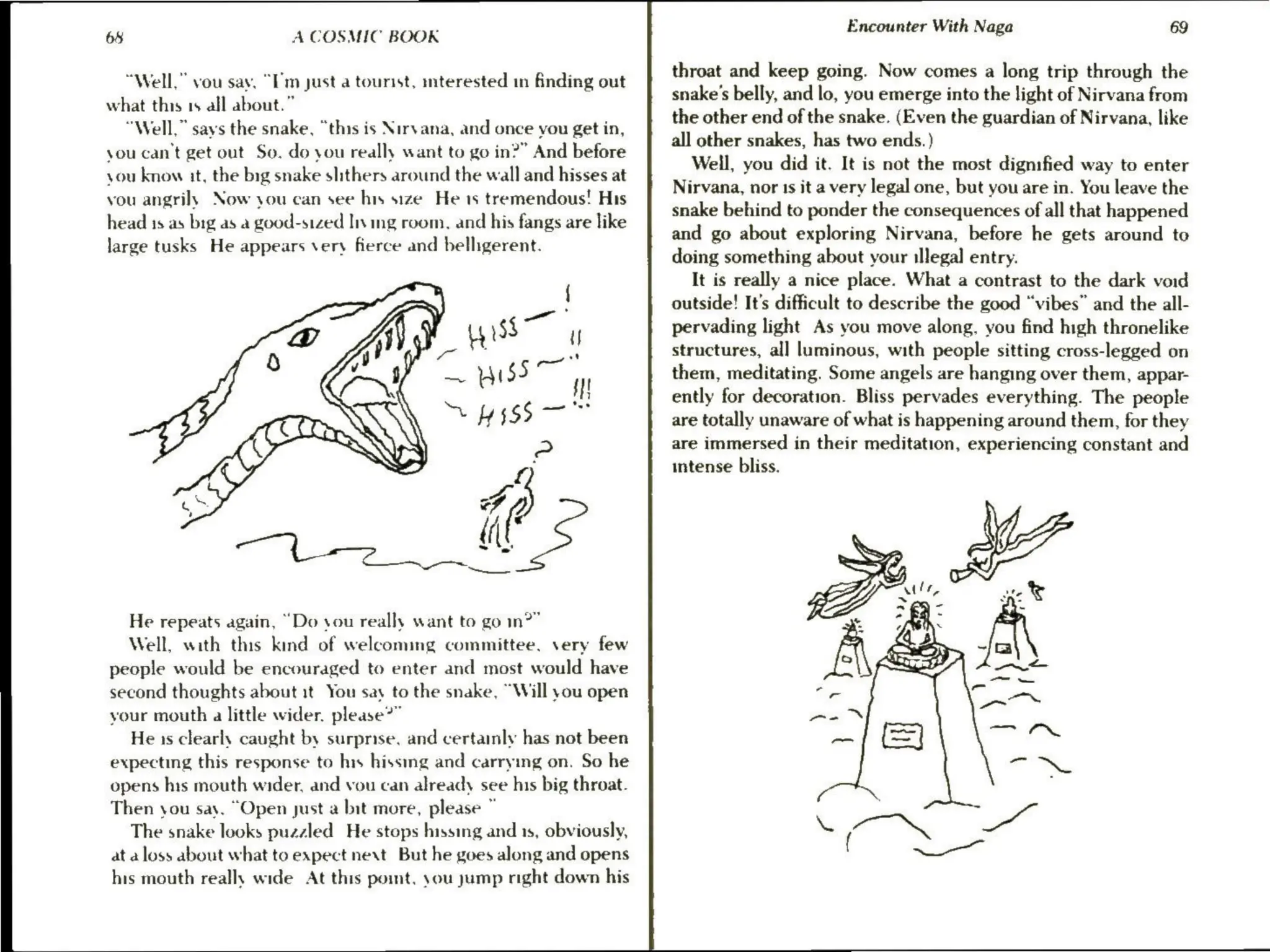
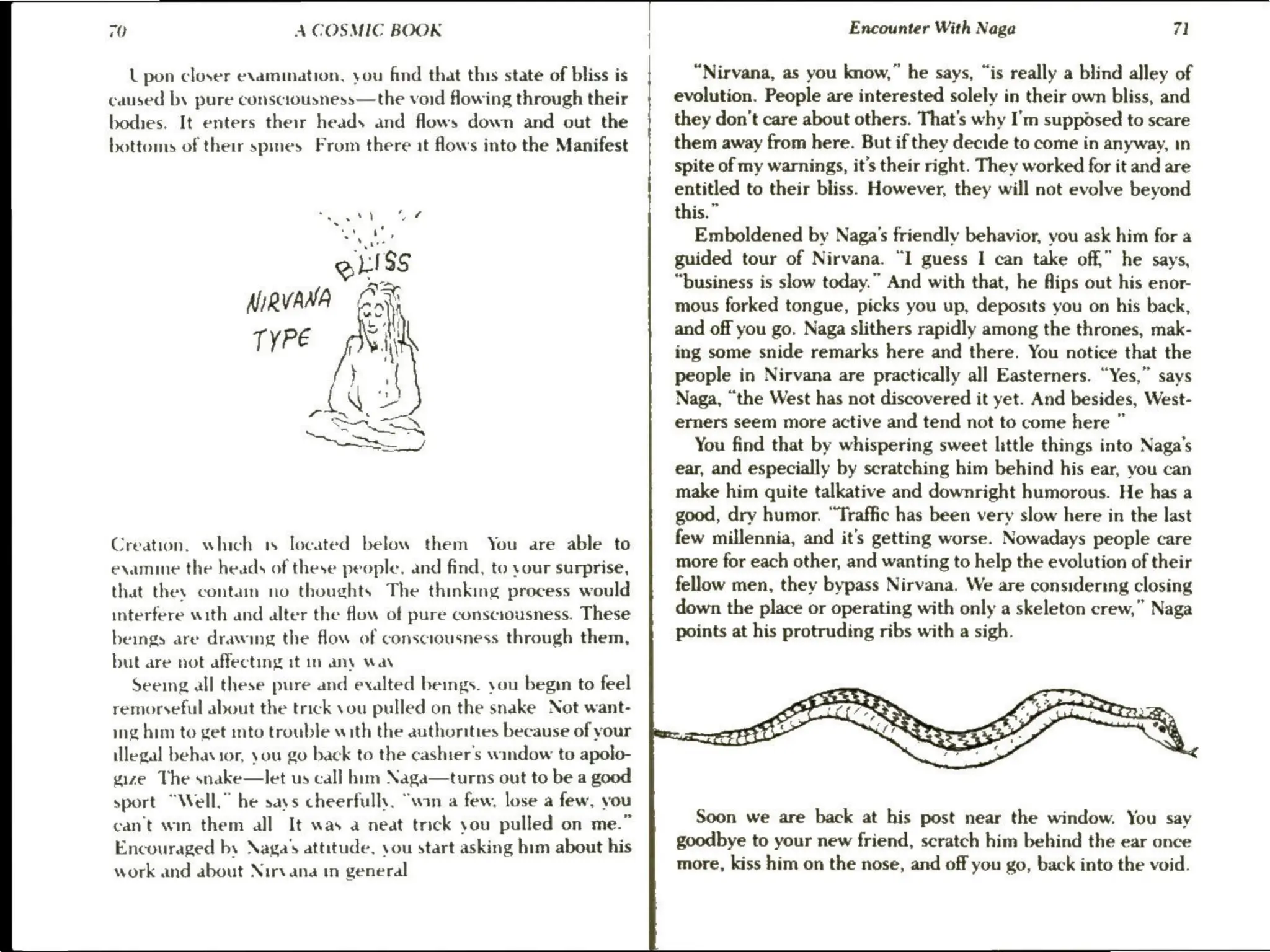
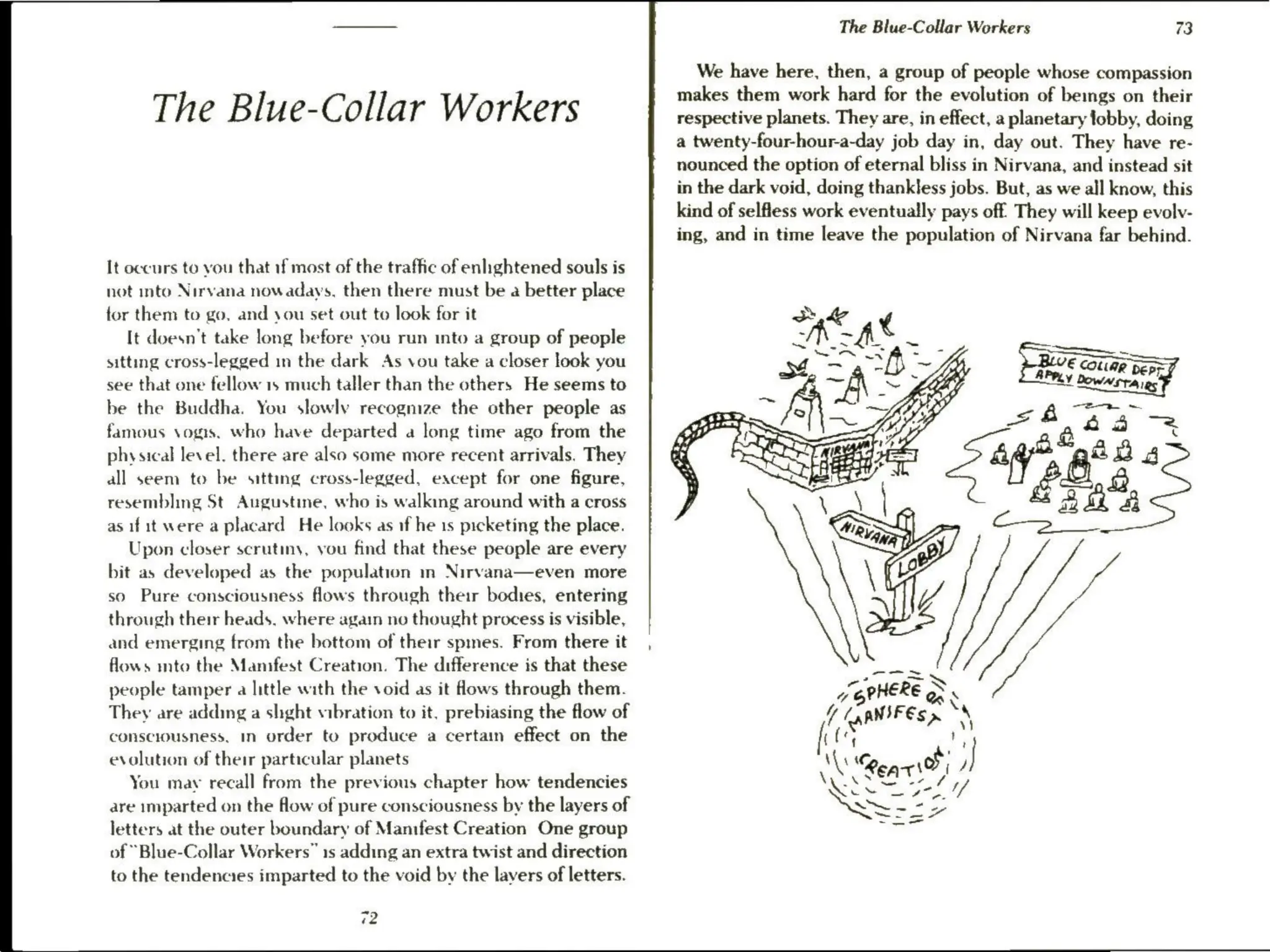
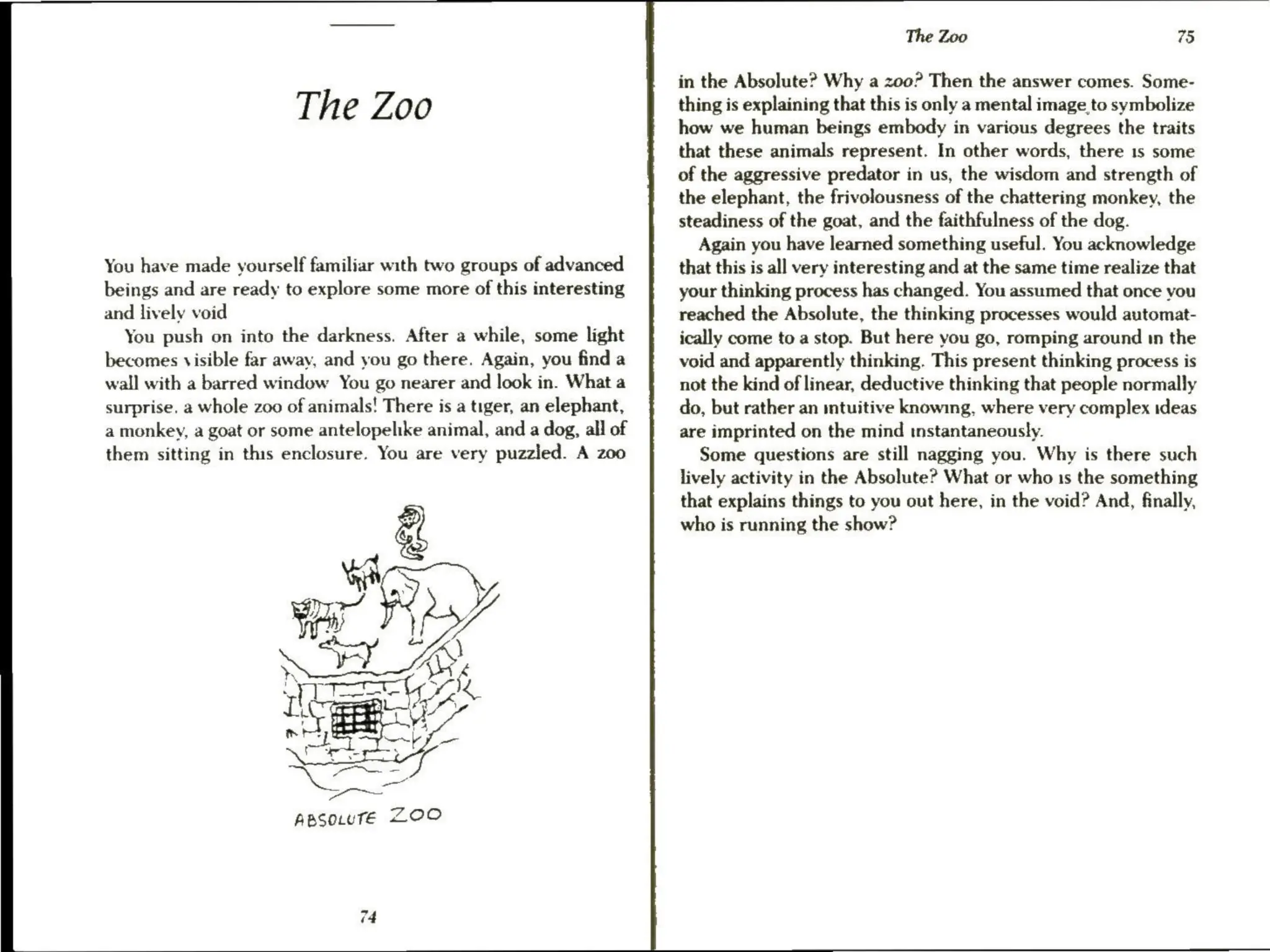
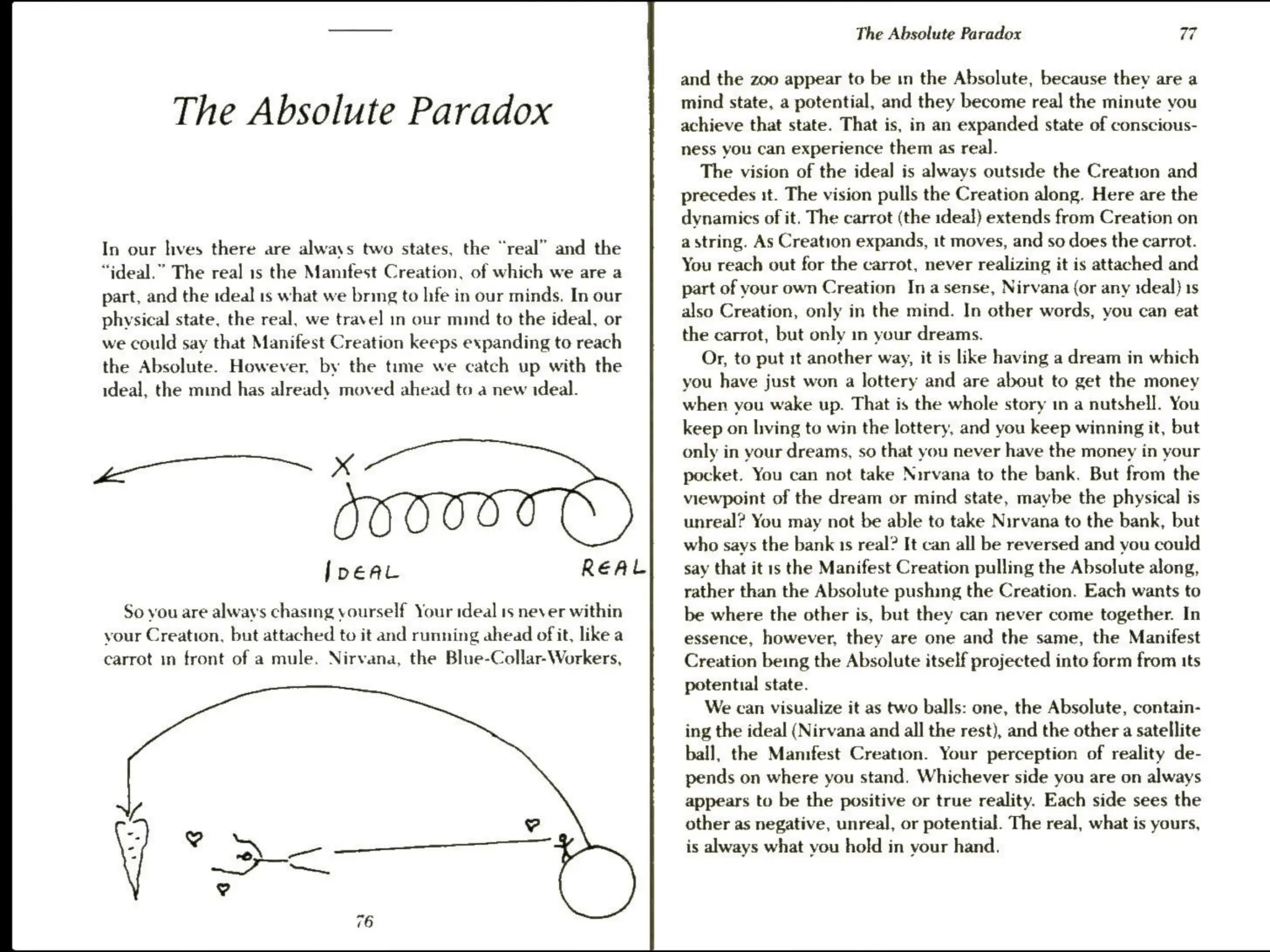
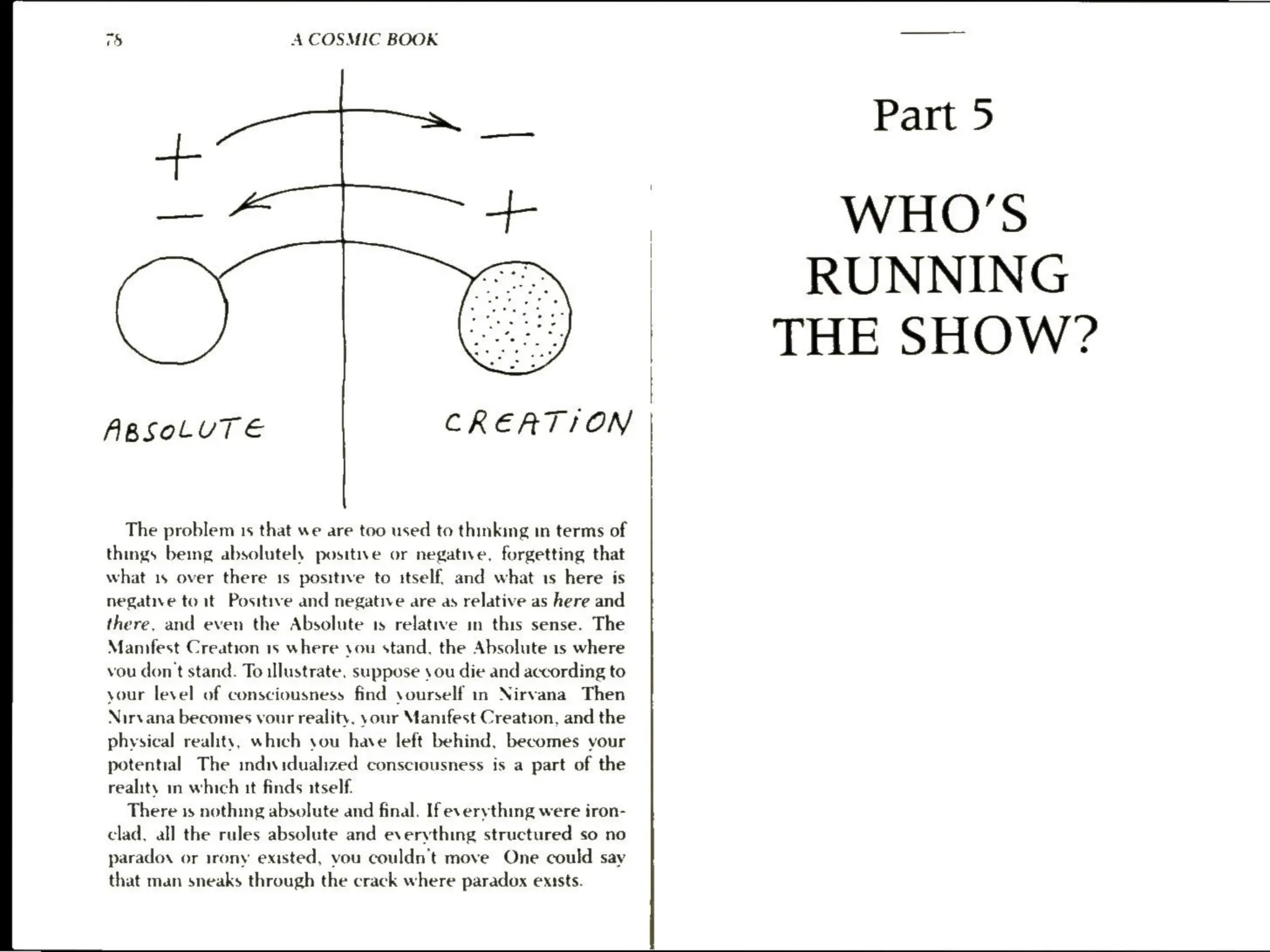
![§2 A COSMIC BOOK
the mm of this column of hight, and to your great surprise find
that it is just a hollow tube It’s a tall tunnel of light, disappear-
ing far up in the distance.
“Well,” vou think to yourself, “a tunnel is an invitation to
enter” So, up the tube you go. And you go, and go. After a
while you feel that the tube 1s bending for some reason; it's
bending some more, and more, and vou feel that vou have
made a U-turn. Now you are moving downward very rapidly.
Soon you have lost control and are hurtling down the tube.
Suddenly, you see the end of the tube. and something is
sitting there You realize that the something you see must be
IT, the rea] thing! You are scared and all this 1s happening very
fast now. You pop out of the tube and there, in front of you sits
the Lord of the system. He sits cross-legged—and guess
who it 1s? It is yourself! It is your SELF. It's a carbon copy of
your physical body, completely immobile, calm, unperturbed,
and impersonal. This, certainly, is quite a surprise. You try to
pull vourself together: Okay, what do vou say to vourself?
———we FTP!
Meeting Your Higher Self 83
. | if
~~ —
~ -
“ ~
~
He does not look at you, his eyes are focused in the distance.
And there vou are, finding yourself in an awkward situation.
You came a long and arduous way to find the answers to your
quest, and there it sits: Yourself. It's unbelievable, but there
sits vour SELF.
Since verbal communication makes little sense here, you
decide to use the old tested merging technique. which vou
used when you had to find out what the different beings and
gods you ran into were all about. You turn around and start
backing slowly into your body. This is done very carefully, just
— Lin
mm Ee AVIA
be = BANG!=
Ts»](https://image.slidesharecdn.com/acosmicbookonthemechanicsofcreationbyitzhakbentov-251212130219-7b800885/75/A-cosmic-book-on-the-mechanics-of-creation-by-Itzhak-Bentov-pdf-54-2048.jpg)
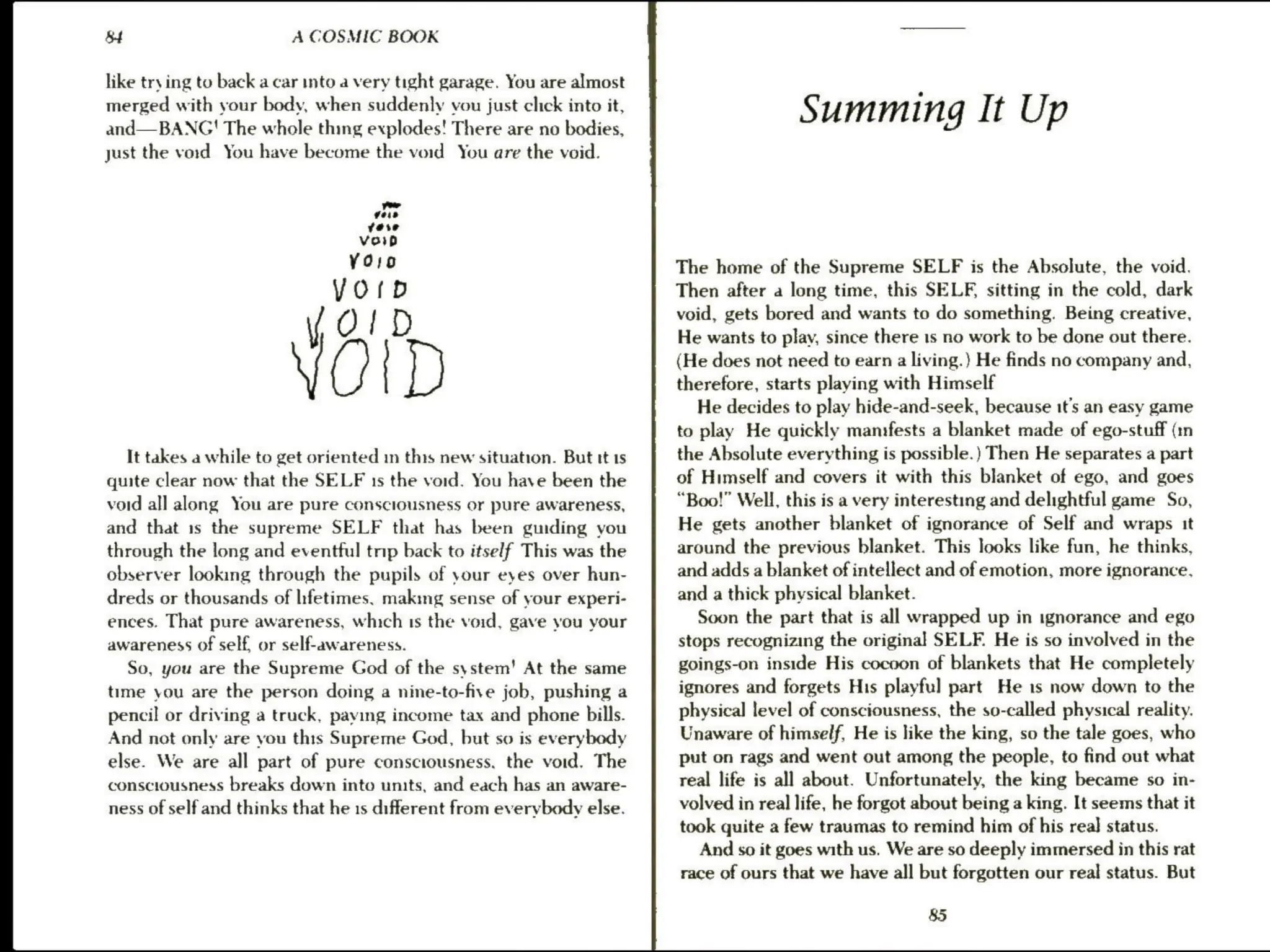
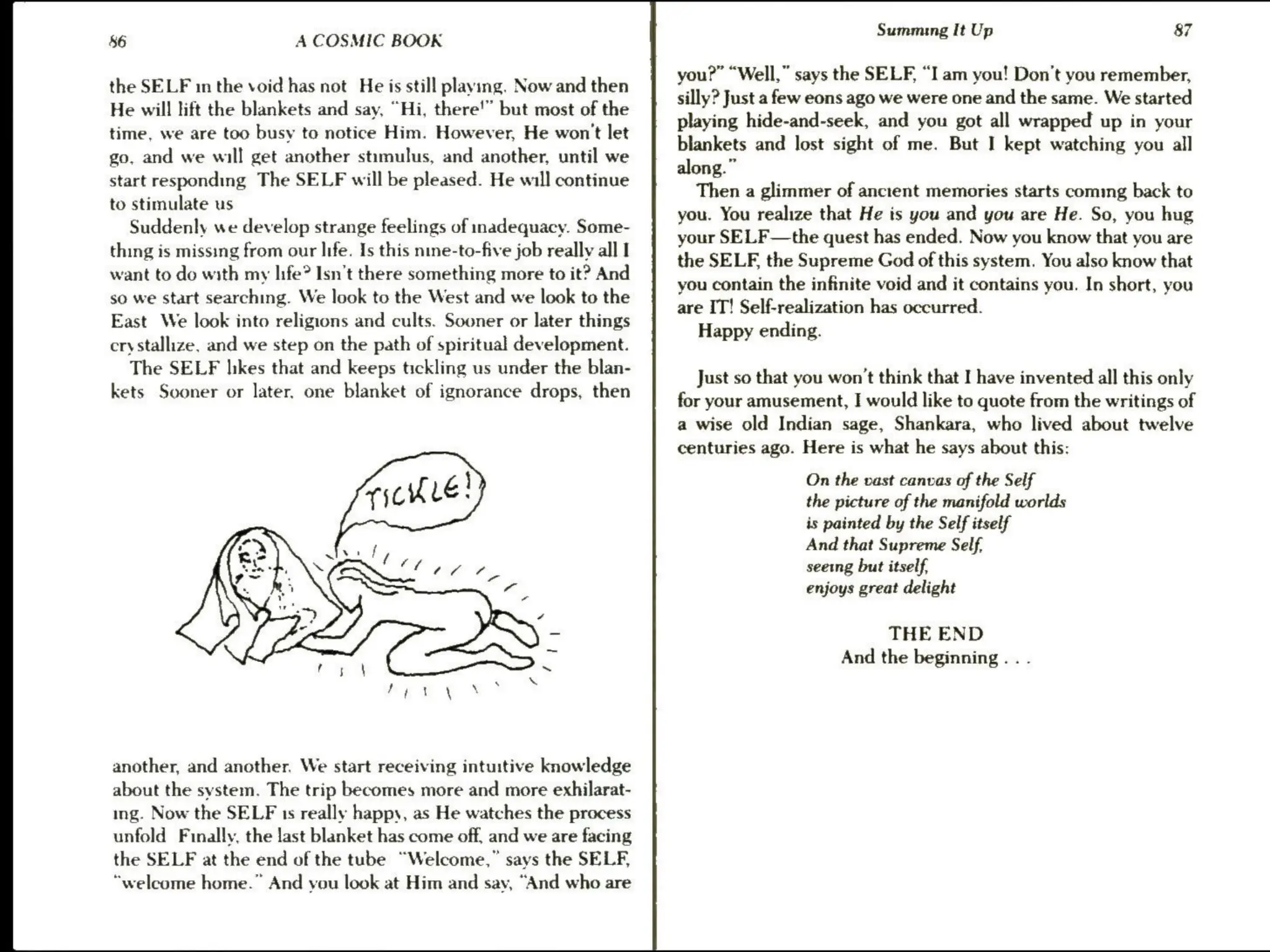
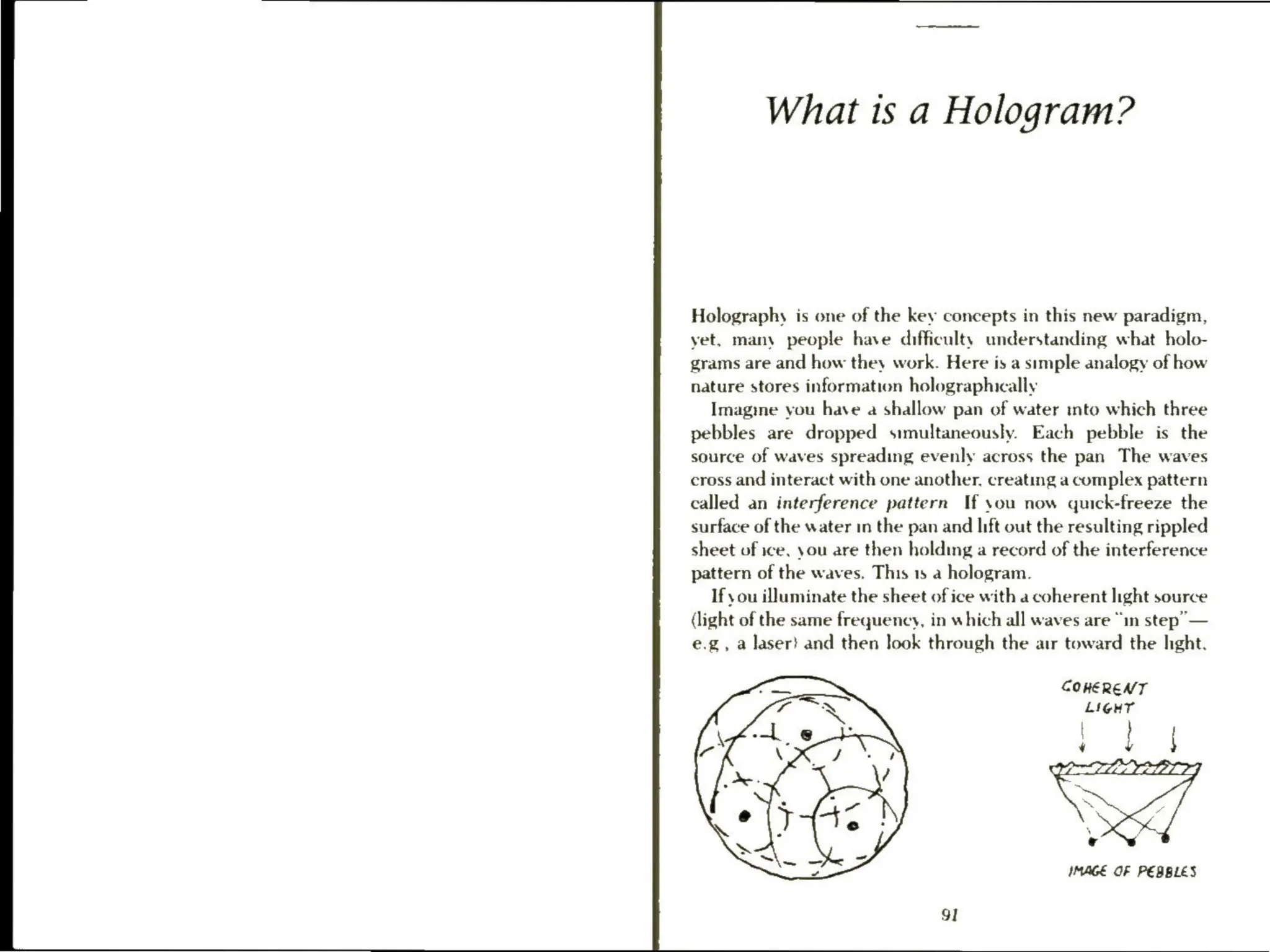
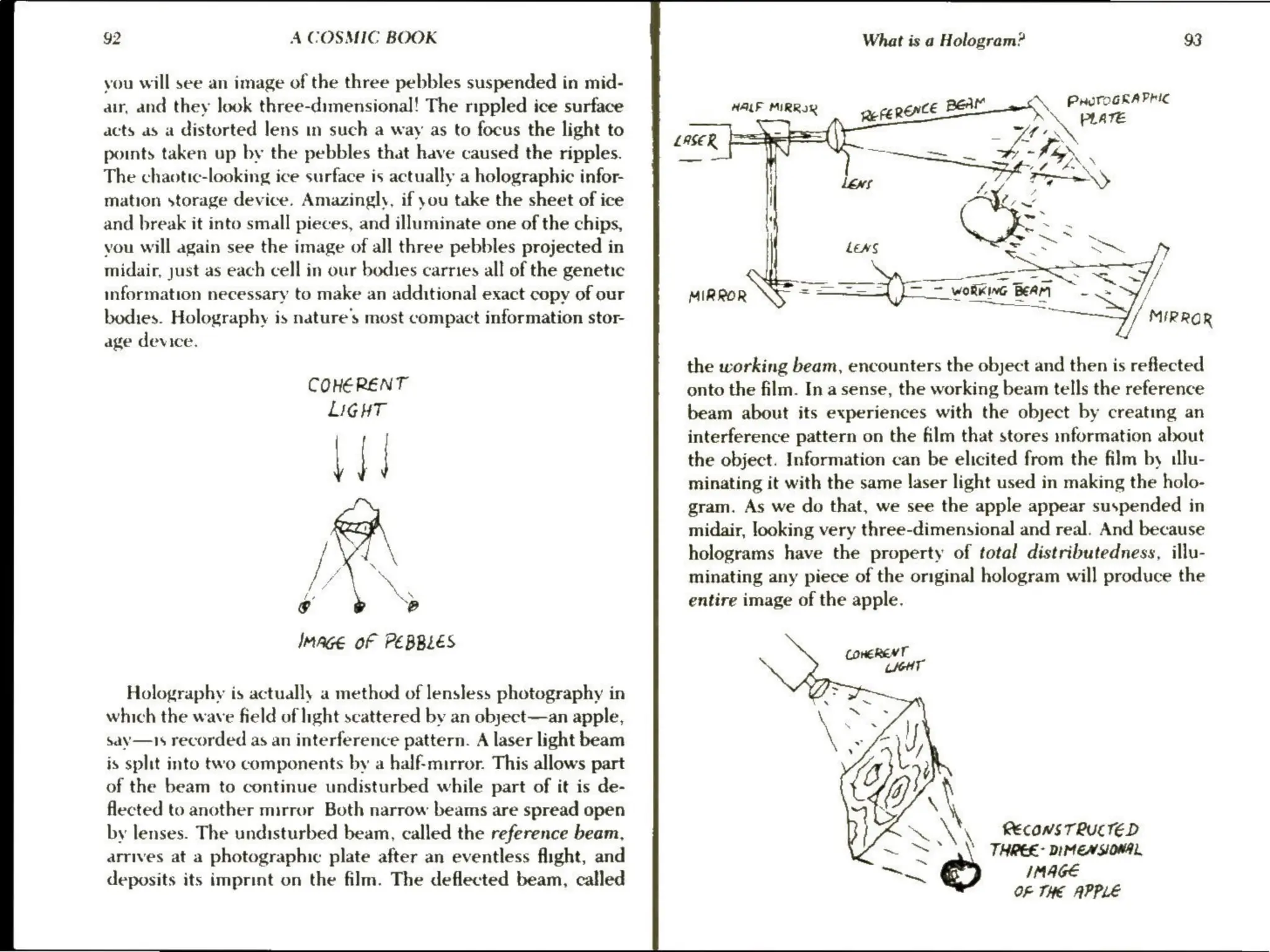
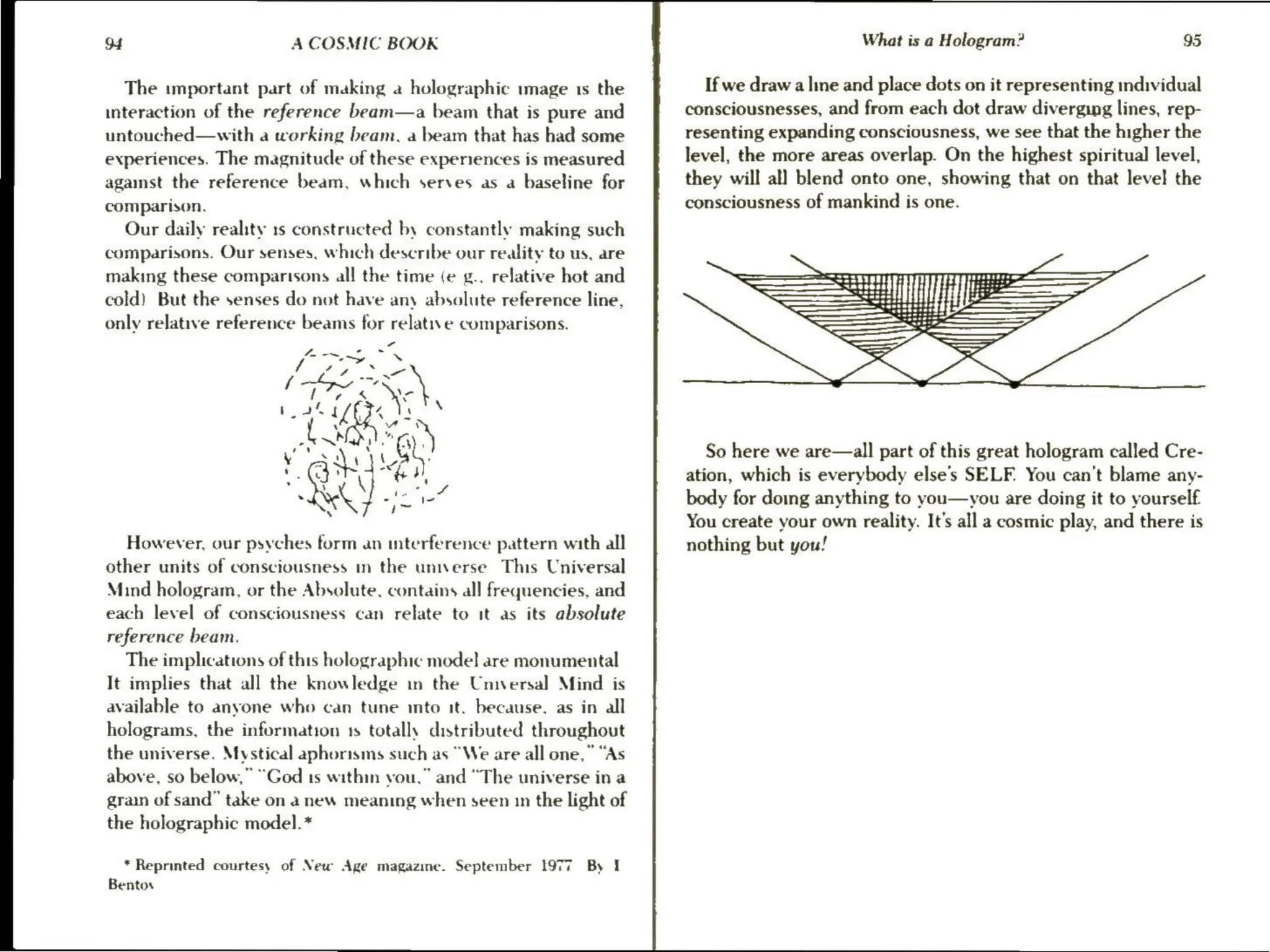

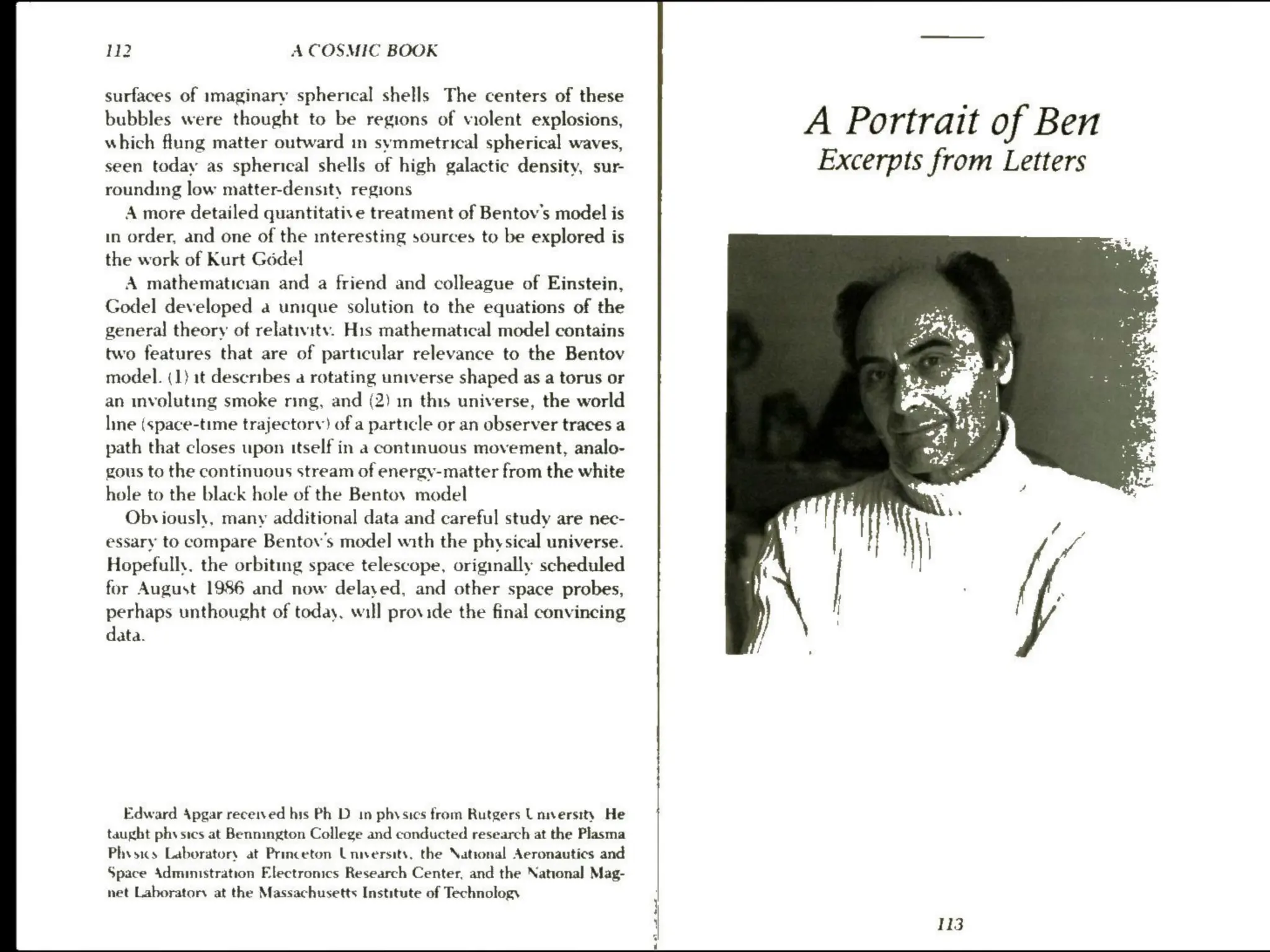
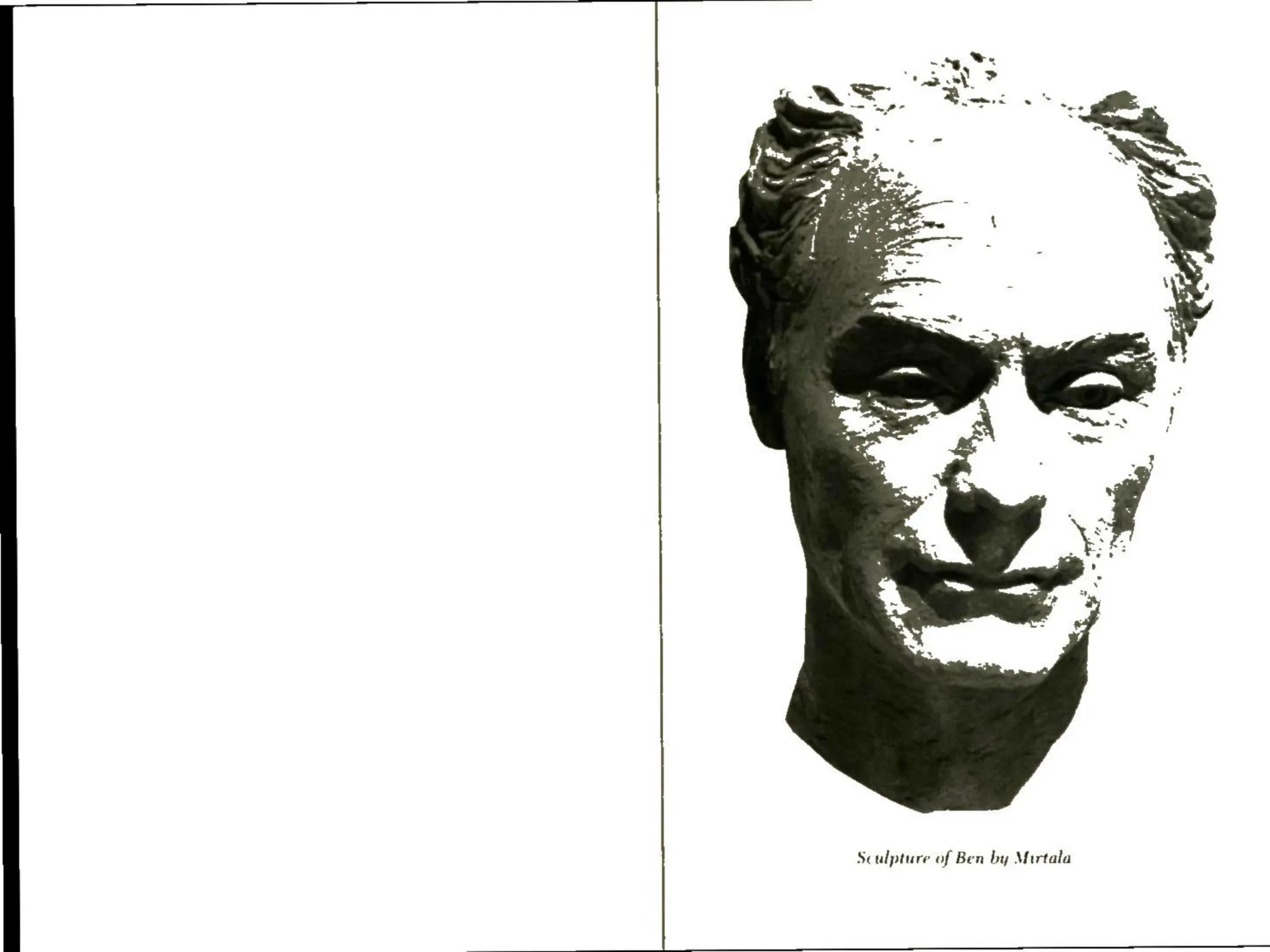




![[Gregory bateson] mind_and_nature](https://cdn.slidesharecdn.com/ss_thumbnails/gregorybatesonmindandnaturebokos-z1-160912074705-thumbnail.jpg?width=640&height=640&fit=bounds)


![[BROCHURE] Italy Tour Project | @SlideON](https://cdn.slidesharecdn.com/ss_thumbnails/brochure8-251215152319-2805af68-thumbnail.jpg?width=640&height=640&fit=bounds)


