TOPIC –
RADIATION HAZARDS
AND SAFETY
RADIATION HAZARDS
It causes injury or changes in the living tissues
resulting in
radiation sickness to the body.
Somatic effects- harmful to the person.
Genetic effects- reflected in the person.
BIOLOGICAL EFFECTS OF RADIATION
1. Radiation produce changes within the living
tissues.
2. The X-ray beam while traversing the tissue
forces
the electrons to be ejected from the atomic
lattice.
3. The atom is thus left with positive electrical
charge.
4. The cells within the tissue come to a state of
high
chemical reactivity which can initiate biological
effect.
DIRECT AND INDIRECT EFFECTS OF RADIATION
1. The direct effect appears due to absorption of
energy by the
molecules
2. While indirect effects are caused by the products of
radiation radiolysis of water and other solutes of the
body.
3. After radiolysis of water in the cells, there is
formation of free radicals with unpaired electrons.
These free radicals and the water formed by them are
highly reactive.
4. Since these free radicals possess large amount of
energy, they can readily break chemical bounds such as
protiens, nucleic acids and lipids.
EARLY EFFECTS OF RADIATION
The intensive irradiation of the entire body severely
depletes radiosensitive cells in many organs
simultaneously. The combined effect produces radiation
sickness(acute radiation syndrome).
STAGES OF ACUTE RADIATION SYNDROME
1. Early symptoms appears after the radiation is known
as prodromal radiation syndrome.
2. Whole body receive doses > 100 Gy may cause death
in 24-48 hours which is called neurovascular syndrome.
3. Dose level of 5-12 Gy may cause death in days is
called gastrointestinal syndrome.
4. dose of 2.5-5 Gy may cause death in weeks to months
is called hematopoietic syndrome
DELAYED EFFECTS OF RADIATION
It includes shortening of the life span, leukemia,
malignant tumours and cataract. in man, there
may also be induration and atrophy of the skin,
connective tissue and lungs.
SUSCEPTIBILITY OF DIFFERENT SPECIES TO THE
RADIATION
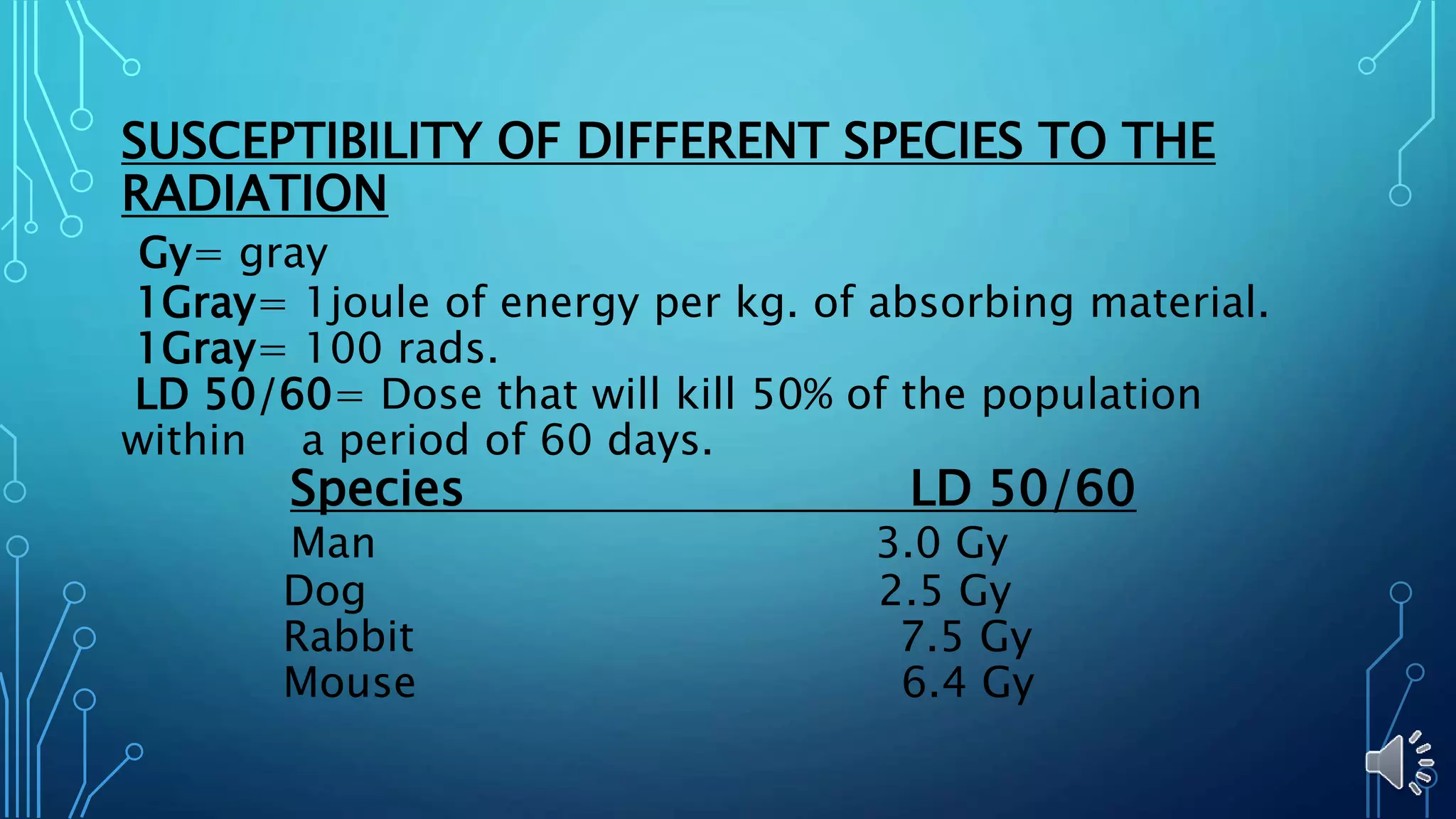
Gy= gray
1Gray= 1joule of energy per kg. of absorbing material.
1Gray= 100 rads.
LD 50/60= Dose that will kill 50% of the population
within a period of 60 days.
Species LD 50/60
Man 3.0 Gy
Dog 2.5 Gy
Rabbit 7.5 Gy
Mouse 6.4 Gy
THE DEGREE OF INJURY TO DIFFERENT
TISSUES/ORGANS BY RADIATION
Lymphoid tissue: within 15 min. after a moderate
dose, these is marked reduction in cell division
among lymphocytes and many show necrotic
changes.
Bone marrow: the precursors of red blood cells,
granulocytes and platelets are radiosensitive. Within a
week or two after radiation exposure most of the
radiosensitive elements disappear from marrow
leaving an aplastic marrow containing resistant cells
and haemorrhages.
Organ of vision: radiation induces inflammatory
reactions in the conjunctiva and sclera
Digestive system: large dose of radiation cause ulcers
& erosions in the buccal cavity. Also the pepsinogen
secreting cells are adversely affected & parietal cells are
functionally disturbed resulting in decreased hydrochloric
acid production. The net effect of this is gastric ulcers &
haemorrhage. Also large dose of radiation may shorten
the villi of intestine & cause injury resulting loss of fluids
& decreased absorption and electrolyte imbalance.
Respiratory system: radiation pneumonitis,
hyalinisation & fibrosis of the lungs may be observed.
Female reproductive system: ova & the granulosa
cells are highly radiosensitive
Male reproductive organs: spermatogonia are highly
sensitive, at higher dose it may not be able to fertilize ova.
If fertilization occurs, the implantation fails. And the
sterility sets in at dose above 2-4Gy.
Urinary system: parenchymal cells, ureters & bladder are
radioresistant. The damage to the kidneys occur due to the
injury to the blood vessels, the resultant ischemia
produces hypertension.
Skin: germinal layer of the epidermis is adversely affected.
Higher doses of radiation cause cell death & increased
cellular differentiation, these cells migrate to the
superficial layer of the skin & desquamate. Normal tight
ridged structure of the dermis become loose. dermatitis &
subsequent ulcers develop above dose of 10 Gy.
RADIATION SAFETY
GENERAL PRINCIPLES OF RADIATION SAFETY
1. Increasing the distance between the radiation source
and personnel.
2. No individuals other than operator and those
essential involved in the procedure should be in the x-
ray room.
3. The operator should be in a shielding booth or
behind a shielding screen or at least 6 feet away from
the X-ray source.
4. No part of the body should be exposed to the
primary X- ray beam.
USE OF PROTECTIVE BARRIERS
1. Gloves: the lead gloves should have 0.5mm lead
equivalent for voltages up to 100kv.
2. Goggles: lead goggles should be used during
fluoroscopy examinations.
3. Aprons: aprons should have a minimum of
0.25mm lead equivalent for voltages up to 100kv.
REDUCTION OF EXPOSURE FACTORS
1. Correct exposure factors must be used in the first
attempt.
2. The X-ray film should be processed correctly and
properly
to avoid repetition.
3. Avoid unnecessary exposure on owners demand.
4. Use of aluminium filters of at least 2.5mm
thickness to
absorb the soft X-ray.
USE OF RADIATION MONITORING DEVICES
1. Radiation monitoring devices should be worn
all the time by the individuals involved in
radiographic work.
2. Ideally, one film badge should be worn at the
belt level to monitor whole body exposure and
the other at the neckline to estimate exposure to
the skin of head & neck & eyes.
3. At periodic intervals these monitoring devices
should be sent to the research center(Bhabha
Atomic Research Center, Bombay) for calculating
radiation dose.
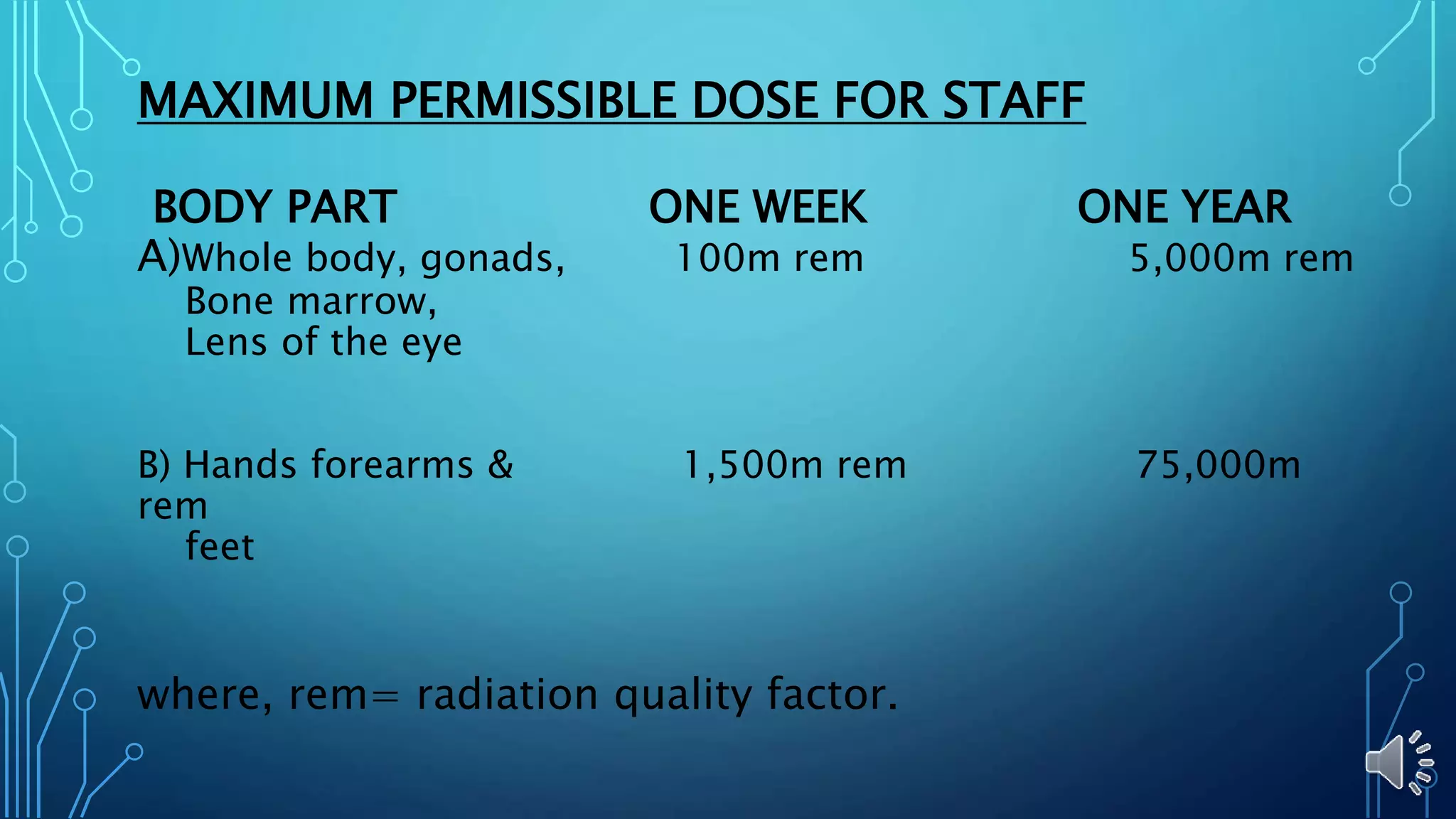
MAXIMUM PERMISSIBLE DOSE FOR STAFF
BODY PART ONE WEEK ONE YEAR
A)Whole body, gonads, 100m rem 5,000m rem
Bone marrow,
Lens of the eye
B) Hands forearms & 1,500m rem 75,000m
rem
feet
where, rem= radiation quality factor.
THANK YOU

RAADIATION HAZARDS FOR RADIOLOGY

  • 1.
  • 2.
    RADIATION HAZARDS It causesinjury or changes in the living tissues resulting in radiation sickness to the body. Somatic effects- harmful to the person. Genetic effects- reflected in the person.
  • 3.
    BIOLOGICAL EFFECTS OFRADIATION 1. Radiation produce changes within the living tissues. 2. The X-ray beam while traversing the tissue forces the electrons to be ejected from the atomic lattice. 3. The atom is thus left with positive electrical charge. 4. The cells within the tissue come to a state of high chemical reactivity which can initiate biological effect.
  • 4.
    DIRECT AND INDIRECTEFFECTS OF RADIATION 1. The direct effect appears due to absorption of energy by the molecules 2. While indirect effects are caused by the products of radiation radiolysis of water and other solutes of the body. 3. After radiolysis of water in the cells, there is formation of free radicals with unpaired electrons. These free radicals and the water formed by them are highly reactive. 4. Since these free radicals possess large amount of energy, they can readily break chemical bounds such as protiens, nucleic acids and lipids.
  • 5.
    EARLY EFFECTS OFRADIATION The intensive irradiation of the entire body severely depletes radiosensitive cells in many organs simultaneously. The combined effect produces radiation sickness(acute radiation syndrome). STAGES OF ACUTE RADIATION SYNDROME 1. Early symptoms appears after the radiation is known as prodromal radiation syndrome. 2. Whole body receive doses > 100 Gy may cause death in 24-48 hours which is called neurovascular syndrome. 3. Dose level of 5-12 Gy may cause death in days is called gastrointestinal syndrome. 4. dose of 2.5-5 Gy may cause death in weeks to months is called hematopoietic syndrome
  • 6.
    DELAYED EFFECTS OFRADIATION It includes shortening of the life span, leukemia, malignant tumours and cataract. in man, there may also be induration and atrophy of the skin, connective tissue and lungs.
  • 7.
    SUSCEPTIBILITY OF DIFFERENTSPECIES TO THE RADIATION Gy= gray 1Gray= 1joule of energy per kg. of absorbing material. 1Gray= 100 rads. LD 50/60= Dose that will kill 50% of the population within a period of 60 days. Species LD 50/60 Man 3.0 Gy Dog 2.5 Gy Rabbit 7.5 Gy Mouse 6.4 Gy
  • 8.
    THE DEGREE OFINJURY TO DIFFERENT TISSUES/ORGANS BY RADIATION Lymphoid tissue: within 15 min. after a moderate dose, these is marked reduction in cell division among lymphocytes and many show necrotic changes. Bone marrow: the precursors of red blood cells, granulocytes and platelets are radiosensitive. Within a week or two after radiation exposure most of the radiosensitive elements disappear from marrow leaving an aplastic marrow containing resistant cells and haemorrhages. Organ of vision: radiation induces inflammatory reactions in the conjunctiva and sclera
  • 9.
    Digestive system: largedose of radiation cause ulcers & erosions in the buccal cavity. Also the pepsinogen secreting cells are adversely affected & parietal cells are functionally disturbed resulting in decreased hydrochloric acid production. The net effect of this is gastric ulcers & haemorrhage. Also large dose of radiation may shorten the villi of intestine & cause injury resulting loss of fluids & decreased absorption and electrolyte imbalance. Respiratory system: radiation pneumonitis, hyalinisation & fibrosis of the lungs may be observed. Female reproductive system: ova & the granulosa cells are highly radiosensitive
  • 10.
    Male reproductive organs:spermatogonia are highly sensitive, at higher dose it may not be able to fertilize ova. If fertilization occurs, the implantation fails. And the sterility sets in at dose above 2-4Gy. Urinary system: parenchymal cells, ureters & bladder are radioresistant. The damage to the kidneys occur due to the injury to the blood vessels, the resultant ischemia produces hypertension. Skin: germinal layer of the epidermis is adversely affected. Higher doses of radiation cause cell death & increased cellular differentiation, these cells migrate to the superficial layer of the skin & desquamate. Normal tight ridged structure of the dermis become loose. dermatitis & subsequent ulcers develop above dose of 10 Gy.
  • 11.
  • 12.
    GENERAL PRINCIPLES OFRADIATION SAFETY 1. Increasing the distance between the radiation source and personnel. 2. No individuals other than operator and those essential involved in the procedure should be in the x- ray room. 3. The operator should be in a shielding booth or behind a shielding screen or at least 6 feet away from the X-ray source. 4. No part of the body should be exposed to the primary X- ray beam.
  • 13.
    USE OF PROTECTIVEBARRIERS 1. Gloves: the lead gloves should have 0.5mm lead equivalent for voltages up to 100kv. 2. Goggles: lead goggles should be used during fluoroscopy examinations. 3. Aprons: aprons should have a minimum of 0.25mm lead equivalent for voltages up to 100kv.
  • 14.
    REDUCTION OF EXPOSUREFACTORS 1. Correct exposure factors must be used in the first attempt. 2. The X-ray film should be processed correctly and properly to avoid repetition. 3. Avoid unnecessary exposure on owners demand. 4. Use of aluminium filters of at least 2.5mm thickness to absorb the soft X-ray.
  • 15.
    USE OF RADIATIONMONITORING DEVICES 1. Radiation monitoring devices should be worn all the time by the individuals involved in radiographic work. 2. Ideally, one film badge should be worn at the belt level to monitor whole body exposure and the other at the neckline to estimate exposure to the skin of head & neck & eyes. 3. At periodic intervals these monitoring devices should be sent to the research center(Bhabha Atomic Research Center, Bombay) for calculating radiation dose.
  • 16.
    MAXIMUM PERMISSIBLE DOSEFOR STAFF BODY PART ONE WEEK ONE YEAR A)Whole body, gonads, 100m rem 5,000m rem Bone marrow, Lens of the eye B) Hands forearms & 1,500m rem 75,000m rem feet where, rem= radiation quality factor.
  • 17.