Workshop using the
Thomas-Kilmann Conflict Mode
Instrument
A facilitated activity using the Thomas-Kilmann Conflict Mode Instrument
questionnaire to assess behaviour in conflict situations. It is based on a model
of conflict modes, which enables an analysis of individual styles in particular
situations. Individuals can identify their primary style, and assess the
productiveness of that style in the various situations that they encounter. They
then have the choice to continue with that style, or to adopt others if they are
more appropriate.
Objectives
• To create a model and language with which to
analyze conflict situations that arise.
• To develop options for constructively resolving
conflicts.
• For individuals within a team to start addressing
unproductive conflict resolution behavior.
Why would you use it?
• Having a model with which to
analyze situations can help the
constructive resolution of conflict.
What is the outcome?
• The Team will have a model and a language
with which to analyse any conflict situations
that arise, and some options for constructively
resolving these conflicts.
• Individuals within the team may start to address
their unproductive conflict resolution modes.
Process
1. The Facilitator explains the objectives of the process to the Participants that they’ll be considering situations
in which they find their wishes differing from those of another person. How do they usually respond to such
situations?
2. The Facilitator hands the Participants the 30 Questions where there are several pairs of statements
describing possible behavioural responses.
3. The Participants consider each pair, and circle the ‘A’ or ‘B’ statements which are most characteristic of their
own behaviour.
4. When every Participant is finished the Facilitator introduces ‘The Five Conflict Modes’ using the slide in this
pack.
5. The Facilitator hands the Participants the Scoring Sheet(s) and asks them to total up their scores in each of
the five columns.
6. The Team then splits into small groups/pairs and each group considers when it might be appropriate to use
a particular style and what the pitfalls of each style might be.
7. The Facilitator asks the groups to report back in plenary and reviews the exercise using the rest of the slides.
Instructions
1. The TKI asks you to think of scenarios where you have different
opinions or needs from another person. What normally
happens then?
2. It then asks you to consider 30 statements describing potential
responses to situations.
3. Sometimes you will find that neither of the statements feels
100% right. In those cases you are invited to select the
response that is most likely.
4. On the following slide you can see 3 example questions from
the TKI.
Example Questions
# Choose Questions
8
A I am usually firm in pursing my goals.
B I attempt to get all concerns and issues immediately out in the open.
15
A I might try to soothe the other’s feelings and preserve our relationship.
B I try to do what is necessary to avoid tensions.
26
A I propose middle ground.
B I am nearly always concerned with satisfying all our wishes.
30 Questions & Scoring Sheet
The TKI is under copyright. For full access
to the 30 questions and Scoring Sheet you
will need to purchase the product at the
following URL:
http://www.kilmanndiagnostics.com/catalog/thomas-kilmann-instrument-one-assessment-person
How To Score
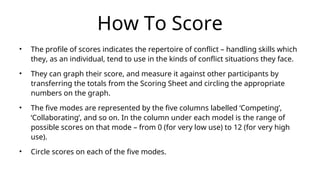
• The profile of scores indicates the repertoire of conflict – handling skills which
they, as an individual, tend to use in the kinds of conflict situations they face.
• They can graph their score, and measure it against other participants by
transferring the totals from the Scoring Sheet and circling the appropriate
numbers on the graph.
• The five modes are represented by the five columns labelled ‘Competing’,
‘Collaborating’, and so on. In the column under each model is the range of
possible scores on that mode – from 0 (for very low use) to 12 (for very high
use).
• Circle scores on each of the five modes.
How To Score
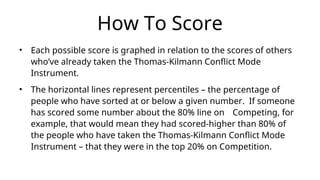
• Each possible score is graphed in relation to the scores of others
who’ve already taken the Thomas-Kilmann Conflict Mode
Instrument.
• The horizontal lines represent percentiles – the percentage of
people who have sorted at or below a given number. If someone
has scored some number about the 80% line on Competing, for
example, that would mean they had scored-higher than 80% of
the people who have taken the Thomas-Kilmann Conflict Mode
Instrument – that they were in the top 20% on Competition.
How To Score
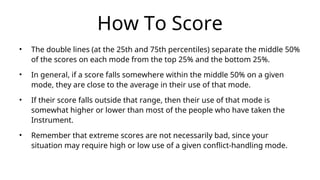
• The double lines (at the 25th and 75th percentiles) separate the middle 50%
of the scores on each mode from the top 25% and the bottom 25%.
• In general, if a score falls somewhere within the middle 50% on a given
mode, they are close to the average in their use of that mode.
• If their score falls outside that range, then their use of that mode is
somewhat higher or lower than most of the people who have taken the
Instrument.
• Remember that extreme scores are not necessarily bad, since your
situation may require high or low use of a given conflict-handling mode.
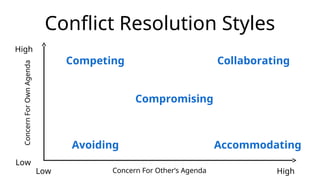
Conflict Resolution Styles
Low High
Low
High
Concern For Other’s Agenda
Concern
For
Own
Agenda
Competing
Avoiding Accommodating
Collaborating
Compromising
When To Use Different Styles?
Low High
Low
High
Concern For Other’s Agenda
Concern
For
Own
Agenda
Competing
Avoiding Accommodating
Collaborating
Compromising
• Quick, decisive action needed
• Important but unpopular issues
are at stake and where there
isn’t “right” way
• Trivial issues
• No chance of getting what you want
• Potential risk of confrontation outweigh
benefits of resolution
• Other better places to resolve the issue
• Moderately important goals but not worth potential disruption
of more assertive modes
• Two equally strong parties committed to mutually exclusive
goals
• Expediency
• Back up competing/collaborating
• Issue much more important to other
party
• To limit damage of continued conflict
• To bank favors
• When in the wrong
• Both sets of concerns too important to be
compromised
• Needs insights from different perspectives
• Increases others’ commitment to solutions
• Long-term major issues
Secret Sauce
• When you are going through the questions sometimes you will see the
people doing the TKI will find that neither of the statements feels 100%
right. When that happens ask them to select the response that is most
likely.
• It should be remembered that extreme scores are not necessarily bad,
since the participant’s situation may require high or low use of a given
conflict-handling mode.
• No one approach is correct. One must tailor their response to the situation.
The essential element to realise is that conflict should be understood and
managed and not feared.
Secret Sauce
• There are also several methods of ensuring that the conflict does
not lead to a break down in the group’s ability to work together:
– Encourage the debate to emerge.
– Ensure that the debate is kept to an issue and is not personalised. This can be
achieved by noting the key issues on a flip chart.
– Ensure that the debate is kept focused on the future, not in recriminations over
past problems.
– Encourage people to say what they have to say to each other and not have all
points addressed through a third party.
– Avoid premature “taking of sides”.

Conflict Resolution By using Thomas Killman Model.ppt

  • 1.
    Workshop using the Thomas-KilmannConflict Mode Instrument A facilitated activity using the Thomas-Kilmann Conflict Mode Instrument questionnaire to assess behaviour in conflict situations. It is based on a model of conflict modes, which enables an analysis of individual styles in particular situations. Individuals can identify their primary style, and assess the productiveness of that style in the various situations that they encounter. They then have the choice to continue with that style, or to adopt others if they are more appropriate.
  • 2.
    Objectives • To createa model and language with which to analyze conflict situations that arise. • To develop options for constructively resolving conflicts. • For individuals within a team to start addressing unproductive conflict resolution behavior.
  • 3.
    Why would youuse it? • Having a model with which to analyze situations can help the constructive resolution of conflict.
  • 4.
    What is theoutcome? • The Team will have a model and a language with which to analyse any conflict situations that arise, and some options for constructively resolving these conflicts. • Individuals within the team may start to address their unproductive conflict resolution modes.
  • 5.
    Process 1. The Facilitatorexplains the objectives of the process to the Participants that they’ll be considering situations in which they find their wishes differing from those of another person. How do they usually respond to such situations? 2. The Facilitator hands the Participants the 30 Questions where there are several pairs of statements describing possible behavioural responses. 3. The Participants consider each pair, and circle the ‘A’ or ‘B’ statements which are most characteristic of their own behaviour. 4. When every Participant is finished the Facilitator introduces ‘The Five Conflict Modes’ using the slide in this pack. 5. The Facilitator hands the Participants the Scoring Sheet(s) and asks them to total up their scores in each of the five columns. 6. The Team then splits into small groups/pairs and each group considers when it might be appropriate to use a particular style and what the pitfalls of each style might be. 7. The Facilitator asks the groups to report back in plenary and reviews the exercise using the rest of the slides.
  • 6.
    Instructions 1. The TKIasks you to think of scenarios where you have different opinions or needs from another person. What normally happens then? 2. It then asks you to consider 30 statements describing potential responses to situations. 3. Sometimes you will find that neither of the statements feels 100% right. In those cases you are invited to select the response that is most likely. 4. On the following slide you can see 3 example questions from the TKI.
  • 7.
    Example Questions # ChooseQuestions 8 A I am usually firm in pursing my goals. B I attempt to get all concerns and issues immediately out in the open. 15 A I might try to soothe the other’s feelings and preserve our relationship. B I try to do what is necessary to avoid tensions. 26 A I propose middle ground. B I am nearly always concerned with satisfying all our wishes.
  • 8.
    30 Questions &Scoring Sheet The TKI is under copyright. For full access to the 30 questions and Scoring Sheet you will need to purchase the product at the following URL: http://www.kilmanndiagnostics.com/catalog/thomas-kilmann-instrument-one-assessment-person
  • 9.
    How To Score •The profile of scores indicates the repertoire of conflict – handling skills which they, as an individual, tend to use in the kinds of conflict situations they face. • They can graph their score, and measure it against other participants by transferring the totals from the Scoring Sheet and circling the appropriate numbers on the graph. • The five modes are represented by the five columns labelled ‘Competing’, ‘Collaborating’, and so on. In the column under each model is the range of possible scores on that mode – from 0 (for very low use) to 12 (for very high use). • Circle scores on each of the five modes.
  • 10.
    How To Score •Each possible score is graphed in relation to the scores of others who’ve already taken the Thomas-Kilmann Conflict Mode Instrument. • The horizontal lines represent percentiles – the percentage of people who have sorted at or below a given number. If someone has scored some number about the 80% line on Competing, for example, that would mean they had scored-higher than 80% of the people who have taken the Thomas-Kilmann Conflict Mode Instrument – that they were in the top 20% on Competition.
  • 11.
    How To Score •The double lines (at the 25th and 75th percentiles) separate the middle 50% of the scores on each mode from the top 25% and the bottom 25%. • In general, if a score falls somewhere within the middle 50% on a given mode, they are close to the average in their use of that mode. • If their score falls outside that range, then their use of that mode is somewhat higher or lower than most of the people who have taken the Instrument. • Remember that extreme scores are not necessarily bad, since your situation may require high or low use of a given conflict-handling mode.
  • 12.
    Conflict Resolution Styles LowHigh Low High Concern For Other’s Agenda Concern For Own Agenda Competing Avoiding Accommodating Collaborating Compromising
  • 13.
    When To UseDifferent Styles? Low High Low High Concern For Other’s Agenda Concern For Own Agenda Competing Avoiding Accommodating Collaborating Compromising • Quick, decisive action needed • Important but unpopular issues are at stake and where there isn’t “right” way • Trivial issues • No chance of getting what you want • Potential risk of confrontation outweigh benefits of resolution • Other better places to resolve the issue • Moderately important goals but not worth potential disruption of more assertive modes • Two equally strong parties committed to mutually exclusive goals • Expediency • Back up competing/collaborating • Issue much more important to other party • To limit damage of continued conflict • To bank favors • When in the wrong • Both sets of concerns too important to be compromised • Needs insights from different perspectives • Increases others’ commitment to solutions • Long-term major issues
  • 14.
    Secret Sauce • Whenyou are going through the questions sometimes you will see the people doing the TKI will find that neither of the statements feels 100% right. When that happens ask them to select the response that is most likely. • It should be remembered that extreme scores are not necessarily bad, since the participant’s situation may require high or low use of a given conflict-handling mode. • No one approach is correct. One must tailor their response to the situation. The essential element to realise is that conflict should be understood and managed and not feared.
  • 15.
    Secret Sauce • Thereare also several methods of ensuring that the conflict does not lead to a break down in the group’s ability to work together: – Encourage the debate to emerge. – Ensure that the debate is kept to an issue and is not personalised. This can be achieved by noting the key issues on a flip chart. – Ensure that the debate is kept focused on the future, not in recriminations over past problems. – Encourage people to say what they have to say to each other and not have all points addressed through a third party. – Avoid premature “taking of sides”.