Download as PDF, PPTX

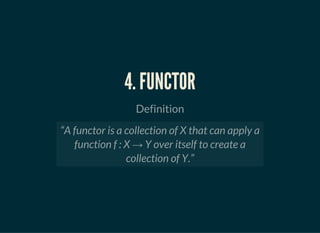
![4. FUNCTOR - MAP
Code:
List< String > map( Function< String, String > f
, List< String > values ) {
List< String > toReturn = new ArrayList< >();
for( String current : values ) {
toReturn.add( f.apply(current) );
}
return toReturn;
}
Result:
List< String > confs =
Arrays.asList( new String[]{"Corkdev", "devoxx", "javaone"
map( s > s.toUpperCase(), confs );
// [CORKDEV, DEVOXX, JAVAONE]
With Java 8:
confs.stream().map( s > s.toUpperCase() ).collect( Collectors.toList() )](https://image.slidesharecdn.com/conceptsoffunctionalprogramming-150419063621-conversion-gate02/85/Concepts-of-functional-programming-12-320.jpg)
![With Coffescript:
["Corkdev", "devoxx", "javaone"].map (el) > el.toUpperCase()](https://image.slidesharecdn.com/conceptsoffunctionalprogramming-150419063621-conversion-gate02/85/Concepts-of-functional-programming-13-320.jpg)
![4. FUNCTOR - FILTER
Code:
List< String > filter( Function< String, Boolean > f,
List< String > values ) {
List< String > toReturn = new ArrayList< >();
for( String current : values ) {
if ( f.apply(current) )
toReturn.add( current );
}
return toReturn;
}
Result:
List< String > confs =
Arrays.asList( new String[]{"jug", "devoxx", "javaone"} );
filter(s > s.contains("j"), confs) ;
// [jug, javaone]
With Java 8:](https://image.slidesharecdn.com/conceptsoffunctionalprogramming-150419063621-conversion-gate02/85/Concepts-of-functional-programming-14-320.jpg)
![confs.stream().filter( s > s.contains("j") ).collect(Collectors.toList())
With Coffescript:
["Corkdev", "devoxx", "javaone"].filter (el) > el.indexOf('k') != 1](https://image.slidesharecdn.com/conceptsoffunctionalprogramming-150419063621-conversion-gate02/85/Concepts-of-functional-programming-15-320.jpg)
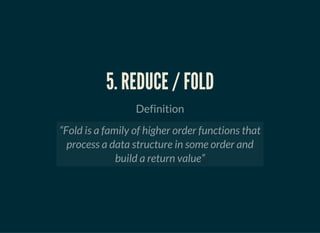
![5. REDUCE / FOLD
Code:
String reduce( BinaryOperator< String > op , List< String > values ) {
String toReturn = "";
for( String current : values ) {
toReturn = toReturn.isEmpty() ? current : op.apply(toReturn, current)
}
return toReturn; }
Result:
List< String > confs = Arrays.asList( "Corkdev", "devoxx", "javaone" );
reduce( (s1, s2) > s1 + ", " + S2, confs );
// Corkdev, devoxx, javaone
With Java 8:
confs.stream().reduce((s1, s2) > s1 + ", " + s2 ).get() )
With Coffescript:
["Corkdev", "devoxx", "javaone"].reduce (e1, e2) > e1 + ", " + e2](https://image.slidesharecdn.com/conceptsoffunctionalprogramming-150419063621-conversion-gate02/85/Concepts-of-functional-programming-17-320.jpg)
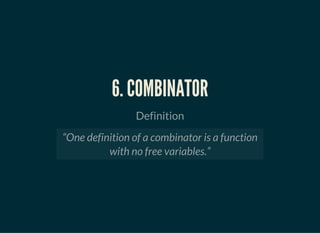
![6. COMBINATOR - NULL COMBINATOR
Constat:
List< String > confs2 = Arrays.asList( new String[]
{"jug", "devoxx", "javaone", null} );
map( s > s.toUpperCase(), confs2);
// Exception in thread "main" java.lang.NullPointerException
Code:
Function< String, String > nullCheck( Function< String, String > f ) {
return (String s) > s == null ? "null" : f.apply(s);
}
Result:
map( nullCheck(s > s.toUpperCase()), confs2)
// [JUG, DEVOXX, JAVAONE, null]](https://image.slidesharecdn.com/conceptsoffunctionalprogramming-150419063621-conversion-gate02/85/Concepts-of-functional-programming-19-320.jpg)
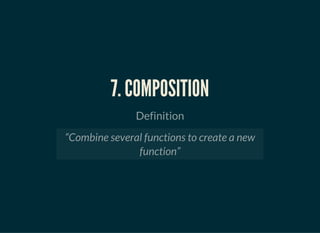

![7. COMPOSITION - JAVASCRIPT
Code Coffee:
compose = (fs...) > fs.reduce (f, g) > (as...) > f g as...
Code JS:
compose = function() {
var fs;
fs = 1 <= arguments.length ? slice.call(arguments, 0) : [];
return fs.reduce(function(f, g) {
return function() {
var as;
as = 1 <= arguments.length ? slice.call(arguments, 0) : [];
return f(g.apply(null, as));
};
});
};
Result:
up = (s) > s.toUpperCase()
hello = (s) > "Hello " + s
compose(up, hello) "Pierre"
// HELLO PIERRE](https://image.slidesharecdn.com/conceptsoffunctionalprogramming-150419063621-conversion-gate02/85/Concepts-of-functional-programming-22-320.jpg)

![WHY??
names = ["Pierre", "John", "Colm", "Petra", "Lenka"]
up = (s) > s.toUpperCase()
hello = (s) > "Hello " + s
Because for me that:
names.filter( (el) > el.indexOf('k') == 1 )
.map( (el) > compose(up, hello)(el) )
.reduce( (e1, e2) > e1 + ", " + e2 )
Is more readable than:
acc = ""
for name in names
if name.indexOf('k') == 1
if acc != ""
acc += ", " + up hello name
else
acc += up hello name](https://image.slidesharecdn.com/conceptsoffunctionalprogramming-150419063621-conversion-gate02/85/Concepts-of-functional-programming-24-320.jpg)


The document discusses key concepts in functional programming, including first-class functions, higher-order functions, currying, functors, and combinators, using practical code examples primarily in Java and JavaScript. It explores how these concepts enhance code readability and efficiency through techniques like mapping, filtering, reducing, and composing functions. Overall, it emphasizes the advantages of applying functional programming principles in modern programming languages, particularly with the introduction of lambda expressions in Java 8.


