ANNUAL REPORT
2017
20
17
— Aplan to
transform.
02Highlights
04Chair’s Report
08Group CEO’s Report
14The Board of Directors
Annual Meeting
The Annual Meeting of shareholders of the
Group will be held in the Guineas Ballroom,
Ellerslie Event Centre, 80–100 Ascot Avenue,
Greenlane East, Auckland, New Zealand,
on Friday 24 November 2017 at 10:00am.
20Our Warehouse Group of Brands
18Annual 5 Year Summary
42Community & Environment
66Health & Safety
70Financial Statements
95Independent Auditor’s Report
We are transforming
how our business
works, anticipating
how our customers
want to shop. Here
is our plan of action
for change.
This Annual Report is dated
18 October 2017 and is signed
on behalf of the Board by:
Joan Withers		 Keith Smith
Chair			Deputy Chair
01OUTLINE
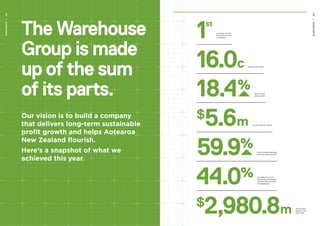
16.0c Dividend per share.
Funds raised for charity.
$
5.6m
44.0%
59.9%
1st
$
2,980.8m Group retail
sales up 1.9%
from FY16.
Launched our first
store within a store
in Auckland.
Everyday low prices –
reinventing the bargain
reached 44% of sales in
The Warehouse.
Group online
sales growth.18.4%
Noel Leeming operating
profit increased by 59%.
02HIGHLIGHTS
HIGHLIGHTS03
The retail industry is facing
an unprecedented age of
digital disruption, which creates
an entirely new set of consumer
expectations. The ability to
anticipate and respond to
customer needs has never
been more important,
resulting in new business
models and a fundamental
shift in how we operate.
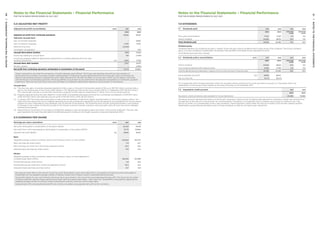
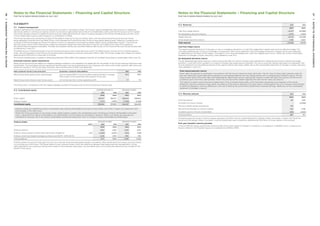
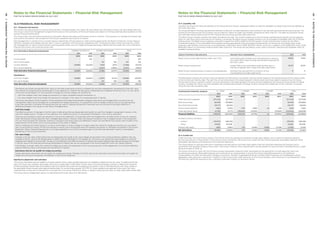
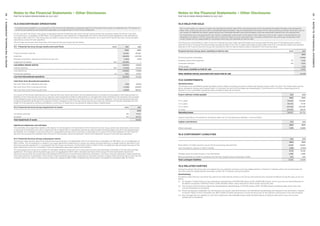
FY17 has marked the start of a significant business transformation for
The Warehouse Group. The weaker trading performance in the first half
of FY17 led to the acceleration of several change programmes, including
a restructuring of the Group’s operating model and the sale of Financial
Services and the Newmarket property. Facing further disruption with the
likes of Amazon coming across the Tasman means that the aggressive
change and simplification to our retail business are our top priorities.
The Board is pleased to report there is encouraging momentum
in a number of key areas, with a robust plan to transform the
business in both the short and long term. The focus for
management during the next 12 months is on executing
against this plan.
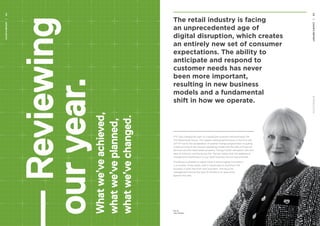
Fig. 01
Joan Withers.
INTRODUCTION05
04
CHAIR’SREPORT
CHAIR’SREPORT
Leadership and Governance
The Board has full confidence in the Executive Team and
their ability to deliver the strategy. With Nick Grayston
as Group Chief Executive Officer, we have the benefit of
someone who has first-hand experience of competing
with the likes of Amazon and the transition to omnichannel
retailing, and can therefore bring insights to help us meet
the challenge of this new consumer landscape here in
New Zealand. The other key benefit has been Nick’s ability
to attract international talent to the business to augment
the Executive Team that was already in place, especially
in the areas of technology, marketing and new business
models. The leadership of the business is in good shape
and is aligned and focused on our transformation plan.
Post year end our founder, Sir Stephen Tindall announced
he would be taking a leave of absence from the Board for
a period of 12 months to focus on other commitments,
in particular securing the necessary infrastructure in
Auckland for the hosting of the next America’s Cup.
In his absence, Robbie Tindall will stand in for Sir Stephen
as his alternate. Robbie has acted as an alternate since 2011.
The Warehouse Group continues to support the
development of governance capability in New Zealand
through the Institute of Directors’ Future Directors
Programme. FY17 saw the conclusion of Malcolm Phillipps’
term on the programme, and we are happy to share the
news that he has since gone on to gain other directorships.
I am also pleased to share that Vena Crawley joined
The Warehouse Group Board as a Future Director on
24 August. Vena is currently the Chief Customer Officer
at Contact Energy where he is taking a lead role in the
transformation of their retail and customer business. We
are looking forward to having someone of Vena’s calibre
on our team, and especially his experience and expertise
in driving customer-centricity within organisations.
I remain focused on ensuring the Board has the right mix
of skills and experience to drive The Warehouse Group
forward in what is likely to be a very different future retail
Our Performance
The Warehouse Group achieved an adjusted net profit
after tax (including discontinued operations) result of
$59.2 million for the full year (FY17), down 7.7% compared
to $64.1 million in FY16 on a like-for-like basis, but
above the guidance range of $54 million to $58 million
previously indicated to the market. Group retail sales for
the year were $2,980.8 million, up 1.9% compared to FY16.
Gross profit of $971.9 million at Group level increased by
1.4% compared to FY16, while costs of doing business of
$864.1 million increased by 2.0% compared to FY16.
Reported net profit after tax (NPAT) of $20.4 million is
73.9% below last year due to a number of one-off items,
including restructuring costs ($12.4 million) and the
goodwill and asset impairments related to the sale of
Financial Services ($40.1 million). Continuing operations
(excluding Financial Services) delivered an adjusted NPAT
result of $68.2 million, which is 1.4% below last year.
Health and Safety
Our Group remains committed to providing a safe
environment for our team, customers, contractors and visitors.
The focus this year has been on embedding a culture of
health and safety awareness and prevention and ensuring
that we have robust reporting throughout the business.
On behalf of the Board, I wish to acknowledge the Group’s
first-ever fatal accident involving an employee of one of our
contractors at our Torpedo7 Fulfilment Centre in Hamilton.
My heartfelt condolences to the family for their loss.
As a Board, we have been dissatisfied by the lack
of a reduction in injury numbers, particularly in The
Warehouse. We do, however, believe this will change
through focused endorsement by leadership, new
technology and from data-driven initiatives.
environment. A yearly independent assessment of our skills
matrix through our Board Performance Review means we
are continuously assessing the key attributes and experience
that are needed to succeed in this age of digital disruption.
Returning Value
The Board is pleased to confirm the final dividend of
6.0 cents per share, bringing the total dividend for FY17
to 16.0 cents per share. This is in line with the dividend
policy of distribution between 75% and 85% of the retail
adjusted NPAT.
The course of FY17 has seen share price under-
performance. Some of this reflects the market view that
retail stocks are vulnerable, especially with the emergence
of Amazon in the region. For The Warehouse in particular,
the vulnerability from a Hi-Lo pricing model has led to
further discounting, which is being countered by our
Everyday Low Pricing (EDLP) strategy. The share price
has also been impacted by a lack of understanding and
confidence in this strategy.
As a result, the Board has worked with the Executive
Team this year to undergo a robust strategy
development process, with a thorough analysis of risks
and opportunities and validation of all assumptions.
We are aware that we also need to do a better job of
communicating the strategy, and in response have
provided far greater specificity and detail on this
alongside the FY17 results announcement.
In addition, the Board will be involved in an Investor Day
with analysts in November, where the Executive Team
will provide further detail on elements of the strategy.
We are committed to improving our investor relations
and ensuring all our shareholders remain informed on
what the future of the business looks like. We also remain
committed to delivering value to shareholders and making
sure the strategy will drive value and the share price.
Looking Forward
We anticipate FY18 to be a year of operational investment in
the business to create the path for future earnings growth.
The earnings drag of Financial Services has been removed
and will be replaced in the short term with some one-off
investments and costs that will drive the transformation
and evolution of the business. The move to EDLP will
lead to a non-recurring impact from the clearance of
discontinued product ranges. We are also facing some
one-off investments that are needed to transition legacy
IT to modern cloud-based systems.
As in previous years, earnings guidance for FY18 will be
given at the end of the second quarter. This will be subject
to the risks and uncertainties affecting trading associated
with customer reaction to our EDLP strategy and the
performance of the business over the critical seasonal
trading period in the second quarter.
We are making some dramatic changes to the business
as we focus on executing against the two arms of
our transformation plan. This includes fixing our retail
fundamentals and investing for the digital future. There will be
some financial pain that we have to endure in the short term.
The Board is confident that we have the right strategy and
team in place to execute this and our long-term goal remains
delivering sustainable profitability and shareholder returns.
Joan Withers
Chair
$
2,98 0.8m
Group retail sales for the
year were $2,980.8 million,
up 1.9% compared to FY16.
Acknowledgement
James Ogden and Vanessa Stoddart will be leaving the
Board as directors at the forthcoming Annual Meeting.
James has served for over eight years as a director
and has Chaired the Audit and Risk Committee.
Vanessa has served for four years and has Chaired
the People and Remuneration Committee.
Both Vanessa and James have made a significant
contribution to the company and we thank them
most sincerely for their contribution.
RETURNINGVALUE&LOOKINGFORWARDCHAIR’SREPORT
06
07
CHAIR’SREPORTOURPERFORMANCE,PEOPLE,LEADERSHIPANDGOVERNANCE
This past year at The
Warehouse Group has been
one of refocusing our priorities
and accelerating a number of
planned change programmes.
We have embarked on a
transformation that we believe
will improve performance
across the Group and enable
us to deliver our strategy of
sustainable profitability and
relevance to customers.
Changing Retail Environment
The world is changing at an exponential pace and is creating an
entirely new set of customer expectations. Companies that you never
thought would have existed ten years ago have developed new business
models which have scaled rapidly and dominate the world we live
in, fundamentally changing the way we live our lives. One thing they
all have in common is customer-centricity with personalised
relationships enabled through technology.
Retail is not exempt from this change. Globally we
are seeing shifts in consumer behaviour having a
profound impact on the traditional retail industry,
especially bricks and mortar, as more people
choose to shop online. We are also seeing that
there will be winners and losers as retailers
come to grips with what this disruption
means for how they do business. As I reflect
on this, it has never been more important for
The Warehouse Group to anticipate and
respond to customer needs in order to
stay relevant and to win.
Fig. 01
Nick Grayston.
09GROUPCEO’SREPORTINTRODUCTION
GROUPCEO’SREPORT08
Our Performance
FY17 saw a weak first-half performance, with severe
margin pressures over the Christmas period in The
Warehouse and a below expectation performance from
The Warehouse Group Financial Services. This led to
a disappointing downgrading of earnings guidance in
December. We assessed the causes of this and came to
the conclusion that a continuation of the same business
model would yield a similar result going forward, so
we embarked on a restructure of the business and a
consequent acceleration of transformative initiatives
over the remainder of the year.
A strong second-half performance demonstrates
encouraging momentum for the transformation.
Performance in the second half delivered an improvement
of 13.9% in adjusted net profit after tax for continuing
operations at $23.1 million up from $20.3 million in H2
FY16. Group retail sales in the half were 0.3% up at
$1,368.9 million compared to H2 FY16. Pleasingly, this
improvement came despite the backdrop of the business
undergoing significant change and restructuring.
Overall for the year, Group retail sales were $2,980.8
million, up 1.9% compared to FY16. The Warehouse saw
modest sales growth during the year but encouraging
results to date from the move to Everyday Low Pricing
(EDLP). Warehouse Stationery achieved record operating
profits, with our Print and Copy Centre category delivering
significant increases in sales and gross margin across
the year. Torpedo7 Group demonstrated strong sales
growth, and we saw an outstanding performance from
Noel Leeming Group with operating profit growth of 60%.
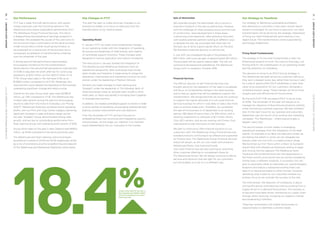
Group online sales for the year in New Zealand were $199.9
million, up 18.4% compared to the same period last year.
The Warehouse and Noel Leeming online businesses
recorded an increase of 25.0% and 54.1% respectively, driven
by a mix of promotions and the re-platforming and relaunch
of The Warehouse and Warehouse Stationery online stores.
Key Changes in FY17
This year has seen us make some key changes to our
business to enable us to focus on execution and the
transformation of our retail business.
Operating Model
In January FY17, we made some fundamental changes
to our operating model with the integration of operating
structures and leadership of retail brands, and creation
of centralised support functions. These changes were
designed to remove duplication and reduce complexity.
The restructure in January started the integration of
The Warehouse and Warehouse Stationery from an
operational perspective. Both businesses have similar
retail models and therefore it made sense to merge the
operations, merchandise and marketing functions for both
brands, under the leadership of Pejman Okhovat.
Similarly, we made changes to Noel Leeming and
Torpedo7 under the leadership of Tim Edwards. Both of
these businesses utilise an assisted sales model to drive
retail sales, so there was benefit in bringing them together
to leverage best practice.
In addition, we created centralised support functions in order
to drive centres of excellence, encouraging operational best
practice, process improvement and cost reduction.
Over the remainder of FY17, we have focused on
embedding these new structures and integrating systems
and processes. At this stage, our intention is to maintain
brand differentiation for our customers in the market.
Sale of Newmarket
We originally bought the Newmarket site to secure a
long-term footprint in this key Auckland area. However,
with the challenge of urban property prices and the cost
of construction, retail development in these areas
is becoming more expensive. After extensive discovery
with several potential partners looking at different ways
to develop the site, we concluded that retail was not
the best use to drive a good capital return on the land.
We therefore made the decision to sell the site.
In July 2017, we completed the sale of the property for
$65 million, with a pre-tax gain of approximately $12 million.
The proceeds will be used to reduce debt. The site will
continue to be leased and operated by The Warehouse
Group until it is vacated in October 2018.
Financial Services
The difficult decision to sell Financial Services was
brought about by the realisation of the need to accelerate
and focus on fundamental change in the retail business
and to free up capital that will be needed to support this
transformation. We recognised that we could not continue
to support the capital demands of a sub-scale financial
services business for which it was likely to take a few more
years to achieve break-even. Therefore, we completed
the sale of the business on 9 September to an existing
partner, SBS Bank (Finance Now), for $18 million, with a
resulting impairment on software of $17 million. Diners
Club (NZ) remains, and we are working with Diners Club
International to plan the future of that business.
We plan to continue to offer financial solutions to our
customers, with The Warehouse Group Financial Services
branded products continuing to be offered and supported
by Finance Now. The Warehouse Group Financial Services
brand will remain, as will our core credit card products –
Warehouse Money Visa Card and Purple
Visa Card. Finance Now are also working on launching
other customer offerings to complement these for
The Warehouse Group. We will always continue to deliver
services and solutions that are right for our customers,
but this enables us to do so in a different way.
Our Strategy to Transform
Our strategy of delivering sustainable profitability
and relevance to customers in last year’s annual report,
remains unchanged. As we move to execution, our retail
transformation will be driven by the strategic imperatives
of fixing our retail fundamentals and investing in our
digital future. The transformation will be supported by
technology enablement.
Fixing Retail Fundamentals
The strategy to fix the retail fundamentals is split into
three broad streams of work: the move to Everyday Low
Pricing (EDLP), the simplification of our operating model
and the reduction of complexity.
The decision to move to an EDLP pricing strategy in
The Warehouse has been driven by customers telling us
they want a bargain every day, rather than having to wait
for a sale or special offer. EDLP establishes a clear ‘best
value’ price proposition for our customers, alongside a
simplified product range. These changes will drive richer
margins and cost efficiencies for the business.
By the end of Q1 FY18, we expect EDLP to be at close
to 100%. The remainder of the year will require us to
manage the clearance of discontinued products carefully
whilst monitoring customer response. We feel confident
that it’s the right move for our business and customers.
September saw the launch of an exciting new marketing
campaign: ‘The Warehouse – where everyone gets a
bargain, every day’.
The second stream of work relates to leveraging
operational synergies from the integration of the retail
brands. An example is our Blue into Red pilot where we
are testing the extent to which we can integrate two
brands under one roof with a curated product range.
We launched our first ‘Store within a Store’ at Auckland
Airport Mall with Warehouse Stationery exiting its lease
and moving into the adjacent The Warehouse store.
Trading at the combined store has met expectations in
the three months since launch and we will be completing
further tests in different locations. If successful, this will
give us optionality either to rationalise our overall property
footprint and reduce a substantial existing fixed cost
base or to repurpose leases to other formats. However,
delivering what is best for our customers remains our
primary focus as we consider the success of this test.
The third stream, the reduction of complexity, is about
driving efficiencies and reducing costs by pivoting from a
supply-driven to a demand-led business. This requires us
to become more data-driven, shortening our supply chain
through direct sourcing, increasing our speed to market
and streamlining fulfilment.
These key workstreams will enable the business to
respond faster to identified customer needs.
18.4%Group online sales for the year in
New Zealand were $199.9 million,
up 18.4% compared to the same
period last year.
11
10
OURSTRATEGYTOTRANSFORM
OURPERFORMANCE&KEYCHANGESINFY17
GROUPCEO’SREPORT
GROUPCEO’SREPORT
Investing in the Future
As we think about retail in an increasingly digital future,
we must make changes and start to invest in becoming a
21st-century retailer. This requires reorienting the business
from product-centricity to customer outcomes, meeting
needs in different ways, through omnichannel digital
capabilities and ecosystems. In some instances, this will
mean partnering with others and redefining how we do
business closer to the point of need, expanding beyond
traditional Brand channels.
The future will also require a culture of innovation with the
adoption of agile methodologies, greater speed to market,
and a test-and-learn approach. We are approaching our
development of digital platforms in this way, beginning
with education, where we are creating a consolidated
shopping platform to enable cross-brand selling, fulfilment
and delivery.
During FY18, we will start to update our technology stack
in order to replace legacy systems, to become more
customer responsive and deliver modern services. This
will be enabled through cloud infrastructure and Software
as a Service (SaaS) applications. We are currently in
discovery mode, although individual elements are already
in flight, such as our foundational data capability.
People and Leadership
It’s important to me that as well as being the first choice
for our customers, The Warehouse Group must continue
to be a great place to work.
This year has been one of change for many of our people
as we begin to transform our business. Despite these
circumstances, our team have continued to achieve excellent
outcomes. An example of this is the tireless work that has
gone into ensuring the integration of systems and processes
for The Warehouse and Warehouse Stationery, with limited
disruption. I am proud to acknowledge that our team, up
and down the country, are working hard to ensure that we
deliver the best possible outcome for our customers.
FY17 has also seen some changes to my Executive Team.
I have made some key international hires to bring skills
and experience to New Zealand, to help us compete
and win against the likes of Amazon. David Benattar
joined us in October 2016 as Chief Experience Officer
and Timothy Kasbe joined in May 2017 as Chief Information
and Digital Officer. I am excited about the experience
and knowledge that both David and Timothy bring to
help augment the team that was already in place. In turn,
they have helped us become a talent magnet, which has
helped us further enrich our expertise, building capability
throughout the organisation.
Embedding a health and safety culture is one of our top
priorities and I’m encouraged by some of the progress
that has been made here, although we can certainly do
more. It was an especially difficult year for us with the
news of the Group’s first fatality. On 21 June 2017, there
was a tragic incident at our Torpedo7 Fulfilment Centre
in Hamilton, involving an employee of a contractor from a
local transport company. Our deepest sympathies remain
with his family.
Following the incident, we have been liaising closely with
WorkSafe to identify root causes and make any required
changes to ensure that this never happens again. We have
also provided ongoing support to our own team members
who were present and have been deeply affected by this
event. This work is ongoing but we are committed to
doing whatever it takes to keep our people safe.
Looking Forward to FY18
Nick Grayston
Group Chief Executive Officer
13
12PEOPLEANDLEADERSHIP
GROUPCEO’SREPORT
GROUPCEO’SREPORT
Fig. 01–08
From left to right
Joan Withers
MBA, CFInstD
Chair and Independent Non-Executive Director
Sir Stephen Tindall
KNZM, Dip.Mgt, FNZIM, CFInstD,
HonD. DCom Honoris Causa
Founder and Non-Executive Director
Keith Smith
BCom, FCA
Deputy Chair and
Independent Non-Executive Director
James Ogden
BCA (Hons), FCA, CFInstD
Independent Non-Executive Director
Antony (Tony) Balfour
Independent Non-Executive Director
Vanessa Stoddart
BCom, LLB (Hons), PGDip
in Professional Ethics
Independent Non-Executive Director
John Journee
BCom, CMInstD
Independent Non-Executive Director
Julia Raue
MInstD, GAICD
Independent Non-Executive Director
— Reporting
	 momentum,
	 with a plan
	 to transform.
15
14
THEBOARDOFDIRECTORS
THEBOARDOFDIRECTORS
Joan Withers
MBA, CFInstD
Chair and Independent Non-Executive Director
Term of office
Appointed Director 23 September 2016,
elected 2016 Annual Meeting
Board Committees
Member of the Audit and Risk Committee, Member of
the Disclosure Committee, Member of the Corporate
Governance Committee and Member of the People
and Remuneration Committee
Joan has been a professional director for 18 years and spent over
25 years working in the media industry, previously holding CEO
positions at The Radio Network and Fairfax Media. Her current
governance roles are Chair of Mercury NZ Limited and The Warehouse
Group Limited and director of ANZ NZ. Joan stepped down from
her TVNZ role in April 2017, after serving eight years as a director.
She is also a Trustee of the Louise Perkins Foundation, and is
Chair of a steering committee working to increase the percentage
of South Auckland Māori and Pacific Island students taking up roles
within the health sector.
Joan holds a Masters degree in Business Administration from
The University of Auckland. She is also a University of Auckland
Distinguished Alumni (2015). Joan is the author of A Girl’s Guide to
Business which was published by Penguin Books in 1998. She was
awarded the New Zealand Shareholders Beacon Award in 2014.
In 2015, Joan was named Supreme Winner in the Women of Influence
Awards and was named Chairperson of the Year at the Deloitte
Top 200 Management Awards.
Sir Stephen Tindall
KNZM, Dip.Mgt, FNZIM, CFInstD, HonD. DCom
Honoris Causa
Founder and Non-Executive Director
Term of office
Appointed Director 10 June 1994,
last re-elected 2013 Annual Meeting
Board Committees
Member of the Disclosure Committee and the People
and Remuneration Committee
Sir Stephen founded The Warehouse in 1982 and grew the company
into a billion-dollar business before stepping down as Managing
Director in 2001. His vision for creating an organisation to provide
support for worthwhile initiatives benefiting New Zealand and New
Zealanders resulted in the establishment of The Tindall Foundation
in 1995, promoting a ‘hand up’ rather than a ‘hand out’ philosophy.
Sir Stephen has seen many personal honours and awards come his
way. In August 2009, he was bestowed the accolade of a knighthood in
recognition of his work with New Zealand businesses and the community.
He has helped ordinary Kiwis reach their potential and is a true leader
across the spheres of business, community and the environment. Through
his investment business K1W1, Sir Stephen has invested in more than 100
New Zealand export-oriented technology companies, with the goal to
help New Zealand businesses thrive on the world stage.
As a further acknowledgement, in 2015 Sir Stephen was named the
Kiwibank ‘New Zealander of the Year’.
Sir Stephen appointed Robert Tindall to be his alternate Director,
effective 1 July 2011.
Keith Smith
BCom, FCA
Deputy Chairman and Independent Non-Executive
Director
Term of office
Appointed Director 10 June 1994,
last re-elected 2014 Annual Meeting
Board Committees
Chairman of the Disclosure Committee and the Corporate
Governance Committee, Member of the Audit and Risk
Committee and the People and Remuneration Committee
Keith has been involved with The Warehouse since Sir Stephen
opened his first store in 1982, initially providing accounting, tax and
corporate advice, and was Chairman from 1995 to May 2011. He has
a long-standing record of leadership as a director and advisor to
companies in a diverse range of industries, including the energy sector,
rural services, printing, media and exporting. He is Chairman of listed
company Goodman (NZ) Limited (the Manager of Goodman Property
Trust) and is a director of Mercury NZ Ltd, Westland Co-operative
Dairy Limited, and several other private companies.
Keith is a past President of the Chartered Accountants Australia and
New Zealand.
James Ogden
BCA (Hons), FCA, CFInstD
Independent Non-Executive Director
Term of office
Appointed Director 4 August 2009,
last re-elected 2015 Annual Meeting
Board Committees
Chairman of the Audit and Risk Committee and Member
of the Disclosure Committee
James brings strong financial expertise to the Board and director
experience across a broad range of industries. He has had a
distinguished career as an investment banker for 11 years, six years
as Country Manager for Macquarie Bank and five years as a director
of Credit Suisse First Boston. Also, James has worked in the New
Zealand dairy industry in chief executive and finance roles for eight
years. In addition to his role as a director of The Warehouse Group,
he is a director of Summerset Group Holdings Limited, a director
of Vista Group International Limited, member of the Investment
Committee of Pencarrow Private Equity and is a member of the
New Zealand Markets Disciplinary Tribunal. Former directorships
include New Zealand Post Limited and Kiwibank Limited.
Antony (Tony) Balfour
Independent Non-Executive Director
Term of office
Appointed Director 15 October 2012,
re-elected 2015 Annual Meeting
Board Committee
Member of the People and Remuneration Committee
Tony has extensive global retail and eCommerce experience with a
strong track record in a diverse range of industries. Most recently,
he was General Manager (Markets) for Icebreaker Clothing with
responsibility for the company’s global business units in New Zealand,
Australia, USA, Canada, Europe and Asia, as well as the development
of the company’s rapidly growing eCommerce and retail business units.
Prior experience includes senior roles in Monster.com and Seek.com,
both successful online recruitment sites. Tony also spent nine years
at Nike in senior general management roles in the USA, Australia and
Asia-Pacific regions. Since 2009, he has been a director of Silver Fern
Farms Limited, New Zealand’s largest meat company. Tony is also
an independent director at Les Mills International (the world’s leading
provider of group fitness programming), Real Journeys Limited (one
of New Zealand’s leading tourism companies) and Mt Difficulty Wines.
Vanessa Stoddart
BCom, LLB (Hons), PGDip in Professional Ethics
Independent Non-Executive Director
Term of office
Appointed Director 17 October 2013,
re-elected 2016 Annual Meeting
Board Committee
Chair of the People and Remuneration Committee
Vanessa was a lawyer by profession. She was previously Group General
Manager of Technical Operations and People at Air New Zealand for
almost 10 years. Prior to this, Vanessa held positions at Carter Holt
Harvey Packaging Australia as Chief Executive and General Manager
Performance Improvement, as well as change management and legal
positions. She is a member of both the Australian and New Zealand
Institute of Directors, an honorary fellow of HRINZ and a Companion
of IPENZ.
Vanessa is an Independent Director for NZ Refinery Ltd, Heartland
Bank Ltd and Alliance Group Ltd. She is a board member of the
Tertiary Education Commission, the Financial Markets Authority,
King’s College and a member of the Audit and Risk Committees
for MBIE and DOC as well as Chair of Global Women.
John Journee
BCom, CMInstD
Independent Non-Executive Director
Term of office
Appointed Director 17 October 2013,
re-elected 2016 Annual Meeting
Board Committee
Member of the Audit and Risk Committee
John has had an extensive retail career which includes executive
experience across sectors that span general merchandise, fashion
apparel, FMCG, consumer electronics, telecommunications and
electricity retailing. Over his 31-year career, he has spent 15 years
with The Warehouse Group, starting as a joint-venture partner in
1990 and progressing through senior roles in operations, marketing,
merchandise, international sourcing and business development, before
taking a role in the UK with a telecommunications company.
He rejoined in 2012 when The Warehouse Group acquired Noel Leeming,
where John was CEO. He is also Chairman of software developer
Flux Federation, fashion retailer Max Fashions and Managing Director
of equipment distributor Southern Hospitality. John has previously
been a non-executive director of multichannel retailer Ezibuy.
Julia Raue
MInstD, GAICD
Independent Non-Executive Director
Term of office
Appointed Director 23 September 2016,
elected 2016 Annual Meeting
Board Committee
Member of the Audit and Risk Committee
Julia is an Independent Director for Z Energy Limited, TVNZ,
Southern Cross Medical Care Society and Jade Software Corporation.
She is also a Member of the Risk & Audit Committee for the Treasury.
Julia has extensive experience in digital and information technology,
business transformation and strategic planning across the airline,
telecommunications and local government sectors, as well as not-for-
profit organisations in New Zealand. Previously, Julia was the Chief
Information Officer of Air New Zealand (2007–2015) and she was
awarded the New Zealand CIO of the Year award in 2009.
Julia is passionate about growing the number of females working in
technology and works with a number of institutions to drive awareness
of IT as a career.
16
17THEBOARDOFDIRECTORS
THEBOARDOFDIRECTORS
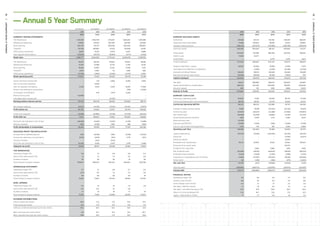
— Annual 5 Year Summary
(52 WEEKS) (52 WEEKS) (53 WEEKS) (52 WEEKS) (52 WEEKS)
2017 2016 2015 2014 2013
$000 $000 $000 $000 $000
SUMMARY INCOME STATEMENTS
The Warehouse 1,761,399 1,760,708 1,718,307 1,665,233 1,591,088
Warehouse Stationery 278,181 279,155 262,780 250,561 231,838
Noel Leeming 810,705 752,137 665,628 620,520 390,667
Torpedo7 157,726 148,660 131,231 107,658 24,193
Other group operations 8,603 13,201 9,276 14,217 9,688
Inter-segment eliminations (35,843) (29,179) (16,801) (9,711) (7,942)
Retail sales 2,980,771 2,924,682 2,770,421 2,648,478 2,239,532
The Warehouse 84,531 89,376 79,600 76,903 85,186
Warehouse Stationery 15,743 14,288 12,723 11,793 10,321
Noel Leeming 19,264 12,050 6,424 11,308 11,011
Torpedo7 2,675 3,380 34 1,085 656
Other group operations (14,376) (7,929) (5,555) (4,373) 4,064
Retail operating profit 107,837 111,165 93,226 96,716 111,238
Equity earnings of associate – 723 2,802 3,006 3,464
Gain on business disposals – 9,950 – – –
Gain on disposal of property 11,455 5,533 5,533 16,810 77,368
Direct costs relating to acquisitions – – – (951) (2,356)
Contingent consideration – 675 (977) 5,259 –
Restructuring costs (12,060) – – – –
Intangible asset impairment – – (12,491) – –
Earnings before interest and tax 107,232 128,046 88,093 120,840 189,714
Net interest expense (12,527) (14,154) (15,123) (13,427) (11,675)
Profit before tax 94,705 113,892 72,970 107,413 178,039
Income tax expense (23,691) (25,890) (21,148) (27,378) (28,423)
Profit after tax 71,014 88,002 51,822 80,035 149,616
Discontinued operations (net of tax) (50,283) (5,526) (2,074) (2,781) (4,288)
Minority interests (302) (4,138) 1,562 496 (580)
Profit attributable to shareholders 20,429 78,338 51,310 77,750 144,748
ADJUSTED PROFIT RECONCILIATION
Unusual items (detailed above) 605 (16,158) 7,935 (21,118) (75,012)
Income tax relating to unusual items (3,132) (2,163) (941) 2,751 (327)
Minority interests – 3,614 (1,170) – –
Discontinued operations (net of tax) 50,283 5,526 2,074 2,781 4,288
Adjusted net profit 68,185 69,157 59,208 62,164 73,697
THE WAREHOUSE
Operating margin (%) 4.8 5.1 4.6 4.6 5.4
Same-store sales growth (%) 1.2 4.1 1.4 3.2 2.0
Number of stores 92 92 92 91 92
Store footprint (square metres) 501,807 499,547 497,702 494,847 500,769
WAREHOUSE STATIONERY
Operating margin (%) 5.7 5.1 4.8 4.7 4.5
Same-store sales growth (%) (0.3) 6.5 1.4 5.3 2.8
Number of stores 69 66 65 63 61
Store footprint (square metres) 73,216 71,927 70,445 68,194 67,230
NOEL LEEMING
Operating margin (%) 2.4 1.6 1.0 1.8 2.8
Same-store sales growth (%) 6.4 14.2 1.0 5.6 –
Number of stores 77 75 78 77 75
Store footprint (square metres) 73,591 71,169 70,999 69,391 67,972
DIVIDEND DISTRIBUTIONS
Interim (cents per share) 10.0 11.0 11.0 13.0 15.5
Final (cents per share) 6.0 5.0 5.0 6.0 5.5
Ordinary dividends declared (cents per share) 16.0 16.0 16.0 19.0 21.0
Basic earnings per share (cents) 5.9 22.7 15.2 24.1 46.7
Basic adjusted earnings per share (cents) 19.8 20.1 17.2 19.3 23.8
2017 2016 2015 2014 2013
$000 $000 $000 $000 $000
SUMMARY BALANCE SHEETS
Inventories 491,818 501,713 510,461 492,109 458,109
Trade and other receivables 71,088 150,624 86,361 91,253 69,887
Creditors and provisions (336,451) (347,073) (315,565) (328,706) (315,679)
Working capital 226,455 305,264 281,257 254,656 212,317
Fixed assets 273,300 312,396 386,709 353,376 318,653
Held for sale 71,699 52,277 – – –
Investments – – 2,778 5,541 5,671
Funds employed 571,454 669,937 670,744 613,573 536,641
Taxation (liabilities) / assets 45,870 40,943 18,599 27,485 11,373
Contingent and deferred consideration – (1,000) (3,250) (22,316) (21,759)
Goodwill and Brand Names 106,601 129,315 120,092 132,583 100,891
Derivative financial instruments (19,265) (28,619) 35,358 (7,653) 370
Capital employed 704,660 810,576 841,543 743,672 627,516
Net debt 218,271 299,980 299,573 220,878 216,874
Equity attributable to shareholders 485,522 510,429 540,060 518,926 400,029
Minority interest 867 167 1,910 3,868 10,613
Sources of funds 704,660 810,576 841,543 743,672 627,516
SUMMARY CASH FLOW
Continuing Operating profit 107,837 111,165 93,226 96,716 111,238
Continuing Depreciation and amortisation 58,376 58,210 57,770 51,025 44,017
Continuing Operating EBITDA 166,213 169,375 150,996 147,741 155,255
Change in trade working capital 21,661 35,198 (35,343) (22,742) (9,243)
Income tax paid (27,454) (28,037) (22,398) (37,492) (40,803)
Net interest paid (16,008) (16,495) (18,662) (13,351) (12,270)
Share based payment expense 1,283 3,208 2,114 2,266 2,545
Restructuring costs (12,397) – – – –
Discontinued EBITDA (6,686) (1,930) (929) (2,095) (5,748)
Loss on sale of plant and equipment 1,476 1,141 691 2,282 3,965
Operating cash flow 128,088 162,460 76,469 76,609 93,701
Capital expenditure (70,575) (75,180) (109,345) (91,010) (93,315)
Advances – – – (17,901) (12,071)
Advances repaid – – – 25,013 –
Proceeds from divestments 79,714 45,870 31,120 27,544 195,572
Proceeds from equity raise – – – 114,072 –
Dividend from associate – 2,695 5,565 3,136 4,165
Net dividends paid (52,466) (58,162) (59,640) (58,193) (69,075)
Employee share schemes (2,148) (2,528) (2,455) (2,818) (2,310)
Acquisition of subsidiaries and minorities (1,000) (74,367) (20,043) (80,181) (116,648)
Other items 96 (1,195) (366) (275) (4,200)
Net cash flow 81,709 (407) (78,695) (4,004) (4,181)
Opening debt (299,980) (299,573) (220,878) (216,874) (212,693)
Closing debt (218,271) (299,980) (299,573) (220,878) (216,874)
FINANCIAL RATIOS
Operating margin (%) 3.6 3.8 3.4 3.7 5.0
Interest cover (times) 8.6 7.9 6.3 7.4 9.8
Fixed charge cover (times) 2.0 2.1 2.1 2.2 2.5
Net debt / EBITDA (times) 1.4 1.8 2.0 1.5 1.4
Net debt / net debt plus equity (%) 31.0 37.0 35.6 29.7 34.6
Return on funds employed (%) 17.4 16.7 15.0 17.3 21.3
Capex / depreciation (times) 1.1 1.2 2.0 1.8 2.2
18
19ANNUAL5YEARSUMMARY
ANNUAL5YEARSUMMARY
FIG. 01 — THE WAREHOUSE PG. 22
FIG. 02 — WAREHOUSE STATIONERY PG. 26
FIG. 03 — NOEL LEEMING PG. 30
FIG. 04 — TORPEDO7 PG. 34
FIG. 05 — FINANCIAL SERVICES PG. 38
20OURGROUPOFBRANDS
21OURGROUPOFBRANDSCONTENTS
Fig. 01
Fig. 03
Fig. 05
Fig. 02
Fig. 04
OUR PLAN FOR THE WAREHOUSE
— A plan
	 to reinvent
	 the bargain.
Financial Performance – a game of two halves
The financial performance for the core The Warehouse (‘Red’) business was
characterised by similar sales levels to the previous year, but very different
operating profit results in each half.
In the first half of the year, slightly lower margin rates were experienced
due to increased clearance activity relating to our changing pricing strategy
and product range reduction, and a poor Christmas. The cost of doing business
(CODB) also increased year-on-year by 1% at a time when gross profit was
dropping. This resulted in operating de-leverage and a 9% reduction overall
in operating profit for the first half.
In the second half of the year, the sales growth was again flat. However, margins
showed some recovery as the performance of the Head to Toe (Apparel),
accessories and footwear categories was strong, and CODB savings began to be
realised towards the end of the half, following a restructure of the business in Q3.
The second half-year performance is encouraging on two levels: first,
the sales and margin rates in categories moving into an EDLP model give
us some comfort that the strategic shift away from Hi-Lo promotional pricing
to EDLP is working; and second, the first steps in a multi-year programme
to reduce the CODB have been achieved. Many of the more significant
structural cost reductions that we are planning rely on improved operating
processes and efficiencies that will be realised following investments in
technology in future years.
Another benefit of the work carried out on changing to EDLP and range
reduction is that inventory at the end of the financial year is in good shape,
with little seasonal overhang, or aged stock requiring clearance. This means
one less headwind for the business as we approach FY18.
Overall, it was an encouraging end to the year for Red.
Store within
a Store model
New value
proposition
Invest in design
and merchandising
New technology
package
Reinventing
the bargain
Major change to
pricing strategy
23
22
THEWAREHOUSEFINANCIALPERFORMANCE
THEWAREHOUSE
Move to EDLP
A major change to pricing strategy was commenced in
FY17. Traditionally, the Red business has been operating
a Hi-Lo price strategy, which sees a range of discounting
and promotional specials offered each week to drive
excitement and to stimulate sales. With technology giving
customers the ability to compare prices from competitors
as they shop, and the advent of global retailers such as
Amazon, who through their buying power can typically
beat or match a discounted price, the future of Hi-Lo
pricing in many categories is bleak.
The Warehouse is changing to an Everyday Low Price
(EDLP) strategy where there is a strong focus on the overall
value proposition of product design, quality, price and range,
with high availability. We plan to move the majority of our
offerings into EDLP, noting that in some categories and
for seasonal events, some targeted promotional activities
still have a role to play for The Warehouse.
FY17 saw much of the foundational planning work
undertaken around the transition to EDLP, and the start
of changes to the Apparel and Homewares categories,
which by the end of FY17 are both at or over 50% EDLP.
FY18 will see a continuation of the programme, with the
objective of completing the bulk of the transition to EDLP
by year-end.
The financial impact of the transition is in clearing and
discontinuing stock lines that will not be part of the EDLP
offer in the future. In addition, investment in design and
merchandising has been made to improve the appeal of
products being sold. Under an EDLP model, we expect
potentially lower sales volumes, but at an overall stronger
margin rate given the lack of discounting. The EDLP
model will also drive significant gains in productivity as
products do not require the same intensive management,
repricing, or moving around the store as they would under
Hi-Lo. Our marketing also needs to change to develop
new ways to excite the customer to drive foot traffic into
stores. A focus on ‘Reinventing the Bargain’ is part of
taking customers on this journey with the business.
Within our team, we have people experienced in EDLP
environments and in making this transition. There are many
international models to point to for examples of how it has
been done well, and what pitfalls to avoid. Our second-half
performance in Red has been encouraging as the EDLP
categories have performed favourably.
Red and Blue Together
A key strategy for the organisation is the integration
of the Red and Blue (Warehouse Stationery) businesses,
first in the back office and then at operational levels.
A restructure was announced in February/March under
which we consolidated the management and operational
functions of the two businesses into one. A major systems
project was commenced at the start of Q4 to move all
of the operational support, merchandising, inventory
management and customer-facing systems (e.g. point
of sale) onto the Red platforms. This was completed
in September allowing the business to operate as an
integrated trading entity early in the new financial year.
As a change-management project this was complex, with
many different elements involved. While there was some
disruption to the business, the completion of the project
within a very tight time frame, is a strong indicator of the
business’ ability to execute its strategy and make bold
change rapidly.
In FY17, we piloted the integration in the market of Red
and Blue stores, with the implementation of a ‘Store within
a Store’ (SWAS) model at our Airport store in Auckland.
During FY18, we plan to test and pilot a number of other
locations with the objective of learning how an in-market
integration of the two Brands’ offerings might work, how
customers both in the B2C and B2B segments respond, in
order to inform a broader programme of integration. With
the challenges on traditional retailers, it is imperative for
the Group to optimise the use of its floor space, and to
drive profitability. Potentially co-locating or integrating the
Blue offering into Red stores may unlock significant fixed
cost savings for the business; however, such a change
needs careful planning to ensure that customers’ needs
are our primary concern.
During FY18, we plan
to test and pilot a
number of other
locations with the
objective of learning
how an in-market
integration of
the two Brands’
offerings might work.
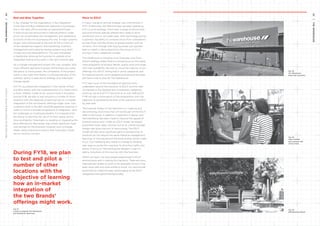
Fig. 01
A plan to integrate The Warehouse
and Warehouse Stationery.
Fig. 02
The Warehouse
Royal Oak, Auckland.
Fig. 03
Team member
and customer talk
Active Intent.
Fig. 04
#MyWarehouseStyle.
24
25THEWAREHOUSE
REDANDBLUETOGETHER&MOVETOEDLPTHEWAREHOUSE
OUR PLAN FOR WAREHOUSE STATIONERY
Financial Performance – another record-breaking year for Blue
– Everything you need to Work, Study, Create and Connect
Warehouse Stationery (‘Blue’) recorded another consistently strong result
with earnings before interest and tax (EBIT) increasing to $15.7 million. This
is the highest EBIT ever recorded by Blue. While sales were flat, market share
increased and we continued to deliver everything our customers need to Work,
Study, Create and Connect. Very careful management of cost of doing business
(CODB) helped to achieve this EBIT result.
Key Strategic Priorities
1.	 Brand Strategy – continue to build the strength of the brand, a loved
and trusted partner
2.	 Products and Services – curated product range and market-leading range
of copy centre and digital creative product
3.	 e-Commerce – innovate and develop our online experience
4.	 Customer Experience – seamless experience across all channels
5.	 B2B and Education – increase market share in the B2B and Education sectors
6.	 Integration and Operating Model – new operating model which transitions
our business, people, capability and culture for the future
Building strength
into our brand
Innovating
e-Commerce
Seamless customer
experience
B2B and
Education
increase
New integration and
operating model
27
26
WAREHOUSESTATIONERYFINANCIALPERFORMANCEANDKEYSTRATEGICPRIORITIES
WAREHOUSESTATIONERY
— A plan to
	 deliver to our
	 customers’
	needs.
Products and Services
Our product range has continued to develop during the
year. More of our stores are carrying a range of Apple
products and our Ink and Toner offering continues to be
market leading. Print and Copy Services have continued
to show significant growth with customers enjoying the
new creative services we have introduced. We have also
rolled out new Fujifilm Digital photo equipment across
the store network.
Our seasonal Furniture catalogue continues to give us
range authority in this category, we have the widest range
of writing with our loose pen rollout and we launched
Lenovo, a major PC brand.
Back to School and Education Sector
We continue to be the Number One destination for Back
to School. Once again, the Back to School trading period
was extremely competitive. We delivered the widest
choice and offering to both parents and schools.
We have seen significant market share in the Education
sector. We intend to continue to leverage opportunities in
this area to remain a trusted partner for the sector.
People and Capability
Once again, we were recognised by IBM Kenexa as a
Finalist in their ‘Best Workplaces’ employee engagement
survey. Our CARE (Connect, Ask, Recommend, Execute)
internal development programme, together with other
capability programmes, are all part of ensuring we can
provide our customers with great service and advice
every time.
Store Network and Store within a Store (SWAS)
We added three new stores during the year, bringing
the total number to 69. The new stores are located at
Tauranga Crossing, Hawera and Johnsonville.
Our Airport store (Auckland) has relocated to within
our Red (The Warehouse) store. This is providing a
SWAS experience for our customers. We intend to trial
this approach with a few of our stores to assess trading
performance and customer experience.
Integration and Operating Model
We have commenced a significant integration programme
of people, processes and systems to operate both of
our brands: Red (The Warehouse) and Blue (Warehouse
Stationery). Central to this will be a people and capability
plan which builds on the ‘Way of Working’ within our
organisation and ensures the future success of our teams.
Fig. 01
Discussing
features and benefits
with a customer.
Fig. 02
Price checking
technology.
Fig. 03
Team members
discussing
promotional activity.
$
15.7m
Warehouse Stationery recorded
another consistently strong
result with operating profit
increasing to $15.7 million.
29
28
WAREHOUSESTATIONERY
PRODUCTS,BACKTOSCHOOL,PEOPLE,STORENETWORKANDINTEGRATIONWAREHOUSESTATIONERY
OUR PLAN FOR NOEL LEEMING
— A plan
	 to deliver
	 passionate
	 expertise.
Financial Performance – a standout
The financial performance for the Noel Leeming business was characterised
by strong sales growth, improvement in margins, and reductions in cost
of doing business (CODB). Overall, it was a standout performance from
Noel Leeming, increasing operating profit year-on-year by 60%, delivering
a profit performance uplift from 1.6% to 2.4% of sales.
In the first half of the year, the sales momentum that had been built at the end
of FY16 continued, with double-digit sales growth year-on-year of 11.1%. Sales
growth slowed as expected in the second half of the year, while the business
cycled the Dick Smith exit from the market in the comparative period, with H2
sales growth of around 3%. Margin growth was flat on H1, but was up 60 points
in H2 to 21.2%.
Market share1
growth continued to be strong. In FY17, the total market
increased in dollar value by 2.9%, while Noel Leeming sales grew by 7.4%.
All channels delivered growth for Noel Leeming, with the commercial profit
growing by 15% and online profit 118%. Despite this growth, working capital
and inventory levels remain similar to last year.
Noel Leeming expanded its store network by a net two stores during the year,
opening stores in Takapuna and Tauriko (Tauranga Crossing).
Overall, it was a very strong performance from Noel Leeming.
Investing in our
store network
Personalised customer
conversations
Adding value through
our tech offering
Extend product
knowledge and
team expertise
1
GFK market share excludes all whiteware products.
31
30
FINANCIALPERFORMANCENOELLEEMING
NOELLEEMING
60%
Overall, it was a standout
performance from Noel Leeming,
increasing operating profit
year-on-year by 60%, delivering
a profit performance uplift from
1.6% to 2.4% of sales.
Services Business
In Noel Leeming, our purpose remains to make Kiwi lives
better through technology and, as market leaders and the
authority on product, we will continue to deliver on this.
Our strategy remains to provide the right product at the
right price through passionate people providing expert
service together with leading services.
Personalised conversations with our customers cement our
position as a loved and trusted brand, with myNoelLeeming
membership currently in excess of 500,000 Kiwis. This
enables us to gain a deeper understanding of our customers
and connect in relevant and more meaningful ways.
The 1600 passionate experts in our stores enable us to
provide outstanding product knowledge and our recent
partnership as the ‘Tech Expert’ with TVNZ reinforces our
position as the authority on technology and appliances.
In FY18, we will work closely with our suppliers to
ensure we continue to be first to market with new
products and technology.
By continued focus on capability and learning, we will
extend the product knowledge and expertise of our team
members, and through maintained focus on a health and
safety culture, we will ensure our team members and
customers remain safe in all that they do.
Services remains our point of difference, adding value
to our customers through our Tech Solutions offering.
This enables us to ‘connect’ with our customers, assisting
them with the set-up, installation and delivery of their
products, along with the ability to learn, connect and share
through our stores and in their homes or business premises.
FY18 will see us extend Tech Solutions to all stores and
launch a new services product (My Tech Solutions) to
further enrich the value offered to our customers.
Whilst the online business grows, the store network –
combined with our passionate experts – remains key to
servicing our customers’ needs. Investing in our store
network is an ongoing priority and FY18 will see us
continuing with our refresh programme, as well as adding
two new stores to the network. In addition, we will be
trialling several new ‘Click and Collect’ concepts.
Continued profit growth remains a focus with improving
gross margin a key initiative through better product life-
cycle management and maximising strong partnerships
with our suppliers. We will also remain focused on our
key assets of people, space and inventory to maximise
productivity and build process efficiencies.
‘Passionate Experts’ and ‘End to End’ service for our
customers is still at the heart of everything we do.
Noel Leeming and Torpedo7 Group –
Combined Operations
As part of the Group strategy, the management and
support functions for Noel Leeming and Torpedo7 have
been integrated during the second half of the year. This
recognises that both businesses have similar assisted sales
models and requirements for in-depth product knowledge
and customer service. Focusing primarily on the online
channel, Torpedo7 is a relatively new player to traditional
bricks-and-mortar retailing, and will benefit greatly
from the retail depth, sales disciplines and performance
management practices within Noel Leeming. Similarly,
Noel Leeming can gain more online trading expertise from
the Torpedo7 team.
Unlike Red and Blue together, there are no plans to trial
any in-store integration, but there is potential to expand
Torpedo7’s physical presence in areas where the Red and
Blue integration goes ahead.
Fig. 01
Passionate
team member,
happy customer.
Fig. 02
Updating on
product knowledge.
33
32NOELLEEMINGNOELLEEMINGANDTORPEDO7GROUP–COMBINEDOPERATIONSANDSERVICESBUSINESS
NOELLEEMING
OUR PLAN FOR TORPEDO7
— A plan to be
	the leader	in
outdoors and
adventure.
Financial Performance – positioned to grow
Total Torpedo7 Group sales grew by 6.1% in the year to $157.7 million, with
strong growth coming from the 1-day business (an increase of 15.6%) and the
retail stores (up by 15.7%) offsetting a decline in the Torpedo7 online business
and in the No.1 Fitness and Shotgun brands.
Margin pressure from clearing aged inventory and a one-off inventory
adjustment of $0.6 million in No.1 Fitness led to reduced gross profit
percentage of 24.4% compared to last year of 25.7%.
Encouragingly, as part of the Torpedo7 turnaround plan, the H2 focus
on cost of doing business (CODB) savings resulted in a decline in CODB
as a percentage of sales, 22.7% compared to last year of 23.4%.
Overall, operating profit declined by 20.9%, from $3.4 million in FY16
to $2.7 million in FY17.
Torpedo7 opened a clearance store during the year in Newmarket, Auckland.
Best range at the
right prices
Defining brand clarity
– ‘See You Out There’
Improve in-store
experience
Relaunch Over and
Above Club
Improve product
supply base
35
34
TORPEDO7FINANCIALPERFORMANCE
TORPEDO7
Moving Forward
In Torpedo7 Group, our strategy is to grow the profitability
of the Torpedo7 business and nurture the successful
1-day business.
We are building the Torpedo7 brand to be New Zealand’s
authority on outdoor and adventure gear, with our team
of passionate enthusiasts ensuring we have the best range
at the right price for our customers.
Key to our success is the down-to-earth attitude of our
committed team members who inspire our customers
to want to ‘Get Out There’ no matter what their abilities.
In FY18, we will work closely with our suppliers to make
sure we enhance our team’s knowledge to give them
opportunities to live and breathe our product range.
The key focus for FY18 will be on defining brand clarity
and understanding our customers in order to help
us better meet their needs. This will result in refining
and curating our product offering, cultivating external
partnerships with brands whilst maximising our Torpedo7
branded product potential. Focus continues on inventory
control, and better life-cycle management of product will
enable us to improve our gross profit margin.
Customer experience in our stores and online remains a
high priority. Following the learnings from our Albany site,
our current flagship store, we will improve the in-store
experience across the network and also look to increase
the number of stores, the first of these new stores being
at Westgate in Auckland. In addition, we are making
changes to the look and feel of our three online stores:
Torpedo7, No.1 Fitness and Shotgun.
Our end-to-end bike, ski and snowboard workshops
and hire service offerings are an integral part of what
differentiates the Torpedo7 business from our competition.
The services crew, who live and breathe the outdoors,
provide expert mechanical and technical service along with
practical solutions and advice to inspire adventurers.
In FY18, we will relaunch our Over and Above Club, to add
more value for our customers and to enable us to personalise
our interactions. Working closely with the community,
both through Torpedo7 events and by our work with the
Hillary Foundation, we will encourage our customers to
make the most of the outdoors.
Driving profit through sales growth and cost control
will be key to the financial success of FY18. We will be
evaluating the efficiency of key business processes,
streamlining our systems and methods as we combine
the Torpedo7, No.1 Fitness and Shotgun businesses,
and fostering a culture of continuous improvement.
For the 1-day.co.nz business, the strategy is to continue
to nurture this entity. We plan to grow sales by further
expanding our database and driving greater customer
engagement through social media. We will also be
improving our product supply base and leveraging the
wider Warehouse Group sourcing team to optimise
speed to market. Through further development of
existing fulfilment capacity, we will continue to delight
our customers. As with the other brands in the business,
we will review our processes on an ongoing basis, with
the intention of streamlining costs, whilst investing in
capability and the areas of our business that will drive
increased profitability.
In summary, the future is exciting for the Torpedo7 Group
business. See you out there!
Fig. 03
Ensuring customers
get the right product
for their needs.
Fig. 02
Expert mechanical
knowledge.
Fig. 01
Living and breathing
the product range.
6.1%
Total Torpedo7 group sales grew
6.1% in the year to $157.7 million,
with strong growth coming from the
1-day business (up by 15.6%) and
the retail stores (up by 15.7%).
37
36MOVINGFORWARDTORPEDO7
TORPEDO7
OUR PLAN FOR FINANCIAL SERVICES
— A plan
	 to de-risk
	through
	divestment.
Financial Performance
The Financial Services business reported an $8 million operating loss for the
full year. The first half’s results were disappointing, with the combined effects
of slower revenue growth and a lower asset base than was expected delivering
a weaker performance than had been planned.
A major contributing factor was the lower level of participation and use of
the Financial Services credit cards from the customer base that came across
as part of the acquisition of Westpac’s share of our Joint Venture business.
Higher write-offs as inactive customers required more collections effort were
also a contributing factor.
This weaker performance created an impairment challenge for the business
at the half year, as the $22.7 million of goodwill on the balance sheet required
valuation support of projected future cash flows. Consequently, in the H1
financial statements, the business impaired all of the goodwill, due to the
uncertainty in cash flows ($11.0 million relating to Diners acquisition, $11.7 million
relating to the Westpac acquisition).
Future financial
services strategy
De-risk
financial investment
Continue to support
product innovation in
financial services
39
38
FINANCIALSERVICESFINANCIALPERFORMANCE
FINANCIALSERVICES
As with all businesses that are in an investment phase,
Financial Services was under close review by both its
independent board from a performance standpoint and
the parent board from an investment perspective. In early
2017, we appointed Donna Cooper to the role of CEO for
Financial Services to assist with execution of the strategy
and to better understand our retail customers’ needs to
inform future product offerings. As part of that work it
became clear that our future financial services strategy
should be centred around more digital, platform-type
offerings than traditional credit manufacturing.
With the acceleration of our retail transformation strategy
in early 2017, a decision was made to de-risk the financial
investment that Financial Services represented to the
Group. We decided to seek a partner who would continue
to be a finance partner for the retail businesses, as well
to as support the product innovation in financial services
that originally drove the Group’s entry into that sector.
Sale
The sale of Financial Services to Finance Now (a subsidiary
of SBS Bank) was announced in July and completed in
early September for a purchase price of $18 million. The
price reflected a discount on net assets in the business,
as it is loss-making, and the transaction was a sale of the
business as a going concern rather than as an asset sale
with associated wind-up costs. As the FY17 balance date
fell prior to the completion of the sale, the discount on sale
has been reflected in the financial statements as a further
impairment on the intangible (software) assets in the
business. Throughout the sale process, the team remained
focused on executing many improvements in the business
and the second half result was in line with our revised
half-year expectations.
The Warehouse Group continues to own Diners Club
(NZ) but that business is classified as discontinued and
assets as held for sale. We are now working with Diners
International to plan the future of that business.
$
18m
The sale of Financial
Services to Finance Now
(a subsidiary of SBS Bank)
was announced in July
and completed in early
September for a purchase
price of $18 million.
Encouraging operational
best practice, process
improvement and
cost reduction
Centralised
support functions
Accelerating planned
change programmes
Driven to deliver our
strategy of sustainable
profitability and
customer relevance
Changes to our
operating model
OUR PLAN FOR THE WAREHOUSE GROUP
Establishing centres
of excellence
40SALEFINANCIALSERVICES
41OURWAREHOUSEGROUPOFBRANDS
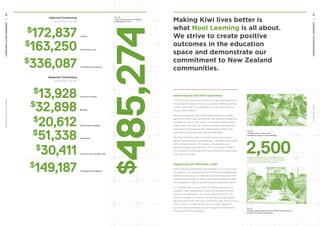
Supporting communities
and the environment is
part of our DNA.
$
5.6In total across the Group,
more than $5.6 million
was raised and donated
during FY17.
The Warehouse Group’s involvement in the community and environment
has been strengthened further over the past year, with corporate social
responsibility becoming a key pillar of the Group’s strategy.
FY17 has been a transformative year for our community and environment
initiatives. Fundraising across the Group has gone from strength to strength
and new collaborative partnerships have been established. This has enabled
us to take a real stance on issues affecting our society today.
In total across the Group, more than $5.6 million was raised and donated
during the financial year.
Our environment strategy has evolved. The Group’s focus on cleaner and
greener products continues, with an even greater emphasis on engaging
and inspiring customers to help them live sustainable lives.
We believe education is critical to ensuring a successful and prosperous country
where every Kiwi can flourish. Going forward, our community and environment
initiatives will increasingly be focused around education, with some exciting
new partnerships and programmes planned for the coming year.
m
43
42
INTRODUCTIONCOMMUNITYENVIRONMENT
COMMUNITYENVIRONMENT
Fig. 01
Youthline cheque
presentation,
16 October 2016.
Fig. 02
Staff enjoying a visit
from Harold and the
Life Education team.
Fig. 03
Christmas celebration
in partnership
with Variety – The
Children’s Charity.
The Warehouse is an iconic part
of the make-up of New Zealand’s
communities, and this lives through
our collaborative community
partnerships. In FY17 we partnered
with five organisations at a
national level, centred around
initiatives that improve outcomes
for young people and their
whānau –supporting them
with their education, well-being
and youth employment.
Fig. 04 — Variety – The Children’s Charity
Almost one in three Kiwi children are growing up without
the basics. Our partnership with Variety raised funds
to help level the playing field for disadvantaged kids,
particularly with their education. With the funds raised
through The Warehouse, children are given a good
start in life by covering basic unmet needs like clothing,
prescriptions, doctor’s bills and school stationery. They are
also given opportunities that they’d otherwise miss out on,
such as the chance to play sport or go on school camp –
helping them reach their full potential.
Fig. 05 — Life Education Trust
The Life Education truck turning up to school with
Harold the giraffe, is often a highlight of the year for
many Kiwi kids. Our partnership with Life Education
Trust provides at-risk children an opportunity to attend
the classroom modules, which empowers them to make
healthy choices so they can live full lives. Funds raised
through The Warehouse also helped Life Education Trust
to adapt their teaching methods from paper-based to
a digital platform so they can engage children further.
Fig. 06 — Women’s Refuge
Children are often seeing, hearing and getting caught in
the middle of family violence. In fact, just under half of
Women’s Refuge’s clients are children. The effect of this
exposure can be devastating. The fundraising campaign
we ran for the Women’s Refuge ‘Kids in the Middle’
initiative funded child-advocates to be based in refuges
across the country. These advocates provide around-the-
clock, wrap-around support for children in the form of
counselling programmes and one-on-one guidance.
Fig. 07 — The Parenting Place
Being a great parent is the most valuable job in the world.
Attending one of The Parenting Place’s Toolbox parenting
courses is often a life-changing education experience.
Over a number of weeks parents learn activities and
strategies they can apply at home, all in a relaxed setting
facilitated by trained volunteers who are friendly and
supportive. The funds raised provided vulnerable families
in local communities the opportunity to attend one of
these courses.
Fig. 08 — Youthline
Youthline supports young people in need and their
families anytime, day or night. Their vision is to create
communities where young people thrive. Thanks to
generous customers who donated during our fundraising
campaign, Youthline have been able to launch their
‘GoForward’ digital strategy. This delivers counselling by
technology, like GoChat – which bridges the gap between
phone and text counselling, GoMobile – a text counselling
programme, and GoLive – an online counselling option.
Fig. 04 Fig. 05 Fig. 06 Fig. 07 Fig. 08
44
45COMMUNITYENVIRONMENTTHEWAREHOUSE
COMMUNITYENVIRONMENTTHEWAREHOUSE
Pedalling for Our Tamariki
In March 2017, more than 160 team members from
The Warehouse and Plunket hopped on their bikes for
a 16-day cycle relay – the length of the country! This
was the second year we’ve run the Pedal for Plunket
campaign, with funds this year supporting Plunket
community services. These services ensure that all families
can connect with their community to provide a safer,
better place for children to grow up in.
Olympic cyclist Alison Shanks joined us on the journey
as our ambassador. Alison motivated our team, provided
handy training tips and tricks, encouraged donations and
supported at Pedal for Plunket events around the country.
In total, cyclists rode more than 3,800 kilometres of
winding New Zealand roads, stopped at 88 of our stores,
and took countless selfies along the way. Our stores
and local Plunket volunteers joined in to put the ‘fun’
into fundraising – they provided energetic welcoming
committees when cyclists flew through cities, rattled
buckets for donations, put on bake sales and hosted
sausage sizzles.
Thanks to the generosity of our customers, we presented
Plunket with a cheque for $456,460 at the end of the event
– significantly up from the first campaign in 2015.
In addition, this year donations to Plunket from approved
car seats sold in The Warehouse reached $38,390.
Work-readiness for Young People
A highlight this year was launching Red Shirts in the
Community officially – a partnership with the Ministry
of Social Development. This means that over the next
year, 1,000 young Kiwis aged 16 to 24 who are not
currently in employment, training or education will
receive vital foundational skills through work experience
in The Warehouse stores.
Participants in the programme receive training in
retail customer service, communication skills, personal
presentation, merchandising, and health and safety.
Participants receive a certificate of participation and a
verbal reference, which they can use while seeking a job.
Where possible, participants can also earn credits towards
a National Certificate in Retail (Level 2 NCEA) and a
Customer Service Award.
The initiative has had proven success. A total of 70% of
participants who completed the pilot programme gained
some form of paid employment within three months of
completing the programme.
We believe that businesses have an important role to play,
contributing to the development of a country where all
youth can flourish. Red Shirts in the Community is believed
to be the largest employer-led youth employment initiative
in New Zealand. We are working with the Ministry of
Social Development to develop a framework that other
organisations can use to roll out similar programmes for
young people. We are looking forward to continuing
to measure the outcomes and success levels of this
innovative programme in the coming year.
$
456kThanks to the generosity of our customers,
we presented Plunket with a cheque for
$456,460 at the end of the campaign.
Fig. 09
Pejman Okhovat, CEO TWL and WSL,
and Amanda Malu, CEO of Plunket, at the
starting line of the Pedal for Plunket event.
Fig. 10
Helping Our Team to Get Ahead Financially
We extended our successful ‘You and Your Money’
financial literacy programme this year, conducting 21
courses for 192 team members of The Warehouse. This
educational programme is run in partnership with the
Commission for Financial Capability and directly links
to the Government’s National Strategy for Financial
Capability, ensuring everyone is prepared to get ahead
financially. It covers everything from budgeting, managing
debt, savings, investing and preparing for retirement.
A total of 94% of our team members who participated in
the programme this year found the course “very useful”.
They reported a general increase in their own financial
knowledge and capability, and believe it will help them
to make the most out of their money for themselves and
their whānau.
Grassroots Community Support
In addition to our national programmes, we believe it’s
important to work at a local level, supporting causes and
needs that matter to communities. This is why each of
our stores partners with neighbourhood organisations,
providing more than $1 million of support over the year
through various ways, such as our iconic community BBQs,
proceeds from our 10c plastic bags and product donations.
Our nine trading regions continued to partner with
organisations in their area. These regional partnerships
funded everything from educational zoo visits for
low-decile schools through The Warehouse Zoofari
programme, to providing free books for schoolchildren
to assist their reading skills through Duffy Books.
Supporting Communities in Need
We believe it’s important to do all that we can to support
those who are vulnerable during disasters and in times
of need. In emergency situations, we partner with
organisations who are on-the-ground co-ordinating
recovery efforts and providing support.
The Kaikoura earthquake disrupted communities
significantly and, in some cases, our business operations.
We worked with New Zealand Red Cross, which had
teams locally providing emergency aid and ensuring
everyone had the support they needed. Our customers
donated generously to the Red Cross Earthquake Appeal
we ran in The Warehouse stores.
In April 2017, flooding in Edgecumbe impacted and
displaced hundreds of families. Once again we worked
with Red Cross co-ordinating flood-relief kits for those
affected around the Bay of Plenty region.
Fig. 11
Minister Tolley
addressing
Red Shirts at a
community launch.
Fig. 12
The Warehouse Lincoln Road
presents a cheque to
Seed2Harvest, one of their
Customer Choice partners.
46
47THEWAREHOUSECOMMUNITYENVIRONMENT
COMMUNITYENVIRONMENTTHEWAREHOUSE
National and Regional Fundraising
August 2016 to July 2017
$
355,044
$
343,708
$
340,727
$
265,504
$
251,983
$
456,460
$
2,013,426
$
758,814
Local and Other Fundraising
August 2016 to July 2017
$
119,712
$
367,240
$
545,475
$
1,032,427
$
273,325
$4,077,992
Fig. 13
Grand total national, regional and
neighbourhood fundraising for FY17.
Variety – The Children’s Charity
Women’s Refuge
The Parenting Place
Youthline
Total National Fundraising
Total Regional Fundraising
Life Education Trust
Coin boxes
Bags for Good
Total Local Fundraising
Other Fundraising
BBQ fundraising
We’re all about helping
Kiwis to do great things,
and Warehouse Stationery’s
education-focused community
partnerships are an essential
part of this. Our team is
passionate about making a
difference – this deeply-ingrained
passion came through in
very successful fundraising
campaigns for our national
partners CanTeen and The
Salvation Army, and our various
regional partners, reaching
record amounts in some cases.
Fig. 14
A Warehouse Stationery
team member invites a
customer to add a
donation to their purchase.
Pedal for Plunket
48
49COMMUNITYENVIRONMENTWAREHOUSESTATIONERY
THEWAREHOUSECOMMUNITYENVIRONMENT
Making Tertiary Education Accessible
As part of our commitment to making education
accessible and affordable for every Kiwi, we are proud to
offer scholarships that support up to six ambitious young
New Zealanders to complete tertiary education every year.
These young people would otherwise not have been able
to afford to study.
FY17 was the second year of the Warehouse Stationery
Scholarships. Along with funding their tertiary study, we
provide every recipient with employment in one of our
stores to assist with living costs. They also receive full
wrap-around support, including mentoring and courses
that help them maximise their chances of successfully
completing their qualification.
In the coming years, we plan to increase the number of
scholarship recipients. We are also extending the selection
criteria to include participants of The Warehouse’s Red
Shirts in Community programme.
Getting Education Back on Track
Often when young people go through cancer their whole
life is put on hold and their education is affected. CanTeen
believes that life shouldn’t stop with a diagnosis of cancer,
and that no young person should ever face cancer alone.
Education is so critical to the success of our young people. The
funds donated generously from our customers help CanTeen
support young people to get their lives back on track, giving
them the strength and resources to reconnect and return to
their education. During FY17, we raised $172,837 for CanTeen.
Aspiring to Greater Things
Life can be tough for young people, which is why our
partnership with The Salvation Army continued to fund
Aspire programmes this year. Aspire is a year-long youth
development programme that helps at-risk young people
overcome their barriers, grow and develop, connect positively
with others, take responsibility and master essential life skills.
Aspire has now been running for three years. The Salvation
Army works directly with schools to identify and help
young people who may be at-risk. The $163,250 raised
for The Salvation Army in FY17 will help these youth
aspire to greater things.
Fig. 16Fig. 15
$
172,837
$
163,250
Raised for CanTeen
Raised for The Salvation Army
Fig. 17
Shari French, GM of
Community Relations,
presents a cheque
to Shane Chisholm,
Territorial Public
Relations Director of
The Salvation Army.
Fig. 18
Teens from
CanTeen.
Fig. 19
Youth supporting
CanTeen.
Fig. 20
The Salvation Army
promotes the Red Shield
Appeal in Warehouse
Stationery stores.
Research completed
as part of the programme
showed a significant increase
in key attitudinal indicators,
such as an increase in young
people’s confidence to
reach their goals.
Aspire is a year-long youth development
programme which helps at-risk young
people aspire to greater things.
50
51
WAREHOUSESTATIONERY
COMMUNITYENVIRONMENTWAREHOUSESTATIONERY
COMMUNITYENVIRONMENT
$485,274
Fig. 21
Grand total national and regional
fundraising for FY17.
National Fundraising
August 2016 to July 2017
$
172,837
$
163,250
$
336,087
Regional Fundraising
August 2016 to July 2017
$
13,928
$
32,898
$
20,612
$
51,338
$
30,411
$
149,187
CanTeen
The Salvation Army
Total National Fundraising
Scouts New Zealand
Child Cancer Foundation
Duffy Books
The Key to Life Charitable Trust
Bluelight
Total Regional Fundraising
Making Kiwi lives better is
what Noel Leeming is all about.
We strive to create positive
outcomes in the education
space and demonstrate our
commitment to New Zealand
communities.
Enhancing the Education Experience
In FY17, we launched the Community Learning Programme.
This initiative evolved from our successful Mobile Learning
Centre, which has now completed its two-year road trip
around New Zealand.
We have partnered with 24 low-decile primary schools,
delivering 2,500 hours of free learning sessions to teachers
and their students. Our mission is to help teachers better
understand how they can use technology to enhance the
experience for their students, create opportunities and
help them to discover new learning pathways.
Our Tech Solutions team members across the country
deliver tailored learning experiences – covering everything
from coding, robotics, 3D design, virtual reality and
educational learning platforms. We are excited to watch
the success of this programme and measure its outcomes
over the year ahead.
Supporting and Mentoring Youth
Noel Leeming established a partnership in FY17 with First
Foundation – an educational trust which gives academically
talented young Kiwis a ‘hand-up’ to tertiary education. The
programme provides students with financial support, paid
work experience, advice, guidance and a supportive mentor.
Our partnership is not just about funding education for
students. After being blown away by the calibre of the
programme applicants, we saw an opportunity for our
team to engage and mentor the talented young people,
assisting them with the major transitions they face moving
from school to university life. We now have several of
our lead team mentoring youth through the programme,
including CEO Tim Edwards.
Fig. 22
Young students experiencing
technology thanks to Noel Leeming.
Fig. 23
Students getting digital advice through Noel Leeming’s
community learning programme.
2,500We have partnered with 24 low-decile primary
schools, delivering 2,500 hours of free learning
sessions to teachers and their students.
53
52
NOELLEEMING
WAREHOUSESTATIONERYCOMMUNITYENVIRONMENT
COMMUNITYENVIRONMENT
At Torpedo7 we live and
breathe the outdoors; we think
it’s important that others have
the opportunity to experience
it as well. That is why we focus
our community efforts on
outdoor education initiatives.
Giving the Gift of the Outdoors
Our partnership with Hillary Outdoors Education Centres
allows our team members and generous customers to
share our outdoors way of life with students who wouldn’t
otherwise have the opportunity.
The partnership focuses on youth from low-decile
schools, giving them the chance to grow through a unique
adventure and outdoor experience. The experiences are
designed to challenge youth both mentally and physically,
helping them work together as a team and grow as
individuals. These are often life-changing, building the
skills and resilience youth need – with a positive flow-on
effect to their school, family and community life.
“I will apply what I have learned about perseverance
and patience into my school work, being patient and
persevering with long, tedious assignments and tasks,
knowing that I will enjoy the end result,” says Rebecca,
a student at Papatoetoe High School who took part in
a five-day outdoor education programme on Great Barrier
Island thanks to funding from Torpedo7.
Schools that have benefited from our partnership
include Melville High School, Papatoetoe High School,
Taupo-a-nui, and Auckland Girls’ Grammar School.
Over $8,500 was raised for Hillary Outdoors during FY17;
this will contribute positively to the life-journey of the
youth who participate in the outdoor learning experiences.
“I believe the funding and
opportunity to attend this
programme has allowed each
individual student to explore
their own values and potential.
This will enable them as
individuals and members of
a community to contribute to
developing a stronger, vibrant
local community in the future.”
	 Keith Francis – Papatoetoe High School teacher
Fig. 24 Fig. 23
Students participating
in the Hillary Outdoors
education programme.
The 1-day team continued their
partnership with Ronald McDonald
House Charities® (RMHC®) in
FY17. Ronald McDonald House®
provides free accommodation
and support services to thousands
of families, ensuring they are
better placed to cope and help
their children heal.
The RMHC® facilities seek to alleviate the emotional, practical
and financial burdens a family can face to enable them to
focus on the most important thing – their child’s recovery.
Through the team’s efforts and the generosity of our
customers, 1-day contributed $25,000 towards Christmas
toys and gifts for all families staying in a Ronald McDonald
House® during this financial year.
The 1-day team also volunteered at the Auckland House to
cook a festive Christmas feast – allowing families to have
a night off cooking so they could spend this special time
with loved ones. Santa added Christmas cheer with a visit
on the night, handing out 1-day presents to the children.
Over 1,000 gifts were donated nationwide to all Ronald
McDonald Houses for children and their families.
In addition to Christmas cheer, 1-day supply all
participating RMHC® Supper Clubs with 1-day products to
auction off at these great events. This year the donated
products raised $29,000 – thanks to a bunch of wonderful
volunteers organising these events. The 1-day staff also ran
an annual corporate golf day at Ngaruawahia Golf Course
in March, which raised $8,500 through auctions and
donations from local businesses and suppliers.
Fig. 26
1-day presents a
cheque to Ronald
McDonald House®.
Fig. 25
54
55
COMMUNITYENVIRONMENTTORPEDO7
1-DAYCOMMUNITYENVIRONMENT
This year saw the continued
success of our The Warehouse
Group fundraising and
community programmes – all
designed to help New Zealand
flourish. The 25th annual Gala
Dinner was New Zealand’s largest
corporate fundraising dinner
and raised a record amount.
Our team members in stores,
our store support office and
distribution centres continued
to get in behind our fundraising
efforts, and they give generously
through payroll giving.
Fig. 27
Students learning
gardening skills with
Harold the Giraffe.
Fig. 28
In FY17, our team members
donated a total of $138,489
through payroll giving.
Fostering Team Member Generosity
We’re all about helping our team to be the best they can
be, which includes supporting communities and helping
New Zealand flourish. Team-member generosity continued
to grow over the past year, with payroll giving becoming
even more popular.
Payroll giving is a voluntary initiative that enables our
team members to give one-off or ongoing donations from
their pay to a registered charitable organisation or school
of their choice. Our team tell us they love the flexibility and
ease of payroll giving, which enables them to support their
neighbourhood and causes that matter to them.
In FY17, our team members donated a total of $138,489
through payroll giving, which has benefited more than
220 community organisations. This takes our all-time total
raised through payroll giving to over $500,000 since we
launched this initiative.
Helping to Tackle Childhood Obesity
New Zealand ranks third-highest in the OECD for child
obesity levels, with one in three Kiwi kids classed as being
obese or overweight – and rates are continuing to rise.
The knock-on effects of being obese or overweight for
a young person include low self-esteem, bullying, eating
disorders, ill health and even suicide.
To tackle this rising epidemic, Life Education Trust and
Garden to Table partnered to create the Empower
programme. This is a comprehensive and sustainable
classroom-based initiative, which will be the largest
programme to tackle childhood obesity in New Zealand.
Empower was funded through The Warehouse Group’s
Gala Dinner 2016, which raised a record amount of
$776,584 to launch the programme, thanks to our
generous suppliers and business partners.
The success of the initiative is down to collaboration – by
bringing together two of the Group’s community partners,
Empower will deliver even greater outcomes. It leverages
Life Education Trust’s experience and strength in delivering
classroom-based modules around food, nutrition and
healthy eating – and Garden to Table brings practical
learning in the garden and the kitchen.
Over a two-year period, Empower will benefit around
32,000 Kiwi children in about 170 schools – with a mission
to empower children with the knowledge to take action
and create healthy, lifelong habits.
“Gaining the support of The Warehouse Group and its
suppliers and business partners, who each year make a
significant contribution to community development, has
ensured our innovative programme can go forward.”
John O’Connell – CEO Life Education Trust
$
776kEmpower was funded through The Warehouse Group’s
Gala Dinner 2016, which raised a record amount of
$776,584 to launch the programme, thanks to our
generous suppliers and business partners.
57
56
THEWAREHOUSEGROUP
THEWAREHOUSEGROUPCOMMUNITYENVIRONMENT
COMMUNITYENVIRONMENT
Recognised for Helping New Zealand Flourish
Throughout the year, The Warehouse Group received
industry recognition for several of our community initiatives.
•	We received our third Business and Community
Shares (BACS) Good Business Egg Award in five
years, which is more than any other New Zealand
business has achieved. Our BACS Award recognised
The Warehouse’s commitment to ‘Community
Empowerment in Aotearoa’ – focusing on education,
well-being and youth employment.
•	 We were the first business to be accredited by White
Ribbon, recognising our policies and work to prevent
family violence.
•	 Our ‘Family Violence, it’s not OK’ initiative won the
Corporate Social Responsibility award and was a
finalist in the Christian Dahmen Memorial Award for HR
Innovation at the 2017 Human Resources Institute of
New Zealand Awards.
•	The Warehouse was first-equal with Rainbow’s End
for the Local Youth Employer Award at the 2016
Auckland ‘Young at Heart’ Awards – acknowledging the
contribution made to creating sustainable employment
opportunities for young people.
Just after year-end we were awarded the Emerging
Diversity and Inclusion Award by Diversity Works for our
family violence initiatives.
A Round of Golf for Good
Over $75,000 was raised for Grandparents Raising
Grandchildren at the Bob Tindall Golf Day in March 2017,
thanks to the generosity of our suppliers.
The funds raised from the event extends caregiver education
programmes throughout New Zealand, providing vital
support services to more than 6,000 full-time grandparent
and whānau caregivers who are raising children in
circumstances where the alternative is foster care.
We are proud to support Grandparents Raising
Grandchildren, ensuring grandparents are well equipped
to deliver the very best outcomes and care for some of
New Zealand’s most vulnerable children.
“I admire grandparents who take on such a huge
responsibility and it is great they have a range of support
services through an organisation like Grandparents
Raising Grandchildren.”
Nick Grayston – CEO, The Warehouse Group
Standing Against Family Violence
In New Zealand, police are called to a family-violence-
related incident every 5.5 minutes and one in three
women will experience domestic violence at some point
in their lifetime. These are just some of the statistics we
are working to change through our ‘Family Violence, it’s
not OK’ initiatives. This multilayered initiative not only
supports our team members but also they have been
recognised by other businesses and industry groups as
leading in their field, which has potential to broaden the
benefits further.
Launched in FY16, the programme was strengthened
in FY17 to include comprehensive training, including
educating people leaders on signs and ways to discuss
the subject with someone who may need support
within their team. During the FY17 year we were the
first business in the country to publish Women’s Refuge
information resources on our team-member intranet. The
information includes advice on the warning signs of family
violence, how to stay safe, how to seek help and how to
help others. It also features a section on how to support
team members, including details of our ‘Family Violence,
it’s not OK’ policy. Another initiative put in place during
the year was an in-store poster campaign to support team
members who may be experiencing family violence.
In addition, we were proud to host two knowledge-sharing
events for other New Zealand businesses which wanted
to know more about our policy and associated training.
The policy and training resources were shared in an
effort to encourage more businesses to implement
similar initiatives.
Fig. 29
The Warehouse being
presented with their
accreditation by White Ribbon.
Group Fundraising
August 2016 to July 2017
The Warehouse Group’s
Gala Dinner (proceeds to
Life Education Trust and
Garden to Table’s Empower
programme)
Bob Tindall Golf Day
(proceeds to Grandparents
Raising Grandchildren)
Payroll giving
Support office, distribution
centre and Shanghai office
fundraising
$1,025,842
Fig. 30
Total Group fundraising.
$
776,584
$
76,000
$
138,489
$
34,769
58
59THEWAREHOUSEGROUP
COMMUNITYENVIRONMENT
THEWAREHOUSEGROUP
3.9%
This year is the third year
of reporting greenhouse
gas (GHG) emissions generated
by all the major Group
businesses: The Warehouse,
Warehouse Stationery,
Noel Leeming, Torpedo7,
and Financial Services.
We have achieved Certified Emissions Measurement and Reduction
Scheme (CEMARS®) certification for these emissions, which recognises
our commitment to managing and reducing our GHG emissions. To receive
this certification our GHG emissions and emissions reduction plan were
independently reviewed and audited.
The Group’s top emissions activities were international shipping (36% of
emissions), electricity (29%) and domestic shipping (15%), which includes road,
rail and sea shipping and courier freight. International shipping emissions are
reported for the products we directly source from overseas; we do not include
international shipping emissions for products sourced within New Zealand,
which our suppliers are responsible for.
Overall, Group emissions fell by 3.9% to 39,515 tonnes of carbon dioxide
equivalent (CO2e).
Overall, Group emissions fell by
3.9% to 39,515 tonnes of carbon
dioxide equivalent (CO2e).
However, there were emissions increases in three key
areas: international shipping, courier freight, and landfill.
International shipping increases were due to greater
use of air transportation. Courier freight, particularly air
freighting of parcels within New Zealand, has increased
as we seek to deliver orders to customers more quickly.
We have started using an electric van for some deliveries,
to reduce emissions where possible. Landfill increases
are primarily as a result of construction-related waste
from opening new stores and extending our distribution
centres, as well as from disposing of damaged products
and fittings because of the Kaikoura earthquake.
Warehouse Stationery’s emissions fell by 9.7%, largely
from decreases in air travel and electricity emissions.
Noel Leeming’s emissions decreased by 9%, also
predominantly from decreases in air travel and electricity
emissions, although there was an increase in fuel used in
company vehicles.
Torpedo7’s emissions grew by 16% with significant
increases in the areas of international shipping and landfill.
There were two main drivers of this reduction: air travel
and electricity. Air travel has been reduced with new
booking controls being put in place. Electricity usage
decreased by 2%; in addition, the emissions impact of
electricity fell significantly during FY17 as very high levels
of renewable electricity were generated, according to the
Ministry of Business, Innovation and Employment. The net
impact was a reduction in electricity emissions of 17%.
Driving the decreases in electricity usage have been
the installation of LED lighting in stores (now in 10 of
The Warehouse stores), a store closure, and – for
unfortunate reasons – the partial closure of the Lower
Hutt store because of damage from the Kaikoura
earthquake. We anticipate long-term electricity use
to grow because we have committed to 30% of our own
road fleet to be electric by the end of 2019. Our overall
emissions will be lower, though, as we substitute fossil
fuels with electricity.
The Warehouse generates 78% of the Group’s emissions,
reflecting its greater store footprint and sales within
the Group. Also, The Warehouse directly sources the
greatest proportion of products from overseas, and so has
significantly more international shipping emissions. The
Warehouse’s emissions fell by 3.9%, largely driven by – as
discussed above – air travel and electricity use, and from
a reduction in gases lost from air-conditioning systems
because of better air-conditioning maintenance and the
use of newer units.
61
60
GHGEMISSIONS
COMMUNITYENVIRONMENTGHGEMISSIONS
COMMUNITYENVIRONMENT
Palm oil
In FY16, we introduced our Palm Oil Sourcing Policy which
covers any product that contains palm oil (or a palm oil
derivative). Palm oil is an ingredient in a wide range of
product categories, most common in food, pet food,
household cleaning products, personal care, and health
and beauty. Like our wood policy, this policy commits
us to ensure that any palm oil ingredients come from
certified sustainable sources. Progress has been slower
than expected because of challenges in identifying palm
oil in products and sourcing genuine certified palm oil.
To accelerate progress, we are focusing on health and
beauty and food categories, as palm oil is most prevalent
in these product areas.
Microplastics
In the early part of FY17 we introduced a ban on wash-off
health and beauty, personal care, and cleaning products
containing microplastics. Microplastics are minuscule
balls of plastic, often called microbeads, which are used
in products for functions such as abrasion (exfoliation),
bulking or controlling viscosity. The plastics are washed
down the drain after use and sewer systems cannot
capture them, so they end up in the ocean as a pollutant
and are often eaten by sea creatures. From May 2018,
the Government will ban the sale of wash-off products
containing microplastics.
Apparel
We have recently started a project to assess and address
the environmental impact of our apparel products. We are
focusing on our top-selling products and evaluating them
against industry benchmarks in areas such as material
types and chemicals used in production processes. Once
we have assessed these risks we will investigate solutions
with suppliers.
Customer Electric Vehicle Charging
The Energy Efficiency Conservation Authority (EECA)
awarded The Warehouse part funding for public electric
vehicle (EV) charging stations outside 20 of The Warehouse’s
stores. We have focused on stores outside of Auckland
because there are fewer public charging stations there.
Our first of these chargers will be installed in Southland by
the end of 2017. The map on page 63 shows the 20 stores
that will have chargers by July 2018.
In addition to these 20, we have installed a public charger
at The Warehouse Royal Oak (Auckland), where we have
been testing how best to install and operate the charger.
In addition, we have installed four chargers at our Store
Support Office for use by employees and visitors.
Environmentally Sustainable Sourcing
Wood
We want to help our customers live more sustainably by
giving them peace of mind that the products they buy are
sourced in environmentally sustainable ways. In FY15 our
Wood Product Sourcing Policy was put in place to ensure
that products containing wood or wood pulp were not
linked to deforestation. We have made significant progress,
with most impacted products now sourced sustainably.
Fig. 32
Energy-efficient LED
lighting at The Warehouse,
Queenstown.
Fig. 31
Our charging station network
to be installed outside
20 of The Warehouse’s stores.
Fig. 33
The Wellington launch
of soft plastics recycling
at The Warehouse, Lyall Bay.
63
62COMMUNITYENVIRONMENT
COMMUNITYENVIRONMENT
Fig. 34
Polystyrene compactor at our North Island Distribution Centre.
Statistics
The
Warehouse
Warehouse
Stationery
Noel
Leeming Torpedo7 Total
Landfill
kg total 2017 2,443,836 243,043 474,793 167,477 3,329,149
2016 2,321,209 269,013 420,437 110,814 3,121,474
2015 2,383,683 322,096 381,225 138,515 3,225,518
2014 2,481,645 587,679 338,660 N/A 3,407,984
AVERAGE
kg per
$m sales
2017 1,387 874 586 1,062 977
2016 1,318 964 559 745 897
2015 1,387 1,226 573 1,056 1,060
2014 1,490 2,345 546 N/A 1,460
Store electricity
kWh total 2017 65,691,866 8,935,375 13,041,998 2,194,523 89,863,762
2016 67,416,524 8,723,446 13,239,335 1,865,900 91,245,205
2015 67,949,942 7,865,957 13,312,421 1,744,219 90,872,538
2014 67,168,416 8,545,690 15,479,178 N/A 91,193,284
AVERAGE
kWh per
m2
per
month
2017 10.64 10.53 13.87 11.48 11.63
2016 11.28 10.93 14.35 10.41 11.74
2015 11.31 9.94 16.38 9.74 11.84
2014 11.18 10.44 19.32 N/A 13.65
GHG
CO2
e total 2017 31,030 2,512 3,814 2,159 39,515
2016 32,222 2,783 4,193 1,862 41,060
2015 31,116 2,752 4,076 1,970 39,914
2014 29,819 2,972 4,339 N/A 37,130
AVERAGE
CO2
e
per $m
2017 17.62 9.03 4.70 13.69 11.26
2016 18.30 9.97 5.58 12.52 11.60
2015 18.11 10.47 6.12 15.01 12.43
2014 17.91 11.86 6.99 N/A 12.25
Plastic bags ordered – The Warehouse
% YOY CHANGE % CHANGE ON 2008
Total 2017 14,132,000 -0.3% -67%
2016 14,178,000 –3.7% –67.3%
2015* 14,726,000 25.6% –66.0%
2014 11,722,000 –73.0%
2008† 43,370,500
Total
per $m
2017 8,023 -0.4 -71.7%
2016 8,052 –6.0% –71.6%
2015* 8,570 21.7% –69.8%
2014 7,039
2008† 28,347
† In 2008 we did not charge for plastic bags.
* 2015 restarted upwards from 14,202,000 due to an error in data originally provided.
Fig. 35
The Warehouse, Lyall Bay team supporting
The Great Community Clean Up.
One potential challenge to this target is the impact of
new regulations in China that restrict importing some
recyclables. This will potentially affect our level of
recycling of plastic film, or pallet wrap. We are working
with our recyclers to understand the impact and
alternatives available.
A recycling difficulty we have had for some time has been
the recycling of polystyrene, as there are few recyclers
with the necessary equipment. As part of our North
Island Distribution Centre expansion, we have included
on-site polystyrene recycling equipment that compacts
this material by over 90%. We then sell this compacted
polystyrene onto one our recycling partners.
The Great Community Clean Up
Late September 2016 saw the inaugural The Warehouse
Great Community Clean Up. The event, in partnership
with Neighbourly, encourages our team members and
the New Zealand public to volunteer their time to clean
up their local neighbourhood. We repeated the clean-up
again in late April 2017, and plan to repeat it annually each
April. Across the two clean-ups in FY17, more than 1,800
people volunteered (including 1,100 team members) across
165 groups, cleaning-up more than 180 communities
across the country.
Plastic Bags and Recycling
In FY17, The Warehouse stores ordered 14.1 million plastic
checkout bags, 46,000 (or 0.3%) fewer than last year.
Customers can now recycle their plastic bags, together
with other soft plastics, at more of The Warehouse’s
stores. The Warehouse is a participant in a voluntary,
industry-led initiative that enables customers to recycle
these plastics in special recycling bins at The Warehouse
stores and grocery retailers. The recycling campaign
launched in October 2015 is now available in 47 of The
Warehouse’s stores across the country, with several more
planned for FY18. To July 2017, the scheme had collected
more than 21 tonnes from our customers, which equates
to approximately 5.5 million pieces of plastic.
Waste and Recycling
Our waste performance has been mixed in FY17,
increasing 7% in weight. This was largely been generated
by construction-related waste from opening new stores
and extending our distribution centres. In addition, we had
to dispose of damaged products and fittings as a result
of the Kaikoura earthquake. These events aside, there is
still significant scope to improve recycling at many of our
sites. To give greater visibility of recycling performance,
we have begun reporting landfill diversion for The
Warehouse, with other brands to follow soon. Landfill
diversion represents the proportion of total waste that
is diverted to recycling. In FY17, The Warehouse stores
diverted approximately 82% of its waste to recycling,
leaving 18% going to landfill. We have set a target of
95% diversion by 2020.
Fig. 36
GHG Emissions Breakdown
Tonnes of carbon dioxide equivalent (CO2
e)
The Warehouse
Warehouse
Stationery
Noel
Leeming
Torpedo7
Financial
Services
Total
FY17 FY16
%
CHANGE FY17 FY16
%
CHANGE FY17 FY16
%
CHANGE FY17 FY16
%
CHANGE FY17 FY16
%
CHANGE FY17 FY16
%
CHANGE
Int’l shipping 13,134 12,048 9% 592 643 –8% – – – 592 411 23% – – – 14,231 13,102 9%
Electricity 8,588 10,571 –19% 1,067 1,227 –13% 1,576 1,862 –15% 262 262 0% 28 36 –22% 11,522 13,958 –17%
Domestic shipping 4,535 2,455 7% 364 313 16% 110 99 10% 1,079 943 14% – – – 6,087 5,580 32%
Employee
air travel
1,948 2,251 –13% 279 378 –26% 503 794 –37% 211 178 19% 13 – – 2,954 3,601 –18%
Landfill 1,512 1,224 24% 146 160 –9% 327 261 25% 78 46 67% – – – 2,062 1,691 22%
Company–owned
vehicles and lifts
966 881 10% 29 20 40% 1,257 1,144 10% 8 14 –44% 11 7 –51% 2,271 2,066 10%
GHG losses from
air–conditioning
systems
160 865 –81% 20 18 11% 28 7 331% – – – – – – 209 890 –77%
Employee private
km claims
130 159 –18% 16 23 –31% 13 26 –51% 17 6 159% 3 3 17% 178 217 –18%
Total emissions 30,974 32,222 –3.9% 2,512 2,783 –9.7% 3,814 4,193 –9.0% 2,159 1,862 16.0% 55 46 20.9% 39,515 41,105 –3.9%
Total emissions
per $m sales
17.62 18.30 –3.7% 9.03 9.97 –9.4% 4.70 5.58 –15.6% 13.69 12.52 +9.4% – – – 11.26 11.60 –2.8%
65
64
GHGEMISSIONSBREAKDOWN
STATISTICSCOMMUNITYENVIRONMENT
COMMUNITYENVIRONMENT
Our Five Strategic
Key Results Areas
Leadership
Wellness
Integration and Simplification
Risk and Compliance
Partner with Businesses
and Customers
Ensure leaders know how to lead to keep our people safe and well
Create an environment where workplace wellness takes priority
Health and Safety systems and processes using data for targeted injury
and wellness initiatives
Manage our risks and compliance obligations
Partner with like-minded businesses and our customers to drive step change
in understanding of safety practices in New Zealand
01
02
03
04
05
67
66
FIVESTRATEGICKEYRESULTSAREASHEALTHSAFETY
HEALTHSAFETY
The Group remains committed to
providing a safe environment for
our team, customers, contractors
and visitors. While solid progress
has been made in the areas
of prevention and reporting,
we were devastated by a recent
fatality involving an employee
of a contractor delivering goods
to our premises. Reporting was enhanced internally as well, with a view
to driving our proactive and preventative health and
safety culture through the incorporation of a new suite
of metrics. These metrics are expected to enhance
clarity and consistency of reporting at all levels of the
organisation, including the Board.
We also placed greater emphasis on the management
of the Group’s 10 most critical risks. Each risk has been
assigned to an Executive Team member to drive activity
and projects, to better understand and mitigate such risks.
A disturbing societal issue we have seen during the
year is an increase in violent activities throughout our
network. We have implemented a comprehensive training
programme to enable our teams to manage these
situations, in addition to increasing our security measures.
We retained our ACC Partnership Programme Tertiary
status for another year, following a successful audit.
In addition to health and safety, we are placing increased
emphasis on the wellness of our teams and, during the
financial year, we implemented several health-related
programmes aimed at improving the lives of our team
members. One of these initiatives is a commitment that
all our sites will be smokefree from January 2018, and
we are introducing measures to support our teams during
this transition.
Much of the focus for FY17 was on embedding a culture
of health and safety awareness and prevention. Significant
inroads were made through the introduction of a new Health
and Safety Management tool and more robust reporting.
Unfortunately, the year was marred by the Group’s first-
ever fatal accident, involving an employee of a contractor
at our Torpedo7 Fulfilment Centre in Hamilton. We were
also disappointed by the lack of a reduction in injury
numbers, particularly in the Red stores. We do, however,
believe this will change through focused endorsement by
leadership, new technology and data-driven initiatives.
A key success for the year was the launch of SafetyHub,
a Group-wide common Health and Safety Management
tool accessible to all team members digitally and on
mobile. SafetyHub has significantly enhanced our ability
to report and capture data on incidents, near misses,
hazards and preventative needs. It has improved access
to information for our teams and, most importantly, made
reporting incidents considerably easier.
Amongst SafetyHub’s features is ‘Spot It, Fix It’, a
mechanism to enable team members to report potential
hazards that they have identified and to either do
something about them immediately or log them for
attention. Over 1600 potential hazards have been loaded
within the first four months of Spot It, Fix It’s launch.
In addition to the preventative reporting, we have
pleasingly also seen a reporting increase in near misses.
SafetyHub’s ease of reporting and its rich data is expected
to go a long way to helping us better understand the root
cause of incidents and being able to prevent them.
Fig. 01
Health  Safety.
69
68
HEALTHSAFETYCOMMITTEDTOPROVIDINGASAFEENVIRONMENT
HEALTHSAFETYINTRODUCTION
Financial Statements
FOR THE 52 WEEK PERIOD ENDED 30 JULY 2017
The financial statements have been presented in a style which attempts to make them less complex and more relevant
to shareholders. The note disclosures have been grouped into six sections: ‘basis of preparation’, ‘financial performance’,
‘operating assets and liabilities’, ‘financing and capital structure’, ‘financial risk management’ and ‘other disclosures’.
Each section sets out the significant accounting policies in grey text boxes applied in producing the relevant notes, along
with details of any key judgements and estimates used. The purpose of this format is to provide readers with a clearer
understanding of what drives financial performance of the Group.
CONTENTS
FINANCIAL STATEMENTS	 PAGE
Consolidated income statement	 72
Consolidated statement of comprehensive income	 72
Consolidated balance sheets	 73
Consolidated statement of cash flows	 74
Consolidated statement of changes in equity	 75
NOTES TO AND FORMING PART OF THE
FINANCIAL STATEMENTS
BASIS OF PREPARATION	
1.1	 Reporting entity	 76
1.2	 Compliance statement	 76
1.3	 Basis of preparation	 76
1.4	 Reporting period	 76
1.5	 Critical accounting judgements, estimates
	 and assumptions	 76
1.6	 Restatement of prior year	 76
FINANCIAL PERFORMANCE	
2.0	 Segment information	77
2.1	 Operating performance	 77
2.2	 Capital expenditure, depreciation and amortisation	 77
2.3	 Balance sheet information	 77
3.0	 Income and expenses	78
3.1	 Other income	 78
3.2	 Lease and occupancy expense	 78
3.3	 Employee expense	 78
3.4	 Other operating expenses	 78
3.5	 Auditor’s fee	 78
4.0	Taxation	79
4.1	 Taxation – Income statement	 79
4.2	 Taxation – Balance sheet current taxation	 79
4.3	 Taxation – Balance sheet deferred taxation	 79
5.0	 Adjusted net profit	80
6.0	 Earnings per share	80
7.0	Dividends	81
7.1	 Dividends paid	 81
7.2	 Dividends policy reconciliation	 81
7.3	 Imputation credit account	 81
OPERATING ASSETS AND LIABILITIES	 PAGE
8.0	 Working capital	82
8.1	Inventory	 82
8.2	 Trade and other receivables	 82
8.3	 Trade and other payables	 82
8.4	Provisions	 83
9.0	 Non-current assets	83
9.1	 Property, plant and equipment	 83
9.2	 Intangible assets	 84
FINANCING AND CAPITAL STRUCTURE	
10.0	Borrowings	85
10.1	 Net debt	 85
10.2	 Net interest expense	 85
10.3	 Bank facilities	 85
11.0	Equity	86
11.1	 Capital management	 86
11.2	 Contributed equity	 86
11.3	Reserves	 87
11.4	 Minority interest	 87
FINANCIAL RISK MANAGEMENT	
12.1	 Financial risk factors	 88
12.2	 Derivative financial instruments	 88
12.3	 Liquidity risk	 89
12.4	 Credit risk	 89
12.5	 Market risks	 90
OTHER DISCLOSURES	
13.0	 Key management personnel	91
14.0	 Executive Long term incentive plan	91
15.0	 Discontinued operations	92
15.1	 Financial Services Group results and cash flows	 92
15.2	 Financial Services Group impairment of assets	 92
15.3	 Financial Services Group subsequent events	 92
16.0	 Held for sale	93
17.0	Commitments	93
18.0	 Contingent liabilities	93
19.0	 Related parties	93
20.0	Prior year restatement	94
21.0	 New Accounting Standards which are relevant
	 to the Group but are not yet effective	94
The Warehouse Group Limited is a limited liability company incorporated and domiciled in New Zealand.
The address of its registered office is Level 4, 4 Graham Street, PO Box 2219, Auckland.
These financial statements have been approved for issue by the Board of Directors on 21 September 2017.
Joan Withers	 Keith Smith
Chairman	 Deputy Chairman
For the 52 week period
ended 30 July 2017
71FINANCIALSTATEMENTS
70FINANCIALSTATEMENTS
Consolidated Income Statement
FOR THE 52 WEEK PERIOD ENDED 30 JULY 2017
(52 WEEKS) (52 WEEKS)
NOTE 2017 2016
$000 $000
Continuing operations
Retail sales 2.1 2,980,771 2,924,682
Cost of retail goods sold 8.1 (2,008,859) (1,966,510)
Gross profit 971,912 958,172
Other income 3.1 8,144 8,858
Lease and occupancy expense 3.2 (156,659) (148,404)
Employee expense 3.3 (486,196) (475,788)
Depreciation and amortisation expense 2.2 (58,376) (58,210)
Other operating expenses 3.4 (170,988) (173,463)
Operating profit from continuing operations 2.1 107,837 111,165
Unusual items 5.0 (605) 16,158
Equity earnings of associate – 723
Earnings before interest and tax from continuing operations 107,232 128,046
Net interest expense 10.2 (12,527) (14,154)
Profit before tax from continuing operations 94,705 113,892
Income tax expense 4.1 (23,691) (25,890)
Net profit for the period from continuing operations 71,014 88,002
Discontinued operations
Loss from discontinued operations (net of tax) 15.1 (50,283) (5,526)
Net profit for the period 20,731 82,476
Attributable to:
Shareholders of the parent 20,429 78,338
Minority interests 11.4 302 4,138
20,731 82,476
Profit attributable to shareholders of the parent relates to:
Profit from continuing operations 70,712 83,864
Loss from discontinued operations (50,283) (5,526)
20,429 78,338
Earnings per share attributable to shareholders of the parent
Basic earnings per share 6.0 5.9 cents 22.7 cents
Diluted earnings per share 6.0 5.9 cents 22.6 cents
Earnings per share attributable to shareholders of the parent from continuing operations
Basic earnings per share 6.0 20.5 cents 24.3 cents
Diluted earnings per share 6.0 20.4 cents 24.2 cents
Consolidated Statement of Comprehensive Income
FOR THE 52 WEEK PERIOD ENDED 30 JULY 2017
(52 WEEKS) (52 WEEKS)
NOTE 2017 2016
$000 $000
Net profit for the period 20,731 82,476
Items that may be reclassified subsequently to the Income Statement
Movement in derivative cash flow hedges 9,484 (64,480)
Movement in de-designated derivative hedges 606 605
Tax relating to movement in hedge reserve (2,825) 17,885
Other comprehensive income 7,265 (45,990)
Total comprehensive income 27,996 36,486
Attributable to:
Shareholders of the parent 27,694 32,348
Minority interest 11.4 302 4,138
Total comprehensive income 27,996 36,486
Attributable to:
Total comprehensive income from continuing operations 78,279 42,012
Total comprehensive loss from discontinued operations (50,283) (5,526)
Total comprehensive income 27,996 36,486
Total comprehensive income from continuing operations attributable to:
Shareholders of the parent 77,977 37,874
Minority interest 11.4 302 4,138
Total comprehensive income 78,279 42,012
The above consolidated income statement and statement of comprehensive income should be read in conjunction with the accompanying notes. The above consolidated balance sheets should be read in conjunction with the accompanying notes.
Consolidated Balance Sheets
AS AT 30 JULY 2017
CONSOLIDATED CONTINUING RETAIL GROUP
DISCONTINUED
FINANCIAL SERVICES GROUP
NOTE 2017 2016 2017 2016 2017 2016
$000 $000 $000 $000 $000 $000
ASSETS
Current assets
Cash and cash equivalents 10.1 47,492 49,881 40,179 36,531 7,313 13,350
Finance business receivables – 73,565 – – – 73,565
Trade and other receivables 8.2 71,088 77,059 71,088 72,434 – 4,625
Inventories 8.1 491,818 501,713 491,818 501,713 – –
Derivative financial instruments 12.2 – 621 – 621 – –
Taxation receivable 4.2 4,959 – – – 5,972 3,352
615,357 702,839 603,085 611,299 13,285 94,892
Assets held for sale 16, 9.1 77,142 52,277 – 52,277 77,142 –
Total current assets 692,499 755,116 603,085 663,576 90,427 94,892
Non-current assets
Property, plant and equipment 9.1 252,175 271,043 252,175 269,791 – 1,252
Intangible assets 9.2 127,726 170,668 127,726 124,492 – 46,176
Investment in discontinued finance business – – 28,186 76,797 – –
Derivative financial instruments 12.2 541 738 541 738 – –
Deferred taxation 4.3 40,911 43,011 40,992 40,718 – 2,293
Total non-current assets 421,353 485,460 449,620 512,536 – 49,721
Total assets 2.3 1,113,852 1,240,576 1,052,705 1,176,112 90,427 144,613
LIABILITIES
Current liabilities
Borrowings 10.1 49,593 125,202 49,593 125,202 – –
Trade and other payables 8.3 267,304 271,308 267,304 264,424 – 6,884
Derivative financial instruments 12.2 17,299 25,133 17,299 25,133 – –
Taxation payable 4.2 – 2,068 1,013 5,420 – –
Provisions 8.4 49,769 58,915 49,769 58,108 – 807
383,965 482,626 384,978 478,287 – 7,691
Securitised borrowings associated with assets held for sale 10.1 56,717 – – – 56,717 –
Other liabilities directly associated with assets held for sale 16 5,443 – – – 5,443 –
Total current liabilities 446,125 482,626 384,978 478,287 62,160 7,691
Non–current liabilities
Borrowings 10.1 159,453 164,534 159,453 164,534 – –
Securitised borrowings 10.1 – 60,125 – – – 60,125
Derivative financial instruments 12.2 2,507 4,845 2,507 4,845 – –
Provisions 8.4 19,378 17,850 19,378 17,850 – –
Deferred taxation 4.3 – – – 81 –
Total non–current liabilities 181,338 247,354 181,338 187,229 81 60,125
Total liabilities 2.3 627,463 729,980 566,316 665,516 62,241 67,816
Net assets 486,389 510,596 486,389 510,596 28,186 76,797
EQUITY
Contributed equity 11.2 358,046 357,685 358,046 357,685 – –
Reserves 11.3 (13,036) (18,816) (13,036) (18,816) – –
Retained earnings 140,512 171,560 140,512 171,560 – –
Investment in finance business – – – – 28,186 76,797
Total equity attributable to shareholders 485,522 510,429 485,522 510,429 28,186 76,797
Minority interest 11.4 867 167 867 167 – –
Total equity 486,389 510,596 486,389 510,596 28,186 76,797
72FINANCIALSTATEMENTS
73FINANCIALSTATEMENTS
Consolidated Statement of Cash Flows
FOR THE 52 WEEK PERIOD ENDED 30 JULY 2017
(52 WEEKS) (52 WEEKS)
NOTE 2017 2016
Cash flows from operating activities $000 $000
Cash received from customers 2,996,090 2,944,555
Payments to suppliers and employees (2,841,679) (2,745,746)
Income tax paid (27,454) (28,037)
Interest paid (16,008) (16,495)
110,949 154,277
Loans repaid by finance business customers 171,188 148,306
New loans to finance business customers (154,049) (140,123)
Net cash flows from operating activities 128,088 162,460
Cash flows from investing activities
Proceeds from sale of property, plant and equipment and computer software 79,714 39,488
Proceeds from business disposal – 6,382
Minority interest capital contribution 750 –
Dividend received from associate – 2,695
Purchase of property, plant and equipment and computer software (70,575) (75,180)
Contingent and deferred acquisition consideration (1,000) (1,575)
Acquisition of minority interest 11.4 – (9,800)
Acquisition of subsidiaries, net of cash acquired – (4,363)
Other items (327) 3
Net cash flows from investing activities 8,562 (42,350)
Cash flows from financing activities
Repayment of retail borrowings (79,821) (41,825)
Repayment of securitised borrowings (3,408) 1,496
Repayment of finance leases (1,196) (1,402)
Purchase of treasury stock 11.2 (2,148) (2,531)
Treasury stock dividends received 290 280
Dividends paid to parent shareholders (52,404) (55,920)
Dividends paid to minority shareholders (352) (2,522)
Net cash flows from financing activities (139,039) (102,424)
Net cash flow (2,389) 17,686
Opening cash position 49,881 32,195
Closing cash position 10.1 47,492 49,881
Reconciliation of Operating Cash Flows
FOR THE 52 WEEK PERIOD ENDED 30 JULY 2017
(52 WEEKS) (52 WEEKS)
NOTE 2017 2016
$000 $000
Net profit 20,731 82,476
Non-cash items
Depreciation and amortisation expense 2.2 60,191 59,660
Intangible asset impairment 9.2 40,061 –
Share based payment expense 3.3 1,283 3,208
Interest capitalisation 524 621
Movement in deferred tax 4.3 (555) (7,977)
Movement in de-designated derivative hedges 436 436
Share of profit from associate – (723)
Total non-cash items 101,940 55,225
Items classified as investing or financing activities
Gain on sale of property, plant and equipment (9,979) (4,392)
Gain on business disposal – (9,950)
Direct costs relating to business acquisitions and disposals 946 479
Contingent consideration – (675)
Supplementary dividend tax credit 4.2 378 425
Total investing and financing adjustments (8,655) (14,113)
Changes in assets and liabilities
Trade and other receivables 4,248 (3,681)
Finance business receivables 6,210 (2,327)
Inventories 9,895 7,851
Trade and other payables 7,557 18,054
Provisions (6,811) 15,471
Income tax (7,027) 3,504
Total changes in assets and liabilities 14,072 38,872
Net cash flows from operating activities 128,088 162,460
Consolidated Statement of Changes in Equity
FOR THE 52 WEEK PERIOD ENDED 30 JULY 2017
NOTE
SHARE
CAPITAL
TREASURY
STOCK
HEDGE
RESERVES
EMPLOYEE
SHARE
BENEFITS
RESERVE
RETAINED
EARNINGS
MINORITY
INTEREST
TOTAL
EQUITY
$000 $000 $000 $000 $000 $000 $000
For the 52 week period ended 30 July 2017
Balance at the beginning of the period 365,517 (7,832) (22,439) 3,623 171,560 167 510,596
Net profit for the period – – – – 20,429 302 20,731
Movement in derivative cash flow hedges – – 9,484 – – – 9,484
Movement in de–designated derivative hedges – – 606 – – – 606
Tax relating to movement in hedge reserve 4.2, 4.3 – – (2,825) – – – (2,825)
Total comprehensive income – – 7,265 – 20,429 302 27,996
Contributions by and distributions to owners
Share rights charged to the income statement – – – 1,283 – – 1,283
Minority interest capital contribution – – – – – 750 750
Share rights vested – 2,509 – (2,768) 259 – –
Dividends paid 7.1, 11.4 – – – – (52,026) (352) (52,378)
Treasury stock dividends received – – – – 290 – 290
Purchase of treasury stock – (2,148) – – – – (2,148)
Balance at the end of the period 365,517 (7,471) (15,174) 2,138 140,512 867 486,389
(note: 11.2) (note: 11.2) (note: 11.3) (note: 11.3) (note: 11.4)
For the 52 week period ended 31 July 2016
Balance at the beginning of the period 365,517 (7,302) 23,551 2,937 155,357 1,910 541,970
Profit for the period – – – – 78,338 4,138 82,476
Movement in derivative cash flow hedges – – (64,480) – – (64,480)
Movement in de–designated derivative hedges – – 605 – – 605
Tax relating to movement in hedge reserve 4.2, 4.3 – – 17,885 – – – 17,885
Total comprehensive income – – (45,990) – 78,338 4,138 36,486
Contributions by and distributions to owners
Share rights charged to the income statement – – – 3,208 – – 3,208
Share rights vested – 2,001 – (2,522) 521 – –
Dividends paid 7.1, 11.4 – – – – (55,495) (3,522) (59,017)
Treasury stock dividends received – – – – 280 – 280
Purchase of treasury stock – (2,531) – – – – (2,531)
Purchase of minority interest 11.4 – – – – (7,441) (2,359) (9,800)
Balance at the end of the period 365,517 (7,832) (22,439) 3,623 171,560 167 510,596
(note: 11.2) (note: 11.2) (note: 11.3) (note: 11.3) (note: 11.4)
The above consolidated statement of cash flows should be read in conjunction with the accompanying notes. The above consolidated statement of changes in equity should be read in conjunction with the accompanying notes.
74FINANCIALSTATEMENTS
75FINANCIALSTATEMENTS
Notes to and forming part of the Financial Statements
FOR THE 52 WEEK PERIOD ENDED 30 JULY 2017
1.0	 BASIS OF PREPARATION
1.1	 Reporting entity
The Warehouse Group Limited (the Company) and its subsidiaries (together the Group) trade in the New Zealand retail and financial services sectors.
The Company is a limited liability company incorporated and domiciled in New Zealand. The Group is registered under the Companies Act 1993 and
is an FMC Reporting Entity under Part 7 of the Financial Markets Conduct Act (FMCA) 2013. The address of its registered office is Level 4, 4 Graham
Street, PO Box 2219, Auckland. The Company is listed on the New Zealand Stock Exchange (NZX).
1.2	 Compliance statement
These financial statements have been prepared in accordance with Generally Accepted Accounting Practice (GAAP), FMCA 2013 and NZX listing rules.
They comply with New Zealand Equivalents to International Financial Reporting Standards (NZ IFRS), other applicable Financial Reporting Standards,
and authoritative notes as appropriate for profit oriented entities. The financial statements also comply with International Financial Reporting Standards
(IFRS).
1.3	 Basis of preparation
The measurement basis adopted in the preparation of these financial statements is historic cost, as modified by the revaluation of certain assets
and liabilities at fair value. The financial statements are presented in New Zealand dollars and all values are rounded to the nearest thousand, unless
otherwise stated.
The principal accounting policies applied in the preparation of these financial statements are set out in the accompanying notes where an accounting
choice is provided by NZ IFRS, is new or has changed, is specific to the Group’s operations or is significant or material. Where NZ IFRS does not provide
any accounting policy choice, the Group has applied the requirements of NZ IFRS but a detailed accounting policy has not been specifically included.
Since balance date the Group has sold most of the Financial Services Group and is actively seeking a buyer for the remaining part of this business
segment. The results for the Financial Services Group have been classified as a discontinued operation and are presented as a single amount in the
Income Statement. The Group has presented separate balance sheets for the retail segment and discontinued finance segment as part of the primary
financial statements. This is a non GAAP financial disclosure; however, the Group has presented the information to provide clarity regarding the balance
sheet for the continuing business. The consolidated balance sheet is the sum of each of the balance sheet line items for the continuing retail group and
discontinued financial services group adjusted for intergroup elimination entries.
The consolidated financial statements comprise the financial statements of the Company and its subsidiaries. A list of material subsidiaries at year end
are listed below.
PERCENTAGE OWNERSHIP
NAME OF ENTITY PRINCIPAL ACTIVITY CHANGE NOTE 2017 2016
The Warehouse Limited Retail 100 100
Warehouse Stationery Limited Retail 100 100
Noel Leeming Group Limited Retail 100 100
Torpedo7 Limited Retail 100 100
RRS 2013 Limited Retail Amalgamated with Torpedo7 Limited N/A 100
Torpedo7 Fitness Limited Retail 100 100
Torpedo7 Supplements Limited Retail 100 100
TW Financial Services Operations Limited Financial Services Classified as discontinued operations 15 100 100
The Warehouse Financial Services Limited Financial Services Classified as discontinued operations 15 100 100
Diners Club (NZ) Limited Financial Services Classified as discontinued operations 15 100 100
TW Money Limited Financial Services Classified as discontinued operations 15 100 100
Eldamos Investments Limited Property 100 100
The Warehouse Nominees Limited Investment 100 100
TWP No.3 Limited Retail/Wholesale 100 100
1.4	 Reporting period
These financial statements are for the 52 week period 1 August 2016 to 30 July 2017. The comparative period is for the 52 week period 3 August 2015
to 31 July 2016. The Group operates on a weekly trading and reporting cycle, which means most financial years represent a 52 week period. However,
a 53 week year will occur once every 5 to 6 years.
1.5	 Critical accounting judgements, estimates and assumptions
The preparation of the financial statements requires the Group to make judgements, estimates and assumptions that effect the reported amounts of
assets and liabilities at balance date and the reported amounts of revenues and expenses during the year. Judgements and estimates which are material
to the financial statements are found in the following notes:
(a)		Inventories (note 8.1)
(b)		Derivative financial instruments (note 12.2)
(c)		Intangible assets (note 9.2)
(d)		Financial Services Group impairment of assets (note 15.2)
1.6	 Restatement of prior year
Discontinued operations
The prior year comparative numbers in the Income statement have been restated to present the results of discontinued operations as a single amount.
The prior year comparative information also provided in notes 3 and 5 which reference to the Income Statement has similarly been restated to exclude
discontinued operations.
Brand intangible assets and deferred taxation
Guidance was released in November 2016 by the IFRS Interpretations Committee (IFRIC) clarifying its position regarding indefinite life intangible
assets and deferred taxation arising as part of a business acquisition. Because of this guidance the Group has been required to recognise a previously
unrecognised deferred tax liability on the Brand Assets acquired as part of the acquisitions of the Noel Leeming Group and Torpedo7 businesses during
the 2013 financial year. The impact of this change means the Group recognised a deferred tax liability of $6.586 million, an increase in goodwill of $5.463
million and a reduction in minority interests of $1.123 million at the date of acquisition. Further information regarding the impact of the restatement
during the periods since the acquisitions through to the prior year is detailed in note 20.
2.0	SEGMENT INFORMATION
2.1	 Operating performance REVENUE OPERATING PROFIT RETAIL OPERATING MARGIN
NOTE 2017 2016 2017 2016 2017 2016
$000 $000 $000 $000
The Warehouse 1,761,399 1,760,708 84,531 89,376 4.8 % 5.1 %
Warehouse Stationery 278,181 279,155 15,743 14,288 5.7 % 5.1 %
Noel Leeming 810,705 752,137 19,264 12,050 2.4 % 1.6 %
Torpedo7 157,726 148,660 2,675 3,380 1.7 % 2.3 %
Other Group operations 8,603 13,201 (14,376) (7,929)
Inter–segment eliminations (35,843) (29,179) – –
Retail Group 2,980,771 2,924,682 107,837 111,165 3.6 % 3.8 %
Unusual items 5.0 (605) 16,158
Equity earnings of associate – 723
Earnings before interest and tax 107,232 128,046
Net interest expense 10.2
Profit before tax from continuing operations (12,527) (14,154)
94,705 113,892
Operating segments
The Group has four operating segments trading in the New Zealand retail sector. These segments form the basis of internal reporting used by
management and the Board of Directors to monitor and assess performance and assist with strategy decisions.
Each of the four retail segments represent a distinct retail chain, synonymous with its segment name. Customers can purchase product from the retail
chains either online or through the Group’s physical retail store network. The Group’s store network currently has 92 (2016: 92) The Warehouse stores,
69 (2016: 66) Warehouse Stationery stores, 77 (2016: 75) Noel Leeming stores and 12 (2016: 11) Torpedo7 stores. The Warehouse predominantly
sells general merchandise and apparel, Noel Leeming sells technology and appliance products, Torpedo7 sells sporting equipment and, as the name
indicates, Warehouse Stationery sells stationery.
Group support office functions, such as Information Systems, Finance, Brand Executives and People Support, are operated using a shared services
model which allocates the costs of these support office functions to individual brands calculated on an arm’s-length basis. The remaining support office
functions which relate to corporate and governance functions, a property company and the Group’s interest in a chocolate factory are not allocated and
form the main components of the “Other Group operations” segment.
2.2	 Capital expenditure, depreciation and amortisation
CAPITAL EXPENDITURE
DEPRECIATION AND
AMORTISATION
NOTE 2017 2016 2017 2016
$000 $000 $000 $000
The Warehouse 36,374 41,301 40,819 41,105
Warehouse Stationery 3,861 5,296 6,722 6,578
Noel Leeming 10,382 6,875 8,421 7,484
Torpedo7 581 781 1,059 1,240
Other Group operations 10,253 10,156 1,355 1,803
Continuing Retail Group 61,451 64,409 58,376 58,210
Discontinued operations 2,513 9,017 1,815 1,450
Total Group 63,964 73,426 60,191 59,660
Comprising
Property, plant and equipment 9.1 51,833 56,360 52,626 53,135
Computer software 9.2 12,131 17,066 7,565 6,525
Total Group 63,964 73,426 60,191 59,660
2.3	 Balance sheet information TOTAL ASSETS TOTAL LIABILITIES
NOTE 2017 2016 2017 2016
$000 $000 $000 $000
The Warehouse 461,772 481,322 182,389 183,502
Warehouse Stationery 72,176 78,021 32,746 33,084
Noel Leeming 160,287 154,374 108,008 103,548
Torpedo7 51,742 49,504 11,269 10,870
Other Group operations 90,229 150,886 2,039 9,378
Continuing Retail Group 836,206 914,107 336,451 340,382
Discontinued operations 77,142 102,903 5,443 7,691
Operating assets/liabilities 913,348 1,017,010 341,894 348,073
Unallocated assets/liabilities
Cash and borrowings 10.1 47,492 49,881 265,763 349,861
Derivative financial instruments 12.2 541 1,359 19,806 29,978
Intangible goodwill and brands 9.2 106,601 129,315 – –
Taxation assets/liabilities 4.2, 4.3 45,870 43,011 – 2,068
Total Group 1,113,852 1,240,576 627,463 729,980
Notes to the Financial Statements – Financial Performance
FOR THE 52 WEEK PERIOD ENDED 30 JULY 2017
76NOTESTOTHEFINANCIALSTATEMENTS
77NOTESTOTHEFINANCIALSTATEMENTS
Notes to the Financial Statements – Financial Performance
FOR THE 52 WEEK PERIOD ENDED 30 JULY 2017
Notes to the Financial Statements – Financial Performance
FOR THE 52 WEEK PERIOD ENDED 30 JULY 2017
3.0	INCOME AND EXPENSES
Retail sales
Retail sales are recognised at the point of sale when the customer receives the goods or delivery takes place. Retail revenue from the sale of goods
is recognised at the fair value of the consideration received or receivable, net of returns, discounts and excluding GST.
Lease expense
Leases in which a significant portion of the risks and rewards of ownership are retained by the lessor are classified as operating leases. Payments
made under operating leases (net of any incentives received from the lessor) are charged to the income statement on a straight-line basis over
the period of the lease.
Employee expense
The employee entitlements expense includes wages and salaries, performance based compensation and share based compensation paid or accruing
to team members. Details of how these entitlements are calculated are found in notes 8.4 and 14.0.
3.1	 Other income 2017 2016
$000 $000
Tenancy rents received 5,032 5,621
Other 3,112 3,237
Other income 8,144 8,858
3.2	 Lease and occupancy expense 2017 2016
$000 $000
Operating lease costs 124,150 115,535
Other occupancy costs 32,509 32,869
Lease and occupancy expense 156,659 148,404
3.3	 Employee expense 2017 2016
$000 $000
Wages and salaries 469,342 448,743
Directors' fees 798 754
Performance based compensation 14,773 23,127
Equity settled share based payments expense 1,283 3,164
Employee expense 486,196 475,788
3.4	 Other operating expenses 2017 2016
$000 $000
Other operating expenses include
Provision for bad and doubtful debts 1,293 484
Loss on disposal of plant and equipment 716 1,135
Donations 634 747
Net foreign currency exchange loss 105 117
3.5	 Auditor’s fees 2017 2016
$000 $000
Auditing the Group financial statements 579 562
Reviewing the half year financial statements 90 90
Other services 43 274
Total fees paid to PricewaterhouseCoopers 712 926
Audit Fees – Corporate Governance
Fees paid to PricewaterhouseCoopers for other services related to treasury policy advice, executive remuneration benchmarking advice and, in the
prior year, digital services advice. In accordance with the Group’s policies regarding audit governance and independence this work was approved by
the Group’s Audit Committee. The Group’s policy permits the audit firm to provide non-audit services that are considered to be not in conflict with the
preservation of the independence of the auditor, subject to Audit Committee approval.
4.0 TAXATION
A reconciliation between the tax expense recognised in the income statement and tax expense calculated per the statutory income tax rate is detailed below.
4.1	 Taxation – Income statement NOTE 2017 2016
$000 $000
Profit before tax from continuing operations 94,705 113,892
Loss before tax from discontinued operations 15.1 (53,894) (7,596)
Profit before tax from continuing operations 40,811 106,296
Taxation calculated at 28% 11,427 29,763
Adjusted for the tax effect of:
Intangible asset impairment 11,217 –
Capital gain on business disposals – (2,652)
Contingent consideration – (189)
Equity earnings of associate – (202)
Share based payments (343) 339
Non deductible expenditure 1,336 1,039
Depreciation adjustments on building disposals and prior year business acquisitions 5.0 (2,963) (3,708)
Income tax over provided in prior year (594) (570)
Income tax expense 20,080 23,820
Adjust for income tax expense attributable to losses from discontinued operations 15.1 3,611 2,070
Income tax expense attributable to continuing operations 23,691 25,890
Income tax expense comprises:
Current year income tax payable 4.2 20,635 31,797
Deferred taxation 4.3 (555) (7,977)
Income tax expense 20,080 23,820
Income taxation
The income tax expense for the period is the tax payable on the current year’s taxable income based on the income tax rate adjusted by changes in
deferred tax assets and liabilities attributable to temporary differences between the tax bases of assets and liabilities and their carrying amounts in
the financial statements.
Deferred tax assets and liabilities are recognised for temporary differences at the tax rates expected to apply when the assets are recovered or
liabilities are settled, based on those tax rates which are enacted or substantively enacted. The relevant tax rates are applied to the cumulative
amounts of deductible and taxable temporary differences to measure the deferred tax asset or liability.
Deferred tax assets are recognised for deductible temporary differences and unused tax losses only if it is probable that future taxable amounts
will be available to utilise those temporary differences and losses. Deferred tax liabilities and assets are not recognised for temporary differences
between the carrying amount and tax bases of investments in subsidiaries and associates where the parent entity is able to control the timing of the
reversal of the temporary differences and it is probable that the differences will not reverse in the foreseeable future.
Current and deferred tax balances attributable to amounts recognised in equity are similarly recognised in equity.
Goods and services tax (GST)
The income statement and statement of cash flows have been prepared so that all components are stated exclusive of GST. All items in the balance
sheet are stated net of GST with the exception of receivables and payables which include GST invoiced.
The following table details the movement in income tax receivable/(payable) during the current and prior year.
4.2	 Taxation – Balance Sheet current taxation NOTE 2017 2016
$000 $000
Opening balance (2,068) 2,250
Current year income tax payable 4.1 (20,635) (31,797)
Acquisition of subsidiary – (814)
Net taxation paid 27,454 28,037
Transfer from cash flow hedge reserve (170) (169)
Supplementary dividend tax credit 378 425
Closing balance 4,959 (2,068)
The following table details the major deferred income tax liabilities and assets recognised by the Group and the movements during the current and prior year.
4.3	 Taxation – Balance Sheet deferred
taxation
NOTE
BRAND
NAMES INVENTORY
PROPERTY,
PLANT,
SOFTWARE AND
EQUIPMENT
EMPLOYEE
PROVISIONS DERIVATIVES OTHER TOTAL
$000 $000 $000 $000 $000 $000 $000
For the 52 week period ended 30 July 2017
Opening balance (6,586) 12,604 9,001 12,844 8,161 6,987 43,011
Charged/(credited) to the income statement 4.1 – (74) (900) 258 – 1,271 555
Net charged to other comprehensive income – – – – (2,655) – (2,655)
Closing balance (6,586) 12,530 8,101 13,102 5,506 8,258 40,911
For the 52 week period ended 31 July 2016
Opening balance (6,586) 11,118 2,809 12,295 (9,893) 6,606 16,349
Charged/(credited) to the income statement 4.1 – 1,486 6,192 549 – (250) 7,977
Net charged to other comprehensive income – – – – 18,054 – 18,054
Acquisition of subsidiary – – – – – 631 631
Closing balance (6,586) 12,604 9,001 12,844 8,161 6,987 43,011
78NOTESTOTHEFINANCIALSTATEMENTS
79NOTESTOTHEFINANCIALSTATEMENTS
Notes to the Financial Statements – Financial Performance
FOR THE 52 WEEK PERIOD ENDED 30 JULY 2017
Notes to the Financial Statements – Financial Performance
FOR THE 52 WEEK PERIOD ENDED 30 JULY 2017
5.0 ADJUSTED NET PROFIT
Adjusted net profit reconciliation NOTE 2017 2016
$000 $000
Adjusted net profit from continuing operations 68,185 69,157
Add back: Unusual items
Gain on business disposals – 9,950
Gain on property disposals 11,455 5,533
Restructuring costs (12,060) –
Contingent consideration – 675
Unusual items before taxation (605) 16,158
Income tax relating to unusual items 169 (1,545)
Income tax expense related to depreciation adjustments on building disposals and prior year
business acquisitions 4.0 2,963 3,708
Unusual items after taxation 2,527 18,321
Minority interest – (3,614)
Net profit from continuing operations attributable to shareholders of the parent 70,712 83,864
Certain transactions can make the comparison of profits between years difficult. The Group uses adjusted net profit as a key indicator of
performance and considers it provides a better understanding of underlying business performance and the Group also uses it as the basis for
determining dividend payments. Adjusted net profit makes allowance for the after tax effect of unusual items which are not directly connected
with the Group’s normal trading activities. The Group defines unusual items as any profits from the disposal of properties or investments, goodwill
impairment, restructuring costs, direct costs and contingent consideration adjustments relating to the acquisition of subsidiaries.
Unusual Items
(a)	 The prior year gain on business disposals represents firstly a gain on the sale of the business assets of Pet.co.nz ($4.750 million), and secondly a
gain on the notional sale of the Group’s 49% interest in The Warehouse Financial Services Limited (TWFSL) in September 2015 ($5.200 million).
The notional gain and sale occurred when the Group’s acquired the 51% majority shareholding in TWFSL from its joint venture partner.
(b)	 Property disposals during the year related to 3 store (2016: 3) properties and surplus land sold for a combined consideration of $79.304 million
(2016: $37.426 million) and realising a pre-tax profit of $11.455 million (2016: $5.533 million).
(c)	 In January 2017 the Group announced plans to restructure its operating model which largely impacted teams in the Group’s support offices. The
objective of the restructure was to integrate operating structures and executive leadership across the segments and strengthen the Group’s shared
support functions. Redundancy costs represent over 50 percent of the expense. The remaining costs include contracted transition costs relating
to changes to the number of roles that qualify for the Group’s incentive schemes, transition costs and asset write-off costs incurred to integrate
systems and processes.
(d)	 Adjustments to the amount of contingent consideration payable or paid are treated as gains and losses in the income statement. The prior year
gain represents the lower than estimated final deferred payment relating to the Insight acquisition (acquired September 2012).
6.0 EARNINGS PER SHARE
Earnings per share calculation NOTE 2017 2016
Net profit attributable to shareholders of the parent ($000) 20,429 78,338
Net profit from continuing operations attributable to shareholders of the parent ($000) 70,712 83,864
Adjusted net profit ($000) 5.0 68,185 69,157
Basic
Weighted average number of ordinary shares (net of treasury stock) on issue (000s) 344,802 344,737
Basic earnings per share (cents) 5.9 22.7
Basic earnings per share from continuing operations (cents) 20.5 24.3
Adjusted basic earnings per share (cents) 19.8 20.1
Diluted
Weighted average number of ordinary shares (net of treasury stock) on issue adjusted for
unvested share rights (000s) 346,355 347,086
Diluted earnings per share (cents) 5.9 22.6
Diluted earnings per share from continuing operations (cents) 20.4 24.2
Adjusted diluted earnings per share (cents) 19.7 19.9
Earnings per share (EPS) is the amount of post tax profit attributable to each share. Basic EPS is calculated by dividing net profit attributable to
shareholders by the weighted average number of ordinary shares (net of treasury stock) outstanding during the year.
Diluted EPS adjusts for any commitments the Group has to issue shares in the future that would decrease the basic EPS. The Group has two types
of dilutive potential ordinary shares (performance share rights and award share rights - refer note 14.0). Diluted EPS is calculated by adjusting the
weighted average number of ordinary shares outstanding to assume conversion of the share rights.
Adjusted basic EPS and adjusted diluted EPS are similarly calculated using adjusted net profit as the numerator.
7.0 DIVIDENDS
7.1	 Dividends paid 2017 2016 2017 2016
$000 $000 CENTS PER
SHARE
CENTS PER
SHARE
Prior year’s final dividend 17,342 17,342 5.0 5.0
Interim dividend 34,684 38,153 10.0 11.0
Total dividends paid 52,026 55,495 15.0 16.0
Dividend policy
The Board declares two dividends annually in respect of the half year (interim dividend) and full year results (final dividend). The Group’s dividend
policy is to pay a dividend to shareholders of between 75% and 85% of the Retail Group’s adjusted net profit.
All dividends paid were fully imputed.
7.2	 Dividends policy reconciliation NOTE 2017 2016 2017 2016
$000 $000 CENTS PER
SHARE
CENTS PER
SHARE
Interim dividend 34,684 38,153 10.0 11.0
Final dividend (declared after balance date) 20,811 17,342 6.0 5.0
Total dividends paid and declared in respect of the current and prior financial years 55,495 55,495 16.0 16.0
Group adjusted net profit 5.0 68,185 69,157
Pay-out ratio (%) 81.4 % 80.2 %
On 21 September 2017 the Board declared a final fully imputed ordinary dividend of 6.0 cents per share to be paid on 7 December 2017 to all
shareholders on the Group’s share register at the close of business on 24 November 2017.
7.3	 Imputation credit account 2017 2016
$000 $000
Imputation credits at balance date available for future distribution 120,296 113,682
The above amounts represent the balance of the Group’s imputation credit account at balance date adjusted for imputation credits that will arise from
the payment of the amount of the provision for income taxation. Imputation is a mechanism that a company uses to pass on credits for tax it has
paid on its profits, to its shareholders when it pays dividends. These imputation credits offset the amount of taxation that the New Zealand resident
shareholders would otherwise be liable to pay on those dividends, so they do not have to pay ‘double tax’.
80NOTESTOTHEFINANCIALSTATEMENTS
81NOTESTOTHEFINANCIALSTATEMENTS
Notes to the Financial Statements – Operating Assets and Liabilities
FOR THE 52 WEEK PERIOD ENDED 30 JULY 2017
Notes to the Financial Statements – Operating Assets and Liabilities
FOR THE 52 WEEK PERIOD ENDED 30 JULY 2017
8.0 WORKING CAPITAL
8.1	Inventory 2017 2016
$000 $000
Finished goods 457,455 469,592
Inventory adjustments (22,547) (19,676)
Retail stock 434,908 449,916
Goods in transit from overseas 56,910 51,797
Inventory 491,818 501,713
Inventories are stated at the lower of cost and net realisable value. Cost is calculated using a weighted average method and includes expenditure
incurred to purchase the inventory and transport it to its current location. Net realisable value is the estimated selling price of the inventory in the
ordinary course of business less costs necessary to make the sale. The cost of inventories consumed during the year are recognised as an expense
and included in cost of goods sold in the Income Statement.
Significant judgements and estimates
Assessing provisions for inventory obsolescence, net realisable value and shrinkage involves making estimates and judgements in relation to future
selling prices and expected shrinkage rates between the most recent store stock counts and balance date. Shrinkage is a reduction in inventory due to
shoplifting, employee theft, paperwork errors and supplier fraud. The Group considers a wide range of factors, including historical data, current trends
and product information from buyers, as part of the process to determine the appropriate value of these provisions.
Goods in transit from overseas
Goods in transit from overseas are recognised when title to the goods is passed to the Group. Title to the goods is passed when valid documents
(which usually include a ‘bill of lading’) are received, and terms, as set out in a supplier’s letter of credit or in the supplier’s terms of trade, are met.
8.2	 Trade and other receivables 2017 2016
$000 $000
Trade receivables 45,207 41,131
Prepayments 9,453 11,092
Rebate accruals and other debtors 16,428 24,836
Trade and other receivables 71,088 77,059
Trade receivables arise from sales made to customers on credit or through the collection of rebates from suppliers not otherwise deducted from
suppliers’ payable accounts. Trade receivables are non-interest bearing and are generally on 30 to 60 day terms. Trade receivables are initially
recognised at the value of the invoice sent to the customer and subsequently at the amount considered recoverable. Collectibility of trade and other
receivables is reviewed on an ongoing basis and debts that are known to be uncollectible are either impaired or written off when they are identified.
8.3	 Trade and other payables 2017 2016
$000 $000
Trade creditors and accruals 204,784 198,828
Goods in transit creditors 21,187 19,673
Capital expenditure creditors 2,802 9,412
Goods and services tax 10,768 11,109
Reward schemes, lay-bys, Christmas club deposits and gift vouchers 15,820 18,010
Contingent consideration – 1,000
Interest accruals 1,089 1,597
Payroll accruals 10,854 11,679
267,304 271,308
Trade payables represent liabilities for goods and services provided to the Group prior to the end of financial year which are unpaid. The amounts
are normally unsecured and are usually settled within 60 days of recognition. Due to the short term nature of these payables, their carrying value is
assumed to approximate their fair value.
8.4	Provisions CURRENT NON-CURRENT TOTAL
2017 2016 2017 2016 2017 2016
$000 $000 $000 $000 $000 $000
Employee entitlements 43,720 53,395 11,973 10,861 55,693 64,256
Make good provision 1,123 1,142 6,889 6,471 8,012 7,613
Sales returns provision 3,708 3,689 – – 3,708 3,689
Onerous lease 1,218 689 516 518 1,734 1,207
Total Provisions 49,769 58,915 19,378 17,850 69,147 76,765
A provision is recognised if, as a result of a past event, the Group has a present legal or constructive obligation that can be estimated reliably, and it
is probable that an outflow of economic benefits will be required to settle the obligation.
Employee entitlements
(i)	 Wages and salaries, annual leave and sick leave
Liabilities for wages and salaries, including non-monetary benefits, annual leave and accumulating sick leave expected to be settled within 12 months
of the reporting date are recognised in provisions in respect of employees’ services up to the reporting date and are measured at the amounts
expected to be paid when the liabilities are settled. Liabilities for non-accumulating sick leave are recognised when the leave is taken and measured
at the rates paid or payable.
(ii)	 Performance based compensation
The Group recognises a liability and expense for incentives payable to employees where either a contractual or constructive obligation arises to pay
an employee based on achieving an agreed level of individual and company performance.
(iii)	Long service leave
The liability for long service leave is recognised in the provision for employee benefits and measured as the present value of expected future
payments to be made in respect of services provided by employees up to the reporting date. Consideration is given to expected future wage
and salary levels, experience of employee departures and periods of service. Expected future payments are discounted using market yields at the
reporting date on New Zealand government bonds with terms to maturity that match, as closely as possible, the estimated future cash outflows.
Make good provision
The Group has an obligation to restore certain leasehold sites to their original condition when the lease expires. This provision represents the present
value of the expected future make good commitment. Amounts charged to the provision represent both make good costs incurred and costs
incurred which mitigate the final liability prior to the lease expiry.
Sales return
The Group provides various guarantees and warranties to replace, repair or refund customers for faulty or defective products sold. This provision
represents the estimated sales return obligation at balance date based on historical sale return rates.
Onerous lease
A provision for an onerous lease is recognised when the Group retains a lease obligation after vacating a property before the expiry of the lease term.
9.0 NON CURRENT ASSETS
9.1	 Property, plant and
equipment
LAND AND BUILDINGS PLANT AND EQUIPMENT WORK IN PROGRESS TOTAL
NOTE 2017 2016 2017 2016 2017 2016 2017 2016
$000 $000 $000 $000 $000 $000 $000 $000
Cost 145,647 172,828 570,260 550,739 23,606 15,264 739,513 738,831
Accumulated depreciation (10,318) (11,875) (405,875) (371,861) – – (416,193) (383,736)
Opening carrying amount 135,329 160,953 164,385 178,878 23,606 15,264 323,320 355,095
Additions 2.2 10,803 7,188 44,617 40,830 (3,587) 8,342 51,833 56,360
Disposals (67,820) (31,374) (1,488) (3,626) – – (69,308) (35,000)
Depreciation 2.2 (1,129) (1,438) (51,497) (51,697) – – (52,626) (53,135)
Closing carrying amount 77,183 135,329 156,017 164,385 20,019 23,606 253,219 323,320
Cost 87,833 145,647 603,888 570,260 20,019 23,606 711,740 739,513
Accumulated depreciation (10,650) (10,318) (447,871) (405,875) – – (458,521) (416,193)
Closing carrying amount 77,183 135,329 156,017 164,385 20,019 23,606 253,219 323,320
Less: Assets held for sale – (49,982) (1,044) – – (2,295) (1,044) (52,277)
Property, plant and equipment 77,183 85,347 154,973 164,385 20,019 21,311 252,175 271,043
Property, plant and equipment are measured at cost less accumulated depreciation and impairment losses. The cost of purchased property, plant
and equipment is the value of the consideration given to acquire the assets and the value of other directly attributable costs, which have been
incurred in bringing the assets to the location and condition necessary for their intended use.
Property, plant and equipment are depreciated on a straight line basis to allocate the cost, less any residual value, over their useful life. The estimated
useful life of property, plant and equipment are as follows:
Freehold land	 indefinite
Freehold buildings	 50 – 100 years
Plant and equipment	 3 – 12 years
Work in progress	 not depreciated
The Group annually reviews the carrying amounts of property, plant and equipment for impairment. An asset’s carrying amount is written down
immediately to its recoverable amount if the asset’s carrying amount is greater than its estimated recoverable amount. In assessing whether an asset
is impaired, reference is made to individual store profitability and any other known events or circumstances that may indicate that the carrying
amount of an asset may be impaired.
Gains and losses on disposals of assets are determined by comparing proceeds with the carrying amount. These gains and losses are included in the
income statement. Costs incurred on repairs and maintenance are charged to the income statement during the financial period in which they are incurred.
Held for sale
Current year assets held for sale form part of a disposal group associated with the Group’s exit from its discontinued Financial Services operations (refer
note 16.0). The prior year asset held for sale related to the Group’s Newmarket store property, which was sold in July 2017 and is part of the gain from
property disposals (refer note 5 (b)) in the current year.
82NOTESTOTHEFINANCIALSTATEMENTS
83NOTESTOTHEFINANCIALSTATEMENTS
Notes to the Financial Statements – Operating Assets and Liabilities
FOR THE 52 WEEK PERIOD ENDED 30 JULY 2017
Notes to the Financial Statements – Financing and Capital Structure
FOR THE 52 WEEK PERIOD ENDED 30 JULY 2017
9.2	 Intangible assets GOODWILL BRAND NAMES COMPUTER SOFTWARE TOTAL
NOTE 2017 2016 2017 2016 2017 2016 2017 2016
$000 $000 $000 $000 $000 $000 $000 $000
Cost 117,094 107,871 23,523 23,523 124,401 110,088 265,018 241,482
Impairment  accumulated amortisation (11,302) (11,302) – – (83,048) (78,474) (94,350) (89,776)
Opening carrying amount 105,792 96,569 23,523 23,523 41,353 31,614 170,668 151,706
Acquisition of subsidiaries – 11,700 – – – – – 11,700
Additions 2.2 – – – – 12,131 17,066 12,131 17,066
Disposals – (2,477) – – (427) (802) (427) (3,279)
Impairment 15.2 (22,714) – – – (17,347) – (40,061) –
Amortisation 2.2 – – – – (7,565) (6,525) (7,565) (6,525)
Closing carrying amount 83,078 105,792 23,523 23,523 28,145 41,353 134,746 170,668
Cost 117,094 117,094 23,523 23,523 133,178 124,401 273,795 265,018
Impairment  accumulated amortisation (34,016) (11,302) – – (105,033) (83,048) (139,049) (94,350)
Closing carrying amount 83,078 105,792 23,523 23,523 28,145 41,353 134,746 170,668
Less: Assets held for sale 16 – – – – (7,020) – (7,020) –
Intangible assets 83,078 105,792 23,523 23,523 21,125 41,353 127,726 170,668
Goodwill
Goodwill arises on the acquisition of subsidiaries and represents the excess of the consideration paid above the fair value of the net identifiable
assets, liabilities and contingent liabilities acquired.
Brand names
Brand names acquired in a business combination are recognised at fair value at the acquisition date. Brand names are considered to have indefinite
useful lives as the Group have rights to use these names in perpetuity.
Impairment of goodwill and brand names
Assets that have an indefinite useful life are reviewed annually for impairment or whenever events or changes in circumstances indicate that the
carrying amount of the asset may not be recoverable. An impairment loss is recognised for the amount by which the asset’s carrying amount
exceeds its recoverable amount.
Computer software
All costs directly incurred in the purchase or development of computer software or subsequent upgrades and enhancements, which can be reliably
measured and are not integral to a related asset, are capitalised as intangible assets. Computer software is amortised on a straight line basis over a
period of between two to fifteen years. Costs incurred on computer software maintenance are expensed to the income statement as they are incurred.
Financial Services Group impairment
The Group fully impaired all the goodwill attributed to the Financial Services Group when it released its 2017 half year results following a review by the
Board of forecast strategies and after assessing the length of time required to achieve profitability. Since this initial review the Board has decided to sell
its investment in the Financial Services Group. Following balance date the Group reached an agreement to sell the business except for Diners Club (NZ),
to Finance Now, a subsidiary of SBS Bank (refer note 15.3). Based on management’s assessment of the expected net proceeds to be realised as part of
the business sale the Group has made a further impairment, this time to the carrying value of computer software to reduce its carrying amount to its
anticipated net realisable value (refer note 15.2).
Prior year acquisition and business disposal
In the prior year the goodwill arising from the acquisition of subsidiaries ($11.700 million) relates to the Group’s acquisition of the 51% majority
shareholding in The Warehouse Financial Services Limited from its joint venture partner in September 2015. The goodwill linking to disposals relates to
the sale of the Pet.co.nz business ($2.477 million) in January 2016.
Significant judgements and estimates – impairment testing
Impairment of indefinite life intangible assets is assessed by comparing the recoverable amount of a cash generating unit with its carrying value. Assets
are grouped at the lowest level for which there are separately identifiable cash flows (cash generating units), which also represent the lowest level
within the Group at which these assets are monitored for internal management purposes. The allocation of the Group’s significant carrying amounts of
Goodwill and Brand names to cash generating units at balance date are set out in the table below.
The recoverable amount of a cash generating unit is calculated as the higher of ‘value in use’ or its ‘fair value less costs to sell’. The recoverable amounts
are determined using either of these two prescribed discounted cash flow valuation methods, which require the use of estimates and projections
regarding future business unit operating performance. The Group considers a wide range of factors including the Group’s financial budgets, strategic
plans, external benchmarks and historical performance to formulate future cashflow projections. The Group also engages external advisors to determine
appropriate discount rates and long term growth rates, integral to the valuations. Cash flows beyond the projection period are extrapolated using the
estimated growth rates stated below. These growth rates do not exceed the long term average growth rate for the sector in which the business unit
operates.
Impairment testing NOEL LEEMING TORPEDO7 TWP NO.3
2017 2016 2017 2016 2017 2016
$000 $000 $000 $000 $000 $000
Goodwill 31,776 31,776 25,622 25,622 21,450 21,450
Brand names 15,500 15,500 8,023 8,023 – –
Closing carrying amount 47,276 47,276 33,645 33,645 21,450 21,450
Key assumptions
EBIT margin (%) 2.6 2.3 6.0 7.6 6.3 5.7
Terminal growth rate (%) 1.7 1.6 1.7 1.6 1.7 1.6
Post-tax discount rate (%) 10.9 10.7 11.7 11.6 12.6 12.4
Noel Leeming and Torpedo7 cash generating units refer to the business segments detailed in note 2.0. TWP No.3 represents the amalgamation of the
trading activities of the Insight business acquired in September 2012 and CES business acquired in February 2013 and forms part of The Warehouse
reporting segment. The trading activities of TWP No.3 include the sourcing and wholesaling of product for other group companies. The impairment
tests have been prepared using a 5 year model.
With the exception of the impairment of the Financial Services business referred to above the current year impairment testing did not indicate the
carrying amounts of either goodwill or brand names to be impaired. The recoverable amount of the Torpedo7 CGU exceeded its carrying amount
by $5.683 million.  The cash flow projections in the Torpedo7 model assumes an average annual growth rate in sales of 7.6% and an increase in gross
margins from 24% to 28% over the 5 year projection period. A reduction of more than 100 basis points in any of the key assumptions, taken in isolation,
could result in the recoverable amount being less than the carrying amount.
10.0 BORROWINGS
10.1	 Net debt 2017 2016
$000 $000
Cash on hand and at bank 47,492 49,881
Bank borrowings at call – interest rate: 2.96% (2016: 3.18%) 49,159 123,980
Lease liabilities 434 1,222
Current borrowings 49,593 125,202
Bank borrowings – interest rate: 2.48% (2016: 2.98%) 35,000 40,000
Lease liabilities 169 490
Fixed rate senior bond (coupon: 5.30%) 125,000 125,000
Fair value adjustment relating to senior bond interest rate hedge 541 738
Unamortised capitalised costs on senior bond issuance (1,257) (1,694)
Non-current borrowings 159,453 164,534
Securitised borrowings – interest rate 2.68% (2016: 3.06%) 56,717 60,125
Total borrowings 265,763 349,861
Net debt 218,271 299,980
Borrowings are initially recognised at fair value, net of transaction costs incurred. Borrowings are subsequently measured at amortised cost. Any
difference between the net proceeds and the redemption amount is recognised in the income statement over the period of the borrowings using
the effective interest method. Borrowings are classified as current liabilities unless the Group has an unconditional right to defer settlement of the
liability for at least 12 months after the balance date.
Cash on hand and at bank
Cash on hand and at bank includes EFTPOS (electronic funds transfer point of sale) transactions which have not been cleared by the bank. The Group’s
balance date is always a Sunday, which means the three previous day’s store sales that have been paid by EFTPOS remain uncleared at balance date.
Securitised borrowings
The Group used a securitised borrowing facility to fund part of the Group’s discontinued Financial Services operations. The facility permitted the
Finance Services Group to borrow up to 80% of the value of qualifying securitised finance business receivables. The Group’s securitised borrowing
facility was included as part of the sale of the Financial Services businesses (refer note 15.3) on 9 September 2017.
Fixed rate senior bond
The Group issued a five-year fixed rate senior bond on the New Zealand Stock Exchange in June 2015 with a 5.30% coupon. Interest on the bond is
payable every six months (15 June and 15 December) and has a final maturity in June 2020. Based on the last quoted closing price of $1.04087 (2016:
$1.06261) traded on the New Zealand Stock Exchange and a market yield of 4.03% (2016: 3.74%), the fair value of the Group’s fixed rate senior bonds at
balance date was $130,109 million (2016: $132.826 million). For accounting purposes (NZ IFRS 13), this is deemed a level 1 fair value measurement as it is
derived from a quoted price, in an active market.
10.2	 Net interest expense NOTE 2017 2016
$000 $000
Interest on bank overdrafts 266 36
Interest on deposits and use of money interest received (150) (204)
Interest on bank borrowings 9,330 10,850
Interest on finance leases 87 184
Interest on fixed rate senior bond 7,043 7,025
Net interest expense 16,576 17,891
Less interest attributable to discontinued operations 15.1 (4,049) (3,737)
Net interest expense from continuing operations 12,527 14,154
10.3	 Bank facilities 2017 2016
$000 $000
Bank debt facilities 280,000 340,000
Bank facilities used (84,159) (163,980)
Unused bank debt facilities 195,841 176,020
Securitised debt facility 150,000 225,000
Securitised facility used (56,717) (60,125)
Unused securitised bank debt facility 93,283 164,875
Letters of credit facilities 32,389 32,566
Letters of credit (13,153) (21,370)
Unused letter of credit facilities 19,236 11,196
Total unused bank facilities 308,360 352,091
84NOTESTOTHEFINANCIALSTATEMENTS
85NOTESTOTHEFINANCIALSTATEMENTS
Notes to the Financial Statements – Financing and Capital Structure
FOR THE 52 WEEK PERIOD ENDED 30 JULY 2017
Notes to the Financial Statements – Financing and Capital Structure
FOR THE 52 WEEK PERIOD ENDED 30 JULY 2017
11.0 EQUITY
11.1	 Capital management
Capital is defined by the Group to be the total equity as shown in the balance sheet. The Group’s capital management objectives are to safeguard
the Group’s ability to continue as a going concern, to provide an appropriate rate of return to shareholders and to optimise the Group’s cost of capital.
The Group regularly reviews its capital structure and may make adjustments by means including changes to the Group’s dividend pay-out ratio, issue
of new shares, debt issuance, sale of assets or a combination of these.
The Group has previously viewed the funding of the balance sheet as having two distinct parts, with the discontinued Financial Services Group
being separately financed from the Retail Group, which allowed the Financial Services Group to have higher gearing levels. Gearing is a measure of a
company’s financial leverage and shows the extent to which its operations are funded by lenders (debt) versus shareholders (equity). The Financial
Services Group was primarily financed by a debt securitisation programme which allowed it to borrow up to 80% of the value of its qualifying
securitised finance business receivables. The debt securitisation facility was sold after balance date as part of the Financial Services Group business sale
as referred to in note 15.3.
The Retail Group is financed through a mixture of bank borrowings and a fixed rate senior bond. The Retail Group currently aims to maintain gearing
levels, with the exception of the Group’s first quarter peak funding period, at levels of between 30% to 40%. The Group’s longer term target is to reduce
gearing below 30% within a three-year time frame.
The Group’s dividend policy is based on distributing between 75% to 85% of the adjusted net profit of the Retail Group back to shareholders (refer note 7.0).
Externally imposed capital requirements
Retail Group borrowings are subject to a negative pledge contained in two separate trust deeds held for the benefit of the Group’s banking institutions and
bondholders. The trust deeds provide a guarantee that the parent and its guaranteeing Group companies will comply with certain quarterly debt ratios and
restrictive covenants. The two principal covenants, which are the same for both trust deeds are:
DEBT COVENANT RATIOS AT BALANCE DATE QUARTERLY COVENANT REQUIREMENT 2017 2016
Retail Group book gearing ratio (percentage) will not exceed 60% in the first quarter ending October or exceed
50% in each of the remaining three quarters of the year
26.9 36.9
Retail Group book interest cover (times cover) will not be less than 2 times operating profit 7.7 7.3
The Group was in compliance with the negative pledge covenants throughout the current and previous financial year.
11.2	 Contributed equity CONTRIBUTED EQUITY ORDINARY SHARES
2017 2016 2017 2016
$000 $000 000s 000s
Share capital 365,517 365,517 346,843 346,843
Treasury shares (7,471) (7,832) (2,346) (2,348)
Contributed equity 358,046 357,685 344,497 344,495
Ordinary shares are classified as equity. Incremental costs, directly attributable to the issue of new shares, are shown in equity as a deduction from
the proceeds of the share issue.
Where the Group purchases its own equity share capital (treasury shares), the consideration paid, including any directly attributable incremental
costs, is deducted from equity attributable to the shareholders until the shares are cancelled or reissued. Where such shares are reissued, any
consideration received, net of any directly attributable incremental transaction costs, is included in equity attributable to shareholders.
Treasury shares TREASURY SHARES ORDINARY SHARES
NOTE 2017 2016 2017 2016
$000 $000 000s 000s
Opening balance 7,832 7,302 2,348 2,134
Ordinary shares issued to settle share rights plan obligations 14.0 (2,509) (2,001) (902) (708)
Ordinary shares purchased (average purchase price $2.39 – 2016: $2.74) 2,148 2,531 900 922
Closing balance 7,471 7,832 2,346 2,348
Ordinary shares on issue are fully paid and carry one vote per share and participate equally in dividends, other distributions from equity and any surplus
on a winding up of the Group. The Group retains its own ordinary shares, which are used for employee share based payment arrangements. Voting
rights attached to the shares are held by the trustees of the employee share plans, and dividends paid on the shares are retained by the trustee for the
benefit of the Group.
11.3	Reserves 2017 2016
$000 $000
Cash flow hedge reserve (14,157) (20,986)
De-designated derivative reserve (1,017) (1,453)
Hedge reserves (15,174) (22,439)
Share based payments reserve 2,138 3,623
Total reserves (13,036) (18,816)
Cash flow hedge reserve
This reserve records the portion of the gain or loss on a hedging derivative in a cash flow hedge that is determined to be an effective hedge. The
cumulative deferred gain or loss on the hedge is recognised in the income statement when the hedged transaction impacts the income statement,
or, depending on the nature of the hedge, is included in a non-financial hedged item when the hedged event occurs. (Refer also to the consolidated
statement of changes in equity and policy notes detailed in note 12.2.)
De-designated derivative reserve
The de-designated derivative reserve is used to record the after tax mark to market losses realised from realigning the Group’s interest rate hedge
portfolio in June 2015 which resulted in a number of interest rate swaps being monetised. The cost to close the interest rate swaps is recognised in the
income statement over the effective period of the original interest rate swaps. (Refer also to the consolidated statement of changes in equity and policy
notes detailed in note 12.2.)
Share based payments reserve
Share rights are granted to employees in accordance with the Group’s executive share rights plan. The fair value of share rights granted under the
plan are measured at grant date and recognised as an employee expense over the vesting period with a corresponding increase in equity. The fair
value at grant date of the share rights are independently determined using an appropriate valuation model that takes into account the terms and
conditions upon which they were granted. (Note 14.0 provides further details regarding the plan and fair value calculations.)
This reserve is used to record the accumulated value of the unvested shares rights, which have been recognised as an expense in the income
statement. Upon the vesting of share rights, the balance of the reserve relating to the share rights is offset against the cost of treasury stock allotted
to settle the obligation, with any difference in the cost of settling the commitment transferred to retained earnings. (Refer also to the consolidated
statement of changes in equity.)
11.4	 Minority interest 2017 2016
$000 $000
Opening balance 167 1,910
Purchase of minority interest – (2,359)
Minority interest capital contribution 750 –
Net profit attributable to minority interest 302 4,138
Dividends paid to minority shareholders (352) (3,522)
Closing balance 867 167
At balance date the Group’s minority interest represents the 50% minority shareholding held in Waikato Valley Chocolates. In March 2017 both the
Group and the Waikato Valley Chocolates’ minority shareholders each invested an additional $0.750 million of share capital of the business.
Prior year Torpedo7 minority purchase
In March 2016 the Group acquired the remaining 20% of the share capital of Torpedo7 Limited for a consideration of $9.800 million, increasing the
Group’s interest in the Torpedo7 group of companies from 80% to 100%.
86NOTESTOTHEFINANCIALSTATEMENTS
87NOTESTOTHEFINANCIALSTATEMENTS
12.0 FINANCIAL RISK MANAGEMENT
12.1	 Financial risk factors
The Group’s activities expose it to various financial risks, including liquidity risk, credit risk and market risk (including currency risk and interest rate risk).
The Group’s overall risk management programme focuses on the uncertainty of financial markets and seeks to minimise potential adverse effects on the
Group’s financial performance.
The Group enters into derivative transactions, principally interest rate swaps and forward currency contracts. The purpose is to manage the interest rate
and currency fluctuation risks arising from the Group’s operations and sources of finance.
Risk management is carried out by a central treasury department (Group Treasury) under policies approved by the Board of Directors. Group Treasury
identifies, evaluates and hedges financial risks in close co-operation with the Group’s operating units. The Board provides written principles for overall
risk management, as well as written policies covering specific areas, such as mitigating foreign exchange, interest rate and credit risks, use of derivative
financial instruments and investing excess cash.
12.2	Derivative financial instruments CURRENCY CONTRACTS INTEREST RATE SWAPS TOTAL
2017 2016 2017 2016 2017 2016
$000 $000 $000 $000 $000 $000
Current assets – 621 – – – 621
Non-current assets – – 541 738 541 738
Current liabilities (16,899) (24,263) (400) (870) (17,299) (25,133)
Non-current liabilities – – (2,507) (4,845) (2,507) (4,845)
Total derivative financial instruments (16,899) (23,642) (2,366) (4,977) (19,265) (28,619)
Classified as:
Cash flow hedges (16,899) (23,642) (2,907) (5,715) (19,806) (29,357)
Fair value hedges – – 541 738 541 738
Total derivative financial instruments (16,899) (23,642) (2,366) (4,977) (19,265) (28,619)
Derivatives are initially recognised at fair value on the date a derivative contract is entered into and are subsequently remeasured to their fair value.
The method of recognising the resulting gain or loss depends on whether the derivative is designated as a hedging instrument and, if so, the nature
of the item being hedged. For the purposes of hedge accounting, hedges are classified as:
•	 Cash flow hedges when they hedge an exposure to a highly probable forecast transaction; or
•	 Fair value hedges when they hedge the exposure to changes in fair value of a recognised asset or liability.
The Group documents at the inception of the transaction the relationship between hedging instruments and hedged items, as well as its risk
management objective and strategy for undertaking the hedge transactions. An assessment, both at hedge inception and on an ongoing basis,
is also documented, of whether the derivatives that are used in hedging transactions have been and will continue to be highly effective in
offsetting changes in fair values or cash flows of hedged items.
Cash flow hedge
The effective portion of changes in the fair value of derivatives that are designated and qualify as cash flow hedges is recognised in equity in the
cash flow hedge reserve. The gain or loss relating to the ineffective portion is recognised immediately in the income statement.
Amounts accumulated in equity are recycled in the income statement in the periods when the hedged item will affect profit or loss (for instance
when the forecast interest payment that is hedged takes place). However, when the forecast transaction that is hedged results in the recognition
of a non-financial asset (for example, inventory), the gains and losses previously deferred in equity are transferred from equity and included in the
measurement of the initial cost or carrying amount of the asset or liability.
When a hedging instrument expires or is sold or terminated, or when a hedge no longer meets the criteria for hedge accounting, any cumulative
gain or loss existing in equity at that time remains in equity and is recognised when the forecast transaction is ultimately recognised in the income
statement. When a forecast transaction is no longer expected to occur, the cumulative gain or loss that was reported in equity is immediately
transferred to the income statement.
Fair value hedge
Changes in the fair value of derivatives that are designated and qualify as fair value hedges are recorded in the income statement, together with any
changes in the fair value of the hedged asset or liability that are attributed to the hedged risk. The Group only applies fair value hedge accounting for
hedging fixed interest on borrowings. The gain or loss relating to the effective portion of interest rate swaps hedging fixed rate borrowings and changes
in the fair value of the fixed rate borrowings attributable to interest rate risk are recognised in the income statement within net interest expense.
If the hedge no longer meets the criteria for hedge accounting, the adjustment to the carrying amount of the hedged item, for which the effective
interest method is used, is amortised over the period to maturity.
Derivatives that do not qualify for hedge accounting
Certain derivative instruments do not qualify for hedge accounting. Changes in the fair value of any derivative instrument that does not qualify for
hedge accounting are recognised immediately in the income statement.
Significant judgements and estimates
The Group’s derivatives are not traded in an active market, which means quoted prices are not available to determine the fair value. To determine the fair
value, the Group uses valuation techniques which rely on observable market data. The fair value of forward exchange contracts is determined using the
forward exchange market rates at the balance date and interest rate swaps are calculated as the present value of estimated future cash flows, based on
the applicable market interest yield rates at balance date. For accounting purposes (NZ IFRS 13), these valuations are deemed to be Level 2 fair value
measurements as they are not derived from a quoted price in an active market but, rather, a valuation technique that relies on other observable market data.
The Group uses an independent advisor to help determine the fair value of its derivatives.
12.3	Liquidity risk
Liquidity risk arises from financial liabilities of the Group and the Group’s subsequent ability to meet the obligation to repay these financial liabilities as
and when they arise.
The Group divided its funding requirements between funding for its retail operations and funding for the discontinued financial services business. The
funding for the financial services business was provided by means of a debt securitisation programme (refer note 10.1). The debt securitisation facility
was sold after balance date as part of the Financial Services Group business sale (note 15.3).
The Retail Group’s liquidity position fluctuates throughout the year. The months leading up to the Christmas trading period typically put the greatest
strain on cash flows due to the build up of inventory, conversely, the Retail Group’s liquidity position is at its strongest immediately after the Christmas
trading period. The Retail Group’s gearing covenants increase from 50% to 60% for the first quarter of each financial year to allow for the effect
of seasonal funding. To accommodate the increased funding requirements during the peak funding period, the Group has committed three month
seasonal credit facilities, commencing in mid September, of $50.000 million (2016: $50.000 million), which are in addition to the $280.000 million (2016:
$340.000 million) of committed credit facilities (refer note 10.3). The Group has set treasury policy limits to ensure it maintains and operates within its
available funding facilities.
LIQUIDITY POSITION AT BALANCE DATE TREASURY POLICY REQUIREMENT 2017 2016
Retail Group unused debt facilities (refer note: 10.3) committed credit facilities to be maintained at an amount
of at least 115% of peak funding requirements projected for
the next 2 years
69.9% 51.8%
Retail Group funding tenor at least 30% of the committed credit facilities have a
maturity of greater than 3 years (includes retail bond)
30.0% 35.5%
Retail Group funding diversity (number of counterparties) funding to be sourced from a minimum of four
counterparties (includes retail bond)
6 6
The table below analyses the Group’s financial liabilities and derivatives into relevant maturity bands, based on the remaining period from balance date
to the contractual maturity date. The cash flow amounts disclosed in the table represent undiscounted cash flows liable for payment by the Group.
The forward currency contracts ‘outflow’ amounts disclosed in the table represent the gross amount payable by the Group for the purchase of foreign
currency, whereas the ‘inflow’ amounts represent the corresponding receipt of foreign currency arising from settlement of the contracts, converted
using the spot rate at balance date.
Contractural maturity analysis 0 – 1 YEAR 1 – 3 YEARS  3 YEARS TOTAL
2017 2016 2017 2016 2017 2016 2017 2016
$000 $000 $000 $000 $000 $000 $000 $000
Trade and other payables (271,443) (271,308) – – – – (271,443) (271,308)
Bank borrowings (84,159) (163,980) – – – – (84,159) (163,980)
Securitised borrowings (56,717) (60,125) – – – (56,717) (60,125)
Finance lease liabilities (464) (1,303) (175) (489) (4) (29) (643) (1,821)
Fixed rate senior bond (5,790) (5,771) (138,250) (13,250) – (131,625) (144,040) (150,646)
Financial liabilities (418,573) (502,487) (138,425) (13,739) (4) (131,654) (557,002) (647,880)
Forward currency contracts –
–	outflow (331,674) (363,291) – – – – (331,674) (363,291)
–	inflow 313,851 337,438 – – – – 313,851 337,438
Interest rate swaps (667) (1,667) (73) (1,036) (1,693) (2,728) (2,433) (5,431)
Net derivatives (18,490) (27,520) (73) (1,036) (1,693) (2,728) (20,256) (31,284)
12.4	Credit risk
Credit risk arises from the financial assets of the Group which are exposed to potential counter-party default, with a maximum exposure equal to
the carrying amount of these assets. In the normal course of business, the Group incurs credit risk from finance business receivables, trade and other
receivables, derivatives and transactions with financial institutions.
The Group places its cash and short-term investments and derivatives with high credit quality financial institutions approved by Directors and in
accordance with specified Treasury Policy limits. The Group’s Treasury Policy requires bank counter-parties to have a minimum Standard  Poor’s credit
rating of at least A (2016: A).
The Group controls its credit risk from finance business receivables, trade and other receivables by the application of credit approval, limits and
monitoring procedures. Receivable balances are monitored on an ongoing basis to ensure the Group’s bad debt exposure is not significant.
Concentrations of credit risk exist when changes in economic, industry or geographical factors similarly affect the group of counterparties whose
aggregate credit exposure is significant in relation to the Group’s total credit exposure. As the Group transacts with a diversity of counterparties it does
not have any significant exposure to any individual customers, industry or economic sector.
Notes to the Financial Statements – Financial Risk Management
FOR THE 52 WEEK PERIOD ENDED 30 JULY 2017
Notes to the Financial Statements – Financial Risk Management
FOR THE 52 WEEK PERIOD ENDED 30 JULY 2017
88NOTESTOTHEFINANCIALSTATEMENTS
89NOTESTOTHEFINANCIALSTATEMENTS
Notes to the Financial Statements – Financial Risk Management
FOR THE 52 WEEK PERIOD ENDED 30 JULY 2017
Notes to the Financial Statements – Other Disclosures
FOR THE 52 WEEK PERIOD ENDED 30 JULY 2017
12.5	Market risks
Foreign exchange risks
The Group purchases inventory directly from overseas suppliers, primarily priced in US dollars. In order to protect against exchange rate movements
and to manage the inventory costing process, the Group enters into forward exchange contracts to purchase foreign currencies. These contracts hedge
highly probable forecast purchases and are timed to mature when the payments are scheduled to be settled. Management work to a Board approved
Treasury Policy to manage this foreign exchange risk. The policy parameters for hedging forecast currency exposures are:
•	 to hedge 40% to 100% of forecast US dollar commitments expected in the next 0 to 6 months
•	 to hedge 0% to 85% of forecast US dollar commitments expected in the next 7 to 12 months
•	 where exposures to other currencies arise, the Group hedges these risks once a firm commitment is in place
•	 where foreign currency hedging extends beyond a 12 month time horizon, this requires specific approval.
Currency position at balance date CARRYING VALUE NOTIONAL AMOUNT (NZD) AVERAGE EXCHANGE RATE 0 TO 12 MONTH HEDGE LEVEL
2017 2016 2017 2016 2017 2016 2017 2016
$000 $000 $000 $000 CENTS CENTS PERCENTAGE PERCENTAGE
Forward exchange contracts
Buy US dollars/Sell
New Zealand dollars (16,899) (23,642) 331,674 363,291 0.7115 0.6714 72.1 74.6
The Group did not hold any foreign exchange derivatives with a maturity exceeding one year at either the current or last year’s balance date. The spot
rate used to determine the mark-to-market carrying value of the US dollar forward contracts at balance date was $0.7520 (2016: $0.7228).
The following sensitivity table, based on foreign currency contracts in existence at balance date, shows the positive/(negative) effect of reasonably
possible exchange rate movements on after tax profit and equity, with all other variables held constant.
Currency position at balance date NET PROFIT AFTER TAX EQUITY
2017 2016 2017 2016
$000 $000 $000 $000
10% appreciation in the New Zealand dollar – – (20,424) (22,006)
10% depreciation in the New Zealand dollar – – 24,965 26,889
There is no profit and loss sensitivity, as the forward currency contracts have been designated as cash flow hedges and based on historical performance
it has been assumed they will be 100% hedge effective.
Interest rate risk
The Group’s exposure to market interest rates primarily relates to the Retail Group’s core borrowings estimated to be $200 million (2016: $250 million)
for treasury management purposes. The Group’s Treasury Policy is to manage its finance costs using a mix of fixed and floating rate debt. The Group’s
Treasury Policy is to maintain between 50% to 90% of core borrowings at fixed rates. At balance date 80% (2016: 76%) of the Group’s core borrowings
were at fixed interest rates. The Group uses fixed rate debt and interest rate swaps to manage the fixed interest rate pricing and profile.
The following sensitivity table, based on interest rate risk exposures in existence at balance date, shows the effect of reasonably possible interest rate
movements on after tax profit and equity, with all other variables held constant.
Interest rate sensitivity table + 100 BASIS POINTS - 100 BASIS POINTS
NOTE AMOUNT PROFIT EQUITY PROFIT EQUITY
$000 $000 $000 $000 $000
At 31 July 2017
Finance business receivables 16.0 67,355 485 485 (485) (485)
Securitised borrowings 10.1 (56,717) (408) (408) 408 408
Net bank borrowings 10.1 (36,667) (264) (264) 264 264
Fixed rate senior bond 10.1 (124,284) 295 295 (308) (308)
Derivative financial instruments
Interest rate swaps – cash flow hedges 12.2 (2,907) 252 1,472 (252) (1,558)
Interest rate swaps – fair value hedges 12.2 541 (295) (295) 308 308
Total increase/(decrease) (152,679) 65 1,285 (65) (1,371)
At 31 July 2016
Finance business receivables 73,565 530 530 (530) (530)
Securitised borrowings 10.1 (60,125) (433) (433) 433 433
Net bank borrowings 10.1 (114,099) (822) (822) 822 822
Fixed rate senior bond 10.1 (124,044) 294 294 (260) (260)
Derivative financial instruments
Interest rate swaps – cash flow hedges 12.2 (5,715) 468 2,058 (468) (2,174)
Interest rate swaps – fair value hedges 12.2 738 (294) (294) 260 260
Total increase/(decrease) (229,680) (257) 1,333 257 (1,449)
13.0 KEY MANAGEMENT PERSONNEL
Key management includes the Directors of the Company and those employees deemed to have disclosure obligations under subpart 6 of the Financial
Markets Conduct Act 2013, being the Group Chief Executive Officer and his 9 (2016: 11) direct reports.
Compensation made to Directors and other members of key management of the Group is set out in the two tables below:
Directors’ fees 2017 2016
$000 $000
J Withers (Chair – appointed September 2016) 128 –
K R Smith (Deputy Chair) 115 115
E K van Arkel (retired September 2016) 42 166
A J Balfour 85 85
J W M Journee 86 86
J H Ogden 94 101
J M Raue (appointed September 2016) 72 –
V C M Stoddart 91 116
Sir Stephen Tindall 85 85
Total 798 754
In addition to the Directors’ fees stated above, K R Smith received fees of $43,000 (2016: $43,000) and J H Ogden also received fees of $43,000
(2016: $43,000) in their capacity as Directors of the Group’s Financial Services business.
Key management 2017 2016
$000 $000
Base salary 6,934 6,934
Annual performance based compensation 1,470 2,881
Equity settled share-based compensation (refer note 14.0) 987 1,520
Termination benefits 981 –
Total 10,372 11,335
14.0 EXECUTIVE LONG TERM INCENTIVE PLAN (LTIP)
Share rights were granted to key management and other senior executives, selected by the Group’s Remuneration Committee as a component of each
participant’s remuneration package. There will be no further share rights granted under this plan as it has been replaced by a new cash based incentive
plan. At balance date this legacy share based plan has 53 (2016: 66) participants.
The plan was divided into medium term (Award shares) and long term (Performance shares) share plans.
Award shares
Award shares provide participants with a conditional right to be allocated and transferred ordinary shares upon the satisfaction of certain company
performance targets and individual performance targets, measured during the initial vesting period. The number of ordinary shares which are allocated
is determined by reference to the percentage achievement of these targets, with one third of the allocated shares being transferred to each participant
at the end of the initial vesting period and a further third at the end of each of the next two vesting dates.
Performance shares
Performance shares provide participants with a conditional right to be transferred ordinary shares at the end of the vesting period if the Group has
achieved a specified total shareholder return on the vesting date. The target total shareholder return represents the increase in Group’s share price over
the period between the grant date and the vesting date, inflated from the grant date using the Group’s cost of equity.
Share rights PERFORMANCE SHARES AWARD SHARES TOTAL SHARE RIGHTS
NOTE 2017 2016 2017 2016 2017 2016
000 000 000 000 000 000
Outstanding at the beginning of the year 1,695 2,005 2,269 2,234 3,964 4,239
Granted during the year – 726 – 1,725 – 2,451
Vested during the year 11.2 – – (902) (708) (902) (708)
Forfeited during the year (741) (1,036) (526) (982) (1,267) (2,018)
Outstanding at the end of the year 954 1,695 841 2,269 1,795 3,964
Expected vesting dates
October 2016 – 351 – 920 – 1,271
October 2017 408 617 502 780 910 1,397
October 2018 546 727 339 569 885 1,296
Outstanding at the end of the year 954 1,695 841 2,269 1,795 3,964
Fair values
The fair value of performance shares at grant date have been estimated using a variant of the Binomial Options Pricing Model. The fair value of award
shares has been calculated as the present value of the rights at grant date discounted using the Group’s estimated cost of equity and allowing for expected
future dividends. The following table lists the fair value of the share rights and key inputs used in the pricing models to determine the values:
Performance shares
Date granted October 2015 October 2014
Vesting date October 2018 October 2017
Target total shareholder return ($) 0.78 1.00
Risk free interest rate (%) 2.64 3.73
Average expected volatility (%) 21.50 21.60
Average share price at measurement date ($) 2.58 3.09
Estimated fair value at grant date ($) 0.81 0.97
Award shares
Date granted October 2015 October 2014
First vesting date (then annually on the next two anniversaries) October 2016 October 2015
Weighted average cost of equity capital (%) 8.72 9.83
Average share price at measurement date ($) 2.58 3.09
Average estimated fair values at grant date ($) 2.30 2.77
90NOTESTOTHEFINANCIALSTATEMENTS
91NOTESTOTHEFINANCIALSTATEMENTS
Notes to the Financial Statements – Other Disclosures
FOR THE 52 WEEK PERIOD ENDED 30 JULY 2017
Notes to the Financial Statements – Other Disclosures
FOR THE 52 WEEK PERIOD ENDED 30 JULY 2017
15.0 DISCONTINUED OPERATIONS
A discontinued operation is a component of the Group that represents a separate major line of business that is part of a disposal plan. The results of
discontinued operations are presented separately as a single amount in the Income Statement.
On 24 July 2017, the Group announced it had approved the conditional sale of the Group’s Financial Services business except for Diners Club (NZ),
to Finance Now, a subsidiary of SBS Bank. Final agreement was reached on 9 September 2017 and a sale and purchase agreement was executed on
that date (refer note 15.3). The Group also has plans in place to exit the Diners Club (NZ) business. As a result, the Financial Services Group has been
reported as a discontinued operation.
The full year results and cash flows from the Financial Services Group are as follows.
15.1	 Financial Services Group results and cash flows NOTE 2017 2016
$000 $000
Finance business revenue 20,392 20,352
Expenses (28,893) (23,732)
Business acquisition, disposal and restructuring costs (1,283) (479)
Impairment of assets 15.2 (40,061) –
Loss before interest and tax (49,845) (3,859)
Interest expense 10.2 (4,049) (3,737)
Loss before tax (53,894) (7,596)
Income tax expense 4.1 3,611 2,070
Loss from discontinued operations (50,283) (5,526)
Cash flows from discontinued operations
Net cash flows from operating activities (169) (9,154)
Net cash flows from investing activities (3,208) (19,387)
Net cash flows from financing activities (2,660) 38,023
As a result of the Group’s planned exit as a Financial Services credit card issuer, the recoverable amount of assets and recognition and measurement of
liabilities of the Financial Services Group segment were reassessed at balance date based on management’s best estimate of the expected net proceeds
to be realised as part of the business sale and payments to be incurred upon an orderly exit from this business segment. The Group had previously fully
impaired all goodwill attributed to the segment when it released its 2017 half year results following a review by the Board of forecast strategies and the
length of time required to achieve profitability. A summary of impairments recognised at balance date is stated below.
15.2	Financial Services Group impairment of assets NOTE 2017
$000
Computer software 9.2 17,347
Goodwill 9.2 22,714
Total impairment of assets 40,061
Significant judgements and estimates
The estimates and judgements applied with respect to the recognition of impairment of the Financial Services Group assets and associated costs involve
a high level of complexity and carry a significant risk of adjustment in subsequent periods as sale proceeds and associated costs from the disposal plans
are realised. Any changes to carrying amounts in subsequent periods due to a revision to estimates or as a result of the final realisation of the Financial
Services Group assets and liabilities upon the exit of the business will be recognised in the Income Statement as part of discontinued operations.
15.3	Financial Services Group subsequent events
The Group confirmed the sale of the financial services business on 9 September 2017, to Finance Now, a subsidiary of SBS Bank, for a consideration of
$18.0 million. The consideration is subject to an asset adjustment referenced to certain net assets acquired relative to a target position specified in the
sale and purchase agreement. It is expected that the Group will receive a further $2.0 million to $3.0 million of additional sale proceeds because of the
asset adjustment once the ‘completion’ financial statements have been agreed and finalised.
The sale exposes the Group to a number of contingent liabilities connected with a claw back provision and warranties contained in the sale and purchase
agreement. The Group will be required to pay up to an aggregate of $3.0 million (termed claw back) if the Group’s Finance receivable’s impairment
provisions are less than the actual write-offs experienced during the 9 month period following completion. The Group was also required to make warranties,
which are typical for a transaction of this nature. These warranties are largely covered by an insurance contract; however, there are some items which are not
covered, such as tax claims. These warranty claims are capped at $18.0 million (representing the purchase consideration) and expire after 18 months.
16.0 HELD FOR SALE
Non-current assets or a group of assets are classified as held for sale if their carrying amount will be recovered principally through a sale transaction
rather than continuing use and a sale is considered highly probable. They are measured at the lower of their carrying amount and fair value less costs to
sell, except for deferred tax assets, assets arising from employee benefits and financial assets which are specifically exempt from this requirement.
An impairment loss is recognised for any initial or subsequent write down of the asset to fair value less costs to sell. A gain is recognised for any
subsequent increase in the fair value less cost to sell of an asset, but not more than any cumulative impairment loss previously recognised. Non-
current assets are not depreciated or amortised while they are classified as held for sale.
The Group has committed to a plan to exit its Financial Services credit card businesses and has executed the first part of the disposal plan when it
sold the Group’s Financial Services business excluding Diners Club (NZ) 6 weeks after balance date (refer note 15.3). Accordingly, assets and liabilities
relating to the Financial Services Group are classified as held for sale at balance date as detailed in the following table.
Financial Services Group assets classified as held for sale NOTE 2017
$000
Finance business receivables 67,355
Property, plant and equipment 9.1 1,044
Computer software 9.2 7,020
Other assets 1,723
Total assets classified as held for sale 77,142
Other liabilities directly associated with assets held for sale (5,443)
17.0 COMMITMENTS
Operating leases
The Group’s non-cancellable operating leases mainly relate to building occupancy leases and typically expire within 10 years. The leases have varying
terms, escalation clauses and renewal rights. On renewal, the terms of the leases are renegotiated. Commitments for minimum lease payments in
relation to non-cancellable operating leases at balance date are as follows:
Future minimum rentals payable 2017 2016
$000 $000
0 to 1 years 120,363 120,636
1 to 2 years 105,533 111,731
2 to 5 years 242,456 254,246
5+ years 270,975 325,121
Operating leases 739,327 811,734
Capital expenditure contracted for at balance date, but not recognised as liabilities, is set out below:		
Capital commitments 2017 2016
$000 $000
Within one year 7,339 12,666
18.0 CONTINGENT LIABILITIES
2017 2016
$000 $000
Bank letters of credit issued to secure future purchasing requirements 8,764 16,804
Less included as a goods in transit creditor (586) (1,394)
8,178 15,410
Standby letter of credit issued to Visa Worldwide 4,389 4,566
Bank guarantees provided to landlords and the New Zealand Stock Exchange Limited 643 643
Total contingent liabilities 13,210 20,619
19.0 RELATED PARTIES
During the period, the Group has not entered into any material contracts involving related parties or Directors’ interests which are not disclosed. No
amounts owed by related parties have been written off or forgiven during the period.
Shareholdings
At balance date Directors and other key executives held ordinary shares in the Group and received fully imputed dividends during the year, as set out
below.
(i)	 Sir Stephen Tindall (Director) has a beneficial shareholding of 93,687,096 shares (2016: 93,687,096 shares) which carry the normal entitlement to
dividends. Dividends of $14.053 million (2016: $14.990 million) were received on these shares during the year.
(ii)	 The Group’s other Directors collectively had beneficial shareholdings of 215,052 shares (2016: 221,066 shares) at balance date which carry the
normal entitlement to dividends.
(iii)	 Share transactions undertaken by the Directors during the year and Directors non-beneficial shareholdings are required to be disclosed in respect
of section 148(2) of the Companies Act 1993. Details of these transactions can be found as part of the statutory disclosures in this annual report.
(iv)	 Key management (as detailed in note 13.0) collectively held 524,069 shares (2016: 672,563 shares) at balance date which carry the normal
entitlement to dividends.
92NOTESTOTHEFINANCIALSTATEMENTS
93NOTESTOTHEFINANCIALSTATEMENTS
Independent Auditor’s Report
TO THE SHAREHOLDERS OF THE WAREHOUSE GROUP LIMITED
The financial statements comprise:
•	 the consolidated balance sheets as at 30 July 2017;
•	 the consolidated income statement for the year then ended;
•	 the consolidated statement of comprehensive income for the year then ended;
•	 the consolidated statement of changes in equity for the year then ended;
•	 the consolidated statement of cash flows for the year then ended; and
•	 the notes to the financial statements, which include a summary of significant accounting policies.
OUR OPINION
In our opinion, the financial statements of The Warehouse Group Limited (the Company), including its subsidiaries (the Group), present
fairly, in all material respects, the financial position of the Group as at 30 July 2017, its financial performance and its cash flows for the
year then ended in accordance with New Zealand Equivalents to International Financial Reporting Standards (NZ IFRS) and International
Financial Reporting Standards (IFRS).
BASIS FOR OPINION
We conducted our audit in accordance with International Standards on Auditing (New Zealand) (ISAs NZ) and International Standards
on Auditing (ISAs). Our responsibilities under those standards are further described in the Auditor’s responsibilities for the audit of the
consolidated financial statements section of our report.
We believe that the audit evidence we have obtained is sufficient and appropriate to provide a basis for our opinion.
We are independent of the Group in accordance with Professional and Ethical Standard 1 (Revised) Code of Ethics for Assurance
Practitioners (PES 1) issued by the New Zealand Auditing and Assurance Standards Board and the International Ethics Standards Board
for Accountants’ Code of Ethics for Professional Accountants (IESBA Code), and we have fulfilled our other ethical responsibilities in
accordance with these requirements.
Our firm carries out other services for the Group in the areas of treasury policy advice and executive remuneration benchmarking advice.
The provision of these other services has not impaired our independence as auditor of the Group.
OUR AUDIT APPROACH
Overview
An audit is designed to obtain reasonable assurance whether the financial statements
are free from material misstatement.
Overall group materiality: $4.2 million, which represents approximately 5% of profit before
tax from continuing and discontinued operations, adjusted for the gain on property disposals,
restructuring costs and impairment of assets.
We chose this as the benchmark because, in our view, it is a proxy for adjusted profit and
accordingly is the benchmark against which the performance of the Group is most commonly
measured by users.
We have determined that there are two key audit matters:
•	 Impairment of intangible assets
•	 Inventory provisioning
Materiality
The scope of our audit was influenced by our application of materiality.
Based on our professional judgement, we determined certain quantitative thresholds for materiality, including the overall Group
materiality for the financial statements as a whole as set out above. These, together with qualitative considerations, helped us to
determine the scope of our audit, the nature, timing and extent of our audit procedures and to evaluate the effect of misstatements, both
individually and in aggregate on the financial statements as a whole.
Audit scope
We designed our audit by assessing the risks of material misstatement in the financial statements and our application of materiality. As in
all of our audits, we also addressed the risk of management override of internal controls including among other matters, consideration of
whether there was evidence of bias that represented a risk of material misstatement due to fraud.
We tailored the scope of our audit in order to perform sufficient work to enable us to provide an opinion on the financial statements
as a whole, taking into account the structure of the Group, the accounting processes and controls, and the industry in which the Group
operates.
We conducted full scope audit work on two entities within the Group which make up 86% of external revenue and 79% of profit before
tax. The remaining entities in the Group were not considered individually significant and depending on our risk assessment were subject
to other audit procedures such as testing of key balances or reconciliations, supplemented by analytic review.
Notes to the Financial Statements – Other Disclosures
FOR THE 52 WEEK PERIOD ENDED 30 JULY 2017
20.0 PRIOR YEAR RESTATEMENT
When the Group acquired the Noel Leeming business in December 2012 and the Torpedo7 business in April 2013 it recognised two indefinite life
brand intangible assets of $15.500 million and $8.023 million respectively. No deferred tax was recognised in relation to these assets at the time of
the acquisition. This assumed that the carrying amount of the brand assets would be recovered through sale as these assets are not amortised. In
November 2016, the IFRS Interpretations Committee (IFRIC) clarified its position regarding indefinite life intangible assets, indicating that just because
an asset is not amortised does not necessarily mean that an entity will recover the carrying amount of the asset only through sale and not through use.
Further, the IFRIC implied that the generation of economic benefits is the recovery of the carrying value.
Following this additional guidance, the Group has reviewed the expected recovery of the carrying amount of its indefinite life brand intangible assets
and concluded that the carrying amounts are expected to be recovered through use of the brand within the businesses. As a result, the Group has
recognised a deferred tax liability of $6.586 million, an increase in goodwill of $5.463 million and a reduction in minority interests of $1.189 million at the
date of acquisition.
In the years that followed the initial acquisitions, the Group impaired the goodwill in the Torpedo7 group in July 2015. As a result of this adjustment the
goodwill impairment is increased by $1.123 million. Between the acquisition date and July 2016 the Group also increased its shareholding in the Torpedo7
group from 51% to 100%. A summary of the effect of these changes on impacted balance sheet line items is detailed below:
Prior year restatement GOODWILL
DEFERRED
TAXATION
MINORITY
INTEREST
RETAINED
EARNINGS
$000 $000 $000 $000
Closing balance at 28 July 2013 5,463 (6,586) 1,123 –
Acquisition of Torpedo7 minority interest (March 2014 - shareholding increased
from 51% to 80%) – – (674) 674
Closing balance at 27 July 2014 5,463 (6,586) 449 674
Torpedo7 goodwill impairment (July 2015) (1,189) – 66 1,123
Closing balance at 2 August 2015 4,274 (6,586) 515 1,797
Acquisition of Torpedo7 minority interest (March 2016 - shareholding increased
from 80% to 100%) – – (515) 515
Closing balance at 31 July 2016 4,274 (6,586) – 2,312
21.0 NEW ACCOUNTING STANDARDS WHICH ARE RELEVANT TO THE GROUP BUT ARE
NOT YET EFFECTIVE
NZ IFRS 16: Leases (Effective date: periods beginning on or after 1 January 2019)
NZ IFRS 16, ‘Leases’, replaces the current guidance in NZ IAS 17. Under NZ IFRS 16, a contract is, or contains, a lease if the contract conveys the right
to control the use of an identified asset for a period of time in exchange for consideration. Under NZ IAS 17, a lessee was required to make a distinction
between a finance lease (on balance sheet) and an operating lease (off balance sheet). NZ IFRS 16 now requires a lessee to recognise a lease liability
reflecting future lease payments and a ‘right-of-use asset’ for virtually all lease contracts. Included is an optional exemption for certain short-term leases
and leases of low-value assets; however, this exemption can only be applied by lessees.
For lessors, the accounting for leases under NZ IFRS 16 is almost the same as NZ IAS 17. However, because the guidance on the definition of a lease has
been updated (as well as the guidance on the combination and separation of contracts), lessors will also be affected by the new standard.
The standard is effective for accounting periods beginning on or after 1 January 2019. Early adoption is permitted but only in conjunction with NZ IFRS
15, ‘Revenue from contracts with customers’. The Group intends to adopt NZ IFRS 16 on its effective date and has yet to assess its full impact. Based on
preliminary assessments, the Group has determined that there will be a significant impact on the consolidated balance sheet and income statement. A
right of use asset and a corresponding lease liability will be recognised on the balance sheet. The income statement will be affected by the recognition
of an interest expense and an amortisation expense and the removal of the current lease and occupancy expense.
NZ IFRS 15: Revenue from contracts with customers (Effective date: periods beginning on or after 1 January 2018)
NZ IFRS 15, ‘Revenue from contracts with customers’ deals with revenue recognition and establishes principles for reporting useful information to users
of financial statements about the nature, amount, timing and uncertainty of revenue and cash flows arising from an entity’s contracts with customers.
Revenue is recognised when a customer obtains control of a good or service and thus has the ability to direct the use and obtain the benefits from the
good or service. The standard replaces NZ IAS 18 ‘Revenue’ and NZ IAS 11 ‘Construction contracts’ and related interpretations. The standard is effective
for annual periods beginning on or after 1 January 2018 and earlier application is permitted. The Group intends to adopt NZ IFRS 15 on its effective date
and is currently assessing its full impact.
NZ IFRS 9: Financial Instruments (Effective date: periods beginning on or after 1 January 2018)
NZ IFRS 9, ‘Financial instruments’, addresses the classification, measurement and recognition of financial assets and financial liabilities. It replaces the
guidance in NZ IAS 39 that relates to the classification and measurement of financial instruments. The standard is effective for accounting periods
beginning on or after 1 January 2018. Early adoption is permitted. This standard is not expected to materially impact the Group.
94NOTESTOTHEFINANCIALSTATEMENTS
95INDEPENDENTAUDITOR’SREPORT
Key audit matters
Key audit matters are those matters that, in our professional judgement, were of most significance in our audit of the financial statements of
the current year. These matters were addressed in the context of our audit of the financial statements as a whole, and in forming our opinion
thereon, and we do not provide a separate opinion on these matters.
KEY AUDIT MATTER HOW OUR AUDIT ADDRESSED THE KEY AUDIT MATTER
Impairment of intangible assets
The carrying value of intangible assets as at 30 July 2017 was
$127.7 million. Of this amount, $106.6 million (2016: $129.3
million) related to goodwill and brands, which are tested for
impairment at least annually.
During the year, management identified impairment indicators
for the Financial Services cash generating unit (CGU) and as a
result of their assessment wrote off goodwill of $22.7 million.
Subsequently, as a result of the Board’s decision to sell Financial
Services on 24 July 2017, an impairment of computer software
amounting to $17.3 million was also recorded.
To test impairment of the remaining goodwill and brands,
management used cash flow forecasts to value the Noel
Leeming, Torpedo7 and TWP No. 3 CGUs and compared the
valuations to the underlying carrying amount of the CGUs,
including goodwill and brands.
The assessment of impairment of the intangible assets was an
area of audit focus due to the magnitude of the balances and
the judgements applied by management in the assessment of
impairment.
The key assumptions adopted by management in their
impairment assessment are described in note 9.2.
To respond to the risk of impairment of goodwill and brands, our audit
procedures included the following:
•	 Engaged our valuation expert to assist in our assessment of the
reasonableness of the key assumptions used by management. In
particular, we obtained an understanding of the terminal growth
rates used by management and challenged the reasonableness of
those rates by comparing them to comparable industry rates. We
also compared the discount rate applied by management to the
average cost of capital.
•	 Performed sensitivity analyses on the discount rates and terminal
growth rates used in the impairment calculations.
•	 Compared cash flow forecasts in the impairment calculations to
the latest Board approved budgets.
•	 Assessed the reliability of management’s forecasts by performing
a lookback analysis of historical forecasts against actual results.
•	 Tested the mathematical accuracy of the underlying model.
•	 Agreed the recognised impairment of computer software by
comparing the agreed sales price to the carrying value of the
software.
•	 Assessed the adequacy of disclosures in the financial statements.
Our procedures did not result in any adjustments to management’s
impairment assessment.
Inventory provisioning
The Group had finished goods of $457.4 million as at 30 July
2017 (2016: $469.6 million).
The inventory provision associated with finished goods of
$22.5 million (2016: $19.7 million) was determined based on
a combination of an automated system calculation as well as
management’s assessment of discontinued and clearance items.
This was an area of focus due to the judgements involved in
determining the appropriate level of provisioning, including
management’s expectations for future sales and estimation of
inventory write-downs.
Note 8.1 of the financial statements describes the judgements
and estimates applied by management in determining the
inventory provision.
Our audit procedures over the Group’s provisioning methodology
included the following:
•	 Observed management’s stocktake process at selected locations
and checked that obsolete inventory items were identified and
accounted for.
•	 On a sample basis, tested the net realisable value of finished
goods by comparing the supplier invoice against the most recent
retail price less cost to sell.
•	 On a sample basis, reperformed the obsolescence and net
realisable value system-generated calculations and tested inputs
to detailed inventory listings.
•	 Held discussions with management to understand and
corroborate assumptions used to estimate the inventory provisions.
•	 Reviewed the inventory ageing schedules to check, on a sample
basis, whether provisions were recorded for aged stock in
accordance with Group policy.
•	 Compared all inventory provisions for each finished goods
category as a percentage of the gross amount versus the prior
year and understood the rationale for any changes.
From the procedures performed, we have no matters to report.
INFORMATION OTHER THAN THE FINANCIAL STATEMENTS AND AUDITOR’S REPORT
The Directors are responsible for the annual report. Our opinion on the financial statements does not cover the other information included in
the annual report and we do not, and will not, express any form of assurance conclusion on the other information. At the time of our audit,
there was no other information available to us.
In connection with our audit of the financial statements, if the other information is included in the annual report, our responsibility is to
read the other information and, in doing so, consider whether the other information is materially inconsistent with the financial statements
or our knowledge obtained in the audit, or otherwise appears to be materially misstated. If, based on the work we have performed on the
other information that we obtained prior to the date of our auditor’s report, we conclude that there is a material misstatement of this other
information, we are required to report that fact.
RESPONSIBILITIES OF THE DIRECTORS FOR THE FINANCIAL STATEMENTS
The Directors are responsible, on behalf of the Company, for the preparation and fair presentation of the financial statements in accordance
with NZ IFRS and IFRS, and for such internal control as the Directors determine is necessary to enable the preparation of financial statements
that are free from material misstatement, whether due to fraud or error.
In preparing the financial statements, the Directors are responsible for assessing the Group’s ability to continue as a going concern,
disclosing, as applicable, matters related to going concern and using the going concern basis of accounting unless the Directors either intend
to liquidate the Group or to cease operations, or have no realistic alternative but to do so.
AUDITOR’S RESPONSIBILITIES FOR THE AUDIT OF THE FINANCIAL STATEMENTS
Our objectives are to obtain reasonable assurance about whether the financial statements, as a whole, are free from material misstatement,
whether due to fraud or error, and to issue an auditor’s report that includes our opinion. Reasonable assurance is a high level of assurance,
but is not a guarantee that an audit conducted in accordance with ISAs NZ and ISAs will always detect a material misstatement when it
exists. Misstatements can arise from fraud or error and are considered material if, individually or in the aggregate, they could reasonably be
expected to influence the economic decisions of users taken on the basis of these financial statements.
As part of an audit in accordance with ISAs (NZ), the auditor exercises professional judgement and maintains professional scepticism
throughout the audit. The auditor also:
•	 Identifies and assesses the risks of material misstatement of the financial statements, whether due to fraud or error, designs and
performs audit procedures responsive to those risks, and obtains audit evidence that is sufficient and appropriate to provide a basis for
the auditor’s opinion. The risk of not detecting a material misstatement resulting from fraud is higher than for one resulting from error,
as fraud may involve collusion, forgery, intentional omissions, misrepresentations, or the override of internal control.
•	 Obtains an understanding of internal control relevant to the audit in order to design audit procedures that are appropriate in the
circumstances, but not for the purpose of expressing an opinion on the effectiveness of the Group’s internal control.
•	 Evaluates the appropriateness of accounting policies used and the reasonableness of accounting estimates and related disclosures
made by management.
•	 Concludes on the appropriateness of the use of the going concern basis of accounting by those charged with governance and, based
on the audit evidence obtained, whether a material uncertainty exists related to events or conditions that may cast significant doubt
on the Group’s ability to continue as a going concern. If the auditor concludes that a material uncertainty exists, the auditor is required
to draw attention in the auditor’s report to the related disclosures in the financial statements or, if such disclosures are inadequate, to
modify the auditor’s opinion. The auditor’s conclusions are based on the audit evidence obtained up to the date of the auditor’s report.
However, future events or conditions may cause the Group to cease to continue as a going concern.
•	 Evaluates the overall presentation, structure and content of the financial statements, including the disclosures, and whether the financial
statements represent the underlying transactions and events in a manner that achieves fair presentation.
•	 Obtains sufficient appropriate audit evidence regarding the financial information of the entities or business activities within the Group
to express an opinion on the financial statements. The auditor is responsible for the direction, supervision and performance of the group
audit. The auditor remains solely responsible for the audit opinion.
The auditor communicates with those charged with governance regarding, among other matters, the planned scope and timing of the audit
and significant audit findings, including any significant deficiencies in internal control that the auditor identifies during the audit.
WHO WE REPORT TO
This report is made solely to the Company’s shareholders, as a body. Our audit work has been undertaken so that we might state those
matters which we are required to state to them in an auditor’s report and for no other purpose. To the fullest extent permitted by law, we do
not accept or assume responsibility to anyone other than the Company and the Company’s shareholders, as a body, for our audit work, for
this report or for the opinions we have formed.
The engagement partner on the audit resulting in this independent auditor’s report is Leopino (Leo) Foliaki.
For and on behalf of:
Chartered Accountants, Auckland
21 September 2017
Independent Auditor’s Report
TO THE SHAREHOLDERS OF THE WAREHOUSE GROUP LIMITED
Independent Auditor’s Report
TO THE SHAREHOLDERS OF THE WAREHOUSE GROUP LIMITED
96
97INDEPENDENTAUDITOR’SREPORT
INDEPENDENTAUDITOR’SREPORT
At The Warehouse Group Limited (the Company), we are committed to
adopting high standards of corporate governance and believe it is a critical
component in creating sustainable long-term value for our shareholders,
building strong relationships with team members, improving the experience we
offer our customers and contributes to our place within the wider community.
This statement gives an overview of the policies and processes that
are in place throughout the Company that ensure best-practice
standards of corporate governance are followed.
We support the recently released NZX Corporate Governance Code
(the NZX Code), which will replace the current Best Practice Code
from October 2017. While the Company is not formally adopting the
NZX Code for the 2017 reporting year, this statement follows the
structure of the new Code and addresses its recommendations.
As at the date of the publication of this Annual Report, the
Company considers its governance practices complied with the
NZX Corporate Governance Best Practice Code in its entirety for the
year ended 30 July 2017. The Company is largely compliant with the
NZX Code and has workstreams underway to achieve full compliance.
This governance statement was approved by the Board on 18 October
and is current as at that date.
The Company’s Constitution, the Board and committee charters,
codes and policies referred to in this statement are available to view at
www.thewarehousegroup.co.nz/investor-centre/corporate-governance.
CODE OF ETHICAL BEHAVIOUR
“Directors should set high standards of ethical behaviour, model this
behaviour, and hold management accountable for delivering these
standards being followed throughout the organisation.”
The Company is committed to fostering the highest standards
of ethical behaviour and good conduct. We believe this is at the
heart of having a reputation as a trusted and respected company
that promotes honesty, integrity and ethical conduct across the
organisation in day-to-day behaviour and decision-making.
Code of Ethics
The Code of Ethics sets out the standards of conduct expected of
everyone working at The Warehouse Group including directors, our
people, contractors and other agents. The Code of Ethics provides a
guide to the conduct that is consistent with the Company’s values and
behaviours, business goals and legal obligations, and outlines internal
reporting procedures for any breaches. Sanctions for breaches may
include serious disciplinary action, removal from office and dismissal
as well as other remedies, all to the extent permitted by law and as
appropriate given the specific circumstances. An introduction to the
Code of Ethics forms part of the induction and training process of
new employees. The Code is available on the Corporate Governance
section of the Company’s website and the Company’s intranet.
Securities Trading Policy
The Company is committed to transparency and fairness in dealing
with all of its stakeholders and to ensuring adherence to all applicable
laws and regulations. The Securities Trading Policy governs trading in
the Company’s securities by directors, employees and other associated
persons. The policy and timing of black-out periods is set out in the
Securities Trading Policy, and can be found on the Corporate Governance
section of the Company‘s website and the Company’s intranet.
BOARD COMPOSITION AND PERFORMANCE
“To ensure an effective Board, there should be a balance of
independence, skills, knowledge, experience and perspectives.”
Responsibilities of the Board
The central role of the Board is to set the strategic direction, to
select and appoint the Group Chief Executive Officer (CEO) and to
oversee the Company’s management and business activities with the
primary objective to create and continue to build, sustainable value
for shareholders.
The Board has adopted a Board Charter which sets out how the
Board will achieve its purpose. The Charter is available in the
Corporate Governance section of the Company’s website. Going
forward, it will be reviewed as required and at least every two years.
The Board’s responsibilities contained in the Charter include:
•	 set strategic direction and appropriate operating frameworks;
•	 monitor Management’s performance within those frameworks;
•	 ensure there are adequate resources available to meet the
Company’s objectives;
•	 appoint and remove the CEO and oversee succession plans for
the Executive Team;
•	 set criteria for, and evaluate the performance of, the CEO and
approve their remuneration;
•	 approve and monitor financial reporting and capital
management including the payment of dividends;
•	 monitor the financial solvency of the Company;
•	 subject to shareholder approval being granted, approve the
appointment and retention of the external auditor;
•	 ensure that effective risk management procedures are in place
and are being used;
•	 approve timely and balanced communication to shareholders;
•	 ensure, so far as is reasonably practicable, a safe and healthy
working environment is provided and maintained for all
employees, customers, contractors and visitors;
•	 promote and authorise ethical and responsible decision-making
by the Company;
•	 ensure the Company has appropriate corporate governance
structures in place including standards of ethical behaviour;
•	 annually review, approve and adopt the diversity policy and
diversity objectives, and measure achievement against the
objectives; and
•	 ensure that the Board is and remains appropriately skilled to
meet the changing needs of the Company.
Day-to-day management and administration of the Company is
undertaken by the CEO in accordance with the strategy, plans and
delegations approved by the Board. The CEO is assisted by the
Executive Team in delivering the Company’s strategy. The Board
has implemented appropriate procedures to enable management
to undertake its delegated duties and for performance to be
assessed. More information can be found in the Remuneration
Report on pages 107 to 108.
Chair
Joan Withers is Chair of The Warehouse Board and was first
appointed in 2016. Mrs Withers is an independent, non-executive
director. Her responsibilities include:
•	 providing leadership to the Board and to the Company;
•	 ensuring the efficient organisation and conduct of the Board;
•	 monitoring Board performance annually;
•	 facilitating Board discussions to ensure core issues facing the
Company are addressed;
•	 briefing all Directors in relation to issues arising at Board
meetings;
•	 facilitating the effective contribution and ongoing development
of all Directors;
•	 promoting consultative and respectful relations between Board
members and between the Board and management; and
•	 chairing Board and shareholder meetings.
The Board Charter states the Company’s Chair must not be the same
person who is the CEO.
Director appointments
Procedures for the appointment and removal of Directors
are governed by the Company’s Constitution. The Corporate
Governance and Nominations Committee is delegated with the
responsibility of identifying and nominating, for the approval of the
Board, candidates to fill Board vacancies as and when they arise.
In doing so, the Committee will seek to identify the necessary and
desirable competencies that will ensure that any candidate it puts
forward will enable the Board to:
•	 fulfil its responsibilities;
•	 represent a variety of skills, expertise, experience (including
commercial and/or industry experience and diversity of
backgrounds and thought); and
•	 competently address accounting, finance and legal matters.
The terms and conditions of appointment are set out in a Letter
of Appointment which details the Director’s duties, term of
appointment (subject to shareholder approval), expectations of the
role and remuneration. A copy of the standard letter is available in
the Corporate Governance section of the Company’s website.
In addition, the Company also enters into deeds of indemnity
and insurance with each director, in terms of which the Company
indemnifies, and provides insurance to, directors in accordance with
the Companies Act for certain claims which may be brought against
them as directors.
Board structure, skills and composition
The Board is comprised of Directors with a mix of qualifications,
skills and experience appropriate to the Company’s existing
operations and strategic directions. Qualifications and experience of
individual Directors are detailed on pages 14 to 17.
James Ogden and Vanessa Stoddart have confirmed they will be
leaving the Board after the conclusion of the Annual Meeting of
shareholders in November. James Ogden was scheduled to stand
for re-election this year but has indicated that after eight years
on the Board he is not seeking a further term. Vanessa Stoddart
has elected to step aside after the Annual Meeting to enable the
Board to progress the search for skills identified in its recent Board
review. These skills will assist the Company in driving its strategic
imperatives of fixing the retail fundamentals and investing in its
digital future, and in supporting the CEO and the globally accredited
Executive Team he has assembled.
Director induction and development
When appointed to the Board, all new Directors undergo a detailed
induction programme to familiarise themselves with the Company’s
businesses and strategy.
Ongoing training includes briefings by senior management and
guest speakers on relevant industry and competitive issues,
occasional site-visits and Directors are actively encouraged to attend
regular Institute of Director (IOD) courses.
Directors and Board committees have the right, in connection with
their duties and responsibilities, to seek independent professional
advice at the Company’s expense.
Board tenure
The Board Charter provides that the size of the Board should be
between five and 10. Each year, one third of the Directors, or if their
number is not a multiple of three then the nearest number to three,
shall retire from office and may offer themselves for re-election at the
annual meeting of shareholders. Directors to retire are those who have
been longest in office since they were last elected or deemed elected.
The Board does not believe that any Director has served on the Board
for a period which could, or could reasonably be perceived to, materially
interfere with the Director’s ability to act in the best interests of the
Company. The Board considers that Directors retain independence
of character and judgement regardless of length of service.
NAME OF DIRECTOR ORIGINALLY APPOINTED LAST REAPPOINTED/ELECTED
Joan Withers 23 September 2016 25 November 2016
Sir Stephen Tindall 10 June 1994 22 November 2013
Keith Smith 10 June 1994 21 November 2014
James Ogden 4 August 2009 20 November 2015
Antony (Tony) Balfour 15 October 2012 20 November 2015
Vanessa Stoddart 17 October 2013 25 November 2016
John Journee 17 October 2013 25 November 2016
Julia Raue 23 September 2016 25 November 2016
Director independence and conflicts
The Board’s standards for determining the independence of a
director, including the requirements of the NZX Listing Rules, are set
out in full in the Board Charter.
Under this criteria, the Board has a majority of independent Directors
and the roles of Chair and CEO are not exercised by the same person.
The Board consists of eight Directors. Joan Withers (Chair),
Keith Smith (Deputy Chair), Antony (Tony) Balfour, James Ogden,
John Journee, Julia Raue and Vanessa Stoddart are independent
non-executive Directors. Sir Stephen Tindall is not deemed to be
independent by virtue of his shareholding in the Company. The
Board assesses the independence of directors on their appointment
and at least annually thereafter.
The Board is conscious of its obligations to ensure that Directors
avoid conflicts of interest between their duty to the Company
and their own interests. Where conflicts of interest do exist at law
then the Director must disclose their interest. Directors and Team
Members are required to minimise any potential conflicts in line with
the Company’s Code of Ethics.
Board evaluation
The Chair, with the assistance of appropriate external advisors,
regularly assesses the performance of individual Directors whilst
Directors also assess the collective performance of the Board and
the performance of the Chair. Most recently, a formal evaluation
was conducted with assistance from an outside facilitator. Propero,
leading experts at Board evaluation and comparisons. The full review
of the current Board was completed in September 2017. The review
involved an assessment against a skills matrix.
Future Directors Programme
Continuing the Company’s commitment to supporting the next
generation of governance talent in New Zealand, the Board appointed
Mr Vena Crawley in August 2017 as part of the Future Directors
initiative administered by the Institute of Directors in New Zealand.
Mr Crawley attended his first Board meeting on 24 August 2017 and
his appointment will continue through to the 2018 Annual Meeting.
Diversity and inclusion
The Company is committed to providing an inclusive work
environment to attract and retain talented people, recognising
the diversity and different skills, ability and experiences of team
members to contribute to the achievement of the Company’s
strategic objectives.
The Company strives for an environment where everyone has the
chance to achieve their full potential with development, tools and
promotions based on merit.
The focus areas to progress our diversity and inclusion agenda
continue to be gender, ethnicity, age, disability and our Lesbian, Gay,
Bisexual, Transgender and Intersex (LGBTI+) community.
In 2017, we evolved our ‘Family Violence, it’s not OK’ initiative, by
becoming White Ribbon accredited for our gold-standard training,
adding comprehensive information to our intranet, speaking out
publicly about our work to support our team members in the area of
family violence and hosting other New Zealand businesses to share
experiences, training materials and policy documents more widely
in the hope of driving greater change.
In early August 2017, we launched a Gender Transition policy,
allowing team members paid leave to undergo gender transition
surgery and attend various medical and related appointments.
The policy is one stage of our journey to become Rainbow
Tick accredited.
A series of well-being initiatives are planned for 2018, including
the launch of a smoke-free policy extension which will see smoking
prohibited both within our buildings and in the wider property
vicinity. Team members who wish to stop smoking will be provided
with the resources and support through a partnership with
Smokefree Aotearoa.
Other initiatives being planned include a suicide prevention toolkit
roll-out in late 2017 and the broadening of our Noel Leeming women
in leadership programme to the wider Group.
The gender composition of directors, officers and all team members
at balance date is provided below:
MALE FEMALE
2017 2016 2017 2016
Directors 5 6 3 1
Officers 8 9 5 4
All Team Members 40% 40% 60% 60%
Diversity is a regular agenda item at the People and Remuneration
Committee. Going forward, the People and Remuneration
Committee will annually assess the Diversity Policy, its objectives and
achievement against those objectives. This will then be reviewed,
approved and adopted by the Board.
Corporate GovernanceCorporate Governance
0 – 3 years
3 – 6 years
6+ years
TENURE
98
99CORPORATEGOVERNANCE
CORPORATEGOVERNANCE
BOARD COMMITTEES
“The Board should use committees where this would enhance its effectiveness in key areas, while still retaining board responsibility.”
The Board has established committees that focus on particular areas of the Board’s responsibilities and together ensure the efficient
performance of the Board, and the achievement of Corporate Governance outcomes. The committees report to the full Board on all material
matters and issues requiring Board decisions. From time to time, the Board may create ad hoc committees to examine specific issues on its
behalf. As at the date of this statement, the Company has no other committees.
Current committees
Following a review of the committee structure, in February 2017 the Board deemed it appropriate to restructure the Board committees.
The Audit Committee was renamed the Audit and Risk Committee to reflect the importance of risk within the governance framework.
The responsibility for director nominations moved from the People and Remuneration Committee to the Corporate Governance Committee
and this committee was renamed the Corporate Governance and Nominations Committee.
COMMITTEE ROLES AND RESPONSIBILITIES MEMBERSHIP MEETINGS
People and Remuneration Review and make recommendations in
relation to the human resources strategy,
the Company’s remuneration policies
and practices, and the remuneration and
performance of the CEO.
Comprised of a majority of non-executive,
independent directors.
Current members:
•	 Vanessa Stoddart (Chair)
•	 Joan Withers
•	 Keith Smith
•	 Sir Stephen Tindall
•	 Tony Balfour
At least twice a year.
Employees may only
attend by invitation.
Corporate Governance and
Nominations Committee
Ensure a high level of corporate
governance through continuous
monitoring of international corporate
governance best practice, as promulgated
by the relevant authoritative bodies, and
ensures its Board comprises directors
who are appropriately skilled.
Comprised of a majority of independent
directors.
Current members:
•	 Keith Smith (Chair)
•	 Joan Withers
•	 Vanessa Stoddart
•	 Sir Stephen Tindall
At least twice a year.
Disclosure Committee Support the Company in meeting its
disclosure obligations as set out in
the NZX Main Board Listing Rules, the
Companies Act and any other applicable
regulations by overseeing the Company’s
compliance with this policy.
Comprised of the Chair, Deputy Chair, Chair of
the Audit Committee, Group Chief Executive
Officer, Chief Financial Officer, Disclosure
Officer, and Founder.
Current members:
•	 Keith Smith (Chair)
•	 Joan Withers
•	 James Ogden
•	 Sir Stephen Tindall
•	 CEO, CFO and Company Secretary
Held as required.
Audit and Risk Committee Assist the Board to fulfil its risk and audit
responsibilities.
Comprised of at least three independent
directors. The Chair will be Independent and
may not be the Chair of the Company.
Current members:
•	 James Ogden (Chair)
•	 Joan Withers
•	 Keith Smith
•	 John Journee
•	 Julia Raue
James Ogden and Keith Smith are fellows of the
New Zealand Institute of Chartered Accountants.
At least three times each
year.
Employees may only
attend by invitation.
Attendance
The table below reports attendance of members at Board and Board Committee meetings during the year ended 30 July 2017.
NUMBER OF MEETINGS
BOARD
AUDIT AND RISK
COMMITTEE
PEOPLE AND
REMUNERATION
COMMITTEE
CORPORATE
GOVERNANCE AND
NOMINATIONS
COMMITTEE4
DISCLOSURE
COMMITTEE
16 4 4 1 1
Tony Balfour 15 11
4
John Journee 16 4 41
11
James Ogden 15 4 31
1
Keith Smith 16 4 3 1 1
Vanessa Stoddart 15 31
4 1 11
Sir Stephen Tindall 15 2 1 1
Joan Withers2 14 3 1 1 1
Julia Raue2 14 3
Ted van Arkel3 2 1 3
1	 Non-committee member in attendance.
2	 Appointed September 2016.
3	 Retired September 2016.
4	 Nominations moved from People and Remuneration Committee to the Corporate Governance Committee in February 2017.
Committee charters
All committees operate under formal charters, which define the role, authority and operations of the committee and can be found in the
Corporate Governance section of the Company’s website. All charters are currently being reviewed and updated. Going forward, charters
are reviewed as required and at least every two years.
REPORTING AND DISCLOSURE
“The Board should demand integrity in financial and non-financial
reporting and in the timeliness and balance of corporate disclosures.”
The Board is committed to providing full and timely financial and
non-financial information that is accurate, balanced, meaningful and
consistent. As a listed company, keeping the market informed is a
key component to ensure the securities are fairly valued.
Market Disclosure Policy
The Board has approved a Market Disclosure Policy which describes
the processes designed to ensure that the Company meets its
reporting and disclosure objectives and all disclosure obligations
under the NZX Listing Rules.
To assist the Company with its Market Disclosure Policy, the
Board has appointed a Disclosure Committee. The Committee
is responsible for making decisions on what should be disclosed
publicly under the Market Disclosure Policy. The Company Secretary
is the Disclosure Officer of the Company and has responsibility for
ensuring compliance with the continuous disclosure requirements,
and overseeing and co-ordinating disclosure to the market.
Financial reporting
The Audit and Risk Committee oversees the quality and integrity
of external financial reporting including the accuracy, completeness
and timeliness of financial statements. The Committee is committed
to balanced, clear and objective financial reporting.
It reviews half-yearly and annual financial statements and makes
recommendations to the Board concerning accounting policies,
areas of judgement, compliance with accounting standards, stock
exchange and legal requirements, and the results of the external
and internal audit.
Management accountability for the integrity of the Company’s
financial reporting is reinforced by certification from the CEO and
the CFO. The CEO and CFO have provided the Board with written
confirmation that the Company’s financial report presents a true and
fair view, in all material respects, of the Company’s financial position
for the year ended 30 July 2017, and that operational results are in
accordance with relevant accounting standards.
Non-financial reporting
The Company’s Corporate Governance section on our website
includes all key governance documents including the Code of Ethics,
Board and Committee Charters, and relevant Company policies.
Communities and Environment are at the heart of the Company’s
culture. Our philosophy and achievements are outlined on pages 42
to 65. The Company annually reports its financial and non-financial
contribution to the community, as well as audited figures on its
greenhouse gas emissions.
REMUNERATION
“The remuneration of directors and executives should be transparent, fair and reasonable.”
The Company’s remuneration philosophy, policy and details regarding executives’ remuneration (including remuneration components and
performance criteria) are discussed on pages 107 to 108.
The Directors remuneration is paid in the form of director’s fees. On 22 November 2013 the shareholders approved the director fee pool limit
of $900,000 per annum.
The Board approved the following fees for Directors with effect from 1 December 2013. The Chair and Deputy Chairman fees include
Committee attendances.
BOARD/COMMITTEE NAME POSITION FEES (PER ANNUM)
Board of Directors Chair $166,000
Deputy Chairman $115,000
Member $78,500
Audit and Risk Committee Chair $15,000
Member $7,500
People and Remuneration Committee Chair $12,000
Member $6,000
Corporate Governance and Nominations Committee Chair –
Member –
Disclosure Committee Chair –
Member –
Fees paid to non-executive directors for FY17 total $881,875, which were paid as follows:
NAME OF DIRECTOR BOARD FEES
AUDIT AND RISK
COMMITTEE
PEOPLE AND
REMUNERATION
COMMITTEE
CORPORATE
GOVERNANCE AND
NOMINATIONS
COMMITTEE
DISCLOSURE
COMMITTEE
OTHER
COMMITTEE
SHARES, AND
OTHER PAYMENTS
OR BENEFITS
TOTAL
INDIVIDUAL
REMUNERATION
Joan Withers (Chair) $128,000 – – – – – – $128,000
Appointed September 2016 (Chair) (member) (member) (member) (member)
Keith Smith
(Deputy Chairman)
$115,000 – – – – – $43,0001 $158,000
(Deputy
Chairman)
(member) (member) (Chair) (Chair)
James Ogden $78,525 $15,000 – – – – $43,0001 $136,525
(Chair) (member)
Tony Balfour $78,525 – $6,000 – – – – $84,525
(member)
Stephen Tindall $78,525 – $6,000 – – – – $84,525
(member) (member) (member)
Vanessa Stoddart $78,525 – $12,000 – – – – $90,525
(Chair) (member)
Julia Raue $65,500 $6,250 – – – – – $71,750
Appointed September 2016 (member)
John Journee $78,525 $7,500 – – – – – $86,025
(member)
Ted van Arkel2 $42,000 – – – – – – $42,000
1	 Director fees paid in their capacity as Directors of the Group’s Financial Services business.
2	 Retired September 2016.
Company Directors do not participate in any executive remuneration scheme or employee share schemes; nor do they receive options, bonus
payments or any incentive-based remuneration.
Corporate GovernanceCorporate Governance
100
101CORPORATEGOVERNANCE
CORPORATEGOVERNANCE
RISK MANAGEMENT
“Directors should have a sound understanding of the material risks
faced by the issuer and how to manage them. The Board should
regularly verify that the issuer has appropriate processes that identify
and manage potential and material risks.”
Risk management framework
Risk is the chance of something happening that will have an impact
on business objectives. Having established an acceptable risk
tolerance, the Company’s approach is to identify, analyse, evaluate
and appropriately manage risk in the business.
The Company recognises three main types of risk:
•	 Operational risk – risk to earnings and reputation arising from
inadequate or failed internal processes, people and systems or
from external events;
•	 Business risk – risk to earnings and reputation from business
event risk, legal, compliance or regulatory risk; and
•	 Market risk – risk to earnings and reputation arising from competitor
activity, product risk and risk associated with changes in financial
markets (such as interest rate, foreign exchange and liquidity risk).
Risk management roles and responsibilities
The Board is responsible for reviewing and approving the Company’s
risk management strategy. The Board delegates day-to-day
management of risk to the Group CEO, who may further delegate
such responsibilities to executive and other officers. Inherent in this
delegation is the belief that responsibility for managing risks in the
business is the domain of the business unit.
Risk monitoring and evaluation
While the Board is ultimately responsible for the risk management
of the Company, the Audit and Risk Committee reviews the reports
of management and the external and internal auditors on the
effectiveness of systems for internal control, financial reporting and
risk management. To assist in discharging this responsibility, the
Board has in place a number of strategies designed to safeguard the
Company’s assets and interests and ensure the integrity of reporting.
These reports include quarterly reviews of store audit results and
quarterly reports on internal audit findings.
Health and safety
The Company’s approach and process on health and safety
initiatives can be found on page 66.
AUDITORS
“The Board should ensure the quality and independence of the
external audit process.”
Approach to audit governance
The independence of the external auditor is of particular importance
to shareholders and the Board. The Audit and Risk Committee
is responsible for overseeing the external audit of the Company.
Accordingly, it monitors developments in the areas of audit and
threats to audit independence, to ensure its policies and practices
are consistent with emerging best practice in these areas.
The Board has adopted a policy on audit independence, the key
elements of which are:
•	 the external auditor must remain independent of the Company
at all times;
•	 the external auditor must monitor its independence and
annually report to the Board that it has remained independent;
•	 the audit firm is permitted to provide certain non-audit services,
set out in the Audit and Risk Committee Charter, that are
not considered to be in conflict with the preservation of the
independence of the auditor; and
•	 the Audit and Risk Committee must approve significant
permissible non-audit work assignments that are awarded to
an external auditor, and the value of non-audit work must be
reported at every Board meeting.
Engagement of the external auditor
The Company’s external auditor is PricewaterhouseCoopers (PwC).
PwC was appointed by shareholders at the 2004 Annual Meeting, in
accordance with the provisions of the Companies Act 1993 (Act). PwC
is automatically reappointed as auditor under Section 200 of the Act.
Attendance at the Annual Meeting
PwC, as auditor of the 2017 Financial Statements, has been
invited to attend this year’s Annual Meeting and will be available
to answer questions about the conduct of the audit, preparation
and content of the auditor’s report, accounting policies adopted by
The Warehouse Group Limited and the independence of the auditor
in relation to the conduct of the audit.
The Company’s corporate legal advisors, Russell McVeagh, will also
attend the Annual Meeting.
Internal Audit
The Company has an internal audit function which is independent
of the Company’s external auditors. The internal audit function of
the Company is undertaken by EY and the Company’s internal audit
team. The respective internal audit teams report to and are directed
by the Audit and Risk Committee.
Each year, the internal audit programme is approved by the Audit and
Risk Committee. The programme of audit work considers the most
significant areas of business risk in the Company and is developed
following discussions with senior management, review of the business
process model of the Company and consideration of the findings of
the strategic risk assessment. The programme considers risks also in
relation to major projects that are planned or currently underway.
The role of internal audit is to:
•	 assess the design and operating effectiveness of controls
governing key operations, processes and business risks;
•	 provide the Board with an assessment, independent of
management, as to the adequacy of the Company’s internal
operating and financial controls, business processes, systems
and practices; and
•	 assist the Board in meeting its corporate governance and
regulatory responsibilities.
SHAREHOLDER RIGHTS AND RELATIONS
“The Board should respect the rights of shareholders and foster
constructive relationships with shareholders that encourage them to
engage with the issuer.”
The Company is committed to providing a high standard of
communication to its investors. The Company believes effective
communication achieved by equal access to timely, accurate and
complete information allows investors to make informed assessments
of the Company’s value and prospects.
The Company has an investor relations programme which includes
communication through:
•	 periodic and continuous disclosure to NZX;
•	 interim and annual reports;
•	 the Annual Shareholders’ Meeting (ASM);
•	 the Company’s website, which includes financial and operational
information, and key Corporate Governance information; and
•	 analyst and investor briefings and roadshows.
Engagement with investors
The Company values its dialogue with strategic stakeholders,
institutional and retail investors and believes effective engagement
benefits both the Company and investors. ASMs, analyst and
investor briefings and roadshows provide an important opportunity
for this dialogue. Shareholders also have the opportunity to direct
questions and comments through investor@twgroup.co.nz.
Website
The Company’s website contains a comprehensive set of investor-
related material and data including NZX disclosures and media
releases, interim and annual reports, share-price and dividend
information, shareholder meeting materials and all of the Company’s
governance charters and policies.
Annual Shareholders Meeting (ASM)
The ASM provides an opportunity for Directors, the CEO, senior
management and the Company’s external auditor to meet
shareholders and answer any questions they may have.
The ASM is held at a convenient time and location as well as being
webcast to maximise participation. The 2017 ASM will be held on
24 November 2017. The Notice of Meeting will be circulated as soon
as possible (at least 28 days before the meeting) and will be posted
on the Company’s website.
In accordance with the Companies Act and Listing Rules, the Company
refers any significant matters to shareholders for approval at the ASM,
and shareholders are given the opportunity to vote by proxy ahead of
the meeting or by polling if attending the meeting in person.
Electronic communication
A key component of the Company’s strategy is cost effectiveness
and minimising the Company’s impact on the environment. Therefore,
in 2016 the Board moved to electronic reporting. We understand
this doesn’t suit everyone, so shareholders can request a hard copy
of the report to be mailed to them, free of charge, by contacting
Computershare, our share registrar. We would also encourage
shareholders to provide their email addresses to Computershare to
enable them to receive all other shareholder materials electronically.
Computershare Investor Services Limited
Telephone: 	 +64 9 488 8777
Email:	investor@twgroup.co.nz
Corporate Governance Statutory Disclosures
DISCLOSURES OF INTERESTS BY DIRECTORS
General disclosures
The following are particulars of general disclosures of interest given by the Directors of the Company pursuant to section 140(2) of the
Companies Act 1993:
ANTONY (TONY) BALFOUR
Director, Les Mills international Limited
Director, Methven Limited
Director, Mt Difficulty Wines Limited
Director, Real Journeys Limited and subsidiaries
Director, Silver Fern Farms Co-operative Limited
JOHN JOURNEE
Chairman, Max Fashions Holdings Limited and subsidiary
Director, Southern Hospitality Limited
Director, Vanishing Point Limited
Chairman, Flux Federation Limited
JAMES OGDEN
Chairman, MMC Group Holding Limited and subsidiaries
Director, Alliance Group Limited
Director, Ogden Consulting Limited
Director, Petone Investments Limited (non-trading)
Director, Summerset Group Holdings Limited and subsidiaries
Director, Vista Group International Limited
Member, Finance and Risk Committee of Crown Forestry Rental Trust
Member, Investment Committee of Pencarrow Private Equity Fund
Member, New Zealand Markets Disciplinary Tribunal
KEITH SMITH
Chairman, Anderson  O’Leary Limited
Chairman, Goodman (NZ) Limited
Chairman, Healthcare Holdings Limited and subsidiaries
Chairman, Mobile Surgical Services Limited
Chairman, HJ Asmuss  Co Limited
Director, Electronic Navigation Limited
Director, Community Financial Services Limited
Director, Enterprise Motor Group Limited and subsidiaries
Director, Gwendoline Holdings Limited (non-trading)
Director, James Raymond Holdings Limited (non-trading)
Director, The Ascot Hospital  Clinics Limited
Director, Mercury NZ Limited
Director, Tree Scape Limited
Director, Westland Co-operative Dairy Limited
Member, Advisory Board Tax Traders Limited
Trustee, Cornwall Park Trust Board
JULIA RAUE
Director, Jade Software Corporation Limited
Director, Southern Cross Health Society
Director, Television New Zealand Limited
Director, Z Energy Limited
Director  Shareholder, Rowdy Consulting Limited
Member, Risk  Audit Committee of The Treasury
VANESSA STODDART
Director, Alliance Group Limited
Director, Heartland Bank Limited
Director, The New Zealand Refining Company Limited
Commissioner, Tertiary Education Commission
Member, Audit and Risk Committee of DOC
Member, Financial Markets Authority
Member, King’s College Board
Member, Audit and Risk Committee of MBIE
Chair, Defence Employer Support Council
Chair, New Zealand Global Women Limited
JOAN WITHERS
Chair, Mercury NZ Limited
Director, ANZ Bank New Zealand Limited
Director, On Being Bold Limited
Member, Economic Development Challenge Group of MBIE
Trustee, Sweet Louise Foundation
SIR STEPHEN TINDALL
Founding Director, KEA New Zealand
Director, Branches Station Limited
Director, Byron Corporation Limited
Director, Foundation Services Limited
Director, Elliott Street No 5 Limited
Director, Highland Resorts Limited
Director, K One W One Limited
Director, K One W One (No 2) Limited
Director, K One W One (No 3) Limited
Director, K One W One (No 4) Limited
Director, Lake Pupuke Investments Limited
Director, Norwood Investments Limited
Director, No Holdings Limited
Director, The Gorse Company Limited
Director, Team New Zealand Limited
Director, Team New Zealand AC35 Challenge Limited
Trustee, Team New Zealand Trust
Trustee, The Tindall Foundation
Shareholder*, Icebreaker Holdings Ltd
Shareholder*, Solar City Ltd
Shareholder*, Velocity Made Good Holdings Ltd
Shareholder*, Ask Nicely Ltd
Shareholder*, Auror Ltd
Shareholder*, Career Engagement Group Ltd
Shareholder*, MEA Mobile Ltd
Shareholder*, PicsOS Ltd
Shareholder*, Qotient Group Ltd
Shareholder*, SLI Systems Ltd
Shareholder*, Snakk Media Ltd
Shareholder*, Sportsground Ltd
Shareholder*, TNX Ltd
Shareholder*, 1Above Ltd
Shareholder*, VWork Ltd
* Indirect interest
ROBERT TINDALL (ALTERNATE DIRECTOR)†
Trustee, The Tindall Foundation
Director, Foundation Services Limited
Director, Franklin Smith Limited
Director, K One W One Limited
Director, K One W One (No 2) Limited
Director, K One W One (No 3) Limited
Director, K One W One (No 4) Limited
† Alternate to Sir Stephen Tindall
INDEMNITY AND INSURANCE
In accordance with section 162 of the Companies Act 1993 and the constitution of the company, the company has provided insurance for, and
indemnities to, directors and employees of the Group and its subsidiaries for losses from actions undertaken in the course of their legitimate
duties. The insurance includes indemnity costs and expenses incurred to defend an action that falls outside the scope of the indemnity.
102
103
CORPORATEGOVERNANCE
STATUTORYDISCLOSURES
Statutory Disclosures
DIRECTORS’ SECURITY PARTICIPATION
Directors’ shareholdings as at 30 July 2017
At 30 July 2017, the following directors, or entities related to them, held interests in the Company shares:
BENEFICIAL
INTEREST
BENEFICIAL
INTEREST
NON-BENEFICIAL
INTEREST
NON-BENEFICIAL
INTEREST RELATED PARTY RELATED PARTY
2017 2016 2017 2016 2017 2016
J Journee 172,000 172,000
J H Ogden 16,088 16,088 43,771 43,771
K R Smith 13,250 13,250 8,155,455 8,155,455 32,800 32,800
R J Tindall1
4,800 4,800 7,233,252 7,233,252 84,738,511
Sir Stephen Tindall 93,687,096 93,687,096 7,986,050 7,986,050 9,600 9,600
J Withers (appointed September 2016) 8,914 2,350,580
1 Alternate director
Major shareholdings in which more than one director has an interest in the same parcel of shares are as follows:
•	 Sir Stephen Tindall and Robert Tindall both hold an interest in 93,687,096 shares and other smaller parcels by virtue of their family relationship
•	 Sir Stephen Tindall and K R Smith both hold an interest in 4,530,947 shares as trustees of the Merani Trust and SRT Family Trust.
Share dealings by Directors
During the year, the directors disclosed in respect of section 148(2) of the Companies Act 1993 that they acquired or disposed of a relevant
interest in shares as follows:
SHARE TRANSACTION DATE OF TRANSACTION
NUMBER OF
ORDINARY SHARES
ACQUIRED/(DISPOSED) CONSIDERATION
J Withers and K R Smith as trustees of The Warehouse
Management Trustee Company No.2 Limited
October 2016 (789,068) Settlement of obligations under the
executive share scheme
J Withers and K R Smith as trustees of The Warehouse
Management Trustee Company No.2 Limited
March 2017 900,000 On-market purchase of shares for
executive share scheme at an average
price of $2.38 per share
Statutory Disclosures
SUBSIDIARY COMPANY DIRECTORS
The following people held office as directors of subsidiary companies at 30 July 2017. Those who retired during the year are indicated with an (R).
COMPANY DIRECTORS
1-Day Limited K Nickels
1-Day Liquor K Nickels
Bond and Bond Limited B Moors, K Nickels
Boye Developments Limited K Nickels, M Yeoman
Diners Club (NZ) Limited G Hansen, M Laing, J Ogden, K Smith, M Yeoman, N Grayston
Eldamos Investments Limited P Judd, K Nickels, P Okhovat
Eldamos Nominees Limited P Judd
Noel Leeming Finance Limited B Moors
Noel Leeming Financial Services Limited B Moors, K Nickels
Noel Leeming Furniture Limited B Moors, K Nickels
Noel Leeming Group Limited B Moors, K Nickels
The Book Depot Limited K Nickels
The Warehouse Card Limited K Nickels
The Warehouse Group Support Services Limited P Judd, K Nickels
The Warehouse Investments Limited K Nickels
The Warehouse Limited M Conelly (R), P Judd, K Smith, N Grayston, M Yeoman
The Warehouse Nominees Limited K Nickels, B Moors
Torpedo7 Limited P Okhovatl
Torpedo7 Fitness Limited P Okhovat, K Nickels
Torpedo7 Supplements Limited P Okhovat, K Nickels
TW Money Limited G Hansen, M Laing, J Ogden, K Smith, M Yeoman, N Grayston
TW Financial Services Operations Limited G Hansen, M Laing, J Ogden, K Smith, M Yeoman, N Grayston
TWGA Pty Ltd I McGill, B Moors, K Smith, Sir Stephen Tindall
TWL Australia Pty Limited I McGill, B Moors, K Smith, Sir Stephen Tindall
TWL Products Limited B Moors
TWP No.1 Limited P Judd, N Tuck
TWP No.3 Limited P Judd, K Nickels, N Tuck
TWP No.4 Limited B Moors, K Nickels
TWP No.5 Limited B Moors, P Okhovat
TWP No. 6 Limited G Hansen, M Laing, J Ogden, K Smith, M Yeoman, N Grayston
Waikato Valley Chocolates Limited N Craig, P Judd, M Razey, H Vetsch, J Adams
Warehouse Stationery Limited P Judd, P Okhovat
104
105STATUTORYDISCLOSURES
STATUTORYDISCLOSURES
Statutory Disclosures
TEAM MEMBERS’ REMUNERATION
Grouped below, in accordance with section 211(1)(g) of the Companies Act 1993, are the number of Team Members or former Team Members,
not being directors or former directors, who received remuneration and other benefits valued at or exceeding $100,000 during the year
under review.
Remuneration includes redundancy payments and termination payments made during the year to Team Members whose remuneration
would not otherwise have been included in the table reported below.
Team Members also received share-based remuneration during the year as part of the Group’s long-term incentive plans (refer note 14 to the
financial statements). The amount attributed to share-based remuneration presented in the table below represents the value to the employee
of the compensation determined using the share price on the date when share options were exercised by the Team Member
and/or the share price on the date when share rights vested.
REMUNERATION
($000)
NUMBER OF TEAM MEMBERS REMUNERATION
($000)
NUMBER OF TEAM MEMBERS
EXCLUDING SHARE-BASED
REMUNERATION
INCLUDING SHARE-BASED
REMUNERATION
EXCLUDING SHARE-BASED
REMUNERATION
INCLUDING SHARE-BASED
REMUNERATION
100 – 110 103 103 410 – 420 1 1
110 – 120 89 88 440 – 450 2 2
120 – 130 63 63 450 – 460 1 –
130 – 140 63 63 470 – 480 1 1
140 – 150 33 34 480 – 490 – 1
150 – 160 36 35 500 – 510 1 –
160 – 170 24 23 530 – 540 – 1
170 – 180 14 13 540 – 550 1 1
180 – 190 21 21 560 – 570 1 –
190 – 200 15 16 580 – 590 1 –
200 – 210 8 8 600 – 610 – 1
210 – 220 14 13 620 – 630 2 –
220 – 230 10 9 630 – 640 – 1
230 – 240 5 3 640 – 650 1 –
240 – 250 5 9 650 – 660 – 1
250 – 260 6 7 680 – 690 1 1
260 – 270 8 6 700 – 710 – 2
270 – 280 3 3 720 – 730 – 1
280 – 290 7 5 810 – 820 1 –
290 – 300 7 3 900 – 910 1 –
300 – 310 2 3 910 – 920 – 1
310 – 320 4 5 970 – 980 1 –
320 – 330 5 4 1,050 – 1,060 – 1
330 – 340 1 4 1,090 – 1,100 1 –
340 – 350 5 3 1,100 – 1,110 – 1
350 – 360 1 3 1,130 – 1,140 1 –
360 – 370 3 – 1,190 – 1,200 1 1
370 – 380 – 3 1,310 – 1,320 – 1
380 – 390 1 3 1,350 – 1,360 – 1
390 – 400 – 1 1,920 – 1,930 1 1
400 – 410 – 1
Statutory Disclosures
REMUNERATION REPORT
1.	 Group CEO remuneration FY17
$000
SALARY
BASE PACKAGE PAY FOR PERFORMANCE
TOTAL
REMUNERATIONTAXABLE BENEFITS SUBTOTAL STI LTI SUBTOTAL
Nick Grayston 1,415 25 1,440 333 – 333 1,773
2.	 5 year summary of Group CEO remuneration
YEAR GROUP CEO TOTAL EARNINGS BASE
TAXABLE
BENEFITS STI
STI AS % OF
MAXIMUM LTI
FY17 Nick Grayston 1,773 1,415 25 333 31% –
FY16 Nick Grayston 1,398 934* – 464* 66% –
Mark Powell 646 733 26 – – (103)
FY15 Mark Powell 1,594 1,263 38 – – 293
FY14 Mark Powell 1,561 1,227 51 – – 283
FY13 Mark Powell 1,995 1,200 26 474 44% 295
* The FY16 base salary and STI payment for Nick Grayston were pro-rated based on his start date of November 2015.
Explanation of the above items
1	 The FY17 STI figure for Nick Grayston represents a payment equivalent to 47% of his potential incentive (31.33% of maximum potential)
for delivery of financial and individual goals (see breakdown below).
2	 No LTI will be payable for Nick Grayston until October 2019 when the three–year performance cycle is completed.
3	 Nick Grayston joined the Group in November 2015 and replaced Mark Powell, who left at the end of January 2016 following
a three–month handover period.
4	 Taxable benefits are the cash value of employer contributions to KiwiSaver contributions made before any employer superannuation
contribution tax (ESCT) has been withheld.
5	 The LTI for Mark Powell was equity-settled share–based compensation and represents the annual expense recognised in the income
statement for share rights granted to executives on the fair value of the share rights measured at grant date, which is likely to be
different from the market value of the share rights at the date when and if the share rights vest.
3.	 Breakdown of pay for performance (FY17)
DESCRIPTION PERFORMANCE MEASURES PERCENTAGE ACHIEVED
STI Set at 50% of base salary for On Target
performance. Combination of financial and
non–financial performance measures.
For this to be payable, the Group must achieve
at least 80% of budgeted Adjusted NPAT and
a minimum level of individual performance
must be achieved.
Financial Measures: 70% weighting:
A combination of achieving EBIT targets for Group and
Financial Services, reducing working capital, and reducing
cost of doing business.
15%
Individual Measures: 30% weighting:
Individual goals relate to delivery of strategic imperatives,
delivering operational imperatives, health and safety, leadership
and community.
32%
LTI Cash-based scheme. Potential 83% of base
salary for On Target performance for FY17
invitation reflecting 19 months’ eligibility.
Reverts to 50% thereafter.
100% weighting based on the three–year average Group Adjusted
NPAT achieved, calculated as a percentage of the budgeted
Group Adjusted NPAT. 50% of potential paid if 95% of target
achieved, increasing to a maximum of 150% of potential for
achievement of 125% of target.
to be set in
Sept 2019
4.	 5 year summary of total shareholder return performance
FY13 60.9%
FY14 –16.9%
FY15 –11.0%
FY16 15.2%
FY17 –18.9%
TOTAL SHAREHOLDER RETURN
-20%
0%
20%
40%
60%
80%
F17F16F15F14F13
106
107NOTESTOTHEFINANCIALSTATEMENTS
STATUTORYDISCLOSURES
Statutory Disclosures
REMUNERATION POLICY AND DISCLOSURES
5.	 Potential Group CEO remuneration (FY18)
The Board has elected, in the interests of transparency, to disclose in advance the structure and package that will apply for FY18.
$000
SALARY
BASE PACKAGE PAY FOR PERFORMANCE
TOTAL
REMUNERATIONTAXABLE BENEFITS SUBTOTAL STI LTI SUBTOTAL
Nick Grayston 1,415 64 1,479 708 –* 708 2,187
* Nick Grayston is not due to receive any entitlements from LTI schemes until 2019. See section 6 for details relating to his scheme participation.
Explanation: Base salary is set at $1.415 million for the financial year. STI is 50% of base salary for On Target performance. The gate for
payment is 95% of budgeted Group EBIT and this would result in an STI of 25% of base salary. A maximum of 75% of base salary is payable
if 125% of budgeted EBIT is achieved and individual goals exceeded. The STI is split 70% based on Group financial results and 30% individual
performance against goals. LTI is 50% of base salary, settled in cash, and is payable at the end of the three-year performance period. The
gate for payment is 95% of budgeted Group Adjusted NPAT and this would result in LTI of 25% of base salary. A maximum of 75% of base
salary is payable if 125% of budgeted Group Adjusted NPAT is achieved.
6.	 Scheme interests awarded to Group CEO
YEAR INVITED % OF SALARY SETTLEMENT PERFORMANCE PERIOD MEASURE
FY17 83%* Cash August 2016 to July 2019 Three–year average Group Adjusted NPAT achieved, calculated
as a percentage of the budgeted Group Adjusted NPAT.
FY18 50% Cash August 2017 to July 2018 Three–year average Group Adjusted NPAT achieved, calculated
as a percentage of the budgeted Group Adjusted NPAT.
*For the FY17 year, the LTI invitation was at a higher percentage as it has been backdated to his start date, which fell into the previous financial year.
7.	 Required disclosures per guidelines
DESCRIPTION PERFORMANCE MEASURES
1.	 Group CEO Pay as a Multiple 36:1 measured on fixed remuneration. Median hourly rate of all Team Members is $18.81 per hour.
2.	 TSR Methodology Total Shareholder Return has been calculated as the movement in the share price during the period plus any
dividends paid.
3.	 Board Discretion The Board of Directors has not exercised any discretion with regards to Group CEO remuneration for FY17.
Any payments made or forecasted are in line with contractual or scheme criteria.
4.	Omissions No information has been omitted relating to Group CEO remuneration.
5.	 Any Other Items There are no other items payable to the Group CEO that are not disclosed .
6.	Benefits There are no benefits attributable to the Group CEO due to any loans made.
7.	Withholdings No part of the Group CEO remuneration has been withheld for any purpose.
8.	Estimates The potential package for Nick Grayston for FY18 has been calculated assuming 100% achievement of
financial and individual goals for the STI. The Taxable Benefits relate to KiwiSaver contributions and assumes
100% payment of the STI.
9.	 Related Parties No related parties are involved with the Group CEO remuneration.
10.	 Payments to Past Group CEOs No additional payments were made to previous Group CEOs during FY17.
11.	 Fair Value Calculations Refer to the Executive Long Term Plan note to the financial statements for details regarding the fair value
calculation of equity-settled remuneration for the previous Group CEO.
LTI
STI
Base
0
1000
2000
3000
4000
MAXIMUMON TARGETFIXED
100% 50% 40%
25%
25%
30%
30%
Statutory Disclosures
TWENTY LARGEST REGISTERED SHAREHOLDERS AS AT 22 SEPTEMBER 2017
NUMBER OF
ORDINARY SHARES
PERCENTAGE OF
ORDINARY SHARES
Sir Stephen Tindall 93,687,096 27.01%
The Tindall Foundation 73,920,496 21.31%
James Pascoe Limited 64,537,890 18.60%
Cash Wholesalers Limited 10,373,363 2.99%
Foodstuffs Auckland Nominees Limited 10,373,363 2.99%
Wardell Brothers  Coy Limited 10,373,363 2.99%
Citibank Nominees (New Zealand) Limited – NZCSD A/C 5,413,286 1.56%
Sir Stephen Tindall, KR Smith  JR Avery (as Trustees) 3,778,149 1.08%
RG Tindall, GM Tindall, Sir Stephen Tindall  SA Kerr (as Trustees) 3,455,103 0.99%
HSBC Nominees (New Zealand) Limited – NZCSD 1,982,878 0.57%
Accident Compensation Corporation – NZCSD 1,672,013 0.48%
The Warehouse Management Trustee Company No.2 Limited 1,334,705 0.38%
JB Were (NZ) Nominees Limited 1,118,308 0.32%
FNZ Custodians Limited 853,910 0.24%
Sir Stephen Tindall, KR Smith  JR Avery (as Trustees) 752,798 0.21%
Custodial Services Limited – A/C 2 710,902 0.20%
The Warehouse Management Trustee Company Limited 667,174 0.19%
James Raymond Holdings Limited 600,000 0.17%
Custodial Services Limited – A/C 3 552,799 0.15%
JP Morgan Chase Bank NA NZ Branch – NZCSD 498,887 0.14%
286,656,483 82.57%
New Zealand Central Securities Depository Limited (NZCSD) is a depository system which allows electronic trading of securities to members. As at 22 September 2017,
total holdings in NZCSD were 10,402,257 or 3% of shares on issue.
SUBSTANTIAL PRODUCT HOLDERS
According to notices given to the Company under the Financial Markets Conduct Act 2013, as at 30 July 2017, the substantial product holders in the
Company and their relevant interests are noted below:
RELEVANT INTEREST DATE OF NOTICE
James Pascoe Limited 64,537,890 30 November 2016
Wardell Bros  Coy Limited, Cash Wholesalers Limited and Foodstuffs (Auckland) Nominees Limited 31,120,089 23 March 2007
Sir Stephen Tindall 84,141,524 19 March 2004
The Tindall Foundation 66,323,220 19 March 2004
108NOTESTOTHEFINANCIALSTATEMENTS
109STATUTORYDISCLOSURES
Statutory Disclosures
DISTRIBUTION OF SHAREHOLDERS AND HOLDINGS AS AT 22 SEPTEMBER 2017
SIZE OF SHAREHOLDING
NUMBER OF
SHAREHOLDERS PERCENTAGE
NUMBER OF
SHARES PERCENTAGE
1 – 1,000 3,980 35.42% 1,878,575 0.54%
1,001 – 5,000 4,679 41.64% 10,334,483 2.98%
5,001 – 10,000 1,233 10.97% 8,087,572 2.33%
10,001 – 100,000 1,256 11.18% 27,445,289 7.91%
100,000 and over 89 0.79% 299,097,201 86.24%
11,237 100.00% 346,843,120 100.00%
GEOGRAPHIC DISTRIBUTION
Auckland and Northland 4,423 39.36% 295,784,943 85.28%
Waikato and Central North Island 2,350 20.91% 12,479,129 3.60%
Lower North Island and Wellington 1,506 13.40% 10,400,850 3.00%
Canterbury, Marlborough and Westland 1,338 11.91% 17,055,711 4.92%
Otago and Southland 681 6.06% 3,211,645 0.92%
Australia 792 7.05% 6,836,479 1.97%
Other Overseas 147 1.31% 1,074,363 0.31%
11,237 100.00% 346,843,120 100.00%
DISTRIBUTION OF BONDHOLDERS AND HOLDINGS AS AT 22 SEPTEMBER 2017
SIZE OF BONDHOLDING
NUMBER OF
BONDHOLDERS PERCENTAGE
NUMBER OF
BONDS PERCENTAGE
5,000 – 9,999 632 31.13% 3,972,000 3.18%
10,000 – 49,999 1,169 57.59% 21,449,000 17.16%
50,000 – 99,999 122 6.01% 7,580,000 6.06%
100,000 – 499,999 90 4.43% 13,355,000 10.68%
500,000 – 999,999 3 0.15% 1,571,000 1.26%
1,000,000 and over 14 0.69% 77,073,000 61.66%
2,030 100.00% 125,000,000 100.00%
GEOGRAPHIC DISTRIBUTION
Auckland and Northland 811 39.95% 31,051,000 24.84%
Waikato and Central North Island 379 18.67% 45,133,000 36.11%
Lower North Island and Wellington 385 18.96% 22,541,000 18.03%
Canterbury, Marlborough and Westland 254 12.51% 3,473,000 2.78%
Otago and Southland 193 9.51% 21,945,000 17.55%
Australia 2 0.10% 635,000 0.51%
Other Overseas 6 0.30% 222,000 0.18%
2,030 100.00% 125,000,000 100.00%
Other Statutory Information
STOCK EXCHANGE LISTING
The ordinary shares of The Warehouse Group Limited are listed on
the New Zealand Stock Exchange (NZX).
ORDINARY SHARES
The total number of voting securities of the company on issue
on 22 September 2017 was 346,843,120 fully paid ordinary shares.
Holders of each class of equity security as at 22 September 2017
CLASS OF EQUITY SECURITY NUMBER OF HOLDERS
NUMBER OF SHARES
OR RIGHTS
Ordinary Shares 11,237 346,843,120
Share Rights
– Executive share scheme 53 1,795,000
RIGHTS ATTACHING TO SHARES
Clauses 20-22 of the company’s constitution set out the voting
rights of shareholders. Ordinary shares in the company each carry
a right to vote on a poll at any general meeting of shareholders on
any resolution. Holders of ordinary shares may vote at a meeting
in person, or by proxy, representative or attorney. Voting may
be conducted by voice, a show of hands or a poll. Each of the
company’s ordinary shares entitles the holder to one vote.
ON-MARKET SHARE BUY-BACKS
The company is not, at the date of this annual report, undertaking
any on-market share buy-backs.
ESCROW
Apart from the shares held under the Staff Purchase Plan, the
company has no securities subject to an escrow agreement.
DIVIDENDS ON ORDINARY SHARES
The Warehouse Group Limited has paid dividends on its ordinary
shares every year without interruption since listing on the NZX in
1994. The Group’s current dividend policy was approved by the
Board in September 2015, commencing from the 2016 financial year.
The Group’s dividend policy is to distribute between 75% and 85% of
Retail Group’s adjusted net profit to shareholders.
On 21 September 2017 the Directors declared a fully imputed final
dividend of 6.0 cents per share bringing the total dividend for the
year to 16.0 cents per share. The dividends will be fully imputed
at a rate of 28.0% and will be paid on 7 December 2017 to all
shareholders on the share register at the close of business on
24 November 2017.
The dividends declared for each of the last five financial years were
as follows:
Cents per share
DIVIDENDS 2017 2016 2015 2014 2013
Interim 10.0 11.0 11.0 13.0 15.5
Final 6.0 5.0 5.0 6.0 5.5
Total 16.0 16.0 16.0 19.0 21.0
AUDITOR
PricewaterhouseCoopers have continued to act as auditors of the
company, and have undertaken the audit of the financial statements
for the 30 July 2017 year.
DISCIPLINARY ACTION
The NZX has taken no disciplinary action against the company
during the period under review.
DONATIONS
In accordance with section 211(1)(h) of the Companies Act 1993, the
company records that it donated $634,000 (2016: $747,000) to
various charities during the year. In line with Board policy, no political
contributions were made in FY17.
NZX WAIVERS
Details of all waivers granted and published by NZX within
or relied upon by The Warehouse Group Limited in the 12 months
immediately preceding the date two months before the date of
publication of this annual report are available on the company’s
website www.thewarehousegroup.co.nz.
MATERIAL DIFFERENCES
There are no material differences between NZX Appendix 1 issued by
the company on 22 September 2017 for the year ended 30 July 2017
and this annual report.
111
110
STATUTORYDISCLOSURES
Board of Directors
Joan Withers (Chair)
Keith Smith (Deputy Chairman)
Sir Stephen Tindall
Tony Balfour
John Journee
James Ogden
Julia Raue
Vanessa Stoddart
Group Chief Executive Officer
Nick Grayston
Group Chief Financial Officer
Mark Yeoman
Company Secretary
Kerry Nickels
Place of Business
26 The Warehouse Way
Northcote, Auckland 0627
PO Box 33470, Takapuna
Auckland 0740, New Zealand
Telephone: +64 9 489 7000
Facsimile: +64 9 489 7444
Registered Office
C/– BDO
Level 4, 4 Graham Street
PO Box 2219
Auckland 1140, New Zealand
Auditor
PricewaterhouseCoopers
Private Bag 92162
Auckland 1142, New Zealand
Shareholder Enquiries
Shareholders with enquiries regarding share transactions, changes
of address or dividend payments should contact the Share Registrar.
You can also manage your shareholding electronically by using
Computershare’s secure website, www.computershare.co.nz/
investorcentre, whereby you can view your share balance, change
your address, view payment and tax information, update your
payment instructions and update your report options.
Share Registrar
Computershare Investor Services Limited
Level 2, 159 Hurstmere Road, Takapuna
Private Bag 92119, Auckland 1142
New Zealand
Telephone: +64 9 488 8777
Facsimile: +64 9 488 8787
Email: enquiry@computershare.co.nz
Website: www.computershare.co.nz/investorcentre
Direct Crediting of Dividends
To minimise the risk of fraud and misplacement of dividend
cheques, shareholders are strongly recommended to have
all payments made by way of direct credit to their nominated
bank account in New Zealand or Australia.
Investor Relations
For investor relations enquiries, email investor@twgroup.co.nz
Stock Exchange Listing
NZSX trading code: WHS
Company Number
New Zealand Incorporation: AK/611207
Website
www.thewarehousegroup.co.nz
The company is a member of the Sustainable
Business Council (SBC).
The SBC is a coalition of leading businesses
united by a shared commitment to sustainable
development via the three pillars of: economic
growth, ecological balance and social progress.
Its mission is to provide business leadership as
a catalyst for change toward sustainable
development and to promote eco-efficiency,
innovation and responsible entrepreneurship.
CEMARS®. A world-leading greenhouse gas
(GHG) certification programme and the first to be
accredited under ISO 14065. It ensures consistency
of emissions measurement and reduction claims.
CEMARS certification was developed at one of
New Zealand’s leading Crown Research Institutes,
Landcare Research. It recognises and rewards
the actions of businesses that measure their GHG
emissions and puts in place strategies to reduce
those emissions.
The Warehouse is a constituent company in the
FTSE4Good Index Series.
The FTSE4Good Index Series has been designed
to objectively measure the performance of
companies that meet globally recognised
corporate responsibility standards.
This document is printed on an environmentally responsible paper produced using elemental chlorine free (ECF) pulp sourced from well managed and
legally harvested forests, and manufactured under the strict ISO14001 environmental management system.
DIRECTORY112
Computer Warehouse Group annual report 2017

Computer Warehouse Group annual report 2017

  • 1.
  • 2.
    02Highlights 04Chair’s Report 08Group CEO’sReport 14The Board of Directors Annual Meeting The Annual Meeting of shareholders of the Group will be held in the Guineas Ballroom, Ellerslie Event Centre, 80–100 Ascot Avenue, Greenlane East, Auckland, New Zealand, on Friday 24 November 2017 at 10:00am. 20Our Warehouse Group of Brands 18Annual 5 Year Summary 42Community & Environment 66Health & Safety 70Financial Statements 95Independent Auditor’s Report We are transforming how our business works, anticipating how our customers want to shop. Here is our plan of action for change. This Annual Report is dated 18 October 2017 and is signed on behalf of the Board by: Joan Withers Keith Smith Chair Deputy Chair 01OUTLINE
  • 3.
    16.0c Dividend pershare. Funds raised for charity. $ 5.6m 44.0% 59.9% 1st $ 2,980.8m Group retail sales up 1.9% from FY16. Launched our first store within a store in Auckland. Everyday low prices – reinventing the bargain reached 44% of sales in The Warehouse. Group online sales growth.18.4% Noel Leeming operating profit increased by 59%. 02HIGHLIGHTS HIGHLIGHTS03
  • 4.
    The retail industryis facing an unprecedented age of digital disruption, which creates an entirely new set of consumer expectations. The ability to anticipate and respond to customer needs has never been more important, resulting in new business models and a fundamental shift in how we operate. FY17 has marked the start of a significant business transformation for The Warehouse Group. The weaker trading performance in the first half of FY17 led to the acceleration of several change programmes, including a restructuring of the Group’s operating model and the sale of Financial Services and the Newmarket property. Facing further disruption with the likes of Amazon coming across the Tasman means that the aggressive change and simplification to our retail business are our top priorities. The Board is pleased to report there is encouraging momentum in a number of key areas, with a robust plan to transform the business in both the short and long term. The focus for management during the next 12 months is on executing against this plan. Fig. 01 Joan Withers. INTRODUCTION05 04 CHAIR’SREPORT CHAIR’SREPORT
  • 5.
    Leadership and Governance TheBoard has full confidence in the Executive Team and their ability to deliver the strategy. With Nick Grayston as Group Chief Executive Officer, we have the benefit of someone who has first-hand experience of competing with the likes of Amazon and the transition to omnichannel retailing, and can therefore bring insights to help us meet the challenge of this new consumer landscape here in New Zealand. The other key benefit has been Nick’s ability to attract international talent to the business to augment the Executive Team that was already in place, especially in the areas of technology, marketing and new business models. The leadership of the business is in good shape and is aligned and focused on our transformation plan. Post year end our founder, Sir Stephen Tindall announced he would be taking a leave of absence from the Board for a period of 12 months to focus on other commitments, in particular securing the necessary infrastructure in Auckland for the hosting of the next America’s Cup. In his absence, Robbie Tindall will stand in for Sir Stephen as his alternate. Robbie has acted as an alternate since 2011. The Warehouse Group continues to support the development of governance capability in New Zealand through the Institute of Directors’ Future Directors Programme. FY17 saw the conclusion of Malcolm Phillipps’ term on the programme, and we are happy to share the news that he has since gone on to gain other directorships. I am also pleased to share that Vena Crawley joined The Warehouse Group Board as a Future Director on 24 August. Vena is currently the Chief Customer Officer at Contact Energy where he is taking a lead role in the transformation of their retail and customer business. We are looking forward to having someone of Vena’s calibre on our team, and especially his experience and expertise in driving customer-centricity within organisations. I remain focused on ensuring the Board has the right mix of skills and experience to drive The Warehouse Group forward in what is likely to be a very different future retail Our Performance The Warehouse Group achieved an adjusted net profit after tax (including discontinued operations) result of $59.2 million for the full year (FY17), down 7.7% compared to $64.1 million in FY16 on a like-for-like basis, but above the guidance range of $54 million to $58 million previously indicated to the market. Group retail sales for the year were $2,980.8 million, up 1.9% compared to FY16. Gross profit of $971.9 million at Group level increased by 1.4% compared to FY16, while costs of doing business of $864.1 million increased by 2.0% compared to FY16. Reported net profit after tax (NPAT) of $20.4 million is 73.9% below last year due to a number of one-off items, including restructuring costs ($12.4 million) and the goodwill and asset impairments related to the sale of Financial Services ($40.1 million). Continuing operations (excluding Financial Services) delivered an adjusted NPAT result of $68.2 million, which is 1.4% below last year. Health and Safety Our Group remains committed to providing a safe environment for our team, customers, contractors and visitors. The focus this year has been on embedding a culture of health and safety awareness and prevention and ensuring that we have robust reporting throughout the business. On behalf of the Board, I wish to acknowledge the Group’s first-ever fatal accident involving an employee of one of our contractors at our Torpedo7 Fulfilment Centre in Hamilton. My heartfelt condolences to the family for their loss. As a Board, we have been dissatisfied by the lack of a reduction in injury numbers, particularly in The Warehouse. We do, however, believe this will change through focused endorsement by leadership, new technology and from data-driven initiatives. environment. A yearly independent assessment of our skills matrix through our Board Performance Review means we are continuously assessing the key attributes and experience that are needed to succeed in this age of digital disruption. Returning Value The Board is pleased to confirm the final dividend of 6.0 cents per share, bringing the total dividend for FY17 to 16.0 cents per share. This is in line with the dividend policy of distribution between 75% and 85% of the retail adjusted NPAT. The course of FY17 has seen share price under- performance. Some of this reflects the market view that retail stocks are vulnerable, especially with the emergence of Amazon in the region. For The Warehouse in particular, the vulnerability from a Hi-Lo pricing model has led to further discounting, which is being countered by our Everyday Low Pricing (EDLP) strategy. The share price has also been impacted by a lack of understanding and confidence in this strategy. As a result, the Board has worked with the Executive Team this year to undergo a robust strategy development process, with a thorough analysis of risks and opportunities and validation of all assumptions. We are aware that we also need to do a better job of communicating the strategy, and in response have provided far greater specificity and detail on this alongside the FY17 results announcement. In addition, the Board will be involved in an Investor Day with analysts in November, where the Executive Team will provide further detail on elements of the strategy. We are committed to improving our investor relations and ensuring all our shareholders remain informed on what the future of the business looks like. We also remain committed to delivering value to shareholders and making sure the strategy will drive value and the share price. Looking Forward We anticipate FY18 to be a year of operational investment in the business to create the path for future earnings growth. The earnings drag of Financial Services has been removed and will be replaced in the short term with some one-off investments and costs that will drive the transformation and evolution of the business. The move to EDLP will lead to a non-recurring impact from the clearance of discontinued product ranges. We are also facing some one-off investments that are needed to transition legacy IT to modern cloud-based systems. As in previous years, earnings guidance for FY18 will be given at the end of the second quarter. This will be subject to the risks and uncertainties affecting trading associated with customer reaction to our EDLP strategy and the performance of the business over the critical seasonal trading period in the second quarter. We are making some dramatic changes to the business as we focus on executing against the two arms of our transformation plan. This includes fixing our retail fundamentals and investing for the digital future. There will be some financial pain that we have to endure in the short term. The Board is confident that we have the right strategy and team in place to execute this and our long-term goal remains delivering sustainable profitability and shareholder returns. Joan Withers Chair $ 2,98 0.8m Group retail sales for the year were $2,980.8 million, up 1.9% compared to FY16. Acknowledgement James Ogden and Vanessa Stoddart will be leaving the Board as directors at the forthcoming Annual Meeting. James has served for over eight years as a director and has Chaired the Audit and Risk Committee. Vanessa has served for four years and has Chaired the People and Remuneration Committee. Both Vanessa and James have made a significant contribution to the company and we thank them most sincerely for their contribution. RETURNINGVALUE&LOOKINGFORWARDCHAIR’SREPORT 06 07 CHAIR’SREPORTOURPERFORMANCE,PEOPLE,LEADERSHIPANDGOVERNANCE
  • 6.
    This past yearat The Warehouse Group has been one of refocusing our priorities and accelerating a number of planned change programmes. We have embarked on a transformation that we believe will improve performance across the Group and enable us to deliver our strategy of sustainable profitability and relevance to customers. Changing Retail Environment The world is changing at an exponential pace and is creating an entirely new set of customer expectations. Companies that you never thought would have existed ten years ago have developed new business models which have scaled rapidly and dominate the world we live in, fundamentally changing the way we live our lives. One thing they all have in common is customer-centricity with personalised relationships enabled through technology. Retail is not exempt from this change. Globally we are seeing shifts in consumer behaviour having a profound impact on the traditional retail industry, especially bricks and mortar, as more people choose to shop online. We are also seeing that there will be winners and losers as retailers come to grips with what this disruption means for how they do business. As I reflect on this, it has never been more important for The Warehouse Group to anticipate and respond to customer needs in order to stay relevant and to win. Fig. 01 Nick Grayston. 09GROUPCEO’SREPORTINTRODUCTION GROUPCEO’SREPORT08
  • 7.
    Our Performance FY17 sawa weak first-half performance, with severe margin pressures over the Christmas period in The Warehouse and a below expectation performance from The Warehouse Group Financial Services. This led to a disappointing downgrading of earnings guidance in December. We assessed the causes of this and came to the conclusion that a continuation of the same business model would yield a similar result going forward, so we embarked on a restructure of the business and a consequent acceleration of transformative initiatives over the remainder of the year. A strong second-half performance demonstrates encouraging momentum for the transformation. Performance in the second half delivered an improvement of 13.9% in adjusted net profit after tax for continuing operations at $23.1 million up from $20.3 million in H2 FY16. Group retail sales in the half were 0.3% up at $1,368.9 million compared to H2 FY16. Pleasingly, this improvement came despite the backdrop of the business undergoing significant change and restructuring. Overall for the year, Group retail sales were $2,980.8 million, up 1.9% compared to FY16. The Warehouse saw modest sales growth during the year but encouraging results to date from the move to Everyday Low Pricing (EDLP). Warehouse Stationery achieved record operating profits, with our Print and Copy Centre category delivering significant increases in sales and gross margin across the year. Torpedo7 Group demonstrated strong sales growth, and we saw an outstanding performance from Noel Leeming Group with operating profit growth of 60%. Group online sales for the year in New Zealand were $199.9 million, up 18.4% compared to the same period last year. The Warehouse and Noel Leeming online businesses recorded an increase of 25.0% and 54.1% respectively, driven by a mix of promotions and the re-platforming and relaunch of The Warehouse and Warehouse Stationery online stores. Key Changes in FY17 This year has seen us make some key changes to our business to enable us to focus on execution and the transformation of our retail business. Operating Model In January FY17, we made some fundamental changes to our operating model with the integration of operating structures and leadership of retail brands, and creation of centralised support functions. These changes were designed to remove duplication and reduce complexity. The restructure in January started the integration of The Warehouse and Warehouse Stationery from an operational perspective. Both businesses have similar retail models and therefore it made sense to merge the operations, merchandise and marketing functions for both brands, under the leadership of Pejman Okhovat. Similarly, we made changes to Noel Leeming and Torpedo7 under the leadership of Tim Edwards. Both of these businesses utilise an assisted sales model to drive retail sales, so there was benefit in bringing them together to leverage best practice. In addition, we created centralised support functions in order to drive centres of excellence, encouraging operational best practice, process improvement and cost reduction. Over the remainder of FY17, we have focused on embedding these new structures and integrating systems and processes. At this stage, our intention is to maintain brand differentiation for our customers in the market. Sale of Newmarket We originally bought the Newmarket site to secure a long-term footprint in this key Auckland area. However, with the challenge of urban property prices and the cost of construction, retail development in these areas is becoming more expensive. After extensive discovery with several potential partners looking at different ways to develop the site, we concluded that retail was not the best use to drive a good capital return on the land. We therefore made the decision to sell the site. In July 2017, we completed the sale of the property for $65 million, with a pre-tax gain of approximately $12 million. The proceeds will be used to reduce debt. The site will continue to be leased and operated by The Warehouse Group until it is vacated in October 2018. Financial Services The difficult decision to sell Financial Services was brought about by the realisation of the need to accelerate and focus on fundamental change in the retail business and to free up capital that will be needed to support this transformation. We recognised that we could not continue to support the capital demands of a sub-scale financial services business for which it was likely to take a few more years to achieve break-even. Therefore, we completed the sale of the business on 9 September to an existing partner, SBS Bank (Finance Now), for $18 million, with a resulting impairment on software of $17 million. Diners Club (NZ) remains, and we are working with Diners Club International to plan the future of that business. We plan to continue to offer financial solutions to our customers, with The Warehouse Group Financial Services branded products continuing to be offered and supported by Finance Now. The Warehouse Group Financial Services brand will remain, as will our core credit card products – Warehouse Money Visa Card and Purple Visa Card. Finance Now are also working on launching other customer offerings to complement these for The Warehouse Group. We will always continue to deliver services and solutions that are right for our customers, but this enables us to do so in a different way. Our Strategy to Transform Our strategy of delivering sustainable profitability and relevance to customers in last year’s annual report, remains unchanged. As we move to execution, our retail transformation will be driven by the strategic imperatives of fixing our retail fundamentals and investing in our digital future. The transformation will be supported by technology enablement. Fixing Retail Fundamentals The strategy to fix the retail fundamentals is split into three broad streams of work: the move to Everyday Low Pricing (EDLP), the simplification of our operating model and the reduction of complexity. The decision to move to an EDLP pricing strategy in The Warehouse has been driven by customers telling us they want a bargain every day, rather than having to wait for a sale or special offer. EDLP establishes a clear ‘best value’ price proposition for our customers, alongside a simplified product range. These changes will drive richer margins and cost efficiencies for the business. By the end of Q1 FY18, we expect EDLP to be at close to 100%. The remainder of the year will require us to manage the clearance of discontinued products carefully whilst monitoring customer response. We feel confident that it’s the right move for our business and customers. September saw the launch of an exciting new marketing campaign: ‘The Warehouse – where everyone gets a bargain, every day’. The second stream of work relates to leveraging operational synergies from the integration of the retail brands. An example is our Blue into Red pilot where we are testing the extent to which we can integrate two brands under one roof with a curated product range. We launched our first ‘Store within a Store’ at Auckland Airport Mall with Warehouse Stationery exiting its lease and moving into the adjacent The Warehouse store. Trading at the combined store has met expectations in the three months since launch and we will be completing further tests in different locations. If successful, this will give us optionality either to rationalise our overall property footprint and reduce a substantial existing fixed cost base or to repurpose leases to other formats. However, delivering what is best for our customers remains our primary focus as we consider the success of this test. The third stream, the reduction of complexity, is about driving efficiencies and reducing costs by pivoting from a supply-driven to a demand-led business. This requires us to become more data-driven, shortening our supply chain through direct sourcing, increasing our speed to market and streamlining fulfilment. These key workstreams will enable the business to respond faster to identified customer needs. 18.4%Group online sales for the year in New Zealand were $199.9 million, up 18.4% compared to the same period last year. 11 10 OURSTRATEGYTOTRANSFORM OURPERFORMANCE&KEYCHANGESINFY17 GROUPCEO’SREPORT GROUPCEO’SREPORT
  • 8.
    Investing in theFuture As we think about retail in an increasingly digital future, we must make changes and start to invest in becoming a 21st-century retailer. This requires reorienting the business from product-centricity to customer outcomes, meeting needs in different ways, through omnichannel digital capabilities and ecosystems. In some instances, this will mean partnering with others and redefining how we do business closer to the point of need, expanding beyond traditional Brand channels. The future will also require a culture of innovation with the adoption of agile methodologies, greater speed to market, and a test-and-learn approach. We are approaching our development of digital platforms in this way, beginning with education, where we are creating a consolidated shopping platform to enable cross-brand selling, fulfilment and delivery. During FY18, we will start to update our technology stack in order to replace legacy systems, to become more customer responsive and deliver modern services. This will be enabled through cloud infrastructure and Software as a Service (SaaS) applications. We are currently in discovery mode, although individual elements are already in flight, such as our foundational data capability. People and Leadership It’s important to me that as well as being the first choice for our customers, The Warehouse Group must continue to be a great place to work. This year has been one of change for many of our people as we begin to transform our business. Despite these circumstances, our team have continued to achieve excellent outcomes. An example of this is the tireless work that has gone into ensuring the integration of systems and processes for The Warehouse and Warehouse Stationery, with limited disruption. I am proud to acknowledge that our team, up and down the country, are working hard to ensure that we deliver the best possible outcome for our customers. FY17 has also seen some changes to my Executive Team. I have made some key international hires to bring skills and experience to New Zealand, to help us compete and win against the likes of Amazon. David Benattar joined us in October 2016 as Chief Experience Officer and Timothy Kasbe joined in May 2017 as Chief Information and Digital Officer. I am excited about the experience and knowledge that both David and Timothy bring to help augment the team that was already in place. In turn, they have helped us become a talent magnet, which has helped us further enrich our expertise, building capability throughout the organisation. Embedding a health and safety culture is one of our top priorities and I’m encouraged by some of the progress that has been made here, although we can certainly do more. It was an especially difficult year for us with the news of the Group’s first fatality. On 21 June 2017, there was a tragic incident at our Torpedo7 Fulfilment Centre in Hamilton, involving an employee of a contractor from a local transport company. Our deepest sympathies remain with his family. Following the incident, we have been liaising closely with WorkSafe to identify root causes and make any required changes to ensure that this never happens again. We have also provided ongoing support to our own team members who were present and have been deeply affected by this event. This work is ongoing but we are committed to doing whatever it takes to keep our people safe. Looking Forward to FY18 Nick Grayston Group Chief Executive Officer 13 12PEOPLEANDLEADERSHIP GROUPCEO’SREPORT GROUPCEO’SREPORT
  • 9.
    Fig. 01–08 From leftto right Joan Withers MBA, CFInstD Chair and Independent Non-Executive Director Sir Stephen Tindall KNZM, Dip.Mgt, FNZIM, CFInstD, HonD. DCom Honoris Causa Founder and Non-Executive Director Keith Smith BCom, FCA Deputy Chair and Independent Non-Executive Director James Ogden BCA (Hons), FCA, CFInstD Independent Non-Executive Director Antony (Tony) Balfour Independent Non-Executive Director Vanessa Stoddart BCom, LLB (Hons), PGDip in Professional Ethics Independent Non-Executive Director John Journee BCom, CMInstD Independent Non-Executive Director Julia Raue MInstD, GAICD Independent Non-Executive Director — Reporting momentum, with a plan to transform. 15 14 THEBOARDOFDIRECTORS THEBOARDOFDIRECTORS
  • 10.
    Joan Withers MBA, CFInstD Chairand Independent Non-Executive Director Term of office Appointed Director 23 September 2016, elected 2016 Annual Meeting Board Committees Member of the Audit and Risk Committee, Member of the Disclosure Committee, Member of the Corporate Governance Committee and Member of the People and Remuneration Committee Joan has been a professional director for 18 years and spent over 25 years working in the media industry, previously holding CEO positions at The Radio Network and Fairfax Media. Her current governance roles are Chair of Mercury NZ Limited and The Warehouse Group Limited and director of ANZ NZ. Joan stepped down from her TVNZ role in April 2017, after serving eight years as a director. She is also a Trustee of the Louise Perkins Foundation, and is Chair of a steering committee working to increase the percentage of South Auckland Māori and Pacific Island students taking up roles within the health sector. Joan holds a Masters degree in Business Administration from The University of Auckland. She is also a University of Auckland Distinguished Alumni (2015). Joan is the author of A Girl’s Guide to Business which was published by Penguin Books in 1998. She was awarded the New Zealand Shareholders Beacon Award in 2014. In 2015, Joan was named Supreme Winner in the Women of Influence Awards and was named Chairperson of the Year at the Deloitte Top 200 Management Awards. Sir Stephen Tindall KNZM, Dip.Mgt, FNZIM, CFInstD, HonD. DCom Honoris Causa Founder and Non-Executive Director Term of office Appointed Director 10 June 1994, last re-elected 2013 Annual Meeting Board Committees Member of the Disclosure Committee and the People and Remuneration Committee Sir Stephen founded The Warehouse in 1982 and grew the company into a billion-dollar business before stepping down as Managing Director in 2001. His vision for creating an organisation to provide support for worthwhile initiatives benefiting New Zealand and New Zealanders resulted in the establishment of The Tindall Foundation in 1995, promoting a ‘hand up’ rather than a ‘hand out’ philosophy. Sir Stephen has seen many personal honours and awards come his way. In August 2009, he was bestowed the accolade of a knighthood in recognition of his work with New Zealand businesses and the community. He has helped ordinary Kiwis reach their potential and is a true leader across the spheres of business, community and the environment. Through his investment business K1W1, Sir Stephen has invested in more than 100 New Zealand export-oriented technology companies, with the goal to help New Zealand businesses thrive on the world stage. As a further acknowledgement, in 2015 Sir Stephen was named the Kiwibank ‘New Zealander of the Year’. Sir Stephen appointed Robert Tindall to be his alternate Director, effective 1 July 2011. Keith Smith BCom, FCA Deputy Chairman and Independent Non-Executive Director Term of office Appointed Director 10 June 1994, last re-elected 2014 Annual Meeting Board Committees Chairman of the Disclosure Committee and the Corporate Governance Committee, Member of the Audit and Risk Committee and the People and Remuneration Committee Keith has been involved with The Warehouse since Sir Stephen opened his first store in 1982, initially providing accounting, tax and corporate advice, and was Chairman from 1995 to May 2011. He has a long-standing record of leadership as a director and advisor to companies in a diverse range of industries, including the energy sector, rural services, printing, media and exporting. He is Chairman of listed company Goodman (NZ) Limited (the Manager of Goodman Property Trust) and is a director of Mercury NZ Ltd, Westland Co-operative Dairy Limited, and several other private companies. Keith is a past President of the Chartered Accountants Australia and New Zealand. James Ogden BCA (Hons), FCA, CFInstD Independent Non-Executive Director Term of office Appointed Director 4 August 2009, last re-elected 2015 Annual Meeting Board Committees Chairman of the Audit and Risk Committee and Member of the Disclosure Committee James brings strong financial expertise to the Board and director experience across a broad range of industries. He has had a distinguished career as an investment banker for 11 years, six years as Country Manager for Macquarie Bank and five years as a director of Credit Suisse First Boston. Also, James has worked in the New Zealand dairy industry in chief executive and finance roles for eight years. In addition to his role as a director of The Warehouse Group, he is a director of Summerset Group Holdings Limited, a director of Vista Group International Limited, member of the Investment Committee of Pencarrow Private Equity and is a member of the New Zealand Markets Disciplinary Tribunal. Former directorships include New Zealand Post Limited and Kiwibank Limited. Antony (Tony) Balfour Independent Non-Executive Director Term of office Appointed Director 15 October 2012, re-elected 2015 Annual Meeting Board Committee Member of the People and Remuneration Committee Tony has extensive global retail and eCommerce experience with a strong track record in a diverse range of industries. Most recently, he was General Manager (Markets) for Icebreaker Clothing with responsibility for the company’s global business units in New Zealand, Australia, USA, Canada, Europe and Asia, as well as the development of the company’s rapidly growing eCommerce and retail business units. Prior experience includes senior roles in Monster.com and Seek.com, both successful online recruitment sites. Tony also spent nine years at Nike in senior general management roles in the USA, Australia and Asia-Pacific regions. Since 2009, he has been a director of Silver Fern Farms Limited, New Zealand’s largest meat company. Tony is also an independent director at Les Mills International (the world’s leading provider of group fitness programming), Real Journeys Limited (one of New Zealand’s leading tourism companies) and Mt Difficulty Wines. Vanessa Stoddart BCom, LLB (Hons), PGDip in Professional Ethics Independent Non-Executive Director Term of office Appointed Director 17 October 2013, re-elected 2016 Annual Meeting Board Committee Chair of the People and Remuneration Committee Vanessa was a lawyer by profession. She was previously Group General Manager of Technical Operations and People at Air New Zealand for almost 10 years. Prior to this, Vanessa held positions at Carter Holt Harvey Packaging Australia as Chief Executive and General Manager Performance Improvement, as well as change management and legal positions. She is a member of both the Australian and New Zealand Institute of Directors, an honorary fellow of HRINZ and a Companion of IPENZ. Vanessa is an Independent Director for NZ Refinery Ltd, Heartland Bank Ltd and Alliance Group Ltd. She is a board member of the Tertiary Education Commission, the Financial Markets Authority, King’s College and a member of the Audit and Risk Committees for MBIE and DOC as well as Chair of Global Women. John Journee BCom, CMInstD Independent Non-Executive Director Term of office Appointed Director 17 October 2013, re-elected 2016 Annual Meeting Board Committee Member of the Audit and Risk Committee John has had an extensive retail career which includes executive experience across sectors that span general merchandise, fashion apparel, FMCG, consumer electronics, telecommunications and electricity retailing. Over his 31-year career, he has spent 15 years with The Warehouse Group, starting as a joint-venture partner in 1990 and progressing through senior roles in operations, marketing, merchandise, international sourcing and business development, before taking a role in the UK with a telecommunications company. He rejoined in 2012 when The Warehouse Group acquired Noel Leeming, where John was CEO. He is also Chairman of software developer Flux Federation, fashion retailer Max Fashions and Managing Director of equipment distributor Southern Hospitality. John has previously been a non-executive director of multichannel retailer Ezibuy. Julia Raue MInstD, GAICD Independent Non-Executive Director Term of office Appointed Director 23 September 2016, elected 2016 Annual Meeting Board Committee Member of the Audit and Risk Committee Julia is an Independent Director for Z Energy Limited, TVNZ, Southern Cross Medical Care Society and Jade Software Corporation. She is also a Member of the Risk & Audit Committee for the Treasury. Julia has extensive experience in digital and information technology, business transformation and strategic planning across the airline, telecommunications and local government sectors, as well as not-for- profit organisations in New Zealand. Previously, Julia was the Chief Information Officer of Air New Zealand (2007–2015) and she was awarded the New Zealand CIO of the Year award in 2009. Julia is passionate about growing the number of females working in technology and works with a number of institutions to drive awareness of IT as a career. 16 17THEBOARDOFDIRECTORS THEBOARDOFDIRECTORS
  • 11.
    — Annual 5Year Summary (52 WEEKS) (52 WEEKS) (53 WEEKS) (52 WEEKS) (52 WEEKS) 2017 2016 2015 2014 2013 $000 $000 $000 $000 $000 SUMMARY INCOME STATEMENTS The Warehouse 1,761,399 1,760,708 1,718,307 1,665,233 1,591,088 Warehouse Stationery 278,181 279,155 262,780 250,561 231,838 Noel Leeming 810,705 752,137 665,628 620,520 390,667 Torpedo7 157,726 148,660 131,231 107,658 24,193 Other group operations 8,603 13,201 9,276 14,217 9,688 Inter-segment eliminations (35,843) (29,179) (16,801) (9,711) (7,942) Retail sales 2,980,771 2,924,682 2,770,421 2,648,478 2,239,532 The Warehouse 84,531 89,376 79,600 76,903 85,186 Warehouse Stationery 15,743 14,288 12,723 11,793 10,321 Noel Leeming 19,264 12,050 6,424 11,308 11,011 Torpedo7 2,675 3,380 34 1,085 656 Other group operations (14,376) (7,929) (5,555) (4,373) 4,064 Retail operating profit 107,837 111,165 93,226 96,716 111,238 Equity earnings of associate – 723 2,802 3,006 3,464 Gain on business disposals – 9,950 – – – Gain on disposal of property 11,455 5,533 5,533 16,810 77,368 Direct costs relating to acquisitions – – – (951) (2,356) Contingent consideration – 675 (977) 5,259 – Restructuring costs (12,060) – – – – Intangible asset impairment – – (12,491) – – Earnings before interest and tax 107,232 128,046 88,093 120,840 189,714 Net interest expense (12,527) (14,154) (15,123) (13,427) (11,675) Profit before tax 94,705 113,892 72,970 107,413 178,039 Income tax expense (23,691) (25,890) (21,148) (27,378) (28,423) Profit after tax 71,014 88,002 51,822 80,035 149,616 Discontinued operations (net of tax) (50,283) (5,526) (2,074) (2,781) (4,288) Minority interests (302) (4,138) 1,562 496 (580) Profit attributable to shareholders 20,429 78,338 51,310 77,750 144,748 ADJUSTED PROFIT RECONCILIATION Unusual items (detailed above) 605 (16,158) 7,935 (21,118) (75,012) Income tax relating to unusual items (3,132) (2,163) (941) 2,751 (327) Minority interests – 3,614 (1,170) – – Discontinued operations (net of tax) 50,283 5,526 2,074 2,781 4,288 Adjusted net profit 68,185 69,157 59,208 62,164 73,697 THE WAREHOUSE Operating margin (%) 4.8 5.1 4.6 4.6 5.4 Same-store sales growth (%) 1.2 4.1 1.4 3.2 2.0 Number of stores 92 92 92 91 92 Store footprint (square metres) 501,807 499,547 497,702 494,847 500,769 WAREHOUSE STATIONERY Operating margin (%) 5.7 5.1 4.8 4.7 4.5 Same-store sales growth (%) (0.3) 6.5 1.4 5.3 2.8 Number of stores 69 66 65 63 61 Store footprint (square metres) 73,216 71,927 70,445 68,194 67,230 NOEL LEEMING Operating margin (%) 2.4 1.6 1.0 1.8 2.8 Same-store sales growth (%) 6.4 14.2 1.0 5.6 – Number of stores 77 75 78 77 75 Store footprint (square metres) 73,591 71,169 70,999 69,391 67,972 DIVIDEND DISTRIBUTIONS Interim (cents per share) 10.0 11.0 11.0 13.0 15.5 Final (cents per share) 6.0 5.0 5.0 6.0 5.5 Ordinary dividends declared (cents per share) 16.0 16.0 16.0 19.0 21.0 Basic earnings per share (cents) 5.9 22.7 15.2 24.1 46.7 Basic adjusted earnings per share (cents) 19.8 20.1 17.2 19.3 23.8 2017 2016 2015 2014 2013 $000 $000 $000 $000 $000 SUMMARY BALANCE SHEETS Inventories 491,818 501,713 510,461 492,109 458,109 Trade and other receivables 71,088 150,624 86,361 91,253 69,887 Creditors and provisions (336,451) (347,073) (315,565) (328,706) (315,679) Working capital 226,455 305,264 281,257 254,656 212,317 Fixed assets 273,300 312,396 386,709 353,376 318,653 Held for sale 71,699 52,277 – – – Investments – – 2,778 5,541 5,671 Funds employed 571,454 669,937 670,744 613,573 536,641 Taxation (liabilities) / assets 45,870 40,943 18,599 27,485 11,373 Contingent and deferred consideration – (1,000) (3,250) (22,316) (21,759) Goodwill and Brand Names 106,601 129,315 120,092 132,583 100,891 Derivative financial instruments (19,265) (28,619) 35,358 (7,653) 370 Capital employed 704,660 810,576 841,543 743,672 627,516 Net debt 218,271 299,980 299,573 220,878 216,874 Equity attributable to shareholders 485,522 510,429 540,060 518,926 400,029 Minority interest 867 167 1,910 3,868 10,613 Sources of funds 704,660 810,576 841,543 743,672 627,516 SUMMARY CASH FLOW Continuing Operating profit 107,837 111,165 93,226 96,716 111,238 Continuing Depreciation and amortisation 58,376 58,210 57,770 51,025 44,017 Continuing Operating EBITDA 166,213 169,375 150,996 147,741 155,255 Change in trade working capital 21,661 35,198 (35,343) (22,742) (9,243) Income tax paid (27,454) (28,037) (22,398) (37,492) (40,803) Net interest paid (16,008) (16,495) (18,662) (13,351) (12,270) Share based payment expense 1,283 3,208 2,114 2,266 2,545 Restructuring costs (12,397) – – – – Discontinued EBITDA (6,686) (1,930) (929) (2,095) (5,748) Loss on sale of plant and equipment 1,476 1,141 691 2,282 3,965 Operating cash flow 128,088 162,460 76,469 76,609 93,701 Capital expenditure (70,575) (75,180) (109,345) (91,010) (93,315) Advances – – – (17,901) (12,071) Advances repaid – – – 25,013 – Proceeds from divestments 79,714 45,870 31,120 27,544 195,572 Proceeds from equity raise – – – 114,072 – Dividend from associate – 2,695 5,565 3,136 4,165 Net dividends paid (52,466) (58,162) (59,640) (58,193) (69,075) Employee share schemes (2,148) (2,528) (2,455) (2,818) (2,310) Acquisition of subsidiaries and minorities (1,000) (74,367) (20,043) (80,181) (116,648) Other items 96 (1,195) (366) (275) (4,200) Net cash flow 81,709 (407) (78,695) (4,004) (4,181) Opening debt (299,980) (299,573) (220,878) (216,874) (212,693) Closing debt (218,271) (299,980) (299,573) (220,878) (216,874) FINANCIAL RATIOS Operating margin (%) 3.6 3.8 3.4 3.7 5.0 Interest cover (times) 8.6 7.9 6.3 7.4 9.8 Fixed charge cover (times) 2.0 2.1 2.1 2.2 2.5 Net debt / EBITDA (times) 1.4 1.8 2.0 1.5 1.4 Net debt / net debt plus equity (%) 31.0 37.0 35.6 29.7 34.6 Return on funds employed (%) 17.4 16.7 15.0 17.3 21.3 Capex / depreciation (times) 1.1 1.2 2.0 1.8 2.2 18 19ANNUAL5YEARSUMMARY ANNUAL5YEARSUMMARY
  • 12.
    FIG. 01 —THE WAREHOUSE PG. 22 FIG. 02 — WAREHOUSE STATIONERY PG. 26 FIG. 03 — NOEL LEEMING PG. 30 FIG. 04 — TORPEDO7 PG. 34 FIG. 05 — FINANCIAL SERVICES PG. 38 20OURGROUPOFBRANDS 21OURGROUPOFBRANDSCONTENTS Fig. 01 Fig. 03 Fig. 05 Fig. 02 Fig. 04
  • 13.
    OUR PLAN FORTHE WAREHOUSE — A plan to reinvent the bargain. Financial Performance – a game of two halves The financial performance for the core The Warehouse (‘Red’) business was characterised by similar sales levels to the previous year, but very different operating profit results in each half. In the first half of the year, slightly lower margin rates were experienced due to increased clearance activity relating to our changing pricing strategy and product range reduction, and a poor Christmas. The cost of doing business (CODB) also increased year-on-year by 1% at a time when gross profit was dropping. This resulted in operating de-leverage and a 9% reduction overall in operating profit for the first half. In the second half of the year, the sales growth was again flat. However, margins showed some recovery as the performance of the Head to Toe (Apparel), accessories and footwear categories was strong, and CODB savings began to be realised towards the end of the half, following a restructure of the business in Q3. The second half-year performance is encouraging on two levels: first, the sales and margin rates in categories moving into an EDLP model give us some comfort that the strategic shift away from Hi-Lo promotional pricing to EDLP is working; and second, the first steps in a multi-year programme to reduce the CODB have been achieved. Many of the more significant structural cost reductions that we are planning rely on improved operating processes and efficiencies that will be realised following investments in technology in future years. Another benefit of the work carried out on changing to EDLP and range reduction is that inventory at the end of the financial year is in good shape, with little seasonal overhang, or aged stock requiring clearance. This means one less headwind for the business as we approach FY18. Overall, it was an encouraging end to the year for Red. Store within a Store model New value proposition Invest in design and merchandising New technology package Reinventing the bargain Major change to pricing strategy 23 22 THEWAREHOUSEFINANCIALPERFORMANCE THEWAREHOUSE
  • 14.
    Move to EDLP Amajor change to pricing strategy was commenced in FY17. Traditionally, the Red business has been operating a Hi-Lo price strategy, which sees a range of discounting and promotional specials offered each week to drive excitement and to stimulate sales. With technology giving customers the ability to compare prices from competitors as they shop, and the advent of global retailers such as Amazon, who through their buying power can typically beat or match a discounted price, the future of Hi-Lo pricing in many categories is bleak. The Warehouse is changing to an Everyday Low Price (EDLP) strategy where there is a strong focus on the overall value proposition of product design, quality, price and range, with high availability. We plan to move the majority of our offerings into EDLP, noting that in some categories and for seasonal events, some targeted promotional activities still have a role to play for The Warehouse. FY17 saw much of the foundational planning work undertaken around the transition to EDLP, and the start of changes to the Apparel and Homewares categories, which by the end of FY17 are both at or over 50% EDLP. FY18 will see a continuation of the programme, with the objective of completing the bulk of the transition to EDLP by year-end. The financial impact of the transition is in clearing and discontinuing stock lines that will not be part of the EDLP offer in the future. In addition, investment in design and merchandising has been made to improve the appeal of products being sold. Under an EDLP model, we expect potentially lower sales volumes, but at an overall stronger margin rate given the lack of discounting. The EDLP model will also drive significant gains in productivity as products do not require the same intensive management, repricing, or moving around the store as they would under Hi-Lo. Our marketing also needs to change to develop new ways to excite the customer to drive foot traffic into stores. A focus on ‘Reinventing the Bargain’ is part of taking customers on this journey with the business. Within our team, we have people experienced in EDLP environments and in making this transition. There are many international models to point to for examples of how it has been done well, and what pitfalls to avoid. Our second-half performance in Red has been encouraging as the EDLP categories have performed favourably. Red and Blue Together A key strategy for the organisation is the integration of the Red and Blue (Warehouse Stationery) businesses, first in the back office and then at operational levels. A restructure was announced in February/March under which we consolidated the management and operational functions of the two businesses into one. A major systems project was commenced at the start of Q4 to move all of the operational support, merchandising, inventory management and customer-facing systems (e.g. point of sale) onto the Red platforms. This was completed in September allowing the business to operate as an integrated trading entity early in the new financial year. As a change-management project this was complex, with many different elements involved. While there was some disruption to the business, the completion of the project within a very tight time frame, is a strong indicator of the business’ ability to execute its strategy and make bold change rapidly. In FY17, we piloted the integration in the market of Red and Blue stores, with the implementation of a ‘Store within a Store’ (SWAS) model at our Airport store in Auckland. During FY18, we plan to test and pilot a number of other locations with the objective of learning how an in-market integration of the two Brands’ offerings might work, how customers both in the B2C and B2B segments respond, in order to inform a broader programme of integration. With the challenges on traditional retailers, it is imperative for the Group to optimise the use of its floor space, and to drive profitability. Potentially co-locating or integrating the Blue offering into Red stores may unlock significant fixed cost savings for the business; however, such a change needs careful planning to ensure that customers’ needs are our primary concern. During FY18, we plan to test and pilot a number of other locations with the objective of learning how an in-market integration of the two Brands’ offerings might work. Fig. 01 A plan to integrate The Warehouse and Warehouse Stationery. Fig. 02 The Warehouse Royal Oak, Auckland. Fig. 03 Team member and customer talk Active Intent. Fig. 04 #MyWarehouseStyle. 24 25THEWAREHOUSE REDANDBLUETOGETHER&MOVETOEDLPTHEWAREHOUSE
  • 15.
    OUR PLAN FORWAREHOUSE STATIONERY Financial Performance – another record-breaking year for Blue – Everything you need to Work, Study, Create and Connect Warehouse Stationery (‘Blue’) recorded another consistently strong result with earnings before interest and tax (EBIT) increasing to $15.7 million. This is the highest EBIT ever recorded by Blue. While sales were flat, market share increased and we continued to deliver everything our customers need to Work, Study, Create and Connect. Very careful management of cost of doing business (CODB) helped to achieve this EBIT result. Key Strategic Priorities 1. Brand Strategy – continue to build the strength of the brand, a loved and trusted partner 2. Products and Services – curated product range and market-leading range of copy centre and digital creative product 3. e-Commerce – innovate and develop our online experience 4. Customer Experience – seamless experience across all channels 5. B2B and Education – increase market share in the B2B and Education sectors 6. Integration and Operating Model – new operating model which transitions our business, people, capability and culture for the future Building strength into our brand Innovating e-Commerce Seamless customer experience B2B and Education increase New integration and operating model 27 26 WAREHOUSESTATIONERYFINANCIALPERFORMANCEANDKEYSTRATEGICPRIORITIES WAREHOUSESTATIONERY — A plan to deliver to our customers’ needs.
  • 16.
    Products and Services Ourproduct range has continued to develop during the year. More of our stores are carrying a range of Apple products and our Ink and Toner offering continues to be market leading. Print and Copy Services have continued to show significant growth with customers enjoying the new creative services we have introduced. We have also rolled out new Fujifilm Digital photo equipment across the store network. Our seasonal Furniture catalogue continues to give us range authority in this category, we have the widest range of writing with our loose pen rollout and we launched Lenovo, a major PC brand. Back to School and Education Sector We continue to be the Number One destination for Back to School. Once again, the Back to School trading period was extremely competitive. We delivered the widest choice and offering to both parents and schools. We have seen significant market share in the Education sector. We intend to continue to leverage opportunities in this area to remain a trusted partner for the sector. People and Capability Once again, we were recognised by IBM Kenexa as a Finalist in their ‘Best Workplaces’ employee engagement survey. Our CARE (Connect, Ask, Recommend, Execute) internal development programme, together with other capability programmes, are all part of ensuring we can provide our customers with great service and advice every time. Store Network and Store within a Store (SWAS) We added three new stores during the year, bringing the total number to 69. The new stores are located at Tauranga Crossing, Hawera and Johnsonville. Our Airport store (Auckland) has relocated to within our Red (The Warehouse) store. This is providing a SWAS experience for our customers. We intend to trial this approach with a few of our stores to assess trading performance and customer experience. Integration and Operating Model We have commenced a significant integration programme of people, processes and systems to operate both of our brands: Red (The Warehouse) and Blue (Warehouse Stationery). Central to this will be a people and capability plan which builds on the ‘Way of Working’ within our organisation and ensures the future success of our teams. Fig. 01 Discussing features and benefits with a customer. Fig. 02 Price checking technology. Fig. 03 Team members discussing promotional activity. $ 15.7m Warehouse Stationery recorded another consistently strong result with operating profit increasing to $15.7 million. 29 28 WAREHOUSESTATIONERY PRODUCTS,BACKTOSCHOOL,PEOPLE,STORENETWORKANDINTEGRATIONWAREHOUSESTATIONERY
  • 17.
    OUR PLAN FORNOEL LEEMING — A plan to deliver passionate expertise. Financial Performance – a standout The financial performance for the Noel Leeming business was characterised by strong sales growth, improvement in margins, and reductions in cost of doing business (CODB). Overall, it was a standout performance from Noel Leeming, increasing operating profit year-on-year by 60%, delivering a profit performance uplift from 1.6% to 2.4% of sales. In the first half of the year, the sales momentum that had been built at the end of FY16 continued, with double-digit sales growth year-on-year of 11.1%. Sales growth slowed as expected in the second half of the year, while the business cycled the Dick Smith exit from the market in the comparative period, with H2 sales growth of around 3%. Margin growth was flat on H1, but was up 60 points in H2 to 21.2%. Market share1 growth continued to be strong. In FY17, the total market increased in dollar value by 2.9%, while Noel Leeming sales grew by 7.4%. All channels delivered growth for Noel Leeming, with the commercial profit growing by 15% and online profit 118%. Despite this growth, working capital and inventory levels remain similar to last year. Noel Leeming expanded its store network by a net two stores during the year, opening stores in Takapuna and Tauriko (Tauranga Crossing). Overall, it was a very strong performance from Noel Leeming. Investing in our store network Personalised customer conversations Adding value through our tech offering Extend product knowledge and team expertise 1 GFK market share excludes all whiteware products. 31 30 FINANCIALPERFORMANCENOELLEEMING NOELLEEMING
  • 18.
    60% Overall, it wasa standout performance from Noel Leeming, increasing operating profit year-on-year by 60%, delivering a profit performance uplift from 1.6% to 2.4% of sales. Services Business In Noel Leeming, our purpose remains to make Kiwi lives better through technology and, as market leaders and the authority on product, we will continue to deliver on this. Our strategy remains to provide the right product at the right price through passionate people providing expert service together with leading services. Personalised conversations with our customers cement our position as a loved and trusted brand, with myNoelLeeming membership currently in excess of 500,000 Kiwis. This enables us to gain a deeper understanding of our customers and connect in relevant and more meaningful ways. The 1600 passionate experts in our stores enable us to provide outstanding product knowledge and our recent partnership as the ‘Tech Expert’ with TVNZ reinforces our position as the authority on technology and appliances. In FY18, we will work closely with our suppliers to ensure we continue to be first to market with new products and technology. By continued focus on capability and learning, we will extend the product knowledge and expertise of our team members, and through maintained focus on a health and safety culture, we will ensure our team members and customers remain safe in all that they do. Services remains our point of difference, adding value to our customers through our Tech Solutions offering. This enables us to ‘connect’ with our customers, assisting them with the set-up, installation and delivery of their products, along with the ability to learn, connect and share through our stores and in their homes or business premises. FY18 will see us extend Tech Solutions to all stores and launch a new services product (My Tech Solutions) to further enrich the value offered to our customers. Whilst the online business grows, the store network – combined with our passionate experts – remains key to servicing our customers’ needs. Investing in our store network is an ongoing priority and FY18 will see us continuing with our refresh programme, as well as adding two new stores to the network. In addition, we will be trialling several new ‘Click and Collect’ concepts. Continued profit growth remains a focus with improving gross margin a key initiative through better product life- cycle management and maximising strong partnerships with our suppliers. We will also remain focused on our key assets of people, space and inventory to maximise productivity and build process efficiencies. ‘Passionate Experts’ and ‘End to End’ service for our customers is still at the heart of everything we do. Noel Leeming and Torpedo7 Group – Combined Operations As part of the Group strategy, the management and support functions for Noel Leeming and Torpedo7 have been integrated during the second half of the year. This recognises that both businesses have similar assisted sales models and requirements for in-depth product knowledge and customer service. Focusing primarily on the online channel, Torpedo7 is a relatively new player to traditional bricks-and-mortar retailing, and will benefit greatly from the retail depth, sales disciplines and performance management practices within Noel Leeming. Similarly, Noel Leeming can gain more online trading expertise from the Torpedo7 team. Unlike Red and Blue together, there are no plans to trial any in-store integration, but there is potential to expand Torpedo7’s physical presence in areas where the Red and Blue integration goes ahead. Fig. 01 Passionate team member, happy customer. Fig. 02 Updating on product knowledge. 33 32NOELLEEMINGNOELLEEMINGANDTORPEDO7GROUP–COMBINEDOPERATIONSANDSERVICESBUSINESS NOELLEEMING
  • 19.
    OUR PLAN FORTORPEDO7 — A plan to be the leader in outdoors and adventure. Financial Performance – positioned to grow Total Torpedo7 Group sales grew by 6.1% in the year to $157.7 million, with strong growth coming from the 1-day business (an increase of 15.6%) and the retail stores (up by 15.7%) offsetting a decline in the Torpedo7 online business and in the No.1 Fitness and Shotgun brands. Margin pressure from clearing aged inventory and a one-off inventory adjustment of $0.6 million in No.1 Fitness led to reduced gross profit percentage of 24.4% compared to last year of 25.7%. Encouragingly, as part of the Torpedo7 turnaround plan, the H2 focus on cost of doing business (CODB) savings resulted in a decline in CODB as a percentage of sales, 22.7% compared to last year of 23.4%. Overall, operating profit declined by 20.9%, from $3.4 million in FY16 to $2.7 million in FY17. Torpedo7 opened a clearance store during the year in Newmarket, Auckland. Best range at the right prices Defining brand clarity – ‘See You Out There’ Improve in-store experience Relaunch Over and Above Club Improve product supply base 35 34 TORPEDO7FINANCIALPERFORMANCE TORPEDO7
  • 20.
    Moving Forward In Torpedo7Group, our strategy is to grow the profitability of the Torpedo7 business and nurture the successful 1-day business. We are building the Torpedo7 brand to be New Zealand’s authority on outdoor and adventure gear, with our team of passionate enthusiasts ensuring we have the best range at the right price for our customers. Key to our success is the down-to-earth attitude of our committed team members who inspire our customers to want to ‘Get Out There’ no matter what their abilities. In FY18, we will work closely with our suppliers to make sure we enhance our team’s knowledge to give them opportunities to live and breathe our product range. The key focus for FY18 will be on defining brand clarity and understanding our customers in order to help us better meet their needs. This will result in refining and curating our product offering, cultivating external partnerships with brands whilst maximising our Torpedo7 branded product potential. Focus continues on inventory control, and better life-cycle management of product will enable us to improve our gross profit margin. Customer experience in our stores and online remains a high priority. Following the learnings from our Albany site, our current flagship store, we will improve the in-store experience across the network and also look to increase the number of stores, the first of these new stores being at Westgate in Auckland. In addition, we are making changes to the look and feel of our three online stores: Torpedo7, No.1 Fitness and Shotgun. Our end-to-end bike, ski and snowboard workshops and hire service offerings are an integral part of what differentiates the Torpedo7 business from our competition. The services crew, who live and breathe the outdoors, provide expert mechanical and technical service along with practical solutions and advice to inspire adventurers. In FY18, we will relaunch our Over and Above Club, to add more value for our customers and to enable us to personalise our interactions. Working closely with the community, both through Torpedo7 events and by our work with the Hillary Foundation, we will encourage our customers to make the most of the outdoors. Driving profit through sales growth and cost control will be key to the financial success of FY18. We will be evaluating the efficiency of key business processes, streamlining our systems and methods as we combine the Torpedo7, No.1 Fitness and Shotgun businesses, and fostering a culture of continuous improvement. For the 1-day.co.nz business, the strategy is to continue to nurture this entity. We plan to grow sales by further expanding our database and driving greater customer engagement through social media. We will also be improving our product supply base and leveraging the wider Warehouse Group sourcing team to optimise speed to market. Through further development of existing fulfilment capacity, we will continue to delight our customers. As with the other brands in the business, we will review our processes on an ongoing basis, with the intention of streamlining costs, whilst investing in capability and the areas of our business that will drive increased profitability. In summary, the future is exciting for the Torpedo7 Group business. See you out there! Fig. 03 Ensuring customers get the right product for their needs. Fig. 02 Expert mechanical knowledge. Fig. 01 Living and breathing the product range. 6.1% Total Torpedo7 group sales grew 6.1% in the year to $157.7 million, with strong growth coming from the 1-day business (up by 15.6%) and the retail stores (up by 15.7%). 37 36MOVINGFORWARDTORPEDO7 TORPEDO7
  • 21.
    OUR PLAN FORFINANCIAL SERVICES — A plan to de-risk through divestment. Financial Performance The Financial Services business reported an $8 million operating loss for the full year. The first half’s results were disappointing, with the combined effects of slower revenue growth and a lower asset base than was expected delivering a weaker performance than had been planned. A major contributing factor was the lower level of participation and use of the Financial Services credit cards from the customer base that came across as part of the acquisition of Westpac’s share of our Joint Venture business. Higher write-offs as inactive customers required more collections effort were also a contributing factor. This weaker performance created an impairment challenge for the business at the half year, as the $22.7 million of goodwill on the balance sheet required valuation support of projected future cash flows. Consequently, in the H1 financial statements, the business impaired all of the goodwill, due to the uncertainty in cash flows ($11.0 million relating to Diners acquisition, $11.7 million relating to the Westpac acquisition). Future financial services strategy De-risk financial investment Continue to support product innovation in financial services 39 38 FINANCIALSERVICESFINANCIALPERFORMANCE FINANCIALSERVICES
  • 22.
    As with allbusinesses that are in an investment phase, Financial Services was under close review by both its independent board from a performance standpoint and the parent board from an investment perspective. In early 2017, we appointed Donna Cooper to the role of CEO for Financial Services to assist with execution of the strategy and to better understand our retail customers’ needs to inform future product offerings. As part of that work it became clear that our future financial services strategy should be centred around more digital, platform-type offerings than traditional credit manufacturing. With the acceleration of our retail transformation strategy in early 2017, a decision was made to de-risk the financial investment that Financial Services represented to the Group. We decided to seek a partner who would continue to be a finance partner for the retail businesses, as well to as support the product innovation in financial services that originally drove the Group’s entry into that sector. Sale The sale of Financial Services to Finance Now (a subsidiary of SBS Bank) was announced in July and completed in early September for a purchase price of $18 million. The price reflected a discount on net assets in the business, as it is loss-making, and the transaction was a sale of the business as a going concern rather than as an asset sale with associated wind-up costs. As the FY17 balance date fell prior to the completion of the sale, the discount on sale has been reflected in the financial statements as a further impairment on the intangible (software) assets in the business. Throughout the sale process, the team remained focused on executing many improvements in the business and the second half result was in line with our revised half-year expectations. The Warehouse Group continues to own Diners Club (NZ) but that business is classified as discontinued and assets as held for sale. We are now working with Diners International to plan the future of that business. $ 18m The sale of Financial Services to Finance Now (a subsidiary of SBS Bank) was announced in July and completed in early September for a purchase price of $18 million. Encouraging operational best practice, process improvement and cost reduction Centralised support functions Accelerating planned change programmes Driven to deliver our strategy of sustainable profitability and customer relevance Changes to our operating model OUR PLAN FOR THE WAREHOUSE GROUP Establishing centres of excellence 40SALEFINANCIALSERVICES 41OURWAREHOUSEGROUPOFBRANDS
  • 23.
    Supporting communities and theenvironment is part of our DNA. $ 5.6In total across the Group, more than $5.6 million was raised and donated during FY17. The Warehouse Group’s involvement in the community and environment has been strengthened further over the past year, with corporate social responsibility becoming a key pillar of the Group’s strategy. FY17 has been a transformative year for our community and environment initiatives. Fundraising across the Group has gone from strength to strength and new collaborative partnerships have been established. This has enabled us to take a real stance on issues affecting our society today. In total across the Group, more than $5.6 million was raised and donated during the financial year. Our environment strategy has evolved. The Group’s focus on cleaner and greener products continues, with an even greater emphasis on engaging and inspiring customers to help them live sustainable lives. We believe education is critical to ensuring a successful and prosperous country where every Kiwi can flourish. Going forward, our community and environment initiatives will increasingly be focused around education, with some exciting new partnerships and programmes planned for the coming year. m 43 42 INTRODUCTIONCOMMUNITYENVIRONMENT COMMUNITYENVIRONMENT
  • 24.
    Fig. 01 Youthline cheque presentation, 16October 2016. Fig. 02 Staff enjoying a visit from Harold and the Life Education team. Fig. 03 Christmas celebration in partnership with Variety – The Children’s Charity. The Warehouse is an iconic part of the make-up of New Zealand’s communities, and this lives through our collaborative community partnerships. In FY17 we partnered with five organisations at a national level, centred around initiatives that improve outcomes for young people and their whānau –supporting them with their education, well-being and youth employment. Fig. 04 — Variety – The Children’s Charity Almost one in three Kiwi children are growing up without the basics. Our partnership with Variety raised funds to help level the playing field for disadvantaged kids, particularly with their education. With the funds raised through The Warehouse, children are given a good start in life by covering basic unmet needs like clothing, prescriptions, doctor’s bills and school stationery. They are also given opportunities that they’d otherwise miss out on, such as the chance to play sport or go on school camp – helping them reach their full potential. Fig. 05 — Life Education Trust The Life Education truck turning up to school with Harold the giraffe, is often a highlight of the year for many Kiwi kids. Our partnership with Life Education Trust provides at-risk children an opportunity to attend the classroom modules, which empowers them to make healthy choices so they can live full lives. Funds raised through The Warehouse also helped Life Education Trust to adapt their teaching methods from paper-based to a digital platform so they can engage children further. Fig. 06 — Women’s Refuge Children are often seeing, hearing and getting caught in the middle of family violence. In fact, just under half of Women’s Refuge’s clients are children. The effect of this exposure can be devastating. The fundraising campaign we ran for the Women’s Refuge ‘Kids in the Middle’ initiative funded child-advocates to be based in refuges across the country. These advocates provide around-the- clock, wrap-around support for children in the form of counselling programmes and one-on-one guidance. Fig. 07 — The Parenting Place Being a great parent is the most valuable job in the world. Attending one of The Parenting Place’s Toolbox parenting courses is often a life-changing education experience. Over a number of weeks parents learn activities and strategies they can apply at home, all in a relaxed setting facilitated by trained volunteers who are friendly and supportive. The funds raised provided vulnerable families in local communities the opportunity to attend one of these courses. Fig. 08 — Youthline Youthline supports young people in need and their families anytime, day or night. Their vision is to create communities where young people thrive. Thanks to generous customers who donated during our fundraising campaign, Youthline have been able to launch their ‘GoForward’ digital strategy. This delivers counselling by technology, like GoChat – which bridges the gap between phone and text counselling, GoMobile – a text counselling programme, and GoLive – an online counselling option. Fig. 04 Fig. 05 Fig. 06 Fig. 07 Fig. 08 44 45COMMUNITYENVIRONMENTTHEWAREHOUSE COMMUNITYENVIRONMENTTHEWAREHOUSE
  • 25.
    Pedalling for OurTamariki In March 2017, more than 160 team members from The Warehouse and Plunket hopped on their bikes for a 16-day cycle relay – the length of the country! This was the second year we’ve run the Pedal for Plunket campaign, with funds this year supporting Plunket community services. These services ensure that all families can connect with their community to provide a safer, better place for children to grow up in. Olympic cyclist Alison Shanks joined us on the journey as our ambassador. Alison motivated our team, provided handy training tips and tricks, encouraged donations and supported at Pedal for Plunket events around the country. In total, cyclists rode more than 3,800 kilometres of winding New Zealand roads, stopped at 88 of our stores, and took countless selfies along the way. Our stores and local Plunket volunteers joined in to put the ‘fun’ into fundraising – they provided energetic welcoming committees when cyclists flew through cities, rattled buckets for donations, put on bake sales and hosted sausage sizzles. Thanks to the generosity of our customers, we presented Plunket with a cheque for $456,460 at the end of the event – significantly up from the first campaign in 2015. In addition, this year donations to Plunket from approved car seats sold in The Warehouse reached $38,390. Work-readiness for Young People A highlight this year was launching Red Shirts in the Community officially – a partnership with the Ministry of Social Development. This means that over the next year, 1,000 young Kiwis aged 16 to 24 who are not currently in employment, training or education will receive vital foundational skills through work experience in The Warehouse stores. Participants in the programme receive training in retail customer service, communication skills, personal presentation, merchandising, and health and safety. Participants receive a certificate of participation and a verbal reference, which they can use while seeking a job. Where possible, participants can also earn credits towards a National Certificate in Retail (Level 2 NCEA) and a Customer Service Award. The initiative has had proven success. A total of 70% of participants who completed the pilot programme gained some form of paid employment within three months of completing the programme. We believe that businesses have an important role to play, contributing to the development of a country where all youth can flourish. Red Shirts in the Community is believed to be the largest employer-led youth employment initiative in New Zealand. We are working with the Ministry of Social Development to develop a framework that other organisations can use to roll out similar programmes for young people. We are looking forward to continuing to measure the outcomes and success levels of this innovative programme in the coming year. $ 456kThanks to the generosity of our customers, we presented Plunket with a cheque for $456,460 at the end of the campaign. Fig. 09 Pejman Okhovat, CEO TWL and WSL, and Amanda Malu, CEO of Plunket, at the starting line of the Pedal for Plunket event. Fig. 10 Helping Our Team to Get Ahead Financially We extended our successful ‘You and Your Money’ financial literacy programme this year, conducting 21 courses for 192 team members of The Warehouse. This educational programme is run in partnership with the Commission for Financial Capability and directly links to the Government’s National Strategy for Financial Capability, ensuring everyone is prepared to get ahead financially. It covers everything from budgeting, managing debt, savings, investing and preparing for retirement. A total of 94% of our team members who participated in the programme this year found the course “very useful”. They reported a general increase in their own financial knowledge and capability, and believe it will help them to make the most out of their money for themselves and their whānau. Grassroots Community Support In addition to our national programmes, we believe it’s important to work at a local level, supporting causes and needs that matter to communities. This is why each of our stores partners with neighbourhood organisations, providing more than $1 million of support over the year through various ways, such as our iconic community BBQs, proceeds from our 10c plastic bags and product donations. Our nine trading regions continued to partner with organisations in their area. These regional partnerships funded everything from educational zoo visits for low-decile schools through The Warehouse Zoofari programme, to providing free books for schoolchildren to assist their reading skills through Duffy Books. Supporting Communities in Need We believe it’s important to do all that we can to support those who are vulnerable during disasters and in times of need. In emergency situations, we partner with organisations who are on-the-ground co-ordinating recovery efforts and providing support. The Kaikoura earthquake disrupted communities significantly and, in some cases, our business operations. We worked with New Zealand Red Cross, which had teams locally providing emergency aid and ensuring everyone had the support they needed. Our customers donated generously to the Red Cross Earthquake Appeal we ran in The Warehouse stores. In April 2017, flooding in Edgecumbe impacted and displaced hundreds of families. Once again we worked with Red Cross co-ordinating flood-relief kits for those affected around the Bay of Plenty region. Fig. 11 Minister Tolley addressing Red Shirts at a community launch. Fig. 12 The Warehouse Lincoln Road presents a cheque to Seed2Harvest, one of their Customer Choice partners. 46 47THEWAREHOUSECOMMUNITYENVIRONMENT COMMUNITYENVIRONMENTTHEWAREHOUSE
  • 26.
    National and RegionalFundraising August 2016 to July 2017 $ 355,044 $ 343,708 $ 340,727 $ 265,504 $ 251,983 $ 456,460 $ 2,013,426 $ 758,814 Local and Other Fundraising August 2016 to July 2017 $ 119,712 $ 367,240 $ 545,475 $ 1,032,427 $ 273,325 $4,077,992 Fig. 13 Grand total national, regional and neighbourhood fundraising for FY17. Variety – The Children’s Charity Women’s Refuge The Parenting Place Youthline Total National Fundraising Total Regional Fundraising Life Education Trust Coin boxes Bags for Good Total Local Fundraising Other Fundraising BBQ fundraising We’re all about helping Kiwis to do great things, and Warehouse Stationery’s education-focused community partnerships are an essential part of this. Our team is passionate about making a difference – this deeply-ingrained passion came through in very successful fundraising campaigns for our national partners CanTeen and The Salvation Army, and our various regional partners, reaching record amounts in some cases. Fig. 14 A Warehouse Stationery team member invites a customer to add a donation to their purchase. Pedal for Plunket 48 49COMMUNITYENVIRONMENTWAREHOUSESTATIONERY THEWAREHOUSECOMMUNITYENVIRONMENT
  • 27.
    Making Tertiary EducationAccessible As part of our commitment to making education accessible and affordable for every Kiwi, we are proud to offer scholarships that support up to six ambitious young New Zealanders to complete tertiary education every year. These young people would otherwise not have been able to afford to study. FY17 was the second year of the Warehouse Stationery Scholarships. Along with funding their tertiary study, we provide every recipient with employment in one of our stores to assist with living costs. They also receive full wrap-around support, including mentoring and courses that help them maximise their chances of successfully completing their qualification. In the coming years, we plan to increase the number of scholarship recipients. We are also extending the selection criteria to include participants of The Warehouse’s Red Shirts in Community programme. Getting Education Back on Track Often when young people go through cancer their whole life is put on hold and their education is affected. CanTeen believes that life shouldn’t stop with a diagnosis of cancer, and that no young person should ever face cancer alone. Education is so critical to the success of our young people. The funds donated generously from our customers help CanTeen support young people to get their lives back on track, giving them the strength and resources to reconnect and return to their education. During FY17, we raised $172,837 for CanTeen. Aspiring to Greater Things Life can be tough for young people, which is why our partnership with The Salvation Army continued to fund Aspire programmes this year. Aspire is a year-long youth development programme that helps at-risk young people overcome their barriers, grow and develop, connect positively with others, take responsibility and master essential life skills. Aspire has now been running for three years. The Salvation Army works directly with schools to identify and help young people who may be at-risk. The $163,250 raised for The Salvation Army in FY17 will help these youth aspire to greater things. Fig. 16Fig. 15 $ 172,837 $ 163,250 Raised for CanTeen Raised for The Salvation Army Fig. 17 Shari French, GM of Community Relations, presents a cheque to Shane Chisholm, Territorial Public Relations Director of The Salvation Army. Fig. 18 Teens from CanTeen. Fig. 19 Youth supporting CanTeen. Fig. 20 The Salvation Army promotes the Red Shield Appeal in Warehouse Stationery stores. Research completed as part of the programme showed a significant increase in key attitudinal indicators, such as an increase in young people’s confidence to reach their goals. Aspire is a year-long youth development programme which helps at-risk young people aspire to greater things. 50 51 WAREHOUSESTATIONERY COMMUNITYENVIRONMENTWAREHOUSESTATIONERY COMMUNITYENVIRONMENT
  • 28.
    $485,274 Fig. 21 Grand totalnational and regional fundraising for FY17. National Fundraising August 2016 to July 2017 $ 172,837 $ 163,250 $ 336,087 Regional Fundraising August 2016 to July 2017 $ 13,928 $ 32,898 $ 20,612 $ 51,338 $ 30,411 $ 149,187 CanTeen The Salvation Army Total National Fundraising Scouts New Zealand Child Cancer Foundation Duffy Books The Key to Life Charitable Trust Bluelight Total Regional Fundraising Making Kiwi lives better is what Noel Leeming is all about. We strive to create positive outcomes in the education space and demonstrate our commitment to New Zealand communities. Enhancing the Education Experience In FY17, we launched the Community Learning Programme. This initiative evolved from our successful Mobile Learning Centre, which has now completed its two-year road trip around New Zealand. We have partnered with 24 low-decile primary schools, delivering 2,500 hours of free learning sessions to teachers and their students. Our mission is to help teachers better understand how they can use technology to enhance the experience for their students, create opportunities and help them to discover new learning pathways. Our Tech Solutions team members across the country deliver tailored learning experiences – covering everything from coding, robotics, 3D design, virtual reality and educational learning platforms. We are excited to watch the success of this programme and measure its outcomes over the year ahead. Supporting and Mentoring Youth Noel Leeming established a partnership in FY17 with First Foundation – an educational trust which gives academically talented young Kiwis a ‘hand-up’ to tertiary education. The programme provides students with financial support, paid work experience, advice, guidance and a supportive mentor. Our partnership is not just about funding education for students. After being blown away by the calibre of the programme applicants, we saw an opportunity for our team to engage and mentor the talented young people, assisting them with the major transitions they face moving from school to university life. We now have several of our lead team mentoring youth through the programme, including CEO Tim Edwards. Fig. 22 Young students experiencing technology thanks to Noel Leeming. Fig. 23 Students getting digital advice through Noel Leeming’s community learning programme. 2,500We have partnered with 24 low-decile primary schools, delivering 2,500 hours of free learning sessions to teachers and their students. 53 52 NOELLEEMING WAREHOUSESTATIONERYCOMMUNITYENVIRONMENT COMMUNITYENVIRONMENT
  • 29.
    At Torpedo7 welive and breathe the outdoors; we think it’s important that others have the opportunity to experience it as well. That is why we focus our community efforts on outdoor education initiatives. Giving the Gift of the Outdoors Our partnership with Hillary Outdoors Education Centres allows our team members and generous customers to share our outdoors way of life with students who wouldn’t otherwise have the opportunity. The partnership focuses on youth from low-decile schools, giving them the chance to grow through a unique adventure and outdoor experience. The experiences are designed to challenge youth both mentally and physically, helping them work together as a team and grow as individuals. These are often life-changing, building the skills and resilience youth need – with a positive flow-on effect to their school, family and community life. “I will apply what I have learned about perseverance and patience into my school work, being patient and persevering with long, tedious assignments and tasks, knowing that I will enjoy the end result,” says Rebecca, a student at Papatoetoe High School who took part in a five-day outdoor education programme on Great Barrier Island thanks to funding from Torpedo7. Schools that have benefited from our partnership include Melville High School, Papatoetoe High School, Taupo-a-nui, and Auckland Girls’ Grammar School. Over $8,500 was raised for Hillary Outdoors during FY17; this will contribute positively to the life-journey of the youth who participate in the outdoor learning experiences. “I believe the funding and opportunity to attend this programme has allowed each individual student to explore their own values and potential. This will enable them as individuals and members of a community to contribute to developing a stronger, vibrant local community in the future.” Keith Francis – Papatoetoe High School teacher Fig. 24 Fig. 23 Students participating in the Hillary Outdoors education programme. The 1-day team continued their partnership with Ronald McDonald House Charities® (RMHC®) in FY17. Ronald McDonald House® provides free accommodation and support services to thousands of families, ensuring they are better placed to cope and help their children heal. The RMHC® facilities seek to alleviate the emotional, practical and financial burdens a family can face to enable them to focus on the most important thing – their child’s recovery. Through the team’s efforts and the generosity of our customers, 1-day contributed $25,000 towards Christmas toys and gifts for all families staying in a Ronald McDonald House® during this financial year. The 1-day team also volunteered at the Auckland House to cook a festive Christmas feast – allowing families to have a night off cooking so they could spend this special time with loved ones. Santa added Christmas cheer with a visit on the night, handing out 1-day presents to the children. Over 1,000 gifts were donated nationwide to all Ronald McDonald Houses for children and their families. In addition to Christmas cheer, 1-day supply all participating RMHC® Supper Clubs with 1-day products to auction off at these great events. This year the donated products raised $29,000 – thanks to a bunch of wonderful volunteers organising these events. The 1-day staff also ran an annual corporate golf day at Ngaruawahia Golf Course in March, which raised $8,500 through auctions and donations from local businesses and suppliers. Fig. 26 1-day presents a cheque to Ronald McDonald House®. Fig. 25 54 55 COMMUNITYENVIRONMENTTORPEDO7 1-DAYCOMMUNITYENVIRONMENT
  • 30.
    This year sawthe continued success of our The Warehouse Group fundraising and community programmes – all designed to help New Zealand flourish. The 25th annual Gala Dinner was New Zealand’s largest corporate fundraising dinner and raised a record amount. Our team members in stores, our store support office and distribution centres continued to get in behind our fundraising efforts, and they give generously through payroll giving. Fig. 27 Students learning gardening skills with Harold the Giraffe. Fig. 28 In FY17, our team members donated a total of $138,489 through payroll giving. Fostering Team Member Generosity We’re all about helping our team to be the best they can be, which includes supporting communities and helping New Zealand flourish. Team-member generosity continued to grow over the past year, with payroll giving becoming even more popular. Payroll giving is a voluntary initiative that enables our team members to give one-off or ongoing donations from their pay to a registered charitable organisation or school of their choice. Our team tell us they love the flexibility and ease of payroll giving, which enables them to support their neighbourhood and causes that matter to them. In FY17, our team members donated a total of $138,489 through payroll giving, which has benefited more than 220 community organisations. This takes our all-time total raised through payroll giving to over $500,000 since we launched this initiative. Helping to Tackle Childhood Obesity New Zealand ranks third-highest in the OECD for child obesity levels, with one in three Kiwi kids classed as being obese or overweight – and rates are continuing to rise. The knock-on effects of being obese or overweight for a young person include low self-esteem, bullying, eating disorders, ill health and even suicide. To tackle this rising epidemic, Life Education Trust and Garden to Table partnered to create the Empower programme. This is a comprehensive and sustainable classroom-based initiative, which will be the largest programme to tackle childhood obesity in New Zealand. Empower was funded through The Warehouse Group’s Gala Dinner 2016, which raised a record amount of $776,584 to launch the programme, thanks to our generous suppliers and business partners. The success of the initiative is down to collaboration – by bringing together two of the Group’s community partners, Empower will deliver even greater outcomes. It leverages Life Education Trust’s experience and strength in delivering classroom-based modules around food, nutrition and healthy eating – and Garden to Table brings practical learning in the garden and the kitchen. Over a two-year period, Empower will benefit around 32,000 Kiwi children in about 170 schools – with a mission to empower children with the knowledge to take action and create healthy, lifelong habits. “Gaining the support of The Warehouse Group and its suppliers and business partners, who each year make a significant contribution to community development, has ensured our innovative programme can go forward.” John O’Connell – CEO Life Education Trust $ 776kEmpower was funded through The Warehouse Group’s Gala Dinner 2016, which raised a record amount of $776,584 to launch the programme, thanks to our generous suppliers and business partners. 57 56 THEWAREHOUSEGROUP THEWAREHOUSEGROUPCOMMUNITYENVIRONMENT COMMUNITYENVIRONMENT
  • 31.
    Recognised for HelpingNew Zealand Flourish Throughout the year, The Warehouse Group received industry recognition for several of our community initiatives. • We received our third Business and Community Shares (BACS) Good Business Egg Award in five years, which is more than any other New Zealand business has achieved. Our BACS Award recognised The Warehouse’s commitment to ‘Community Empowerment in Aotearoa’ – focusing on education, well-being and youth employment. • We were the first business to be accredited by White Ribbon, recognising our policies and work to prevent family violence. • Our ‘Family Violence, it’s not OK’ initiative won the Corporate Social Responsibility award and was a finalist in the Christian Dahmen Memorial Award for HR Innovation at the 2017 Human Resources Institute of New Zealand Awards. • The Warehouse was first-equal with Rainbow’s End for the Local Youth Employer Award at the 2016 Auckland ‘Young at Heart’ Awards – acknowledging the contribution made to creating sustainable employment opportunities for young people. Just after year-end we were awarded the Emerging Diversity and Inclusion Award by Diversity Works for our family violence initiatives. A Round of Golf for Good Over $75,000 was raised for Grandparents Raising Grandchildren at the Bob Tindall Golf Day in March 2017, thanks to the generosity of our suppliers. The funds raised from the event extends caregiver education programmes throughout New Zealand, providing vital support services to more than 6,000 full-time grandparent and whānau caregivers who are raising children in circumstances where the alternative is foster care. We are proud to support Grandparents Raising Grandchildren, ensuring grandparents are well equipped to deliver the very best outcomes and care for some of New Zealand’s most vulnerable children. “I admire grandparents who take on such a huge responsibility and it is great they have a range of support services through an organisation like Grandparents Raising Grandchildren.” Nick Grayston – CEO, The Warehouse Group Standing Against Family Violence In New Zealand, police are called to a family-violence- related incident every 5.5 minutes and one in three women will experience domestic violence at some point in their lifetime. These are just some of the statistics we are working to change through our ‘Family Violence, it’s not OK’ initiatives. This multilayered initiative not only supports our team members but also they have been recognised by other businesses and industry groups as leading in their field, which has potential to broaden the benefits further. Launched in FY16, the programme was strengthened in FY17 to include comprehensive training, including educating people leaders on signs and ways to discuss the subject with someone who may need support within their team. During the FY17 year we were the first business in the country to publish Women’s Refuge information resources on our team-member intranet. The information includes advice on the warning signs of family violence, how to stay safe, how to seek help and how to help others. It also features a section on how to support team members, including details of our ‘Family Violence, it’s not OK’ policy. Another initiative put in place during the year was an in-store poster campaign to support team members who may be experiencing family violence. In addition, we were proud to host two knowledge-sharing events for other New Zealand businesses which wanted to know more about our policy and associated training. The policy and training resources were shared in an effort to encourage more businesses to implement similar initiatives. Fig. 29 The Warehouse being presented with their accreditation by White Ribbon. Group Fundraising August 2016 to July 2017 The Warehouse Group’s Gala Dinner (proceeds to Life Education Trust and Garden to Table’s Empower programme) Bob Tindall Golf Day (proceeds to Grandparents Raising Grandchildren) Payroll giving Support office, distribution centre and Shanghai office fundraising $1,025,842 Fig. 30 Total Group fundraising. $ 776,584 $ 76,000 $ 138,489 $ 34,769 58 59THEWAREHOUSEGROUP COMMUNITYENVIRONMENT COMMUNITYENVIRONMENT THEWAREHOUSEGROUP
  • 32.
    3.9% This year isthe third year of reporting greenhouse gas (GHG) emissions generated by all the major Group businesses: The Warehouse, Warehouse Stationery, Noel Leeming, Torpedo7, and Financial Services. We have achieved Certified Emissions Measurement and Reduction Scheme (CEMARS®) certification for these emissions, which recognises our commitment to managing and reducing our GHG emissions. To receive this certification our GHG emissions and emissions reduction plan were independently reviewed and audited. The Group’s top emissions activities were international shipping (36% of emissions), electricity (29%) and domestic shipping (15%), which includes road, rail and sea shipping and courier freight. International shipping emissions are reported for the products we directly source from overseas; we do not include international shipping emissions for products sourced within New Zealand, which our suppliers are responsible for. Overall, Group emissions fell by 3.9% to 39,515 tonnes of carbon dioxide equivalent (CO2e). Overall, Group emissions fell by 3.9% to 39,515 tonnes of carbon dioxide equivalent (CO2e). However, there were emissions increases in three key areas: international shipping, courier freight, and landfill. International shipping increases were due to greater use of air transportation. Courier freight, particularly air freighting of parcels within New Zealand, has increased as we seek to deliver orders to customers more quickly. We have started using an electric van for some deliveries, to reduce emissions where possible. Landfill increases are primarily as a result of construction-related waste from opening new stores and extending our distribution centres, as well as from disposing of damaged products and fittings because of the Kaikoura earthquake. Warehouse Stationery’s emissions fell by 9.7%, largely from decreases in air travel and electricity emissions. Noel Leeming’s emissions decreased by 9%, also predominantly from decreases in air travel and electricity emissions, although there was an increase in fuel used in company vehicles. Torpedo7’s emissions grew by 16% with significant increases in the areas of international shipping and landfill. There were two main drivers of this reduction: air travel and electricity. Air travel has been reduced with new booking controls being put in place. Electricity usage decreased by 2%; in addition, the emissions impact of electricity fell significantly during FY17 as very high levels of renewable electricity were generated, according to the Ministry of Business, Innovation and Employment. The net impact was a reduction in electricity emissions of 17%. Driving the decreases in electricity usage have been the installation of LED lighting in stores (now in 10 of The Warehouse stores), a store closure, and – for unfortunate reasons – the partial closure of the Lower Hutt store because of damage from the Kaikoura earthquake. We anticipate long-term electricity use to grow because we have committed to 30% of our own road fleet to be electric by the end of 2019. Our overall emissions will be lower, though, as we substitute fossil fuels with electricity. The Warehouse generates 78% of the Group’s emissions, reflecting its greater store footprint and sales within the Group. Also, The Warehouse directly sources the greatest proportion of products from overseas, and so has significantly more international shipping emissions. The Warehouse’s emissions fell by 3.9%, largely driven by – as discussed above – air travel and electricity use, and from a reduction in gases lost from air-conditioning systems because of better air-conditioning maintenance and the use of newer units. 61 60 GHGEMISSIONS COMMUNITYENVIRONMENTGHGEMISSIONS COMMUNITYENVIRONMENT
  • 33.
    Palm oil In FY16,we introduced our Palm Oil Sourcing Policy which covers any product that contains palm oil (or a palm oil derivative). Palm oil is an ingredient in a wide range of product categories, most common in food, pet food, household cleaning products, personal care, and health and beauty. Like our wood policy, this policy commits us to ensure that any palm oil ingredients come from certified sustainable sources. Progress has been slower than expected because of challenges in identifying palm oil in products and sourcing genuine certified palm oil. To accelerate progress, we are focusing on health and beauty and food categories, as palm oil is most prevalent in these product areas. Microplastics In the early part of FY17 we introduced a ban on wash-off health and beauty, personal care, and cleaning products containing microplastics. Microplastics are minuscule balls of plastic, often called microbeads, which are used in products for functions such as abrasion (exfoliation), bulking or controlling viscosity. The plastics are washed down the drain after use and sewer systems cannot capture them, so they end up in the ocean as a pollutant and are often eaten by sea creatures. From May 2018, the Government will ban the sale of wash-off products containing microplastics. Apparel We have recently started a project to assess and address the environmental impact of our apparel products. We are focusing on our top-selling products and evaluating them against industry benchmarks in areas such as material types and chemicals used in production processes. Once we have assessed these risks we will investigate solutions with suppliers. Customer Electric Vehicle Charging The Energy Efficiency Conservation Authority (EECA) awarded The Warehouse part funding for public electric vehicle (EV) charging stations outside 20 of The Warehouse’s stores. We have focused on stores outside of Auckland because there are fewer public charging stations there. Our first of these chargers will be installed in Southland by the end of 2017. The map on page 63 shows the 20 stores that will have chargers by July 2018. In addition to these 20, we have installed a public charger at The Warehouse Royal Oak (Auckland), where we have been testing how best to install and operate the charger. In addition, we have installed four chargers at our Store Support Office for use by employees and visitors. Environmentally Sustainable Sourcing Wood We want to help our customers live more sustainably by giving them peace of mind that the products they buy are sourced in environmentally sustainable ways. In FY15 our Wood Product Sourcing Policy was put in place to ensure that products containing wood or wood pulp were not linked to deforestation. We have made significant progress, with most impacted products now sourced sustainably. Fig. 32 Energy-efficient LED lighting at The Warehouse, Queenstown. Fig. 31 Our charging station network to be installed outside 20 of The Warehouse’s stores. Fig. 33 The Wellington launch of soft plastics recycling at The Warehouse, Lyall Bay. 63 62COMMUNITYENVIRONMENT COMMUNITYENVIRONMENT
  • 34.
    Fig. 34 Polystyrene compactorat our North Island Distribution Centre. Statistics The Warehouse Warehouse Stationery Noel Leeming Torpedo7 Total Landfill kg total 2017 2,443,836 243,043 474,793 167,477 3,329,149 2016 2,321,209 269,013 420,437 110,814 3,121,474 2015 2,383,683 322,096 381,225 138,515 3,225,518 2014 2,481,645 587,679 338,660 N/A 3,407,984 AVERAGE kg per $m sales 2017 1,387 874 586 1,062 977 2016 1,318 964 559 745 897 2015 1,387 1,226 573 1,056 1,060 2014 1,490 2,345 546 N/A 1,460 Store electricity kWh total 2017 65,691,866 8,935,375 13,041,998 2,194,523 89,863,762 2016 67,416,524 8,723,446 13,239,335 1,865,900 91,245,205 2015 67,949,942 7,865,957 13,312,421 1,744,219 90,872,538 2014 67,168,416 8,545,690 15,479,178 N/A 91,193,284 AVERAGE kWh per m2 per month 2017 10.64 10.53 13.87 11.48 11.63 2016 11.28 10.93 14.35 10.41 11.74 2015 11.31 9.94 16.38 9.74 11.84 2014 11.18 10.44 19.32 N/A 13.65 GHG CO2 e total 2017 31,030 2,512 3,814 2,159 39,515 2016 32,222 2,783 4,193 1,862 41,060 2015 31,116 2,752 4,076 1,970 39,914 2014 29,819 2,972 4,339 N/A 37,130 AVERAGE CO2 e per $m 2017 17.62 9.03 4.70 13.69 11.26 2016 18.30 9.97 5.58 12.52 11.60 2015 18.11 10.47 6.12 15.01 12.43 2014 17.91 11.86 6.99 N/A 12.25 Plastic bags ordered – The Warehouse % YOY CHANGE % CHANGE ON 2008 Total 2017 14,132,000 -0.3% -67% 2016 14,178,000 –3.7% –67.3% 2015* 14,726,000 25.6% –66.0% 2014 11,722,000 –73.0% 2008† 43,370,500 Total per $m 2017 8,023 -0.4 -71.7% 2016 8,052 –6.0% –71.6% 2015* 8,570 21.7% –69.8% 2014 7,039 2008† 28,347 † In 2008 we did not charge for plastic bags. * 2015 restarted upwards from 14,202,000 due to an error in data originally provided. Fig. 35 The Warehouse, Lyall Bay team supporting The Great Community Clean Up. One potential challenge to this target is the impact of new regulations in China that restrict importing some recyclables. This will potentially affect our level of recycling of plastic film, or pallet wrap. We are working with our recyclers to understand the impact and alternatives available. A recycling difficulty we have had for some time has been the recycling of polystyrene, as there are few recyclers with the necessary equipment. As part of our North Island Distribution Centre expansion, we have included on-site polystyrene recycling equipment that compacts this material by over 90%. We then sell this compacted polystyrene onto one our recycling partners. The Great Community Clean Up Late September 2016 saw the inaugural The Warehouse Great Community Clean Up. The event, in partnership with Neighbourly, encourages our team members and the New Zealand public to volunteer their time to clean up their local neighbourhood. We repeated the clean-up again in late April 2017, and plan to repeat it annually each April. Across the two clean-ups in FY17, more than 1,800 people volunteered (including 1,100 team members) across 165 groups, cleaning-up more than 180 communities across the country. Plastic Bags and Recycling In FY17, The Warehouse stores ordered 14.1 million plastic checkout bags, 46,000 (or 0.3%) fewer than last year. Customers can now recycle their plastic bags, together with other soft plastics, at more of The Warehouse’s stores. The Warehouse is a participant in a voluntary, industry-led initiative that enables customers to recycle these plastics in special recycling bins at The Warehouse stores and grocery retailers. The recycling campaign launched in October 2015 is now available in 47 of The Warehouse’s stores across the country, with several more planned for FY18. To July 2017, the scheme had collected more than 21 tonnes from our customers, which equates to approximately 5.5 million pieces of plastic. Waste and Recycling Our waste performance has been mixed in FY17, increasing 7% in weight. This was largely been generated by construction-related waste from opening new stores and extending our distribution centres. In addition, we had to dispose of damaged products and fittings as a result of the Kaikoura earthquake. These events aside, there is still significant scope to improve recycling at many of our sites. To give greater visibility of recycling performance, we have begun reporting landfill diversion for The Warehouse, with other brands to follow soon. Landfill diversion represents the proportion of total waste that is diverted to recycling. In FY17, The Warehouse stores diverted approximately 82% of its waste to recycling, leaving 18% going to landfill. We have set a target of 95% diversion by 2020. Fig. 36 GHG Emissions Breakdown Tonnes of carbon dioxide equivalent (CO2 e) The Warehouse Warehouse Stationery Noel Leeming Torpedo7 Financial Services Total FY17 FY16 % CHANGE FY17 FY16 % CHANGE FY17 FY16 % CHANGE FY17 FY16 % CHANGE FY17 FY16 % CHANGE FY17 FY16 % CHANGE Int’l shipping 13,134 12,048 9% 592 643 –8% – – – 592 411 23% – – – 14,231 13,102 9% Electricity 8,588 10,571 –19% 1,067 1,227 –13% 1,576 1,862 –15% 262 262 0% 28 36 –22% 11,522 13,958 –17% Domestic shipping 4,535 2,455 7% 364 313 16% 110 99 10% 1,079 943 14% – – – 6,087 5,580 32% Employee air travel 1,948 2,251 –13% 279 378 –26% 503 794 –37% 211 178 19% 13 – – 2,954 3,601 –18% Landfill 1,512 1,224 24% 146 160 –9% 327 261 25% 78 46 67% – – – 2,062 1,691 22% Company–owned vehicles and lifts 966 881 10% 29 20 40% 1,257 1,144 10% 8 14 –44% 11 7 –51% 2,271 2,066 10% GHG losses from air–conditioning systems 160 865 –81% 20 18 11% 28 7 331% – – – – – – 209 890 –77% Employee private km claims 130 159 –18% 16 23 –31% 13 26 –51% 17 6 159% 3 3 17% 178 217 –18% Total emissions 30,974 32,222 –3.9% 2,512 2,783 –9.7% 3,814 4,193 –9.0% 2,159 1,862 16.0% 55 46 20.9% 39,515 41,105 –3.9% Total emissions per $m sales 17.62 18.30 –3.7% 9.03 9.97 –9.4% 4.70 5.58 –15.6% 13.69 12.52 +9.4% – – – 11.26 11.60 –2.8% 65 64 GHGEMISSIONSBREAKDOWN STATISTICSCOMMUNITYENVIRONMENT COMMUNITYENVIRONMENT
  • 35.
    Our Five Strategic KeyResults Areas Leadership Wellness Integration and Simplification Risk and Compliance Partner with Businesses and Customers Ensure leaders know how to lead to keep our people safe and well Create an environment where workplace wellness takes priority Health and Safety systems and processes using data for targeted injury and wellness initiatives Manage our risks and compliance obligations Partner with like-minded businesses and our customers to drive step change in understanding of safety practices in New Zealand 01 02 03 04 05 67 66 FIVESTRATEGICKEYRESULTSAREASHEALTHSAFETY HEALTHSAFETY
  • 36.
    The Group remainscommitted to providing a safe environment for our team, customers, contractors and visitors. While solid progress has been made in the areas of prevention and reporting, we were devastated by a recent fatality involving an employee of a contractor delivering goods to our premises. Reporting was enhanced internally as well, with a view to driving our proactive and preventative health and safety culture through the incorporation of a new suite of metrics. These metrics are expected to enhance clarity and consistency of reporting at all levels of the organisation, including the Board. We also placed greater emphasis on the management of the Group’s 10 most critical risks. Each risk has been assigned to an Executive Team member to drive activity and projects, to better understand and mitigate such risks. A disturbing societal issue we have seen during the year is an increase in violent activities throughout our network. We have implemented a comprehensive training programme to enable our teams to manage these situations, in addition to increasing our security measures. We retained our ACC Partnership Programme Tertiary status for another year, following a successful audit. In addition to health and safety, we are placing increased emphasis on the wellness of our teams and, during the financial year, we implemented several health-related programmes aimed at improving the lives of our team members. One of these initiatives is a commitment that all our sites will be smokefree from January 2018, and we are introducing measures to support our teams during this transition. Much of the focus for FY17 was on embedding a culture of health and safety awareness and prevention. Significant inroads were made through the introduction of a new Health and Safety Management tool and more robust reporting. Unfortunately, the year was marred by the Group’s first- ever fatal accident, involving an employee of a contractor at our Torpedo7 Fulfilment Centre in Hamilton. We were also disappointed by the lack of a reduction in injury numbers, particularly in the Red stores. We do, however, believe this will change through focused endorsement by leadership, new technology and data-driven initiatives. A key success for the year was the launch of SafetyHub, a Group-wide common Health and Safety Management tool accessible to all team members digitally and on mobile. SafetyHub has significantly enhanced our ability to report and capture data on incidents, near misses, hazards and preventative needs. It has improved access to information for our teams and, most importantly, made reporting incidents considerably easier. Amongst SafetyHub’s features is ‘Spot It, Fix It’, a mechanism to enable team members to report potential hazards that they have identified and to either do something about them immediately or log them for attention. Over 1600 potential hazards have been loaded within the first four months of Spot It, Fix It’s launch. In addition to the preventative reporting, we have pleasingly also seen a reporting increase in near misses. SafetyHub’s ease of reporting and its rich data is expected to go a long way to helping us better understand the root cause of incidents and being able to prevent them. Fig. 01 Health Safety. 69 68 HEALTHSAFETYCOMMITTEDTOPROVIDINGASAFEENVIRONMENT HEALTHSAFETYINTRODUCTION
  • 37.
    Financial Statements FOR THE52 WEEK PERIOD ENDED 30 JULY 2017 The financial statements have been presented in a style which attempts to make them less complex and more relevant to shareholders. The note disclosures have been grouped into six sections: ‘basis of preparation’, ‘financial performance’, ‘operating assets and liabilities’, ‘financing and capital structure’, ‘financial risk management’ and ‘other disclosures’. Each section sets out the significant accounting policies in grey text boxes applied in producing the relevant notes, along with details of any key judgements and estimates used. The purpose of this format is to provide readers with a clearer understanding of what drives financial performance of the Group. CONTENTS FINANCIAL STATEMENTS PAGE Consolidated income statement 72 Consolidated statement of comprehensive income 72 Consolidated balance sheets 73 Consolidated statement of cash flows 74 Consolidated statement of changes in equity 75 NOTES TO AND FORMING PART OF THE FINANCIAL STATEMENTS BASIS OF PREPARATION 1.1 Reporting entity 76 1.2 Compliance statement 76 1.3 Basis of preparation 76 1.4 Reporting period 76 1.5 Critical accounting judgements, estimates and assumptions 76 1.6 Restatement of prior year 76 FINANCIAL PERFORMANCE 2.0 Segment information 77 2.1 Operating performance 77 2.2 Capital expenditure, depreciation and amortisation 77 2.3 Balance sheet information 77 3.0 Income and expenses 78 3.1 Other income 78 3.2 Lease and occupancy expense 78 3.3 Employee expense 78 3.4 Other operating expenses 78 3.5 Auditor’s fee 78 4.0 Taxation 79 4.1 Taxation – Income statement 79 4.2 Taxation – Balance sheet current taxation 79 4.3 Taxation – Balance sheet deferred taxation 79 5.0 Adjusted net profit 80 6.0 Earnings per share 80 7.0 Dividends 81 7.1 Dividends paid 81 7.2 Dividends policy reconciliation 81 7.3 Imputation credit account 81 OPERATING ASSETS AND LIABILITIES PAGE 8.0 Working capital 82 8.1 Inventory 82 8.2 Trade and other receivables 82 8.3 Trade and other payables 82 8.4 Provisions 83 9.0 Non-current assets 83 9.1 Property, plant and equipment 83 9.2 Intangible assets 84 FINANCING AND CAPITAL STRUCTURE 10.0 Borrowings 85 10.1 Net debt 85 10.2 Net interest expense 85 10.3 Bank facilities 85 11.0 Equity 86 11.1 Capital management 86 11.2 Contributed equity 86 11.3 Reserves 87 11.4 Minority interest 87 FINANCIAL RISK MANAGEMENT 12.1 Financial risk factors 88 12.2 Derivative financial instruments 88 12.3 Liquidity risk 89 12.4 Credit risk 89 12.5 Market risks 90 OTHER DISCLOSURES 13.0 Key management personnel 91 14.0 Executive Long term incentive plan 91 15.0 Discontinued operations 92 15.1 Financial Services Group results and cash flows 92 15.2 Financial Services Group impairment of assets 92 15.3 Financial Services Group subsequent events 92 16.0 Held for sale 93 17.0 Commitments 93 18.0 Contingent liabilities 93 19.0 Related parties 93 20.0 Prior year restatement 94 21.0 New Accounting Standards which are relevant to the Group but are not yet effective 94 The Warehouse Group Limited is a limited liability company incorporated and domiciled in New Zealand. The address of its registered office is Level 4, 4 Graham Street, PO Box 2219, Auckland. These financial statements have been approved for issue by the Board of Directors on 21 September 2017. Joan Withers Keith Smith Chairman Deputy Chairman For the 52 week period ended 30 July 2017 71FINANCIALSTATEMENTS 70FINANCIALSTATEMENTS
  • 38.
    Consolidated Income Statement FORTHE 52 WEEK PERIOD ENDED 30 JULY 2017 (52 WEEKS) (52 WEEKS) NOTE 2017 2016 $000 $000 Continuing operations Retail sales 2.1 2,980,771 2,924,682 Cost of retail goods sold 8.1 (2,008,859) (1,966,510) Gross profit 971,912 958,172 Other income 3.1 8,144 8,858 Lease and occupancy expense 3.2 (156,659) (148,404) Employee expense 3.3 (486,196) (475,788) Depreciation and amortisation expense 2.2 (58,376) (58,210) Other operating expenses 3.4 (170,988) (173,463) Operating profit from continuing operations 2.1 107,837 111,165 Unusual items 5.0 (605) 16,158 Equity earnings of associate – 723 Earnings before interest and tax from continuing operations 107,232 128,046 Net interest expense 10.2 (12,527) (14,154) Profit before tax from continuing operations 94,705 113,892 Income tax expense 4.1 (23,691) (25,890) Net profit for the period from continuing operations 71,014 88,002 Discontinued operations Loss from discontinued operations (net of tax) 15.1 (50,283) (5,526) Net profit for the period 20,731 82,476 Attributable to: Shareholders of the parent 20,429 78,338 Minority interests 11.4 302 4,138 20,731 82,476 Profit attributable to shareholders of the parent relates to: Profit from continuing operations 70,712 83,864 Loss from discontinued operations (50,283) (5,526) 20,429 78,338 Earnings per share attributable to shareholders of the parent Basic earnings per share 6.0 5.9 cents 22.7 cents Diluted earnings per share 6.0 5.9 cents 22.6 cents Earnings per share attributable to shareholders of the parent from continuing operations Basic earnings per share 6.0 20.5 cents 24.3 cents Diluted earnings per share 6.0 20.4 cents 24.2 cents Consolidated Statement of Comprehensive Income FOR THE 52 WEEK PERIOD ENDED 30 JULY 2017 (52 WEEKS) (52 WEEKS) NOTE 2017 2016 $000 $000 Net profit for the period 20,731 82,476 Items that may be reclassified subsequently to the Income Statement Movement in derivative cash flow hedges 9,484 (64,480) Movement in de-designated derivative hedges 606 605 Tax relating to movement in hedge reserve (2,825) 17,885 Other comprehensive income 7,265 (45,990) Total comprehensive income 27,996 36,486 Attributable to: Shareholders of the parent 27,694 32,348 Minority interest 11.4 302 4,138 Total comprehensive income 27,996 36,486 Attributable to: Total comprehensive income from continuing operations 78,279 42,012 Total comprehensive loss from discontinued operations (50,283) (5,526) Total comprehensive income 27,996 36,486 Total comprehensive income from continuing operations attributable to: Shareholders of the parent 77,977 37,874 Minority interest 11.4 302 4,138 Total comprehensive income 78,279 42,012 The above consolidated income statement and statement of comprehensive income should be read in conjunction with the accompanying notes. The above consolidated balance sheets should be read in conjunction with the accompanying notes. Consolidated Balance Sheets AS AT 30 JULY 2017 CONSOLIDATED CONTINUING RETAIL GROUP DISCONTINUED FINANCIAL SERVICES GROUP NOTE 2017 2016 2017 2016 2017 2016 $000 $000 $000 $000 $000 $000 ASSETS Current assets Cash and cash equivalents 10.1 47,492 49,881 40,179 36,531 7,313 13,350 Finance business receivables – 73,565 – – – 73,565 Trade and other receivables 8.2 71,088 77,059 71,088 72,434 – 4,625 Inventories 8.1 491,818 501,713 491,818 501,713 – – Derivative financial instruments 12.2 – 621 – 621 – – Taxation receivable 4.2 4,959 – – – 5,972 3,352 615,357 702,839 603,085 611,299 13,285 94,892 Assets held for sale 16, 9.1 77,142 52,277 – 52,277 77,142 – Total current assets 692,499 755,116 603,085 663,576 90,427 94,892 Non-current assets Property, plant and equipment 9.1 252,175 271,043 252,175 269,791 – 1,252 Intangible assets 9.2 127,726 170,668 127,726 124,492 – 46,176 Investment in discontinued finance business – – 28,186 76,797 – – Derivative financial instruments 12.2 541 738 541 738 – – Deferred taxation 4.3 40,911 43,011 40,992 40,718 – 2,293 Total non-current assets 421,353 485,460 449,620 512,536 – 49,721 Total assets 2.3 1,113,852 1,240,576 1,052,705 1,176,112 90,427 144,613 LIABILITIES Current liabilities Borrowings 10.1 49,593 125,202 49,593 125,202 – – Trade and other payables 8.3 267,304 271,308 267,304 264,424 – 6,884 Derivative financial instruments 12.2 17,299 25,133 17,299 25,133 – – Taxation payable 4.2 – 2,068 1,013 5,420 – – Provisions 8.4 49,769 58,915 49,769 58,108 – 807 383,965 482,626 384,978 478,287 – 7,691 Securitised borrowings associated with assets held for sale 10.1 56,717 – – – 56,717 – Other liabilities directly associated with assets held for sale 16 5,443 – – – 5,443 – Total current liabilities 446,125 482,626 384,978 478,287 62,160 7,691 Non–current liabilities Borrowings 10.1 159,453 164,534 159,453 164,534 – – Securitised borrowings 10.1 – 60,125 – – – 60,125 Derivative financial instruments 12.2 2,507 4,845 2,507 4,845 – – Provisions 8.4 19,378 17,850 19,378 17,850 – – Deferred taxation 4.3 – – – 81 – Total non–current liabilities 181,338 247,354 181,338 187,229 81 60,125 Total liabilities 2.3 627,463 729,980 566,316 665,516 62,241 67,816 Net assets 486,389 510,596 486,389 510,596 28,186 76,797 EQUITY Contributed equity 11.2 358,046 357,685 358,046 357,685 – – Reserves 11.3 (13,036) (18,816) (13,036) (18,816) – – Retained earnings 140,512 171,560 140,512 171,560 – – Investment in finance business – – – – 28,186 76,797 Total equity attributable to shareholders 485,522 510,429 485,522 510,429 28,186 76,797 Minority interest 11.4 867 167 867 167 – – Total equity 486,389 510,596 486,389 510,596 28,186 76,797 72FINANCIALSTATEMENTS 73FINANCIALSTATEMENTS
  • 39.
    Consolidated Statement ofCash Flows FOR THE 52 WEEK PERIOD ENDED 30 JULY 2017 (52 WEEKS) (52 WEEKS) NOTE 2017 2016 Cash flows from operating activities $000 $000 Cash received from customers 2,996,090 2,944,555 Payments to suppliers and employees (2,841,679) (2,745,746) Income tax paid (27,454) (28,037) Interest paid (16,008) (16,495) 110,949 154,277 Loans repaid by finance business customers 171,188 148,306 New loans to finance business customers (154,049) (140,123) Net cash flows from operating activities 128,088 162,460 Cash flows from investing activities Proceeds from sale of property, plant and equipment and computer software 79,714 39,488 Proceeds from business disposal – 6,382 Minority interest capital contribution 750 – Dividend received from associate – 2,695 Purchase of property, plant and equipment and computer software (70,575) (75,180) Contingent and deferred acquisition consideration (1,000) (1,575) Acquisition of minority interest 11.4 – (9,800) Acquisition of subsidiaries, net of cash acquired – (4,363) Other items (327) 3 Net cash flows from investing activities 8,562 (42,350) Cash flows from financing activities Repayment of retail borrowings (79,821) (41,825) Repayment of securitised borrowings (3,408) 1,496 Repayment of finance leases (1,196) (1,402) Purchase of treasury stock 11.2 (2,148) (2,531) Treasury stock dividends received 290 280 Dividends paid to parent shareholders (52,404) (55,920) Dividends paid to minority shareholders (352) (2,522) Net cash flows from financing activities (139,039) (102,424) Net cash flow (2,389) 17,686 Opening cash position 49,881 32,195 Closing cash position 10.1 47,492 49,881 Reconciliation of Operating Cash Flows FOR THE 52 WEEK PERIOD ENDED 30 JULY 2017 (52 WEEKS) (52 WEEKS) NOTE 2017 2016 $000 $000 Net profit 20,731 82,476 Non-cash items Depreciation and amortisation expense 2.2 60,191 59,660 Intangible asset impairment 9.2 40,061 – Share based payment expense 3.3 1,283 3,208 Interest capitalisation 524 621 Movement in deferred tax 4.3 (555) (7,977) Movement in de-designated derivative hedges 436 436 Share of profit from associate – (723) Total non-cash items 101,940 55,225 Items classified as investing or financing activities Gain on sale of property, plant and equipment (9,979) (4,392) Gain on business disposal – (9,950) Direct costs relating to business acquisitions and disposals 946 479 Contingent consideration – (675) Supplementary dividend tax credit 4.2 378 425 Total investing and financing adjustments (8,655) (14,113) Changes in assets and liabilities Trade and other receivables 4,248 (3,681) Finance business receivables 6,210 (2,327) Inventories 9,895 7,851 Trade and other payables 7,557 18,054 Provisions (6,811) 15,471 Income tax (7,027) 3,504 Total changes in assets and liabilities 14,072 38,872 Net cash flows from operating activities 128,088 162,460 Consolidated Statement of Changes in Equity FOR THE 52 WEEK PERIOD ENDED 30 JULY 2017 NOTE SHARE CAPITAL TREASURY STOCK HEDGE RESERVES EMPLOYEE SHARE BENEFITS RESERVE RETAINED EARNINGS MINORITY INTEREST TOTAL EQUITY $000 $000 $000 $000 $000 $000 $000 For the 52 week period ended 30 July 2017 Balance at the beginning of the period 365,517 (7,832) (22,439) 3,623 171,560 167 510,596 Net profit for the period – – – – 20,429 302 20,731 Movement in derivative cash flow hedges – – 9,484 – – – 9,484 Movement in de–designated derivative hedges – – 606 – – – 606 Tax relating to movement in hedge reserve 4.2, 4.3 – – (2,825) – – – (2,825) Total comprehensive income – – 7,265 – 20,429 302 27,996 Contributions by and distributions to owners Share rights charged to the income statement – – – 1,283 – – 1,283 Minority interest capital contribution – – – – – 750 750 Share rights vested – 2,509 – (2,768) 259 – – Dividends paid 7.1, 11.4 – – – – (52,026) (352) (52,378) Treasury stock dividends received – – – – 290 – 290 Purchase of treasury stock – (2,148) – – – – (2,148) Balance at the end of the period 365,517 (7,471) (15,174) 2,138 140,512 867 486,389 (note: 11.2) (note: 11.2) (note: 11.3) (note: 11.3) (note: 11.4) For the 52 week period ended 31 July 2016 Balance at the beginning of the period 365,517 (7,302) 23,551 2,937 155,357 1,910 541,970 Profit for the period – – – – 78,338 4,138 82,476 Movement in derivative cash flow hedges – – (64,480) – – (64,480) Movement in de–designated derivative hedges – – 605 – – 605 Tax relating to movement in hedge reserve 4.2, 4.3 – – 17,885 – – – 17,885 Total comprehensive income – – (45,990) – 78,338 4,138 36,486 Contributions by and distributions to owners Share rights charged to the income statement – – – 3,208 – – 3,208 Share rights vested – 2,001 – (2,522) 521 – – Dividends paid 7.1, 11.4 – – – – (55,495) (3,522) (59,017) Treasury stock dividends received – – – – 280 – 280 Purchase of treasury stock – (2,531) – – – – (2,531) Purchase of minority interest 11.4 – – – – (7,441) (2,359) (9,800) Balance at the end of the period 365,517 (7,832) (22,439) 3,623 171,560 167 510,596 (note: 11.2) (note: 11.2) (note: 11.3) (note: 11.3) (note: 11.4) The above consolidated statement of cash flows should be read in conjunction with the accompanying notes. The above consolidated statement of changes in equity should be read in conjunction with the accompanying notes. 74FINANCIALSTATEMENTS 75FINANCIALSTATEMENTS
  • 40.
    Notes to andforming part of the Financial Statements FOR THE 52 WEEK PERIOD ENDED 30 JULY 2017 1.0 BASIS OF PREPARATION 1.1 Reporting entity The Warehouse Group Limited (the Company) and its subsidiaries (together the Group) trade in the New Zealand retail and financial services sectors. The Company is a limited liability company incorporated and domiciled in New Zealand. The Group is registered under the Companies Act 1993 and is an FMC Reporting Entity under Part 7 of the Financial Markets Conduct Act (FMCA) 2013. The address of its registered office is Level 4, 4 Graham Street, PO Box 2219, Auckland. The Company is listed on the New Zealand Stock Exchange (NZX). 1.2 Compliance statement These financial statements have been prepared in accordance with Generally Accepted Accounting Practice (GAAP), FMCA 2013 and NZX listing rules. They comply with New Zealand Equivalents to International Financial Reporting Standards (NZ IFRS), other applicable Financial Reporting Standards, and authoritative notes as appropriate for profit oriented entities. The financial statements also comply with International Financial Reporting Standards (IFRS). 1.3 Basis of preparation The measurement basis adopted in the preparation of these financial statements is historic cost, as modified by the revaluation of certain assets and liabilities at fair value. The financial statements are presented in New Zealand dollars and all values are rounded to the nearest thousand, unless otherwise stated. The principal accounting policies applied in the preparation of these financial statements are set out in the accompanying notes where an accounting choice is provided by NZ IFRS, is new or has changed, is specific to the Group’s operations or is significant or material. Where NZ IFRS does not provide any accounting policy choice, the Group has applied the requirements of NZ IFRS but a detailed accounting policy has not been specifically included. Since balance date the Group has sold most of the Financial Services Group and is actively seeking a buyer for the remaining part of this business segment. The results for the Financial Services Group have been classified as a discontinued operation and are presented as a single amount in the Income Statement. The Group has presented separate balance sheets for the retail segment and discontinued finance segment as part of the primary financial statements. This is a non GAAP financial disclosure; however, the Group has presented the information to provide clarity regarding the balance sheet for the continuing business. The consolidated balance sheet is the sum of each of the balance sheet line items for the continuing retail group and discontinued financial services group adjusted for intergroup elimination entries. The consolidated financial statements comprise the financial statements of the Company and its subsidiaries. A list of material subsidiaries at year end are listed below. PERCENTAGE OWNERSHIP NAME OF ENTITY PRINCIPAL ACTIVITY CHANGE NOTE 2017 2016 The Warehouse Limited Retail 100 100 Warehouse Stationery Limited Retail 100 100 Noel Leeming Group Limited Retail 100 100 Torpedo7 Limited Retail 100 100 RRS 2013 Limited Retail Amalgamated with Torpedo7 Limited N/A 100 Torpedo7 Fitness Limited Retail 100 100 Torpedo7 Supplements Limited Retail 100 100 TW Financial Services Operations Limited Financial Services Classified as discontinued operations 15 100 100 The Warehouse Financial Services Limited Financial Services Classified as discontinued operations 15 100 100 Diners Club (NZ) Limited Financial Services Classified as discontinued operations 15 100 100 TW Money Limited Financial Services Classified as discontinued operations 15 100 100 Eldamos Investments Limited Property 100 100 The Warehouse Nominees Limited Investment 100 100 TWP No.3 Limited Retail/Wholesale 100 100 1.4 Reporting period These financial statements are for the 52 week period 1 August 2016 to 30 July 2017. The comparative period is for the 52 week period 3 August 2015 to 31 July 2016. The Group operates on a weekly trading and reporting cycle, which means most financial years represent a 52 week period. However, a 53 week year will occur once every 5 to 6 years. 1.5 Critical accounting judgements, estimates and assumptions The preparation of the financial statements requires the Group to make judgements, estimates and assumptions that effect the reported amounts of assets and liabilities at balance date and the reported amounts of revenues and expenses during the year. Judgements and estimates which are material to the financial statements are found in the following notes: (a) Inventories (note 8.1) (b) Derivative financial instruments (note 12.2) (c) Intangible assets (note 9.2) (d) Financial Services Group impairment of assets (note 15.2) 1.6 Restatement of prior year Discontinued operations The prior year comparative numbers in the Income statement have been restated to present the results of discontinued operations as a single amount. The prior year comparative information also provided in notes 3 and 5 which reference to the Income Statement has similarly been restated to exclude discontinued operations. Brand intangible assets and deferred taxation Guidance was released in November 2016 by the IFRS Interpretations Committee (IFRIC) clarifying its position regarding indefinite life intangible assets and deferred taxation arising as part of a business acquisition. Because of this guidance the Group has been required to recognise a previously unrecognised deferred tax liability on the Brand Assets acquired as part of the acquisitions of the Noel Leeming Group and Torpedo7 businesses during the 2013 financial year. The impact of this change means the Group recognised a deferred tax liability of $6.586 million, an increase in goodwill of $5.463 million and a reduction in minority interests of $1.123 million at the date of acquisition. Further information regarding the impact of the restatement during the periods since the acquisitions through to the prior year is detailed in note 20. 2.0 SEGMENT INFORMATION 2.1 Operating performance REVENUE OPERATING PROFIT RETAIL OPERATING MARGIN NOTE 2017 2016 2017 2016 2017 2016 $000 $000 $000 $000 The Warehouse 1,761,399 1,760,708 84,531 89,376 4.8 % 5.1 % Warehouse Stationery 278,181 279,155 15,743 14,288 5.7 % 5.1 % Noel Leeming 810,705 752,137 19,264 12,050 2.4 % 1.6 % Torpedo7 157,726 148,660 2,675 3,380 1.7 % 2.3 % Other Group operations 8,603 13,201 (14,376) (7,929) Inter–segment eliminations (35,843) (29,179) – – Retail Group 2,980,771 2,924,682 107,837 111,165 3.6 % 3.8 % Unusual items 5.0 (605) 16,158 Equity earnings of associate – 723 Earnings before interest and tax 107,232 128,046 Net interest expense 10.2 Profit before tax from continuing operations (12,527) (14,154) 94,705 113,892 Operating segments The Group has four operating segments trading in the New Zealand retail sector. These segments form the basis of internal reporting used by management and the Board of Directors to monitor and assess performance and assist with strategy decisions. Each of the four retail segments represent a distinct retail chain, synonymous with its segment name. Customers can purchase product from the retail chains either online or through the Group’s physical retail store network. The Group’s store network currently has 92 (2016: 92) The Warehouse stores, 69 (2016: 66) Warehouse Stationery stores, 77 (2016: 75) Noel Leeming stores and 12 (2016: 11) Torpedo7 stores. The Warehouse predominantly sells general merchandise and apparel, Noel Leeming sells technology and appliance products, Torpedo7 sells sporting equipment and, as the name indicates, Warehouse Stationery sells stationery. Group support office functions, such as Information Systems, Finance, Brand Executives and People Support, are operated using a shared services model which allocates the costs of these support office functions to individual brands calculated on an arm’s-length basis. The remaining support office functions which relate to corporate and governance functions, a property company and the Group’s interest in a chocolate factory are not allocated and form the main components of the “Other Group operations” segment. 2.2 Capital expenditure, depreciation and amortisation CAPITAL EXPENDITURE DEPRECIATION AND AMORTISATION NOTE 2017 2016 2017 2016 $000 $000 $000 $000 The Warehouse 36,374 41,301 40,819 41,105 Warehouse Stationery 3,861 5,296 6,722 6,578 Noel Leeming 10,382 6,875 8,421 7,484 Torpedo7 581 781 1,059 1,240 Other Group operations 10,253 10,156 1,355 1,803 Continuing Retail Group 61,451 64,409 58,376 58,210 Discontinued operations 2,513 9,017 1,815 1,450 Total Group 63,964 73,426 60,191 59,660 Comprising Property, plant and equipment 9.1 51,833 56,360 52,626 53,135 Computer software 9.2 12,131 17,066 7,565 6,525 Total Group 63,964 73,426 60,191 59,660 2.3 Balance sheet information TOTAL ASSETS TOTAL LIABILITIES NOTE 2017 2016 2017 2016 $000 $000 $000 $000 The Warehouse 461,772 481,322 182,389 183,502 Warehouse Stationery 72,176 78,021 32,746 33,084 Noel Leeming 160,287 154,374 108,008 103,548 Torpedo7 51,742 49,504 11,269 10,870 Other Group operations 90,229 150,886 2,039 9,378 Continuing Retail Group 836,206 914,107 336,451 340,382 Discontinued operations 77,142 102,903 5,443 7,691 Operating assets/liabilities 913,348 1,017,010 341,894 348,073 Unallocated assets/liabilities Cash and borrowings 10.1 47,492 49,881 265,763 349,861 Derivative financial instruments 12.2 541 1,359 19,806 29,978 Intangible goodwill and brands 9.2 106,601 129,315 – – Taxation assets/liabilities 4.2, 4.3 45,870 43,011 – 2,068 Total Group 1,113,852 1,240,576 627,463 729,980 Notes to the Financial Statements – Financial Performance FOR THE 52 WEEK PERIOD ENDED 30 JULY 2017 76NOTESTOTHEFINANCIALSTATEMENTS 77NOTESTOTHEFINANCIALSTATEMENTS
  • 41.
    Notes to theFinancial Statements – Financial Performance FOR THE 52 WEEK PERIOD ENDED 30 JULY 2017 Notes to the Financial Statements – Financial Performance FOR THE 52 WEEK PERIOD ENDED 30 JULY 2017 3.0 INCOME AND EXPENSES Retail sales Retail sales are recognised at the point of sale when the customer receives the goods or delivery takes place. Retail revenue from the sale of goods is recognised at the fair value of the consideration received or receivable, net of returns, discounts and excluding GST. Lease expense Leases in which a significant portion of the risks and rewards of ownership are retained by the lessor are classified as operating leases. Payments made under operating leases (net of any incentives received from the lessor) are charged to the income statement on a straight-line basis over the period of the lease. Employee expense The employee entitlements expense includes wages and salaries, performance based compensation and share based compensation paid or accruing to team members. Details of how these entitlements are calculated are found in notes 8.4 and 14.0. 3.1 Other income 2017 2016 $000 $000 Tenancy rents received 5,032 5,621 Other 3,112 3,237 Other income 8,144 8,858 3.2 Lease and occupancy expense 2017 2016 $000 $000 Operating lease costs 124,150 115,535 Other occupancy costs 32,509 32,869 Lease and occupancy expense 156,659 148,404 3.3 Employee expense 2017 2016 $000 $000 Wages and salaries 469,342 448,743 Directors' fees 798 754 Performance based compensation 14,773 23,127 Equity settled share based payments expense 1,283 3,164 Employee expense 486,196 475,788 3.4 Other operating expenses 2017 2016 $000 $000 Other operating expenses include Provision for bad and doubtful debts 1,293 484 Loss on disposal of plant and equipment 716 1,135 Donations 634 747 Net foreign currency exchange loss 105 117 3.5 Auditor’s fees 2017 2016 $000 $000 Auditing the Group financial statements 579 562 Reviewing the half year financial statements 90 90 Other services 43 274 Total fees paid to PricewaterhouseCoopers 712 926 Audit Fees – Corporate Governance Fees paid to PricewaterhouseCoopers for other services related to treasury policy advice, executive remuneration benchmarking advice and, in the prior year, digital services advice. In accordance with the Group’s policies regarding audit governance and independence this work was approved by the Group’s Audit Committee. The Group’s policy permits the audit firm to provide non-audit services that are considered to be not in conflict with the preservation of the independence of the auditor, subject to Audit Committee approval. 4.0 TAXATION A reconciliation between the tax expense recognised in the income statement and tax expense calculated per the statutory income tax rate is detailed below. 4.1 Taxation – Income statement NOTE 2017 2016 $000 $000 Profit before tax from continuing operations 94,705 113,892 Loss before tax from discontinued operations 15.1 (53,894) (7,596) Profit before tax from continuing operations 40,811 106,296 Taxation calculated at 28% 11,427 29,763 Adjusted for the tax effect of: Intangible asset impairment 11,217 – Capital gain on business disposals – (2,652) Contingent consideration – (189) Equity earnings of associate – (202) Share based payments (343) 339 Non deductible expenditure 1,336 1,039 Depreciation adjustments on building disposals and prior year business acquisitions 5.0 (2,963) (3,708) Income tax over provided in prior year (594) (570) Income tax expense 20,080 23,820 Adjust for income tax expense attributable to losses from discontinued operations 15.1 3,611 2,070 Income tax expense attributable to continuing operations 23,691 25,890 Income tax expense comprises: Current year income tax payable 4.2 20,635 31,797 Deferred taxation 4.3 (555) (7,977) Income tax expense 20,080 23,820 Income taxation The income tax expense for the period is the tax payable on the current year’s taxable income based on the income tax rate adjusted by changes in deferred tax assets and liabilities attributable to temporary differences between the tax bases of assets and liabilities and their carrying amounts in the financial statements. Deferred tax assets and liabilities are recognised for temporary differences at the tax rates expected to apply when the assets are recovered or liabilities are settled, based on those tax rates which are enacted or substantively enacted. The relevant tax rates are applied to the cumulative amounts of deductible and taxable temporary differences to measure the deferred tax asset or liability. Deferred tax assets are recognised for deductible temporary differences and unused tax losses only if it is probable that future taxable amounts will be available to utilise those temporary differences and losses. Deferred tax liabilities and assets are not recognised for temporary differences between the carrying amount and tax bases of investments in subsidiaries and associates where the parent entity is able to control the timing of the reversal of the temporary differences and it is probable that the differences will not reverse in the foreseeable future. Current and deferred tax balances attributable to amounts recognised in equity are similarly recognised in equity. Goods and services tax (GST) The income statement and statement of cash flows have been prepared so that all components are stated exclusive of GST. All items in the balance sheet are stated net of GST with the exception of receivables and payables which include GST invoiced. The following table details the movement in income tax receivable/(payable) during the current and prior year. 4.2 Taxation – Balance Sheet current taxation NOTE 2017 2016 $000 $000 Opening balance (2,068) 2,250 Current year income tax payable 4.1 (20,635) (31,797) Acquisition of subsidiary – (814) Net taxation paid 27,454 28,037 Transfer from cash flow hedge reserve (170) (169) Supplementary dividend tax credit 378 425 Closing balance 4,959 (2,068) The following table details the major deferred income tax liabilities and assets recognised by the Group and the movements during the current and prior year. 4.3 Taxation – Balance Sheet deferred taxation NOTE BRAND NAMES INVENTORY PROPERTY, PLANT, SOFTWARE AND EQUIPMENT EMPLOYEE PROVISIONS DERIVATIVES OTHER TOTAL $000 $000 $000 $000 $000 $000 $000 For the 52 week period ended 30 July 2017 Opening balance (6,586) 12,604 9,001 12,844 8,161 6,987 43,011 Charged/(credited) to the income statement 4.1 – (74) (900) 258 – 1,271 555 Net charged to other comprehensive income – – – – (2,655) – (2,655) Closing balance (6,586) 12,530 8,101 13,102 5,506 8,258 40,911 For the 52 week period ended 31 July 2016 Opening balance (6,586) 11,118 2,809 12,295 (9,893) 6,606 16,349 Charged/(credited) to the income statement 4.1 – 1,486 6,192 549 – (250) 7,977 Net charged to other comprehensive income – – – – 18,054 – 18,054 Acquisition of subsidiary – – – – – 631 631 Closing balance (6,586) 12,604 9,001 12,844 8,161 6,987 43,011 78NOTESTOTHEFINANCIALSTATEMENTS 79NOTESTOTHEFINANCIALSTATEMENTS
  • 42.
    Notes to theFinancial Statements – Financial Performance FOR THE 52 WEEK PERIOD ENDED 30 JULY 2017 Notes to the Financial Statements – Financial Performance FOR THE 52 WEEK PERIOD ENDED 30 JULY 2017 5.0 ADJUSTED NET PROFIT Adjusted net profit reconciliation NOTE 2017 2016 $000 $000 Adjusted net profit from continuing operations 68,185 69,157 Add back: Unusual items Gain on business disposals – 9,950 Gain on property disposals 11,455 5,533 Restructuring costs (12,060) – Contingent consideration – 675 Unusual items before taxation (605) 16,158 Income tax relating to unusual items 169 (1,545) Income tax expense related to depreciation adjustments on building disposals and prior year business acquisitions 4.0 2,963 3,708 Unusual items after taxation 2,527 18,321 Minority interest – (3,614) Net profit from continuing operations attributable to shareholders of the parent 70,712 83,864 Certain transactions can make the comparison of profits between years difficult. The Group uses adjusted net profit as a key indicator of performance and considers it provides a better understanding of underlying business performance and the Group also uses it as the basis for determining dividend payments. Adjusted net profit makes allowance for the after tax effect of unusual items which are not directly connected with the Group’s normal trading activities. The Group defines unusual items as any profits from the disposal of properties or investments, goodwill impairment, restructuring costs, direct costs and contingent consideration adjustments relating to the acquisition of subsidiaries. Unusual Items (a) The prior year gain on business disposals represents firstly a gain on the sale of the business assets of Pet.co.nz ($4.750 million), and secondly a gain on the notional sale of the Group’s 49% interest in The Warehouse Financial Services Limited (TWFSL) in September 2015 ($5.200 million). The notional gain and sale occurred when the Group’s acquired the 51% majority shareholding in TWFSL from its joint venture partner. (b) Property disposals during the year related to 3 store (2016: 3) properties and surplus land sold for a combined consideration of $79.304 million (2016: $37.426 million) and realising a pre-tax profit of $11.455 million (2016: $5.533 million). (c) In January 2017 the Group announced plans to restructure its operating model which largely impacted teams in the Group’s support offices. The objective of the restructure was to integrate operating structures and executive leadership across the segments and strengthen the Group’s shared support functions. Redundancy costs represent over 50 percent of the expense. The remaining costs include contracted transition costs relating to changes to the number of roles that qualify for the Group’s incentive schemes, transition costs and asset write-off costs incurred to integrate systems and processes. (d) Adjustments to the amount of contingent consideration payable or paid are treated as gains and losses in the income statement. The prior year gain represents the lower than estimated final deferred payment relating to the Insight acquisition (acquired September 2012). 6.0 EARNINGS PER SHARE Earnings per share calculation NOTE 2017 2016 Net profit attributable to shareholders of the parent ($000) 20,429 78,338 Net profit from continuing operations attributable to shareholders of the parent ($000) 70,712 83,864 Adjusted net profit ($000) 5.0 68,185 69,157 Basic Weighted average number of ordinary shares (net of treasury stock) on issue (000s) 344,802 344,737 Basic earnings per share (cents) 5.9 22.7 Basic earnings per share from continuing operations (cents) 20.5 24.3 Adjusted basic earnings per share (cents) 19.8 20.1 Diluted Weighted average number of ordinary shares (net of treasury stock) on issue adjusted for unvested share rights (000s) 346,355 347,086 Diluted earnings per share (cents) 5.9 22.6 Diluted earnings per share from continuing operations (cents) 20.4 24.2 Adjusted diluted earnings per share (cents) 19.7 19.9 Earnings per share (EPS) is the amount of post tax profit attributable to each share. Basic EPS is calculated by dividing net profit attributable to shareholders by the weighted average number of ordinary shares (net of treasury stock) outstanding during the year. Diluted EPS adjusts for any commitments the Group has to issue shares in the future that would decrease the basic EPS. The Group has two types of dilutive potential ordinary shares (performance share rights and award share rights - refer note 14.0). Diluted EPS is calculated by adjusting the weighted average number of ordinary shares outstanding to assume conversion of the share rights. Adjusted basic EPS and adjusted diluted EPS are similarly calculated using adjusted net profit as the numerator. 7.0 DIVIDENDS 7.1 Dividends paid 2017 2016 2017 2016 $000 $000 CENTS PER SHARE CENTS PER SHARE Prior year’s final dividend 17,342 17,342 5.0 5.0 Interim dividend 34,684 38,153 10.0 11.0 Total dividends paid 52,026 55,495 15.0 16.0 Dividend policy The Board declares two dividends annually in respect of the half year (interim dividend) and full year results (final dividend). The Group’s dividend policy is to pay a dividend to shareholders of between 75% and 85% of the Retail Group’s adjusted net profit. All dividends paid were fully imputed. 7.2 Dividends policy reconciliation NOTE 2017 2016 2017 2016 $000 $000 CENTS PER SHARE CENTS PER SHARE Interim dividend 34,684 38,153 10.0 11.0 Final dividend (declared after balance date) 20,811 17,342 6.0 5.0 Total dividends paid and declared in respect of the current and prior financial years 55,495 55,495 16.0 16.0 Group adjusted net profit 5.0 68,185 69,157 Pay-out ratio (%) 81.4 % 80.2 % On 21 September 2017 the Board declared a final fully imputed ordinary dividend of 6.0 cents per share to be paid on 7 December 2017 to all shareholders on the Group’s share register at the close of business on 24 November 2017. 7.3 Imputation credit account 2017 2016 $000 $000 Imputation credits at balance date available for future distribution 120,296 113,682 The above amounts represent the balance of the Group’s imputation credit account at balance date adjusted for imputation credits that will arise from the payment of the amount of the provision for income taxation. Imputation is a mechanism that a company uses to pass on credits for tax it has paid on its profits, to its shareholders when it pays dividends. These imputation credits offset the amount of taxation that the New Zealand resident shareholders would otherwise be liable to pay on those dividends, so they do not have to pay ‘double tax’. 80NOTESTOTHEFINANCIALSTATEMENTS 81NOTESTOTHEFINANCIALSTATEMENTS
  • 43.
    Notes to theFinancial Statements – Operating Assets and Liabilities FOR THE 52 WEEK PERIOD ENDED 30 JULY 2017 Notes to the Financial Statements – Operating Assets and Liabilities FOR THE 52 WEEK PERIOD ENDED 30 JULY 2017 8.0 WORKING CAPITAL 8.1 Inventory 2017 2016 $000 $000 Finished goods 457,455 469,592 Inventory adjustments (22,547) (19,676) Retail stock 434,908 449,916 Goods in transit from overseas 56,910 51,797 Inventory 491,818 501,713 Inventories are stated at the lower of cost and net realisable value. Cost is calculated using a weighted average method and includes expenditure incurred to purchase the inventory and transport it to its current location. Net realisable value is the estimated selling price of the inventory in the ordinary course of business less costs necessary to make the sale. The cost of inventories consumed during the year are recognised as an expense and included in cost of goods sold in the Income Statement. Significant judgements and estimates Assessing provisions for inventory obsolescence, net realisable value and shrinkage involves making estimates and judgements in relation to future selling prices and expected shrinkage rates between the most recent store stock counts and balance date. Shrinkage is a reduction in inventory due to shoplifting, employee theft, paperwork errors and supplier fraud. The Group considers a wide range of factors, including historical data, current trends and product information from buyers, as part of the process to determine the appropriate value of these provisions. Goods in transit from overseas Goods in transit from overseas are recognised when title to the goods is passed to the Group. Title to the goods is passed when valid documents (which usually include a ‘bill of lading’) are received, and terms, as set out in a supplier’s letter of credit or in the supplier’s terms of trade, are met. 8.2 Trade and other receivables 2017 2016 $000 $000 Trade receivables 45,207 41,131 Prepayments 9,453 11,092 Rebate accruals and other debtors 16,428 24,836 Trade and other receivables 71,088 77,059 Trade receivables arise from sales made to customers on credit or through the collection of rebates from suppliers not otherwise deducted from suppliers’ payable accounts. Trade receivables are non-interest bearing and are generally on 30 to 60 day terms. Trade receivables are initially recognised at the value of the invoice sent to the customer and subsequently at the amount considered recoverable. Collectibility of trade and other receivables is reviewed on an ongoing basis and debts that are known to be uncollectible are either impaired or written off when they are identified. 8.3 Trade and other payables 2017 2016 $000 $000 Trade creditors and accruals 204,784 198,828 Goods in transit creditors 21,187 19,673 Capital expenditure creditors 2,802 9,412 Goods and services tax 10,768 11,109 Reward schemes, lay-bys, Christmas club deposits and gift vouchers 15,820 18,010 Contingent consideration – 1,000 Interest accruals 1,089 1,597 Payroll accruals 10,854 11,679 267,304 271,308 Trade payables represent liabilities for goods and services provided to the Group prior to the end of financial year which are unpaid. The amounts are normally unsecured and are usually settled within 60 days of recognition. Due to the short term nature of these payables, their carrying value is assumed to approximate their fair value. 8.4 Provisions CURRENT NON-CURRENT TOTAL 2017 2016 2017 2016 2017 2016 $000 $000 $000 $000 $000 $000 Employee entitlements 43,720 53,395 11,973 10,861 55,693 64,256 Make good provision 1,123 1,142 6,889 6,471 8,012 7,613 Sales returns provision 3,708 3,689 – – 3,708 3,689 Onerous lease 1,218 689 516 518 1,734 1,207 Total Provisions 49,769 58,915 19,378 17,850 69,147 76,765 A provision is recognised if, as a result of a past event, the Group has a present legal or constructive obligation that can be estimated reliably, and it is probable that an outflow of economic benefits will be required to settle the obligation. Employee entitlements (i) Wages and salaries, annual leave and sick leave Liabilities for wages and salaries, including non-monetary benefits, annual leave and accumulating sick leave expected to be settled within 12 months of the reporting date are recognised in provisions in respect of employees’ services up to the reporting date and are measured at the amounts expected to be paid when the liabilities are settled. Liabilities for non-accumulating sick leave are recognised when the leave is taken and measured at the rates paid or payable. (ii) Performance based compensation The Group recognises a liability and expense for incentives payable to employees where either a contractual or constructive obligation arises to pay an employee based on achieving an agreed level of individual and company performance. (iii) Long service leave The liability for long service leave is recognised in the provision for employee benefits and measured as the present value of expected future payments to be made in respect of services provided by employees up to the reporting date. Consideration is given to expected future wage and salary levels, experience of employee departures and periods of service. Expected future payments are discounted using market yields at the reporting date on New Zealand government bonds with terms to maturity that match, as closely as possible, the estimated future cash outflows. Make good provision The Group has an obligation to restore certain leasehold sites to their original condition when the lease expires. This provision represents the present value of the expected future make good commitment. Amounts charged to the provision represent both make good costs incurred and costs incurred which mitigate the final liability prior to the lease expiry. Sales return The Group provides various guarantees and warranties to replace, repair or refund customers for faulty or defective products sold. This provision represents the estimated sales return obligation at balance date based on historical sale return rates. Onerous lease A provision for an onerous lease is recognised when the Group retains a lease obligation after vacating a property before the expiry of the lease term. 9.0 NON CURRENT ASSETS 9.1 Property, plant and equipment LAND AND BUILDINGS PLANT AND EQUIPMENT WORK IN PROGRESS TOTAL NOTE 2017 2016 2017 2016 2017 2016 2017 2016 $000 $000 $000 $000 $000 $000 $000 $000 Cost 145,647 172,828 570,260 550,739 23,606 15,264 739,513 738,831 Accumulated depreciation (10,318) (11,875) (405,875) (371,861) – – (416,193) (383,736) Opening carrying amount 135,329 160,953 164,385 178,878 23,606 15,264 323,320 355,095 Additions 2.2 10,803 7,188 44,617 40,830 (3,587) 8,342 51,833 56,360 Disposals (67,820) (31,374) (1,488) (3,626) – – (69,308) (35,000) Depreciation 2.2 (1,129) (1,438) (51,497) (51,697) – – (52,626) (53,135) Closing carrying amount 77,183 135,329 156,017 164,385 20,019 23,606 253,219 323,320 Cost 87,833 145,647 603,888 570,260 20,019 23,606 711,740 739,513 Accumulated depreciation (10,650) (10,318) (447,871) (405,875) – – (458,521) (416,193) Closing carrying amount 77,183 135,329 156,017 164,385 20,019 23,606 253,219 323,320 Less: Assets held for sale – (49,982) (1,044) – – (2,295) (1,044) (52,277) Property, plant and equipment 77,183 85,347 154,973 164,385 20,019 21,311 252,175 271,043 Property, plant and equipment are measured at cost less accumulated depreciation and impairment losses. The cost of purchased property, plant and equipment is the value of the consideration given to acquire the assets and the value of other directly attributable costs, which have been incurred in bringing the assets to the location and condition necessary for their intended use. Property, plant and equipment are depreciated on a straight line basis to allocate the cost, less any residual value, over their useful life. The estimated useful life of property, plant and equipment are as follows: Freehold land indefinite Freehold buildings 50 – 100 years Plant and equipment 3 – 12 years Work in progress not depreciated The Group annually reviews the carrying amounts of property, plant and equipment for impairment. An asset’s carrying amount is written down immediately to its recoverable amount if the asset’s carrying amount is greater than its estimated recoverable amount. In assessing whether an asset is impaired, reference is made to individual store profitability and any other known events or circumstances that may indicate that the carrying amount of an asset may be impaired. Gains and losses on disposals of assets are determined by comparing proceeds with the carrying amount. These gains and losses are included in the income statement. Costs incurred on repairs and maintenance are charged to the income statement during the financial period in which they are incurred. Held for sale Current year assets held for sale form part of a disposal group associated with the Group’s exit from its discontinued Financial Services operations (refer note 16.0). The prior year asset held for sale related to the Group’s Newmarket store property, which was sold in July 2017 and is part of the gain from property disposals (refer note 5 (b)) in the current year. 82NOTESTOTHEFINANCIALSTATEMENTS 83NOTESTOTHEFINANCIALSTATEMENTS
  • 44.
    Notes to theFinancial Statements – Operating Assets and Liabilities FOR THE 52 WEEK PERIOD ENDED 30 JULY 2017 Notes to the Financial Statements – Financing and Capital Structure FOR THE 52 WEEK PERIOD ENDED 30 JULY 2017 9.2 Intangible assets GOODWILL BRAND NAMES COMPUTER SOFTWARE TOTAL NOTE 2017 2016 2017 2016 2017 2016 2017 2016 $000 $000 $000 $000 $000 $000 $000 $000 Cost 117,094 107,871 23,523 23,523 124,401 110,088 265,018 241,482 Impairment accumulated amortisation (11,302) (11,302) – – (83,048) (78,474) (94,350) (89,776) Opening carrying amount 105,792 96,569 23,523 23,523 41,353 31,614 170,668 151,706 Acquisition of subsidiaries – 11,700 – – – – – 11,700 Additions 2.2 – – – – 12,131 17,066 12,131 17,066 Disposals – (2,477) – – (427) (802) (427) (3,279) Impairment 15.2 (22,714) – – – (17,347) – (40,061) – Amortisation 2.2 – – – – (7,565) (6,525) (7,565) (6,525) Closing carrying amount 83,078 105,792 23,523 23,523 28,145 41,353 134,746 170,668 Cost 117,094 117,094 23,523 23,523 133,178 124,401 273,795 265,018 Impairment accumulated amortisation (34,016) (11,302) – – (105,033) (83,048) (139,049) (94,350) Closing carrying amount 83,078 105,792 23,523 23,523 28,145 41,353 134,746 170,668 Less: Assets held for sale 16 – – – – (7,020) – (7,020) – Intangible assets 83,078 105,792 23,523 23,523 21,125 41,353 127,726 170,668 Goodwill Goodwill arises on the acquisition of subsidiaries and represents the excess of the consideration paid above the fair value of the net identifiable assets, liabilities and contingent liabilities acquired. Brand names Brand names acquired in a business combination are recognised at fair value at the acquisition date. Brand names are considered to have indefinite useful lives as the Group have rights to use these names in perpetuity. Impairment of goodwill and brand names Assets that have an indefinite useful life are reviewed annually for impairment or whenever events or changes in circumstances indicate that the carrying amount of the asset may not be recoverable. An impairment loss is recognised for the amount by which the asset’s carrying amount exceeds its recoverable amount. Computer software All costs directly incurred in the purchase or development of computer software or subsequent upgrades and enhancements, which can be reliably measured and are not integral to a related asset, are capitalised as intangible assets. Computer software is amortised on a straight line basis over a period of between two to fifteen years. Costs incurred on computer software maintenance are expensed to the income statement as they are incurred. Financial Services Group impairment The Group fully impaired all the goodwill attributed to the Financial Services Group when it released its 2017 half year results following a review by the Board of forecast strategies and after assessing the length of time required to achieve profitability. Since this initial review the Board has decided to sell its investment in the Financial Services Group. Following balance date the Group reached an agreement to sell the business except for Diners Club (NZ), to Finance Now, a subsidiary of SBS Bank (refer note 15.3). Based on management’s assessment of the expected net proceeds to be realised as part of the business sale the Group has made a further impairment, this time to the carrying value of computer software to reduce its carrying amount to its anticipated net realisable value (refer note 15.2). Prior year acquisition and business disposal In the prior year the goodwill arising from the acquisition of subsidiaries ($11.700 million) relates to the Group’s acquisition of the 51% majority shareholding in The Warehouse Financial Services Limited from its joint venture partner in September 2015. The goodwill linking to disposals relates to the sale of the Pet.co.nz business ($2.477 million) in January 2016. Significant judgements and estimates – impairment testing Impairment of indefinite life intangible assets is assessed by comparing the recoverable amount of a cash generating unit with its carrying value. Assets are grouped at the lowest level for which there are separately identifiable cash flows (cash generating units), which also represent the lowest level within the Group at which these assets are monitored for internal management purposes. The allocation of the Group’s significant carrying amounts of Goodwill and Brand names to cash generating units at balance date are set out in the table below. The recoverable amount of a cash generating unit is calculated as the higher of ‘value in use’ or its ‘fair value less costs to sell’. The recoverable amounts are determined using either of these two prescribed discounted cash flow valuation methods, which require the use of estimates and projections regarding future business unit operating performance. The Group considers a wide range of factors including the Group’s financial budgets, strategic plans, external benchmarks and historical performance to formulate future cashflow projections. The Group also engages external advisors to determine appropriate discount rates and long term growth rates, integral to the valuations. Cash flows beyond the projection period are extrapolated using the estimated growth rates stated below. These growth rates do not exceed the long term average growth rate for the sector in which the business unit operates. Impairment testing NOEL LEEMING TORPEDO7 TWP NO.3 2017 2016 2017 2016 2017 2016 $000 $000 $000 $000 $000 $000 Goodwill 31,776 31,776 25,622 25,622 21,450 21,450 Brand names 15,500 15,500 8,023 8,023 – – Closing carrying amount 47,276 47,276 33,645 33,645 21,450 21,450 Key assumptions EBIT margin (%) 2.6 2.3 6.0 7.6 6.3 5.7 Terminal growth rate (%) 1.7 1.6 1.7 1.6 1.7 1.6 Post-tax discount rate (%) 10.9 10.7 11.7 11.6 12.6 12.4 Noel Leeming and Torpedo7 cash generating units refer to the business segments detailed in note 2.0. TWP No.3 represents the amalgamation of the trading activities of the Insight business acquired in September 2012 and CES business acquired in February 2013 and forms part of The Warehouse reporting segment. The trading activities of TWP No.3 include the sourcing and wholesaling of product for other group companies. The impairment tests have been prepared using a 5 year model. With the exception of the impairment of the Financial Services business referred to above the current year impairment testing did not indicate the carrying amounts of either goodwill or brand names to be impaired. The recoverable amount of the Torpedo7 CGU exceeded its carrying amount by $5.683 million.  The cash flow projections in the Torpedo7 model assumes an average annual growth rate in sales of 7.6% and an increase in gross margins from 24% to 28% over the 5 year projection period. A reduction of more than 100 basis points in any of the key assumptions, taken in isolation, could result in the recoverable amount being less than the carrying amount. 10.0 BORROWINGS 10.1 Net debt 2017 2016 $000 $000 Cash on hand and at bank 47,492 49,881 Bank borrowings at call – interest rate: 2.96% (2016: 3.18%) 49,159 123,980 Lease liabilities 434 1,222 Current borrowings 49,593 125,202 Bank borrowings – interest rate: 2.48% (2016: 2.98%) 35,000 40,000 Lease liabilities 169 490 Fixed rate senior bond (coupon: 5.30%) 125,000 125,000 Fair value adjustment relating to senior bond interest rate hedge 541 738 Unamortised capitalised costs on senior bond issuance (1,257) (1,694) Non-current borrowings 159,453 164,534 Securitised borrowings – interest rate 2.68% (2016: 3.06%) 56,717 60,125 Total borrowings 265,763 349,861 Net debt 218,271 299,980 Borrowings are initially recognised at fair value, net of transaction costs incurred. Borrowings are subsequently measured at amortised cost. Any difference between the net proceeds and the redemption amount is recognised in the income statement over the period of the borrowings using the effective interest method. Borrowings are classified as current liabilities unless the Group has an unconditional right to defer settlement of the liability for at least 12 months after the balance date. Cash on hand and at bank Cash on hand and at bank includes EFTPOS (electronic funds transfer point of sale) transactions which have not been cleared by the bank. The Group’s balance date is always a Sunday, which means the three previous day’s store sales that have been paid by EFTPOS remain uncleared at balance date. Securitised borrowings The Group used a securitised borrowing facility to fund part of the Group’s discontinued Financial Services operations. The facility permitted the Finance Services Group to borrow up to 80% of the value of qualifying securitised finance business receivables. The Group’s securitised borrowing facility was included as part of the sale of the Financial Services businesses (refer note 15.3) on 9 September 2017. Fixed rate senior bond The Group issued a five-year fixed rate senior bond on the New Zealand Stock Exchange in June 2015 with a 5.30% coupon. Interest on the bond is payable every six months (15 June and 15 December) and has a final maturity in June 2020. Based on the last quoted closing price of $1.04087 (2016: $1.06261) traded on the New Zealand Stock Exchange and a market yield of 4.03% (2016: 3.74%), the fair value of the Group’s fixed rate senior bonds at balance date was $130,109 million (2016: $132.826 million). For accounting purposes (NZ IFRS 13), this is deemed a level 1 fair value measurement as it is derived from a quoted price, in an active market. 10.2 Net interest expense NOTE 2017 2016 $000 $000 Interest on bank overdrafts 266 36 Interest on deposits and use of money interest received (150) (204) Interest on bank borrowings 9,330 10,850 Interest on finance leases 87 184 Interest on fixed rate senior bond 7,043 7,025 Net interest expense 16,576 17,891 Less interest attributable to discontinued operations 15.1 (4,049) (3,737) Net interest expense from continuing operations 12,527 14,154 10.3 Bank facilities 2017 2016 $000 $000 Bank debt facilities 280,000 340,000 Bank facilities used (84,159) (163,980) Unused bank debt facilities 195,841 176,020 Securitised debt facility 150,000 225,000 Securitised facility used (56,717) (60,125) Unused securitised bank debt facility 93,283 164,875 Letters of credit facilities 32,389 32,566 Letters of credit (13,153) (21,370) Unused letter of credit facilities 19,236 11,196 Total unused bank facilities 308,360 352,091 84NOTESTOTHEFINANCIALSTATEMENTS 85NOTESTOTHEFINANCIALSTATEMENTS
  • 45.
    Notes to theFinancial Statements – Financing and Capital Structure FOR THE 52 WEEK PERIOD ENDED 30 JULY 2017 Notes to the Financial Statements – Financing and Capital Structure FOR THE 52 WEEK PERIOD ENDED 30 JULY 2017 11.0 EQUITY 11.1 Capital management Capital is defined by the Group to be the total equity as shown in the balance sheet. The Group’s capital management objectives are to safeguard the Group’s ability to continue as a going concern, to provide an appropriate rate of return to shareholders and to optimise the Group’s cost of capital. The Group regularly reviews its capital structure and may make adjustments by means including changes to the Group’s dividend pay-out ratio, issue of new shares, debt issuance, sale of assets or a combination of these. The Group has previously viewed the funding of the balance sheet as having two distinct parts, with the discontinued Financial Services Group being separately financed from the Retail Group, which allowed the Financial Services Group to have higher gearing levels. Gearing is a measure of a company’s financial leverage and shows the extent to which its operations are funded by lenders (debt) versus shareholders (equity). The Financial Services Group was primarily financed by a debt securitisation programme which allowed it to borrow up to 80% of the value of its qualifying securitised finance business receivables. The debt securitisation facility was sold after balance date as part of the Financial Services Group business sale as referred to in note 15.3. The Retail Group is financed through a mixture of bank borrowings and a fixed rate senior bond. The Retail Group currently aims to maintain gearing levels, with the exception of the Group’s first quarter peak funding period, at levels of between 30% to 40%. The Group’s longer term target is to reduce gearing below 30% within a three-year time frame. The Group’s dividend policy is based on distributing between 75% to 85% of the adjusted net profit of the Retail Group back to shareholders (refer note 7.0). Externally imposed capital requirements Retail Group borrowings are subject to a negative pledge contained in two separate trust deeds held for the benefit of the Group’s banking institutions and bondholders. The trust deeds provide a guarantee that the parent and its guaranteeing Group companies will comply with certain quarterly debt ratios and restrictive covenants. The two principal covenants, which are the same for both trust deeds are: DEBT COVENANT RATIOS AT BALANCE DATE QUARTERLY COVENANT REQUIREMENT 2017 2016 Retail Group book gearing ratio (percentage) will not exceed 60% in the first quarter ending October or exceed 50% in each of the remaining three quarters of the year 26.9 36.9 Retail Group book interest cover (times cover) will not be less than 2 times operating profit 7.7 7.3 The Group was in compliance with the negative pledge covenants throughout the current and previous financial year. 11.2 Contributed equity CONTRIBUTED EQUITY ORDINARY SHARES 2017 2016 2017 2016 $000 $000 000s 000s Share capital 365,517 365,517 346,843 346,843 Treasury shares (7,471) (7,832) (2,346) (2,348) Contributed equity 358,046 357,685 344,497 344,495 Ordinary shares are classified as equity. Incremental costs, directly attributable to the issue of new shares, are shown in equity as a deduction from the proceeds of the share issue. Where the Group purchases its own equity share capital (treasury shares), the consideration paid, including any directly attributable incremental costs, is deducted from equity attributable to the shareholders until the shares are cancelled or reissued. Where such shares are reissued, any consideration received, net of any directly attributable incremental transaction costs, is included in equity attributable to shareholders. Treasury shares TREASURY SHARES ORDINARY SHARES NOTE 2017 2016 2017 2016 $000 $000 000s 000s Opening balance 7,832 7,302 2,348 2,134 Ordinary shares issued to settle share rights plan obligations 14.0 (2,509) (2,001) (902) (708) Ordinary shares purchased (average purchase price $2.39 – 2016: $2.74) 2,148 2,531 900 922 Closing balance 7,471 7,832 2,346 2,348 Ordinary shares on issue are fully paid and carry one vote per share and participate equally in dividends, other distributions from equity and any surplus on a winding up of the Group. The Group retains its own ordinary shares, which are used for employee share based payment arrangements. Voting rights attached to the shares are held by the trustees of the employee share plans, and dividends paid on the shares are retained by the trustee for the benefit of the Group. 11.3 Reserves 2017 2016 $000 $000 Cash flow hedge reserve (14,157) (20,986) De-designated derivative reserve (1,017) (1,453) Hedge reserves (15,174) (22,439) Share based payments reserve 2,138 3,623 Total reserves (13,036) (18,816) Cash flow hedge reserve This reserve records the portion of the gain or loss on a hedging derivative in a cash flow hedge that is determined to be an effective hedge. The cumulative deferred gain or loss on the hedge is recognised in the income statement when the hedged transaction impacts the income statement, or, depending on the nature of the hedge, is included in a non-financial hedged item when the hedged event occurs. (Refer also to the consolidated statement of changes in equity and policy notes detailed in note 12.2.) De-designated derivative reserve The de-designated derivative reserve is used to record the after tax mark to market losses realised from realigning the Group’s interest rate hedge portfolio in June 2015 which resulted in a number of interest rate swaps being monetised. The cost to close the interest rate swaps is recognised in the income statement over the effective period of the original interest rate swaps. (Refer also to the consolidated statement of changes in equity and policy notes detailed in note 12.2.) Share based payments reserve Share rights are granted to employees in accordance with the Group’s executive share rights plan. The fair value of share rights granted under the plan are measured at grant date and recognised as an employee expense over the vesting period with a corresponding increase in equity. The fair value at grant date of the share rights are independently determined using an appropriate valuation model that takes into account the terms and conditions upon which they were granted. (Note 14.0 provides further details regarding the plan and fair value calculations.) This reserve is used to record the accumulated value of the unvested shares rights, which have been recognised as an expense in the income statement. Upon the vesting of share rights, the balance of the reserve relating to the share rights is offset against the cost of treasury stock allotted to settle the obligation, with any difference in the cost of settling the commitment transferred to retained earnings. (Refer also to the consolidated statement of changes in equity.) 11.4 Minority interest 2017 2016 $000 $000 Opening balance 167 1,910 Purchase of minority interest – (2,359) Minority interest capital contribution 750 – Net profit attributable to minority interest 302 4,138 Dividends paid to minority shareholders (352) (3,522) Closing balance 867 167 At balance date the Group’s minority interest represents the 50% minority shareholding held in Waikato Valley Chocolates. In March 2017 both the Group and the Waikato Valley Chocolates’ minority shareholders each invested an additional $0.750 million of share capital of the business. Prior year Torpedo7 minority purchase In March 2016 the Group acquired the remaining 20% of the share capital of Torpedo7 Limited for a consideration of $9.800 million, increasing the Group’s interest in the Torpedo7 group of companies from 80% to 100%. 86NOTESTOTHEFINANCIALSTATEMENTS 87NOTESTOTHEFINANCIALSTATEMENTS
  • 46.
    12.0 FINANCIAL RISKMANAGEMENT 12.1 Financial risk factors The Group’s activities expose it to various financial risks, including liquidity risk, credit risk and market risk (including currency risk and interest rate risk). The Group’s overall risk management programme focuses on the uncertainty of financial markets and seeks to minimise potential adverse effects on the Group’s financial performance. The Group enters into derivative transactions, principally interest rate swaps and forward currency contracts. The purpose is to manage the interest rate and currency fluctuation risks arising from the Group’s operations and sources of finance. Risk management is carried out by a central treasury department (Group Treasury) under policies approved by the Board of Directors. Group Treasury identifies, evaluates and hedges financial risks in close co-operation with the Group’s operating units. The Board provides written principles for overall risk management, as well as written policies covering specific areas, such as mitigating foreign exchange, interest rate and credit risks, use of derivative financial instruments and investing excess cash. 12.2 Derivative financial instruments CURRENCY CONTRACTS INTEREST RATE SWAPS TOTAL 2017 2016 2017 2016 2017 2016 $000 $000 $000 $000 $000 $000 Current assets – 621 – – – 621 Non-current assets – – 541 738 541 738 Current liabilities (16,899) (24,263) (400) (870) (17,299) (25,133) Non-current liabilities – – (2,507) (4,845) (2,507) (4,845) Total derivative financial instruments (16,899) (23,642) (2,366) (4,977) (19,265) (28,619) Classified as: Cash flow hedges (16,899) (23,642) (2,907) (5,715) (19,806) (29,357) Fair value hedges – – 541 738 541 738 Total derivative financial instruments (16,899) (23,642) (2,366) (4,977) (19,265) (28,619) Derivatives are initially recognised at fair value on the date a derivative contract is entered into and are subsequently remeasured to their fair value. The method of recognising the resulting gain or loss depends on whether the derivative is designated as a hedging instrument and, if so, the nature of the item being hedged. For the purposes of hedge accounting, hedges are classified as: • Cash flow hedges when they hedge an exposure to a highly probable forecast transaction; or • Fair value hedges when they hedge the exposure to changes in fair value of a recognised asset or liability. The Group documents at the inception of the transaction the relationship between hedging instruments and hedged items, as well as its risk management objective and strategy for undertaking the hedge transactions. An assessment, both at hedge inception and on an ongoing basis, is also documented, of whether the derivatives that are used in hedging transactions have been and will continue to be highly effective in offsetting changes in fair values or cash flows of hedged items. Cash flow hedge The effective portion of changes in the fair value of derivatives that are designated and qualify as cash flow hedges is recognised in equity in the cash flow hedge reserve. The gain or loss relating to the ineffective portion is recognised immediately in the income statement. Amounts accumulated in equity are recycled in the income statement in the periods when the hedged item will affect profit or loss (for instance when the forecast interest payment that is hedged takes place). However, when the forecast transaction that is hedged results in the recognition of a non-financial asset (for example, inventory), the gains and losses previously deferred in equity are transferred from equity and included in the measurement of the initial cost or carrying amount of the asset or liability. When a hedging instrument expires or is sold or terminated, or when a hedge no longer meets the criteria for hedge accounting, any cumulative gain or loss existing in equity at that time remains in equity and is recognised when the forecast transaction is ultimately recognised in the income statement. When a forecast transaction is no longer expected to occur, the cumulative gain or loss that was reported in equity is immediately transferred to the income statement. Fair value hedge Changes in the fair value of derivatives that are designated and qualify as fair value hedges are recorded in the income statement, together with any changes in the fair value of the hedged asset or liability that are attributed to the hedged risk. The Group only applies fair value hedge accounting for hedging fixed interest on borrowings. The gain or loss relating to the effective portion of interest rate swaps hedging fixed rate borrowings and changes in the fair value of the fixed rate borrowings attributable to interest rate risk are recognised in the income statement within net interest expense. If the hedge no longer meets the criteria for hedge accounting, the adjustment to the carrying amount of the hedged item, for which the effective interest method is used, is amortised over the period to maturity. Derivatives that do not qualify for hedge accounting Certain derivative instruments do not qualify for hedge accounting. Changes in the fair value of any derivative instrument that does not qualify for hedge accounting are recognised immediately in the income statement. Significant judgements and estimates The Group’s derivatives are not traded in an active market, which means quoted prices are not available to determine the fair value. To determine the fair value, the Group uses valuation techniques which rely on observable market data. The fair value of forward exchange contracts is determined using the forward exchange market rates at the balance date and interest rate swaps are calculated as the present value of estimated future cash flows, based on the applicable market interest yield rates at balance date. For accounting purposes (NZ IFRS 13), these valuations are deemed to be Level 2 fair value measurements as they are not derived from a quoted price in an active market but, rather, a valuation technique that relies on other observable market data. The Group uses an independent advisor to help determine the fair value of its derivatives. 12.3 Liquidity risk Liquidity risk arises from financial liabilities of the Group and the Group’s subsequent ability to meet the obligation to repay these financial liabilities as and when they arise. The Group divided its funding requirements between funding for its retail operations and funding for the discontinued financial services business. The funding for the financial services business was provided by means of a debt securitisation programme (refer note 10.1). The debt securitisation facility was sold after balance date as part of the Financial Services Group business sale (note 15.3). The Retail Group’s liquidity position fluctuates throughout the year. The months leading up to the Christmas trading period typically put the greatest strain on cash flows due to the build up of inventory, conversely, the Retail Group’s liquidity position is at its strongest immediately after the Christmas trading period. The Retail Group’s gearing covenants increase from 50% to 60% for the first quarter of each financial year to allow for the effect of seasonal funding. To accommodate the increased funding requirements during the peak funding period, the Group has committed three month seasonal credit facilities, commencing in mid September, of $50.000 million (2016: $50.000 million), which are in addition to the $280.000 million (2016: $340.000 million) of committed credit facilities (refer note 10.3). The Group has set treasury policy limits to ensure it maintains and operates within its available funding facilities. LIQUIDITY POSITION AT BALANCE DATE TREASURY POLICY REQUIREMENT 2017 2016 Retail Group unused debt facilities (refer note: 10.3) committed credit facilities to be maintained at an amount of at least 115% of peak funding requirements projected for the next 2 years 69.9% 51.8% Retail Group funding tenor at least 30% of the committed credit facilities have a maturity of greater than 3 years (includes retail bond) 30.0% 35.5% Retail Group funding diversity (number of counterparties) funding to be sourced from a minimum of four counterparties (includes retail bond) 6 6 The table below analyses the Group’s financial liabilities and derivatives into relevant maturity bands, based on the remaining period from balance date to the contractual maturity date. The cash flow amounts disclosed in the table represent undiscounted cash flows liable for payment by the Group. The forward currency contracts ‘outflow’ amounts disclosed in the table represent the gross amount payable by the Group for the purchase of foreign currency, whereas the ‘inflow’ amounts represent the corresponding receipt of foreign currency arising from settlement of the contracts, converted using the spot rate at balance date. Contractural maturity analysis 0 – 1 YEAR 1 – 3 YEARS 3 YEARS TOTAL 2017 2016 2017 2016 2017 2016 2017 2016 $000 $000 $000 $000 $000 $000 $000 $000 Trade and other payables (271,443) (271,308) – – – – (271,443) (271,308) Bank borrowings (84,159) (163,980) – – – – (84,159) (163,980) Securitised borrowings (56,717) (60,125) – – – (56,717) (60,125) Finance lease liabilities (464) (1,303) (175) (489) (4) (29) (643) (1,821) Fixed rate senior bond (5,790) (5,771) (138,250) (13,250) – (131,625) (144,040) (150,646) Financial liabilities (418,573) (502,487) (138,425) (13,739) (4) (131,654) (557,002) (647,880) Forward currency contracts – – outflow (331,674) (363,291) – – – – (331,674) (363,291) – inflow 313,851 337,438 – – – – 313,851 337,438 Interest rate swaps (667) (1,667) (73) (1,036) (1,693) (2,728) (2,433) (5,431) Net derivatives (18,490) (27,520) (73) (1,036) (1,693) (2,728) (20,256) (31,284) 12.4 Credit risk Credit risk arises from the financial assets of the Group which are exposed to potential counter-party default, with a maximum exposure equal to the carrying amount of these assets. In the normal course of business, the Group incurs credit risk from finance business receivables, trade and other receivables, derivatives and transactions with financial institutions. The Group places its cash and short-term investments and derivatives with high credit quality financial institutions approved by Directors and in accordance with specified Treasury Policy limits. The Group’s Treasury Policy requires bank counter-parties to have a minimum Standard Poor’s credit rating of at least A (2016: A). The Group controls its credit risk from finance business receivables, trade and other receivables by the application of credit approval, limits and monitoring procedures. Receivable balances are monitored on an ongoing basis to ensure the Group’s bad debt exposure is not significant. Concentrations of credit risk exist when changes in economic, industry or geographical factors similarly affect the group of counterparties whose aggregate credit exposure is significant in relation to the Group’s total credit exposure. As the Group transacts with a diversity of counterparties it does not have any significant exposure to any individual customers, industry or economic sector. Notes to the Financial Statements – Financial Risk Management FOR THE 52 WEEK PERIOD ENDED 30 JULY 2017 Notes to the Financial Statements – Financial Risk Management FOR THE 52 WEEK PERIOD ENDED 30 JULY 2017 88NOTESTOTHEFINANCIALSTATEMENTS 89NOTESTOTHEFINANCIALSTATEMENTS
  • 47.
    Notes to theFinancial Statements – Financial Risk Management FOR THE 52 WEEK PERIOD ENDED 30 JULY 2017 Notes to the Financial Statements – Other Disclosures FOR THE 52 WEEK PERIOD ENDED 30 JULY 2017 12.5 Market risks Foreign exchange risks The Group purchases inventory directly from overseas suppliers, primarily priced in US dollars. In order to protect against exchange rate movements and to manage the inventory costing process, the Group enters into forward exchange contracts to purchase foreign currencies. These contracts hedge highly probable forecast purchases and are timed to mature when the payments are scheduled to be settled. Management work to a Board approved Treasury Policy to manage this foreign exchange risk. The policy parameters for hedging forecast currency exposures are: • to hedge 40% to 100% of forecast US dollar commitments expected in the next 0 to 6 months • to hedge 0% to 85% of forecast US dollar commitments expected in the next 7 to 12 months • where exposures to other currencies arise, the Group hedges these risks once a firm commitment is in place • where foreign currency hedging extends beyond a 12 month time horizon, this requires specific approval. Currency position at balance date CARRYING VALUE NOTIONAL AMOUNT (NZD) AVERAGE EXCHANGE RATE 0 TO 12 MONTH HEDGE LEVEL 2017 2016 2017 2016 2017 2016 2017 2016 $000 $000 $000 $000 CENTS CENTS PERCENTAGE PERCENTAGE Forward exchange contracts Buy US dollars/Sell New Zealand dollars (16,899) (23,642) 331,674 363,291 0.7115 0.6714 72.1 74.6 The Group did not hold any foreign exchange derivatives with a maturity exceeding one year at either the current or last year’s balance date. The spot rate used to determine the mark-to-market carrying value of the US dollar forward contracts at balance date was $0.7520 (2016: $0.7228). The following sensitivity table, based on foreign currency contracts in existence at balance date, shows the positive/(negative) effect of reasonably possible exchange rate movements on after tax profit and equity, with all other variables held constant. Currency position at balance date NET PROFIT AFTER TAX EQUITY 2017 2016 2017 2016 $000 $000 $000 $000 10% appreciation in the New Zealand dollar – – (20,424) (22,006) 10% depreciation in the New Zealand dollar – – 24,965 26,889 There is no profit and loss sensitivity, as the forward currency contracts have been designated as cash flow hedges and based on historical performance it has been assumed they will be 100% hedge effective. Interest rate risk The Group’s exposure to market interest rates primarily relates to the Retail Group’s core borrowings estimated to be $200 million (2016: $250 million) for treasury management purposes. The Group’s Treasury Policy is to manage its finance costs using a mix of fixed and floating rate debt. The Group’s Treasury Policy is to maintain between 50% to 90% of core borrowings at fixed rates. At balance date 80% (2016: 76%) of the Group’s core borrowings were at fixed interest rates. The Group uses fixed rate debt and interest rate swaps to manage the fixed interest rate pricing and profile. The following sensitivity table, based on interest rate risk exposures in existence at balance date, shows the effect of reasonably possible interest rate movements on after tax profit and equity, with all other variables held constant. Interest rate sensitivity table + 100 BASIS POINTS - 100 BASIS POINTS NOTE AMOUNT PROFIT EQUITY PROFIT EQUITY $000 $000 $000 $000 $000 At 31 July 2017 Finance business receivables 16.0 67,355 485 485 (485) (485) Securitised borrowings 10.1 (56,717) (408) (408) 408 408 Net bank borrowings 10.1 (36,667) (264) (264) 264 264 Fixed rate senior bond 10.1 (124,284) 295 295 (308) (308) Derivative financial instruments Interest rate swaps – cash flow hedges 12.2 (2,907) 252 1,472 (252) (1,558) Interest rate swaps – fair value hedges 12.2 541 (295) (295) 308 308 Total increase/(decrease) (152,679) 65 1,285 (65) (1,371) At 31 July 2016 Finance business receivables 73,565 530 530 (530) (530) Securitised borrowings 10.1 (60,125) (433) (433) 433 433 Net bank borrowings 10.1 (114,099) (822) (822) 822 822 Fixed rate senior bond 10.1 (124,044) 294 294 (260) (260) Derivative financial instruments Interest rate swaps – cash flow hedges 12.2 (5,715) 468 2,058 (468) (2,174) Interest rate swaps – fair value hedges 12.2 738 (294) (294) 260 260 Total increase/(decrease) (229,680) (257) 1,333 257 (1,449) 13.0 KEY MANAGEMENT PERSONNEL Key management includes the Directors of the Company and those employees deemed to have disclosure obligations under subpart 6 of the Financial Markets Conduct Act 2013, being the Group Chief Executive Officer and his 9 (2016: 11) direct reports. Compensation made to Directors and other members of key management of the Group is set out in the two tables below: Directors’ fees 2017 2016 $000 $000 J Withers (Chair – appointed September 2016) 128 – K R Smith (Deputy Chair) 115 115 E K van Arkel (retired September 2016) 42 166 A J Balfour 85 85 J W M Journee 86 86 J H Ogden 94 101 J M Raue (appointed September 2016) 72 – V C M Stoddart 91 116 Sir Stephen Tindall 85 85 Total 798 754 In addition to the Directors’ fees stated above, K R Smith received fees of $43,000 (2016: $43,000) and J H Ogden also received fees of $43,000 (2016: $43,000) in their capacity as Directors of the Group’s Financial Services business. Key management 2017 2016 $000 $000 Base salary 6,934 6,934 Annual performance based compensation 1,470 2,881 Equity settled share-based compensation (refer note 14.0) 987 1,520 Termination benefits 981 – Total 10,372 11,335 14.0 EXECUTIVE LONG TERM INCENTIVE PLAN (LTIP) Share rights were granted to key management and other senior executives, selected by the Group’s Remuneration Committee as a component of each participant’s remuneration package. There will be no further share rights granted under this plan as it has been replaced by a new cash based incentive plan. At balance date this legacy share based plan has 53 (2016: 66) participants. The plan was divided into medium term (Award shares) and long term (Performance shares) share plans. Award shares Award shares provide participants with a conditional right to be allocated and transferred ordinary shares upon the satisfaction of certain company performance targets and individual performance targets, measured during the initial vesting period. The number of ordinary shares which are allocated is determined by reference to the percentage achievement of these targets, with one third of the allocated shares being transferred to each participant at the end of the initial vesting period and a further third at the end of each of the next two vesting dates. Performance shares Performance shares provide participants with a conditional right to be transferred ordinary shares at the end of the vesting period if the Group has achieved a specified total shareholder return on the vesting date. The target total shareholder return represents the increase in Group’s share price over the period between the grant date and the vesting date, inflated from the grant date using the Group’s cost of equity. Share rights PERFORMANCE SHARES AWARD SHARES TOTAL SHARE RIGHTS NOTE 2017 2016 2017 2016 2017 2016 000 000 000 000 000 000 Outstanding at the beginning of the year 1,695 2,005 2,269 2,234 3,964 4,239 Granted during the year – 726 – 1,725 – 2,451 Vested during the year 11.2 – – (902) (708) (902) (708) Forfeited during the year (741) (1,036) (526) (982) (1,267) (2,018) Outstanding at the end of the year 954 1,695 841 2,269 1,795 3,964 Expected vesting dates October 2016 – 351 – 920 – 1,271 October 2017 408 617 502 780 910 1,397 October 2018 546 727 339 569 885 1,296 Outstanding at the end of the year 954 1,695 841 2,269 1,795 3,964 Fair values The fair value of performance shares at grant date have been estimated using a variant of the Binomial Options Pricing Model. The fair value of award shares has been calculated as the present value of the rights at grant date discounted using the Group’s estimated cost of equity and allowing for expected future dividends. The following table lists the fair value of the share rights and key inputs used in the pricing models to determine the values: Performance shares Date granted October 2015 October 2014 Vesting date October 2018 October 2017 Target total shareholder return ($) 0.78 1.00 Risk free interest rate (%) 2.64 3.73 Average expected volatility (%) 21.50 21.60 Average share price at measurement date ($) 2.58 3.09 Estimated fair value at grant date ($) 0.81 0.97 Award shares Date granted October 2015 October 2014 First vesting date (then annually on the next two anniversaries) October 2016 October 2015 Weighted average cost of equity capital (%) 8.72 9.83 Average share price at measurement date ($) 2.58 3.09 Average estimated fair values at grant date ($) 2.30 2.77 90NOTESTOTHEFINANCIALSTATEMENTS 91NOTESTOTHEFINANCIALSTATEMENTS
  • 48.
    Notes to theFinancial Statements – Other Disclosures FOR THE 52 WEEK PERIOD ENDED 30 JULY 2017 Notes to the Financial Statements – Other Disclosures FOR THE 52 WEEK PERIOD ENDED 30 JULY 2017 15.0 DISCONTINUED OPERATIONS A discontinued operation is a component of the Group that represents a separate major line of business that is part of a disposal plan. The results of discontinued operations are presented separately as a single amount in the Income Statement. On 24 July 2017, the Group announced it had approved the conditional sale of the Group’s Financial Services business except for Diners Club (NZ), to Finance Now, a subsidiary of SBS Bank. Final agreement was reached on 9 September 2017 and a sale and purchase agreement was executed on that date (refer note 15.3). The Group also has plans in place to exit the Diners Club (NZ) business. As a result, the Financial Services Group has been reported as a discontinued operation. The full year results and cash flows from the Financial Services Group are as follows. 15.1 Financial Services Group results and cash flows NOTE 2017 2016 $000 $000 Finance business revenue 20,392 20,352 Expenses (28,893) (23,732) Business acquisition, disposal and restructuring costs (1,283) (479) Impairment of assets 15.2 (40,061) – Loss before interest and tax (49,845) (3,859) Interest expense 10.2 (4,049) (3,737) Loss before tax (53,894) (7,596) Income tax expense 4.1 3,611 2,070 Loss from discontinued operations (50,283) (5,526) Cash flows from discontinued operations Net cash flows from operating activities (169) (9,154) Net cash flows from investing activities (3,208) (19,387) Net cash flows from financing activities (2,660) 38,023 As a result of the Group’s planned exit as a Financial Services credit card issuer, the recoverable amount of assets and recognition and measurement of liabilities of the Financial Services Group segment were reassessed at balance date based on management’s best estimate of the expected net proceeds to be realised as part of the business sale and payments to be incurred upon an orderly exit from this business segment. The Group had previously fully impaired all goodwill attributed to the segment when it released its 2017 half year results following a review by the Board of forecast strategies and the length of time required to achieve profitability. A summary of impairments recognised at balance date is stated below. 15.2 Financial Services Group impairment of assets NOTE 2017 $000 Computer software 9.2 17,347 Goodwill 9.2 22,714 Total impairment of assets 40,061 Significant judgements and estimates The estimates and judgements applied with respect to the recognition of impairment of the Financial Services Group assets and associated costs involve a high level of complexity and carry a significant risk of adjustment in subsequent periods as sale proceeds and associated costs from the disposal plans are realised. Any changes to carrying amounts in subsequent periods due to a revision to estimates or as a result of the final realisation of the Financial Services Group assets and liabilities upon the exit of the business will be recognised in the Income Statement as part of discontinued operations. 15.3 Financial Services Group subsequent events The Group confirmed the sale of the financial services business on 9 September 2017, to Finance Now, a subsidiary of SBS Bank, for a consideration of $18.0 million. The consideration is subject to an asset adjustment referenced to certain net assets acquired relative to a target position specified in the sale and purchase agreement. It is expected that the Group will receive a further $2.0 million to $3.0 million of additional sale proceeds because of the asset adjustment once the ‘completion’ financial statements have been agreed and finalised. The sale exposes the Group to a number of contingent liabilities connected with a claw back provision and warranties contained in the sale and purchase agreement. The Group will be required to pay up to an aggregate of $3.0 million (termed claw back) if the Group’s Finance receivable’s impairment provisions are less than the actual write-offs experienced during the 9 month period following completion. The Group was also required to make warranties, which are typical for a transaction of this nature. These warranties are largely covered by an insurance contract; however, there are some items which are not covered, such as tax claims. These warranty claims are capped at $18.0 million (representing the purchase consideration) and expire after 18 months. 16.0 HELD FOR SALE Non-current assets or a group of assets are classified as held for sale if their carrying amount will be recovered principally through a sale transaction rather than continuing use and a sale is considered highly probable. They are measured at the lower of their carrying amount and fair value less costs to sell, except for deferred tax assets, assets arising from employee benefits and financial assets which are specifically exempt from this requirement. An impairment loss is recognised for any initial or subsequent write down of the asset to fair value less costs to sell. A gain is recognised for any subsequent increase in the fair value less cost to sell of an asset, but not more than any cumulative impairment loss previously recognised. Non- current assets are not depreciated or amortised while they are classified as held for sale. The Group has committed to a plan to exit its Financial Services credit card businesses and has executed the first part of the disposal plan when it sold the Group’s Financial Services business excluding Diners Club (NZ) 6 weeks after balance date (refer note 15.3). Accordingly, assets and liabilities relating to the Financial Services Group are classified as held for sale at balance date as detailed in the following table. Financial Services Group assets classified as held for sale NOTE 2017 $000 Finance business receivables 67,355 Property, plant and equipment 9.1 1,044 Computer software 9.2 7,020 Other assets 1,723 Total assets classified as held for sale 77,142 Other liabilities directly associated with assets held for sale (5,443) 17.0 COMMITMENTS Operating leases The Group’s non-cancellable operating leases mainly relate to building occupancy leases and typically expire within 10 years. The leases have varying terms, escalation clauses and renewal rights. On renewal, the terms of the leases are renegotiated. Commitments for minimum lease payments in relation to non-cancellable operating leases at balance date are as follows: Future minimum rentals payable 2017 2016 $000 $000 0 to 1 years 120,363 120,636 1 to 2 years 105,533 111,731 2 to 5 years 242,456 254,246 5+ years 270,975 325,121 Operating leases 739,327 811,734 Capital expenditure contracted for at balance date, but not recognised as liabilities, is set out below: Capital commitments 2017 2016 $000 $000 Within one year 7,339 12,666 18.0 CONTINGENT LIABILITIES 2017 2016 $000 $000 Bank letters of credit issued to secure future purchasing requirements 8,764 16,804 Less included as a goods in transit creditor (586) (1,394) 8,178 15,410 Standby letter of credit issued to Visa Worldwide 4,389 4,566 Bank guarantees provided to landlords and the New Zealand Stock Exchange Limited 643 643 Total contingent liabilities 13,210 20,619 19.0 RELATED PARTIES During the period, the Group has not entered into any material contracts involving related parties or Directors’ interests which are not disclosed. No amounts owed by related parties have been written off or forgiven during the period. Shareholdings At balance date Directors and other key executives held ordinary shares in the Group and received fully imputed dividends during the year, as set out below. (i) Sir Stephen Tindall (Director) has a beneficial shareholding of 93,687,096 shares (2016: 93,687,096 shares) which carry the normal entitlement to dividends. Dividends of $14.053 million (2016: $14.990 million) were received on these shares during the year. (ii) The Group’s other Directors collectively had beneficial shareholdings of 215,052 shares (2016: 221,066 shares) at balance date which carry the normal entitlement to dividends. (iii) Share transactions undertaken by the Directors during the year and Directors non-beneficial shareholdings are required to be disclosed in respect of section 148(2) of the Companies Act 1993. Details of these transactions can be found as part of the statutory disclosures in this annual report. (iv) Key management (as detailed in note 13.0) collectively held 524,069 shares (2016: 672,563 shares) at balance date which carry the normal entitlement to dividends. 92NOTESTOTHEFINANCIALSTATEMENTS 93NOTESTOTHEFINANCIALSTATEMENTS
  • 49.
    Independent Auditor’s Report TOTHE SHAREHOLDERS OF THE WAREHOUSE GROUP LIMITED The financial statements comprise: • the consolidated balance sheets as at 30 July 2017; • the consolidated income statement for the year then ended; • the consolidated statement of comprehensive income for the year then ended; • the consolidated statement of changes in equity for the year then ended; • the consolidated statement of cash flows for the year then ended; and • the notes to the financial statements, which include a summary of significant accounting policies. OUR OPINION In our opinion, the financial statements of The Warehouse Group Limited (the Company), including its subsidiaries (the Group), present fairly, in all material respects, the financial position of the Group as at 30 July 2017, its financial performance and its cash flows for the year then ended in accordance with New Zealand Equivalents to International Financial Reporting Standards (NZ IFRS) and International Financial Reporting Standards (IFRS). BASIS FOR OPINION We conducted our audit in accordance with International Standards on Auditing (New Zealand) (ISAs NZ) and International Standards on Auditing (ISAs). Our responsibilities under those standards are further described in the Auditor’s responsibilities for the audit of the consolidated financial statements section of our report. We believe that the audit evidence we have obtained is sufficient and appropriate to provide a basis for our opinion. We are independent of the Group in accordance with Professional and Ethical Standard 1 (Revised) Code of Ethics for Assurance Practitioners (PES 1) issued by the New Zealand Auditing and Assurance Standards Board and the International Ethics Standards Board for Accountants’ Code of Ethics for Professional Accountants (IESBA Code), and we have fulfilled our other ethical responsibilities in accordance with these requirements. Our firm carries out other services for the Group in the areas of treasury policy advice and executive remuneration benchmarking advice. The provision of these other services has not impaired our independence as auditor of the Group. OUR AUDIT APPROACH Overview An audit is designed to obtain reasonable assurance whether the financial statements are free from material misstatement. Overall group materiality: $4.2 million, which represents approximately 5% of profit before tax from continuing and discontinued operations, adjusted for the gain on property disposals, restructuring costs and impairment of assets. We chose this as the benchmark because, in our view, it is a proxy for adjusted profit and accordingly is the benchmark against which the performance of the Group is most commonly measured by users. We have determined that there are two key audit matters: • Impairment of intangible assets • Inventory provisioning Materiality The scope of our audit was influenced by our application of materiality. Based on our professional judgement, we determined certain quantitative thresholds for materiality, including the overall Group materiality for the financial statements as a whole as set out above. These, together with qualitative considerations, helped us to determine the scope of our audit, the nature, timing and extent of our audit procedures and to evaluate the effect of misstatements, both individually and in aggregate on the financial statements as a whole. Audit scope We designed our audit by assessing the risks of material misstatement in the financial statements and our application of materiality. As in all of our audits, we also addressed the risk of management override of internal controls including among other matters, consideration of whether there was evidence of bias that represented a risk of material misstatement due to fraud. We tailored the scope of our audit in order to perform sufficient work to enable us to provide an opinion on the financial statements as a whole, taking into account the structure of the Group, the accounting processes and controls, and the industry in which the Group operates. We conducted full scope audit work on two entities within the Group which make up 86% of external revenue and 79% of profit before tax. The remaining entities in the Group were not considered individually significant and depending on our risk assessment were subject to other audit procedures such as testing of key balances or reconciliations, supplemented by analytic review. Notes to the Financial Statements – Other Disclosures FOR THE 52 WEEK PERIOD ENDED 30 JULY 2017 20.0 PRIOR YEAR RESTATEMENT When the Group acquired the Noel Leeming business in December 2012 and the Torpedo7 business in April 2013 it recognised two indefinite life brand intangible assets of $15.500 million and $8.023 million respectively. No deferred tax was recognised in relation to these assets at the time of the acquisition. This assumed that the carrying amount of the brand assets would be recovered through sale as these assets are not amortised. In November 2016, the IFRS Interpretations Committee (IFRIC) clarified its position regarding indefinite life intangible assets, indicating that just because an asset is not amortised does not necessarily mean that an entity will recover the carrying amount of the asset only through sale and not through use. Further, the IFRIC implied that the generation of economic benefits is the recovery of the carrying value. Following this additional guidance, the Group has reviewed the expected recovery of the carrying amount of its indefinite life brand intangible assets and concluded that the carrying amounts are expected to be recovered through use of the brand within the businesses. As a result, the Group has recognised a deferred tax liability of $6.586 million, an increase in goodwill of $5.463 million and a reduction in minority interests of $1.189 million at the date of acquisition. In the years that followed the initial acquisitions, the Group impaired the goodwill in the Torpedo7 group in July 2015. As a result of this adjustment the goodwill impairment is increased by $1.123 million. Between the acquisition date and July 2016 the Group also increased its shareholding in the Torpedo7 group from 51% to 100%. A summary of the effect of these changes on impacted balance sheet line items is detailed below: Prior year restatement GOODWILL DEFERRED TAXATION MINORITY INTEREST RETAINED EARNINGS $000 $000 $000 $000 Closing balance at 28 July 2013 5,463 (6,586) 1,123 – Acquisition of Torpedo7 minority interest (March 2014 - shareholding increased from 51% to 80%) – – (674) 674 Closing balance at 27 July 2014 5,463 (6,586) 449 674 Torpedo7 goodwill impairment (July 2015) (1,189) – 66 1,123 Closing balance at 2 August 2015 4,274 (6,586) 515 1,797 Acquisition of Torpedo7 minority interest (March 2016 - shareholding increased from 80% to 100%) – – (515) 515 Closing balance at 31 July 2016 4,274 (6,586) – 2,312 21.0 NEW ACCOUNTING STANDARDS WHICH ARE RELEVANT TO THE GROUP BUT ARE NOT YET EFFECTIVE NZ IFRS 16: Leases (Effective date: periods beginning on or after 1 January 2019) NZ IFRS 16, ‘Leases’, replaces the current guidance in NZ IAS 17. Under NZ IFRS 16, a contract is, or contains, a lease if the contract conveys the right to control the use of an identified asset for a period of time in exchange for consideration. Under NZ IAS 17, a lessee was required to make a distinction between a finance lease (on balance sheet) and an operating lease (off balance sheet). NZ IFRS 16 now requires a lessee to recognise a lease liability reflecting future lease payments and a ‘right-of-use asset’ for virtually all lease contracts. Included is an optional exemption for certain short-term leases and leases of low-value assets; however, this exemption can only be applied by lessees. For lessors, the accounting for leases under NZ IFRS 16 is almost the same as NZ IAS 17. However, because the guidance on the definition of a lease has been updated (as well as the guidance on the combination and separation of contracts), lessors will also be affected by the new standard. The standard is effective for accounting periods beginning on or after 1 January 2019. Early adoption is permitted but only in conjunction with NZ IFRS 15, ‘Revenue from contracts with customers’. The Group intends to adopt NZ IFRS 16 on its effective date and has yet to assess its full impact. Based on preliminary assessments, the Group has determined that there will be a significant impact on the consolidated balance sheet and income statement. A right of use asset and a corresponding lease liability will be recognised on the balance sheet. The income statement will be affected by the recognition of an interest expense and an amortisation expense and the removal of the current lease and occupancy expense. NZ IFRS 15: Revenue from contracts with customers (Effective date: periods beginning on or after 1 January 2018) NZ IFRS 15, ‘Revenue from contracts with customers’ deals with revenue recognition and establishes principles for reporting useful information to users of financial statements about the nature, amount, timing and uncertainty of revenue and cash flows arising from an entity’s contracts with customers. Revenue is recognised when a customer obtains control of a good or service and thus has the ability to direct the use and obtain the benefits from the good or service. The standard replaces NZ IAS 18 ‘Revenue’ and NZ IAS 11 ‘Construction contracts’ and related interpretations. The standard is effective for annual periods beginning on or after 1 January 2018 and earlier application is permitted. The Group intends to adopt NZ IFRS 15 on its effective date and is currently assessing its full impact. NZ IFRS 9: Financial Instruments (Effective date: periods beginning on or after 1 January 2018) NZ IFRS 9, ‘Financial instruments’, addresses the classification, measurement and recognition of financial assets and financial liabilities. It replaces the guidance in NZ IAS 39 that relates to the classification and measurement of financial instruments. The standard is effective for accounting periods beginning on or after 1 January 2018. Early adoption is permitted. This standard is not expected to materially impact the Group. 94NOTESTOTHEFINANCIALSTATEMENTS 95INDEPENDENTAUDITOR’SREPORT
  • 50.
    Key audit matters Keyaudit matters are those matters that, in our professional judgement, were of most significance in our audit of the financial statements of the current year. These matters were addressed in the context of our audit of the financial statements as a whole, and in forming our opinion thereon, and we do not provide a separate opinion on these matters. KEY AUDIT MATTER HOW OUR AUDIT ADDRESSED THE KEY AUDIT MATTER Impairment of intangible assets The carrying value of intangible assets as at 30 July 2017 was $127.7 million. Of this amount, $106.6 million (2016: $129.3 million) related to goodwill and brands, which are tested for impairment at least annually. During the year, management identified impairment indicators for the Financial Services cash generating unit (CGU) and as a result of their assessment wrote off goodwill of $22.7 million. Subsequently, as a result of the Board’s decision to sell Financial Services on 24 July 2017, an impairment of computer software amounting to $17.3 million was also recorded. To test impairment of the remaining goodwill and brands, management used cash flow forecasts to value the Noel Leeming, Torpedo7 and TWP No. 3 CGUs and compared the valuations to the underlying carrying amount of the CGUs, including goodwill and brands. The assessment of impairment of the intangible assets was an area of audit focus due to the magnitude of the balances and the judgements applied by management in the assessment of impairment. The key assumptions adopted by management in their impairment assessment are described in note 9.2. To respond to the risk of impairment of goodwill and brands, our audit procedures included the following: • Engaged our valuation expert to assist in our assessment of the reasonableness of the key assumptions used by management. In particular, we obtained an understanding of the terminal growth rates used by management and challenged the reasonableness of those rates by comparing them to comparable industry rates. We also compared the discount rate applied by management to the average cost of capital. • Performed sensitivity analyses on the discount rates and terminal growth rates used in the impairment calculations. • Compared cash flow forecasts in the impairment calculations to the latest Board approved budgets. • Assessed the reliability of management’s forecasts by performing a lookback analysis of historical forecasts against actual results. • Tested the mathematical accuracy of the underlying model. • Agreed the recognised impairment of computer software by comparing the agreed sales price to the carrying value of the software. • Assessed the adequacy of disclosures in the financial statements. Our procedures did not result in any adjustments to management’s impairment assessment. Inventory provisioning The Group had finished goods of $457.4 million as at 30 July 2017 (2016: $469.6 million). The inventory provision associated with finished goods of $22.5 million (2016: $19.7 million) was determined based on a combination of an automated system calculation as well as management’s assessment of discontinued and clearance items. This was an area of focus due to the judgements involved in determining the appropriate level of provisioning, including management’s expectations for future sales and estimation of inventory write-downs. Note 8.1 of the financial statements describes the judgements and estimates applied by management in determining the inventory provision. Our audit procedures over the Group’s provisioning methodology included the following: • Observed management’s stocktake process at selected locations and checked that obsolete inventory items were identified and accounted for. • On a sample basis, tested the net realisable value of finished goods by comparing the supplier invoice against the most recent retail price less cost to sell. • On a sample basis, reperformed the obsolescence and net realisable value system-generated calculations and tested inputs to detailed inventory listings. • Held discussions with management to understand and corroborate assumptions used to estimate the inventory provisions. • Reviewed the inventory ageing schedules to check, on a sample basis, whether provisions were recorded for aged stock in accordance with Group policy. • Compared all inventory provisions for each finished goods category as a percentage of the gross amount versus the prior year and understood the rationale for any changes. From the procedures performed, we have no matters to report. INFORMATION OTHER THAN THE FINANCIAL STATEMENTS AND AUDITOR’S REPORT The Directors are responsible for the annual report. Our opinion on the financial statements does not cover the other information included in the annual report and we do not, and will not, express any form of assurance conclusion on the other information. At the time of our audit, there was no other information available to us. In connection with our audit of the financial statements, if the other information is included in the annual report, our responsibility is to read the other information and, in doing so, consider whether the other information is materially inconsistent with the financial statements or our knowledge obtained in the audit, or otherwise appears to be materially misstated. If, based on the work we have performed on the other information that we obtained prior to the date of our auditor’s report, we conclude that there is a material misstatement of this other information, we are required to report that fact. RESPONSIBILITIES OF THE DIRECTORS FOR THE FINANCIAL STATEMENTS The Directors are responsible, on behalf of the Company, for the preparation and fair presentation of the financial statements in accordance with NZ IFRS and IFRS, and for such internal control as the Directors determine is necessary to enable the preparation of financial statements that are free from material misstatement, whether due to fraud or error. In preparing the financial statements, the Directors are responsible for assessing the Group’s ability to continue as a going concern, disclosing, as applicable, matters related to going concern and using the going concern basis of accounting unless the Directors either intend to liquidate the Group or to cease operations, or have no realistic alternative but to do so. AUDITOR’S RESPONSIBILITIES FOR THE AUDIT OF THE FINANCIAL STATEMENTS Our objectives are to obtain reasonable assurance about whether the financial statements, as a whole, are free from material misstatement, whether due to fraud or error, and to issue an auditor’s report that includes our opinion. Reasonable assurance is a high level of assurance, but is not a guarantee that an audit conducted in accordance with ISAs NZ and ISAs will always detect a material misstatement when it exists. Misstatements can arise from fraud or error and are considered material if, individually or in the aggregate, they could reasonably be expected to influence the economic decisions of users taken on the basis of these financial statements. As part of an audit in accordance with ISAs (NZ), the auditor exercises professional judgement and maintains professional scepticism throughout the audit. The auditor also: • Identifies and assesses the risks of material misstatement of the financial statements, whether due to fraud or error, designs and performs audit procedures responsive to those risks, and obtains audit evidence that is sufficient and appropriate to provide a basis for the auditor’s opinion. The risk of not detecting a material misstatement resulting from fraud is higher than for one resulting from error, as fraud may involve collusion, forgery, intentional omissions, misrepresentations, or the override of internal control. • Obtains an understanding of internal control relevant to the audit in order to design audit procedures that are appropriate in the circumstances, but not for the purpose of expressing an opinion on the effectiveness of the Group’s internal control. • Evaluates the appropriateness of accounting policies used and the reasonableness of accounting estimates and related disclosures made by management. • Concludes on the appropriateness of the use of the going concern basis of accounting by those charged with governance and, based on the audit evidence obtained, whether a material uncertainty exists related to events or conditions that may cast significant doubt on the Group’s ability to continue as a going concern. If the auditor concludes that a material uncertainty exists, the auditor is required to draw attention in the auditor’s report to the related disclosures in the financial statements or, if such disclosures are inadequate, to modify the auditor’s opinion. The auditor’s conclusions are based on the audit evidence obtained up to the date of the auditor’s report. However, future events or conditions may cause the Group to cease to continue as a going concern. • Evaluates the overall presentation, structure and content of the financial statements, including the disclosures, and whether the financial statements represent the underlying transactions and events in a manner that achieves fair presentation. • Obtains sufficient appropriate audit evidence regarding the financial information of the entities or business activities within the Group to express an opinion on the financial statements. The auditor is responsible for the direction, supervision and performance of the group audit. The auditor remains solely responsible for the audit opinion. The auditor communicates with those charged with governance regarding, among other matters, the planned scope and timing of the audit and significant audit findings, including any significant deficiencies in internal control that the auditor identifies during the audit. WHO WE REPORT TO This report is made solely to the Company’s shareholders, as a body. Our audit work has been undertaken so that we might state those matters which we are required to state to them in an auditor’s report and for no other purpose. To the fullest extent permitted by law, we do not accept or assume responsibility to anyone other than the Company and the Company’s shareholders, as a body, for our audit work, for this report or for the opinions we have formed. The engagement partner on the audit resulting in this independent auditor’s report is Leopino (Leo) Foliaki. For and on behalf of: Chartered Accountants, Auckland 21 September 2017 Independent Auditor’s Report TO THE SHAREHOLDERS OF THE WAREHOUSE GROUP LIMITED Independent Auditor’s Report TO THE SHAREHOLDERS OF THE WAREHOUSE GROUP LIMITED 96 97INDEPENDENTAUDITOR’SREPORT INDEPENDENTAUDITOR’SREPORT
  • 51.
    At The WarehouseGroup Limited (the Company), we are committed to adopting high standards of corporate governance and believe it is a critical component in creating sustainable long-term value for our shareholders, building strong relationships with team members, improving the experience we offer our customers and contributes to our place within the wider community. This statement gives an overview of the policies and processes that are in place throughout the Company that ensure best-practice standards of corporate governance are followed. We support the recently released NZX Corporate Governance Code (the NZX Code), which will replace the current Best Practice Code from October 2017. While the Company is not formally adopting the NZX Code for the 2017 reporting year, this statement follows the structure of the new Code and addresses its recommendations. As at the date of the publication of this Annual Report, the Company considers its governance practices complied with the NZX Corporate Governance Best Practice Code in its entirety for the year ended 30 July 2017. The Company is largely compliant with the NZX Code and has workstreams underway to achieve full compliance. This governance statement was approved by the Board on 18 October and is current as at that date. The Company’s Constitution, the Board and committee charters, codes and policies referred to in this statement are available to view at www.thewarehousegroup.co.nz/investor-centre/corporate-governance. CODE OF ETHICAL BEHAVIOUR “Directors should set high standards of ethical behaviour, model this behaviour, and hold management accountable for delivering these standards being followed throughout the organisation.” The Company is committed to fostering the highest standards of ethical behaviour and good conduct. We believe this is at the heart of having a reputation as a trusted and respected company that promotes honesty, integrity and ethical conduct across the organisation in day-to-day behaviour and decision-making. Code of Ethics The Code of Ethics sets out the standards of conduct expected of everyone working at The Warehouse Group including directors, our people, contractors and other agents. The Code of Ethics provides a guide to the conduct that is consistent with the Company’s values and behaviours, business goals and legal obligations, and outlines internal reporting procedures for any breaches. Sanctions for breaches may include serious disciplinary action, removal from office and dismissal as well as other remedies, all to the extent permitted by law and as appropriate given the specific circumstances. An introduction to the Code of Ethics forms part of the induction and training process of new employees. The Code is available on the Corporate Governance section of the Company’s website and the Company’s intranet. Securities Trading Policy The Company is committed to transparency and fairness in dealing with all of its stakeholders and to ensuring adherence to all applicable laws and regulations. The Securities Trading Policy governs trading in the Company’s securities by directors, employees and other associated persons. The policy and timing of black-out periods is set out in the Securities Trading Policy, and can be found on the Corporate Governance section of the Company‘s website and the Company’s intranet. BOARD COMPOSITION AND PERFORMANCE “To ensure an effective Board, there should be a balance of independence, skills, knowledge, experience and perspectives.” Responsibilities of the Board The central role of the Board is to set the strategic direction, to select and appoint the Group Chief Executive Officer (CEO) and to oversee the Company’s management and business activities with the primary objective to create and continue to build, sustainable value for shareholders. The Board has adopted a Board Charter which sets out how the Board will achieve its purpose. The Charter is available in the Corporate Governance section of the Company’s website. Going forward, it will be reviewed as required and at least every two years. The Board’s responsibilities contained in the Charter include: • set strategic direction and appropriate operating frameworks; • monitor Management’s performance within those frameworks; • ensure there are adequate resources available to meet the Company’s objectives; • appoint and remove the CEO and oversee succession plans for the Executive Team; • set criteria for, and evaluate the performance of, the CEO and approve their remuneration; • approve and monitor financial reporting and capital management including the payment of dividends; • monitor the financial solvency of the Company; • subject to shareholder approval being granted, approve the appointment and retention of the external auditor; • ensure that effective risk management procedures are in place and are being used; • approve timely and balanced communication to shareholders; • ensure, so far as is reasonably practicable, a safe and healthy working environment is provided and maintained for all employees, customers, contractors and visitors; • promote and authorise ethical and responsible decision-making by the Company; • ensure the Company has appropriate corporate governance structures in place including standards of ethical behaviour; • annually review, approve and adopt the diversity policy and diversity objectives, and measure achievement against the objectives; and • ensure that the Board is and remains appropriately skilled to meet the changing needs of the Company. Day-to-day management and administration of the Company is undertaken by the CEO in accordance with the strategy, plans and delegations approved by the Board. The CEO is assisted by the Executive Team in delivering the Company’s strategy. The Board has implemented appropriate procedures to enable management to undertake its delegated duties and for performance to be assessed. More information can be found in the Remuneration Report on pages 107 to 108. Chair Joan Withers is Chair of The Warehouse Board and was first appointed in 2016. Mrs Withers is an independent, non-executive director. Her responsibilities include: • providing leadership to the Board and to the Company; • ensuring the efficient organisation and conduct of the Board; • monitoring Board performance annually; • facilitating Board discussions to ensure core issues facing the Company are addressed; • briefing all Directors in relation to issues arising at Board meetings; • facilitating the effective contribution and ongoing development of all Directors; • promoting consultative and respectful relations between Board members and between the Board and management; and • chairing Board and shareholder meetings. The Board Charter states the Company’s Chair must not be the same person who is the CEO. Director appointments Procedures for the appointment and removal of Directors are governed by the Company’s Constitution. The Corporate Governance and Nominations Committee is delegated with the responsibility of identifying and nominating, for the approval of the Board, candidates to fill Board vacancies as and when they arise. In doing so, the Committee will seek to identify the necessary and desirable competencies that will ensure that any candidate it puts forward will enable the Board to: • fulfil its responsibilities; • represent a variety of skills, expertise, experience (including commercial and/or industry experience and diversity of backgrounds and thought); and • competently address accounting, finance and legal matters. The terms and conditions of appointment are set out in a Letter of Appointment which details the Director’s duties, term of appointment (subject to shareholder approval), expectations of the role and remuneration. A copy of the standard letter is available in the Corporate Governance section of the Company’s website. In addition, the Company also enters into deeds of indemnity and insurance with each director, in terms of which the Company indemnifies, and provides insurance to, directors in accordance with the Companies Act for certain claims which may be brought against them as directors. Board structure, skills and composition The Board is comprised of Directors with a mix of qualifications, skills and experience appropriate to the Company’s existing operations and strategic directions. Qualifications and experience of individual Directors are detailed on pages 14 to 17. James Ogden and Vanessa Stoddart have confirmed they will be leaving the Board after the conclusion of the Annual Meeting of shareholders in November. James Ogden was scheduled to stand for re-election this year but has indicated that after eight years on the Board he is not seeking a further term. Vanessa Stoddart has elected to step aside after the Annual Meeting to enable the Board to progress the search for skills identified in its recent Board review. These skills will assist the Company in driving its strategic imperatives of fixing the retail fundamentals and investing in its digital future, and in supporting the CEO and the globally accredited Executive Team he has assembled. Director induction and development When appointed to the Board, all new Directors undergo a detailed induction programme to familiarise themselves with the Company’s businesses and strategy. Ongoing training includes briefings by senior management and guest speakers on relevant industry and competitive issues, occasional site-visits and Directors are actively encouraged to attend regular Institute of Director (IOD) courses. Directors and Board committees have the right, in connection with their duties and responsibilities, to seek independent professional advice at the Company’s expense. Board tenure The Board Charter provides that the size of the Board should be between five and 10. Each year, one third of the Directors, or if their number is not a multiple of three then the nearest number to three, shall retire from office and may offer themselves for re-election at the annual meeting of shareholders. Directors to retire are those who have been longest in office since they were last elected or deemed elected. The Board does not believe that any Director has served on the Board for a period which could, or could reasonably be perceived to, materially interfere with the Director’s ability to act in the best interests of the Company. The Board considers that Directors retain independence of character and judgement regardless of length of service. NAME OF DIRECTOR ORIGINALLY APPOINTED LAST REAPPOINTED/ELECTED Joan Withers 23 September 2016 25 November 2016 Sir Stephen Tindall 10 June 1994 22 November 2013 Keith Smith 10 June 1994 21 November 2014 James Ogden 4 August 2009 20 November 2015 Antony (Tony) Balfour 15 October 2012 20 November 2015 Vanessa Stoddart 17 October 2013 25 November 2016 John Journee 17 October 2013 25 November 2016 Julia Raue 23 September 2016 25 November 2016 Director independence and conflicts The Board’s standards for determining the independence of a director, including the requirements of the NZX Listing Rules, are set out in full in the Board Charter. Under this criteria, the Board has a majority of independent Directors and the roles of Chair and CEO are not exercised by the same person. The Board consists of eight Directors. Joan Withers (Chair), Keith Smith (Deputy Chair), Antony (Tony) Balfour, James Ogden, John Journee, Julia Raue and Vanessa Stoddart are independent non-executive Directors. Sir Stephen Tindall is not deemed to be independent by virtue of his shareholding in the Company. The Board assesses the independence of directors on their appointment and at least annually thereafter. The Board is conscious of its obligations to ensure that Directors avoid conflicts of interest between their duty to the Company and their own interests. Where conflicts of interest do exist at law then the Director must disclose their interest. Directors and Team Members are required to minimise any potential conflicts in line with the Company’s Code of Ethics. Board evaluation The Chair, with the assistance of appropriate external advisors, regularly assesses the performance of individual Directors whilst Directors also assess the collective performance of the Board and the performance of the Chair. Most recently, a formal evaluation was conducted with assistance from an outside facilitator. Propero, leading experts at Board evaluation and comparisons. The full review of the current Board was completed in September 2017. The review involved an assessment against a skills matrix. Future Directors Programme Continuing the Company’s commitment to supporting the next generation of governance talent in New Zealand, the Board appointed Mr Vena Crawley in August 2017 as part of the Future Directors initiative administered by the Institute of Directors in New Zealand. Mr Crawley attended his first Board meeting on 24 August 2017 and his appointment will continue through to the 2018 Annual Meeting. Diversity and inclusion The Company is committed to providing an inclusive work environment to attract and retain talented people, recognising the diversity and different skills, ability and experiences of team members to contribute to the achievement of the Company’s strategic objectives. The Company strives for an environment where everyone has the chance to achieve their full potential with development, tools and promotions based on merit. The focus areas to progress our diversity and inclusion agenda continue to be gender, ethnicity, age, disability and our Lesbian, Gay, Bisexual, Transgender and Intersex (LGBTI+) community. In 2017, we evolved our ‘Family Violence, it’s not OK’ initiative, by becoming White Ribbon accredited for our gold-standard training, adding comprehensive information to our intranet, speaking out publicly about our work to support our team members in the area of family violence and hosting other New Zealand businesses to share experiences, training materials and policy documents more widely in the hope of driving greater change. In early August 2017, we launched a Gender Transition policy, allowing team members paid leave to undergo gender transition surgery and attend various medical and related appointments. The policy is one stage of our journey to become Rainbow Tick accredited. A series of well-being initiatives are planned for 2018, including the launch of a smoke-free policy extension which will see smoking prohibited both within our buildings and in the wider property vicinity. Team members who wish to stop smoking will be provided with the resources and support through a partnership with Smokefree Aotearoa. Other initiatives being planned include a suicide prevention toolkit roll-out in late 2017 and the broadening of our Noel Leeming women in leadership programme to the wider Group. The gender composition of directors, officers and all team members at balance date is provided below: MALE FEMALE 2017 2016 2017 2016 Directors 5 6 3 1 Officers 8 9 5 4 All Team Members 40% 40% 60% 60% Diversity is a regular agenda item at the People and Remuneration Committee. Going forward, the People and Remuneration Committee will annually assess the Diversity Policy, its objectives and achievement against those objectives. This will then be reviewed, approved and adopted by the Board. Corporate GovernanceCorporate Governance 0 – 3 years 3 – 6 years 6+ years TENURE 98 99CORPORATEGOVERNANCE CORPORATEGOVERNANCE
  • 52.
    BOARD COMMITTEES “The Boardshould use committees where this would enhance its effectiveness in key areas, while still retaining board responsibility.” The Board has established committees that focus on particular areas of the Board’s responsibilities and together ensure the efficient performance of the Board, and the achievement of Corporate Governance outcomes. The committees report to the full Board on all material matters and issues requiring Board decisions. From time to time, the Board may create ad hoc committees to examine specific issues on its behalf. As at the date of this statement, the Company has no other committees. Current committees Following a review of the committee structure, in February 2017 the Board deemed it appropriate to restructure the Board committees. The Audit Committee was renamed the Audit and Risk Committee to reflect the importance of risk within the governance framework. The responsibility for director nominations moved from the People and Remuneration Committee to the Corporate Governance Committee and this committee was renamed the Corporate Governance and Nominations Committee. COMMITTEE ROLES AND RESPONSIBILITIES MEMBERSHIP MEETINGS People and Remuneration Review and make recommendations in relation to the human resources strategy, the Company’s remuneration policies and practices, and the remuneration and performance of the CEO. Comprised of a majority of non-executive, independent directors. Current members: • Vanessa Stoddart (Chair) • Joan Withers • Keith Smith • Sir Stephen Tindall • Tony Balfour At least twice a year. Employees may only attend by invitation. Corporate Governance and Nominations Committee Ensure a high level of corporate governance through continuous monitoring of international corporate governance best practice, as promulgated by the relevant authoritative bodies, and ensures its Board comprises directors who are appropriately skilled. Comprised of a majority of independent directors. Current members: • Keith Smith (Chair) • Joan Withers • Vanessa Stoddart • Sir Stephen Tindall At least twice a year. Disclosure Committee Support the Company in meeting its disclosure obligations as set out in the NZX Main Board Listing Rules, the Companies Act and any other applicable regulations by overseeing the Company’s compliance with this policy. Comprised of the Chair, Deputy Chair, Chair of the Audit Committee, Group Chief Executive Officer, Chief Financial Officer, Disclosure Officer, and Founder. Current members: • Keith Smith (Chair) • Joan Withers • James Ogden • Sir Stephen Tindall • CEO, CFO and Company Secretary Held as required. Audit and Risk Committee Assist the Board to fulfil its risk and audit responsibilities. Comprised of at least three independent directors. The Chair will be Independent and may not be the Chair of the Company. Current members: • James Ogden (Chair) • Joan Withers • Keith Smith • John Journee • Julia Raue James Ogden and Keith Smith are fellows of the New Zealand Institute of Chartered Accountants. At least three times each year. Employees may only attend by invitation. Attendance The table below reports attendance of members at Board and Board Committee meetings during the year ended 30 July 2017. NUMBER OF MEETINGS BOARD AUDIT AND RISK COMMITTEE PEOPLE AND REMUNERATION COMMITTEE CORPORATE GOVERNANCE AND NOMINATIONS COMMITTEE4 DISCLOSURE COMMITTEE 16 4 4 1 1 Tony Balfour 15 11 4 John Journee 16 4 41 11 James Ogden 15 4 31 1 Keith Smith 16 4 3 1 1 Vanessa Stoddart 15 31 4 1 11 Sir Stephen Tindall 15 2 1 1 Joan Withers2 14 3 1 1 1 Julia Raue2 14 3 Ted van Arkel3 2 1 3 1 Non-committee member in attendance. 2 Appointed September 2016. 3 Retired September 2016. 4 Nominations moved from People and Remuneration Committee to the Corporate Governance Committee in February 2017. Committee charters All committees operate under formal charters, which define the role, authority and operations of the committee and can be found in the Corporate Governance section of the Company’s website. All charters are currently being reviewed and updated. Going forward, charters are reviewed as required and at least every two years. REPORTING AND DISCLOSURE “The Board should demand integrity in financial and non-financial reporting and in the timeliness and balance of corporate disclosures.” The Board is committed to providing full and timely financial and non-financial information that is accurate, balanced, meaningful and consistent. As a listed company, keeping the market informed is a key component to ensure the securities are fairly valued. Market Disclosure Policy The Board has approved a Market Disclosure Policy which describes the processes designed to ensure that the Company meets its reporting and disclosure objectives and all disclosure obligations under the NZX Listing Rules. To assist the Company with its Market Disclosure Policy, the Board has appointed a Disclosure Committee. The Committee is responsible for making decisions on what should be disclosed publicly under the Market Disclosure Policy. The Company Secretary is the Disclosure Officer of the Company and has responsibility for ensuring compliance with the continuous disclosure requirements, and overseeing and co-ordinating disclosure to the market. Financial reporting The Audit and Risk Committee oversees the quality and integrity of external financial reporting including the accuracy, completeness and timeliness of financial statements. The Committee is committed to balanced, clear and objective financial reporting. It reviews half-yearly and annual financial statements and makes recommendations to the Board concerning accounting policies, areas of judgement, compliance with accounting standards, stock exchange and legal requirements, and the results of the external and internal audit. Management accountability for the integrity of the Company’s financial reporting is reinforced by certification from the CEO and the CFO. The CEO and CFO have provided the Board with written confirmation that the Company’s financial report presents a true and fair view, in all material respects, of the Company’s financial position for the year ended 30 July 2017, and that operational results are in accordance with relevant accounting standards. Non-financial reporting The Company’s Corporate Governance section on our website includes all key governance documents including the Code of Ethics, Board and Committee Charters, and relevant Company policies. Communities and Environment are at the heart of the Company’s culture. Our philosophy and achievements are outlined on pages 42 to 65. The Company annually reports its financial and non-financial contribution to the community, as well as audited figures on its greenhouse gas emissions. REMUNERATION “The remuneration of directors and executives should be transparent, fair and reasonable.” The Company’s remuneration philosophy, policy and details regarding executives’ remuneration (including remuneration components and performance criteria) are discussed on pages 107 to 108. The Directors remuneration is paid in the form of director’s fees. On 22 November 2013 the shareholders approved the director fee pool limit of $900,000 per annum. The Board approved the following fees for Directors with effect from 1 December 2013. The Chair and Deputy Chairman fees include Committee attendances. BOARD/COMMITTEE NAME POSITION FEES (PER ANNUM) Board of Directors Chair $166,000 Deputy Chairman $115,000 Member $78,500 Audit and Risk Committee Chair $15,000 Member $7,500 People and Remuneration Committee Chair $12,000 Member $6,000 Corporate Governance and Nominations Committee Chair – Member – Disclosure Committee Chair – Member – Fees paid to non-executive directors for FY17 total $881,875, which were paid as follows: NAME OF DIRECTOR BOARD FEES AUDIT AND RISK COMMITTEE PEOPLE AND REMUNERATION COMMITTEE CORPORATE GOVERNANCE AND NOMINATIONS COMMITTEE DISCLOSURE COMMITTEE OTHER COMMITTEE SHARES, AND OTHER PAYMENTS OR BENEFITS TOTAL INDIVIDUAL REMUNERATION Joan Withers (Chair) $128,000 – – – – – – $128,000 Appointed September 2016 (Chair) (member) (member) (member) (member) Keith Smith (Deputy Chairman) $115,000 – – – – – $43,0001 $158,000 (Deputy Chairman) (member) (member) (Chair) (Chair) James Ogden $78,525 $15,000 – – – – $43,0001 $136,525 (Chair) (member) Tony Balfour $78,525 – $6,000 – – – – $84,525 (member) Stephen Tindall $78,525 – $6,000 – – – – $84,525 (member) (member) (member) Vanessa Stoddart $78,525 – $12,000 – – – – $90,525 (Chair) (member) Julia Raue $65,500 $6,250 – – – – – $71,750 Appointed September 2016 (member) John Journee $78,525 $7,500 – – – – – $86,025 (member) Ted van Arkel2 $42,000 – – – – – – $42,000 1 Director fees paid in their capacity as Directors of the Group’s Financial Services business. 2 Retired September 2016. Company Directors do not participate in any executive remuneration scheme or employee share schemes; nor do they receive options, bonus payments or any incentive-based remuneration. Corporate GovernanceCorporate Governance 100 101CORPORATEGOVERNANCE CORPORATEGOVERNANCE
  • 53.
    RISK MANAGEMENT “Directors shouldhave a sound understanding of the material risks faced by the issuer and how to manage them. The Board should regularly verify that the issuer has appropriate processes that identify and manage potential and material risks.” Risk management framework Risk is the chance of something happening that will have an impact on business objectives. Having established an acceptable risk tolerance, the Company’s approach is to identify, analyse, evaluate and appropriately manage risk in the business. The Company recognises three main types of risk: • Operational risk – risk to earnings and reputation arising from inadequate or failed internal processes, people and systems or from external events; • Business risk – risk to earnings and reputation from business event risk, legal, compliance or regulatory risk; and • Market risk – risk to earnings and reputation arising from competitor activity, product risk and risk associated with changes in financial markets (such as interest rate, foreign exchange and liquidity risk). Risk management roles and responsibilities The Board is responsible for reviewing and approving the Company’s risk management strategy. The Board delegates day-to-day management of risk to the Group CEO, who may further delegate such responsibilities to executive and other officers. Inherent in this delegation is the belief that responsibility for managing risks in the business is the domain of the business unit. Risk monitoring and evaluation While the Board is ultimately responsible for the risk management of the Company, the Audit and Risk Committee reviews the reports of management and the external and internal auditors on the effectiveness of systems for internal control, financial reporting and risk management. To assist in discharging this responsibility, the Board has in place a number of strategies designed to safeguard the Company’s assets and interests and ensure the integrity of reporting. These reports include quarterly reviews of store audit results and quarterly reports on internal audit findings. Health and safety The Company’s approach and process on health and safety initiatives can be found on page 66. AUDITORS “The Board should ensure the quality and independence of the external audit process.” Approach to audit governance The independence of the external auditor is of particular importance to shareholders and the Board. The Audit and Risk Committee is responsible for overseeing the external audit of the Company. Accordingly, it monitors developments in the areas of audit and threats to audit independence, to ensure its policies and practices are consistent with emerging best practice in these areas. The Board has adopted a policy on audit independence, the key elements of which are: • the external auditor must remain independent of the Company at all times; • the external auditor must monitor its independence and annually report to the Board that it has remained independent; • the audit firm is permitted to provide certain non-audit services, set out in the Audit and Risk Committee Charter, that are not considered to be in conflict with the preservation of the independence of the auditor; and • the Audit and Risk Committee must approve significant permissible non-audit work assignments that are awarded to an external auditor, and the value of non-audit work must be reported at every Board meeting. Engagement of the external auditor The Company’s external auditor is PricewaterhouseCoopers (PwC). PwC was appointed by shareholders at the 2004 Annual Meeting, in accordance with the provisions of the Companies Act 1993 (Act). PwC is automatically reappointed as auditor under Section 200 of the Act. Attendance at the Annual Meeting PwC, as auditor of the 2017 Financial Statements, has been invited to attend this year’s Annual Meeting and will be available to answer questions about the conduct of the audit, preparation and content of the auditor’s report, accounting policies adopted by The Warehouse Group Limited and the independence of the auditor in relation to the conduct of the audit. The Company’s corporate legal advisors, Russell McVeagh, will also attend the Annual Meeting. Internal Audit The Company has an internal audit function which is independent of the Company’s external auditors. The internal audit function of the Company is undertaken by EY and the Company’s internal audit team. The respective internal audit teams report to and are directed by the Audit and Risk Committee. Each year, the internal audit programme is approved by the Audit and Risk Committee. The programme of audit work considers the most significant areas of business risk in the Company and is developed following discussions with senior management, review of the business process model of the Company and consideration of the findings of the strategic risk assessment. The programme considers risks also in relation to major projects that are planned or currently underway. The role of internal audit is to: • assess the design and operating effectiveness of controls governing key operations, processes and business risks; • provide the Board with an assessment, independent of management, as to the adequacy of the Company’s internal operating and financial controls, business processes, systems and practices; and • assist the Board in meeting its corporate governance and regulatory responsibilities. SHAREHOLDER RIGHTS AND RELATIONS “The Board should respect the rights of shareholders and foster constructive relationships with shareholders that encourage them to engage with the issuer.” The Company is committed to providing a high standard of communication to its investors. The Company believes effective communication achieved by equal access to timely, accurate and complete information allows investors to make informed assessments of the Company’s value and prospects. The Company has an investor relations programme which includes communication through: • periodic and continuous disclosure to NZX; • interim and annual reports; • the Annual Shareholders’ Meeting (ASM); • the Company’s website, which includes financial and operational information, and key Corporate Governance information; and • analyst and investor briefings and roadshows. Engagement with investors The Company values its dialogue with strategic stakeholders, institutional and retail investors and believes effective engagement benefits both the Company and investors. ASMs, analyst and investor briefings and roadshows provide an important opportunity for this dialogue. Shareholders also have the opportunity to direct questions and comments through investor@twgroup.co.nz. Website The Company’s website contains a comprehensive set of investor- related material and data including NZX disclosures and media releases, interim and annual reports, share-price and dividend information, shareholder meeting materials and all of the Company’s governance charters and policies. Annual Shareholders Meeting (ASM) The ASM provides an opportunity for Directors, the CEO, senior management and the Company’s external auditor to meet shareholders and answer any questions they may have. The ASM is held at a convenient time and location as well as being webcast to maximise participation. The 2017 ASM will be held on 24 November 2017. The Notice of Meeting will be circulated as soon as possible (at least 28 days before the meeting) and will be posted on the Company’s website. In accordance with the Companies Act and Listing Rules, the Company refers any significant matters to shareholders for approval at the ASM, and shareholders are given the opportunity to vote by proxy ahead of the meeting or by polling if attending the meeting in person. Electronic communication A key component of the Company’s strategy is cost effectiveness and minimising the Company’s impact on the environment. Therefore, in 2016 the Board moved to electronic reporting. We understand this doesn’t suit everyone, so shareholders can request a hard copy of the report to be mailed to them, free of charge, by contacting Computershare, our share registrar. We would also encourage shareholders to provide their email addresses to Computershare to enable them to receive all other shareholder materials electronically. Computershare Investor Services Limited Telephone: +64 9 488 8777 Email: investor@twgroup.co.nz Corporate Governance Statutory Disclosures DISCLOSURES OF INTERESTS BY DIRECTORS General disclosures The following are particulars of general disclosures of interest given by the Directors of the Company pursuant to section 140(2) of the Companies Act 1993: ANTONY (TONY) BALFOUR Director, Les Mills international Limited Director, Methven Limited Director, Mt Difficulty Wines Limited Director, Real Journeys Limited and subsidiaries Director, Silver Fern Farms Co-operative Limited JOHN JOURNEE Chairman, Max Fashions Holdings Limited and subsidiary Director, Southern Hospitality Limited Director, Vanishing Point Limited Chairman, Flux Federation Limited JAMES OGDEN Chairman, MMC Group Holding Limited and subsidiaries Director, Alliance Group Limited Director, Ogden Consulting Limited Director, Petone Investments Limited (non-trading) Director, Summerset Group Holdings Limited and subsidiaries Director, Vista Group International Limited Member, Finance and Risk Committee of Crown Forestry Rental Trust Member, Investment Committee of Pencarrow Private Equity Fund Member, New Zealand Markets Disciplinary Tribunal KEITH SMITH Chairman, Anderson O’Leary Limited Chairman, Goodman (NZ) Limited Chairman, Healthcare Holdings Limited and subsidiaries Chairman, Mobile Surgical Services Limited Chairman, HJ Asmuss Co Limited Director, Electronic Navigation Limited Director, Community Financial Services Limited Director, Enterprise Motor Group Limited and subsidiaries Director, Gwendoline Holdings Limited (non-trading) Director, James Raymond Holdings Limited (non-trading) Director, The Ascot Hospital Clinics Limited Director, Mercury NZ Limited Director, Tree Scape Limited Director, Westland Co-operative Dairy Limited Member, Advisory Board Tax Traders Limited Trustee, Cornwall Park Trust Board JULIA RAUE Director, Jade Software Corporation Limited Director, Southern Cross Health Society Director, Television New Zealand Limited Director, Z Energy Limited Director Shareholder, Rowdy Consulting Limited Member, Risk Audit Committee of The Treasury VANESSA STODDART Director, Alliance Group Limited Director, Heartland Bank Limited Director, The New Zealand Refining Company Limited Commissioner, Tertiary Education Commission Member, Audit and Risk Committee of DOC Member, Financial Markets Authority Member, King’s College Board Member, Audit and Risk Committee of MBIE Chair, Defence Employer Support Council Chair, New Zealand Global Women Limited JOAN WITHERS Chair, Mercury NZ Limited Director, ANZ Bank New Zealand Limited Director, On Being Bold Limited Member, Economic Development Challenge Group of MBIE Trustee, Sweet Louise Foundation SIR STEPHEN TINDALL Founding Director, KEA New Zealand Director, Branches Station Limited Director, Byron Corporation Limited Director, Foundation Services Limited Director, Elliott Street No 5 Limited Director, Highland Resorts Limited Director, K One W One Limited Director, K One W One (No 2) Limited Director, K One W One (No 3) Limited Director, K One W One (No 4) Limited Director, Lake Pupuke Investments Limited Director, Norwood Investments Limited Director, No Holdings Limited Director, The Gorse Company Limited Director, Team New Zealand Limited Director, Team New Zealand AC35 Challenge Limited Trustee, Team New Zealand Trust Trustee, The Tindall Foundation Shareholder*, Icebreaker Holdings Ltd Shareholder*, Solar City Ltd Shareholder*, Velocity Made Good Holdings Ltd Shareholder*, Ask Nicely Ltd Shareholder*, Auror Ltd Shareholder*, Career Engagement Group Ltd Shareholder*, MEA Mobile Ltd Shareholder*, PicsOS Ltd Shareholder*, Qotient Group Ltd Shareholder*, SLI Systems Ltd Shareholder*, Snakk Media Ltd Shareholder*, Sportsground Ltd Shareholder*, TNX Ltd Shareholder*, 1Above Ltd Shareholder*, VWork Ltd * Indirect interest ROBERT TINDALL (ALTERNATE DIRECTOR)† Trustee, The Tindall Foundation Director, Foundation Services Limited Director, Franklin Smith Limited Director, K One W One Limited Director, K One W One (No 2) Limited Director, K One W One (No 3) Limited Director, K One W One (No 4) Limited † Alternate to Sir Stephen Tindall INDEMNITY AND INSURANCE In accordance with section 162 of the Companies Act 1993 and the constitution of the company, the company has provided insurance for, and indemnities to, directors and employees of the Group and its subsidiaries for losses from actions undertaken in the course of their legitimate duties. The insurance includes indemnity costs and expenses incurred to defend an action that falls outside the scope of the indemnity. 102 103 CORPORATEGOVERNANCE STATUTORYDISCLOSURES
  • 54.
    Statutory Disclosures DIRECTORS’ SECURITYPARTICIPATION Directors’ shareholdings as at 30 July 2017 At 30 July 2017, the following directors, or entities related to them, held interests in the Company shares: BENEFICIAL INTEREST BENEFICIAL INTEREST NON-BENEFICIAL INTEREST NON-BENEFICIAL INTEREST RELATED PARTY RELATED PARTY 2017 2016 2017 2016 2017 2016 J Journee 172,000 172,000 J H Ogden 16,088 16,088 43,771 43,771 K R Smith 13,250 13,250 8,155,455 8,155,455 32,800 32,800 R J Tindall1 4,800 4,800 7,233,252 7,233,252 84,738,511 Sir Stephen Tindall 93,687,096 93,687,096 7,986,050 7,986,050 9,600 9,600 J Withers (appointed September 2016) 8,914 2,350,580 1 Alternate director Major shareholdings in which more than one director has an interest in the same parcel of shares are as follows: • Sir Stephen Tindall and Robert Tindall both hold an interest in 93,687,096 shares and other smaller parcels by virtue of their family relationship • Sir Stephen Tindall and K R Smith both hold an interest in 4,530,947 shares as trustees of the Merani Trust and SRT Family Trust. Share dealings by Directors During the year, the directors disclosed in respect of section 148(2) of the Companies Act 1993 that they acquired or disposed of a relevant interest in shares as follows: SHARE TRANSACTION DATE OF TRANSACTION NUMBER OF ORDINARY SHARES ACQUIRED/(DISPOSED) CONSIDERATION J Withers and K R Smith as trustees of The Warehouse Management Trustee Company No.2 Limited October 2016 (789,068) Settlement of obligations under the executive share scheme J Withers and K R Smith as trustees of The Warehouse Management Trustee Company No.2 Limited March 2017 900,000 On-market purchase of shares for executive share scheme at an average price of $2.38 per share Statutory Disclosures SUBSIDIARY COMPANY DIRECTORS The following people held office as directors of subsidiary companies at 30 July 2017. Those who retired during the year are indicated with an (R). COMPANY DIRECTORS 1-Day Limited K Nickels 1-Day Liquor K Nickels Bond and Bond Limited B Moors, K Nickels Boye Developments Limited K Nickels, M Yeoman Diners Club (NZ) Limited G Hansen, M Laing, J Ogden, K Smith, M Yeoman, N Grayston Eldamos Investments Limited P Judd, K Nickels, P Okhovat Eldamos Nominees Limited P Judd Noel Leeming Finance Limited B Moors Noel Leeming Financial Services Limited B Moors, K Nickels Noel Leeming Furniture Limited B Moors, K Nickels Noel Leeming Group Limited B Moors, K Nickels The Book Depot Limited K Nickels The Warehouse Card Limited K Nickels The Warehouse Group Support Services Limited P Judd, K Nickels The Warehouse Investments Limited K Nickels The Warehouse Limited M Conelly (R), P Judd, K Smith, N Grayston, M Yeoman The Warehouse Nominees Limited K Nickels, B Moors Torpedo7 Limited P Okhovatl Torpedo7 Fitness Limited P Okhovat, K Nickels Torpedo7 Supplements Limited P Okhovat, K Nickels TW Money Limited G Hansen, M Laing, J Ogden, K Smith, M Yeoman, N Grayston TW Financial Services Operations Limited G Hansen, M Laing, J Ogden, K Smith, M Yeoman, N Grayston TWGA Pty Ltd I McGill, B Moors, K Smith, Sir Stephen Tindall TWL Australia Pty Limited I McGill, B Moors, K Smith, Sir Stephen Tindall TWL Products Limited B Moors TWP No.1 Limited P Judd, N Tuck TWP No.3 Limited P Judd, K Nickels, N Tuck TWP No.4 Limited B Moors, K Nickels TWP No.5 Limited B Moors, P Okhovat TWP No. 6 Limited G Hansen, M Laing, J Ogden, K Smith, M Yeoman, N Grayston Waikato Valley Chocolates Limited N Craig, P Judd, M Razey, H Vetsch, J Adams Warehouse Stationery Limited P Judd, P Okhovat 104 105STATUTORYDISCLOSURES STATUTORYDISCLOSURES
  • 55.
    Statutory Disclosures TEAM MEMBERS’REMUNERATION Grouped below, in accordance with section 211(1)(g) of the Companies Act 1993, are the number of Team Members or former Team Members, not being directors or former directors, who received remuneration and other benefits valued at or exceeding $100,000 during the year under review. Remuneration includes redundancy payments and termination payments made during the year to Team Members whose remuneration would not otherwise have been included in the table reported below. Team Members also received share-based remuneration during the year as part of the Group’s long-term incentive plans (refer note 14 to the financial statements). The amount attributed to share-based remuneration presented in the table below represents the value to the employee of the compensation determined using the share price on the date when share options were exercised by the Team Member and/or the share price on the date when share rights vested. REMUNERATION ($000) NUMBER OF TEAM MEMBERS REMUNERATION ($000) NUMBER OF TEAM MEMBERS EXCLUDING SHARE-BASED REMUNERATION INCLUDING SHARE-BASED REMUNERATION EXCLUDING SHARE-BASED REMUNERATION INCLUDING SHARE-BASED REMUNERATION 100 – 110 103 103 410 – 420 1 1 110 – 120 89 88 440 – 450 2 2 120 – 130 63 63 450 – 460 1 – 130 – 140 63 63 470 – 480 1 1 140 – 150 33 34 480 – 490 – 1 150 – 160 36 35 500 – 510 1 – 160 – 170 24 23 530 – 540 – 1 170 – 180 14 13 540 – 550 1 1 180 – 190 21 21 560 – 570 1 – 190 – 200 15 16 580 – 590 1 – 200 – 210 8 8 600 – 610 – 1 210 – 220 14 13 620 – 630 2 – 220 – 230 10 9 630 – 640 – 1 230 – 240 5 3 640 – 650 1 – 240 – 250 5 9 650 – 660 – 1 250 – 260 6 7 680 – 690 1 1 260 – 270 8 6 700 – 710 – 2 270 – 280 3 3 720 – 730 – 1 280 – 290 7 5 810 – 820 1 – 290 – 300 7 3 900 – 910 1 – 300 – 310 2 3 910 – 920 – 1 310 – 320 4 5 970 – 980 1 – 320 – 330 5 4 1,050 – 1,060 – 1 330 – 340 1 4 1,090 – 1,100 1 – 340 – 350 5 3 1,100 – 1,110 – 1 350 – 360 1 3 1,130 – 1,140 1 – 360 – 370 3 – 1,190 – 1,200 1 1 370 – 380 – 3 1,310 – 1,320 – 1 380 – 390 1 3 1,350 – 1,360 – 1 390 – 400 – 1 1,920 – 1,930 1 1 400 – 410 – 1 Statutory Disclosures REMUNERATION REPORT 1. Group CEO remuneration FY17 $000 SALARY BASE PACKAGE PAY FOR PERFORMANCE TOTAL REMUNERATIONTAXABLE BENEFITS SUBTOTAL STI LTI SUBTOTAL Nick Grayston 1,415 25 1,440 333 – 333 1,773 2. 5 year summary of Group CEO remuneration YEAR GROUP CEO TOTAL EARNINGS BASE TAXABLE BENEFITS STI STI AS % OF MAXIMUM LTI FY17 Nick Grayston 1,773 1,415 25 333 31% – FY16 Nick Grayston 1,398 934* – 464* 66% – Mark Powell 646 733 26 – – (103) FY15 Mark Powell 1,594 1,263 38 – – 293 FY14 Mark Powell 1,561 1,227 51 – – 283 FY13 Mark Powell 1,995 1,200 26 474 44% 295 * The FY16 base salary and STI payment for Nick Grayston were pro-rated based on his start date of November 2015. Explanation of the above items 1 The FY17 STI figure for Nick Grayston represents a payment equivalent to 47% of his potential incentive (31.33% of maximum potential) for delivery of financial and individual goals (see breakdown below). 2 No LTI will be payable for Nick Grayston until October 2019 when the three–year performance cycle is completed. 3 Nick Grayston joined the Group in November 2015 and replaced Mark Powell, who left at the end of January 2016 following a three–month handover period. 4 Taxable benefits are the cash value of employer contributions to KiwiSaver contributions made before any employer superannuation contribution tax (ESCT) has been withheld. 5 The LTI for Mark Powell was equity-settled share–based compensation and represents the annual expense recognised in the income statement for share rights granted to executives on the fair value of the share rights measured at grant date, which is likely to be different from the market value of the share rights at the date when and if the share rights vest. 3. Breakdown of pay for performance (FY17) DESCRIPTION PERFORMANCE MEASURES PERCENTAGE ACHIEVED STI Set at 50% of base salary for On Target performance. Combination of financial and non–financial performance measures. For this to be payable, the Group must achieve at least 80% of budgeted Adjusted NPAT and a minimum level of individual performance must be achieved. Financial Measures: 70% weighting: A combination of achieving EBIT targets for Group and Financial Services, reducing working capital, and reducing cost of doing business. 15% Individual Measures: 30% weighting: Individual goals relate to delivery of strategic imperatives, delivering operational imperatives, health and safety, leadership and community. 32% LTI Cash-based scheme. Potential 83% of base salary for On Target performance for FY17 invitation reflecting 19 months’ eligibility. Reverts to 50% thereafter. 100% weighting based on the three–year average Group Adjusted NPAT achieved, calculated as a percentage of the budgeted Group Adjusted NPAT. 50% of potential paid if 95% of target achieved, increasing to a maximum of 150% of potential for achievement of 125% of target. to be set in Sept 2019 4. 5 year summary of total shareholder return performance FY13 60.9% FY14 –16.9% FY15 –11.0% FY16 15.2% FY17 –18.9% TOTAL SHAREHOLDER RETURN -20% 0% 20% 40% 60% 80% F17F16F15F14F13 106 107NOTESTOTHEFINANCIALSTATEMENTS STATUTORYDISCLOSURES
  • 56.
    Statutory Disclosures REMUNERATION POLICYAND DISCLOSURES 5. Potential Group CEO remuneration (FY18) The Board has elected, in the interests of transparency, to disclose in advance the structure and package that will apply for FY18. $000 SALARY BASE PACKAGE PAY FOR PERFORMANCE TOTAL REMUNERATIONTAXABLE BENEFITS SUBTOTAL STI LTI SUBTOTAL Nick Grayston 1,415 64 1,479 708 –* 708 2,187 * Nick Grayston is not due to receive any entitlements from LTI schemes until 2019. See section 6 for details relating to his scheme participation. Explanation: Base salary is set at $1.415 million for the financial year. STI is 50% of base salary for On Target performance. The gate for payment is 95% of budgeted Group EBIT and this would result in an STI of 25% of base salary. A maximum of 75% of base salary is payable if 125% of budgeted EBIT is achieved and individual goals exceeded. The STI is split 70% based on Group financial results and 30% individual performance against goals. LTI is 50% of base salary, settled in cash, and is payable at the end of the three-year performance period. The gate for payment is 95% of budgeted Group Adjusted NPAT and this would result in LTI of 25% of base salary. A maximum of 75% of base salary is payable if 125% of budgeted Group Adjusted NPAT is achieved. 6. Scheme interests awarded to Group CEO YEAR INVITED % OF SALARY SETTLEMENT PERFORMANCE PERIOD MEASURE FY17 83%* Cash August 2016 to July 2019 Three–year average Group Adjusted NPAT achieved, calculated as a percentage of the budgeted Group Adjusted NPAT. FY18 50% Cash August 2017 to July 2018 Three–year average Group Adjusted NPAT achieved, calculated as a percentage of the budgeted Group Adjusted NPAT. *For the FY17 year, the LTI invitation was at a higher percentage as it has been backdated to his start date, which fell into the previous financial year. 7. Required disclosures per guidelines DESCRIPTION PERFORMANCE MEASURES 1. Group CEO Pay as a Multiple 36:1 measured on fixed remuneration. Median hourly rate of all Team Members is $18.81 per hour. 2. TSR Methodology Total Shareholder Return has been calculated as the movement in the share price during the period plus any dividends paid. 3. Board Discretion The Board of Directors has not exercised any discretion with regards to Group CEO remuneration for FY17. Any payments made or forecasted are in line with contractual or scheme criteria. 4. Omissions No information has been omitted relating to Group CEO remuneration. 5. Any Other Items There are no other items payable to the Group CEO that are not disclosed . 6. Benefits There are no benefits attributable to the Group CEO due to any loans made. 7. Withholdings No part of the Group CEO remuneration has been withheld for any purpose. 8. Estimates The potential package for Nick Grayston for FY18 has been calculated assuming 100% achievement of financial and individual goals for the STI. The Taxable Benefits relate to KiwiSaver contributions and assumes 100% payment of the STI. 9. Related Parties No related parties are involved with the Group CEO remuneration. 10. Payments to Past Group CEOs No additional payments were made to previous Group CEOs during FY17. 11. Fair Value Calculations Refer to the Executive Long Term Plan note to the financial statements for details regarding the fair value calculation of equity-settled remuneration for the previous Group CEO. LTI STI Base 0 1000 2000 3000 4000 MAXIMUMON TARGETFIXED 100% 50% 40% 25% 25% 30% 30% Statutory Disclosures TWENTY LARGEST REGISTERED SHAREHOLDERS AS AT 22 SEPTEMBER 2017 NUMBER OF ORDINARY SHARES PERCENTAGE OF ORDINARY SHARES Sir Stephen Tindall 93,687,096 27.01% The Tindall Foundation 73,920,496 21.31% James Pascoe Limited 64,537,890 18.60% Cash Wholesalers Limited 10,373,363 2.99% Foodstuffs Auckland Nominees Limited 10,373,363 2.99% Wardell Brothers Coy Limited 10,373,363 2.99% Citibank Nominees (New Zealand) Limited – NZCSD A/C 5,413,286 1.56% Sir Stephen Tindall, KR Smith JR Avery (as Trustees) 3,778,149 1.08% RG Tindall, GM Tindall, Sir Stephen Tindall SA Kerr (as Trustees) 3,455,103 0.99% HSBC Nominees (New Zealand) Limited – NZCSD 1,982,878 0.57% Accident Compensation Corporation – NZCSD 1,672,013 0.48% The Warehouse Management Trustee Company No.2 Limited 1,334,705 0.38% JB Were (NZ) Nominees Limited 1,118,308 0.32% FNZ Custodians Limited 853,910 0.24% Sir Stephen Tindall, KR Smith JR Avery (as Trustees) 752,798 0.21% Custodial Services Limited – A/C 2 710,902 0.20% The Warehouse Management Trustee Company Limited 667,174 0.19% James Raymond Holdings Limited 600,000 0.17% Custodial Services Limited – A/C 3 552,799 0.15% JP Morgan Chase Bank NA NZ Branch – NZCSD 498,887 0.14% 286,656,483 82.57% New Zealand Central Securities Depository Limited (NZCSD) is a depository system which allows electronic trading of securities to members. As at 22 September 2017, total holdings in NZCSD were 10,402,257 or 3% of shares on issue. SUBSTANTIAL PRODUCT HOLDERS According to notices given to the Company under the Financial Markets Conduct Act 2013, as at 30 July 2017, the substantial product holders in the Company and their relevant interests are noted below: RELEVANT INTEREST DATE OF NOTICE James Pascoe Limited 64,537,890 30 November 2016 Wardell Bros Coy Limited, Cash Wholesalers Limited and Foodstuffs (Auckland) Nominees Limited 31,120,089 23 March 2007 Sir Stephen Tindall 84,141,524 19 March 2004 The Tindall Foundation 66,323,220 19 March 2004 108NOTESTOTHEFINANCIALSTATEMENTS 109STATUTORYDISCLOSURES
  • 57.
    Statutory Disclosures DISTRIBUTION OFSHAREHOLDERS AND HOLDINGS AS AT 22 SEPTEMBER 2017 SIZE OF SHAREHOLDING NUMBER OF SHAREHOLDERS PERCENTAGE NUMBER OF SHARES PERCENTAGE 1 – 1,000 3,980 35.42% 1,878,575 0.54% 1,001 – 5,000 4,679 41.64% 10,334,483 2.98% 5,001 – 10,000 1,233 10.97% 8,087,572 2.33% 10,001 – 100,000 1,256 11.18% 27,445,289 7.91% 100,000 and over 89 0.79% 299,097,201 86.24% 11,237 100.00% 346,843,120 100.00% GEOGRAPHIC DISTRIBUTION Auckland and Northland 4,423 39.36% 295,784,943 85.28% Waikato and Central North Island 2,350 20.91% 12,479,129 3.60% Lower North Island and Wellington 1,506 13.40% 10,400,850 3.00% Canterbury, Marlborough and Westland 1,338 11.91% 17,055,711 4.92% Otago and Southland 681 6.06% 3,211,645 0.92% Australia 792 7.05% 6,836,479 1.97% Other Overseas 147 1.31% 1,074,363 0.31% 11,237 100.00% 346,843,120 100.00% DISTRIBUTION OF BONDHOLDERS AND HOLDINGS AS AT 22 SEPTEMBER 2017 SIZE OF BONDHOLDING NUMBER OF BONDHOLDERS PERCENTAGE NUMBER OF BONDS PERCENTAGE 5,000 – 9,999 632 31.13% 3,972,000 3.18% 10,000 – 49,999 1,169 57.59% 21,449,000 17.16% 50,000 – 99,999 122 6.01% 7,580,000 6.06% 100,000 – 499,999 90 4.43% 13,355,000 10.68% 500,000 – 999,999 3 0.15% 1,571,000 1.26% 1,000,000 and over 14 0.69% 77,073,000 61.66% 2,030 100.00% 125,000,000 100.00% GEOGRAPHIC DISTRIBUTION Auckland and Northland 811 39.95% 31,051,000 24.84% Waikato and Central North Island 379 18.67% 45,133,000 36.11% Lower North Island and Wellington 385 18.96% 22,541,000 18.03% Canterbury, Marlborough and Westland 254 12.51% 3,473,000 2.78% Otago and Southland 193 9.51% 21,945,000 17.55% Australia 2 0.10% 635,000 0.51% Other Overseas 6 0.30% 222,000 0.18% 2,030 100.00% 125,000,000 100.00% Other Statutory Information STOCK EXCHANGE LISTING The ordinary shares of The Warehouse Group Limited are listed on the New Zealand Stock Exchange (NZX). ORDINARY SHARES The total number of voting securities of the company on issue on 22 September 2017 was 346,843,120 fully paid ordinary shares. Holders of each class of equity security as at 22 September 2017 CLASS OF EQUITY SECURITY NUMBER OF HOLDERS NUMBER OF SHARES OR RIGHTS Ordinary Shares 11,237 346,843,120 Share Rights – Executive share scheme 53 1,795,000 RIGHTS ATTACHING TO SHARES Clauses 20-22 of the company’s constitution set out the voting rights of shareholders. Ordinary shares in the company each carry a right to vote on a poll at any general meeting of shareholders on any resolution. Holders of ordinary shares may vote at a meeting in person, or by proxy, representative or attorney. Voting may be conducted by voice, a show of hands or a poll. Each of the company’s ordinary shares entitles the holder to one vote. ON-MARKET SHARE BUY-BACKS The company is not, at the date of this annual report, undertaking any on-market share buy-backs. ESCROW Apart from the shares held under the Staff Purchase Plan, the company has no securities subject to an escrow agreement. DIVIDENDS ON ORDINARY SHARES The Warehouse Group Limited has paid dividends on its ordinary shares every year without interruption since listing on the NZX in 1994. The Group’s current dividend policy was approved by the Board in September 2015, commencing from the 2016 financial year. The Group’s dividend policy is to distribute between 75% and 85% of Retail Group’s adjusted net profit to shareholders. On 21 September 2017 the Directors declared a fully imputed final dividend of 6.0 cents per share bringing the total dividend for the year to 16.0 cents per share. The dividends will be fully imputed at a rate of 28.0% and will be paid on 7 December 2017 to all shareholders on the share register at the close of business on 24 November 2017. The dividends declared for each of the last five financial years were as follows: Cents per share DIVIDENDS 2017 2016 2015 2014 2013 Interim 10.0 11.0 11.0 13.0 15.5 Final 6.0 5.0 5.0 6.0 5.5 Total 16.0 16.0 16.0 19.0 21.0 AUDITOR PricewaterhouseCoopers have continued to act as auditors of the company, and have undertaken the audit of the financial statements for the 30 July 2017 year. DISCIPLINARY ACTION The NZX has taken no disciplinary action against the company during the period under review. DONATIONS In accordance with section 211(1)(h) of the Companies Act 1993, the company records that it donated $634,000 (2016: $747,000) to various charities during the year. In line with Board policy, no political contributions were made in FY17. NZX WAIVERS Details of all waivers granted and published by NZX within or relied upon by The Warehouse Group Limited in the 12 months immediately preceding the date two months before the date of publication of this annual report are available on the company’s website www.thewarehousegroup.co.nz. MATERIAL DIFFERENCES There are no material differences between NZX Appendix 1 issued by the company on 22 September 2017 for the year ended 30 July 2017 and this annual report. 111 110 STATUTORYDISCLOSURES STATUTORYDISCLOSURES
  • 58.
    Board of Directors JoanWithers (Chair) Keith Smith (Deputy Chairman) Sir Stephen Tindall Tony Balfour John Journee James Ogden Julia Raue Vanessa Stoddart Group Chief Executive Officer Nick Grayston Group Chief Financial Officer Mark Yeoman Company Secretary Kerry Nickels Place of Business 26 The Warehouse Way Northcote, Auckland 0627 PO Box 33470, Takapuna Auckland 0740, New Zealand Telephone: +64 9 489 7000 Facsimile: +64 9 489 7444 Registered Office C/– BDO Level 4, 4 Graham Street PO Box 2219 Auckland 1140, New Zealand Auditor PricewaterhouseCoopers Private Bag 92162 Auckland 1142, New Zealand Shareholder Enquiries Shareholders with enquiries regarding share transactions, changes of address or dividend payments should contact the Share Registrar. You can also manage your shareholding electronically by using Computershare’s secure website, www.computershare.co.nz/ investorcentre, whereby you can view your share balance, change your address, view payment and tax information, update your payment instructions and update your report options. Share Registrar Computershare Investor Services Limited Level 2, 159 Hurstmere Road, Takapuna Private Bag 92119, Auckland 1142 New Zealand Telephone: +64 9 488 8777 Facsimile: +64 9 488 8787 Email: enquiry@computershare.co.nz Website: www.computershare.co.nz/investorcentre Direct Crediting of Dividends To minimise the risk of fraud and misplacement of dividend cheques, shareholders are strongly recommended to have all payments made by way of direct credit to their nominated bank account in New Zealand or Australia. Investor Relations For investor relations enquiries, email investor@twgroup.co.nz Stock Exchange Listing NZSX trading code: WHS Company Number New Zealand Incorporation: AK/611207 Website www.thewarehousegroup.co.nz The company is a member of the Sustainable Business Council (SBC). The SBC is a coalition of leading businesses united by a shared commitment to sustainable development via the three pillars of: economic growth, ecological balance and social progress. Its mission is to provide business leadership as a catalyst for change toward sustainable development and to promote eco-efficiency, innovation and responsible entrepreneurship. CEMARS®. A world-leading greenhouse gas (GHG) certification programme and the first to be accredited under ISO 14065. It ensures consistency of emissions measurement and reduction claims. CEMARS certification was developed at one of New Zealand’s leading Crown Research Institutes, Landcare Research. It recognises and rewards the actions of businesses that measure their GHG emissions and puts in place strategies to reduce those emissions. The Warehouse is a constituent company in the FTSE4Good Index Series. The FTSE4Good Index Series has been designed to objectively measure the performance of companies that meet globally recognised corporate responsibility standards. This document is printed on an environmentally responsible paper produced using elemental chlorine free (ECF) pulp sourced from well managed and legally harvested forests, and manufactured under the strict ISO14001 environmental management system. DIRECTORY112