Computer Security Principles And Practice Global
3rd Edition Stallings Solutions Manual download
https://testbankfan.com/product/computer-security-principles-and-
practice-global-3rd-edition-stallings-solutions-manual/
Find test banks or solution manuals at testbankfan.com today!
Here are some recommended products for you. Click the link to
download, or explore more at testbankfan.com
Computer Security Principles And Practice Global 3rd
Edition Stallings Test Bank
https://testbankfan.com/product/computer-security-principles-and-
practice-global-3rd-edition-stallings-test-bank/
Computer Security Principles and Practice 3rd Edition
Stallings Solutions Manual

https://testbankfan.com/product/computer-security-principles-and-
practice-3rd-edition-stallings-solutions-manual/
Computer Security Principles and Practice 3rd Edition
Stallings Test Bank
https://testbankfan.com/product/computer-security-principles-and-
practice-3rd-edition-stallings-test-bank/
Fundamentals of Pharmacology 8th Edition Bullock Test Bank
https://testbankfan.com/product/fundamentals-of-pharmacology-8th-
edition-bullock-test-bank/
Corporate Finance Foundations Global Edition 15th Edition
Block Solutions Manual
https://testbankfan.com/product/corporate-finance-foundations-global-
edition-15th-edition-block-solutions-manual/
Economics For Managers 2nd Edition Farnham Solutions
Manual
https://testbankfan.com/product/economics-for-managers-2nd-edition-
farnham-solutions-manual/
QuickBooks 2011 A Complete Course 12th Edition Janet Horne
Solutions Manual
https://testbankfan.com/product/quickbooks-2011-a-complete-
course-12th-edition-janet-horne-solutions-manual/
History of the American Economy With Infotrac 11th Edition
Walton Test Bank
https://testbankfan.com/product/history-of-the-american-economy-with-
infotrac-11th-edition-walton-test-bank/
Introduction to Human Services 8th Edition Woodside Test
Bank
https://testbankfan.com/product/introduction-to-human-services-8th-
edition-woodside-test-bank/
Corporate Finance Canadian 7th Edition Jaffe Test Bank
https://testbankfan.com/product/corporate-finance-canadian-7th-
edition-jaffe-test-bank/
Random documents with unrelated
content Scribd suggests to you:
regeneration appear to point to the possession by the somatic cells
of more than this restricted power of reproducing the tissues of
which they form part: to this extent the regeneration experiments
tend to remove the essential distinction between the somatic and
germinal cells. Neglecting these results in the meantime, we see that
the germ-cells contain within themselves the potentiality of
reproducing the entire organism in all its specificity. That which is
transmitted from the parent to the offspring is the parental
organisation in all its specificity; and to say that this organisation is a
material thing is, of course, to state a hypothesis, not a fact of
observation.
This transmission of a specific form and mode of behaviour from
generation to generation is what a hypothesis of heredity attempts
to explain—that is, to describe in the simplest possible terms,
making use of the concepts of physical science. “Twelve years ago,”
says Jacques Loeb, “the field of heredity was the stamping ground
for the rhetorician and metaphysician; it is to-day perhaps the most
exact and rationalistic part of biology, where facts cannot only be
predicted qualitatively, but also quantitatively.” Let the reader
examine for himself the meagre array of facts on which this
apotheosis of mechanistic biology is based.
Two modern hypotheses of heredity demand attention—Weismann’s
hypothesis of the continuity of the germ-plasm, and Semon’s
“Mnemic” hypothesis. In the latter it is assumed that the basis of
heredity is the unconscious memory of the organism: modes of
functioning are “remembered” by the germ-plasm and are
transmitted. This notion presents many points of similarity to that
which we consider later on, so that it need only be mentioned here.
Weismann’s hypothesis—like Darwin’s hypothesis of Pangenesis—is a
corpuscular one, and has obviously been suggested by the modern
development of the concepts of molecules and atoms in the physical
sciences. It supposes that that which is handed down is a material
substance of a definite chemical and physical structure. This is not
the germ-cell, nor even the nucleus of the latter, but a certain
material contained in the nucleus. The latter contains protein
substances containing a greater proportion of phosphoric acid than
does the cytoplasm of the cells in general; these proteins are known
as nucleo-proteins, though our knowledge of their chemical structure
is, so far, not very exact. It is not, however, these that are the germ-
plasm, but a substance in the nucleus which becomes visible when
the cell is killed in certain ways, and which becomes stained by
certain basic dyes. It is distinguished by this character alone and on
that account is loosely called “chromatin.” This substance Weismann
identifies as “the material basis of inheritance.”
When a cell divides, a very complex train of events usually occurs.
This process of “Mitosis” exhibits many variations of detail, and
without actual demonstration it is rather difficult to explain clearly.
But its essential feature is evidently the exact halving of all the
structures in the cell which is about to divide. In the ordinary cell
which is not going to divide immediately, the chromatin is diffused
throughout the nucleus as very numerous fine granules, recognised
only by their staining reactions. They may be concentrated at some
part of the nucleus, so that a division through a plane of geometrical
symmetry of the cell would not, in general, exactly halve the
chromatin. Prior to division, therefore, this substance becomes
aggregated as granules lying along a convoluted filament of a
substance called “linin,” which is characterised principally by the fact
that it does not stain with the dyes that stain the chromatin. The
filament breaks up into short rods, called Chromosomes, and these
rods become arranged in the equator of the nucleus. The rods then
split longitudinally, and one-half of each moves towards one pole of
the nucleus, the other half moving towards the other pole. Various
other modifications of the cell and nucleus occur concomitantly with
these changes, but the essential thing that happens seems to be the
halving of all the structures of the cell, and this is the simplest
explanation of the phenomena of mitotic cell division. Two daughter-
cells are then formed by the division of the mother-cell, and each of
these daughter-cells receives one-half of each of the chromatin
granules that were contained in the mother-cell.
The chromosomes, or “Idants,” are seen to consist of discrete
granules, and these are (generally) the bodies known as the “Ids.”
The id cannot be resolved by the microscope into any smaller
structures: it lies on the limits of aided vision; but the hypothesis
assumes that it is composed of parts called “Determinants,” and the
determinants are further supposed to consist of “Biophors.” The
biophors are the ultimate organic units or elements, and they are of
the same order of magnitude as chemical molecules. We must
suppose them to be more complex than a protein molecule, and the
latter contains many hundreds (at least) of chemical atoms. Now it is
possible to calculate the number of atoms contained in a particle of
the same size as the id: such a calculation may be made by different
methods, all of them yielding concordant results. This calculated
number of atoms may be less than that which we must suppose to
be present in the biophors, of which the hypothetical id is
composed!28
The id is supposed to contain all the potentialities of the completely
developed organism. It is composed of a definite number of
determinants, each of the latter being a “factor” for some definite,
material constituent of the adult body. There would be a
determinant for each kind of cell in the retina of the eye, one for the
lens, one for the cornea (or rather for each kind of tissue in the
latter), one for each kind of pigment in the choroid and iris, and so
on; every particular kind of tissue in the body would be represented
by a determinant. Thus packed away in a particle which lies just on
the limits of microscopic vision are representatives of all those parts
of the body which are chemically and physically individualised, each
of these hypothetical “factors” being a very complex assemblage of
chemical atoms. In development the determinants become
separated from each other, so that whatever parts of the body are
formed by the first two blastomeres are represented by
determinants which are contained in those cells, and which are
sifted out from each other and segregated. As development
proceeds this process of sifting becomes finer and finer, until when
the rudiments of each kind of tissue have been laid down a cell
contains only one kind of determinant. This consists of biophors of a
special kind, and the latter then migrate out from the chromatin into
the cytoplasm of the cells in which they are contained, and proceed
to build up the particular kind of tissue required.
The nucleus of the germ-cell is thus a mixture of incredible
complexity, but in addition to this material mixture there must exist
in it the means for the arrangement of the determinants in the
positions relative to each other occupied by the adult organs and
tissues. A mechanism of unimaginable complexity would be required
for this purpose, and it must be a mechanism involving only known
chemical and physical factors. It is safe to say that absolutely no hint
as to the nature of this mechanism is contained in the hypothesis.
The determinants must be able to grow by reproduction, or by the
accretion of new biophors, since in each generation new germ-cells
are formed. If we say that they grow by reproduction in the sense
that an organism grows by reproduction, we beg the question of
their means of formation. Do they grow by the addition of similar
substances in the way that a crystal grows? If so, the molecules of
which they are composed must exist in the lymph stream bathing
the germ-cells—that is, the biophors themselves must already exist
in this liquid, for if we suppose that the biophors are able to divide
and grow by making use of the protein substances which we know
are present in the lymph stream, then we confer upon these bodies
all the properties of the fully developed organism. If they are present
in the blood, then the composition of the latter must be one of
inconceivable complexity, since it must contain as many substances
as there are distinct tissues in the animal body. We know, of course,
that this is not the case. How, then, are the biophors reproduced?
We must leave this field of unbridled speculation (which cannot
surely be “the most exact and rationalistic part of biology.”) What the
study of the reproduction of the organism does show is that
something—which we call the specific organisation—is handed down
from parent to offspring, and that this something may possess a
high degree of stability. No apparent change of significance can be
observed in the very numerous generation of organisms (the 2000
generations of Paramœcium, for instance, which were bred by
Woodruff) which can be produced by experimental breeding. Some
species of animals—the Brachiopod Lingula, for instance—have
persisted unchanged since Palæozoic times. Throughout the
incredibly numerous generations represented by this animal series,
the specific organisation must have been transmitted in an almost
absolutely unchanged condition. The germ-plasm is therefore
continuous from generation to generation, and it possesses an
exceedingly great degree of constancy of character. This conception
of the continuity and stability of the specific organisation is the
feature of value in Weismannism, and all that we know of the
phenomena of heredity confirms it. But it is pure speculation to
regard the organisation as an aggregate of chemically distinct
substances, or if we say that this speculation is rather a working
hypothesis, then it must justify itself by leading us back again to the
results of experience.
It is, however, not quite accurate to say that the organisation
persists unchanged from generation to generation. The offspring is
similar to the parent—that is, the organisation has been transmitted
unchanged. But the offspring also differs just a little from the parent
—that is to say, the organisation is modified by each transmission. In
these two statements we formulate in the simplest manner the law
of organic variability. Organisms may obviously be arranged in
categories in such a way that the individuals in any one category
resemble each other more closely than they resemble the individuals
belonging to another category. We may, by experimental breeding,
produce an assemblage of organisms all of which have had a
common ancestor, or a pair of ancestors. Now the individuals
composing such an assemblage would exhibit a close resemblance to
each other, such a resemblance as our categories of naturally
occurring organisms are seen to exhibit. We should also find that the
individuals of our naturally occurring assemblage would be able to
interbreed among themselves, just as in the case of the
experimentally produced population. It may be concluded, then, that
the naturally occurring population is also the product of a pair of
ancestors. This inter-fertility, as well as the close morphological
resemblance of the individuals, are the facts on which the hypothesis
of the common origin and unity of the assemblage, or species, is
formed.
The morphological resemblance between the individuals, either in
the natural or the artificial populations, is not absolute. If we take
any single character capable of measurement we shall find that it is
variable from organism to organism. This important concept of
organic variability may be made more clear by a concrete example.
Examination of a large number of cockle shells taken from the same
restricted part of the sea-shore, and therefore belonging presumably
to the same race, will show that the number of the radiating ridges
on the shell varies from 19 to 27, and that the ratio of the length to
the depth of the shell also varies from 1 : 0.59 to 1 : 0.85. In the
former case the most common number of ridges is 23, and in the
latter case the most common ratio of length to depth is 1 : 0.71.
These are the characteristic or modal values of the morphological
characters in question, and the other or less commonly occurring
values are distributed symmetrically on either side of the mean or
modal value, forming “frequency distributions.”29 The value of the
first character changes by unity in any distribution: obviously there
cannot be a fraction of a ridge; and this kind of variation is called
“discontinuous.” The value of the second character may change
imperceptibly, and it is therefore called “continuous,” a term which is
not strictly accurate, since in applying it we assume that the
numerical difference between two variates may be less than any
finite number, however small. In this assumption we postulate for
biology the distinctive mathematical concept of infinite divisibility.
The difference from the mode, or mean, with respect to a definite
character in a fully grown organism may be due to the direct action
of the environment, in the sense in which we have regarded the
environment as influencing the organism; or it may be due to the
changes in the organism resulting from the increased or decreased
use of some of its parts. The conditions with regard to nutrition, for
instance, will not be the same for all the individuals composing a
cluster of mussels growing on the sea-bottom. Those in the interior
of the cluster do not receive so abundant a supply of sea-water as
those on the outside of the cluster; and since the amount of food
received by any individual depends on the quantity of water
streaming over it in unit time, we shall find that the internally
situated individuals will be stunted or dwarfed, while those on the
outside will be well grown. Such variations are acquired ones, but
even when we allow for them, even if we take care that all the
organisms studied live under conditions which are as nearly uniform
as possible, there will still be some degree of variability. We cannot
be sure that this absolute uniformity ever exists; and the notion of
the environment of an organism may be extended so as to include
the medium in which embryonic development took place, and even
the parental body which formed the environment for the germ-cells
from which embryonic development began. But it is probably the
case that even with an uniform environment, or with one in which
the differences were insignificant, variability would still exist. The
variations that might be observed in such a case would belong to
two kinds—“fluctuating variations,” and “mutations.”
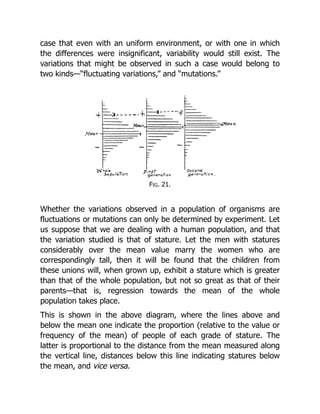
Fig. 21.
Whether the variations observed in a population of organisms are
fluctuations or mutations can only be determined by experiment. Let
us suppose that we are dealing with a human population, and that
the variation studied is that of stature. Let the men with statures
considerably over the mean value marry the women who are
correspondingly tall, then it will be found that the children from
these unions will, when grown up, exhibit a stature which is greater
than that of the whole population, but not so great as that of their
parents—that is, regression towards the mean of the whole
population takes place.
This is shown in the above diagram, where the lines above and
below the mean one indicate the proportion (relative to the value or
frequency of the mean) of people of each grade of stature. The
latter is proportional to the distance from the mean measured along
the vertical line, distances below this line indicating statures below
the mean, and vice versa.
If, on the other hand, the men and women with statures
considerably below the mean marry, their children will ultimately
exhibit statures which are greater than that of their parents, but
which are less than that of the whole population. Regression again
occurs, but in the opposite direction, and such a case would be
represented by the above diagram reversed. Continued selection of
this kind would lead to an immediate increase in the mean stature
(or the opposite, if the “sign” of the selection were reversed) in one
or two generations, but after that the amount of change would be
very small, while if the selection were to cease the race produced
would slowly revert to the mean, which is characteristic of the whole
population from which it arose. It is very important to grasp this
result of the practical and theoretical study of heredity—the selection
of the ordinary variations shown by a general population leads at
once to a small change in the mean value of the character which is
selected, but continued selection thereafter makes very little
difference to this result, while the race slowly reverts to the value of
that from which it arose on the cessation of the selection.
Races which “breed true” do, of course, exist; thus the mean height
of the Galloway peasant is greater than that of the Welsh. In the
cases of “pure races”—that is, races which breed true with respect to
one or more characters, we have to deal with another kind of
variation, one which shows no tendency to revert to the value from
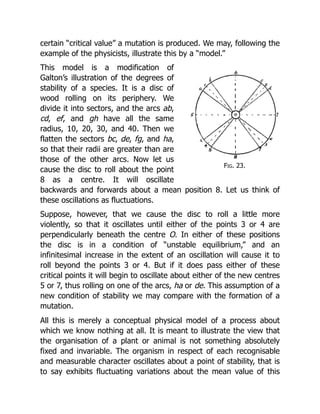
which it arose. Let the observed variability of stature in a human
population be represented by the frequency distribution A, and let
the individuals at N—that is, those in which the stature was greater
than the mean by the deviation ON—intermarry. It might then
happen that the variability of the offspring of these unions would be
represented by the frequency distribution B, in which the value of
the mean is also that of the stock, at N, from which the race
originated. It does not matter now from what variants in B a
progeny of the third generation arises: the mean height of the latter
will be that of the pure race. In this case the individuals from which
the pure race originated (those at N in A) have exhibited a mutation.
The stature of the individuals of this new race will continue to exhibit
fluctuating variations, and the range of this variability may be as
much as that of the stock from which it arose, but the mean stature
of the new race will continue to be that of the original mutants.
Fig. 22.
It is well known that de Vries himself considered fluctuating
variations and mutations as something quite different. The former he
considered as nothing new, only as augmentations or diminutions of
something previously existing; and he regarded fluctuations as due
to the action of the environment, following in their distribution the
laws of chance.30 Mutations, on the other hand, were something
quite new. Now future analysis of variability will not, we think, bear
out the validity of this distinction. It is far more likely that a
fluctuation is a variation which is the result of some causes the
action of which is variable. (We are regarding variability now as
subject to “causation” in the physical sense, for only by so regarding
it can we attempt its analysis). As a rule this process results in a
fluctuation, but if its extent, or degree of operation, exceeds a
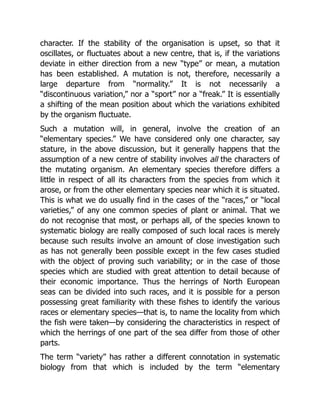
Fig. 23.
certain “critical value” a mutation is produced. We may, following the
example of the physicists, illustrate this by a “model.”
This model is a modification of
Galton’s illustration of the degrees of
stability of a species. It is a disc of
wood rolling on its periphery. We
divide it into sectors, and the arcs ab,
cd, ef, and gh have all the same
radius, 10, 20, 30, and 40. Then we
flatten the sectors bc, de, fg, and ha,
so that their radii are greater than are
those of the other arcs. Now let us
cause the disc to roll about the point
8 as a centre. It will oscillate
backwards and forwards about a mean position 8. Let us think of
these oscillations as fluctuations.
Suppose, however, that we cause the disc to roll a little more
violently, so that it oscillates until either of the points 3 or 4 are
perpendicularly beneath the centre O. In either of these positions
the disc is in a condition of “unstable equilibrium,” and an
infinitesimal increase in the extent of an oscillation will cause it to
roll beyond the points 3 or 4. But if it does pass either of these
critical points it will begin to oscillate about either of the new centres
5 or 7, thus rolling on one of the arcs, ha or de. This assumption of a
new condition of stability we may compare with the formation of a
mutation.
All this is merely a conceptual physical model of a process about
which we know nothing at all. It is meant to illustrate the view that
the organisation of a plant or animal is not something absolutely
fixed and invariable. The organism in respect of each recognisable
and measurable character oscillates about a point of stability, that is
to say exhibits fluctuating variations about the mean value of this
character. If the stability of the organisation is upset, so that it
oscillates, or fluctuates about a new centre, that is, if the variations
deviate in either direction from a new “type” or mean, a mutation
has been established. A mutation is not, therefore, necessarily a
large departure from “normality.” It is not necessarily a
“discontinuous variation,” nor a “sport” nor a “freak.” It is essentially
a shifting of the mean position about which the variations exhibited
by the organism fluctuate.
Such a mutation will, in general, involve the creation of an
“elementary species.” We have considered only one character, say
stature, in the above discussion, but it generally happens that the
assumption of a new centre of stability involves all the characters of
the mutating organism. An elementary species therefore differs a
little in respect of all its characters from the species from which it
arose, or from the other elementary species near which it is situated.
This is what we do usually find in the cases of the “races,” or “local
varieties,” of any one common species of plant or animal. That we
do not recognise that most, or perhaps all, of the species known to
systematic biology are really composed of such local races is merely
because such results involve an amount of close investigation such
as has not generally been possible except in the few cases studied
with the object of proving such variability; or in the case of those
species which are studied with great attention to detail because of
their economic importance. Thus the herrings of North European
seas can be divided into such races, and it is possible for a person
possessing great familiarity with these fishes to identify the various
races or elementary species—that is, to name the locality from which
the fish were taken—by considering the characteristics in respect of
which the herrings of one part of the sea differ from those of other
parts.
The term “variety” has rather a different connotation in systematic
biology from that which is included by the term “elementary
species.” The meaning of the latter is simple and clear. Two or more
elementary species are assemblages of organisms, in each of which
assemblages the mean positions about which the various characters
fluctuate is different. The term “variety” cannot so easily be defined.
The progeny of two different species (in the sense of the term as it
is usually applied by systematists) may be called a hybrid variety of
one or other of the parent species. In the case of the ordinary
species of zoology such a hybrid would, in general, be infertile, or if
it did produce offspring these would be infertile. In the case of
ordinarily bred offspring from parents of the same species a large
deviation from the parental characters might be a malformation, or
the result of some irregularity of development. An “atavistic”
variation we may regard as the reappearance of some character
present in a more or less remote ancestor. Thus dogfishes and
skates are no doubt descended from some elasmobranch fish which
possessed an anterior dorsal fin. This fin persists in the dog-fishes,
but has been lost in the skates and rays. Yet it may appear in the
latter fishes as an atavistic variation.
In a variety (following de Vries’ analysis) a character which
disappears is not really lost: it is only suppressed, and it still exists in
a latent form. Some flowers are coloured, for instance, but there
may be varieties in the species to which they belong in which the
flowers are colourless. It may not be quite correct, in the physical
sense, to say that the colour has been lost, but we may put it in this
way. These flowers are then coloured and colourless varieties of the
same species. Colour or lack of colour is not, however, fixed in the
variety, for the individual plant bearing colourless flowers also bears
in its organisation the potentiality of producing coloured flowers. The
petals of a flower may be smooth or covered with hairs, and in the
same stock both of these varieties may occur. But we must not
speak of the presence or absence of hairs as constituting a
difference of kind: the smooth-petalled flowers might be regarded as
containing the epidermal rudiments of hairs. So also coloured and
colourless flowers may be regarded as containing the same kinds of
pigment, but these pigments are mixed in different proportions.
Such a view enables us to look upon these contrasting characters in
the same way as we look upon fluctuating variations, that is, as
quantitative differences in the value of the same character.
Such a suppression of a character is not really a loss. An organism
belonging to an elementary species in which, say, monochromatic
flowers are usually produced may produce flowers which are striped.
The progeny of the plant may still produce monochromatic flowers,
but we must think of it as also possessing the potentiality of
producing striped flowers. In the terminology of Mendelism the
characters are dominant and recessive ones.
In discussing Mendelian varieties we consider the manner in which
two contrasting characters—one present in the male parent and one
in the female—are transmitted to the offspring. The characters in
question may be the tallness of the male parent and the contrasting
shortness of the female; or the brown eyes of the male and the blue
eyes of the female; or the brown skin of the female parent and the
white skin of the male one. These characters may be inherited in
two ways: either they may be blended or they may remain distinct in
the offspring. The children of the brown mother and the white father
are usually coloured in some tint intermediate between those of the
parents. The mulatto hybrid is fertile with either of the parent races,
and again the offspring may take a tint intermediate between those
of the parents, and so on through a number of generations. But
somewhere in this series the concealed or recessive brown colour
may appear in all its completeness, showing that it has been present
in the organisations of all the intervening generations. The progeny
of a tall male parent and a short female parent are not, in general,
intermediate in stature between the parents; some of them may be
tall and others short. The children of a brown-eyed mother and a
blue-eyed father do not usually have eyes in which the colours of the
parental eyes are blended: they are blue-eyed or brown-eyed. The
contrasting characters are spoken of as dominant and recessive: if
tallness is transmitted to offspring, which may nevertheless produce
dwarf offspring, the latter character is said to be recessive to
tallness. The contrasting characters of the parents therefore remain
distinct in the progeny, some of the latter exhibiting the one
character and some the other; while it may happen that the one
character or the other may be segregated, so that it only appears in,
and is transmitted by, the offspring. There are numerical
relationships between the numbers of the offspring in which the
contrasting characters appear.
Obviously, tallness and dwarfness are not characters which differ in
quality: they are different degrees of the same thing. Brown eyes
and blue eyes are not necessarily different in quality, for we may
think of the same kinds of pigment as being present in the iris but
mixed in different proportions. But the terminology of this branch of
biology appears to suggest that the contrasting characters are, each
of them, something quite different from the other: there are
“factors” for “tallness,” “dwarfness,” for blue eyes and brown eyes,
and so on. These qualities are called “unit-characters,” and they are
supposed to possess much the same individuality in the germ-plasm
as the “radicles” of the chemist possess in a compound. Sodium
chloride, for instance, is not a blend of sodium and chlorine: the two
kinds of atoms do not fuse together but are held together merely.
The analogy is, however, very imperfect, for in the chemical
molecule the characters are not those of either of the constituents
but something quite different, whereas in the Mendelian cross the
characters remain distinct, but one of them is patent while the other
is latent. In the molecule, however, the atoms are regarded by the
chemist as lying beside each other in certain positions, and the
Mendelian factors are also spoken of as if they lay side by side in the
germ-plasm. This terminology is useful, perhaps necessary, in the
work of investigation, but we must not forget that it symbolises,
rather than describes, the results of experiment. If the factors are
identified with certain morphological structures in the nuclei of the
germ-cells, obviously all the objections that may be urged against
the Weismannian hypothesis as an hypothesis of development apply
also to the Mendelian hypotheses as descriptions of a physical
process of the transmission of morphological characters.
It should clearly be understood what is implied in the construction of
such a hypothesis. Certain processes are observed to take place
when a somatic cell divides: these processes we have regarded as
having for their object the exact division of all the parts of the cell
into two halves. This process of somatic cell division is modified
when a germ cell divides prior to maturation (the process fitting it to
become fertilised). Then the cell nucleus divides into four daughter-
nuclei. One of these remains in the cell substance which is to
become the ovum, and the other three, each of them invested in a
minimal quantity of cytoplasm, are eliminated as the “polar bodies.”
Also the number of chromosomes in the mother-cell becomes
halved, so that the mature ovum, or spermatozoon, possesses only
one-half of the number of chromosomes which are present in the
ordinary somatic cell. Now let the reader puzzle out for himself what
may be meant by this behaviour of the germ cells, and he will
certainly see that several interpretations are possible. But suppose
that the chromatin consists of an incredibly large number of bodies
differing in chemical structure from each other, and occupying
definite positions with regard to each other; and suppose that there
is a mechanism of unimaginable complexity in the cell capable of
rejecting some of these chemically individualised parts, and of
“assembling” or arranging the others in much the same way as an
engineer assembles the parts of a dynamo when he completes the
machine. Then we may regard the hypothetical discrete bodies
which form the hypothetical nuclear architecture as the material
carriers of Mendelian characters. It is strange that the
correspondence of such a logically constructed mechanism with the
effects which it would produce if it existed should be regarded as a
proof that it does exist, yet biological speculation has actually made
use of such an argument. “It seems exceedingly unlikely that a
mechanism so exactly adapted to bring it” (the separation from each
other of the Mendelian material “factors” of inheritance) “about
should be found in every developing germ cell if it had no connection
with the segregation of characters that is observed in experimental
breeding.” Put quite plainly this argument is as follows: there is a
certain segregation to be seen in experimental breeding, and certain
processes may be observed to occur in the developing germ cell.
Add to these processes many others logically conceivable, and add
to the observed material structure of the cell another structure also
logically conceivable. Then the assumed mechanism and structure is
“exactly adapted” to produce the effects which are to be explained.
Therefore the mechanism and structure do actually exist!
That which renders the son similar to the father—the specific
organisation—is undoubtedly very stable, and it may persist in the
face of a variable environment. But now and then the son differs
from the father. The differences may be “accidental” and may not be
transmitted further—then we have to deal with an unstable
fluctuation; or the differences may be permanent—then we have to
deal with a stable mutation. What “produces” a mutation? A change
of the environment, it may be said: if so, the mutation is an active
change or adaptation of the organism to a change in its
surroundings, and this adaptation is a permanent one and is
transmitted. Or the mutation may be a spontaneous change of
functioning. If this disturbance of the stability of the organisation is
general, if it affects all the characters of the organism, we have to
deal with the establishment of a new elementary species. But if the
disturbance affects only one, or a few characters, then we need not
recognise that a new elementary species has come into existence.
Men and women remain men and women (in their morphology),
although some time or other among the brown eyes characteristic of
a race blue eyes may have appeared. The result of the disturbance,
in this case, has been to cause one, or a few, of the characters that
fluctuate to surpass their limits of stability.
The idea of the elementary species is a clear and simple one. It is a
group of organisms connected by ties of blood relationship: all have
descended from one pair of ancestors. The individuals exhibit certain
characters, all of which are variable. This variability is not
cumulative; in generation after generation the individuals of the
species display variations which fluctuate round the same mean
values. Two or more elementary species may have had the same
origin—a common ancestor or ancestors—but the organisms in one
species exhibit characters which, although similar in nature to those
of the other species, yet fluctuate about different mean values.
This is not the “species” of the systematic biologist. The Linnean or
systematic species is a concept which is much more difficult to
define: it is a concept indeed which has not any clear and definite
meaning, in actual practice.
We often forget how very young the science of systematic biology is,
and how intimately its progress has been dependent on that of
human invention and industrial enterprise. Physics and mathematics
might be studied in a monastic cell, but the study of systematic
biology can only be carried on when we have ships and other means
of travelling—the means, in short, of collecting the animals and
plants inhabiting all the parts of the earth’s surface. Until a
comparatively few years ago the fauna and flora of great tracts of
land and sea were almost unknown: even now our knowledge of the
life of many parts of the earth is scanty and inaccurate. Systematic
biology has therefore had to collect and describe the organisms of
the earth, and in so doing it has set up the Linnean species of plants
and animals. These we may describe as, in the main, categories of
morphological structures. The older and more familiar species are
clearly defined in this respect: such are cats and dogs, rabbits,
tigers, herrings, lobsters, oysters, and so on: the individuals in each
of these categories are clearly marked out with respect to their
morphology, and the limits of the categories are clearly defined. In
all of them the specific organisation has attained a high degree of
stability so that the individuals “breed true to type”; and it has also
attained a high degree of specialisation, so that it does not fuse with
other organisations.
Yet, in the majority of the systematic species of biology, this criterion
of specific individuality—this recognition of the isolation of the
species from other species—cannot be applied. Very many species
have been described from a few specimens only, many from only
one. How does a systematist recognise that an organism with which
he is dealing has not already been classified? It differs from all other
organisms most like it, that is, he cannot identify it with any known
specific description. But the differences may be very small, and if he
had a number of specimens of the species most nearly resembling it
he might find that these differences were less than the limits of
variation in this most closely allied species, and he would then
relegate it to this category. But if he has to compare his specimen
with the “type” one, that is, the only existing specimen on which the
species of comparison was founded, the test would be unavailable.
The question to be answered is this: are the difference or differences
to be regarded as fluctuations, or are they of “specific rank”? Now
certainly many systematists of great experience possess this power
of judgment, though they might be embarrassed by having to state
clearly what were the grounds on which their judgment was based.
But on the other hand hosts of species have been made by workers
who did not possess this quality of judgment; and even with the
great systematists of biology confusion has originated. Slowly, very
slowly, the organic world is becoming better known, and this
confusion is disappearing.
The species, then, whether it is the systematic group of the
biological systems, or the elementary species based on the study of
variability and inheritance, is an intellectual construction: an artifice
designed to facilitate our description of nature. This is clearly the
case with the higher orders of groups in classifications: genera,
families, orders, classes, and phyla express logical relationships, or
describe in a hypothetical form our notions of an evolutionary
process. But species, it may be said, have an actual reality: there are
no genera in nature, only species. These categories of organisms
really exist; they have individuality, a certain kind of organic unity,
inasmuch as the individuals composing them have descended from a
common ancestor. Yet just as much may be said of genera, families,
and the other groupings. One species originates from another by a
process of transmutation: a genus is a group of species which have
all had a common origin; a family is a similarly related group of
genera, and so on. The higher categories of biological science are
intended to introduce order and simplification into the confusion and
richness of nature as we observe it, but obviously the concept of the
species has the same practical object. Must we then say that there
are no species in nature, only individuals? If so, we are at once
embarrassed by the difficulty of forming a clear notion of what is
meant by organic individuality. Does it not indicate that life on the
earth is really integral, and that our analysis of its forms—species,
genera, families, and so on—are only convenient ways of dealing
actively with all its richness?
Systematic biology is a very matter-of-fact occupation, and one is
surprised to find upon reflection how he, in his handling of the
concepts of the science, follows the methods of ancient philosophy.
In classical metaphysical systems mutability was an illusion. Behind
the confusion and change given to sensation there is something that
is immutable and eternal. If there is change there is something that
changes; or, at least there ought to be something that changes
when it is perceived through the mists of sensation, just as the
image of a well-known object on the horizon wavers and is distorted
by refraction. This immutable reality is the Form or Essence of the
Platonic Idea: that which is in some way degraded by its projection
into materiality, so that we become aware of it only through our
imperfect organs of sense. We do not see the Form itself, but its
quality rather, the Form with something added or something taken
away from it.
The Form itself is only a phase in a process of transmutation.
Everything that exists in time flows or passes into something else.
But it is not a momentary or instantaneous view of the flux that we
see, but rather a certain aspect of the reality that flows, that in some
way expresses the nature of the transmutation from one Form into
another. The sculptor represents the motion of a man running by
symbolising in one attitude all the actions of body and limbs; so that
from our actual, sensible experience or intuition of the movement of
the runner we see in the rigid marble all the plasticity of life. The
instantaneous photograph shows us a momentary fixed attitude of
the runner—an attitude which is strange and unfamiliar. The Idea
does not, then, represent a moment of becoming like the
photograph, but rather a typical or essential phase of the process of
transmutation, just as the sculptor represents in immobile form the
characteristic leap forward of the runner. Just as our intuitive
knowledge of the actions of our own bodies enables us to read into
the characteristic attitude represented in the marble all the other
attitudes of the series of movements, so our experience enables us
to expand the formal moment of becoming into the action which it
symbolises.
This action has a purpose, an intention or design which was
contemplated before it began. There is therefore the threefold
meaning in the Platonic Idea: (1) an immutable and essential Form
of which we perceive only the quality; (2) the characteristic phase in
the transmutation of this Form into some other one; and (3) the
design or intention of the transmutation.
This was, as Bergson says, the natural metaphysics of the intellect.
It was, in reality, the “practical” way of introducing order and
simplification into the confusion of the sensible world—all that is
presented to us by our intuitions. And in the effort to reduce to order
the welter of the organic world biology has followed the same
method, so that it represents the species with the threefold
significance of the Platonic Idea. That which is expressed in the term
species is an assemblage of organisms each of which is defined by
an essential form and an essential mode of behaviour—the
characters indicated in the specific diagnosis. But organisms are
variable, their specific characters fluctuate round a mean, and in
saying this we suggest that there is something which varies—there
ought to be an essential form from which the observed forms of the
individuals deviate, something invariable which nevertheless varies
accidentally. This is (1) the quality of the specific idea. So also we
never do actually observe the essential individual; what we do see is
the embryo, or the young and sexually immature organism, or the
sexually mature one, or the senescent one: there is continual
change from the time of birth to that of senile decay. This confusion
is unmanageable, and for it we substitute the characteristic form and
functioning, and that phase in the life-history of the organism which
suggests all that the previous phases have led up to, and all that
subsequent phases take away. Thus there is contained in our idea of
the species (2) the notion of a typical moment in an individual
transformation. It is not a “snap-shot” of some moment in the life-
history that we make: in identifying a larval form as some species of
animal we are identifying it with all the other phases of the life-
history.
Since we accept the doctrine of transformism, the specific idea also
includes that of an evolutionary process. For the organic world is a
flux of becoming, and species are only moments in this becoming. It
does not help us to reflect that if the hypothesis of evolution by
mutations is true the process is a discontinuous one: mutability is
the result of periods of immutability during which the change was
germinating, so to speak. In this flux of becoming we seize moments
at which the specific form flashes out—not as instantaneous views of
the flux, but as aspects of it which suggest the steps, the
morphological processes, by which the transmutation of the species
has been effected. Thus our specific idea represents not only a
phase of becoming in an individual life-history, but also a phase of
becoming in an evolutionary history.
Whether we consider this evolutionary movement as the working out
of a Creative Thought, or as the development of elements
assembled together by design, or as the results of the action of a
mechanism working by itself, we must suppose that underlying it
there is design, or purpose, or determinism. All is given, therefore,
and our comparison between the metaphysical Platonic Idea and the
modern concept of the species becomes complete.
CHAPTER VI
TRANSFORMISM
The species is therefore a group of organisms all of which exhibit the
same morphological characters. This sameness is not absolute, for
the individuals composing the species may vary from each other with
respect to any one character. But the range of these variations is
limited. They fluctuate about an imaginary mean value which
remains constant in the case of a species which is not undergoing
selection, and is therefore nearly the same throughout a series of
generations. The formal characters which we regard as diagnostic of
the species are these imaginary mean ones.
It is possible to breed from stock a very great number of animals, all
of which are connected by a tie of blood-relationship, that is, all
have descended from the same ancestor or ancestors. Such an
assemblage of animals would resemble those assemblages living in
the wild which we call species, in that a certain morphological
similarity would be exhibited by all the individuals. If the breeding
were conducted so as to avoid selection, the range of variability
would be very much the same as that observed in the wild race. The
two groups of animals—that bred artificially, and that observed in
natural conditions—would be very much alike, and it is impossible to
resist the conclusion that the natural race, like the artificial one, is a
family in the human sense, that is, all the individuals composing it
are connected together by a tie of common descent.
Let us extend this reasoning to categories of organisms of higher
orders than species. We can associate together groups of species in
the same way that we associate together the individuals of the same
species. There are certain morphological characters which are
common to all the species in the category, but there are also
differences between specific group and specific group, and these
differences may be regarded as variations from the generic
morphological type. All the Cats, for instance, have certain
characters in common: fully retractile claws, a certain kind of
dentition, certain cranial characters, and so on. We postulate a feline
type of structure, and we then regard the characters displayed by
the cat, lion, tiger, leopard, etc., as deviations from this feline
morphological type. Thus we establish the Family Felidæ. But again
we find that the Felidæ together with the Canidæ, and many other
species of animals, also display common characters, dental and
osteological chiefly, and we express this resemblance by assembling
all these families in one Order, the Carnivora. The Carnivores,
however, are only one large group of Quadrupeds: there are many
others, such as the Rodents, Ungulates, Cetacea, etc., and all of
these possess common characters. In all of them the integument is
provided with hairs, or other similarly developed structures; all
breathe by means of a diaphragm; in all, the young are nourished by
suckling the mammæ of the mother; and all develop on a placenta.
We therefore group them all in the Class Mammalia. Now the
Mammals possess an internal skeleton of which the most
fundamental part is an axial rod—the notochord—developing to form
a vertebral column; and this notochordal skeleton is also possessed
by the Birds, Reptiles, Amphibia, and Fishes. There are also some
smaller groups in which the notochord is present but does not
develop to form segmented vertebræ. Including these, we are able
to form a large category of animals—the Chordata—and this phylum
is sharply distinguished from all other cognate groups.
All animals and plants may be classified in a similar way. Insects,
Spiders, and Crustacea, for instance, are all animals in which the
body is jointed, each joint or segment being typically provided with a
pair of jointed appendages or limbs. Because of this similarity of
fundamental structure we include all these animals, with some
others, in one phylum, the Arthropoda. So also with the rest of the
animal kingdom, and similar methods may be extended to the
classification of the plants. A few small groups in each of the
kingdoms are difficult to classify, but it has been possible to arrange
most living organisms in a small number of sub-kingdoms or phyla,
and even to attempt to trace relationships between these various
categories.
The mere systematic description of the organic world would have
resulted in such a reasoned classification apart altogether from any
notions of an evolutionary process. But the classification, originally a
conventional way of making a list of organisms, would at once
suggest morphological similarities. It would suggest that all the Cats
were Carnivores, that all the Carnivores were Mammals, and that all
the Mammals were Chordates. It would suggest that all Wasps were
Hymenoptera, that all Hymenoptera were Insects, and that all
Insects were Arthropods. It would establish a host of logical relations
between animals of all kinds.
It would show us a number of groups of animals separated from
each other by morphological dissimilarities. But let us also consider
all those animals which lived in the past of the earth, and the
remains of which are found in the rocks as fossils. Including all the
forms of life known to Palæontology, we should find that the
dissimilarities between the various groups would tend to disappear.
The gaps between existing Birds and Reptiles, for instance, would
become partially bridged. Palæontology would also supplement
morphology in another way. The study of the structure of animals
leads us to describe them as “higher” and “lower”—higher in the
sense of a greater complexity of structure. Thus the body of a
Carnivore is more complex than that of a Fish, inasmuch as it
possesses the homologues of the truly piscine gills, but it also
possesses a four-chambered heart instead of a two-chambered one;
and it possesses the mammalian lungs, diaphragm, and placenta,
structures which are not present in the Fish. Now, so far as its
imperfect materials go, palæontology shows us that the higher forms
of life appeared on the earth at a later date than did the lower
forms. The remains of Mammals, for instance, are first found in
rocks which are younger than (that is, they are superposed upon)
those rocks in which Reptiles first appear; and so also Reptiles
appear later in the rock series than do Fishes. Palæontology thus
adds to the logical order suggested by morphology a chronological
order of this nature: higher, or more complex forms of life appeared
at a later date in the history of the earth than did lower or less
complex ones.
A parallel chronological sequence would also be suggested by the
results of embryology. This branch of biology shows us that all
animals pass through a series of stages in their individual
development, or ontogeny. The earlier stages represent a simple
type of structure, usually a hollow ball of cells, but as development
proceeds, the structure of the embryo becomes more and more
complex. The process of development is continuous in many
animals, but in others (perhaps in most) larval stages appear, that is,
development is interrupted, and the animal may lead for a time an
independent existence similar to that of the fully developed form.
Often these larval stages suggest types of structure lower than that
of the fully developed animal into which they transform. Even if
larval stages may not appear in the ontogeny, it is very often the
case that the developing embryo exhibits traces, or at least
reminiscences, of the types of morphology characteristic of the
animals which are lower or less complex than itself; thus the piscine
gills appear during the development of the tailed Amphibian, and
even in that of the Mammal, and then vanish, or are converted into
organs of another kind. The individual thus passes through a series
of developmental stages of increasing complexity: it repeats, in its
Welcome to our website – the perfect destination for book lovers and
knowledge seekers. We believe that every book holds a new world,
offering opportunities for learning, discovery, and personal growth.
That’s why we are dedicated to bringing you a diverse collection of
books, ranging from classic literature and specialized publications to
self-development guides and children's books.
More than just a book-buying platform, we strive to be a bridge
connecting you with timeless cultural and intellectual values. With an
elegant, user-friendly interface and a smart search system, you can
quickly find the books that best suit your interests. Additionally,
our special promotions and home delivery services help you save time
and fully enjoy the joy of reading.
Join us on a journey of knowledge exploration, passion nurturing, and
personal growth every day!
testbankfan.com

Computer Security Principles And Practice Global 3rd Edition Stallings Solutions Manual

  • 1.
    Computer Security PrinciplesAnd Practice Global 3rd Edition Stallings Solutions Manual download https://testbankfan.com/product/computer-security-principles-and- practice-global-3rd-edition-stallings-solutions-manual/ Find test banks or solution manuals at testbankfan.com today!

  • 2.
    Here are somerecommended products for you. Click the link to download, or explore more at testbankfan.com Computer Security Principles And Practice Global 3rd Edition Stallings Test Bank https://testbankfan.com/product/computer-security-principles-and- practice-global-3rd-edition-stallings-test-bank/ Computer Security Principles and Practice 3rd Edition Stallings Solutions Manual https://testbankfan.com/product/computer-security-principles-and- practice-3rd-edition-stallings-solutions-manual/ Computer Security Principles and Practice 3rd Edition Stallings Test Bank https://testbankfan.com/product/computer-security-principles-and- practice-3rd-edition-stallings-test-bank/ Fundamentals of Pharmacology 8th Edition Bullock Test Bank https://testbankfan.com/product/fundamentals-of-pharmacology-8th- edition-bullock-test-bank/

  • 3.
    Corporate Finance FoundationsGlobal Edition 15th Edition Block Solutions Manual https://testbankfan.com/product/corporate-finance-foundations-global- edition-15th-edition-block-solutions-manual/ Economics For Managers 2nd Edition Farnham Solutions Manual https://testbankfan.com/product/economics-for-managers-2nd-edition- farnham-solutions-manual/ QuickBooks 2011 A Complete Course 12th Edition Janet Horne Solutions Manual https://testbankfan.com/product/quickbooks-2011-a-complete- course-12th-edition-janet-horne-solutions-manual/ History of the American Economy With Infotrac 11th Edition Walton Test Bank https://testbankfan.com/product/history-of-the-american-economy-with- infotrac-11th-edition-walton-test-bank/ Introduction to Human Services 8th Edition Woodside Test Bank https://testbankfan.com/product/introduction-to-human-services-8th- edition-woodside-test-bank/
  • 4.
    Corporate Finance Canadian7th Edition Jaffe Test Bank https://testbankfan.com/product/corporate-finance-canadian-7th- edition-jaffe-test-bank/
  • 5.
    Random documents withunrelated content Scribd suggests to you:
  • 6.
    regeneration appear topoint to the possession by the somatic cells of more than this restricted power of reproducing the tissues of which they form part: to this extent the regeneration experiments tend to remove the essential distinction between the somatic and germinal cells. Neglecting these results in the meantime, we see that the germ-cells contain within themselves the potentiality of reproducing the entire organism in all its specificity. That which is transmitted from the parent to the offspring is the parental organisation in all its specificity; and to say that this organisation is a material thing is, of course, to state a hypothesis, not a fact of observation. This transmission of a specific form and mode of behaviour from generation to generation is what a hypothesis of heredity attempts to explain—that is, to describe in the simplest possible terms, making use of the concepts of physical science. “Twelve years ago,” says Jacques Loeb, “the field of heredity was the stamping ground for the rhetorician and metaphysician; it is to-day perhaps the most exact and rationalistic part of biology, where facts cannot only be predicted qualitatively, but also quantitatively.” Let the reader examine for himself the meagre array of facts on which this apotheosis of mechanistic biology is based. Two modern hypotheses of heredity demand attention—Weismann’s hypothesis of the continuity of the germ-plasm, and Semon’s “Mnemic” hypothesis. In the latter it is assumed that the basis of heredity is the unconscious memory of the organism: modes of functioning are “remembered” by the germ-plasm and are transmitted. This notion presents many points of similarity to that which we consider later on, so that it need only be mentioned here. Weismann’s hypothesis—like Darwin’s hypothesis of Pangenesis—is a corpuscular one, and has obviously been suggested by the modern development of the concepts of molecules and atoms in the physical sciences. It supposes that that which is handed down is a material
  • 7.
    substance of adefinite chemical and physical structure. This is not the germ-cell, nor even the nucleus of the latter, but a certain material contained in the nucleus. The latter contains protein substances containing a greater proportion of phosphoric acid than does the cytoplasm of the cells in general; these proteins are known as nucleo-proteins, though our knowledge of their chemical structure is, so far, not very exact. It is not, however, these that are the germ- plasm, but a substance in the nucleus which becomes visible when the cell is killed in certain ways, and which becomes stained by certain basic dyes. It is distinguished by this character alone and on that account is loosely called “chromatin.” This substance Weismann identifies as “the material basis of inheritance.” When a cell divides, a very complex train of events usually occurs. This process of “Mitosis” exhibits many variations of detail, and without actual demonstration it is rather difficult to explain clearly. But its essential feature is evidently the exact halving of all the structures in the cell which is about to divide. In the ordinary cell which is not going to divide immediately, the chromatin is diffused throughout the nucleus as very numerous fine granules, recognised only by their staining reactions. They may be concentrated at some part of the nucleus, so that a division through a plane of geometrical symmetry of the cell would not, in general, exactly halve the chromatin. Prior to division, therefore, this substance becomes aggregated as granules lying along a convoluted filament of a substance called “linin,” which is characterised principally by the fact that it does not stain with the dyes that stain the chromatin. The filament breaks up into short rods, called Chromosomes, and these rods become arranged in the equator of the nucleus. The rods then split longitudinally, and one-half of each moves towards one pole of the nucleus, the other half moving towards the other pole. Various other modifications of the cell and nucleus occur concomitantly with these changes, but the essential thing that happens seems to be the
  • 8.
    halving of allthe structures of the cell, and this is the simplest explanation of the phenomena of mitotic cell division. Two daughter- cells are then formed by the division of the mother-cell, and each of these daughter-cells receives one-half of each of the chromatin granules that were contained in the mother-cell. The chromosomes, or “Idants,” are seen to consist of discrete granules, and these are (generally) the bodies known as the “Ids.” The id cannot be resolved by the microscope into any smaller structures: it lies on the limits of aided vision; but the hypothesis assumes that it is composed of parts called “Determinants,” and the determinants are further supposed to consist of “Biophors.” The biophors are the ultimate organic units or elements, and they are of the same order of magnitude as chemical molecules. We must suppose them to be more complex than a protein molecule, and the latter contains many hundreds (at least) of chemical atoms. Now it is possible to calculate the number of atoms contained in a particle of the same size as the id: such a calculation may be made by different methods, all of them yielding concordant results. This calculated number of atoms may be less than that which we must suppose to be present in the biophors, of which the hypothetical id is composed!28 The id is supposed to contain all the potentialities of the completely developed organism. It is composed of a definite number of determinants, each of the latter being a “factor” for some definite, material constituent of the adult body. There would be a determinant for each kind of cell in the retina of the eye, one for the lens, one for the cornea (or rather for each kind of tissue in the latter), one for each kind of pigment in the choroid and iris, and so on; every particular kind of tissue in the body would be represented by a determinant. Thus packed away in a particle which lies just on the limits of microscopic vision are representatives of all those parts of the body which are chemically and physically individualised, each
  • 9.
    of these hypothetical“factors” being a very complex assemblage of chemical atoms. In development the determinants become separated from each other, so that whatever parts of the body are formed by the first two blastomeres are represented by determinants which are contained in those cells, and which are sifted out from each other and segregated. As development proceeds this process of sifting becomes finer and finer, until when the rudiments of each kind of tissue have been laid down a cell contains only one kind of determinant. This consists of biophors of a special kind, and the latter then migrate out from the chromatin into the cytoplasm of the cells in which they are contained, and proceed to build up the particular kind of tissue required. The nucleus of the germ-cell is thus a mixture of incredible complexity, but in addition to this material mixture there must exist in it the means for the arrangement of the determinants in the positions relative to each other occupied by the adult organs and tissues. A mechanism of unimaginable complexity would be required for this purpose, and it must be a mechanism involving only known chemical and physical factors. It is safe to say that absolutely no hint as to the nature of this mechanism is contained in the hypothesis. The determinants must be able to grow by reproduction, or by the accretion of new biophors, since in each generation new germ-cells are formed. If we say that they grow by reproduction in the sense that an organism grows by reproduction, we beg the question of their means of formation. Do they grow by the addition of similar substances in the way that a crystal grows? If so, the molecules of which they are composed must exist in the lymph stream bathing the germ-cells—that is, the biophors themselves must already exist in this liquid, for if we suppose that the biophors are able to divide and grow by making use of the protein substances which we know are present in the lymph stream, then we confer upon these bodies all the properties of the fully developed organism. If they are present
  • 10.
    in the blood,then the composition of the latter must be one of inconceivable complexity, since it must contain as many substances as there are distinct tissues in the animal body. We know, of course, that this is not the case. How, then, are the biophors reproduced? We must leave this field of unbridled speculation (which cannot surely be “the most exact and rationalistic part of biology.”) What the study of the reproduction of the organism does show is that something—which we call the specific organisation—is handed down from parent to offspring, and that this something may possess a high degree of stability. No apparent change of significance can be observed in the very numerous generation of organisms (the 2000 generations of Paramœcium, for instance, which were bred by Woodruff) which can be produced by experimental breeding. Some species of animals—the Brachiopod Lingula, for instance—have persisted unchanged since Palæozoic times. Throughout the incredibly numerous generations represented by this animal series, the specific organisation must have been transmitted in an almost absolutely unchanged condition. The germ-plasm is therefore continuous from generation to generation, and it possesses an exceedingly great degree of constancy of character. This conception of the continuity and stability of the specific organisation is the feature of value in Weismannism, and all that we know of the phenomena of heredity confirms it. But it is pure speculation to regard the organisation as an aggregate of chemically distinct substances, or if we say that this speculation is rather a working hypothesis, then it must justify itself by leading us back again to the results of experience. It is, however, not quite accurate to say that the organisation persists unchanged from generation to generation. The offspring is similar to the parent—that is, the organisation has been transmitted unchanged. But the offspring also differs just a little from the parent —that is to say, the organisation is modified by each transmission. In
  • 11.
    these two statementswe formulate in the simplest manner the law of organic variability. Organisms may obviously be arranged in categories in such a way that the individuals in any one category resemble each other more closely than they resemble the individuals belonging to another category. We may, by experimental breeding, produce an assemblage of organisms all of which have had a common ancestor, or a pair of ancestors. Now the individuals composing such an assemblage would exhibit a close resemblance to each other, such a resemblance as our categories of naturally occurring organisms are seen to exhibit. We should also find that the individuals of our naturally occurring assemblage would be able to interbreed among themselves, just as in the case of the experimentally produced population. It may be concluded, then, that the naturally occurring population is also the product of a pair of ancestors. This inter-fertility, as well as the close morphological resemblance of the individuals, are the facts on which the hypothesis of the common origin and unity of the assemblage, or species, is formed. The morphological resemblance between the individuals, either in the natural or the artificial populations, is not absolute. If we take any single character capable of measurement we shall find that it is variable from organism to organism. This important concept of organic variability may be made more clear by a concrete example. Examination of a large number of cockle shells taken from the same restricted part of the sea-shore, and therefore belonging presumably to the same race, will show that the number of the radiating ridges on the shell varies from 19 to 27, and that the ratio of the length to the depth of the shell also varies from 1 : 0.59 to 1 : 0.85. In the former case the most common number of ridges is 23, and in the latter case the most common ratio of length to depth is 1 : 0.71. These are the characteristic or modal values of the morphological characters in question, and the other or less commonly occurring
  • 12.
    values are distributedsymmetrically on either side of the mean or modal value, forming “frequency distributions.”29 The value of the first character changes by unity in any distribution: obviously there cannot be a fraction of a ridge; and this kind of variation is called “discontinuous.” The value of the second character may change imperceptibly, and it is therefore called “continuous,” a term which is not strictly accurate, since in applying it we assume that the numerical difference between two variates may be less than any finite number, however small. In this assumption we postulate for biology the distinctive mathematical concept of infinite divisibility. The difference from the mode, or mean, with respect to a definite character in a fully grown organism may be due to the direct action of the environment, in the sense in which we have regarded the environment as influencing the organism; or it may be due to the changes in the organism resulting from the increased or decreased use of some of its parts. The conditions with regard to nutrition, for instance, will not be the same for all the individuals composing a cluster of mussels growing on the sea-bottom. Those in the interior of the cluster do not receive so abundant a supply of sea-water as those on the outside of the cluster; and since the amount of food received by any individual depends on the quantity of water streaming over it in unit time, we shall find that the internally situated individuals will be stunted or dwarfed, while those on the outside will be well grown. Such variations are acquired ones, but even when we allow for them, even if we take care that all the organisms studied live under conditions which are as nearly uniform as possible, there will still be some degree of variability. We cannot be sure that this absolute uniformity ever exists; and the notion of the environment of an organism may be extended so as to include the medium in which embryonic development took place, and even the parental body which formed the environment for the germ-cells from which embryonic development began. But it is probably the
  • 13.
    case that evenwith an uniform environment, or with one in which the differences were insignificant, variability would still exist. The variations that might be observed in such a case would belong to two kinds—“fluctuating variations,” and “mutations.” Fig. 21. Whether the variations observed in a population of organisms are fluctuations or mutations can only be determined by experiment. Let us suppose that we are dealing with a human population, and that the variation studied is that of stature. Let the men with statures considerably over the mean value marry the women who are correspondingly tall, then it will be found that the children from these unions will, when grown up, exhibit a stature which is greater than that of the whole population, but not so great as that of their parents—that is, regression towards the mean of the whole population takes place. This is shown in the above diagram, where the lines above and below the mean one indicate the proportion (relative to the value or frequency of the mean) of people of each grade of stature. The latter is proportional to the distance from the mean measured along the vertical line, distances below this line indicating statures below the mean, and vice versa.
  • 14.
    If, on theother hand, the men and women with statures considerably below the mean marry, their children will ultimately exhibit statures which are greater than that of their parents, but which are less than that of the whole population. Regression again occurs, but in the opposite direction, and such a case would be represented by the above diagram reversed. Continued selection of this kind would lead to an immediate increase in the mean stature (or the opposite, if the “sign” of the selection were reversed) in one or two generations, but after that the amount of change would be very small, while if the selection were to cease the race produced would slowly revert to the mean, which is characteristic of the whole population from which it arose. It is very important to grasp this result of the practical and theoretical study of heredity—the selection of the ordinary variations shown by a general population leads at once to a small change in the mean value of the character which is selected, but continued selection thereafter makes very little difference to this result, while the race slowly reverts to the value of that from which it arose on the cessation of the selection. Races which “breed true” do, of course, exist; thus the mean height of the Galloway peasant is greater than that of the Welsh. In the cases of “pure races”—that is, races which breed true with respect to one or more characters, we have to deal with another kind of variation, one which shows no tendency to revert to the value from which it arose. Let the observed variability of stature in a human population be represented by the frequency distribution A, and let the individuals at N—that is, those in which the stature was greater than the mean by the deviation ON—intermarry. It might then happen that the variability of the offspring of these unions would be represented by the frequency distribution B, in which the value of the mean is also that of the stock, at N, from which the race originated. It does not matter now from what variants in B a progeny of the third generation arises: the mean height of the latter
  • 15.
    will be thatof the pure race. In this case the individuals from which the pure race originated (those at N in A) have exhibited a mutation. The stature of the individuals of this new race will continue to exhibit fluctuating variations, and the range of this variability may be as much as that of the stock from which it arose, but the mean stature of the new race will continue to be that of the original mutants. Fig. 22. It is well known that de Vries himself considered fluctuating variations and mutations as something quite different. The former he considered as nothing new, only as augmentations or diminutions of something previously existing; and he regarded fluctuations as due to the action of the environment, following in their distribution the laws of chance.30 Mutations, on the other hand, were something quite new. Now future analysis of variability will not, we think, bear out the validity of this distinction. It is far more likely that a fluctuation is a variation which is the result of some causes the action of which is variable. (We are regarding variability now as subject to “causation” in the physical sense, for only by so regarding it can we attempt its analysis). As a rule this process results in a fluctuation, but if its extent, or degree of operation, exceeds a
  • 16.
    Fig. 23. certain “criticalvalue” a mutation is produced. We may, following the example of the physicists, illustrate this by a “model.” This model is a modification of Galton’s illustration of the degrees of stability of a species. It is a disc of wood rolling on its periphery. We divide it into sectors, and the arcs ab, cd, ef, and gh have all the same radius, 10, 20, 30, and 40. Then we flatten the sectors bc, de, fg, and ha, so that their radii are greater than are those of the other arcs. Now let us cause the disc to roll about the point 8 as a centre. It will oscillate backwards and forwards about a mean position 8. Let us think of these oscillations as fluctuations. Suppose, however, that we cause the disc to roll a little more violently, so that it oscillates until either of the points 3 or 4 are perpendicularly beneath the centre O. In either of these positions the disc is in a condition of “unstable equilibrium,” and an infinitesimal increase in the extent of an oscillation will cause it to roll beyond the points 3 or 4. But if it does pass either of these critical points it will begin to oscillate about either of the new centres 5 or 7, thus rolling on one of the arcs, ha or de. This assumption of a new condition of stability we may compare with the formation of a mutation. All this is merely a conceptual physical model of a process about which we know nothing at all. It is meant to illustrate the view that the organisation of a plant or animal is not something absolutely fixed and invariable. The organism in respect of each recognisable and measurable character oscillates about a point of stability, that is to say exhibits fluctuating variations about the mean value of this
  • 17.
    character. If thestability of the organisation is upset, so that it oscillates, or fluctuates about a new centre, that is, if the variations deviate in either direction from a new “type” or mean, a mutation has been established. A mutation is not, therefore, necessarily a large departure from “normality.” It is not necessarily a “discontinuous variation,” nor a “sport” nor a “freak.” It is essentially a shifting of the mean position about which the variations exhibited by the organism fluctuate. Such a mutation will, in general, involve the creation of an “elementary species.” We have considered only one character, say stature, in the above discussion, but it generally happens that the assumption of a new centre of stability involves all the characters of the mutating organism. An elementary species therefore differs a little in respect of all its characters from the species from which it arose, or from the other elementary species near which it is situated. This is what we do usually find in the cases of the “races,” or “local varieties,” of any one common species of plant or animal. That we do not recognise that most, or perhaps all, of the species known to systematic biology are really composed of such local races is merely because such results involve an amount of close investigation such as has not generally been possible except in the few cases studied with the object of proving such variability; or in the case of those species which are studied with great attention to detail because of their economic importance. Thus the herrings of North European seas can be divided into such races, and it is possible for a person possessing great familiarity with these fishes to identify the various races or elementary species—that is, to name the locality from which the fish were taken—by considering the characteristics in respect of which the herrings of one part of the sea differ from those of other parts. The term “variety” has rather a different connotation in systematic biology from that which is included by the term “elementary
  • 18.
    species.” The meaningof the latter is simple and clear. Two or more elementary species are assemblages of organisms, in each of which assemblages the mean positions about which the various characters fluctuate is different. The term “variety” cannot so easily be defined. The progeny of two different species (in the sense of the term as it is usually applied by systematists) may be called a hybrid variety of one or other of the parent species. In the case of the ordinary species of zoology such a hybrid would, in general, be infertile, or if it did produce offspring these would be infertile. In the case of ordinarily bred offspring from parents of the same species a large deviation from the parental characters might be a malformation, or the result of some irregularity of development. An “atavistic” variation we may regard as the reappearance of some character present in a more or less remote ancestor. Thus dogfishes and skates are no doubt descended from some elasmobranch fish which possessed an anterior dorsal fin. This fin persists in the dog-fishes, but has been lost in the skates and rays. Yet it may appear in the latter fishes as an atavistic variation. In a variety (following de Vries’ analysis) a character which disappears is not really lost: it is only suppressed, and it still exists in a latent form. Some flowers are coloured, for instance, but there may be varieties in the species to which they belong in which the flowers are colourless. It may not be quite correct, in the physical sense, to say that the colour has been lost, but we may put it in this way. These flowers are then coloured and colourless varieties of the same species. Colour or lack of colour is not, however, fixed in the variety, for the individual plant bearing colourless flowers also bears in its organisation the potentiality of producing coloured flowers. The petals of a flower may be smooth or covered with hairs, and in the same stock both of these varieties may occur. But we must not speak of the presence or absence of hairs as constituting a difference of kind: the smooth-petalled flowers might be regarded as
  • 19.
    containing the epidermalrudiments of hairs. So also coloured and colourless flowers may be regarded as containing the same kinds of pigment, but these pigments are mixed in different proportions. Such a view enables us to look upon these contrasting characters in the same way as we look upon fluctuating variations, that is, as quantitative differences in the value of the same character. Such a suppression of a character is not really a loss. An organism belonging to an elementary species in which, say, monochromatic flowers are usually produced may produce flowers which are striped. The progeny of the plant may still produce monochromatic flowers, but we must think of it as also possessing the potentiality of producing striped flowers. In the terminology of Mendelism the characters are dominant and recessive ones. In discussing Mendelian varieties we consider the manner in which two contrasting characters—one present in the male parent and one in the female—are transmitted to the offspring. The characters in question may be the tallness of the male parent and the contrasting shortness of the female; or the brown eyes of the male and the blue eyes of the female; or the brown skin of the female parent and the white skin of the male one. These characters may be inherited in two ways: either they may be blended or they may remain distinct in the offspring. The children of the brown mother and the white father are usually coloured in some tint intermediate between those of the parents. The mulatto hybrid is fertile with either of the parent races, and again the offspring may take a tint intermediate between those of the parents, and so on through a number of generations. But somewhere in this series the concealed or recessive brown colour may appear in all its completeness, showing that it has been present in the organisations of all the intervening generations. The progeny of a tall male parent and a short female parent are not, in general, intermediate in stature between the parents; some of them may be tall and others short. The children of a brown-eyed mother and a
  • 20.
    blue-eyed father donot usually have eyes in which the colours of the parental eyes are blended: they are blue-eyed or brown-eyed. The contrasting characters are spoken of as dominant and recessive: if tallness is transmitted to offspring, which may nevertheless produce dwarf offspring, the latter character is said to be recessive to tallness. The contrasting characters of the parents therefore remain distinct in the progeny, some of the latter exhibiting the one character and some the other; while it may happen that the one character or the other may be segregated, so that it only appears in, and is transmitted by, the offspring. There are numerical relationships between the numbers of the offspring in which the contrasting characters appear. Obviously, tallness and dwarfness are not characters which differ in quality: they are different degrees of the same thing. Brown eyes and blue eyes are not necessarily different in quality, for we may think of the same kinds of pigment as being present in the iris but mixed in different proportions. But the terminology of this branch of biology appears to suggest that the contrasting characters are, each of them, something quite different from the other: there are “factors” for “tallness,” “dwarfness,” for blue eyes and brown eyes, and so on. These qualities are called “unit-characters,” and they are supposed to possess much the same individuality in the germ-plasm as the “radicles” of the chemist possess in a compound. Sodium chloride, for instance, is not a blend of sodium and chlorine: the two kinds of atoms do not fuse together but are held together merely. The analogy is, however, very imperfect, for in the chemical molecule the characters are not those of either of the constituents but something quite different, whereas in the Mendelian cross the characters remain distinct, but one of them is patent while the other is latent. In the molecule, however, the atoms are regarded by the chemist as lying beside each other in certain positions, and the Mendelian factors are also spoken of as if they lay side by side in the
  • 21.
    germ-plasm. This terminologyis useful, perhaps necessary, in the work of investigation, but we must not forget that it symbolises, rather than describes, the results of experiment. If the factors are identified with certain morphological structures in the nuclei of the germ-cells, obviously all the objections that may be urged against the Weismannian hypothesis as an hypothesis of development apply also to the Mendelian hypotheses as descriptions of a physical process of the transmission of morphological characters. It should clearly be understood what is implied in the construction of such a hypothesis. Certain processes are observed to take place when a somatic cell divides: these processes we have regarded as having for their object the exact division of all the parts of the cell into two halves. This process of somatic cell division is modified when a germ cell divides prior to maturation (the process fitting it to become fertilised). Then the cell nucleus divides into four daughter- nuclei. One of these remains in the cell substance which is to become the ovum, and the other three, each of them invested in a minimal quantity of cytoplasm, are eliminated as the “polar bodies.” Also the number of chromosomes in the mother-cell becomes halved, so that the mature ovum, or spermatozoon, possesses only one-half of the number of chromosomes which are present in the ordinary somatic cell. Now let the reader puzzle out for himself what may be meant by this behaviour of the germ cells, and he will certainly see that several interpretations are possible. But suppose that the chromatin consists of an incredibly large number of bodies differing in chemical structure from each other, and occupying definite positions with regard to each other; and suppose that there is a mechanism of unimaginable complexity in the cell capable of rejecting some of these chemically individualised parts, and of “assembling” or arranging the others in much the same way as an engineer assembles the parts of a dynamo when he completes the machine. Then we may regard the hypothetical discrete bodies
  • 22.
    which form thehypothetical nuclear architecture as the material carriers of Mendelian characters. It is strange that the correspondence of such a logically constructed mechanism with the effects which it would produce if it existed should be regarded as a proof that it does exist, yet biological speculation has actually made use of such an argument. “It seems exceedingly unlikely that a mechanism so exactly adapted to bring it” (the separation from each other of the Mendelian material “factors” of inheritance) “about should be found in every developing germ cell if it had no connection with the segregation of characters that is observed in experimental breeding.” Put quite plainly this argument is as follows: there is a certain segregation to be seen in experimental breeding, and certain processes may be observed to occur in the developing germ cell. Add to these processes many others logically conceivable, and add to the observed material structure of the cell another structure also logically conceivable. Then the assumed mechanism and structure is “exactly adapted” to produce the effects which are to be explained. Therefore the mechanism and structure do actually exist! That which renders the son similar to the father—the specific organisation—is undoubtedly very stable, and it may persist in the face of a variable environment. But now and then the son differs from the father. The differences may be “accidental” and may not be transmitted further—then we have to deal with an unstable fluctuation; or the differences may be permanent—then we have to deal with a stable mutation. What “produces” a mutation? A change of the environment, it may be said: if so, the mutation is an active change or adaptation of the organism to a change in its surroundings, and this adaptation is a permanent one and is transmitted. Or the mutation may be a spontaneous change of functioning. If this disturbance of the stability of the organisation is general, if it affects all the characters of the organism, we have to deal with the establishment of a new elementary species. But if the
  • 23.
    disturbance affects onlyone, or a few characters, then we need not recognise that a new elementary species has come into existence. Men and women remain men and women (in their morphology), although some time or other among the brown eyes characteristic of a race blue eyes may have appeared. The result of the disturbance, in this case, has been to cause one, or a few, of the characters that fluctuate to surpass their limits of stability. The idea of the elementary species is a clear and simple one. It is a group of organisms connected by ties of blood relationship: all have descended from one pair of ancestors. The individuals exhibit certain characters, all of which are variable. This variability is not cumulative; in generation after generation the individuals of the species display variations which fluctuate round the same mean values. Two or more elementary species may have had the same origin—a common ancestor or ancestors—but the organisms in one species exhibit characters which, although similar in nature to those of the other species, yet fluctuate about different mean values. This is not the “species” of the systematic biologist. The Linnean or systematic species is a concept which is much more difficult to define: it is a concept indeed which has not any clear and definite meaning, in actual practice. We often forget how very young the science of systematic biology is, and how intimately its progress has been dependent on that of human invention and industrial enterprise. Physics and mathematics might be studied in a monastic cell, but the study of systematic biology can only be carried on when we have ships and other means of travelling—the means, in short, of collecting the animals and plants inhabiting all the parts of the earth’s surface. Until a comparatively few years ago the fauna and flora of great tracts of land and sea were almost unknown: even now our knowledge of the life of many parts of the earth is scanty and inaccurate. Systematic biology has therefore had to collect and describe the organisms of
  • 24.
    the earth, andin so doing it has set up the Linnean species of plants and animals. These we may describe as, in the main, categories of morphological structures. The older and more familiar species are clearly defined in this respect: such are cats and dogs, rabbits, tigers, herrings, lobsters, oysters, and so on: the individuals in each of these categories are clearly marked out with respect to their morphology, and the limits of the categories are clearly defined. In all of them the specific organisation has attained a high degree of stability so that the individuals “breed true to type”; and it has also attained a high degree of specialisation, so that it does not fuse with other organisations. Yet, in the majority of the systematic species of biology, this criterion of specific individuality—this recognition of the isolation of the species from other species—cannot be applied. Very many species have been described from a few specimens only, many from only one. How does a systematist recognise that an organism with which he is dealing has not already been classified? It differs from all other organisms most like it, that is, he cannot identify it with any known specific description. But the differences may be very small, and if he had a number of specimens of the species most nearly resembling it he might find that these differences were less than the limits of variation in this most closely allied species, and he would then relegate it to this category. But if he has to compare his specimen with the “type” one, that is, the only existing specimen on which the species of comparison was founded, the test would be unavailable. The question to be answered is this: are the difference or differences to be regarded as fluctuations, or are they of “specific rank”? Now certainly many systematists of great experience possess this power of judgment, though they might be embarrassed by having to state clearly what were the grounds on which their judgment was based. But on the other hand hosts of species have been made by workers who did not possess this quality of judgment; and even with the
  • 25.
    great systematists ofbiology confusion has originated. Slowly, very slowly, the organic world is becoming better known, and this confusion is disappearing. The species, then, whether it is the systematic group of the biological systems, or the elementary species based on the study of variability and inheritance, is an intellectual construction: an artifice designed to facilitate our description of nature. This is clearly the case with the higher orders of groups in classifications: genera, families, orders, classes, and phyla express logical relationships, or describe in a hypothetical form our notions of an evolutionary process. But species, it may be said, have an actual reality: there are no genera in nature, only species. These categories of organisms really exist; they have individuality, a certain kind of organic unity, inasmuch as the individuals composing them have descended from a common ancestor. Yet just as much may be said of genera, families, and the other groupings. One species originates from another by a process of transmutation: a genus is a group of species which have all had a common origin; a family is a similarly related group of genera, and so on. The higher categories of biological science are intended to introduce order and simplification into the confusion and richness of nature as we observe it, but obviously the concept of the species has the same practical object. Must we then say that there are no species in nature, only individuals? If so, we are at once embarrassed by the difficulty of forming a clear notion of what is meant by organic individuality. Does it not indicate that life on the earth is really integral, and that our analysis of its forms—species, genera, families, and so on—are only convenient ways of dealing actively with all its richness? Systematic biology is a very matter-of-fact occupation, and one is surprised to find upon reflection how he, in his handling of the concepts of the science, follows the methods of ancient philosophy. In classical metaphysical systems mutability was an illusion. Behind
  • 26.
    the confusion andchange given to sensation there is something that is immutable and eternal. If there is change there is something that changes; or, at least there ought to be something that changes when it is perceived through the mists of sensation, just as the image of a well-known object on the horizon wavers and is distorted by refraction. This immutable reality is the Form or Essence of the Platonic Idea: that which is in some way degraded by its projection into materiality, so that we become aware of it only through our imperfect organs of sense. We do not see the Form itself, but its quality rather, the Form with something added or something taken away from it. The Form itself is only a phase in a process of transmutation. Everything that exists in time flows or passes into something else. But it is not a momentary or instantaneous view of the flux that we see, but rather a certain aspect of the reality that flows, that in some way expresses the nature of the transmutation from one Form into another. The sculptor represents the motion of a man running by symbolising in one attitude all the actions of body and limbs; so that from our actual, sensible experience or intuition of the movement of the runner we see in the rigid marble all the plasticity of life. The instantaneous photograph shows us a momentary fixed attitude of the runner—an attitude which is strange and unfamiliar. The Idea does not, then, represent a moment of becoming like the photograph, but rather a typical or essential phase of the process of transmutation, just as the sculptor represents in immobile form the characteristic leap forward of the runner. Just as our intuitive knowledge of the actions of our own bodies enables us to read into the characteristic attitude represented in the marble all the other attitudes of the series of movements, so our experience enables us to expand the formal moment of becoming into the action which it symbolises.
  • 27.
    This action hasa purpose, an intention or design which was contemplated before it began. There is therefore the threefold meaning in the Platonic Idea: (1) an immutable and essential Form of which we perceive only the quality; (2) the characteristic phase in the transmutation of this Form into some other one; and (3) the design or intention of the transmutation. This was, as Bergson says, the natural metaphysics of the intellect. It was, in reality, the “practical” way of introducing order and simplification into the confusion of the sensible world—all that is presented to us by our intuitions. And in the effort to reduce to order the welter of the organic world biology has followed the same method, so that it represents the species with the threefold significance of the Platonic Idea. That which is expressed in the term species is an assemblage of organisms each of which is defined by an essential form and an essential mode of behaviour—the characters indicated in the specific diagnosis. But organisms are variable, their specific characters fluctuate round a mean, and in saying this we suggest that there is something which varies—there ought to be an essential form from which the observed forms of the individuals deviate, something invariable which nevertheless varies accidentally. This is (1) the quality of the specific idea. So also we never do actually observe the essential individual; what we do see is the embryo, or the young and sexually immature organism, or the sexually mature one, or the senescent one: there is continual change from the time of birth to that of senile decay. This confusion is unmanageable, and for it we substitute the characteristic form and functioning, and that phase in the life-history of the organism which suggests all that the previous phases have led up to, and all that subsequent phases take away. Thus there is contained in our idea of the species (2) the notion of a typical moment in an individual transformation. It is not a “snap-shot” of some moment in the life- history that we make: in identifying a larval form as some species of
  • 28.
    animal we areidentifying it with all the other phases of the life- history. Since we accept the doctrine of transformism, the specific idea also includes that of an evolutionary process. For the organic world is a flux of becoming, and species are only moments in this becoming. It does not help us to reflect that if the hypothesis of evolution by mutations is true the process is a discontinuous one: mutability is the result of periods of immutability during which the change was germinating, so to speak. In this flux of becoming we seize moments at which the specific form flashes out—not as instantaneous views of the flux, but as aspects of it which suggest the steps, the morphological processes, by which the transmutation of the species has been effected. Thus our specific idea represents not only a phase of becoming in an individual life-history, but also a phase of becoming in an evolutionary history. Whether we consider this evolutionary movement as the working out of a Creative Thought, or as the development of elements assembled together by design, or as the results of the action of a mechanism working by itself, we must suppose that underlying it there is design, or purpose, or determinism. All is given, therefore, and our comparison between the metaphysical Platonic Idea and the modern concept of the species becomes complete.
  • 30.
    CHAPTER VI TRANSFORMISM The speciesis therefore a group of organisms all of which exhibit the same morphological characters. This sameness is not absolute, for the individuals composing the species may vary from each other with respect to any one character. But the range of these variations is limited. They fluctuate about an imaginary mean value which remains constant in the case of a species which is not undergoing selection, and is therefore nearly the same throughout a series of generations. The formal characters which we regard as diagnostic of the species are these imaginary mean ones. It is possible to breed from stock a very great number of animals, all of which are connected by a tie of blood-relationship, that is, all have descended from the same ancestor or ancestors. Such an assemblage of animals would resemble those assemblages living in the wild which we call species, in that a certain morphological similarity would be exhibited by all the individuals. If the breeding were conducted so as to avoid selection, the range of variability would be very much the same as that observed in the wild race. The two groups of animals—that bred artificially, and that observed in natural conditions—would be very much alike, and it is impossible to resist the conclusion that the natural race, like the artificial one, is a family in the human sense, that is, all the individuals composing it are connected together by a tie of common descent. Let us extend this reasoning to categories of organisms of higher orders than species. We can associate together groups of species in the same way that we associate together the individuals of the same species. There are certain morphological characters which are common to all the species in the category, but there are also
  • 31.
    differences between specificgroup and specific group, and these differences may be regarded as variations from the generic morphological type. All the Cats, for instance, have certain characters in common: fully retractile claws, a certain kind of dentition, certain cranial characters, and so on. We postulate a feline type of structure, and we then regard the characters displayed by the cat, lion, tiger, leopard, etc., as deviations from this feline morphological type. Thus we establish the Family Felidæ. But again we find that the Felidæ together with the Canidæ, and many other species of animals, also display common characters, dental and osteological chiefly, and we express this resemblance by assembling all these families in one Order, the Carnivora. The Carnivores, however, are only one large group of Quadrupeds: there are many others, such as the Rodents, Ungulates, Cetacea, etc., and all of these possess common characters. In all of them the integument is provided with hairs, or other similarly developed structures; all breathe by means of a diaphragm; in all, the young are nourished by suckling the mammæ of the mother; and all develop on a placenta. We therefore group them all in the Class Mammalia. Now the Mammals possess an internal skeleton of which the most fundamental part is an axial rod—the notochord—developing to form a vertebral column; and this notochordal skeleton is also possessed by the Birds, Reptiles, Amphibia, and Fishes. There are also some smaller groups in which the notochord is present but does not develop to form segmented vertebræ. Including these, we are able to form a large category of animals—the Chordata—and this phylum is sharply distinguished from all other cognate groups. All animals and plants may be classified in a similar way. Insects, Spiders, and Crustacea, for instance, are all animals in which the body is jointed, each joint or segment being typically provided with a pair of jointed appendages or limbs. Because of this similarity of fundamental structure we include all these animals, with some
  • 32.
    others, in onephylum, the Arthropoda. So also with the rest of the animal kingdom, and similar methods may be extended to the classification of the plants. A few small groups in each of the kingdoms are difficult to classify, but it has been possible to arrange most living organisms in a small number of sub-kingdoms or phyla, and even to attempt to trace relationships between these various categories. The mere systematic description of the organic world would have resulted in such a reasoned classification apart altogether from any notions of an evolutionary process. But the classification, originally a conventional way of making a list of organisms, would at once suggest morphological similarities. It would suggest that all the Cats were Carnivores, that all the Carnivores were Mammals, and that all the Mammals were Chordates. It would suggest that all Wasps were Hymenoptera, that all Hymenoptera were Insects, and that all Insects were Arthropods. It would establish a host of logical relations between animals of all kinds. It would show us a number of groups of animals separated from each other by morphological dissimilarities. But let us also consider all those animals which lived in the past of the earth, and the remains of which are found in the rocks as fossils. Including all the forms of life known to Palæontology, we should find that the dissimilarities between the various groups would tend to disappear. The gaps between existing Birds and Reptiles, for instance, would become partially bridged. Palæontology would also supplement morphology in another way. The study of the structure of animals leads us to describe them as “higher” and “lower”—higher in the sense of a greater complexity of structure. Thus the body of a Carnivore is more complex than that of a Fish, inasmuch as it possesses the homologues of the truly piscine gills, but it also possesses a four-chambered heart instead of a two-chambered one; and it possesses the mammalian lungs, diaphragm, and placenta,
  • 33.
    structures which arenot present in the Fish. Now, so far as its imperfect materials go, palæontology shows us that the higher forms of life appeared on the earth at a later date than did the lower forms. The remains of Mammals, for instance, are first found in rocks which are younger than (that is, they are superposed upon) those rocks in which Reptiles first appear; and so also Reptiles appear later in the rock series than do Fishes. Palæontology thus adds to the logical order suggested by morphology a chronological order of this nature: higher, or more complex forms of life appeared at a later date in the history of the earth than did lower or less complex ones. A parallel chronological sequence would also be suggested by the results of embryology. This branch of biology shows us that all animals pass through a series of stages in their individual development, or ontogeny. The earlier stages represent a simple type of structure, usually a hollow ball of cells, but as development proceeds, the structure of the embryo becomes more and more complex. The process of development is continuous in many animals, but in others (perhaps in most) larval stages appear, that is, development is interrupted, and the animal may lead for a time an independent existence similar to that of the fully developed form. Often these larval stages suggest types of structure lower than that of the fully developed animal into which they transform. Even if larval stages may not appear in the ontogeny, it is very often the case that the developing embryo exhibits traces, or at least reminiscences, of the types of morphology characteristic of the animals which are lower or less complex than itself; thus the piscine gills appear during the development of the tailed Amphibian, and even in that of the Mammal, and then vanish, or are converted into organs of another kind. The individual thus passes through a series of developmental stages of increasing complexity: it repeats, in its
  • 34.
    Welcome to ourwebsite – the perfect destination for book lovers and knowledge seekers. We believe that every book holds a new world, offering opportunities for learning, discovery, and personal growth. That’s why we are dedicated to bringing you a diverse collection of books, ranging from classic literature and specialized publications to self-development guides and children's books. More than just a book-buying platform, we strive to be a bridge connecting you with timeless cultural and intellectual values. With an elegant, user-friendly interface and a smart search system, you can quickly find the books that best suit your interests. Additionally, our special promotions and home delivery services help you save time and fully enjoy the joy of reading. Join us on a journey of knowledge exploration, passion nurturing, and personal growth every day! testbankfan.com