Structures in C
By Chirag, Sobhit, Fazal, Zishan,
Saad and Misbah
B.Tech in Food Technology ( 2nd
Sem)
Submitted to Mr. Faisal Malik (bftc-
202,206)
Definition
 Structure is a user-defined data type
in C which allows you to combine
different data types to store a
particular type of record.
 It is somewhat similar to an Array. The
only difference is that array is used to
store collection of similar data types
while structure can store collection of
any type of data.
Example:
Structure is used to represent a record.
 Suppose you want to store record
of Student which consists of student
name, address, roll number and age. You
can define a structure to hold this
information.
 Suppose you want to keep track of your
books in a library. You might want to track
the following attributes about each book −
 Title
 Author
 Subject
 Book ID
Defining a structure
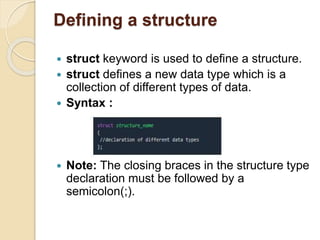
 struct keyword is used to define a structure.
 struct defines a new data type which is a
collection of different types of data.
 Syntax :
 Note: The closing braces in the structure type
declaration must be followed by a
semicolon(;).
Example of Structure
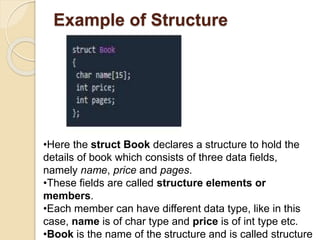
•Here the struct Book declares a structure to hold the
details of book which consists of three data fields,
namely name, price and pages.
•These fields are called structure elements or
members.
•Each member can have different data type, like in this
case, name is of char type and price is of int type etc.
•Book is the name of the structure and is called structure
Declaring Structure Variables
 It is possible to declare variables of
a structure, after the structure is
defined.
 Structure variable declaration is
similar to the declaration of variables
of any other data types.
 Structure variables can be declared in
following two ways.
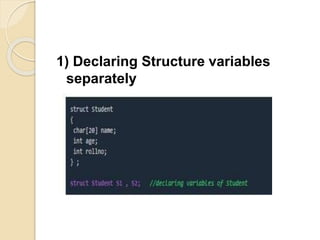
1) Declaring Structure variables
separately
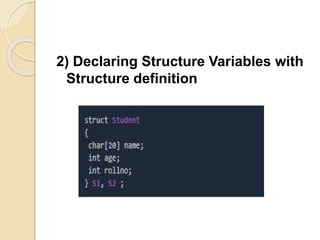
2) Declaring Structure Variables with
Structure definition
Accessing Structure Members
 Structure members can be accessed
and assigned values in number of ways.
 Structure member has no meaning
independently.
 In order to assign a value to a structure
member, the member name must be
linked with the structure variable using
dot . operator also called period
or member access operator.
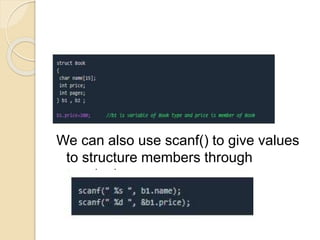
We can also use scanf() to give values
to structure members through
terminal.
Structure Initialization
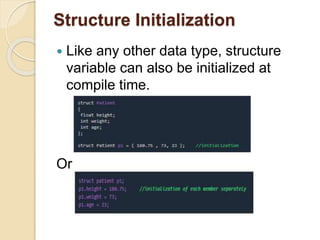
 Like any other data type, structure
variable can also be initialized at
compile time.
Or
Array of Structure
 We can also declare an array of structure.
Each element of the array represents a
structure variable.
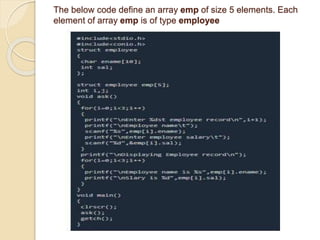
 Example : struct employee emp[5];
The below code define an array emp of size 5 elements. Each
element of array emp is of type employee
Nested Structures
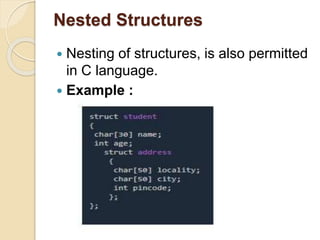
 Nesting of structures, is also permitted
in C language.
 Example :
Structure as function arguments
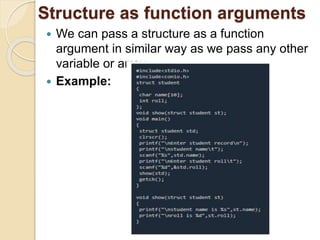
 We can pass a structure as a function
argument in similar way as we pass any other
variable or array.
 Example:
C Pointers
 Pointers are one of the core
components of the C programming
language. A pointer can be used to
store the memory address of other
variables, functions, or even other
pointers. The use of pointers allows
low-level memory access, dynamic
memory allocation, and many other
functionality in C.
What is a Pointer in C
 A pointer is defined as a derived data
type that can store the address of
other C variables or a memory
location. We can access and
manipulate the data stored in that
memory location using pointers.
Syntax of C Pointers
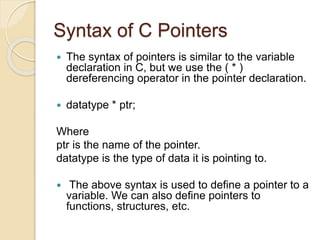
 The syntax of pointers is similar to the variable
declaration in C, but we use the ( * )
dereferencing operator in the pointer declaration.
 datatype * ptr;
Where
ptr is the name of the pointer.
datatype is the type of data it is pointing to.
 The above syntax is used to define a pointer to a
variable. We can also define pointers to
functions, structures, etc.
How To Use Pointers
 The use of pointers in C can be
divided into three steps:
 Pointer Declaration
 Pointer Initialization Pointer
 Dereferencing
Pointer Declaration
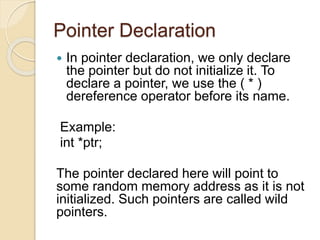
 In pointer declaration, we only declare
the pointer but do not initialize it. To
declare a pointer, we use the ( * )
dereference operator before its name.
Example:
int *ptr;
The pointer declared here will point to
some random memory address as it is not
initialized. Such pointers are called wild
pointers.
Pointer Initialization
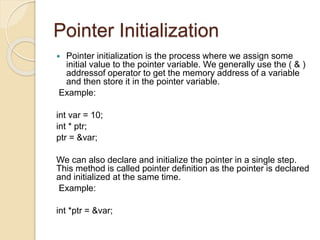
 Pointer initialization is the process where we assign some
initial value to the pointer variable. We generally use the ( & )
addressof operator to get the memory address of a variable
and then store it in the pointer variable.
Example:
int var = 10;
int * ptr;
ptr = &var;
We can also declare and initialize the pointer in a single step.
This method is called pointer definition as the pointer is declared
and initialized at the same time.
Example:
int *ptr = &var;
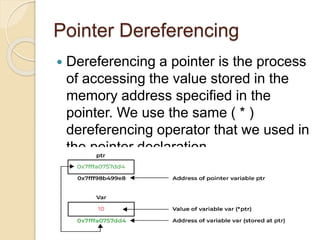
Pointer Dereferencing
 Dereferencing a pointer is the process
of accessing the value stored in the
memory address specified in the
pointer. We use the same ( * )
dereferencing operator that we used in
the pointer declaration.
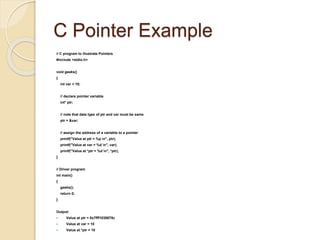
C Pointer Example
// C program to illustrate Pointers
#include <stdio.h>
void geeks()
{
int var = 10;
// declare pointer variable
int* ptr;
// note that data type of ptr and var must be same
ptr = &var;
// assign the address of a variable to a pointer
printf("Value at ptr = %p n", ptr);
printf("Value at var = %d n", var);
printf("Value at *ptr = %d n", *ptr);
}
// Driver program
int main()
{
geeks();
return 0;
}
Output:
 Value at ptr = 0x7fff1038675c
 Value at var = 10
 Value at *ptr = 10
C Pointers and Arrays
 In C programming language, pointers
and arrays are closely related. An array
name acts like a pointer constant. The
value of this pointer constant is the
address of the first element. For
example, if we have an array named val
then val and &val[0] can be used
interchangeably.
 If we assign this value to a non-constant
pointer of the same type, then we can
access the elements of the array using
Example
// C Program to access array elements using pointer
#include <stdio.h>
void geeks()
{
// Declare an array
int val[3] = { 5, 10, 15 };
// Declare pointer variable
int* ptr;
// Assign address of val[0] to ptr.
// We can use ptr=&val[0];(both are same)
ptr = val;
printf("Elements of the array are: ");
printf("%d, %d, %d", ptr[0], ptr[1], ptr[2]);
return;
}
// Driver program
int main()
{
geeks();
return 0;
}
 Output:
Elements of the array are: 5 10 15
Self Referential Structres
 It is used to create the dynamic data
structures linked lists, queues stacks
and tress etc .
 A structure cannot contain an instance
of itself
 However it can contain a pointer to the
same structure type
 A structure containing a pointer to the
same structure type is known as self
referential structure
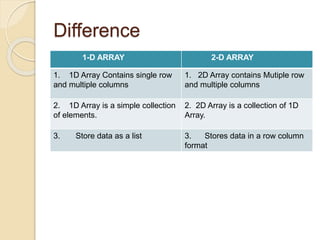
Difference
1-D ARRAY 2-D ARRAY
1. 1D Array Contains single row
and multiple columns
1. 2D Array contains Mutiple row
and multiple columns
2. 1D Array is a simple collection
of elements.
2. 2D Array is a collection of 1D
Array.
3. Store data as a list 3. Stores data in a row column
format
Strings are Character Arrays
 Strings in c are Simply Arrays of
characters - Example: Char s[10];
 This is a 10 element array that can hold
a character string consisting = or < than
9 characters
 This is because c does not know where
the end of an array is at run time by
using NULL character to terminate all
strings in its functions
 For example char str [10] ={‘u’, ‘n’, ‘I’,
‘x’,’0’};
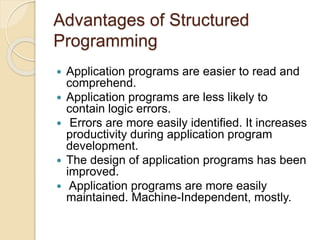
Advantages of Structured
Programming
 Application programs are easier to read and
comprehend.
 Application programs are less likely to
contain logic errors.
 Errors are more easily identified. It increases
productivity during application program
development.
 The design of application programs has been
improved.
 Application programs are more easily
maintained. Machine-Independent, mostly.
Computer science  ( Structures  In C ) Ppt

Computer science ( Structures In C ) Ppt

  • 1.
    Structures in C ByChirag, Sobhit, Fazal, Zishan, Saad and Misbah B.Tech in Food Technology ( 2nd Sem) Submitted to Mr. Faisal Malik (bftc- 202,206)
  • 2.
    Definition  Structure isa user-defined data type in C which allows you to combine different data types to store a particular type of record.  It is somewhat similar to an Array. The only difference is that array is used to store collection of similar data types while structure can store collection of any type of data.
  • 3.
    Example: Structure is usedto represent a record.  Suppose you want to store record of Student which consists of student name, address, roll number and age. You can define a structure to hold this information.  Suppose you want to keep track of your books in a library. You might want to track the following attributes about each book −  Title  Author  Subject  Book ID
  • 4.
    Defining a structure struct keyword is used to define a structure.  struct defines a new data type which is a collection of different types of data.  Syntax :  Note: The closing braces in the structure type declaration must be followed by a semicolon(;).
  • 5.
    Example of Structure •Herethe struct Book declares a structure to hold the details of book which consists of three data fields, namely name, price and pages. •These fields are called structure elements or members. •Each member can have different data type, like in this case, name is of char type and price is of int type etc. •Book is the name of the structure and is called structure
  • 6.
    Declaring Structure Variables It is possible to declare variables of a structure, after the structure is defined.  Structure variable declaration is similar to the declaration of variables of any other data types.  Structure variables can be declared in following two ways.
  • 7.
    1) Declaring Structurevariables separately
  • 8.
    2) Declaring StructureVariables with Structure definition
  • 9.
    Accessing Structure Members Structure members can be accessed and assigned values in number of ways.  Structure member has no meaning independently.  In order to assign a value to a structure member, the member name must be linked with the structure variable using dot . operator also called period or member access operator.
  • 10.
    We can alsouse scanf() to give values to structure members through terminal.
  • 11.
    Structure Initialization  Likeany other data type, structure variable can also be initialized at compile time. Or
  • 12.
    Array of Structure We can also declare an array of structure. Each element of the array represents a structure variable.  Example : struct employee emp[5];
  • 13.
    The below codedefine an array emp of size 5 elements. Each element of array emp is of type employee
  • 14.
    Nested Structures  Nestingof structures, is also permitted in C language.  Example :
  • 15.
    Structure as functionarguments  We can pass a structure as a function argument in similar way as we pass any other variable or array.  Example:
  • 16.
    C Pointers  Pointersare one of the core components of the C programming language. A pointer can be used to store the memory address of other variables, functions, or even other pointers. The use of pointers allows low-level memory access, dynamic memory allocation, and many other functionality in C.
  • 17.
    What is aPointer in C  A pointer is defined as a derived data type that can store the address of other C variables or a memory location. We can access and manipulate the data stored in that memory location using pointers.
  • 18.
    Syntax of CPointers  The syntax of pointers is similar to the variable declaration in C, but we use the ( * ) dereferencing operator in the pointer declaration.  datatype * ptr; Where ptr is the name of the pointer. datatype is the type of data it is pointing to.  The above syntax is used to define a pointer to a variable. We can also define pointers to functions, structures, etc.
  • 19.
    How To UsePointers  The use of pointers in C can be divided into three steps:  Pointer Declaration  Pointer Initialization Pointer  Dereferencing
  • 20.
    Pointer Declaration  Inpointer declaration, we only declare the pointer but do not initialize it. To declare a pointer, we use the ( * ) dereference operator before its name. Example: int *ptr; The pointer declared here will point to some random memory address as it is not initialized. Such pointers are called wild pointers.
  • 21.
    Pointer Initialization  Pointerinitialization is the process where we assign some initial value to the pointer variable. We generally use the ( & ) addressof operator to get the memory address of a variable and then store it in the pointer variable. Example: int var = 10; int * ptr; ptr = &var; We can also declare and initialize the pointer in a single step. This method is called pointer definition as the pointer is declared and initialized at the same time. Example: int *ptr = &var;
  • 22.
    Pointer Dereferencing  Dereferencinga pointer is the process of accessing the value stored in the memory address specified in the pointer. We use the same ( * ) dereferencing operator that we used in the pointer declaration.
  • 23.
    C Pointer Example //C program to illustrate Pointers #include <stdio.h> void geeks() { int var = 10; // declare pointer variable int* ptr; // note that data type of ptr and var must be same ptr = &var; // assign the address of a variable to a pointer printf("Value at ptr = %p n", ptr); printf("Value at var = %d n", var); printf("Value at *ptr = %d n", *ptr); } // Driver program int main() { geeks(); return 0; } Output:  Value at ptr = 0x7fff1038675c  Value at var = 10  Value at *ptr = 10
  • 24.
    C Pointers andArrays  In C programming language, pointers and arrays are closely related. An array name acts like a pointer constant. The value of this pointer constant is the address of the first element. For example, if we have an array named val then val and &val[0] can be used interchangeably.  If we assign this value to a non-constant pointer of the same type, then we can access the elements of the array using
  • 25.
    Example // C Programto access array elements using pointer #include <stdio.h> void geeks() { // Declare an array int val[3] = { 5, 10, 15 }; // Declare pointer variable int* ptr; // Assign address of val[0] to ptr. // We can use ptr=&val[0];(both are same) ptr = val; printf("Elements of the array are: "); printf("%d, %d, %d", ptr[0], ptr[1], ptr[2]); return; } // Driver program int main() { geeks(); return 0; }  Output: Elements of the array are: 5 10 15
  • 26.
    Self Referential Structres It is used to create the dynamic data structures linked lists, queues stacks and tress etc .  A structure cannot contain an instance of itself  However it can contain a pointer to the same structure type  A structure containing a pointer to the same structure type is known as self referential structure
  • 27.
    Difference 1-D ARRAY 2-DARRAY 1. 1D Array Contains single row and multiple columns 1. 2D Array contains Mutiple row and multiple columns 2. 1D Array is a simple collection of elements. 2. 2D Array is a collection of 1D Array. 3. Store data as a list 3. Stores data in a row column format
  • 28.
    Strings are CharacterArrays  Strings in c are Simply Arrays of characters - Example: Char s[10];  This is a 10 element array that can hold a character string consisting = or < than 9 characters  This is because c does not know where the end of an array is at run time by using NULL character to terminate all strings in its functions  For example char str [10] ={‘u’, ‘n’, ‘I’, ‘x’,’0’};
  • 29.
    Advantages of Structured Programming Application programs are easier to read and comprehend.  Application programs are less likely to contain logic errors.  Errors are more easily identified. It increases productivity during application program development.  The design of application programs has been improved.  Application programs are more easily maintained. Machine-Independent, mostly.