COMPUTER
PROGRAMMING
Niko Neal P. Fariñas
Subject Teacher
What is COMPUTER
PROGRAMMING?
Computer programming has become of part our daily
lives. From creating emails, documents, presentations,
the applications on our mobile phones and even the bar
code scanners in groceries stores – all of these involve
computer programming.
Computer programming involves the development of
computer programs. A computer program is a sequence
of instructions written in a computer language to perform
a specified task by the computer. These programs make
our computers and even mobile phones useful.
Computer programming resulted to the development
of applications that became our everyday companion.
Below are examples.
Computer programming is the process that
professionals use to write code that instructs how a
computer, application or software program performs.
A professional that creates instructions for a
computer to execute by writing and testing code that
enables applications and software programs to
operate successfully is called a computer programmer
or simply programmer.
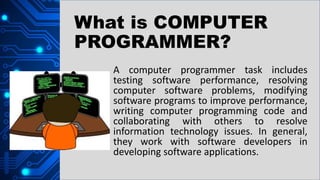
A computer programmer task includes
testing software performance, resolving
computer software problems, modifying
software programs to improve performance,
writing computer programming code and
collaborating with others to resolve
information technology issues. In general,
they work with software developers in
developing software applications.
What is COMPUTER
PROGRAMMER?
COMPUTER PROGRAMMING
LANGUAGES
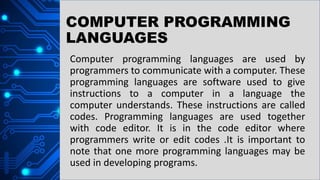
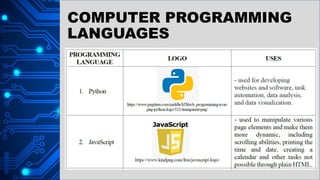
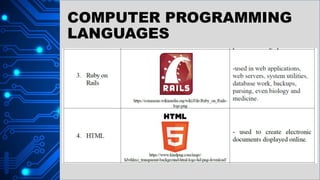
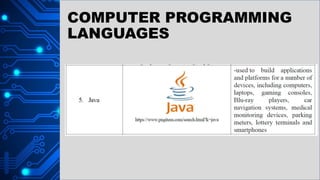
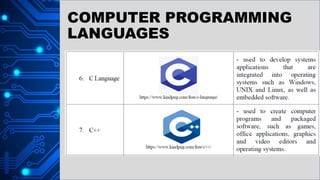
Computer programming languages are used by
programmers to communicate with a computer. These
programming languages are software used to give
instructions to a computer in a language the
computer understands. These instructions are called
codes. Programming languages are used together
with code editor. It is in the code editor where
programmers write or edit codes .It is important to
note that one more programming languages may be
used in developing programs.
COMPUTER PROGRAMMING
LANGUAGES
COMPUTER PROGRAMMING
LANGUAGES
COMPUTER PROGRAMMING
LANGUAGES
COMPUTER PROGRAMMING
LANGUAGES
COMPUTER PROGRAMMING
LANGUAGES
COMPUTER PROGRAMMING
LANGUAGES
ACTIVITY
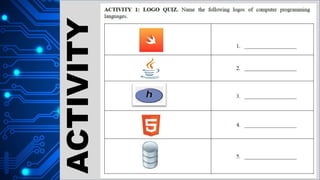
GROUP ACTIVITY
Group the students into 5 and each group will
have a leader, a secretary and researchers. The
teacher will flash definitions on the board and the
each group will answer it on the board.
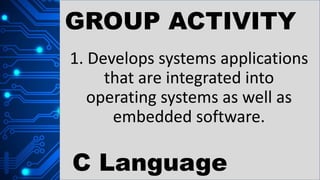
GROUP ACTIVITY
1. Develops systems applications
that are integrated into
operating systems as well as
embedded software.
C Language
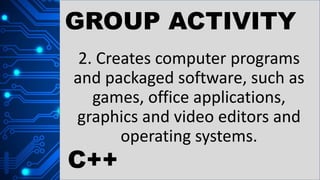
GROUP ACTIVITY
2. Creates computer programs
and packaged software, such as
games, office applications,
graphics and video editors and
operating systems.
C++
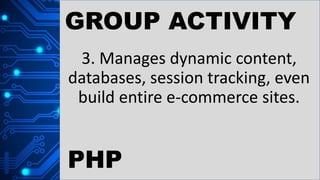
GROUP ACTIVITY
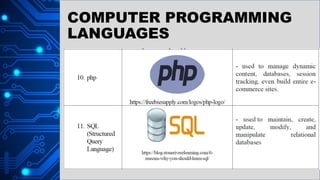
3. Manages dynamic content,
databases, session tracking, even
build entire e-commerce sites.
PHP
GROUP ACTIVITY
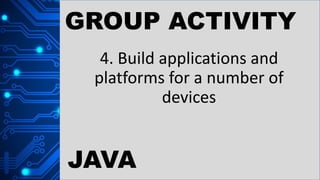
4. Build applications and
platforms for a number of
devices
JAVA
GROUP ACTIVITY
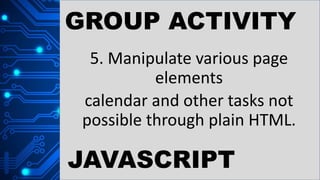
5. Manipulate various page
elements
calendar and other tasks not
possible through plain HTML.
JAVASCRIPT
GROUP ACTIVITY
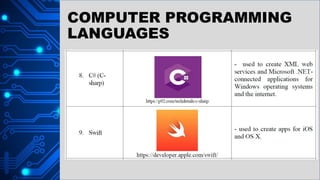
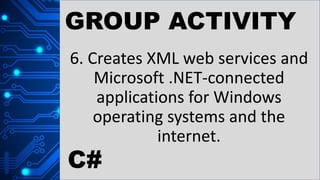
6. Creates XML web services and
Microsoft .NET-connected
applications for Windows
operating systems and the
internet.
C#
GROUP ACTIVITY
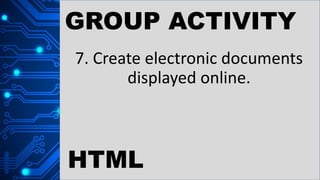
7. Create electronic documents
displayed online.
HTML
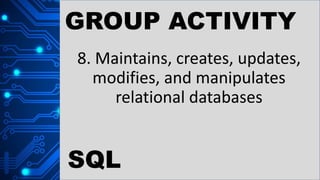
GROUP ACTIVITY
8. Maintains, creates, updates,
modifies, and manipulates
relational databases
SQL
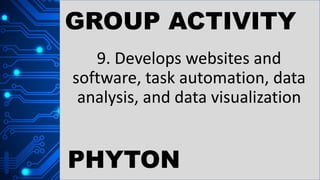
GROUP ACTIVITY
9. Develops websites and
software, task automation, data
analysis, and data visualization
PHYTON
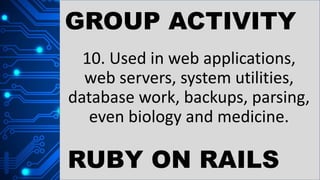
GROUP ACTIVITY
10. Used in web applications,
web servers, system utilities,
database work, backups, parsing,
even biology and medicine.
RUBY ON RAILS

COMPUTER PROGRAMMING 10 WEEK 1.pptx

  • 1.
    COMPUTER PROGRAMMING Niko Neal P.Fariñas Subject Teacher
  • 3.
    What is COMPUTER PROGRAMMING? Computerprogramming has become of part our daily lives. From creating emails, documents, presentations, the applications on our mobile phones and even the bar code scanners in groceries stores – all of these involve computer programming. Computer programming involves the development of computer programs. A computer program is a sequence of instructions written in a computer language to perform a specified task by the computer. These programs make our computers and even mobile phones useful.
  • 4.
    Computer programming resultedto the development of applications that became our everyday companion. Below are examples. Computer programming is the process that professionals use to write code that instructs how a computer, application or software program performs. A professional that creates instructions for a computer to execute by writing and testing code that enables applications and software programs to operate successfully is called a computer programmer or simply programmer.
  • 5.
    A computer programmertask includes testing software performance, resolving computer software problems, modifying software programs to improve performance, writing computer programming code and collaborating with others to resolve information technology issues. In general, they work with software developers in developing software applications. What is COMPUTER PROGRAMMER?
  • 6.
    COMPUTER PROGRAMMING LANGUAGES Computer programminglanguages are used by programmers to communicate with a computer. These programming languages are software used to give instructions to a computer in a language the computer understands. These instructions are called codes. Programming languages are used together with code editor. It is in the code editor where programmers write or edit codes .It is important to note that one more programming languages may be used in developing programs.
  • 7.
  • 8.
  • 9.
  • 10.
  • 11.
  • 12.
  • 13.
  • 14.
    GROUP ACTIVITY Group thestudents into 5 and each group will have a leader, a secretary and researchers. The teacher will flash definitions on the board and the each group will answer it on the board.
  • 15.
    GROUP ACTIVITY 1. Developssystems applications that are integrated into operating systems as well as embedded software. C Language
  • 16.
    GROUP ACTIVITY 2. Createscomputer programs and packaged software, such as games, office applications, graphics and video editors and operating systems. C++
  • 17.
    GROUP ACTIVITY 3. Managesdynamic content, databases, session tracking, even build entire e-commerce sites. PHP
  • 18.
    GROUP ACTIVITY 4. Buildapplications and platforms for a number of devices JAVA
  • 19.
    GROUP ACTIVITY 5. Manipulatevarious page elements calendar and other tasks not possible through plain HTML. JAVASCRIPT
  • 20.
    GROUP ACTIVITY 6. CreatesXML web services and Microsoft .NET-connected applications for Windows operating systems and the internet. C#
  • 21.
    GROUP ACTIVITY 7. Createelectronic documents displayed online. HTML
  • 22.
    GROUP ACTIVITY 8. Maintains,creates, updates, modifies, and manipulates relational databases SQL
  • 23.
    GROUP ACTIVITY 9. Developswebsites and software, task automation, data analysis, and data visualization PHYTON
  • 24.
    GROUP ACTIVITY 10. Usedin web applications, web servers, system utilities, database work, backups, parsing, even biology and medicine. RUBY ON RAILS