Presented To Sir Umair Ali
Presented By Numan Naveed
Shakeel khan
Shehroz khan
Jawad Ahmed
Waqar Ahmed
Yashfa
What is Computer Networking?
A computer network is a system that connects two or more computing
devices for transmitting and sharing information. Computing devices
include everything from a mobile phone to a server. These devices are
connected using physical wires such as fiber optics, but they can also be
wireless.
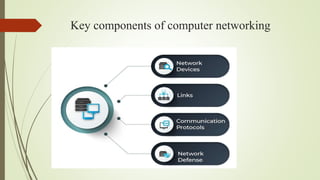
Key components of computer networking
Network Devices:
Network devices or nodes are computing devices that need to be linked in the network. Some network devices
include:
 Computers
 Mobiles
 Switches
Links
Links are the transmission media which can be of two types
Wired
Wireless
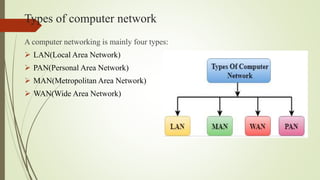
Types of computer network
A computer networking is mainly four types:
 LAN(Local Area Network)
 PAN(Personal Area Network)
 MAN(Metropolitan Area Network)
 WAN(Wide Area Network)
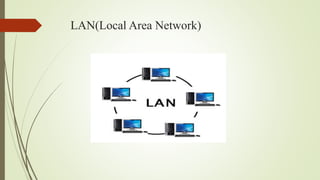
LAN(Local Area Network)
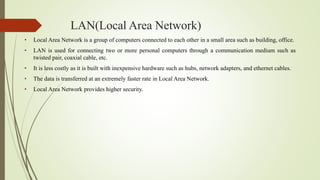
• Local Area Network is a group of computers connected to each other in a small area such as building, office.
• LAN is used for connecting two or more personal computers through a communication medium such as
twisted pair, coaxial cable, etc.
• It is less costly as it is built with inexpensive hardware such as hubs, network adapters, and ethernet cables.
• The data is transferred at an extremely faster rate in Local Area Network.
• Local Area Network provides higher security.
LAN(Local Area Network)
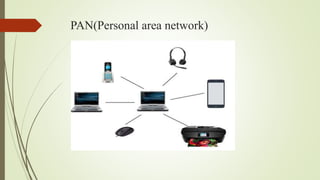
PAN(Personal area network)
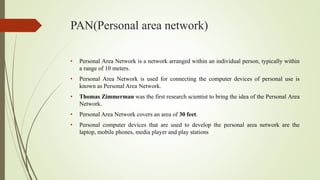
• Personal Area Network is a network arranged within an individual person, typically within
a range of 10 meters.
• Personal Area Network is used for connecting the computer devices of personal use is
known as Personal Area Network.
• Thomas Zimmerman was the first research scientist to bring the idea of the Personal Area
Network.
• Personal Area Network covers an area of 30 feet.
• Personal computer devices that are used to develop the personal area network are the
laptop, mobile phones, media player and play stations
PAN(Personal area network)
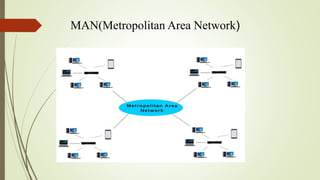
MAN(Metropolitan Area Network)
• A metropolitan area network is a network that covers a larger geographic area by
interconnecting a different LAN to form a larger network.
• Government agencies use MAN to connect to the citizens and private industries.
• In MAN, various LANs are connected to each other through a telephone exchange
line.
• The most widely used protocols in MAN are RS-232, Frame Relay, ATM, ISDN,
OC-3, ADSL, etc.
• It has a higher range than Local Area Network(LAN).
MAN(Metropolitan Area Network)
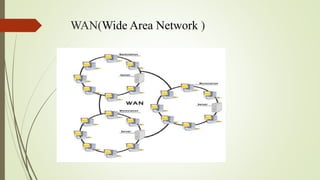
WAN(Wide Area Network )
 A Wide Area Network is a network that extends over a large geographical area such as
states or countries.
 A Wide Area Network is quite bigger network than the LAN.
 A Wide Area Network is not limited to a single location, but it spans over a large
geographical area through a telephone line, fibre optic cable or satellite links.
 The internet is one of the biggest WAN in the world.
 A Wide Area Network is widely used in the field of Business, government, and education.
WAN(Wide Area Network )

Computer networking and its different types

  • 1.
    Presented To SirUmair Ali Presented By Numan Naveed Shakeel khan Shehroz khan Jawad Ahmed Waqar Ahmed Yashfa
  • 2.
    What is ComputerNetworking? A computer network is a system that connects two or more computing devices for transmitting and sharing information. Computing devices include everything from a mobile phone to a server. These devices are connected using physical wires such as fiber optics, but they can also be wireless.
  • 3.
    Key components ofcomputer networking
  • 4.
    Network Devices: Network devicesor nodes are computing devices that need to be linked in the network. Some network devices include:  Computers  Mobiles  Switches Links Links are the transmission media which can be of two types Wired Wireless
  • 5.
    Types of computernetwork A computer networking is mainly four types:  LAN(Local Area Network)  PAN(Personal Area Network)  MAN(Metropolitan Area Network)  WAN(Wide Area Network)
  • 6.
    LAN(Local Area Network) •Local Area Network is a group of computers connected to each other in a small area such as building, office. • LAN is used for connecting two or more personal computers through a communication medium such as twisted pair, coaxial cable, etc. • It is less costly as it is built with inexpensive hardware such as hubs, network adapters, and ethernet cables. • The data is transferred at an extremely faster rate in Local Area Network. • Local Area Network provides higher security.
  • 7.
  • 8.
    PAN(Personal area network) •Personal Area Network is a network arranged within an individual person, typically within a range of 10 meters. • Personal Area Network is used for connecting the computer devices of personal use is known as Personal Area Network. • Thomas Zimmerman was the first research scientist to bring the idea of the Personal Area Network. • Personal Area Network covers an area of 30 feet. • Personal computer devices that are used to develop the personal area network are the laptop, mobile phones, media player and play stations
  • 9.
  • 10.
    MAN(Metropolitan Area Network) •A metropolitan area network is a network that covers a larger geographic area by interconnecting a different LAN to form a larger network. • Government agencies use MAN to connect to the citizens and private industries. • In MAN, various LANs are connected to each other through a telephone exchange line. • The most widely used protocols in MAN are RS-232, Frame Relay, ATM, ISDN, OC-3, ADSL, etc. • It has a higher range than Local Area Network(LAN).
  • 11.
  • 12.
    WAN(Wide Area Network)  A Wide Area Network is a network that extends over a large geographical area such as states or countries.  A Wide Area Network is quite bigger network than the LAN.  A Wide Area Network is not limited to a single location, but it spans over a large geographical area through a telephone line, fibre optic cable or satellite links.  The internet is one of the biggest WAN in the world.  A Wide Area Network is widely used in the field of Business, government, and education.
  • 13.