Computer and Device News

        11 20 2011
Voice tools
• Google voice to voice translation
  – Speak press a button, instant translation
  – Listen to foreign speaker, press button for
    translation
  – Works for 14 languages
• Mobile connections
  – 6 billion later this year – near world coverage
    numerically
     • So translation is important
Mobile Connections
Quantum computers
• Using nitrogen vacancy diamond
• Photonic quantum computing
  – Difficult to process and measure single photons
    efficiently
  – Solutions uses lasers to drive coherent conversion
    between states
Race toward exaflop computer
• Fujitsu (commercially available)
  – Scalable to 23 petaflops
• IBM Blue Gene/Q
  – Scalable to 100 petaflops
Communications
• Spin lasers
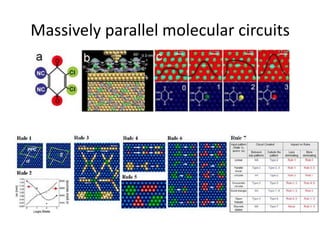
Massively parallel molecular circuits
Printable, wearable, stretchable
      • Printed Logic with Printed Memory
      • Stretchable Graphene Transistors with Printed
        Dielectrics and Gate Electrodes
      • Stretchy Skin-like Sensor arrays
      • Ultra-thin, ultra-flexible brain implants

gic wied
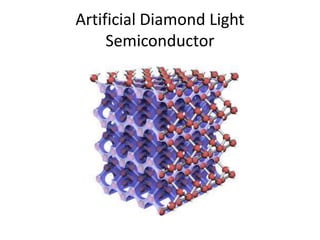
Artificial Diamond Light
     Semiconductor
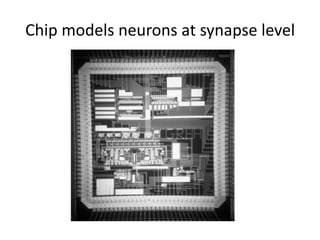
Chip models neurons at synapse level
Quad Core Snapdragon
Device Development
• Magnetic cloaking (anti-magnet)
• Spin on spin computing
• Weaving nanotube products
• Flexible stretchable nanotube backplane
  matrix
• 10 billion bits per second transmission at 3
  orders of magnitude less power
Computation,devices 11202011

Computation,devices 11202011

Editor's Notes

  • #3 Google voice translationhttp://nextbigfuture.com/2011/10/google-conversation-mode-voide-to-voice.htmlThe number of languages supported for text and text-to-speech translations continues to grow, with 63 languages supported for text, speech-to-text in 17 languages and text-to-speech working in 24 languages.
  • #5 Nitrogen vacancy diamondUniversity of Buffalo - New Knowledge About "Flawed" Diamonds Could Speed The Development of Diamond-Based Quantum ComputersDiamonds with defects known as "nitrogen-vacancy centers" can be used in applications including quantum information processing.* One problem preventing scientists from fully understanding these defective diamonds is that at the point of defect, the high-symmetry energy configuration of the defect becomes unstable when an electron is promoted to an excited state. This is known as the Jahn-Teller effect.* Now, for the first time, researchers led by the University at Buffalo have conducted calculations revealing how the diamond lattice stabilizes itself at the point of defect by changing its shape, providing new information on the consequence of such dynamical distortion.Photonic quantum computing http://nextbigfuture.com/2011/10/new-scheme-for-photonic-quantum.htmlA new scheme termed “coherent photon conversion”, could potentially overcome all of the currently unresolved problems for optical implementations of quantum computing.Quantum technology derives its potential by exploiting uniquely quantum features such as superposition and entanglement. Single photons are excellent quantum information carriers, because they are naturally almost perfectly isolated from their environment. Also, quantum computers based on photons promise to be extremely fast. But current schemes for preparing, processing and measuring photons are inefficient.The new scheme provides a method of coherent conversion between different photon states and is based on enhancing the nonlinearity of a medium by a strong laser field. The method paves a road to solving all open challenges for optical quantum computation. For example, deterministically doubling single photons solves the preparation and measuring problems, and a novel type of photon-photon interaction gives efficient quantum gates. This new quantum optics toolbox opened up by "coherent photon conversion" promises to lead to a nonlinear optical quantum computer.
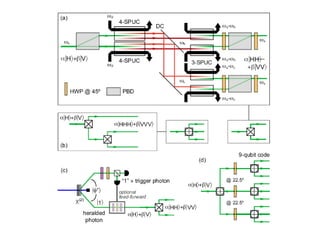
  • #6 CPC circuits for creating (a) bipartite and (b) tripartite entanglement. (c) A CPC circuit for generating arbitrary, nonlocally prepared, nonmaximally entangled states. (d) A direct implementation of the error-correction encoding step for a simple 9-qubit code.Supplemental material http://www.nature.com/nature/journal/vaop/ncurrent/extref/nature10463-s1.pdf
  • #7 http://nextbigfuture.com/2011/11/fujitsu-has-announced-worldwide.htmlFujitsu has announced worldwide availability for its new PRIMEHPC FX10 supercomputer, which can be scaled up to a 1,024 rack configuration for 23.2 petaflops of theoretical processing powerUPDATE - TechCrunch - The PRIMEHPC FX10 will go on sale in January next year, with prices starting at US$640,000 for a one-rack model. Fujitsu hopes to sell a total of 50 supercomputers in three years. Based on the one rack price - 1024 racks could be about $300 million assuming that there was volume discounts over the price of the one rack model. However, the price might be a bit higher to fully load the 1024 racks and to add all of the networking and other gear. Blue Gene/QEETimes - IBM’s officially unveiled its next generation Blue Gene/Q (BGQ) supercomputer, the third generation in its Blue Gene family, with 16 multi-processing core technology and a scalable peak performance of up to 100 petaflops. It can produce 2 gigaflops per watt. A 100 petaflop system would need 50 megawatts of power.
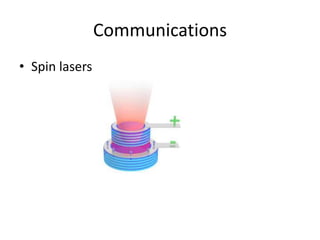
  • #8 HSpin lasers at 11.1 Gigahertz with potential for well over 100 gigahertz speed for the internet of tomorrow18ShareElectrical engineers in Bochum have succeeded in developing a new concept for ultrafast semiconductor lasers. The researchers make clever use of the intrinsic angular momentum of electrons, called spin, to successfully break the previous speed barriers. The new spin lasers have the potential to achieve modulation frequencies of well above 100 GHz in future. This is a decisive step towards high-speed data transmission, e.g. for the Internet of tomorrow. http://nextbigfuture.com/2011/10/spin-lasers-at-111-gigahertz-with.html
  • #9 http://nextbigfuture.com/2011/10/massively-parallel-computing-on-organic.htmlThe concept of a wireless molecular circuit: a. The DDQ molecule. b. The DDQ bilayer’s atomic structure; side view (above); top view (below, Movie 1). T denotes a molecule on the top layerTechnology Review - Japanese scientists have built a cellular automaton from individual molecules that carries out huge numbers of calculations in parallel They've laid down 300 DDQ molecules on a gold substrate, setting them up as a cellular automaton. More impressive still, they've then initialised the system so that it "calculates" the way heat diffuses in a conducting medium and the way cancer spreads through tissue. And since the entire layer is involved in the calculation, this a massively parallel computation using a single layer of organic molecules. Current computers operate at enormous speeds of ~10^13 bits per second, but their principle of sequential logic operation has remained unchanged since the 1950s. Though our brain is much slower on a per-neuron base (~10^3 firings per second), it is capable of remarkable decision-making based on the collective operations of millions of neurons at a time in ever-evolving neural circuitry. Here we use molecular switches to build an assembly where each molecule communicates–like neurons–with many neighbors simultaneously. The assembly’s ability to reconfigure itself spontaneously for a new problem allows us to realize conventional computing constructs like logic gates and Voronoi decompositions, as well as to reproduce two natural phenomena: heat diffusion and the mutation of normal cells to cancer cells. This is a shift from the current static computing paradigm of serial bit-processing to a regime in which a large number of bits are processed in parallel in dynamically changing hardwareIn order to realize a CA (cellular automata) that can carry out a wide variety of computational tasks, it is necessary to obtain a sufficient level of control on the transition state dynamics. The DDQ (2,3-dichloro-5,6-dicyano-p-benzoquinone molecule) CA in this article provides an intriguing avenue to achieve such control while still relying on a relatively small and simple molecule.
  • #10 Researchers at the Palo Alto Research Center (PARC) and the Norwegian company Thinfilm Electronics have announced a printed electronic device that, for the first time, marries transistors with memory. The device provides a low-cost way to read, write, and process small amounts of data. In addition, the added logic increases the amount of data that can be stored.Printed circuits, made of organic inks, operate far more slowly and with less memory capacity than their silicon counterparts, but they can be made for pennies. Printed circuits can also go where silicon currently cannot: wrapping around a child's toy, for example, or conforming to the curve of a soldier's helmet.Adding logic to memory is crucial to increasing the storage capacity of the device, explains Janos Veres, manager of printed electronics at PARC. "We really needed to have a printed logic array that lets us address memory and increase bit count," he says. Memory arrays are split up into rows and columns. To select a row or column, you need a logic circuit, Veres says. "The power of this demonstration is we've shown that you can address rows and columns with this technology," he says. "The next step will be building bigger memory."One of the major advances of this prototype is the development of printed logic circuits that are analogous to so-called CMOS circuits in silicon.http://nextbigfuture.com/2011/10/stretchable-graphene-transistors-with.htmlWith the emergence of human interface technology, the development of new applications based on stretchable electronics such as conformal biosensors and rollable displays are required. However, the difficulty in developing semiconducting materials with high stretchability required for such applications has restricted the range of applications of stretchable electronics. Here, we present stretchable, printable, and transparent transistors composed of monolithically patterned graphene films. This material offers excellent mechanical, electrical, and optical properties, capable of use as semiconducting channels as well as the source/drain electrodes. Such monolithic graphene transistors show hole and electron mobilities of 1188 ± 136 and 422 ± 52 cm2 (V s), respectively, with stable operation at stretching up to 5% even after 1000 or more cycles.http://nextbigfuture.com/2011/10/stanford-researchers-build-transparent.htmlStanford University - Using carbon nanotubes bent to act as springs, Stanford researchers have developed a stretchable, transparent skin-like sensor. The sensor can be stretched to more than twice its original length and bounce back perfectly to its original shape. It can sense pressure from a firm pinch to thousands of pounds. The sensor could have applications in prosthetic limbs, robotics and touch-sensitive computer displays.When the nanotubes are airbrushed onto the silicone, they tend to land in randomly oriented little clumps. When the silicone is stretched, some of the "nano-bundles" get pulled into alignment in the direction of the stretching.When the silicone is released, it rebounds back to its original dimensions, but the nanotubes buckle and form little nanostructures that look like springs."After we have done this kind of pre-stretching to the nanotubes, they behave like springs and can be stretched again and again, without any permanent change in shape," Bao said.Transparent, elastic conductors are essential components of electronic and optoelectronic devices that facilitate human interaction and biofeedback, such as interactive electronics, implantable medical devices and robotic systems with human-like sensing capabilities. Transparent, elastic conductors are essential components of electronic and optoelectronic devices that facilitate human interaction and biofeedback, such as interactive electronics, implantable medical devices and robotic systems with human-like sensing capabilities. Brain implantsA new, ultrathin, ultraflexible implant loaded with sensors can record the electrical storm that erupts in the brain during a seizure with nearly 50-fold greater resolution than was previously possible. The level of detail could revolutionize epilepsy treatment by allowing for less invasive procedures to detect and treat seizures. It could also lead to a deeper understanding of brain function and result in brain-computer interfaces with unprecedented capacity.Current technology has stalled out at a sensor array with about eight sensors per square centimeter; the new array—built in collaboration with John Rogers, a professor of materials science and engineering at the University of Illinois Urbana-Champaign—can fit 360 sensors in the same amount of space. To create a small device so densely packed with sensors, Rogers integrated electronics and silicon transistors into the array itself, drastically reducing the amount of wiringhttp://www.technologyreview.com/biomedicine/39158/?nlid=nldly&nld=2011-11-18
  • #11 Model of a diamond structure superimposed on the artificial diamond structure (as in Figure 1). The red spheres indicate the atoms in the crystal lattice of diamond or silicon; the grey lines represent the bonds between atoms. The similarities between the diamond lattice and the artificial structure are clearly visible. Artificial diamondhttp://nextbigfuture.com/2011/11/artificial-diamond-structure-in.htmlOptical computer now a step closer Researchers from the FOM Foundation, the MESA+ Institute at the University of Twente, Philips and ASML have designed a completely new method for manufacturing 3D structures in silicon, which function as a semiconductor for light. They publish their results in two leading journals. The use of standard equipment makes the integration in silicon chips possible and that is vitally important for their application in a future optical computer. One way of making computers far faster still is the production of three-dimensional computer chips. The technology currently used for the manufacture of computer chips is not particularly suitable for the manufacture of three-dimensional spatial structures. The structures on a chip are built up layer by layer, as a result of which the production of an extensive structure is a time-consuming and expensive job. In two recently published articles in the journals 'Advanced Functional Materials' and 'Journal of Vacuum Science and Technology' former FOM researchers Johanna van den Broek, Willem Tjerkstra, LéonWoldering and Willem Vos described with their colleagues how they could make a three-dimensional structure in crystalline silicon that consisted of an orthogonal regular pattern of pores that crossed each other perpendicularly. The pores formed a diamond structure that was found to behave as a semiconductor for light: a photonic crystal
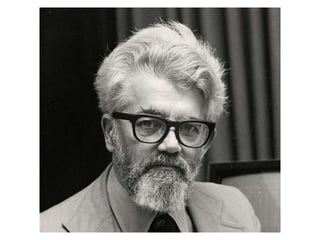
  • #12 RIP John McCarthy, 84Creator of LISP, founder of field and coiner of term Artificial Intelligence.“Computer chess has developed much as genetics might have if the geneticists had concentrated their efforts starting in 1910 on breeding racing Drosophila,” McCarthy wrote following Deep Blue’s win. “We would have some science, but mainly we would have very fast fruit flies.”According Daphne Koller — a professor in the Stanford AI Lab who still carries the torch for McCarthy’s orthodox vision of artificial intelligence — it’s a quote that sums up both McCarthy and his work. “The word that bests describes him is ‘uncompromising’,” she tells Wired. “He believed in artificial intelligence in terms of building an artifact that could actually replicate human level intelligence, and because of this, we was very unhappy with a lot of AI today, which provides some very useful applications but focuses on machine learning.“He wanted AI to pass the Turing test.”John McCarthy had pages discussing energy in general, nuclear energy, solar energy, food supply, population, fresh water supply, forests and wood supply, global engineering, pollution, biodiversity, various menaces to human survival, the role of ideology in discussing these matters, useful references. Other problems are discussed in the main text including minerals and pollution. http://www-formal.stanford.edu/jmc/progress/http://www-formal.stanford.edu/jmc/index.html“[McCarthy] really encapsulated what computation meant,” says Peter Norvig, the director of research at Google, pointing to modern languages like JavaScript and Python as Lisp’s successors. “To some extent, that had been done before. People like Turing had a mathematical way of defining computing. But he was the first one to really put the essence of computing into a simple programming language, and that had a big effect on a lot of people.”
  • #13  “We now have a way to capture each and every ionic process that’s going on in a neuron.”Previously, researchers had built circuits that could simulate the firing of an action potential, but not all of the circumstances that produce the potentials. “If you really want to mimic brain function realistically, you have to do more than just spiking. You have to capture the intracellular processes that are ion channel-based,” Poon says.http://web.mit.edu/newsoffice/2011/brain-chip-1115.htmlMIT researchers have now taken a major step toward brain emulation by designing a computer chip that mimics how the brain’s neurons adapt in response to new information. This phenomenon, known as plasticity, is believed to underlie many brain functions, including learning and memory.With about 400 transistors, the silicon chip can simulate the activity of a single brain synapse — a connection between two neurons that allows information to flow from one to the other. The researchers anticipate this chip will help neuroscientists learn much more about how the brain works, and could also be used in neural prosthetic devices such as artificial retinas, says Chi-Sang Poon, a principal research scientist in the Harvard-MIT Division of Health Sciences and Technology. The MIT researchers designed their computer chip so that the transistors could mimic the activity of different ion channels. While most chips operate in a binary, on/off mode, current flows through the transistors on the new brain chip in analog, not digital, fashion. A gradient of electrical potential drives current to flow through the transistors just as ions flow through ion channels in a cell.The new chip represents a “significant advance in the efforts to incorporate what we know about the biology of neurons and synaptic plasticity onto CMOS [complementary metal-oxide-semiconductor] chips,” says Dean Buonomano, a professor of neurobiology at the University of California at Los Angeles, adding that “the level of biological realism is impressive.The MIT researchers plan to use their chip to build systems to model specific neural functions, such as the visual processing system. Such systems could be much faster than digital computers. Even on high-capacity computer systems, it takes hours or days to simulate a simple brain circuit. With the analog chip system, the simulation is even faster than the biological system itself.Another potential application is building chips that can interface with biological systems. This could be useful in enabling communication between neural prosthetic devices such as artificial retinas and the brain. Further down the road, these chips could also become building blocks for artificial intelligence devices, Poon says.
  • #14 Engadget - the HTC Zeta is a quad-core device but with a faster chip than the HTC Edge at 2.5GHz. It will have a Qualcomm Snapdragon APQ8064 CPU. The APQ8064 will have five times the power and use 75% less power.It will have 4.5in screen size with an HD 720p resolution display.The processor will be supported by 1GB of RAM, 32GB of internal storage and an 1830mAh battery. The leak includes a lot of details including an 8 MP rear facing camera, 1.3MP front facing camera, Bluetooth 4.0 and Beats Audio.The HTC Ville (codename) is set to launch in April with Android 4.0 Ice Cream Sandwich and, for the first time, HTC Sense 4.0. The smartphone will feature a 4.3-inch qHD Super AMOLED display, and is powered by a 1.5GHz dual-core Snapdragon Series 4 processor. In addition to those specifications, the HTC Ville will house an 8-megapixel backside-illuminated camera, just like the one on the HTC Edge, with 1080p HD video capture supportBoy Genius Reports also had details on the HTC EdgeHTC Edge will have a quad-core 1.5GHz NVIDIA processor (Tegra 3).The HTC Edge will feature a 4.7-inch 720p HD S-LCD 2 with optical lamination. Translation: this could possibly be one of the best displays in the world; just imagine the iPhone’s display blown up to 4.7 inches.The unibody design of the HTC Edge will be around 8.8mm thin and it will house 32GB of built-in storage, 1GB of RAM, a microSIM card slot and an 8-megapixel camera with backside-illumination and 1080p HD video capture support. This super smartphone will also feature a 720p front-facing camera, Beats Audio, Bluetooth 4.0, an 1,800 mAh battery and NFC, though it will omit a removable storage slot.
  • #15 http://www.physorg.com/news/2011-09-cloaking-magnetic-fields-antimagnet-device.htmlSpanish researchers have designed what they believe to be a new type of magnetic cloak, which shields objects from external magnetic fields, while at the same time preventing any magnetic internal fields from leaking outside, making the cloak undetectable.The development of such a device, described as an 'antimagnet', could offer many beneficial applications, such as protecting a ship's hull from mines designed to detonate when a magnetic field is detected, or allowing patients with pacemakers or cochlear implants to use medical equipment.In their study, published today, Friday 23 September, in the Institute of Physics and German Physical Society's New Journal of Physics, researchers have proved that such a cloak could be built using practical and available materials and technologies, and used to develop an array of applications.Spin Computinghttp://nextbigfuture.com/2011/10/moving-forward-spin-goes-sideways.htmlBuilding electronic devices that work without needing to actually transport electrons is a goal of spintronics researchers, since this could lead to: reduced power consumption, lower levels of signal noise, faster operation, and denser information storage. However, the generation of pure spin currents remains a challenge. Now, YoshiChikaOtani and colleagues at the RIKEN Advanced Science Institute, Wako, and five other research institutes in Japan and China, have produced a large spin current in an important spintronic device called a lateral spin valve. They lowered junction resistance by a factor of up to 1,000, and increased the efficiency of spin injection into the silver wire. As a result, the output voltage reached 220 microvolts, which is more than 100 times greater than that of existing devices. In addition, the research team was able to observe the injected spins rotating, of what is technically known as precessing, in response to a magnetic field along the entire length of their 6-micrometer silver wire, confirming high spin injection efficiency. Nanocomphttp://nextbigfuture.com/2011/11/nanocomp-technologies-get-big-defense.htmlNanocomp Technologies, Inc., a developer of performance materials and component products from carbon nanotubes (CNTs), today announced it has been selected by the United States Government to supply CNT yarn and sheet material for the program needs of the Department of Defense, as well as to create a path toward commercialization for civilian industrial use. Nanocomp’s CNT yarn and sheet materials are currently featured within the advanced design programs of several critical DoD and NASA applications. The U.S. Dept. of Defense recognizes that CNT materials are vital to several of its next generation platforms and components, including lightweight body and vehicle armor with superior strength, improved structural components for satellites and aircraft, enhanced shielding on a broad array of military systems from electromagnetic interference (EMI) and directed energy, and lightweight cable and wiring. The Company’s CTex™ CNT yarns and tapes, for example, can reduce the weight of aircraft wire and cable harnesses by as much as 50 percent, resulting in considerable operational cost savings, as well as provide other valuable attributes such as flame resistance and improved reliability.http://nextbigfuture.com/2011/11/carbon-nanotube-active-matrix.htmlNanoLetters - Carbon Nanotube Active-Matrix Backplanes for Conformal Electronics and Sensors (12 pages)In this paper, we report a promising approach for fabricating large-scale flexible and stretchable electronics using a semiconductor-enriched carbon nanotube solution. Uniform semiconducting nanotube networks with superb electrical properties (mobility of ∼20 cm2 V^-1 s^-1 and ION/IOFF of ∼10^4) are obtained on polyimide substrates. The substrate is made stretchable by laser cutting a honeycomb mesh structure, which combined with nanotubenetwork transistors enables highly robust conformal electronic devices with minimal device-to-device stochastic variations. The utility of this device concept is demonstrated by fabricating an active-matrix backplane (12 X 8 pixels, physical size of 6 X 4 cm2) for pressure mapping using a pressure sensitive rubber as the sensor elementIn the future, pixel density can be further improved by decreasing the size of both the SWNT active region and the contact region to PSR. This solution-based approach can be potentially combined with inkjet printing of metal contacts to achieve lithography-free fabrication of low-cost flexible and stretchable electronics with superb electrical and mechanical properties. Notably, to achieve stretchability using robust PI substrates, a concept often used in the paper decoration industry was applied by proper laser cutting of the substrate. The back-plane technology explored here can be further expanded in the future by adding various sensor and/or other active device components to enable multifunctional artificial skinhttp://nextbigfuture.com/2011/11/stanford-led-nanophotonics-uses-two.html
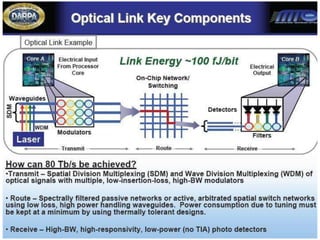
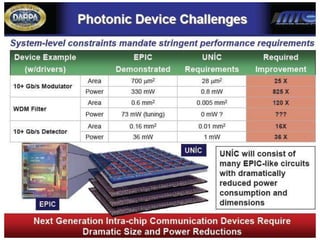
  • #16 Low-power and electrically controlled optical sources are vital for next generation optical interconnect systems to meet strict energy demands. Current optical transmitters consisting of high-threshold lasers plus external modulators consume far too much power to be competitive with future electrical interconnects. Here we demonstrate a directly modulated photonic crystal nanocavity light-emitting diode (LED) with 10 GHz modulation speed and less than 1 fJ per bit energy of operation, which is orders of magnitude lower than previous solutions. The device is electrically controlled and operates at room temperature, while the high modulation speed results from the fast relaxation of the quantum dots used as the active material. By virtue of possessing a small mode volume, our LED is intrinsically single mode and, therefore, useful for communicating information over a single narrowband channel. The demonstrated device is a major step forward in providing practical low-power and integrable sources for on-chip photonics.http://nextbigfuture.com/2011/11/stanford-led-nanophotonics-uses-two.html
  • #17 A team at Stanford's School of Engineering has demonstrated an ultrafastnanoscale light-emitting diode (LED) that is orders of magnitude lower in power consumption than today's laser-based systems and is able to transmit data at the very rapid rate of 10 billion bits per second. The new nanoscale device transmits data at ultrafast rates while using thousands of times less energy than current technologies. The nanophotonics device is a major step forward for on-chip data transmission.Nature Communications - Ultrafast direct modulation of a single-mode photonic crystal nanocavity light-emitting diodeCompact, low power onchip photonics is key to developing zettaflop supercomputers.The LED in question is a "single-mode LED," a special type of diode that emits light more or less at a single wavelength, similarly to a laser."Traditionally, engineers have thought only lasers can communicate at high data rates and ultralow power," said Shambat. "Our nanophotonic, single-mode LED can perform all the same tasks as lasers, but at much lower power."Nanophotonics is key to the technology. In the heart of their device, the engineers have inserted little islands of the light-emitting material indium arsenide, which, when pulsed with electricity, produce light. These "quantum dots" are surrounded by photonic crystal – an array of tiny holes etched in a semiconductor. The photonic crystal serves as a mirror that bounces the light toward the center of the device, confining it inside the LED and forcing it to resonate at a single frequency."In other words, it becomes single-mode," said Shambat.