 Scientists to Develop World's Smallest High 
Performance Sensor 
 According to the scientists at the University of Southampton's 
School ofElectronics and Computer Science (ECS) , they are 
working on creating the smallest high-performance and low-power 
sensor in the world. The sensor is made in silicon and it will be used in 
the fields ofbiosensing (the development of devices able to identify, 
record or transmit physiological information, especially information 
regarding the presence of chemical compounds) and environmental 
monitoring. Together with his colleagues, Pr. Hiroshi Mizuta is 
working on a 3-year project, which will allow the production of world's 
smallest sensors. The project is funded by the European FP-7 and it is 
entitled NEMSIC, which stands for nano electro mechanical system 
integrated circuits. 
 The Seventh Framework Programme for research and 
technological development (FP7) is the central tool of the European 
Union for funding research throughout the period between 2007 and 
2013. FP7 supports RD activities that cover nearly all scientific fields. 
 Besides being the smallest in the world, the sensor will also feature high 
sensitivity and will consume very little power. Such advantages are
launches Paper, a news-reading app 
user's News Feed. Users can customize the app from there with other topics. 
By Doug Gross, CNN 
January 30, 2014 -- Updated 1910 GMT 
(0310 HKT) | Filed under: Social Media 
over that Facebook app on the homescreen of your smartphone -- to make room for another Facebook app. 
akin to existing options like Flipboard, Feedly and Zite, will be released for the iPhone in the United States Facebook content in a more attractive, magazine-style way that will encourage users to linger over posts, beautiful with an immersive design and fullscreen, distraction-free layouts," the company said in a post on the beautiful stories of your own." 
be your Facebook News Feed. It won't have all the functions of the native Facebook app, but it will present categories, in a slicker, prettier package. 
Feed section will feature a new design for photos and video and the ability to read longer written posts. 
by adding more than a dozen other topics, "from photography and sports to food, science and design." Facebook voices and well-known publications." 
Instead, users will be able to flip through stories and other posts by tilting the phone in various ways and swiping
 168 
votes 
 Tongue Drive System to Operate 
Computers 
 Scientists developed a new revolutionary system to help individuals with 
disabilities to control wheelchairs, computers and other devices simply 
by using their tongue. 
 Engineers at the Georgia Institute of Technology say that a 
newtechnology called Tongue Drive system will be helpful to 
individuals with serious disabilities, such as those with severe spinal 
cord injuries and will allow them to lead more active and independent 
lives. 
 Individuals using a tongue-based system should only be able to move 
their tongue, which is especially important if a person has paralyzed 
limbs. A tiny magnet, only a size of a grain of rice, is attached to an 
individual's tongue using implantation, piercing or adhesive. This 
technology allows a disabled person to use tongue when moving a 
computer mouse or a powered wheelchair. 
 Scientists chose the tongue to control the system because unlike the 
feet and the hands, which are connected by brain through spinal cord, 
the tongue and the brain has a direct connection through cranial nerve. 
In case when a person has a severe spinal cord injure or other damage, 
the tongue will remain mobile to activate the system. "Tongue 
movements are also fast, accurate and do not require much thinking, 
concentration or effort." said Maysam Ghovanloo, an assistant professor
 To live or die - computer will decide 
 Are you ready to entrust your destiny to a computer? Researches say 
that a new computer program can make life-or-death decisions for 
disabled people better than their closest relatives. 
 A new research conducted by National Institute of Health (NIH) 
introduced a software program that can calculate all the pros and 
contras for further treatment of the seriously ill patients based on the 
mathematical formula. The decisions made by computer calculations are 
claimed to be even more accurate than those of the patient's close 
people. 
 Usually, when a doctor deals with an incapacitated patient and the 
chances for treatment are not evident, the decision is handed in to 
surrogate. But NIH scientists revealed, the surrogate decision may not 
be precise. A thorough analysis of the 20,000 choices of surrogates and 
patients showed that their decisions coincided only in two third of the 
times. 
 NIH professor David Wendler suggested a population-based treatment 
indicator to make such decision more precise. The program is based on 
database of other patients with the same disease, with similar 
characteristics like age, illness peculiarities, nationality and others along
 11 
votes 
 Computer the Size of a Molecule 
Imitates Brain Work 
 Scientists created a device that is not larger than a few molecules and 
that is claimed to mimic how the most complicated computer – human 
brain works. 
 The computer can perform 16 times more operations than a 
common computer transistor. Researchers expect the device to 
complete even 1,000 times more operations. 
 The tiny computer is made of a duroquinone, a molecule looking like 
a hexagonal plate with four cones attached to it. Duroquinone is less 
than a nanometer large, which is hundreds times smaller than a 
wavelength of a visible light. The device is formed with 17 duroquinone 
molecules with one molecule positioned in the center and 16 others 
making up a ring. This wonder sits on a gold surface. 
 The computer is operated with the help of electrical impulses 
transmitted through the electrically conductive needle. The central 
molecule shifts around in different ways, causing the 16 surrounding 
molecules shift too. 
 Anirban Bandyopadhyay, an artificial intelligence and molecular 
electronics expert at the National Institute for Materials Science at 
Tsukuba in Japan, explained that the work of the device resembles the 
way brain cells interact.
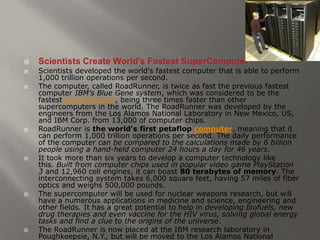
 Scientists Create World's Fastest SuperComputer 
 Scientists developed the world's fastest computer that is able to perform 
1,000 trillion operations per second. 
 The computer, called RoadRunner, is twice as fast the previous fastest 
computer IBM's Blue Gene system, which was considered to be the 
fastestsupercomputer, being three times faster than other 
supercomputers in the world. The RoadRunner was developed by the 
engineers from the Los Alamos National Laboratory in New Mexico, US, 
and IBM Corp. from 13,000 of computer chips. 
 RoadRunner is the world's first petaflop computer, meaning that it 
can perform 1,000 trillion operations per second. The daily performance 
of the computer can be compared to the calculations made by 6 billion 
people using a hand-held computer 24 hours a day for 46 years. 
 It took more than six years to develop a computer technology like 
this. Built from computer chips used in popular video game PlayStation 
3 and 12,960 cell engines, it can boast 80 terabytes of memory. The 
interconnecting system takes 6,000 square feet, having 57 miles of fiber 
optics and weighs 500,000 pounds. 
 The supercomputer will be used for nuclear weapons research, but will 
have a numerous applications in medicine and science, engineering and 
other fields. It has a great potential to help in developing biofuels, new 
drug therapies and even vaccine for the HIV virus, solving global energy 
tasks and find a clue to the origins of the universe. 
 The RoadRunner is now placed at the IBM research laboratory in 
Poughkeepsie, N.Y., but will be moved to the Los Alamos National
 The Most Dangerous Computer 
Viruses in History 
 Computer viruses have a relatively short history, but the damages 
caused by some of them pushed cyber-experts to opening a new chapter 
on computer viruses. Some viruses led to serious damages and affected 
a large number of companies, universities and even governments. 
 Here are some of the most dangerous computer viruses in history: 
 Jerusalem - 1987 
 This is one of the first MS-DOS viruses in history that caused enormous 
destructions, affecting many countries, universities and companies 
worldwide. On Friday 13, 1988 the computer virus managed to infect a 
number of institutions in Europe, America and the Middle East. The 
name was given to the virus after one of the first places that got 
"acquainted" with it - the Jerusalem University. 
 Along with a number of other computer viruses, 
including "Cascade", "Stoned" and "Vienna" the Jerusalem virus 
managed to infect thousands of computers and still remain unnoticed. 
Back then the anti-virus programs were not as advanced as they are 
today and a lot of users had little knowledge of the existence of 
computer viruses. 
 Morris (a.k.a. Internet Worm) - November 1988 
 This computer virus infected over 6,000 computer systems in the United 
States, including the famous NASA research Institute, which for some
 Second Light - the Second Generation Multi-touch 
Computer from Microsoft 
 At the South by SouthWest Festival visitors were told that in just 
two or three years they will witness the appearance of a second 
generation Surface - a computing gadget from the software 
giant Microsoft. Currently, according to the developer Joe Olsen, the 
device is in the development stage. It is worth mentioning that Mr. 
Olsen works for a company namedPhenomblue that writes 
applications for the Surface.Surface represents a multi-touch 
computer that resembles a coffee table. The device features a flat 
screen that is able to read multi-touch gestures. Surface may also 
read content found on printed material that is placed onto the screen. 
This became possible with the help of five cameras installed inside the 
device. 
 When developing Surface, engineers took into consideration enterprise, 
tourism and public-facing solutions. 
 The second generation of the multi-touch screen is called Second 
Light. The device is going to be developed on the first model and 
feature a second projector within the table computer. This projector will 
be able to project pictures onto a layer above the face of the screen. In 
fact, Surface 2 will be able to superimpose secondary pictures above 
the images on the screen. For example it might overlay satellite picture 
over a street map, reports News BBC. 
 In addition, the device will include infrared sensors. With their help 
the device will be able to read gestures and motions without having to
 Computers to be Tested on 
Intelligence 
 Six computers are going to compete in an experiment that aims to find 
out if a computer has a potential to think like human.The experiment, 
where computers will communicate with human volunteers, is planned 
to take place on September 13 at the University of Reading. The 
sixcomputer programs are called Alice, Brother Jerome, Elbot, Eugene 
Goostman, Jabberwacky and Ultra Hal. 
 Human interrogators will put the machines to the Turing test, 
developed to find a computer's ability to demonstrate intelligence. Each 
of the volunteers will start conversation with one unseen human and one 
computer program on any subject. After that the volunteers will be 
asked to tell which is which. The computer is considered to pass the test 
if the interrogator is unsure or guessed wrong. 
 The Turning test was developed by a mathematician Alan Turning in 
1950 and was described in the article "Computing machinery and 
intelligence". The renowned scientist studied if it is possible for 
machines to think. Until now no computer has passed the test, while 
Turning expected that thinking machines will appear by the year 2000. 
 The designer of the computer that will succeed in an experiment will be 
awarded with 18-carat gold medal and $100,000 offered by 
the Loebner Prize in Artificial Intelligence. The Loebner Prize is 
organized annually to determine which of the computer systems will 
demonstrate the most human conversational behavior.
 Israeli start-up develops app to detect 
bogus Facebook accounts 
 An Israel-based start-up has developed an application, FakeOff, that helps 
to identify fake accountson Facebook. 
The app on the world's largest social networking platform claims to protects users 
from scams devised by fake Facebook users, who are mistaken for genuine 'new 
friends'. 
"Recent statistics show that at least 10 per cent of about 1.35 billion Facebook 
users are not authentic. Besides, there are millions of users who create fake 
identities and appear as regular users," FakeOff creator Eliran Shachar told PTI. 
Fake profiles are divided into several groups including criminals, commercial and 
psychological, that can risk reputations (identity theft), children (paedophiles and 
sexual abuse), property (home break-ins) and personal safety, he added. 
"FakeOff app uses sophisticated algorithm to investigate the behaviour of suspect 
'friends' and rank them according to a 1-10 credibility score. It scans up to 365 
days of timeline activity for every suspect Facebook friend and checks for abnormal 
activity," Shachar said. 
The app checks timeline activity of the suspect and tries to locate abnormal activity 
that indicates a non-normal way of usage. It allows the user to scan the photos of 
the suspect to find out if it was stolen from someplace online, he added.

Presentation1ba

  • 1.
     Scientists toDevelop World's Smallest High Performance Sensor  According to the scientists at the University of Southampton's School ofElectronics and Computer Science (ECS) , they are working on creating the smallest high-performance and low-power sensor in the world. The sensor is made in silicon and it will be used in the fields ofbiosensing (the development of devices able to identify, record or transmit physiological information, especially information regarding the presence of chemical compounds) and environmental monitoring. Together with his colleagues, Pr. Hiroshi Mizuta is working on a 3-year project, which will allow the production of world's smallest sensors. The project is funded by the European FP-7 and it is entitled NEMSIC, which stands for nano electro mechanical system integrated circuits.  The Seventh Framework Programme for research and technological development (FP7) is the central tool of the European Union for funding research throughout the period between 2007 and 2013. FP7 supports RD activities that cover nearly all scientific fields.  Besides being the smallest in the world, the sensor will also feature high sensitivity and will consume very little power. Such advantages are
  • 2.
    launches Paper, anews-reading app user's News Feed. Users can customize the app from there with other topics. By Doug Gross, CNN January 30, 2014 -- Updated 1910 GMT (0310 HKT) | Filed under: Social Media over that Facebook app on the homescreen of your smartphone -- to make room for another Facebook app. akin to existing options like Flipboard, Feedly and Zite, will be released for the iPhone in the United States Facebook content in a more attractive, magazine-style way that will encourage users to linger over posts, beautiful with an immersive design and fullscreen, distraction-free layouts," the company said in a post on the beautiful stories of your own." be your Facebook News Feed. It won't have all the functions of the native Facebook app, but it will present categories, in a slicker, prettier package. Feed section will feature a new design for photos and video and the ability to read longer written posts. by adding more than a dozen other topics, "from photography and sports to food, science and design." Facebook voices and well-known publications." Instead, users will be able to flip through stories and other posts by tilting the phone in various ways and swiping
  • 3.
     168 votes  Tongue Drive System to Operate Computers  Scientists developed a new revolutionary system to help individuals with disabilities to control wheelchairs, computers and other devices simply by using their tongue.  Engineers at the Georgia Institute of Technology say that a newtechnology called Tongue Drive system will be helpful to individuals with serious disabilities, such as those with severe spinal cord injuries and will allow them to lead more active and independent lives.  Individuals using a tongue-based system should only be able to move their tongue, which is especially important if a person has paralyzed limbs. A tiny magnet, only a size of a grain of rice, is attached to an individual's tongue using implantation, piercing or adhesive. This technology allows a disabled person to use tongue when moving a computer mouse or a powered wheelchair.  Scientists chose the tongue to control the system because unlike the feet and the hands, which are connected by brain through spinal cord, the tongue and the brain has a direct connection through cranial nerve. In case when a person has a severe spinal cord injure or other damage, the tongue will remain mobile to activate the system. "Tongue movements are also fast, accurate and do not require much thinking, concentration or effort." said Maysam Ghovanloo, an assistant professor
  • 4.
     To liveor die - computer will decide  Are you ready to entrust your destiny to a computer? Researches say that a new computer program can make life-or-death decisions for disabled people better than their closest relatives.  A new research conducted by National Institute of Health (NIH) introduced a software program that can calculate all the pros and contras for further treatment of the seriously ill patients based on the mathematical formula. The decisions made by computer calculations are claimed to be even more accurate than those of the patient's close people.  Usually, when a doctor deals with an incapacitated patient and the chances for treatment are not evident, the decision is handed in to surrogate. But NIH scientists revealed, the surrogate decision may not be precise. A thorough analysis of the 20,000 choices of surrogates and patients showed that their decisions coincided only in two third of the times.  NIH professor David Wendler suggested a population-based treatment indicator to make such decision more precise. The program is based on database of other patients with the same disease, with similar characteristics like age, illness peculiarities, nationality and others along
  • 5.
     11 votes  Computer the Size of a Molecule Imitates Brain Work  Scientists created a device that is not larger than a few molecules and that is claimed to mimic how the most complicated computer – human brain works.  The computer can perform 16 times more operations than a common computer transistor. Researchers expect the device to complete even 1,000 times more operations.  The tiny computer is made of a duroquinone, a molecule looking like a hexagonal plate with four cones attached to it. Duroquinone is less than a nanometer large, which is hundreds times smaller than a wavelength of a visible light. The device is formed with 17 duroquinone molecules with one molecule positioned in the center and 16 others making up a ring. This wonder sits on a gold surface.  The computer is operated with the help of electrical impulses transmitted through the electrically conductive needle. The central molecule shifts around in different ways, causing the 16 surrounding molecules shift too.  Anirban Bandyopadhyay, an artificial intelligence and molecular electronics expert at the National Institute for Materials Science at Tsukuba in Japan, explained that the work of the device resembles the way brain cells interact.
  • 6.
     Scientists CreateWorld's Fastest SuperComputer  Scientists developed the world's fastest computer that is able to perform 1,000 trillion operations per second.  The computer, called RoadRunner, is twice as fast the previous fastest computer IBM's Blue Gene system, which was considered to be the fastestsupercomputer, being three times faster than other supercomputers in the world. The RoadRunner was developed by the engineers from the Los Alamos National Laboratory in New Mexico, US, and IBM Corp. from 13,000 of computer chips.  RoadRunner is the world's first petaflop computer, meaning that it can perform 1,000 trillion operations per second. The daily performance of the computer can be compared to the calculations made by 6 billion people using a hand-held computer 24 hours a day for 46 years.  It took more than six years to develop a computer technology like this. Built from computer chips used in popular video game PlayStation 3 and 12,960 cell engines, it can boast 80 terabytes of memory. The interconnecting system takes 6,000 square feet, having 57 miles of fiber optics and weighs 500,000 pounds.  The supercomputer will be used for nuclear weapons research, but will have a numerous applications in medicine and science, engineering and other fields. It has a great potential to help in developing biofuels, new drug therapies and even vaccine for the HIV virus, solving global energy tasks and find a clue to the origins of the universe.  The RoadRunner is now placed at the IBM research laboratory in Poughkeepsie, N.Y., but will be moved to the Los Alamos National
  • 7.
     The MostDangerous Computer Viruses in History  Computer viruses have a relatively short history, but the damages caused by some of them pushed cyber-experts to opening a new chapter on computer viruses. Some viruses led to serious damages and affected a large number of companies, universities and even governments.  Here are some of the most dangerous computer viruses in history:  Jerusalem - 1987  This is one of the first MS-DOS viruses in history that caused enormous destructions, affecting many countries, universities and companies worldwide. On Friday 13, 1988 the computer virus managed to infect a number of institutions in Europe, America and the Middle East. The name was given to the virus after one of the first places that got "acquainted" with it - the Jerusalem University.  Along with a number of other computer viruses, including "Cascade", "Stoned" and "Vienna" the Jerusalem virus managed to infect thousands of computers and still remain unnoticed. Back then the anti-virus programs were not as advanced as they are today and a lot of users had little knowledge of the existence of computer viruses.  Morris (a.k.a. Internet Worm) - November 1988  This computer virus infected over 6,000 computer systems in the United States, including the famous NASA research Institute, which for some
  • 8.
     Second Light- the Second Generation Multi-touch Computer from Microsoft  At the South by SouthWest Festival visitors were told that in just two or three years they will witness the appearance of a second generation Surface - a computing gadget from the software giant Microsoft. Currently, according to the developer Joe Olsen, the device is in the development stage. It is worth mentioning that Mr. Olsen works for a company namedPhenomblue that writes applications for the Surface.Surface represents a multi-touch computer that resembles a coffee table. The device features a flat screen that is able to read multi-touch gestures. Surface may also read content found on printed material that is placed onto the screen. This became possible with the help of five cameras installed inside the device.  When developing Surface, engineers took into consideration enterprise, tourism and public-facing solutions.  The second generation of the multi-touch screen is called Second Light. The device is going to be developed on the first model and feature a second projector within the table computer. This projector will be able to project pictures onto a layer above the face of the screen. In fact, Surface 2 will be able to superimpose secondary pictures above the images on the screen. For example it might overlay satellite picture over a street map, reports News BBC.  In addition, the device will include infrared sensors. With their help the device will be able to read gestures and motions without having to
  • 9.
     Computers tobe Tested on Intelligence  Six computers are going to compete in an experiment that aims to find out if a computer has a potential to think like human.The experiment, where computers will communicate with human volunteers, is planned to take place on September 13 at the University of Reading. The sixcomputer programs are called Alice, Brother Jerome, Elbot, Eugene Goostman, Jabberwacky and Ultra Hal.  Human interrogators will put the machines to the Turing test, developed to find a computer's ability to demonstrate intelligence. Each of the volunteers will start conversation with one unseen human and one computer program on any subject. After that the volunteers will be asked to tell which is which. The computer is considered to pass the test if the interrogator is unsure or guessed wrong.  The Turning test was developed by a mathematician Alan Turning in 1950 and was described in the article "Computing machinery and intelligence". The renowned scientist studied if it is possible for machines to think. Until now no computer has passed the test, while Turning expected that thinking machines will appear by the year 2000.  The designer of the computer that will succeed in an experiment will be awarded with 18-carat gold medal and $100,000 offered by the Loebner Prize in Artificial Intelligence. The Loebner Prize is organized annually to determine which of the computer systems will demonstrate the most human conversational behavior.
  • 10.
     Israeli start-updevelops app to detect bogus Facebook accounts  An Israel-based start-up has developed an application, FakeOff, that helps to identify fake accountson Facebook. The app on the world's largest social networking platform claims to protects users from scams devised by fake Facebook users, who are mistaken for genuine 'new friends'. "Recent statistics show that at least 10 per cent of about 1.35 billion Facebook users are not authentic. Besides, there are millions of users who create fake identities and appear as regular users," FakeOff creator Eliran Shachar told PTI. Fake profiles are divided into several groups including criminals, commercial and psychological, that can risk reputations (identity theft), children (paedophiles and sexual abuse), property (home break-ins) and personal safety, he added. "FakeOff app uses sophisticated algorithm to investigate the behaviour of suspect 'friends' and rank them according to a 1-10 credibility score. It scans up to 365 days of timeline activity for every suspect Facebook friend and checks for abnormal activity," Shachar said. The app checks timeline activity of the suspect and tries to locate abnormal activity that indicates a non-normal way of usage. It allows the user to scan the photos of the suspect to find out if it was stolen from someplace online, he added.