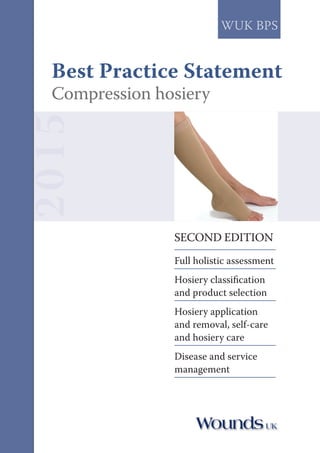
Best Practice Statement
Compression hosiery
Full holistic assessment
Hosiery classification
and product selection
Hosiery application
and removal, self-care
and hosiery care
Disease and service
management
SECOND EDITION
2015
WUK BPS
BEST PRACTICE STATEMENT:
COMPRESSION HOSIERY
(2ND EDITION) 2015
PUBLISHED BY:
Wounds UK
A division of Schofield Healthcare
Media Limited, Enterprise House
1–2 Hatfields, London SE1 9PG, UK
Tel: +44 (0)20 7627 1510
Web: www.wounds-uk.com
© Wounds UK, March 2015
This document has been developed
by Wounds UK and is supported by
an educational grant from Activa
Healthcare.
The views expressed are those
of the expert working group and
review panel and do not necessarily
reflect those of Activa Healthcare.
How to cite this document:
Wounds UK Best Practice
Statement (2015)
Compression hosiery (2nd edn).
London: Wounds UK. Available
to download from:
www.wounds-uk.com
EXPERT WORKING GROUP:
Jackie Stephen-Haynes (Chair), Professor and
Consultant Nurse in Tissue Viability,
Birmingham City University and
Worcestershire Health & Care Trust
Leanne Atkin, Vascular Nurse Specialist,
Mid Yorks NHS Trust
Alan Elstone, Vascular Nurse Specialist,
Derriford Hospital
Lesley Johnson, Faculty Development Lead,
Royal Pharmaceutical Society
Ellie Lindsay, Independent Specialist
Practitioner; Visiting Fellow, Queensland
University of Technology
Caitriona O’Neill, Lymphoedema
Specialist, Accelerate CIC
Rebecca Elwell, Macmillan Lymphoedema
Certified Nurse Specialist, City General
Hospital; Oncology, Haematology &
Medical Physics Directorate, University
Hospital of North Midlands NHS Trust
Peter Vowden, Senior Vascular Surgeon, Bradford
Royal Infirmary; Clinical Director, NIHR
Healthcare Co-operative for Wound Prevention
and Treatment at Bradford Teaching Hospitals
NHS Foundation Trust; Visiting Professor in
Wound Healing Research, University of Bradford
Anne Williams, Lymphoedema Nurse
Consultant, NHS Highland Lymphoedema
Project and The Haven, Blantyre;
Director, Esklymphology
REVIEW PANEL:
The Lindsay Leg Club Foundation
Wound Care Alliance UK
Isobel MacEwan, Chairman, Talk Lipoedema
Elizabeth Nichols, Editor, Wound Essentials;
Tissue Viability Nurse Consultant,
Epsom and St Helier University Hospital
Kathryn Vowden, Nurse Consultant, Acute and
Chronic Wounds, Bradford Teaching Hospitals
NHS Foundation Trust
Trudie Young, Tissue Viability Nurse (Hon),
Aneurin Bevan Health Board, Wales; Trustee,
The Lindsay Leg Club Foundation
1BEST PRACTICE STATEMENT: COMPRESSION HOSIERY
Compression hosiery is used to manage
conditions associated with chronic venous
insufficiency, including post-thrombotic
syndrome, varicose veins, venous eczema,
lipodermatosclerosis, and swelling in the legs
associated with pregnancy (NICE, 2012). It is
also effective as part of an integrated, multi-
faceted approach to managing oedema, as it
has been demonstrated to help improve skin
integrity, restore limb shape and enhance
patient quality of life (Osborne, 2009).
Compression hosiery options vary in
degrees of compression, fabric, stiffness,
size, length, and whether they are closed-
or open-toe; these variances can lead to
inconsistency in the way compression
hosiery is selected and prescribed (NICE,
2012). Additionally, a large amount of care is
delivered by non-qualified staff and carers,
who may lack knowledge of the principles
of compression. Users therefore need to be
supported with a multidisciplinary approach
that involves patients, healthcare practitio-
ners, pharmacists, social care organisations
and others.
All healthcare practitioners (HCPs) need
to work as part of a multidisciplinary team
(MDT) to optimise prevention, manage-
ment and maintenance therapy in venous
disease and chronic oedema. Furthermore,
practitioners and patients alike face the same
challenges when using compression hosiery
in practice, as outlined in Figure 1 — it is
important that members of the MDT keep
these challenges in mind when creating a
patient-centred partnership that will encour-
age concordance with compression hosiery.
Registered and non-registered HCPs and
carers need clear, concise guidance about how
to appropriately assess for, choose and apply
compression hosiery. There is also a need for
guidance regarding managing patients within
an MDT service, in which the role of each
member is clearly defined, to optimise therapy
and support for patients with venous disease
and chronic oedema (Appendix 1, p18).
This second edition of Best practice state-
ment: Compression hosiery aims to provide
that guidance. A broad range of informa-
tional sources have been reviewed and
distilled. During the peer-review process, a
panel of experts — including tissue viability,
vascular and lymphoedema specialists — has
discussed, commented and agreed this text in
order to produce a document that provides
practical information for clinical decision-
making, key principles of best practice and
tools for everyday use.
To guide practice and encourage a consis-
tent and cohesive approach to care, this
best practice statement covers the following
areas of concern to HCPs who work with
patients who use compression hosiery:
■ 	Full holistic assessment (p2)
■ 	Hosiery classification and product
selection (p5)
■ 	Hosiery application and removal,
self-care and hosiery care (p10)
■ 	Disease and service management (p14)
■ 	Roles and competencies (p18)
■ 	Decision-making algorithm (p20).
Jackie Stephen-Haynes
Chair
INTRODUCTION
Developing best practice for
compression hosiery
GUIDE TO USING THIS
DOCUMENT
Each section offers advice
about creating a patient-
centred experience
when assessing for,
selecting, prescribing
and delivering care with
compression hosiery. The
best practice statements,
their rationales, and
how to demonstrate
best practice appear at
the end of each of the
four sections. There are
also two appendices:
roles and competencies,
elucidating the
contributions that may
be possible for members
of the multidisciplinary
team, and a clinical
decision-making
algorithm, for guiding
clinical and service
management.
Figure 1. Challenges in
compression hosiery
Practitioner key concerns
Patient key concerns
Practitioner/patient concerns
Education
Comfort
Dexterity
Communication
Consistency
Removal
Self-care
BEST PRACTICE STATEMENT: COMPRESSION HOSIERY2
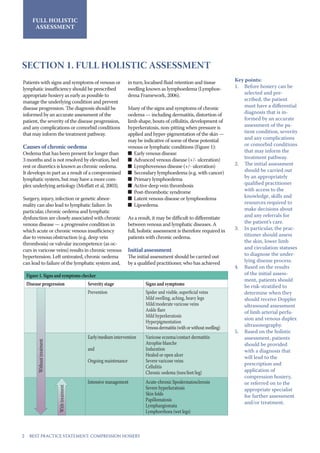
Figure1.Signsandsymptomschecker
Disease progression Severity stage Signs and symptoms
Prevention Spider and visible, superficial veins
Mild swelling, aching, heavy legs
Mild/moderate varicose veins
Ankle flare
Mild hyperkeratosis
Hyperpigmentation
Venousdermatitis(withorwithoutswelling)
Early/medium intervention
and
Ongoing maintenance
Varicose eczema/contact dermatitis
Atrophie blanche
Induration
Healed or open ulcer
Severe varicose veins
Cellulitis
Chronic oedema (toes/feet/leg)
Intensive management Acute-chronic lipodermatosclerosis
Severe hyperkeratosis
Skin folds
Papillomatosis
Lymphangiomata
Lymphorrhoea (wet legs)
SECTION 1. FULL HOLISTIC ASSESSMENT
FULL HOLISTIC
ASSESSMENT
Patients with signs and symptoms of venous or
lymphatic insufficiency should be prescribed
appropriate hosiery as early as possible to
manage the underlying condition and prevent
disease progression. The diagnosis should be
informed by an accurate assessment of the
patient, the severity of the disease progression,
and any complications or comorbid conditions
that may inform the treatment pathway.
Causes of chronic oedema
Oedema that has been present for longer than
3 months and is not resolved by elevation, bed
rest or diuretics is known as chronic oedema.
It develops in part as a result of a compromised
lymphatic system, but may have a more com-
plex underlying aetiology (Moffatt et al, 2003).
Surgery, injury, infection or genetic abnor-
mality can also lead to lymphatic failure. In
particular, chronic oedema and lymphatic
dysfunction are closely associated with chronic
venous disease ­— a progressive condition in
which acute or chronic venous insufficiency
due to venous obstruction (e.g. deep vein
thrombosis) or valvular incompetence (as oc-
curs in varicose veins) results in chronic venous
hypertension. Left untreated, chronic oedema
can lead to failure of the lymphatic system and,
in turn, localised fluid retention and tissue
swelling known as lymphoedema (Lymphoe-
dema Framework, 2006).
Many of the signs and symptoms of chronic
oedema — including dermatitis, distortion of
limb shape, bouts of cellulitis, development of
hyperkeratosis, non-pitting when pressure is
applied and hyper-pigmentation of the skin —
may be indicative of some of these potential
venous or lymphatic conditions (Figure 1):
■	 Early venous disease
■	 Advanced venous disease (+/- ulceration)
■	 Lymphovenous disease (+/- ulceration)
■	 Secondary lymphoedema (e.g. with cancer)
■	 Primary lymphoedema
■	 Active deep vein thrombosis
■	 Post-thrombotic syndrome
■	 Latent venous disease or lymphoedema
■	Lipoedema.
As a result, it may be difficult to differentiate
between venous and lymphatic diseases. A
full, holistic assessment is therefore required in
patients with chronic oedema.
Initial assessment
The initial assessment should be carried out
by a qualified practitioner, who has achieved
Key points:
1.	 Before hosiery can be
selected and pre-
scribed, the patient
must have a differential
diagnosis that is in-
formed by an accurate
assessment of the pa-
tient condition, severity
and any complications
or comorbid conditions
that may inform the
treatment pathway.
2.	 The initial assessment
should be carried out
by an appropriately
qualified practitioner
with access to the
knowledge, skills and
resources required to
make decisions about
and any referrals for
the patient’s care.
3.	 In particular, the prac-
titioner should assess
the skin, lower limb
and circulation statuses
to diagnose the under-
lying disease process.
4.	 Based on the results
of the initial assess-
ment, patients should
be risk-stratified to
determine when they
should receive Doppler
ultrasound assessment
of limb arterial perfu-
sion and venous duplex
ultrasonography.
5.	 Based on the holistic
assessment, patients
should be provided
with a diagnosis that
will lead to the
prescription and
application of
compression hosiery,
or referred on to the
appropriate specialist
for further assessment
and/or treatment.
Withouttreatment
Withtreatment
3BEST PRACTICE STATEMENT: COMPRESSION HOSIERY
the necessary competencies, and has access to
the knowledge, skills and resources required to
make decisions and referrals for the patient’s
care (Appendix 1, p18). The practitioner must
undertake and document a holistic assessment
of the patient and limb with the goals of com-
pleting a full assessment, reaching an accurate
diagnosis regarding the condition and stage of
disease (Figure 1, p2), providing an appropriate
service and treatment in primary care settings,
and referring appropriately to secondary care or
other specialist services.
Patients should receive a comprehensive assess-
ment within 10 working days of presentation
with symptoms to establish the underlying aeti-
ology of venous or oedema-related skin changes
(Wounds UK Guidelines for Practice, 2013).
When deemed urgent, assessment should be
done within 3 working days. Triage by phone or
remote video can be done to aid prioritisation.
Components of holistic assessment
On presentation, a comprehensive assessment
should be taken, beginning with a detailed
history, including past medical and surgical his-
tory, history of limb trauma and skin infection,
medications (e.g. steroids), concurrent illnesses,
a family history of venous disease or limb swell-
ing, and ankle mobility (Partsch, 2003). The
practitioner should assess the skin, lower limb
and circulation statuses to help diagnose the
underlying disease process (Table 1) (Lymphoe-
dema Framework, 2006).
Wellbeing, quality of life and lifestyle factors
— such as occupation, mobility, obesity status,
history of previous ulceration, interests and
limitations to daily activities — should also be
assessed and, if possible, addressed, to manage
patient expectations of treatment outcomes
(Keeley, 2008; Upton, 2013). Age should also be
a consideration, as incidence of venous disease
increases with older age, and intervention at an
early stage is important.
Other patient-specific factors include sleep
status, nutrition status, psychological and social
impact, weight and wound history. Patients
should be assessed for their understanding of
the role of hosiery in disease treatment, the
need to wear hosiery long-term and how they
will apply/remove hosiery, because concordance
with hosiery is critical to good outcomes.
Vascular assessment
Doppler ultrasound for ankle-brachial pressure
index (ABPI) is considered the standard tool for
vascular assessment to rule out arterial involve-
ment (RCN, 2006; SIGN, 2010). Compression is
contraindicated where there is significant arterial
disease (e.g. ABPI<0.5, critical ischaemia) (SIGN,
FULL HOLISTIC
ASSESSMENT
Table 1. Components of assessment
Skin Limb Circulation
Hydration (e.g. dryness) Mobility and ankle movement Vascular history
Pigmentation/
lipodermatosclerosis
Measurement of limb circumference Deep vein thrombosis history
Fragility Measurement of limb volume,
or series of circumference
measurements
Presence of spider veins/ankle flare
Presence of itch Feet (e.g. whether oedema
is present in feet, or feet are
unaffected, as seen in lipoedema)
Diagnostic testing (e.g. Doppler
ankle-brachial pressure index,
duplex ultrasound)
Deepened skin folds Oedema above the knee, in the
thigh or involving the trunk
Erythema/pallor/cyanosis
Fungal infection Shape of both limbs (e.g. oedema is
generalised, unilateral, bilateral)
Warmth/coolness
Scarring related to previous surgery
or trauma
Ulcer in the gaiter area or evidence
of healed ulcer
Skin changes (e.g. fibrosis, hyper-
keratosis, ulceration)
Risk factors for or comorbidities
associated with circulatory disease
Signs of cellulitis Discomfortrelatedtovaricoseveins
BEST PRACTICE STATEMENT: COMPRESSION HOSIERY4
FULL HOLISTIC
ASSESSMENT
BPS APPLICATION TO PRACTICE: ASSESSMENT
Best practice statement (BPS) Reason for BPS How to demonstrate best practice
Before hosiery can be selected and pre-
scribed, the patient must have a diagnosis
that is informed by an accurate assessment
of the patient condition, severity and any
complications or comorbid conditions
To ensure that the correct treatment
pathway will be followed
Ensure a full holistic assessment has been carried out by documenting
its components and the resulting diagnosis in the patient’s case notes.
Include past medical history, hosiery history, diagnostic test results
and clinical signs of disease. This may, where relevant, record hosiery
history, sensitivity history, and any patient preferences
The initial assessment should be carried out
by an appropriately qualified practitioner with
access to the knowledge, skills and resources
required to make decisions about care and
referrals if required
To ensure patients receive appropri-
ate, multidisciplinary care on an
ongoing basis
The practitioner should be trained and competent in assessment,
diagnosis and appropriate care planning, referring to specialist
services where necessary
Based on the results of the initial and
vascular assessment, patients should be
risk-stratified
Todeterminewhenfurtherdiagnostic
testing,suchasDopplerorduplex,is
needed
Document the results of risk-stratification assessment in the patient
record, making particular note of the rationale for the decision and
outlining the care plan to be followed
Based on the holistic assessment, patients
should be provided a diagnosis that will
lead to the prescription and application of
compression hosiery, or referred on to the
appropriate specialist for further assessment
and/or treatment
To ensure the patient receives appro-
priate compression hosiery or is seen
by the appropriate specialists
Document the diagnosis resulting from holistic assessment in
the patient record, making particular note of the rationale for the
decision and outlining the care plan to be followed
2010) or where arterial disease is suspected. These
patients should be therefore be referred for assessment
and further diagnostic testing by a vascular specialist
to determine adequacy of blood flow in the limb:
■	If ABPI is carried out by the initial assessing prac-
titioner, the patient should be referred if <0.9 or
>1.3–1.5, depending on the results of the holistic
assessment (SIGN, 2010; NICE, 2014).
■	Where the results of the assessment lead the
practitioner to suspect arterial disease, e.g. painful
cramping in leg muscles during activity, leg numb-
ness or weakness, change in colour of legs, shiny
skin on legs, hair loss or slower hair growth on feet
and legs, slower growth of toenails.
■	All patients presenting with a venous leg ulcer
should be referred to either a specialist leg ulcer
clinic or a vascular team (NICE, 2014; Wounds UK
Guidelines for Practice, 2013).
■	Patients at risk of (e.g. due to diabetes, immobility)
or presenting with lower-limb signs or symptoms,
who require compression at a level of higher than
18mmHg, should undergo a full vascular assess-
ment with a specialist before hosiery is prescribed.
■	Where very oedematous limbs make ABPI difficult
to carry out, and access to a non-vascular practitio-
ner skilled in carrying out and interpreting an ABPI
reading may be limited. These patients should be
referred to a vascular specialist for further evalu-
ation (e.g. duplex ultrasonography) to determine
treatment in line with the underlying disease.
■	If under the care of a lymphoedema specialist,
ABPI may be deemed inappropriate due to the
distribution of oedema or presence of advanced
disease. In such cases, all other aspects of a full
vascular assessment should be carried out by a
practitioner who has achieved competence in this
area and can confidently determine suitability for
compression. Consultation with a vascular special-
ist is recommended.
■	Younger patients (e.g. 20 to 30 years old) may
have high ABPI readings that are not indicative
of vascular insufficiency; these patients should be
referred for vascular assessment only if other risk
factors are present, not based on ABPI alone (Al-
Qaisi et al, 2009).
■	For patients who are deemed low risk for arterial
insufficiency, hosiery ≤17mmHG can be issued
without a full vascular assessment (see page 6,
column 1, for more information). Such patients
will still require monitoring. This may not be a
long-term option, as venous, lymphatic and arterial
status could deteriorate over time. The patient may
in future require a full vascular assessment, special-
ist review and change of treatment.
It is important to consider local guidelines when
determining whether to refer a patient to a specialist.
Patients who have had a vascular assessment should
be sent for regular, subsequent assessments incorpo-
rating Doppler, usually at 3-, 6- or 12-month intervals,
depending on initial and ongoing assessment out-
comes, patient needs, or according to local guidelines
(NICE, 2014). Those at high risk of arterial disease
should be monitored and reassessed more frequently.
5BEST PRACTICE STATEMENT: COMPRESSION HOSIERY
SECTION 2: HOSIERY CLASSIFICATION AND
PRODUCT SELECTION
Hosiery must be selected based on the
outcomes of the holistic assessment, and
according to the goals of treatment. Product
selection should also take into account limb
size and shape (measurements and availability
of appropriately sized hosiery), the strength
and stiffness of the garment, skin condition,
allergies and sensitivities, and patient consid-
erations (e.g. dexterity, psychosocial issues).
Construction of compression hosiery
Hosiery materials may be inelastic (also
known as short-stretch) or elastic. Inelas-
tic compression hosiery is favoured for
those with chronic oedema, as the fabric
does not yield to expansion related to the
oedema. Hosiery can be constructed in two
ways: circular-knit or flat-knit. Both types
are used in the UK; in some parts of Europe
and for the management of lymphoedema,
flat-knit is predominantly used (Anderson
and Smith, 2014).
Circular-knit
The fabric is knitted on a cylinder with cir-
cular needles and has no seam. The fabric
tends to be finer, which patients often find
more cosmetically acceptable. Circular-knit
is generally used to create ready-to-wear
hosiery (although it can be used for made-
to-measure hosiery) and is most suitable
where there is no or minimal limb distor-
tion due to oedema (Anderson and Smith,
2014).
Flat-knit
The edges of a flat fabric are sewn together,
creating a seam. The fabric tends to be
relatively thick and stiff, which lets it lie
across skin folds without cutting into the
skin. Flat-knit is usually used for made-to-
measure garments because it can be more
readily adapted to limb shape distortion
(Lymphoedema Framework, 2006).
Hosiery available in standard sizes, which
may not be appropriate for all patients or
limb sizes/shapes, is known as ‘ready to
wear’. Where the patient does not fit into
standard sizing, made-to-measure hosiery
can be ordered and customised according
to the measurements and shape of the limb
being treated.
HOSIERY
CLASSIFICATION
AND PRODUCT
Key points:
1.	 Hosiery may be inelas-
tic or elastic, may be
circular- or flat-knit,
and may be available
off the shelf or made to
measure.
2.	 The manufacturers of
medical and support
hosiery follow different
manufacturing stan-
dards, which describe
methods used to char-
acterise the graduated
compression applied
to the lower limb by
compression hosiery.
3.	 Compression hosiery
may be used in patients
with either venous dis-
ease for primary pre-
vention, early/medium
intervention, intensive
management and ongo-
ing maintenance/sec-
ondary prevention.
4.	 In patients with
chronic oedema, the
key function of hosiery
is ongoing maintenance
and prevention of pro-
gression.
5.	 Compression hosiery
works only if measure-
ments are correct and
hosiery is subsequently
selected, applied and
worn correctly.
6.	 Patient-specific factors
should be taken into
consideration as part
of a patient-centred
approach.
7.	 To support patients in
making a choice, prac-
titioners must know
what hosiery choices
are available and be
able to instruct the
patient on the various
ways to don, doff and
care for hosiery.
Classes of compression hosiery
The manufacturers of medical and sup-
port hosiery follow different standards,
which describe the medical support or
compression applied to the lower leg by
compression hosiery, and focus on in vitro
measurement of the pressures likely to
be applied at various points on the limb
(Lymphoedema Framework, 2006).
Stiffness ­—­defined as the pressure in-
crease produced by compression hosiery
per 1cm of increase in leg circumference —
is, in more simple terms, the ability of the
bandage/stockings to oppose the muscle
expansion during contraction (Mosti,
2012). The stiffness of the compression
hosiery material therefore affects the com-
pression levels exerted by different types
and classes of hosiery.
The compression measured at the ankle is
used to classify the hosiery into compres-
sion classes; however, the pressure range
used to define each class varies between
the different standards, and different tech-
niques are used to measure compression
(Lymphoedema Framework, 2006).
Because the various classes may not cor-
relate to one another, it is important to
understand the terminology, classes and
corresponding compression levels for dif-
ferent hosiery types (Table 1, p6).
Functions of compression hosiery
Compression hosiery may be used in pa-
tients with either venous disease for prima-
ry prevention, early/medium intervention,
intensive management and ongoing main-
tenance/secondary prevention. In patients
with chronic oedema, the key function of
hosiery is ongoing maintenance.
Different classes of hosiery should be used
at different stages of disease progression,
depending on the conditions and symp-
toms present, and whether or not oedema
is present (Figure 1, p6).
Primary prevention
Prevention is a key NHS strategy for
maintaining public health and minimising
HOSIERY
CLASSIFICATION
AND SELECTION
BEST PRACTICE STATEMENT: COMPRESSION HOSIERY6
the burden on healthcare (Wounds UK
Guidelines for Practice, 2013). Successful
prevention of ulceration, chronic oedema
or lymphoedema depends on early patient
presentation. However, awareness of early
signs of venous disease, chronic oedema
and lymphoedema is poor, and patients
often delay in presenting (Wounds UK
Guidelines for Practice, 2013).
Compression hosiery may also be used
when there are early signs of lymphoede-
ma (to prevent further swelling) or venous
insufficiency (to prevent ulcer develop-
ment), or for the prevention of deep vein
thrombosis in at-risk patients (e.g. due to
surgery) (NICE, 2014).
Many of these patients can be prescribed
14–17mmHg without a full vascular
assessment, to avoid delays in applying
compression. (The responsibility regard-
ing this decision rests with the hosiery
prescriber.) In addition, this level of
compression is generally safe to use, as
it is low strength, classified as ‘support
hosiery’, and available over the counter.
However, this may not be a long-term
solution, and these patients should be
monitored regularly.
Patients who are candidates for immediate
14–17mmHg prescription should have:
■■ A diagnosis
■■ Intact sensation
■■ No signs of critical limb ischaemia
■■ Appropriate build (poor shape/size of
the limb can contraindicate)
■■ Risk of swelling (e.g. pregnancy).
HOSIERY
CLASSIFICATION
AND PRODUCT
Table 1. Classes of compression hosiery terminology
Compressionclass British standard* European classifications*
Class 1 14–17mmHg 18–21mmHg
Class 2 18–24mmHg 23–32mmHg
Class 3 25–35mmHg 34–46mmHg
Class 4 ­Not available 49–70mmHg (not commonly used by non-specialists)
Class 4 super Not available 60–90mmHg(notcommonlyusedbynon-specialists)
Figure 1. Functions of compression hosiery (Timmons and Bianchi, 2008)
With oedema
18–21 mmHg
•	Off-the-shelf
•	Flat-knit
made-to-
measure
22–32 mmHg
•	Off-the-shelf
•	Flat-knit made-
to-measure
34–46 mmHg
•	Off-the-shelf
40mmHg
(hosiery kit)
34–46mmHg
•	Flat-knit made-
to-measure
Without oedema
14–17 mmHg
•	Off-the-shelf
•	Circular knit/
made-to-measure
18–24 mmHg
•	Off-the-shelf
•	Circular knit/
made-to-measure
18–24 mmHg
•	Off-the-shelf
•	Circular knit/
made-to-measure
25–35 mmHg
•	Off-the-shelf
•	Circular knit/
made-to-measure
40mmHg (hosiery
kit)
40mmHg (hosiery
kit), if appropriate
Ongoing maintenance and early/medium intervention
Conditions
Primary prevention
• Spider and visible superficial veins
• Tired, aching, heavy legs
• Mild to moderate varicose veins
• Ankle flare
• Mild hyperkeratosis
• Hyperpigmentation
• Venous dermatitis
• Varicose eczema/contact
dermatitis
• Atrophie blanche
• Severe varicose veins
• Moderate hyperkeratosis
• Healed ulcer
• Recurring ulcer
• Cellulitis
• Chronic oedema (toes, feet, leg)
Intensive management
• Acute or chronic
lipodermatosclerosis
• Severe hyperkeratosis
• Skin folds
• Papillomatosis
• Lymphangiomata
• Lymphorrhoea (wet legs)
• Lymphoedema/lipoedema
(BNF, 2015) | *Quality and test specifications carried out according to national norms
HOSIERY
CLASSIFICATION
AND SELECTION
7BEST PRACTICE STATEMENT: COMPRESSION HOSIERY
HOSIERY
CLASSIFICATION
AND PRODUCT
If the patient has a history of peripheral arte-
rial disease but is otherwise asymptomatic,
Class I may be implemented, along with
onward referral for specialist assessment.
Depending on the severity of symptoms, a
Doppler/duplex scan may be advised after
prescription of Class I hosiery to confirm the
outcomes of the clinical examination. Lack
of dexterity or a carer who can apply hosiery
may contraindicate prescription of compres-
sion that can be applied at home.
Ongoing maintenance
Compression hosiery is most commonly
used post-ulcer healing to control oedema
and reduce venous hypertension, both
of which help prevent ulcer recurrence
(secondary prevention) (Anderson and
Smith, 2014). Patients are also commonly
post-thrombotic. In patients with chronic
oedema and lymphoedema, all use of
compression hosiery is considered to be
ongoing maintenance, to control oedema,
with some reduction if possible.
Any patient who will be prescribed pressures
≥18mmHg (e.g. Class II British standard,
European class I or higher) for ongoing
maintenance or intensive management (see
next section) should undergo vascular as-
sessment and may require further diagnostic
testing before prescription or compression
application.
Intensive management
Compression bandaging historically has
been considered the gold-standard treat-
ment for venous ulceration (Ashby et al,
2014). However, for patients who find ban-
dages difficult to tolerate or who have low-
exuding ulcers, recent research indicates
that hosiery kits may provide an equally ef-
fective alternative for treating active ulcers.
In the multicentre, randomised, controlled
VenUS IV trial, 453 participants randomly
allocated into hosiery kits (230) and bandag-
ing (223) groups finished the trial. Median
time to ulcer healing was 99 days in the
hosiery group (70.9% healed ulcers) and 98
days in the bandaging group (70.4% healed),
indicating that both compression hosiery
and the ‘gold standard’ of VLU treatment
may be equally effective during the intensive
management phase (Ashby et al, 2014).
Furthermore, the researchers’ economic
analysis found that the average mean costs
were about £300 lower per participant
per year in the hosiery group than in the
bandage group (Ashby et al, 2014), mak-
ing compression hosiery a potentially more
cost-effective option.
Although participants “had more complaints
about discomfort with hosiery,” Ashby et al
(2014) did note “a significant reduction in
recurrence in people allocated to hosiery,”
which might support the idea that patients
who became used to wearing hosiery as an
ulcer treatment would be “more likely to
wear it as a maintenance treatment after
healing and therefore reduce their risk of ul-
cer recurrence”. The authors concluded that
“increased use of hosiery as a treatment is
likely to result in substantial savings for the
NHS and improved quality of life for people
with venous ulcers” (Ashby et al, 2014).
Box 1. Tips for hosiery measurement
■■ Take measurements as early in the morning as possible, when oedema is at a minimum
■■ Take measurements directly against the skin to ensure accuracy (use a skin marker to ensure reproducability and accuracy)
■■ Take measurements for each leg as they may differ in size
■■ Take measurements when the patient is sitting down, with feet flat on the floor
■■ Use the correct measuring guide for the brand of hosiery to be prescribed, as each manufacturer will vary
■■ If the patient has skin folds due to oedema, or the limb is particularly misshapen, a specialist flat-knit garment and, therefore, referral for
specialist assessment may be required
■■ If a patient feels uncomfortable or embarrassed when having their legs measured, try to make them feel more at ease by:
•	 Taking the measurements in a private area
•	 Explaining how you are going to measure their legs before you start, including how far up the leg you will need to measure for thigh-length
hosiery
•	 Explaining why it is important to get the right size hosiery so that it works properly
•	 Explaining what you are doing at each stage
HOSIERY
CLASSIFICATION
AND SELECTION
BEST PRACTICE STATEMENT: COMPRESSION HOSIERY8
Compression hosiery kits have an inner
layer (liner) that delivers approximately 10–
20mmHg to the limb (depending on manu-
facturer specifications). A higher-pressure
hosiery garment is then applied to increase
pressure to the limb, usually up to 40mmHg in
total. The inner layer helps the stronger outer
layer to be applied more easily, as it provides
a smoother surface than skin. However, these
kits may be difficult to apply over some dress-
ings, especially if they are bulky or there is a
high level of exudate present. When there is
severe oedema present, compression bandag-
ing may be worn to improve the management
of oedema and exudate levels before applica-
tion of compression hosiery.
Measurement and sizing
Compression hosiery works only if measure-
ments are correct and hosiery is subsequently
applied correctly. Legs should therefore be
measured and hosiery prescribed according
to each manufacturer’s own measuring guide,
as sizes vary according to manufacturer. Every
effort should be made to reduce oedema
before hosiery is measured. In most cases,
bandaging should be used short-term dur-
ing the intensive management phase to help
reshape the limb and/or treat the ulcer. Once
the ulcer has healed and oedema has reduced,
patients can be measured for hosiery (Box 1,
p7) and prescribed a garment that will deliver
sufficient pressure to control oedema on an
ongoing basis.
If a patient does not fit into the measure-
ments on the manufacturer’s sizing chart
for standard sizes, customised (‘made-to-
measure’) hosiery should be prescribed. This
may require referral to a practitioner with
knowledge of how to correctly measure for
made-to-measure garments. Current suppli-
ers are outlined in the drug tariffs for England
and Wales, Scotland and Northern Ireland
(BNF, 2014).
Patient considerations
Patient-specific factors should be taken into
consideration but, more than that, a patient-
partnership approach should be taken (Box
2). The practitioner should speak in clear
language patients can easily understand, to
encourage shared decision-making.
Identify the focus of the consultation. The
patient needs to know what to expect at
each stage. Encourage patients to return to
the same pharmacy, nurse or GP for repeat
assessment; explain that hosiery should be
removed at bedtime, but may be worn up to
7 days before bedtime removal and morning
reapplication if necessary, based on appropri-
ate assessment and advice. Patients also need
to be aware that patient choice cannot always
be 100% accommodated, that there may have
to be some balance between clinical need and
patient preference. This can enhance concor-
dance, because patients will understand what
the trade-offs are for effective care.
Discuss modification of treatment to use a
lower class if high compression is not tol-
erated, but also explain that, over time, as
tolerance builds, compression levels may also
HOSIERY
CLASSIFICATION
AND PRODUCT
Box 2. Patient-specific
considerations
■■ Mobility
■■ Dexterity
■■ Skin status (friable skin
should not be a contra-
indication, but should be
approached with caution)
■■ Limb shape
■■ Site of oedema
■■ Weight status/build
■■ Sex
■■ Age
■■ Comorbidities
■■ Other regular/ongoing
treatments (e.g. podiatry
care for diabetic foot)
■■ Preference for open- versus
closed-toe hosiery
■■ Ability with/preference for a
particular application aid
■■ Ability to self-care/-manage
■■ Availability of help/
assistance
■■ Ability of carer
■■ Psychosocial factors
■■ Colour preference
■■ Whether the patient will
need/can afford to buy extra
pairs
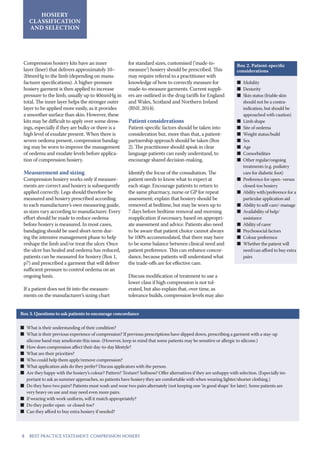
Box 3. Questions to ask patients to encourage concordance
■■ What is their understanding of their condition?
■■ What is their previous experience of compression? If previous prescriptions have slipped down, prescribing a garment with a stay-up
silicone band may ameliorate this issue. (However, keep in mind that some patients may be sensitive or allergic to silicone.)
■■ How does compression affect their day-to-day lifestyle?
■■ What are their priorities?
■■ Who could help them apply/remove compression?
■■ What application aids do they prefer? Discuss applicators with the person.
■■ Are they happy with the hosiery’s colour? Pattern? Texture? Softness? Offer alternatives if they are unhappy with selection. (Especially im-
portant to ask as summer approaches, so patients have hosiery they are comfortable with when wearing lighter/shorter clothing.)
■■ Do they have two pairs? Patients must wash and wear two pairs alternately (not keeping one ‘in good shape’ for later). Some patients are
very heavy on use and may need even more pairs.
■■ If wearing with work uniform, will it match appropriately?
■■ Do they prefer open- or closed-toe?
■■ Can they afford to buy extra hosiery if needed?
HOSIERY
CLASSIFICATION
AND SELECTION
9BEST PRACTICE STATEMENT: COMPRESSION HOSIERY
BPSapplicationtopracticehosieryclassificationandproductselection
Best practice statement (BPS) Reason for BPS How to demonstrate best practice
Oncevenousdiseaseorchronicoedemais
confirmed,hosierymustbeselectedbasedon
theoutcomesoftheholisticassessment,and
accordingtothegoalsoftreatment
To ensure that the patient receives the most
appropriate, optimised care for his or her
condition
Document the care plan to be followed, in line with
the diagnosis
Product selection should also take into
account limb size and shape, the strength
and stiffness of the garment, and patient
considerations
Because hosiery may be inelastic or elastic,
may be circular- or flat-knit, and may be
available off the shelf or made to measure,
and the manufacturers of medical and
support hosiery follow different standards
for construction
The practitioner should be competent in knowledge
regarding hosiery construction: the different classes,
standards and strengths of hosiery; the indications
associated with these different types of hosiery; and
how to accommodate patient considerations while
optimising hosiery choice
Patient-specific factors should be taken into
consideration as part of a patient/practitioner-
partnership approach
To encourage patients to be part of the
conversation about their care; to promote
ownership and self-management of the
condition
Thepractitionershouldspeakinclearlanguagepatients
caneasilyunderstand,andengagepatientsbydiscussing
therangeoftreatmentoptions,thetrade-offwithlower
compression,andcompromise
Practitionersmustknowwhathosierychoices
areavailable,beabletoadviseaccordingtothe
patient’sconditionandlimbshape,andbeaware
oftheweartimesforhosiery(typicallytwopairs
every6months)
To support patients in making a choice The practitioner should be competent in knowledge
regarding hosiery choices, how they affect the
patient’s condition, and the practical factors that may
affect hosiery choice in relation to patient condition
be increased. Practitioner and patient alike
should understand that compression is an
ongoing treatment that needs to be worn long-
term, just as long-term medication regimens
should be adhered to.
A patient may require open-toe hosiery
because:
■■ The patient has arthritic or clawed toes
■■ The patient has a fungal infection
■■ The patient prefers to wear a sock over the
compression hosiery
■■ The patient has a long foot size compared
with calf size (hosiery with longer foot-size
options available, if necessary)
■■ The patient requires regular podiatry/chi-
ropody appointments
■■ There is no oedema present in the toes, and
the patient prefers open-toe hosiery (NICE,
2012).
Ultimately, the hosiery selected should be
the patient’s choice. The practitioner’s job is
to explain the options and direct the patient
towards the clinically optimal choice, but
some compression is better than no compres-
sion, and patient concordance is crucial to
positive clinical outcomes. It is important that
the practitioner understand the psychosocial
issues that may result in non-concordance,
and that he or she try to identify these factors
(Box 3, p8).
Who selects and prescribes hosiery
To support patients in choosing, practitioners
must know what hosiery choices are available
and be able to instruct the patient on the vari-
ous ways to don and doff hosiery. The practi-
tioner should have an understanding of venous
and lymphatic disease processes, and be able
to advise according to the patient’s condition
and limb shape (British Lymphology Society
Tariff Costings Document, 2013).
Finally, the practitioner should prescribe two
pairs every 6 months (one to wash, one to
wear) to ensure effectiveness of compression,
regardless of the type of compression or class.
Prescriptions should be clearly and thoroughly
specified to ensure accurate dispensing.
HOSIERY
CLASSIFICATION
AND SELECTION
BEST PRACTICE STATEMENT: COMPRESSION HOSIERY10
HOSIERY
CLASSIFICATION
AND PRODUCT
SECTION 3. HOSIERY APPLICATION AND REMOVAL,
SELF-CARE AND HOSIERY CARE
Key points:
1.	 The practitioner who mea-
sured, selected and pre-
scribed the hosiery should
ideally be the one to guide
the patient through first
application/removal, and
to educate on application
at home, skin care under
compression and care of
the compression hosiery.
2.	 Hosiery or bandaging
should not be discontinued
until the new hosiery pre-
scription is in hand, and a
good fit has been ensured.
3.	 Precautions must be
taken with regard to skin
care under compression,
regardless of whether skin
is already fragile.
4.	 Skin care should be con-
sidered part of the overall
treatment plan, rather than
a discrete condition to be
managed on its own.
5.	 Advise patients in the care
of their hosiery, to extend
the effective life until re-
prescription is due.
6.	 Select removal/applica-
tion aids according to the
patient’s assistance needs.
The practitioner who measured, selected
and prescribed the hosiery should ideally
be the one to guide the patient through
first application, and to educate on appli-
cation at home, skin care under compres-
sion and care of the compression hosiery.
If this is not possible, another qualified
practitioner, who is educated in these fac-
ets of compression hosiery treatment and
has achieved the required competencies,
should guide the patient.
Fitting at first application
If the patient has a current compression
prescription, it should not be discontinued
until the new hosiery present. Even if the
patient is experienced with compression
hosiery, he or she should not independent-
ly apply compression hosiery for the first
time or if the prescription has changed.
This will let the practitioner judge whether
the prescribed hosiery fits correctly (Fig-
ures 1a–b; Box 1, p11).
Try to perform education around what
constitutes a good fit with a carer present,
if possible. First application of a hosiery
prescription should be done in a private
area, to protect patient dignity, and every
step of the experience should be explained.
In a social care setting, patients may wish
to have application performed within the
context of the group; the key is that they
be concordant with this option.
Many patients are elderly and may experi-
ence limited dexterity when trying to apply
compression hosiery. This may be over-
come by supplying them with a smooth, in-
ner toe liner (if the hosiery is open-toe) or
an aid to ease application and/or removal,
despite minimal grip strength.
The practitioner should demonstrate don-
ning and doffing, then help the patient
practise until they are competent at apply-
ing and taking off compression hosiery on
their own. If relevant, patients should also
be instructed on use of the chosen applica-
tion aid, and allowed to practise with it as
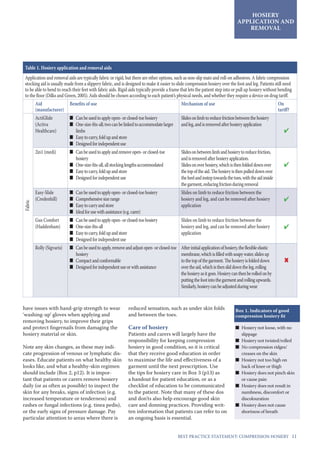
well (Table 1, pp11–12).
Application and removal aids are typically
fabric or rigid, but there are other options,
such as non-slip mats and roll-on adhesives.
A fabric compression stocking aid is usually
made from a slippery fabric, and is designed
to make it easier to slide compression ho-
siery over the foot and leg. Patients will still
need to be able to bend to reach their feet
with fabric aids.
Rigid aids typically provide a frame that lets
the patient step into hosiery or pull up gar-
ments without bending to reach the floor
(Dilks and Green, 2005). Aids should be
chosen according to each patient’s physical
needs, and whether they require a device
that is on drug tariff.
Skin care under compression
Precautions must be taken with regard
to skin care under compression, regard-
less of whether skin is already fragile. Skin
care should be considered part of hosiery
management and the overall treatment
plan, rather than a discrete condition to be
managed on its own.
Provide patients pragmatic advice about
skin care and skin changes to look for, and
take steps to prevent skin-related issues. For
example, prescribe an appropriate emollient
and soap substitute, if required, or prescribe
cotton-bonded hosiery, or skin-friendly
under-hosiery garments or heel-less socks
that can help protect skin and ease don-
ning and doffing — during which injuries
to the skin may occur. Advise patients who
HOSIERY
APPLICATION AND
REMOVAL
Figures 1a–b.
Examples of good
fit in compression
hosiery
11BEST PRACTICE STATEMENT: COMPRESSION HOSIERY
HOSIERY
APPLICATION AND
REMOVAL
have issues with hand-grip strength to wear
‘washing-up’ gloves when applying and
removing hosiery, to improve their grips
and protect fingernails from damaging the
hosiery material or skin.
Note any skin changes, as these may indi-
cate progression of venous or lymphatic dis-
eases. Educate patients on what healthy skin
looks like, and what a healthy-skin regimen
should include (Box 2, p12). It is impor-
tant that patients or carers remove hosiery
daily (or as often as possible) to inspect the
skin for any breaks, signs of infection (e.g.
increased temperature or tenderness) and
rashes or fungal infections (e.g. tinea pedis),
or the early signs of pressure damage. Pay
particular attention to areas where there is
reduced sensation, such as under skin folds
and between the toes.
Care of hosiery
Patients and carers will largely have the
responsibility for keeping compression
hosiery in good condition, so it is critical
that they receive good education in order
to maximise the life and effectiveness of a
garment until the next prescription. Use
the tips for hosiery care in Box 3 (p13) as
a handout for patient education, or as a
checklist of education to be communicated
to the patient. Note that many of these dos
and don’ts also help encourage good skin
care and donning practices. Providing writ-
ten information that patients can refer to on
an ongoing basis is essential.
Table 1. Hosiery application and removal aids
Application and removal aids are typically fabric or rigid, but there are other options, such as non-slip mats and roll-on adhesives. A fabric compression
stocking aid is usually made from a slippery fabric, and is designed to make it easier to slide compression hosiery over the foot and leg. Patients still need
to be able to bend to reach their feet with fabric aids. Rigid aids typically provide a frame that lets the patient step into or pull up hosiery without bending
to the floor (Dilks and Green, 2005). Aids should be chosen according to each patient’s physical needs, and whether they require a device on drug tariff.
Aid
(manufacturer)
Benefits of use Mechanism of use On
tariff?
Fabric
ActiGlide
(Activa
Healthcare)
■■ Canbeusedtoapplyopen-orclosed-toehosiery
■■ One-size-fits-all;twocanbelinkedtoaccommodatelarger
limbs
■■ Easytocarry,foldupandstore
■■ Designedforindependentuse
Slidesonlimbtoreducefrictionbetweenthehosiery
andleg,andisremovedafterhosieryapplication
4
2in1 (medi) ■■ Canbeusedtoapplyandremoveopen-orclosed-toe
hosiery
■■ One-size-fits-all,allstockinglengthsaccommodated
■■ Easytocarry,foldupandstore
■■ Designedforindependentuse
Slidesonbetweenlimbandhosierytoreducefriction,
andisremovedafterhosieryapplication.
Slidesonoverhosiery,whichisthenfoldeddownover
thetopoftheaid.Thehosieryisthenpulleddownover
theheelandinsteptowardsthetoes,withtheaidinside
thegarment,reducingfrictionduringremoval
4
Easy-Slide
(Credenhill)
■■ Canbeusedtoapplyopen-orclosed-toehosiery
■■ Comprehensivesizerange
■■ Easytocarryandstore
■■ Idealforusewithassistance(e.g.carer)
Slides on limb to reduce friction between the
hosiery and leg, and can be removed after hosiery
application
4
Gus Comfort
(Haddenham)
■■ Canbeusedtoapplyopen-orclosed-toehosiery
■■ One-size-fits-all
■■ Easytocarry,foldupandstore
■■ Designedforindependentuse
Slides on limb to reduce friction between the
hosiery and leg, and can be removed after hosiery
application
4
Rolly (Sigvaris) ■■ Canbeusedtoapply,removeandadjustopen-orclosed-toe
hosiery
■■ Compactandconformable
■■ Designedforindependentuseorwithassistance
Afterinitialapplicationofhosiery,theflexibleelastic
membrane,whichisfilledwithsoapywater,slidesup
tothetopofthegarment.Thehosieryisfoldeddown
overtheaid,whichisthensliddowntheleg,rolling
thehosieryasitgoes.Hosierycanthenberolledonby
puttingthefootintothegarmentandrollingupwards.
Similarly,hosierycanbeadjustedduringwear
6
Box 1. Indicators of good
compression hosiery fit
■■ Hosiery not loose, with no
slippage
■■ Hosiery not twisted/rolled
■■ No compression ridges/
creases on the skin
■■ Hosiery not too high on
back of knee or thigh
■■ Hosiery does not pinch skin
or cause pain
■■ Hosiery does not result in
numbness, discomfort or
discolouration
■■ Hosiery does not cause
shortness of breath
HOSIERY
APPLICATION AND
REMOVAL
BEST PRACTICE STATEMENT: COMPRESSION HOSIERY12
HOSIERY
APPLICATION AND
REMOVAL
Table 1. Hosiery application and removal aids (continued)
Aid
(manufacturer)
Benefits of use Mechanism of use On
tariff?
Rigid
Ableware Heel
Guide (Maddak)
■■ Canbeusedtoapplyopen-orclosed-toehosiery
■■ Extra-wideconeshape
■■ Handleswithmultiplegrippositions
■■ Canbedisassembledforstorage
Hosieryisfoldeddownovertheplasticcone,sothatthe
patientcaninsertthefoot,thenrolluphosieryusingthe
handles
4
Butler (medi) ■■ Canbeusedtoapplyopen-orclosed-toehosiery
■■ Reducesneedforbendingdown
■■ Comesinanextra-widesize(andwithlonghandleoption)
forlargerlimbs
Plastic-coatedmetalframestretcheshosierytomakeit
easiertostepintoandapply 4
Dorking
Stocking
Donner
(Homecraft
Rolyan)
■■ Extendablehandlesaidpatientswithlimitedreach
■■ Handlescanberotated90°,formultiplegrippositions
■■ Centralcolumnaccommodateslargerlimbsizesandhasa
ridgethatpreventsmovementduringapplication
■■ Reducesneedforbendingdown
Hosieryisfoldeddownovertheinnerplastic-coated
frame,sothatthepatientcaninsertthefoot,thenrollup
hosieryusingthehandles 4
Easy Fit (Juzo) ■■ Canbeusedtoapplyorremoveopen-orclosed-toehosiery
■■ Comesinanextra-widesizeforlargerlimbs
■■ Reducesneedforbendingdown
■■ Aidspatientswithpoordexterityorgripstrength
Hosieryisrolleddownovertheinnerplastic-coatedshaft,
sothatthepatientcaninsertthefoot,thenrollupthe
hosierybyliftingtheunit.Toremove,thepatientsteps
intothecolumn,rollsthetopofthehosieryovertheshaft,
securesitwithaclasp,andthenstepsoutofthehosiery
4
Easy-Lever
(Credenhill)
■■ Can be used to remove open- or closed-toe hosiery
■■ Reduces need for bending down
■■ Aids patients with poor dexterity or grip strength
Slides between hosiery and leg to push off rolled-
down garment 6
Easy Off (medi) ■■ Can be used to remove open- or closed-toe hosiery
■■ Reduces need for bending down
■■ Aids patients with poor dexterity or grip strength
Slides between hosiery and leg, with ridge that pushes
garment down and off 6
Ezy-As ■■ Canbeusedtoapplyopen-orclosed-toehosiery
■■ Comesin3sizesandadditionallengthforunassisted
application
Hosiery is folded down over plastic frame, so that the
patient can insert foot, then roll up hosiery 4
Ezy-on
Compression
StockingFrame
(TheHelping
HandCompany)
■■ Canbeusedtoapplyorremoveopen-orclosed-toehosiery
■■ Comesinanextra-widesizeforlargerlimbs
■■ Reducesneedforbendingdown
■■ Aidspatientswithpoordexterityorgripstrength
Hosieryisrolleddownovertheinnerplastic-coatedshaft,
sothatthepatientcaninsertthefoot,thenrollupthe
hosierybyliftingtheunit 6
Sockaid (Urgo
Medical)
■■ Canbeusedtoapplyopen-orclosed-toehosiery
■■ Canbeusedinoroutofbed
Hosiery is folded down over plasticised metal frame,
so that the patient can insert foot, then roll up hosiery
4
Miscellaneous
Gus Grip Mat
(Haddenham)
■■ Anti-slipmattoaidapplicationandremovalofhosiery Patientplacesfootonmatwhiledonningordoffing
hosiery,toavoidslipping
6
Gloves (various) ■■ Rubbergloveswithsoftinteriorliningstoaidgripduring
applicationandremovalofhosiery
Patient wears gloves for improved grip during
application and removal of hosiery
6
Roll-on adhesive
(various)
■■ Roll-onsubstancethathelpshosiery‘stick’tothelimbwhile
remainingpliable,andthatcanbewashedoffwithwater
Roll adhesive on to skin using the applicator bottle,
apply hosiery and press to secure
6
Box 2. Tips for good skin care
■■ Apply skin care products (e.g. emollients, topical corticosteroids) in the evening, after removing hosiery for bed
■■ Check skin daily (or as often as possible) for changes, including on the legs, toes/nails and interdigital spaces
■■ Gently elevate legs when resting to reduce pooling of oedema that can result in skin damage (high elevation is not necessary)
■■ Keep physically active to the fullest extent possible, depending on each patient’s specific situation
■■ Don hosiery first thing in the morning, when oedema is at its lowest levels, to help avoid skin damage and limb expansion
HOSIERY
APPLICATION AND
REMOVAL
13BEST PRACTICE STATEMENT: COMPRESSION HOSIERY
DISEASE AND
SERVICE
MANAGEMENT
BPS application to practice: Hosiery application and removal, self-care and hosiery care
Best practice statement (BPS) Reason for BPS How to demonstrate best practice
Thepractitionerwhomeasured,selected
andprescribedthehosieryshouldguide
thepatientthroughfirstapplication,
andeducateonapplicationathome,
skincareundercompressionandcareof
compressionhosiery
To ensure continuity of care
and that the practitioner has
the requisite specialist skills to
guide the patient in beginning
compression hosiery therapy
The practitioner should be able to demonstrate competence in
knowledge regarding hosiery application, skin care under compression
and care of compression hosiery
Hosiery or bandaging should not be
discontinued until the new hosiery
prescription is available, and a good fit
has been ensured
To ensure continuity of care,
and that the new prescription is
appropriate
Schedule a fitting appointment with the patient as soon after dispensing
as possible. Inspectthelimbforsignsofimproperfit.Helpthepatient
practiseapplicationandremoval,togetusedtothenewgarment.Document
theresultsoftheinspectionandthepatienteducationprovided
Even if the patient is experienced with
compression hosiery, he or she should
not independently apply compression
hosiery for the first time or if the
prescription has changed
To ensure the hosiery
prescription fits the limb
properly
Scheduleafittingappointmentwiththepatientassoonafterdispensingas
possible.Inspectthelimbforsignsofimproperfit.Helpthepatientpractise
applicationandremoval,togetusedtothenewgarment.Documentthe
resultsoftheinspectionandthepatienteducationprovided
Skin care should be considered part of
hosiery management and the overall
treatment plan, rather than a discrete
condition to be managed on its own
To prevent skin breakdown
under compression
Providepatientspragmaticadviceaboutskincareandskinchangestolookfor,
andtakestepstopreventskin-relatedissues.Documenttheeducationinthe
patient’snotes
Instruct patients to remove hosiery daily
(or as often as possible) to inspect the
skin for changes (e.g. breaks, signs of
infection and rashes)
Skin changes should be noted, as
these may indicate progression
of venous or lymphatic diseases
Educatepatientsonwhathealthyskinlookslike,andwhatahealthy-skin
regimenshouldinclude.Documenttheeducationprovidedinthepatient’s
notes
Instruct patients in the care
requirements of their hosiery
To extend the hosiery’s effective
life until re-prescription is due
Documenttheeducationprovidedinthepatient’snotes.Provideliteraturethat
patientscanrefertoifneededwhenself-applyingandremovinghosiery
✓	Be careful donning and removing over areas of hard skin
that can damage hosiery, or while wearing jewellery.
✓	Ensure legs are dry before putting on hosiery, to protect
skin and garment integrity. If the skin is fully intact and in
good condition, consider patting legs dry to absorb excess
moisture.
✓	Speak to the GP, a pharmacist or other relevant specialist if
compression hosiery is not fitting well.
✓	Follow the manufacturer’s wash and care instructions.
Note: Some garments can go in the normal wash, at lower
temperatures, although labels say hand-wash.
✓	Air-dry hosiery to maintain elasticity unless stated
otherwise.
✓	If applying or removing compression hosiery is too diffi-
cult, speak to the GP, pharmacist or other relevant special-
ist about being prescribed a new application aid.
✓	If there is new numbness to the toes, remove hosiery and
inform the GP or the practitioner who fitted the hosiery.
✓	See the GP immediately if the leg suddenly swells, there
is redness or warmth of the skin, new numbness or
tingling in the toes, fatigue in the leg or pain that may
increase when standing or walking. These are poten-
tial signs of a potentially life-threatening blood clot or
localised cellulitis infection. If the swelling increases so
that hosiery does not fit, removal of hosiery is necessary.
8	 Do not roll or fold down compression stockings during
wear; it hampers circulation and increases the risk of a
blood clot.
8	 Avoid applying emollients (e.g. lotions or creams) just be-
fore application of hosiery, as they can make the garment
harder to put on.
8	 Do not cut holes into the elastic or hold-up bands of
compression hosiery.
8	 Do not cut off the feet of the hosiery — discuss options
with the GP, pharmacist or other relevant specialist.
8	 Do not wear compression stockings while sleeping unless
specifically advised otherwise by a healthcare professional.
8	 Do not wear larger-sized compression hosiery without
speaking to the GP, pharmacist or other relevant specialist
about alternative options.
8	 Do not buy extra pairs of compression hosiery off
prescription unless you have been advised to do so by a
relevant practitioner.
8	 Do not double-layer compression hosiery unless specifi-
cally advised otherwise by a healthcare professional.
8	 Do not wear compression hosiery that has been prescribed
for someone else.
8	 Do not keep old hosiery after new pairs have been pre-
scribed, to avoid wearing over-stretched or ill-fitting
garments.
Box 3. Dos and don’ts of hosiery care
HOSIERY
APPLICATION AND
REMOVAL
BEST PRACTICE STATEMENT: COMPRESSION HOSIERY14
DISEASE AND
SERVICE
MANAGEMENT
Key points:	
1.	 The multidisciplinary
team (MDT) should be
involved in the ongoing,
comprehensive care
of the person with
compression hosiery,
with specialist referral
used where specific skills
are needed to add value
to care.
2.	 Roles should be linked
on a decision-making
and referral pathway to
ensure the right patients
are connected to clini-
cians with the appropri-
ate and necessary skills,
which more efficiently
uses time and resources.
3.	 The role of pharmacists
is changing, in terms of
their ability to act both as
a direct contact with the
patient and a care link
with MDT members.
4.	 Patients can be referred
to, or self-refer into, a
leg ulcer clinic, lower-leg
care service or Leg Club.
5.	 There should be
regular MDT contact
with patients prescribed
compression hosiery, to
monitor suitability
of treatment and its
outcome.
6.	 Based on the results of
the initial assessment,
patients should be risk-
stratified to determine
when they should receive
another holistic, compre-
hensive assessment.
7.	 When possible, patients
should take some
responsibility for their
care, supported by
practitioners taking a
caring and motivational
approach.
SECTION 4. DISEASE AND SERVICE MANAGEMENT
The multidisciplinary team (MDT) should be
involved in the ongoing, comprehensive care
of the person using compression hosiery, with
specialist referral used where specific skills
are needed to add value to care. Each MDT
member’s scope of practice should focus on
the skills and roles in which competency can
be reasonably/have been achieved, rather
than being narrowly limited by the constraints
of job titles. The patient and his or her journey
should be at the centre of all care provided in
the context of an MDT (Figure 1, p16).
Linking treatment roles
Thorough assessment improves the ability to
accurately diagnose and triage patients, with
referral back to GPs or onward as appropriate
to specialist services for patients with mixed
or arterial disease, or lymphoedema (Gard-
ner, 2013). In addition, patients with chronic
oedema are at increased risk of cellulitis,
which may require referral to a dermatologist
or hospital admission in acute cases (BLS/
LSN, 2006). Patients with these conditions
are not immediately suitable for treatment
with compression hosiery, as the underlying
diseases and/or accompanying conditions will
have to be controlled and/or resolved before
proceeding.
Roles should be linked on a decision-making
and referral pathway to ensure the right
patients are connected to clinicians with
the appropriate and necessary skills, which
more efficiently uses time and resources. The
reasons for referral need to be made clear to
patients so they understand they are being re-
ferred elsewhere to receive more appropriate
care, and subsequent referral (e.g. back to the
GP, on to a leg ulcer clinic or lymphoedema
service) instructions should be clear to the
specialist practitioner or service.
Regardless of role and extent of involvement,
every member of the MDT should be charged
with communicating about care with both the
patient and other members of the MDT as
appropriate (Appendix 2, p20). For example,
pharmacists are particularly well-placed to
communicate with patients, GPs and various
specialists, and can help ensure the patient
gets the appropriate care or that practitioners
receive the appropriate information (Box 1,
p15). Organisations using the social model of
care can also act as a referral/communication
source that links with the MDT (Box 2, p16).
An integrated pathway of care in which deci-
sions are made with consultation and referrals
(where appropriate), that supports the patient
journey for the long term, is critical to ensur-
ing concordance with compression therapy.
Ongoing review and care
As with any chronic disease, there should
be regular contact with the patient to moni-
tor their treatment. It may be difficult for
some patients to accept that compression
hosiery must be worn for life if the desired
effect and prevention of recurrence is to be
achieved, but audit data have demonstrated
that systematic well-leg checks and ongo-
ing health education can prevent recurrence
and encourage concordance with ongoing
maintenance (Dowsett, 2011). High-risk
patients require more regular review and
should be asked to report back at appropriate
intervals — and contacted if they do not. In
areas where a lack of resources may lead to
less-than-ideal review periods and difficulty
referring a patient to a specialist, it is impor-
tant to work with clinical commissioning
groups (where applicable) to ensure sufficient
access to ongoing review and care.
Based on the results of the initial assessment,
patients should be risk-stratified to determine
when they should receive another holistic,
comprehensive assessment (Box 3, p16).
In most cases, it is recommended that
compression hosiery be remeasured and
replaced every 3–6 months (NICE, 2012).
Reassessments may be carried out by a
practitioner who has more generalised
competency in care of the lower-limb, such as
a community nurse or pharmacist.
The results of this risk stratification should be
recorded in the comprehensive assessment,
and the patient followed up to ensure they re-
turn for subsequent holistic assessment. Keep
in mind that other considerations — includ-
ing age, nutritional status, and depression/
mental health issues/psychosocial factors —
may change the risk stratification and result in
more frequent reassessment.
In addition, patients should be assessed for
compliance with compression hosiery treat-
DISEASE AND
SERVICE
MANAGEMENT
15BEST PRACTICE STATEMENT: COMPRESSION HOSIERY
Box 1. The changing role of pharmacists
Differently placed from other practitioners, pharmacists can work both as a direct
contact with the patient and a care link with the members of the multidisciplinary team.
Because pharmacists may be the first point of contact for patients (and potential
patients), and may see some patients more often than GPs do, they are ideally posi-
tioned to engage people at risk of venous or lymphatic disease on a daily basis, and
discuss intervention at an early stage (O’Hanlon, 2013). Patients may be at risk due to:
■■ Hereditary factors (e.g. a parent had venous disease)
■■ Pregnancy (including after birth, in addition to during gestation)
■■ Occupation (e.g. standing for long periods of time)
■■ Injury to the legs
■■ Being overweight
■■ Age (vein elasticity is gradually lost with age)
■■ Travel, particularly long-haul air travel.
Pharmacists are in a prime position to make interventions on a regular basis with
patients, based on their medication histories, by observing them or by asking relevant
questions while face-to-face with patients. They are therefore ideally positioned to help:
■■ People with untreated swelling of the limbs, or changes in the appearance of the skin
on their lower limbs
■■ People who don’t re-order hosiery
■■ People with ill-fitting hosiery and related problems
■■ People with mobility problems that may make hosiery difficult to self-apply
■■ Changes to the person’s original condition. For example, a deterioration in the
varices or the other leg becoming affected.
In addition, pharmacists can intervene when a patient presents at the pharmacy with a
prescription. For example, where GPs prescribe only one pair instead of two, or one leg
instead of both, or patients decline to fill repeat prescriptions. Where this is seen, the
pharmacist can speak to the patient or contact the GP or practice to advise.
Medicines Use Reviews (MURs; known as Chronic Medication Service in Scotland
and Managing Your Medicines in Northern Ireland) are opportunities to see whether a
patient has been re-prescribed hosiery at the appropriate intervals. The pharmacy team,
including pharmacy technicians, can also use patient medication records to identify
when reassessment and re-prescription of hosiery is needed, to help improve compli-
ance. Further, the pharmacist and technicians can opportunistically enquire about
hosiery during pharmacy visits, asking how they are wearing it and whether they are
having any issues with it. If patients are not complying with treatment, the pharmacist
can explain why hosiery should be worn, initiate a discussion about referral back to the
GP for follow-up, and offer possible solutions (e.g. different style or colour).
ment and be re-measured and re-fitted for
a new hosiery prescription every 6 months.
Old hosiery should be checked for lack of
expected wear or over-use. Patients should be
given the option of regular contact to monitor
treatment, such as face-to-face appointments,
telephone or text message check-ins or via
online methods.
Pharmacists undertake Medicines Use Reviews
(MURs; known as Chronic Medication Service
in Scotland and Managing Your Medicines
in Northern Ireland) on long-term, repeat
prescriptions. In these structured reviews,
pharmacists identify and discuss prescrip-
tions and over-the-counter medications with
patients, sending the results of the review to
patients’ GPs.
The MUR process may seem more infor-
mal to patients, but it should be part of the
formal ongoing review process, with trig-
gers for intervention and referral. Trigger
questions for prescribing or re-prescribing
may include:
■■ Are you experiencing swelling in your legs?
If yes: Have you been prescribed appropri-
ate compression hosiery?
■■ Do you have any problems with the skin on
your legs?
■■ Do you have any issues with your compres-
sion hosiery?
■■ Have you had an ABPI in the last year?
Any problems reported by patients should trig-
ger a re-assessment. In addition, the pharma-
cist could intervene when a patient presents
at the pharmacy for the dispensing of other
prescriptions or healthcare needs, and share
information with the GP. In this way, the phar-
macist can act as the ‘safety net’ of the MDT.
Patient involvement and concordance
Although patients do need to take some
responsibility for their care, this should be
supported by practitioners taking a caring and
motivational approach. When patients are
involved in decision-making (Hopkins, 2004;
International Consensus, 2012) practitioners
can improve patient concordance with medi-
cal advice by tailoring treatment to individual
patients’ needs and desires. However, ensur-
ing concordance with compression therapy
remains a challenge (Box 4, p17). Listening
to a patient to understand important lifestyle
factors can help to find solutions (Moffatt,
2004). Written information should be
provided, to support patients at home.
This might result in balancing evidence-based
care with what patients will accept and use,
to improve concordance. For example, if an
elderly patient cannot tolerate the indicated
level of compression or is unwilling based on
a previous experience of pain, the practitioner
might need to be pragmatic and apply re-
duced compression to re-introduce compres-
sion to gain the patient’s trust (Vowden and
Vowden, 2012; Beldon, 2013). It is acceptable
to discuss compromise, as it keeps the patient
engaged and can help ease patients into the
idea of committing to a long-term treatment
such as compression hosiery.
DISEASE AND
SERVICE
MANAGEMENT
BEST PRACTICE STATEMENT: COMPRESSION HOSIERY16
DISEASE AND
SERVICE
MANAGEMENT
Loneliness or loss of social contact in patients with leg ulceration has
been linked to lack of motivation, increased levels of wound recur-
rence and poor clinical outcomes (Hawkins and Lindsay, 2006). These
occurrences are not always best addressed by medically based clinics
(Hopkins, 2004). Leg treatment services that include a social dimen-
sion can therefore enhance patient perception of quality of life, help
improve healing rates, engender positive health benefits (eliminating
sick-role behaviours), improve morale and reduce pain levels.
Lindsay Leg Clubs were developed as a way to treat patients suffer-
ing from or at risk of leg ulceration, within a social model of care
(Lindsay, 2004). This was intended to address both healing and the
wider factors affecting this patient group, such as social isolation and
wellbeing. The Leg Club model partners practitioners with the local
community, letting patients become stakeholders in the delivery of
their own care, empowered to make informed decisions and take
ownership of their treatment and continuing well-leg maintenance.
Leg Clubs provide informal, drop-in facilities for easy access and an
un-intimidating, non-medical setting that encourages people of all
age groups to seek advice when they might not consider attending a
formal clinic or GP surgery. This presents an ideal environment for
opportunistic and early diagnosis, health promotion and treatment of
advanced lower-limb problems — especially where this service works
as a gateway to other members of the multidisciplinary team.
In partnership with practitioners, Leg Clubs are managed by a com-
mittee of volunteers from the local community, who provide services
such as administrative support, moral support, refreshments and
transport. Fundraising within the community provides for hiring
premises and for the purchase of specialised equipment such as Dop-
pler machines, ultrasound and digital cameras, as well as all the social
services deemed by the club’s members to be important.
In this environment, leg care is carried out collectively; patients are
able to share their experiences and gain peer support, which can ef-
fectively address many patient-centred issues, particularly when used
alongside a well-planned clinical decision-making pathway.
Follow-up care by social leg services is an essential part of preventing
recurrence (in the case of venous leg ulcers), encouraging ongoing
maintenance and promoting a well-leg regimen. Once every three
months, patients attending for well-leg monitoring receive a full
reassessment, including a Doppler scan to ensure ABPI remains satis-
factory. Before prescribing new hosiery, the patient is re-measured to
ensure that stockings are correctly fitted.
Outcomes for patients attending Lindsay Leg Clubs tend to be very
encouraging, with a dramatic decrease in ulcer recurrence rates,
combined with high levels of patient satisfaction, wellbeing and cost-
effectiveness (Clark et al, 2014).
The best way for patients to join a Leg Club is for them to be referred
by their general practitioner. Where there is not a formal Leg Club
in place, a similar structure can be organised to offer an alternative
social model of care.
Box 3. Risk stratification for
re-assessment*
Annual
■■ No cellulitis
■■ Limited or well-controlled
comorbidities
■■ Healed ulcer (no recurrence
in 12 months)
■■ Stable oedema
■■ Fully concordant, no report-
ed problems with hosiery
■■ ABPI >0.9
6-monthly
■■ Lower-leg infection, even if it
has been resolved
■■ Diagnosed with new disease/
comorbidity
■■ History of recurrent lower-
limb problems
■■ Multiple morbidities on an
established regimen
3-monthly
■■ History of non-concordance
■■ Repeated poor fit
■■ Increasing oedema
■■ Skin breakdown/ulceration
■■ Rapidly changing medical
condition (e.g. palliative)
*Expedite new assessment if
there is increased oedema,
lower-leg pain or new ulceration
Give patients practical advice. Have them
bring hosiery with them to appointments, and
spend time reiterating good practice in don-
ning and doffing. Be realistic about the chal-
lenges of everyday life for some patients when
advising on hosiery removal and application,
hosiery wear times, and how to care for the
garment. Let patients know they are able to
choose colours that aren’t on drug tariff, and
will have to pay only the excess above the
tariff price.
Explore other avenues that will aid treat-
ment and make compression more tolerable,
e.g. skin care, elevation, activity and weight
loss (bringing a dietitian into the MDT if
necessary). Discuss the advantages and
disadvantages of application aids that may
Box 2. The role of the social model of care
Rheumatologist
Palliative care
Social services
Dietician
Podiatrist
Clinical
psychologist
Community
based leg care
Nursing team
Vascular
specialist
service
Tissue viability
nurse
Leg ulcer
service
Nursing/care
home
Lymphoedema
specialist
service
GP
Plastic
surgeon
Dermatologist
CommissionersHealthcare
assistants
Patient
Pharmacist
Colour key
■	 Care focus
■	 Core team
■	 Extended team
■	 Care link
Figure 1. Patient-focused care in the context of a multidisciplinary team
Microbiology
Orthotics
17BEST PRACTICE STATEMENT: COMPRESSION HOSIERY
 
DISEASE AND
SERVICE
MANAGEMENT
BPS application to practice: Disease and service management
Best practice statement (BPS) Reason for BPS How to demonstrate best practice
Themultidisciplinaryteam(MDT)
shouldbeinvolvedincareoftheperson
withcompressionhosiery,withspecialist
referralusedwherespecificskillsare
neededtoaddvaluetocare
To ensure comprehensive, holistic ongoing care
and efficiently use time and resources
Develop decision-making and local referral pathways that
link roles and connect patients with practitioners with the
appropriate and necessary skills
Each MDT member’s scope of
practice should focus on the skills
and roles in which competency can
be reasonably/have been achieved,
rather than being narrowly limited by
the constraints of job titles
To ensure patients receive expansive, ongoing
care related to their compression hosiery, while
maximising care resources
Train members of the MDT in the necessary skills to
achieve competency where possible in care related to
compression hosiery. Document training and achievement
of competence
The pharmacist should be educated
and included in the MDT as both a
care link to other members and as a
direct contact with the patient
Pharmacists are differently placed from
other practitioners, and can act as a safety
net for patients with compression hosiery
prescriptions, or those who might be candidates
for hosiery
Developcommunicationchannelswithlocalpharmacists.
Educatepatientsontheroleofthepharmacist
Refer patients to a Leg Club or
similar structure (e.g. leg ulcer clinic,
lower-leg clinic, lymphoedema clinic,
self-management courses)
To help empower patients to make informed
decisions about and take ownership for their
treatment and continuing well-leg maintenance
Createlinkswithalocalsocially-basedcaremodel.Document
referralofthepatient
Ensure regular MDT contact with
patients prescribed compression
hosiery
To monitor treatment. Systematic well-leg
checks and ongoing health education can
prevent recurrence and encourage concordance
with maintenance therapy
Developadecision-makingpathwayandcareplanthatcall
forregularappointmentsorcommunicationswithpatients.
Documentencounters,andaudittoensurecontactratesmatch
thoseprescribedbythecareplan
Based on the results of the initial
assessment, patients should be risk-
stratified
To determine when they should receive another
holistic, comprehensive assessment
Theresultsofthisriskstratificationshouldberecordedinthe
comprehensiveassessment,andthepatientfollowedupto
ensuretheyreturnforsubsequentholisticassessment
Patientsneedtotakesomeresponsibility
fortheircare,butshouldbesupported
bypractitionerstakingacaringand
motivationalapproach
When patients are involved in decision-making,
practitioners can improve patient concordance
with medical advice by tailoring treatment to
individual patients’ needs and desires
Providepatientspragmaticadviceabouttheircareoptionson
anongoingbasis.Usemotivationalinterviewingtechniques
andprioritisetheirconcordancewithtreatment.Documentthe
educationanddiscussionnotesinthepatientrecord
suit the patient’s needs, and supply the one
that is chosen. In addition, there is anecdotal
evidence that including a clinical psychologist
in the MDT, who is available for patients dur-
ing clinic times, can positively affect patient
compliance. If this isn’t a practical option, an
alternative is to train practitioners in moti-
vational interviewing (Rollnick et al, 2010),
which might prove to be more cost-effective.
Use a motivational interviewing approach to
ask questions such as:
■■ How do you feel treatment is working?
■■ Why have you not been able to comply?
■■ What issues do you have with application
and removal?
■■ How is your carer helping you? What is
your social structure?
■■ Have you had recent episodes of memory
loss or self-neglect?
■■ Why do you think treatment has been
prescribed?
■■ What are the effects of temperature,
weather, work/occupation, etc., on your
daily hosiery wear?
■■ How does your age (younger versus older)
affect wear and application/removal?
There will be different issues and attitudes
depending on the age group, so care may need
to be adjusted accordingly.
Where patients are non-concordant, dem-
onstrate informed choice by documenting
attempts at numerous interventions, using
a variety of methods of communication.
Patients can then sign this document, stating
they have been fully informed, understand
the proposed care options, and wish to take
a decision against medical advice. This route
should be used as a last resort only.
Box 4. Fundamental steps to
patient concordance
(Brown, 2013)
1 	 Ask about overall well-
being, keeping in mind the
patient is a person with
individual needs
2	 Prioritise wellbeing when
assessing, measuring
and fitting compression
hosiery
3	 Offer a genuine choice in
treatment options and pro-
vide treatment accordingly
4	 Use patient feedback to
plan and adapt care
5	 Collaborate with the mul-
tidisciplinary team, par-
ticularly to develop strong
local referral pathways
DISEASE AND
SERVICE
MANAGEMENT
BEST PRACTICE STATEMENT: COMPRESSION HOSIERY18
GENERAL ROLE DEFINITIONS
Dermatologist
A specialist physician who diagnoses and
treats conditions of the skin, hair and nails.
Role: Referral may be needed in the event of
cellulitis, suspected sensitivities or other skin
conditions concurrent with chronic oedema
or venous insufficiency.
Dietitian
A person professionally qualified to translate
the science of nutrition into everyday infor-
mation about food, typically working in the
hospital, GP surgery and community settings.
Role: Optimising patients’ nutritional status to
help treat underlying conditions.
Community nurse (including practice
nurses)
A nurse who visits and treats patients in their
homes or in the GP practice, operating in a
specific area or in association with a particular
general practice surgery or health centre. Role:
Direct contact with the patient, in support of
the GP’s/clinical specialist’s plan of care.
General practitioner
Medical doctor who treats acute and chronic
illnesses and provides preventive care and
health education to patients. Role: Often the
first point of contact for patients with lym-
phatic or venous diseases; develops care plan
with other MDT members, referring the pa-
tient as necessary; primary follow-up contact.
Healthcare assistant
Sometimes known as nursing auxiliaries or
support workers, healthcare assistants are not
qualified nurses, but work in a skill-mix team
with nurses, midwives and other healthcare
professionals. Role: Supports care and pa-
tients’ comfort and well-being.
Lymphoedema specialist practitioner
Clinical specialist practitioner who provides
lymphoedema-focused care for patients,
including assessment and diagnosis, and
lymphoedema information to other health-
care professionals. Role: Assess, diagnose and
treat patients with lymphoedema; measure,
prescribe, fit and explain the use and care of
compression hosiery; communicate informa-
tion about care to other members of the MDT.
Pharmacist
A person professionally qualified to prepare
and dispense medicinal drugs and other
prescriptions from an appropriate practitio-
ner; may also prescribe for medical condi-
tions within their own competences. Role:
Perform annual prescription reviews, linking
information back to the GP; advise members
of the MDT in prescribing best practices; use
frequent contact with patients to communi-
cate to other members of the MDT; act as a
‘safety net’.
Physiotherapist
Licenced healthcare professional who can help
patients reduce pain and improve or restore
mobility through manual therapy, therapeutic
exercise and the application of electro-physical
modalities. Role: Help increase patients’ mo-
bility status; direct patients to GP if increased
oedema or skin changes in the limb are noted.
Podiatrist
A medical professional who diagnoses and
treat abnormalities of the lower limb, typically
in the foot and ankle. Role: Direct patients
to GP if increased oedema or skin changes in
the limb are noted; support ongoing use of
compression.
Rheumatologist
A specialist physician focusing on the investi-
gation, diagnosis and management of patients
with arthritis and other musculoskeletal con-
ditions. Role: Direct patients to GP if oedema
increases or skin changes occur in the limb.
Tissue viability nurse
Clinical specialist nurse who focuses on
preventing injuries to the skin and underly-
ing tissues, facilitating healing in wounds
with delayed healing, and communicating
information about prevention and healing to
other healthcare professionals. Role: Assess
and diagnose patients; measure, prescribe, fit
and explain the use and care of compression
hosiery; communicate information about care
to other members of the MDT.
Vascular nurse
Clinical nurse specialist who acts as a central
member of the vascular team, assessing and
diagnosing patient conditions, and commu-
APPENDIX 1: ROLES AND COMPETENCIES
APPENDIX 1
19BEST PRACTICE STATEMENT: COMPRESSION HOSIERY
nicating about and coordinating services and
care between the hospital and the community.
Role: Assess and diagnose patients; measure,
prescribe, fit and explain the use and care of
compression hosiery; communicate informa-
tion about care to other members of the MDT.
Vascular surgeon
A specialist physician focusing on medical
and surgical interventions for the treatment of
diseases affecting the vascular system, includ-
ing diseases of arteries, veins and lymphatic
vessels. Role: Treat the underlying disease
via surgical intervention. Direct patients to
relevant practitioner if oedema increases or
skin changes in the limb.
ROLES AND DEFINED LEVELS OF
COMPETENCYAND SKILL
A competent person is someone with enough
training and experience or knowledge and
other qualities to be able to implement these
measures properly. Keep in mind that this
diagram provides only general guidance, and
that actual competency levels and roles will
vary by specialty, area and practice (Figure 1).
APPENDIX 1
Regardless of job function, the practitioner should:
■■ Carry out care in a consultation room, to respect patient dignity, or collectively if in a social care-model setting
■■ Communicate with the patient about what’s going to happen
■■ Have general knowledge of measuring systems and hosiery used
■■ Follow accepted compression hosiery guidance.
Figure 1. Skills framework
Task Note Practitioner
Assessment and diagnosis
Requires specialist skills,
understanding of venous or
lymphatic diseases
GP, lymphoedema specialist, tissue viability nurse, vascular
nurse, community nurse/practice nurse with specialist skills
Reassessment
Requires competency in
reassessment skills
Dermatologist, district nurse, GP, lymphoedema specialist, phar-
macist, podiatrist, practice nurse, rheumatologist, tissue viability
nurse, vascular nurse, vascular surgeon
Compression hosiery
measurement
Requires training in
measurement and fitting
District nurse, GP, lymphoedema specialist, pharmacist, tissue
viability nurse, vascular nurse, pharmacy technician
Compression hosiery product
selection and prescription
Requires understanding of
different types of compression
and levels of pressure applied
GP, lymphoedema specialist, pharmacist (typically 14–17mmHg),
practice nurse (typically 14–17mmHg), tissue viability nurse,
vascular nurse
First application of new hosiery
and instruction in use of aids
Requires training in applica-
tion of compression
GP, lymphoedema specialist, pharmacist, practice nurse, tissue
viability nurse, vascular nurse
Referral for assessment and
diagnosis
Requires understanding of
triggers for referral and ability
to make referrals
Dietitian, district nurse, GP, lymphoedema specialist, pharma-
cist, physiotherapist, podiatrist, practice nurse, rheumatologist
Ongoing care
Requires skills according to
each practitioner’s role in the
multidisciplinary team
All members of the multidisciplinary team
Communication regarding care
and concordance
Requires interaction
between roles and between
practitioners and patients
All members of the multidisciplinary team
Specialist
Advanced
Generalist
BEST PRACTICE STATEMENT: COMPRESSION HOSIERY20
APPENDIX 2: DECISION-MAKING ALGORITHM
FOR COMPRESSION HOSIERY
Carry out a full holistic assessment incorporating a
3-component vascular assessment (VAL)
Venous symptoms
■	Aching/heaviness
■	 Ankle flare
■	 Dilated vessels
■	Hyperpigmentation
■	 Varicose eczema
Arterial symptoms
■	Pain
■	 Absent palpable pulses
■	Discolouration
■	 Reduced ABPI
Lymphatic symptoms
■	Oedema
■	Fibrosis
■	Hyperkeratosis
■	Lipodermatosclerosis
British Standard hosiery as per
measurement chart
European class hosiery as
per size chart
Less-rigid,
flat-knit hosiery
(latex-free
options available)
■	Mildly
distorted
■	Minimal
fibrosis
■	Palliative
oedemas
Flat-knit hosiery
with higher
stiffness index
■	Stubborn,
distorted
oedema
■	Fibrotic limbs
■	Difficult-to-
contain limbs
Continue,
reassess as per
local guidelines
Continue,
reassess as per
local guidelines
*Ongoing review
■■ Holistic/VAL assessment
■■ Skin assessment
■■ Conversations with patient about
hosiery experience
■■ Remeasure
No Yes
Does the patient have distortion/severe
fibrotic skin changes to the limb?
*Ongoing review
*Ongoing review
Consider
European
class made-to-
measure hosiery
Yes No
Is the hosiery
containing the
oedema?
Reassess for
presence of
oedema
Is the hosiery maintaining
the condition?
YesNo
Flat-knit European class
hosiery as per size chart
Options
Yes No
Does the person have oedema?
APPENDIX 2
Adapted from Stephen-Haynes and Sykes, 2013
21BEST PRACTICE STATEMENT: COMPRESSION HOSIERY
Al-Qaisi M, Nott DM, King DH, Kaddoura S (2009)
Ankle brachial pressure index (ABPI): an update
for practitioners. Vasc Health Risk Manage 5:
833–41.
Anderson I, Smith G (2014) Compression made easy.
Wounds UK. Available at: http://www.wounds-
uk.com/made-easy/compression-made-easy
(accessed 4.03.2015).
Ashby RL, Gabe R, Ali S, et al (2014) Clinical and
cost-effectiveness of compression hosiery versus
compression bandages in treatment of venous
leg ulcers (Venous leg Ulcer Study IV, VenUS
IV): a randomised controlled trial. Lancet
383(9920): 871–9.
Beldon P (2013) Compression therapy for venous
leg ulceration: part 3 — multilayer compression
bandaging. Wound Essentials 8(1): 25–30.
British Lymphoma Society (BLS). BLS National
Lymphoedema Tariff, 2013.
British Lymphoma Society/Lymphoma Support
Network (BLS/LSN) (2006) Management
of cellulitis and lymphoedema. A consensus
document. Available at: http://www.thebls.com/
docs/consensus.pdf (accessed 4.03.2015).
British National Formulary (BNF) (2014).
British Medical Association and the Royal
Pharmaceutical Society of Great Britain,
London.
British National Formulary (BNF) (2015) A5.9
Compression hosiery and garments. Available
at: http://www.evidence.nhs.uk/formulary/bnf/
current/a5-wound-management-products-and-
elasticated-garments/a59-compression-hosiery-
and-garments (accessed 10.03.2015).
Brown A (2013) Self-care support in leg ulcer
services should be the priority. Nurs Times
109(4): 11.
Clark M, Griffin J, Upton D (2014) The 4 main
categories of effective treatment for leg ulcers.
Poster presented at: Wounds UK, Harrogate,
10–12 November. Available at: www.wounds-
uk.com/pdf/cases_11518_394.pdf (accessed
15.03.2015).
Dilks A, Green J (2005) The use and benefits of
compression stocking aids. Nurs Times 101(21):
32.
Dowsett C (2011) Treatment and prevention of
recurrence of venous leg ulcers using RAL
hosiery. Wounds UK 7(1):115–9.
Gardner S (2013) Using treatment pathways to
improve healing of venous leg ulceration.
Wounds UK 9(1):67–75.
Hawkins J, Lindsay E (2006) We listen, but do we
hear? The importance of patient stories. Br J
Comm Nurs 11(9 suppl): S6–S14.
Hopkins A (2004) Disrupted lives: investigating
coping strategies for non-healing leg ulcers. Br J
Nurs 13(9): 556–63.
International Consensus (2012) Optimising
wellbeing in patients living with a wound.
Wounds International. Available at: http://www.
woundsinternational.com/clinical-guidelines/
international-consensus-optimising-wellbeing-
in-people-living-with-a-wound (accessed
4.03.2015).
Keeley V (2008) Quality of life assessment tools in
chronic oedema. Br J Community Nurs 13(10):
S22–7.
Lindsay E (2004) The Lindsay Leg Club model:
a model for evidence-based leg ulcer
management. Br J Community Nurs 9(6 Suppl):
S15–20.
Lymphoedema Framework (2006) Template for
Practice: Compression hosiery in lymphoedema.
London: MEP Ltd. Available at: http://www.
woundsinternational.com/media/issues/210/
files/content_175.pdf (accessed 4.03.2015).
Moffatt CJ (2004) Perspectives on concordance in leg
ulcer management. J Wound Care 13(6): 243–8.
Moffatt CJ, Franks PJ, Doherty DC, et al (2003)
Lymphoedema: an underestimated health
problem. Q J Med 96(10): 731–8.
Mosti G (2012) Stiffness of compression devices.
Veins and Lymphatics 2(e1):1–2.
National Institute for Health and Care Excellence
(NICE) (2012) Clinical knowledge
summaries: compression stockings. Available
at: http://cks.nice.org.uk/compression-
stockings#!topicsummary (accessed 4.03.2015).
National Institute for Health and Care Excellence
(NICE) (2014) Clinical knowledge summaries:
varicose veins. Available at: http://cks.nice.org.
uk/varicose-veins#!topicsummary (accessed
4.03.2015).
O’Hanlon S (2013) Why pharmacists are the
missing link in integration. Health Services
J. 12 Aug 2013. Available at: http://www.hsj.
co.uk/5061638.article#.VL5zSWSsX8c (accessed
4.03.2015).
Osborne K (2009) How to use multilayer inelastic
bandaging and compression garments. In: Skills
for Practice: Management of chronic oedema
in the community. Wounds International.
Available at: http://www.woundsinternational.
com/media/issues/240/files/content_206.pdf
(accessed 4.03.2015).
Partsch H (2003) Understanding the
pathophysiology effects of compression. In:
European Wound Management Association
(EWMA) Position Statement: Understanding
compression therapy. Medical Education
Partnership, London: 2–4.
Rollnick S, Butler CC, Kinnersley P, et al (2010)
Motivational interviewing. BMJ 340: c1900.
Royal College of Nursing (RCN) (2006) Clinical
practice guidelines: The nursing management
of patients with venous leg ulcers. London:
RCN. Available at: http://www.rcn.org.uk/
development/practice/clinicalguidelines/
venous_leg_ulcers (accessed 4.03.2015).
Scottish Intercollegiate Guidelines Network (SIGN)
(2010) Management of chronic venous leg ulcers:
a national clinical guideline. Edinburgh: SIGN.
Available at: http://www.sign.ac.uk/pdf/sign120.
pdf (accessed 4.03.2015).
Stephen-Haynes J, Sykes R (2013) Development and
evaluation of a hosiery selection algorithm in an
acute and community NHS trust. Wounds UK
9(4): 30–5.
Timmons J, Bianchi J (2008) Disease progression in
venous and lymphovenous disease: the need for
early identification and management. Wounds
UK 4(3): 59–71.
Upton D (2013) Emotional and financial costs
associated with stress and pain in two chronic
leg ulcer patients. Wounds UK 9(2): 83–5.
Vowden K, Vowden P (2012) How to guide: effective
compression therapy. Wound Essentials 7(2):
1–6.
Wounds UK Guidelines for Practice (2013)
Optimising venous leg ulcer services in a
changing NHS: a UK consensus. Wounds UK.
Available at: http://www.wounds-uk.com/
supplements/optimising-venous-leg-ulcer-
services-in-a-changing-nhs-a-uk-consensus
(accessed 4.03.2015).
REFERENCES
Compression hosiery-second-edition-1

Compression hosiery-second-edition-1

  • 1.
    Best Practice Statement Compressionhosiery Full holistic assessment Hosiery classification and product selection Hosiery application and removal, self-care and hosiery care Disease and service management SECOND EDITION 2015 WUK BPS
  • 2.
    BEST PRACTICE STATEMENT: COMPRESSIONHOSIERY (2ND EDITION) 2015 PUBLISHED BY: Wounds UK A division of Schofield Healthcare Media Limited, Enterprise House 1–2 Hatfields, London SE1 9PG, UK Tel: +44 (0)20 7627 1510 Web: www.wounds-uk.com © Wounds UK, March 2015 This document has been developed by Wounds UK and is supported by an educational grant from Activa Healthcare. The views expressed are those of the expert working group and review panel and do not necessarily reflect those of Activa Healthcare. How to cite this document: Wounds UK Best Practice Statement (2015) Compression hosiery (2nd edn). London: Wounds UK. Available to download from: www.wounds-uk.com EXPERT WORKING GROUP: Jackie Stephen-Haynes (Chair), Professor and Consultant Nurse in Tissue Viability, Birmingham City University and Worcestershire Health & Care Trust Leanne Atkin, Vascular Nurse Specialist, Mid Yorks NHS Trust Alan Elstone, Vascular Nurse Specialist, Derriford Hospital Lesley Johnson, Faculty Development Lead, Royal Pharmaceutical Society Ellie Lindsay, Independent Specialist Practitioner; Visiting Fellow, Queensland University of Technology Caitriona O’Neill, Lymphoedema Specialist, Accelerate CIC Rebecca Elwell, Macmillan Lymphoedema Certified Nurse Specialist, City General Hospital; Oncology, Haematology & Medical Physics Directorate, University Hospital of North Midlands NHS Trust Peter Vowden, Senior Vascular Surgeon, Bradford Royal Infirmary; Clinical Director, NIHR Healthcare Co-operative for Wound Prevention and Treatment at Bradford Teaching Hospitals NHS Foundation Trust; Visiting Professor in Wound Healing Research, University of Bradford Anne Williams, Lymphoedema Nurse Consultant, NHS Highland Lymphoedema Project and The Haven, Blantyre; Director, Esklymphology REVIEW PANEL: The Lindsay Leg Club Foundation Wound Care Alliance UK Isobel MacEwan, Chairman, Talk Lipoedema Elizabeth Nichols, Editor, Wound Essentials; Tissue Viability Nurse Consultant, Epsom and St Helier University Hospital Kathryn Vowden, Nurse Consultant, Acute and Chronic Wounds, Bradford Teaching Hospitals NHS Foundation Trust Trudie Young, Tissue Viability Nurse (Hon), Aneurin Bevan Health Board, Wales; Trustee, The Lindsay Leg Club Foundation
  • 3.
    1BEST PRACTICE STATEMENT:COMPRESSION HOSIERY Compression hosiery is used to manage conditions associated with chronic venous insufficiency, including post-thrombotic syndrome, varicose veins, venous eczema, lipodermatosclerosis, and swelling in the legs associated with pregnancy (NICE, 2012). It is also effective as part of an integrated, multi- faceted approach to managing oedema, as it has been demonstrated to help improve skin integrity, restore limb shape and enhance patient quality of life (Osborne, 2009). Compression hosiery options vary in degrees of compression, fabric, stiffness, size, length, and whether they are closed- or open-toe; these variances can lead to inconsistency in the way compression hosiery is selected and prescribed (NICE, 2012). Additionally, a large amount of care is delivered by non-qualified staff and carers, who may lack knowledge of the principles of compression. Users therefore need to be supported with a multidisciplinary approach that involves patients, healthcare practitio- ners, pharmacists, social care organisations and others. All healthcare practitioners (HCPs) need to work as part of a multidisciplinary team (MDT) to optimise prevention, manage- ment and maintenance therapy in venous disease and chronic oedema. Furthermore, practitioners and patients alike face the same challenges when using compression hosiery in practice, as outlined in Figure 1 — it is important that members of the MDT keep these challenges in mind when creating a patient-centred partnership that will encour- age concordance with compression hosiery. Registered and non-registered HCPs and carers need clear, concise guidance about how to appropriately assess for, choose and apply compression hosiery. There is also a need for guidance regarding managing patients within an MDT service, in which the role of each member is clearly defined, to optimise therapy and support for patients with venous disease and chronic oedema (Appendix 1, p18). This second edition of Best practice state- ment: Compression hosiery aims to provide that guidance. A broad range of informa- tional sources have been reviewed and distilled. During the peer-review process, a panel of experts — including tissue viability, vascular and lymphoedema specialists — has discussed, commented and agreed this text in order to produce a document that provides practical information for clinical decision- making, key principles of best practice and tools for everyday use. To guide practice and encourage a consis- tent and cohesive approach to care, this best practice statement covers the following areas of concern to HCPs who work with patients who use compression hosiery: ■ Full holistic assessment (p2) ■ Hosiery classification and product selection (p5) ■ Hosiery application and removal, self-care and hosiery care (p10) ■ Disease and service management (p14) ■ Roles and competencies (p18) ■ Decision-making algorithm (p20). Jackie Stephen-Haynes Chair INTRODUCTION Developing best practice for compression hosiery GUIDE TO USING THIS DOCUMENT Each section offers advice about creating a patient- centred experience when assessing for, selecting, prescribing and delivering care with compression hosiery. The best practice statements, their rationales, and how to demonstrate best practice appear at the end of each of the four sections. There are also two appendices: roles and competencies, elucidating the contributions that may be possible for members of the multidisciplinary team, and a clinical decision-making algorithm, for guiding clinical and service management. Figure 1. Challenges in compression hosiery Practitioner key concerns Patient key concerns Practitioner/patient concerns Education Comfort Dexterity Communication Consistency Removal Self-care
  • 4.
    BEST PRACTICE STATEMENT:COMPRESSION HOSIERY2 Figure1.Signsandsymptomschecker Disease progression Severity stage Signs and symptoms Prevention Spider and visible, superficial veins Mild swelling, aching, heavy legs Mild/moderate varicose veins Ankle flare Mild hyperkeratosis Hyperpigmentation Venousdermatitis(withorwithoutswelling) Early/medium intervention and Ongoing maintenance Varicose eczema/contact dermatitis Atrophie blanche Induration Healed or open ulcer Severe varicose veins Cellulitis Chronic oedema (toes/feet/leg) Intensive management Acute-chronic lipodermatosclerosis Severe hyperkeratosis Skin folds Papillomatosis Lymphangiomata Lymphorrhoea (wet legs) SECTION 1. FULL HOLISTIC ASSESSMENT FULL HOLISTIC ASSESSMENT Patients with signs and symptoms of venous or lymphatic insufficiency should be prescribed appropriate hosiery as early as possible to manage the underlying condition and prevent disease progression. The diagnosis should be informed by an accurate assessment of the patient, the severity of the disease progression, and any complications or comorbid conditions that may inform the treatment pathway. Causes of chronic oedema Oedema that has been present for longer than 3 months and is not resolved by elevation, bed rest or diuretics is known as chronic oedema. It develops in part as a result of a compromised lymphatic system, but may have a more com- plex underlying aetiology (Moffatt et al, 2003). Surgery, injury, infection or genetic abnor- mality can also lead to lymphatic failure. In particular, chronic oedema and lymphatic dysfunction are closely associated with chronic venous disease ­— a progressive condition in which acute or chronic venous insufficiency due to venous obstruction (e.g. deep vein thrombosis) or valvular incompetence (as oc- curs in varicose veins) results in chronic venous hypertension. Left untreated, chronic oedema can lead to failure of the lymphatic system and, in turn, localised fluid retention and tissue swelling known as lymphoedema (Lymphoe- dema Framework, 2006). Many of the signs and symptoms of chronic oedema — including dermatitis, distortion of limb shape, bouts of cellulitis, development of hyperkeratosis, non-pitting when pressure is applied and hyper-pigmentation of the skin — may be indicative of some of these potential venous or lymphatic conditions (Figure 1): ■ Early venous disease ■ Advanced venous disease (+/- ulceration) ■ Lymphovenous disease (+/- ulceration) ■ Secondary lymphoedema (e.g. with cancer) ■ Primary lymphoedema ■ Active deep vein thrombosis ■ Post-thrombotic syndrome ■ Latent venous disease or lymphoedema ■ Lipoedema. As a result, it may be difficult to differentiate between venous and lymphatic diseases. A full, holistic assessment is therefore required in patients with chronic oedema. Initial assessment The initial assessment should be carried out by a qualified practitioner, who has achieved Key points: 1. Before hosiery can be selected and pre- scribed, the patient must have a differential diagnosis that is in- formed by an accurate assessment of the pa- tient condition, severity and any complications or comorbid conditions that may inform the treatment pathway. 2. The initial assessment should be carried out by an appropriately qualified practitioner with access to the knowledge, skills and resources required to make decisions about and any referrals for the patient’s care. 3. In particular, the prac- titioner should assess the skin, lower limb and circulation statuses to diagnose the under- lying disease process. 4. Based on the results of the initial assess- ment, patients should be risk-stratified to determine when they should receive Doppler ultrasound assessment of limb arterial perfu- sion and venous duplex ultrasonography. 5. Based on the holistic assessment, patients should be provided with a diagnosis that will lead to the prescription and application of compression hosiery, or referred on to the appropriate specialist for further assessment and/or treatment. Withouttreatment Withtreatment
  • 5.
    3BEST PRACTICE STATEMENT:COMPRESSION HOSIERY the necessary competencies, and has access to the knowledge, skills and resources required to make decisions and referrals for the patient’s care (Appendix 1, p18). The practitioner must undertake and document a holistic assessment of the patient and limb with the goals of com- pleting a full assessment, reaching an accurate diagnosis regarding the condition and stage of disease (Figure 1, p2), providing an appropriate service and treatment in primary care settings, and referring appropriately to secondary care or other specialist services. Patients should receive a comprehensive assess- ment within 10 working days of presentation with symptoms to establish the underlying aeti- ology of venous or oedema-related skin changes (Wounds UK Guidelines for Practice, 2013). When deemed urgent, assessment should be done within 3 working days. Triage by phone or remote video can be done to aid prioritisation. Components of holistic assessment On presentation, a comprehensive assessment should be taken, beginning with a detailed history, including past medical and surgical his- tory, history of limb trauma and skin infection, medications (e.g. steroids), concurrent illnesses, a family history of venous disease or limb swell- ing, and ankle mobility (Partsch, 2003). The practitioner should assess the skin, lower limb and circulation statuses to help diagnose the underlying disease process (Table 1) (Lymphoe- dema Framework, 2006). Wellbeing, quality of life and lifestyle factors — such as occupation, mobility, obesity status, history of previous ulceration, interests and limitations to daily activities — should also be assessed and, if possible, addressed, to manage patient expectations of treatment outcomes (Keeley, 2008; Upton, 2013). Age should also be a consideration, as incidence of venous disease increases with older age, and intervention at an early stage is important. Other patient-specific factors include sleep status, nutrition status, psychological and social impact, weight and wound history. Patients should be assessed for their understanding of the role of hosiery in disease treatment, the need to wear hosiery long-term and how they will apply/remove hosiery, because concordance with hosiery is critical to good outcomes. Vascular assessment Doppler ultrasound for ankle-brachial pressure index (ABPI) is considered the standard tool for vascular assessment to rule out arterial involve- ment (RCN, 2006; SIGN, 2010). Compression is contraindicated where there is significant arterial disease (e.g. ABPI<0.5, critical ischaemia) (SIGN, FULL HOLISTIC ASSESSMENT Table 1. Components of assessment Skin Limb Circulation Hydration (e.g. dryness) Mobility and ankle movement Vascular history Pigmentation/ lipodermatosclerosis Measurement of limb circumference Deep vein thrombosis history Fragility Measurement of limb volume, or series of circumference measurements Presence of spider veins/ankle flare Presence of itch Feet (e.g. whether oedema is present in feet, or feet are unaffected, as seen in lipoedema) Diagnostic testing (e.g. Doppler ankle-brachial pressure index, duplex ultrasound) Deepened skin folds Oedema above the knee, in the thigh or involving the trunk Erythema/pallor/cyanosis Fungal infection Shape of both limbs (e.g. oedema is generalised, unilateral, bilateral) Warmth/coolness Scarring related to previous surgery or trauma Ulcer in the gaiter area or evidence of healed ulcer Skin changes (e.g. fibrosis, hyper- keratosis, ulceration) Risk factors for or comorbidities associated with circulatory disease Signs of cellulitis Discomfortrelatedtovaricoseveins
  • 6.
    BEST PRACTICE STATEMENT:COMPRESSION HOSIERY4 FULL HOLISTIC ASSESSMENT BPS APPLICATION TO PRACTICE: ASSESSMENT Best practice statement (BPS) Reason for BPS How to demonstrate best practice Before hosiery can be selected and pre- scribed, the patient must have a diagnosis that is informed by an accurate assessment of the patient condition, severity and any complications or comorbid conditions To ensure that the correct treatment pathway will be followed Ensure a full holistic assessment has been carried out by documenting its components and the resulting diagnosis in the patient’s case notes. Include past medical history, hosiery history, diagnostic test results and clinical signs of disease. This may, where relevant, record hosiery history, sensitivity history, and any patient preferences The initial assessment should be carried out by an appropriately qualified practitioner with access to the knowledge, skills and resources required to make decisions about care and referrals if required To ensure patients receive appropri- ate, multidisciplinary care on an ongoing basis The practitioner should be trained and competent in assessment, diagnosis and appropriate care planning, referring to specialist services where necessary Based on the results of the initial and vascular assessment, patients should be risk-stratified Todeterminewhenfurtherdiagnostic testing,suchasDopplerorduplex,is needed Document the results of risk-stratification assessment in the patient record, making particular note of the rationale for the decision and outlining the care plan to be followed Based on the holistic assessment, patients should be provided a diagnosis that will lead to the prescription and application of compression hosiery, or referred on to the appropriate specialist for further assessment and/or treatment To ensure the patient receives appro- priate compression hosiery or is seen by the appropriate specialists Document the diagnosis resulting from holistic assessment in the patient record, making particular note of the rationale for the decision and outlining the care plan to be followed 2010) or where arterial disease is suspected. These patients should be therefore be referred for assessment and further diagnostic testing by a vascular specialist to determine adequacy of blood flow in the limb: ■ If ABPI is carried out by the initial assessing prac- titioner, the patient should be referred if <0.9 or >1.3–1.5, depending on the results of the holistic assessment (SIGN, 2010; NICE, 2014). ■ Where the results of the assessment lead the practitioner to suspect arterial disease, e.g. painful cramping in leg muscles during activity, leg numb- ness or weakness, change in colour of legs, shiny skin on legs, hair loss or slower hair growth on feet and legs, slower growth of toenails. ■ All patients presenting with a venous leg ulcer should be referred to either a specialist leg ulcer clinic or a vascular team (NICE, 2014; Wounds UK Guidelines for Practice, 2013). ■ Patients at risk of (e.g. due to diabetes, immobility) or presenting with lower-limb signs or symptoms, who require compression at a level of higher than 18mmHg, should undergo a full vascular assess- ment with a specialist before hosiery is prescribed. ■ Where very oedematous limbs make ABPI difficult to carry out, and access to a non-vascular practitio- ner skilled in carrying out and interpreting an ABPI reading may be limited. These patients should be referred to a vascular specialist for further evalu- ation (e.g. duplex ultrasonography) to determine treatment in line with the underlying disease. ■ If under the care of a lymphoedema specialist, ABPI may be deemed inappropriate due to the distribution of oedema or presence of advanced disease. In such cases, all other aspects of a full vascular assessment should be carried out by a practitioner who has achieved competence in this area and can confidently determine suitability for compression. Consultation with a vascular special- ist is recommended. ■ Younger patients (e.g. 20 to 30 years old) may have high ABPI readings that are not indicative of vascular insufficiency; these patients should be referred for vascular assessment only if other risk factors are present, not based on ABPI alone (Al- Qaisi et al, 2009). ■ For patients who are deemed low risk for arterial insufficiency, hosiery ≤17mmHG can be issued without a full vascular assessment (see page 6, column 1, for more information). Such patients will still require monitoring. This may not be a long-term option, as venous, lymphatic and arterial status could deteriorate over time. The patient may in future require a full vascular assessment, special- ist review and change of treatment. It is important to consider local guidelines when determining whether to refer a patient to a specialist. Patients who have had a vascular assessment should be sent for regular, subsequent assessments incorpo- rating Doppler, usually at 3-, 6- or 12-month intervals, depending on initial and ongoing assessment out- comes, patient needs, or according to local guidelines (NICE, 2014). Those at high risk of arterial disease should be monitored and reassessed more frequently.
  • 7.
    5BEST PRACTICE STATEMENT:COMPRESSION HOSIERY SECTION 2: HOSIERY CLASSIFICATION AND PRODUCT SELECTION Hosiery must be selected based on the outcomes of the holistic assessment, and according to the goals of treatment. Product selection should also take into account limb size and shape (measurements and availability of appropriately sized hosiery), the strength and stiffness of the garment, skin condition, allergies and sensitivities, and patient consid- erations (e.g. dexterity, psychosocial issues). Construction of compression hosiery Hosiery materials may be inelastic (also known as short-stretch) or elastic. Inelas- tic compression hosiery is favoured for those with chronic oedema, as the fabric does not yield to expansion related to the oedema. Hosiery can be constructed in two ways: circular-knit or flat-knit. Both types are used in the UK; in some parts of Europe and for the management of lymphoedema, flat-knit is predominantly used (Anderson and Smith, 2014). Circular-knit The fabric is knitted on a cylinder with cir- cular needles and has no seam. The fabric tends to be finer, which patients often find more cosmetically acceptable. Circular-knit is generally used to create ready-to-wear hosiery (although it can be used for made- to-measure hosiery) and is most suitable where there is no or minimal limb distor- tion due to oedema (Anderson and Smith, 2014). Flat-knit The edges of a flat fabric are sewn together, creating a seam. The fabric tends to be relatively thick and stiff, which lets it lie across skin folds without cutting into the skin. Flat-knit is usually used for made-to- measure garments because it can be more readily adapted to limb shape distortion (Lymphoedema Framework, 2006). Hosiery available in standard sizes, which may not be appropriate for all patients or limb sizes/shapes, is known as ‘ready to wear’. Where the patient does not fit into standard sizing, made-to-measure hosiery can be ordered and customised according to the measurements and shape of the limb being treated. HOSIERY CLASSIFICATION AND PRODUCT Key points: 1. Hosiery may be inelas- tic or elastic, may be circular- or flat-knit, and may be available off the shelf or made to measure. 2. The manufacturers of medical and support hosiery follow different manufacturing stan- dards, which describe methods used to char- acterise the graduated compression applied to the lower limb by compression hosiery. 3. Compression hosiery may be used in patients with either venous dis- ease for primary pre- vention, early/medium intervention, intensive management and ongo- ing maintenance/sec- ondary prevention. 4. In patients with chronic oedema, the key function of hosiery is ongoing maintenance and prevention of pro- gression. 5. Compression hosiery works only if measure- ments are correct and hosiery is subsequently selected, applied and worn correctly. 6. Patient-specific factors should be taken into consideration as part of a patient-centred approach. 7. To support patients in making a choice, prac- titioners must know what hosiery choices are available and be able to instruct the patient on the various ways to don, doff and care for hosiery. Classes of compression hosiery The manufacturers of medical and sup- port hosiery follow different standards, which describe the medical support or compression applied to the lower leg by compression hosiery, and focus on in vitro measurement of the pressures likely to be applied at various points on the limb (Lymphoedema Framework, 2006). Stiffness ­—­defined as the pressure in- crease produced by compression hosiery per 1cm of increase in leg circumference — is, in more simple terms, the ability of the bandage/stockings to oppose the muscle expansion during contraction (Mosti, 2012). The stiffness of the compression hosiery material therefore affects the com- pression levels exerted by different types and classes of hosiery. The compression measured at the ankle is used to classify the hosiery into compres- sion classes; however, the pressure range used to define each class varies between the different standards, and different tech- niques are used to measure compression (Lymphoedema Framework, 2006). Because the various classes may not cor- relate to one another, it is important to understand the terminology, classes and corresponding compression levels for dif- ferent hosiery types (Table 1, p6). Functions of compression hosiery Compression hosiery may be used in pa- tients with either venous disease for prima- ry prevention, early/medium intervention, intensive management and ongoing main- tenance/secondary prevention. In patients with chronic oedema, the key function of hosiery is ongoing maintenance. Different classes of hosiery should be used at different stages of disease progression, depending on the conditions and symp- toms present, and whether or not oedema is present (Figure 1, p6). Primary prevention Prevention is a key NHS strategy for maintaining public health and minimising HOSIERY CLASSIFICATION AND SELECTION
  • 8.
    BEST PRACTICE STATEMENT:COMPRESSION HOSIERY6 the burden on healthcare (Wounds UK Guidelines for Practice, 2013). Successful prevention of ulceration, chronic oedema or lymphoedema depends on early patient presentation. However, awareness of early signs of venous disease, chronic oedema and lymphoedema is poor, and patients often delay in presenting (Wounds UK Guidelines for Practice, 2013). Compression hosiery may also be used when there are early signs of lymphoede- ma (to prevent further swelling) or venous insufficiency (to prevent ulcer develop- ment), or for the prevention of deep vein thrombosis in at-risk patients (e.g. due to surgery) (NICE, 2014). Many of these patients can be prescribed 14–17mmHg without a full vascular assessment, to avoid delays in applying compression. (The responsibility regard- ing this decision rests with the hosiery prescriber.) In addition, this level of compression is generally safe to use, as it is low strength, classified as ‘support hosiery’, and available over the counter. However, this may not be a long-term solution, and these patients should be monitored regularly. Patients who are candidates for immediate 14–17mmHg prescription should have: ■■ A diagnosis ■■ Intact sensation ■■ No signs of critical limb ischaemia ■■ Appropriate build (poor shape/size of the limb can contraindicate) ■■ Risk of swelling (e.g. pregnancy). HOSIERY CLASSIFICATION AND PRODUCT Table 1. Classes of compression hosiery terminology Compressionclass British standard* European classifications* Class 1 14–17mmHg 18–21mmHg Class 2 18–24mmHg 23–32mmHg Class 3 25–35mmHg 34–46mmHg Class 4 ­Not available 49–70mmHg (not commonly used by non-specialists) Class 4 super Not available 60–90mmHg(notcommonlyusedbynon-specialists) Figure 1. Functions of compression hosiery (Timmons and Bianchi, 2008) With oedema 18–21 mmHg • Off-the-shelf • Flat-knit made-to- measure 22–32 mmHg • Off-the-shelf • Flat-knit made- to-measure 34–46 mmHg • Off-the-shelf 40mmHg (hosiery kit) 34–46mmHg • Flat-knit made- to-measure Without oedema 14–17 mmHg • Off-the-shelf • Circular knit/ made-to-measure 18–24 mmHg • Off-the-shelf • Circular knit/ made-to-measure 18–24 mmHg • Off-the-shelf • Circular knit/ made-to-measure 25–35 mmHg • Off-the-shelf • Circular knit/ made-to-measure 40mmHg (hosiery kit) 40mmHg (hosiery kit), if appropriate Ongoing maintenance and early/medium intervention Conditions Primary prevention • Spider and visible superficial veins • Tired, aching, heavy legs • Mild to moderate varicose veins • Ankle flare • Mild hyperkeratosis • Hyperpigmentation • Venous dermatitis • Varicose eczema/contact dermatitis • Atrophie blanche • Severe varicose veins • Moderate hyperkeratosis • Healed ulcer • Recurring ulcer • Cellulitis • Chronic oedema (toes, feet, leg) Intensive management • Acute or chronic lipodermatosclerosis • Severe hyperkeratosis • Skin folds • Papillomatosis • Lymphangiomata • Lymphorrhoea (wet legs) • Lymphoedema/lipoedema (BNF, 2015) | *Quality and test specifications carried out according to national norms HOSIERY CLASSIFICATION AND SELECTION
  • 9.
    7BEST PRACTICE STATEMENT:COMPRESSION HOSIERY HOSIERY CLASSIFICATION AND PRODUCT If the patient has a history of peripheral arte- rial disease but is otherwise asymptomatic, Class I may be implemented, along with onward referral for specialist assessment. Depending on the severity of symptoms, a Doppler/duplex scan may be advised after prescription of Class I hosiery to confirm the outcomes of the clinical examination. Lack of dexterity or a carer who can apply hosiery may contraindicate prescription of compres- sion that can be applied at home. Ongoing maintenance Compression hosiery is most commonly used post-ulcer healing to control oedema and reduce venous hypertension, both of which help prevent ulcer recurrence (secondary prevention) (Anderson and Smith, 2014). Patients are also commonly post-thrombotic. In patients with chronic oedema and lymphoedema, all use of compression hosiery is considered to be ongoing maintenance, to control oedema, with some reduction if possible. Any patient who will be prescribed pressures ≥18mmHg (e.g. Class II British standard, European class I or higher) for ongoing maintenance or intensive management (see next section) should undergo vascular as- sessment and may require further diagnostic testing before prescription or compression application. Intensive management Compression bandaging historically has been considered the gold-standard treat- ment for venous ulceration (Ashby et al, 2014). However, for patients who find ban- dages difficult to tolerate or who have low- exuding ulcers, recent research indicates that hosiery kits may provide an equally ef- fective alternative for treating active ulcers. In the multicentre, randomised, controlled VenUS IV trial, 453 participants randomly allocated into hosiery kits (230) and bandag- ing (223) groups finished the trial. Median time to ulcer healing was 99 days in the hosiery group (70.9% healed ulcers) and 98 days in the bandaging group (70.4% healed), indicating that both compression hosiery and the ‘gold standard’ of VLU treatment may be equally effective during the intensive management phase (Ashby et al, 2014). Furthermore, the researchers’ economic analysis found that the average mean costs were about £300 lower per participant per year in the hosiery group than in the bandage group (Ashby et al, 2014), mak- ing compression hosiery a potentially more cost-effective option. Although participants “had more complaints about discomfort with hosiery,” Ashby et al (2014) did note “a significant reduction in recurrence in people allocated to hosiery,” which might support the idea that patients who became used to wearing hosiery as an ulcer treatment would be “more likely to wear it as a maintenance treatment after healing and therefore reduce their risk of ul- cer recurrence”. The authors concluded that “increased use of hosiery as a treatment is likely to result in substantial savings for the NHS and improved quality of life for people with venous ulcers” (Ashby et al, 2014). Box 1. Tips for hosiery measurement ■■ Take measurements as early in the morning as possible, when oedema is at a minimum ■■ Take measurements directly against the skin to ensure accuracy (use a skin marker to ensure reproducability and accuracy) ■■ Take measurements for each leg as they may differ in size ■■ Take measurements when the patient is sitting down, with feet flat on the floor ■■ Use the correct measuring guide for the brand of hosiery to be prescribed, as each manufacturer will vary ■■ If the patient has skin folds due to oedema, or the limb is particularly misshapen, a specialist flat-knit garment and, therefore, referral for specialist assessment may be required ■■ If a patient feels uncomfortable or embarrassed when having their legs measured, try to make them feel more at ease by: • Taking the measurements in a private area • Explaining how you are going to measure their legs before you start, including how far up the leg you will need to measure for thigh-length hosiery • Explaining why it is important to get the right size hosiery so that it works properly • Explaining what you are doing at each stage HOSIERY CLASSIFICATION AND SELECTION
  • 10.
    BEST PRACTICE STATEMENT:COMPRESSION HOSIERY8 Compression hosiery kits have an inner layer (liner) that delivers approximately 10– 20mmHg to the limb (depending on manu- facturer specifications). A higher-pressure hosiery garment is then applied to increase pressure to the limb, usually up to 40mmHg in total. The inner layer helps the stronger outer layer to be applied more easily, as it provides a smoother surface than skin. However, these kits may be difficult to apply over some dress- ings, especially if they are bulky or there is a high level of exudate present. When there is severe oedema present, compression bandag- ing may be worn to improve the management of oedema and exudate levels before applica- tion of compression hosiery. Measurement and sizing Compression hosiery works only if measure- ments are correct and hosiery is subsequently applied correctly. Legs should therefore be measured and hosiery prescribed according to each manufacturer’s own measuring guide, as sizes vary according to manufacturer. Every effort should be made to reduce oedema before hosiery is measured. In most cases, bandaging should be used short-term dur- ing the intensive management phase to help reshape the limb and/or treat the ulcer. Once the ulcer has healed and oedema has reduced, patients can be measured for hosiery (Box 1, p7) and prescribed a garment that will deliver sufficient pressure to control oedema on an ongoing basis. If a patient does not fit into the measure- ments on the manufacturer’s sizing chart for standard sizes, customised (‘made-to- measure’) hosiery should be prescribed. This may require referral to a practitioner with knowledge of how to correctly measure for made-to-measure garments. Current suppli- ers are outlined in the drug tariffs for England and Wales, Scotland and Northern Ireland (BNF, 2014). Patient considerations Patient-specific factors should be taken into consideration but, more than that, a patient- partnership approach should be taken (Box 2). The practitioner should speak in clear language patients can easily understand, to encourage shared decision-making. Identify the focus of the consultation. The patient needs to know what to expect at each stage. Encourage patients to return to the same pharmacy, nurse or GP for repeat assessment; explain that hosiery should be removed at bedtime, but may be worn up to 7 days before bedtime removal and morning reapplication if necessary, based on appropri- ate assessment and advice. Patients also need to be aware that patient choice cannot always be 100% accommodated, that there may have to be some balance between clinical need and patient preference. This can enhance concor- dance, because patients will understand what the trade-offs are for effective care. Discuss modification of treatment to use a lower class if high compression is not tol- erated, but also explain that, over time, as tolerance builds, compression levels may also HOSIERY CLASSIFICATION AND PRODUCT Box 2. Patient-specific considerations ■■ Mobility ■■ Dexterity ■■ Skin status (friable skin should not be a contra- indication, but should be approached with caution) ■■ Limb shape ■■ Site of oedema ■■ Weight status/build ■■ Sex ■■ Age ■■ Comorbidities ■■ Other regular/ongoing treatments (e.g. podiatry care for diabetic foot) ■■ Preference for open- versus closed-toe hosiery ■■ Ability with/preference for a particular application aid ■■ Ability to self-care/-manage ■■ Availability of help/ assistance ■■ Ability of carer ■■ Psychosocial factors ■■ Colour preference ■■ Whether the patient will need/can afford to buy extra pairs Box 3. Questions to ask patients to encourage concordance ■■ What is their understanding of their condition? ■■ What is their previous experience of compression? If previous prescriptions have slipped down, prescribing a garment with a stay-up silicone band may ameliorate this issue. (However, keep in mind that some patients may be sensitive or allergic to silicone.) ■■ How does compression affect their day-to-day lifestyle? ■■ What are their priorities? ■■ Who could help them apply/remove compression? ■■ What application aids do they prefer? Discuss applicators with the person. ■■ Are they happy with the hosiery’s colour? Pattern? Texture? Softness? Offer alternatives if they are unhappy with selection. (Especially im- portant to ask as summer approaches, so patients have hosiery they are comfortable with when wearing lighter/shorter clothing.) ■■ Do they have two pairs? Patients must wash and wear two pairs alternately (not keeping one ‘in good shape’ for later). Some patients are very heavy on use and may need even more pairs. ■■ If wearing with work uniform, will it match appropriately? ■■ Do they prefer open- or closed-toe? ■■ Can they afford to buy extra hosiery if needed? HOSIERY CLASSIFICATION AND SELECTION
  • 11.
    9BEST PRACTICE STATEMENT:COMPRESSION HOSIERY BPSapplicationtopracticehosieryclassificationandproductselection Best practice statement (BPS) Reason for BPS How to demonstrate best practice Oncevenousdiseaseorchronicoedemais confirmed,hosierymustbeselectedbasedon theoutcomesoftheholisticassessment,and accordingtothegoalsoftreatment To ensure that the patient receives the most appropriate, optimised care for his or her condition Document the care plan to be followed, in line with the diagnosis Product selection should also take into account limb size and shape, the strength and stiffness of the garment, and patient considerations Because hosiery may be inelastic or elastic, may be circular- or flat-knit, and may be available off the shelf or made to measure, and the manufacturers of medical and support hosiery follow different standards for construction The practitioner should be competent in knowledge regarding hosiery construction: the different classes, standards and strengths of hosiery; the indications associated with these different types of hosiery; and how to accommodate patient considerations while optimising hosiery choice Patient-specific factors should be taken into consideration as part of a patient/practitioner- partnership approach To encourage patients to be part of the conversation about their care; to promote ownership and self-management of the condition Thepractitionershouldspeakinclearlanguagepatients caneasilyunderstand,andengagepatientsbydiscussing therangeoftreatmentoptions,thetrade-offwithlower compression,andcompromise Practitionersmustknowwhathosierychoices areavailable,beabletoadviseaccordingtothe patient’sconditionandlimbshape,andbeaware oftheweartimesforhosiery(typicallytwopairs every6months) To support patients in making a choice The practitioner should be competent in knowledge regarding hosiery choices, how they affect the patient’s condition, and the practical factors that may affect hosiery choice in relation to patient condition be increased. Practitioner and patient alike should understand that compression is an ongoing treatment that needs to be worn long- term, just as long-term medication regimens should be adhered to. A patient may require open-toe hosiery because: ■■ The patient has arthritic or clawed toes ■■ The patient has a fungal infection ■■ The patient prefers to wear a sock over the compression hosiery ■■ The patient has a long foot size compared with calf size (hosiery with longer foot-size options available, if necessary) ■■ The patient requires regular podiatry/chi- ropody appointments ■■ There is no oedema present in the toes, and the patient prefers open-toe hosiery (NICE, 2012). Ultimately, the hosiery selected should be the patient’s choice. The practitioner’s job is to explain the options and direct the patient towards the clinically optimal choice, but some compression is better than no compres- sion, and patient concordance is crucial to positive clinical outcomes. It is important that the practitioner understand the psychosocial issues that may result in non-concordance, and that he or she try to identify these factors (Box 3, p8). Who selects and prescribes hosiery To support patients in choosing, practitioners must know what hosiery choices are available and be able to instruct the patient on the vari- ous ways to don and doff hosiery. The practi- tioner should have an understanding of venous and lymphatic disease processes, and be able to advise according to the patient’s condition and limb shape (British Lymphology Society Tariff Costings Document, 2013). Finally, the practitioner should prescribe two pairs every 6 months (one to wash, one to wear) to ensure effectiveness of compression, regardless of the type of compression or class. Prescriptions should be clearly and thoroughly specified to ensure accurate dispensing. HOSIERY CLASSIFICATION AND SELECTION
  • 12.
    BEST PRACTICE STATEMENT:COMPRESSION HOSIERY10 HOSIERY CLASSIFICATION AND PRODUCT SECTION 3. HOSIERY APPLICATION AND REMOVAL, SELF-CARE AND HOSIERY CARE Key points: 1. The practitioner who mea- sured, selected and pre- scribed the hosiery should ideally be the one to guide the patient through first application/removal, and to educate on application at home, skin care under compression and care of the compression hosiery. 2. Hosiery or bandaging should not be discontinued until the new hosiery pre- scription is in hand, and a good fit has been ensured. 3. Precautions must be taken with regard to skin care under compression, regardless of whether skin is already fragile. 4. Skin care should be con- sidered part of the overall treatment plan, rather than a discrete condition to be managed on its own. 5. Advise patients in the care of their hosiery, to extend the effective life until re- prescription is due. 6. Select removal/applica- tion aids according to the patient’s assistance needs. The practitioner who measured, selected and prescribed the hosiery should ideally be the one to guide the patient through first application, and to educate on appli- cation at home, skin care under compres- sion and care of the compression hosiery. If this is not possible, another qualified practitioner, who is educated in these fac- ets of compression hosiery treatment and has achieved the required competencies, should guide the patient. Fitting at first application If the patient has a current compression prescription, it should not be discontinued until the new hosiery present. Even if the patient is experienced with compression hosiery, he or she should not independent- ly apply compression hosiery for the first time or if the prescription has changed. This will let the practitioner judge whether the prescribed hosiery fits correctly (Fig- ures 1a–b; Box 1, p11). Try to perform education around what constitutes a good fit with a carer present, if possible. First application of a hosiery prescription should be done in a private area, to protect patient dignity, and every step of the experience should be explained. In a social care setting, patients may wish to have application performed within the context of the group; the key is that they be concordant with this option. Many patients are elderly and may experi- ence limited dexterity when trying to apply compression hosiery. This may be over- come by supplying them with a smooth, in- ner toe liner (if the hosiery is open-toe) or an aid to ease application and/or removal, despite minimal grip strength. The practitioner should demonstrate don- ning and doffing, then help the patient practise until they are competent at apply- ing and taking off compression hosiery on their own. If relevant, patients should also be instructed on use of the chosen applica- tion aid, and allowed to practise with it as well (Table 1, pp11–12). Application and removal aids are typically fabric or rigid, but there are other options, such as non-slip mats and roll-on adhesives. A fabric compression stocking aid is usually made from a slippery fabric, and is designed to make it easier to slide compression ho- siery over the foot and leg. Patients will still need to be able to bend to reach their feet with fabric aids. Rigid aids typically provide a frame that lets the patient step into hosiery or pull up gar- ments without bending to reach the floor (Dilks and Green, 2005). Aids should be chosen according to each patient’s physical needs, and whether they require a device that is on drug tariff. Skin care under compression Precautions must be taken with regard to skin care under compression, regard- less of whether skin is already fragile. Skin care should be considered part of hosiery management and the overall treatment plan, rather than a discrete condition to be managed on its own. Provide patients pragmatic advice about skin care and skin changes to look for, and take steps to prevent skin-related issues. For example, prescribe an appropriate emollient and soap substitute, if required, or prescribe cotton-bonded hosiery, or skin-friendly under-hosiery garments or heel-less socks that can help protect skin and ease don- ning and doffing — during which injuries to the skin may occur. Advise patients who HOSIERY APPLICATION AND REMOVAL Figures 1a–b. Examples of good fit in compression hosiery
  • 13.
    11BEST PRACTICE STATEMENT:COMPRESSION HOSIERY HOSIERY APPLICATION AND REMOVAL have issues with hand-grip strength to wear ‘washing-up’ gloves when applying and removing hosiery, to improve their grips and protect fingernails from damaging the hosiery material or skin. Note any skin changes, as these may indi- cate progression of venous or lymphatic dis- eases. Educate patients on what healthy skin looks like, and what a healthy-skin regimen should include (Box 2, p12). It is impor- tant that patients or carers remove hosiery daily (or as often as possible) to inspect the skin for any breaks, signs of infection (e.g. increased temperature or tenderness) and rashes or fungal infections (e.g. tinea pedis), or the early signs of pressure damage. Pay particular attention to areas where there is reduced sensation, such as under skin folds and between the toes. Care of hosiery Patients and carers will largely have the responsibility for keeping compression hosiery in good condition, so it is critical that they receive good education in order to maximise the life and effectiveness of a garment until the next prescription. Use the tips for hosiery care in Box 3 (p13) as a handout for patient education, or as a checklist of education to be communicated to the patient. Note that many of these dos and don’ts also help encourage good skin care and donning practices. Providing writ- ten information that patients can refer to on an ongoing basis is essential. Table 1. Hosiery application and removal aids Application and removal aids are typically fabric or rigid, but there are other options, such as non-slip mats and roll-on adhesives. A fabric compression stocking aid is usually made from a slippery fabric, and is designed to make it easier to slide compression hosiery over the foot and leg. Patients still need to be able to bend to reach their feet with fabric aids. Rigid aids typically provide a frame that lets the patient step into or pull up hosiery without bending to the floor (Dilks and Green, 2005). Aids should be chosen according to each patient’s physical needs, and whether they require a device on drug tariff. Aid (manufacturer) Benefits of use Mechanism of use On tariff? Fabric ActiGlide (Activa Healthcare) ■■ Canbeusedtoapplyopen-orclosed-toehosiery ■■ One-size-fits-all;twocanbelinkedtoaccommodatelarger limbs ■■ Easytocarry,foldupandstore ■■ Designedforindependentuse Slidesonlimbtoreducefrictionbetweenthehosiery andleg,andisremovedafterhosieryapplication 4 2in1 (medi) ■■ Canbeusedtoapplyandremoveopen-orclosed-toe hosiery ■■ One-size-fits-all,allstockinglengthsaccommodated ■■ Easytocarry,foldupandstore ■■ Designedforindependentuse Slidesonbetweenlimbandhosierytoreducefriction, andisremovedafterhosieryapplication. Slidesonoverhosiery,whichisthenfoldeddownover thetopoftheaid.Thehosieryisthenpulleddownover theheelandinsteptowardsthetoes,withtheaidinside thegarment,reducingfrictionduringremoval 4 Easy-Slide (Credenhill) ■■ Canbeusedtoapplyopen-orclosed-toehosiery ■■ Comprehensivesizerange ■■ Easytocarryandstore ■■ Idealforusewithassistance(e.g.carer) Slides on limb to reduce friction between the hosiery and leg, and can be removed after hosiery application 4 Gus Comfort (Haddenham) ■■ Canbeusedtoapplyopen-orclosed-toehosiery ■■ One-size-fits-all ■■ Easytocarry,foldupandstore ■■ Designedforindependentuse Slides on limb to reduce friction between the hosiery and leg, and can be removed after hosiery application 4 Rolly (Sigvaris) ■■ Canbeusedtoapply,removeandadjustopen-orclosed-toe hosiery ■■ Compactandconformable ■■ Designedforindependentuseorwithassistance Afterinitialapplicationofhosiery,theflexibleelastic membrane,whichisfilledwithsoapywater,slidesup tothetopofthegarment.Thehosieryisfoldeddown overtheaid,whichisthensliddowntheleg,rolling thehosieryasitgoes.Hosierycanthenberolledonby puttingthefootintothegarmentandrollingupwards. Similarly,hosierycanbeadjustedduringwear 6 Box 1. Indicators of good compression hosiery fit ■■ Hosiery not loose, with no slippage ■■ Hosiery not twisted/rolled ■■ No compression ridges/ creases on the skin ■■ Hosiery not too high on back of knee or thigh ■■ Hosiery does not pinch skin or cause pain ■■ Hosiery does not result in numbness, discomfort or discolouration ■■ Hosiery does not cause shortness of breath HOSIERY APPLICATION AND REMOVAL
  • 14.
    BEST PRACTICE STATEMENT:COMPRESSION HOSIERY12 HOSIERY APPLICATION AND REMOVAL Table 1. Hosiery application and removal aids (continued) Aid (manufacturer) Benefits of use Mechanism of use On tariff? Rigid Ableware Heel Guide (Maddak) ■■ Canbeusedtoapplyopen-orclosed-toehosiery ■■ Extra-wideconeshape ■■ Handleswithmultiplegrippositions ■■ Canbedisassembledforstorage Hosieryisfoldeddownovertheplasticcone,sothatthe patientcaninsertthefoot,thenrolluphosieryusingthe handles 4 Butler (medi) ■■ Canbeusedtoapplyopen-orclosed-toehosiery ■■ Reducesneedforbendingdown ■■ Comesinanextra-widesize(andwithlonghandleoption) forlargerlimbs Plastic-coatedmetalframestretcheshosierytomakeit easiertostepintoandapply 4 Dorking Stocking Donner (Homecraft Rolyan) ■■ Extendablehandlesaidpatientswithlimitedreach ■■ Handlescanberotated90°,formultiplegrippositions ■■ Centralcolumnaccommodateslargerlimbsizesandhasa ridgethatpreventsmovementduringapplication ■■ Reducesneedforbendingdown Hosieryisfoldeddownovertheinnerplastic-coated frame,sothatthepatientcaninsertthefoot,thenrollup hosieryusingthehandles 4 Easy Fit (Juzo) ■■ Canbeusedtoapplyorremoveopen-orclosed-toehosiery ■■ Comesinanextra-widesizeforlargerlimbs ■■ Reducesneedforbendingdown ■■ Aidspatientswithpoordexterityorgripstrength Hosieryisrolleddownovertheinnerplastic-coatedshaft, sothatthepatientcaninsertthefoot,thenrollupthe hosierybyliftingtheunit.Toremove,thepatientsteps intothecolumn,rollsthetopofthehosieryovertheshaft, securesitwithaclasp,andthenstepsoutofthehosiery 4 Easy-Lever (Credenhill) ■■ Can be used to remove open- or closed-toe hosiery ■■ Reduces need for bending down ■■ Aids patients with poor dexterity or grip strength Slides between hosiery and leg to push off rolled- down garment 6 Easy Off (medi) ■■ Can be used to remove open- or closed-toe hosiery ■■ Reduces need for bending down ■■ Aids patients with poor dexterity or grip strength Slides between hosiery and leg, with ridge that pushes garment down and off 6 Ezy-As ■■ Canbeusedtoapplyopen-orclosed-toehosiery ■■ Comesin3sizesandadditionallengthforunassisted application Hosiery is folded down over plastic frame, so that the patient can insert foot, then roll up hosiery 4 Ezy-on Compression StockingFrame (TheHelping HandCompany) ■■ Canbeusedtoapplyorremoveopen-orclosed-toehosiery ■■ Comesinanextra-widesizeforlargerlimbs ■■ Reducesneedforbendingdown ■■ Aidspatientswithpoordexterityorgripstrength Hosieryisrolleddownovertheinnerplastic-coatedshaft, sothatthepatientcaninsertthefoot,thenrollupthe hosierybyliftingtheunit 6 Sockaid (Urgo Medical) ■■ Canbeusedtoapplyopen-orclosed-toehosiery ■■ Canbeusedinoroutofbed Hosiery is folded down over plasticised metal frame, so that the patient can insert foot, then roll up hosiery 4 Miscellaneous Gus Grip Mat (Haddenham) ■■ Anti-slipmattoaidapplicationandremovalofhosiery Patientplacesfootonmatwhiledonningordoffing hosiery,toavoidslipping 6 Gloves (various) ■■ Rubbergloveswithsoftinteriorliningstoaidgripduring applicationandremovalofhosiery Patient wears gloves for improved grip during application and removal of hosiery 6 Roll-on adhesive (various) ■■ Roll-onsubstancethathelpshosiery‘stick’tothelimbwhile remainingpliable,andthatcanbewashedoffwithwater Roll adhesive on to skin using the applicator bottle, apply hosiery and press to secure 6 Box 2. Tips for good skin care ■■ Apply skin care products (e.g. emollients, topical corticosteroids) in the evening, after removing hosiery for bed ■■ Check skin daily (or as often as possible) for changes, including on the legs, toes/nails and interdigital spaces ■■ Gently elevate legs when resting to reduce pooling of oedema that can result in skin damage (high elevation is not necessary) ■■ Keep physically active to the fullest extent possible, depending on each patient’s specific situation ■■ Don hosiery first thing in the morning, when oedema is at its lowest levels, to help avoid skin damage and limb expansion HOSIERY APPLICATION AND REMOVAL
  • 15.
    13BEST PRACTICE STATEMENT:COMPRESSION HOSIERY DISEASE AND SERVICE MANAGEMENT BPS application to practice: Hosiery application and removal, self-care and hosiery care Best practice statement (BPS) Reason for BPS How to demonstrate best practice Thepractitionerwhomeasured,selected andprescribedthehosieryshouldguide thepatientthroughfirstapplication, andeducateonapplicationathome, skincareundercompressionandcareof compressionhosiery To ensure continuity of care and that the practitioner has the requisite specialist skills to guide the patient in beginning compression hosiery therapy The practitioner should be able to demonstrate competence in knowledge regarding hosiery application, skin care under compression and care of compression hosiery Hosiery or bandaging should not be discontinued until the new hosiery prescription is available, and a good fit has been ensured To ensure continuity of care, and that the new prescription is appropriate Schedule a fitting appointment with the patient as soon after dispensing as possible. Inspectthelimbforsignsofimproperfit.Helpthepatient practiseapplicationandremoval,togetusedtothenewgarment.Document theresultsoftheinspectionandthepatienteducationprovided Even if the patient is experienced with compression hosiery, he or she should not independently apply compression hosiery for the first time or if the prescription has changed To ensure the hosiery prescription fits the limb properly Scheduleafittingappointmentwiththepatientassoonafterdispensingas possible.Inspectthelimbforsignsofimproperfit.Helpthepatientpractise applicationandremoval,togetusedtothenewgarment.Documentthe resultsoftheinspectionandthepatienteducationprovided Skin care should be considered part of hosiery management and the overall treatment plan, rather than a discrete condition to be managed on its own To prevent skin breakdown under compression Providepatientspragmaticadviceaboutskincareandskinchangestolookfor, andtakestepstopreventskin-relatedissues.Documenttheeducationinthe patient’snotes Instruct patients to remove hosiery daily (or as often as possible) to inspect the skin for changes (e.g. breaks, signs of infection and rashes) Skin changes should be noted, as these may indicate progression of venous or lymphatic diseases Educatepatientsonwhathealthyskinlookslike,andwhatahealthy-skin regimenshouldinclude.Documenttheeducationprovidedinthepatient’s notes Instruct patients in the care requirements of their hosiery To extend the hosiery’s effective life until re-prescription is due Documenttheeducationprovidedinthepatient’snotes.Provideliteraturethat patientscanrefertoifneededwhenself-applyingandremovinghosiery ✓ Be careful donning and removing over areas of hard skin that can damage hosiery, or while wearing jewellery. ✓ Ensure legs are dry before putting on hosiery, to protect skin and garment integrity. If the skin is fully intact and in good condition, consider patting legs dry to absorb excess moisture. ✓ Speak to the GP, a pharmacist or other relevant specialist if compression hosiery is not fitting well. ✓ Follow the manufacturer’s wash and care instructions. Note: Some garments can go in the normal wash, at lower temperatures, although labels say hand-wash. ✓ Air-dry hosiery to maintain elasticity unless stated otherwise. ✓ If applying or removing compression hosiery is too diffi- cult, speak to the GP, pharmacist or other relevant special- ist about being prescribed a new application aid. ✓ If there is new numbness to the toes, remove hosiery and inform the GP or the practitioner who fitted the hosiery. ✓ See the GP immediately if the leg suddenly swells, there is redness or warmth of the skin, new numbness or tingling in the toes, fatigue in the leg or pain that may increase when standing or walking. These are poten- tial signs of a potentially life-threatening blood clot or localised cellulitis infection. If the swelling increases so that hosiery does not fit, removal of hosiery is necessary. 8 Do not roll or fold down compression stockings during wear; it hampers circulation and increases the risk of a blood clot. 8 Avoid applying emollients (e.g. lotions or creams) just be- fore application of hosiery, as they can make the garment harder to put on. 8 Do not cut holes into the elastic or hold-up bands of compression hosiery. 8 Do not cut off the feet of the hosiery — discuss options with the GP, pharmacist or other relevant specialist. 8 Do not wear compression stockings while sleeping unless specifically advised otherwise by a healthcare professional. 8 Do not wear larger-sized compression hosiery without speaking to the GP, pharmacist or other relevant specialist about alternative options. 8 Do not buy extra pairs of compression hosiery off prescription unless you have been advised to do so by a relevant practitioner. 8 Do not double-layer compression hosiery unless specifi- cally advised otherwise by a healthcare professional. 8 Do not wear compression hosiery that has been prescribed for someone else. 8 Do not keep old hosiery after new pairs have been pre- scribed, to avoid wearing over-stretched or ill-fitting garments. Box 3. Dos and don’ts of hosiery care HOSIERY APPLICATION AND REMOVAL
  • 16.
    BEST PRACTICE STATEMENT:COMPRESSION HOSIERY14 DISEASE AND SERVICE MANAGEMENT Key points: 1. The multidisciplinary team (MDT) should be involved in the ongoing, comprehensive care of the person with compression hosiery, with specialist referral used where specific skills are needed to add value to care. 2. Roles should be linked on a decision-making and referral pathway to ensure the right patients are connected to clini- cians with the appropri- ate and necessary skills, which more efficiently uses time and resources. 3. The role of pharmacists is changing, in terms of their ability to act both as a direct contact with the patient and a care link with MDT members. 4. Patients can be referred to, or self-refer into, a leg ulcer clinic, lower-leg care service or Leg Club. 5. There should be regular MDT contact with patients prescribed compression hosiery, to monitor suitability of treatment and its outcome. 6. Based on the results of the initial assessment, patients should be risk- stratified to determine when they should receive another holistic, compre- hensive assessment. 7. When possible, patients should take some responsibility for their care, supported by practitioners taking a caring and motivational approach. SECTION 4. DISEASE AND SERVICE MANAGEMENT The multidisciplinary team (MDT) should be involved in the ongoing, comprehensive care of the person using compression hosiery, with specialist referral used where specific skills are needed to add value to care. Each MDT member’s scope of practice should focus on the skills and roles in which competency can be reasonably/have been achieved, rather than being narrowly limited by the constraints of job titles. The patient and his or her journey should be at the centre of all care provided in the context of an MDT (Figure 1, p16). Linking treatment roles Thorough assessment improves the ability to accurately diagnose and triage patients, with referral back to GPs or onward as appropriate to specialist services for patients with mixed or arterial disease, or lymphoedema (Gard- ner, 2013). In addition, patients with chronic oedema are at increased risk of cellulitis, which may require referral to a dermatologist or hospital admission in acute cases (BLS/ LSN, 2006). Patients with these conditions are not immediately suitable for treatment with compression hosiery, as the underlying diseases and/or accompanying conditions will have to be controlled and/or resolved before proceeding. Roles should be linked on a decision-making and referral pathway to ensure the right patients are connected to clinicians with the appropriate and necessary skills, which more efficiently uses time and resources. The reasons for referral need to be made clear to patients so they understand they are being re- ferred elsewhere to receive more appropriate care, and subsequent referral (e.g. back to the GP, on to a leg ulcer clinic or lymphoedema service) instructions should be clear to the specialist practitioner or service. Regardless of role and extent of involvement, every member of the MDT should be charged with communicating about care with both the patient and other members of the MDT as appropriate (Appendix 2, p20). For example, pharmacists are particularly well-placed to communicate with patients, GPs and various specialists, and can help ensure the patient gets the appropriate care or that practitioners receive the appropriate information (Box 1, p15). Organisations using the social model of care can also act as a referral/communication source that links with the MDT (Box 2, p16). An integrated pathway of care in which deci- sions are made with consultation and referrals (where appropriate), that supports the patient journey for the long term, is critical to ensur- ing concordance with compression therapy. Ongoing review and care As with any chronic disease, there should be regular contact with the patient to moni- tor their treatment. It may be difficult for some patients to accept that compression hosiery must be worn for life if the desired effect and prevention of recurrence is to be achieved, but audit data have demonstrated that systematic well-leg checks and ongo- ing health education can prevent recurrence and encourage concordance with ongoing maintenance (Dowsett, 2011). High-risk patients require more regular review and should be asked to report back at appropriate intervals — and contacted if they do not. In areas where a lack of resources may lead to less-than-ideal review periods and difficulty referring a patient to a specialist, it is impor- tant to work with clinical commissioning groups (where applicable) to ensure sufficient access to ongoing review and care. Based on the results of the initial assessment, patients should be risk-stratified to determine when they should receive another holistic, comprehensive assessment (Box 3, p16). In most cases, it is recommended that compression hosiery be remeasured and replaced every 3–6 months (NICE, 2012). Reassessments may be carried out by a practitioner who has more generalised competency in care of the lower-limb, such as a community nurse or pharmacist. The results of this risk stratification should be recorded in the comprehensive assessment, and the patient followed up to ensure they re- turn for subsequent holistic assessment. Keep in mind that other considerations — includ- ing age, nutritional status, and depression/ mental health issues/psychosocial factors — may change the risk stratification and result in more frequent reassessment. In addition, patients should be assessed for compliance with compression hosiery treat- DISEASE AND SERVICE MANAGEMENT
  • 17.
    15BEST PRACTICE STATEMENT:COMPRESSION HOSIERY Box 1. The changing role of pharmacists Differently placed from other practitioners, pharmacists can work both as a direct contact with the patient and a care link with the members of the multidisciplinary team. Because pharmacists may be the first point of contact for patients (and potential patients), and may see some patients more often than GPs do, they are ideally posi- tioned to engage people at risk of venous or lymphatic disease on a daily basis, and discuss intervention at an early stage (O’Hanlon, 2013). Patients may be at risk due to: ■■ Hereditary factors (e.g. a parent had venous disease) ■■ Pregnancy (including after birth, in addition to during gestation) ■■ Occupation (e.g. standing for long periods of time) ■■ Injury to the legs ■■ Being overweight ■■ Age (vein elasticity is gradually lost with age) ■■ Travel, particularly long-haul air travel. Pharmacists are in a prime position to make interventions on a regular basis with patients, based on their medication histories, by observing them or by asking relevant questions while face-to-face with patients. They are therefore ideally positioned to help: ■■ People with untreated swelling of the limbs, or changes in the appearance of the skin on their lower limbs ■■ People who don’t re-order hosiery ■■ People with ill-fitting hosiery and related problems ■■ People with mobility problems that may make hosiery difficult to self-apply ■■ Changes to the person’s original condition. For example, a deterioration in the varices or the other leg becoming affected. In addition, pharmacists can intervene when a patient presents at the pharmacy with a prescription. For example, where GPs prescribe only one pair instead of two, or one leg instead of both, or patients decline to fill repeat prescriptions. Where this is seen, the pharmacist can speak to the patient or contact the GP or practice to advise. Medicines Use Reviews (MURs; known as Chronic Medication Service in Scotland and Managing Your Medicines in Northern Ireland) are opportunities to see whether a patient has been re-prescribed hosiery at the appropriate intervals. The pharmacy team, including pharmacy technicians, can also use patient medication records to identify when reassessment and re-prescription of hosiery is needed, to help improve compli- ance. Further, the pharmacist and technicians can opportunistically enquire about hosiery during pharmacy visits, asking how they are wearing it and whether they are having any issues with it. If patients are not complying with treatment, the pharmacist can explain why hosiery should be worn, initiate a discussion about referral back to the GP for follow-up, and offer possible solutions (e.g. different style or colour). ment and be re-measured and re-fitted for a new hosiery prescription every 6 months. Old hosiery should be checked for lack of expected wear or over-use. Patients should be given the option of regular contact to monitor treatment, such as face-to-face appointments, telephone or text message check-ins or via online methods. Pharmacists undertake Medicines Use Reviews (MURs; known as Chronic Medication Service in Scotland and Managing Your Medicines in Northern Ireland) on long-term, repeat prescriptions. In these structured reviews, pharmacists identify and discuss prescrip- tions and over-the-counter medications with patients, sending the results of the review to patients’ GPs. The MUR process may seem more infor- mal to patients, but it should be part of the formal ongoing review process, with trig- gers for intervention and referral. Trigger questions for prescribing or re-prescribing may include: ■■ Are you experiencing swelling in your legs? If yes: Have you been prescribed appropri- ate compression hosiery? ■■ Do you have any problems with the skin on your legs? ■■ Do you have any issues with your compres- sion hosiery? ■■ Have you had an ABPI in the last year? Any problems reported by patients should trig- ger a re-assessment. In addition, the pharma- cist could intervene when a patient presents at the pharmacy for the dispensing of other prescriptions or healthcare needs, and share information with the GP. In this way, the phar- macist can act as the ‘safety net’ of the MDT. Patient involvement and concordance Although patients do need to take some responsibility for their care, this should be supported by practitioners taking a caring and motivational approach. When patients are involved in decision-making (Hopkins, 2004; International Consensus, 2012) practitioners can improve patient concordance with medi- cal advice by tailoring treatment to individual patients’ needs and desires. However, ensur- ing concordance with compression therapy remains a challenge (Box 4, p17). Listening to a patient to understand important lifestyle factors can help to find solutions (Moffatt, 2004). Written information should be provided, to support patients at home. This might result in balancing evidence-based care with what patients will accept and use, to improve concordance. For example, if an elderly patient cannot tolerate the indicated level of compression or is unwilling based on a previous experience of pain, the practitioner might need to be pragmatic and apply re- duced compression to re-introduce compres- sion to gain the patient’s trust (Vowden and Vowden, 2012; Beldon, 2013). It is acceptable to discuss compromise, as it keeps the patient engaged and can help ease patients into the idea of committing to a long-term treatment such as compression hosiery. DISEASE AND SERVICE MANAGEMENT
  • 18.
    BEST PRACTICE STATEMENT:COMPRESSION HOSIERY16 DISEASE AND SERVICE MANAGEMENT Loneliness or loss of social contact in patients with leg ulceration has been linked to lack of motivation, increased levels of wound recur- rence and poor clinical outcomes (Hawkins and Lindsay, 2006). These occurrences are not always best addressed by medically based clinics (Hopkins, 2004). Leg treatment services that include a social dimen- sion can therefore enhance patient perception of quality of life, help improve healing rates, engender positive health benefits (eliminating sick-role behaviours), improve morale and reduce pain levels. Lindsay Leg Clubs were developed as a way to treat patients suffer- ing from or at risk of leg ulceration, within a social model of care (Lindsay, 2004). This was intended to address both healing and the wider factors affecting this patient group, such as social isolation and wellbeing. The Leg Club model partners practitioners with the local community, letting patients become stakeholders in the delivery of their own care, empowered to make informed decisions and take ownership of their treatment and continuing well-leg maintenance. Leg Clubs provide informal, drop-in facilities for easy access and an un-intimidating, non-medical setting that encourages people of all age groups to seek advice when they might not consider attending a formal clinic or GP surgery. This presents an ideal environment for opportunistic and early diagnosis, health promotion and treatment of advanced lower-limb problems — especially where this service works as a gateway to other members of the multidisciplinary team. In partnership with practitioners, Leg Clubs are managed by a com- mittee of volunteers from the local community, who provide services such as administrative support, moral support, refreshments and transport. Fundraising within the community provides for hiring premises and for the purchase of specialised equipment such as Dop- pler machines, ultrasound and digital cameras, as well as all the social services deemed by the club’s members to be important. In this environment, leg care is carried out collectively; patients are able to share their experiences and gain peer support, which can ef- fectively address many patient-centred issues, particularly when used alongside a well-planned clinical decision-making pathway. Follow-up care by social leg services is an essential part of preventing recurrence (in the case of venous leg ulcers), encouraging ongoing maintenance and promoting a well-leg regimen. Once every three months, patients attending for well-leg monitoring receive a full reassessment, including a Doppler scan to ensure ABPI remains satis- factory. Before prescribing new hosiery, the patient is re-measured to ensure that stockings are correctly fitted. Outcomes for patients attending Lindsay Leg Clubs tend to be very encouraging, with a dramatic decrease in ulcer recurrence rates, combined with high levels of patient satisfaction, wellbeing and cost- effectiveness (Clark et al, 2014). The best way for patients to join a Leg Club is for them to be referred by their general practitioner. Where there is not a formal Leg Club in place, a similar structure can be organised to offer an alternative social model of care. Box 3. Risk stratification for re-assessment* Annual ■■ No cellulitis ■■ Limited or well-controlled comorbidities ■■ Healed ulcer (no recurrence in 12 months) ■■ Stable oedema ■■ Fully concordant, no report- ed problems with hosiery ■■ ABPI >0.9 6-monthly ■■ Lower-leg infection, even if it has been resolved ■■ Diagnosed with new disease/ comorbidity ■■ History of recurrent lower- limb problems ■■ Multiple morbidities on an established regimen 3-monthly ■■ History of non-concordance ■■ Repeated poor fit ■■ Increasing oedema ■■ Skin breakdown/ulceration ■■ Rapidly changing medical condition (e.g. palliative) *Expedite new assessment if there is increased oedema, lower-leg pain or new ulceration Give patients practical advice. Have them bring hosiery with them to appointments, and spend time reiterating good practice in don- ning and doffing. Be realistic about the chal- lenges of everyday life for some patients when advising on hosiery removal and application, hosiery wear times, and how to care for the garment. Let patients know they are able to choose colours that aren’t on drug tariff, and will have to pay only the excess above the tariff price. Explore other avenues that will aid treat- ment and make compression more tolerable, e.g. skin care, elevation, activity and weight loss (bringing a dietitian into the MDT if necessary). Discuss the advantages and disadvantages of application aids that may Box 2. The role of the social model of care Rheumatologist Palliative care Social services Dietician Podiatrist Clinical psychologist Community based leg care Nursing team Vascular specialist service Tissue viability nurse Leg ulcer service Nursing/care home Lymphoedema specialist service GP Plastic surgeon Dermatologist CommissionersHealthcare assistants Patient Pharmacist Colour key ■ Care focus ■ Core team ■ Extended team ■ Care link Figure 1. Patient-focused care in the context of a multidisciplinary team Microbiology Orthotics
  • 19.
    17BEST PRACTICE STATEMENT:COMPRESSION HOSIERY   DISEASE AND SERVICE MANAGEMENT BPS application to practice: Disease and service management Best practice statement (BPS) Reason for BPS How to demonstrate best practice Themultidisciplinaryteam(MDT) shouldbeinvolvedincareoftheperson withcompressionhosiery,withspecialist referralusedwherespecificskillsare neededtoaddvaluetocare To ensure comprehensive, holistic ongoing care and efficiently use time and resources Develop decision-making and local referral pathways that link roles and connect patients with practitioners with the appropriate and necessary skills Each MDT member’s scope of practice should focus on the skills and roles in which competency can be reasonably/have been achieved, rather than being narrowly limited by the constraints of job titles To ensure patients receive expansive, ongoing care related to their compression hosiery, while maximising care resources Train members of the MDT in the necessary skills to achieve competency where possible in care related to compression hosiery. Document training and achievement of competence The pharmacist should be educated and included in the MDT as both a care link to other members and as a direct contact with the patient Pharmacists are differently placed from other practitioners, and can act as a safety net for patients with compression hosiery prescriptions, or those who might be candidates for hosiery Developcommunicationchannelswithlocalpharmacists. Educatepatientsontheroleofthepharmacist Refer patients to a Leg Club or similar structure (e.g. leg ulcer clinic, lower-leg clinic, lymphoedema clinic, self-management courses) To help empower patients to make informed decisions about and take ownership for their treatment and continuing well-leg maintenance Createlinkswithalocalsocially-basedcaremodel.Document referralofthepatient Ensure regular MDT contact with patients prescribed compression hosiery To monitor treatment. Systematic well-leg checks and ongoing health education can prevent recurrence and encourage concordance with maintenance therapy Developadecision-makingpathwayandcareplanthatcall forregularappointmentsorcommunicationswithpatients. Documentencounters,andaudittoensurecontactratesmatch thoseprescribedbythecareplan Based on the results of the initial assessment, patients should be risk- stratified To determine when they should receive another holistic, comprehensive assessment Theresultsofthisriskstratificationshouldberecordedinthe comprehensiveassessment,andthepatientfollowedupto ensuretheyreturnforsubsequentholisticassessment Patientsneedtotakesomeresponsibility fortheircare,butshouldbesupported bypractitionerstakingacaringand motivationalapproach When patients are involved in decision-making, practitioners can improve patient concordance with medical advice by tailoring treatment to individual patients’ needs and desires Providepatientspragmaticadviceabouttheircareoptionson anongoingbasis.Usemotivationalinterviewingtechniques andprioritisetheirconcordancewithtreatment.Documentthe educationanddiscussionnotesinthepatientrecord suit the patient’s needs, and supply the one that is chosen. In addition, there is anecdotal evidence that including a clinical psychologist in the MDT, who is available for patients dur- ing clinic times, can positively affect patient compliance. If this isn’t a practical option, an alternative is to train practitioners in moti- vational interviewing (Rollnick et al, 2010), which might prove to be more cost-effective. Use a motivational interviewing approach to ask questions such as: ■■ How do you feel treatment is working? ■■ Why have you not been able to comply? ■■ What issues do you have with application and removal? ■■ How is your carer helping you? What is your social structure? ■■ Have you had recent episodes of memory loss or self-neglect? ■■ Why do you think treatment has been prescribed? ■■ What are the effects of temperature, weather, work/occupation, etc., on your daily hosiery wear? ■■ How does your age (younger versus older) affect wear and application/removal? There will be different issues and attitudes depending on the age group, so care may need to be adjusted accordingly. Where patients are non-concordant, dem- onstrate informed choice by documenting attempts at numerous interventions, using a variety of methods of communication. Patients can then sign this document, stating they have been fully informed, understand the proposed care options, and wish to take a decision against medical advice. This route should be used as a last resort only. Box 4. Fundamental steps to patient concordance (Brown, 2013) 1 Ask about overall well- being, keeping in mind the patient is a person with individual needs 2 Prioritise wellbeing when assessing, measuring and fitting compression hosiery 3 Offer a genuine choice in treatment options and pro- vide treatment accordingly 4 Use patient feedback to plan and adapt care 5 Collaborate with the mul- tidisciplinary team, par- ticularly to develop strong local referral pathways DISEASE AND SERVICE MANAGEMENT
  • 20.
    BEST PRACTICE STATEMENT:COMPRESSION HOSIERY18 GENERAL ROLE DEFINITIONS Dermatologist A specialist physician who diagnoses and treats conditions of the skin, hair and nails. Role: Referral may be needed in the event of cellulitis, suspected sensitivities or other skin conditions concurrent with chronic oedema or venous insufficiency. Dietitian A person professionally qualified to translate the science of nutrition into everyday infor- mation about food, typically working in the hospital, GP surgery and community settings. Role: Optimising patients’ nutritional status to help treat underlying conditions. Community nurse (including practice nurses) A nurse who visits and treats patients in their homes or in the GP practice, operating in a specific area or in association with a particular general practice surgery or health centre. Role: Direct contact with the patient, in support of the GP’s/clinical specialist’s plan of care. General practitioner Medical doctor who treats acute and chronic illnesses and provides preventive care and health education to patients. Role: Often the first point of contact for patients with lym- phatic or venous diseases; develops care plan with other MDT members, referring the pa- tient as necessary; primary follow-up contact. Healthcare assistant Sometimes known as nursing auxiliaries or support workers, healthcare assistants are not qualified nurses, but work in a skill-mix team with nurses, midwives and other healthcare professionals. Role: Supports care and pa- tients’ comfort and well-being. Lymphoedema specialist practitioner Clinical specialist practitioner who provides lymphoedema-focused care for patients, including assessment and diagnosis, and lymphoedema information to other health- care professionals. Role: Assess, diagnose and treat patients with lymphoedema; measure, prescribe, fit and explain the use and care of compression hosiery; communicate informa- tion about care to other members of the MDT. Pharmacist A person professionally qualified to prepare and dispense medicinal drugs and other prescriptions from an appropriate practitio- ner; may also prescribe for medical condi- tions within their own competences. Role: Perform annual prescription reviews, linking information back to the GP; advise members of the MDT in prescribing best practices; use frequent contact with patients to communi- cate to other members of the MDT; act as a ‘safety net’. Physiotherapist Licenced healthcare professional who can help patients reduce pain and improve or restore mobility through manual therapy, therapeutic exercise and the application of electro-physical modalities. Role: Help increase patients’ mo- bility status; direct patients to GP if increased oedema or skin changes in the limb are noted. Podiatrist A medical professional who diagnoses and treat abnormalities of the lower limb, typically in the foot and ankle. Role: Direct patients to GP if increased oedema or skin changes in the limb are noted; support ongoing use of compression. Rheumatologist A specialist physician focusing on the investi- gation, diagnosis and management of patients with arthritis and other musculoskeletal con- ditions. Role: Direct patients to GP if oedema increases or skin changes occur in the limb. Tissue viability nurse Clinical specialist nurse who focuses on preventing injuries to the skin and underly- ing tissues, facilitating healing in wounds with delayed healing, and communicating information about prevention and healing to other healthcare professionals. Role: Assess and diagnose patients; measure, prescribe, fit and explain the use and care of compression hosiery; communicate information about care to other members of the MDT. Vascular nurse Clinical nurse specialist who acts as a central member of the vascular team, assessing and diagnosing patient conditions, and commu- APPENDIX 1: ROLES AND COMPETENCIES APPENDIX 1
  • 21.
    19BEST PRACTICE STATEMENT:COMPRESSION HOSIERY nicating about and coordinating services and care between the hospital and the community. Role: Assess and diagnose patients; measure, prescribe, fit and explain the use and care of compression hosiery; communicate informa- tion about care to other members of the MDT. Vascular surgeon A specialist physician focusing on medical and surgical interventions for the treatment of diseases affecting the vascular system, includ- ing diseases of arteries, veins and lymphatic vessels. Role: Treat the underlying disease via surgical intervention. Direct patients to relevant practitioner if oedema increases or skin changes in the limb. ROLES AND DEFINED LEVELS OF COMPETENCYAND SKILL A competent person is someone with enough training and experience or knowledge and other qualities to be able to implement these measures properly. Keep in mind that this diagram provides only general guidance, and that actual competency levels and roles will vary by specialty, area and practice (Figure 1). APPENDIX 1 Regardless of job function, the practitioner should: ■■ Carry out care in a consultation room, to respect patient dignity, or collectively if in a social care-model setting ■■ Communicate with the patient about what’s going to happen ■■ Have general knowledge of measuring systems and hosiery used ■■ Follow accepted compression hosiery guidance. Figure 1. Skills framework Task Note Practitioner Assessment and diagnosis Requires specialist skills, understanding of venous or lymphatic diseases GP, lymphoedema specialist, tissue viability nurse, vascular nurse, community nurse/practice nurse with specialist skills Reassessment Requires competency in reassessment skills Dermatologist, district nurse, GP, lymphoedema specialist, phar- macist, podiatrist, practice nurse, rheumatologist, tissue viability nurse, vascular nurse, vascular surgeon Compression hosiery measurement Requires training in measurement and fitting District nurse, GP, lymphoedema specialist, pharmacist, tissue viability nurse, vascular nurse, pharmacy technician Compression hosiery product selection and prescription Requires understanding of different types of compression and levels of pressure applied GP, lymphoedema specialist, pharmacist (typically 14–17mmHg), practice nurse (typically 14–17mmHg), tissue viability nurse, vascular nurse First application of new hosiery and instruction in use of aids Requires training in applica- tion of compression GP, lymphoedema specialist, pharmacist, practice nurse, tissue viability nurse, vascular nurse Referral for assessment and diagnosis Requires understanding of triggers for referral and ability to make referrals Dietitian, district nurse, GP, lymphoedema specialist, pharma- cist, physiotherapist, podiatrist, practice nurse, rheumatologist Ongoing care Requires skills according to each practitioner’s role in the multidisciplinary team All members of the multidisciplinary team Communication regarding care and concordance Requires interaction between roles and between practitioners and patients All members of the multidisciplinary team Specialist Advanced Generalist
  • 22.
    BEST PRACTICE STATEMENT:COMPRESSION HOSIERY20 APPENDIX 2: DECISION-MAKING ALGORITHM FOR COMPRESSION HOSIERY Carry out a full holistic assessment incorporating a 3-component vascular assessment (VAL) Venous symptoms ■ Aching/heaviness ■ Ankle flare ■ Dilated vessels ■ Hyperpigmentation ■ Varicose eczema Arterial symptoms ■ Pain ■ Absent palpable pulses ■ Discolouration ■ Reduced ABPI Lymphatic symptoms ■ Oedema ■ Fibrosis ■ Hyperkeratosis ■ Lipodermatosclerosis British Standard hosiery as per measurement chart European class hosiery as per size chart Less-rigid, flat-knit hosiery (latex-free options available) ■ Mildly distorted ■ Minimal fibrosis ■ Palliative oedemas Flat-knit hosiery with higher stiffness index ■ Stubborn, distorted oedema ■ Fibrotic limbs ■ Difficult-to- contain limbs Continue, reassess as per local guidelines Continue, reassess as per local guidelines *Ongoing review ■■ Holistic/VAL assessment ■■ Skin assessment ■■ Conversations with patient about hosiery experience ■■ Remeasure No Yes Does the patient have distortion/severe fibrotic skin changes to the limb? *Ongoing review *Ongoing review Consider European class made-to- measure hosiery Yes No Is the hosiery containing the oedema? Reassess for presence of oedema Is the hosiery maintaining the condition? YesNo Flat-knit European class hosiery as per size chart Options Yes No Does the person have oedema? APPENDIX 2 Adapted from Stephen-Haynes and Sykes, 2013
  • 23.
    21BEST PRACTICE STATEMENT:COMPRESSION HOSIERY Al-Qaisi M, Nott DM, King DH, Kaddoura S (2009) Ankle brachial pressure index (ABPI): an update for practitioners. Vasc Health Risk Manage 5: 833–41. Anderson I, Smith G (2014) Compression made easy. Wounds UK. Available at: http://www.wounds- uk.com/made-easy/compression-made-easy (accessed 4.03.2015). Ashby RL, Gabe R, Ali S, et al (2014) Clinical and cost-effectiveness of compression hosiery versus compression bandages in treatment of venous leg ulcers (Venous leg Ulcer Study IV, VenUS IV): a randomised controlled trial. Lancet 383(9920): 871–9. Beldon P (2013) Compression therapy for venous leg ulceration: part 3 — multilayer compression bandaging. Wound Essentials 8(1): 25–30. British Lymphoma Society (BLS). BLS National Lymphoedema Tariff, 2013. British Lymphoma Society/Lymphoma Support Network (BLS/LSN) (2006) Management of cellulitis and lymphoedema. A consensus document. Available at: http://www.thebls.com/ docs/consensus.pdf (accessed 4.03.2015). British National Formulary (BNF) (2014). British Medical Association and the Royal Pharmaceutical Society of Great Britain, London. British National Formulary (BNF) (2015) A5.9 Compression hosiery and garments. Available at: http://www.evidence.nhs.uk/formulary/bnf/ current/a5-wound-management-products-and- elasticated-garments/a59-compression-hosiery- and-garments (accessed 10.03.2015). Brown A (2013) Self-care support in leg ulcer services should be the priority. Nurs Times 109(4): 11. Clark M, Griffin J, Upton D (2014) The 4 main categories of effective treatment for leg ulcers. Poster presented at: Wounds UK, Harrogate, 10–12 November. Available at: www.wounds- uk.com/pdf/cases_11518_394.pdf (accessed 15.03.2015). Dilks A, Green J (2005) The use and benefits of compression stocking aids. Nurs Times 101(21): 32. Dowsett C (2011) Treatment and prevention of recurrence of venous leg ulcers using RAL hosiery. Wounds UK 7(1):115–9. Gardner S (2013) Using treatment pathways to improve healing of venous leg ulceration. Wounds UK 9(1):67–75. Hawkins J, Lindsay E (2006) We listen, but do we hear? The importance of patient stories. Br J Comm Nurs 11(9 suppl): S6–S14. Hopkins A (2004) Disrupted lives: investigating coping strategies for non-healing leg ulcers. Br J Nurs 13(9): 556–63. International Consensus (2012) Optimising wellbeing in patients living with a wound. Wounds International. Available at: http://www. woundsinternational.com/clinical-guidelines/ international-consensus-optimising-wellbeing- in-people-living-with-a-wound (accessed 4.03.2015). Keeley V (2008) Quality of life assessment tools in chronic oedema. Br J Community Nurs 13(10): S22–7. Lindsay E (2004) The Lindsay Leg Club model: a model for evidence-based leg ulcer management. Br J Community Nurs 9(6 Suppl): S15–20. Lymphoedema Framework (2006) Template for Practice: Compression hosiery in lymphoedema. London: MEP Ltd. Available at: http://www. woundsinternational.com/media/issues/210/ files/content_175.pdf (accessed 4.03.2015). Moffatt CJ (2004) Perspectives on concordance in leg ulcer management. J Wound Care 13(6): 243–8. Moffatt CJ, Franks PJ, Doherty DC, et al (2003) Lymphoedema: an underestimated health problem. Q J Med 96(10): 731–8. Mosti G (2012) Stiffness of compression devices. Veins and Lymphatics 2(e1):1–2. National Institute for Health and Care Excellence (NICE) (2012) Clinical knowledge summaries: compression stockings. Available at: http://cks.nice.org.uk/compression- stockings#!topicsummary (accessed 4.03.2015). National Institute for Health and Care Excellence (NICE) (2014) Clinical knowledge summaries: varicose veins. Available at: http://cks.nice.org. uk/varicose-veins#!topicsummary (accessed 4.03.2015). O’Hanlon S (2013) Why pharmacists are the missing link in integration. Health Services J. 12 Aug 2013. Available at: http://www.hsj. co.uk/5061638.article#.VL5zSWSsX8c (accessed 4.03.2015). Osborne K (2009) How to use multilayer inelastic bandaging and compression garments. In: Skills for Practice: Management of chronic oedema in the community. Wounds International. Available at: http://www.woundsinternational. com/media/issues/240/files/content_206.pdf (accessed 4.03.2015). Partsch H (2003) Understanding the pathophysiology effects of compression. In: European Wound Management Association (EWMA) Position Statement: Understanding compression therapy. Medical Education Partnership, London: 2–4. Rollnick S, Butler CC, Kinnersley P, et al (2010) Motivational interviewing. BMJ 340: c1900. Royal College of Nursing (RCN) (2006) Clinical practice guidelines: The nursing management of patients with venous leg ulcers. London: RCN. Available at: http://www.rcn.org.uk/ development/practice/clinicalguidelines/ venous_leg_ulcers (accessed 4.03.2015). Scottish Intercollegiate Guidelines Network (SIGN) (2010) Management of chronic venous leg ulcers: a national clinical guideline. Edinburgh: SIGN. Available at: http://www.sign.ac.uk/pdf/sign120. pdf (accessed 4.03.2015). Stephen-Haynes J, Sykes R (2013) Development and evaluation of a hosiery selection algorithm in an acute and community NHS trust. Wounds UK 9(4): 30–5. Timmons J, Bianchi J (2008) Disease progression in venous and lymphovenous disease: the need for early identification and management. Wounds UK 4(3): 59–71. Upton D (2013) Emotional and financial costs associated with stress and pain in two chronic leg ulcer patients. Wounds UK 9(2): 83–5. Vowden K, Vowden P (2012) How to guide: effective compression therapy. Wound Essentials 7(2): 1–6. Wounds UK Guidelines for Practice (2013) Optimising venous leg ulcer services in a changing NHS: a UK consensus. Wounds UK. Available at: http://www.wounds-uk.com/ supplements/optimising-venous-leg-ulcer- services-in-a-changing-nhs-a-uk-consensus (accessed 4.03.2015). REFERENCES