Biostatistics Quiz
Round 1: Types of Data & Levels of
Measurement
• Game Activity: Categorize the Data
• Each team must correctly classify the data type as Nominal, Ordinal,
Interval, or Ratio.
Questions
Blood groups of patients (A, B, AB, O)
Answer: Nominal
Pain severity scale (Mild, Moderate, Severe)
Answer: Ordinal
Body temperature in Celsius
Answer: Interval
Number of hospital visits per year
Answer: Ratio
Patient satisfaction ratings (1 to 5 stars)
Answer: Ordinal
Time taken for a surgery (in minutes)
Answer: Ratio
Questions
• Types of insurance plans (Basic, Premium, Gold)
• Answer: Nominal
• Weight of newborns (in kg)
• Answer: Ratio
• Temperature in Fahrenheit
• Interval
• COVID-19 test results (Positive/Negative)
• Answer: Nominal
• Hospital room types (General, Semi-private, Private)
• Nominal
• Severity of disease classified as Mild, Moderate, Severe
• Ordinal
Case Scenarios
• A research study tracks the number of days it takes for patients to fully
recover after knee replacement surgery. The study aims to compare
different rehabilitation programs.
• Answer: Ratio
• Doctors assign an ICU mortality risk score ranging from 0 to 100 based on
various patient factors like blood pressure, age, and oxygen levels. A higher
score indicates a higher risk.
• Answer: Interval
• A smartwatch company collects heart rate variability (HRV) data from users
over a month. HRV is recorded in milliseconds (ms).
• Answer: Ratio
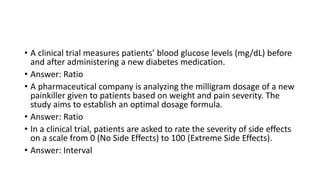
• A clinical trial measures patients’ blood glucose levels (mg/dL) before
and after administering a new diabetes medication.
• Answer: Ratio
• A pharmaceutical company is analyzing the milligram dosage of a new
painkiller given to patients based on weight and pain severity. The
study aims to establish an optimal dosage formula.
• Answer: Ratio
• In a clinical trial, patients are asked to rate the severity of side effects
on a scale from 0 (No Side Effects) to 100 (Extreme Side Effects).
• Answer: Interval
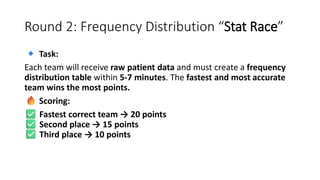
Round 2: Frequency Distribution “Stat Race”
Task:
Each team will receive raw patient data and must create a frequency
distribution table within 5-7 minutes. The fastest and most accurate
team wins the most points.
Scoring:
Fastest correct team → 20 points
Second place → 15 points
Third place → 10 points
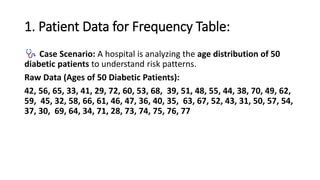
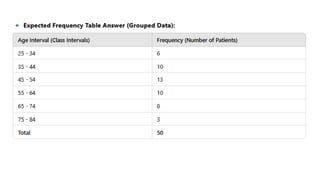
1. Patient Data for Frequency Table:
Case Scenario: A hospital is analyzing the age distribution of 50
diabetic patients to understand risk patterns.
Raw Data (Ages of 50 Diabetic Patients):
42, 56, 65, 33, 41, 29, 72, 60, 53, 68, 39, 51, 48, 55, 44, 38, 70, 49, 62,
59, 45, 32, 58, 66, 61, 46, 47, 36, 40, 35, 63, 67, 52, 43, 31, 50, 57, 54,
37, 30, 69, 64, 34, 71, 28, 73, 74, 75, 76, 77
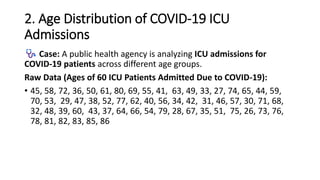
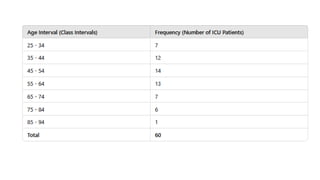
2. Age Distribution of COVID-19 ICU
Admissions
Case: A public health agency is analyzing ICU admissions for
COVID-19 patients across different age groups.
Raw Data (Ages of 60 ICU Patients Admitted Due to COVID-19):
• 45, 58, 72, 36, 50, 61, 80, 69, 55, 41, 63, 49, 33, 27, 74, 65, 44, 59,
70, 53, 29, 47, 38, 52, 77, 62, 40, 56, 34, 42, 31, 46, 57, 30, 71, 68,
32, 48, 39, 60, 43, 37, 64, 66, 54, 79, 28, 67, 35, 51, 75, 26, 73, 76,
78, 81, 82, 83, 85, 86
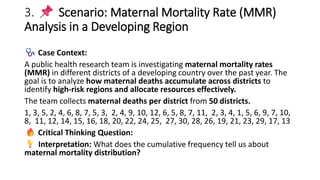
3. Scenario: Maternal Mortality Rate (MMR)
Analysis in a Developing Region
Case Context:
A public health research team is investigating maternal mortality rates
(MMR) in different districts of a developing country over the past year. The
goal is to analyze how maternal deaths accumulate across districts to
identify high-risk regions and allocate resources effectively.
The team collects maternal deaths per district from 50 districts.
1, 3, 5, 2, 4, 6, 8, 7, 5, 3, 2, 4, 9, 10, 12, 6, 5, 8, 7, 11, 2, 3, 4, 1, 5, 6, 9, 7, 10,
8, 11, 12, 14, 15, 16, 18, 20, 22, 24, 25, 27, 30, 28, 26, 19, 21, 23, 29, 17, 13
Critical Thinking Question:
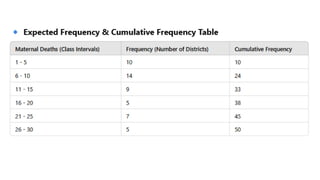
Interpretation: What does the cumulative frequency tell us about
maternal mortality distribution?
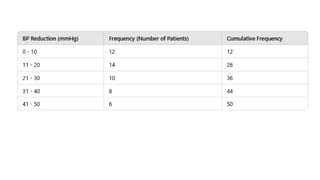
4. Scenario: Clinical Trial for a New
Hypertension Drug
Case Context:
A pharmaceutical company is conducting Phase 3 clinical trials for a new
antihypertensive drug to test its effectiveness in reducing blood pressure
(BP) over 12 weeks. The trial consists of 500 patients, divided into different
BP reduction categories (in mmHg).
The research team wants to analyze the cumulative distribution of patients
experiencing different levels of BP reduction.
5, 8, 10, 12, 15, 18, 20, 22, 25, 27, 10, 14, 19, 23, 26, 30, 35, 38, 40, 42, 4, 9,
13, 16, 21, 28, 33, 37, 41, 45, 3, 6, 11, 17, 24, 29, 34, 39, 44, 48, 2, 7, 9, 20,
25, 31, 36, 43, 47, 50
Critical Thinking Questions:
Interpretation: What does the cumulative frequency tell us about the
drug's effectiveness?
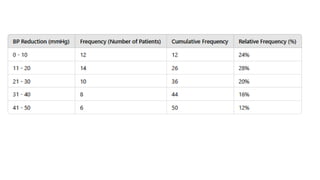
5. Scenario: Clinical Trial for a New
Hypertension Drug
Case Context:
A pharmaceutical company is conducting Phase 3 clinical trials for a new
antihypertensive drug to test its effectiveness in reducing blood pressure
(BP) over 12 weeks. The trial consists of 50 patients, divided into different
BP reduction categories (in mmHg).
The research team wants to analyze the cumulative distribution and relative
frequency of patients experiencing different levels of BP reduction.
5, 8, 10, 12, 15, 18, 20, 22, 25, 27, 10, 14, 19, 23, 26, 30, 35, 38, 40, 42, 4, 9,
13, 16, 21, 28, 33, 37, 41, 45, 3, 6, 11, 17, 24, 29, 34, 39, 44, 48, 2, 7, 9, 20,
25, 31, 36, 43, 47, 50
Critical Thinking Questions:
Interpretation: What does the cumulative and relative frequency tell us
about the drug's effectiveness?
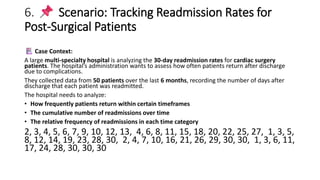
6. Scenario: Tracking Readmission Rates for
Post-Surgical Patients
Case Context:
A large multi-specialty hospital is analyzing the 30-day readmission rates for cardiac surgery
patients. The hospital’s administration wants to assess how often patients return after discharge
due to complications.
They collected data from 50 patients over the last 6 months, recording the number of days after
discharge that each patient was readmitted.
The hospital needs to analyze:
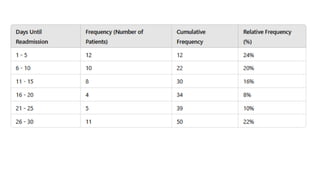
• How frequently patients return within certain timeframes
• The cumulative number of readmissions over time
• The relative frequency of readmissions in each time category
2, 3, 4, 5, 6, 7, 9, 10, 12, 13, 4, 6, 8, 11, 15, 18, 20, 22, 25, 27, 1, 3, 5,
8, 12, 14, 19, 23, 28, 30, 2, 4, 7, 10, 16, 21, 26, 29, 30, 30, 1, 3, 6, 11,
17, 24, 28, 30, 30, 30
Round 3: Measures of Central Tendency
Game: “Stat Pick ”
Activity:
Teams should pick a number, based on the number received they must
calculate mean, median, and mode for the dataset. (5-7 mins) 20 points, -5
for Wrong Answer
1
2
3
4
5
6
Case 1
Case Study:
A hospital recorded the following patient wait times (in minutes) for
the past week:
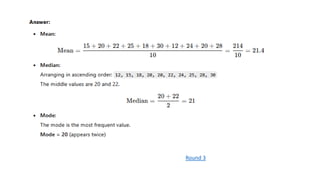
15, 20, 22, 25, 18, 30, 12, 24, 20, 28
Task
• Calculate the mean, median, and mode for the above dataset.
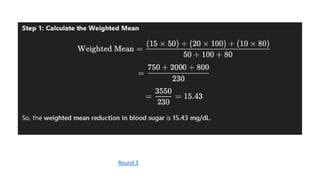
Round 3
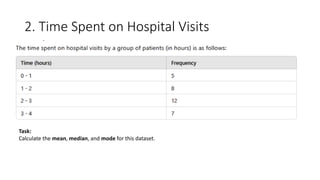
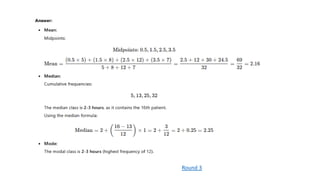
2. Time Spent on Hospital Visits
Task:
Calculate the mean, median, and mode for this dataset.
Round 3
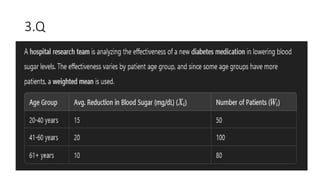
3.Q
Round 3
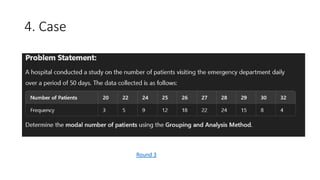
4. Case
Round 3
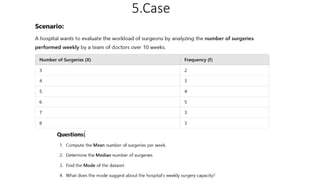
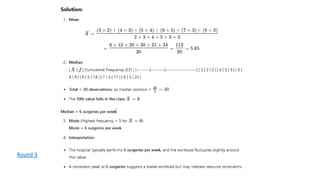
5.Case
Round 3
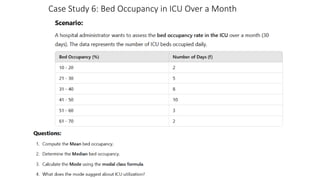
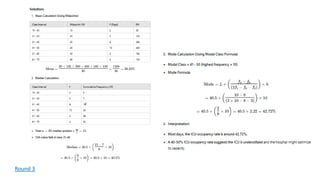
Case Study 6: Bed Occupancy in ICU Over a Month
Round 3
Bonus Challenge
You will be Shown a Slide, you have to solve it on the paper given, first team that
gives will get the highest points
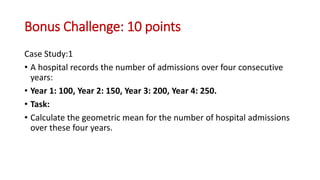
Bonus Challenge: 10 points
Case Study:1
• A hospital records the number of admissions over four consecutive
years:
• Year 1: 100, Year 2: 150, Year 3: 200, Year 4: 250.
• Task:
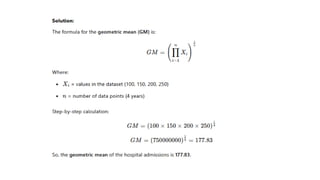
• Calculate the geometric mean for the number of hospital admissions
over these four years.
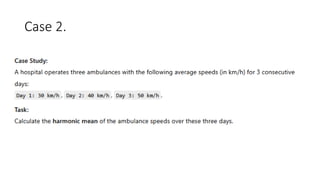
Case 2.
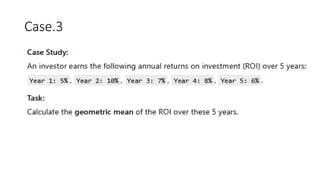
Case.3
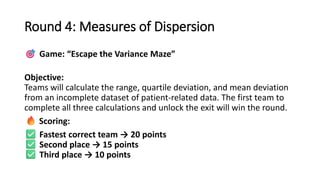
Round 4: Measures of Dispersion
Game: “Escape the Variance Maze”
Objective:
Teams will calculate the range, quartile deviation, and mean deviation
from an incomplete dataset of patient-related data. The first team to
complete all three calculations and unlock the exit will win the round.
Scoring:
Fastest correct team → 20 points
Second place → 15 points
Third place → 10 points
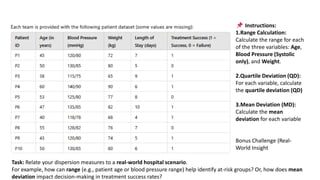
Instructions:
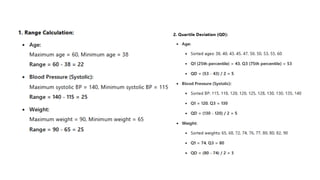
1.Range Calculation:
Calculate the range for each
of the three variables: Age,
Blood Pressure (Systolic
only), and Weight.
2.Quartile Deviation (QD):
For each variable, calculate
the quartile deviation (QD)
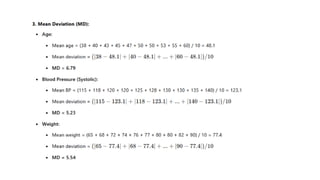
3.Mean Deviation (MD):
Calculate the mean
deviation for each variable
Bonus Challenge (Real-
World Insight
Task: Relate your dispersion measures to a real-world hospital scenario.
For example, how can range (e.g., patient age or blood pressure range) help identify at-risk groups? Or, how does mean
deviation impact decision-making in treatment success rates?
Question 2
Calculate the Mean Deviation
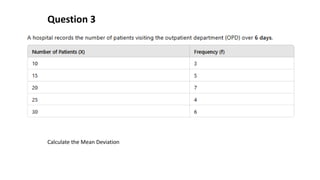
Question 3
Calculate the Mean Deviation
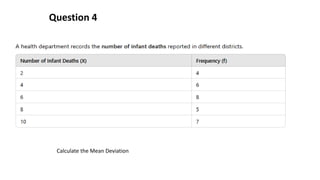
Question 4
Calculate the Mean Deviation
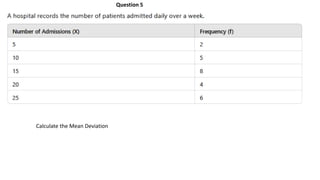
Question 5
Calculate the Mean Deviation
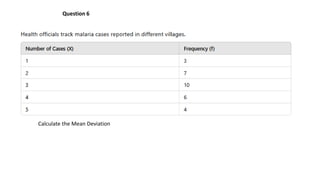
Question 6
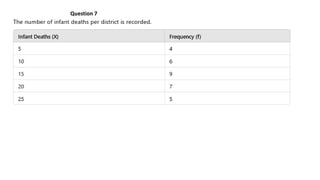
Question 7

Comprehensive Biostatistics Quiz: Test Your Knowledge on Key Concepts and Method

  • 1.
  • 2.
    Round 1: Typesof Data & Levels of Measurement • Game Activity: Categorize the Data • Each team must correctly classify the data type as Nominal, Ordinal, Interval, or Ratio.
  • 3.
    Questions Blood groups ofpatients (A, B, AB, O) Answer: Nominal Pain severity scale (Mild, Moderate, Severe) Answer: Ordinal Body temperature in Celsius Answer: Interval Number of hospital visits per year Answer: Ratio Patient satisfaction ratings (1 to 5 stars) Answer: Ordinal Time taken for a surgery (in minutes) Answer: Ratio
  • 4.
    Questions • Types ofinsurance plans (Basic, Premium, Gold) • Answer: Nominal • Weight of newborns (in kg) • Answer: Ratio • Temperature in Fahrenheit • Interval • COVID-19 test results (Positive/Negative) • Answer: Nominal • Hospital room types (General, Semi-private, Private) • Nominal • Severity of disease classified as Mild, Moderate, Severe • Ordinal
  • 5.
    Case Scenarios • Aresearch study tracks the number of days it takes for patients to fully recover after knee replacement surgery. The study aims to compare different rehabilitation programs. • Answer: Ratio • Doctors assign an ICU mortality risk score ranging from 0 to 100 based on various patient factors like blood pressure, age, and oxygen levels. A higher score indicates a higher risk. • Answer: Interval • A smartwatch company collects heart rate variability (HRV) data from users over a month. HRV is recorded in milliseconds (ms). • Answer: Ratio
  • 6.
    • A clinicaltrial measures patients’ blood glucose levels (mg/dL) before and after administering a new diabetes medication. • Answer: Ratio • A pharmaceutical company is analyzing the milligram dosage of a new painkiller given to patients based on weight and pain severity. The study aims to establish an optimal dosage formula. • Answer: Ratio • In a clinical trial, patients are asked to rate the severity of side effects on a scale from 0 (No Side Effects) to 100 (Extreme Side Effects). • Answer: Interval
  • 7.
    Round 2: FrequencyDistribution “Stat Race” Task: Each team will receive raw patient data and must create a frequency distribution table within 5-7 minutes. The fastest and most accurate team wins the most points. Scoring: Fastest correct team → 20 points Second place → 15 points Third place → 10 points
  • 8.
    1. Patient Datafor Frequency Table: Case Scenario: A hospital is analyzing the age distribution of 50 diabetic patients to understand risk patterns. Raw Data (Ages of 50 Diabetic Patients): 42, 56, 65, 33, 41, 29, 72, 60, 53, 68, 39, 51, 48, 55, 44, 38, 70, 49, 62, 59, 45, 32, 58, 66, 61, 46, 47, 36, 40, 35, 63, 67, 52, 43, 31, 50, 57, 54, 37, 30, 69, 64, 34, 71, 28, 73, 74, 75, 76, 77
  • 10.
    2. Age Distributionof COVID-19 ICU Admissions Case: A public health agency is analyzing ICU admissions for COVID-19 patients across different age groups. Raw Data (Ages of 60 ICU Patients Admitted Due to COVID-19): • 45, 58, 72, 36, 50, 61, 80, 69, 55, 41, 63, 49, 33, 27, 74, 65, 44, 59, 70, 53, 29, 47, 38, 52, 77, 62, 40, 56, 34, 42, 31, 46, 57, 30, 71, 68, 32, 48, 39, 60, 43, 37, 64, 66, 54, 79, 28, 67, 35, 51, 75, 26, 73, 76, 78, 81, 82, 83, 85, 86
  • 12.
    3. Scenario: MaternalMortality Rate (MMR) Analysis in a Developing Region Case Context: A public health research team is investigating maternal mortality rates (MMR) in different districts of a developing country over the past year. The goal is to analyze how maternal deaths accumulate across districts to identify high-risk regions and allocate resources effectively. The team collects maternal deaths per district from 50 districts. 1, 3, 5, 2, 4, 6, 8, 7, 5, 3, 2, 4, 9, 10, 12, 6, 5, 8, 7, 11, 2, 3, 4, 1, 5, 6, 9, 7, 10, 8, 11, 12, 14, 15, 16, 18, 20, 22, 24, 25, 27, 30, 28, 26, 19, 21, 23, 29, 17, 13 Critical Thinking Question: Interpretation: What does the cumulative frequency tell us about maternal mortality distribution?
  • 14.
    4. Scenario: ClinicalTrial for a New Hypertension Drug Case Context: A pharmaceutical company is conducting Phase 3 clinical trials for a new antihypertensive drug to test its effectiveness in reducing blood pressure (BP) over 12 weeks. The trial consists of 500 patients, divided into different BP reduction categories (in mmHg). The research team wants to analyze the cumulative distribution of patients experiencing different levels of BP reduction. 5, 8, 10, 12, 15, 18, 20, 22, 25, 27, 10, 14, 19, 23, 26, 30, 35, 38, 40, 42, 4, 9, 13, 16, 21, 28, 33, 37, 41, 45, 3, 6, 11, 17, 24, 29, 34, 39, 44, 48, 2, 7, 9, 20, 25, 31, 36, 43, 47, 50 Critical Thinking Questions: Interpretation: What does the cumulative frequency tell us about the drug's effectiveness?
  • 16.
    5. Scenario: ClinicalTrial for a New Hypertension Drug Case Context: A pharmaceutical company is conducting Phase 3 clinical trials for a new antihypertensive drug to test its effectiveness in reducing blood pressure (BP) over 12 weeks. The trial consists of 50 patients, divided into different BP reduction categories (in mmHg). The research team wants to analyze the cumulative distribution and relative frequency of patients experiencing different levels of BP reduction. 5, 8, 10, 12, 15, 18, 20, 22, 25, 27, 10, 14, 19, 23, 26, 30, 35, 38, 40, 42, 4, 9, 13, 16, 21, 28, 33, 37, 41, 45, 3, 6, 11, 17, 24, 29, 34, 39, 44, 48, 2, 7, 9, 20, 25, 31, 36, 43, 47, 50 Critical Thinking Questions: Interpretation: What does the cumulative and relative frequency tell us about the drug's effectiveness?
  • 18.
    6. Scenario: TrackingReadmission Rates for Post-Surgical Patients Case Context: A large multi-specialty hospital is analyzing the 30-day readmission rates for cardiac surgery patients. The hospital’s administration wants to assess how often patients return after discharge due to complications. They collected data from 50 patients over the last 6 months, recording the number of days after discharge that each patient was readmitted. The hospital needs to analyze: • How frequently patients return within certain timeframes • The cumulative number of readmissions over time • The relative frequency of readmissions in each time category 2, 3, 4, 5, 6, 7, 9, 10, 12, 13, 4, 6, 8, 11, 15, 18, 20, 22, 25, 27, 1, 3, 5, 8, 12, 14, 19, 23, 28, 30, 2, 4, 7, 10, 16, 21, 26, 29, 30, 30, 1, 3, 6, 11, 17, 24, 28, 30, 30, 30
  • 20.
    Round 3: Measuresof Central Tendency Game: “Stat Pick ” Activity: Teams should pick a number, based on the number received they must calculate mean, median, and mode for the dataset. (5-7 mins) 20 points, -5 for Wrong Answer 1 2 3 4 5 6
  • 21.
    Case 1 Case Study: Ahospital recorded the following patient wait times (in minutes) for the past week: 15, 20, 22, 25, 18, 30, 12, 24, 20, 28 Task • Calculate the mean, median, and mode for the above dataset.
  • 22.
  • 23.
    2. Time Spenton Hospital Visits Task: Calculate the mean, median, and mode for this dataset.
  • 24.
  • 25.
  • 26.
  • 27.
  • 28.
  • 29.
  • 30.
    Case Study 6:Bed Occupancy in ICU Over a Month
  • 31.
  • 32.
    Bonus Challenge You willbe Shown a Slide, you have to solve it on the paper given, first team that gives will get the highest points
  • 33.
    Bonus Challenge: 10points Case Study:1 • A hospital records the number of admissions over four consecutive years: • Year 1: 100, Year 2: 150, Year 3: 200, Year 4: 250. • Task: • Calculate the geometric mean for the number of hospital admissions over these four years.
  • 35.
  • 37.
  • 39.
    Round 4: Measuresof Dispersion Game: “Escape the Variance Maze” Objective: Teams will calculate the range, quartile deviation, and mean deviation from an incomplete dataset of patient-related data. The first team to complete all three calculations and unlock the exit will win the round. Scoring: Fastest correct team → 20 points Second place → 15 points Third place → 10 points
  • 40.
    Instructions: 1.Range Calculation: Calculate therange for each of the three variables: Age, Blood Pressure (Systolic only), and Weight. 2.Quartile Deviation (QD): For each variable, calculate the quartile deviation (QD) 3.Mean Deviation (MD): Calculate the mean deviation for each variable Bonus Challenge (Real- World Insight Task: Relate your dispersion measures to a real-world hospital scenario. For example, how can range (e.g., patient age or blood pressure range) help identify at-risk groups? Or, how does mean deviation impact decision-making in treatment success rates?
  • 43.
  • 44.
    Calculate the MeanDeviation Question 3
  • 45.
    Calculate the MeanDeviation Question 4
  • 46.
    Calculate the MeanDeviation Question 5
  • 47.
    Calculate the MeanDeviation Question 6
  • 48.