composites
• In addition to metals, ceramics, and polymers, a fourth material category
can be distinguished: composites.
• composed of two or more physically distinct phases whose combination
produces aggregate properties that are different from those of its
constituents.
• In certain respects, composites are the most interesting of the engineering
materials because their structure is more complex than the other three
types.
• Composites can be designed that are very strong and stiff, yet very light in
weight, giving them strength to- weight and stiffness-to-weight ratios
several times greater than steel or aluminum.
• These properties are highly desirable in applications like commercial aircraft
to sports equipment.
• Fatigue properties are generally better
• Toughness is often greater, too.
• do not corrode like steel; this is important in automotive and in others
• it is possible to achieve combinations of properties not attainable with
metals, ceramics, or polymers alone.
• Better appearance and control of surface smoothness are possible with
certain composite materials.
Disadvantages
• (1) properties of many important composites are anisotropic
• (2) many of the polymer- based composites are subject to attack by
chemicals or solvents, just as the polymers themselves are susceptible to
attack; (3)composite materials are generally expensive, although prices may
drop as volume increases; and (4) manufacturing methods - shaping
composite materials are slow and costly.
• Composite material consists of two or more distinct phases.
• One possible classification (1) traditional and (2) synthetic composites.
• Traditional composites- occur in nature - Wood is a naturally occurring
composite material, while concrete (Portland cement plus sand or gravel)
and asphalt mixed with gravel are traditional composites used in
construction.
• Synthetic composites are modern material systems normally associated
with the manufacturing industries, in which the components are first
produced separately and then combined in a controlled way to achieve the
desired structure, properties, and part geometry.
• These synthetic materials are the composites normally thought of in the
context of engineered products.
COMPONENTS IN A COMPOSITE MATERIAL
• Composite material consists of two phases: a primary phase and a secondary
phase.
• The primary phase forms the matrix within which the secondary phase is
imbedded.
• The imbedded phase is sometimes referred to as a reinforcing agent - serves to
strengthen
• The reinforcing phase may be in the form of fibers, particles, or various other
geometries.
• The phases are generally insoluble in each other - strong adhesion The secondary
phase may also be one of the three basic materials, or it may be an element such
as carbon or boron.
• The classification system is based on the matrix phase
• 1. Metal Matrix Composites (MMCs) include mixtures of ceramics and metals, such
as cemented carbides and other cermets, as well as aluminum or magnesium
reinforced by strong, high stiffness fibers.
• 2. Ceramic Matrix Composites (CMCs) are the least common category. Aluminum
oxide and silicon carbide are materials that can be imbedded with fibers for
improved properties, especially in high temperature applications.
• 3. Polymer Matrix Composites (PMCs). Thermosetting resins are the most widely
used polymers in PMCs.
• Epoxy and polyester are commonly mixed with fiber reinforcement, and phenolic is
mixed with powders.
• Thermoplastic molding compounds are often reinforced, usually with powders
• THE REINFORCING PHASE
• Fibers
• Fibers are filaments of reinforcing material, generally circular in cross-section,
• alternative shapes are sometimes used (e.g., tubular, rectangular, hexagonal).
• Diameters range from less than 0.0025 mm to about 0.13 mm
• In fiber-reinforced composites, the fiber is often considered to be the principal constituent
since it bears the major share of the load.
• Fibers are of interest as reinforcing agents because the filament form of most materials is
significantly stronger than the bulk form.
• As diameter is reduced, the material becomes oriented in the direction of the fiber axis and
the probability of defects in the structure decreases significantly.
• As a result, tensile strength increases dramatically.
• Fibers used in composites can be either continuous or discontinuous.
• Continuous fibers are very long; in theory, they offer a continuous path by which a load can
be carried by the composite part.
• In reality, this is difficult to achieve due to variations in the fibrous material and processing.
• Discontinuous fibers (chopped sections of continuous fibers) are short lengths (L/D =100).
• An important type of discontinuous fiber are whiskers—hair-like single crystals with
diameters down to about 0.001 mm and very high strength.
• Fiber orientation is another factor in composite parts. We can distinguish three
• cases, (a) one-dimensional reinforcement, in which maximum strength and stiffness are
obtained in the direction of the fiber; (b) planar reinforcement in some cases in the form of
a two-dimensional woven fabric; and (c) random or three dimensional in which the
composite material tends to possess isotropic properties.
• Various materials are used as fibers in fiber-reinforced composites: metals,
ceramics, polymers, carbon, and boron.
• The most important commercial use of fibers is in polymer composites.
• However, use of fiber-reinforced metals and ceramics is growing.
• Glass—The most widely used fiber in polymers, the term fiberglass is applied to
denote glass fiber-reinforced plastic (GFRP).
• The two common glass fibers are Eglass and S-glass. E-glass is strong and low cost,
• But its modulus is less than other fibers.
• S-glass is stiffer, and its tensile strength is one of the highest of all fiber materials;
however, it is more expensive than E-glass.
• Carbon—Carbon can be made into high-modulus fibers. Besides stiffness, other
attractive properties include low-density and low-thermal expansion.
• C-fibers are generally a combination of graphite and amorphous carbon. Boron—
Boron has a very high elastic modulus, but its high cost limits applications to
aerospace components in which this property (and others) are critical.
• Kevlar 49—This is the most important polymer fiber; it is a highly crystalline
aramid, a member of the polyamide family . Its specific gravity is low, giving it one
of the highest strength-to-weight ratios of all fibers.
• Ceramics—Silicon carbide (SiC) and aluminum oxide (Al2O3) are the main fiber
materials among ceramics. Both have high elastic moduli and can be used to
strengthen low-density, low-modulus metals such as aluminum and magnesium.
• Metal—Steel filaments, both continuous and discontinuous, are used as
reinforcing fibers in plastics. Other metals are currently less common as reinforcing
fibers.
• METAL MATRIX COMPOSITES
• Metal matrix composites (MMCs) consist of a metal matrix reinforced by a second phase.
• Common reinforcing phases -particles of ceramic- fibers of various materials, - including
other metals, ceramics, carbon, and boron.
• MMCs of the first type are commonly called cermets.
CERMETS
• is a composite material in which a ceramic is contained in a metallic matrix.
• The ceramic often dominates the mixture, sometimes ranging up to 96% by volume.
• Bonding can be enhanced by slight solubility between phases at the elevated temperatures
used in processing these composites.
• Cermets can be subdivided into (1) cemented carbides and (2) oxide-based cermets
• Cemented Carbides Cemented carbides are composed of one or more carbide compounds
bonded in a metallic matrix.
• The term cermet is not used for all of these materials, even though it is technically correct.
• The common cemented carbides are based on tungsten carbide (WC), titanium carbide (TiC),
and chromium carbide (Cr3C2). Tantalum carbide (TaC) and others are also used but less
commonly.
• The principal metallic binders are cobalt and nickel.
• Cemented carbide parts are produced by particulate processing techniques.
• Cobalt is the binder used for WC, and nickel is a common binder for TiC and Cr3C2.
• Cutting tools are the most common application of cemented carbides based on tungsten
carbide.
• Titanium carbide cermets are used principally for high temperature
applications.
• Nickel is the preferred binder
• its oxidation resistance at high temperatures is superior to that of cobalt.
• Applications include gas-turbine nozzle vanes, valve seats, thermocouple
protection tubes, torch tips, and hot-working spinning tools
• TiC–Ni is also used as a cutting tool material in machining operations.
• Compared with WC–Co cemented carbides, nickel-bonded chromium
carbides are more brittle, but have excellent chemical stability and
corrosion resistance.
• This combination, together with good wear resistance, makes it suitable for
applications such as gage blocks, valve liners, spray nozzles, and bearing seal
rings
• Oxide-based Cermets Most of these composites utilize Al2O3 as the
particulate phase;
• MgO is another oxide sometimes used.
• A common metal matrix is chromium, although other metals can also be
used as binders.
• Applications include cutting tools, mechanical seals, and thermocouple
shields.
• FIBER-REINFORCED METAL MATRIX COMPOSITES
• These MMCs are of interest because they combine the high tensile
strength and modulus of elasticity of a fiber with metals of low
density, thus achieving good strength-to-weight and modulus-to-
weight ratios in the resulting composite material.
• Typical metals used as the low-density matrix are aluminum,
magnesium, and titanium.
• Some of the important fiber materials used in the composite
include Al2O3, boron, carbon, and SiC.
• Properties of fiber-reinforced MMCs are anisotropic, as expected.
• Maximum tensile strength in the preferred direction is obtained by
using continuous fibers bonded strongly to the matrix metal.
• Elastic modulus and tensile strength of the composite material
increase with increasing fiber volume.
• MMCs with fiber reinforcement have good high-temperature
strength properties; and they are good electrical and thermal
conductors.
• Applications have largely been components in aircraft and turbine
machinery, where these properties can be exploited.
CERAMIC MATRIX COMPOSITES
• Ceramics properties: high stiffness, hardness, hot hardness, and compressive
strength; and relatively low density.
• Ceramics also have several faults: low toughness and bulk tensile strength, and
susceptibility to thermal cracking.
• CMCs consist of a ceramic primary phase imbedded with a secondary phase.
• Ceramic materials used as matrices include alumina (Al2O3), boron carbide (B4C),
boron nitride (BN), silicon carbide (SiC), silicon nitride (Si3N4), titanium carbide
(TiC), and several types of glass
• Fiber materials in CMCs include carbon, SiC, and Al2O3.
• The reinforcing phase in current CMC technology consists of either short fibers,
such as whiskers, or long fibers.
• Products with short fibers have been successfully fabricated using particulate
processing methods, the fibers being treated as a form of powder in these
materials.
• Although there are performance advantages in using long fibers as reinforcement
in ceramic matrix composites, development of economical processing techniques
for these materials has been difficult.
• One promising commercial application of CMCs is in metal-cutting tools as a
competitor of cemented carbides
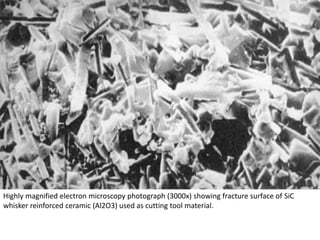
• The composite tool material has whiskers of SiC in a matrix of Al2O3.
• Other potential applications are in elevated temperatures and environments that
are chemically corrosive to other materials.
Highly magnified electron microscopy photograph (3000x) showing fracture surface of SiC
whisker reinforced ceramic (Al2O3) used as cutting tool material.
POLYMER MATRIX COMPOSITES
• A polymer matrix composite (PMC) consists of a polymer primary phase in which a
secondary phase is imbedded in the form of fibers, particles, or flakes.
• Commercially, PMCs are the most important of the three classes of synthetic
composites.
• They include most plastic molding compounds, rubber reinforced with carbon
black, and fiber reinforced polymers (FRPs).
• FRPs are most closely identified with the term composite.
• If one mentions ‘‘composite material’’ to a design engineer, FRP is usually the
composite that comes to mind.
• FIBER-REINFORCED POLYMERS
• A fiber-reinforced polymer is a composite material consisting of a polymer matrix
imbedded with high-strength fibers.
• The polymer matrix is usually a thermosetting plastic such as unsaturated polyester
or epoxy,
• but thermoplastic polymers, such as nylons (polyamides), polycarbonate,
polystyrene, and polyvinylchloride, are also used.
• In addition, elastomers are also reinforced by fibers for rubber products such as
tires and conveyor belts.
• Fibers in PMCs come in various forms: discontinuous (chopped), continuous, or
woven as a fabric.
• Principal fiber materials in FRPs are glass, carbon, and Kevlar 49.
• Less common fibers include boron, SiC, and Al2O3, and steel.
• Glass (in particular E-glass) is the most common fiber material in today’s FRPs;
• Epoxy is the common matrix polymer.
• These composites generally have high fiber content (>50% by volume) and
possess high strength and modulus of elasticity.
• When two or more fiber materials are combined in the FRP composite, it is
called a hybrid composite.
• Advanced and hybrid composites are used in aerospace applications.
• The most widely used form of the FRP itself is a laminar structure, made by
stacking and bonding thin layers of fiber and polymer until the desired
thickness is obtained.
• By varying the fiber orientation among the layers, a specified level of
anisotropy in properties can be achieved in the laminate.
• This method is used to form parts of thin cross section, such as aircraft wing
and fuselage sections, automobile and truck body panels, and boat hulls.
Properties
• (1) high strength-to-weight ratio, (2) high modulus-to-weight ratio, and (3)
low specific gravity. (4) good fatigue strength; (5) good corrosion resistance,
although polymers are soluble in various chemicals; (6) low thermal
expansion for many FRPs, leading to good dimensional stability; and (7)
significant anisotropy in properties
• A typical FRP weighs only about one fifth as much as steel; yet strength and
modulus are comparable in the fiber direction.
• compares these properties for several FRPs, steels, and an aluminum alloy.
• Applications
• The aerospace industry is one of the biggest users of advanced composites.
• Designers are continually striving to reduce aircraft weight to increase fuel
efficiency and payload capacity.
• Applications of advanced composites in both military and commercial aircraft have
increased steadily
• The new Boeing 787Dreamliner features50%(by weight) composite (carbon fiber-
reinforced plastic).
• That’s about 80% of the volume of the aircaft.
• Composites are used for the fuselage, wings, tail, doors, and interior.
• By comparison, Boeing’s 777 has only about 12% composites (by weight).
• The automotive industry is another important user of FRPs.
• The most obvious applications are FRP body panels for cars and truck cabs.
• A notable example is the Chevrolet Corvette that has been produced with FRP
bodies for decades.
• Less apparent applications are in certain chassis and engine parts.
• Car and truck applications can use conventional fiber glass reinforced plastics
rather than advanced composites.
• Fiber glass reinforced plastic has been used for boat hulls since the 1940s.
• Fishing rods were another early application.
• FRPs are represented in a wide assortment of sports products, including tennis
rackets, golf club shafts, football helmets, bows and arrows, skis, and bicycle
wheels.
• PULTRUSION PROCESSES
• Shaping Processes for Polymer Matrix Composites
• The basic pultrusion process was developed around 1950 for making fishing
rods of glass fiber–reinforced polymer (GFRP).
• The process is similar to extrusion (hence the similarity in name), but it
involves pulling of the workpiece (so the prefix ‘‘pul-’’ is used in place of
‘‘ex-’’).
• Like extrusion, pultrusion produces continuous, straight sections of constant
cross section.
• A related process, called pulforming, can be used to make parts that are
curved and may have variations in cross section throughout their lengths.
• PULTRUSION
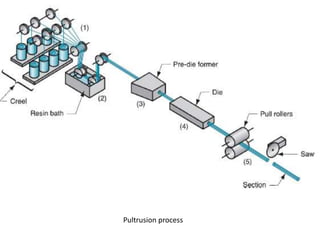
• Pultrusion is a process in which continuous fiber rovings are dipped into a
resin bath and pulled through a shaping die where the impregnated resin
cures.
• Cured product being cut into long, straight sections.
• The sections are reinforced throughout their length by continuous fibers.
• Like extrusion, the pieces have a constant cross section, whose profile is
determined by the shape of the die opening.
• The process consists of five steps performed in a continuous sequence
• 1. filament feeding, in which the fibers are unreeled from a creel (shelves
with skewers that hold filament bobbins)
• (2) resin impregnation, in which the fibers are dipped in the uncured liquid
resin;
• (3) pre-die forming—the collection of filaments is gradually shaped into the
approximate cross section desired;
• (4) shaping and curing, in which the impregnated fibers are pulled through
the heated die whose length is 1 to 1.5m and whose inside surfaces are
highly polished; and
• (5) pulling and cutting—pullers are used to draw the cured length through
the die, after which it is cut by a cut-off wheel with SiC or diamond grits.
• Common resins used in pultrusion are unsaturated polyesters, epoxies, and
silicones, all thermosetting polymers.
• There are difficulties in processing with epoxy polymers because of sticking
on the die surface.
• Thermoplastics have also been studied for possible applications .
• E-glass is by far the most widely used reinforcing material; proportions
range from 30% to 70%.
• Modulus of elasticity and tensile strength increase with reinforcement
content.
• Products made by pultrusion include solid rods, tubing, long and flat sheets,
structural sections (such as channels, angled and flanged beams), tool
handles for high-voltage work, and third-rail covers for subways.
Pultrusion process
Sintering
• Sintering is the process whereby green compacts are heated in a controlled
atmosphere furnace to a temperature below the melting point,
• but sufficiently high to allow bonding (fusion) of the individual particles.
• the green compact is brittle, and its green strength is low.
• The nature and strength of the bond between the particles and, hence, that
of the sintered compact, depend on the complex mechanisms of diffusion,
plastic flow, evaporation of volatile materials in the compact,
recrystallization, grain growth, and pore shrinkage.
• The principal variables in sintering are temperature, time, and the furnace
atmosphere.
• Sintering temperatures are generally within 70 to 90% of the melting point
of the metal or alloy
• Sintering times range from a minimum of about 10 minutes for iron and
copper alloys to as much as 8 hours for tungsten and tantalum.
• Continuous-sintering furnaces, which are used for most production, have
three chambers:
• l. Burn-off chamber, for volatilizing the lubricants in the green compact in
order to improve bond strength and prevent cracking.
• 2. High-temperature chamber, for sintering.
• 3. Cooling chamber.
• An oxygen-free atmosphere is essential to control the carburization and
decarburization of iron and iron-based compacts and to prevent oxidation
of the powders.
• A vacuum generally is used for sintering refractory-metal alloys and
stainless steels.
• The gases most commonly used for sintering are hydrogen, dissociated or
burned ammonia, partially combusted hydrocarbon gases, and nitrogen.
• Sintering mechanisms are complex and depend on the composition of the
metal particles as well as on the processing parameters.
• The sintering mechanisms are diffusion, vapor-phase transport, and liquid-
phase sintering.
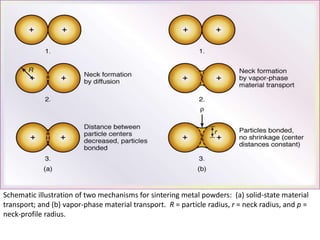
• As the temperature increases, two adjacent powder particles begin to form
a bond by a diffusion mechanism (solid-state bonding, Fig. a); as a result,
the strength, density, ductility, and thermal and electrical conductivities of
the compact increase.
• At the same time, however, the compact shrinks.
• Hence, allowances should be made for shrinkage, as are done in casting.
• A second sintering mechanism is vapor-phase transport
• Because the material is heated to very close to its melting temperature,
metal atoms will be released to the vapor phase from the particles.
• At convergent geometries (the interface of two particles), the melting
temperature is locally higher and the vapor phase resolidifies.
• Thus, the interface grows and strengthens while each particle
shrinks as a whole.
• If two adjacent particles are of different metals, alloying can
take place at the interface of the two particles.
• If one of the particles has a lower melting point than the
other, the particle will melt and (because of surface tension)
surround the particle that has not melted.
• An example of this mechanism, known as liquid-phase
sintering, is cobalt in tungsten-carbide tools and dies
• Stronger and denser parts can be obtained in this way.
• In spark sintering (an experimental process), loose metal
powders are placed in a graphite mold, heated by electric
current, subjected to a high-energy discharge, and
compacted-all in one step.
• Another technique under development is microwave
sintering, which reduces sintering times and thereby prevents
grain growth, which can adversely affect strength.
Schematic illustration of two mechanisms for sintering metal powders: (a) solid-state material
transport; and (b) vapor-phase material transport. R = particle radius, r = neck radius, and p =
neck-profile radius.

Composites

  • 1.
  • 2.
    • In additionto metals, ceramics, and polymers, a fourth material category can be distinguished: composites. • composed of two or more physically distinct phases whose combination produces aggregate properties that are different from those of its constituents. • In certain respects, composites are the most interesting of the engineering materials because their structure is more complex than the other three types. • Composites can be designed that are very strong and stiff, yet very light in weight, giving them strength to- weight and stiffness-to-weight ratios several times greater than steel or aluminum. • These properties are highly desirable in applications like commercial aircraft to sports equipment. • Fatigue properties are generally better • Toughness is often greater, too. • do not corrode like steel; this is important in automotive and in others • it is possible to achieve combinations of properties not attainable with metals, ceramics, or polymers alone. • Better appearance and control of surface smoothness are possible with certain composite materials.
  • 3.
    Disadvantages • (1) propertiesof many important composites are anisotropic • (2) many of the polymer- based composites are subject to attack by chemicals or solvents, just as the polymers themselves are susceptible to attack; (3)composite materials are generally expensive, although prices may drop as volume increases; and (4) manufacturing methods - shaping composite materials are slow and costly. • Composite material consists of two or more distinct phases. • One possible classification (1) traditional and (2) synthetic composites. • Traditional composites- occur in nature - Wood is a naturally occurring composite material, while concrete (Portland cement plus sand or gravel) and asphalt mixed with gravel are traditional composites used in construction. • Synthetic composites are modern material systems normally associated with the manufacturing industries, in which the components are first produced separately and then combined in a controlled way to achieve the desired structure, properties, and part geometry. • These synthetic materials are the composites normally thought of in the context of engineered products.
  • 4.
    COMPONENTS IN ACOMPOSITE MATERIAL • Composite material consists of two phases: a primary phase and a secondary phase. • The primary phase forms the matrix within which the secondary phase is imbedded. • The imbedded phase is sometimes referred to as a reinforcing agent - serves to strengthen • The reinforcing phase may be in the form of fibers, particles, or various other geometries. • The phases are generally insoluble in each other - strong adhesion The secondary phase may also be one of the three basic materials, or it may be an element such as carbon or boron. • The classification system is based on the matrix phase • 1. Metal Matrix Composites (MMCs) include mixtures of ceramics and metals, such as cemented carbides and other cermets, as well as aluminum or magnesium reinforced by strong, high stiffness fibers. • 2. Ceramic Matrix Composites (CMCs) are the least common category. Aluminum oxide and silicon carbide are materials that can be imbedded with fibers for improved properties, especially in high temperature applications. • 3. Polymer Matrix Composites (PMCs). Thermosetting resins are the most widely used polymers in PMCs. • Epoxy and polyester are commonly mixed with fiber reinforcement, and phenolic is mixed with powders. • Thermoplastic molding compounds are often reinforced, usually with powders
  • 5.
    • THE REINFORCINGPHASE • Fibers • Fibers are filaments of reinforcing material, generally circular in cross-section, • alternative shapes are sometimes used (e.g., tubular, rectangular, hexagonal). • Diameters range from less than 0.0025 mm to about 0.13 mm • In fiber-reinforced composites, the fiber is often considered to be the principal constituent since it bears the major share of the load. • Fibers are of interest as reinforcing agents because the filament form of most materials is significantly stronger than the bulk form. • As diameter is reduced, the material becomes oriented in the direction of the fiber axis and the probability of defects in the structure decreases significantly. • As a result, tensile strength increases dramatically. • Fibers used in composites can be either continuous or discontinuous. • Continuous fibers are very long; in theory, they offer a continuous path by which a load can be carried by the composite part. • In reality, this is difficult to achieve due to variations in the fibrous material and processing. • Discontinuous fibers (chopped sections of continuous fibers) are short lengths (L/D =100). • An important type of discontinuous fiber are whiskers—hair-like single crystals with diameters down to about 0.001 mm and very high strength. • Fiber orientation is another factor in composite parts. We can distinguish three • cases, (a) one-dimensional reinforcement, in which maximum strength and stiffness are obtained in the direction of the fiber; (b) planar reinforcement in some cases in the form of a two-dimensional woven fabric; and (c) random or three dimensional in which the composite material tends to possess isotropic properties.
  • 6.
    • Various materialsare used as fibers in fiber-reinforced composites: metals, ceramics, polymers, carbon, and boron. • The most important commercial use of fibers is in polymer composites. • However, use of fiber-reinforced metals and ceramics is growing. • Glass—The most widely used fiber in polymers, the term fiberglass is applied to denote glass fiber-reinforced plastic (GFRP). • The two common glass fibers are Eglass and S-glass. E-glass is strong and low cost, • But its modulus is less than other fibers. • S-glass is stiffer, and its tensile strength is one of the highest of all fiber materials; however, it is more expensive than E-glass. • Carbon—Carbon can be made into high-modulus fibers. Besides stiffness, other attractive properties include low-density and low-thermal expansion. • C-fibers are generally a combination of graphite and amorphous carbon. Boron— Boron has a very high elastic modulus, but its high cost limits applications to aerospace components in which this property (and others) are critical. • Kevlar 49—This is the most important polymer fiber; it is a highly crystalline aramid, a member of the polyamide family . Its specific gravity is low, giving it one of the highest strength-to-weight ratios of all fibers. • Ceramics—Silicon carbide (SiC) and aluminum oxide (Al2O3) are the main fiber materials among ceramics. Both have high elastic moduli and can be used to strengthen low-density, low-modulus metals such as aluminum and magnesium. • Metal—Steel filaments, both continuous and discontinuous, are used as reinforcing fibers in plastics. Other metals are currently less common as reinforcing fibers.
  • 7.
    • METAL MATRIXCOMPOSITES • Metal matrix composites (MMCs) consist of a metal matrix reinforced by a second phase. • Common reinforcing phases -particles of ceramic- fibers of various materials, - including other metals, ceramics, carbon, and boron. • MMCs of the first type are commonly called cermets. CERMETS • is a composite material in which a ceramic is contained in a metallic matrix. • The ceramic often dominates the mixture, sometimes ranging up to 96% by volume. • Bonding can be enhanced by slight solubility between phases at the elevated temperatures used in processing these composites. • Cermets can be subdivided into (1) cemented carbides and (2) oxide-based cermets • Cemented Carbides Cemented carbides are composed of one or more carbide compounds bonded in a metallic matrix. • The term cermet is not used for all of these materials, even though it is technically correct. • The common cemented carbides are based on tungsten carbide (WC), titanium carbide (TiC), and chromium carbide (Cr3C2). Tantalum carbide (TaC) and others are also used but less commonly. • The principal metallic binders are cobalt and nickel. • Cemented carbide parts are produced by particulate processing techniques. • Cobalt is the binder used for WC, and nickel is a common binder for TiC and Cr3C2. • Cutting tools are the most common application of cemented carbides based on tungsten carbide.
  • 8.
    • Titanium carbidecermets are used principally for high temperature applications. • Nickel is the preferred binder • its oxidation resistance at high temperatures is superior to that of cobalt. • Applications include gas-turbine nozzle vanes, valve seats, thermocouple protection tubes, torch tips, and hot-working spinning tools • TiC–Ni is also used as a cutting tool material in machining operations. • Compared with WC–Co cemented carbides, nickel-bonded chromium carbides are more brittle, but have excellent chemical stability and corrosion resistance. • This combination, together with good wear resistance, makes it suitable for applications such as gage blocks, valve liners, spray nozzles, and bearing seal rings • Oxide-based Cermets Most of these composites utilize Al2O3 as the particulate phase; • MgO is another oxide sometimes used. • A common metal matrix is chromium, although other metals can also be used as binders. • Applications include cutting tools, mechanical seals, and thermocouple shields.
  • 9.
    • FIBER-REINFORCED METALMATRIX COMPOSITES • These MMCs are of interest because they combine the high tensile strength and modulus of elasticity of a fiber with metals of low density, thus achieving good strength-to-weight and modulus-to- weight ratios in the resulting composite material. • Typical metals used as the low-density matrix are aluminum, magnesium, and titanium. • Some of the important fiber materials used in the composite include Al2O3, boron, carbon, and SiC. • Properties of fiber-reinforced MMCs are anisotropic, as expected. • Maximum tensile strength in the preferred direction is obtained by using continuous fibers bonded strongly to the matrix metal. • Elastic modulus and tensile strength of the composite material increase with increasing fiber volume. • MMCs with fiber reinforcement have good high-temperature strength properties; and they are good electrical and thermal conductors. • Applications have largely been components in aircraft and turbine machinery, where these properties can be exploited.
  • 10.
    CERAMIC MATRIX COMPOSITES •Ceramics properties: high stiffness, hardness, hot hardness, and compressive strength; and relatively low density. • Ceramics also have several faults: low toughness and bulk tensile strength, and susceptibility to thermal cracking. • CMCs consist of a ceramic primary phase imbedded with a secondary phase. • Ceramic materials used as matrices include alumina (Al2O3), boron carbide (B4C), boron nitride (BN), silicon carbide (SiC), silicon nitride (Si3N4), titanium carbide (TiC), and several types of glass • Fiber materials in CMCs include carbon, SiC, and Al2O3. • The reinforcing phase in current CMC technology consists of either short fibers, such as whiskers, or long fibers. • Products with short fibers have been successfully fabricated using particulate processing methods, the fibers being treated as a form of powder in these materials. • Although there are performance advantages in using long fibers as reinforcement in ceramic matrix composites, development of economical processing techniques for these materials has been difficult. • One promising commercial application of CMCs is in metal-cutting tools as a competitor of cemented carbides • The composite tool material has whiskers of SiC in a matrix of Al2O3. • Other potential applications are in elevated temperatures and environments that are chemically corrosive to other materials.
  • 11.
    Highly magnified electronmicroscopy photograph (3000x) showing fracture surface of SiC whisker reinforced ceramic (Al2O3) used as cutting tool material.
  • 12.
    POLYMER MATRIX COMPOSITES •A polymer matrix composite (PMC) consists of a polymer primary phase in which a secondary phase is imbedded in the form of fibers, particles, or flakes. • Commercially, PMCs are the most important of the three classes of synthetic composites. • They include most plastic molding compounds, rubber reinforced with carbon black, and fiber reinforced polymers (FRPs). • FRPs are most closely identified with the term composite. • If one mentions ‘‘composite material’’ to a design engineer, FRP is usually the composite that comes to mind. • FIBER-REINFORCED POLYMERS • A fiber-reinforced polymer is a composite material consisting of a polymer matrix imbedded with high-strength fibers. • The polymer matrix is usually a thermosetting plastic such as unsaturated polyester or epoxy, • but thermoplastic polymers, such as nylons (polyamides), polycarbonate, polystyrene, and polyvinylchloride, are also used. • In addition, elastomers are also reinforced by fibers for rubber products such as tires and conveyor belts. • Fibers in PMCs come in various forms: discontinuous (chopped), continuous, or woven as a fabric. • Principal fiber materials in FRPs are glass, carbon, and Kevlar 49. • Less common fibers include boron, SiC, and Al2O3, and steel. • Glass (in particular E-glass) is the most common fiber material in today’s FRPs;
  • 13.
    • Epoxy isthe common matrix polymer. • These composites generally have high fiber content (>50% by volume) and possess high strength and modulus of elasticity. • When two or more fiber materials are combined in the FRP composite, it is called a hybrid composite. • Advanced and hybrid composites are used in aerospace applications. • The most widely used form of the FRP itself is a laminar structure, made by stacking and bonding thin layers of fiber and polymer until the desired thickness is obtained. • By varying the fiber orientation among the layers, a specified level of anisotropy in properties can be achieved in the laminate. • This method is used to form parts of thin cross section, such as aircraft wing and fuselage sections, automobile and truck body panels, and boat hulls. Properties • (1) high strength-to-weight ratio, (2) high modulus-to-weight ratio, and (3) low specific gravity. (4) good fatigue strength; (5) good corrosion resistance, although polymers are soluble in various chemicals; (6) low thermal expansion for many FRPs, leading to good dimensional stability; and (7) significant anisotropy in properties • A typical FRP weighs only about one fifth as much as steel; yet strength and modulus are comparable in the fiber direction. • compares these properties for several FRPs, steels, and an aluminum alloy.
  • 14.
    • Applications • Theaerospace industry is one of the biggest users of advanced composites. • Designers are continually striving to reduce aircraft weight to increase fuel efficiency and payload capacity. • Applications of advanced composites in both military and commercial aircraft have increased steadily • The new Boeing 787Dreamliner features50%(by weight) composite (carbon fiber- reinforced plastic). • That’s about 80% of the volume of the aircaft. • Composites are used for the fuselage, wings, tail, doors, and interior. • By comparison, Boeing’s 777 has only about 12% composites (by weight). • The automotive industry is another important user of FRPs. • The most obvious applications are FRP body panels for cars and truck cabs. • A notable example is the Chevrolet Corvette that has been produced with FRP bodies for decades. • Less apparent applications are in certain chassis and engine parts. • Car and truck applications can use conventional fiber glass reinforced plastics rather than advanced composites. • Fiber glass reinforced plastic has been used for boat hulls since the 1940s. • Fishing rods were another early application. • FRPs are represented in a wide assortment of sports products, including tennis rackets, golf club shafts, football helmets, bows and arrows, skis, and bicycle wheels.
  • 15.
    • PULTRUSION PROCESSES •Shaping Processes for Polymer Matrix Composites • The basic pultrusion process was developed around 1950 for making fishing rods of glass fiber–reinforced polymer (GFRP). • The process is similar to extrusion (hence the similarity in name), but it involves pulling of the workpiece (so the prefix ‘‘pul-’’ is used in place of ‘‘ex-’’). • Like extrusion, pultrusion produces continuous, straight sections of constant cross section. • A related process, called pulforming, can be used to make parts that are curved and may have variations in cross section throughout their lengths. • PULTRUSION • Pultrusion is a process in which continuous fiber rovings are dipped into a resin bath and pulled through a shaping die where the impregnated resin cures. • Cured product being cut into long, straight sections. • The sections are reinforced throughout their length by continuous fibers. • Like extrusion, the pieces have a constant cross section, whose profile is determined by the shape of the die opening. • The process consists of five steps performed in a continuous sequence • 1. filament feeding, in which the fibers are unreeled from a creel (shelves with skewers that hold filament bobbins)
  • 16.
    • (2) resinimpregnation, in which the fibers are dipped in the uncured liquid resin; • (3) pre-die forming—the collection of filaments is gradually shaped into the approximate cross section desired; • (4) shaping and curing, in which the impregnated fibers are pulled through the heated die whose length is 1 to 1.5m and whose inside surfaces are highly polished; and • (5) pulling and cutting—pullers are used to draw the cured length through the die, after which it is cut by a cut-off wheel with SiC or diamond grits. • Common resins used in pultrusion are unsaturated polyesters, epoxies, and silicones, all thermosetting polymers. • There are difficulties in processing with epoxy polymers because of sticking on the die surface. • Thermoplastics have also been studied for possible applications . • E-glass is by far the most widely used reinforcing material; proportions range from 30% to 70%. • Modulus of elasticity and tensile strength increase with reinforcement content. • Products made by pultrusion include solid rods, tubing, long and flat sheets, structural sections (such as channels, angled and flanged beams), tool handles for high-voltage work, and third-rail covers for subways.
  • 17.
  • 18.
    Sintering • Sintering isthe process whereby green compacts are heated in a controlled atmosphere furnace to a temperature below the melting point, • but sufficiently high to allow bonding (fusion) of the individual particles. • the green compact is brittle, and its green strength is low. • The nature and strength of the bond between the particles and, hence, that of the sintered compact, depend on the complex mechanisms of diffusion, plastic flow, evaporation of volatile materials in the compact, recrystallization, grain growth, and pore shrinkage. • The principal variables in sintering are temperature, time, and the furnace atmosphere. • Sintering temperatures are generally within 70 to 90% of the melting point of the metal or alloy • Sintering times range from a minimum of about 10 minutes for iron and copper alloys to as much as 8 hours for tungsten and tantalum. • Continuous-sintering furnaces, which are used for most production, have three chambers: • l. Burn-off chamber, for volatilizing the lubricants in the green compact in order to improve bond strength and prevent cracking. • 2. High-temperature chamber, for sintering. • 3. Cooling chamber.
  • 19.
    • An oxygen-freeatmosphere is essential to control the carburization and decarburization of iron and iron-based compacts and to prevent oxidation of the powders. • A vacuum generally is used for sintering refractory-metal alloys and stainless steels. • The gases most commonly used for sintering are hydrogen, dissociated or burned ammonia, partially combusted hydrocarbon gases, and nitrogen. • Sintering mechanisms are complex and depend on the composition of the metal particles as well as on the processing parameters. • The sintering mechanisms are diffusion, vapor-phase transport, and liquid- phase sintering. • As the temperature increases, two adjacent powder particles begin to form a bond by a diffusion mechanism (solid-state bonding, Fig. a); as a result, the strength, density, ductility, and thermal and electrical conductivities of the compact increase. • At the same time, however, the compact shrinks. • Hence, allowances should be made for shrinkage, as are done in casting. • A second sintering mechanism is vapor-phase transport • Because the material is heated to very close to its melting temperature, metal atoms will be released to the vapor phase from the particles. • At convergent geometries (the interface of two particles), the melting temperature is locally higher and the vapor phase resolidifies.
  • 20.
    • Thus, theinterface grows and strengthens while each particle shrinks as a whole. • If two adjacent particles are of different metals, alloying can take place at the interface of the two particles. • If one of the particles has a lower melting point than the other, the particle will melt and (because of surface tension) surround the particle that has not melted. • An example of this mechanism, known as liquid-phase sintering, is cobalt in tungsten-carbide tools and dies • Stronger and denser parts can be obtained in this way. • In spark sintering (an experimental process), loose metal powders are placed in a graphite mold, heated by electric current, subjected to a high-energy discharge, and compacted-all in one step. • Another technique under development is microwave sintering, which reduces sintering times and thereby prevents grain growth, which can adversely affect strength.
  • 21.
    Schematic illustration oftwo mechanisms for sintering metal powders: (a) solid-state material transport; and (b) vapor-phase material transport. R = particle radius, r = neck radius, and p = neck-profile radius.