Presented by
R.S.S. MANOJ KUMAR
172ML017 - M. Tech
Materials Engineering
APPLICATION OF CERAMIC
COMPOSITE MATERIALS IN
AVIATION
OUTLINE
 Introduction to Conventional Materials
 Necessity of Advanced Materials
 Ceramic Composite Materials (CCM)
 General Structure of CCM
 Properties of CCM
 Advantages
 Challenges
 Applications
 Conclusion
Introduction to Conventional Materials
Nickel, Cobalt ,Titanium-based Superalloys
These superalloys are the most complex, the most widely used for the hottest parts, and, to many metallurgists,
the most interesting of all superalloys. They currently constitute over 50% of the weight of advanced aircraft
engines.
The properties of these base metals can be readily increased by alloying suitable alloying elements with proper
percentage, which is a highly tedious process.
Operating Temperatures of these materials restrict to 1050 °c and density is 8.44 gm/cc.(for Ni based Alloy)
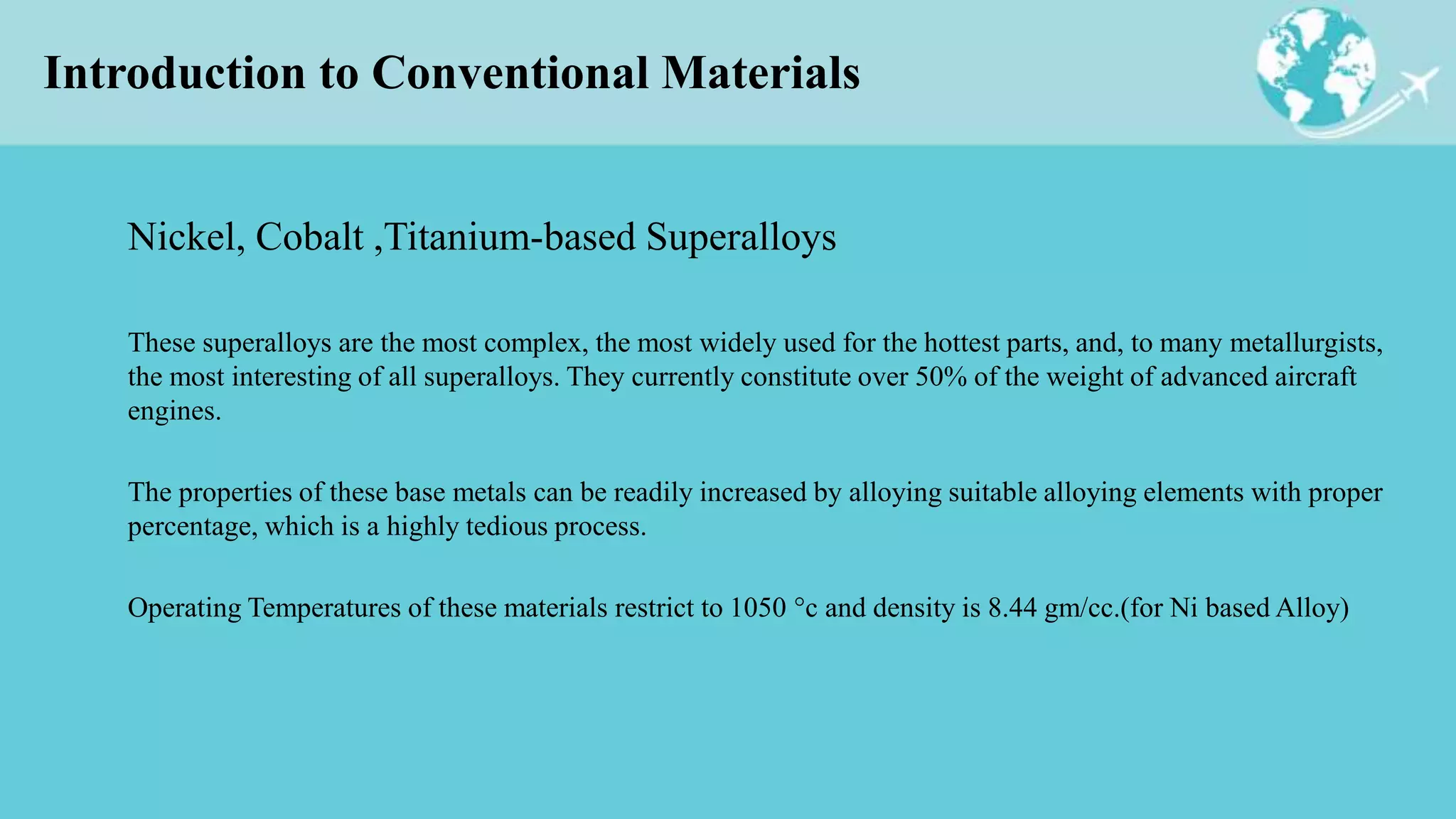
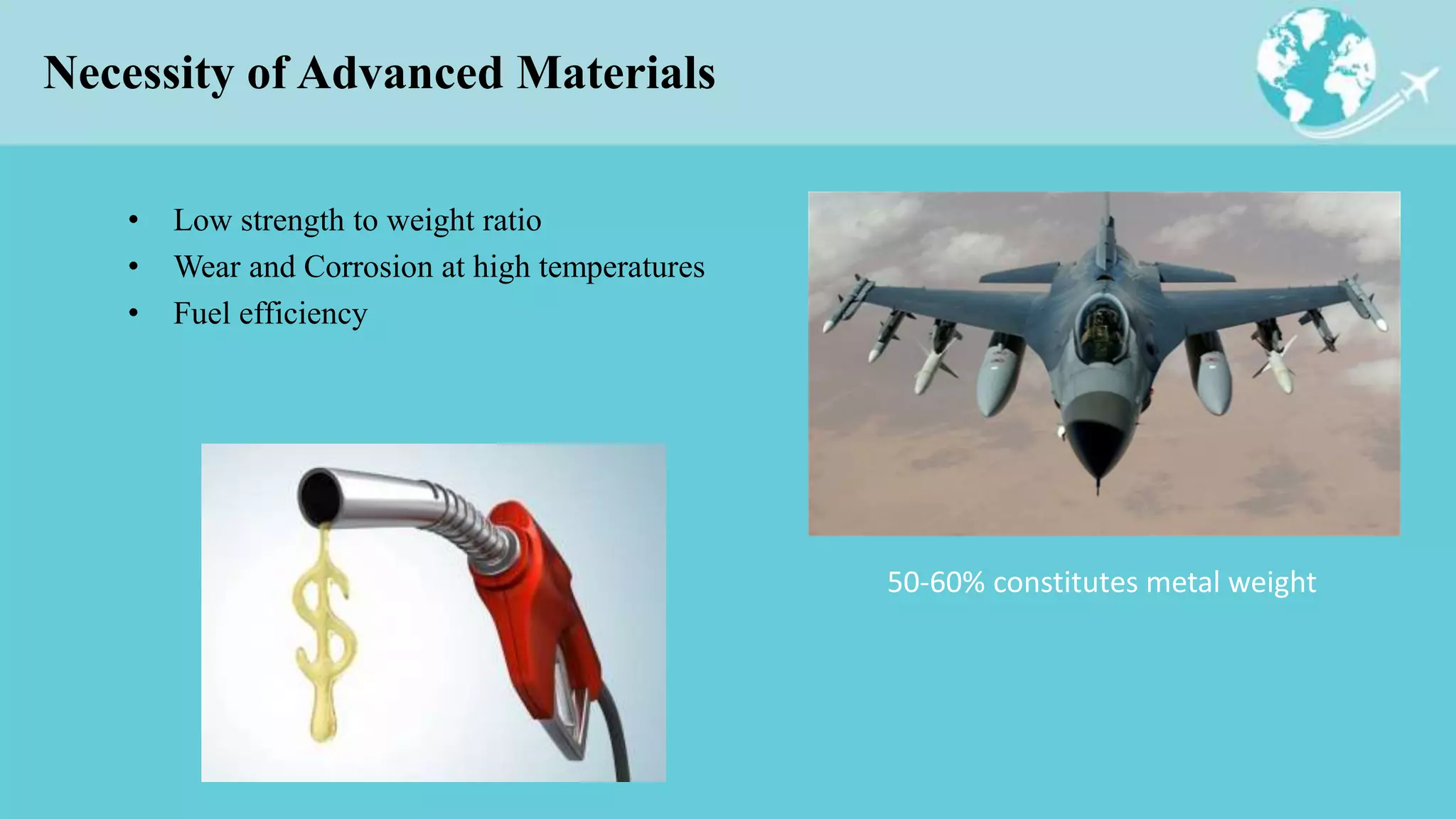
Necessity of Advanced Materials
• Low strength to weight ratio
• Wear and Corrosion at high temperatures
• Fuel efficiency
50-60% constitutes metal weight
What are Composite Materials
Composites are advanced engineering materials having combination of two or more constituents
whether organic, inorganic or any metal which will give the combined properties of each phase.
Composite Consists of Matrix ( Major Phase) and Reinforcement ( Minor Phase)
Composites are generally classified into following five groups
1. Metal Matrix Composite
2. Polymer Matrix Composite
3. Ceramic Matrix Composite
4. Carbon – Carbon Composite.
5. Hybrid Matrix Composite.
CERAMIC COMPOSITE MATERIALS
When ceramic materials are subjected to mechanical or thermal loading, catastrophic failure
takes place because ceramics are Brittle – Lack of Toughness
The main purpose of using reinforcement (such as fibers, particles and whiskers) in Ceramic
Composite Materials (CCM) is to increase toughness of the composites.
Matrix - Load transfer media & protects reinforcement from the environment.
Example: Al2O3 , SiC, BN, Mullite, TiC….
Reinforcement – Should have high Strength and Elastic Modulus (Stiffness).
Example: Al2O3 , SiC, BN, TiC, ZrO2….
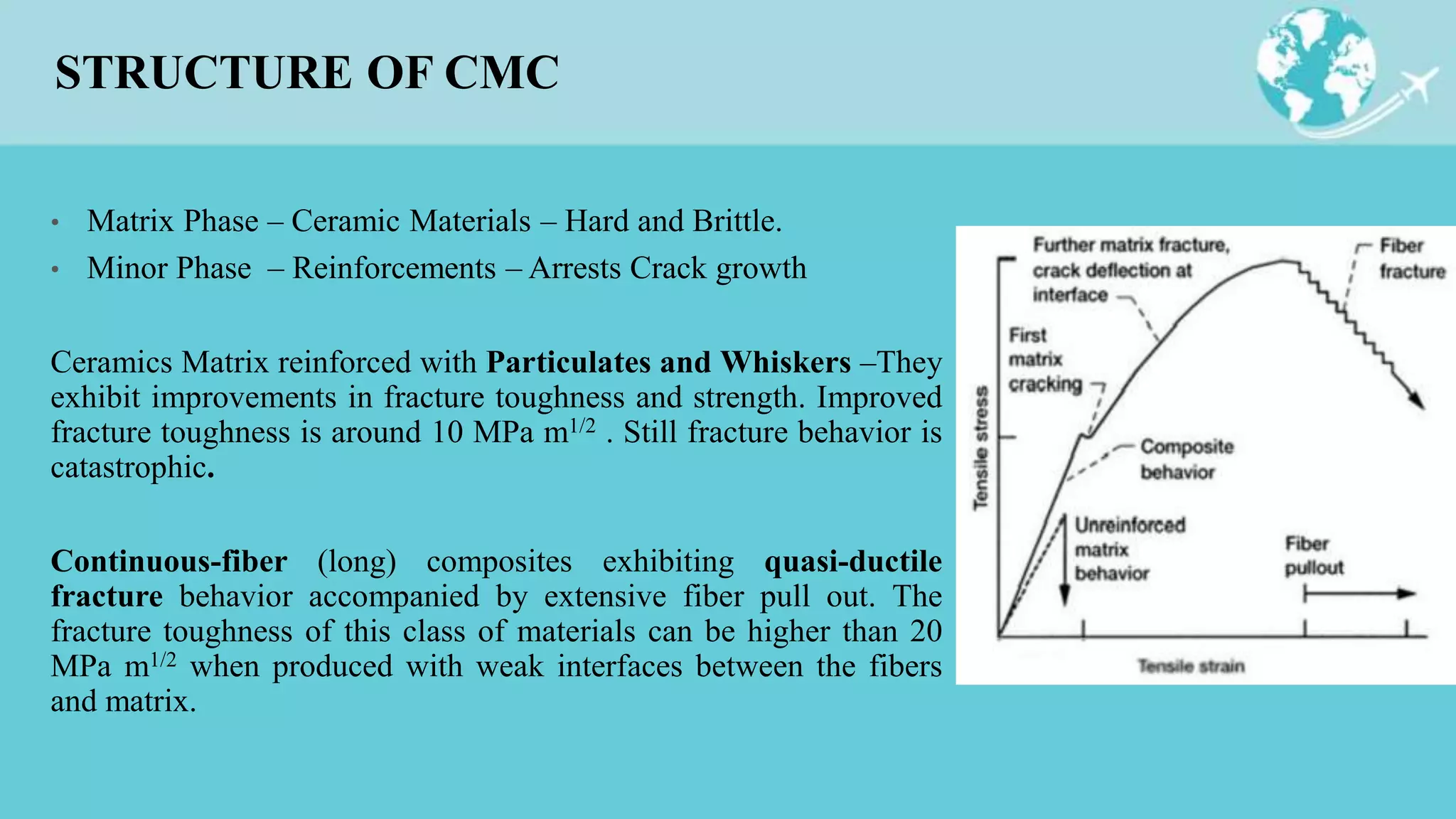
• Matrix Phase – Ceramic Materials – Hard and Brittle.
• Minor Phase – Reinforcements – Arrests Crack growth
Ceramics Matrix reinforced with Particulates and Whiskers –They
exhibit improvements in fracture toughness and strength. Improved
fracture toughness is around 10 MPa m1/2 . Still fracture behavior is
catastrophic.
Continuous-fiber (long) composites exhibiting quasi-ductile
fracture behavior accompanied by extensive fiber pull out. The
fracture toughness of this class of materials can be higher than 20
MPa m1/2 when produced with weak interfaces between the fibers
and matrix.
STRUCTURE OF CMC
PROPERTIES OF CMC’S
 Tensile & Compressive Behaviour
No sudden failure in CMC as like in Ceramics. Certain amount of Elongation in CMC improves
the tensile and compressive property.
 Fracture Toughness
It limits to ceramics, but for CMC’s fracture toughness increases due to reinforcement.
 Fatigue Resistance
Fatigue occurs due to cyclic loading, in case of CMC’s cracks arrested by reinforcement. So
higher Fatigue Resistance.
 Thermal Response
It can withstand high temperature.
 Chemical Inertness
Ceramic do not react with chemicals.
 Corrosion Resistance
ADVANTAGES OF CMC
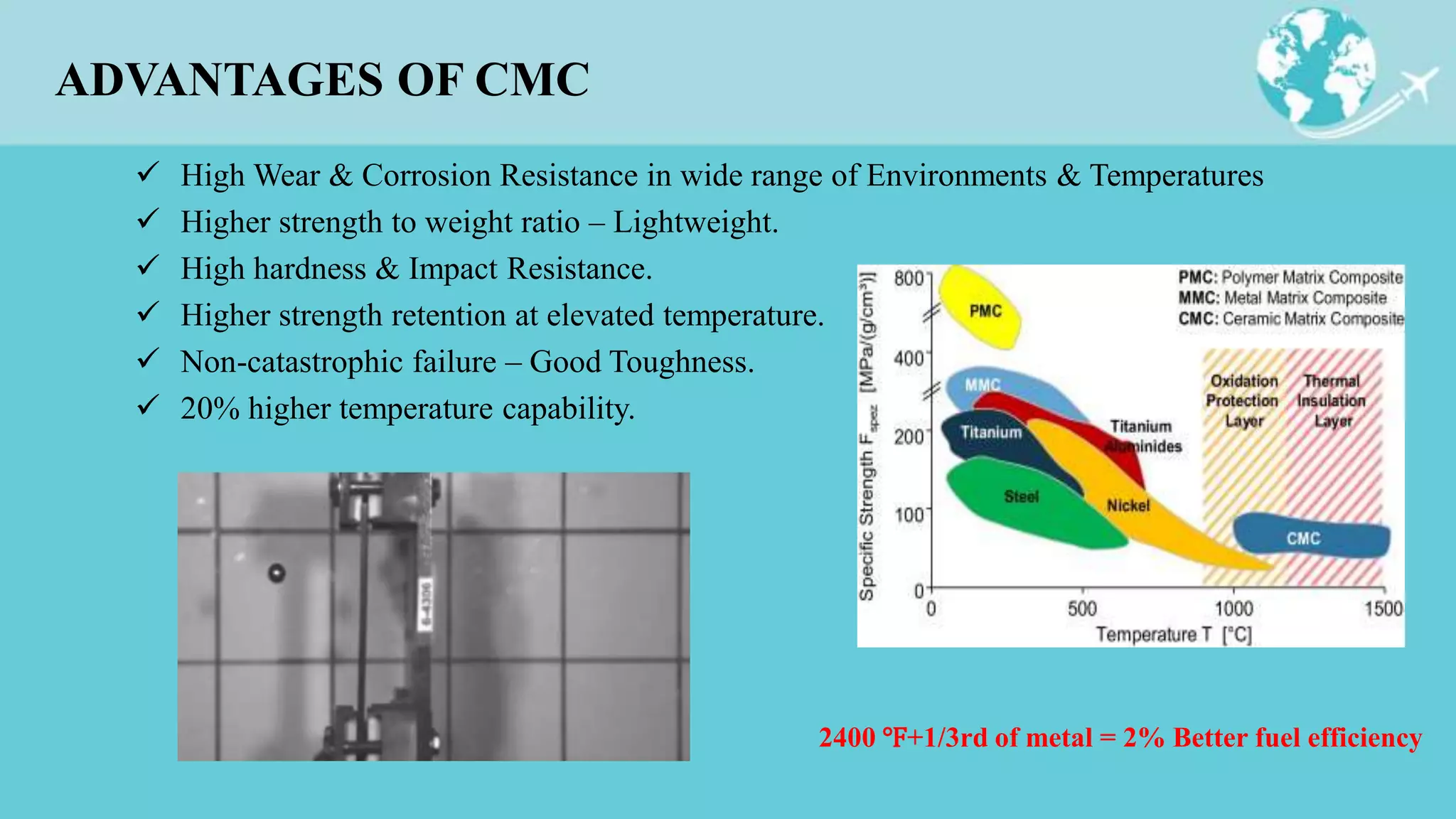
 High Wear & Corrosion Resistance in wide range of Environments & Temperatures
 Higher strength to weight ratio – Lightweight.
 High hardness & Impact Resistance.
 Higher strength retention at elevated temperature.
 Non-catastrophic failure – Good Toughness.
 20% higher temperature capability.
2400 ℉+1/3rd of metal = 2% Better fuel efficiency
Challenges In CMC’s
o Processing routes for CMCs involve high temperatures can only be employed with high
temperature reinforcements.
o High processing temperature results in complexity in manufacturing and hence expensive
processing.
o Difference in the coefficients of thermal expansion between the matrix and the reinforcement
lead to thermal stresses on cooling from the processing temperatures.
● Aeronautical and Automotive purposes
● Orthopedic and dental implants
● Petroleum hydro-treatments
● High speed cutting tool applications
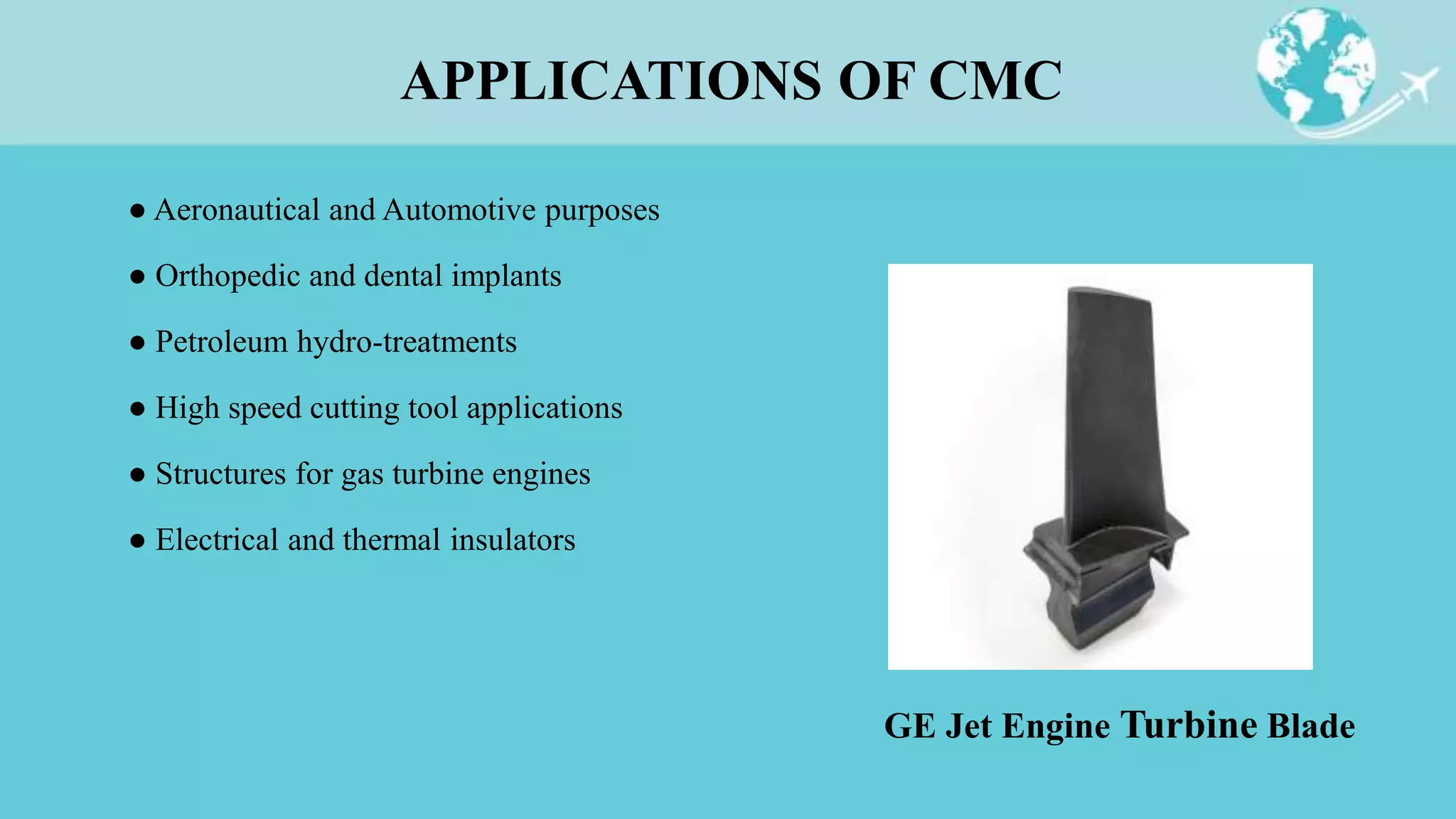
● Structures for gas turbine engines
● Electrical and thermal insulators
APPLICATIONS OF CMC
GE Jet Engine Turbine Blade
LATEST DEVELOPMENTS IN CMC
GE ADVENT Air Flow Diagram
ADVENT – Adaptive Versatile Engine Technology
High Thrust Mode High Efficiency Mode
LATEST DEVELOPMENTS IN CMC
ADVANTAGES
 50% increase in Loiter Time
 35% increase in range for pilots
 25% increase in fuel Efficiency
 60% increase in heat absorption
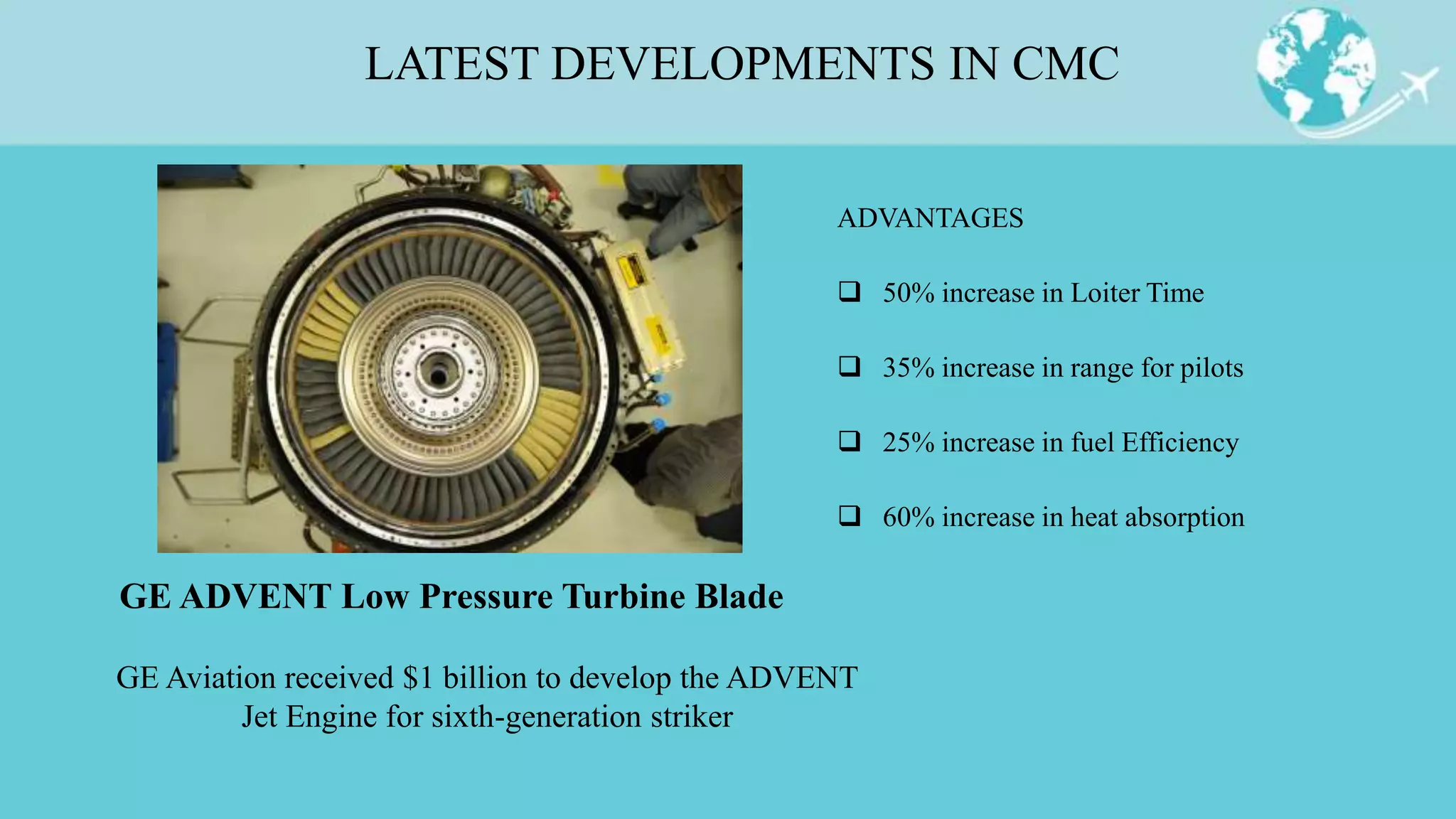
GE ADVENT Low Pressure Turbine Blade
GE Aviation received $1 billion to develop the ADVENT
Jet Engine for sixth-generation striker
Conclusion
• Detailed report on the necessity of Ceramic Matrix Composites in today’s industry in various
sectors like Defense, Aerospace and many other areas.
• Important properties of CMC and why there are special than other materials.
• Latest developments in the field of CMC materials and few examples
[1] Ceramic Matrix Composites: Processing Techniques and Recent advancements by Neera Singh et.al
Journal of Materials and Environmental Sciences – 2017 Volume 8 Issue 5 ISSN : 2028-2508
[2] Ceramic Matrix Composites Manufacturing and Applications in the Automotive Industry by Diego Brach
García, Advanced Composite Centre for Innovation and Science - University of Bristol
[3] Ceramic Matrix Composites (CMC) for demanding Aerospace and Terrestrial Applications Dr. Karin E.
Handrick – MT Aerospace XXI C AIV – Catania May 2013
[4] Modelling of Damage and Fracture In Ceramic Matrix Composites – An Overview by Michał Basista in
Journal of Theoretical and Applied Mechanics 2006 Volume 44, Page 454 -484
[5] Comprehensive Composite Materials, Volume 4: Carbon/Carbon, Cement, and Ceramic Matrix Composites,
4.01 Matrix Materials, R. MORRELL
REFERENCES
Application of Ceramic Composite Materials in Aviation

Application of Ceramic Composite Materials in Aviation

  • 1.
    Presented by R.S.S. MANOJKUMAR 172ML017 - M. Tech Materials Engineering APPLICATION OF CERAMIC COMPOSITE MATERIALS IN AVIATION
  • 2.
    OUTLINE  Introduction toConventional Materials  Necessity of Advanced Materials  Ceramic Composite Materials (CCM)  General Structure of CCM  Properties of CCM  Advantages  Challenges  Applications  Conclusion
  • 3.
    Introduction to ConventionalMaterials Nickel, Cobalt ,Titanium-based Superalloys These superalloys are the most complex, the most widely used for the hottest parts, and, to many metallurgists, the most interesting of all superalloys. They currently constitute over 50% of the weight of advanced aircraft engines. The properties of these base metals can be readily increased by alloying suitable alloying elements with proper percentage, which is a highly tedious process. Operating Temperatures of these materials restrict to 1050 °c and density is 8.44 gm/cc.(for Ni based Alloy)
  • 4.
    Necessity of AdvancedMaterials • Low strength to weight ratio • Wear and Corrosion at high temperatures • Fuel efficiency 50-60% constitutes metal weight
  • 5.
    What are CompositeMaterials Composites are advanced engineering materials having combination of two or more constituents whether organic, inorganic or any metal which will give the combined properties of each phase. Composite Consists of Matrix ( Major Phase) and Reinforcement ( Minor Phase) Composites are generally classified into following five groups 1. Metal Matrix Composite 2. Polymer Matrix Composite 3. Ceramic Matrix Composite 4. Carbon – Carbon Composite. 5. Hybrid Matrix Composite.
  • 6.
    CERAMIC COMPOSITE MATERIALS Whenceramic materials are subjected to mechanical or thermal loading, catastrophic failure takes place because ceramics are Brittle – Lack of Toughness The main purpose of using reinforcement (such as fibers, particles and whiskers) in Ceramic Composite Materials (CCM) is to increase toughness of the composites. Matrix - Load transfer media & protects reinforcement from the environment. Example: Al2O3 , SiC, BN, Mullite, TiC…. Reinforcement – Should have high Strength and Elastic Modulus (Stiffness). Example: Al2O3 , SiC, BN, TiC, ZrO2….
  • 7.
    • Matrix Phase– Ceramic Materials – Hard and Brittle. • Minor Phase – Reinforcements – Arrests Crack growth Ceramics Matrix reinforced with Particulates and Whiskers –They exhibit improvements in fracture toughness and strength. Improved fracture toughness is around 10 MPa m1/2 . Still fracture behavior is catastrophic. Continuous-fiber (long) composites exhibiting quasi-ductile fracture behavior accompanied by extensive fiber pull out. The fracture toughness of this class of materials can be higher than 20 MPa m1/2 when produced with weak interfaces between the fibers and matrix. STRUCTURE OF CMC
  • 8.
    PROPERTIES OF CMC’S Tensile & Compressive Behaviour No sudden failure in CMC as like in Ceramics. Certain amount of Elongation in CMC improves the tensile and compressive property.  Fracture Toughness It limits to ceramics, but for CMC’s fracture toughness increases due to reinforcement.  Fatigue Resistance Fatigue occurs due to cyclic loading, in case of CMC’s cracks arrested by reinforcement. So higher Fatigue Resistance.  Thermal Response It can withstand high temperature.  Chemical Inertness Ceramic do not react with chemicals.  Corrosion Resistance
  • 9.
    ADVANTAGES OF CMC High Wear & Corrosion Resistance in wide range of Environments & Temperatures  Higher strength to weight ratio – Lightweight.  High hardness & Impact Resistance.  Higher strength retention at elevated temperature.  Non-catastrophic failure – Good Toughness.  20% higher temperature capability. 2400 ℉+1/3rd of metal = 2% Better fuel efficiency
  • 10.
    Challenges In CMC’s oProcessing routes for CMCs involve high temperatures can only be employed with high temperature reinforcements. o High processing temperature results in complexity in manufacturing and hence expensive processing. o Difference in the coefficients of thermal expansion between the matrix and the reinforcement lead to thermal stresses on cooling from the processing temperatures.
  • 11.
    ● Aeronautical andAutomotive purposes ● Orthopedic and dental implants ● Petroleum hydro-treatments ● High speed cutting tool applications ● Structures for gas turbine engines ● Electrical and thermal insulators APPLICATIONS OF CMC GE Jet Engine Turbine Blade
  • 12.
    LATEST DEVELOPMENTS INCMC GE ADVENT Air Flow Diagram ADVENT – Adaptive Versatile Engine Technology High Thrust Mode High Efficiency Mode
  • 13.
    LATEST DEVELOPMENTS INCMC ADVANTAGES  50% increase in Loiter Time  35% increase in range for pilots  25% increase in fuel Efficiency  60% increase in heat absorption GE ADVENT Low Pressure Turbine Blade GE Aviation received $1 billion to develop the ADVENT Jet Engine for sixth-generation striker
  • 14.
    Conclusion • Detailed reporton the necessity of Ceramic Matrix Composites in today’s industry in various sectors like Defense, Aerospace and many other areas. • Important properties of CMC and why there are special than other materials. • Latest developments in the field of CMC materials and few examples
  • 15.
    [1] Ceramic MatrixComposites: Processing Techniques and Recent advancements by Neera Singh et.al Journal of Materials and Environmental Sciences – 2017 Volume 8 Issue 5 ISSN : 2028-2508 [2] Ceramic Matrix Composites Manufacturing and Applications in the Automotive Industry by Diego Brach García, Advanced Composite Centre for Innovation and Science - University of Bristol [3] Ceramic Matrix Composites (CMC) for demanding Aerospace and Terrestrial Applications Dr. Karin E. Handrick – MT Aerospace XXI C AIV – Catania May 2013 [4] Modelling of Damage and Fracture In Ceramic Matrix Composites – An Overview by Michał Basista in Journal of Theoretical and Applied Mechanics 2006 Volume 44, Page 454 -484 [5] Comprehensive Composite Materials, Volume 4: Carbon/Carbon, Cement, and Ceramic Matrix Composites, 4.01 Matrix Materials, R. MORRELL REFERENCES