Composite Material
Applications
Content
 Carbon fiber & Applications
 Fiber Glass & Applications
 Fiber Reinforced Concrete (FRC) & Applications
 Laminated Floors
 Bullet Proof Glass
 Modern Light Armor
 Aerospace Applications
 Construction Applications
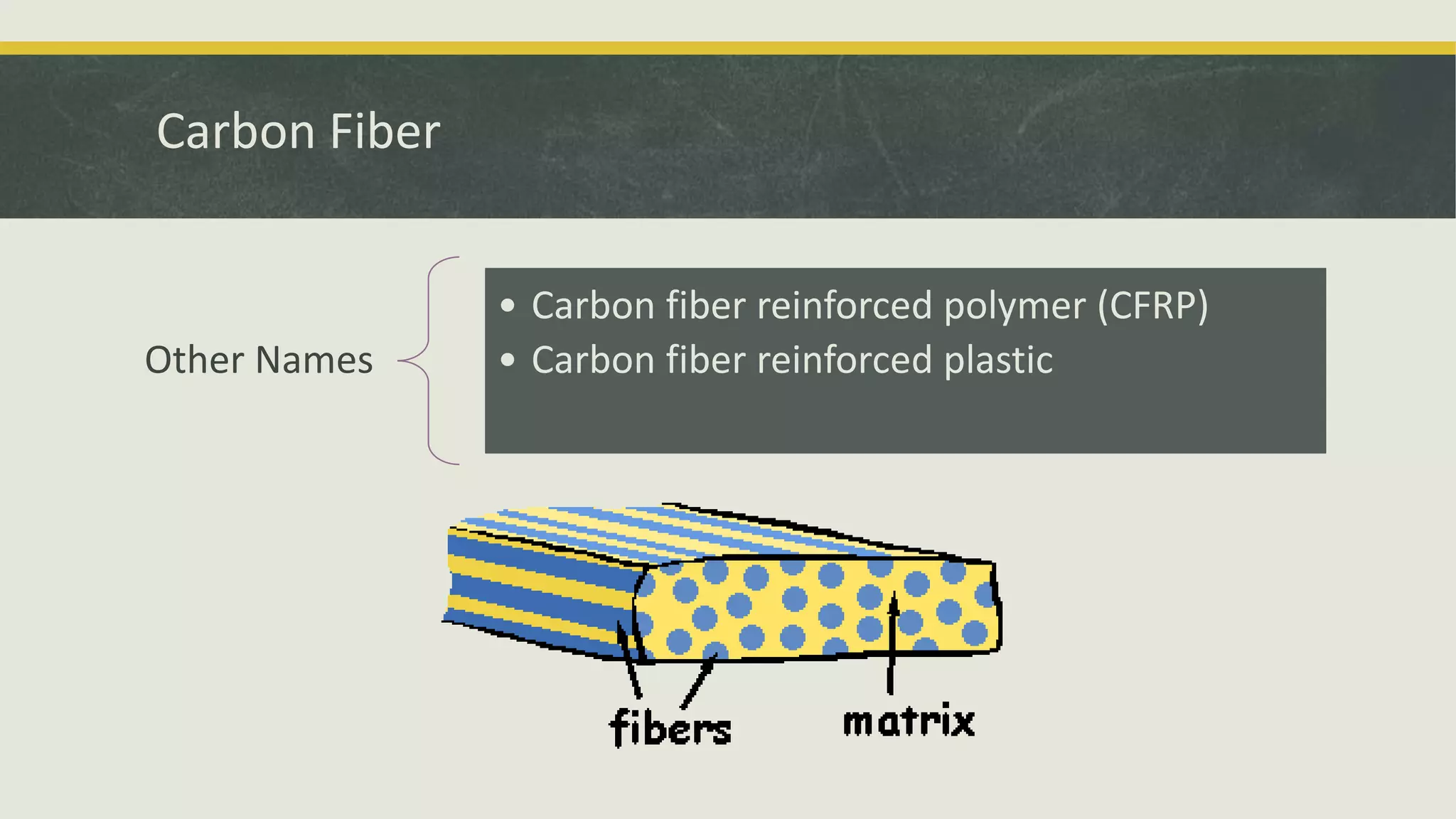
Carbon Fiber
Other Names
• Carbon fiber reinforced polymer (CFRP)
• Carbon fiber reinforced plastic
Carbon Fiber
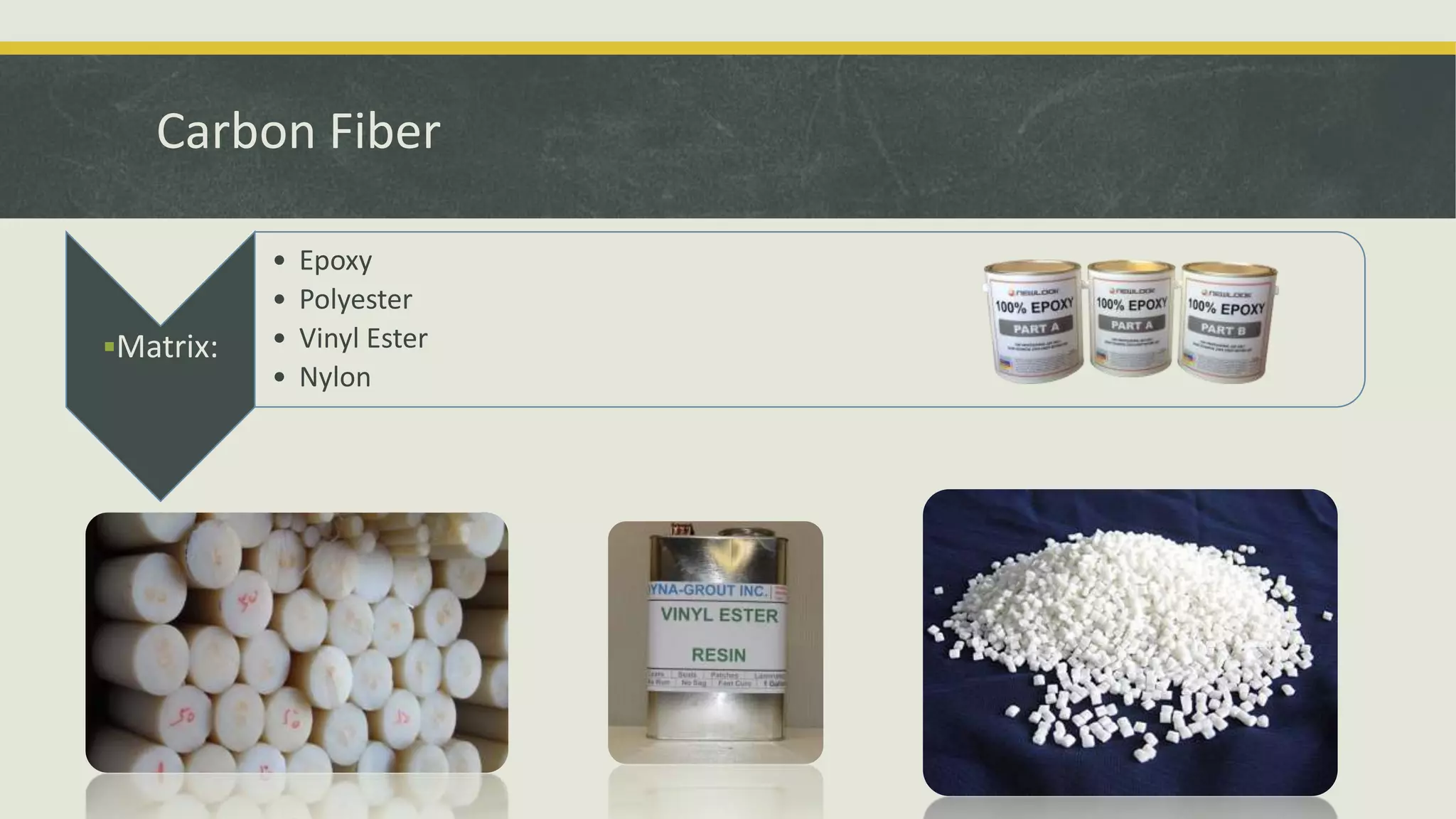
Matrix:
• Epoxy
• Polyester
• Vinyl Ester
• Nylon
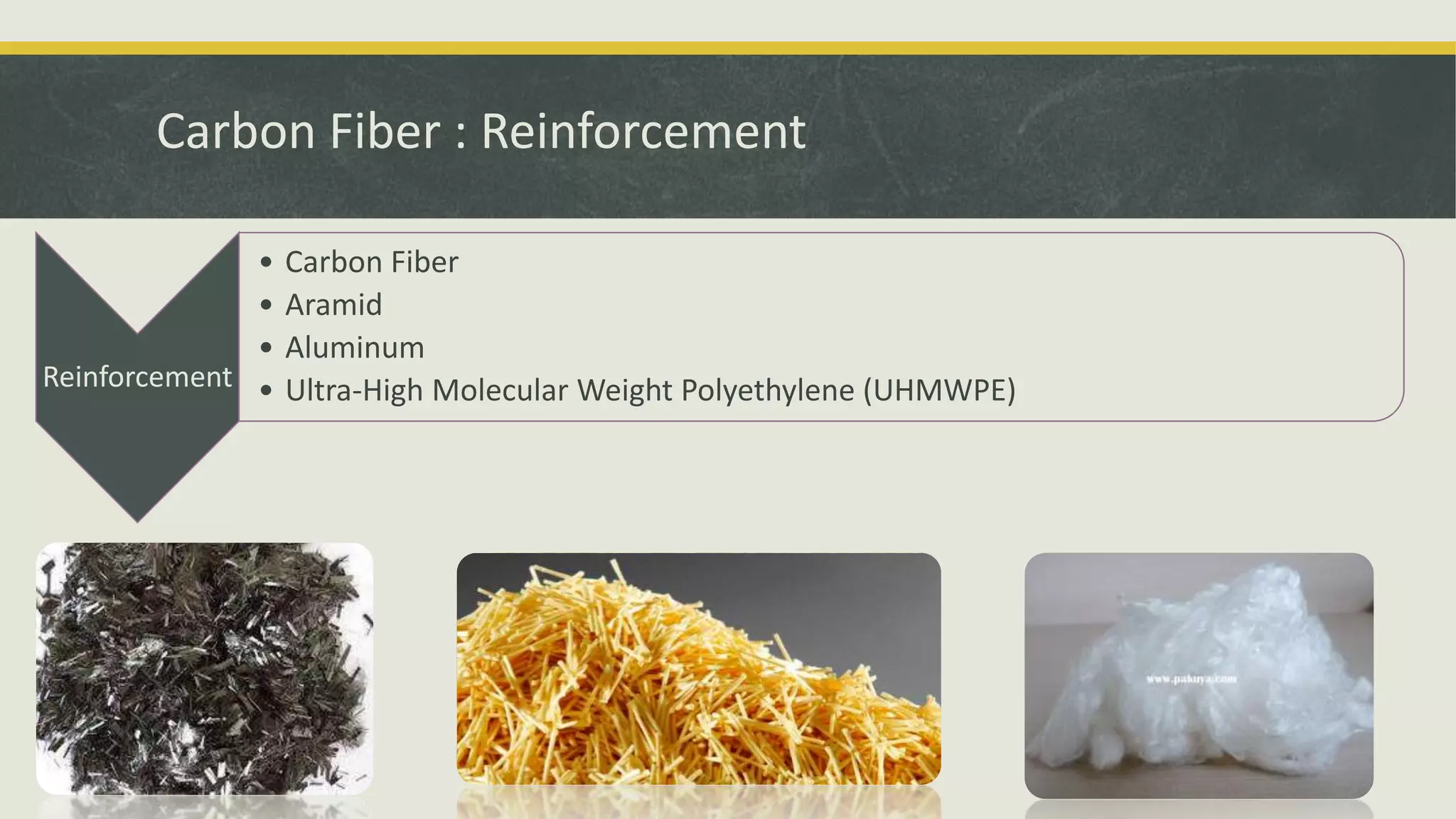
Carbon Fiber : Reinforcement
Reinforcement
• Carbon Fiber
• Aramid
• Aluminum
• Ultra-High Molecular Weight Polyethylene (UHMWPE)
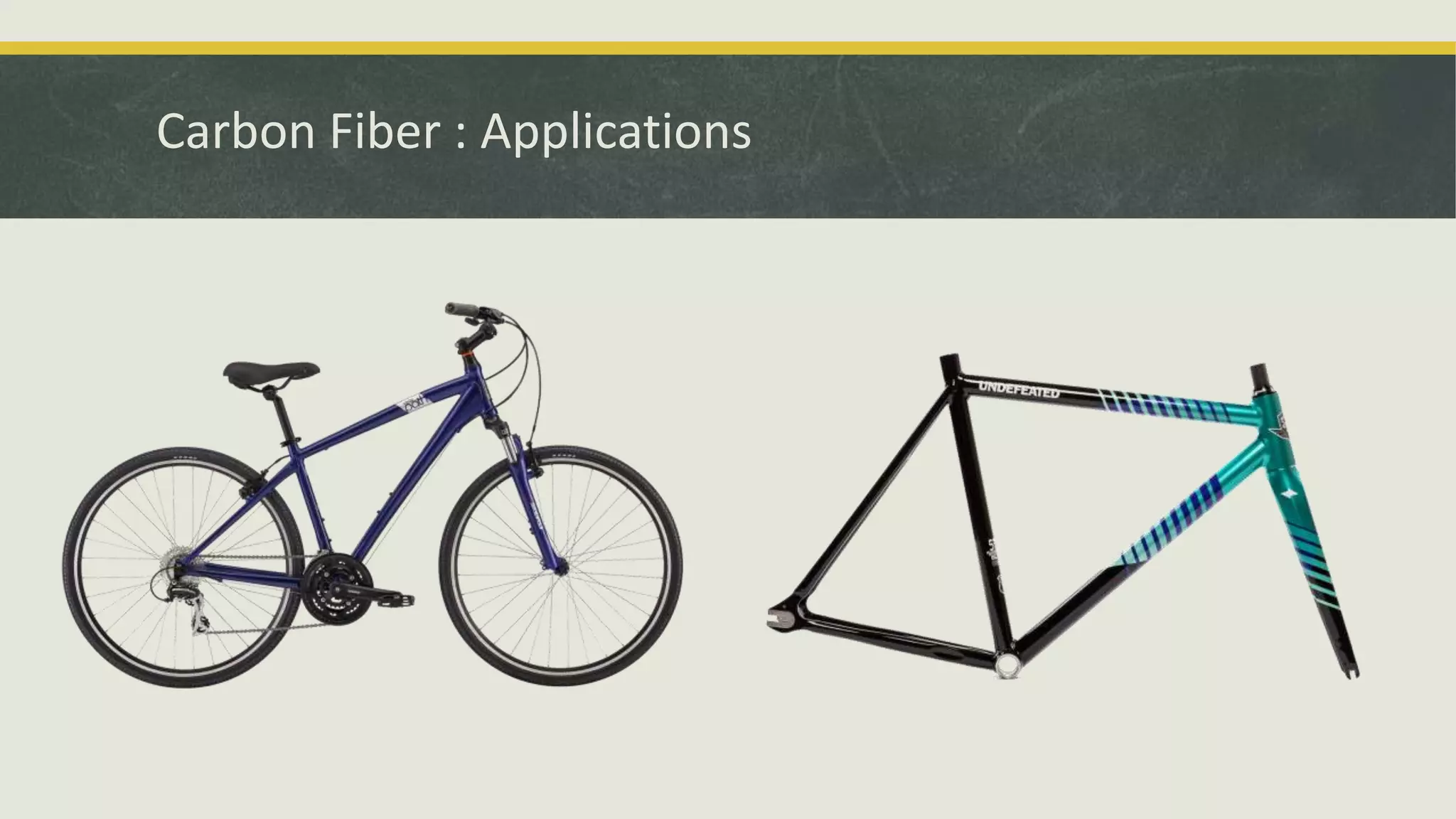
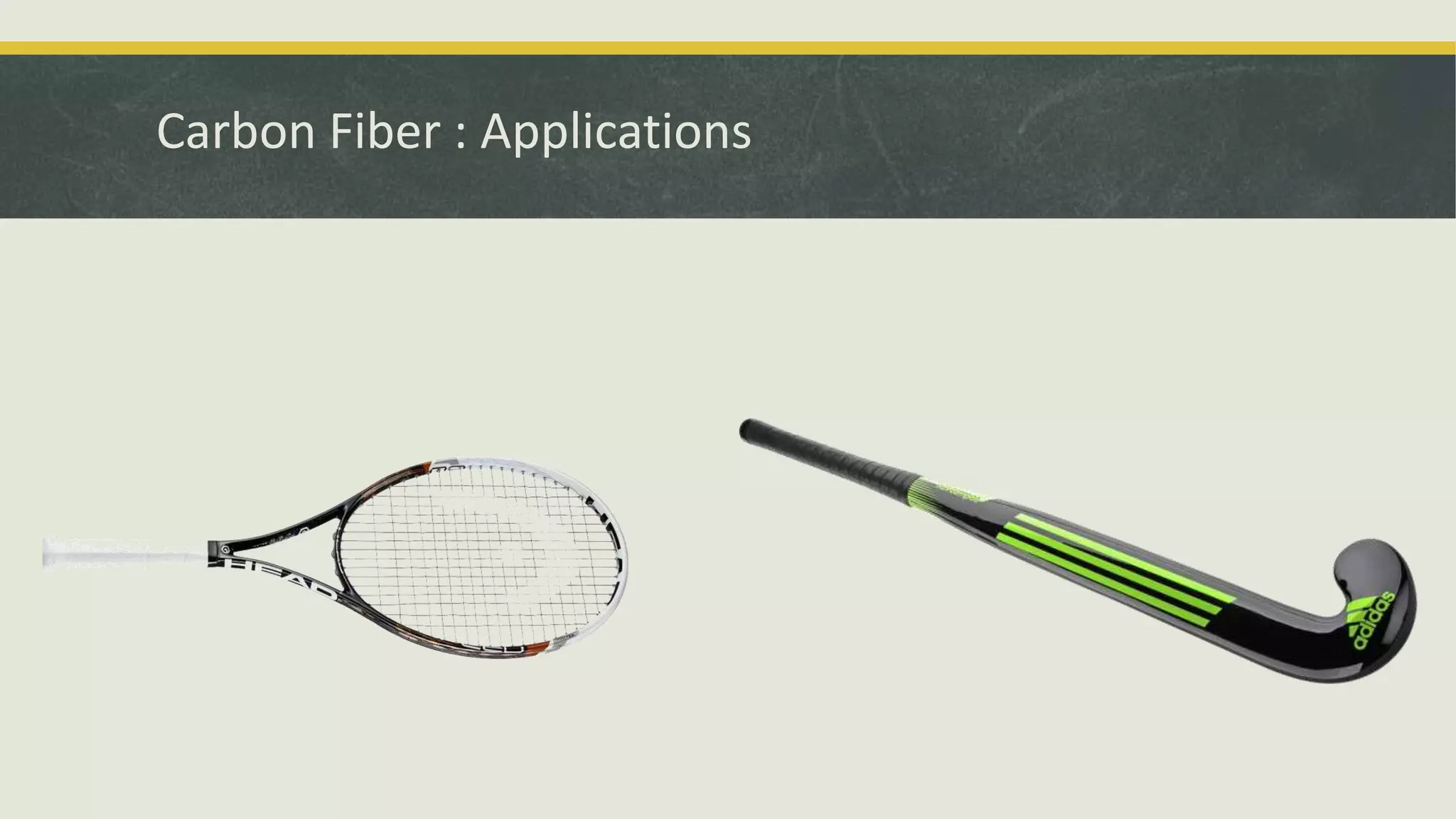
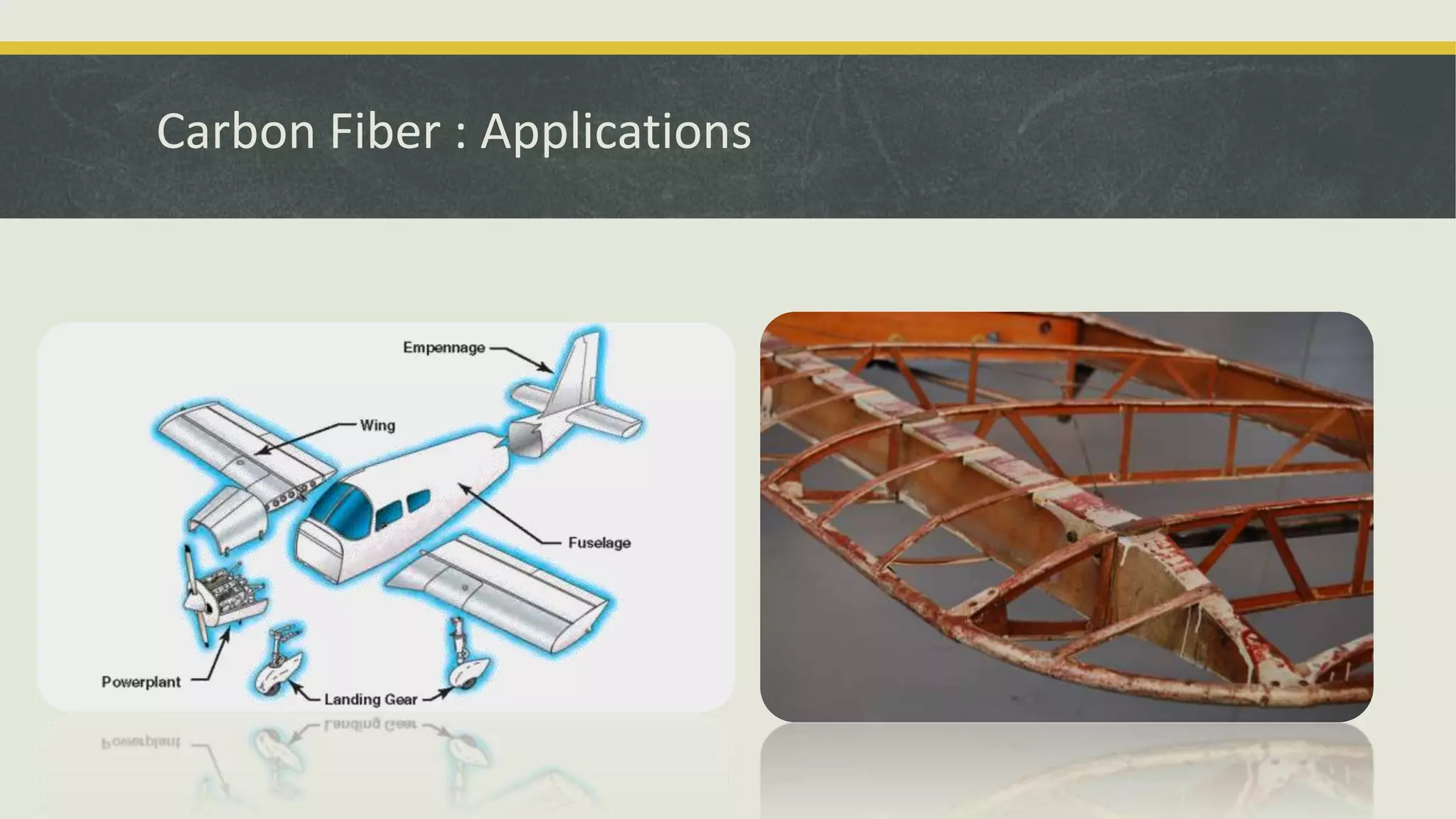
Carbon Fiber : Applications
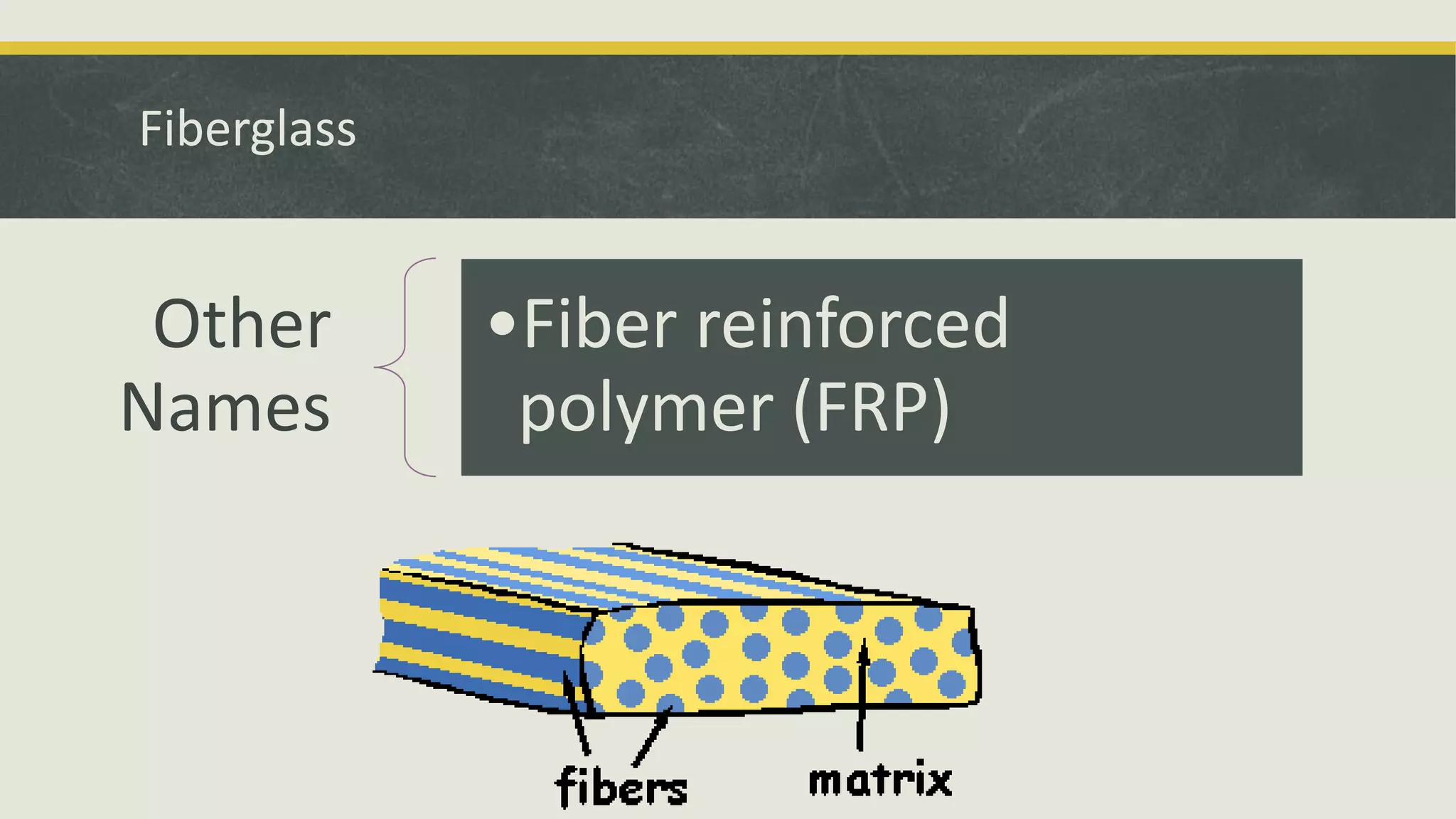
Fiberglass
Other
Names
•Fiber reinforced
polymer (FRP)
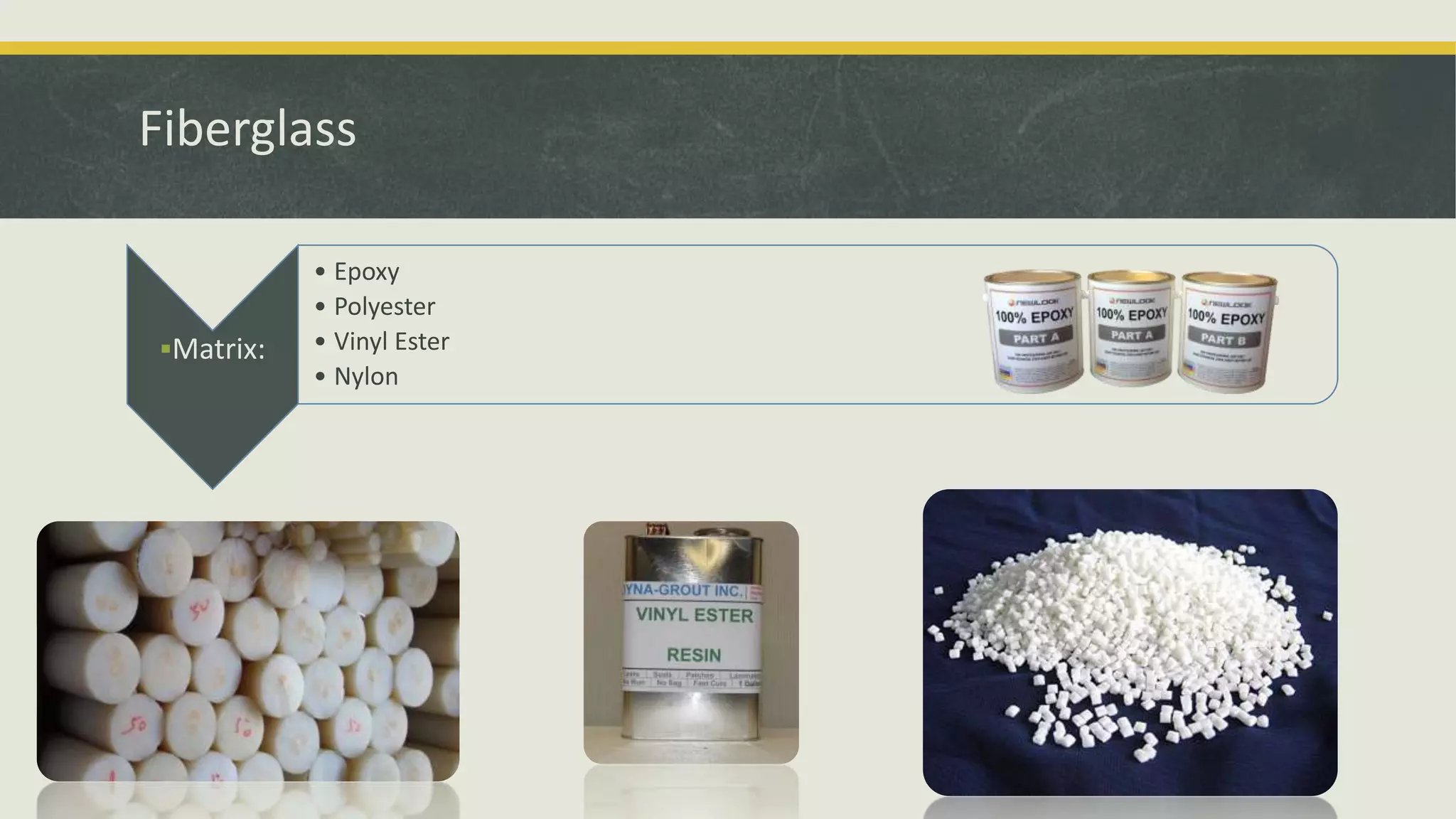
Matrix:
• Epoxy
• Polyester
• Vinyl Ester
• Nylon
Fiberglass
Fiberglass
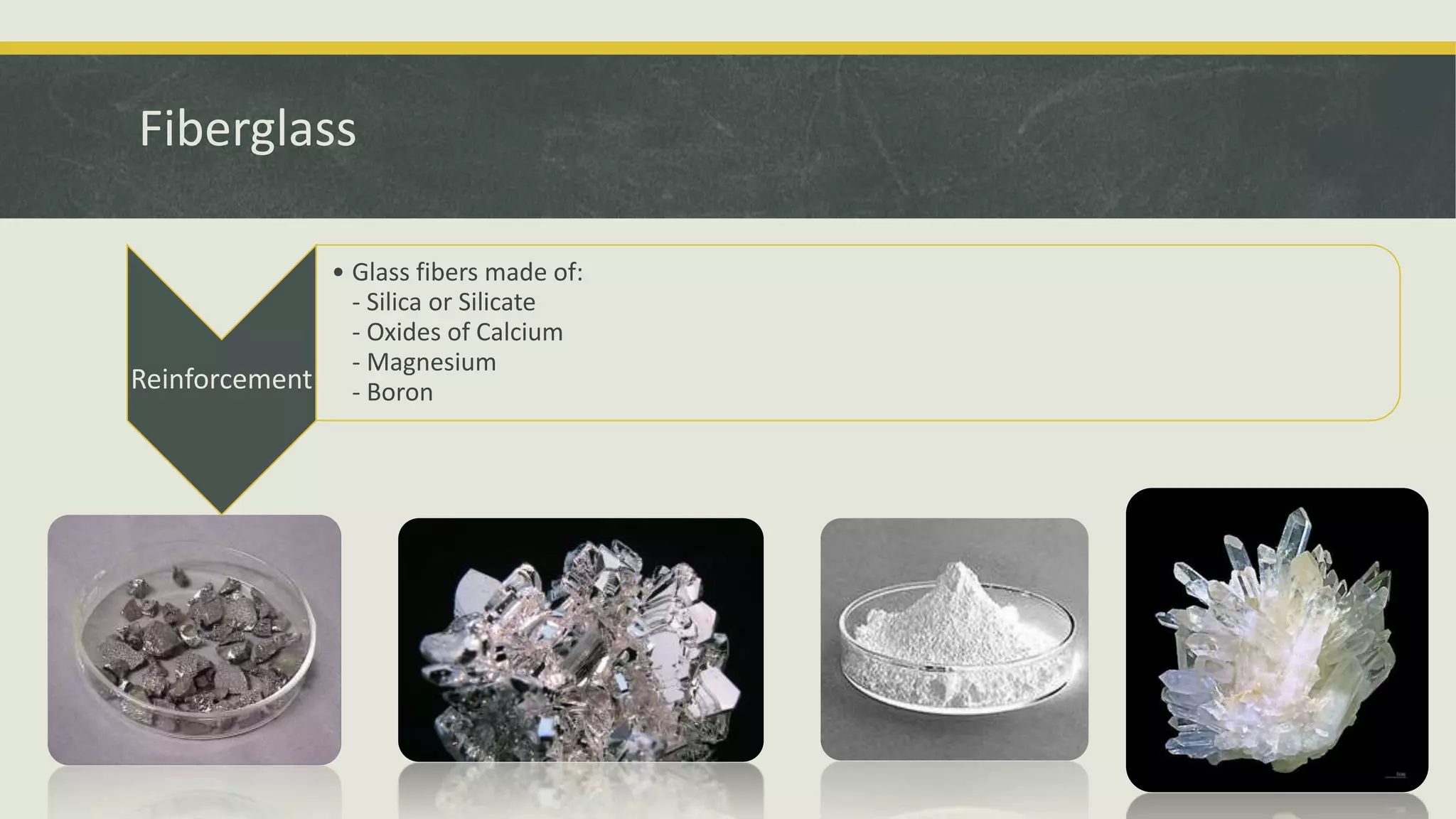
Reinforcement
• Glass fibers made of:
- Silica or Silicate
- Oxides of Calcium
- Magnesium
- Boron
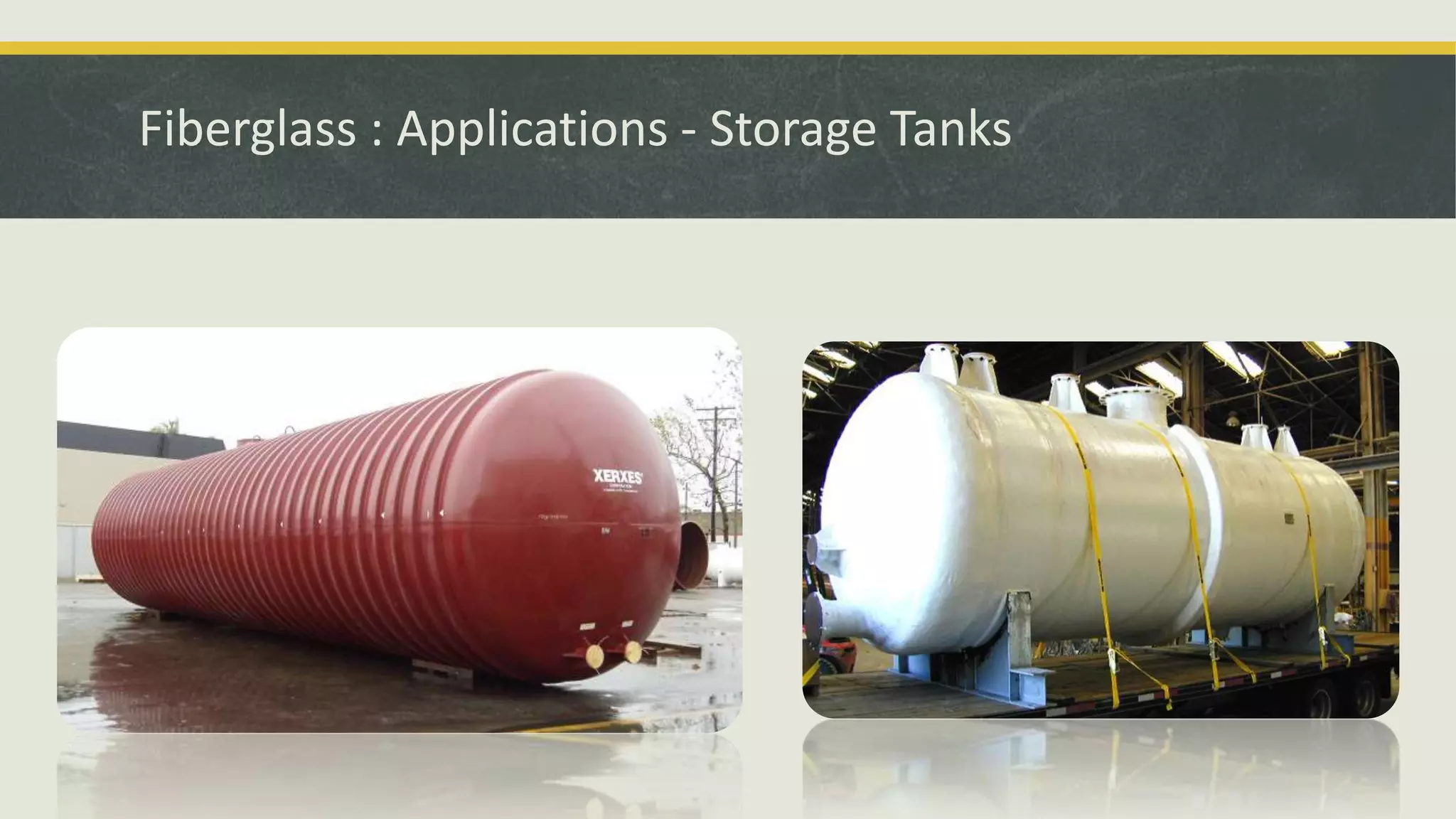
Fiberglass : Applications - Storage Tanks
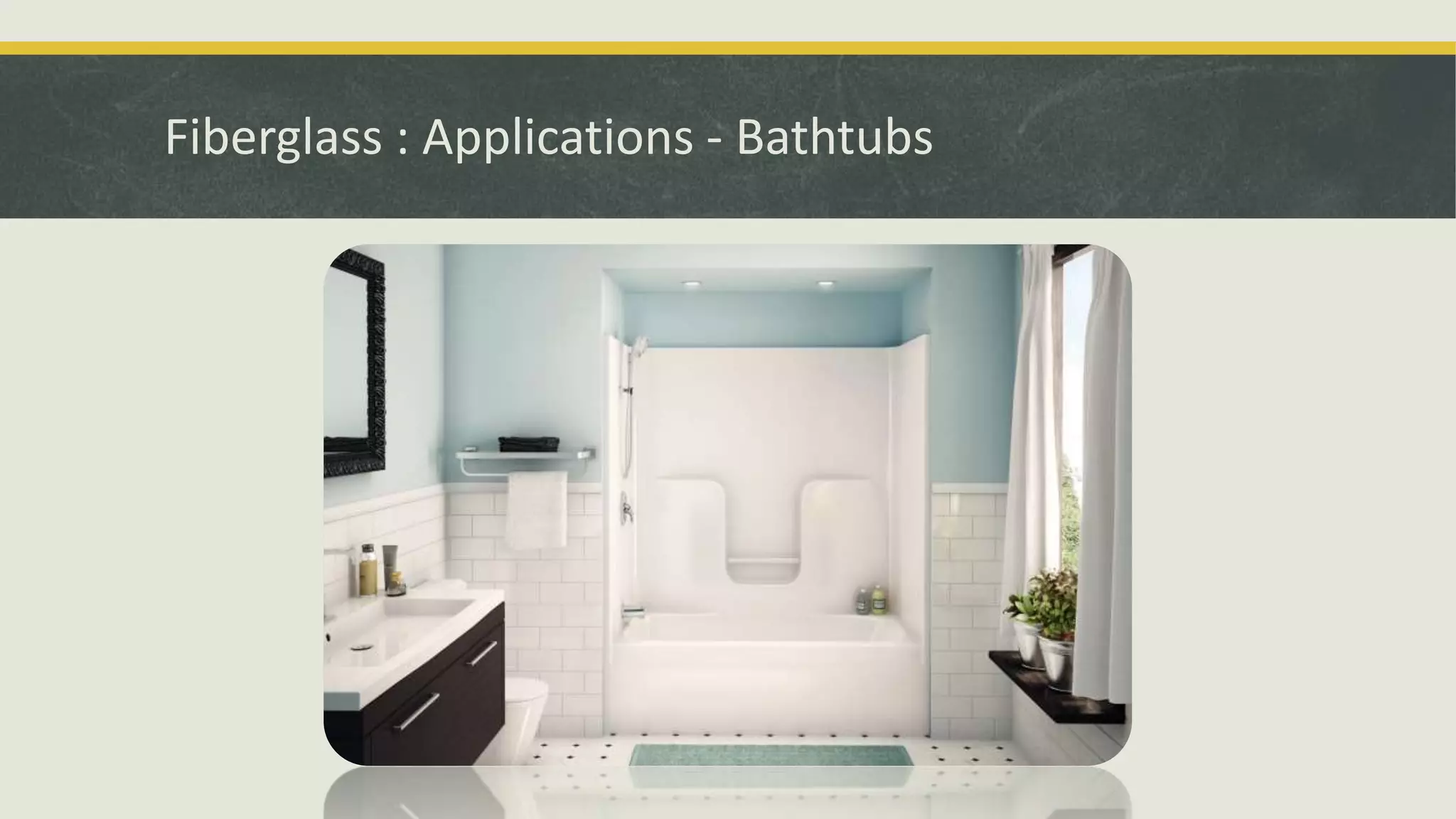
Fiberglass : Applications - Bathtubs
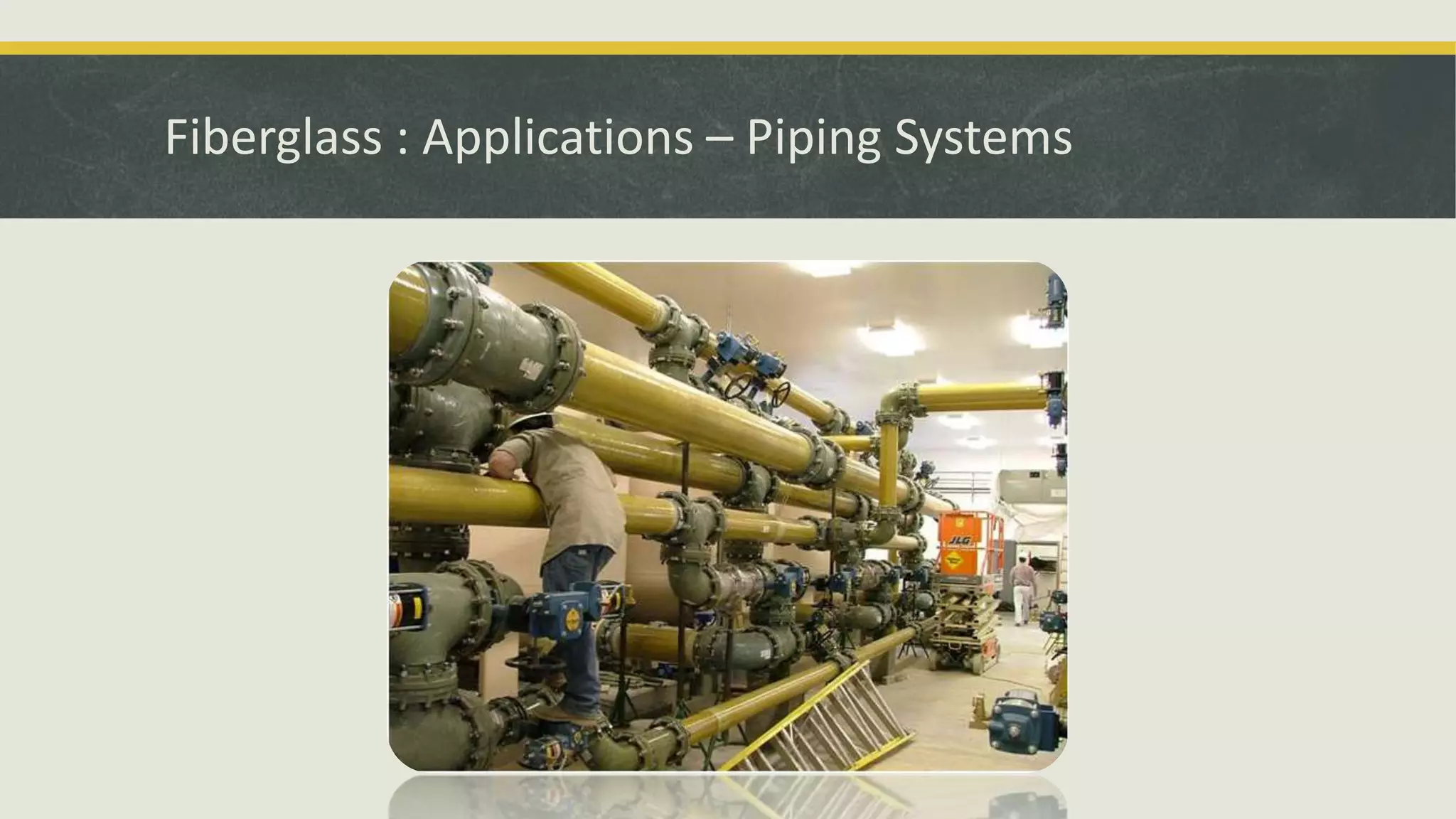
Fiberglass : Applications – Piping Systems
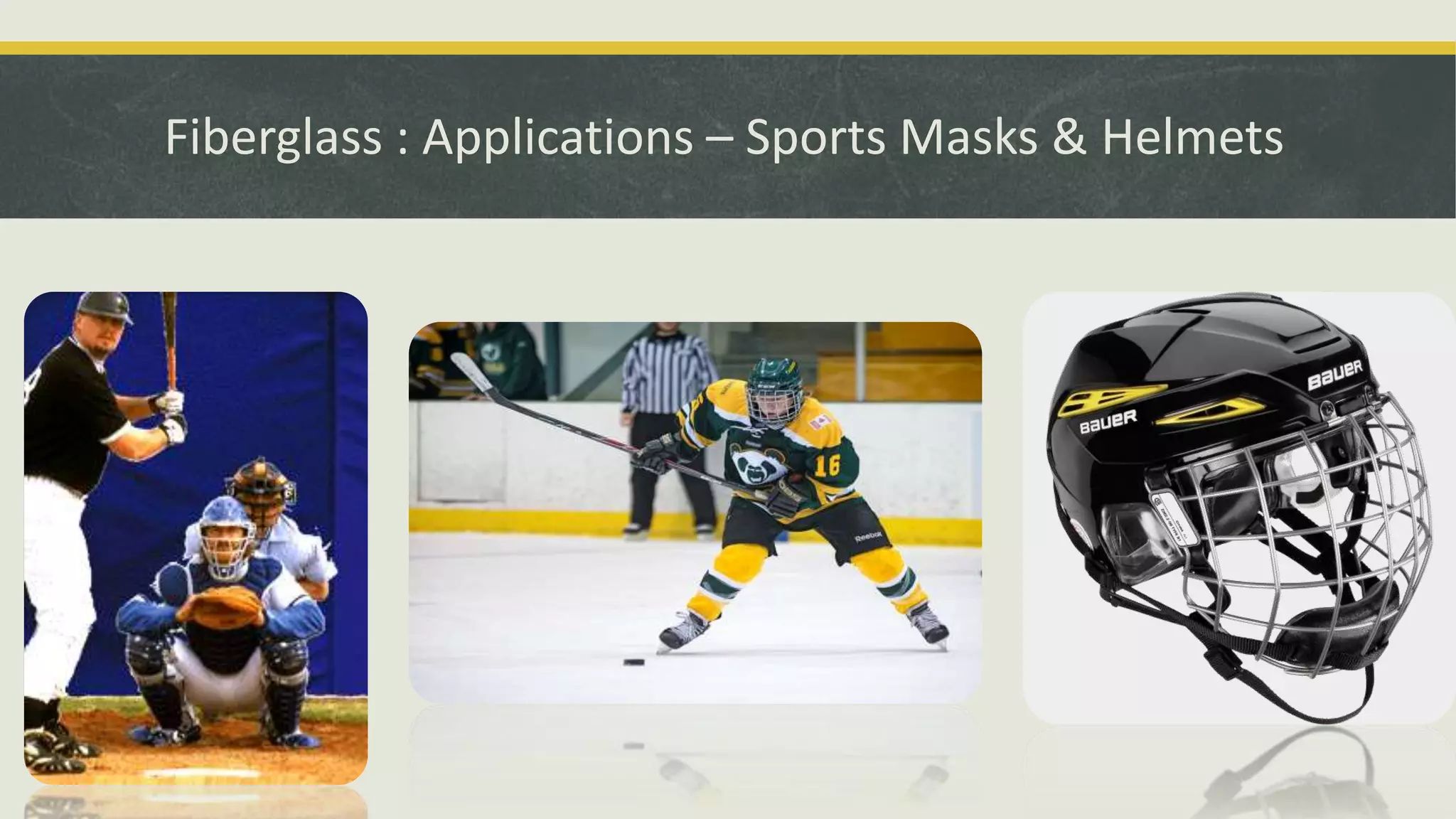
Fiberglass : Applications – Sports Masks & Helmets
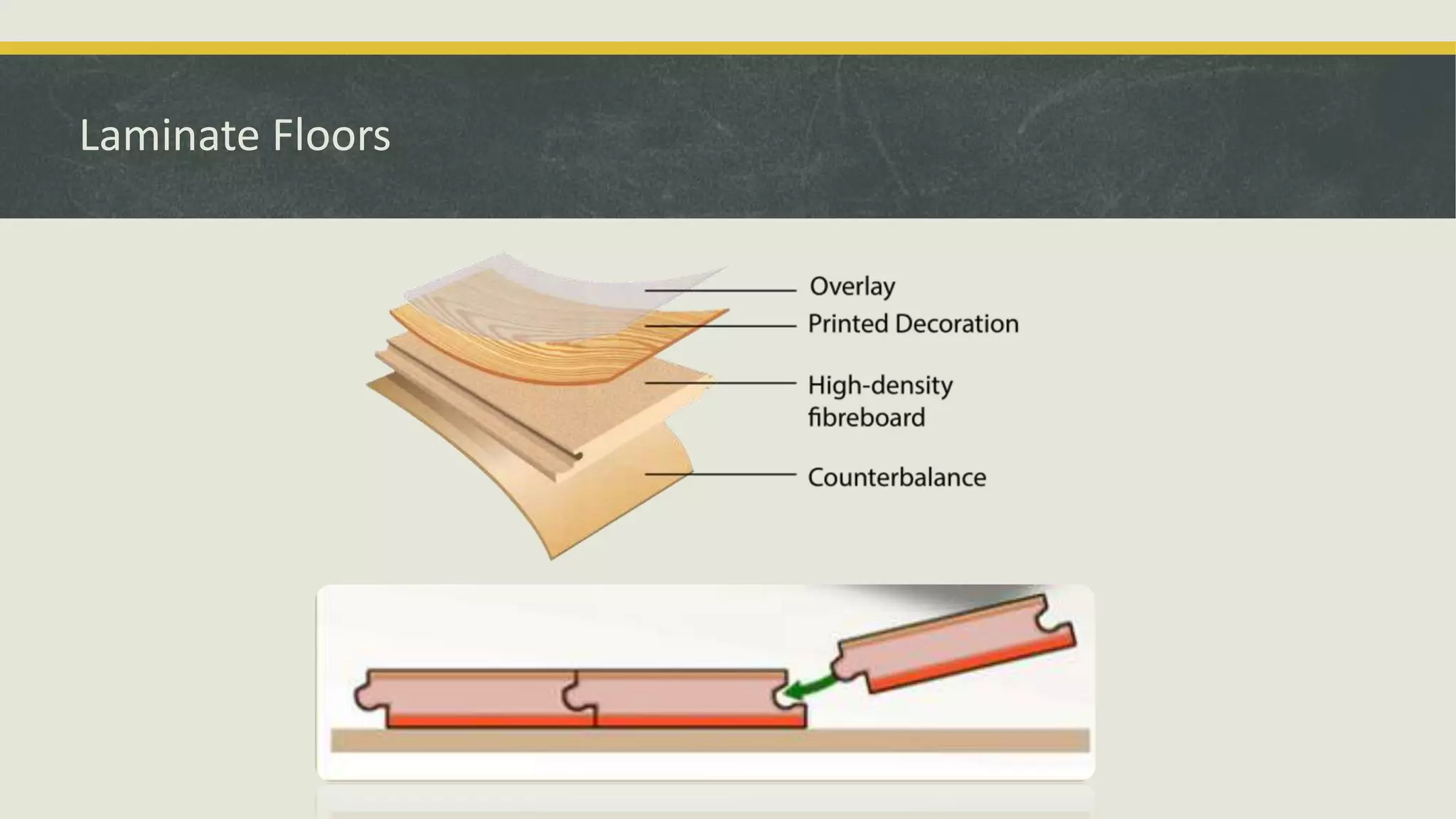
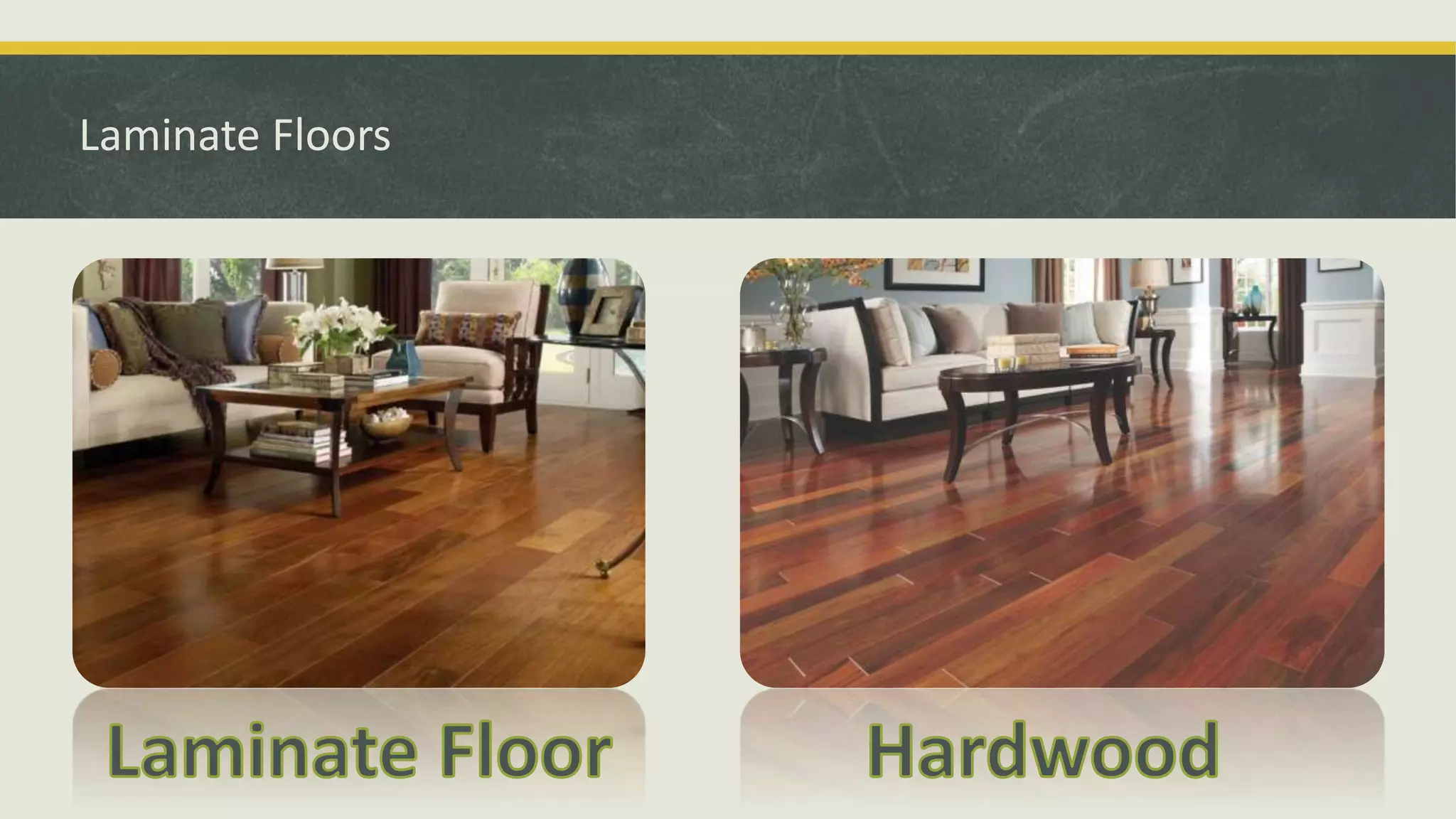
Laminate Floors
Laminate Floors
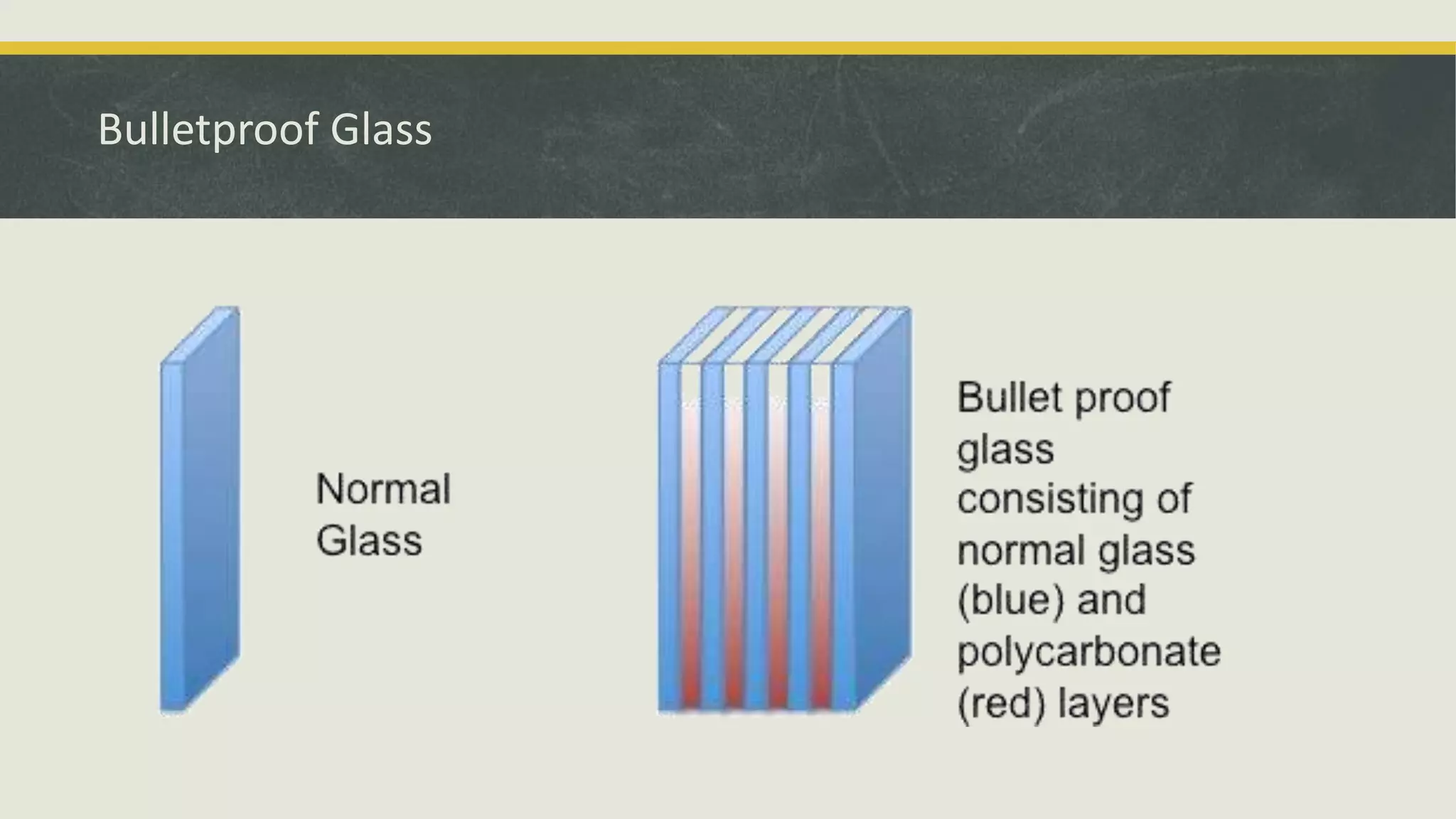
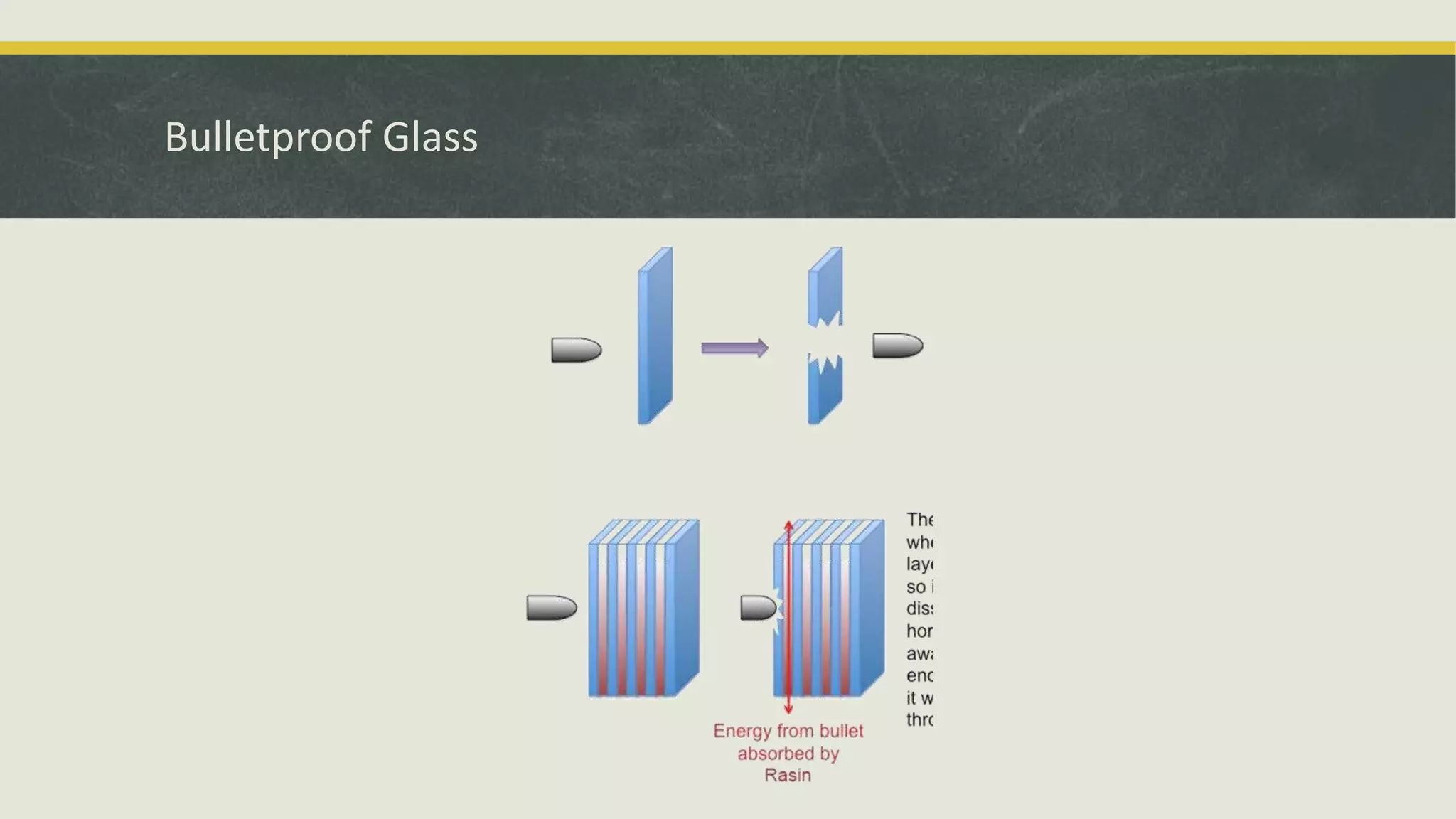
Bulletproof Glass
Bulletproof Glass
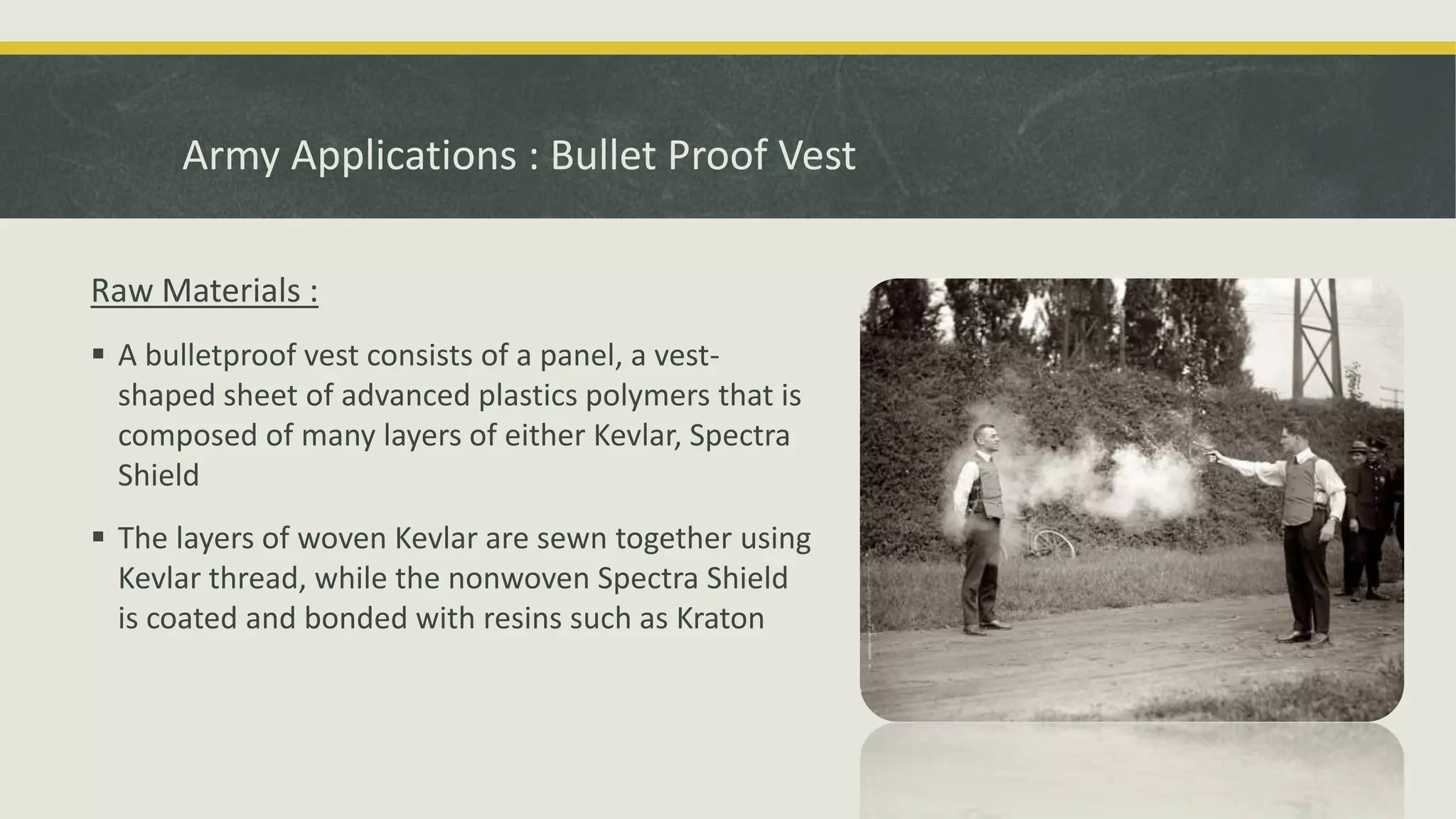
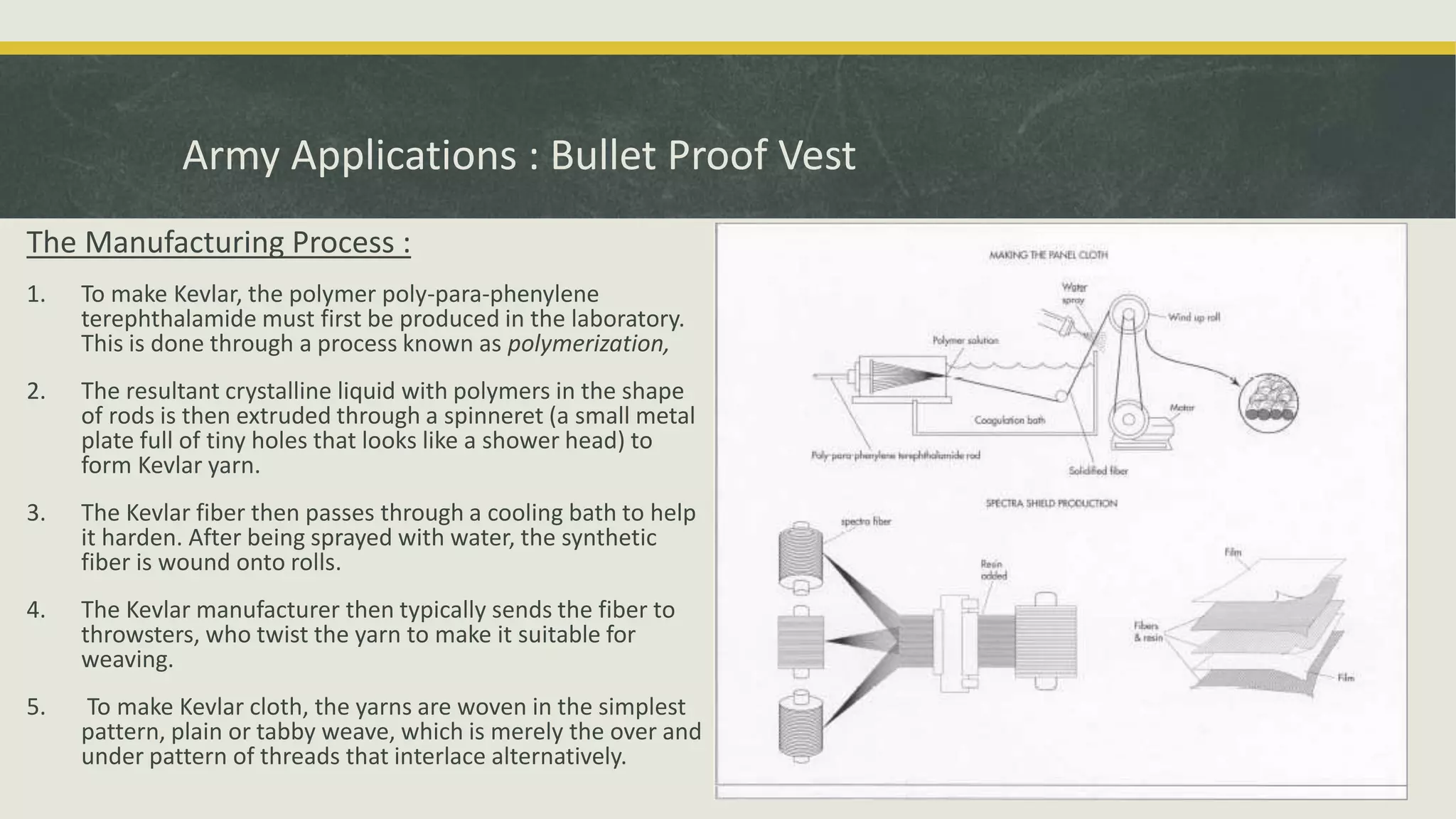
Raw Materials :
 A bulletproof vest consists of a panel, a vest-
shaped sheet of advanced plastics polymers that is
composed of many layers of either Kevlar, Spectra
Shield
 The layers of woven Kevlar are sewn together using
Kevlar thread, while the nonwoven Spectra Shield
is coated and bonded with resins such as Kraton
Army Applications : Bullet Proof Vest
The Manufacturing Process :
1. To make Kevlar, the polymer poly-para-phenylene
terephthalamide must first be produced in the laboratory.
This is done through a process known as polymerization,
2. The resultant crystalline liquid with polymers in the shape
of rods is then extruded through a spinneret (a small metal
plate full of tiny holes that looks like a shower head) to
form Kevlar yarn.
3. The Kevlar fiber then passes through a cooling bath to help
it harden. After being sprayed with water, the synthetic
fiber is wound onto rolls.
4. The Kevlar manufacturer then typically sends the fiber to
throwsters, who twist the yarn to make it suitable for
weaving.
5. To make Kevlar cloth, the yarns are woven in the simplest
pattern, plain or tabby weave, which is merely the over and
under pattern of threads that interlace alternatively.
Army Applications : Bullet Proof Vest
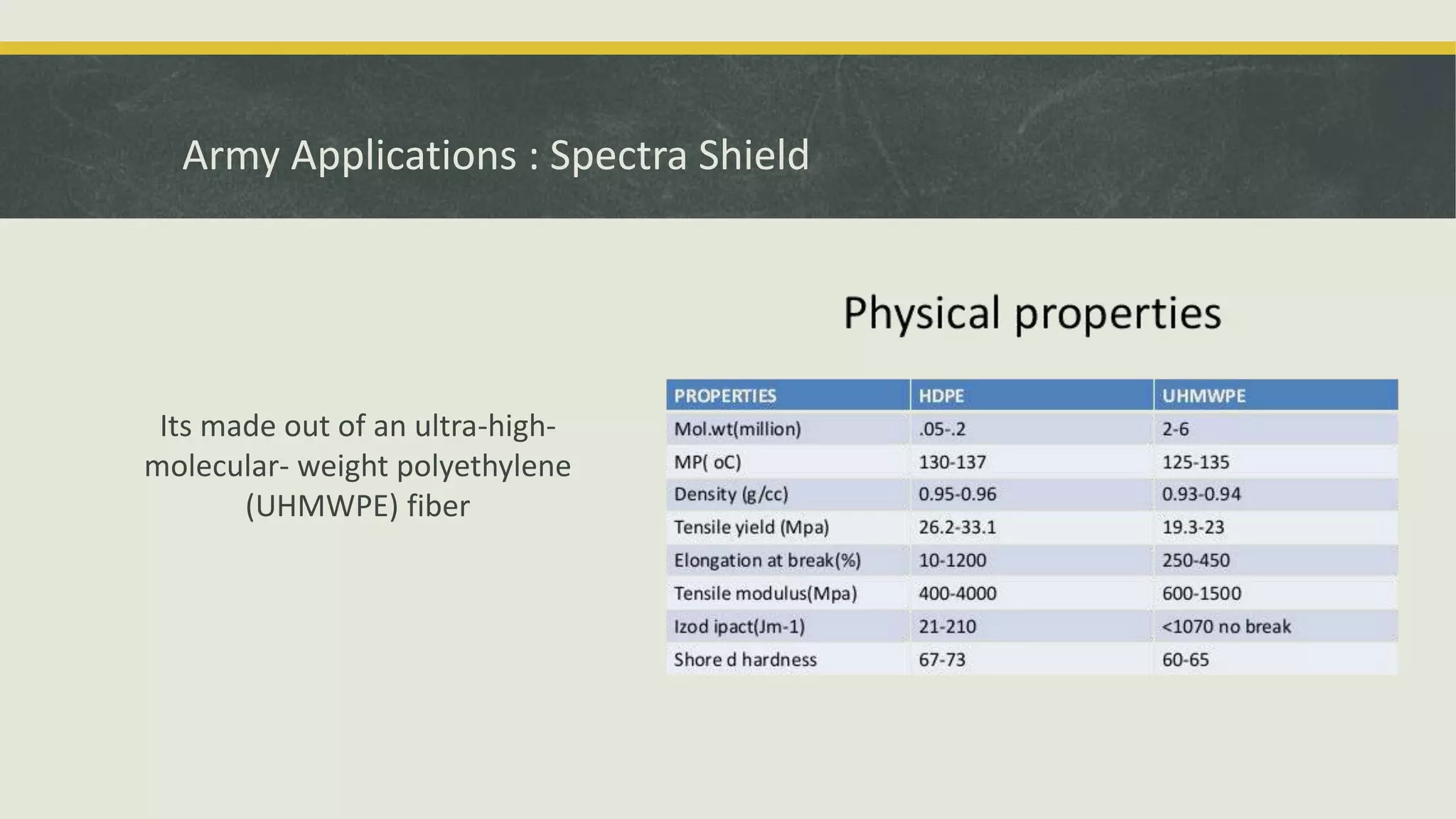
Its made out of an ultra-high-
molecular- weight polyethylene
(UHMWPE) fiber
Army Applications : Spectra Shield
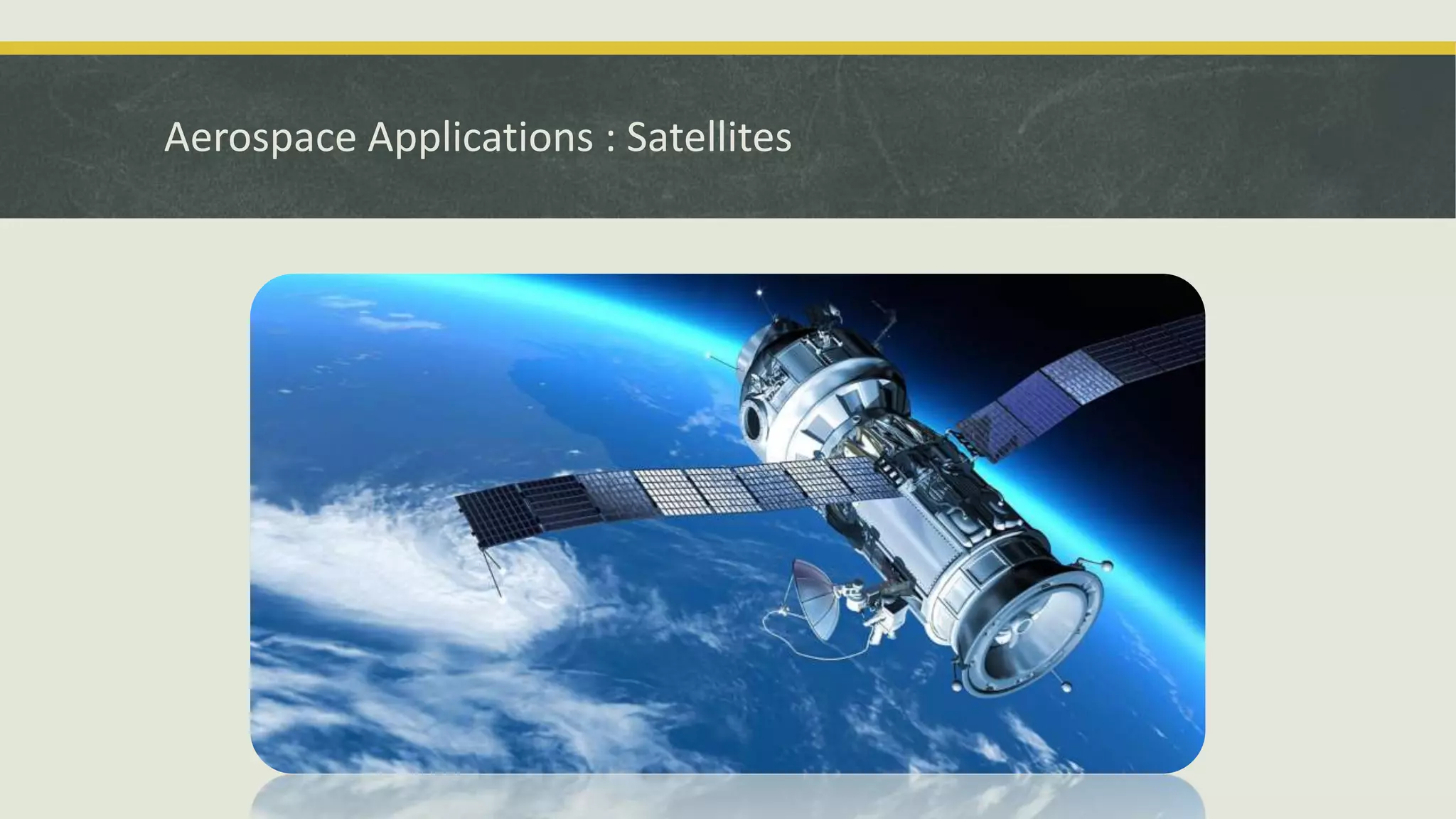
Aerospace Applications : Satellites
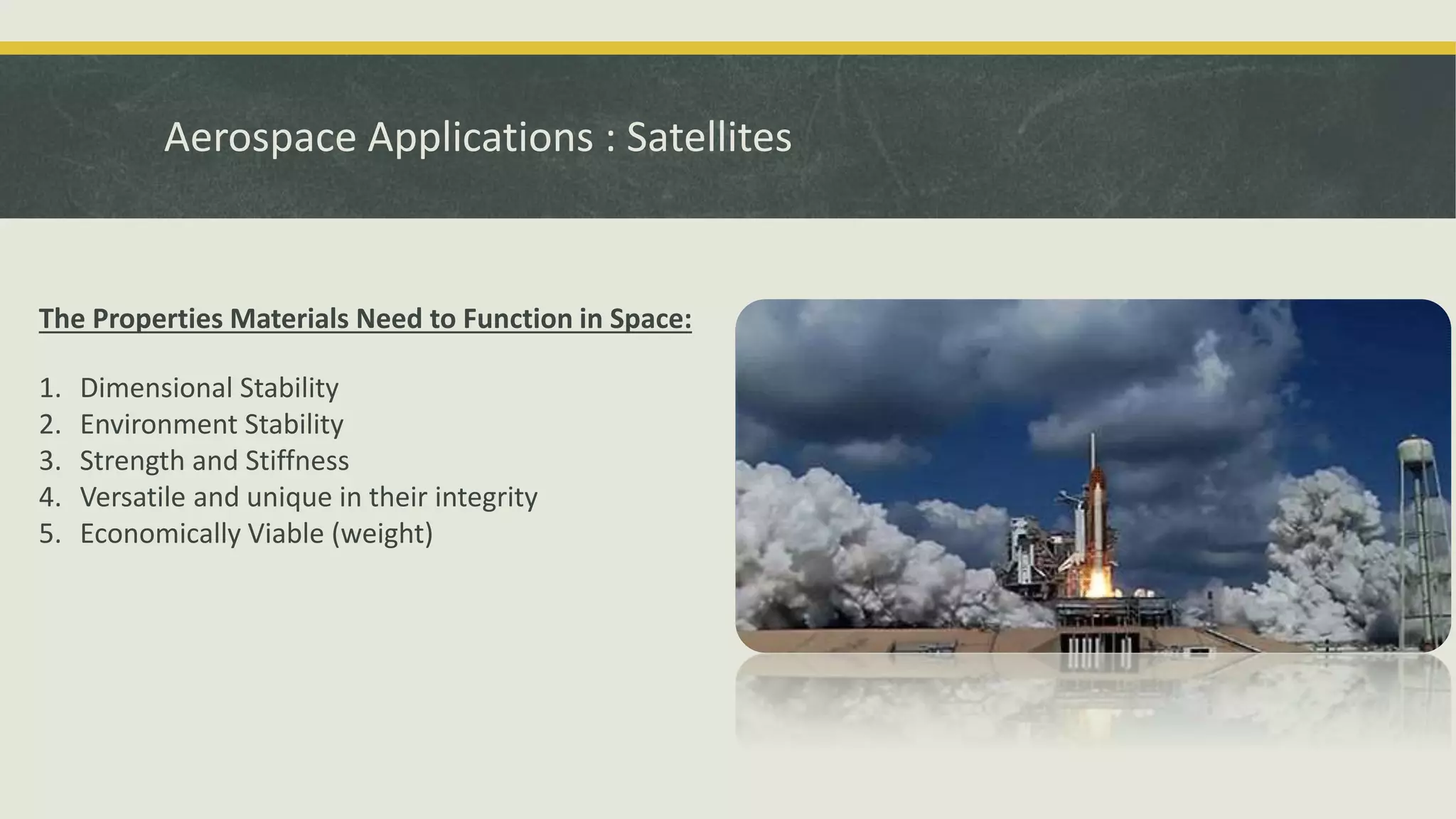
The Properties Materials Need to Function in Space:
1. Dimensional Stability
2. Environment Stability
3. Strength and Stiffness
4. Versatile and unique in their integrity
5. Economically Viable (weight)
Chemical Composition :
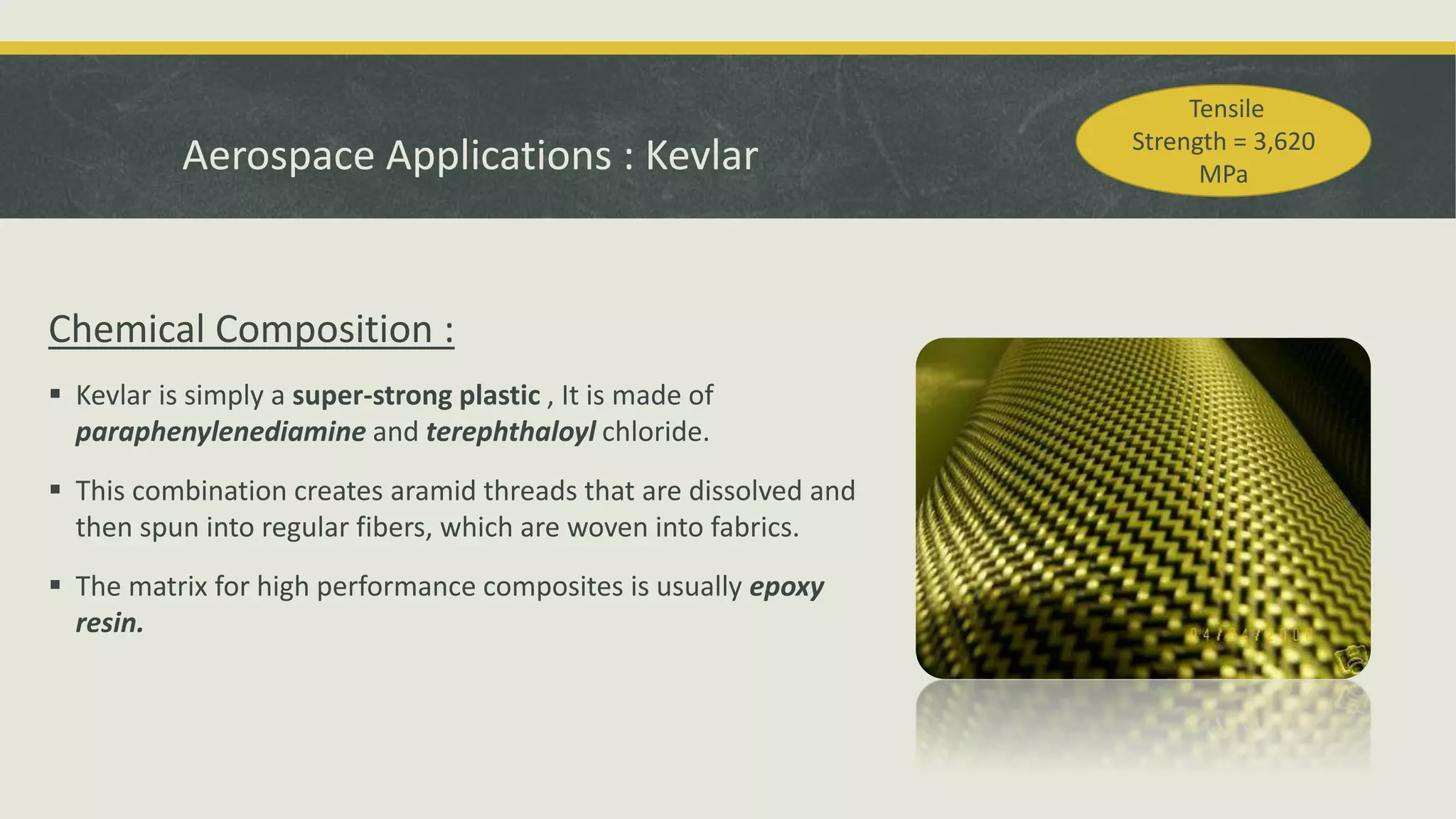
 Kevlar is simply a super-strong plastic , It is made of
paraphenylenediamine and terephthaloyl chloride.
 This combination creates aramid threads that are dissolved and
then spun into regular fibers, which are woven into fabrics.
 The matrix for high performance composites is usually epoxy
resin.
Aerospace Applications : Kevlar
Tensile
Strength = 3,620
MPa
Advantages :
• maintains its strength and resilience down to cryogenic temperatures (−196 °C)
• High tensile strength-to-weight ratio (5 times stronger than steel)
• Can resist attacks from many different chemicals
Disadvantages :
• it has very poor compressive strength
Aerospace Applications : Kevlar
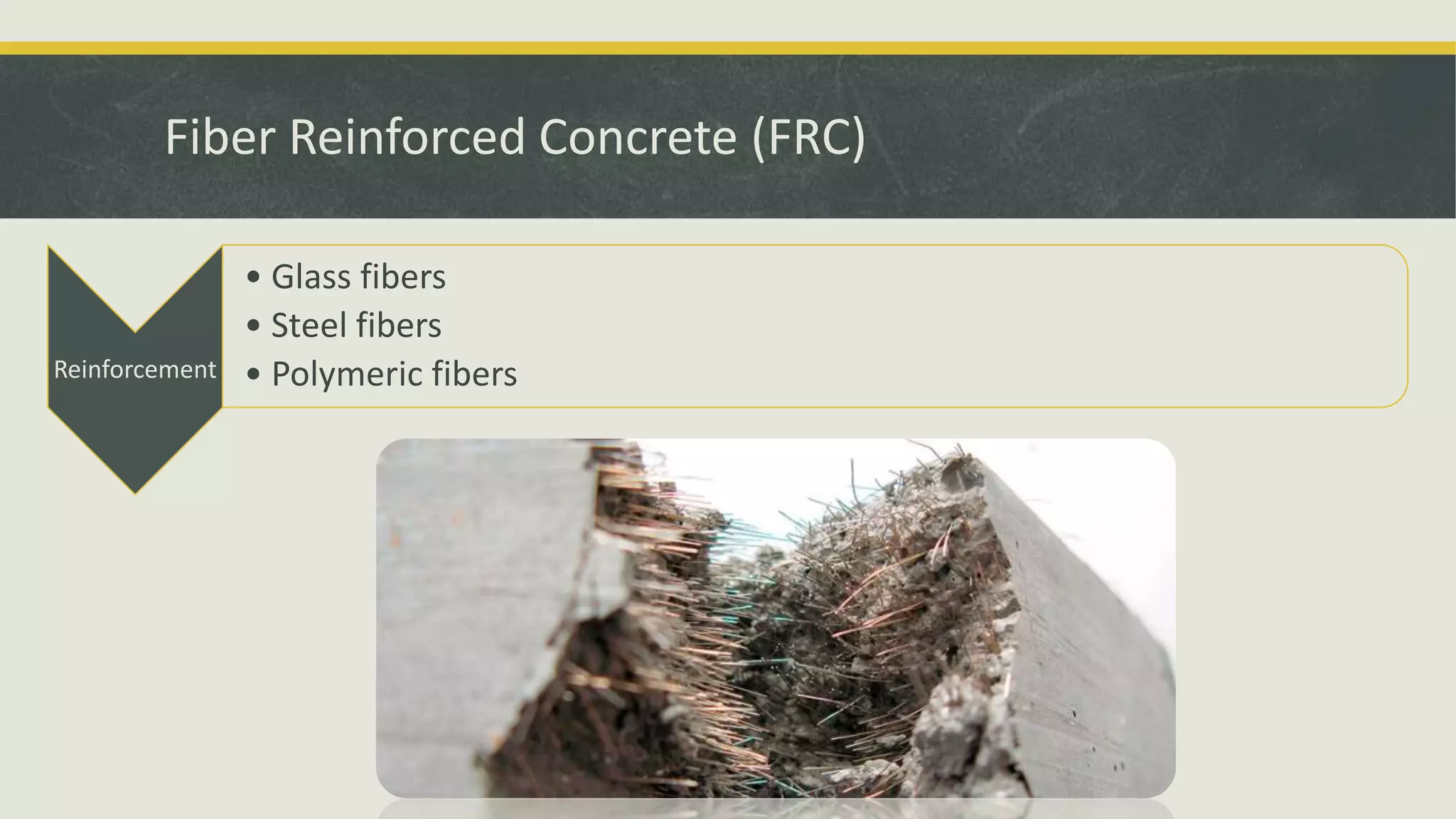
Fiber Reinforced Concrete (FRC)
Reinforcement
• Glass fibers
• Steel fibers
• Polymeric fibers
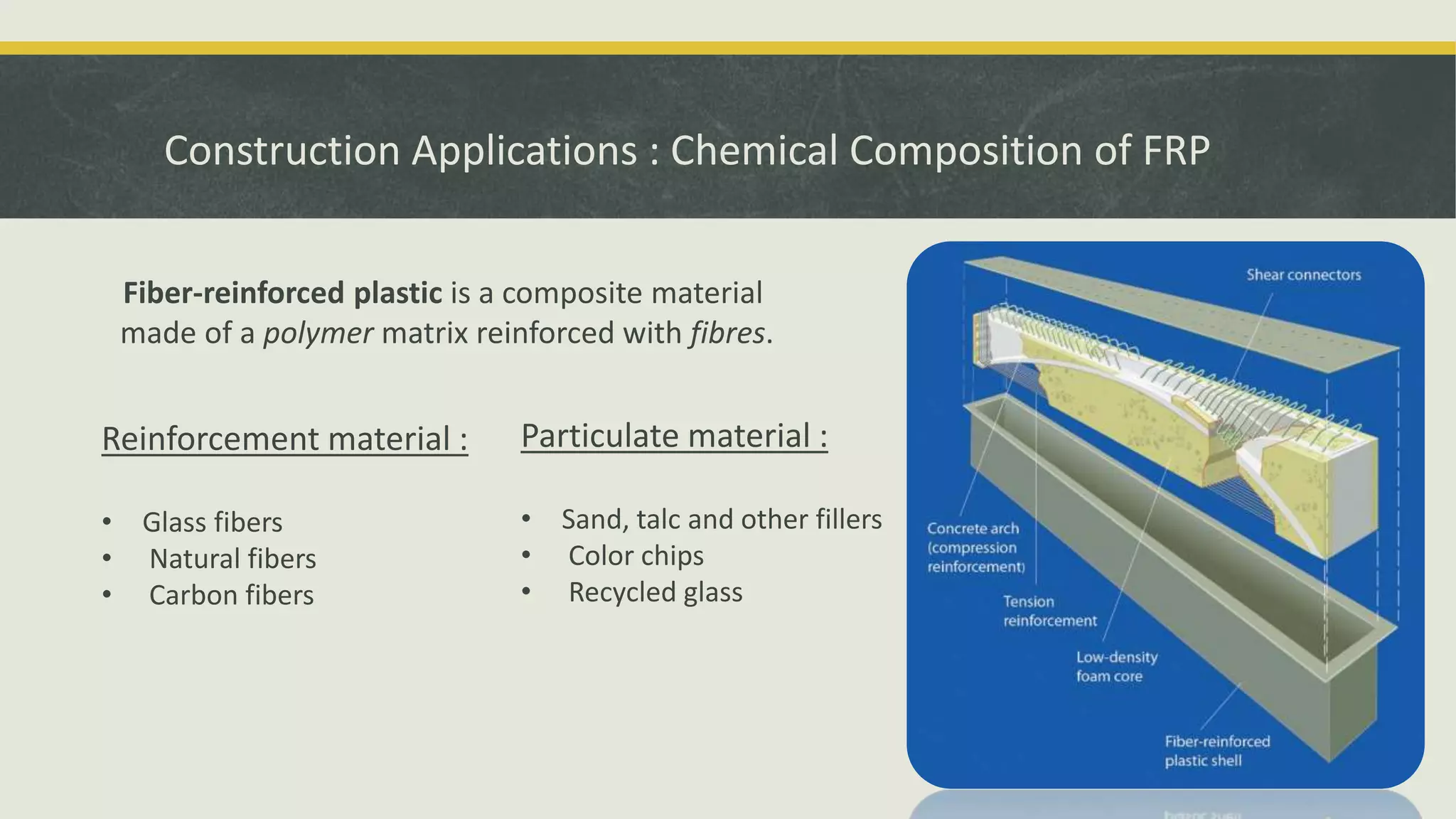
Construction Applications : Chemical Composition of FRP
Fiber-reinforced plastic is a composite material
made of a polymer matrix reinforced with fibres.
Reinforcement material :
• Glass fibers
• Natural fibers
• Carbon fibers
Particulate material :
• Sand, talc and other fillers
• Color chips
• Recycled glass
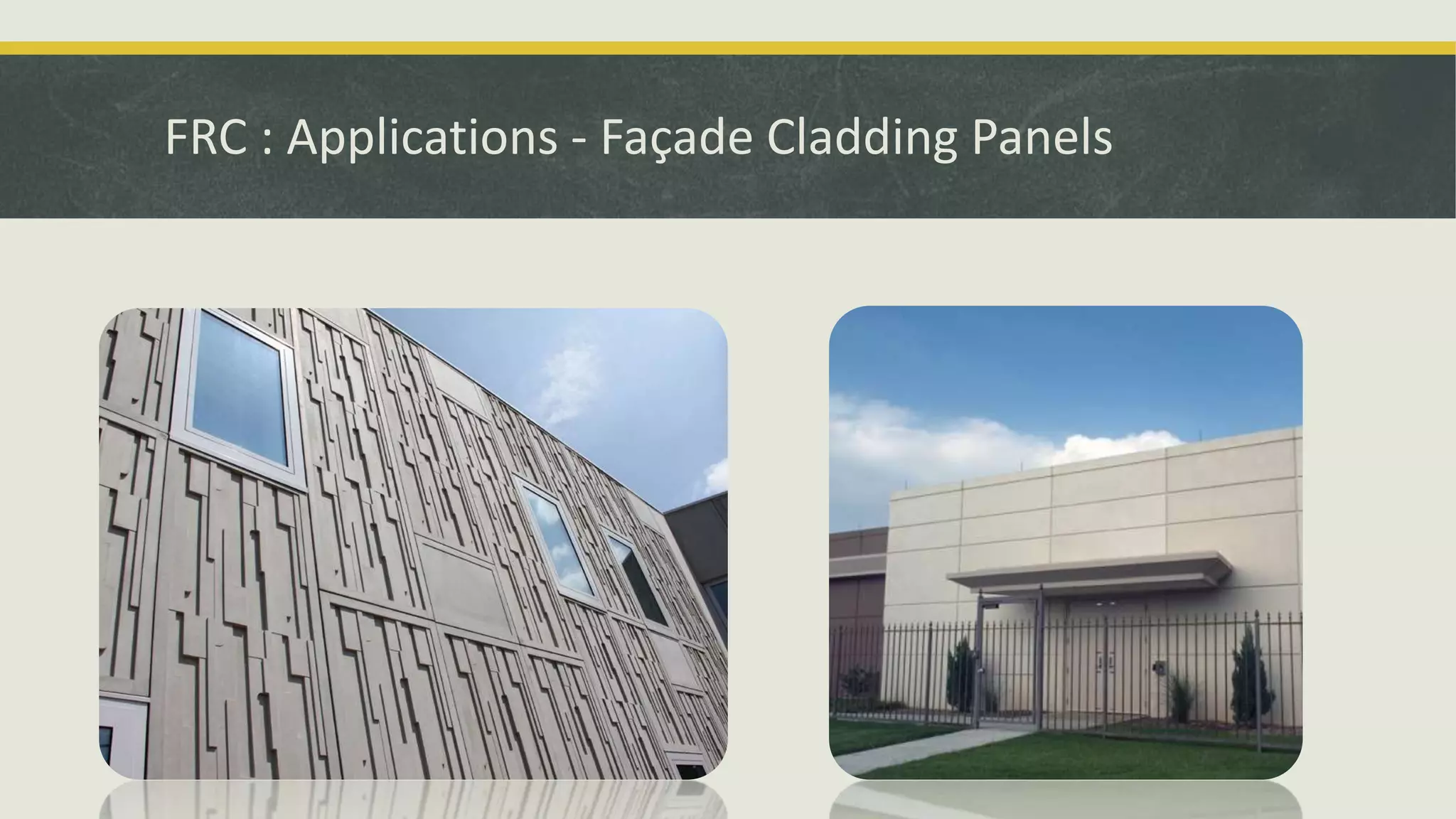
FRC : Applications - Façade Cladding Panels
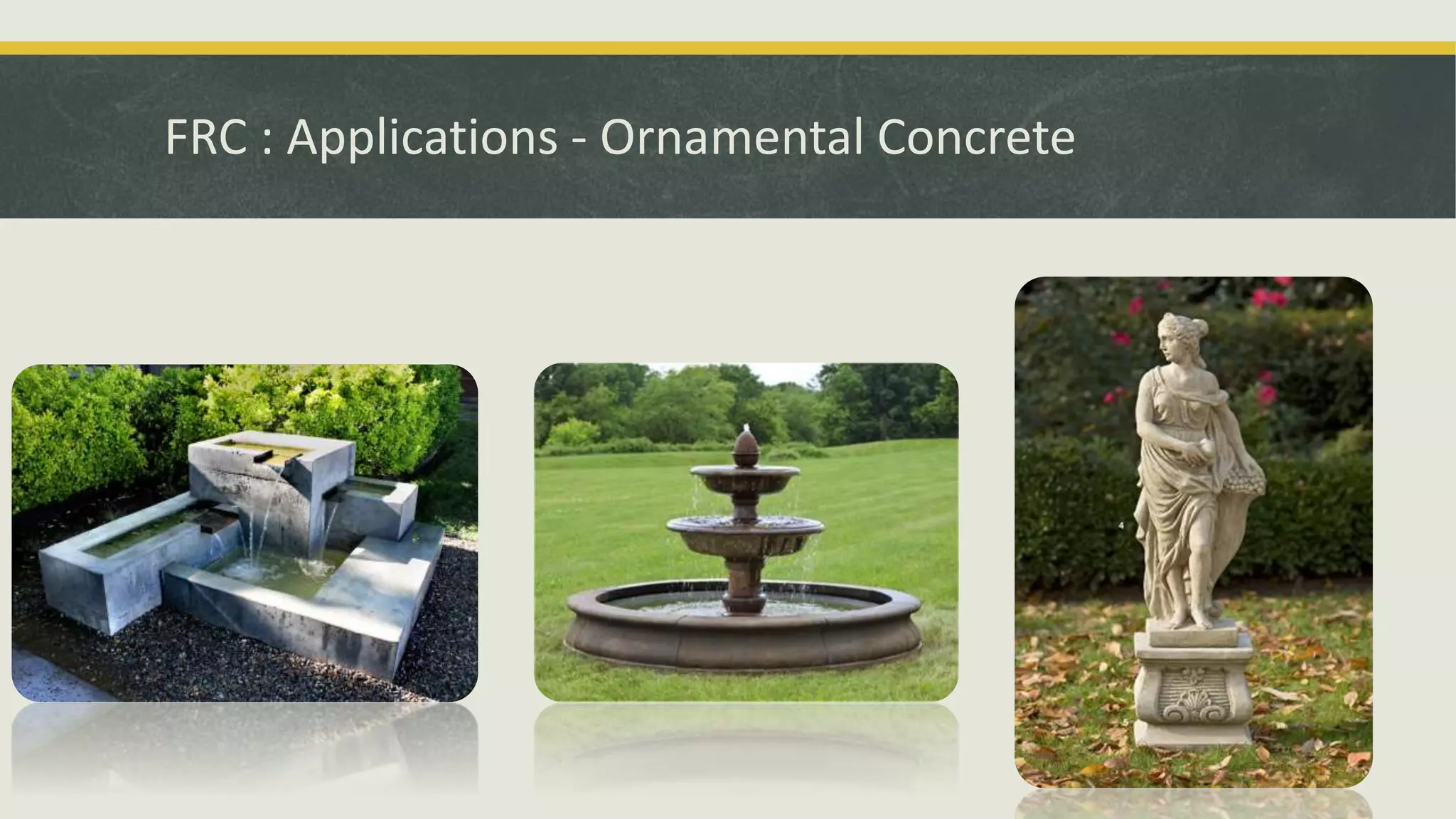
FRC : Applications - Ornamental Concrete
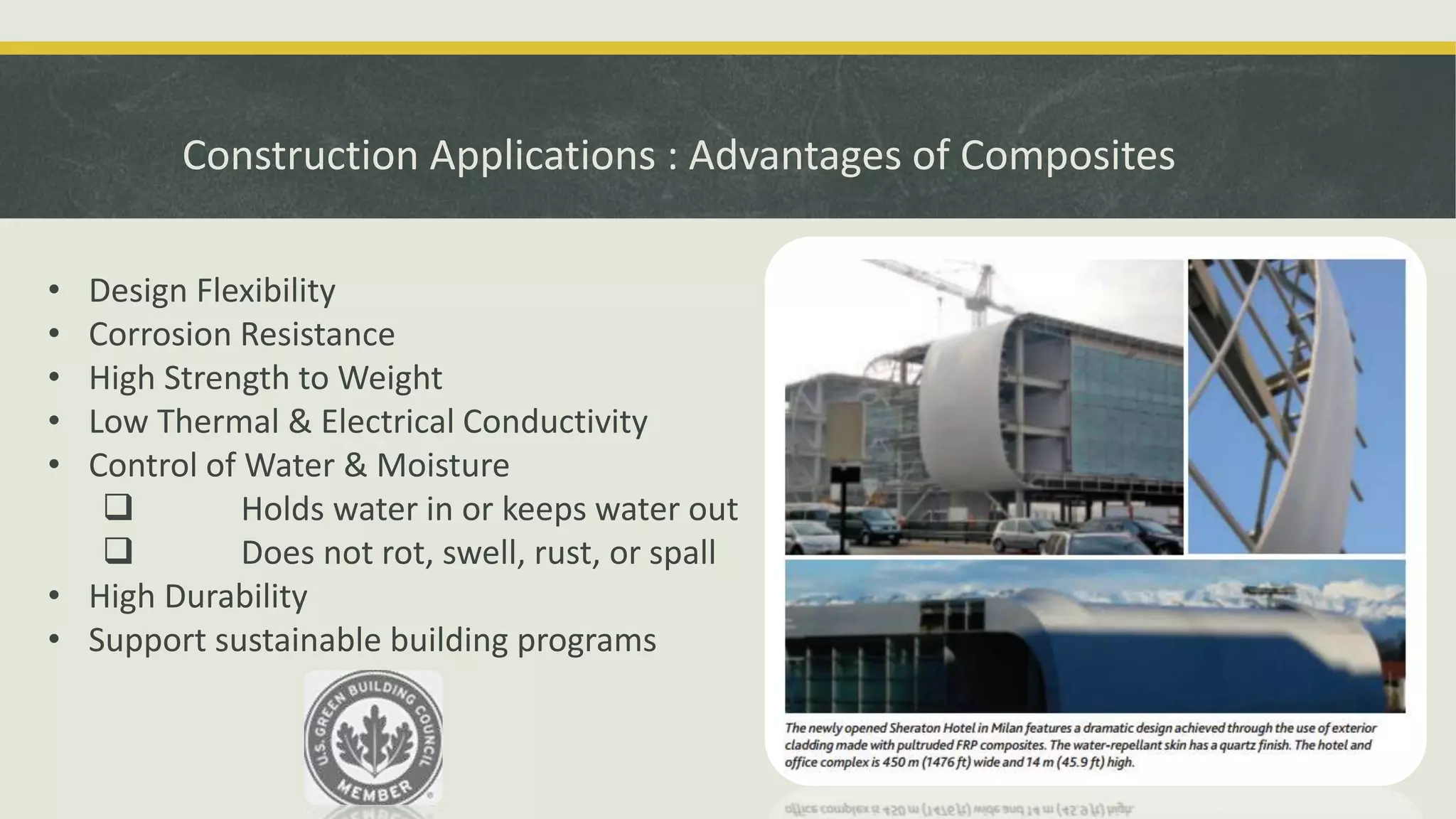
Construction Applications : Advantages of Composites
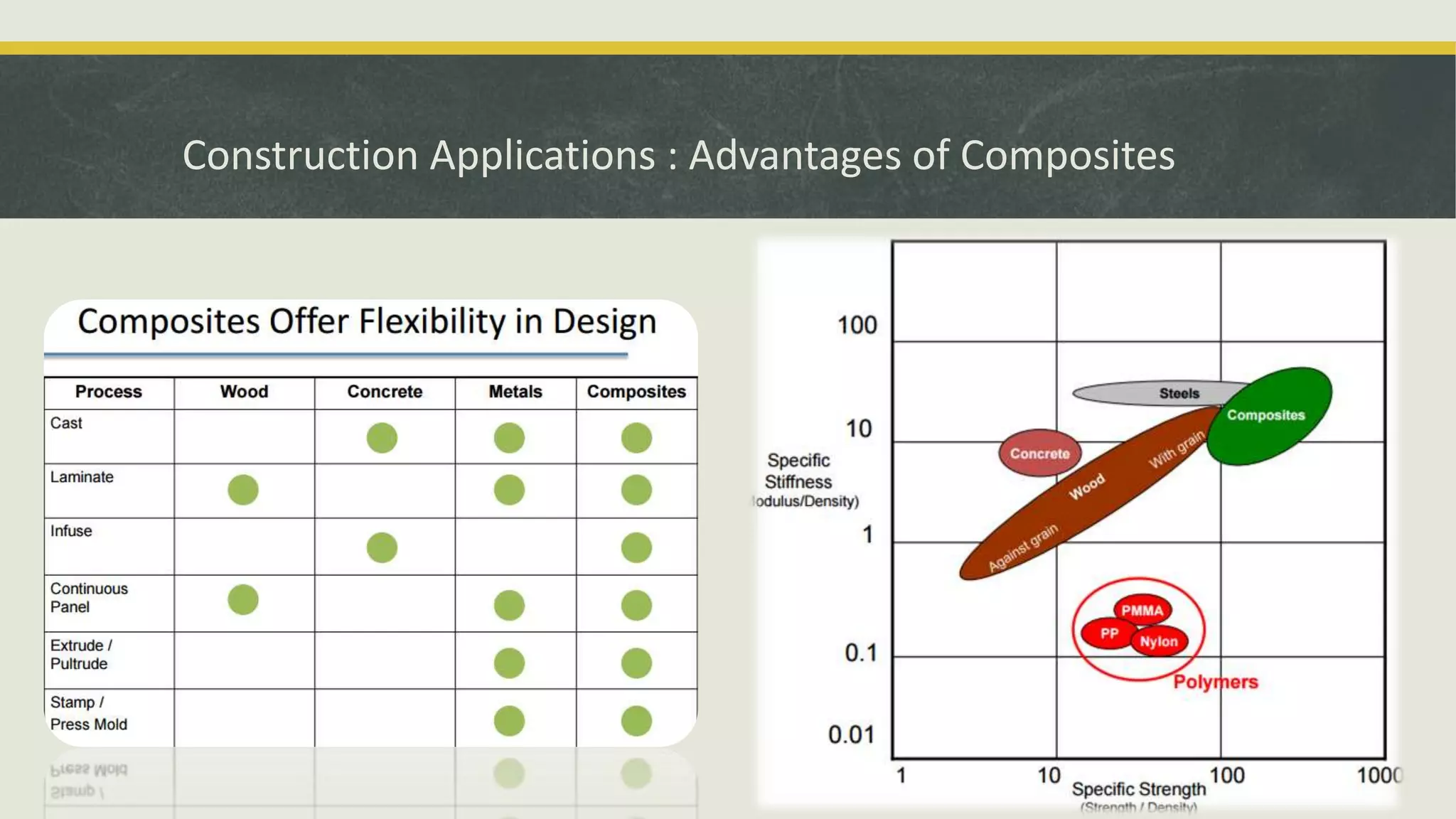
• Design Flexibility
• Corrosion Resistance
• High Strength to Weight
• Low Thermal & Electrical Conductivity
• Control of Water & Moisture
 Holds water in or keeps water out
 Does not rot, swell, rust, or spall
• High Durability
• Support sustainable building programs
Construction Applications : Advantages of Composites
References :
http://www.azom.com/article.aspx?ArticleID=12034
http://www.tencate.com/txtures/035-summer-2015/Composites-in-satellites-and-
launch-vehicles.aspx
http://www.convertunits.com/from/pound/inch/to/N/mm
https://en.wikipedia.org/wiki/Kevlar#Structure_and_properties
http://www.madehow.com/Volume-1/Bulletproof-Vest.html
https://en.wikipedia.org/wiki/Ultra-high-molecular-weight_polyethylene
Videos :
https://www.youtube.com/watch?v=kaoq8Mc4xxw
https://www.youtube.com/watch?v=4XDJC64tDR0
https://www.youtube.com/watch?v=c9bOox0KCuM
https://www.youtube.com/watch?v=SeqDm9l3yEM

Composite Material Definition & Applications

Editor's Notes

  • #24 We rely on satellites and structures in space for communications more than ever before. They help provide us with television pictures, telephone calls and a wide variety of communication signals, whilst surviving the hostile environment of space. The materials used in space are, more often than not, the most advanced materials that humans have created and we are constantly researching and creating new and improved materials. 
  • #25 1- An Object that is continually moving in and out of the sun’s direct heat is in constant temperature flux, which can cause it to expand and contract. As a result, scientists consider a material’s ability to maintain its size and shape despite temperature changes. 2-the material can remain stable in despite the presence of radiation and the vacuum of space. 3-The launch alone can put a material under up to three times the force of gravity, meaning that each component will weigh up to three times as much as it would on Earth. The material must maintain its integrity and not break or bend under immense forces or the satellite will not function once it reaches space.