Dental Therapy Update 15April/May 2015
Special Care Dentistry
COMPLEX MADE SIMPLE
It takes a special person to work in
special care dentistry. According
to BADT member, Carol MacNeil,
you cannot be fazed by a person’s
behaviour; you get to see some
very dirty mouths, and you need to
be calm and have patience. It also
requires an ability to “communicate
at any level and in some imaginative
ways”. Key to this role is an absolute
confidence in your skills “both
clinically and personally”.
Carol is based at the Special
Care Dental Service in Bromley
Healthcare in south-east London.
Its mission statement is “Providing
patient-focused dentistry for those
in Bromley with special care needs
in order to help them achieve and
maintain oral health”. It is this that
lies at the very heart of everything
Carol sets out to achieve. She says:
“The work is demanding and varied
with many patients completely reliant
on carers and/or family members
for all their needs. All the patients
referred to the team tend to have
more than one additional need.
“These can be anything from a
learning difficulty or patients with
physical needs to those receiving
polypharmacy or have dysphasia,
dystonia or mental health problems.
Many are non verbal which can make
communication challenging.”
Carol’s treatment locations are
diverse, too – from visiting patients
in their day centres and schools, to
treating patients in the waiting room,
sitting on the floor and even on
the back seat of a car. Carol says:
‘The improvement of a person’s
oral health has a huge impact on
their general health, their social
interactions and how they feel
about themselves. This is important
whether they have a learning difficulty
or not. Visiting patients in their own
environment has given me insight
into how difficult it can be to have
children or adults living in the house
with complex needs.
Influential voice
Interestingly, Bromley Healthcare
is a social enterprise company
commissioned to provide a range
of NHS services including the
Special Care Dental Service.
As employees, Carol and her
colleagues are shareholders and,
therefore, have the opportunity to
influence management decisions.
She explains: “When I first qualified
as a dental therapist, we were only
employed in community/hospital
dental services. The community
services have largely evolved into
providers of SCD and this is how I
came to be a provider of care to this
group of people.”
Dental therapists have an
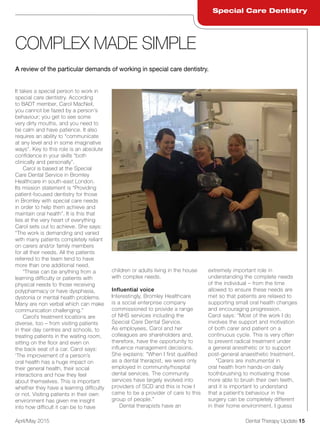
A review of the particular demands of working in special care dentistry.
extremely important role in
understanding the complete needs
of the individual – from the time
allowed to ensure these needs are
met so that patients are relaxed to
supporting small oral health changes
and encouraging progression.
Carol says: “Most of the work I do
involves the support and motivation
of both carer and patient on a
continuous cycle. This is very often
to prevent radical treatment under
a general anesthetic or to support
post-general anaesthetic treatment.
“Carers are instrumental in
oral health from hands-on daily
toothbrushing to motivating those
more able to brush their own teeth,
and it is important to understand
that a patient’s behaviour in the
surgery can be completely different
in their home environment. I guess
16 Dental Therapy Update April/May 2015
Special Care Dentistry
that is why in my role it really helps
to understand the individual and the
carer’s needs.”
A need to grow
With an ageing population who
are retaining more of their natural
teeth – and with the advances
in medical care that extends the
quality and length of life – special
care dentistry will need to grow.
There needs to be more dental
professionals who can meet the
needs of this group with empathy
and the necessary skills.
Carol says: “As far as I know,
there are no formal training or
additional qualifications for dental
therapists in the field of special care
dentistry, and this is a shame as
courses exist for both dental nurses
and dentists. But, you develop your
own patient management styles and
this is the most important part of the
role.”
She adds: “Building relationships
with my patients and their carers is
important and I’m always bumping
into them as I live locally – my
daughter says: ‘Mum, is there
anyone with a learning difficulty in
Bromley who you don’t know?’ –
and the answer is probably no!”
From an outsider looking in, these
sessions can be seen as chaotic
with lots of loud singing, dancing
and all sorts of cajoling with the
aim of making our patients feel
more comfortable.
Carol’s typical day…
“My day begins with a black coffee
and a brisk walk with my dog at the
park before going back home to
shower, put on make up on and get
out of the door to work.
“I arrive for 8.30am to begin clinic
at 9.15am. Depending on where
I am working, it can take up to 45
minutes to drive to work – a car
is essential as I can be out during
the day providing home visits. I see
between nine and 10 patients a
day, which may not sound a lot but,
because of their additional needs,
appointment times need to be
longer. It can take over 20 minutes
for some patients to be seated for
an appointment, be it transferring to
the dental chair, adjusting their own
wheelchair or using our wheelchair
tipper. More time may be needed
because communication is slower
due to speech impairments or
limited understanding, and we
also need extra time for checking
medical history, treatment plans
and ensuring consent is valid and
appropriate for each individual.
“On Fridays, I work alongside our
specialist in special care dentistry
– Carolyn Morris-Clapp. Carolyn
qualified as a dental therapist
the year before I did (1980) and
has since gone on to qualify as
a dentist, achieved a masters,
followed by a PhD and is now on
the specialist list for special care
dentistry.
“Carolyn examines patients
and creates treatment plans for
our patients with input from me
to ensure we are providing the
optimum successful outcome for
each individual. Having qualified as
a therapist, Carolyn is fully aware of
the remit of a dental therapist and
also likes to challenge me as well.
This is also beneficial to a lot of our
patients as they can start treatment
(if needed) on the same visit – some
find the surgery visits difficult either
due to transport or the surgery
environment.
“Alongside the needs of the
patient, we also acknowledge and
provide support for the carers –
from individual needs to group
training of care staff in residential
units. From an outsider looking in,
these sessions can be seen as
chaotic with lots of loud singing,
dancing and all sorts of cajoling so
that our patients are comfortable.
“When not at work, I am an
assistant district commissioner for
the beaver scouts in Bromley. I have
been married for 33 years and have
two grown-up children.
Working full time can be difficult
and I have learned to stop work at
the end of the day. But there are still
times when I’m so exhausted from
talking and being patient all day at
work that I just flop in front of the TV!”
Case study
An epileptic, blind patient with severe
learning difficulties needed gross
scaling as she has not been seen for
more than five years. The situation
was made worse as she was also
taking liquid iron supplements. She
became very disorientated in the
clinic which resulted in her self-
harming as a way of showing her
distress. To orientate her into having
dental work, I made some home
visits so she could learn my voice,
smell and touch and become more
comfortable with treatment.
After three home visits – and building
a relationship with both the patient
and her care team – I successfully
scaled her teeth with an ultrasonic
and removed the iron staining in the
surgery. Her gingival condition was
vastly improved and it prevented the
need for a general anaesthetic for
treatment. I now see her regularly
for maintenance scaling and she is
compliant for treatment.
What is special care dentistry?
‘Special Care Dentistry (SCD)
provides preventive and treatment
oral care services for people
who are unable to accept
routine dental care because
of some physical, intellectual,
medical, emotional, sensory,
mental or social impairment, or
a combination of these factors.
Special Care Dentistry is
concerned with the improvement
of oral health of individuals and
groups in society who fall within
these categories. It requires
a holistic approach that is
specialist led in order to meet the
complex requirements of people
with impairments. It pertains to
adolescents and adults, as the
care of children with disabilities
and additional needs sits within
the domain of the specialty of
paediatric dentistry.’ General
Dental Council

Complex made Simple

  • 1.
    Dental Therapy Update15April/May 2015 Special Care Dentistry COMPLEX MADE SIMPLE It takes a special person to work in special care dentistry. According to BADT member, Carol MacNeil, you cannot be fazed by a person’s behaviour; you get to see some very dirty mouths, and you need to be calm and have patience. It also requires an ability to “communicate at any level and in some imaginative ways”. Key to this role is an absolute confidence in your skills “both clinically and personally”. Carol is based at the Special Care Dental Service in Bromley Healthcare in south-east London. Its mission statement is “Providing patient-focused dentistry for those in Bromley with special care needs in order to help them achieve and maintain oral health”. It is this that lies at the very heart of everything Carol sets out to achieve. She says: “The work is demanding and varied with many patients completely reliant on carers and/or family members for all their needs. All the patients referred to the team tend to have more than one additional need. “These can be anything from a learning difficulty or patients with physical needs to those receiving polypharmacy or have dysphasia, dystonia or mental health problems. Many are non verbal which can make communication challenging.” Carol’s treatment locations are diverse, too – from visiting patients in their day centres and schools, to treating patients in the waiting room, sitting on the floor and even on the back seat of a car. Carol says: ‘The improvement of a person’s oral health has a huge impact on their general health, their social interactions and how they feel about themselves. This is important whether they have a learning difficulty or not. Visiting patients in their own environment has given me insight into how difficult it can be to have children or adults living in the house with complex needs. Influential voice Interestingly, Bromley Healthcare is a social enterprise company commissioned to provide a range of NHS services including the Special Care Dental Service. As employees, Carol and her colleagues are shareholders and, therefore, have the opportunity to influence management decisions. She explains: “When I first qualified as a dental therapist, we were only employed in community/hospital dental services. The community services have largely evolved into providers of SCD and this is how I came to be a provider of care to this group of people.” Dental therapists have an A review of the particular demands of working in special care dentistry. extremely important role in understanding the complete needs of the individual – from the time allowed to ensure these needs are met so that patients are relaxed to supporting small oral health changes and encouraging progression. Carol says: “Most of the work I do involves the support and motivation of both carer and patient on a continuous cycle. This is very often to prevent radical treatment under a general anesthetic or to support post-general anaesthetic treatment. “Carers are instrumental in oral health from hands-on daily toothbrushing to motivating those more able to brush their own teeth, and it is important to understand that a patient’s behaviour in the surgery can be completely different in their home environment. I guess
  • 2.
    16 Dental TherapyUpdate April/May 2015 Special Care Dentistry that is why in my role it really helps to understand the individual and the carer’s needs.” A need to grow With an ageing population who are retaining more of their natural teeth – and with the advances in medical care that extends the quality and length of life – special care dentistry will need to grow. There needs to be more dental professionals who can meet the needs of this group with empathy and the necessary skills. Carol says: “As far as I know, there are no formal training or additional qualifications for dental therapists in the field of special care dentistry, and this is a shame as courses exist for both dental nurses and dentists. But, you develop your own patient management styles and this is the most important part of the role.” She adds: “Building relationships with my patients and their carers is important and I’m always bumping into them as I live locally – my daughter says: ‘Mum, is there anyone with a learning difficulty in Bromley who you don’t know?’ – and the answer is probably no!” From an outsider looking in, these sessions can be seen as chaotic with lots of loud singing, dancing and all sorts of cajoling with the aim of making our patients feel more comfortable. Carol’s typical day… “My day begins with a black coffee and a brisk walk with my dog at the park before going back home to shower, put on make up on and get out of the door to work. “I arrive for 8.30am to begin clinic at 9.15am. Depending on where I am working, it can take up to 45 minutes to drive to work – a car is essential as I can be out during the day providing home visits. I see between nine and 10 patients a day, which may not sound a lot but, because of their additional needs, appointment times need to be longer. It can take over 20 minutes for some patients to be seated for an appointment, be it transferring to the dental chair, adjusting their own wheelchair or using our wheelchair tipper. More time may be needed because communication is slower due to speech impairments or limited understanding, and we also need extra time for checking medical history, treatment plans and ensuring consent is valid and appropriate for each individual. “On Fridays, I work alongside our specialist in special care dentistry – Carolyn Morris-Clapp. Carolyn qualified as a dental therapist the year before I did (1980) and has since gone on to qualify as a dentist, achieved a masters, followed by a PhD and is now on the specialist list for special care dentistry. “Carolyn examines patients and creates treatment plans for our patients with input from me to ensure we are providing the optimum successful outcome for each individual. Having qualified as a therapist, Carolyn is fully aware of the remit of a dental therapist and also likes to challenge me as well. This is also beneficial to a lot of our patients as they can start treatment (if needed) on the same visit – some find the surgery visits difficult either due to transport or the surgery environment. “Alongside the needs of the patient, we also acknowledge and provide support for the carers – from individual needs to group training of care staff in residential units. From an outsider looking in, these sessions can be seen as chaotic with lots of loud singing, dancing and all sorts of cajoling so that our patients are comfortable. “When not at work, I am an assistant district commissioner for the beaver scouts in Bromley. I have been married for 33 years and have two grown-up children. Working full time can be difficult and I have learned to stop work at the end of the day. But there are still times when I’m so exhausted from talking and being patient all day at work that I just flop in front of the TV!” Case study An epileptic, blind patient with severe learning difficulties needed gross scaling as she has not been seen for more than five years. The situation was made worse as she was also taking liquid iron supplements. She became very disorientated in the clinic which resulted in her self- harming as a way of showing her distress. To orientate her into having dental work, I made some home visits so she could learn my voice, smell and touch and become more comfortable with treatment. After three home visits – and building a relationship with both the patient and her care team – I successfully scaled her teeth with an ultrasonic and removed the iron staining in the surgery. Her gingival condition was vastly improved and it prevented the need for a general anaesthetic for treatment. I now see her regularly for maintenance scaling and she is compliant for treatment. What is special care dentistry? ‘Special Care Dentistry (SCD) provides preventive and treatment oral care services for people who are unable to accept routine dental care because of some physical, intellectual, medical, emotional, sensory, mental or social impairment, or a combination of these factors. Special Care Dentistry is concerned with the improvement of oral health of individuals and groups in society who fall within these categories. It requires a holistic approach that is specialist led in order to meet the complex requirements of people with impairments. It pertains to adolescents and adults, as the care of children with disabilities and additional needs sits within the domain of the specialty of paediatric dentistry.’ General Dental Council