28
©Suzanne Tucker/Shutterstock.com
IC38-Cycling.qxp_Layout 1 30/08/2016 16:51 Page 1
SPORT
2229
JUST
COASTING
REDISCOVER LIFE’S NATURAL
PLEASURES BY EXPLORING THE HEADY,
HIGH ROADS AND COOL COASTAL ROUTES
OF THE ALGARVE ON TWO WHEELS
TEXT & PHOTOS JULIE BISSETT
P
ortugal is perfectly placed to meet the needs of a
fair-weather cyclist. The Algarve’s long, rolling
roads satisfy a hunger for adventure and discovery;
the terrain is an undulating rollercoaster that
challenges the most experienced of cyclists, with its deep dips
and steep climbs laid out in an open, sprawling landscape.
Pepper with some wind-whipped coastal routes and breath-
taking views and you have all the ingredients for a perfect
week of cycling.
June is a good time for a cycling holiday, beating the mass
exodus of families, who head south for the summer, but the
cooler months of September and October are also great
options. My base is the sleepy fishing village of Salema,
between Lagos and Vila do Bispo, the epitome of an
unruffled, sleepy backwater, lost somewhere in Europe. Out
of the high season, it can feel like the clocks have stopped, with
fishing boats launched from the beach by tractor, the old-style
whitewashed and tiled cottages nestling close together along
cobbled streets.
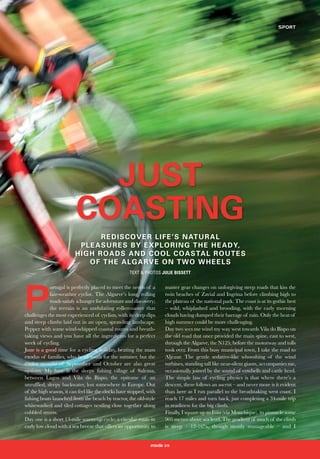
Day one is a short 13-mile warm-up cycle; a circular route in
early low cloud with a sea breeze that offers an opportunity to
master gear changes on unforgiving steep roads that kiss the
twin beaches of Zavial and Ingrina before climbing high to
the plateau of the national park. The coast is at its gothic best
– wild, whiplashed and brooding, with the early morning
clouds having dumped their barrage of rain. Only the heat of
high summer could be more challenging.
Day two sees me wind my way west towards Vila do Bispo on
the old road that once provided the main spine, east to west,
through the Algarve, the N125, before the motorway and tolls
took over. From this busy municipal town, I take the road to
Aljezur. The gentle sedative-like whooshing of the wind
turbines, standing tall like near-silent giants, accompanies me,
occasionally joined by the sound of cowbells and cattle herd.
The simple law of cycling physics is that where there’s a
descent, there follows an ascent – and never more is it evident
than here as I run parallel to the breathtaking west coast. I
reach 17 miles and turn back, just completing a 34-mile trip
in readiness for the big climb.
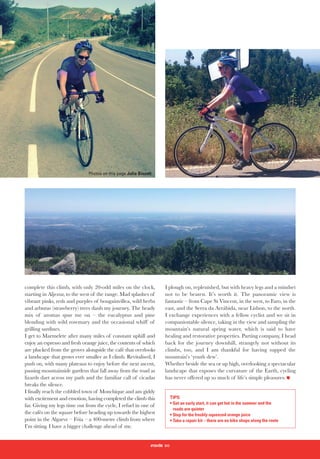
Finally, I square up to Fóia (via Monchique), its pinnacle some
905 metres above sea level. The gradient of much of the climb
is steep – 12-16%, though mostly manageable – and I
IC38-Cycling.qxp_Layout 1 30/08/2016 16:51 Page 2
30
complete this climb, with only 20-odd miles on the clock,
starting in Aljezur, to the west of the range. Mad splashes of
vibrant pinks, reds and purples of bougainvillea, wild herbs
and arbutus (strawberry) trees daub my journey. The heady
mix of aromas spur me on – the eucalyptus and pine
blending with wild rosemary and the occasional whiff of
grilling sardines.
I get to Marmelete after many miles of constant uphill and
enjoy an espresso and fresh orange juice, the contents of which
are plucked from the groves alongside the café that overlooks
a landscape that grows ever smaller as I climb. Revitalised, I
push on, with many plateaus to enjoy before the next ascent,
passing mountainside gardens that fall away from the road as
lizards dart across my path and the familiar call of cicadas
breaks the silence.
I finally reach the cobbled town of Monchique and am giddy
with excitement and emotion, having completed the climb this
far. Giving my legs time out from the cycle, I refuel in one of
the cafés on the square before heading up towards the highest
point in the Algarve – Fóia – a 400-metre climb from where
I’m sitting. I have a bigger challenge ahead of me.
I plough on, replenished, but with heavy legs and a mindset
not to be beaten. It’s worth it. The panoramic view is
fantastic – from Cape St Vincent, in the west, to Faro, in the
east, and the Serra da Arrábida, near Lisbon, to the north.
I exchange experiences with a fellow cyclist and we sit in
companionable silence, taking in the view and sampling the
mountain’s natural spring water, which is said to have
healing and restorative properties. Parting company, I head
back for the journey downhill, strangely not without its
climbs, too, and I am thankful for having supped the
mountain’s ‘youth dew’.
Whether beside the sea or up high, overlooking a spectacular
landscape that exposes the curvature of the Earth, cycling
has never offered up so much of life’s simple pleasures.
TIPS
• Get an early start, it can get hot in the summer and the
roads are quieter
• Stop for the freshly-squeezed orange juice
• Take a repair kit – there are no bike shops along the route
Photos on this page Julie Bissett
IC38-Cycling.qxp_Layout 1 30/08/2016 16:51 Page 3

IC#38 - Cycling

  • 1.
  • 2.
    SPORT 2229 JUST COASTING REDISCOVER LIFE’S NATURAL PLEASURESBY EXPLORING THE HEADY, HIGH ROADS AND COOL COASTAL ROUTES OF THE ALGARVE ON TWO WHEELS TEXT & PHOTOS JULIE BISSETT P ortugal is perfectly placed to meet the needs of a fair-weather cyclist. The Algarve’s long, rolling roads satisfy a hunger for adventure and discovery; the terrain is an undulating rollercoaster that challenges the most experienced of cyclists, with its deep dips and steep climbs laid out in an open, sprawling landscape. Pepper with some wind-whipped coastal routes and breath- taking views and you have all the ingredients for a perfect week of cycling. June is a good time for a cycling holiday, beating the mass exodus of families, who head south for the summer, but the cooler months of September and October are also great options. My base is the sleepy fishing village of Salema, between Lagos and Vila do Bispo, the epitome of an unruffled, sleepy backwater, lost somewhere in Europe. Out of the high season, it can feel like the clocks have stopped, with fishing boats launched from the beach by tractor, the old-style whitewashed and tiled cottages nestling close together along cobbled streets. Day one is a short 13-mile warm-up cycle; a circular route in early low cloud with a sea breeze that offers an opportunity to master gear changes on unforgiving steep roads that kiss the twin beaches of Zavial and Ingrina before climbing high to the plateau of the national park. The coast is at its gothic best – wild, whiplashed and brooding, with the early morning clouds having dumped their barrage of rain. Only the heat of high summer could be more challenging. Day two sees me wind my way west towards Vila do Bispo on the old road that once provided the main spine, east to west, through the Algarve, the N125, before the motorway and tolls took over. From this busy municipal town, I take the road to Aljezur. The gentle sedative-like whooshing of the wind turbines, standing tall like near-silent giants, accompanies me, occasionally joined by the sound of cowbells and cattle herd. The simple law of cycling physics is that where there’s a descent, there follows an ascent – and never more is it evident than here as I run parallel to the breathtaking west coast. I reach 17 miles and turn back, just completing a 34-mile trip in readiness for the big climb. Finally, I square up to Fóia (via Monchique), its pinnacle some 905 metres above sea level. The gradient of much of the climb is steep – 12-16%, though mostly manageable – and I IC38-Cycling.qxp_Layout 1 30/08/2016 16:51 Page 2
  • 3.
    30 complete this climb,with only 20-odd miles on the clock, starting in Aljezur, to the west of the range. Mad splashes of vibrant pinks, reds and purples of bougainvillea, wild herbs and arbutus (strawberry) trees daub my journey. The heady mix of aromas spur me on – the eucalyptus and pine blending with wild rosemary and the occasional whiff of grilling sardines. I get to Marmelete after many miles of constant uphill and enjoy an espresso and fresh orange juice, the contents of which are plucked from the groves alongside the café that overlooks a landscape that grows ever smaller as I climb. Revitalised, I push on, with many plateaus to enjoy before the next ascent, passing mountainside gardens that fall away from the road as lizards dart across my path and the familiar call of cicadas breaks the silence. I finally reach the cobbled town of Monchique and am giddy with excitement and emotion, having completed the climb this far. Giving my legs time out from the cycle, I refuel in one of the cafés on the square before heading up towards the highest point in the Algarve – Fóia – a 400-metre climb from where I’m sitting. I have a bigger challenge ahead of me. I plough on, replenished, but with heavy legs and a mindset not to be beaten. It’s worth it. The panoramic view is fantastic – from Cape St Vincent, in the west, to Faro, in the east, and the Serra da Arrábida, near Lisbon, to the north. I exchange experiences with a fellow cyclist and we sit in companionable silence, taking in the view and sampling the mountain’s natural spring water, which is said to have healing and restorative properties. Parting company, I head back for the journey downhill, strangely not without its climbs, too, and I am thankful for having supped the mountain’s ‘youth dew’. Whether beside the sea or up high, overlooking a spectacular landscape that exposes the curvature of the Earth, cycling has never offered up so much of life’s simple pleasures. TIPS • Get an early start, it can get hot in the summer and the roads are quieter • Stop for the freshly-squeezed orange juice • Take a repair kit – there are no bike shops along the route Photos on this page Julie Bissett IC38-Cycling.qxp_Layout 1 30/08/2016 16:51 Page 3