Movies for Mental Health
Miami Regionals
April 17, 2018
@artwithimpact
#Movies4MentalHealth
Here’s the Plan
I. Quick Introduction
II. Set the Stage Together
III. Watch Short Films & Discuss Them
IV. Make it Personal with Our Panel
Brought to you by
• Monthly Short Film
Competition
• Campus Workshops
• Global Community (blog,
IG, Twitter, FB)
Heads Up
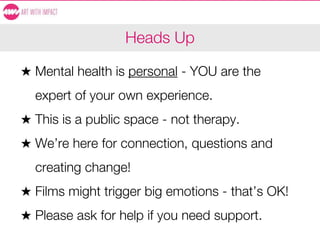
★ Mental health is personal - YOU are the
expert of your own experience.
★ This is a public space - not therapy.
★ We’re here for connection, questions and
creating change!
★ Films might trigger big emotions - that’s OK!
★ Please ask for help if you need support.
Stigma
A judgment or stereotype that is:
1. Always negative
2. Always untrue
3. Can be internalized
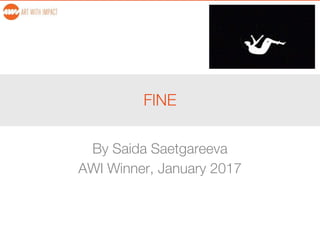
FINE
By Saida Saetgareeva
AWI Winner, January 2017
What did you notice about stigma?
Isolated
Said she was fine when she wasn’t
Kept falling and falling into the dark
Internal struggle of wanting to say something but you can’t
Could tell she felt silenced
How does stigma feel?
Isolating
Depressing
Helpless
Silenced
Negative
Crazy
Nervous
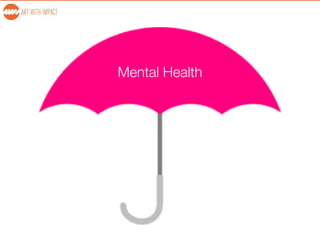
Mental Health
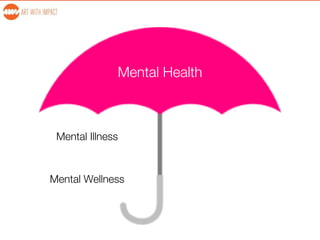
Mental Health
Mental Illness
Mental Wellness
Some movies that show mental illness:
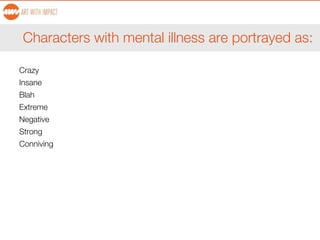
Characters with mental illness are portrayed as:
Crazy
Insane
Blah
Extreme
Negative
Strong
Conniving
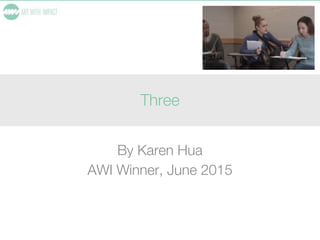
Three
By Karen Hua
AWI Winner, June 2015
Discuss
• What did you think?
• What did you feel?
What did you think? What did you feel?
Thoughts
Like at the end when they all came together. If
they could talk to each other they could know they
aren’t alone.
The different depiction of eating disorder and
related issues that go against stereotypes.
Feelings
Hopeful
Nervous
Concerned
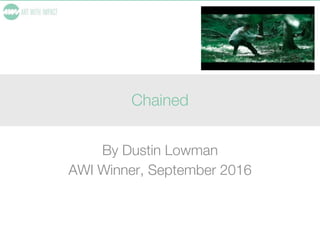
Chained
By Dustin Lowman
AWI Winner, September 2016
Discuss
• What did you think?
• What did you feel?
What did you think? What did you feel?
Thoughts
Dig deeper
Hope is always near
The key is finding hope within us
Our struggles can make us feel trapped
I wanted him to win
Feelings
Hopeful
Supported
Encouraged
Sad
Why don’t people get help?
Don't want to disappoint family
Cultural and language barriers
Don’t want to be a burden
Problems aren’t that bad
Don’t believe deserve help
Want to be “normal”
Financial barriers
People might be angry
Think you should help yourself
Feel isolated
Don’t know how
FEAR
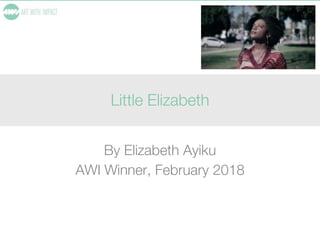
Little Elizabeth
By Elizabeth Ayiku
AWI Winner, February 2018
Initial Reactions?
What can we do?
Meet the Panel
• Kelsie Antoloci - Miami Student
• Desiree Cooper - Miami Student
• Courtney "Bell" Brackenbury - Miami Student
• Mary Bausano - Assistant Dean for Student Success/Counselor,
Hamilton Campus
• Nancy Ferguson Robinson - Director of Counseling Services,
Middletown Campus
• Adalica Carillo - Program Manager for Butler County Consultation
and Crisis Intervention at Butler Behavioral Health Services
• Maria Sulcer - Outreach Specialist, Lindner Center of HOPE
• Jennifer Hamilton, MA, LSW - Community Liaison, Beckett-Springs
AWI Ambassadors
• You’re invited! Continue the conversation, be a
leader!
• Join the AWI Ambassadors FB group and
connect with students across North America:
www.facebook.com/groups/awiambassadors/
• Blog, be a juror for the film competition, run
campaigns, and much more!
Thank you for coming!
• Contact us: info@artwithimpact.org
• Follow us!
• Submit a film!
https://www.artwithimpact.org/films/submit-a-film/

Completed miami regionals april 2018 - powerpoint

  • 1.
    Movies for MentalHealth Miami Regionals April 17, 2018 @artwithimpact #Movies4MentalHealth
  • 2.
    Here’s the Plan I.Quick Introduction II. Set the Stage Together III. Watch Short Films & Discuss Them IV. Make it Personal with Our Panel
  • 3.
    Brought to youby • Monthly Short Film Competition • Campus Workshops • Global Community (blog, IG, Twitter, FB)
  • 4.
    Heads Up ★ Mentalhealth is personal - YOU are the expert of your own experience. ★ This is a public space - not therapy. ★ We’re here for connection, questions and creating change! ★ Films might trigger big emotions - that’s OK! ★ Please ask for help if you need support.
  • 5.
    Stigma A judgment orstereotype that is: 1. Always negative 2. Always untrue 3. Can be internalized
  • 6.
    FINE By Saida Saetgareeva AWIWinner, January 2017
  • 7.
    What did younotice about stigma? Isolated Said she was fine when she wasn’t Kept falling and falling into the dark Internal struggle of wanting to say something but you can’t Could tell she felt silenced
  • 8.
    How does stigmafeel? Isolating Depressing Helpless Silenced Negative Crazy Nervous
  • 9.
  • 10.
  • 11.
    Some movies thatshow mental illness:
  • 12.
    Characters with mentalillness are portrayed as: Crazy Insane Blah Extreme Negative Strong Conniving
  • 13.
    Three By Karen Hua AWIWinner, June 2015
  • 14.
    Discuss • What didyou think? • What did you feel?
  • 15.
    What did youthink? What did you feel? Thoughts Like at the end when they all came together. If they could talk to each other they could know they aren’t alone. The different depiction of eating disorder and related issues that go against stereotypes. Feelings Hopeful Nervous Concerned
  • 16.
    Chained By Dustin Lowman AWIWinner, September 2016
  • 17.
    Discuss • What didyou think? • What did you feel?
  • 18.
    What did youthink? What did you feel? Thoughts Dig deeper Hope is always near The key is finding hope within us Our struggles can make us feel trapped I wanted him to win Feelings Hopeful Supported Encouraged Sad
  • 19.
    Why don’t peopleget help? Don't want to disappoint family Cultural and language barriers Don’t want to be a burden Problems aren’t that bad Don’t believe deserve help Want to be “normal” Financial barriers People might be angry Think you should help yourself Feel isolated Don’t know how FEAR
  • 20.
    Little Elizabeth By ElizabethAyiku AWI Winner, February 2018
  • 21.
  • 22.
  • 23.
    Meet the Panel •Kelsie Antoloci - Miami Student • Desiree Cooper - Miami Student • Courtney "Bell" Brackenbury - Miami Student • Mary Bausano - Assistant Dean for Student Success/Counselor, Hamilton Campus • Nancy Ferguson Robinson - Director of Counseling Services, Middletown Campus • Adalica Carillo - Program Manager for Butler County Consultation and Crisis Intervention at Butler Behavioral Health Services • Maria Sulcer - Outreach Specialist, Lindner Center of HOPE • Jennifer Hamilton, MA, LSW - Community Liaison, Beckett-Springs
  • 24.
    AWI Ambassadors • You’reinvited! Continue the conversation, be a leader! • Join the AWI Ambassadors FB group and connect with students across North America: www.facebook.com/groups/awiambassadors/ • Blog, be a juror for the film competition, run campaigns, and much more!
  • 25.
    Thank you forcoming! • Contact us: info@artwithimpact.org • Follow us! • Submit a film! https://www.artwithimpact.org/films/submit-a-film/

Editor's Notes

  • #2 Campus organizer (may) introduce facilitator Brief introduction – welcome, name Encourage people to come closer Connect with us on Instagram, Facebook or Twitter and document this event - we’d love to see your photos!
  • #3 Brief agenda review: - will give you a brief summary of AWI - set the stage together, which really means that as a group we’ll have a discussion and provide a context for the topics - we have four short films from our library to show you, together we’ll discuss the themes - Make it personal with a panel of campus and community resources to connect you with - You’ll be doing most of the talking today! Mention photos - if you would prefer not to have your face in photos please inform us after the event
  • #4 Who is AWI? - we are a charity dedicated to reducing the stigma of mental illness with transition-aged youth, work in regions throughout North America - we have been working in the US and Canada since 2011 - We host an ongoing monthly short film competition where filmmakers anywhere in the world can submit a film on the topic of mental health, these are juried and monthly winners receive $1,000 cash prize (will tell you more about that at the end of our time together) - We then take these winning films and facilitate discussions in our postsecondary Movies for Mental Health program (you’ll see what this is all about today) and run a high school program that teaches media literacy to youth and allows them to make their own short films on mental health - Also a part of a larger global community, release blogs twice a week on feature length films, or film festivals related to themes of mental illness Brought to you by: - mention any nonprofit partners or corporate sponsors
  • #5 Want to explain what I mean about this statement… Mental health is personal and our experiences are different, we all come from different backgrounds and cultures – you are the experts on YOU and know yourself better than anyone else. We don’t often talk about mental health; as a society we don’t tend to talk about issues/experiences related to this theme, so sometimes we don’t know HOW to talk about these topics. First and foremost keep yourself safe today, don’t feel compelled to share anything you’re not comfortable with. This is a new space and you might feel ready to share but might not know what responses you’ll have, and it is a public space with no guaranteed confidentiality so be mindful of the space that we are in before you disclose. Some of the films might be triggering, meaning they might elicit an emotional reaction. It’s ok to feel! But if you ever feel that you are not OK, or unsafe, please do what you need to do to take care of yourself. We have counsellors in the room today that are here to help you if you need to step out (say names of counsellors, have them raise their hands in the audience).
  • #6 FIRST - ask for one or two people to define “stereotype.” Really just one or two - NOT a big discussion. THEN, name that stigma and stereotype are often used interchangeably, but stigma has a few distinct qualities. Quick definition. Provide a little explanation of the third point - we can take in these judgments and believe them about ourselves, even though they’re untrue. For example, if everyone tells me that having depression is just being lazy, it’s possible that I could start to believe that myself, that I’m just lazy and don’t need to seek support. Do a quick check to see if everyone gets it and is on board - again, not a big discussion, but a “thumbs up” check or see if they’re generally nodding
  • #7 15 minutes into the workshop
  • #9 Can close this slide by naming that yes, stigma can be a huge negative aspect of our experience, but it’s not permanent. Through conversations like these, and by sharing our truths, we can change stigma, and reduce it, and ultimately, get rid of it entirely.
  • #10 25 minutes into the workshop Introduce ways that AWI holds some concepts around MH - these may change over time, terms are evolving. Quick slide: We see mental health as an umbrella in that it is something that we are all existing under, and experiencing. Mental health can include many aspects of life. It’s our internal way of seeing the world, and something we all have and experience. Like physical health, we all have mental health, and things within and outside of ourselves can affect our mental health. Things outside of the MH umbrella, like culture, spirituality, physical health, support systems, etc. can affect our MH. There’s lots of intersectionality and influences when it comes to MH. There can be embedded and systemic influences (such as histories of oppression, privilege, access to services) and other components that influence the way we as individuals experience MH.
  • #11 MI and MW are concepts that fall under the umbrella of MH. MI can be defined as when uncontrollable things happening within you and/or influenced by other things get in the way of you living the life you want to live. This can arise from trauma or be circumstantial, and can also be influenced by genetics and biology. Mental illness diagnoses are helpful for some, and for others provide more of a shared language. MI may differ between how society defines it and how we define it for ourselves. MW means feeling “well” - however you define it - in your mind and spirit. It can include practices and behaviors that support you and help you feel and be your best self. Like physical health, it requires maintenance. We don’t hold these as opposites - you can have symptoms of a mental illness, and engage in mental wellness practices. You can also not have symptoms of a MI, but still not be mentally well, if you don’t have ways of supporting your internal (and external) self.
  • #13 Can close up this slide by saying yes, media portrayals are overall negative, but there are artists and filmmakers out there making films that can change this. Many of our films are made by people with lived experience, and share their genuine truths.
  • #14 35 minutes into the workshop
  • #17 50 minutes into the workshop
  • #20 ***CAN SKIP SLIDE IF RUNNING LOW ON TIME*** Ideally, you will be able to use this slide, as it can lead to a great discussion about stigma, and how different stigmas (and other factors) can keep people from seeking support. If you think you’re running out of time, try to prompt this question in the previous “thoughts / feelings” slide so it’s at least touched on, even if you don’t use this slide.
  • #21 1 hour and 5 minutes into the workshop
  • #22 This slide is to give space to discussing the last film, but isn’t an in-depth thoughts/feelings slide. It should be a group conversation (not small groups), and just take a few people’s reactions to the film. Depending on time, you might need to move on quickly, but if you have time, feel free to let this be an open discussion about the film.
  • #23 From what we’ve learned - actions we may be drawn to take. Be sure to encourage responses that relate to what we can do as friends, family members, and community members of people with MI, AND ALSO make sure they address what we can do for ourselves, i.e. mental wellness practices.
  • #24 1 hour and 20 minutes into the workshop “Now will invite our panelists to come up. We will hear from the students, sharing their personal stories. We’re so grateful for their courage in sharing their stories! We will also hear from resources on-campus and in the community. After the panelists all speak, you will have a chance to ask the panel any questions you have. If you need to leave early, please do so respectfully, and please make sure to fill out an evaluation before you leave. This information is super helpful for us in making sure we and your school are serving your needs as well as we can. We will also pass these out at the end of the workshop.” **Applause for panelists!** They will then speak in order of how they are in the slide. At the end, you will invite questions from the audience.
  • #25 1 hour and 55 minutes into the workshop AWI exists to create a community of students, artists, advocates, who want to have these conversations...if you’re interested in staying in touch with us and becoming a part of a larger community of students across N. America who believe in the power of art to subvert stigma