Complete Guide to Payroll Management
in 2024
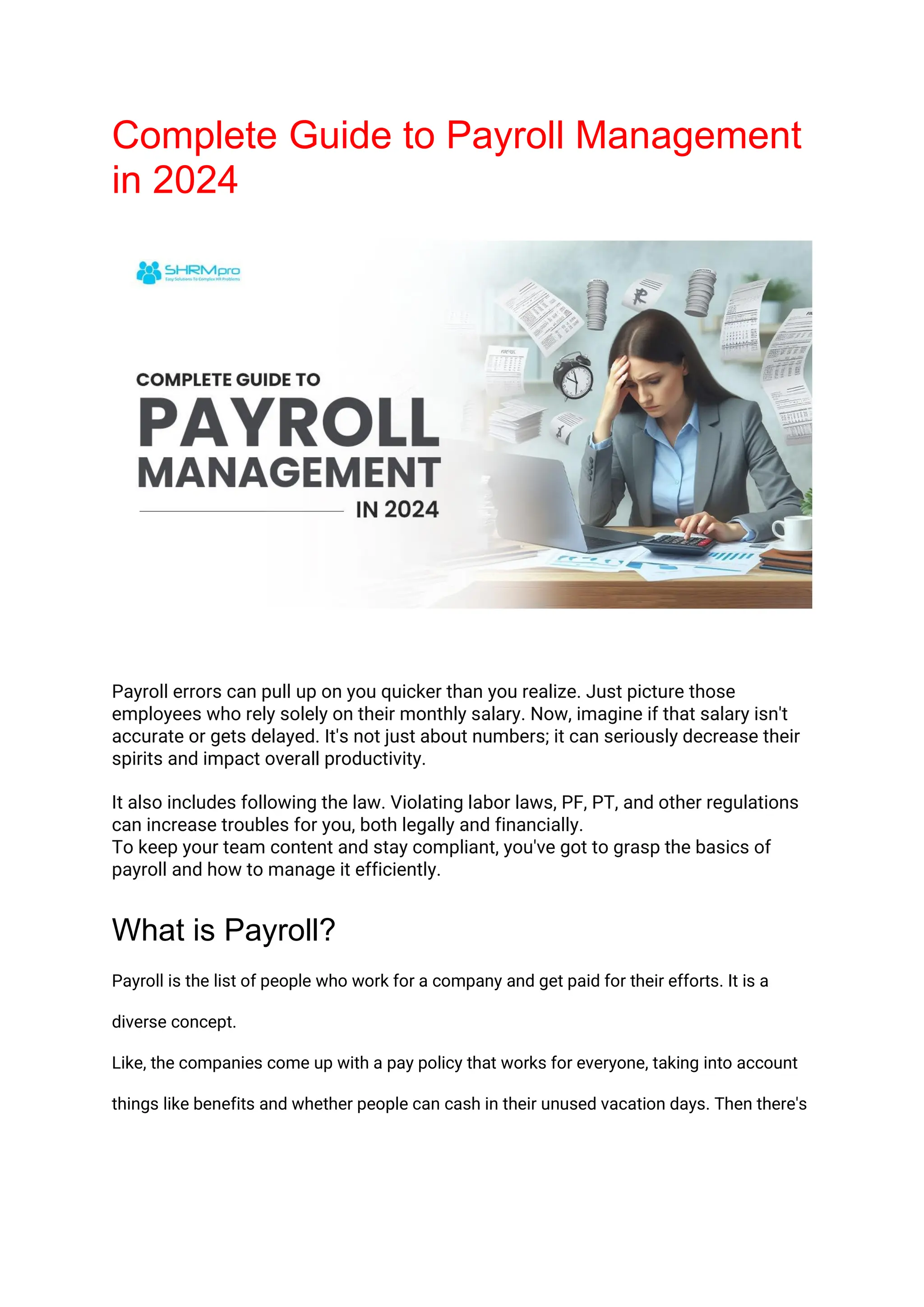
Payroll errors can pull up on you quicker than you realize. Just picture those
employees who rely solely on their monthly salary. Now, imagine if that salary isn't
accurate or gets delayed. It's not just about numbers; it can seriously decrease their
spirits and impact overall productivity.
It also includes following the law. Violating labor laws, PF, PT, and other regulations
can increase troubles for you, both legally and financially.
To keep your team content and stay compliant, you've got to grasp the basics of
payroll and how to manage it efficiently.
What is Payroll?
Payroll is the list of people who work for a company and get paid for their efforts. It is a
diverse concept.
Like, the companies come up with a pay policy that works for everyone, taking into account
things like benefits and whether people can cash in their unused vacation days. Then there's
figuring out what goes on those pay stubs the basic salary, any bonuses or perks, housing
allowances, travel allowances, etc.
Then comes the phase of evaluating all those numbers and taking into account the taxes
and other deductions to figure out the actual amount each person owes. Once all that's
sorted, it's time actually to release the paychecks or set up direct deposits.
The company still needs to make sure that all the taxes are paid. So they have to deposit the
income tax and pension contributions to the right authorities and make sure all the
paperwork is in order.
In a nutshell, payroll is figuring out what the employees are owed, and their net pay after all
the necessary deductions have been made.
What are the Stages of Payroll Processing?
There are always ongoing tasks that need attention and a constant need to monitor
changes to withholdings, contributions to social security funds, etc.
This entire process can be split into three stages, pre-payroll, actual payroll, and
post-payroll activities.
Pre-Payroll Activities
Defining Payroll Policy
The final amount you receive in your paycheck depends on several factors, like the
company's policies on pay, leave, benefits, and attendance.
Before anything else, these policies should be clearly defined and approved by
management to ensure a smooth payroll process.
Gathering Inputs
In big organizations, gathering all the necessary data can be a hectic task. From mid-
year salary adjustments to attendance records, there's a lot of information to collect
from various departments and individuals.
However, with the help of a smart payroll system equipped with features like
integrated leave and attendance management, as well as an employee self-service
portal, the process of gathering inputs becomes much easier.
Input Validation
Once you receive the inputs, it's crucial to verify the data to ensure it complies with
company policies, follows the authorization and approval procedures, and adheres to
the correct formats.
Additionally, you must make certain that every active employee is accounted for and
that inactive employee records are not included in the salary payment process.
Actual Payroll Process
Payroll Calculation
Once the validated input data gets into the payroll system for actual payroll
processing, the result is the net pay, factoring in all the necessary taxes and
deductions.
Once that's done, it's always smart to double-check everything to make sure it's all
accurate and error-free. This helps catch any mistakes and ensures everything adds
up smoothly.
Post Payroll Process
Statutory Compliance
When processing payroll, the company deducts statutory contributions like EPF, TDS,
and ESI, and then sends the appropriate amounts to government agencies.
The frequency of these payments can vary, and they are typically made using
challans. Once all the dues are paid, returns or reports are filed accordingly. For
instance, to file a PF return, an ECR is generated and submitted.
Payroll Accounting
Every company maintains records of its financial activities, including the salaries it
pays out.
To ensure smooth payroll management, it's necessary to input accurate salary and
reimbursement information into the accounting or ERP system.
Payout
When it comes to paying employees, companies typically offer three options i.e.
cash, cheque, or bank transfer. Most often, employees are provided with a salary
bank account for ease of payment.
After finalizing payroll, it's important to ensure that the company's bank account
holds enough funds to cover the salaries. Following this, a salary bank advice
statement is sent to the relevant branch, containing details such as employee ID,
bank account number, and wages.
If a company opts for payroll management software with an employee self-service
portal, it can effortlessly distribute payslips online. Employees can then log in to their
accounts and view their payslips at their convenience.
Reporting
After wrapping up the payroll process for a given month, the finance and top
management teams often request detailed reports like departmental or location-
based breakdowns of employee expenses.
As a payroll officer, it's your duty to delve into the data, extract the necessary
information, and furnish these reports promptly.
Challenges in Handling Payroll Management
Process
The Requirement to Stay Statutory Compliant
Failure to follow legal requirements can result in fines and penalties, and in extreme
cases, it could even risk the survival of the business.
Nowadays, there are numerous payroll management software options available that
handle payroll tasks while ensuring compliance with the stated laws.
Dependence on Multiple Payroll Inputs Sources
Before payroll can be processed, you've got to gather all the necessary data from
various sources like attendance logs, records of conveyance facility usage, and info
from the HR department such as updates on salary revisions.
It's quite a complex process. For ages, HR and payroll officers have been juggling
data on Excel sheets.
However, using Excel comes with its own set of issues: reliance on formulas for
salary calculations, challenges in adding or removing employees, and limitations like
manual data entry and difficulty in extracting insights.
Various Methods Available to do Payroll for your
Business.
The possible options for running payroll can be
• Excel-based payroll management
• Payroll outsourcing
• Using payroll software
Excel-based Payroll Management
Many startups and small businesses, when just kicking off with a small team, often
resort to managing their payroll using Excel spreadsheets.
This method involves manual data input into a pre-set payroll template, dependent
on built-in formulas to crunch the numbers. While it's a cost-effective approach, it
also has a fair share of limitations.
Errors in calculations are common due to manual data entry, and managing changes
in employee rolls can be hectic. There's also the risk of duplicate entries or missing
out on data.
Payroll Outsourcing
When a company outsources its payroll, it means they're getting an external agency
to handle all things related to paying employees. This is common for businesses
without a dedicated payroll person.
They send over details like employee salaries, attendance, leave records, and
expense reimbursements to the outsourcing service every month, based on their pay
schedule. Then, the service provider calculates the payroll and ensures everything
aligns with legal requirements.
However, some businesses hesitate to outsource payroll because it is a critical
function, and they want to maintain full control and transparency over it.
Payroll Software
As we've discussed earlier, to smoothly run your payroll operations, it's crucial to
ensure that all necessary inputs are received promptly and seamlessly from various
sources. Using software can greatly ease this process by reducing any friction
involved in gathering these inputs.
Nowadays, you can find sophisticated AI-based payroll management software on the
market that not only automates payroll calculations but also offers comprehensive
features like managing leave, attendance, and HR tasks, and provides employees
with self-service options.
Depending on the size of your company and specific needs, one can choose the right
payroll software to suit your business requirements.
Best Payroll Software for your Organization
Transitioning from a manual payroll system to an automated one can effectively
offer significant time savings. Not only does it streamline payroll processing, but it
also fosters accuracy, keeping everyone from employees to management to
regulatory bodies content.
When choosing payroll management software, there are certain features you should
prioritize.
Ease of Operation
Managing payroll can be quite a hassle. It's wise to go for a system with clear and
comprehensive workflows. If the software is easy to use, it minimizes the need for
broader training and support.
Also, ensure that the software provider offers well-maintained documentation so you
can access information whenever you need it.
Scalability
As your organization grows, your software must evolve as well. This could mean
handling larger volumes of employee data or offering additional features like leave
and attendance management, expense reimbursement, and more.
The software you choose must provide options for upgrading to advanced features
without breaking the bank.
Integration with Time, Attendance and Leave Management
System
Effective time management tools are crucial for professional sectors like consulting
firms and medical practices to ensure productivity and accurate client billing.
Automated attendance management systems, including biometric scanners and
access cards, smoothen tracking and integrates with payroll software.
Leave management software eases the process of allocating vacation, sick leaves,
and public holiday days to employees, enabling easy requests and approvals.
Integrated with payroll software, it ensures accurate payroll processing.
Integration with the Accounting System
When your accounting system doesn't directly sync with your payroll solution, it
becomes a manual task for the payroll officer to furnish all transaction specifics to
the accounts department.
The accountant then inputs these details into the accounting software, such as Tally
ERP, SAP, Quickbooks, and others, through journal entries.
Integrations between payroll and accounting software smoothen this process,
promoting collaboration between finance and payroll teams and eliminating the need
for manual data entry.
Conclusion: Complete Guide to Payroll
Management in 2024
By implementing a payroll management system, you can easily
overcome your challenges of inefficient payroll processing and focus on
making your organization's vision and mission a reality.
So, if you are looking for a cloud-based HR software that can simplify
workforce processes and provide solutions to all your HR problems,
SHRMpro is the one-stop location for you.
With a user-friendly interface, we have automated tasks like Payroll
Management, Application Tracking, Employee Data Management,
Attendance Management, Training Sessions, etc., catering to all HRMS
problems, to all our clients across the globe.
To know more about our Payroll Management System and how we can
solve your Payroll processing challenges in your HR, book a demo of
our HR software today!
Source URL: - https://www.shrmpro.com/features/payroll-
management/
Contact US:-
Company Name : SHRMPRO
URL : - https://www.shrmpro.com/
Mobile: - 6204603662
Address : A 27B, A Block, Sector 16, Noida, Uttar Pradesh 201301

Complete Guide to Payroll Management in 2024 | Shrmpro

  • 1.
    Complete Guide toPayroll Management in 2024 Payroll errors can pull up on you quicker than you realize. Just picture those employees who rely solely on their monthly salary. Now, imagine if that salary isn't accurate or gets delayed. It's not just about numbers; it can seriously decrease their spirits and impact overall productivity. It also includes following the law. Violating labor laws, PF, PT, and other regulations can increase troubles for you, both legally and financially. To keep your team content and stay compliant, you've got to grasp the basics of payroll and how to manage it efficiently. What is Payroll? Payroll is the list of people who work for a company and get paid for their efforts. It is a diverse concept. Like, the companies come up with a pay policy that works for everyone, taking into account things like benefits and whether people can cash in their unused vacation days. Then there's
  • 2.
    figuring out whatgoes on those pay stubs the basic salary, any bonuses or perks, housing allowances, travel allowances, etc. Then comes the phase of evaluating all those numbers and taking into account the taxes and other deductions to figure out the actual amount each person owes. Once all that's sorted, it's time actually to release the paychecks or set up direct deposits. The company still needs to make sure that all the taxes are paid. So they have to deposit the income tax and pension contributions to the right authorities and make sure all the paperwork is in order. In a nutshell, payroll is figuring out what the employees are owed, and their net pay after all the necessary deductions have been made. What are the Stages of Payroll Processing? There are always ongoing tasks that need attention and a constant need to monitor changes to withholdings, contributions to social security funds, etc. This entire process can be split into three stages, pre-payroll, actual payroll, and post-payroll activities. Pre-Payroll Activities Defining Payroll Policy The final amount you receive in your paycheck depends on several factors, like the company's policies on pay, leave, benefits, and attendance. Before anything else, these policies should be clearly defined and approved by management to ensure a smooth payroll process. Gathering Inputs
  • 3.
    In big organizations,gathering all the necessary data can be a hectic task. From mid- year salary adjustments to attendance records, there's a lot of information to collect from various departments and individuals. However, with the help of a smart payroll system equipped with features like integrated leave and attendance management, as well as an employee self-service portal, the process of gathering inputs becomes much easier. Input Validation Once you receive the inputs, it's crucial to verify the data to ensure it complies with company policies, follows the authorization and approval procedures, and adheres to the correct formats. Additionally, you must make certain that every active employee is accounted for and that inactive employee records are not included in the salary payment process. Actual Payroll Process Payroll Calculation Once the validated input data gets into the payroll system for actual payroll processing, the result is the net pay, factoring in all the necessary taxes and deductions. Once that's done, it's always smart to double-check everything to make sure it's all accurate and error-free. This helps catch any mistakes and ensures everything adds up smoothly. Post Payroll Process Statutory Compliance When processing payroll, the company deducts statutory contributions like EPF, TDS, and ESI, and then sends the appropriate amounts to government agencies. The frequency of these payments can vary, and they are typically made using challans. Once all the dues are paid, returns or reports are filed accordingly. For instance, to file a PF return, an ECR is generated and submitted.
  • 4.
    Payroll Accounting Every companymaintains records of its financial activities, including the salaries it pays out. To ensure smooth payroll management, it's necessary to input accurate salary and reimbursement information into the accounting or ERP system. Payout When it comes to paying employees, companies typically offer three options i.e. cash, cheque, or bank transfer. Most often, employees are provided with a salary bank account for ease of payment. After finalizing payroll, it's important to ensure that the company's bank account holds enough funds to cover the salaries. Following this, a salary bank advice statement is sent to the relevant branch, containing details such as employee ID, bank account number, and wages. If a company opts for payroll management software with an employee self-service portal, it can effortlessly distribute payslips online. Employees can then log in to their accounts and view their payslips at their convenience. Reporting After wrapping up the payroll process for a given month, the finance and top management teams often request detailed reports like departmental or location- based breakdowns of employee expenses. As a payroll officer, it's your duty to delve into the data, extract the necessary information, and furnish these reports promptly. Challenges in Handling Payroll Management Process The Requirement to Stay Statutory Compliant Failure to follow legal requirements can result in fines and penalties, and in extreme cases, it could even risk the survival of the business. Nowadays, there are numerous payroll management software options available that handle payroll tasks while ensuring compliance with the stated laws. Dependence on Multiple Payroll Inputs Sources
  • 5.
    Before payroll canbe processed, you've got to gather all the necessary data from various sources like attendance logs, records of conveyance facility usage, and info from the HR department such as updates on salary revisions. It's quite a complex process. For ages, HR and payroll officers have been juggling data on Excel sheets. However, using Excel comes with its own set of issues: reliance on formulas for salary calculations, challenges in adding or removing employees, and limitations like manual data entry and difficulty in extracting insights. Various Methods Available to do Payroll for your Business. The possible options for running payroll can be • Excel-based payroll management • Payroll outsourcing • Using payroll software Excel-based Payroll Management Many startups and small businesses, when just kicking off with a small team, often resort to managing their payroll using Excel spreadsheets. This method involves manual data input into a pre-set payroll template, dependent on built-in formulas to crunch the numbers. While it's a cost-effective approach, it also has a fair share of limitations. Errors in calculations are common due to manual data entry, and managing changes in employee rolls can be hectic. There's also the risk of duplicate entries or missing out on data. Payroll Outsourcing When a company outsources its payroll, it means they're getting an external agency to handle all things related to paying employees. This is common for businesses without a dedicated payroll person. They send over details like employee salaries, attendance, leave records, and expense reimbursements to the outsourcing service every month, based on their pay schedule. Then, the service provider calculates the payroll and ensures everything aligns with legal requirements.
  • 6.
    However, some businesseshesitate to outsource payroll because it is a critical function, and they want to maintain full control and transparency over it. Payroll Software As we've discussed earlier, to smoothly run your payroll operations, it's crucial to ensure that all necessary inputs are received promptly and seamlessly from various sources. Using software can greatly ease this process by reducing any friction involved in gathering these inputs. Nowadays, you can find sophisticated AI-based payroll management software on the market that not only automates payroll calculations but also offers comprehensive features like managing leave, attendance, and HR tasks, and provides employees with self-service options. Depending on the size of your company and specific needs, one can choose the right payroll software to suit your business requirements. Best Payroll Software for your Organization Transitioning from a manual payroll system to an automated one can effectively offer significant time savings. Not only does it streamline payroll processing, but it also fosters accuracy, keeping everyone from employees to management to regulatory bodies content. When choosing payroll management software, there are certain features you should prioritize. Ease of Operation Managing payroll can be quite a hassle. It's wise to go for a system with clear and comprehensive workflows. If the software is easy to use, it minimizes the need for broader training and support. Also, ensure that the software provider offers well-maintained documentation so you can access information whenever you need it.
  • 7.
    Scalability As your organizationgrows, your software must evolve as well. This could mean handling larger volumes of employee data or offering additional features like leave and attendance management, expense reimbursement, and more. The software you choose must provide options for upgrading to advanced features without breaking the bank. Integration with Time, Attendance and Leave Management System Effective time management tools are crucial for professional sectors like consulting firms and medical practices to ensure productivity and accurate client billing. Automated attendance management systems, including biometric scanners and access cards, smoothen tracking and integrates with payroll software. Leave management software eases the process of allocating vacation, sick leaves, and public holiday days to employees, enabling easy requests and approvals. Integrated with payroll software, it ensures accurate payroll processing. Integration with the Accounting System When your accounting system doesn't directly sync with your payroll solution, it becomes a manual task for the payroll officer to furnish all transaction specifics to the accounts department. The accountant then inputs these details into the accounting software, such as Tally ERP, SAP, Quickbooks, and others, through journal entries. Integrations between payroll and accounting software smoothen this process, promoting collaboration between finance and payroll teams and eliminating the need for manual data entry. Conclusion: Complete Guide to Payroll Management in 2024
  • 8.
    By implementing apayroll management system, you can easily overcome your challenges of inefficient payroll processing and focus on making your organization's vision and mission a reality. So, if you are looking for a cloud-based HR software that can simplify workforce processes and provide solutions to all your HR problems, SHRMpro is the one-stop location for you. With a user-friendly interface, we have automated tasks like Payroll Management, Application Tracking, Employee Data Management, Attendance Management, Training Sessions, etc., catering to all HRMS problems, to all our clients across the globe. To know more about our Payroll Management System and how we can solve your Payroll processing challenges in your HR, book a demo of our HR software today! Source URL: - https://www.shrmpro.com/features/payroll- management/ Contact US:- Company Name : SHRMPRO URL : - https://www.shrmpro.com/ Mobile: - 6204603662 Address : A 27B, A Block, Sector 16, Noida, Uttar Pradesh 201301