Compiler Design -Lecture 1
Introduction to Compiler
Stage 3 - Computer Science
Department
2.
What is aCompiler?
• • A compiler is a program that translates code
written in a high-level programming language
into machine code.
• • It allows programmers to write in human-
readable languages while enabling the
computer to execute the instructions.
• • Example: Translating C++ code into Assembly
or Machine Code.
3.
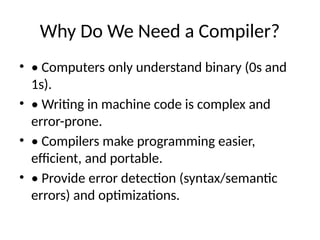
Why Do WeNeed a Compiler?
• • Computers only understand binary (0s and
1s).
• • Writing in machine code is complex and
error-prone.
• • Compilers make programming easier,
efficient, and portable.
• • Provide error detection (syntax/semantic
errors) and optimizations.
Example: int a= b + 5;
• • Lexical Analysis → Tokens: [int], [a], [=], [b],
[+], [5], [;]
• • Syntax Analysis → Valid assignment
expression
• • Semantic Analysis → Checks types of
variables
• • Intermediate Code → t1 = b + 5; a = t1
• • Optimization → a = b + 5
• • Code Generation → Assembly instructions
6.
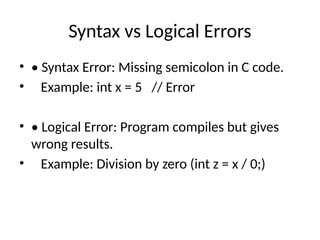
Syntax vs LogicalErrors
• • Syntax Error: Missing semicolon in C code.
• Example: int x = 5 // Error
• • Logical Error: Program compiles but gives
wrong results.
• Example: Division by zero (int z = x / 0;)
7.
Thinking Question
• Imagineif compilers did not exist:
• • How would programmers write code?
• • Would programming be practical using only
0s and 1s?
• • Discuss the importance of compilers in
software development.


![Example: int a = b + 5;
• • Lexical Analysis → Tokens: [int], [a], [=], [b],
[+], [5], [;]
• • Syntax Analysis → Valid assignment
expression
• • Semantic Analysis → Checks types of
variables
• • Intermediate Code → t1 = b + 5; a = t1
• • Optimization → a = b + 5
• • Code Generation → Assembly instructions](https://image.slidesharecdn.com/compilerlecture1-250908155703-3f7b2d22/85/Compiler-Design-Theory-Tools-and-Examples-5-320.jpg)


![[DSC Europe 25] Danilo Djukanovic - From Vibes to KPIs: Turning Culture Into ...](https://cdn.slidesharecdn.com/ss_thumbnails/inqestws5wf0cik2glgv-3-danilo-djukanovic-from-vibes-to-kpis-presentation-260114111931-dacff81f-thumbnail.jpg?width=640&height=640&fit=bounds)
![[DSC Europe 25] Ivica Milaric - The Future of Gaming and AI Tools.pptx](https://cdn.slidesharecdn.com/ss_thumbnails/tijgzsmgse2kj2y5pzzp-5-ivica-milaric-the-future-of-gaming-x-ai-tools-260114111931-87c2b3ac-thumbnail.jpg?width=640&height=640&fit=bounds)


