1
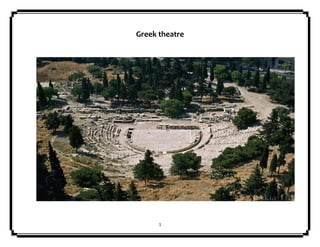
Greek theatre
2
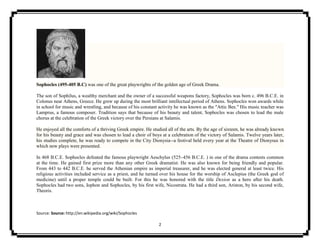
Sophocles (495-405 B.C) was one of the great playwrights of the golden age of Greek Drama.

The son of Sophilus, a wealthy merchant and the owner of a successful weapons factory, Sophocles was born c. 496 B.C.E. in
Colonus near Athens, Greece. He grew up during the most brilliant intellectual period of Athens. Sophocles won awards while
in school for music and wrestling, and because of his constant activity he was known as the "Attic Bee." His music teacher was
Lamprus, a famous composer. Tradition says that because of his beauty and talent, Sophocles was chosen to lead the male
chorus at the celebration of the Greek victory over the Persians at Salamis.
He enjoyed all the comforts of a thriving Greek empire. He studied all of the arts. By the age of sixteen, he was already known
for his beauty and grace and was chosen to lead a choir of boys at a celebration of the victory of Salamis. Twelve years later,
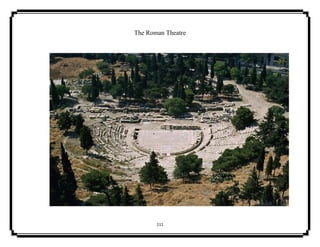
his studies complete, he was ready to compete in the City Dionysia--a festival held every year at the Theatre of Dionysus in
which new plays were presented.
In 468 B.C.E. Sophocles defeated the famous playwright Aeschylus (525–456 B.C.E. ) in one of the drama contests common
at the time. He gained first prize more than any other Greek dramatist. He was also known for being friendly and popular.
From 443 to 442 B.C.E. he served the Athenian empire as imperial treasurer, and he was elected general at least twice. His
religious activities included service as a priest, and he turned over his house for the worship of Asclepius (the Greek god of
medicine) until a proper temple could be built. For this he was honored with the title Dexion as a hero after his death.
Sophocles had two sons, Iophon and Sophocles, by his first wife, Nicostrata. He had a third son, Ariston, by his second wife,
Theoris.
Source: Source: http://en.wikipedia.org/wiki/Sophocles
3
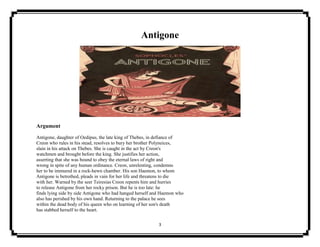
Antigone
Argument
Antigone, daughter of Oedipus, the late king of Thebes, in defiance of
Creon who rules in his stead, resolves to bury her brother Polyneices,
slain in his attack on Thebes. She is caught in the act by Creon's
watchmen and brought before the king. She justifies her action,
asserting that she was bound to obey the eternal laws of right and
wrong in spite of any human ordinance. Creon, unrelenting, condemns
her to be immured in a rock-hewn chamber. His son Haemon, to whom
Antigone is betrothed, pleads in vain for her life and threatens to die
with her. Warned by the seer Teiresias Creon repents him and hurries
to release Antigone from her rocky prison. But he is too late: he
finds lying side by side Antigone who had hanged herself and Haemon who
also has perished by his own hand. Returning to the palace he sees
within the dead body of his queen who on learning of her son's death
has stabbed herself to the heart.
4
Dramatis Personae
ANTIGONE
and ISMENE - daughters of Oedipus and sisters of
Polyneices
and Eteocles.
CREON, King of Thebes.
HAEMON, Son of Creon, betrothed to Antigone.
EURYDICE, wife of Creon.
TEIRESIAS, the prophet.
CHORUS, of Theban elders.
A WATCHMAN
A MESSENGER
A SECOND MESSENGER
----------------------------------------------------------------------
ANTIGONE and ISMENE before the Palace gates.
ANTIGONE
Ismene, sister of my blood and heart,
See'st thou how Zeus would in our lives fulfill
The weird of Oedipus, a world of woes!
For what of pain, affliction, outrage, shame,
Is lacking in our fortunes, thine and mine?
And now this proclamation of today
Made by our Captain-General to the State,
What can its purport be? Didst hear and heed,
Or art thou deaf when friends are banned as foes?
ISMENE
To me, Antigone, no word of friends
Has come, or glad or grievous, since we twain
Were reft of our two brethren in one day
By double fratricide; and since i' the night
Our Argive leaguers fled, no later news
Has reached me, to inspirit or deject.
ANTIGONE
I know 'twas so, and therefore summoned thee
Beyond the gates to breathe it in thine ear.
ISMENE
What is it? Some dark secret stirs thy breast.
ANTIGONE
What but the thought of our two brothers dead,
The one by Creon graced with funeral rites,
The other disappointed? Eteocles
He hath consigned to earth (as fame reports)
With obsequies that use and wont ordain,
So gracing him among the dead below.
But Polyneices, a dishonored corse,
(So by report the royal edict runs)
No man may bury him or make lament--
Must leave him tombless and unwept, a feast
For kites to scent afar and swoop upon.
Such is the edict (if report speak true)
Of Creon, our most noble Creon, aimed
5
At thee and me, aye me too; and anon
He will be here to promulgate, for such
As have not heard, his mandate; 'tis in sooth
No passing humor, for the edict says
Whoe'er transgresses shall be stoned to death.
So stands it with us; now 'tis thine to show
If thou art worthy of thy blood or base.
ISMENE
But how, my rash, fond sister, in such case
Can I do anything to make or mar?
ANTIGONE
Say, wilt thou aid me and abet? Decide.
ISMENE
In what bold venture? What is in thy thought?
ANTIGONE
Lend me a hand to bear the corpse away.
ISMENE
What, bury him despite the interdict?
ANTIGONE
My brother, and, though thou deny him, thine
No man shall say that _I_ betrayed a brother.
ISMENE
Wilt thou persist, though Creon has forbid?
ANTIGONE
What right has he to keep me from my own?
ISMENE
Bethink thee, sister, of our father's fate,
Abhorred, dishonored, self-convinced of sin,
Blinded, himself his executioner.
Think of his mother-wife (ill sorted names)
Done by a noose herself had twined to death
And last, our hapless brethren in one day,
Both in a mutual destiny involved,
Self-slaughtered, both the slayer and the slain.
Bethink thee, sister, we are left alone;
Shall we not perish wretchedest of all,
If in defiance of the law we cross
A monarch's will?--weak women, think of that,
Not framed by nature to contend with men.
Remember this too that the stronger rules;
We must obey his orders, these or worse.
Therefore I plead compulsion and entreat
The dead to pardon. I perforce obey
The powers that be. 'Tis foolishness, I ween,
To overstep in aught the golden mean.
ANTIGONE
I urge no more; nay, wert thou willing still,
I would not welcome such a fellowship.
Go thine own way; myself will bury him.
How sweet to die in such employ, to rest,--
Sister and brother linked in love's embrace--
A sinless sinner, banned awhile on earth,
2
But by the dead commended; and with them
I shall abide for ever. As for thee,
Scorn, if thou wilt, the eternal laws of Heaven.
ISMENE
I scorn them not, but to defy the State
Or break her ordinance I have no skill.
ANTIGONE
A specious pretext. I will go alone
To lap my dearest brother in the grave.
ISMENE
My poor, fond sister, how I fear for thee!
ANTIGONE
O waste no fears on me; look to thyself.
ISMENE
At least let no man know of thine intent,
But keep it close and secret, as will I.
ANTIGONE
O tell it, sister; I shall hate thee more
If thou proclaim it not to all the town.
ISMENE
Thou hast a fiery soul for numbing work.
ANTIGONE
I pleasure those whom I would liefest please.
ISMENE
If thou succeed; but thou art doomed to fail.
ANTIGONE
When strength shall fail me, yes, but not before.
ISMENE
But, if the venture's hopeless, why essay?
ANTIGONE
Sister, forbear, or I shall hate thee soon,
And the dead man will hate thee too, with cause.
Say I am mad and give my madness rein
To wreck itself; the worst that can befall
Is but to die an honorable death.
ISMENE
Have thine own way then; 'tis a mad endeavor,
Yet to thy lovers thou art dear as ever.
[Exeunt]
CHORUS
(Str. 1)
Sunbeam, of all that ever dawn upon
Our seven-gated Thebes the brightest ray,
O eye of golden day,
How fair thy light o'er Dirce's fountain shone,
Speeding upon their headlong homeward course,
Far quicker than they came, the Argive force;
Putting to flight
The argent shields, the host with scutcheons white.
Against our land the proud invader came
To vindicate fell Polyneices' claim.
3
Like to an eagle swooping low,
On pinions white as new fall'n snow.
With clanging scream, a horsetail plume his crest,
The aspiring lord of Argos onward pressed.
(Ant. 1)
Hovering around our city walls he waits,
His spearmen raven at our seven gates.
But ere a torch our crown of towers could burn,
Ere they had tasted of our blood, they turn
Forced by the Dragon; in their rear
The din of Ares panic-struck they hear.
For Zeus who hates the braggart's boast
Beheld that gold-bespangled host;
As at the goal the paean they upraise,
He struck them with his forked lightning blaze.
(Str. 2)
To earthy from earth rebounding, down he crashed;
The fire-brand from his impious hand was dashed,
As like a Bacchic reveler on he came,
Outbreathing hate and flame,
And tottered. Elsewhere in the field,
Here, there, great Area like a war-horse wheeled;
Beneath his car down thrust
Our foemen bit the dust.
Seven captains at our seven gates
Thundered; for each a champion waits,
Each left behind his armor bright,
Trophy for Zeus who turns the fight;
Save two alone, that ill-starred pair
One mother to one father bare,
Who lance in rest, one 'gainst the other
Drave, and both perished, brother slain by brother.
(Ant. 2)
Now Victory to Thebes returns again
And smiles upon her chariot-circled plain.
Now let feast and festal should
Memories of war blot out.
Let us to the temples throng,
Dance and sing the live night long.
God of Thebes, lead thou the round.
Bacchus, shaker of the ground!
Let us end our revels here;
Lo! Creon our new lord draws near,
Crowned by this strange chance, our king.
What, I marvel, pondering?
Why this summons? Wherefore call
Us, his elders, one and all,
Bidding us with him debate,
On some grave concern of State?
[Enter CREON]
CREON
Elders, the gods have righted one again
Our storm-tossed ship of state, now safe in port.
But you by special summons I convened
As my most trusted councilors; first, because
I knew you loyal to Laius of old;
Again, when Oedipus restored our State,
Both while he ruled and when his rule was o'er,
Ye still were constant to the royal line.
Now that his two sons perished in one day,
Brother by brother murderously slain,
4
By right of kinship to the Princes dead,
I claim and hold the throne and sovereignty.
Yet 'tis no easy matter to discern
The temper of a man, his mind and will,
Till he be proved by exercise of power;
And in my case, if one who reigns supreme
Swerve from the highest policy, tongue-tied
By fear of consequence, that man I hold,
And ever held, the basest of the base.
And I contemn the man who sets his friend
Before his country. For myself, I call
To witness Zeus, whose eyes are everywhere,
If I perceive some mischievous design
To sap the State, I will not hold my tongue;
Nor would I reckon as my private friend
A public foe, well knowing that the State
Is the good ship that holds our fortunes all:
Farewell to friendship, if she suffers wreck.
Such is the policy by which I seek
To serve the Commons and conformably
I have proclaimed an edict as concerns
The sons of Oedipus; Eteocles
Who in his country's battle fought and fell,
The foremost champion--duly bury him
With all observances and ceremonies
That are the guerdon of the heroic dead.
But for the miscreant exile who returned
Minded in flames and ashes to blot out
His father's city and his father's gods,
And glut his vengeance with his kinsmen's blood,
Or drag them captive at his chariot wheels--
For Polyneices 'tis ordained that none
Shall give him burial or make mourn for him,
But leave his corpse unburied, to be meat
For dogs and carrion crows, a ghastly sight.
So am I purposed; never by my will
Shall miscreants take precedence of true men,
But all good patriots, alive or dead,
Shall be by me preferred and honored.
CHORUS
Son of Menoeceus, thus thou will'st to deal
With him who loathed and him who loved our State.
Thy word is law; thou canst dispose of us
The living, as thou will'st, as of the dead.
CREON
See then ye execute what I ordain.
CHORUS
On younger shoulders lay this grievous charge.
CREON
Fear not, I've posted guards to watch the corpse.
CHORUS
What further duty would'st thou lay on us?
CREON
Not to connive at disobedience.
CHORUS
No man is mad enough to court his death.
CREON
The penalty _is_ death: yet hope of gain
5
Hath lured men to their ruin oftentimes.
[Enter GUARD]
GUARD
My lord, I will not make pretense to pant
And puff as some light-footed messenger.
In sooth my soul beneath its pack of thought
Made many a halt and turned and turned again;
For conscience plied her spur and curb by turns.
"Why hurry headlong to thy fate, poor fool?"
She whispered. Then again, "If Creon learn
This from another, thou wilt rue it worse."
Thus leisurely I hastened on my road;
Much thought extends a furlong to a league.
But in the end the forward voice prevailed,
To face thee. I will speak though I say nothing.
For plucking courage from despair methought,
'Let the worst hap, thou canst but meet thy fate.'
CREON
What is thy news? Why this despondency?
GUARD
Let me premise a word about myself?
I neither did the deed nor saw it done,
Nor were it just that I should come to harm.
CREON
Thou art good at parry, and canst fence about
Some matter of grave import, as is plain.
GUARD
The bearer of dread tidings needs must quake.
CREON
Then, sirrah, shoot thy bolt and get thee gone.
GUARD
Well, it must out; the corpse is buried; someone
E'en now besprinkled it with thirsty dust,
Performed the proper ritual--and was gone.
CREON
What say'st thou? Who hath dared to do this thing?
GUARD
I cannot tell, for there was ne'er a trace
Of pick or mattock--hard unbroken ground,
Without a scratch or rut of chariot wheels,
No sign that human hands had been at work.
When the first sentry of the morning watch
Gave the alarm, we all were terror-stricken.
The corpse had vanished, not interred in earth,
But strewn with dust, as if by one who sought
To avert the curse that haunts the unburied dead:
Of hound or ravening jackal, not a sign.
Thereat arose an angry war of words;
Guard railed at guard and blows were like to end it,
For none was there to part us, each in turn
Suspected, but the guilt brought home to none,
From lack of evidence. We challenged each
The ordeal, or to handle red-hot iron,
Or pass through fire, affirming on our oath
Our innocence--we neither did the deed
Ourselves, nor know who did or compassed it.
Our quest was at a standstill, when one spake
And bowed us all to earth like quivering reeds,
6
For there was no gainsaying him nor way
To escape perdition: _Ye_are_bound_to_tell_
_The_King,_ye_cannot_hide_it_; so he spake.
And he convinced us all; so lots were cast,
And I, unlucky scapegoat, drew the prize.
So here I am unwilling and withal
Unwelcome; no man cares to hear ill news.
CHORUS
I had misgivings from the first, my liege,
Of something more than natural at work.
CREON
O cease, you vex me with your babblement;
I am like to think you dote in your old age.
Is it not arrant folly to pretend
That gods would have a thought for this dead man?
Did they forsooth award him special grace,
And as some benefactor bury him,
Who came to fire their hallowed sanctuaries,
To sack their shrines, to desolate their land,
And scout their ordinances? Or perchance
The gods bestow their favors on the bad.
No! no! I have long noted malcontents
Who wagged their heads, and kicked against the yoke,
Misliking these my orders, and my rule.
'Tis they, I warrant, who suborned my guards
By bribes. Of evils current upon earth
The worst is money. Money 'tis that sacks
Cities, and drives men forth from hearth and home;
Warps and seduces native innocence,
And breeds a habit of dishonesty.
But they who sold themselves shall find their greed
Out-shot the mark, and rue it soon or late.
Yea, as I still revere the dread of Zeus,
By Zeus I swear, except ye find and bring
Before my presence here the very man
Who carried out this lawless burial,
Death for your punishment shall not suffice.
Hanged on a cross, alive ye first shall make
Confession of this outrage. This will teach you
What practices are like to serve your turn.
There are some villainies that bring no gain.
For by dishonesty the few may thrive,
The many come to ruin and disgrace.
GUARD
May I not speak, or must I turn and go
Without a word?--
CREON
Begone! canst thou not see
That e'en this question irks me?
GUARD
Where, my lord?
Is it thy ears that suffer, or thy heart?
CREON
Why seek to probe and find the seat of pain?
GUARD
I gall thine ears--this miscreant thy mind.
CREON
What an inveterate babbler! get thee gone!
7
GUARD
Babbler perchance, but innocent of the crime.
CREON
Twice guilty, having sold thy soul for gain.
GUARD
Alas! how sad when reasoners reason wrong.
CREON
Go, quibble with thy reason. If thou fail'st
To find these malefactors, thou shalt own
The wages of ill-gotten gains is death.
[Exit CREON]
GUARD
I pray he may be found. But caught or not
(And fortune must determine that) thou never
Shalt see me here returning; that is sure.
For past all hope or thought I have escaped,
And for my safety owe the gods much thanks.
CHORUS
(Str. 1)
Many wonders there be, but naught more wondrous than
man;
Over the surging sea, with a whitening south wind wan,
Through the foam of the firth, man makes his perilous way;
And the eldest of deities Earth that knows not toil nor
decay
Ever he furrows and scores, as his team, year in year out,
With breed of the yoked horse, the ploughshare turneth
about.
(Ant. 1)
The light-witted birds of the air, the beasts of the weald and
the wood
He traps with his woven snare, and the brood of the briny
flood.
Master of cunning he: the savage bull, and the hart
Who roams the mountain free, are tamed by his infinite art;
And the shaggy rough-maned steed is broken to bear the
bit.
(Str. 2)
Speech and the wind-swift speed of counsel and civic wit,
He hath learnt for himself all these; and the arrowy rain to
fly
And the nipping airs that freeze, 'neath the open winter sky.
He hath provision for all: fell plague he hath learnt to
endure;
Safe whate'er may befall: yet for death he hath found no
cure.
(Ant. 2)
Passing the wildest flight thought are the cunning and skill,
That guide man now to the light, but now to counsels of ill.
If he honors the laws of the land, and reveres the Gods of
the State
Proudly his city shall stand; but a cityless outcast I rate
Whoso bold in his pride from the path of right doth depart;
Ne'er may I sit by his side, or share the thoughts of his
heart.
What strange vision meets my eyes,
Fills me with a wild surprise?
Sure I know her, sure 'tis she,
8
The maid Antigone.
Hapless child of hapless sire,
Didst thou recklessly conspire,
Madly brave the King's decree?
Therefore are they haling thee?
[Enter GUARD bringing ANTIGONE]
GUARD
Here is the culprit taken in the act
Of giving burial. But where's the King?
CHORUS
There from the palace he returns in time.
[Enter CREON]
CREON
Why is my presence timely? What has chanced?
GUARD
No man, my lord, should make a vow, for if
He ever swears he will not do a thing,
His afterthoughts belie his first resolve.
When from the hail-storm of thy threats I fled
I sware thou wouldst not see me here again;
But the wild rapture of a glad surprise
Intoxicates, and so I'm here forsworn.
And here's my prisoner, caught in the very act,
Decking the grave. No lottery this time;
This prize is mine by right of treasure-trove.
So take her, judge her, rack her, if thou wilt.
She's thine, my liege; but I may rightly claim
Hence to depart well quit of all these ills.
CREON
Say, how didst thou arrest the maid, and where?
GUARD
Burying the man. There's nothing more to tell.
CREON
Hast thou thy wits? Or know'st thou what thou say'st?
GUARD
I saw this woman burying the corpse
Against thy orders. Is that clear and plain?
CREON
But how was she surprised and caught in the act?
GUARD
It happened thus. No sooner had we come,
Driven from thy presence by those awful threats,
Than straight we swept away all trace of dust,
And bared the clammy body. Then we sat
High on the ridge to windward of the stench,
While each man kept he fellow alert and rated
Roundly the sluggard if he chanced to nap.
So all night long we watched, until the sun
Stood high in heaven, and his blazing beams
Smote us. A sudden whirlwind then upraised
A cloud of dust that blotted out the sky,
And swept the plain, and stripped the woodlands bare,
And shook the firmament. We closed our eyes
And waited till the heaven-sent plague should pass.
At last it ceased, and lo! there stood this maid.
A piercing cry she uttered, sad and shrill,
9
As when the mother bird beholds her nest
Robbed of its nestlings; even so the maid
Wailed as she saw the body stripped and bare,
And cursed the ruffians who had done this deed.
Anon she gathered handfuls of dry dust,
Then, holding high a well-wrought brazen urn,
Thrice on the dead she poured a lustral stream.
We at the sight swooped down on her and seized
Our quarry. Undismayed she stood, and when
We taxed her with the former crime and this,
She disowned nothing. I was glad--and grieved;
For 'tis most sweet to 'scape oneself scot-free,
And yet to bring disaster to a friend
Is grievous. Take it all in all, I deem
A man's first duty is to serve himself.
CREON
Speak, girl, with head bent low and downcast eyes,
Does thou plead guilty or deny the deed?
ANTIGONE
Guilty. I did it, I deny it not.
CREON (to GUARD)
Sirrah, begone whither thou wilt, and thank
Thy luck that thou hast 'scaped a heavy charge.
(To ANTIGONE)
Now answer this plain question, yes or no,
Wast thou acquainted with the interdict?
ANTIGONE
I knew, all knew; how should I fail to know?
CREON
And yet wert bold enough to break the law?
ANTIGONE
Yea, for these laws were not ordained of Zeus,
And she who sits enthroned with gods below,
Justice, enacted not these human laws.
Nor did I deem that thou, a mortal man,
Could'st by a breath annul and override
The immutable unwritten laws of Heaven.
They were not born today nor yesterday;
They die not; and none knoweth whence they sprang.
I was not like, who feared no mortal's frown,
To disobey these laws and so provoke
The wrath of Heaven. I knew that I must die,
E'en hadst thou not proclaimed it; and if death
Is thereby hastened, I shall count it gain.
For death is gain to him whose life, like mine,
Is full of misery. Thus my lot appears
Not sad, but blissful; for had I endured
To leave my mother's son unburied there,
I should have grieved with reason, but not now.
And if in this thou judgest me a fool,
Methinks the judge of folly's not acquit.
CHORUS
A stubborn daughter of a stubborn sire,
This ill-starred maiden kicks against the pricks.
CREON
Well, let her know the stubbornest of wills
Are soonest bended, as the hardest iron,
O'er-heated in the fire to brittleness,
10
Flies soonest into fragments, shivered through.
A snaffle curbs the fieriest steed, and he
Who in subjection lives must needs be meek.
But this proud girl, in insolence well-schooled,
First overstepped the established law, and then--
A second and worse act of insolence--
She boasts and glories in her wickedness.
Now if she thus can flout authority
Unpunished, I am woman, she the man.
But though she be my sister's child or nearer
Of kin than all who worship at my hearth,
Nor she nor yet her sister shall escape
The utmost penalty, for both I hold,
As arch-conspirators, of equal guilt.
Bring forth the older; even now I saw her
Within the palace, frenzied and distraught.
The workings of the mind discover oft
Dark deeds in darkness schemed, before the act.
More hateful still the miscreant who seeks
When caught, to make a virtue of a crime.
ANTIGONE
Would'st thou do more than slay thy prisoner?
CREON
Not I, thy life is mine, and that's enough.
ANTIGONE
Why dally then? To me no word of thine
Is pleasant: God forbid it e'er should please;
Nor am I more acceptable to thee.
And yet how otherwise had I achieved
A name so glorious as by burying
A brother? so my townsmen all would say,
Where they not gagged by terror, Manifold
A king's prerogatives, and not the least
That all his acts and all his words are law.
CREON
Of all these Thebans none so deems but thou.
ANTIGONE
These think as I, but bate their breath to thee.
CREON
Hast thou no shame to differ from all these?
ANTIGONE
To reverence kith and kin can bring no shame.
CREON
Was his dead foeman not thy kinsman too?
ANTIGONE
One mother bare them and the self-same sire.
CREON
Why cast a slur on one by honoring one?
ANTIGONE
The dead man will not bear thee out in this.
CREON
Surely, if good and evil fare alive.
11
ANTIGONE
The slain man was no villain but a brother.
CREON
The patriot perished by the outlaw's brand.
ANTIGONE
Nathless the realms below these rites require.
CREON
Not that the base should fare as do the brave.
ANTIGONE
Who knows if this world's crimes are virtues there?
CREON
Not even death can make a foe a friend.
ANTIGONE
My nature is for mutual love, not hate.
CREON
Die then, and love the dead if thou must;
No woman shall be the master while I live.
[Enter ISMENE]
CHORUS
Lo from out the palace gate,
Weeping o'er her sister's fate,
Comes Ismene; see her brow,
Once serene, beclouded now,
See her beauteous face o'erspread
With a flush of angry red.
CREON
Woman, who like a viper unperceived
Didst harbor in my house and drain my blood,
Two plagues I nurtured blindly, so it proved,
To sap my throne. Say, didst thou too abet
This crime, or dost abjure all privity?
ISMENE
I did the deed, if she will have it so,
And with my sister claim to share the guilt.
ANTIGONE
That were unjust. Thou would'st not act with me
At first, and I refused thy partnership.
ISMENE
But now thy bark is stranded, I am bold
To claim my share as partner in the loss.
ANTIGONE
Who did the deed the under-world knows well:
A friend in word is never friend of mine.
ISMENE
O sister, scorn me not, let me but share
Thy work of piety, and with thee die.
ANTIGONE
Claim not a work in which thou hadst no hand;
One death sufficeth. Wherefore should'st thou die?
ISMENE
What would life profit me bereft of thee?
12
ANTIGONE
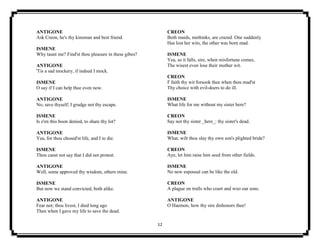
Ask Creon, he's thy kinsman and best friend.
ISMENE
Why taunt me? Find'st thou pleasure in these gibes?
ANTIGONE
'Tis a sad mockery, if indeed I mock.
ISMENE
O say if I can help thee even now.
ANTIGONE
No, save thyself; I grudge not thy escape.
ISMENE
Is e'en this boon denied, to share thy lot?
ANTIGONE
Yea, for thou chosed'st life, and I to die.
ISMENE
Thou canst not say that I did not protest.
ANTIGONE
Well, some approved thy wisdom, others mine.
ISMENE
But now we stand convicted, both alike.
ANTIGONE
Fear not; thou livest, I died long ago
Then when I gave my life to save the dead.
CREON
Both maids, methinks, are crazed. One suddenly
Has lost her wits, the other was born mad.
ISMENE
Yea, so it falls, sire, when misfortune comes,
The wisest even lose their mother wit.
CREON
I' faith thy wit forsook thee when thou mad'st
Thy choice with evil-doers to do ill.
ISMENE
What life for me without my sister here?
CREON
Say not thy sister _here_: thy sister's dead.
ISMENE
What, wilt thou slay thy own son's plighted bride?
CREON
Aye, let him raise him seed from other fields.
ISMENE
No new espousal can be like the old.
CREON
A plague on trulls who court and woo our sons.
ANTIGONE
O Haemon, how thy sire dishonors thee!
13
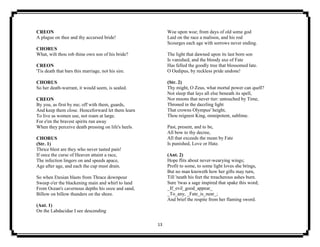
CREON
A plague on thee and thy accursed bride!
CHORUS
What, wilt thou rob thine own son of his bride?
CREON
'Tis death that bars this marriage, not his sire.
CHORUS
So her death-warrant, it would seem, is sealed.
CREON
By you, as first by me; off with them, guards,
And keep them close. Henceforward let them learn
To live as women use, not roam at large.
For e'en the bravest spirits run away
When they perceive death pressing on life's heels.
CHORUS
(Str. 1)
Thrice blest are they who never tasted pain!
If once the curse of Heaven attaint a race,
The infection lingers on and speeds apace,
Age after age, and each the cup must drain.
So when Etesian blasts from Thrace downpour
Sweep o'er the blackening main and whirl to land
From Ocean's cavernous depths his ooze and sand,
Billow on billow thunders on the shore.
(Ant. 1)
On the Labdacidae I see descending
Woe upon woe; from days of old some god
Laid on the race a malison, and his rod
Scourges each age with sorrows never ending.
The light that dawned upon its last born son
Is vanished, and the bloody axe of Fate
Has felled the goodly tree that blossomed late.
O Oedipus, by reckless pride undone!
(Str. 2)
Thy might, O Zeus, what mortal power can quell?
Not sleep that lays all else beneath its spell,
Nor moons that never tier: untouched by Time,
Throned in the dazzling light
That crowns Olympus' height,
Thou reignest King, omnipotent, sublime.
Past, present, and to be,
All bow to thy decree,
All that exceeds the mean by Fate
Is punished, Love or Hate.
(Ant. 2)
Hope flits about never-wearying wings;
Profit to some, to some light loves she brings,
But no man knoweth how her gifts may turn,
Till 'neath his feet the treacherous ashes burn.
Sure 'twas a sage inspired that spake this word;
_If_evil_good_appear_
_To_any, _Fate_is_near_;
And brief the respite from her flaming sword.
14
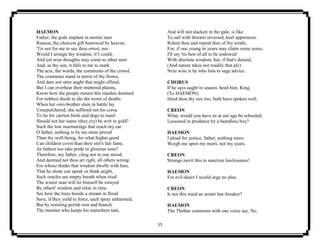
Hither comes in angry mood
Haemon, latest of thy brood;
Is it for his bride he's grieved,
Or her marriage-bed deceived,
Doth he make his mourn for thee,
Maid forlorn, Antigone?
[Enter HAEMON]
CREON
Soon shall we know, better than seer can tell.
Learning may fixed decree anent thy bride,
Thou mean'st not, son, to rave against thy sire?
Know'st not whate'er we do is done in love?
HAEMON
O father, I am thine, and I will take
Thy wisdom as the helm to steer withal.
Therefore no wedlock shall by me be held
More precious than thy loving goverance.
CREON
Well spoken: so right-minded sons should feel,
In all deferring to a father's will.
For 'tis the hope of parents they may rear
A brood of sons submissive, keen to avenge
Their father's wrongs, and count his friends their own.
But who begets unprofitable sons,
He verily breeds trouble for himself,
And for his foes much laughter. Son, be warned
And let no woman fool away thy wits.
Ill fares the husband mated with a shrew,
And her embraces very soon wax cold.
For what can wound so surely to the quick
As a false friend? So spue and cast her off,
Bid her go find a husband with the dead.
For since I caught her openly rebelling,
Of all my subjects the one malcontent,
I will not prove a traitor to the State.
She surely dies. Go, let her, if she will,
Appeal to Zeus the God of Kindred, for
If thus I nurse rebellion in my house,
Shall not I foster mutiny without?
For whoso rules his household worthily,
Will prove in civic matters no less wise.
But he who overbears the laws, or thinks
To overrule his rulers, such as one
I never will allow. Whome'er the State
Appoints must be obeyed in everything,
But small and great, just and unjust alike.
I warrant such a one in either case
Would shine, as King or subject; such a man
Would in the storm of battle stand his ground,
A comrade leal and true; but Anarchy--
What evils are not wrought by Anarchy!
She ruins States, and overthrows the home,
She dissipates and routs the embattled host;
While discipline preserves the ordered ranks.
Therefore we must maintain authority
And yield to title to a woman's will.
Better, if needs be, men should cast us out
Than hear it said, a woman proved his match.
CHORUS
To me, unless old age have dulled wits,
Thy words appear both reasonable and wise.
15
HAEMON
Father, the gods implant in mortal men
Reason, the choicest gift bestowed by heaven.
'Tis not for me to say thou errest, nor
Would I arraign thy wisdom, if I could;
And yet wise thoughts may come to other men
And, as thy son, it falls to me to mark
The acts, the words, the comments of the crowd.
The commons stand in terror of thy frown,
And dare not utter aught that might offend,
But I can overhear their muttered plaints,
Know how the people mourn this maiden doomed
For noblest deeds to die the worst of deaths.
When her own brother slain in battle lay
Unsepulchered, she suffered not his corse
To lie for carrion birds and dogs to maul:
Should not her name (they cry) be writ in gold?
Such the low murmurings that reach my ear.
O father, nothing is by me more prized
Than thy well-being, for what higher good
Can children covet than their sire's fair fame,
As fathers too take pride in glorious sons?
Therefore, my father, cling not to one mood,
And deemed not thou art right, all others wrong.
For whoso thinks that wisdom dwells with him,
That he alone can speak or think aright,
Such oracles are empty breath when tried.
The wisest man will let himself be swayed
By others' wisdom and relax in time.
See how the trees beside a stream in flood
Save, if they yield to force, each spray unharmed,
But by resisting perish root and branch.
The mariner who keeps his mainsheet taut,
And will not slacken in the gale, is like
To sail with thwarts reversed, keel uppermost.
Relent then and repent thee of thy wrath;
For, if one young in years may claim some sense,
I'll say 'tis best of all to be endowed
With absolute wisdom; but, if that's denied,
(And nature takes not readily that ply)
Next wise is he who lists to sage advice.
CHORUS
If he says aught in season, heed him, King.
(To HAEMON)
Heed thou thy sire too; both have spoken well.
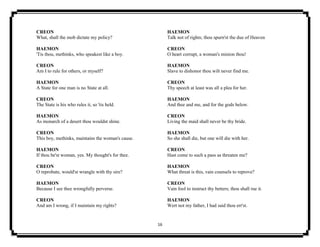
CREON
What, would you have us at our age be schooled,
Lessoned in prudence by a beardless boy?
HAEMON
I plead for justice, father, nothing more.
Weigh me upon my merit, not my years.
CREON
Strange merit this to sanction lawlessness!
HAEMON
For evil-doers I would urge no plea.
CREON
Is not this maid an arrant law-breaker?
HAEMON
The Theban commons with one voice say, No.
16
CREON
What, shall the mob dictate my policy?
HAEMON
'Tis thou, methinks, who speakest like a boy.
CREON
Am I to rule for others, or myself?
HAEMON
A State for one man is no State at all.
CREON
The State is his who rules it, so 'tis held.
HAEMON
As monarch of a desert thou wouldst shine.
CREON
This boy, methinks, maintains the woman's cause.
HAEMON
If thou be'st woman, yes. My thought's for thee.
CREON
O reprobate, would'st wrangle with thy sire?
HAEMON
Because I see thee wrongfully perverse.
CREON
And am I wrong, if I maintain my rights?
HAEMON
Talk not of rights; thou spurn'st the due of Heaven
CREON
O heart corrupt, a woman's minion thou!
HAEMON
Slave to dishonor thou wilt never find me.
CREON
Thy speech at least was all a plea for her.
HAEMON
And thee and me, and for the gods below.
CREON
Living the maid shall never be thy bride.
HAEMON
So she shall die, but one will die with her.
CREON
Hast come to such a pass as threaten me?
HAEMON
What threat is this, vain counsels to reprove?
CREON
Vain fool to instruct thy betters; thou shall rue it.
HAEMON
Wert not my father, I had said thou err'st.
17
CREON
Play not the spaniel, thou a woman's slave.
HAEMON
When thou dost speak, must no man make reply?
CREON
This passes bounds. By heaven, thou shalt not rate
And jeer and flout me with impunity.
Off with the hateful thing that she may die
At once, beside her bridegroom, in his sight.
HAEMON
Think not that in my sight the maid shall die,
Or by my side; never shalt thou again
Behold my face hereafter. Go, consort
With friends who like a madman for their mate.
[Exit HAEMON]
CHORUS
Thy son has gone, my liege, in angry haste.
Fell is the wrath of youth beneath a smart.
CREON
Let him go vent his fury like a fiend:
These sisters twain he shall not save from death.
CHORUS
Surely, thou meanest not to slay them both?
CREON
I stand corrected; only her who touched
The body.
CHORUS
And what death is she to die?
CREON
She shall be taken to some desert place
By man untrod, and in a rock-hewn cave,
With food no more than to avoid the taint
That homicide might bring on all the State,
Buried alive. There let her call in aid
The King of Death, the one god she reveres,
Or learn too late a lesson learnt at last:
'Tis labor lost, to reverence the dead.
CHORUS
(Str.)
Love resistless in fight, all yield at a glance of thine eye,
Love who pillowed all night on a maiden's cheek dost lie,
Over the upland holds. Shall mortals not yield to thee?
(Ant).
Mad are thy subjects all, and even the wisest heart
Straight to folly will fall, at a touch of thy poisoned dart.
Thou didst kindle the strife, this feud of kinsman with kin,
By the eyes of a winsome wife, and the yearning her heart
to win.
For as her consort still, enthroned with Justice above,
Thou bendest man to thy will, O all invincible Love.
Lo I myself am borne aside,
From Justice, as I view this bride.
(O sight an eye in tears to drown)
Antigone, so young, so fair,
18
Thus hurried down
Death's bower with the dead to share.
ANTIGONE
(Str. 1)
Friends, countrymen, my last farewell I make;
My journey's done.
One last fond, lingering, longing look I take
At the bright sun.
For Death who puts to sleep both young and old
Hales my young life,
And beckons me to Acheron's dark fold,
An unwed wife.
No youths have sung the marriage song for me,
My bridal bed
No maids have strewn with flowers from the lea,
'Tis Death I wed.
CHORUS
But bethink thee, thou art sped,
Great and glorious, to the dead.
Thou the sword's edge hast not tasted,
No disease thy frame hath wasted.
Freely thou alone shalt go
Living to the dead below.
ANTIGONE
(Ant. 1)
Nay, but the piteous tale I've heard men tell
Of Tantalus' doomed child,
Chained upon Siphylus' high rocky fell,
That clung like ivy wild,
Drenched by the pelting rain and whirling snow,
Left there to pine,
While on her frozen breast the tears aye flow--
Her fate is mine.
CHORUS
She was sprung of gods, divine,
Mortals we of mortal line.
Like renown with gods to gain
Recompenses all thy pain.
Take this solace to thy tomb
Hers in life and death thy doom.
ANTIGONE
(Str. 2)
Alack, alack! Ye mock me. Is it meet
Thus to insult me living, to my face?
Cease, by our country's altars I entreat,
Ye lordly rulers of a lordly race.
O fount of Dirce, wood-embowered plain
Where Theban chariots to victory speed,
Mark ye the cruel laws that now have wrought my bane,
The friends who show no pity in my need!
Was ever fate like mine? O monstrous doom,
Within a rock-built prison sepulchered,
To fade and wither in a living tomb,
And alien midst the living and the dead.
CHORUS
(Str. 3)
In thy boldness over-rash
Madly thou thy foot didst dash
'Gainst high Justice' altar stair.
Thou a father's guild dost bear.
19
ANTIGONE
(Ant. 2)
At this thou touchest my most poignant pain,
My ill-starred father's piteous disgrace,
The taint of blood, the hereditary stain,
That clings to all of Labdacus' famed race.
Woe worth the monstrous marriage-bed where lay
A mother with the son her womb had borne,
Therein I was conceived, woe worth the day,
Fruit of incestuous sheets, a maid forlorn,
And now I pass, accursed and unwed,
To meet them as an alien there below;
And thee, O brother, in marriage ill-bestead,
'Twas thy dead hand that dealt me this death-blow.
CHORUS
Religion has her chains, 'tis true,
Let rite be paid when rites are due.
Yet is it ill to disobey
The powers who hold by might the sway.
Thou hast withstood authority,
A self-willed rebel, thou must die.
ANTIGONE
Unwept, unwed, unfriended, hence I go,
No longer may I see the day's bright eye;
Not one friend left to share my bitter woe,
And o'er my ashes heave one passing sigh.
CREON
If wail and lamentation aught availed
To stave off death, I trow they'd never end.
Away with her, and having walled her up
In a rock-vaulted tomb, as I ordained,
Leave her alone at liberty to die,
Or, if she choose, to live in solitude,
The tomb her dwelling. We in either case
Are guiltless as concerns this maiden's blood,
Only on earth no lodging shall she find.
ANTIGONE
O grave, O bridal bower, O prison house
Hewn from the rock, my everlasting home,
Whither I go to join the mighty host
Of kinsfolk, Persephassa's guests long dead,
The last of all, of all more miserable,
I pass, my destined span of years cut short.
And yet good hope is mine that I shall find
A welcome from my sire, a welcome too,
From thee, my mother, and my brother dear;
From with these hands, I laved and decked your limbs
In death, and poured libations on your grave.
And last, my Polyneices, unto thee
I paid due rites, and this my recompense!
Yet am I justified in wisdom's eyes.
For even had it been some child of mine,
Or husband mouldering in death's decay,
I had not wrought this deed despite the State.
What is the law I call in aid? 'Tis thus
I argue. Had it been a husband dead
I might have wed another, and have borne
Another child, to take the dead child's place.
But, now my sire and mother both are dead,
No second brother can be born for me.
Thus by the law of conscience I was led
To honor thee, dear brother, and was judged
20
By Creon guilty of a heinous crime.
And now he drags me like a criminal,
A bride unwed, amerced of marriage-song
And marriage-bed and joys of motherhood,
By friends deserted to a living grave.
What ordinance of heaven have I transgressed?
Hereafter can I look to any god
For succor, call on any man for help?
Alas, my piety is impious deemed.
Well, if such justice is approved of heaven,
I shall be taught by suffering my sin;
But if the sin is theirs, O may they suffer
No worse ills than the wrongs they do to me.
CHORUS
The same ungovernable will
Drives like a gale the maiden still.
CREON
Therefore, my guards who let her stay
Shall smart full sore for their delay.
ANTIGONE
Ah, woe is me! This word I hear
Brings death most near.
CHORUS
I have no comfort. What he saith,
Portends no other thing than death.
ANTIGONE
My fatherland, city of Thebes divine,
Ye gods of Thebes whence sprang my line,
Look, puissant lords of Thebes, on me;
The last of all your royal house ye see.
Martyred by men of sin, undone.
Such meed my piety hath won.
[Exit ANTIGONE]
CHORUS
(Str. 1)
Like to thee that maiden bright,
Danae, in her brass-bound tower,
Once exchanged the glad sunlight
For a cell, her bridal bower.
And yet she sprang of royal line,
My child, like thine,
And nursed the seed
By her conceived
Of Zeus descending in a golden shower.
Strange are the ways of Fate, her power
Nor wealth, nor arms withstand, nor tower;
Nor brass-prowed ships, that breast the sea
From Fate can flee.
(Ant. 1)
Thus Dryas' child, the rash Edonian King,
For words of high disdain
Did Bacchus to a rocky dungeon bring,
To cool the madness of a fevered brain.
His frenzy passed,
He learnt at last
'Twas madness gibes against a god to fling.
For once he fain had quenched the Maenad's fire;
And of the tuneful Nine provoked the ire.
21
(Str. 2)
By the Iron Rocks that guard the double main,
On Bosporus' lone strand,
Where stretcheth Salmydessus' plain
In the wild Thracian land,
There on his borders Ares witnessed
The vengeance by a jealous step-dame ta'en
The gore that trickled from a spindle red,
The sightless orbits of her step-sons twain.
(Ant. 2)
Wasting away they mourned their piteous doom,
The blasted issue of their mother's womb.
But she her lineage could trace
To great Erecththeus' race;
Daughter of Boreas in her sire's vast caves
Reared, where the tempest raves,
Swift as his horses o'er the hills she sped;
A child of gods; yet she, my child, like thee,
By Destiny
That knows not death nor age--she too was vanquished.
[Enter TEIRESIAS and BOY]
TEIRESIAS
Princes of Thebes, two wayfarers as one,
Having betwixt us eyes for one, we are here.
The blind man cannot move without a guide.
CREON
Why tidings, old Teiresias?
TEIRESIAS
I will tell thee;
And when thou hearest thou must heed the seer.
CREON
Thus far I ne'er have disobeyed thy rede.
TEIRESIAS
So hast thou steered the ship of State aright.
CREON
I know it, and I gladly own my debt.
TEIRESIAS
Bethink thee that thou treadest once again
The razor edge of peril.
CREON
What is this?
Thy words inspire a dread presentiment.
TEIRESIAS
The divination of my arts shall tell.
Sitting upon my throne of augury,
As is my wont, where every fowl of heaven
Find harborage, upon mine ears was borne
A jargon strange of twitterings, hoots, and screams;
So knew I that each bird at the other tare
With bloody talons, for the whirr of wings
Could signify naught else. Perturbed in soul,
I straight essayed the sacrifice by fire
On blazing altars, but the God of Fire
Came not in flame, and from the thigh bones dripped
22
And sputtered in the ashes a foul ooze;
Gall-bladders cracked and spurted up: the fat
Melted and fell and left the thigh bones bare.
Such are the signs, taught by this lad, I read--
As I guide others, so the boy guides me--
The frustrate signs of oracles grown dumb.
O King, thy willful temper ails the State,
For all our shrines and altars are profaned
By what has filled the maw of dogs and crows,
The flesh of Oedipus' unburied son.
Therefore the angry gods abominate
Our litanies and our burnt offerings;
Therefore no birds trill out a happy note,
Gorged with the carnival of human gore.
O ponder this, my son. To err is common
To all men, but the man who having erred
Hugs not his errors, but repents and seeks
The cure, is not a wastrel nor unwise.
No fool, the saw goes, like the obstinate fool.
Let death disarm thy vengeance. O forbear
To vex the dead. What glory wilt thou win
By slaying twice the slain? I mean thee well;
Counsel's most welcome if I promise gain.
CREON
Old man, ye all let fly at me your shafts
Like anchors at a target; yea, ye set
Your soothsayer on me. Peddlers are ye all
And I the merchandise ye buy and sell.
Go to, and make your profit where ye will,
Silver of Sardis change for gold of Ind;
Ye will not purchase this man's burial,
Not though the winged ministers of Zeus
Should bear him in their talons to his throne;
Not e'en in awe of prodigy so dire
Would I permit his burial, for I know
No human soilure can assail the gods;
This too I know, Teiresias, dire's the fall
Of craft and cunning when it tries to gloss
Foul treachery with fair words for filthy gain.
TEIRESIAS
Alas! doth any know and lay to heart--
CREON
Is this the prelude to some hackneyed saw?
TEIRESIAS
How far good counsel is the best of goods?
CREON
True, as unwisdom is the worst of ills.
TEIRESIAS
Thou art infected with that ill thyself.
CREON
I will not bandy insults with thee, seer.
TEIRESIAS
And yet thou say'st my prophesies are frauds.
CREON
Prophets are all a money-getting tribe.
23
TEIRESIAS
And kings are all a lucre-loving race.
CREON
Dost know at whom thou glancest, me thy lord?
TEIRESIAS
Lord of the State and savior, thanks to me.
CREON
Skilled prophet art thou, but to wrong inclined.
TEIRESIAS
Take heed, thou wilt provoke me to reveal
The mystery deep hidden in my breast.
CREON
Say on, but see it be not said for gain.
TEIRESIAS
Such thou, methinks, till now hast judged my words.
CREON
Be sure thou wilt not traffic on my wits.
TEIRESIAS
Know then for sure, the coursers of the sun
Not many times shall run their race, before
Thou shalt have given the fruit of thine own loins
In quittance of thy murder, life for life;
For that thou hast entombed a living soul,
And sent below a denizen of earth,
And wronged the nether gods by leaving here
A corpse unlaved, unwept, unsepulchered.
Herein thou hast no part, nor e'en the gods
In heaven; and thou usurp'st a power not thine.
For this the avenging spirits of Heaven and Hell
Who dog the steps of sin are on thy trail:
What these have suffered thou shalt suffer too.
And now, consider whether bought by gold
I prophesy. For, yet a little while,
And sound of lamentation shall be heard,
Of men and women through thy desolate halls;
And all thy neighbor States are leagues to avenge
Their mangled warriors who have found a grave
I' the maw of wolf or hound, or winged bird
That flying homewards taints their city's air.
These are the shafts, that like a bowman I
Provoked to anger, loosen at thy breast,
Unerring, and their smart thou shalt not shun.
Boy, lead me home, that he may vent his spleen
On younger men, and learn to curb his tongue
With gentler manners than his present mood.
[Exit TEIRESIAS]
CHORUS
My liege, that man hath gone, foretelling woe.
And, O believe me, since these grizzled locks
Were like the raven, never have I known
The prophet's warning to the State to fail.
CREON
I know it too, and it perplexes me.
To yield is grievous, but the obstinate soul
That fights with Fate, is smitten grievously.
24
CHORUS
Son of Menoeceus, list to good advice.
CHORUS
What should I do. Advise me. I will heed.
CHORUS
Go, free the maiden from her rocky cell;
And for the unburied outlaw build a tomb.
CREON
Is that your counsel? You would have me yield?
CHORUS
Yea, king, this instant. Vengeance of the gods
Is swift to overtake the impenitent.
CREON
Ah! what a wrench it is to sacrifice
My heart's resolve; but Fate is ill to fight.
CHORUS
Go, trust not others. Do it quick thyself.
CREON
I go hot-foot. Bestir ye one and all,
My henchmen! Get ye axes! Speed away
To yonder eminence! I too will go,
For all my resolution this way sways.
'Twas I that bound, I too will set her free.
Almost I am persuaded it is best
To keep through life the law ordained of old.
[Exit CREON]
CHORUS
(Str. 1)
Thou by many names adored,
Child of Zeus the God of thunder,
Of a Theban bride the wonder,
Fair Italia's guardian lord;
In the deep-embosomed glades
Of the Eleusinian Queen
Haunt of revelers, men and maids,
Dionysus, thou art seen.
Where Ismenus rolls his waters,
Where the Dragon's teeth were sown,
Where the Bacchanals thy daughters
Round thee roam,
There thy home;
Thebes, O Bacchus, is thine own.
(Ant. 1)
Thee on the two-crested rock
Lurid-flaming torches see;
Where Corisian maidens flock,
Thee the springs of Castaly.
By Nysa's bastion ivy-clad,
By shores with clustered vineyards glad,
There to thee the hymn rings out,
And through our streets we Thebans shout,
All hall to thee
Evoe, Evoe!
25
(Str. 2)
Oh, as thou lov'st this city best of all,
To thee, and to thy Mother levin-stricken,
In our dire need we call;
Thou see'st with what a plague our townsfolk sicken.
Thy ready help we crave,
Whether adown Parnassian heights descending,
Or o'er the roaring straits thy swift was wending,
Save us, O save!
(Ant. 2)
Brightest of all the orbs that breathe forth light,
Authentic son of Zeus, immortal king,
Leader of all the voices of the night,
Come, and thy train of Thyiads with thee bring,
Thy maddened rout
Who dance before thee all night long, and shout,
Thy handmaids we,
Evoe, Evoe!
[Enter MESSENGER]
MESSENGER
Attend all ye who dwell beside the halls
Of Cadmus and Amphion. No man's life
As of one tenor would I praise or blame,
For Fortune with a constant ebb and rise
Casts down and raises high and low alike,
And none can read a mortal's horoscope.
Take Creon; he, methought, if any man,
Was enviable. He had saved this land
Of Cadmus from our enemies and attained
A monarch's powers and ruled the state supreme,
While a right noble issue crowned his bliss.
Now all is gone and wasted, for a life
Without life's joys I count a living death.
You'll tell me he has ample store of wealth,
The pomp and circumstance of kings; but if
These give no pleasure, all the rest I count
The shadow of a shade, nor would I weigh
His wealth and power 'gainst a dram of joy.
CHORUS
What fresh woes bring'st thou to the royal house?
MESSENGER
Both dead, and they who live deserve to die.
CHORUS
Who is the slayer, who the victim? speak.
MESSENGER
Haemon; his blood shed by no stranger hand.
CHORUS
What mean ye? by his father's or his own?
MESSENGER
His own; in anger for his father's crime.
CHORUS
O prophet, what thou spakest comes to pass.
MESSENGER
So stands the case; now 'tis for you to act.
26
CHORUS
Lo! from the palace gates I see approaching
Creon's unhappy wife, Eurydice.
Comes she by chance or learning her son's fate?
[Enter EURYDICE]
EURYDICE
Ye men of Thebes, I overheard your talk.
As I passed out to offer up my prayer
To Pallas, and was drawing back the bar
To open wide the door, upon my ears
There broke a wail that told of household woe
Stricken with terror in my handmaids' arms
I fell and fainted. But repeat your tale
To one not unacquaint with misery.
MESSENGER
Dear mistress, I was there and will relate
The perfect truth, omitting not one word.
Why should we gloze and flatter, to be proved
Liars hereafter? Truth is ever best.
Well, in attendance on my liege, your lord,
I crossed the plain to its utmost margin, where
The corse of Polyneices, gnawn and mauled,
Was lying yet. We offered first a prayer
To Pluto and the goddess of cross-ways,
With contrite hearts, to deprecate their ire.
Then laved with lustral waves the mangled corse,
Laid it on fresh-lopped branches, lit a pyre,
And to his memory piled a mighty mound
Of mother earth. Then to the caverned rock,
The bridal chamber of the maid and Death,
We sped, about to enter. But a guard
Heard from that godless shrine a far shrill wail,
And ran back to our lord to tell the news.
But as he nearer drew a hollow sound
Of lamentation to the King was borne.
He groaned and uttered then this bitter plaint:
"Am I a prophet? miserable me!
Is this the saddest path I ever trod?
'Tis my son's voice that calls me. On press on,
My henchmen, haste with double speed to the tomb
Where rocks down-torn have made a gap, look in
And tell me if in truth I recognize
The voice of Haemon or am heaven-deceived."
So at the bidding of our distraught lord
We looked, and in the craven's vaulted gloom
I saw the maiden lying strangled there,
A noose of linen twined about her neck;
And hard beside her, clasping her cold form,
Her lover lay bewailing his dead bride
Death-wedded, and his father's cruelty.
When the King saw him, with a terrible groan
He moved towards him, crying, "O my son
What hast thou done? What ailed thee? What mischance
Has reft thee of thy reason? O come forth,
Come forth, my son; thy father supplicates."
But the son glared at him with tiger eyes,
Spat in his face, and then, without a word,
Drew his two-hilted sword and smote, but missed
His father flying backwards. Then the boy,
Wroth with himself, poor wretch, incontinent
Fell on his sword and drove it through his side
Home, but yet breathing clasped in his lax arms
The maid, her pallid cheek incarnadined
With his expiring gasps. So there they lay
27
Two corpses, one in death. His marriage rites
Are consummated in the halls of Death:
A witness that of ills whate'er befall
Mortals' unwisdom is the worst of all.
[Exit EURYDICE]
CHORUS
What makest thou of this? The Queen has gone
Without a word importing good or ill.
MESSENGER
I marvel too, but entertain good hope.
'Tis that she shrinks in public to lament
Her son's sad ending, and in privacy
Would with her maidens mourn a private loss.
Trust me, she is discreet and will not err.
CHORUS
I know not, but strained silence, so I deem,
Is no less ominous than excessive grief.
MESSENGER
Well, let us to the house and solve our doubts,
Whether the tumult of her heart conceals
Some fell design. It may be thou art right:
Unnatural silence signifies no good.
CHORUS
Lo! the King himself appears.
Evidence he with him bears
'Gainst himself (ah me! I quake
'Gainst a king such charge to make)
But all must own,
The guilt is his and his alone.
CREON
(Str. 1)
Woe for sin of minds perverse,
Deadly fraught with mortal curse.
Behold us slain and slayers, all akin.
Woe for my counsel dire, conceived in sin.
Alas, my son,
Life scarce begun,
Thou wast undone.
The fault was mine, mine only, O my son!
CHORUS
Too late thou seemest to perceive the truth.
CREON
(Str. 2)
By sorrow schooled. Heavy the hand of God,
Thorny and rough the paths my feet have trod,
Humbled my pride, my pleasure turned to pain;
Poor mortals, how we labor all in vain!
[Enter SECOND MESSENGER]
SECOND MESSENGER
Sorrows are thine, my lord, and more to come,
One lying at thy feet, another yet
More grievous waits thee, when thou comest home.
CREON
What woe is lacking to my tale of woes?
28
SECOND MESSENGER
Thy wife, the mother of thy dead son here,
Lies stricken by a fresh inflicted blow.
CREON
(Ant. 1)
How bottomless the pit!
Does claim me too, O Death?
What is this word he saith,
This woeful messenger? Say, is it fit
To slay anew a man already slain?
Is Death at work again,
Stroke upon stroke, first son, then mother slain?
CHORUS
Look for thyself. She lies for all to view.
CREON
(Ant. 2)
Alas! another added woe I see.
What more remains to crown my agony?
A minute past I clasped a lifeless son,
And now another victim Death hath won.
Unhappy mother, most unhappy son!
SECOND MESSENGER
Beside the altar on a keen-edged sword
She fell and closed her eyes in night, but erst
She mourned for Megareus who nobly died
Long since, then for her son; with her last breath
She cursed thee, the slayer of her child.
CREON
(Str. 3)
I shudder with affright
O for a two-edged sword to slay outright
A wretch like me,
Made one with misery.
SECOND MESSENGER
'Tis true that thou wert charged by the dead Queen
As author of both deaths, hers and her son's.
CREON
In what wise was her self-destruction wrought?
SECOND MESSENGER
Hearing the loud lament above her son
With her own hand she stabbed herself to the heart.
CREON
(Str. 4)
I am the guilty cause. I did the deed,
Thy murderer. Yea, I guilty plead.
My henchmen, lead me hence, away, away,
A cipher, less than nothing; no delay!
CHORUS
Well said, if in disaster aught is well
His past endure demand the speediest cure.
CREON
(Ant. 3)
Come, Fate, a friend at need,
Come with all speed!
29
Come, my best friend,
And speed my end!
Away, away!
Let me not look upon another day!
CHORUS
This for the morrow; to us are present needs
That they whom it concerns must take in hand.
CREON
I join your prayer that echoes my desire.
CHORUS
O pray not, prayers are idle; from the doom
Of fate for mortals refuge is there none.
CREON
(Ant. 4)
Away with me, a worthless wretch who slew
Unwitting thee, my son, thy mother too.
Whither to turn I know now; every way
Leads but astray,
And on my head I feel the heavy weight
Of crushing Fate.
CHORUS
Of happiness the chiefest part
Is a wise heart:
And to defraud the gods in aught
With peril's fraught.
Swelling words of high-flown might
Mightily the gods do smite.
Chastisement for errors past
Wisdom brings to age at last.
30
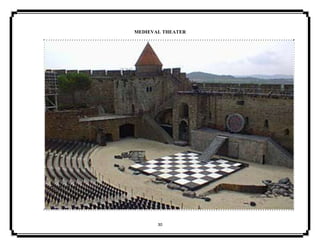
MEDIEVAL THEATER
31
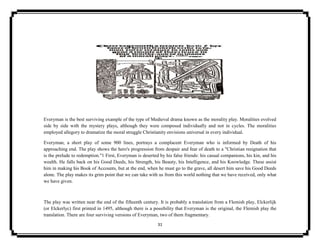
Everyman is the best surviving example of the type of Medieval drama known as the morality play. Moralities evolved
side by side with the mystery plays, although they were composed individually and not in cycles. The moralities
employed allegory to dramatize the moral struggle Christianity envisions universal in every individual.
Everyman, a short play of some 900 lines, portrays a complacent Everyman who is informed by Death of his
approaching end. The play shows the hero's progression from despair and fear of death to a "Christian resignation that
is the prelude to redemption."1 First, Everyman is deserted by his false friends: his casual companions, his kin, and his
wealth. He falls back on his Good Deeds, his Strength, his Beauty, his Intelligence, and his Knowledge. These assist
him in making his Book of Accounts, but at the end, when he must go to the grave, all desert him save his Good Deeds
alone. The play makes its grim point that we can take with us from this world nothing that we have received, only what
we have given.
The play was written near the end of the fifteenth century. It is probably a translation from a Flemish play, Elckerlijk
(or Elckerlyc) first printed in 1495, although there is a possibility that Everyman is the original, the Flemish play the
translation. There are four surviving versions of Everyman, two of them fragmentary.
32
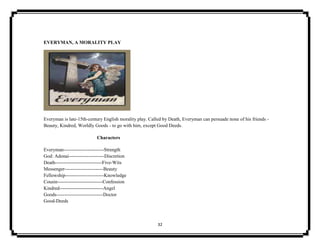
EVERYMAN, A MORALITY PLAY
Everyman is late-15th-century English morality play. Called by Death, Everyman can persuade none of his friends -
Beauty, Kindred, Worldly Goods - to go with him, except Good Deeds.
Characters
Everyman-------------------------Strength
God: Adonai----------------------Discretion
Death-----------------------------Five-Wits
Messenger------------------------Beauty
Fellowship------------------------Knowledge
Cousin----------------------------Confession
Kindred---------------------------Angel
Goods-----------------------------Doctor
Good-Deeds
33
HERE BEGINETH A TREATISE HOW THE HIGH FATHER OH HEAVEN SENDETH DEATH TO SUMMON
EVERY CREATURE TO COME AND GIVE ACCOUNT OF THEIR LIVES IN THIS WORLD AND IS IN
MANNER OF A MORAL PLAY.
THE SUMMONING
Messenger: I pray you all give your audience,
And here this matter with reverence,
By figure a moral play-
The Summoning of Everyman called it is,
That of our lives and ending shows
How transitory we be all day.
This matter is wonderous precious,
But the intent of it is more gracious,
And sweet to bear away.
The story saith,-Man, in the beginning,
Look well, and take good heed to the ending,
Be you never so gay!
Ye think sin in the beginning full sweet,
34
Which in the end causeth thy soul to weep,
When the body lieth in clay.
Here shall you see how Fellowship and Jollity,
Both Strength, Pleasure, and Beauty,
Will fade from thee as flower in May.
For ye shall here, how our heavenly king
Calleth Everyman to a general reckoning:
Give audience, and here what he doth say.
God: I perceive here in my majesty,
How that all the creatures be to me unkind,
Living without dread in worldly prosperity:
Of ghostly sight the people be so blind,
Drowned in sin, they know me not for their God;
In worldly riches is all their mind,
They fear not my rightwiseness, the sharp rod;
My law that I shewed, when I for them died,
They forget clean, and shedding of my blood red;
35
I hanged between two, it cannot be denied;
To get them life I suffered to be dead;
I healed their feet; with thorns hurt was my head:
I could do no more than I did truly,
And now I see the people do clean forsake me.
They use the seven deadly sins damnable;
As pride, covetise, wrath, and lechery,
Now in the world be made commendable;
And thus they leave of angels the heavenly company;
Everyman liveth so after his own pleasure,
And yet of their life they be nothing sure:
I see the more that I them forbear
The worse they be from year to year;
All that liveth appaireth fast, [appaireth="is impaired"]
Therefore I will in all the haste
Have a reckoning of Everyman's person
36
For and I leave the people thus alone
In their life and wicked tempests,
Verily they will become much worse than beasts;
For now one would by envy another up eat;
Charity they all do clean forget.
I hope well that Everyman
In my glory should make his mansion,
And thereto I had them all elect;
But now I see, like traitors deject,
They thank me not for the pleasure that I to them meant,
Nor yet for their being that I them have lent;
I proffered the people great multitude of mercy,
And few there be that asketh it heartily;
They be so cumbered with worldly riches,
That needs on them I must do justice,
On Everyman living without fear.
37
Where art thou, Death, thou mighty messenger?
Death: Almighty God, I am here at your will,
Your commandment to fulfil.
God: Go thou to Everyman,
And show him in my name
A pilgrimage he must on him take,
Which he in no wise may escape;
And that he bring with him a sure reckoning
Without delay or any tarrying.
Death: Lord, I will in the world go run over all,
And cruelly outsearch both great and small;
Every man will I beset that liveth beastly
Out of God's laws, and dreadeth not folly;
He that loveth riches I will strike with my dart,
His sight to blind, and from heaven to depart,
38
Except that alms be his good friend,
In hell for to dwell, world without end.
Lo, yonder I see Everyman walking;
Full little he thinketh on my coming;
His mind is on fleshly lust and his treasure,
And great pain it shall cause him to endure
Before the Lord Heaven King.
Everyman, stand still; whither art thou going
Thus gaily? Hast thou thy Maker forget?
Everyman: Why askst thou?
Wouldest thou wete? [wete="know"]
Death: Yea, sir, I will show you;
In great haste I am sent to thee
From God out of his great majesty.
39
Everyman: What, sent to me?
Death: Yeah, certainly.
Though thou have forget him here,
He thinketh on thee in the heavenly sphere,
As, or we depart, thou shalt know.
Everyman: What desireth God of me?
Death: That shall I show thee;
A reckoning he will needs have
Without any longer respite.
Everyman: To give a reckoning longer leisure I crave;
This blind matter troubleth my wit.
Death: On thee thou must take a long journey:
Therefore thy book of count with thee thou bring;
40
For turn again thou can not by no way,
And look thou be sure of thy reckoning:
For before God thou shalt answer, and show
Thy many bad deeds and good but few;
How thou hast spent thy life, and in what wise,
Before the chief lord of paradise.
Have ado that we were in that way,
For, wete thou well, thou shalt make none attournay. [attournay="mediator"]
Everyman: Full unready I am such reckoning to give
I know thee not: what messenger art thou?
Death: I am Death, that no man dreadeth.
For every man I rest and no man spareth;
For it is God's commandment
That all to me should be obedient.
Everyman: O Death, thou comest when I had thee least in mind;
41
In thy power it lieth me to save,
Yet of my good will I give thee, if ye will be kind,
Yea, a thousand pound shalt thou have,
And defer this matter till another day.
Death: Everyman, it may not be by no way;
I set not by gold, silver nor, riches,
Ne by pope, emperor, king, duke, ne princes.
For and I would receive gifts great,
All the world I might get;
But my custom is clean contrary.
I give thee no respite: come hence, and not tarry.
Everyman: Alas, shall I have no longer respite?
I may say Death giveth no warning:
To think on thee, it maketh my heart sick,
For all unready is my book of reckoning.
But twelve year and I might have abiding,
42
My counting book I would make so clear,
That my reckoning I should not need to fear.
Wherefore, Death, I pray thee, for God's mercy,
Spare me till I provided of remedy.
Death: Thee availeth not to cry, weep, and pray:
But haste thee lightly that you were gone the journey,
And prove thy friends if thou can.
For, wete thou well, the tide abideth no man,
And in the world each living creature
For Adam's sin must die of nature.
Everyman: Death, if I should this pilgrimage take,
And my reckoning surely make,
Show me, for saint charity,
Should I not come again shortly?
Death: No, Everyman; and thou be once there,
43
Thou mayst never more come here,
Trust me verily.
Everyman: O gracious God, in the high seat celestial,
Have mercy on me in this most need;
Shall I have no company from this vale terrestrial
Of mine acquaintance that way to me lead?
Death: Yea, if any be so hardy
That would go with thee and bear thee company.
Hie thee that you were gone to God's magnificence,
Thy reckoning to give before his presence.
What, weenest thou thy life is given thee,
And thy worldly goods also?
Everyman: I had went so verily.
Death: Nay, nay; it was but lent thee;
44
For as soon as thou art go,
Another awhile shall have it, and then go therefor
Even as thou hast done.
Everyman, thou art mad; thou hast thou wits five,
And here on earth will not amend thy life,
For suddenly I do come.
Everyman: O wretched caitiff, whither shall I flee,
That I might scape this endless sorrow!
Now, gentle Death, spare me till to-morrow,
That I may amend me
With good advisement.
Death: Nay, thereto I will not consent,
Nor no man will I respite,
But to the heart suddenly I shall smite
Without any advisement.
And now out of thy sight I will me hie;
45
See thou make thee ready shortly,
For thou mayst say this is the day
That no man living may escape away.
Everyman; Alas, I may well weep with sighs deep;
Now have I no manner of company
To help me in my journey, and me to keep;
And also my writing is full unready.
How shall I do now for to excuse me?
I would to God I had never be gete! [gete="been born"]
To my soul a great profit it had be;
For now I fear pains huge and great.
The time passeth; Lord, help that all wrought;
For though I mourn it availeth nought.
The day passeth, and is almost a-go;
I wot not well what for to do.
To whom were I best my complaint do make?
46
What, and I to Fellowship thereof spake,
And show him of this sudden chance?
For in him is all my affiance;
We have in the world so many a day
Be on good friends in sport and play.
I see him yonder, certainly;
I trust that he will bear me company;
Therefore to him will I speak to ease my sorrow.
Well met, good Fellowship, and good morrow!
Fellowship: Everyman, good morrow by this day.
Sir, why lookest thou so piteously?
If anything be amiss, I pray thee, me say,
That I may help to remedy.
Everyman: Yea, good Fellowship, yea,
I am in great jeopardy.
47
Fellowship: My true friend, show me your mind;
I will not forsake thee, unto my life's end,
In the way of good company.
Everyman: That was well spoken, and lovingly.
Fellowship: Sir, I must needs know your heaviness;
I have pity to see you in any distress;
If any have you wronged ye shall revenged be,
Though I on the ground be slain for thee,-
Though that I know before that I should die.
Everyman: Verily, Fellowship, gramercy.
Fellowship: Tush! by thy thanks I set not a straw.
Show me your grief, and say no more.
48
Everyman: If I my heart should to you break,
And then you to turn your mind from me,
And would not me comfort, when you here me speak,
Then should I ten times sorrier be.
Fellowship: Sir, I say as I will do in deed.
Everyman: Then be you a good friend at need;
I have found you true here before.
Fellowship: And so ye shall evermore;
For, in faith, and thou go to Hell
I will not forsake thee by the way!
Everyman: Ye speak like a good friend; I believe you well;
I shall deserve it, and I may.
Fellowship: I speak of no deserving, by this day.
49
For he that will say and nothing do
Is not worthy with good company to go;
Therefore show me the grief of your mind,
As to your friend most loving and kind.
Everyman: I shall show you how it is;
Commanded I am to go on a journey,
A long way, hard and dangerous,
And give a strait count without delay
Before the high judge Adonai. [Adonai="God"]
Wherefore I pray you bear me company,
As ye have promised, in this journey.
Fellowship: That is a matter indeed! Promise is duty,
But, and I should take such a voyage on me,
I know it well, it should be to my pain:
Also it make me afeard, certain.
But let us take counsel here as well we can,
50
For your words would fear a strong man.
Everyman: Why, ye said, If I had need,
Ye would me never forsake, quick nor dead,
Though it were to hell truly.
Fellowship: So I said, certainly,
But such pleasures be set aside, thee sooth to say:
And also, if we took such a journey,
When should we come again?
Everyman: Nay, never again till the day of doom.
Fellowship: In faith, then will not I come there!
Who hath you these tidings brought?
Everyman: Indeed, Death was with me here
51
Fellowship: Now, by God that all hath brought,
If Death were the messenger,
For no man that is living to-day
I will not go that loath journey-
Not for the father that begat me!
Everyman: Ye promised other wise, pardie.
Fellowship: I wot well I say so truly;
And yet if thou wilt eat, and drink, and make good cheer,
Or haunt to women, the lusty companion,
I would not forsake you, while the day is clear,
Trust me verily!
Everyman: Yea, thereto ye would be ready;
To go to mirth, solace, and play,
Your mind will sooner apply
Than to bear me company in my long journey.
52
Fellowship: Now, in good faith, I will not that way.
But and thou wilt murder, or any man kill,
In that I will help thee with a good will!
Everyman: O that is a simple advice indeed!
Gentle fellow, help me in my necessity;
We have loved long, and now I need,
And now, gentle Fellowship, remember me.
Fellowship: Whether ye have loved me or no,
By Saint John, I will not with thee go.
Everyman: Yet I pray thee, take the labour, and do so much for me
To bring me forward, for saint charity,
And comfort me till I come without the town.
Fellowship: Nay, and thou would give me a new gown,
53
I will not a foot with thee go;
But and you had tarried I would not have left thee so.
And as now, God speed thee in thy journey,
For from thee I will depart as fast as I may.
Everyman: Whither away, Fellowship? Will you forsake me?
Fellowship: Yea, by my fay, to God I betake thee.
Everyman: Farewell, good Fellowship; for this my heart is sore;
Adieu for ever, I shall see thee no more.
Fellowship: In faith, Everyman, farewell now at the end;
For you I will remember that parting is mourning.
Everyman: Alack! Shall we thus depart indeed?
Our Lady, help, without any more comfort,
Lo, Fellowship forsaketh me in my most need:
54
For help in this world whither shall I resort?
Fellowship herebefore with me would merry make;
And now little sorrow for me doth he take.
It is said, in prosperity men friends may find,
Which in adversity be fully unkind.
Now whither for succour shall I flee,
Sith that Fellowship hath forsaken me?
To my kinsmen I will truly,
Praying them to help me in my necessity;
I believe that they will do so,
For kind will creep where it may not go.
I will go say, for yonder I see them go.
Where be ye now, my friends and kinsmen?
Kindred: Here be we now at your commandment.
Cousin, I pray you show us your intent
55
In any wise, and not spare.
Cousin: Yea, Everyman, and to us declare
If ye be disposed to go any whither,
For wete you well, we will live and die together.
Kindred: In wealth and woe we will with you hold,
For over his kin a man may be bold.
Everyman: Gramercy, my friends and kinsmen kind.
Now shall I show you the grief of my mind:
I was commanded by a messenger,
That is a high king's chief officer;
He bade me go on a pilgrimage to my pain,
And I know well I shall never come again;
Also I must give a reckoning straight,
For I have a great enemy, that hath me in wait,
Which intendeth me for to hinder.
56
Kindred: What account is that which ye must render?
That would I know.
Everyman: Of all my works I must show
How I have lived and my days spent;
Also of ill deeds, that I have used
In my time, sith life was me lent;
And of all virtues that I have refused.
Therefore I pray you thither with me,
To help to make account, for saint charity.
Cousin: What, to go thither? Is that the matter?
Nay, Everyman, I had liefer fast bread and water
All this five year and more.
Everyman: Alas, that ever I was bore!
For now shall I never be merry
57
If that you forsake me.
Kindred: Ah, sir; what, ye be a merry man!
Take good heart to you, and make no moan.
But as one thing I warn you, by Saint Anne,
As for me, ye shall go alone.
Everyman: My Cousin, will you not with me go.
Cousin: No by our Lady; I have the cramp in my toe.
Trust not to me, for, so God me speed,
I will deceive you in your most need.
Kindred: It availeth not us to tice.
Ye shall have my maid with all my heart;
She loveth to go to feasts, there to be nice,
And to dance, and abroad to start:
I will give her leave to help you in that journey,
58
If that you and she may agree.
Everyman: Now show me the very effect of your mind.
Will you go with me, or abide behind?
Kindred: Abide behind? Yea, that I will and I may!
Therefore farewell until another day.
Everyman: How should I be mary or glad?
For fair promises to me make,
But when I have most need, they me forsake.
I am deceived; that maketh me sad
Cousin: Cousin Everyman, farewell now,
For varily I will not go with you;
Also of mine an unready reckoning
I have to account; therefore I make tarrying.
Now, God keep thee, for now I go.
59
Everyman: Ah, Jesus, is all come hereto?
Lo, fair words maketh fools feign;
They promise and nothing will do certain.
My kinsmen promised me faithfully
For to abide with me steadfastly,
And now fast away do they flee:
Even so Fellowship promised me.
What friend were best me of to provide?
I lose my time here longer to abide.
Yet in my mind a thing there is;-
All my life I have loved riches;
If that my good now help me might,
He would make my heart full light.
I will speak to him in this distress.-
Where art thou, my Goods and riches?
60
Goods: Who calleth me? Everyman? What hast thou hast!
I lie here in corners, trussed and piled so high,
And in chest I am locked so fast,
Also sacked in bags, thou mayst see with thine eye,
I cannot stir; in packs low I lie.
What would ye have, lightly me say.
Everyman: Come hither, Goods, in all the hast thou may,
For of counsel I must desire thee.
Goods: Sir, and ye in the world have trouble or adversity,
That can I help you to remedy shortly.
Everyman: It is another disease that grieveth me;
In this world it is not, I tell thee so.
I am sent for another way to go,
To give a straight account general
61
Before the highest Jupiter of all;
And all my life I have had joy and pleasure in thee.
Therefore I pray thee go with me,
For, peradventure, thou mayst before God Almighty
My reckoning help to clean and purify;
For it is said ever among,
That money maketh all right that is wrong.
Goods: Nay, Everyman, I sing another song,
I follow no man in such voyages;
For and I went with thee
Thou shouldst fare much the worse for me;
For because on me thou did set thy hand,
Thy reckoning I have made blotted and blind,
That thine account thou cannot make truly;
And that hast thou for the love of me.
Everyman: That would grieve me full sore,
62
When I should come to that fearful answer.
Up, let us go thither together.
Goods: Nay, not so, I am, to brittle, I may not endure;
I will follow no man one foot, be ye sure.
Everyman: Alas, I have thee loved, and had great pleasure
All my life-days on good and treasure.
Goods: That is to thy damnation without lesing,
For my love is contrary to the love everlasting.
But if thou had loved moderately during,
As, to the poor give part of me,
Then shouldst thou not in this dolour be,
Nor in this great sorrow care.
Everyman: Lo, now was I deceived or was I ware,
And all may wyte my spending time. [wyte="blame"]
63
Goods: What, weenest thou that I am thine?
Everyman: I had wend so.
Goods: Nay, Everyman, say no;
As for a while I was lent thee,
A season thou hast had me in prosperity;
My condition is man's soul to kill;
If I save one, a thousand I do spill;
Weenest thou that I will follow thee?
Nay, from this world, not verrily.
Everyman: I had wend otherwise.
Goods: Therefore to thy soul Good is a thief;
For when thou art dead, this is my guise
Another to deceive in the same wise
64
As I have done thee, and all to his soul's reprief.
Everyman: O false Good, cursed thou be!
Thou traitor to God, that hast deceived me,
And caught me in thy snare.
Goods: Marry, thou brought thyself in care,
Whereof I am glad,
I must needs laugh, I cannot be sad.
Everyman: Ah, Good, thou hast had long my heartly love;
I gave thee that which should be the Lord's above.
But wilt thou not go with me in deed?
I pray thee truth to say.
Goods: No, so God me speed,
Therefore farewell, and have good day.
65
THE TRANSFORMATION
Everyman: O, to whom shall I make my moan
For to go with me in that heavy journey?
First Fellowship said he would go with me gone;
His words were very pleasant and gay,
But afterward he left me alone.
Then spake I to my kinsmen all in despair,
And also they gave me words fair,
They lacked no fair speaking,
But all forsake me in the ending.
Then went I to my Goods that I loved best,
In hope to have comfort, but there had I least;
For my Goods sharply did me tell
That he bringeth many to hell.
66
Then of myself I was ashamed,
And so I am worthy to be blamed;
Thus may I well myself hate.
Of whom shall now counsel take?
I think that I shall never speed
Till that I go to my Good-Deed,
But alas, she is so weak,
That she can neither go nor speak;
Yet I will venture on her now.-
My Good-Deeds, where be you?
Good-Deeds: Here I lie cold in the ground;
Thy sins hath me sore bound,
That I cannot stir.
Everyman: O, Good-Deeds, I stand in fear;
I must you pray counsel,
67
For help now should come right well.
Good-Deeds: Everyman, I have understanding
That ye be summoned account to make
Before Messiahs, of Jerusalem King;
And if you do by me that journey what you will I take.
Everyman: Therefore I come to you, my moan to make;
I pray you, that ye will go with me.
Good-Deeds: I would full fain, but I cannot stand verily.
Everyman: Why, is there anything on you fall?
Good-Deeds: Yea, sir, I may thank you of all;
If ye had perfectly cheered me,
Your book of account now full ready had be.
Look, the books of your works and deeds eke;
68
Oh, see how they lie under the feet,
To your soul's heaviness.
Everyman: Our Lord Jesus, help me!
For one letter here I can not see.
Good-Deeds: There is a blind reckoning in time of distress!
Everyman: Good-Deeds, I pray you, help me in this need,
Or else I am forever damned indeed;
Therefore help me to make reckoning
Before the redeemer of all thing,
That king is, and was, and ever shall.
Good-Deeds: Everyman, I am sorry for your fall,
And fain would I help you, and I were able.
Everyman: Good-Deeds, you counsel I pray you give me.
69
Good-Deeds: That shall I do verily;
Though that on my feet I may not go,
I have a sister, that shall with you also,
Called Knowledge, which shall you abide,
To help you make that dreadful reckoning.
Knowledge: Everyman, I will go with thee, and be thy guide,
In thy most need to go by thy side.
Everyman: In good condition I am now in every thing,
And am wholly content with this good thing;
Thanked be God my creator.
Good-Deeds: And when he hath brought thee there,
Where thou shalt heal thee of thy smart,
Then go with your reckoning and your Good-Deeds together
For to make you joyful at heart
70
Before the blessed Trinity.
Everyman: My Good-Deeds, gramercy;
I am well content, certainly,
With your words sweet.
Knowledge: Now we go together lovingly,
To Confession, that cleansing river.
Everyman: For joy I weep; I would we were there;
But, I pray you, give me cognition
Where dwelleth that holy man, Confession.
Knowledge: in the house of salvation:
We shall find him in that place,
That shall us comfort by God's grace.
Lo, this is Confession; kneel down and ask mercy,
For he is in good conceit with God almighty.
71
Everyman: O glorious fountain that all uncleanness doth clarify,
That on me no sin may be seen;
I come with Knowledge for my redemption,
Repent with hearty and full contrition;
For I am commanded a pilgrimage to take,
And great accounts before God to make.
Now, I pray you, Shrift, mother of salvation,
Help my good deeds for my piteous exclamation.
Confession: I know your sorrow well, Everyman;
Because with Knowledge ye come to me,
I will you comfort as well as I can,
And a precious jewel I will give thee,
Called penance, wise voider of adversity;
Therewith shall your body chastised be,
With abstinence and perseverance in God's service:
Here shall you receive that scourge of me,
72
Which is penance strong, that ye must endure,
To remember thy Saviour was scourged for thee
With sharp scourges, and suffered it patiently;
So must thou, or thou scape that that painful pilgrimage;
Knowledge, keep him in this voyage,
And by that time Good-Deeds will be with thee.
But in any wise, be sure of mercy,
For your time draweth fast, and ye will saved be;
Ask God mercy, and He will grant truly,
When with the scourge of penance man doth him bind,
The oil of forgiveness then shall he find.
Everyman: Thanked be God for his gracious work!
For now I will my penance begin;
This hath rejoiced and lighted my heart,
Though the knots be painful and within.
73
Knowledge: Everyman, look your penance that ye fulfil,
What pain that ever it to you be,
And Knowledge shall give you counsel at will,
How your accounts you shall make clearly,
Everyman: O eternal God, O heavenly figure,
O way of rightwiseness, O goodly vision,
Which descended down in a virgin pure
Because he would Everyman redeem,
Which Adam forfeited by his disobedience:
O blessed Godhead, elect and high-divine,
Forgive my grievous offence;
Here I cry thee mercy in this presence.
O ghostly treasure, O ransomer and redeemer
Of all the world, hope and conductor,
Mirror of joy, and founder of mercy,
Which illumineth heaven and earth thereby,
74
Hear my clamorous complain, though it late be;
Receive my prayers; unworthy in this heavy life,
Though I be, a sinner most abominable,
Yet let my name be written in Moses' table;
O Mary, pray to the Maker of all thing,
Me for to help at my ending,
And same me from the power of my enemy,
For Death assaileth me strongly,
And, Lady, that I may by means of they prayer
Of your Son's glory to be partaker,
By the means of h is passion I it crave,
I beseech you, help my soul to save.
Knowledge, give me the scourge of penance;
My flesh therewith shall give a quittance;
I will now begin, if God give me grace.
Knowledge: Everyman, God give you time and space:
75
Thus I bequeath you in the hands of our Savior,
Thus may you make your reckoning sure.
Everyman: In the name of the Holy Trinity,
My body sore punished shall be:
Take this body for the sin of the flesh;
Also though delightest to go gay and fresh;
And in the way of damnation thou did me brine;
Therefore suffer now strokes and punishing.
Now of penance I will wade the water clear,
To save me from purgatory, that sharp fire.
Good-Deeds: I thank God, now I can walk and go;
And am delivered of my sickness and woe.
Therefore with Everyman I will go, and not spare;
His good works I will help him to declare.
Knowledge: Now, Everyman, be merry and glad;
76
Your Good-Deeds cometh now;
Now is your Good-Deeds whole and sound,
Going upright upon the ground.
Everyman: My heart is light, and shall be evermore;
Now will I smite faster than I did before.
Good-Deeds: Everyman, pilgrim, my special friend,
Blessed by thou without end;
For thee is prepared the eternal glory,
Ye gave me made whole and sound,
Therefore I will bid by thee in every stound. [stound="season"]
Everyman: Welcome, my Good-Deeds; now I hear thy voice,
I weep for very sweetness of love.
Knowledge: Be no more sad, but ever rejoice,
God seeth they living in this throne above;
77
Put on his garment to thy behove,
Which is wet with your tears,
Or else before god you may it miss,
When you to your journey's end come shall.
Everyman: Gentle Knowledge, what do you it call?
Knowledge: It is a garment of sorrow:
From pain it will you borrow;
Contrition it is,
That getteth forgiveness;
It pleaseth God passing well.
Good-Deeds: Everyman, will you wear it for your heal?
Everyman: Now blessed by Jesu. Mary's Son!
From now have I on true contrition.
And let us go now without tarrying;
78
Good-Deeds, have we clear our reckoning?
Good-Deeds: Yea, indeed I have it here.
Everyman: Then I trust we need not fear;
Now friends, let us not part in twain.
Knowledge: Nay, Everyman, that will we not, certain.
Good-Deeds: Yet must thou lead with thee
Three persons of great might.
Everyman: Who should they be?
Good-Deeds: Discretion and Strength, they hight,
And thy Beauty may not abide behind.
Knowledge: Also ye must call to mind.
79
Your Five-wits as for your counsellors.
Good-Deeds: You must have them ready at all hours
Everyman: How shall I get them hinder?
Knowledge: You must call them all together,
And they will hear you incontient.
Everyman: My friends, come hither and be present
Discretion, Strength, my Five-wits and Beauty.
Beauty: Here at you will we be all ready.
What will ye that we should do?
Good-Deeds: That ye would with Everyman go,
And help him in his pilgrimage,
Advise you, will ye with him or not in that voyage?
80
Strength: We will bring him all thither,
To his help and comfort, ye may believe me.
Discretion: So will we go with him all together.
Everyman: Almighty God, loved thou be,
I give thee laud that I have hither brought
Strength, Discretion, Beauty, and Five-wits; lack I nought;
And my Good-Deeds, with Knowledge clear,
I desire no more to my business.
Strength: And I, Strength, will by you stand in distress,
Though thou would be battle fight on the ground.
Five-Wits: And though it were through the world round,
We will not depart for sweet nor sour.
81
Beauty: No more will I unto death's hour,
Whatsoever thereof befall.
Discretion: Everyman, advise you first of all;
Go with a good advisement and deliberation;
We all give you virtuous monitiion
That all shall be well.
Everyman: My friends, harken what I will tell:
I pray God reward you in his heavenly sphere.
Now harken, all that be here,
For I will make my testament
Here before you all present.
In alms half good I will give with my hands twain
In the way of charity with good intent,
And the other half still shall remain
In quiet to be returned there it ought to be.
82
This I do in despite of the fiend of hell
To go quite out if his peril.
Even after and this day.
Knowledge: Everyman, hearken what I say;
Go to priesthood, I you advise,
And receive of him in any wise
The holy sacrament and ointment together;
Then shortly see ye turn again hither;
We will all abide you here.
Five-Wits: Yea, Everyman, hie you that ye ready were,
There is no emperor, king, duke, ne baron,
That of God hath commission,
As hath the least priest in the world being;
He beareth the keys and thereof hath the cure
For man's redemption, it is ever sure;
83
Which God for our soul's medicine
Gave us out of his heart with great pine;
Here in this transitory life, for thee and me
The blessed sacraments seven there be,
Baptism, confirmation, with priesthood good,
And the sacrament of God's precious flesh and blood,
Marriage, the holy extreme unction, and penance;
Gracious sacraments of high divinity.
Everyman: Fain would I receive that holy body
And meek to my ghostly father I will go.
Five-wits: Everyman, that is the best that ye can do:
God will you to salvation bring,
For priesthood exceedeth all other things;
To us Holy Scripture they do teach.
And converteth man from sin heaven to reach;
God hath to them more power given,
84
Than to any angel that is in heaven;
With five words he may consecrate
God's body in flesh and blood to male,
And handleth his maker between his hands;
The priest bindeth and unbindeth all bands,
Both in earth and in heaven;
Thou ministers all the sacraments seven;
Though we kissed thy feet thou were worthy;
Thou art surgeon that cureth sin deadly;
No remedy we find under God
But all only priesthood.
Everyman, God gave priests that dignity,
And setteth them in his stead amount us to be;
Thus be they above angels in degree
Knowledge: If priests be good it is so surely;
But when Jesus hanged on the cross with great smart
85
There he gave, out of his blessed heart,
The same sacrament in great torment:
He sold them not to us, that Lord Omnipotent.
Therefore Saint Peter the apostle doth say
That Jesu's curse hath all they
Which God their Savior do buy or sell,
Or they for any money do take or tell.
Sinful priests giveth the sinners example bad;
Their children sitteth by other men's fires, I have heard;
And some haunteth women's company,
With unclean life, as lusts of lechery:
These be with sin made blind.
Five-wits: I trust to God no such may we find;
Therefore let us priesthood honour,
And follow their doctrine for our souls' succour;
We be their sheep, and they shepherds be
86
By whom we all be kept in surety.
Peace, for yonder I see Everyman come,
Which hath made true satisfaction.
Good-Deeds: Methinketh it is he indeed.
Everyman: Now Jesu be our alder speed. ["Now Jesus speed in help of all"]
I have received the sacrament for my redemption,
And then mine extreme unction:
Blessed be all they that counsell me to take it!
And now, friends, let us go without longer respite;
I thank God that ye have tarried so long.
Now set each of you on this rod your hand,
And shortly follow me:
I go before, there I would be; God be our guide.
Strength: Everyman, we will not from you go,
87
Till ye have done this voyage long.
Discretion: I, Discretion, will bide by you also.
Knowledge: And though this pilgrimage be never so strong,
I will never part you fro:
Everyman, I will be as sure by the
As ever I did by Judas Maccabee.
THE FINAL PASSAGE (This scene is the climax)
Everyman: Alas, I am so faint I may not stand,
My limbs under me do fold;
Friends, let us not turn again to this land,
Not for all the world's gold,
For into this cave must I creep
And turn to the earth and there to sleep.
88
Beauty: What into this grave? Alas!
Everyman: Yea, there shall you consume more and less.
Beauty: And what, should I smother here?
Everyman: Yea, by my faith, and never more appear.
In this world live no more we shall,
But in heaven before the highest Lord of all.
Beauty: I cross out all this; adieu by Saint John;
I take my cap in my lap and am gone.
Everyman: What, Beauty, whither will ye?
Beauty: Peace, I am deaf; I look not behind me,
Not and thou would give me all the gold in thy chest.
89
Everyman: Alas, whereto may I trust?
Beauty goeth fast away hie;
She promised with me to live and die.
Strength: Everyman, I will thee also forsake and deny;
Thy game liketh me not at all.
Everyman: Why, then ye will forsake me all.
Sweet Strength, tarry a little space.
Strength: Nay, sir, by thy rood of grace
I will hie me from thee fast,
Though thou weep till thy heart brast.
Everyman: Ye would ever bide by me, ye said.
Strength: Yea, I have you far enough conveyed;
Ye be old enough, I understand,
90
Your pilgrimage to take on hand;
I repent me that I hither came.
Everyman: Strength, you to displease I am to blame;
Will you break promise that is debt?
Strength: In faith, I care not;
Thou art but a fool to complain,
You spend your speech and waste your brain;
Go thrust thee into the ground.
Everyman: I had went surer I should you have found.
He that trustest in his Strength
She him deceiveth at the length.
Both Strength and Beauty forsaketh me,
Yet they promise me fair and lovingly.
Discretion: Everyman, I will after Strength be gone,
91
As for me I will leave you alone.
Everyman: Why, Discretion, will ye forsake me?
Discretion: Yea, in faith, I will go from thee,
For when Strength goeth before
I follow after evermore.
Everyman: Yet, I pray thee, for the love of the Trinity,
Look in my grave once piteously.
Discretion: Nay, so nigh will I not come.
Farewell, every one!
Everyman: O all thing faileth, save God alone;
Beauty, Strength, and Discretion;
For when Death bloweth his blast,
They all run from me full fast.
92
Five-wits: Everyman, my leave now of thee I take;
I will follow the other, for here I thee forsake.
Everyman: O Jesu, help, all hath forsaken me!
Good-Deeds: Nay, Everyman, I will bide with thee,
I will not forsake thee indeed;
Thou shalt find me a good friend at need.
Everyman: Gramercy, Good-Deeds; now may I true friends see;
They have forsaken me every one;
I loved them better than my Good-Deeds alone.
Knowledge, will ye forsake me also?
Knowledge: Yea, Everyman, when ye to death do go;
But not yet for no manner of danger.
93
Everyman: Gramercy, Knowledge, with all me heart.
Knowledge: Nay, yet I will not depart from hence depart,
Till I see where ye shall be come.
Everyman: Methinketh, alas, that I must be gone,
To make my reckoning and my debts pay,
For I see my time is nigh spent away.
Take example, all ye that do hear or see,
How they that I loved best do forsake me,
Except my Good-Deeds that bideth truly.
Good-Deeds: All earthly things is but vanity:
Beauty, Strength, and Discretion, do man forsake,
Foolish friends and kinsmen, that fair spake,
All fleeth save Good-Deeds, and that am I.
Everyman: Have mercy on me, God, most mighty;
And stand by me, thou Mother and Maid, holy Mary.
94
Good-Deeds: Fear not, I will speak for thee.
Everyman: Here I cry God mercy.
Good-Deeds: Short our end, and minish our pain;
Let us go and never come again.
Everyman: Into thy hands, Lord, my soul I commend;
Receive it, Lord, that it be not lost;
As thou me boughtest, so me defend,
And save me from the fiend's boast,
That I may appear with that blessed host
That shall be saved at the day of doom.
In manus tuas- of might's most [manus tuas, Latin for "your hands"]
For ever- commendo spiritum meum. ["I commend my spirit"]
Knowledge: Now hath he suffered that we all shall endure;
The Good-Deeds shall make all sure.
Now hath he made ending;
Methinketh that I hear angels sing
95
And make great joy and melody,
Where Everyman's soul received shall be.
Angel: Come, excellent elect spouse to Jesu:
Hereabove thou shalt go
Because of thy singular virtue:
Now the soul is taken the body fro;
Thy reckoning is crystal-clear.
Now shalt thou into the heavenly sphere,
Unto the which all ye shall come
That liveth well before the day of doom.
Doctor: This moral men may have in mind;
Ye hearers, take it of worth, old and young,
And forsake pride, for he deceiveth you in the end,
And remember Beauty, Five-wits, Strength, and Discretion,
They all at last do Everyman forsake,
Save his Good-Deeds, there doth he take.
But beware, and they be small
96
Before God, he hath no help at all.
None excuse may be there for Everyman:
Alas, how shall he do then?
For after death amends may no man make,
For then mercy and pity do him forsake.
If his reckoning be not clear when he do come,
God will say- ite maledicti in ignem aeternum. ["go, sinner to the eternal flames"]
And he that hath his account whole and sound,
High in heaven he shall be crowned;
Unto which place God bring us all thither
That we may live body and soul together.
Thereto help the Trinity,
Amen, say ye, for saint Charity.
THUS ENDETH THIS MORALL PLAY OF EVERYMAN.
97
Nō Drama
98
Kan’ami, in full Kan’ami Kiyotsugu, original name Yūsaki Kiyotsugu, also called Miyomaru, or Kanze Kiyotsugu
(born 1333, Iga province, Japan—died June 8, 1384, Suruga province), Japanese actor, playwright, and musician who
was one of the founders of Noh drama.
Kan’ami organized a theatre group in Obata to perform sarugaku (a form of popular drama that had apparently
included tricks, acrobatics, and slapstick skits), which by his time had become plays with dialogue, acrobatics, and
dances. He moved his troupe to Yamato and formed the Yūzaki Theatrical Company, which eventually became the
highly influential Kanze school of Noh. His popularity spread, and he began traveling to Kyōto to perform there as
well. At one such performance in 1374 the shogun Ashikaga Yoshimitsu was in the audience and was so favourably
impressed that he became Kan’ami’s patron and thus enabled Kan’ami to continue refining the form and to write new
plays.
Kan’ami was the first to incorporate kusemai (a popular song and dance form with a strong irregular beat) in the drama.
He also used music and dances of the dengaku (rustic harvest celebrations). Thus he brought together the two principal
tributaries to Noh in his plays, which also set new standards of literary quality for drama. Some of the outstanding
works attributed to him are Komachi, Ji’nen koji, Shii no shōshō, Matzukaze, and Eguchi. His son Zeami Motokiyo,
trained by Kan’ami in the theatrical arts, acted, wrote plays, and became the foremost theorist of the Noh theatre. He
succeeded his father as director of the Kanze school.
99
SOTOBA KOMACHI
INTRODUCTION
Sotoba-Komachi is a kyojo-mono or' mad woman' piece of the Fourth Group.
The heroine of the play is Ono-no-Komachi.1 When young she was greatly admired for her beauty and her poetry.
She had many suitors whose love she trifled with and whose pain she mocked at. Among them was Fukakusa-no-
Sh6sh62 who, to prove the sincerity of his love, was asked by Komachi to visit her home on a hundred consecutive
nights. Braving wind, rain and snow and coming a long way, he makes a hundred visits but one, when he suddenly
dies before his task is complete. Throughout the action of the play, Komachi is in extreme old age. She has
been long
100
forsaken by all her former friends and wanders about the streets of Miyako a poor old beggar woman who suffers
from occasional fits of madness, caused by her mind being possessed by the spirit of Fukakusa-no-Sh6sh6, whom
she tormented and who has now returned to torment her in revenge. The play takes place in the suburbs of Miyako.
Some monks of Mt. K6ya,3 on their way to Miyako, meet the old woman who is resting on a stupa,4 which in their
eyes is a sacrilege. They remonstrate with her and request her to leave it at once. This becomes the occasion
for a controversy on Buddhist doctrine. She refutes the monks' formalist approach from a higher standpoint of
Mahayana Buddhism by arguing that all things in effect are phenomenal and the difference between Buddha and
mortals is non-existent, and that sitting on a stupa has no more significance than sitting on any other piece of timber.
The monks are impressed by her wisdom and ask her name. She confesses that she is Komachi and starts to
reminisce on her youth when she is seized by one of her fits of madness, in which she imagines she is her former
lover carrying out his task of love by visiting her on one hundred consecutive nights. She emerges from her
madness, with her mind set on a religious path and a humble seeker for Buddha's mercy.
There is an accepted rule among Noh actors that no one should play the part of Komachi until he has reached
the age of sixty. That the rule is strictly observed is a recognition of the great difficulty in playing this part
and the long years of experience required to master it. Compared to other ' old woman pieces, '
Sotoba-Komachi is more ambitious and richer in changes and contrasts, and the title-role is more
intricate and presents more difficulties of interpretation than other roles in this group.
101
CHARACTERS:
A PRIEST OF THE KŌYASAN.
SECOND PRIEST( ATTENDANT )
ONO NO KOMACHI.
CHORUS.
PLACE:
A Suburb of Miyako
SEASON:
Autumn
------------------------
While the entrance music shidai is being played, the PRIEST OF MOUNT KOYA, wearing a pointed hood,
small-checked under-kimono, broad-sleeved robe and carrying a rosary in his hand by his ATTENDANT similarly
dressed, a crosses the Bridgeway and enters the stage.
PRIEST.
We who on shallow hills 1 have built our home
In the heart's deep recess seek solitude.
(Turning to the audience.)
102
I am a priest of the Kōyasan. I am minded to go up to
the Capital to visit the shrines and sanctuaries there.
The Buddha of the Past is gone,
And he that shall be Buddha has not yet
come into the world.
SECOND PRIEST.
In a dream-lull our lives are passed; all,
all
That round us lies
Is visionary, void.
Yet got we by rare fortune at our birth
Man's shape, that is hard to get;
And dearer gift was given us, harder to
win,
The doctrine of Buddha, seed of our
Salvation.
And me this only thought possessed,
How I might bring that seed to blossom,
till at last
I drew this sombre cassock across my
back.
And knowing now the lives before my
birth,
No love I owe
To those that to this life engendered me,
Nor seek a care (have I not disavowed
Such hollow bonds?) from child by me
begot.
A thousand leagues
Is little road p. 115
To the pilgrim's feet.
The fields his bed,
The hills his home
Till the travel's close.
PRIEST.
We have come so fast that we have
reached the pine-woods of Abeno, in the
country of Tsu. Let us rest in this place.
(They sit down by the Waki's pillar.)
KOMACHI.
Like a root-cut reed, 1
Should the tide entice,
I would come, I think; but now
No wave asks; no stream stirs.
Long ago I was full of pride;
Crowned with nodding tresses, halcyon
locks,
I walked like a young willow delicately
wafted
By the winds of Spring.
I spoke with the voice of a nightingale
that has sipped the dew.
I was lovelier than the petals of the wild-
rose open-stretched
In the hour before its fall.
But now I am grown loathsome even to
sluts,
Poor girls of the people, and they and all
103
men
Turn scornful from me.
Unhappy months and days pile up their
score;
I am old; old by a hundred years.
In the City I fear men's eyes,
And at dusk, lest they should cry "Is it
she?"
Westward with the moon I creep
From the cloud-high City of the Hundred
Towers.
No guard will question, none challenge
Pilgrim so wretched: yet must I he
walking
Hid ever in shadow of the trees.
Past the Lovers' Tomb,
And the Hill of Autumn
To the River of Katsura, the boats, the
moonlight.
(She shrinks back and covers her face, frightened of
being known.)
p. 116
Who are those rowing in the boats? 1
Oh, I am weary. I will sit on this tree-
stump and rest awhile.
PRIEST.
Come! The sun is sinking; we must
hasten on our way. Look, look at that
beggar there! It is a holy Stūpa that she
is sitting on! I must tell her to come off
it.
Now then, what is that you are sitting
on? Is it not a holy Stūpa, the worshipful
Body of Buddha? Come off it and rest in
some other place.
KOMACHI.
Buddha's worshipful body, you say? But
I could see no writing on it, nor any
figure carved. I thought it was only a
tree-stump.
PRIEST.
Even the little black tree on the hillside
When it has put its blossoms on
Cannot be hid;
And think you that this tree
Cut fivefold in the fashion of Buddha's
holy form
Shall not make manifest its power?
KOMACHI.
I too am a poor withered bough.
But there are flowers at my heart, 2
Good enough, maybe, for an offering.
But why is this called Buddha's body?
104
PRIEST.
Hear then! This Stūpa is the Body of the
Diamond Lord. 3 It is the symbol of his
incarnation.
KOMACHI.
And in what elements did he choose to
manifest his body?
p. 117
PRIEST.
Earth, water, wind, fire and space.
KOMACHI.
Of these five man also is compounded.
Where then is the difference?
PRIEST.
The forms are the same, but not the
virtue.
KOMACHI.
And what is the virtue of the Stūpa?
PRIEST.
"He that has looked once upon the
Stūpa, shall escape forever from the
Three Paths of Evil." 1
KOMACHI.
"One thought can sow salvation in the
heart." 2 Is that of less price?
SECOND PRIEST.
If your heart has seen salvation, how
comes it that you linger in the World?
KOMACHI.
It is my body that lingers, for my heart
left it long ago.
PRIEST.
You have no heart at all, or you would
have known the Body of Buddha.
KOMACHI.
It was because I knew it that I came to
see it!
105
SECOND PRIEST.
And knowing what you know, you
sprawled upon it without a word of
prayer?
KOMACHI.
It was on the ground already. What harm
could it get by my resting on it?
p. 118
PRIEST.
It was an act of discord. 1
KOMACHI.
Sometimes from discord salvation
springs.
SECOND PRIEST.
From the malice of Daiba ... 2
KOMACHI.
As from the mercy of Kwannon. 3
PRIEST.
From the folly of Handoku ... 4
KOMACHI.
As from the wisdom of Monju. 5
SECOND PRIEST.
That which is called Evil
KOMACHI.
Is Good.
PRIEST.
That which is called Illusion
KOMACHI.
Is Salvation. 6
SECOND PRIEST.
For Salvation
p. 119
KOMACHI.
Cannot be planted like a tree.
106
PRIEST.
And the Heart's Mirror
KOMACHI.
Hangs in the void.
CHORUS (speaking for KOMACHI).
"Nothing is real.
Between Buddha and Man
Is no distinction, but a seeming of
difference planned
For the welfare of the humble , the ill-
instructed,
Whom he has vowed to save.
Sin itself may be the ladder of
salvation."
So she spoke, eagerly; and the priests,
"A saint, a saint is this decrepit, outcast
soul."
And bending their heads to the ground,
Three times did homage before her.
KOMACHI.
I now emboldened
Recite a riddle, a jesting song.
"Were I in Heaven
The Stūpa were an ill seat;
But here, in the world without,
What harm is done?" 1
CHORUS.
The priests would have rebuked her;
But they have found their match.
PRIEST.
Who are you? Pray tell us the name you
had, and we will pray
for you when you are dead.
KOMACHI.
Shame covers me when I speak my
name; but if you will pray for p. 120 me,
I will try to tell you. This is my name;
write it down in your prayer-list: I am
the ruins of Komachi, daughter of Ono
no Yoshizane, Governor of the land of
Dewa.
PRIESTS.
Oh piteous, piteous! Is this
Komachi that once
Was a bright flower,
Komachi the beautiful, whose dark
brows
Linked like young moons;
Her face white-farded ever;
107
Whose many, many damask robes
Filled cedar-scented halls?
KOMACHI.
I made verses in our speech
And in the speech of the foreign Court.
CHORUS.
The cup she held at the feast
Like gentle moonlight dropped its glint
on her sleeve.
Oh how fell she from splendour,
How came the white of winter
To crown her head?
Where are gone the lovely locks, double-
twined,
The coils of jet?
Lank wisps, scant curls wither now
On wilted flesh;
And twin-arches, moth-brows tinge no
more
With the hue of far hills. "Oh cover,
cover
From the creeping light of dawn
Silted seaweed locks that of a hundred
years
Lack now but one.
Oh hide me from my shame."
(KOMACHI hides her face.)
CHORUS (speaking for the PRIEST).
What is it you carry in the wallet string
at your neck?
KOMACHI.
Death may come to-day--or hunger to-
morrow. p. 121
A few beans and a cake of millet:
That is what I carry in my bag.
CHORUS.
And in the wallet on your back?
KOMACHI.
A garment stained with dust and sweat.
CHORUS.
And in the basket on your arm?
KOMACHI.
Sagittaries white and black.
CHORUS.
108
Tattered cloak, 1
KOMACHI.
Broken hat . . .
CHORUS.
She cannot hide her face from our eyes;
And how her limbs
KOMACHI.
From rain and dew, hoar-frost and
snow?
CHORUS (speaking for KOMACHI while she mimes
the actions they describe).
Not rags enough to wipe the tears from
my eyes!
Now, wandering along the roads
I beg an alms of those that pass.
And when they will not give,
An evil rage, a very madness possesses
me.
My voice changes.
Oh terrible!
p. 122
KOMACHI (thrusting her hat under the PRIESTS'
noses and shrieking at them menacingly).
Grr! You priests, give me something:
give me something ... Ah!
PRIEST.
What do you want?
KOMACHI.
Let me go to Komachi. 1
PRIEST.
But you told us you were Komachi.
What folly is this you are talking?
KOMACHI.
No, no.... Komachi was very beautiful.
Many letters came to her, many
messages,--
Thick as raindrops out of a black
summer sky.
But she sent no answer, not even an
empty word.
And now in punishment she has grown
old:
She has lived a hundred years--
I love her, oh I love her!
PRIEST.
109
You love Komachi? Say then, whose
spirit has possessed you?
KOMACHI.
There were many who set their hearts on
her,
But among them all
It was Shōshō who loved her best,
Shii no Shōshō of the Deep Grass. 2
CHORUS (speaking for KOMACHI, i. e. for the spirit
of Sōshō).
The wheel goes back; I live again
through the cycle of my woes.
Again I travel to the shaft-bench.
The sun ... what hour does he show? p.
123
Dusk. . . . Alone in the moonlight
I must go my way.
Though the watchmen of the barriers
Stand across my path,
They shall not stop me!
(Attendants robe KOMACHI in the Court hat and
travelling-cloak of Shōshō.)
Look, I go!
KOMACHI.
Lifting the white skirts of my trailing
dress,
CHORUS (speaking for KOMACHI, while she, dressed
as her lover Shōshō, mimes the night-journey).
Pulling down over my ears the tall,
nodding hat,
Tying over my head the long sleeves of
my hunting cloak,
Hidden from the eyes of men,
In moonlight, in darkness,
On rainy nights I travelled; on windy
nights,
Under a shower of leaves; when the
snow was deep,
KOMACHI.
And when water dripped at the roof-
eaves,--tok, tok . . .
CHORUS.
Swiftly, swiftly coming and going,
coming and going
One night, two nights, three nights,
Ten nights (and this was harvest night) .
. .
I never saw her, yet I travelled;
Faithful as the cock who marks each day
110
the dawn,
I carved my marks on the bench.
I was to come a hundred times;
There lacked but one . . .
KOMACHI (feeling the death-agony of Shōshō).
My eyes dazzle. Oh the pain, the pain!
CHORUS.
Oh the pain! and desperate,
Before the last night had come,
He died,--Shii no Shōshō the Captain.
p. 124
(Speaking for KOMACHI, who is now no longer
possessed by Shōshō's spirit.)
Was it his spirit that possessed me,
Was it his anger that broke my wits?
If this be so, let me pray for the life
hereafter,
Where alone is comfort;
Piling high the sands 1
Till I be burnished as gold. 2
See, I offer my flower 3 to Buddha,
1 hold it in both hands.
Oh may He lead me into the Path of
Truth,
Into the Path of Truth
KOMACHl joins her hands in prayer near the
Shite Pillar.
.
111
The Roman Theatre
112
Plautus, full name Titus Maccius Plautus (254-184 BC), Roman comic dramatist, who enjoyed immense popularity
among the Romans and greatly influenced post-Renaissance European dramatic literature.Plautus was born in Sarsina,
Umbria. According to legend he went to Rome as a youth, made money doing backstage work, lost it in business, and
began to write comedies while employed in a mill. More than 100 comedies were ascribed to him, but of these only 20
and the very fragmentary Vidularia have been preserved; almost all were composed in the last 20 years of his life. The
extant comedies of Plautus are all plays with costumes, characters, plots, and settings modeled upon original comedies
written by Menander, Philemon, Diphilus, and other playwrights of the Greek New Comedy. Plautus added numerous
local allusions, introduced the elements of song and dance, and, with his broad sense of humor and his mastery of
colloquial Latin, produced farces that, although less polished, were often more amusing than the plays of the Greek
New Comedy. The plots were usually based upon love affairs, with complications arising from deception or mistaken
identity, and the characters were the standard types inherited from Greek comedies, such as parasites and braggart
warriors. The comedies of Plautus, however, display variety and inventiveness in the treatment of both theme and
character, and range from mythological parody (Amphitruo) to romance (Rudens), and from burlesque (Casina) and
farce (Menaechmi) to refined comedy (Captivi and Trinummus). He died in 184 .
113
Menaechmus Brothers
By :Plautus
INTRODUCTION
THE SUBJECT.
MOSCHUS, a merchant of Syracuse, had two twin sons who exactly resembled each other. One of these, whose name
was Menaechmus, when a child, accompanied his father to Tarentum, at which place he was stolen and carried away to
Epidamnus, where in course of time he has married a wealthy wife. Disagreements, however, arising with her, he forms
an acquaintance with the Courtesan Erotium, and is in the habit of presenting her with clothes and jewels which he
pilfers from his wife. The original name of the other twin-brother was Sosicles, but on the loss of Menaechmus, the
114
latter name has been substituted by their grandfather for Sosicles, in remembrance of the lost child. Menaechmus
Sosicles, on growing to manhood, determines to seek his lost brother. Having wandered for six years, lie arrives at
Epidamnus, attended by his servant, Messenio. In consequence of his resemblance to his brother, many curious and
laughable mistakes happen between him and the Courtesan Erotium, the wife of Menaechmus of Epidamnus, the Cook
Cylindrus, the Parasite Peniculus, the father-in-law of Menaechmus of Epidamnus, and lastly Messenio himself. At
length, through the agency of the latter, the brothers recognize each other; on which Messenio receives his liberty, and
Menaechmus of Epidamnus resolves to make sale of his possessions and to return to Syracuse, his native place.
THE ACROSTIC ARGUMENT.
A SICILIAN merchant (Mercator) who had two sons, on one being stolen from him (Ei), ended his life. As a name
(Nomen) for him who is at home, his paternal grandfather (Avus) gives him that of Menaechmus instead of Sosicles.
And (Et) he, as soon as he is grown up, goes to seek his brother about (Circum) all countries. At last he comes to
Epidamnus; hither (Huc) the one that was stoien has been carried. All think that the stranger, Menaechmus
(Menaechmum), is their fellow-citizen, and address him (Eum) as such: Courtesan, wife, and father-in-law. There (Ibi)
at last the brothers mutually recognize each other.
ACT PROLOGUE.
Prologus
In the first1
place now, Spectators, at the commencement, do I wish health and happiness2
to myself and to you.I bring
you Plautus, with my tongue, not with my hand: I beg that you will receive him with favouring ears. Now learn the
argument, and give your attention; in as few words as possible will I be brief. And, in fact, this subject is a Greek one;
still, it is not an Attic3
, but a Sicilian one. But in their Comedies the poets do this; they feign that all the business takes
place at Athens4
, in order that it may appear the more Grecian to you. I will not tell you that this matter happened
115
anywhere except where it is said to have happened. This has been my preface to the subject of this play. Now will I
give the subject, meted out to you, not in a measure, nor yet in a threefold measure5
, but in the granary itself; so great is
my heartiness in telling you the plot.
There was a certain aged man, a merchant at Syracuse6
; to him two sons were born, twins, children so like in
appearance that their own foster-mother7
, who gave the breast, was not able to distinguish them, nor even the mother
herself who had given them birth; as a person, indeed, informed me who had seen the children; I never saw them, let no
one of you fancy so. After the children were now seven years old, the father freighted a large ship with much
merchandize. The father put one of the twins on board the ship, and took him away, together with himself, to traffic at
Tarentum8
; the other one he left with his mother at home. By accident, there were games at Tarentum when he came
there: many persons, as generally happens at the games, had met together; the child strayed away there from his father
among the people. A certain merchant of Epidamnus was there; he picked up the child, and carried it away to
Epidamnus9
. But its father, after he had lost the child, took it heavily to heart, and through grief at it he died a few days
after at Tarentum. Now, after news reached the grandfather of the children at home about this matter, how that one of
the children had been stolen, the grandfather changed the name of that other twin. So much did he love that one which
had been stolen, that he gave his name to the one that was at home. That you may not mistake hereafter, I tell you then
this beforehand; the name of both the twin-brothers is the same. He gave the same name of Menaechmus to this one as
the other had; and by the same name the grandfather himself was called. I remember his name the more easily for the
reason that I saw him cried with much noise10
. Now must I speed back on foot to Epidamnus, that I may exactly
disclose this matter to you. If any one of you11
wishes anything to be transacted for him at Epidamnus, command me
boldly and speak out; but on these terms, that he give me the means by which it may be transacted for him. For unless a
person gives the money, he will be mistaken; in a lower tone except that he who does give it will be very much more
mistaken12
. But I have returned to that place whence I set forth, and yet I am standing in the self-same spot. This person
of Epidamnus, whom I mentioned just now, that stole that other twin child, had no children, except his wealth. He
adopted as his son the child so carried off, and gave him a well-portioned wife, and made him his heir when he himself
died. For as, by chance, he was going into the country, when it had rained heavily, entering, not far from the city, a
rapid stream, in its rapidity13
it threw the ravisher of the child off his legs; and hurried the man away to great and
grievous destruction. And so a very large fortune fell to that youth. Here pointing to the house does the stolen twin now
dwell. Now that twin, who dwells at Syracuse, has come this day to Epidamnus with his servant to make enquiry for
this own twin-brother of his. This is the city of Epidamnus while this play is acting; when another shall be acted, it will
become another town; just as our companies, too, are wont to be shifted about. The same person now acts the procurer,
now the youth, now the old man, the pauper, the beggar, the king, the parasite, the soothsayer ...
116
Enter PENICULUS.
PENICULUS:
The young men have given me the name of Peniculus1
, for this reason, because when I eat, I wipe the tables clean. ...
The persons who bind captives with chains, and who put fetters upon runaway slaves, act very foolishly, in my opinion
at least. For if bad usage is added to his misfortune for a wretched man, the greater is his inclination to run away and to
do amiss. For by some means or other do they release themselves from the chains; while thus fettered, they either wear
away a link with a file, or else with a stone they knock out the nail; 'tis a mere trifle this. He whom you wish to keep
securely that he may not run away, with meat and with drink ought he to be chained; do you bind down the mouth of a
man to a full table. So long as you give him what to eat and what to drink at his own pleasure in abundance every day,
i' faith he'll never run away, even if he has committed an offence that's capital; easily will you secure him so long as
you shall bind him with such chains. So very supple are these chains of food, the more you stretch them so much the
more tightly do they bind. But now I'm going directly to Menaechmus; whither for this long time I have been
sentenced, thither of my own accord I am going, that he may enchain me. For, by my troth, this man does not nourish
persons, but he quite rears and reinvigorates them; no one administers medicine more agreably. Such is this young man;
himself with a very well-stocked larder, he gives dinners fit for Ceres2
; so does he heap the tables up, and piles so vast
of dishes does he arrange, you must stand on your couch if you wish for anything at the top. But I have now had an
interval these many days, while I've been lording it at home all along together with my dear ones3
;--for nothing do I eat
or purchase but what it is most dear. But inasmuch as dear ones, when they are provided, are in the habit of forsaking
us, I am now paying him a visit. But his door is opening; and see, 1 perceive Menaechmus himself; he is coming out of
doors.
Enter MENAECHMUS of Epidamnus, from his house.
MENAECHMUS of Epidamnus.
speaking at the door to his WIFE within . Unless you were worthless, unless you were foolish, unless you were stark
wild and an idiot, that which you see is disagreable to your husband, you would deem to be so to yourself as well.
Moreover, if after this day you do any such thing to me, I'll force you, a divorced woman, turned out of my doors to go
visit your father. For as often as I wish to go out of the house, you are detaining me, calling me back, asking me
questions; whither I am going, what matter I am about, what business I am transacting, what I am wanting, what I am
117
bringing, what I have been doing out of doors? I've surely brought home a custom-house officer4
as my wife; so much
am I obliged to disclose all my business, whatever I have done and am doing. I've had you hitherto indulged too much.
Now, therefore, I'll tell you how I am about to act. Since I find you handsomely in maids, provisions, wool, gold
trinkets, garments, and purple, and you are wanting in nought, you'll beware of a mischief if you're wise; you'll leave
off watching your husband. In a lower voice. And therefore, that you mayn't be watching me in vain, for your pains I
shall find me a mistress to-day, and invite her to dinner somewhere out of doors.
PENICULUS
apart . This fellow pretends that he's upbraiding his wife, but he's addressing myself; for if he does dine out of doors, he
really is punishing me, not his wife.
MENAECHMUS of Epidamnus.
to himself . Hurra! I' troth, by my taunts I've driven my wife from the door at last. Where now are your intriguing
husbands? Why do they hesitate, all returning thanks, to bring presents to me who have fought so gallantly? This
mantle5
of my wife's taking it from under his cloak I've just now stolen from in-doors, and I'm taking it to my mistress.
This way it's proper for a clever trick to be played this knowing husband-watcher. This is a becoming action, this is
right, this is skilful, this is done in workman-like style; inasmuch as at my own risk I've taken this from my plague, this
same shall be carried off to destruction6
. With the safety of my allies7
I've gained a booty from the foe.
PENICULUS
aloud, at a distance . Harkye! young man; pray what
share have I8
in that booty?
MENAECHMUS of Epidamnus.
I'm undone; I've fallen into an ambuscade.
PENICULUS
Say a safeguard rather. Don't be afraid.
MENAECHMUS of Epidamnus.
What person's this?
PENICULUS
'Tis I. Coming up to him.
MENAECHMUS of Epidamnus.
O my convenient friend--O my ready occasion, save
you.
PENICULUS
And save you. they shake hands.
MENAECHMUS of Epidamnus.
What are you about?
118
PENICULUS
Holding my good Genius in my right hand.
MENAECHMUS of Epidamnus.
You couldn't have come to me more à propos than you
have come.
MENAECHMUS of Epidamnus.
I'm in the habit of doing so; I understand all the points
of ready occasion.
MENAECHMUS of Epidamnus.
Would you like to be witness of a brilliant exploit?
PENICULUS
What cook has cooked it? I shall know at once if he has
made any mistake, when I see the remnants.9
.
MENAECHMUS of Epidamnus.
Tell me--did you ever see a picture painted on a wall,
where the eagle is carrying off Ganymede10
, or Venus
Adonis?
PENICULUS
Many a time. But what are these pictures to me?
MENAECHMUS of Epidamnus.
Come, look at me11
. Do I at all bear any resemblance to
them?
PENICULUS
What's this garb of yours?
MENAECHMUS of Epidamnus.
Pronounce me to be a very clever fellow.
PENICULUS
Where are we to feed?
MENAECHMUS of Epidamnus.
Only do you say that which I requested you.
PENICULUS
Well, I do say so; very clever fellow.
MENAECHMUS of Epidamnus.
And don't you venture to add anything of your own to
it?
PENICULUS
-- And very pleasant fellow.
MENAECHMUS of Epidamnus.
Go on.
PENICULUS
I' faith, I really can't go on, unless I know for what
reason. You've had a fall-out with your wife; on that
ground am I the more strongly on my guards12
against
you.
MENAECHMUS of Epidamnus.
While you are interrupting me, you are delaying
yourself.
119
PENICULUS
Knock out my only eye13
, Menaechmus, if I speak one
word but what you bid me.
MENAECHMUS of Epidamnus.
... where, unknown to my wife, we will erect the funeral
pile ... and let us consume this day14
upon it.
PENICULUS
Well, come then, since you request what's fair, how
soon am I to set fire to the pile? Why really, the day's
half dead already down to its navel15
.
MENAECHMUS of Epidamnus.
Come this way from the door.
PENICULUS
Be it so. Moves from the door.
MENAECHMUS of Epidamnus.
Come still more this way.
PENICULUS
Very well. Moves.
MENAECHMUS of Epidamnus
Even still, step aside boldly from the lioness's den.
PENICULUS
still moving . Well done; by my troth, as I fancy, you
really would bean excellent charioteers16
.
MENAECHMUS of Epidamnus.
Why so?
PENICULUS
That your wife mayn't follow you, you are looking back
ever and anon.
MENAECHMUS of Epidamnus.
But what say you?
PENICULUS
What, I? Why, whatever you choose, that same do I
say, and that same do I deny.
MENAECHMUS of Epidamnus.
Could you make any conjecture at all from the smell, if
perchance you were to take a smell at something?
PENICULUS
Were the college of Augurs summoned ...
MENAECHMUS of Epidamnus.
holds out the skirt of the mantle . Come then, take a
sniff at this mantle that I'm holding. What does it smell
of? Do you decline?
PENICULUS
It's as well to smell the top of a woman's garment; for at
this other place the nose is offended with an odour that
can't be washed out.
120
MENAECHMUS of Epidamnus.
holding another part . Take a smell here then,
Peniculus, as you are so daintily nice.
PENICULUS
Very well. He smells it.
MENAECHMUS
How now? What does it smell of? Answer me.
PENICULUS
Theft, a mistress, and a breakfast. To you ...
MENAECHMUS of Epidamnus.
You have spoken out ... now it shall be taken to this
mistress of mine, the Courtesan Erotium. I'll order a
breakfast at once to be got ready, for me, you, and her;
then will we booze away even to the morrow's morning
star.
PENICULUS
Capital. You've spoken out distinctly. Am I to knock at
the door then?
MENAECHMUS of Epidamnus.
Knock--or hold, rather.
PENICULUS
You've removed17
the goblet a full mile by that.
MENAECHMUS of Epidamnus.
Knock gently.
PENICULUS
You're afraid, I think, that the doors are made of
Samian crockery. Goes to knock.
MENAECHMUS of Epidamnus.
Hold, prithee, hold, i' faith; see, she's coming out
herself. The door of EROTIUM'S house is opened. Ha
you behold the sun, is it not quite darkened in
comparison with the bright rays of her person.
Enter EROTIUM, from her house.
EROTIUM
My life, Menaechmus, save you.
PENICULUS
And what for me?
EROTIUM
You are out of my number.
PENICULUS
... that same thing is wont to be done for the other
supernumeraries18
of the legion.
MENAECHMUS of Epidamnus.
I would order a skirmish to be got ready there at your
house for me to-day.
EROTIUM
To-day it shall be done.
121
MENAECHMUS of Epidamnus.
In that skirmish we two shall drink. Him shall you
choose that shall be found there the better warrior with
the goblet; do you make up your mind with which of
the two you'll pass this night. How much, my love,
when I look upon you, do I hate my wife.
EROTIUM
Meantime, however, you cannot help being wrapped in
something of hers. What's this? Takes hold of the
mantle.
MENAECHMUS of Epidamnus.
taking it off . 'Tis a new dress for you, and a spoil
from19
my wife, my rosebud.
EROTIUM
You have a ready way of prevailing, so as to be
superior in my eyes to any one of those that pay me
suit. Embraces him.
PENICULUS
aside . The harlot's coaxing in the meantime, while she's
looking out what to plunder ... to EROTLUM for if you
really loved him, by this his nose ought to have been off
with your teething him.20
.
MENAECHMUS of Epidamnus.
Take hold of this, Peniculus: I wish to dedicate the spoil
that I've vowed.
PENICULUS
Give it me. Holds it while MENAECHMUS puts it on.
But, i' faith, prithee, do dance afterwards with the
mantle on in this way.
MENAECHMUS of Epidamnus.
I--dance? I' faith, you're not in your senses.
PENICULUS
Are you or I the most? If you won't dance, then take it
off.
MENAECHMUS of Epidamnus.
to EROTIUM . At a great risk have I stolen this to-day.
In my opinion, indeed, Hercules didn't ever carry off
the belt from Hippolyta21
with danger as great. Take
this for yourself he takes it off, and gives her the mantle
, since you are the only one alive that's compliant with
my humours.
EROTIUM
With such feelings 'tis proper that real lovers should be
animated.
PENICULUS
aside . Those, indeed, who are making haste to bring
themselves down to beggary.
MENAECHMUS of Epidamnus.
I purchased that for my wife a year since at the price of
four minae.
PENICULUS
aside . The four minae are clearly gone for ever, as the
account now stands.
122
MENAECHMUS of Epidamnus.
Do you know what I wish you to attend to?
EROTIUM
I don't know; but I'll attend to whatever you do wish.
MENAECHMUS of Epidamnus.
Order a breakfast, then, to be provided for us three at
your house, and some dainties to be purchased at the
market; kernels of boars' neck, or bacon off the
gammon22
, or pig's head, or something in that way,
which, when cooked and placed on table before me,
may promote an appetite like a kite's: and-forthwith----
EROTIUM
I' faith, I will.
MENAECHMUS of Epidamnus.
We're going to the Forum: we shall be here just now.
While it's cooking, we'll take a whet in the meantime.
EROTIUM
Come when you like, the things shall be ready.
MENAECHMUS of Epidamnus.
Only make haste, then. Do you follow me to
PENICULUS .
PENICULUS
By my troth, I certainly shall keep an eye on you, and
follow you. I wouldn't take the wealth of the Gods to
lose you this day. (Exeunt MENAECHMUS and
PENICULUS.)
EROTIUM
speaking at the door of her house . Call Cylindrus, the
cook, out of doors this moment from within.
Enter CYLINDRUS, from the house.
EROTIUM
Take a hand-basket and some money. See, you have
three didrachmns here. Giving him money. .
CYLINDRUS
I have so.
EROTIUM
Go and bring some provisions, see that there's enough
for three; let it be neither deficient nor overmuch.
CYLINDRUS
What sort of persons are these to be?
EROTIUM
Myself, Menaechmus, and his Parasite.
CYLINDRUS
Then these make ten, for the Parasite easily performs
the duty of eight persons23
.
EROTIUM
I've now told you the guests; do you take care of the
rest.
123
CYLINDRUS
Very well. It's cooked already; bid them go and take
their places.
EROTIUM
Make haste back.
CYLINDRUS
I'll be here directly. (Exit CYLINDRUS, and
EROTIUM goes into her house.)
Act II
Enter MENAECHMUS SOSICLES and MESSENIO.
MENAECHMUS SOSICLES
There's no greater pleasure to voyagers, in my notion,
Messenio, than at the moment when from sea they espy
the land afar.
MESSENIO
There is a greater, I'll say it without subterfuge,--if on
your arrival you see the land that is your own. But,
prithee, why are we now come to Epidamnus? Why,
like the sea, are we going round all the islands?
MENAECHMUS SOSICLES
To seek for my own twin-brother born?
MESSENIO
Why, what end is there to be of searching for him? This
is the sixth year that we've devoted our attention to this
business. We have been already carried round the
Istrians1
, the Hispanians, the Massilians, the Illyrians,
all the Upper Adriatic Sea, and foreign Greece2
, and all
the shores of Italy, wherever the sea reaches them. If
you had been searching for a needle, I do believe you
would, long ere this, have found the needle, if it were
visible. Among the living are we seeking a person that's
dead; for long ago should we have found him if he had
been alive.
MENAECHMUS SOSICLES
For that reason I am looking for a person to give me
that information for certain, who can say that he knows
that he really is dead; after that I shall never take any
trouble in seeking further. But otherwise I shall never,
while I'm alive, desist; I know how dear he is to my
heart.
MESSENIO
You are seeking a knot in a bulrush3
. Why don't we
return homeward hence, unless we are to write a
history4
?
MENAECHMUS SOSICLES
Have done with your witty sayings, and be on your
guard against a mischief. Don't you be troublesome;
this matter shan't be done at your bidding.
MESSENIO
aside . Aye, aye; by that same expression do I rest
assured that I'm a slave; he couldn't in a few words have
said more in a plain-spoken way. But still I can't
124
restrain myself from speaking. Aloud. Do you hear,
Menaechmus? When I look in the purse, I find, i' faith,
we're only equipped for our journey like summer
travellers5
. By my troth, I guess, if you don't be
returning home, while you're seeking your twin-brother,
you'll surely be groaning6
, when you have nothing left.
For such is this race of people; among the men of
Epidamnus there are debauchees and very great
drinkers; swindlers besides, and many wheedlers are
living in this city; then the women in the harlot line are
said nowhere in the world to be more captivating. The
name of Epidamnus was given to this city for the very
reason, because hardly any person sojourns here
without some damnable mishaps7
.
MENAECHMUS SOSICLES
I'll guard against that. Just give me the purse this way.
MESSENIO
What do you want with it?
MENAECHMUS SOSICLES
I'm apprehensive then about yourself, from your
expressions.
MESSENIO
Why are you apprehensive?
MENAECHMUS SOSICLES
Lest you should cause me some damnable mishap in
Epidamnus. You are a great admirer of the women,
Messenio, and I'm a passionate man, of an
unmanageable disposition; of both these things will I
have a care, when I've got the money, that you shall not
commit a fault, and that I shall not be in a passion with
you.
MESSENIO
giving him the purse . Take and keep it; with all my
heart you may do so.
Enter CYLINDRUS, with a basket of provisions.
CYLINDRUS
I've catered well, and to my mind. I'll set a good
breakfast before the breakfasters. But see, I perceive
Menaechmus. Woe to my back; the guests are now
already walking before the door, before I've returned
with the provisions. I'll go and accost him. Save you,
Menaechmus.
MENAECHMUS SOSICLES
The Gods bless you, whoever you are. ...
CYLINDRUS
... who I am?
MESSENIO
I' faith, not I, indeed.
CYLINDRUS
Where are the other guests?
MENAECHMUS SOSICLES
What guests are you enquiring about?
125
CYLINDRUS
Your Parasite.
MENAECHMUS SOSICLES
My Parasite? Surely this fellow's deranged.
MESSENIO
Didn't I tell you that there were many swindlers here?
MENAECHMUS SOSICLES
What Parasite of mine, young man, are you enquiring
about?
CYLINDRUS
Peniculus.
MENAECHMUS SOSICLES
... Where is my ... ?
MESSENIO
See, I've got your sponge8
[Peniculus] all safe in the
wallet.
CYLINDRUS
Menaechmus, you've come here too soon for breakfast;
I'm but now returning with the provisions.
MENAECHMUS SOSICLES
Answer me this, young man: at what price do pigs sell
here9
, unblemished ones, for sacrifice?
CYLINDRUS
At a didrachm a-piece.
MENAECHMUS SOSICLES
holding out his hand . Receive, then, a didrachm of me;
bid a sacrifice be made for you at my expense; for, by
my faith, I really am sure in very truth that you are
deranged, who are annoying me, a person that's a
stranger, whoever you are.
CYLINDRUS
I am Cylindrus; don't you know my name?
MENAECHMUS SOSICLES
Whether you are Cylindrus or Caliendrus10
, confound
you. I don't know you, and, in fact, I don't want to know
you.
CYLINDRUS
Well, your name, however, is Menaechmus, that I do
know.
MENAECHMUS SOSICLES
You speak like a sane person when you call me by my
name. But where have you known me?
CYLINDRUS
Where have I known you, you who have Erotium, this
mistress of mine pointing to the house , for your lady?
MENAECHMUS SOSICLES
By my troth, I have not, nor do I know yourself what
person you are.
CYLINDRUS
Not know who I am, who have many a time filled the
126
cups for your own self at our house, when you've been
drinking?
MESSENIO
Woe to me, that I've got nothing with which to break
this fellow's head.
MENAECHMUS SOSICLES
Are you in the habit of filling the cups for me, who,
before this day, have never beheld Epidamnus, nor been
there?
CYLINDRUS
Do you deny it?
MENAECHMUS SOSICLES
Upon my honor,, I decidedly do deny it.
CYLINDRUS
Don't you live in that house? Pointing to the house of
MENAECHMUS of Epidamnus.
MENAECHMUS SOSICLES
May the Gods send to perdition those that live there.
CYLINDRUS
Surely, this fellow's mad, who is thus uttering curses
against his own self. Do you hear, Menaechmus?
MENAECHMUS SOSICLES
What do you want?
CYLINDRUS
If you take my advice, that didrachm, which you just
now promised to give me--you would order, if you were
wise, a pig to be procured with it for yourself. For, i'
faith, you really for sure are not in your senses,
Menaechmus, who are now uttering curses against your
own self.
MENAECHMUS SOSICLES
Alas! By my faith, a very silly fellow, and an
annoyance to me.
CYLINDRUS
to MESSENIO . He's in the habit of often joking with
me in this fashion. How very droll he is, when his wife
isn't present. How say you----?
MENAECHMUS SOSICLES
What do you mean, you rascal?
CYLINDRUS
pointing to the basket . Has this that you see been
provided in sufficient quantity for three persons, or am I
to provide still more for yourself and the Parasite and
the lady?
MENAECHMUS SOSICLES
What ladies--what Parasites are you talking about?
MESSENIO
What, you villain, urges you to be an annoyance to
him?
127
CYLINDRUS
Pray what business have you with me? I don't know
you; I'm talking to this person, whom I do know.
MENAECHMUS SOSICLES
By my troth, you are not a person in his right senses,
that I know for sure.
CYLINDRUS
I'll have these things cooked directly; there shall be no
delay. Don't you be going after this anywhere at a
distance from the house. Do you want anything?
MENAECHMUS SOSICLES
You to go to utter and extreme perdition.
CYLINDRUS
I' faith, 'twere better for you to go in-doors at once and
take your place, while I'm subjecting these things to the
strength of the fire11
. I'll go in-doors now, and tell
Erotium that you are standing here, that she may fetch
you away hence, rather than you be standing here out of
doors. He goes into the house.
MENAECHMUS SOSICLES
Is he gone then? He is gone. By my faith, I find by
experience that your words are not untrue.
MESSENIO
Do you only be on your guard; for I do believe that
some woman in the harlot line is living here, as, in fact.
this madman said, who has just gone away from here.
MENAECHMUS SOSICLES
But I wonder how he came to know my name.
MESSENIO
I' faith, 'tis far from surprising: courtesans have this
custom; they send servant-boys and servant-girls down
to the harbour; if any foreign ship comes into port, they
enquire of what country it is, and what its name is; after
that, at once they set themselves to work, and fasten
themselves upon him; if they inveigle him, they send
him home a ruined man. Now in this harbour there
stands a piratical craft, against which I really think that
we must be on our guard.
MENAECHMUS SOSICLES
I' troth, you really counsel aright.
MESSENIO
Then, in fine, shall I be sure that I've counselled aright,
if you are rightly on your guard.
MENAECHMUS SOSICLES
Be silent for a moment, then; for the door makes a
noise. Let's see who's coming out from there.
MESSENIO
Meanwhile, I'll lay this down. He puts down the wallet.
Do you keep watch upon these things, if you please,
you sailors12
.
Enter EROTIUM from her house.
128
EROTIUM
speacking to her SERVANTS within . Leave the door
ajar13
thus; begone. I don't want it shut: prepare, attend,
and provide within; what is requisite, let it be done. Lay
down the couches, burn the perfumes; neatness, that is
the charm for the minds of lovers. Our agreableness is
for the lover's loss, for our own gain. To herself. But
where is he whom the Cook said was in front of the
house? O, I see him there--one who is of service to me,
and who profits me very much. And right willingly is
such usage shown to him, as he deserves to be of
especial importance in my house. Now I'll accost him;
I'll address him of my own accord. To MENAECHMUS.
My dear life, it seems wonderful to me that you are
standing here out of doors, for whom the door is wide
open, more so than your own house, inasmuch as this
house is at your service. Everything's ready as you
requested and as you desired; nor have you now any
delay in-doors. The breakfast, as you ordered, is
prepared here; when you please, you may go and take
your place.
MENAECHMUS SOSICLES
To whom is this woman addressing herself?
EROTIUM
Why, I'm talking to yourself.
MENAECHMUS SOSICLES
What business have I ever had with you, or have I now?
EROTIUM
Troth, inasmuch as Venus has willed that you singly
above all I should exalt; and that not without your
deserving it. For, by my faith, you alone make me, by
your kindnesses, to be thriving.
MENAECHMUS SOSICLES
For sure this woman is either mad or drunk, Messemo,
that addresses me, a person whom she knows not in so
familiar a way.
MESSENIO
Didn't I say that these things are in the habit of
occurring here? The leaves are falling now; in
comparison with this, if we shall be here for three days,
the trees will be tumbling upon you. For to such a
degree are all these Courtesans wheedlers out of one's
money. But only let me address her. Harkye, woman,
I'm speaking to you.
EROTIUM
What's the matter?
MESSENIO
Where have you yourself known this person?
EROTIUM
In that same place where he has known me for this long
time, in Epidamnus.
MESSENIO
In Epidamnus? A man who, until this day, has never put
a foot here inside of this city.
129
EROTIUM
Heyday! You are making fun, my dear Menaechmus.
But, prithee, why not go in? There, it will be more
suitable for you.
MENAECHMUS SOSICLES
I' faith, this woman really does address me rightly by
my name. I wonder very much what's the meaning of
this business.
MESSENIO
aside . That purse that you are carrying has been smelt
out by her.
MENAECHMUS SOSICLES
aside . I' faith, and rightly have you put me in mind.
Take it, then; I'll know now whether she loves myself
or the purse most. Gives him the purse.
EROTIUM
Let's go in the house to breakfast.
MENAECHMUS SOSICLES
You invite me kindly; so far, my thanks.
EROTIUM
Why then did you bid me a while since prepare a
breakfast for you?
MENAECHMUS SOSICLES
I, bid you prepare?
EROTIUM
Certainly you did, for yourself and your Parasite.
MENAECHMUS SOSICLES
A plague, what Parasite? Surely this woman isn't quite
right in her senses.
EROTIUM
Peniculus.
MENAECHMUS SOSICLES
Who is this Peniculus The one with which the shoes are
wiped clean14
?
EROTIUM
Him, I mean, who came with you a while ago, when
you brought me the mantle which you purloined from
your wife.
MENAECHMUS SOSICLES
What do you mean? I, gave you a mantle, which I
purloined from my wife? Are you in your senses?
Surely this woman dreams standing, after the manner of
a gelding15
.
EROTIUM
Why does it please you to hold me in ridicule, and to
deny to me things that have been done by you?
MENAECHMUS SOSICLES
Tell me what it is that I deny after having done it?
130
EROTIUM
That you to-day gave me your wife's mantle.
MENAECHMUS SOSICLES
Even still do I deny it. Indeed, I never had a wife, nor
have I one; nor have I ever set my foot here within the
city gate since I was born. I breakfasted on board ship;
thence did I come this way, and here I met you.
EROTIUM
See that now; I'm undone, wretched creature that I am!
What ship are you now telling me about?
MENAECHMUS SOSICLES
A wooden one, weather-beaten full oft, cracked full oft,
many a time thumped with mallets. Just as the
implements of the furrier16
; so peg is close to peg.
EROTIUM
Now, prithee, do leave off making fun of me, and step
this way with me.
MENAECHMUS SOSICLES
... for, madam, you are looking for some other person, I
know not whom, not me.
EROTIUM
Don't I know you, Menaechmus, the son of your father
Moschus, who are said to have been born in Sicily, at
Syracuse, where King Agathocles reigned, and after
him Pintia17
, the third Liparo, who at his death left the
kingdom to Hiero--which Hiero is now king?
MENAECHMUS SOSICLES
You say, madam, what is not untrue.
MESSENIO
By Jupiter, hasn't this woman come from there, who
knows you so readily? ...
MENAECHMUS SOSICLES
apart . Troth, I think she must not be denied.
MESSENIO
apart . Don't you do it. You are undone, if you enter
inside her threshold.
MENAECHMUS SOSICLES
apart . But you only hold your tongue ... The matter
goes on well. I shall assent to the woman, whatever she
shall say, if I can get some entertainment. Just now,
madam speaking to her in a low voice , I contradicted
you not undesignedly; I was afraid of that fellow, lest
he might carry word to my wife about the mantle and
the breakfast. Now, when you please, let's go in-doors.
EROTIUM
Are you going to wait for the Parasite as well?
MENAECHMUS SOSICLES
I'm neither going to wait for him, nor do I care a straw
for him, nor, if he should come, do I want him to be
admitted in-doors.
131
EROTIUM
By my faith, I shall do that not at all reluctantly. But do
you know what I beg you to do?
MENAECHMUS SOSICLES
Only command me what you will.
EROTIUM
For you to take that mantle which you gave me just
now to the embroiderer's18
, that it may be trimmed
again, and that some work may be added which I want.
MENAECHMUS SOSICLES
I' faith, you say what's right; in such a way shall it be
disguised that my wife shan't know that you are
wearing it, if she should see you in the street.
EROTIUM
Then take it away with you just now, when you go
away.
MENAECHMUS SOSICLES
By all means.
EROTIUM
Let's go in-doors. Goes into her house.
MENAECHMUS SOSICLES
I'll follow you this instant; I only wish to speak to this
person. So, there! Messenio, step to me this way.
MESSENIO
What's the matter?
MENAECHMUS SOSICLES
Listen.
MESSENIO
What need for it?
MENAECHMUS SOSICLES
There is need, I know what you'll say to me----
MESSENIO
So much the worse.
MENAECHMUS SOSICLES
Hold your tongue ... I've got some spoil; thus much of
the business have I begun upon. Go, and, as quick as
you can, take away those peoples19
at once to an inn20
.
Then do you take care to come and meet me21
before
sunset.
MESSENIO
Don't you know that these people are harlots, master?
MENAECHMUS SOSICLES
Hold your tongue, I say, and go you away from here. It
will cost me pain, not you, if I do anything here that's
foolish. This woman is silly and inexperienced. So far
as I've perceived just now, there's some spoil for us
here. He goes into the house of EROTIUM.
MESSENIO
I'm undone. Are you going away then? He is certainly
ruined; the piratical craft is now leading the boat
straight to destruction. But I'm an unreasonable fellow
132
to wish to rule my master; he bought me to obey his
orders, not to be his commander. To the ATTENDANTS.
Follow me, that, as I'm ordered, I may come in good
time to meet my master.
Act III
Enter PENICULUS.
PENICULUS
More than thirty years have I been born yet during that
time I never did any more mischievous or more evil
trick than this day, when, to my misfortune, I thrust
myself into the midst of the assembly1
. while I was
gaping about there, Menaechmus stole away from me,
and went, I suppose, to his mistress, and didn't want to
take me. May all the Divinities confound that man who
first mischievously devised the holding of an assembly,
which keeps men thus engaged. By my troth, is it not
fitting that men who are disengaged should be chosen
for that purpose? These, when they are cited, if they are
not present, let the officers exact the fine2
forthwith ...
the senate ... Abundance of men are there who every
day eat their victuals alone, who have no business, who
are neither invited nor invite to feast; these ought to
give their attendance at the assembly and the law-
courts3
. If so it had been, this say I shouldn't have lost
my breakfast; to which I deemed myself as much
accustomed, as to see myself alive. I'll go; even yet the
hope of the scraps comforts my mind. But why do I see
Menaechmus here? He's coming out of doors with a
chaplet on? The banquet is removed; i' faith, I come just
in time to meet him. I'll watch the fellow, what he's
about, then I'll go and accost him. He steps aside.
Enter MENAECHMUS SOSICLES, from the house of
EROTIUM, with the mantle on.
MENAECHMUS SOSICLES
speaking to EROTIUM within . Can't you rest content,
if this day I bring it you back in good time, nicely and
properly trimmed? I'll cause you to say it isn't itself, so
much shall it be disguised.
PENICULUS
apart . He's carrying the mantle to the embroiderer's,
the breakfast finished and the wine drunk up, and the
Parasite shut out of doors. By my troth, I'm not the
person that I am, if I don't handsomely avenge this
injury and myself. 'Tis requisite I should watch ... I'll
give something.
MENAECHMUS SOSICLES
to himself . O ye immortal Gods! on what man ever
have you conferred more blessings in one day, who
hoped for less? I've been breakfasting, drinking,
feasting with a mistress; and I've carried off this mantle,
of which she shall no more be owner after this day.
PENICULUS
Isn't he now talking about me, and my share of the
repast? I can't well hear what he says.
133
MENAECHMUS SOSICLES
to himself . She says that I secretly gave her this, and
that I stole it away from my wife. When I perceived that
she was mistaken, at once I began to assent, as though I
really had had acquaintanceship with her. Whatever the
woman said, the same said I. What need of many
words? I was never entertained at less expense.
PENICULUS
apart . I'll accost the fellow; for I quite long to have a
row.
MENAECHMUS SOSICLES
Who's this that's coming up towards me? Takes off the
mantle, and hides it.
PENICULUS
What say you, you fellow lighter than a feather, most
rascally and most abandoned--you disgraceful man--
you cheat, and most worthless fellow? Why have I
deserved this of you? For what reason should you ruin
me? How you stole yourself away from me just now at
the Forum. You've been performing the funeral of the
breakfast in my absence. Why did you dare to do so,
when I was entitled to it in an equal degree?
MENAECHMUS SOSICLES
Young man, prithee, what business with me have you,
who are thus purposely insulting a person whom you
know not? Do you wish a punishment to be given you
for your abuse?
PENICULUS
Do be quiet; by my faith, I discover that you've done
that already indeed.
MENAECHMUS SOSICLES
Answer me, young man, I beg; what is your name?
PENICULUS
Are you laughing at me, as well, as though you didn't
know my name?
MENAECHMUS SOSICLES
By my troth, I never saw or knew you, that I'm aware
of, before this day; but at all events, whoever you are, if
you do what's right, you won't be an annoyance to me.
PENICULUS
Don't you know me?
MENAECHMUS SOSICLES
I shouldn't deny it if I did know you.
PENICULUS
Menaechmus, awake.
MENAECHMUS SOSICLES
I' troth, I really am awake, so far as I know.
PENICULUS
Don't you know your own Parasite?
MENAECHMUS SOSICLES
Young man, I find that your headpiece isn't sound.
134
PENICULUS
Answer me; have you not purloined that mantle from
your wife to-day, and given it to Erotium?
MENAECHMUS SOSICLES
I' faith I have no wife, nor have I given the mantle to
Erotium, nor have I purloined it.
PENICULUS
Are you really in your senses? ... This matter's settled4
.
Did I not see you coming out of doors clad in a mantle?
MENAECHMUS SOSICLES
Woe to your head. Do you think that all people are
effeminate rogues5
because you are one? Do you
declare that I was clothed in a mantle?
PENICULUS
Troth, I really do.
MENAECHMUS SOSICLES
Why don't you go where you are deserving to go, or
else request yourself to be atoned for, you downright
madman?
PENICULUS
By my troth, never shall any one prevail upon me not to
tell your wife the whole matter now, just as it happened.
All these insults shall be retorted upon yourself. I'll take
care that you shan't have devoured the breakfast
unpunished. He goes into the house of MENAECHMUS
of Epidamnus.
MENAECHMUS SOSICLES
What's the meaning of this business? Why, Just as I see
each person, do they all make fun of me in this way?
But the door makes a noise.
Enter a MAID-SERVANT, from the house of
EROTIUM.
MAID-SERVANT of Erotium.
Menaechmus, Erotium says that she entreats you much,
that at the same opportunity you'll take this to the
goldsmith's, and add to it an ounce in weight of gold,
and order the bracelet6
to be fashioned anew. Gives him
a bracelet.
MENAECHMUS SOSICLES
Tell her that I'll attend both to this and anything else
that she shall wish, if she wishes anything else attended
to.
MAID-SERVANT of Erotium.
Do you know what this bracelet is?
MENAECHMUS SOSICLES
I don't know, unless it's of gold.
MAID-SERVANT of Erotium.
This is the same one that you once said that you had
secretly stolen out of the closet from your wife.
MENAECHMUS SOSICLES
By my troth, 'twas never done.
135
MAID-SERVANT of Erotium.
Prithee, don't you remember it?
MENAECHMUS SOSICLES
Not in the least.
MAID-SERVANT of Erotium.
Give it me back then, if you don't remember it. Tries to
take it.
MENAECHMUS SOSICLES
Stop. Pretends to examine the bracelet. O yes, I really
do remember it; it's the same, I believe, that I presented
to her.
MAID-SERVANT of Erotium.
I' faith, it is the same.
MENAECHMUS SOSICLES
Where are the clasps which I gave her together with
them?
MAID-SERVANT of Erotium.
You never gave her any.
MENAECHMUS SOSICLES
Why, faith, I gave them together with this ...
MAID-SERVANT of Erotium.
Shall I say that you'll attend to it?
MENAECHMUS SOSICLES
Do say so; it shall be attended to. I'll take care that the
mantle and the bracelet are brought back together.
MAID-SERVANT of Erotium.
My dear Menaechmus, do, pray, give me some
earrings7
, the pendants to be made two didrachms in
weight; that I may look on you with delight when you
come to our house.
MENAECHMUS SOSICLES
Be it so. Give me the gold8
; I'll find the price of the
workmanship.
MAID-SERVANT of Erotium.
Give it yourself, please; at a future time I'll give it you
back.
MENAECHMUS SOSICLES
No, give it yourself; at a future time I'll give it you
twofold.
MAID-SERVANT of Erotium.
I haven't any.
MENAECHMUS SOSICLES
But when you have it, do you give it me, then.
MAID-SERVANT of Erotium.
Do you wish for aught?
MENAECHMUS SOSICLES
136
Say that I'll attend to these things, aside to be sold as
soon as they can, and for what they'll fetch. The MAID-
SERVANT goes into the house. Has she now gone off
in-doors? She's gone, and has shut the door. Surely all
the Gods are favouring, amplifying, and prospering me.
But why do I delay while opportunity and time are
granted me to get away from these procurers' dens?
Make haste, Menaechmus; pull foot and quicken your
pace. I'll take off this chaplet9
, and throw it away on the
left hand side throws the chaplet down , that, if they
follow me, they may think I've gone in that direction.
I'll go and meet my servant, if I can, that he may learn
from me these blessings which the Gods confer upon
me.
Act IV
Enter, from her house, the WIFE of MENAECHMUS of
Epidamnus, followed by PENICULUS.
THE WIFE OF MENAECHMUS of Epidamnus.
And shall I allow myself to remain in wedlock1
here,
when my husband secretly pilfers whatever's in the
house, and carries it thence off to his mistress?
PENICULUS
Why don't you hold your peace? I'll let you now catch
him in the fact; do you only follow me this way. They
go to the opposite side of the stage. In a state of
drunkenness, with a chaplet on, he was carrying the
mantle to the embroiderer's, which he purloined from
you at home to-day. But see, here is the chaplet which
he had on. Seeing the chaplet on the ground. Now am I
saying false? Aha, this way has he gone, if you wish to
trace his footsteps. And, by my faith, see, here he
comes on his way back most opportunely, but he isn't
wearing the mantle.
THE WIFE OF MENAECHMUS of Epidamnus.
What now shall I do to him?
PENICULUS
The same as usual; abuse him.
THE WIFE OF MENAECHMUS of Epidamnus.
So I am resolved.
PENICULUS
Let's step aside this way watch him from ambush. They
retire on one side.
Enter MENAECHMUS of Epidamnus.
MENAECHMUS of Epidamnus.
to himself . How we do practise a custom here that is
very foolish and extremely troublesome, and how even
those who are the most worthy and great2
do follow this
habit: all wish their dependants to be many in number;
whether they are deserving or undeserving, about that
they don't enquire. Their property is more enquired
about, than what the reputation of their clients is for
honor. If any person is poor and not dishonest, he is
considered worthless; but if a rich man is dishonest, he
137
is considered a good client. Those who neither regard
laws nor any good or justice at all, the same have
zealous patrons. What has been entrusted to them, they
deny to have been so entrusted; men full of litigation,
rapacious, and fraudulent; who have acquired their
property either by usury or by perjury; their whole
pleasure is in litigation. When the day for trial is
appointed, at the same time it is mentioned to their
patrons, in order that they may plead for them, about
what they have done amiss. Before the people3
, or at
law before the Praetor, or before the Aedile, is the cause
tried. Just so, this day, a certain dependant has kept me
very much engaged, nor was it allowed me to do what I
wished, or in company with whom I wished; so fast did
he stick to me, so much did he detain me. Before the
Aedile, in behalf of his doings, very many and very
disgraceful, did I plead his cause; a compromise I
obtained, obscure and perplexed--more than enough I
said, and than I needed to say, that surety for him4
might end this litigation. What did he do? Well, what?
He gave bail. And never did I at any time see any
person more clearly detected; three very adverse
witnesses against all his misdeeds were there. May all
the Gods confound him, he has so spoilt this day for
me; and myself as well, who ever this day beheld the
Forum with my eyes. I ordered a breakfast to be
prepared; my mistress is expecting me, I'm sure; as
soon as ever I had the opportunity, I made haste
immediately to leave the Forum. Now, I suppose, she's
angry with me; the mantle, however, will appease her
that I gave her, the one I took away to-day from my
wife and carried to Erotium here.
PENICULUS
apart to the WIFE . What say you now?
THE WIFE OF MENAECHMUS of Epidamnus.
apart . That I'm unfortunately married to a worthless
fellow.
PENICULUS
apart . Do you perfectly hear what he says?
THE WIFE OF MENAECHMUS of Epidamnus.
apart . Quite well.
MENAECHMUS of Epidamnus.
If I am wise, I shall be going hence in-doors, where it
may be comfortable for me.
PENICULUS
coming forward Stop; on the contrary, it shall be
uncomfortable.
MENAECHMUS of Epidamnus.
... she is very sorrowful; this doesn't quite please me,
but I'll speak to her. Tell me, my wife, what is it amiss
with you?
PENICULUS
to the WIFE . The pretty fellow's soothing you.
MENAECHMUS of Epidamnus.
Can't you cease being annoying to me? Did I address
you?
138
THE WIFE OF MENAECHMUS of Epidamnus.
turning away from MENAECHMUS . Take yourself off-
-away with your caresses from me. Do you persist in it?
MENAECHMUS of Epidamnus.
Why are you offended with me?
THE WIFE OF MENAECHMUS of Epidamnus.
You ought to know.
PENICULUS
The rascal knows, but he pretends not to know.
MENAECHMUS of Epidamnus.
Has any one of the servants done amiss? Do either the
maid or the men-servants give you saucy answers?
Speak out; it shan't be done with impunity.
THE WIFE OF MENAECHMUS of Epidamnus.
You are trifling.
MENAECHMUS of Epidamnus.
Surely you are angry at some one of the domestics?
THE WIFE OF MENAECHMUS of Epidamnus.
You are trifling.
MENAECHMUS of Epidamnus.
Are you angry with me at all events?
THE WIFE OF MENAECHMUS of Epidamnus.
Now you are not trifling.
MENAECHMUS of Epidamnus.
I' faith, I haven't done wrong in anything.
THE WIFE OF MENAECHMUS of Epidamnus.
Ah! now you are trifling again.
MENAECHMUS of Epidamnus.
Wife, what's the matter?
THE WIFE OF MENAECHMUS of Epidamnus.
Do you ask me that?
MENAECHMUS of Epidamnus.
Do you wish me to ask him? To PENICULUS. What's
the matter?
THE WIFE OF MENAECHMUS of Epidamnus.
The mantle.
MENAECHMUS of Epidamnus.
The mantle?
THE WIFE OF MENAECHMUS of Epidamnus.
A certain person has taken a mantle. MENAECHMUS
starts.
PENICULUS
to MENAECHMUS . Why are you alarmed?
MENAECHMUS of Epidamnus.
For my part, I'm not alarmed at all--aside except about
one thing; the mantle makes5
my face mantle.
139
PENICULUS
aside to MENAECHMUS . But as for me, you shouldn't
have slily devoured the breakfast. To the WIFE. Go on
against your husband.
MENAECHMUS of Epidamnus.
making signs to PENICULUS . Won't you hold your
tongue?
PENICULUS
Faith, I really will not hold my tongue. To the WIFE.
He's nodding to me not to speak.
MENAECHMUS of Epidamnus.
On my word, I really never did nod to you, or wink in
any way.
PENICULUS
Nothing is more audacious than this man, who
resolutely denies those things which you see.
MENAECHMUS of Epidamnus.
By Jupiter and all the Gods, I swear, wife, that I did not
nod to him; isn't that enough for you?
PENICULUS
She now believes you about that matter; go back again
there.
MENAECHMUS of Epidamnus.
Go back where?
PENICULUS
Why, to the embroiderer, as I suppose. Go and bring the
mantle back.
MENAECHMUS of Epidamnus.
What mantle is it?
PENICULUS
Now I hold my tongue, since he doesn't remember his
own business.
THE WIFE OF MENAECHMUS of Epidamnus.
Did you suppose that you could possibly commit these
villanies unknown to me? By heavens, you have
assuredly taken that away from me at a heavy usury;
such is the return6
. Shaking her fist.
PENICULUS
Such is the return. Do you make haste to eat up the
breakfast in my absence; and then in your drunkenness
make fun of me, with your chaplet on, before the house.
MENAECHMUS of Epidamnus.
By all the powers, I have neither breakfasted, nor have I
this day set foot inside of that house.
PENICULUS
Do you deny it?
MENAECHMUS of Epidamnus.
By my troth, I really do deny it.
140
PENICULUS
Nothing is there more audacious than this fellow. Did I
not just now see you standing here before the house,
with a chaplet of flowers on, when you were declaring
that my headpiece wasn't sound, and declaring that you
didn't know me, and saying that you were a foreigner?
MENAECHMUS of Epidamnus.
On the contrary, as some time since I parted with you,
so I'm now returning home at last.
PENICULUS
I understand you. You didn't think it was in my power
to take vengeance upon you; i' faith, I've told it all to
your wife.
MENAECHMUS of Epidamnus.
Told her what?
PENICULUS
I don't know; ask her own self.
MENAECHMUS of Epidamnus.
turning to his WIFE . What's this, wife? Pray, what has
he been telling you? What is it? Why are you silent?
Why don't you say what it is?
THE WIFE OF MENAECHMUS of Epidamnus.
As though you didn't know. I' faith, I certainly am a
miserable woman.
MENAECHMUS of Epidamnus.
Why are you a miserable woman? tell me.
THE WIFE OF MENAECHMUS of Epidamnus.
Do you ask me?
MENAECHMUS of Epidamnus.
Faith, I shouldn't ask you if I knew.
PENICULUS
O the wicked fellow; how he does dissemble. You
cannot conceal it; she knows the matter thoroughly; by
my faith, I've disclosed everything.
MENAECHMUS of Epidamnus.
What is it?
THE WIFE OF MENAECHMUS of Epidamnus.
Inasmuch as you are not at all ashamed, and don't wish
to confess of your own accord, listen, and attend to this;
I'll both let you know why I'm sorrowful, and what he
has told me. My mantle has been purloined from me at
home.
MENAECHMUS of Epidamnus.
Mantle purloined from me?
PENICULUS
to the WIFE . D'you see how the rogue is catching you
up? To MENAECHMUS. It was purloined from her, not
from you; for certainly if it had been purloined from
you, it would now be safe.
MENAECHMUS of Epidamnus.
to PENICULUS . I've nothing to do with you. But to his
WIFE what is it you say?
141
THE WIFE OF MENAECHMUS of Epidamnus.
A mantle, I say, has been lost from home.
MENAECHMUS of Epidamnus.
Who has stolen it?
THE WIFE OF MENAECHMUS of Epidamnus.
I faith, he knows that, who took it away.
MENAECHMUS of Epidamnus.
What person was it?
THE WIFE OF MENAECHMUS of Epidamnus.
A certain Menaechmus.
MENAECHMUS of Epidamnus.
By my troth, 'twas villanously done. Who is this
Menaechmus?
THE WIFE OF MENAECHMUS of Epidamnus.
You are he, I say.
MENAECHMUS of Epidamnus.
I?
THE WIFE OF MENAECHMUS of Epidamnus.
You.
MENAECHMUS of Epidamnus.
Who accuses me?
THE WIFE OF MENAECHMUS of Epidamnus.
I, myself.
PENICULUS
I, too; and you carried it off to Erotium here, your
mistress.
MENAECHMUS of Epidamnus.
I, gave it her?
PENICULUS
You, you, I say. Do you wish for an owl7
to be brought
here, to say "you, you," continually to you? For we are
now quite tired of it.
MENAECHMUS of Epidamnus.
By Jupiter and all the Gods, I swear, wife (and isn't that
enough for you?), that I did not give it.
PENICULUS
Aye, and I, by all the powers, that we are telling no
untruth.
MENAECHMUS of Epidamnus.
But I haven't given it away, but just only lent it to be
made use of.
THE WIFE OF MENAECHMUS of Epidamnus.
But, i' faith, for my part, I don't lend either your scarf or
your cloak out of the house, to any one, to be made use
of. 'Tis fair that the woman should lend out of the house
the woman's apparel, the man the man's. But why don't
you bring the mantle home again?
MENAECHMUS of Epidamnus.
I'll have it brought back.
142
THE WIFE OF MENAECHMUS of Epidamnus.
For your own interest you'll do so, as I think; for you
shall never enter the house to-day unless you bring the
mantle with you. I'm going home.
PENICULUS
to the WIFE . What's there to be for me, who have
given you this assistance?
THE WIFE OF MENAECHMUS of Epidamnus.
Your assistance shall be repaid, when anything shall be
purloined from your house. The WIFE goes into the
house.
PENICULUS
Then, by my troth, that really will never be; for nothing
have I at home to lose. May the Gods confound you,
both husband and wife. I'll make haste to the Forum, for
I see clearly that I've quite fallen out with this family.
(Exit.)
MENAECHMUS of Epidamnus.
My wife thinks that she does me an injury when she
shuts me out of doors; as though I hadn't another better
place to be admitted into. If I displease you, I must
endure it; I shall please Erotium here, who won't be
shutting me out of her house, but will be shutting me up
in her house rather. Now I'll go; I'll beg her to give me
back the mantle that I gave her a while since. I'll
purchase another for her--a better one. Hallo! is any one
the porter here? Knocks at EROTIUM'S door. Open
here, and some one of you call Erotium before the door.
Enter EROTIUM, from her house.
EROTIUM
Who's enquiring for me here?
MENAECHMUS of Epidamnus.
One that's more of an enemy to his own self than to
yourself8
.
EROTIUM
My dear Menaechmus? Why are you standing before
the house? Do follow me in-doors.
MENAECHMUS of Epidamnus.
Stop. Do you know why it is that I'm come to you?
EROTIUM
I know well; that you may amuse yourself with me.
MENAECHMUS of Epidamnus.
Why no, troth, that mantle which I gave you a while
since, give it me back, I entreat you; my wife has
become acquainted with all the transaction, in its order,
just as it happened. I'll procure for you a mantle of
twofold greater value than you shall wish.
EROTIUM
Why, I gave it your own self a little while since, that
you might take it to the embroiderer's, and that bracelet,
too, that you might take it to the goldsmith's that it
might be made anew.
143
MENAECHMUS of Epidamnus.
You, gave me the mantle and the bracelet? You'll find
'twas never done. For, indeed, after I gave it you a
while ago, and went away to the Forum, I'm but just
returning, and now see you for the first time since.
EROTIUM
I see what plan you are upon; that you may defraud me
of what I entrusted to you, at that thing you are aiming--
--
MENAECHMUS of Epidamnus.
On my word, I do not ask it for the sake of defrauding
you. But I tell you that my wife has discovered the
matter.
EROTIUM
Nor did I of my own accord beg you to give it me; of
your own accord you yourself brought it me. You gave
it me as a present; now you're asking for the same thing
back again. I'll put up with it; keep it to yourself; take it
away; make use of it, either yourself or your wife, or
squeeze it into your money-box9
even. After this day,
that you mayn't be deceived, you shan't set your foot in
this house, since you hold me in contempt, who deserve
so well of you. Unless you bring money, you'll be
disappointed; you can't cajole me. Find some other
woman, henceforth, for you to be disappointing.
MENAECHMUS of Epidamnus.
By my troth, very angry at last. Hallo! you; stay, I bid
you. Come you back. Will you stay now? Will you even
for my sake come back? EROTIUM goes into her
house, and shuts the door. She has gone indoors, and
shut the house. Now I'm regularly barred out; I have
neither any credit at home now, nor with my mistress.
I'll go and consult my friends on this matter, as to what
they think should be done. (Exit.)
Act V
Enter MENAECHMUS SOSICLES, with the mantle on.
MENAECHMUS SOSICLES
I did very foolishly a while since, in entrusting my
purse to Messenio with the money. I suspect he has got
himself into some bad house1
or other.Enter the WIFE
of Menaechmus of Epidamnus, from the house.
THE WIFE OF MENAECHMUS of Epidamnus.
I'll look out to see how soon my husband is going to
return home. But here he is; I see him; I'm all right, he's
bringing back the mantle.
MENAECHMUS SOSICLES
to himself . I wonder where Messenio can be walking
now.
THE WIFE OF MENAECHMUS of Epidamnus.
I'll go and receive the fellow with such language as he
deserves. Accosting him. Are you not ashamed to come
forward in my presence, you disgraceful man, in that
garb?
144
MENAECHMUS SOSICLES
What's the matter? What thing is troubling you,
woman?
THE WIFE OF MENAECHMUS of Epidamnus.
Do you dare, you shameless fellow, to utter even a
single word, or to speak to me?
MENAECHMUS SOSICLES
Pray, what wrong have I committed, that I shouldn't
dare to speak to you?
THE WIFE OF MENAECHMUS of Epidamnus.
Do you ask me? O dear, the impudent audacity of the
fellow!
MENAECHMUS SOSICLES
Don't you know, madam, for what reason the Greeks
used to say that Hecuba was a bitch2
?
THE WIFE OF MENAECHMUS of Epidamnus.
I don't know, indeed.
MENAECHMUS SOSICLES
Because Hecuba used to do the same thing that you are
now doing. She used to heap all kinds of imprecations
on every one she saw; and, therefore, for that reason she
was properly begun to be called a bitch.
THE WIFE OF MENAECHMUS of Epidamnus.
I can't put up with this disgraceful conduct of yours; for
I had rather see my life that of a widow, than endure
this vile conduct of yours that you are guilty of.
MENAECHMUS SOSICLES
What is it to me, whether you are able to endure to live
in the married state, or whether you will separate from
your husband? Is it thus the fashion here to tell these
stories to a stranger on his arrival?
THE WIFE OF MENAECHMUS of Epidamnus.
What stories? I say, I'll not endure it henceforth, but
live separate rather than put up with these ways.
MENAECHMUS SOSICLES
Troth, so far indeed as I'm concerned, do live separate,
even so long as Jupiter shall hold his sway.
THE WIFE OF MENAECHMUS of Epidamnus.
By heavens, I'll certainly now send for my father, and
I'll tell him your disgraceful conduct that you are guilty
of. Go, Decio calling to a SERVANT , seek for my
father, that he may come along with you to me; tell him
that occasion has arisen for it. I'll. now disclose to him
this disgraceful conduct of yours.
MENAECHMUS SOSICLES
Are you in your senses? What disgraceful conduct of
mine?
THE WIFE OF MENAECHMUS of Epidamnus.
When you filch from home my mantle and gold
trinkets, without the knowledge of your wife, and carry
them off to your mistress. Don't I state this correctly?
MENAECHMUS SOSICLES
O dear! madam, by my faith, you are both very bold
145
and very perverse. Do you dare to say pointing at the
mantle that this was stolen from you which another
woman gave me, for me to get it trimmed?
THE WIFE OF MENAECHMUS of Epidamnus.
A little while since you didn't deny that you had
purloined it from me; do you now hold up that same
before my eyes? Are you not ashamed?
MENAECHMUS SOSICLES
By my faith, madam, I entreat you, if you know, show
me what I'm to drink3
, by means of which I may put up
with your impertinence. What person you are taking me
to be, I don't know; I know you just as well as
Parthaon4
.
THE WIFE OF MENAECHMUS of Epidamnus.
If you laugh at me, still, i' troth, you can't do so at him;
my father, I mean, who's coming here. Why don't you
look back? Do you know that person?
MENAECHMUS SOSICLES
Just as well as Calchas5
do I know him; I have seen him
on that same day on which I have seen yourself before
this present day.
THE WIFE OF MENAECHMUS of Epidamnus.
Do you deny that you know me? Do you deny that you
know my father?
MENAECHMUS SOSICLES
Troth, I shall say the same thing, if you choose to bring
your grandfather.
THE WIFE OF MENAECHMUS of Epidamnus.
I' faith, you do this and other things just in a like
fashion.
Enter an OLD MAN, hobbling with a stick.
OLD MAN
According as my age permits, and as there is occasion
to do so, I'll push on my steps and make haste to get
along. But how far from easy 'tis for me, I'm not
mistaken as to that. For my agility forsakes me, and I
am beset with age; I carry my body weighed down; my
strength has deserted me. How grievous a pack upon
one's back is age. For when it comes, it brings very
many and very grievous particulars, were I now to
recount all of which, my speech would be too long. But
this matter is a trouble to my mind and heart, what this
business can possibly be on account of which my
daughter suddenly requires me to come to her, and
doesn't first let me know what's the matter, what she
wants, or why she sends for me. But pretty nearly do I
know now what's the matter; I suspect that some quarrel
has arisen with her husband. So are these women wont
to do, who, presuming on their portions, and haughty,
require their husbands to be obedient to them; and they
as well full oft are not without fault. But still there are
bounds, within which a wife ought to be put up with.
By my troth, my daughter never sends for her father to
come to her except when either something has been
done wrong, or there is a cause for quarrelling. But
whatever it is, I shall now know. And see, I perceive
her herself before the house, and her husband in a
146
pensive mood. 'Tis the same as I suspected. I'll accost
her.
THE WIFE OF MENAECHMUS of Epidamnus.
I'll go and meet him. May every happiness attend you,
my father.
OLD MAN
Happiness attend you. Do I find you in good spirits? Do
you bid me be fetched in happy mood? Why are you
sorrowful? And why does he pointing at
MENAECHMUS in anger stand apart from you?
Something, I know not what, are you two wrangling
about6
between you. Say, in few words, which of the
two is in fault: no long speeches, though.
THE WIFE OF MENAECHMUS of Epidamnus.
For my part, I've done nothing wrong; as to that point
do I at once make you easy, father. But I cannot live or
remain here on any account; you must take me away
hence immediately.
OLD MAN
Why, what's the matter?
THE WIFE OF MENAECHMUS of Epidamnus.
I am made a laughing-stock of, father.
OLD MAN
By whom?
THE WIFE OF MENAECHMUS of Epidamnus.
By him to whom you gave me, my husband.
OLD MAN
Look at that -- a quarrel now. How often, I wonder,
have I told you to be cautious, that neither should be
coming to me with your complaints.
THE WIFE OF MENAECHMUS of Epidamnus.
How, my father, can I possibly guard against that?
OLD MAN
Do you ask me? ... unless you don't wish. How often
have I told you to be compliant to your husband. Don't
be watching what he does, where he goes, or what
matter he's about.
THE WIFE OF MENAECHMUS of Epidamnus.
Why, but he's in love with a courtesan here close by.
OLD MAN
. He is exceedingly wise: and for this painstaking of
yours, I would even have him love her the more.
THE WIFE OF MENAECHMUS of Epidamnus.
He drinks there, too.
OLD MAN
And will he really drink the less for you, whether it
shall please him to do so there or anywhere else?
Plague on it, what assurance is this? On the same
principle, you would wish to hinder him from engaging
to dine out, or from receiving any other person at his
own house. Do you want husbands to be your servants?
You might as well expect, on the same principle, to be
147
giving him out his task, and bidding him sit among the
female servants and card wool.
THE WIFE OF MENAECHMUS of Epidamnus.
Why, surely, father, I've sent for you not to be my
advocate, but my husband's: on this side you stand7
, on
the other you plead the cause.
OLD MAN
If he has done wrong in anything, so much the more
shall I censure him than I've censured you. Since he
keeps you provided for and well clothed, and finds you
amply in female servants and provisions, 'tis better,
madam, to entertain kindly feelings.
THE WIFE OF MENAECHMUS of Epidamnus.
But he purloins from me gold trinkets and mantles from
out of the chests at home; he plunders me, and secretly
carries off my ornaments to harlots.
OLD MAN
He does wrong, if he does that; if he does not do it, you
do wrong in accusing him when innocent.
THE WIFE OF MENAECHMUS of Epidamnus.
Why at this moment, even, he has got a mantle, father,
and a bracelet, which he had carried off to her; now,
because I came to know of it, he brings them back.
OLD MAN
I'll know from himself, then, how it happened. I'll go up
to this man and accost him. Goes up to
MENAECHMUS. Tell me this, Menaechmus, what you
two are disputing about, that I may know. Why are you
pensive? And why does she in anger stand apart from
you?
MENAECHMUS SOSICLES
Whoever you are, whatever is your name, old
gentleman, I call to witness supreme Jove and the
Deities----
OLD MAN
For what reason, or what matter of all matters?
MENAECHMUS SOSICLES
That I have neither done wrong to that woman, who is
accusing me of having purloined this pointing to the
mantle away from her at home ... and which she
solemnly swears that I did take away. If ever I set foot
inside of her house where she lives, I wish that I may
become the most wretched of all wretched men.
OLD MAN
Are you in your senses to wish this, or to deny that you
ever set foot in that house where you live, you
downright madman?
MENAECHMUS SOSICLES
Do you say, old gentleman, that I live in this house?
Pointing at the house.
OLD MAN
Do you deny it?
148
MENAECHMUS SOSICLES
By my faith, certainly do deny it.
OLD MAN
In your fun you are going too far in denying it; unless
you flitted elsewhere this last night. Step this way,
please, daughter. To the WIFE. What do you say? Have
you removed from this house?
THE WIFE OF MENAECHMUS of Epidamnus.
To what place, or for what reason, prithee?
OLD MAN
I' faith, I don't know.
THE WIFE OF MENAECHMUS of Epidamnus.
He's surely making fun of you.
OLD MAN
Can't you keep yourself quiet? Now, Menaechmus, you
really have joked long enough; now do seriously attend
to this matter.
MENAECHMUS SOSICLES
Prithee, what have I to do with you? Whence or what
person are you? Is your mind right, or hers, in fact, who
is an annoyance to me in every way?
THE WIFE OF MENAECHMUS of Epidamnus.
Don't you see how his eyes sparkle? How a green
colour8
is arising on his temples and his forehead; look
how his eyes do glisten ...
MENAECHMUS SOSICLES
O me! They say I'm mad, whereas they of themselves
are mad.
THE WIFE OF MENAECHMUS of Epidamnus.
How he yawns, as he stretches himself. What am I to do
now, my father?
OLD MAN
Step this way, my daughter, as far as ever you can from
him.
MENAECHMUS SOSICLES
aside . What is there better for me than, since they say
I'm mad, to pretend that I am mad, that I may frighten
them away from me? He dances about. Evoë, Bacchus,
ho! Bromius9
, in what forest dost thou invite me to the
chase? I hear thee, but I cannot get away from this spot,
so much does this raving mad female cur watch me on
the left side. And behind there is that other old he-goat,
who many a time in his life has proved the destruction
of an innocent fellow-citizen by his false testimony.
OLD MAN
shaking his stick at him . Woe to your head.
MENAECHMUS SOSICLES
Lo! by his oracle, Apollo bids me burn out her eyes
with blazing torches. He points with his fingers at her.
THE WIFE OF MENAECHMUS of Epidamnus.
I'm undone, my father; he's threatening to burn my eyes
out.
149
OLD MAN
Hark you, daughter.
THE WIFE OF MENAECHMUS of Epidamnus.
What's the matter? What are we to do?
OLD MAN
What if I call the servants out here? I'll go bring some
to take him away hence, and bind him at home, before
he makes any further disturbance.
MENAECHMUS SOSICLES
aside . So now; I think now if I don't adopt some plan
for myself, these people will be carrying me off home
to their house. Aloud. Dost thou forbid me to spare my
fists at all upon her face, unless she does at once get out
of my sight to utter and extreme perdition? I will do
what thou dost bid me, Apollo. Runs after her.
OLD MAN
to the WIFE . Away with you home as soon as possible,
lest he should knock you down.
THE WIFE OF MENAECHMUS of Epidamnus.
I'm off. Watch him, my father, I entreat you, that he
mayn't go anywhere hence. Am I not a wretched
woman to hear these things? She goes into her house.
MENAECHMUS SOSICLES
aside . I've got rid of her not so badly. Aloud . Now as
for this most filthy, long-bearded, palsied Tithonus,
who is said to have had Cygnus for his father10
, you bid
me break in pieces his limbs, and bones, and members
with that walking-stick which he himself is holding.
OLD MAN
Punishment shall be inflicted if you touch me indeed, or
if you come nearer to me.
MENAECHMUS SOSICLES
shouting aloud . I will do what thou dost bid me; I will
take a two-edged axe, and I will hew this old fellow to
his very bones, and I will chop his entrails into
mincemeat.
OLD MAN
retreating as far as he can . Why really against that
must I take care and precaution. As he threatens, I'm
quite in dread of him, lest he should do me some
mischief.
MENAECHMUS SOSICLES
jumping and raising his arms . Many things dost thou
bid me do, Apollo. Now thou dost order me to take the
yoked horses, unbroke and fierce, and to mount the
chariot, that I may crush to pieces this aged, stinking,
toothless lion. Now have I mounted the chariot; now do
I hold the reins; now is the whip in my hand. Speed
onward, ye steeds, let the sound of your hoofs be heard;
in your swift course let the rapid pace of your feet11
be
redoubled. Points at the OLD MAN as he pretends to
gallop.
OLD MAN
Are you threatening me with your yoked steeds?
150
MENAECHMUS SOSICLES
Lo! again, Apollo, thou dost bid me to make an onset
against him who is standing here, and to murder him.
But what person is this that is tearing me hence by the
hair down from the chariot? He revokes thy commands
and the decree of Apollo.
OLD MAN
Alas! a severe and obstinate malady, i' faith. By our
trust in you, ye Gods ... even this person who is now
mad, how well he was a little time since. All on a
sudden has so great a distemper attacked him. I'll go
now and fetch a physician as fast as I can. (Exit.)
MENAECHMUS SOSICLES
Prithee, are these persons gone now out of my sight,
who are compelling me by force, while in my wits, to
be mad? Why do I delay to be off to the ship, while I
can in safety? ... And all of you to the SPECTATORS ,
if the old gentleman should return, I beg not to tell him,
now, by what street I fled away hence. (Exit.)
Enter the OLD MAN, very slowly.
OLD MAN
My bones ache with sitting, my eyes with watching,
while waiting for the Doctor, till he returned from his
business. At last the troublesome fellow has with
difficulty got away from his patients. He says that he
has set a broken leg for Aesculapius12
, and an arm for
Apollo. I'm now thinking whether I'm to say that I'm
bringing a doctor or a carpenter13
. But, see, here he
comes.--Do get on with your ant's pace.
Enter a DOCTOR.
DOCTOR.
What did you say was his disorder? Tell me, respected
sir. Is he harassed by sprites14
, or is he frenzied? Let me
know. Is it lethargy, or is it dropsy, that possesses him?
OLD MAN
Why, I'm bringing you for that reason, that you may tell
me that, and make him convalescent.
DOCTOR.
That indeed is a very easy matter. Why, I shall heal
innumerable times as many15
in the day.
OLD MAN
I wish him to be treated with great attention.
DOCTOR.
That he shall be healed, I promise that on my word; so
with great attention will I treat him for you.
OLD MAN
Why, see! here's the man himself.
DOCTOR.
Let's watch what matter he's about. (They stand aside.)
151
Enter MENAECHMUS of Epidamnus.
MENAECHMUS of Epidamnus.
to himself . By my faith, this day has certainly fallen out
perverse and adverse for me, since the Parasite, who
has filled me full of disgrace and terror, has made that
all known, which I supposed I was doing secretly; my
own Ulysses16
, who has brought so great evil on his
king--a fellow that, by my troth, if I only live, I'll soon
finish his life17
. But I'm a fool, who call that his, which
is my own. With my own victuals and at my own
expense has he been supported; of existence will I
deprive the fellow. But the Courtesan has done this in a
way worthy of her, just as the harlot's habit is: because I
ask for the mantle, that it may be returned again to my
wife, she declares that she has given it me. O dear! By
my faith, I do live a wretched man.
OLD MAN
apart . Do you hear what he says ?
DOCTOR.
apart . He declares that he is wretched.
OLD MAN
apart . I wish you to accost him.
DOCTOR.
going up to him . Save you, Menaechmus. Prithee, why
do you bare your arm? Don't you know how much
mischief you are now doing to that disease of yours?
MENAECHMUS of Epidamnus.
Why don't you go hang yourself?
OLD MAN
What think you now?
DOCTOR.
What shouldn't I think? This case can't be treated with
even ointment of hellebore. But what have you to say,
Menaechmus?
MENAECHMUS of Epidamnus.
What do you want?
DOCTOR.
Tell me this that I ask of you; do you drink white wine
or dark-coloured?
MENAECHMUS of Epidamnus.
What need have you to enquire?
DOCTOR.
...
MENAECHMUS of Epidamnus.
Why don't you go to utter perdition ?
OLD MAN
Troth, he's now beginning to be attacked with the fit.
MENAECHMUS of Epidamnus.
Why don't you ask whether I'm wont to eat dark bread,
152
or purple, or yellow? Or whether I'm wont to eat birds
with scales, or fish with wings?
OLD MAN
Dear, dear! To the DOCTOR. Don't you hear how
deliriously he talks? Why do you delay to give him
something by way of a potion, before his raving
overtakes him?
DOCTOR.
Stop a little; I'll question him on some other matters as
well.
OLD MAN
You are killing me18
by your prating.
DOCTOR.
to MENAECHMUS . Tell me this; are your eyes ever in
the habit of becoming hard19
?
MENAECHMUS of Epidamnus.
What? Do you take me to be a locust20
, you most
worthless fellow?
DOCTOR.
Tell me, now, do your bowels ever rumble that you
know of?
MENAECHMUS of Epidamnus.
When I'm full, they don't rumble at all; when I'm
hungry, then they do rumble.
DOCTOR.
I' faith, he really gave me that answer not like an insane
person. Do you always sleep soundly until daylight? Do
you easily go to sleep when in bed?
MENAECHMUS of Epidamnus.
I sleep throughout if ... I go to sleep if I have paid my
money to him to whom I owe it.
DOCTOR.
...
MENAECHMUS of Epidamnus.
to the DOCTOR . May Jupiter and all the Divinities
confound you, you questioner.
DOCTOR.
aside . Now this person begins to rave. To the OLD
MAN. From those expressions do you take care of
yourself.
OLD MAN
Why, he's now really quite favourable in his language,
in comparison with what he was a short time since; for,
a little while ago, he was saying that his wife was a
raving cur.
MENAECHMUS of Epidamnus.
What did I say?
OLD MAN
You were raving, I say.
153
MENAECHMUS of Epidamnus.
What, I?
OLD MAN
You there; who threatened as well to ride me down with
your yoked steeds.
MENAECHMUS of Epidamnus.
...
OLD MAN
I myself saw you do this; I myself accuse you of this.
MENAECHMUS of Epidamnus.
And I know that you stole21
the sacred crown of Jupiter;
and that on that account you were confined in prison;
and after you were let out, I know that you were beaten
with rods in the bilboes; I know, too, that you murdered
your father and sold your mother. Don't I give this
abuse in answer for your abuse, like a sane person?
OLD MAN
I' faith, Doctor, whatever you are about to do, prithee,
do it quickly. Don't you see that the man is raving?
DOCTOR.
Do you know what's the best for you to do? Have him
taken to my house.
OLD MAN
Do you think so?
DOCTOR.
Why should I not? There at my own discretion I shall
be able to treat the man.
OLD MAN
Do just as you please.
DOCTOR.
to MENAECHMUS . I'll make you drink hellebore some
twenty days.
MENAECHMUS of Epidamnus.
But, hanging up22
, I'll flog you with a whip for thirty
days.
DOCTOR.
to the OLD MAN . Go fetch some men to take him off
to my house.
OLD MAN
How many are sufficient?
DOCTOR.
Since I see him thus raving, four, no less.
OLD MAN
They shall be here this instant. Do you keep an eye on
him, Doctor.
DOCTOR.
Why, no, I shall go home that the things may be got
ready, which are necessary to be prepared. Bid your
servants carry him to my house.
154
OLD MAN
I'll make him be there just now.
DOCTOR.
I'm off.
OLD MAN
Farewell.(Exeunt OLD MAN and DOCTOR,
separately.)
MENAECHMUS of Epidamnus.
My father-in-law is gone, the Doctor is gone; I'm alone.
O Jupiter! Why is it that these people say I'm mad?
Why, in fact, since I was born, I have never for a single
day been ill. I'm neither mad, nor do I commence strifes
or quarrels. In health myself, I see others well; I know
people, I address them. Is it that they who falsely say
I'm mad, are mad themselves? What shall I do now? I
wish to go home; but my wife doesn't allow me; and
here pointing to EROTIUM'S house no one admits me.
Most unfortunately has this fallen out. Here will I still
remain; at night, at least, I shall be let into the house, I
trust. Stands near his door.
Enter MESSENIO.
MESSENIO
to himself . This is the proof of a good servant, who
takes care of his master's business, looks after it,
arranges it, thinks about it, in the absence of his master
diligently to attend to the affairs of his master, as much
so as if he himself were present, or even better. It is
proper that his back23
should be of more consequence
than his appetite, his legs than his stomach, whose heart
is rightly placed. Let him bear in mind, those who are
good for nothing, what reward is given them by their
masters--lazy, worthless fellows. Stripes, fetters, the
mill, weariness, hunger, sharp cold; these are the
rewards of idleness. This evil do I terribly stand in awe
of. Wherefore 'tis sure that to be good is better than to
be bad. Much more readily do I submit to words, stripes
I do detest; and I eat what is ground much more readily
than supply it ground by myself24
. Therefore do I obey
the command of my master, carefully and diligently do
I observe it; and in such manner do I pay obedience, as
I think is for the interest of my back. And that course
does profit me. Let others be just as they take it to be
their interest; I shall be just as I ought to be. If I adhere
to that, I shall avoid faultiness; so that I am in readiness
for my master on all occasions, I shall not be much
afraid. The time is near, when, for these deeds of mine,
my master will give his reward. After I had deposited
the goods and the servants in the inn, as he ordered me,
thus am I come to meet him. Going to the door of
EROTIUM'S house. Now I'll knock at the door, that he
may know that I'm here, and that out of this thick
wood25
of peril I may get my master safe out of doors.
But I'm afraid that I'm come too late, after the battle has
been fought.
Enter the OLD MAN, with SERVANTS.
OLD MAN
to the SERVANTS . By Gods and men, I tell you
155
prudently to pay regard to my commands, as to what I
have commanded and do command. Take care that this
person is carried at once upon your shoulders to the
surgery, unless, indeed, you set no value upon your legs
or your sides. Take care each of you to regard at a straw
whatever threats he shall utter. What are you standing
for? Why are you hesitating? By this you ought to have
had him carried off on your shoulders. I'll go to the
Doctor; I'll be there ready when you shall come.(Exit.
The SERVANTS gather around MENAECHMUS.)
MENAECHMUS of Epidamnus.
I'm undone. What business is this? Why are these men
running towards me, pray? What do you want? What do
you seek? Why do you stand around me? They seize
and drag him. Whither are you dragging me? Whither
are you carrying me? I'm undone. I entreat your
assistance, citizens, men of Epidamnus, come and help
me. To the men. Why don't you let me go?
MESSENIO
running towards them . O ye immortal Gods, I beseech
you, what do I behold with my eyes? Some fellows, I
know not who, are most disgracefully carrying off my
master upon their shoulders.
MENAECHMUS of Epidamnus.
Who is it that ventures to bring me aid?
MESSENIO
I, master, and right boldly. Aloud. O shameful and
scandalous deed, citizens of Epidamnus, for my master,
here in a town enjoying peace, to be carried off, in
daylight, in the street, who came to you a free man. Let
him go.
MENAECHMUS of Epidamnus.
Prithee, whoever you are, do lend me your aid, and
don't suffer so great an outrage to be signally
committed against me.
MESSENIO
Aye, I'll give you my aid, and I'll defend you, and
zealously succour you. I'll never let you come to harm;
'tis fitter that I myself should come to harm. I'll now
make a sowing on the faces of these fellows, and there
I'll plant my fists. I' faith, you're carrying this person off
this day at your own extreme hazard. Let him go. He
lays about him.
MENAECHMUS of Epidamnus.
fighting with them . I've got hold of this fellow's eye.
MESSENIO
Make the socket of his eye be seen in his head. You
rascals! you villains! you robbers!
THE SERVANTS
severally . We are undone. Troth, now, prithee, do----
MESSENIO
Let him go then.
MENAECHMUS of Epidamnus.
What business have you to touch me? Thump them
with your fists.
156
MESSENIO
Come, begone, fly hence to utter perdition with you.
Three run away. Here's for you, too giving the fourth
one a punch ; because you are the last to yield, you
shall have this for a reward. They all disappear. Right
well have I marked his face, and quite to my liking.
Troth, now, master, I really did come to your help just
now in the nick of time.
MENAECHMUS of Epidamnus.
And may the Gods, young man, whoever you are, ever
bless you. For, had it not been for you, I should never
have survived this day until sunset.
MESSENIO
By my troth, then, master, if you do right, you will give
me my freedom.
MENAECHMUS of Epidamnus.
I, give you your freedom?
MESSENIO
Doubtless: since, master, I have saved you.
MENAECHMUS of Epidamnus.
How's this? Young man, you are mistaken.
MESSENIO
How, mistaken?
MENAECHMUS of Epidamnus.
By father Jove, I solemnly swear that I am not your
master.
MESSENIO
Will you not hold your peace?
MENAECHMUS of Epidamnus.
I'm telling no lie; nor did any servant of mine ever do
such a thing as you have done for me.
MESSENIO
In that case, then, let me go free, if you deny that I am
your servant.
MENAECHMUS of Epidamnus.
By my faith, so far, indeed, as I'm concerned, be free,
and go where you like.
MESSENIO
That is, you order me to do so?
MENAECHMUS of Epidamnus.
I' faith, I do order you, if I have aught of authority over
you.
MESSENIO
Save you, my patron. Since you seriously give me my
freedom, I rejoice.
MENAECHMUS of Epidamnus.
I' faith, I really do believe you.
MESSENIO
But, my patron, I do entreat you that you won't
command me any the less now than when I was your
servant. With you will I dwell, and when you go I'll go
157
home together with you. Wait for me here; I'll now go
to the inn, and bring back the luggage and the money
for you. The purse, with the money for our journey, is
fast sealed up in the wallet; I'll bring it just now here to
you.
MENAECHMUS of Epidamnus.
Bring it carefully.
MESSENIO
I'll give it back safe to you just as you gave it to me. Do
you wait for me here.(Exit MESSENIO.)
MENAECHMUS of Epidamnus.
Very wonderful things have really happened this day to
me in wonderful ways. Some deny that I am he who I
am, and shut me out of doors; others say that I am he
who I am not, and will have it that they are my servants.
He for instance, who said that he was going for the
money, to whom I gave his freedom just now. Since he
says that he will bring me a purse with money, if he
does bring it26
, I'll say that he may go free from me
where he pleases, lest at a time when he shall have
come to his senses he should ask the money of me. My
father-in-law and the Doctor were saying that I am mad.
Whatever it is, it is a wonderful affair. These things
appear to me not at all otherwise than dreams. Now I'll
go in the house to this Courtesan, although she is angry
with me; if I can prevail upon her to restore the mantle
for me to take back home. He goes into EROTIUM'S
house.
Enter MENAECHMUS SOSICLES and MESSENIO.
MENAECHMUS SOSICLES
Do you dare affirm, audacious fellow, that I have ever
met you this day since the time when I ordered you to
come here to meet me?
MESSENIO
Why, I just now rescued you before this house, when
four men were carrying you off upon their shoulders.
You invoked the aid of all Gods and men, when I ran
up and delivered you by main force, fighting, and in
spite of them. For this reason, because I rescued you,
you set me at liberty. When I said that I was going for
the money and the luggage, you ran before to meet me
as quickly as you could, in order that you might deny
what you did.
MENAECHMUS SOSICLES
I, bade you go away a free man?
MESSENIO
Certainly.
MENAECHMUS SOSICLES
Why, on the contrary, 'tis most certain that I myself
would rather become a slave than ever give you your
freedom.
Enter MENAECHMUS of Epidamnus, from
EROTIUM's house.
MENAECHMUS of Epidamnus.
at the door, to EROTIUM within . If you are ready to
158
swear by your eyes, by my troth, not a bit the more for
that reason, most vile woman, will you make it that I
took away the mantle and the bracelet to-day.
MESSENIO
Immortal Gods, what do I see?
MENAECHMUS SOSICLES
What do you see?
MESSENIO
Your resemblance in a mirror.
MENAECHMUS SOSICLES
What's the matter?
MESSENIO
'Tis your image; 'tis as like as possible.
MENAECHMUS SOSICLES
catching sight of the other . Troth, it really is not unlike,
so far as I know my own form.
MENAECHMUS of Epidamnus.
to MESSENIO . O young man, save you, you who
preserved me, whoever you are.
MESSENIO
By my troth, young man, prithee, tell me your name,
unless it's disagreable.
MENAECHMUS of Epidamnus.
I' faith, you've not so deserved of me, that it should be
disagreable for me to tell what you wish. My name is
Menaechmus.
MENAECHMUS SOSICLES
Why, by my troth, so is mine.
MENAECHMUS of Epidamnus.
I am a Sicilian, of Syracuse.
MENAECHMUS SOSICLES
Troth, the same is my native country.
MENAECHMUS of Epidamnus.
What is it that I hear of you?
MENAECHMUS SOSICLES
That which is the fact.
MESSENIO
To MENAECHMUS SOSICLES, by mistake . I know
this person myself pointing to the other
MENAECHMUS ; he is my master, I really am his
servant; but I did think I belonged to this other. To
MENAECHMUS of Epidamnus, by mistake. I took him
to be you; to him, too, did I give some trouble. To his
master. Pray, pardon me if I have said aught foolishly
or unadvisedly to you.
MENAECHMUS SOSICLES
You seem to me to be mad. Don't you remember that
together with me you disembarked from board ship to-
day?
159
MESSENIO
Why, really, you say what's right--you are my master;
to MENAECHMUS of Epidamnus do you look out for a
servant. To his master. To you my greetings (to
MENAECHMUS of Epidamnus) to you, farewell. This,
I say, is Menaechmus.
MENAECHMUS of Epidamnus.
But I say I am.
MENAECHMUS SOSICLES
What story's this? Are you Menaechmus?
MENAECHMUS of Epidamnus.
I say that I'm the son of Moschus, who was my father.
MENAECHMUS SOSICLES
Are you the son of my father?
MENAECHMUS of Epidamnus.
Aye, I really am, young man, of my own father. I don't
want to claim your father, nor to take possession of him
from you.
MESSENIO
Immortal Gods, what unhoped-for hope do you bestow
on me, as I suspect. For unless my mind misleads me,
these are the two twin-brothers; for they mention alike
their native country and their father. I'll call my master
aside--Menaechmus.
BOTH OF THE MENAECHMI.
What do you want?
MESSENIO
I don't want you both. But which of you was brought
here in the ship with me?
MENAECHMUS of Epidamnus.
Not I.
MENAECHMUS SOSICLES
But 'twas I.
MESSENIO
You, then, I want. Step this way. They go aside.
MENAECHMUS SOSICLES
I've stepped aside now. What's the matter?
MESSENIO
This man is either an impostor, or he is your twin-
brother. But I never beheld one person more like
another person. Neither water, believe me, is ever more
like to water nor milk to milk, than he is to you, and
you likewise to him; besides, he speaks of the same
native country and father. 'Tis better for us to accost
him and make further enquiries of him.
MENAECHMUS SOSICLES
I' faith, but you've given me good advice, and I return
you thanks. Troth, now, prithee, do continue to lend me
your assistance. If you discover that this is my brother,
be you a free man.
MESSENIO
I hope I shall.
160
MENAECHMUS SOSICLES
I too hope that it will be so.
MESSENIO
to MENAECHMUS of Epidamnus . How say you? I
think you said that you are called Menaechmus?
MENAECHMUS of Epidamnus.
I did so indeed.
MESSENIO
pointing to his master . His name, too, is Menaechmus.
You said that you were born at Syracuse, in Sicily; he
was born there. You said that Moschus was your father;
he was his as well. Now both of you can be giving help
to me and to yourselves at the same time.
MENAECHMUS of Epidamnus.
You have deserved that you should beg nothing but
what you should obtain that which you desire. Free as I
am, I'll serve you as though you. had bought me for
money.
MESSENIO
I have a hope that I shall find that you two are twin-
born brothers, born of one mother and of one father on
the same day.
MENAECHMUS of Epidamnus.
You mention wondrous things. I wish that you could
effect what you've promised.
MESSENIO
I can. But attend now, both of you, and tell me that
which I shall ask.
MENAECHMUS of Epidamnus.
Ask as you please, I'll answer you. I'll not conceal
anything that I know.
MESSENIO
Isn't your name Menaechmus?
MENAECHMUS of Epidamnus.
I own it.
MESSENIO
Isn't it yours as well?
MENAECHMUS SOSICLES
It is.
MESSENIO
Do you say that Moschus was your father?
MENAECHMUS of Epidamnus.
Truly, I do say so.
MENAECHMUS SOSICLES
And mine as well.
MESSENIO
Are you of Syracuse?
161
MENAECHMUS of Epidamnus.
Certainly.
MESSENIO
And you?
MENAECHMUS SOSICLES
Why not the same?
MESSENIO
Hitherto the marks agree perfectly well. Still lend me
your attention. To MENAECHMUS. Tell me, what do
you remember at the greatest distance of time in your
native country?
MENAECHMUS of Epidamnus.
When I went with my father to Tarentum to traffic; and
afterwards how I strayed away from my father among
the people, and was carried away thence.
MENAECHMUS SOSICLES
Supreme Jupiter, preserve me!
MESSENIO
to MENAECHMUS SOSICLES . Why do you exclaim?
Why don't you hold your peace? To MENAECHMUS.
How many years old were you when your father took
you from your native country?
MENAECHMUS of Epidamnus.
Seven years old; for just then my teeth were changing
for the first time. And never since then have I seen my
father.
MESSENIO
Well, how many sons of you had your father then?
MENAECHMUS of Epidamnus.
As far as I now remember, two.
MESSENIO
Which of the two was the older--you or the other?
MENAECHMUS of Epidamnus.
Both were just alike in age.
MESSENIO
How can that be?
MENAECHMUS of Epidamnus.
We two were twins.
MENAECHMUS SOSICLES
The Gods wish to bless me.
MESSENIO
to MENAECHMUS SOSICLES . If you interrupt, I shall
hold my tongue.
MENAECHMUS SOSICLES
Rather than that, I'll hold my tongue.
MESSENIO
Tell me, were you both of the same name?
162
MENAECHMUS of Epidamnus.
By no means; for my name was what it is now
Menaechmus; the other they then used to call Sosicles.
MENAECHMUS SOSICLES
embracing his brother . I recognize the proofs, I cannot
refrain from embracing him. My own twin-brother,
blessings on you; I am Sosicles.
MENAECHMUS of Epidamnus.
How then was the name of Menaechmus afterwards
given to you?
MENAECHMUS SOSICLES
After word was brought to us that you ... and that my
father was dead, my grandfather changed it; the name
that was yours he gave to me.
MENAECHMUS of Epidamnus.
I believe that it did so happen as you say. But answer
me this.
MENAECHMUS SOSICLES
Ask it of me.
MENAECHMUS of Epidamnus.
What was the name of our mother?
MENAECHMUS SOSICLES
Teuximarcha.
MENAECHMUS of Epidamnus.
That quite agrees. He again embraces him. O welcome,
unhoped-for brother, whom after many years I now
behold.
MENAECHMUS SOSICLES
And you, whom with many and anxious labours I have
ever been seeking up to this time, and whom I rejoice at
being found.
MESSENIO
to his master . It was for this reason that this Courtesan
called you by his name; she thought that you were he, I
suppose, when she invited you to breakfast.
MENAECHMUS of Epidamnus.
Why, faith, to-day I ordered a breakfast to be got ready
here pointing to EROTIUM'S house for me, unknown to
my wife; a mantle which a short time since I filched
from home, to her I gave it.
MENAECHMUS SOSICLES
Do you say, brother, that this is the mantle which I'm
wearing?
MENAECHMUS of Epidamnus.
How did this come to you?
MENAECHMUS SOSICLES
The Courtesan who took me here pointing to
EROTIUM'S house to breakfast, said that I had given it
to her. I breakfasted very pleasantly; I drank and
entertained myself with my mistress; she gave me the
mantle and this golden trinket. Showing the bracelet. ...
163
MENAECHMUS of Epidamnus.
I' faith, I'm glad if any luck has befallen you on my
account; for when she invited you to her house, she
supposed it to be me.
MESSENIO
Do you make any objection that I should be free as you
commanded?
MENAECHMUS of Epidamnus.
He asks, brother, what's very fair and very just Do it for
my sake.
MENAECHMUS SOSICLES
touching MESSENIO'S shoulder . Be thou a free man.
MENAECHMUS of Epidamnus.
I am glad, Messenio, that you are free.
MESSENIO
Why, better auspices27
were required that I should be
free for life. ...
MENAECHMUS SOSICLES
Since these matters, brother, have turned out to our
wishes, let us both return to our native land.
MENAECHMUS of Epidamnus.
Brother, I'll do as you wish. I'll have an auction here,
and sell whatever I have. In the meantime, brother, let's
now go in-doors.
MENAECHMUS SOSICLES
Be it so.
MESSENIO
Do you know what I ask of you?
MENAECHMUS of Epidamnus.
What?
MESSENIO
To give me the place of auctioneer.
MENAECHMUS of Epidamnus.
It shall be given you.
MESSENIO
Would you like the auction, then, to be proclaimed at
once? For what day?
MENAECHMUS of Epidamnus.
On the seventh day hence.
MESSENIO
coming forward, and speaking in a loud voice . An
auction of the property of Menaechmus will certainly
take place on the morning of the seventh day hence. His
slaves, furniture, house, and farms, will be sold. All will
go for whatever they'll fetch at ready money prices. His
wife, too, will be sold as well, if any purchaser shall
come. I think that by the entire sale Menaechmus will
hardly get fifty hundred thousand28
sesterces. To the
SPECTATORS. Now, Spectators, fare you well, and
give us loud applause.
164

Compilation of different plays

  • 1.
  • 2.
    2 Sophocles (495-405 B.C)was one of the great playwrights of the golden age of Greek Drama. The son of Sophilus, a wealthy merchant and the owner of a successful weapons factory, Sophocles was born c. 496 B.C.E. in Colonus near Athens, Greece. He grew up during the most brilliant intellectual period of Athens. Sophocles won awards while in school for music and wrestling, and because of his constant activity he was known as the "Attic Bee." His music teacher was Lamprus, a famous composer. Tradition says that because of his beauty and talent, Sophocles was chosen to lead the male chorus at the celebration of the Greek victory over the Persians at Salamis. He enjoyed all the comforts of a thriving Greek empire. He studied all of the arts. By the age of sixteen, he was already known for his beauty and grace and was chosen to lead a choir of boys at a celebration of the victory of Salamis. Twelve years later, his studies complete, he was ready to compete in the City Dionysia--a festival held every year at the Theatre of Dionysus in which new plays were presented. In 468 B.C.E. Sophocles defeated the famous playwright Aeschylus (525–456 B.C.E. ) in one of the drama contests common at the time. He gained first prize more than any other Greek dramatist. He was also known for being friendly and popular. From 443 to 442 B.C.E. he served the Athenian empire as imperial treasurer, and he was elected general at least twice. His religious activities included service as a priest, and he turned over his house for the worship of Asclepius (the Greek god of medicine) until a proper temple could be built. For this he was honored with the title Dexion as a hero after his death. Sophocles had two sons, Iophon and Sophocles, by his first wife, Nicostrata. He had a third son, Ariston, by his second wife, Theoris. Source: Source: http://en.wikipedia.org/wiki/Sophocles
  • 3.
    3 Antigone Argument Antigone, daughter ofOedipus, the late king of Thebes, in defiance of Creon who rules in his stead, resolves to bury her brother Polyneices, slain in his attack on Thebes. She is caught in the act by Creon's watchmen and brought before the king. She justifies her action, asserting that she was bound to obey the eternal laws of right and wrong in spite of any human ordinance. Creon, unrelenting, condemns her to be immured in a rock-hewn chamber. His son Haemon, to whom Antigone is betrothed, pleads in vain for her life and threatens to die with her. Warned by the seer Teiresias Creon repents him and hurries to release Antigone from her rocky prison. But he is too late: he finds lying side by side Antigone who had hanged herself and Haemon who also has perished by his own hand. Returning to the palace he sees within the dead body of his queen who on learning of her son's death has stabbed herself to the heart.
  • 4.
    4 Dramatis Personae ANTIGONE and ISMENE- daughters of Oedipus and sisters of Polyneices and Eteocles. CREON, King of Thebes. HAEMON, Son of Creon, betrothed to Antigone. EURYDICE, wife of Creon. TEIRESIAS, the prophet. CHORUS, of Theban elders. A WATCHMAN A MESSENGER A SECOND MESSENGER ---------------------------------------------------------------------- ANTIGONE and ISMENE before the Palace gates. ANTIGONE Ismene, sister of my blood and heart, See'st thou how Zeus would in our lives fulfill The weird of Oedipus, a world of woes! For what of pain, affliction, outrage, shame, Is lacking in our fortunes, thine and mine? And now this proclamation of today Made by our Captain-General to the State, What can its purport be? Didst hear and heed, Or art thou deaf when friends are banned as foes? ISMENE To me, Antigone, no word of friends Has come, or glad or grievous, since we twain Were reft of our two brethren in one day By double fratricide; and since i' the night Our Argive leaguers fled, no later news Has reached me, to inspirit or deject. ANTIGONE I know 'twas so, and therefore summoned thee Beyond the gates to breathe it in thine ear. ISMENE What is it? Some dark secret stirs thy breast. ANTIGONE What but the thought of our two brothers dead, The one by Creon graced with funeral rites, The other disappointed? Eteocles He hath consigned to earth (as fame reports) With obsequies that use and wont ordain, So gracing him among the dead below. But Polyneices, a dishonored corse, (So by report the royal edict runs) No man may bury him or make lament-- Must leave him tombless and unwept, a feast For kites to scent afar and swoop upon. Such is the edict (if report speak true) Of Creon, our most noble Creon, aimed
  • 5.
    5 At thee andme, aye me too; and anon He will be here to promulgate, for such As have not heard, his mandate; 'tis in sooth No passing humor, for the edict says Whoe'er transgresses shall be stoned to death. So stands it with us; now 'tis thine to show If thou art worthy of thy blood or base. ISMENE But how, my rash, fond sister, in such case Can I do anything to make or mar? ANTIGONE Say, wilt thou aid me and abet? Decide. ISMENE In what bold venture? What is in thy thought? ANTIGONE Lend me a hand to bear the corpse away. ISMENE What, bury him despite the interdict? ANTIGONE My brother, and, though thou deny him, thine No man shall say that _I_ betrayed a brother. ISMENE Wilt thou persist, though Creon has forbid? ANTIGONE What right has he to keep me from my own? ISMENE Bethink thee, sister, of our father's fate, Abhorred, dishonored, self-convinced of sin, Blinded, himself his executioner. Think of his mother-wife (ill sorted names) Done by a noose herself had twined to death And last, our hapless brethren in one day, Both in a mutual destiny involved, Self-slaughtered, both the slayer and the slain. Bethink thee, sister, we are left alone; Shall we not perish wretchedest of all, If in defiance of the law we cross A monarch's will?--weak women, think of that, Not framed by nature to contend with men. Remember this too that the stronger rules; We must obey his orders, these or worse. Therefore I plead compulsion and entreat The dead to pardon. I perforce obey The powers that be. 'Tis foolishness, I ween, To overstep in aught the golden mean. ANTIGONE I urge no more; nay, wert thou willing still, I would not welcome such a fellowship. Go thine own way; myself will bury him. How sweet to die in such employ, to rest,-- Sister and brother linked in love's embrace-- A sinless sinner, banned awhile on earth,
  • 6.
    2 But by thedead commended; and with them I shall abide for ever. As for thee, Scorn, if thou wilt, the eternal laws of Heaven. ISMENE I scorn them not, but to defy the State Or break her ordinance I have no skill. ANTIGONE A specious pretext. I will go alone To lap my dearest brother in the grave. ISMENE My poor, fond sister, how I fear for thee! ANTIGONE O waste no fears on me; look to thyself. ISMENE At least let no man know of thine intent, But keep it close and secret, as will I. ANTIGONE O tell it, sister; I shall hate thee more If thou proclaim it not to all the town. ISMENE Thou hast a fiery soul for numbing work. ANTIGONE I pleasure those whom I would liefest please. ISMENE If thou succeed; but thou art doomed to fail. ANTIGONE When strength shall fail me, yes, but not before. ISMENE But, if the venture's hopeless, why essay? ANTIGONE Sister, forbear, or I shall hate thee soon, And the dead man will hate thee too, with cause. Say I am mad and give my madness rein To wreck itself; the worst that can befall Is but to die an honorable death. ISMENE Have thine own way then; 'tis a mad endeavor, Yet to thy lovers thou art dear as ever. [Exeunt] CHORUS (Str. 1) Sunbeam, of all that ever dawn upon Our seven-gated Thebes the brightest ray, O eye of golden day, How fair thy light o'er Dirce's fountain shone, Speeding upon their headlong homeward course, Far quicker than they came, the Argive force; Putting to flight The argent shields, the host with scutcheons white. Against our land the proud invader came To vindicate fell Polyneices' claim.
  • 7.
    3 Like to aneagle swooping low, On pinions white as new fall'n snow. With clanging scream, a horsetail plume his crest, The aspiring lord of Argos onward pressed. (Ant. 1) Hovering around our city walls he waits, His spearmen raven at our seven gates. But ere a torch our crown of towers could burn, Ere they had tasted of our blood, they turn Forced by the Dragon; in their rear The din of Ares panic-struck they hear. For Zeus who hates the braggart's boast Beheld that gold-bespangled host; As at the goal the paean they upraise, He struck them with his forked lightning blaze. (Str. 2) To earthy from earth rebounding, down he crashed; The fire-brand from his impious hand was dashed, As like a Bacchic reveler on he came, Outbreathing hate and flame, And tottered. Elsewhere in the field, Here, there, great Area like a war-horse wheeled; Beneath his car down thrust Our foemen bit the dust. Seven captains at our seven gates Thundered; for each a champion waits, Each left behind his armor bright, Trophy for Zeus who turns the fight; Save two alone, that ill-starred pair One mother to one father bare, Who lance in rest, one 'gainst the other Drave, and both perished, brother slain by brother. (Ant. 2) Now Victory to Thebes returns again And smiles upon her chariot-circled plain. Now let feast and festal should Memories of war blot out. Let us to the temples throng, Dance and sing the live night long. God of Thebes, lead thou the round. Bacchus, shaker of the ground! Let us end our revels here; Lo! Creon our new lord draws near, Crowned by this strange chance, our king. What, I marvel, pondering? Why this summons? Wherefore call Us, his elders, one and all, Bidding us with him debate, On some grave concern of State? [Enter CREON] CREON Elders, the gods have righted one again Our storm-tossed ship of state, now safe in port. But you by special summons I convened As my most trusted councilors; first, because I knew you loyal to Laius of old; Again, when Oedipus restored our State, Both while he ruled and when his rule was o'er, Ye still were constant to the royal line. Now that his two sons perished in one day, Brother by brother murderously slain,
  • 8.
    4 By right ofkinship to the Princes dead, I claim and hold the throne and sovereignty. Yet 'tis no easy matter to discern The temper of a man, his mind and will, Till he be proved by exercise of power; And in my case, if one who reigns supreme Swerve from the highest policy, tongue-tied By fear of consequence, that man I hold, And ever held, the basest of the base. And I contemn the man who sets his friend Before his country. For myself, I call To witness Zeus, whose eyes are everywhere, If I perceive some mischievous design To sap the State, I will not hold my tongue; Nor would I reckon as my private friend A public foe, well knowing that the State Is the good ship that holds our fortunes all: Farewell to friendship, if she suffers wreck. Such is the policy by which I seek To serve the Commons and conformably I have proclaimed an edict as concerns The sons of Oedipus; Eteocles Who in his country's battle fought and fell, The foremost champion--duly bury him With all observances and ceremonies That are the guerdon of the heroic dead. But for the miscreant exile who returned Minded in flames and ashes to blot out His father's city and his father's gods, And glut his vengeance with his kinsmen's blood, Or drag them captive at his chariot wheels-- For Polyneices 'tis ordained that none Shall give him burial or make mourn for him, But leave his corpse unburied, to be meat For dogs and carrion crows, a ghastly sight. So am I purposed; never by my will Shall miscreants take precedence of true men, But all good patriots, alive or dead, Shall be by me preferred and honored. CHORUS Son of Menoeceus, thus thou will'st to deal With him who loathed and him who loved our State. Thy word is law; thou canst dispose of us The living, as thou will'st, as of the dead. CREON See then ye execute what I ordain. CHORUS On younger shoulders lay this grievous charge. CREON Fear not, I've posted guards to watch the corpse. CHORUS What further duty would'st thou lay on us? CREON Not to connive at disobedience. CHORUS No man is mad enough to court his death. CREON The penalty _is_ death: yet hope of gain
  • 9.
    5 Hath lured mento their ruin oftentimes. [Enter GUARD] GUARD My lord, I will not make pretense to pant And puff as some light-footed messenger. In sooth my soul beneath its pack of thought Made many a halt and turned and turned again; For conscience plied her spur and curb by turns. "Why hurry headlong to thy fate, poor fool?" She whispered. Then again, "If Creon learn This from another, thou wilt rue it worse." Thus leisurely I hastened on my road; Much thought extends a furlong to a league. But in the end the forward voice prevailed, To face thee. I will speak though I say nothing. For plucking courage from despair methought, 'Let the worst hap, thou canst but meet thy fate.' CREON What is thy news? Why this despondency? GUARD Let me premise a word about myself? I neither did the deed nor saw it done, Nor were it just that I should come to harm. CREON Thou art good at parry, and canst fence about Some matter of grave import, as is plain. GUARD The bearer of dread tidings needs must quake. CREON Then, sirrah, shoot thy bolt and get thee gone. GUARD Well, it must out; the corpse is buried; someone E'en now besprinkled it with thirsty dust, Performed the proper ritual--and was gone. CREON What say'st thou? Who hath dared to do this thing? GUARD I cannot tell, for there was ne'er a trace Of pick or mattock--hard unbroken ground, Without a scratch or rut of chariot wheels, No sign that human hands had been at work. When the first sentry of the morning watch Gave the alarm, we all were terror-stricken. The corpse had vanished, not interred in earth, But strewn with dust, as if by one who sought To avert the curse that haunts the unburied dead: Of hound or ravening jackal, not a sign. Thereat arose an angry war of words; Guard railed at guard and blows were like to end it, For none was there to part us, each in turn Suspected, but the guilt brought home to none, From lack of evidence. We challenged each The ordeal, or to handle red-hot iron, Or pass through fire, affirming on our oath Our innocence--we neither did the deed Ourselves, nor know who did or compassed it. Our quest was at a standstill, when one spake And bowed us all to earth like quivering reeds,
  • 10.
    6 For there wasno gainsaying him nor way To escape perdition: _Ye_are_bound_to_tell_ _The_King,_ye_cannot_hide_it_; so he spake. And he convinced us all; so lots were cast, And I, unlucky scapegoat, drew the prize. So here I am unwilling and withal Unwelcome; no man cares to hear ill news. CHORUS I had misgivings from the first, my liege, Of something more than natural at work. CREON O cease, you vex me with your babblement; I am like to think you dote in your old age. Is it not arrant folly to pretend That gods would have a thought for this dead man? Did they forsooth award him special grace, And as some benefactor bury him, Who came to fire their hallowed sanctuaries, To sack their shrines, to desolate their land, And scout their ordinances? Or perchance The gods bestow their favors on the bad. No! no! I have long noted malcontents Who wagged their heads, and kicked against the yoke, Misliking these my orders, and my rule. 'Tis they, I warrant, who suborned my guards By bribes. Of evils current upon earth The worst is money. Money 'tis that sacks Cities, and drives men forth from hearth and home; Warps and seduces native innocence, And breeds a habit of dishonesty. But they who sold themselves shall find their greed Out-shot the mark, and rue it soon or late. Yea, as I still revere the dread of Zeus, By Zeus I swear, except ye find and bring Before my presence here the very man Who carried out this lawless burial, Death for your punishment shall not suffice. Hanged on a cross, alive ye first shall make Confession of this outrage. This will teach you What practices are like to serve your turn. There are some villainies that bring no gain. For by dishonesty the few may thrive, The many come to ruin and disgrace. GUARD May I not speak, or must I turn and go Without a word?-- CREON Begone! canst thou not see That e'en this question irks me? GUARD Where, my lord? Is it thy ears that suffer, or thy heart? CREON Why seek to probe and find the seat of pain? GUARD I gall thine ears--this miscreant thy mind. CREON What an inveterate babbler! get thee gone!
  • 11.
    7 GUARD Babbler perchance, butinnocent of the crime. CREON Twice guilty, having sold thy soul for gain. GUARD Alas! how sad when reasoners reason wrong. CREON Go, quibble with thy reason. If thou fail'st To find these malefactors, thou shalt own The wages of ill-gotten gains is death. [Exit CREON] GUARD I pray he may be found. But caught or not (And fortune must determine that) thou never Shalt see me here returning; that is sure. For past all hope or thought I have escaped, And for my safety owe the gods much thanks. CHORUS (Str. 1) Many wonders there be, but naught more wondrous than man; Over the surging sea, with a whitening south wind wan, Through the foam of the firth, man makes his perilous way; And the eldest of deities Earth that knows not toil nor decay Ever he furrows and scores, as his team, year in year out, With breed of the yoked horse, the ploughshare turneth about. (Ant. 1) The light-witted birds of the air, the beasts of the weald and the wood He traps with his woven snare, and the brood of the briny flood. Master of cunning he: the savage bull, and the hart Who roams the mountain free, are tamed by his infinite art; And the shaggy rough-maned steed is broken to bear the bit. (Str. 2) Speech and the wind-swift speed of counsel and civic wit, He hath learnt for himself all these; and the arrowy rain to fly And the nipping airs that freeze, 'neath the open winter sky. He hath provision for all: fell plague he hath learnt to endure; Safe whate'er may befall: yet for death he hath found no cure. (Ant. 2) Passing the wildest flight thought are the cunning and skill, That guide man now to the light, but now to counsels of ill. If he honors the laws of the land, and reveres the Gods of the State Proudly his city shall stand; but a cityless outcast I rate Whoso bold in his pride from the path of right doth depart; Ne'er may I sit by his side, or share the thoughts of his heart. What strange vision meets my eyes, Fills me with a wild surprise? Sure I know her, sure 'tis she,
  • 12.
    8 The maid Antigone. Haplesschild of hapless sire, Didst thou recklessly conspire, Madly brave the King's decree? Therefore are they haling thee? [Enter GUARD bringing ANTIGONE] GUARD Here is the culprit taken in the act Of giving burial. But where's the King? CHORUS There from the palace he returns in time. [Enter CREON] CREON Why is my presence timely? What has chanced? GUARD No man, my lord, should make a vow, for if He ever swears he will not do a thing, His afterthoughts belie his first resolve. When from the hail-storm of thy threats I fled I sware thou wouldst not see me here again; But the wild rapture of a glad surprise Intoxicates, and so I'm here forsworn. And here's my prisoner, caught in the very act, Decking the grave. No lottery this time; This prize is mine by right of treasure-trove. So take her, judge her, rack her, if thou wilt. She's thine, my liege; but I may rightly claim Hence to depart well quit of all these ills. CREON Say, how didst thou arrest the maid, and where? GUARD Burying the man. There's nothing more to tell. CREON Hast thou thy wits? Or know'st thou what thou say'st? GUARD I saw this woman burying the corpse Against thy orders. Is that clear and plain? CREON But how was she surprised and caught in the act? GUARD It happened thus. No sooner had we come, Driven from thy presence by those awful threats, Than straight we swept away all trace of dust, And bared the clammy body. Then we sat High on the ridge to windward of the stench, While each man kept he fellow alert and rated Roundly the sluggard if he chanced to nap. So all night long we watched, until the sun Stood high in heaven, and his blazing beams Smote us. A sudden whirlwind then upraised A cloud of dust that blotted out the sky, And swept the plain, and stripped the woodlands bare, And shook the firmament. We closed our eyes And waited till the heaven-sent plague should pass. At last it ceased, and lo! there stood this maid. A piercing cry she uttered, sad and shrill,
  • 13.
    9 As when themother bird beholds her nest Robbed of its nestlings; even so the maid Wailed as she saw the body stripped and bare, And cursed the ruffians who had done this deed. Anon she gathered handfuls of dry dust, Then, holding high a well-wrought brazen urn, Thrice on the dead she poured a lustral stream. We at the sight swooped down on her and seized Our quarry. Undismayed she stood, and when We taxed her with the former crime and this, She disowned nothing. I was glad--and grieved; For 'tis most sweet to 'scape oneself scot-free, And yet to bring disaster to a friend Is grievous. Take it all in all, I deem A man's first duty is to serve himself. CREON Speak, girl, with head bent low and downcast eyes, Does thou plead guilty or deny the deed? ANTIGONE Guilty. I did it, I deny it not. CREON (to GUARD) Sirrah, begone whither thou wilt, and thank Thy luck that thou hast 'scaped a heavy charge. (To ANTIGONE) Now answer this plain question, yes or no, Wast thou acquainted with the interdict? ANTIGONE I knew, all knew; how should I fail to know? CREON And yet wert bold enough to break the law? ANTIGONE Yea, for these laws were not ordained of Zeus, And she who sits enthroned with gods below, Justice, enacted not these human laws. Nor did I deem that thou, a mortal man, Could'st by a breath annul and override The immutable unwritten laws of Heaven. They were not born today nor yesterday; They die not; and none knoweth whence they sprang. I was not like, who feared no mortal's frown, To disobey these laws and so provoke The wrath of Heaven. I knew that I must die, E'en hadst thou not proclaimed it; and if death Is thereby hastened, I shall count it gain. For death is gain to him whose life, like mine, Is full of misery. Thus my lot appears Not sad, but blissful; for had I endured To leave my mother's son unburied there, I should have grieved with reason, but not now. And if in this thou judgest me a fool, Methinks the judge of folly's not acquit. CHORUS A stubborn daughter of a stubborn sire, This ill-starred maiden kicks against the pricks. CREON Well, let her know the stubbornest of wills Are soonest bended, as the hardest iron, O'er-heated in the fire to brittleness,
  • 14.
    10 Flies soonest intofragments, shivered through. A snaffle curbs the fieriest steed, and he Who in subjection lives must needs be meek. But this proud girl, in insolence well-schooled, First overstepped the established law, and then-- A second and worse act of insolence-- She boasts and glories in her wickedness. Now if she thus can flout authority Unpunished, I am woman, she the man. But though she be my sister's child or nearer Of kin than all who worship at my hearth, Nor she nor yet her sister shall escape The utmost penalty, for both I hold, As arch-conspirators, of equal guilt. Bring forth the older; even now I saw her Within the palace, frenzied and distraught. The workings of the mind discover oft Dark deeds in darkness schemed, before the act. More hateful still the miscreant who seeks When caught, to make a virtue of a crime. ANTIGONE Would'st thou do more than slay thy prisoner? CREON Not I, thy life is mine, and that's enough. ANTIGONE Why dally then? To me no word of thine Is pleasant: God forbid it e'er should please; Nor am I more acceptable to thee. And yet how otherwise had I achieved A name so glorious as by burying A brother? so my townsmen all would say, Where they not gagged by terror, Manifold A king's prerogatives, and not the least That all his acts and all his words are law. CREON Of all these Thebans none so deems but thou. ANTIGONE These think as I, but bate their breath to thee. CREON Hast thou no shame to differ from all these? ANTIGONE To reverence kith and kin can bring no shame. CREON Was his dead foeman not thy kinsman too? ANTIGONE One mother bare them and the self-same sire. CREON Why cast a slur on one by honoring one? ANTIGONE The dead man will not bear thee out in this. CREON Surely, if good and evil fare alive.
  • 15.
    11 ANTIGONE The slain manwas no villain but a brother. CREON The patriot perished by the outlaw's brand. ANTIGONE Nathless the realms below these rites require. CREON Not that the base should fare as do the brave. ANTIGONE Who knows if this world's crimes are virtues there? CREON Not even death can make a foe a friend. ANTIGONE My nature is for mutual love, not hate. CREON Die then, and love the dead if thou must; No woman shall be the master while I live. [Enter ISMENE] CHORUS Lo from out the palace gate, Weeping o'er her sister's fate, Comes Ismene; see her brow, Once serene, beclouded now, See her beauteous face o'erspread With a flush of angry red. CREON Woman, who like a viper unperceived Didst harbor in my house and drain my blood, Two plagues I nurtured blindly, so it proved, To sap my throne. Say, didst thou too abet This crime, or dost abjure all privity? ISMENE I did the deed, if she will have it so, And with my sister claim to share the guilt. ANTIGONE That were unjust. Thou would'st not act with me At first, and I refused thy partnership. ISMENE But now thy bark is stranded, I am bold To claim my share as partner in the loss. ANTIGONE Who did the deed the under-world knows well: A friend in word is never friend of mine. ISMENE O sister, scorn me not, let me but share Thy work of piety, and with thee die. ANTIGONE Claim not a work in which thou hadst no hand; One death sufficeth. Wherefore should'st thou die? ISMENE What would life profit me bereft of thee?
  • 16.
    12 ANTIGONE Ask Creon, he'sthy kinsman and best friend. ISMENE Why taunt me? Find'st thou pleasure in these gibes? ANTIGONE 'Tis a sad mockery, if indeed I mock. ISMENE O say if I can help thee even now. ANTIGONE No, save thyself; I grudge not thy escape. ISMENE Is e'en this boon denied, to share thy lot? ANTIGONE Yea, for thou chosed'st life, and I to die. ISMENE Thou canst not say that I did not protest. ANTIGONE Well, some approved thy wisdom, others mine. ISMENE But now we stand convicted, both alike. ANTIGONE Fear not; thou livest, I died long ago Then when I gave my life to save the dead. CREON Both maids, methinks, are crazed. One suddenly Has lost her wits, the other was born mad. ISMENE Yea, so it falls, sire, when misfortune comes, The wisest even lose their mother wit. CREON I' faith thy wit forsook thee when thou mad'st Thy choice with evil-doers to do ill. ISMENE What life for me without my sister here? CREON Say not thy sister _here_: thy sister's dead. ISMENE What, wilt thou slay thy own son's plighted bride? CREON Aye, let him raise him seed from other fields. ISMENE No new espousal can be like the old. CREON A plague on trulls who court and woo our sons. ANTIGONE O Haemon, how thy sire dishonors thee!
  • 17.
    13 CREON A plague onthee and thy accursed bride! CHORUS What, wilt thou rob thine own son of his bride? CREON 'Tis death that bars this marriage, not his sire. CHORUS So her death-warrant, it would seem, is sealed. CREON By you, as first by me; off with them, guards, And keep them close. Henceforward let them learn To live as women use, not roam at large. For e'en the bravest spirits run away When they perceive death pressing on life's heels. CHORUS (Str. 1) Thrice blest are they who never tasted pain! If once the curse of Heaven attaint a race, The infection lingers on and speeds apace, Age after age, and each the cup must drain. So when Etesian blasts from Thrace downpour Sweep o'er the blackening main and whirl to land From Ocean's cavernous depths his ooze and sand, Billow on billow thunders on the shore. (Ant. 1) On the Labdacidae I see descending Woe upon woe; from days of old some god Laid on the race a malison, and his rod Scourges each age with sorrows never ending. The light that dawned upon its last born son Is vanished, and the bloody axe of Fate Has felled the goodly tree that blossomed late. O Oedipus, by reckless pride undone! (Str. 2) Thy might, O Zeus, what mortal power can quell? Not sleep that lays all else beneath its spell, Nor moons that never tier: untouched by Time, Throned in the dazzling light That crowns Olympus' height, Thou reignest King, omnipotent, sublime. Past, present, and to be, All bow to thy decree, All that exceeds the mean by Fate Is punished, Love or Hate. (Ant. 2) Hope flits about never-wearying wings; Profit to some, to some light loves she brings, But no man knoweth how her gifts may turn, Till 'neath his feet the treacherous ashes burn. Sure 'twas a sage inspired that spake this word; _If_evil_good_appear_ _To_any, _Fate_is_near_; And brief the respite from her flaming sword.
  • 18.
    14 Hither comes inangry mood Haemon, latest of thy brood; Is it for his bride he's grieved, Or her marriage-bed deceived, Doth he make his mourn for thee, Maid forlorn, Antigone? [Enter HAEMON] CREON Soon shall we know, better than seer can tell. Learning may fixed decree anent thy bride, Thou mean'st not, son, to rave against thy sire? Know'st not whate'er we do is done in love? HAEMON O father, I am thine, and I will take Thy wisdom as the helm to steer withal. Therefore no wedlock shall by me be held More precious than thy loving goverance. CREON Well spoken: so right-minded sons should feel, In all deferring to a father's will. For 'tis the hope of parents they may rear A brood of sons submissive, keen to avenge Their father's wrongs, and count his friends their own. But who begets unprofitable sons, He verily breeds trouble for himself, And for his foes much laughter. Son, be warned And let no woman fool away thy wits. Ill fares the husband mated with a shrew, And her embraces very soon wax cold. For what can wound so surely to the quick As a false friend? So spue and cast her off, Bid her go find a husband with the dead. For since I caught her openly rebelling, Of all my subjects the one malcontent, I will not prove a traitor to the State. She surely dies. Go, let her, if she will, Appeal to Zeus the God of Kindred, for If thus I nurse rebellion in my house, Shall not I foster mutiny without? For whoso rules his household worthily, Will prove in civic matters no less wise. But he who overbears the laws, or thinks To overrule his rulers, such as one I never will allow. Whome'er the State Appoints must be obeyed in everything, But small and great, just and unjust alike. I warrant such a one in either case Would shine, as King or subject; such a man Would in the storm of battle stand his ground, A comrade leal and true; but Anarchy-- What evils are not wrought by Anarchy! She ruins States, and overthrows the home, She dissipates and routs the embattled host; While discipline preserves the ordered ranks. Therefore we must maintain authority And yield to title to a woman's will. Better, if needs be, men should cast us out Than hear it said, a woman proved his match. CHORUS To me, unless old age have dulled wits, Thy words appear both reasonable and wise.
  • 19.
    15 HAEMON Father, the godsimplant in mortal men Reason, the choicest gift bestowed by heaven. 'Tis not for me to say thou errest, nor Would I arraign thy wisdom, if I could; And yet wise thoughts may come to other men And, as thy son, it falls to me to mark The acts, the words, the comments of the crowd. The commons stand in terror of thy frown, And dare not utter aught that might offend, But I can overhear their muttered plaints, Know how the people mourn this maiden doomed For noblest deeds to die the worst of deaths. When her own brother slain in battle lay Unsepulchered, she suffered not his corse To lie for carrion birds and dogs to maul: Should not her name (they cry) be writ in gold? Such the low murmurings that reach my ear. O father, nothing is by me more prized Than thy well-being, for what higher good Can children covet than their sire's fair fame, As fathers too take pride in glorious sons? Therefore, my father, cling not to one mood, And deemed not thou art right, all others wrong. For whoso thinks that wisdom dwells with him, That he alone can speak or think aright, Such oracles are empty breath when tried. The wisest man will let himself be swayed By others' wisdom and relax in time. See how the trees beside a stream in flood Save, if they yield to force, each spray unharmed, But by resisting perish root and branch. The mariner who keeps his mainsheet taut, And will not slacken in the gale, is like To sail with thwarts reversed, keel uppermost. Relent then and repent thee of thy wrath; For, if one young in years may claim some sense, I'll say 'tis best of all to be endowed With absolute wisdom; but, if that's denied, (And nature takes not readily that ply) Next wise is he who lists to sage advice. CHORUS If he says aught in season, heed him, King. (To HAEMON) Heed thou thy sire too; both have spoken well. CREON What, would you have us at our age be schooled, Lessoned in prudence by a beardless boy? HAEMON I plead for justice, father, nothing more. Weigh me upon my merit, not my years. CREON Strange merit this to sanction lawlessness! HAEMON For evil-doers I would urge no plea. CREON Is not this maid an arrant law-breaker? HAEMON The Theban commons with one voice say, No.
  • 20.
    16 CREON What, shall themob dictate my policy? HAEMON 'Tis thou, methinks, who speakest like a boy. CREON Am I to rule for others, or myself? HAEMON A State for one man is no State at all. CREON The State is his who rules it, so 'tis held. HAEMON As monarch of a desert thou wouldst shine. CREON This boy, methinks, maintains the woman's cause. HAEMON If thou be'st woman, yes. My thought's for thee. CREON O reprobate, would'st wrangle with thy sire? HAEMON Because I see thee wrongfully perverse. CREON And am I wrong, if I maintain my rights? HAEMON Talk not of rights; thou spurn'st the due of Heaven CREON O heart corrupt, a woman's minion thou! HAEMON Slave to dishonor thou wilt never find me. CREON Thy speech at least was all a plea for her. HAEMON And thee and me, and for the gods below. CREON Living the maid shall never be thy bride. HAEMON So she shall die, but one will die with her. CREON Hast come to such a pass as threaten me? HAEMON What threat is this, vain counsels to reprove? CREON Vain fool to instruct thy betters; thou shall rue it. HAEMON Wert not my father, I had said thou err'st.
  • 21.
    17 CREON Play not thespaniel, thou a woman's slave. HAEMON When thou dost speak, must no man make reply? CREON This passes bounds. By heaven, thou shalt not rate And jeer and flout me with impunity. Off with the hateful thing that she may die At once, beside her bridegroom, in his sight. HAEMON Think not that in my sight the maid shall die, Or by my side; never shalt thou again Behold my face hereafter. Go, consort With friends who like a madman for their mate. [Exit HAEMON] CHORUS Thy son has gone, my liege, in angry haste. Fell is the wrath of youth beneath a smart. CREON Let him go vent his fury like a fiend: These sisters twain he shall not save from death. CHORUS Surely, thou meanest not to slay them both? CREON I stand corrected; only her who touched The body. CHORUS And what death is she to die? CREON She shall be taken to some desert place By man untrod, and in a rock-hewn cave, With food no more than to avoid the taint That homicide might bring on all the State, Buried alive. There let her call in aid The King of Death, the one god she reveres, Or learn too late a lesson learnt at last: 'Tis labor lost, to reverence the dead. CHORUS (Str.) Love resistless in fight, all yield at a glance of thine eye, Love who pillowed all night on a maiden's cheek dost lie, Over the upland holds. Shall mortals not yield to thee? (Ant). Mad are thy subjects all, and even the wisest heart Straight to folly will fall, at a touch of thy poisoned dart. Thou didst kindle the strife, this feud of kinsman with kin, By the eyes of a winsome wife, and the yearning her heart to win. For as her consort still, enthroned with Justice above, Thou bendest man to thy will, O all invincible Love. Lo I myself am borne aside, From Justice, as I view this bride. (O sight an eye in tears to drown) Antigone, so young, so fair,
  • 22.
    18 Thus hurried down Death'sbower with the dead to share. ANTIGONE (Str. 1) Friends, countrymen, my last farewell I make; My journey's done. One last fond, lingering, longing look I take At the bright sun. For Death who puts to sleep both young and old Hales my young life, And beckons me to Acheron's dark fold, An unwed wife. No youths have sung the marriage song for me, My bridal bed No maids have strewn with flowers from the lea, 'Tis Death I wed. CHORUS But bethink thee, thou art sped, Great and glorious, to the dead. Thou the sword's edge hast not tasted, No disease thy frame hath wasted. Freely thou alone shalt go Living to the dead below. ANTIGONE (Ant. 1) Nay, but the piteous tale I've heard men tell Of Tantalus' doomed child, Chained upon Siphylus' high rocky fell, That clung like ivy wild, Drenched by the pelting rain and whirling snow, Left there to pine, While on her frozen breast the tears aye flow-- Her fate is mine. CHORUS She was sprung of gods, divine, Mortals we of mortal line. Like renown with gods to gain Recompenses all thy pain. Take this solace to thy tomb Hers in life and death thy doom. ANTIGONE (Str. 2) Alack, alack! Ye mock me. Is it meet Thus to insult me living, to my face? Cease, by our country's altars I entreat, Ye lordly rulers of a lordly race. O fount of Dirce, wood-embowered plain Where Theban chariots to victory speed, Mark ye the cruel laws that now have wrought my bane, The friends who show no pity in my need! Was ever fate like mine? O monstrous doom, Within a rock-built prison sepulchered, To fade and wither in a living tomb, And alien midst the living and the dead. CHORUS (Str. 3) In thy boldness over-rash Madly thou thy foot didst dash 'Gainst high Justice' altar stair. Thou a father's guild dost bear.
  • 23.
    19 ANTIGONE (Ant. 2) At thisthou touchest my most poignant pain, My ill-starred father's piteous disgrace, The taint of blood, the hereditary stain, That clings to all of Labdacus' famed race. Woe worth the monstrous marriage-bed where lay A mother with the son her womb had borne, Therein I was conceived, woe worth the day, Fruit of incestuous sheets, a maid forlorn, And now I pass, accursed and unwed, To meet them as an alien there below; And thee, O brother, in marriage ill-bestead, 'Twas thy dead hand that dealt me this death-blow. CHORUS Religion has her chains, 'tis true, Let rite be paid when rites are due. Yet is it ill to disobey The powers who hold by might the sway. Thou hast withstood authority, A self-willed rebel, thou must die. ANTIGONE Unwept, unwed, unfriended, hence I go, No longer may I see the day's bright eye; Not one friend left to share my bitter woe, And o'er my ashes heave one passing sigh. CREON If wail and lamentation aught availed To stave off death, I trow they'd never end. Away with her, and having walled her up In a rock-vaulted tomb, as I ordained, Leave her alone at liberty to die, Or, if she choose, to live in solitude, The tomb her dwelling. We in either case Are guiltless as concerns this maiden's blood, Only on earth no lodging shall she find. ANTIGONE O grave, O bridal bower, O prison house Hewn from the rock, my everlasting home, Whither I go to join the mighty host Of kinsfolk, Persephassa's guests long dead, The last of all, of all more miserable, I pass, my destined span of years cut short. And yet good hope is mine that I shall find A welcome from my sire, a welcome too, From thee, my mother, and my brother dear; From with these hands, I laved and decked your limbs In death, and poured libations on your grave. And last, my Polyneices, unto thee I paid due rites, and this my recompense! Yet am I justified in wisdom's eyes. For even had it been some child of mine, Or husband mouldering in death's decay, I had not wrought this deed despite the State. What is the law I call in aid? 'Tis thus I argue. Had it been a husband dead I might have wed another, and have borne Another child, to take the dead child's place. But, now my sire and mother both are dead, No second brother can be born for me. Thus by the law of conscience I was led To honor thee, dear brother, and was judged
  • 24.
    20 By Creon guiltyof a heinous crime. And now he drags me like a criminal, A bride unwed, amerced of marriage-song And marriage-bed and joys of motherhood, By friends deserted to a living grave. What ordinance of heaven have I transgressed? Hereafter can I look to any god For succor, call on any man for help? Alas, my piety is impious deemed. Well, if such justice is approved of heaven, I shall be taught by suffering my sin; But if the sin is theirs, O may they suffer No worse ills than the wrongs they do to me. CHORUS The same ungovernable will Drives like a gale the maiden still. CREON Therefore, my guards who let her stay Shall smart full sore for their delay. ANTIGONE Ah, woe is me! This word I hear Brings death most near. CHORUS I have no comfort. What he saith, Portends no other thing than death. ANTIGONE My fatherland, city of Thebes divine, Ye gods of Thebes whence sprang my line, Look, puissant lords of Thebes, on me; The last of all your royal house ye see. Martyred by men of sin, undone. Such meed my piety hath won. [Exit ANTIGONE] CHORUS (Str. 1) Like to thee that maiden bright, Danae, in her brass-bound tower, Once exchanged the glad sunlight For a cell, her bridal bower. And yet she sprang of royal line, My child, like thine, And nursed the seed By her conceived Of Zeus descending in a golden shower. Strange are the ways of Fate, her power Nor wealth, nor arms withstand, nor tower; Nor brass-prowed ships, that breast the sea From Fate can flee. (Ant. 1) Thus Dryas' child, the rash Edonian King, For words of high disdain Did Bacchus to a rocky dungeon bring, To cool the madness of a fevered brain. His frenzy passed, He learnt at last 'Twas madness gibes against a god to fling. For once he fain had quenched the Maenad's fire; And of the tuneful Nine provoked the ire.
  • 25.
    21 (Str. 2) By theIron Rocks that guard the double main, On Bosporus' lone strand, Where stretcheth Salmydessus' plain In the wild Thracian land, There on his borders Ares witnessed The vengeance by a jealous step-dame ta'en The gore that trickled from a spindle red, The sightless orbits of her step-sons twain. (Ant. 2) Wasting away they mourned their piteous doom, The blasted issue of their mother's womb. But she her lineage could trace To great Erecththeus' race; Daughter of Boreas in her sire's vast caves Reared, where the tempest raves, Swift as his horses o'er the hills she sped; A child of gods; yet she, my child, like thee, By Destiny That knows not death nor age--she too was vanquished. [Enter TEIRESIAS and BOY] TEIRESIAS Princes of Thebes, two wayfarers as one, Having betwixt us eyes for one, we are here. The blind man cannot move without a guide. CREON Why tidings, old Teiresias? TEIRESIAS I will tell thee; And when thou hearest thou must heed the seer. CREON Thus far I ne'er have disobeyed thy rede. TEIRESIAS So hast thou steered the ship of State aright. CREON I know it, and I gladly own my debt. TEIRESIAS Bethink thee that thou treadest once again The razor edge of peril. CREON What is this? Thy words inspire a dread presentiment. TEIRESIAS The divination of my arts shall tell. Sitting upon my throne of augury, As is my wont, where every fowl of heaven Find harborage, upon mine ears was borne A jargon strange of twitterings, hoots, and screams; So knew I that each bird at the other tare With bloody talons, for the whirr of wings Could signify naught else. Perturbed in soul, I straight essayed the sacrifice by fire On blazing altars, but the God of Fire Came not in flame, and from the thigh bones dripped
  • 26.
    22 And sputtered inthe ashes a foul ooze; Gall-bladders cracked and spurted up: the fat Melted and fell and left the thigh bones bare. Such are the signs, taught by this lad, I read-- As I guide others, so the boy guides me-- The frustrate signs of oracles grown dumb. O King, thy willful temper ails the State, For all our shrines and altars are profaned By what has filled the maw of dogs and crows, The flesh of Oedipus' unburied son. Therefore the angry gods abominate Our litanies and our burnt offerings; Therefore no birds trill out a happy note, Gorged with the carnival of human gore. O ponder this, my son. To err is common To all men, but the man who having erred Hugs not his errors, but repents and seeks The cure, is not a wastrel nor unwise. No fool, the saw goes, like the obstinate fool. Let death disarm thy vengeance. O forbear To vex the dead. What glory wilt thou win By slaying twice the slain? I mean thee well; Counsel's most welcome if I promise gain. CREON Old man, ye all let fly at me your shafts Like anchors at a target; yea, ye set Your soothsayer on me. Peddlers are ye all And I the merchandise ye buy and sell. Go to, and make your profit where ye will, Silver of Sardis change for gold of Ind; Ye will not purchase this man's burial, Not though the winged ministers of Zeus Should bear him in their talons to his throne; Not e'en in awe of prodigy so dire Would I permit his burial, for I know No human soilure can assail the gods; This too I know, Teiresias, dire's the fall Of craft and cunning when it tries to gloss Foul treachery with fair words for filthy gain. TEIRESIAS Alas! doth any know and lay to heart-- CREON Is this the prelude to some hackneyed saw? TEIRESIAS How far good counsel is the best of goods? CREON True, as unwisdom is the worst of ills. TEIRESIAS Thou art infected with that ill thyself. CREON I will not bandy insults with thee, seer. TEIRESIAS And yet thou say'st my prophesies are frauds. CREON Prophets are all a money-getting tribe.
  • 27.
    23 TEIRESIAS And kings areall a lucre-loving race. CREON Dost know at whom thou glancest, me thy lord? TEIRESIAS Lord of the State and savior, thanks to me. CREON Skilled prophet art thou, but to wrong inclined. TEIRESIAS Take heed, thou wilt provoke me to reveal The mystery deep hidden in my breast. CREON Say on, but see it be not said for gain. TEIRESIAS Such thou, methinks, till now hast judged my words. CREON Be sure thou wilt not traffic on my wits. TEIRESIAS Know then for sure, the coursers of the sun Not many times shall run their race, before Thou shalt have given the fruit of thine own loins In quittance of thy murder, life for life; For that thou hast entombed a living soul, And sent below a denizen of earth, And wronged the nether gods by leaving here A corpse unlaved, unwept, unsepulchered. Herein thou hast no part, nor e'en the gods In heaven; and thou usurp'st a power not thine. For this the avenging spirits of Heaven and Hell Who dog the steps of sin are on thy trail: What these have suffered thou shalt suffer too. And now, consider whether bought by gold I prophesy. For, yet a little while, And sound of lamentation shall be heard, Of men and women through thy desolate halls; And all thy neighbor States are leagues to avenge Their mangled warriors who have found a grave I' the maw of wolf or hound, or winged bird That flying homewards taints their city's air. These are the shafts, that like a bowman I Provoked to anger, loosen at thy breast, Unerring, and their smart thou shalt not shun. Boy, lead me home, that he may vent his spleen On younger men, and learn to curb his tongue With gentler manners than his present mood. [Exit TEIRESIAS] CHORUS My liege, that man hath gone, foretelling woe. And, O believe me, since these grizzled locks Were like the raven, never have I known The prophet's warning to the State to fail. CREON I know it too, and it perplexes me. To yield is grievous, but the obstinate soul That fights with Fate, is smitten grievously.
  • 28.
    24 CHORUS Son of Menoeceus,list to good advice. CHORUS What should I do. Advise me. I will heed. CHORUS Go, free the maiden from her rocky cell; And for the unburied outlaw build a tomb. CREON Is that your counsel? You would have me yield? CHORUS Yea, king, this instant. Vengeance of the gods Is swift to overtake the impenitent. CREON Ah! what a wrench it is to sacrifice My heart's resolve; but Fate is ill to fight. CHORUS Go, trust not others. Do it quick thyself. CREON I go hot-foot. Bestir ye one and all, My henchmen! Get ye axes! Speed away To yonder eminence! I too will go, For all my resolution this way sways. 'Twas I that bound, I too will set her free. Almost I am persuaded it is best To keep through life the law ordained of old. [Exit CREON] CHORUS (Str. 1) Thou by many names adored, Child of Zeus the God of thunder, Of a Theban bride the wonder, Fair Italia's guardian lord; In the deep-embosomed glades Of the Eleusinian Queen Haunt of revelers, men and maids, Dionysus, thou art seen. Where Ismenus rolls his waters, Where the Dragon's teeth were sown, Where the Bacchanals thy daughters Round thee roam, There thy home; Thebes, O Bacchus, is thine own. (Ant. 1) Thee on the two-crested rock Lurid-flaming torches see; Where Corisian maidens flock, Thee the springs of Castaly. By Nysa's bastion ivy-clad, By shores with clustered vineyards glad, There to thee the hymn rings out, And through our streets we Thebans shout, All hall to thee Evoe, Evoe!
  • 29.
    25 (Str. 2) Oh, asthou lov'st this city best of all, To thee, and to thy Mother levin-stricken, In our dire need we call; Thou see'st with what a plague our townsfolk sicken. Thy ready help we crave, Whether adown Parnassian heights descending, Or o'er the roaring straits thy swift was wending, Save us, O save! (Ant. 2) Brightest of all the orbs that breathe forth light, Authentic son of Zeus, immortal king, Leader of all the voices of the night, Come, and thy train of Thyiads with thee bring, Thy maddened rout Who dance before thee all night long, and shout, Thy handmaids we, Evoe, Evoe! [Enter MESSENGER] MESSENGER Attend all ye who dwell beside the halls Of Cadmus and Amphion. No man's life As of one tenor would I praise or blame, For Fortune with a constant ebb and rise Casts down and raises high and low alike, And none can read a mortal's horoscope. Take Creon; he, methought, if any man, Was enviable. He had saved this land Of Cadmus from our enemies and attained A monarch's powers and ruled the state supreme, While a right noble issue crowned his bliss. Now all is gone and wasted, for a life Without life's joys I count a living death. You'll tell me he has ample store of wealth, The pomp and circumstance of kings; but if These give no pleasure, all the rest I count The shadow of a shade, nor would I weigh His wealth and power 'gainst a dram of joy. CHORUS What fresh woes bring'st thou to the royal house? MESSENGER Both dead, and they who live deserve to die. CHORUS Who is the slayer, who the victim? speak. MESSENGER Haemon; his blood shed by no stranger hand. CHORUS What mean ye? by his father's or his own? MESSENGER His own; in anger for his father's crime. CHORUS O prophet, what thou spakest comes to pass. MESSENGER So stands the case; now 'tis for you to act.
  • 30.
    26 CHORUS Lo! from thepalace gates I see approaching Creon's unhappy wife, Eurydice. Comes she by chance or learning her son's fate? [Enter EURYDICE] EURYDICE Ye men of Thebes, I overheard your talk. As I passed out to offer up my prayer To Pallas, and was drawing back the bar To open wide the door, upon my ears There broke a wail that told of household woe Stricken with terror in my handmaids' arms I fell and fainted. But repeat your tale To one not unacquaint with misery. MESSENGER Dear mistress, I was there and will relate The perfect truth, omitting not one word. Why should we gloze and flatter, to be proved Liars hereafter? Truth is ever best. Well, in attendance on my liege, your lord, I crossed the plain to its utmost margin, where The corse of Polyneices, gnawn and mauled, Was lying yet. We offered first a prayer To Pluto and the goddess of cross-ways, With contrite hearts, to deprecate their ire. Then laved with lustral waves the mangled corse, Laid it on fresh-lopped branches, lit a pyre, And to his memory piled a mighty mound Of mother earth. Then to the caverned rock, The bridal chamber of the maid and Death, We sped, about to enter. But a guard Heard from that godless shrine a far shrill wail, And ran back to our lord to tell the news. But as he nearer drew a hollow sound Of lamentation to the King was borne. He groaned and uttered then this bitter plaint: "Am I a prophet? miserable me! Is this the saddest path I ever trod? 'Tis my son's voice that calls me. On press on, My henchmen, haste with double speed to the tomb Where rocks down-torn have made a gap, look in And tell me if in truth I recognize The voice of Haemon or am heaven-deceived." So at the bidding of our distraught lord We looked, and in the craven's vaulted gloom I saw the maiden lying strangled there, A noose of linen twined about her neck; And hard beside her, clasping her cold form, Her lover lay bewailing his dead bride Death-wedded, and his father's cruelty. When the King saw him, with a terrible groan He moved towards him, crying, "O my son What hast thou done? What ailed thee? What mischance Has reft thee of thy reason? O come forth, Come forth, my son; thy father supplicates." But the son glared at him with tiger eyes, Spat in his face, and then, without a word, Drew his two-hilted sword and smote, but missed His father flying backwards. Then the boy, Wroth with himself, poor wretch, incontinent Fell on his sword and drove it through his side Home, but yet breathing clasped in his lax arms The maid, her pallid cheek incarnadined With his expiring gasps. So there they lay
  • 31.
    27 Two corpses, onein death. His marriage rites Are consummated in the halls of Death: A witness that of ills whate'er befall Mortals' unwisdom is the worst of all. [Exit EURYDICE] CHORUS What makest thou of this? The Queen has gone Without a word importing good or ill. MESSENGER I marvel too, but entertain good hope. 'Tis that she shrinks in public to lament Her son's sad ending, and in privacy Would with her maidens mourn a private loss. Trust me, she is discreet and will not err. CHORUS I know not, but strained silence, so I deem, Is no less ominous than excessive grief. MESSENGER Well, let us to the house and solve our doubts, Whether the tumult of her heart conceals Some fell design. It may be thou art right: Unnatural silence signifies no good. CHORUS Lo! the King himself appears. Evidence he with him bears 'Gainst himself (ah me! I quake 'Gainst a king such charge to make) But all must own, The guilt is his and his alone. CREON (Str. 1) Woe for sin of minds perverse, Deadly fraught with mortal curse. Behold us slain and slayers, all akin. Woe for my counsel dire, conceived in sin. Alas, my son, Life scarce begun, Thou wast undone. The fault was mine, mine only, O my son! CHORUS Too late thou seemest to perceive the truth. CREON (Str. 2) By sorrow schooled. Heavy the hand of God, Thorny and rough the paths my feet have trod, Humbled my pride, my pleasure turned to pain; Poor mortals, how we labor all in vain! [Enter SECOND MESSENGER] SECOND MESSENGER Sorrows are thine, my lord, and more to come, One lying at thy feet, another yet More grievous waits thee, when thou comest home. CREON What woe is lacking to my tale of woes?
  • 32.
    28 SECOND MESSENGER Thy wife,the mother of thy dead son here, Lies stricken by a fresh inflicted blow. CREON (Ant. 1) How bottomless the pit! Does claim me too, O Death? What is this word he saith, This woeful messenger? Say, is it fit To slay anew a man already slain? Is Death at work again, Stroke upon stroke, first son, then mother slain? CHORUS Look for thyself. She lies for all to view. CREON (Ant. 2) Alas! another added woe I see. What more remains to crown my agony? A minute past I clasped a lifeless son, And now another victim Death hath won. Unhappy mother, most unhappy son! SECOND MESSENGER Beside the altar on a keen-edged sword She fell and closed her eyes in night, but erst She mourned for Megareus who nobly died Long since, then for her son; with her last breath She cursed thee, the slayer of her child. CREON (Str. 3) I shudder with affright O for a two-edged sword to slay outright A wretch like me, Made one with misery. SECOND MESSENGER 'Tis true that thou wert charged by the dead Queen As author of both deaths, hers and her son's. CREON In what wise was her self-destruction wrought? SECOND MESSENGER Hearing the loud lament above her son With her own hand she stabbed herself to the heart. CREON (Str. 4) I am the guilty cause. I did the deed, Thy murderer. Yea, I guilty plead. My henchmen, lead me hence, away, away, A cipher, less than nothing; no delay! CHORUS Well said, if in disaster aught is well His past endure demand the speediest cure. CREON (Ant. 3) Come, Fate, a friend at need, Come with all speed!
  • 33.
    29 Come, my bestfriend, And speed my end! Away, away! Let me not look upon another day! CHORUS This for the morrow; to us are present needs That they whom it concerns must take in hand. CREON I join your prayer that echoes my desire. CHORUS O pray not, prayers are idle; from the doom Of fate for mortals refuge is there none. CREON (Ant. 4) Away with me, a worthless wretch who slew Unwitting thee, my son, thy mother too. Whither to turn I know now; every way Leads but astray, And on my head I feel the heavy weight Of crushing Fate. CHORUS Of happiness the chiefest part Is a wise heart: And to defraud the gods in aught With peril's fraught. Swelling words of high-flown might Mightily the gods do smite. Chastisement for errors past Wisdom brings to age at last.
  • 34.
  • 35.
    31 Everyman is thebest surviving example of the type of Medieval drama known as the morality play. Moralities evolved side by side with the mystery plays, although they were composed individually and not in cycles. The moralities employed allegory to dramatize the moral struggle Christianity envisions universal in every individual. Everyman, a short play of some 900 lines, portrays a complacent Everyman who is informed by Death of his approaching end. The play shows the hero's progression from despair and fear of death to a "Christian resignation that is the prelude to redemption."1 First, Everyman is deserted by his false friends: his casual companions, his kin, and his wealth. He falls back on his Good Deeds, his Strength, his Beauty, his Intelligence, and his Knowledge. These assist him in making his Book of Accounts, but at the end, when he must go to the grave, all desert him save his Good Deeds alone. The play makes its grim point that we can take with us from this world nothing that we have received, only what we have given. The play was written near the end of the fifteenth century. It is probably a translation from a Flemish play, Elckerlijk (or Elckerlyc) first printed in 1495, although there is a possibility that Everyman is the original, the Flemish play the translation. There are four surviving versions of Everyman, two of them fragmentary.
  • 36.
    32 EVERYMAN, A MORALITYPLAY Everyman is late-15th-century English morality play. Called by Death, Everyman can persuade none of his friends - Beauty, Kindred, Worldly Goods - to go with him, except Good Deeds. Characters Everyman-------------------------Strength God: Adonai----------------------Discretion Death-----------------------------Five-Wits Messenger------------------------Beauty Fellowship------------------------Knowledge Cousin----------------------------Confession Kindred---------------------------Angel Goods-----------------------------Doctor Good-Deeds
  • 37.
    33 HERE BEGINETH ATREATISE HOW THE HIGH FATHER OH HEAVEN SENDETH DEATH TO SUMMON EVERY CREATURE TO COME AND GIVE ACCOUNT OF THEIR LIVES IN THIS WORLD AND IS IN MANNER OF A MORAL PLAY. THE SUMMONING Messenger: I pray you all give your audience, And here this matter with reverence, By figure a moral play- The Summoning of Everyman called it is, That of our lives and ending shows How transitory we be all day. This matter is wonderous precious, But the intent of it is more gracious, And sweet to bear away. The story saith,-Man, in the beginning, Look well, and take good heed to the ending, Be you never so gay! Ye think sin in the beginning full sweet,
  • 38.
    34 Which in theend causeth thy soul to weep, When the body lieth in clay. Here shall you see how Fellowship and Jollity, Both Strength, Pleasure, and Beauty, Will fade from thee as flower in May. For ye shall here, how our heavenly king Calleth Everyman to a general reckoning: Give audience, and here what he doth say. God: I perceive here in my majesty, How that all the creatures be to me unkind, Living without dread in worldly prosperity: Of ghostly sight the people be so blind, Drowned in sin, they know me not for their God; In worldly riches is all their mind, They fear not my rightwiseness, the sharp rod; My law that I shewed, when I for them died, They forget clean, and shedding of my blood red;
  • 39.
    35 I hanged betweentwo, it cannot be denied; To get them life I suffered to be dead; I healed their feet; with thorns hurt was my head: I could do no more than I did truly, And now I see the people do clean forsake me. They use the seven deadly sins damnable; As pride, covetise, wrath, and lechery, Now in the world be made commendable; And thus they leave of angels the heavenly company; Everyman liveth so after his own pleasure, And yet of their life they be nothing sure: I see the more that I them forbear The worse they be from year to year; All that liveth appaireth fast, [appaireth="is impaired"] Therefore I will in all the haste Have a reckoning of Everyman's person
  • 40.
    36 For and Ileave the people thus alone In their life and wicked tempests, Verily they will become much worse than beasts; For now one would by envy another up eat; Charity they all do clean forget. I hope well that Everyman In my glory should make his mansion, And thereto I had them all elect; But now I see, like traitors deject, They thank me not for the pleasure that I to them meant, Nor yet for their being that I them have lent; I proffered the people great multitude of mercy, And few there be that asketh it heartily; They be so cumbered with worldly riches, That needs on them I must do justice, On Everyman living without fear.
  • 41.
    37 Where art thou,Death, thou mighty messenger? Death: Almighty God, I am here at your will, Your commandment to fulfil. God: Go thou to Everyman, And show him in my name A pilgrimage he must on him take, Which he in no wise may escape; And that he bring with him a sure reckoning Without delay or any tarrying. Death: Lord, I will in the world go run over all, And cruelly outsearch both great and small; Every man will I beset that liveth beastly Out of God's laws, and dreadeth not folly; He that loveth riches I will strike with my dart, His sight to blind, and from heaven to depart,
  • 42.
    38 Except that almsbe his good friend, In hell for to dwell, world without end. Lo, yonder I see Everyman walking; Full little he thinketh on my coming; His mind is on fleshly lust and his treasure, And great pain it shall cause him to endure Before the Lord Heaven King. Everyman, stand still; whither art thou going Thus gaily? Hast thou thy Maker forget? Everyman: Why askst thou? Wouldest thou wete? [wete="know"] Death: Yea, sir, I will show you; In great haste I am sent to thee From God out of his great majesty.
  • 43.
    39 Everyman: What, sentto me? Death: Yeah, certainly. Though thou have forget him here, He thinketh on thee in the heavenly sphere, As, or we depart, thou shalt know. Everyman: What desireth God of me? Death: That shall I show thee; A reckoning he will needs have Without any longer respite. Everyman: To give a reckoning longer leisure I crave; This blind matter troubleth my wit. Death: On thee thou must take a long journey: Therefore thy book of count with thee thou bring;
  • 44.
    40 For turn againthou can not by no way, And look thou be sure of thy reckoning: For before God thou shalt answer, and show Thy many bad deeds and good but few; How thou hast spent thy life, and in what wise, Before the chief lord of paradise. Have ado that we were in that way, For, wete thou well, thou shalt make none attournay. [attournay="mediator"] Everyman: Full unready I am such reckoning to give I know thee not: what messenger art thou? Death: I am Death, that no man dreadeth. For every man I rest and no man spareth; For it is God's commandment That all to me should be obedient. Everyman: O Death, thou comest when I had thee least in mind;
  • 45.
    41 In thy powerit lieth me to save, Yet of my good will I give thee, if ye will be kind, Yea, a thousand pound shalt thou have, And defer this matter till another day. Death: Everyman, it may not be by no way; I set not by gold, silver nor, riches, Ne by pope, emperor, king, duke, ne princes. For and I would receive gifts great, All the world I might get; But my custom is clean contrary. I give thee no respite: come hence, and not tarry. Everyman: Alas, shall I have no longer respite? I may say Death giveth no warning: To think on thee, it maketh my heart sick, For all unready is my book of reckoning. But twelve year and I might have abiding,
  • 46.
    42 My counting bookI would make so clear, That my reckoning I should not need to fear. Wherefore, Death, I pray thee, for God's mercy, Spare me till I provided of remedy. Death: Thee availeth not to cry, weep, and pray: But haste thee lightly that you were gone the journey, And prove thy friends if thou can. For, wete thou well, the tide abideth no man, And in the world each living creature For Adam's sin must die of nature. Everyman: Death, if I should this pilgrimage take, And my reckoning surely make, Show me, for saint charity, Should I not come again shortly? Death: No, Everyman; and thou be once there,
  • 47.
    43 Thou mayst nevermore come here, Trust me verily. Everyman: O gracious God, in the high seat celestial, Have mercy on me in this most need; Shall I have no company from this vale terrestrial Of mine acquaintance that way to me lead? Death: Yea, if any be so hardy That would go with thee and bear thee company. Hie thee that you were gone to God's magnificence, Thy reckoning to give before his presence. What, weenest thou thy life is given thee, And thy worldly goods also? Everyman: I had went so verily. Death: Nay, nay; it was but lent thee;
  • 48.
    44 For as soonas thou art go, Another awhile shall have it, and then go therefor Even as thou hast done. Everyman, thou art mad; thou hast thou wits five, And here on earth will not amend thy life, For suddenly I do come. Everyman: O wretched caitiff, whither shall I flee, That I might scape this endless sorrow! Now, gentle Death, spare me till to-morrow, That I may amend me With good advisement. Death: Nay, thereto I will not consent, Nor no man will I respite, But to the heart suddenly I shall smite Without any advisement. And now out of thy sight I will me hie;
  • 49.
    45 See thou makethee ready shortly, For thou mayst say this is the day That no man living may escape away. Everyman; Alas, I may well weep with sighs deep; Now have I no manner of company To help me in my journey, and me to keep; And also my writing is full unready. How shall I do now for to excuse me? I would to God I had never be gete! [gete="been born"] To my soul a great profit it had be; For now I fear pains huge and great. The time passeth; Lord, help that all wrought; For though I mourn it availeth nought. The day passeth, and is almost a-go; I wot not well what for to do. To whom were I best my complaint do make?
  • 50.
    46 What, and Ito Fellowship thereof spake, And show him of this sudden chance? For in him is all my affiance; We have in the world so many a day Be on good friends in sport and play. I see him yonder, certainly; I trust that he will bear me company; Therefore to him will I speak to ease my sorrow. Well met, good Fellowship, and good morrow! Fellowship: Everyman, good morrow by this day. Sir, why lookest thou so piteously? If anything be amiss, I pray thee, me say, That I may help to remedy. Everyman: Yea, good Fellowship, yea, I am in great jeopardy.
  • 51.
    47 Fellowship: My truefriend, show me your mind; I will not forsake thee, unto my life's end, In the way of good company. Everyman: That was well spoken, and lovingly. Fellowship: Sir, I must needs know your heaviness; I have pity to see you in any distress; If any have you wronged ye shall revenged be, Though I on the ground be slain for thee,- Though that I know before that I should die. Everyman: Verily, Fellowship, gramercy. Fellowship: Tush! by thy thanks I set not a straw. Show me your grief, and say no more.
  • 52.
    48 Everyman: If Imy heart should to you break, And then you to turn your mind from me, And would not me comfort, when you here me speak, Then should I ten times sorrier be. Fellowship: Sir, I say as I will do in deed. Everyman: Then be you a good friend at need; I have found you true here before. Fellowship: And so ye shall evermore; For, in faith, and thou go to Hell I will not forsake thee by the way! Everyman: Ye speak like a good friend; I believe you well; I shall deserve it, and I may. Fellowship: I speak of no deserving, by this day.
  • 53.
    49 For he thatwill say and nothing do Is not worthy with good company to go; Therefore show me the grief of your mind, As to your friend most loving and kind. Everyman: I shall show you how it is; Commanded I am to go on a journey, A long way, hard and dangerous, And give a strait count without delay Before the high judge Adonai. [Adonai="God"] Wherefore I pray you bear me company, As ye have promised, in this journey. Fellowship: That is a matter indeed! Promise is duty, But, and I should take such a voyage on me, I know it well, it should be to my pain: Also it make me afeard, certain. But let us take counsel here as well we can,
  • 54.
    50 For your wordswould fear a strong man. Everyman: Why, ye said, If I had need, Ye would me never forsake, quick nor dead, Though it were to hell truly. Fellowship: So I said, certainly, But such pleasures be set aside, thee sooth to say: And also, if we took such a journey, When should we come again? Everyman: Nay, never again till the day of doom. Fellowship: In faith, then will not I come there! Who hath you these tidings brought? Everyman: Indeed, Death was with me here
  • 55.
    51 Fellowship: Now, byGod that all hath brought, If Death were the messenger, For no man that is living to-day I will not go that loath journey- Not for the father that begat me! Everyman: Ye promised other wise, pardie. Fellowship: I wot well I say so truly; And yet if thou wilt eat, and drink, and make good cheer, Or haunt to women, the lusty companion, I would not forsake you, while the day is clear, Trust me verily! Everyman: Yea, thereto ye would be ready; To go to mirth, solace, and play, Your mind will sooner apply Than to bear me company in my long journey.
  • 56.
    52 Fellowship: Now, ingood faith, I will not that way. But and thou wilt murder, or any man kill, In that I will help thee with a good will! Everyman: O that is a simple advice indeed! Gentle fellow, help me in my necessity; We have loved long, and now I need, And now, gentle Fellowship, remember me. Fellowship: Whether ye have loved me or no, By Saint John, I will not with thee go. Everyman: Yet I pray thee, take the labour, and do so much for me To bring me forward, for saint charity, And comfort me till I come without the town. Fellowship: Nay, and thou would give me a new gown,
  • 57.
    53 I will nota foot with thee go; But and you had tarried I would not have left thee so. And as now, God speed thee in thy journey, For from thee I will depart as fast as I may. Everyman: Whither away, Fellowship? Will you forsake me? Fellowship: Yea, by my fay, to God I betake thee. Everyman: Farewell, good Fellowship; for this my heart is sore; Adieu for ever, I shall see thee no more. Fellowship: In faith, Everyman, farewell now at the end; For you I will remember that parting is mourning. Everyman: Alack! Shall we thus depart indeed? Our Lady, help, without any more comfort, Lo, Fellowship forsaketh me in my most need:
  • 58.
    54 For help inthis world whither shall I resort? Fellowship herebefore with me would merry make; And now little sorrow for me doth he take. It is said, in prosperity men friends may find, Which in adversity be fully unkind. Now whither for succour shall I flee, Sith that Fellowship hath forsaken me? To my kinsmen I will truly, Praying them to help me in my necessity; I believe that they will do so, For kind will creep where it may not go. I will go say, for yonder I see them go. Where be ye now, my friends and kinsmen? Kindred: Here be we now at your commandment. Cousin, I pray you show us your intent
  • 59.
    55 In any wise,and not spare. Cousin: Yea, Everyman, and to us declare If ye be disposed to go any whither, For wete you well, we will live and die together. Kindred: In wealth and woe we will with you hold, For over his kin a man may be bold. Everyman: Gramercy, my friends and kinsmen kind. Now shall I show you the grief of my mind: I was commanded by a messenger, That is a high king's chief officer; He bade me go on a pilgrimage to my pain, And I know well I shall never come again; Also I must give a reckoning straight, For I have a great enemy, that hath me in wait, Which intendeth me for to hinder.
  • 60.
    56 Kindred: What accountis that which ye must render? That would I know. Everyman: Of all my works I must show How I have lived and my days spent; Also of ill deeds, that I have used In my time, sith life was me lent; And of all virtues that I have refused. Therefore I pray you thither with me, To help to make account, for saint charity. Cousin: What, to go thither? Is that the matter? Nay, Everyman, I had liefer fast bread and water All this five year and more. Everyman: Alas, that ever I was bore! For now shall I never be merry
  • 61.
    57 If that youforsake me. Kindred: Ah, sir; what, ye be a merry man! Take good heart to you, and make no moan. But as one thing I warn you, by Saint Anne, As for me, ye shall go alone. Everyman: My Cousin, will you not with me go. Cousin: No by our Lady; I have the cramp in my toe. Trust not to me, for, so God me speed, I will deceive you in your most need. Kindred: It availeth not us to tice. Ye shall have my maid with all my heart; She loveth to go to feasts, there to be nice, And to dance, and abroad to start: I will give her leave to help you in that journey,
  • 62.
    58 If that youand she may agree. Everyman: Now show me the very effect of your mind. Will you go with me, or abide behind? Kindred: Abide behind? Yea, that I will and I may! Therefore farewell until another day. Everyman: How should I be mary or glad? For fair promises to me make, But when I have most need, they me forsake. I am deceived; that maketh me sad Cousin: Cousin Everyman, farewell now, For varily I will not go with you; Also of mine an unready reckoning I have to account; therefore I make tarrying. Now, God keep thee, for now I go.
  • 63.
    59 Everyman: Ah, Jesus,is all come hereto? Lo, fair words maketh fools feign; They promise and nothing will do certain. My kinsmen promised me faithfully For to abide with me steadfastly, And now fast away do they flee: Even so Fellowship promised me. What friend were best me of to provide? I lose my time here longer to abide. Yet in my mind a thing there is;- All my life I have loved riches; If that my good now help me might, He would make my heart full light. I will speak to him in this distress.- Where art thou, my Goods and riches?
  • 64.
    60 Goods: Who callethme? Everyman? What hast thou hast! I lie here in corners, trussed and piled so high, And in chest I am locked so fast, Also sacked in bags, thou mayst see with thine eye, I cannot stir; in packs low I lie. What would ye have, lightly me say. Everyman: Come hither, Goods, in all the hast thou may, For of counsel I must desire thee. Goods: Sir, and ye in the world have trouble or adversity, That can I help you to remedy shortly. Everyman: It is another disease that grieveth me; In this world it is not, I tell thee so. I am sent for another way to go, To give a straight account general
  • 65.
    61 Before the highestJupiter of all; And all my life I have had joy and pleasure in thee. Therefore I pray thee go with me, For, peradventure, thou mayst before God Almighty My reckoning help to clean and purify; For it is said ever among, That money maketh all right that is wrong. Goods: Nay, Everyman, I sing another song, I follow no man in such voyages; For and I went with thee Thou shouldst fare much the worse for me; For because on me thou did set thy hand, Thy reckoning I have made blotted and blind, That thine account thou cannot make truly; And that hast thou for the love of me. Everyman: That would grieve me full sore,
  • 66.
    62 When I shouldcome to that fearful answer. Up, let us go thither together. Goods: Nay, not so, I am, to brittle, I may not endure; I will follow no man one foot, be ye sure. Everyman: Alas, I have thee loved, and had great pleasure All my life-days on good and treasure. Goods: That is to thy damnation without lesing, For my love is contrary to the love everlasting. But if thou had loved moderately during, As, to the poor give part of me, Then shouldst thou not in this dolour be, Nor in this great sorrow care. Everyman: Lo, now was I deceived or was I ware, And all may wyte my spending time. [wyte="blame"]
  • 67.
    63 Goods: What, weenestthou that I am thine? Everyman: I had wend so. Goods: Nay, Everyman, say no; As for a while I was lent thee, A season thou hast had me in prosperity; My condition is man's soul to kill; If I save one, a thousand I do spill; Weenest thou that I will follow thee? Nay, from this world, not verrily. Everyman: I had wend otherwise. Goods: Therefore to thy soul Good is a thief; For when thou art dead, this is my guise Another to deceive in the same wise
  • 68.
    64 As I havedone thee, and all to his soul's reprief. Everyman: O false Good, cursed thou be! Thou traitor to God, that hast deceived me, And caught me in thy snare. Goods: Marry, thou brought thyself in care, Whereof I am glad, I must needs laugh, I cannot be sad. Everyman: Ah, Good, thou hast had long my heartly love; I gave thee that which should be the Lord's above. But wilt thou not go with me in deed? I pray thee truth to say. Goods: No, so God me speed, Therefore farewell, and have good day.
  • 69.
    65 THE TRANSFORMATION Everyman: O,to whom shall I make my moan For to go with me in that heavy journey? First Fellowship said he would go with me gone; His words were very pleasant and gay, But afterward he left me alone. Then spake I to my kinsmen all in despair, And also they gave me words fair, They lacked no fair speaking, But all forsake me in the ending. Then went I to my Goods that I loved best, In hope to have comfort, but there had I least; For my Goods sharply did me tell That he bringeth many to hell.
  • 70.
    66 Then of myselfI was ashamed, And so I am worthy to be blamed; Thus may I well myself hate. Of whom shall now counsel take? I think that I shall never speed Till that I go to my Good-Deed, But alas, she is so weak, That she can neither go nor speak; Yet I will venture on her now.- My Good-Deeds, where be you? Good-Deeds: Here I lie cold in the ground; Thy sins hath me sore bound, That I cannot stir. Everyman: O, Good-Deeds, I stand in fear; I must you pray counsel,
  • 71.
    67 For help nowshould come right well. Good-Deeds: Everyman, I have understanding That ye be summoned account to make Before Messiahs, of Jerusalem King; And if you do by me that journey what you will I take. Everyman: Therefore I come to you, my moan to make; I pray you, that ye will go with me. Good-Deeds: I would full fain, but I cannot stand verily. Everyman: Why, is there anything on you fall? Good-Deeds: Yea, sir, I may thank you of all; If ye had perfectly cheered me, Your book of account now full ready had be. Look, the books of your works and deeds eke;
  • 72.
    68 Oh, see howthey lie under the feet, To your soul's heaviness. Everyman: Our Lord Jesus, help me! For one letter here I can not see. Good-Deeds: There is a blind reckoning in time of distress! Everyman: Good-Deeds, I pray you, help me in this need, Or else I am forever damned indeed; Therefore help me to make reckoning Before the redeemer of all thing, That king is, and was, and ever shall. Good-Deeds: Everyman, I am sorry for your fall, And fain would I help you, and I were able. Everyman: Good-Deeds, you counsel I pray you give me.
  • 73.
    69 Good-Deeds: That shallI do verily; Though that on my feet I may not go, I have a sister, that shall with you also, Called Knowledge, which shall you abide, To help you make that dreadful reckoning. Knowledge: Everyman, I will go with thee, and be thy guide, In thy most need to go by thy side. Everyman: In good condition I am now in every thing, And am wholly content with this good thing; Thanked be God my creator. Good-Deeds: And when he hath brought thee there, Where thou shalt heal thee of thy smart, Then go with your reckoning and your Good-Deeds together For to make you joyful at heart
  • 74.
    70 Before the blessedTrinity. Everyman: My Good-Deeds, gramercy; I am well content, certainly, With your words sweet. Knowledge: Now we go together lovingly, To Confession, that cleansing river. Everyman: For joy I weep; I would we were there; But, I pray you, give me cognition Where dwelleth that holy man, Confession. Knowledge: in the house of salvation: We shall find him in that place, That shall us comfort by God's grace. Lo, this is Confession; kneel down and ask mercy, For he is in good conceit with God almighty.
  • 75.
    71 Everyman: O gloriousfountain that all uncleanness doth clarify, That on me no sin may be seen; I come with Knowledge for my redemption, Repent with hearty and full contrition; For I am commanded a pilgrimage to take, And great accounts before God to make. Now, I pray you, Shrift, mother of salvation, Help my good deeds for my piteous exclamation. Confession: I know your sorrow well, Everyman; Because with Knowledge ye come to me, I will you comfort as well as I can, And a precious jewel I will give thee, Called penance, wise voider of adversity; Therewith shall your body chastised be, With abstinence and perseverance in God's service: Here shall you receive that scourge of me,
  • 76.
    72 Which is penancestrong, that ye must endure, To remember thy Saviour was scourged for thee With sharp scourges, and suffered it patiently; So must thou, or thou scape that that painful pilgrimage; Knowledge, keep him in this voyage, And by that time Good-Deeds will be with thee. But in any wise, be sure of mercy, For your time draweth fast, and ye will saved be; Ask God mercy, and He will grant truly, When with the scourge of penance man doth him bind, The oil of forgiveness then shall he find. Everyman: Thanked be God for his gracious work! For now I will my penance begin; This hath rejoiced and lighted my heart, Though the knots be painful and within.
  • 77.
    73 Knowledge: Everyman, lookyour penance that ye fulfil, What pain that ever it to you be, And Knowledge shall give you counsel at will, How your accounts you shall make clearly, Everyman: O eternal God, O heavenly figure, O way of rightwiseness, O goodly vision, Which descended down in a virgin pure Because he would Everyman redeem, Which Adam forfeited by his disobedience: O blessed Godhead, elect and high-divine, Forgive my grievous offence; Here I cry thee mercy in this presence. O ghostly treasure, O ransomer and redeemer Of all the world, hope and conductor, Mirror of joy, and founder of mercy, Which illumineth heaven and earth thereby,
  • 78.
    74 Hear my clamorouscomplain, though it late be; Receive my prayers; unworthy in this heavy life, Though I be, a sinner most abominable, Yet let my name be written in Moses' table; O Mary, pray to the Maker of all thing, Me for to help at my ending, And same me from the power of my enemy, For Death assaileth me strongly, And, Lady, that I may by means of they prayer Of your Son's glory to be partaker, By the means of h is passion I it crave, I beseech you, help my soul to save. Knowledge, give me the scourge of penance; My flesh therewith shall give a quittance; I will now begin, if God give me grace. Knowledge: Everyman, God give you time and space:
  • 79.
    75 Thus I bequeathyou in the hands of our Savior, Thus may you make your reckoning sure. Everyman: In the name of the Holy Trinity, My body sore punished shall be: Take this body for the sin of the flesh; Also though delightest to go gay and fresh; And in the way of damnation thou did me brine; Therefore suffer now strokes and punishing. Now of penance I will wade the water clear, To save me from purgatory, that sharp fire. Good-Deeds: I thank God, now I can walk and go; And am delivered of my sickness and woe. Therefore with Everyman I will go, and not spare; His good works I will help him to declare. Knowledge: Now, Everyman, be merry and glad;
  • 80.
    76 Your Good-Deeds comethnow; Now is your Good-Deeds whole and sound, Going upright upon the ground. Everyman: My heart is light, and shall be evermore; Now will I smite faster than I did before. Good-Deeds: Everyman, pilgrim, my special friend, Blessed by thou without end; For thee is prepared the eternal glory, Ye gave me made whole and sound, Therefore I will bid by thee in every stound. [stound="season"] Everyman: Welcome, my Good-Deeds; now I hear thy voice, I weep for very sweetness of love. Knowledge: Be no more sad, but ever rejoice, God seeth they living in this throne above;
  • 81.
    77 Put on hisgarment to thy behove, Which is wet with your tears, Or else before god you may it miss, When you to your journey's end come shall. Everyman: Gentle Knowledge, what do you it call? Knowledge: It is a garment of sorrow: From pain it will you borrow; Contrition it is, That getteth forgiveness; It pleaseth God passing well. Good-Deeds: Everyman, will you wear it for your heal? Everyman: Now blessed by Jesu. Mary's Son! From now have I on true contrition. And let us go now without tarrying;
  • 82.
    78 Good-Deeds, have weclear our reckoning? Good-Deeds: Yea, indeed I have it here. Everyman: Then I trust we need not fear; Now friends, let us not part in twain. Knowledge: Nay, Everyman, that will we not, certain. Good-Deeds: Yet must thou lead with thee Three persons of great might. Everyman: Who should they be? Good-Deeds: Discretion and Strength, they hight, And thy Beauty may not abide behind. Knowledge: Also ye must call to mind.
  • 83.
    79 Your Five-wits asfor your counsellors. Good-Deeds: You must have them ready at all hours Everyman: How shall I get them hinder? Knowledge: You must call them all together, And they will hear you incontient. Everyman: My friends, come hither and be present Discretion, Strength, my Five-wits and Beauty. Beauty: Here at you will we be all ready. What will ye that we should do? Good-Deeds: That ye would with Everyman go, And help him in his pilgrimage, Advise you, will ye with him or not in that voyage?
  • 84.
    80 Strength: We willbring him all thither, To his help and comfort, ye may believe me. Discretion: So will we go with him all together. Everyman: Almighty God, loved thou be, I give thee laud that I have hither brought Strength, Discretion, Beauty, and Five-wits; lack I nought; And my Good-Deeds, with Knowledge clear, I desire no more to my business. Strength: And I, Strength, will by you stand in distress, Though thou would be battle fight on the ground. Five-Wits: And though it were through the world round, We will not depart for sweet nor sour.
  • 85.
    81 Beauty: No morewill I unto death's hour, Whatsoever thereof befall. Discretion: Everyman, advise you first of all; Go with a good advisement and deliberation; We all give you virtuous monitiion That all shall be well. Everyman: My friends, harken what I will tell: I pray God reward you in his heavenly sphere. Now harken, all that be here, For I will make my testament Here before you all present. In alms half good I will give with my hands twain In the way of charity with good intent, And the other half still shall remain In quiet to be returned there it ought to be.
  • 86.
    82 This I doin despite of the fiend of hell To go quite out if his peril. Even after and this day. Knowledge: Everyman, hearken what I say; Go to priesthood, I you advise, And receive of him in any wise The holy sacrament and ointment together; Then shortly see ye turn again hither; We will all abide you here. Five-Wits: Yea, Everyman, hie you that ye ready were, There is no emperor, king, duke, ne baron, That of God hath commission, As hath the least priest in the world being; He beareth the keys and thereof hath the cure For man's redemption, it is ever sure;
  • 87.
    83 Which God forour soul's medicine Gave us out of his heart with great pine; Here in this transitory life, for thee and me The blessed sacraments seven there be, Baptism, confirmation, with priesthood good, And the sacrament of God's precious flesh and blood, Marriage, the holy extreme unction, and penance; Gracious sacraments of high divinity. Everyman: Fain would I receive that holy body And meek to my ghostly father I will go. Five-wits: Everyman, that is the best that ye can do: God will you to salvation bring, For priesthood exceedeth all other things; To us Holy Scripture they do teach. And converteth man from sin heaven to reach; God hath to them more power given,
  • 88.
    84 Than to anyangel that is in heaven; With five words he may consecrate God's body in flesh and blood to male, And handleth his maker between his hands; The priest bindeth and unbindeth all bands, Both in earth and in heaven; Thou ministers all the sacraments seven; Though we kissed thy feet thou were worthy; Thou art surgeon that cureth sin deadly; No remedy we find under God But all only priesthood. Everyman, God gave priests that dignity, And setteth them in his stead amount us to be; Thus be they above angels in degree Knowledge: If priests be good it is so surely; But when Jesus hanged on the cross with great smart
  • 89.
    85 There he gave,out of his blessed heart, The same sacrament in great torment: He sold them not to us, that Lord Omnipotent. Therefore Saint Peter the apostle doth say That Jesu's curse hath all they Which God their Savior do buy or sell, Or they for any money do take or tell. Sinful priests giveth the sinners example bad; Their children sitteth by other men's fires, I have heard; And some haunteth women's company, With unclean life, as lusts of lechery: These be with sin made blind. Five-wits: I trust to God no such may we find; Therefore let us priesthood honour, And follow their doctrine for our souls' succour; We be their sheep, and they shepherds be
  • 90.
    86 By whom weall be kept in surety. Peace, for yonder I see Everyman come, Which hath made true satisfaction. Good-Deeds: Methinketh it is he indeed. Everyman: Now Jesu be our alder speed. ["Now Jesus speed in help of all"] I have received the sacrament for my redemption, And then mine extreme unction: Blessed be all they that counsell me to take it! And now, friends, let us go without longer respite; I thank God that ye have tarried so long. Now set each of you on this rod your hand, And shortly follow me: I go before, there I would be; God be our guide. Strength: Everyman, we will not from you go,
  • 91.
    87 Till ye havedone this voyage long. Discretion: I, Discretion, will bide by you also. Knowledge: And though this pilgrimage be never so strong, I will never part you fro: Everyman, I will be as sure by the As ever I did by Judas Maccabee. THE FINAL PASSAGE (This scene is the climax) Everyman: Alas, I am so faint I may not stand, My limbs under me do fold; Friends, let us not turn again to this land, Not for all the world's gold, For into this cave must I creep And turn to the earth and there to sleep.
  • 92.
    88 Beauty: What intothis grave? Alas! Everyman: Yea, there shall you consume more and less. Beauty: And what, should I smother here? Everyman: Yea, by my faith, and never more appear. In this world live no more we shall, But in heaven before the highest Lord of all. Beauty: I cross out all this; adieu by Saint John; I take my cap in my lap and am gone. Everyman: What, Beauty, whither will ye? Beauty: Peace, I am deaf; I look not behind me, Not and thou would give me all the gold in thy chest.
  • 93.
    89 Everyman: Alas, wheretomay I trust? Beauty goeth fast away hie; She promised with me to live and die. Strength: Everyman, I will thee also forsake and deny; Thy game liketh me not at all. Everyman: Why, then ye will forsake me all. Sweet Strength, tarry a little space. Strength: Nay, sir, by thy rood of grace I will hie me from thee fast, Though thou weep till thy heart brast. Everyman: Ye would ever bide by me, ye said. Strength: Yea, I have you far enough conveyed; Ye be old enough, I understand,
  • 94.
    90 Your pilgrimage totake on hand; I repent me that I hither came. Everyman: Strength, you to displease I am to blame; Will you break promise that is debt? Strength: In faith, I care not; Thou art but a fool to complain, You spend your speech and waste your brain; Go thrust thee into the ground. Everyman: I had went surer I should you have found. He that trustest in his Strength She him deceiveth at the length. Both Strength and Beauty forsaketh me, Yet they promise me fair and lovingly. Discretion: Everyman, I will after Strength be gone,
  • 95.
    91 As for meI will leave you alone. Everyman: Why, Discretion, will ye forsake me? Discretion: Yea, in faith, I will go from thee, For when Strength goeth before I follow after evermore. Everyman: Yet, I pray thee, for the love of the Trinity, Look in my grave once piteously. Discretion: Nay, so nigh will I not come. Farewell, every one! Everyman: O all thing faileth, save God alone; Beauty, Strength, and Discretion; For when Death bloweth his blast, They all run from me full fast.
  • 96.
    92 Five-wits: Everyman, myleave now of thee I take; I will follow the other, for here I thee forsake. Everyman: O Jesu, help, all hath forsaken me! Good-Deeds: Nay, Everyman, I will bide with thee, I will not forsake thee indeed; Thou shalt find me a good friend at need. Everyman: Gramercy, Good-Deeds; now may I true friends see; They have forsaken me every one; I loved them better than my Good-Deeds alone. Knowledge, will ye forsake me also? Knowledge: Yea, Everyman, when ye to death do go; But not yet for no manner of danger.
  • 97.
    93 Everyman: Gramercy, Knowledge,with all me heart. Knowledge: Nay, yet I will not depart from hence depart, Till I see where ye shall be come. Everyman: Methinketh, alas, that I must be gone, To make my reckoning and my debts pay, For I see my time is nigh spent away. Take example, all ye that do hear or see, How they that I loved best do forsake me, Except my Good-Deeds that bideth truly. Good-Deeds: All earthly things is but vanity: Beauty, Strength, and Discretion, do man forsake, Foolish friends and kinsmen, that fair spake, All fleeth save Good-Deeds, and that am I. Everyman: Have mercy on me, God, most mighty; And stand by me, thou Mother and Maid, holy Mary.
  • 98.
    94 Good-Deeds: Fear not,I will speak for thee. Everyman: Here I cry God mercy. Good-Deeds: Short our end, and minish our pain; Let us go and never come again. Everyman: Into thy hands, Lord, my soul I commend; Receive it, Lord, that it be not lost; As thou me boughtest, so me defend, And save me from the fiend's boast, That I may appear with that blessed host That shall be saved at the day of doom. In manus tuas- of might's most [manus tuas, Latin for "your hands"] For ever- commendo spiritum meum. ["I commend my spirit"] Knowledge: Now hath he suffered that we all shall endure; The Good-Deeds shall make all sure. Now hath he made ending; Methinketh that I hear angels sing
  • 99.
    95 And make greatjoy and melody, Where Everyman's soul received shall be. Angel: Come, excellent elect spouse to Jesu: Hereabove thou shalt go Because of thy singular virtue: Now the soul is taken the body fro; Thy reckoning is crystal-clear. Now shalt thou into the heavenly sphere, Unto the which all ye shall come That liveth well before the day of doom. Doctor: This moral men may have in mind; Ye hearers, take it of worth, old and young, And forsake pride, for he deceiveth you in the end, And remember Beauty, Five-wits, Strength, and Discretion, They all at last do Everyman forsake, Save his Good-Deeds, there doth he take. But beware, and they be small
  • 100.
    96 Before God, hehath no help at all. None excuse may be there for Everyman: Alas, how shall he do then? For after death amends may no man make, For then mercy and pity do him forsake. If his reckoning be not clear when he do come, God will say- ite maledicti in ignem aeternum. ["go, sinner to the eternal flames"] And he that hath his account whole and sound, High in heaven he shall be crowned; Unto which place God bring us all thither That we may live body and soul together. Thereto help the Trinity, Amen, say ye, for saint Charity. THUS ENDETH THIS MORALL PLAY OF EVERYMAN.
  • 101.
  • 102.
    98 Kan’ami, in fullKan’ami Kiyotsugu, original name Yūsaki Kiyotsugu, also called Miyomaru, or Kanze Kiyotsugu (born 1333, Iga province, Japan—died June 8, 1384, Suruga province), Japanese actor, playwright, and musician who was one of the founders of Noh drama. Kan’ami organized a theatre group in Obata to perform sarugaku (a form of popular drama that had apparently included tricks, acrobatics, and slapstick skits), which by his time had become plays with dialogue, acrobatics, and dances. He moved his troupe to Yamato and formed the Yūzaki Theatrical Company, which eventually became the highly influential Kanze school of Noh. His popularity spread, and he began traveling to Kyōto to perform there as well. At one such performance in 1374 the shogun Ashikaga Yoshimitsu was in the audience and was so favourably impressed that he became Kan’ami’s patron and thus enabled Kan’ami to continue refining the form and to write new plays. Kan’ami was the first to incorporate kusemai (a popular song and dance form with a strong irregular beat) in the drama. He also used music and dances of the dengaku (rustic harvest celebrations). Thus he brought together the two principal tributaries to Noh in his plays, which also set new standards of literary quality for drama. Some of the outstanding works attributed to him are Komachi, Ji’nen koji, Shii no shōshō, Matzukaze, and Eguchi. His son Zeami Motokiyo, trained by Kan’ami in the theatrical arts, acted, wrote plays, and became the foremost theorist of the Noh theatre. He succeeded his father as director of the Kanze school.
  • 103.
    99 SOTOBA KOMACHI INTRODUCTION Sotoba-Komachi isa kyojo-mono or' mad woman' piece of the Fourth Group. The heroine of the play is Ono-no-Komachi.1 When young she was greatly admired for her beauty and her poetry. She had many suitors whose love she trifled with and whose pain she mocked at. Among them was Fukakusa-no- Sh6sh62 who, to prove the sincerity of his love, was asked by Komachi to visit her home on a hundred consecutive nights. Braving wind, rain and snow and coming a long way, he makes a hundred visits but one, when he suddenly dies before his task is complete. Throughout the action of the play, Komachi is in extreme old age. She has been long
  • 104.
    100 forsaken by allher former friends and wanders about the streets of Miyako a poor old beggar woman who suffers from occasional fits of madness, caused by her mind being possessed by the spirit of Fukakusa-no-Sh6sh6, whom she tormented and who has now returned to torment her in revenge. The play takes place in the suburbs of Miyako. Some monks of Mt. K6ya,3 on their way to Miyako, meet the old woman who is resting on a stupa,4 which in their eyes is a sacrilege. They remonstrate with her and request her to leave it at once. This becomes the occasion for a controversy on Buddhist doctrine. She refutes the monks' formalist approach from a higher standpoint of Mahayana Buddhism by arguing that all things in effect are phenomenal and the difference between Buddha and mortals is non-existent, and that sitting on a stupa has no more significance than sitting on any other piece of timber. The monks are impressed by her wisdom and ask her name. She confesses that she is Komachi and starts to reminisce on her youth when she is seized by one of her fits of madness, in which she imagines she is her former lover carrying out his task of love by visiting her on one hundred consecutive nights. She emerges from her madness, with her mind set on a religious path and a humble seeker for Buddha's mercy. There is an accepted rule among Noh actors that no one should play the part of Komachi until he has reached the age of sixty. That the rule is strictly observed is a recognition of the great difficulty in playing this part and the long years of experience required to master it. Compared to other ' old woman pieces, ' Sotoba-Komachi is more ambitious and richer in changes and contrasts, and the title-role is more intricate and presents more difficulties of interpretation than other roles in this group.
  • 105.
    101 CHARACTERS: A PRIEST OFTHE KŌYASAN. SECOND PRIEST( ATTENDANT ) ONO NO KOMACHI. CHORUS. PLACE: A Suburb of Miyako SEASON: Autumn ------------------------ While the entrance music shidai is being played, the PRIEST OF MOUNT KOYA, wearing a pointed hood, small-checked under-kimono, broad-sleeved robe and carrying a rosary in his hand by his ATTENDANT similarly dressed, a crosses the Bridgeway and enters the stage. PRIEST. We who on shallow hills 1 have built our home In the heart's deep recess seek solitude. (Turning to the audience.)
  • 106.
    102 I am apriest of the Kōyasan. I am minded to go up to the Capital to visit the shrines and sanctuaries there. The Buddha of the Past is gone, And he that shall be Buddha has not yet come into the world. SECOND PRIEST. In a dream-lull our lives are passed; all, all That round us lies Is visionary, void. Yet got we by rare fortune at our birth Man's shape, that is hard to get; And dearer gift was given us, harder to win, The doctrine of Buddha, seed of our Salvation. And me this only thought possessed, How I might bring that seed to blossom, till at last I drew this sombre cassock across my back. And knowing now the lives before my birth, No love I owe To those that to this life engendered me, Nor seek a care (have I not disavowed Such hollow bonds?) from child by me begot. A thousand leagues Is little road p. 115 To the pilgrim's feet. The fields his bed, The hills his home Till the travel's close. PRIEST. We have come so fast that we have reached the pine-woods of Abeno, in the country of Tsu. Let us rest in this place. (They sit down by the Waki's pillar.) KOMACHI. Like a root-cut reed, 1 Should the tide entice, I would come, I think; but now No wave asks; no stream stirs. Long ago I was full of pride; Crowned with nodding tresses, halcyon locks, I walked like a young willow delicately wafted By the winds of Spring. I spoke with the voice of a nightingale that has sipped the dew. I was lovelier than the petals of the wild- rose open-stretched In the hour before its fall. But now I am grown loathsome even to sluts, Poor girls of the people, and they and all
  • 107.
    103 men Turn scornful fromme. Unhappy months and days pile up their score; I am old; old by a hundred years. In the City I fear men's eyes, And at dusk, lest they should cry "Is it she?" Westward with the moon I creep From the cloud-high City of the Hundred Towers. No guard will question, none challenge Pilgrim so wretched: yet must I he walking Hid ever in shadow of the trees. Past the Lovers' Tomb, And the Hill of Autumn To the River of Katsura, the boats, the moonlight. (She shrinks back and covers her face, frightened of being known.) p. 116 Who are those rowing in the boats? 1 Oh, I am weary. I will sit on this tree- stump and rest awhile. PRIEST. Come! The sun is sinking; we must hasten on our way. Look, look at that beggar there! It is a holy Stūpa that she is sitting on! I must tell her to come off it. Now then, what is that you are sitting on? Is it not a holy Stūpa, the worshipful Body of Buddha? Come off it and rest in some other place. KOMACHI. Buddha's worshipful body, you say? But I could see no writing on it, nor any figure carved. I thought it was only a tree-stump. PRIEST. Even the little black tree on the hillside When it has put its blossoms on Cannot be hid; And think you that this tree Cut fivefold in the fashion of Buddha's holy form Shall not make manifest its power? KOMACHI. I too am a poor withered bough. But there are flowers at my heart, 2 Good enough, maybe, for an offering. But why is this called Buddha's body?
  • 108.
    104 PRIEST. Hear then! ThisStūpa is the Body of the Diamond Lord. 3 It is the symbol of his incarnation. KOMACHI. And in what elements did he choose to manifest his body? p. 117 PRIEST. Earth, water, wind, fire and space. KOMACHI. Of these five man also is compounded. Where then is the difference? PRIEST. The forms are the same, but not the virtue. KOMACHI. And what is the virtue of the Stūpa? PRIEST. "He that has looked once upon the Stūpa, shall escape forever from the Three Paths of Evil." 1 KOMACHI. "One thought can sow salvation in the heart." 2 Is that of less price? SECOND PRIEST. If your heart has seen salvation, how comes it that you linger in the World? KOMACHI. It is my body that lingers, for my heart left it long ago. PRIEST. You have no heart at all, or you would have known the Body of Buddha. KOMACHI. It was because I knew it that I came to see it!
  • 109.
    105 SECOND PRIEST. And knowingwhat you know, you sprawled upon it without a word of prayer? KOMACHI. It was on the ground already. What harm could it get by my resting on it? p. 118 PRIEST. It was an act of discord. 1 KOMACHI. Sometimes from discord salvation springs. SECOND PRIEST. From the malice of Daiba ... 2 KOMACHI. As from the mercy of Kwannon. 3 PRIEST. From the folly of Handoku ... 4 KOMACHI. As from the wisdom of Monju. 5 SECOND PRIEST. That which is called Evil KOMACHI. Is Good. PRIEST. That which is called Illusion KOMACHI. Is Salvation. 6 SECOND PRIEST. For Salvation p. 119 KOMACHI. Cannot be planted like a tree.
  • 110.
    106 PRIEST. And the Heart'sMirror KOMACHI. Hangs in the void. CHORUS (speaking for KOMACHI). "Nothing is real. Between Buddha and Man Is no distinction, but a seeming of difference planned For the welfare of the humble , the ill- instructed, Whom he has vowed to save. Sin itself may be the ladder of salvation." So she spoke, eagerly; and the priests, "A saint, a saint is this decrepit, outcast soul." And bending their heads to the ground, Three times did homage before her. KOMACHI. I now emboldened Recite a riddle, a jesting song. "Were I in Heaven The Stūpa were an ill seat; But here, in the world without, What harm is done?" 1 CHORUS. The priests would have rebuked her; But they have found their match. PRIEST. Who are you? Pray tell us the name you had, and we will pray for you when you are dead. KOMACHI. Shame covers me when I speak my name; but if you will pray for p. 120 me, I will try to tell you. This is my name; write it down in your prayer-list: I am the ruins of Komachi, daughter of Ono no Yoshizane, Governor of the land of Dewa. PRIESTS. Oh piteous, piteous! Is this Komachi that once Was a bright flower, Komachi the beautiful, whose dark brows Linked like young moons; Her face white-farded ever;
  • 111.
    107 Whose many, manydamask robes Filled cedar-scented halls? KOMACHI. I made verses in our speech And in the speech of the foreign Court. CHORUS. The cup she held at the feast Like gentle moonlight dropped its glint on her sleeve. Oh how fell she from splendour, How came the white of winter To crown her head? Where are gone the lovely locks, double- twined, The coils of jet? Lank wisps, scant curls wither now On wilted flesh; And twin-arches, moth-brows tinge no more With the hue of far hills. "Oh cover, cover From the creeping light of dawn Silted seaweed locks that of a hundred years Lack now but one. Oh hide me from my shame." (KOMACHI hides her face.) CHORUS (speaking for the PRIEST). What is it you carry in the wallet string at your neck? KOMACHI. Death may come to-day--or hunger to- morrow. p. 121 A few beans and a cake of millet: That is what I carry in my bag. CHORUS. And in the wallet on your back? KOMACHI. A garment stained with dust and sweat. CHORUS. And in the basket on your arm? KOMACHI. Sagittaries white and black. CHORUS.
  • 112.
    108 Tattered cloak, 1 KOMACHI. Brokenhat . . . CHORUS. She cannot hide her face from our eyes; And how her limbs KOMACHI. From rain and dew, hoar-frost and snow? CHORUS (speaking for KOMACHI while she mimes the actions they describe). Not rags enough to wipe the tears from my eyes! Now, wandering along the roads I beg an alms of those that pass. And when they will not give, An evil rage, a very madness possesses me. My voice changes. Oh terrible! p. 122 KOMACHI (thrusting her hat under the PRIESTS' noses and shrieking at them menacingly). Grr! You priests, give me something: give me something ... Ah! PRIEST. What do you want? KOMACHI. Let me go to Komachi. 1 PRIEST. But you told us you were Komachi. What folly is this you are talking? KOMACHI. No, no.... Komachi was very beautiful. Many letters came to her, many messages,-- Thick as raindrops out of a black summer sky. But she sent no answer, not even an empty word. And now in punishment she has grown old: She has lived a hundred years-- I love her, oh I love her! PRIEST.
  • 113.
    109 You love Komachi?Say then, whose spirit has possessed you? KOMACHI. There were many who set their hearts on her, But among them all It was Shōshō who loved her best, Shii no Shōshō of the Deep Grass. 2 CHORUS (speaking for KOMACHI, i. e. for the spirit of Sōshō). The wheel goes back; I live again through the cycle of my woes. Again I travel to the shaft-bench. The sun ... what hour does he show? p. 123 Dusk. . . . Alone in the moonlight I must go my way. Though the watchmen of the barriers Stand across my path, They shall not stop me! (Attendants robe KOMACHI in the Court hat and travelling-cloak of Shōshō.) Look, I go! KOMACHI. Lifting the white skirts of my trailing dress, CHORUS (speaking for KOMACHI, while she, dressed as her lover Shōshō, mimes the night-journey). Pulling down over my ears the tall, nodding hat, Tying over my head the long sleeves of my hunting cloak, Hidden from the eyes of men, In moonlight, in darkness, On rainy nights I travelled; on windy nights, Under a shower of leaves; when the snow was deep, KOMACHI. And when water dripped at the roof- eaves,--tok, tok . . . CHORUS. Swiftly, swiftly coming and going, coming and going One night, two nights, three nights, Ten nights (and this was harvest night) . . . I never saw her, yet I travelled; Faithful as the cock who marks each day
  • 114.
    110 the dawn, I carvedmy marks on the bench. I was to come a hundred times; There lacked but one . . . KOMACHI (feeling the death-agony of Shōshō). My eyes dazzle. Oh the pain, the pain! CHORUS. Oh the pain! and desperate, Before the last night had come, He died,--Shii no Shōshō the Captain. p. 124 (Speaking for KOMACHI, who is now no longer possessed by Shōshō's spirit.) Was it his spirit that possessed me, Was it his anger that broke my wits? If this be so, let me pray for the life hereafter, Where alone is comfort; Piling high the sands 1 Till I be burnished as gold. 2 See, I offer my flower 3 to Buddha, 1 hold it in both hands. Oh may He lead me into the Path of Truth, Into the Path of Truth KOMACHl joins her hands in prayer near the Shite Pillar. .
  • 115.
  • 116.
    112 Plautus, full nameTitus Maccius Plautus (254-184 BC), Roman comic dramatist, who enjoyed immense popularity among the Romans and greatly influenced post-Renaissance European dramatic literature.Plautus was born in Sarsina, Umbria. According to legend he went to Rome as a youth, made money doing backstage work, lost it in business, and began to write comedies while employed in a mill. More than 100 comedies were ascribed to him, but of these only 20 and the very fragmentary Vidularia have been preserved; almost all were composed in the last 20 years of his life. The extant comedies of Plautus are all plays with costumes, characters, plots, and settings modeled upon original comedies written by Menander, Philemon, Diphilus, and other playwrights of the Greek New Comedy. Plautus added numerous local allusions, introduced the elements of song and dance, and, with his broad sense of humor and his mastery of colloquial Latin, produced farces that, although less polished, were often more amusing than the plays of the Greek New Comedy. The plots were usually based upon love affairs, with complications arising from deception or mistaken identity, and the characters were the standard types inherited from Greek comedies, such as parasites and braggart warriors. The comedies of Plautus, however, display variety and inventiveness in the treatment of both theme and character, and range from mythological parody (Amphitruo) to romance (Rudens), and from burlesque (Casina) and farce (Menaechmi) to refined comedy (Captivi and Trinummus). He died in 184 .
  • 117.
    113 Menaechmus Brothers By :Plautus INTRODUCTION THESUBJECT. MOSCHUS, a merchant of Syracuse, had two twin sons who exactly resembled each other. One of these, whose name was Menaechmus, when a child, accompanied his father to Tarentum, at which place he was stolen and carried away to Epidamnus, where in course of time he has married a wealthy wife. Disagreements, however, arising with her, he forms an acquaintance with the Courtesan Erotium, and is in the habit of presenting her with clothes and jewels which he pilfers from his wife. The original name of the other twin-brother was Sosicles, but on the loss of Menaechmus, the
  • 118.
    114 latter name hasbeen substituted by their grandfather for Sosicles, in remembrance of the lost child. Menaechmus Sosicles, on growing to manhood, determines to seek his lost brother. Having wandered for six years, lie arrives at Epidamnus, attended by his servant, Messenio. In consequence of his resemblance to his brother, many curious and laughable mistakes happen between him and the Courtesan Erotium, the wife of Menaechmus of Epidamnus, the Cook Cylindrus, the Parasite Peniculus, the father-in-law of Menaechmus of Epidamnus, and lastly Messenio himself. At length, through the agency of the latter, the brothers recognize each other; on which Messenio receives his liberty, and Menaechmus of Epidamnus resolves to make sale of his possessions and to return to Syracuse, his native place. THE ACROSTIC ARGUMENT. A SICILIAN merchant (Mercator) who had two sons, on one being stolen from him (Ei), ended his life. As a name (Nomen) for him who is at home, his paternal grandfather (Avus) gives him that of Menaechmus instead of Sosicles. And (Et) he, as soon as he is grown up, goes to seek his brother about (Circum) all countries. At last he comes to Epidamnus; hither (Huc) the one that was stoien has been carried. All think that the stranger, Menaechmus (Menaechmum), is their fellow-citizen, and address him (Eum) as such: Courtesan, wife, and father-in-law. There (Ibi) at last the brothers mutually recognize each other. ACT PROLOGUE. Prologus In the first1 place now, Spectators, at the commencement, do I wish health and happiness2 to myself and to you.I bring you Plautus, with my tongue, not with my hand: I beg that you will receive him with favouring ears. Now learn the argument, and give your attention; in as few words as possible will I be brief. And, in fact, this subject is a Greek one; still, it is not an Attic3 , but a Sicilian one. But in their Comedies the poets do this; they feign that all the business takes place at Athens4 , in order that it may appear the more Grecian to you. I will not tell you that this matter happened
  • 119.
    115 anywhere except whereit is said to have happened. This has been my preface to the subject of this play. Now will I give the subject, meted out to you, not in a measure, nor yet in a threefold measure5 , but in the granary itself; so great is my heartiness in telling you the plot. There was a certain aged man, a merchant at Syracuse6 ; to him two sons were born, twins, children so like in appearance that their own foster-mother7 , who gave the breast, was not able to distinguish them, nor even the mother herself who had given them birth; as a person, indeed, informed me who had seen the children; I never saw them, let no one of you fancy so. After the children were now seven years old, the father freighted a large ship with much merchandize. The father put one of the twins on board the ship, and took him away, together with himself, to traffic at Tarentum8 ; the other one he left with his mother at home. By accident, there were games at Tarentum when he came there: many persons, as generally happens at the games, had met together; the child strayed away there from his father among the people. A certain merchant of Epidamnus was there; he picked up the child, and carried it away to Epidamnus9 . But its father, after he had lost the child, took it heavily to heart, and through grief at it he died a few days after at Tarentum. Now, after news reached the grandfather of the children at home about this matter, how that one of the children had been stolen, the grandfather changed the name of that other twin. So much did he love that one which had been stolen, that he gave his name to the one that was at home. That you may not mistake hereafter, I tell you then this beforehand; the name of both the twin-brothers is the same. He gave the same name of Menaechmus to this one as the other had; and by the same name the grandfather himself was called. I remember his name the more easily for the reason that I saw him cried with much noise10 . Now must I speed back on foot to Epidamnus, that I may exactly disclose this matter to you. If any one of you11 wishes anything to be transacted for him at Epidamnus, command me boldly and speak out; but on these terms, that he give me the means by which it may be transacted for him. For unless a person gives the money, he will be mistaken; in a lower tone except that he who does give it will be very much more mistaken12 . But I have returned to that place whence I set forth, and yet I am standing in the self-same spot. This person of Epidamnus, whom I mentioned just now, that stole that other twin child, had no children, except his wealth. He adopted as his son the child so carried off, and gave him a well-portioned wife, and made him his heir when he himself died. For as, by chance, he was going into the country, when it had rained heavily, entering, not far from the city, a rapid stream, in its rapidity13 it threw the ravisher of the child off his legs; and hurried the man away to great and grievous destruction. And so a very large fortune fell to that youth. Here pointing to the house does the stolen twin now dwell. Now that twin, who dwells at Syracuse, has come this day to Epidamnus with his servant to make enquiry for this own twin-brother of his. This is the city of Epidamnus while this play is acting; when another shall be acted, it will become another town; just as our companies, too, are wont to be shifted about. The same person now acts the procurer, now the youth, now the old man, the pauper, the beggar, the king, the parasite, the soothsayer ...
  • 120.
    116 Enter PENICULUS. PENICULUS: The youngmen have given me the name of Peniculus1 , for this reason, because when I eat, I wipe the tables clean. ... The persons who bind captives with chains, and who put fetters upon runaway slaves, act very foolishly, in my opinion at least. For if bad usage is added to his misfortune for a wretched man, the greater is his inclination to run away and to do amiss. For by some means or other do they release themselves from the chains; while thus fettered, they either wear away a link with a file, or else with a stone they knock out the nail; 'tis a mere trifle this. He whom you wish to keep securely that he may not run away, with meat and with drink ought he to be chained; do you bind down the mouth of a man to a full table. So long as you give him what to eat and what to drink at his own pleasure in abundance every day, i' faith he'll never run away, even if he has committed an offence that's capital; easily will you secure him so long as you shall bind him with such chains. So very supple are these chains of food, the more you stretch them so much the more tightly do they bind. But now I'm going directly to Menaechmus; whither for this long time I have been sentenced, thither of my own accord I am going, that he may enchain me. For, by my troth, this man does not nourish persons, but he quite rears and reinvigorates them; no one administers medicine more agreably. Such is this young man; himself with a very well-stocked larder, he gives dinners fit for Ceres2 ; so does he heap the tables up, and piles so vast of dishes does he arrange, you must stand on your couch if you wish for anything at the top. But I have now had an interval these many days, while I've been lording it at home all along together with my dear ones3 ;--for nothing do I eat or purchase but what it is most dear. But inasmuch as dear ones, when they are provided, are in the habit of forsaking us, I am now paying him a visit. But his door is opening; and see, 1 perceive Menaechmus himself; he is coming out of doors. Enter MENAECHMUS of Epidamnus, from his house. MENAECHMUS of Epidamnus. speaking at the door to his WIFE within . Unless you were worthless, unless you were foolish, unless you were stark wild and an idiot, that which you see is disagreable to your husband, you would deem to be so to yourself as well. Moreover, if after this day you do any such thing to me, I'll force you, a divorced woman, turned out of my doors to go visit your father. For as often as I wish to go out of the house, you are detaining me, calling me back, asking me questions; whither I am going, what matter I am about, what business I am transacting, what I am wanting, what I am
  • 121.
    117 bringing, what Ihave been doing out of doors? I've surely brought home a custom-house officer4 as my wife; so much am I obliged to disclose all my business, whatever I have done and am doing. I've had you hitherto indulged too much. Now, therefore, I'll tell you how I am about to act. Since I find you handsomely in maids, provisions, wool, gold trinkets, garments, and purple, and you are wanting in nought, you'll beware of a mischief if you're wise; you'll leave off watching your husband. In a lower voice. And therefore, that you mayn't be watching me in vain, for your pains I shall find me a mistress to-day, and invite her to dinner somewhere out of doors. PENICULUS apart . This fellow pretends that he's upbraiding his wife, but he's addressing myself; for if he does dine out of doors, he really is punishing me, not his wife. MENAECHMUS of Epidamnus. to himself . Hurra! I' troth, by my taunts I've driven my wife from the door at last. Where now are your intriguing husbands? Why do they hesitate, all returning thanks, to bring presents to me who have fought so gallantly? This mantle5 of my wife's taking it from under his cloak I've just now stolen from in-doors, and I'm taking it to my mistress. This way it's proper for a clever trick to be played this knowing husband-watcher. This is a becoming action, this is right, this is skilful, this is done in workman-like style; inasmuch as at my own risk I've taken this from my plague, this same shall be carried off to destruction6 . With the safety of my allies7 I've gained a booty from the foe. PENICULUS aloud, at a distance . Harkye! young man; pray what share have I8 in that booty? MENAECHMUS of Epidamnus. I'm undone; I've fallen into an ambuscade. PENICULUS Say a safeguard rather. Don't be afraid. MENAECHMUS of Epidamnus. What person's this? PENICULUS 'Tis I. Coming up to him. MENAECHMUS of Epidamnus. O my convenient friend--O my ready occasion, save you. PENICULUS And save you. they shake hands. MENAECHMUS of Epidamnus. What are you about?
  • 122.
    118 PENICULUS Holding my goodGenius in my right hand. MENAECHMUS of Epidamnus. You couldn't have come to me more à propos than you have come. MENAECHMUS of Epidamnus. I'm in the habit of doing so; I understand all the points of ready occasion. MENAECHMUS of Epidamnus. Would you like to be witness of a brilliant exploit? PENICULUS What cook has cooked it? I shall know at once if he has made any mistake, when I see the remnants.9 . MENAECHMUS of Epidamnus. Tell me--did you ever see a picture painted on a wall, where the eagle is carrying off Ganymede10 , or Venus Adonis? PENICULUS Many a time. But what are these pictures to me? MENAECHMUS of Epidamnus. Come, look at me11 . Do I at all bear any resemblance to them? PENICULUS What's this garb of yours? MENAECHMUS of Epidamnus. Pronounce me to be a very clever fellow. PENICULUS Where are we to feed? MENAECHMUS of Epidamnus. Only do you say that which I requested you. PENICULUS Well, I do say so; very clever fellow. MENAECHMUS of Epidamnus. And don't you venture to add anything of your own to it? PENICULUS -- And very pleasant fellow. MENAECHMUS of Epidamnus. Go on. PENICULUS I' faith, I really can't go on, unless I know for what reason. You've had a fall-out with your wife; on that ground am I the more strongly on my guards12 against you. MENAECHMUS of Epidamnus. While you are interrupting me, you are delaying yourself.
  • 123.
    119 PENICULUS Knock out myonly eye13 , Menaechmus, if I speak one word but what you bid me. MENAECHMUS of Epidamnus. ... where, unknown to my wife, we will erect the funeral pile ... and let us consume this day14 upon it. PENICULUS Well, come then, since you request what's fair, how soon am I to set fire to the pile? Why really, the day's half dead already down to its navel15 . MENAECHMUS of Epidamnus. Come this way from the door. PENICULUS Be it so. Moves from the door. MENAECHMUS of Epidamnus. Come still more this way. PENICULUS Very well. Moves. MENAECHMUS of Epidamnus Even still, step aside boldly from the lioness's den. PENICULUS still moving . Well done; by my troth, as I fancy, you really would bean excellent charioteers16 . MENAECHMUS of Epidamnus. Why so? PENICULUS That your wife mayn't follow you, you are looking back ever and anon. MENAECHMUS of Epidamnus. But what say you? PENICULUS What, I? Why, whatever you choose, that same do I say, and that same do I deny. MENAECHMUS of Epidamnus. Could you make any conjecture at all from the smell, if perchance you were to take a smell at something? PENICULUS Were the college of Augurs summoned ... MENAECHMUS of Epidamnus. holds out the skirt of the mantle . Come then, take a sniff at this mantle that I'm holding. What does it smell of? Do you decline? PENICULUS It's as well to smell the top of a woman's garment; for at this other place the nose is offended with an odour that can't be washed out.
  • 124.
    120 MENAECHMUS of Epidamnus. holdinganother part . Take a smell here then, Peniculus, as you are so daintily nice. PENICULUS Very well. He smells it. MENAECHMUS How now? What does it smell of? Answer me. PENICULUS Theft, a mistress, and a breakfast. To you ... MENAECHMUS of Epidamnus. You have spoken out ... now it shall be taken to this mistress of mine, the Courtesan Erotium. I'll order a breakfast at once to be got ready, for me, you, and her; then will we booze away even to the morrow's morning star. PENICULUS Capital. You've spoken out distinctly. Am I to knock at the door then? MENAECHMUS of Epidamnus. Knock--or hold, rather. PENICULUS You've removed17 the goblet a full mile by that. MENAECHMUS of Epidamnus. Knock gently. PENICULUS You're afraid, I think, that the doors are made of Samian crockery. Goes to knock. MENAECHMUS of Epidamnus. Hold, prithee, hold, i' faith; see, she's coming out herself. The door of EROTIUM'S house is opened. Ha you behold the sun, is it not quite darkened in comparison with the bright rays of her person. Enter EROTIUM, from her house. EROTIUM My life, Menaechmus, save you. PENICULUS And what for me? EROTIUM You are out of my number. PENICULUS ... that same thing is wont to be done for the other supernumeraries18 of the legion. MENAECHMUS of Epidamnus. I would order a skirmish to be got ready there at your house for me to-day. EROTIUM To-day it shall be done.
  • 125.
    121 MENAECHMUS of Epidamnus. Inthat skirmish we two shall drink. Him shall you choose that shall be found there the better warrior with the goblet; do you make up your mind with which of the two you'll pass this night. How much, my love, when I look upon you, do I hate my wife. EROTIUM Meantime, however, you cannot help being wrapped in something of hers. What's this? Takes hold of the mantle. MENAECHMUS of Epidamnus. taking it off . 'Tis a new dress for you, and a spoil from19 my wife, my rosebud. EROTIUM You have a ready way of prevailing, so as to be superior in my eyes to any one of those that pay me suit. Embraces him. PENICULUS aside . The harlot's coaxing in the meantime, while she's looking out what to plunder ... to EROTLUM for if you really loved him, by this his nose ought to have been off with your teething him.20 . MENAECHMUS of Epidamnus. Take hold of this, Peniculus: I wish to dedicate the spoil that I've vowed. PENICULUS Give it me. Holds it while MENAECHMUS puts it on. But, i' faith, prithee, do dance afterwards with the mantle on in this way. MENAECHMUS of Epidamnus. I--dance? I' faith, you're not in your senses. PENICULUS Are you or I the most? If you won't dance, then take it off. MENAECHMUS of Epidamnus. to EROTIUM . At a great risk have I stolen this to-day. In my opinion, indeed, Hercules didn't ever carry off the belt from Hippolyta21 with danger as great. Take this for yourself he takes it off, and gives her the mantle , since you are the only one alive that's compliant with my humours. EROTIUM With such feelings 'tis proper that real lovers should be animated. PENICULUS aside . Those, indeed, who are making haste to bring themselves down to beggary. MENAECHMUS of Epidamnus. I purchased that for my wife a year since at the price of four minae. PENICULUS aside . The four minae are clearly gone for ever, as the account now stands.
  • 126.
    122 MENAECHMUS of Epidamnus. Doyou know what I wish you to attend to? EROTIUM I don't know; but I'll attend to whatever you do wish. MENAECHMUS of Epidamnus. Order a breakfast, then, to be provided for us three at your house, and some dainties to be purchased at the market; kernels of boars' neck, or bacon off the gammon22 , or pig's head, or something in that way, which, when cooked and placed on table before me, may promote an appetite like a kite's: and-forthwith---- EROTIUM I' faith, I will. MENAECHMUS of Epidamnus. We're going to the Forum: we shall be here just now. While it's cooking, we'll take a whet in the meantime. EROTIUM Come when you like, the things shall be ready. MENAECHMUS of Epidamnus. Only make haste, then. Do you follow me to PENICULUS . PENICULUS By my troth, I certainly shall keep an eye on you, and follow you. I wouldn't take the wealth of the Gods to lose you this day. (Exeunt MENAECHMUS and PENICULUS.) EROTIUM speaking at the door of her house . Call Cylindrus, the cook, out of doors this moment from within. Enter CYLINDRUS, from the house. EROTIUM Take a hand-basket and some money. See, you have three didrachmns here. Giving him money. . CYLINDRUS I have so. EROTIUM Go and bring some provisions, see that there's enough for three; let it be neither deficient nor overmuch. CYLINDRUS What sort of persons are these to be? EROTIUM Myself, Menaechmus, and his Parasite. CYLINDRUS Then these make ten, for the Parasite easily performs the duty of eight persons23 . EROTIUM I've now told you the guests; do you take care of the rest.
  • 127.
    123 CYLINDRUS Very well. It'scooked already; bid them go and take their places. EROTIUM Make haste back. CYLINDRUS I'll be here directly. (Exit CYLINDRUS, and EROTIUM goes into her house.) Act II Enter MENAECHMUS SOSICLES and MESSENIO. MENAECHMUS SOSICLES There's no greater pleasure to voyagers, in my notion, Messenio, than at the moment when from sea they espy the land afar. MESSENIO There is a greater, I'll say it without subterfuge,--if on your arrival you see the land that is your own. But, prithee, why are we now come to Epidamnus? Why, like the sea, are we going round all the islands? MENAECHMUS SOSICLES To seek for my own twin-brother born? MESSENIO Why, what end is there to be of searching for him? This is the sixth year that we've devoted our attention to this business. We have been already carried round the Istrians1 , the Hispanians, the Massilians, the Illyrians, all the Upper Adriatic Sea, and foreign Greece2 , and all the shores of Italy, wherever the sea reaches them. If you had been searching for a needle, I do believe you would, long ere this, have found the needle, if it were visible. Among the living are we seeking a person that's dead; for long ago should we have found him if he had been alive. MENAECHMUS SOSICLES For that reason I am looking for a person to give me that information for certain, who can say that he knows that he really is dead; after that I shall never take any trouble in seeking further. But otherwise I shall never, while I'm alive, desist; I know how dear he is to my heart. MESSENIO You are seeking a knot in a bulrush3 . Why don't we return homeward hence, unless we are to write a history4 ? MENAECHMUS SOSICLES Have done with your witty sayings, and be on your guard against a mischief. Don't you be troublesome; this matter shan't be done at your bidding. MESSENIO aside . Aye, aye; by that same expression do I rest assured that I'm a slave; he couldn't in a few words have said more in a plain-spoken way. But still I can't
  • 128.
    124 restrain myself fromspeaking. Aloud. Do you hear, Menaechmus? When I look in the purse, I find, i' faith, we're only equipped for our journey like summer travellers5 . By my troth, I guess, if you don't be returning home, while you're seeking your twin-brother, you'll surely be groaning6 , when you have nothing left. For such is this race of people; among the men of Epidamnus there are debauchees and very great drinkers; swindlers besides, and many wheedlers are living in this city; then the women in the harlot line are said nowhere in the world to be more captivating. The name of Epidamnus was given to this city for the very reason, because hardly any person sojourns here without some damnable mishaps7 . MENAECHMUS SOSICLES I'll guard against that. Just give me the purse this way. MESSENIO What do you want with it? MENAECHMUS SOSICLES I'm apprehensive then about yourself, from your expressions. MESSENIO Why are you apprehensive? MENAECHMUS SOSICLES Lest you should cause me some damnable mishap in Epidamnus. You are a great admirer of the women, Messenio, and I'm a passionate man, of an unmanageable disposition; of both these things will I have a care, when I've got the money, that you shall not commit a fault, and that I shall not be in a passion with you. MESSENIO giving him the purse . Take and keep it; with all my heart you may do so. Enter CYLINDRUS, with a basket of provisions. CYLINDRUS I've catered well, and to my mind. I'll set a good breakfast before the breakfasters. But see, I perceive Menaechmus. Woe to my back; the guests are now already walking before the door, before I've returned with the provisions. I'll go and accost him. Save you, Menaechmus. MENAECHMUS SOSICLES The Gods bless you, whoever you are. ... CYLINDRUS ... who I am? MESSENIO I' faith, not I, indeed. CYLINDRUS Where are the other guests? MENAECHMUS SOSICLES What guests are you enquiring about?
  • 129.
    125 CYLINDRUS Your Parasite. MENAECHMUS SOSICLES MyParasite? Surely this fellow's deranged. MESSENIO Didn't I tell you that there were many swindlers here? MENAECHMUS SOSICLES What Parasite of mine, young man, are you enquiring about? CYLINDRUS Peniculus. MENAECHMUS SOSICLES ... Where is my ... ? MESSENIO See, I've got your sponge8 [Peniculus] all safe in the wallet. CYLINDRUS Menaechmus, you've come here too soon for breakfast; I'm but now returning with the provisions. MENAECHMUS SOSICLES Answer me this, young man: at what price do pigs sell here9 , unblemished ones, for sacrifice? CYLINDRUS At a didrachm a-piece. MENAECHMUS SOSICLES holding out his hand . Receive, then, a didrachm of me; bid a sacrifice be made for you at my expense; for, by my faith, I really am sure in very truth that you are deranged, who are annoying me, a person that's a stranger, whoever you are. CYLINDRUS I am Cylindrus; don't you know my name? MENAECHMUS SOSICLES Whether you are Cylindrus or Caliendrus10 , confound you. I don't know you, and, in fact, I don't want to know you. CYLINDRUS Well, your name, however, is Menaechmus, that I do know. MENAECHMUS SOSICLES You speak like a sane person when you call me by my name. But where have you known me? CYLINDRUS Where have I known you, you who have Erotium, this mistress of mine pointing to the house , for your lady? MENAECHMUS SOSICLES By my troth, I have not, nor do I know yourself what person you are. CYLINDRUS Not know who I am, who have many a time filled the
  • 130.
    126 cups for yourown self at our house, when you've been drinking? MESSENIO Woe to me, that I've got nothing with which to break this fellow's head. MENAECHMUS SOSICLES Are you in the habit of filling the cups for me, who, before this day, have never beheld Epidamnus, nor been there? CYLINDRUS Do you deny it? MENAECHMUS SOSICLES Upon my honor,, I decidedly do deny it. CYLINDRUS Don't you live in that house? Pointing to the house of MENAECHMUS of Epidamnus. MENAECHMUS SOSICLES May the Gods send to perdition those that live there. CYLINDRUS Surely, this fellow's mad, who is thus uttering curses against his own self. Do you hear, Menaechmus? MENAECHMUS SOSICLES What do you want? CYLINDRUS If you take my advice, that didrachm, which you just now promised to give me--you would order, if you were wise, a pig to be procured with it for yourself. For, i' faith, you really for sure are not in your senses, Menaechmus, who are now uttering curses against your own self. MENAECHMUS SOSICLES Alas! By my faith, a very silly fellow, and an annoyance to me. CYLINDRUS to MESSENIO . He's in the habit of often joking with me in this fashion. How very droll he is, when his wife isn't present. How say you----? MENAECHMUS SOSICLES What do you mean, you rascal? CYLINDRUS pointing to the basket . Has this that you see been provided in sufficient quantity for three persons, or am I to provide still more for yourself and the Parasite and the lady? MENAECHMUS SOSICLES What ladies--what Parasites are you talking about? MESSENIO What, you villain, urges you to be an annoyance to him?
  • 131.
    127 CYLINDRUS Pray what businesshave you with me? I don't know you; I'm talking to this person, whom I do know. MENAECHMUS SOSICLES By my troth, you are not a person in his right senses, that I know for sure. CYLINDRUS I'll have these things cooked directly; there shall be no delay. Don't you be going after this anywhere at a distance from the house. Do you want anything? MENAECHMUS SOSICLES You to go to utter and extreme perdition. CYLINDRUS I' faith, 'twere better for you to go in-doors at once and take your place, while I'm subjecting these things to the strength of the fire11 . I'll go in-doors now, and tell Erotium that you are standing here, that she may fetch you away hence, rather than you be standing here out of doors. He goes into the house. MENAECHMUS SOSICLES Is he gone then? He is gone. By my faith, I find by experience that your words are not untrue. MESSENIO Do you only be on your guard; for I do believe that some woman in the harlot line is living here, as, in fact. this madman said, who has just gone away from here. MENAECHMUS SOSICLES But I wonder how he came to know my name. MESSENIO I' faith, 'tis far from surprising: courtesans have this custom; they send servant-boys and servant-girls down to the harbour; if any foreign ship comes into port, they enquire of what country it is, and what its name is; after that, at once they set themselves to work, and fasten themselves upon him; if they inveigle him, they send him home a ruined man. Now in this harbour there stands a piratical craft, against which I really think that we must be on our guard. MENAECHMUS SOSICLES I' troth, you really counsel aright. MESSENIO Then, in fine, shall I be sure that I've counselled aright, if you are rightly on your guard. MENAECHMUS SOSICLES Be silent for a moment, then; for the door makes a noise. Let's see who's coming out from there. MESSENIO Meanwhile, I'll lay this down. He puts down the wallet. Do you keep watch upon these things, if you please, you sailors12 . Enter EROTIUM from her house.
  • 132.
    128 EROTIUM speacking to herSERVANTS within . Leave the door ajar13 thus; begone. I don't want it shut: prepare, attend, and provide within; what is requisite, let it be done. Lay down the couches, burn the perfumes; neatness, that is the charm for the minds of lovers. Our agreableness is for the lover's loss, for our own gain. To herself. But where is he whom the Cook said was in front of the house? O, I see him there--one who is of service to me, and who profits me very much. And right willingly is such usage shown to him, as he deserves to be of especial importance in my house. Now I'll accost him; I'll address him of my own accord. To MENAECHMUS. My dear life, it seems wonderful to me that you are standing here out of doors, for whom the door is wide open, more so than your own house, inasmuch as this house is at your service. Everything's ready as you requested and as you desired; nor have you now any delay in-doors. The breakfast, as you ordered, is prepared here; when you please, you may go and take your place. MENAECHMUS SOSICLES To whom is this woman addressing herself? EROTIUM Why, I'm talking to yourself. MENAECHMUS SOSICLES What business have I ever had with you, or have I now? EROTIUM Troth, inasmuch as Venus has willed that you singly above all I should exalt; and that not without your deserving it. For, by my faith, you alone make me, by your kindnesses, to be thriving. MENAECHMUS SOSICLES For sure this woman is either mad or drunk, Messemo, that addresses me, a person whom she knows not in so familiar a way. MESSENIO Didn't I say that these things are in the habit of occurring here? The leaves are falling now; in comparison with this, if we shall be here for three days, the trees will be tumbling upon you. For to such a degree are all these Courtesans wheedlers out of one's money. But only let me address her. Harkye, woman, I'm speaking to you. EROTIUM What's the matter? MESSENIO Where have you yourself known this person? EROTIUM In that same place where he has known me for this long time, in Epidamnus. MESSENIO In Epidamnus? A man who, until this day, has never put a foot here inside of this city.
  • 133.
    129 EROTIUM Heyday! You aremaking fun, my dear Menaechmus. But, prithee, why not go in? There, it will be more suitable for you. MENAECHMUS SOSICLES I' faith, this woman really does address me rightly by my name. I wonder very much what's the meaning of this business. MESSENIO aside . That purse that you are carrying has been smelt out by her. MENAECHMUS SOSICLES aside . I' faith, and rightly have you put me in mind. Take it, then; I'll know now whether she loves myself or the purse most. Gives him the purse. EROTIUM Let's go in the house to breakfast. MENAECHMUS SOSICLES You invite me kindly; so far, my thanks. EROTIUM Why then did you bid me a while since prepare a breakfast for you? MENAECHMUS SOSICLES I, bid you prepare? EROTIUM Certainly you did, for yourself and your Parasite. MENAECHMUS SOSICLES A plague, what Parasite? Surely this woman isn't quite right in her senses. EROTIUM Peniculus. MENAECHMUS SOSICLES Who is this Peniculus The one with which the shoes are wiped clean14 ? EROTIUM Him, I mean, who came with you a while ago, when you brought me the mantle which you purloined from your wife. MENAECHMUS SOSICLES What do you mean? I, gave you a mantle, which I purloined from my wife? Are you in your senses? Surely this woman dreams standing, after the manner of a gelding15 . EROTIUM Why does it please you to hold me in ridicule, and to deny to me things that have been done by you? MENAECHMUS SOSICLES Tell me what it is that I deny after having done it?
  • 134.
    130 EROTIUM That you to-daygave me your wife's mantle. MENAECHMUS SOSICLES Even still do I deny it. Indeed, I never had a wife, nor have I one; nor have I ever set my foot here within the city gate since I was born. I breakfasted on board ship; thence did I come this way, and here I met you. EROTIUM See that now; I'm undone, wretched creature that I am! What ship are you now telling me about? MENAECHMUS SOSICLES A wooden one, weather-beaten full oft, cracked full oft, many a time thumped with mallets. Just as the implements of the furrier16 ; so peg is close to peg. EROTIUM Now, prithee, do leave off making fun of me, and step this way with me. MENAECHMUS SOSICLES ... for, madam, you are looking for some other person, I know not whom, not me. EROTIUM Don't I know you, Menaechmus, the son of your father Moschus, who are said to have been born in Sicily, at Syracuse, where King Agathocles reigned, and after him Pintia17 , the third Liparo, who at his death left the kingdom to Hiero--which Hiero is now king? MENAECHMUS SOSICLES You say, madam, what is not untrue. MESSENIO By Jupiter, hasn't this woman come from there, who knows you so readily? ... MENAECHMUS SOSICLES apart . Troth, I think she must not be denied. MESSENIO apart . Don't you do it. You are undone, if you enter inside her threshold. MENAECHMUS SOSICLES apart . But you only hold your tongue ... The matter goes on well. I shall assent to the woman, whatever she shall say, if I can get some entertainment. Just now, madam speaking to her in a low voice , I contradicted you not undesignedly; I was afraid of that fellow, lest he might carry word to my wife about the mantle and the breakfast. Now, when you please, let's go in-doors. EROTIUM Are you going to wait for the Parasite as well? MENAECHMUS SOSICLES I'm neither going to wait for him, nor do I care a straw for him, nor, if he should come, do I want him to be admitted in-doors.
  • 135.
    131 EROTIUM By my faith,I shall do that not at all reluctantly. But do you know what I beg you to do? MENAECHMUS SOSICLES Only command me what you will. EROTIUM For you to take that mantle which you gave me just now to the embroiderer's18 , that it may be trimmed again, and that some work may be added which I want. MENAECHMUS SOSICLES I' faith, you say what's right; in such a way shall it be disguised that my wife shan't know that you are wearing it, if she should see you in the street. EROTIUM Then take it away with you just now, when you go away. MENAECHMUS SOSICLES By all means. EROTIUM Let's go in-doors. Goes into her house. MENAECHMUS SOSICLES I'll follow you this instant; I only wish to speak to this person. So, there! Messenio, step to me this way. MESSENIO What's the matter? MENAECHMUS SOSICLES Listen. MESSENIO What need for it? MENAECHMUS SOSICLES There is need, I know what you'll say to me---- MESSENIO So much the worse. MENAECHMUS SOSICLES Hold your tongue ... I've got some spoil; thus much of the business have I begun upon. Go, and, as quick as you can, take away those peoples19 at once to an inn20 . Then do you take care to come and meet me21 before sunset. MESSENIO Don't you know that these people are harlots, master? MENAECHMUS SOSICLES Hold your tongue, I say, and go you away from here. It will cost me pain, not you, if I do anything here that's foolish. This woman is silly and inexperienced. So far as I've perceived just now, there's some spoil for us here. He goes into the house of EROTIUM. MESSENIO I'm undone. Are you going away then? He is certainly ruined; the piratical craft is now leading the boat straight to destruction. But I'm an unreasonable fellow
  • 136.
    132 to wish torule my master; he bought me to obey his orders, not to be his commander. To the ATTENDANTS. Follow me, that, as I'm ordered, I may come in good time to meet my master. Act III Enter PENICULUS. PENICULUS More than thirty years have I been born yet during that time I never did any more mischievous or more evil trick than this day, when, to my misfortune, I thrust myself into the midst of the assembly1 . while I was gaping about there, Menaechmus stole away from me, and went, I suppose, to his mistress, and didn't want to take me. May all the Divinities confound that man who first mischievously devised the holding of an assembly, which keeps men thus engaged. By my troth, is it not fitting that men who are disengaged should be chosen for that purpose? These, when they are cited, if they are not present, let the officers exact the fine2 forthwith ... the senate ... Abundance of men are there who every day eat their victuals alone, who have no business, who are neither invited nor invite to feast; these ought to give their attendance at the assembly and the law- courts3 . If so it had been, this say I shouldn't have lost my breakfast; to which I deemed myself as much accustomed, as to see myself alive. I'll go; even yet the hope of the scraps comforts my mind. But why do I see Menaechmus here? He's coming out of doors with a chaplet on? The banquet is removed; i' faith, I come just in time to meet him. I'll watch the fellow, what he's about, then I'll go and accost him. He steps aside. Enter MENAECHMUS SOSICLES, from the house of EROTIUM, with the mantle on. MENAECHMUS SOSICLES speaking to EROTIUM within . Can't you rest content, if this day I bring it you back in good time, nicely and properly trimmed? I'll cause you to say it isn't itself, so much shall it be disguised. PENICULUS apart . He's carrying the mantle to the embroiderer's, the breakfast finished and the wine drunk up, and the Parasite shut out of doors. By my troth, I'm not the person that I am, if I don't handsomely avenge this injury and myself. 'Tis requisite I should watch ... I'll give something. MENAECHMUS SOSICLES to himself . O ye immortal Gods! on what man ever have you conferred more blessings in one day, who hoped for less? I've been breakfasting, drinking, feasting with a mistress; and I've carried off this mantle, of which she shall no more be owner after this day. PENICULUS Isn't he now talking about me, and my share of the repast? I can't well hear what he says.
  • 137.
    133 MENAECHMUS SOSICLES to himself. She says that I secretly gave her this, and that I stole it away from my wife. When I perceived that she was mistaken, at once I began to assent, as though I really had had acquaintanceship with her. Whatever the woman said, the same said I. What need of many words? I was never entertained at less expense. PENICULUS apart . I'll accost the fellow; for I quite long to have a row. MENAECHMUS SOSICLES Who's this that's coming up towards me? Takes off the mantle, and hides it. PENICULUS What say you, you fellow lighter than a feather, most rascally and most abandoned--you disgraceful man-- you cheat, and most worthless fellow? Why have I deserved this of you? For what reason should you ruin me? How you stole yourself away from me just now at the Forum. You've been performing the funeral of the breakfast in my absence. Why did you dare to do so, when I was entitled to it in an equal degree? MENAECHMUS SOSICLES Young man, prithee, what business with me have you, who are thus purposely insulting a person whom you know not? Do you wish a punishment to be given you for your abuse? PENICULUS Do be quiet; by my faith, I discover that you've done that already indeed. MENAECHMUS SOSICLES Answer me, young man, I beg; what is your name? PENICULUS Are you laughing at me, as well, as though you didn't know my name? MENAECHMUS SOSICLES By my troth, I never saw or knew you, that I'm aware of, before this day; but at all events, whoever you are, if you do what's right, you won't be an annoyance to me. PENICULUS Don't you know me? MENAECHMUS SOSICLES I shouldn't deny it if I did know you. PENICULUS Menaechmus, awake. MENAECHMUS SOSICLES I' troth, I really am awake, so far as I know. PENICULUS Don't you know your own Parasite? MENAECHMUS SOSICLES Young man, I find that your headpiece isn't sound.
  • 138.
    134 PENICULUS Answer me; haveyou not purloined that mantle from your wife to-day, and given it to Erotium? MENAECHMUS SOSICLES I' faith I have no wife, nor have I given the mantle to Erotium, nor have I purloined it. PENICULUS Are you really in your senses? ... This matter's settled4 . Did I not see you coming out of doors clad in a mantle? MENAECHMUS SOSICLES Woe to your head. Do you think that all people are effeminate rogues5 because you are one? Do you declare that I was clothed in a mantle? PENICULUS Troth, I really do. MENAECHMUS SOSICLES Why don't you go where you are deserving to go, or else request yourself to be atoned for, you downright madman? PENICULUS By my troth, never shall any one prevail upon me not to tell your wife the whole matter now, just as it happened. All these insults shall be retorted upon yourself. I'll take care that you shan't have devoured the breakfast unpunished. He goes into the house of MENAECHMUS of Epidamnus. MENAECHMUS SOSICLES What's the meaning of this business? Why, Just as I see each person, do they all make fun of me in this way? But the door makes a noise. Enter a MAID-SERVANT, from the house of EROTIUM. MAID-SERVANT of Erotium. Menaechmus, Erotium says that she entreats you much, that at the same opportunity you'll take this to the goldsmith's, and add to it an ounce in weight of gold, and order the bracelet6 to be fashioned anew. Gives him a bracelet. MENAECHMUS SOSICLES Tell her that I'll attend both to this and anything else that she shall wish, if she wishes anything else attended to. MAID-SERVANT of Erotium. Do you know what this bracelet is? MENAECHMUS SOSICLES I don't know, unless it's of gold. MAID-SERVANT of Erotium. This is the same one that you once said that you had secretly stolen out of the closet from your wife. MENAECHMUS SOSICLES By my troth, 'twas never done.
  • 139.
    135 MAID-SERVANT of Erotium. Prithee,don't you remember it? MENAECHMUS SOSICLES Not in the least. MAID-SERVANT of Erotium. Give it me back then, if you don't remember it. Tries to take it. MENAECHMUS SOSICLES Stop. Pretends to examine the bracelet. O yes, I really do remember it; it's the same, I believe, that I presented to her. MAID-SERVANT of Erotium. I' faith, it is the same. MENAECHMUS SOSICLES Where are the clasps which I gave her together with them? MAID-SERVANT of Erotium. You never gave her any. MENAECHMUS SOSICLES Why, faith, I gave them together with this ... MAID-SERVANT of Erotium. Shall I say that you'll attend to it? MENAECHMUS SOSICLES Do say so; it shall be attended to. I'll take care that the mantle and the bracelet are brought back together. MAID-SERVANT of Erotium. My dear Menaechmus, do, pray, give me some earrings7 , the pendants to be made two didrachms in weight; that I may look on you with delight when you come to our house. MENAECHMUS SOSICLES Be it so. Give me the gold8 ; I'll find the price of the workmanship. MAID-SERVANT of Erotium. Give it yourself, please; at a future time I'll give it you back. MENAECHMUS SOSICLES No, give it yourself; at a future time I'll give it you twofold. MAID-SERVANT of Erotium. I haven't any. MENAECHMUS SOSICLES But when you have it, do you give it me, then. MAID-SERVANT of Erotium. Do you wish for aught? MENAECHMUS SOSICLES
  • 140.
    136 Say that I'llattend to these things, aside to be sold as soon as they can, and for what they'll fetch. The MAID- SERVANT goes into the house. Has she now gone off in-doors? She's gone, and has shut the door. Surely all the Gods are favouring, amplifying, and prospering me. But why do I delay while opportunity and time are granted me to get away from these procurers' dens? Make haste, Menaechmus; pull foot and quicken your pace. I'll take off this chaplet9 , and throw it away on the left hand side throws the chaplet down , that, if they follow me, they may think I've gone in that direction. I'll go and meet my servant, if I can, that he may learn from me these blessings which the Gods confer upon me. Act IV Enter, from her house, the WIFE of MENAECHMUS of Epidamnus, followed by PENICULUS. THE WIFE OF MENAECHMUS of Epidamnus. And shall I allow myself to remain in wedlock1 here, when my husband secretly pilfers whatever's in the house, and carries it thence off to his mistress? PENICULUS Why don't you hold your peace? I'll let you now catch him in the fact; do you only follow me this way. They go to the opposite side of the stage. In a state of drunkenness, with a chaplet on, he was carrying the mantle to the embroiderer's, which he purloined from you at home to-day. But see, here is the chaplet which he had on. Seeing the chaplet on the ground. Now am I saying false? Aha, this way has he gone, if you wish to trace his footsteps. And, by my faith, see, here he comes on his way back most opportunely, but he isn't wearing the mantle. THE WIFE OF MENAECHMUS of Epidamnus. What now shall I do to him? PENICULUS The same as usual; abuse him. THE WIFE OF MENAECHMUS of Epidamnus. So I am resolved. PENICULUS Let's step aside this way watch him from ambush. They retire on one side. Enter MENAECHMUS of Epidamnus. MENAECHMUS of Epidamnus. to himself . How we do practise a custom here that is very foolish and extremely troublesome, and how even those who are the most worthy and great2 do follow this habit: all wish their dependants to be many in number; whether they are deserving or undeserving, about that they don't enquire. Their property is more enquired about, than what the reputation of their clients is for honor. If any person is poor and not dishonest, he is considered worthless; but if a rich man is dishonest, he
  • 141.
    137 is considered agood client. Those who neither regard laws nor any good or justice at all, the same have zealous patrons. What has been entrusted to them, they deny to have been so entrusted; men full of litigation, rapacious, and fraudulent; who have acquired their property either by usury or by perjury; their whole pleasure is in litigation. When the day for trial is appointed, at the same time it is mentioned to their patrons, in order that they may plead for them, about what they have done amiss. Before the people3 , or at law before the Praetor, or before the Aedile, is the cause tried. Just so, this day, a certain dependant has kept me very much engaged, nor was it allowed me to do what I wished, or in company with whom I wished; so fast did he stick to me, so much did he detain me. Before the Aedile, in behalf of his doings, very many and very disgraceful, did I plead his cause; a compromise I obtained, obscure and perplexed--more than enough I said, and than I needed to say, that surety for him4 might end this litigation. What did he do? Well, what? He gave bail. And never did I at any time see any person more clearly detected; three very adverse witnesses against all his misdeeds were there. May all the Gods confound him, he has so spoilt this day for me; and myself as well, who ever this day beheld the Forum with my eyes. I ordered a breakfast to be prepared; my mistress is expecting me, I'm sure; as soon as ever I had the opportunity, I made haste immediately to leave the Forum. Now, I suppose, she's angry with me; the mantle, however, will appease her that I gave her, the one I took away to-day from my wife and carried to Erotium here. PENICULUS apart to the WIFE . What say you now? THE WIFE OF MENAECHMUS of Epidamnus. apart . That I'm unfortunately married to a worthless fellow. PENICULUS apart . Do you perfectly hear what he says? THE WIFE OF MENAECHMUS of Epidamnus. apart . Quite well. MENAECHMUS of Epidamnus. If I am wise, I shall be going hence in-doors, where it may be comfortable for me. PENICULUS coming forward Stop; on the contrary, it shall be uncomfortable. MENAECHMUS of Epidamnus. ... she is very sorrowful; this doesn't quite please me, but I'll speak to her. Tell me, my wife, what is it amiss with you? PENICULUS to the WIFE . The pretty fellow's soothing you. MENAECHMUS of Epidamnus. Can't you cease being annoying to me? Did I address you?
  • 142.
    138 THE WIFE OFMENAECHMUS of Epidamnus. turning away from MENAECHMUS . Take yourself off- -away with your caresses from me. Do you persist in it? MENAECHMUS of Epidamnus. Why are you offended with me? THE WIFE OF MENAECHMUS of Epidamnus. You ought to know. PENICULUS The rascal knows, but he pretends not to know. MENAECHMUS of Epidamnus. Has any one of the servants done amiss? Do either the maid or the men-servants give you saucy answers? Speak out; it shan't be done with impunity. THE WIFE OF MENAECHMUS of Epidamnus. You are trifling. MENAECHMUS of Epidamnus. Surely you are angry at some one of the domestics? THE WIFE OF MENAECHMUS of Epidamnus. You are trifling. MENAECHMUS of Epidamnus. Are you angry with me at all events? THE WIFE OF MENAECHMUS of Epidamnus. Now you are not trifling. MENAECHMUS of Epidamnus. I' faith, I haven't done wrong in anything. THE WIFE OF MENAECHMUS of Epidamnus. Ah! now you are trifling again. MENAECHMUS of Epidamnus. Wife, what's the matter? THE WIFE OF MENAECHMUS of Epidamnus. Do you ask me that? MENAECHMUS of Epidamnus. Do you wish me to ask him? To PENICULUS. What's the matter? THE WIFE OF MENAECHMUS of Epidamnus. The mantle. MENAECHMUS of Epidamnus. The mantle? THE WIFE OF MENAECHMUS of Epidamnus. A certain person has taken a mantle. MENAECHMUS starts. PENICULUS to MENAECHMUS . Why are you alarmed? MENAECHMUS of Epidamnus. For my part, I'm not alarmed at all--aside except about one thing; the mantle makes5 my face mantle.
  • 143.
    139 PENICULUS aside to MENAECHMUS. But as for me, you shouldn't have slily devoured the breakfast. To the WIFE. Go on against your husband. MENAECHMUS of Epidamnus. making signs to PENICULUS . Won't you hold your tongue? PENICULUS Faith, I really will not hold my tongue. To the WIFE. He's nodding to me not to speak. MENAECHMUS of Epidamnus. On my word, I really never did nod to you, or wink in any way. PENICULUS Nothing is more audacious than this man, who resolutely denies those things which you see. MENAECHMUS of Epidamnus. By Jupiter and all the Gods, I swear, wife, that I did not nod to him; isn't that enough for you? PENICULUS She now believes you about that matter; go back again there. MENAECHMUS of Epidamnus. Go back where? PENICULUS Why, to the embroiderer, as I suppose. Go and bring the mantle back. MENAECHMUS of Epidamnus. What mantle is it? PENICULUS Now I hold my tongue, since he doesn't remember his own business. THE WIFE OF MENAECHMUS of Epidamnus. Did you suppose that you could possibly commit these villanies unknown to me? By heavens, you have assuredly taken that away from me at a heavy usury; such is the return6 . Shaking her fist. PENICULUS Such is the return. Do you make haste to eat up the breakfast in my absence; and then in your drunkenness make fun of me, with your chaplet on, before the house. MENAECHMUS of Epidamnus. By all the powers, I have neither breakfasted, nor have I this day set foot inside of that house. PENICULUS Do you deny it? MENAECHMUS of Epidamnus. By my troth, I really do deny it.
  • 144.
    140 PENICULUS Nothing is theremore audacious than this fellow. Did I not just now see you standing here before the house, with a chaplet of flowers on, when you were declaring that my headpiece wasn't sound, and declaring that you didn't know me, and saying that you were a foreigner? MENAECHMUS of Epidamnus. On the contrary, as some time since I parted with you, so I'm now returning home at last. PENICULUS I understand you. You didn't think it was in my power to take vengeance upon you; i' faith, I've told it all to your wife. MENAECHMUS of Epidamnus. Told her what? PENICULUS I don't know; ask her own self. MENAECHMUS of Epidamnus. turning to his WIFE . What's this, wife? Pray, what has he been telling you? What is it? Why are you silent? Why don't you say what it is? THE WIFE OF MENAECHMUS of Epidamnus. As though you didn't know. I' faith, I certainly am a miserable woman. MENAECHMUS of Epidamnus. Why are you a miserable woman? tell me. THE WIFE OF MENAECHMUS of Epidamnus. Do you ask me? MENAECHMUS of Epidamnus. Faith, I shouldn't ask you if I knew. PENICULUS O the wicked fellow; how he does dissemble. You cannot conceal it; she knows the matter thoroughly; by my faith, I've disclosed everything. MENAECHMUS of Epidamnus. What is it? THE WIFE OF MENAECHMUS of Epidamnus. Inasmuch as you are not at all ashamed, and don't wish to confess of your own accord, listen, and attend to this; I'll both let you know why I'm sorrowful, and what he has told me. My mantle has been purloined from me at home. MENAECHMUS of Epidamnus. Mantle purloined from me? PENICULUS to the WIFE . D'you see how the rogue is catching you up? To MENAECHMUS. It was purloined from her, not from you; for certainly if it had been purloined from you, it would now be safe. MENAECHMUS of Epidamnus. to PENICULUS . I've nothing to do with you. But to his WIFE what is it you say?
  • 145.
    141 THE WIFE OFMENAECHMUS of Epidamnus. A mantle, I say, has been lost from home. MENAECHMUS of Epidamnus. Who has stolen it? THE WIFE OF MENAECHMUS of Epidamnus. I faith, he knows that, who took it away. MENAECHMUS of Epidamnus. What person was it? THE WIFE OF MENAECHMUS of Epidamnus. A certain Menaechmus. MENAECHMUS of Epidamnus. By my troth, 'twas villanously done. Who is this Menaechmus? THE WIFE OF MENAECHMUS of Epidamnus. You are he, I say. MENAECHMUS of Epidamnus. I? THE WIFE OF MENAECHMUS of Epidamnus. You. MENAECHMUS of Epidamnus. Who accuses me? THE WIFE OF MENAECHMUS of Epidamnus. I, myself. PENICULUS I, too; and you carried it off to Erotium here, your mistress. MENAECHMUS of Epidamnus. I, gave it her? PENICULUS You, you, I say. Do you wish for an owl7 to be brought here, to say "you, you," continually to you? For we are now quite tired of it. MENAECHMUS of Epidamnus. By Jupiter and all the Gods, I swear, wife (and isn't that enough for you?), that I did not give it. PENICULUS Aye, and I, by all the powers, that we are telling no untruth. MENAECHMUS of Epidamnus. But I haven't given it away, but just only lent it to be made use of. THE WIFE OF MENAECHMUS of Epidamnus. But, i' faith, for my part, I don't lend either your scarf or your cloak out of the house, to any one, to be made use of. 'Tis fair that the woman should lend out of the house the woman's apparel, the man the man's. But why don't you bring the mantle home again? MENAECHMUS of Epidamnus. I'll have it brought back.
  • 146.
    142 THE WIFE OFMENAECHMUS of Epidamnus. For your own interest you'll do so, as I think; for you shall never enter the house to-day unless you bring the mantle with you. I'm going home. PENICULUS to the WIFE . What's there to be for me, who have given you this assistance? THE WIFE OF MENAECHMUS of Epidamnus. Your assistance shall be repaid, when anything shall be purloined from your house. The WIFE goes into the house. PENICULUS Then, by my troth, that really will never be; for nothing have I at home to lose. May the Gods confound you, both husband and wife. I'll make haste to the Forum, for I see clearly that I've quite fallen out with this family. (Exit.) MENAECHMUS of Epidamnus. My wife thinks that she does me an injury when she shuts me out of doors; as though I hadn't another better place to be admitted into. If I displease you, I must endure it; I shall please Erotium here, who won't be shutting me out of her house, but will be shutting me up in her house rather. Now I'll go; I'll beg her to give me back the mantle that I gave her a while since. I'll purchase another for her--a better one. Hallo! is any one the porter here? Knocks at EROTIUM'S door. Open here, and some one of you call Erotium before the door. Enter EROTIUM, from her house. EROTIUM Who's enquiring for me here? MENAECHMUS of Epidamnus. One that's more of an enemy to his own self than to yourself8 . EROTIUM My dear Menaechmus? Why are you standing before the house? Do follow me in-doors. MENAECHMUS of Epidamnus. Stop. Do you know why it is that I'm come to you? EROTIUM I know well; that you may amuse yourself with me. MENAECHMUS of Epidamnus. Why no, troth, that mantle which I gave you a while since, give it me back, I entreat you; my wife has become acquainted with all the transaction, in its order, just as it happened. I'll procure for you a mantle of twofold greater value than you shall wish. EROTIUM Why, I gave it your own self a little while since, that you might take it to the embroiderer's, and that bracelet, too, that you might take it to the goldsmith's that it might be made anew.
  • 147.
    143 MENAECHMUS of Epidamnus. You,gave me the mantle and the bracelet? You'll find 'twas never done. For, indeed, after I gave it you a while ago, and went away to the Forum, I'm but just returning, and now see you for the first time since. EROTIUM I see what plan you are upon; that you may defraud me of what I entrusted to you, at that thing you are aiming-- -- MENAECHMUS of Epidamnus. On my word, I do not ask it for the sake of defrauding you. But I tell you that my wife has discovered the matter. EROTIUM Nor did I of my own accord beg you to give it me; of your own accord you yourself brought it me. You gave it me as a present; now you're asking for the same thing back again. I'll put up with it; keep it to yourself; take it away; make use of it, either yourself or your wife, or squeeze it into your money-box9 even. After this day, that you mayn't be deceived, you shan't set your foot in this house, since you hold me in contempt, who deserve so well of you. Unless you bring money, you'll be disappointed; you can't cajole me. Find some other woman, henceforth, for you to be disappointing. MENAECHMUS of Epidamnus. By my troth, very angry at last. Hallo! you; stay, I bid you. Come you back. Will you stay now? Will you even for my sake come back? EROTIUM goes into her house, and shuts the door. She has gone indoors, and shut the house. Now I'm regularly barred out; I have neither any credit at home now, nor with my mistress. I'll go and consult my friends on this matter, as to what they think should be done. (Exit.) Act V Enter MENAECHMUS SOSICLES, with the mantle on. MENAECHMUS SOSICLES I did very foolishly a while since, in entrusting my purse to Messenio with the money. I suspect he has got himself into some bad house1 or other.Enter the WIFE of Menaechmus of Epidamnus, from the house. THE WIFE OF MENAECHMUS of Epidamnus. I'll look out to see how soon my husband is going to return home. But here he is; I see him; I'm all right, he's bringing back the mantle. MENAECHMUS SOSICLES to himself . I wonder where Messenio can be walking now. THE WIFE OF MENAECHMUS of Epidamnus. I'll go and receive the fellow with such language as he deserves. Accosting him. Are you not ashamed to come forward in my presence, you disgraceful man, in that garb?
  • 148.
    144 MENAECHMUS SOSICLES What's thematter? What thing is troubling you, woman? THE WIFE OF MENAECHMUS of Epidamnus. Do you dare, you shameless fellow, to utter even a single word, or to speak to me? MENAECHMUS SOSICLES Pray, what wrong have I committed, that I shouldn't dare to speak to you? THE WIFE OF MENAECHMUS of Epidamnus. Do you ask me? O dear, the impudent audacity of the fellow! MENAECHMUS SOSICLES Don't you know, madam, for what reason the Greeks used to say that Hecuba was a bitch2 ? THE WIFE OF MENAECHMUS of Epidamnus. I don't know, indeed. MENAECHMUS SOSICLES Because Hecuba used to do the same thing that you are now doing. She used to heap all kinds of imprecations on every one she saw; and, therefore, for that reason she was properly begun to be called a bitch. THE WIFE OF MENAECHMUS of Epidamnus. I can't put up with this disgraceful conduct of yours; for I had rather see my life that of a widow, than endure this vile conduct of yours that you are guilty of. MENAECHMUS SOSICLES What is it to me, whether you are able to endure to live in the married state, or whether you will separate from your husband? Is it thus the fashion here to tell these stories to a stranger on his arrival? THE WIFE OF MENAECHMUS of Epidamnus. What stories? I say, I'll not endure it henceforth, but live separate rather than put up with these ways. MENAECHMUS SOSICLES Troth, so far indeed as I'm concerned, do live separate, even so long as Jupiter shall hold his sway. THE WIFE OF MENAECHMUS of Epidamnus. By heavens, I'll certainly now send for my father, and I'll tell him your disgraceful conduct that you are guilty of. Go, Decio calling to a SERVANT , seek for my father, that he may come along with you to me; tell him that occasion has arisen for it. I'll. now disclose to him this disgraceful conduct of yours. MENAECHMUS SOSICLES Are you in your senses? What disgraceful conduct of mine? THE WIFE OF MENAECHMUS of Epidamnus. When you filch from home my mantle and gold trinkets, without the knowledge of your wife, and carry them off to your mistress. Don't I state this correctly? MENAECHMUS SOSICLES O dear! madam, by my faith, you are both very bold
  • 149.
    145 and very perverse.Do you dare to say pointing at the mantle that this was stolen from you which another woman gave me, for me to get it trimmed? THE WIFE OF MENAECHMUS of Epidamnus. A little while since you didn't deny that you had purloined it from me; do you now hold up that same before my eyes? Are you not ashamed? MENAECHMUS SOSICLES By my faith, madam, I entreat you, if you know, show me what I'm to drink3 , by means of which I may put up with your impertinence. What person you are taking me to be, I don't know; I know you just as well as Parthaon4 . THE WIFE OF MENAECHMUS of Epidamnus. If you laugh at me, still, i' troth, you can't do so at him; my father, I mean, who's coming here. Why don't you look back? Do you know that person? MENAECHMUS SOSICLES Just as well as Calchas5 do I know him; I have seen him on that same day on which I have seen yourself before this present day. THE WIFE OF MENAECHMUS of Epidamnus. Do you deny that you know me? Do you deny that you know my father? MENAECHMUS SOSICLES Troth, I shall say the same thing, if you choose to bring your grandfather. THE WIFE OF MENAECHMUS of Epidamnus. I' faith, you do this and other things just in a like fashion. Enter an OLD MAN, hobbling with a stick. OLD MAN According as my age permits, and as there is occasion to do so, I'll push on my steps and make haste to get along. But how far from easy 'tis for me, I'm not mistaken as to that. For my agility forsakes me, and I am beset with age; I carry my body weighed down; my strength has deserted me. How grievous a pack upon one's back is age. For when it comes, it brings very many and very grievous particulars, were I now to recount all of which, my speech would be too long. But this matter is a trouble to my mind and heart, what this business can possibly be on account of which my daughter suddenly requires me to come to her, and doesn't first let me know what's the matter, what she wants, or why she sends for me. But pretty nearly do I know now what's the matter; I suspect that some quarrel has arisen with her husband. So are these women wont to do, who, presuming on their portions, and haughty, require their husbands to be obedient to them; and they as well full oft are not without fault. But still there are bounds, within which a wife ought to be put up with. By my troth, my daughter never sends for her father to come to her except when either something has been done wrong, or there is a cause for quarrelling. But whatever it is, I shall now know. And see, I perceive her herself before the house, and her husband in a
  • 150.
    146 pensive mood. 'Tisthe same as I suspected. I'll accost her. THE WIFE OF MENAECHMUS of Epidamnus. I'll go and meet him. May every happiness attend you, my father. OLD MAN Happiness attend you. Do I find you in good spirits? Do you bid me be fetched in happy mood? Why are you sorrowful? And why does he pointing at MENAECHMUS in anger stand apart from you? Something, I know not what, are you two wrangling about6 between you. Say, in few words, which of the two is in fault: no long speeches, though. THE WIFE OF MENAECHMUS of Epidamnus. For my part, I've done nothing wrong; as to that point do I at once make you easy, father. But I cannot live or remain here on any account; you must take me away hence immediately. OLD MAN Why, what's the matter? THE WIFE OF MENAECHMUS of Epidamnus. I am made a laughing-stock of, father. OLD MAN By whom? THE WIFE OF MENAECHMUS of Epidamnus. By him to whom you gave me, my husband. OLD MAN Look at that -- a quarrel now. How often, I wonder, have I told you to be cautious, that neither should be coming to me with your complaints. THE WIFE OF MENAECHMUS of Epidamnus. How, my father, can I possibly guard against that? OLD MAN Do you ask me? ... unless you don't wish. How often have I told you to be compliant to your husband. Don't be watching what he does, where he goes, or what matter he's about. THE WIFE OF MENAECHMUS of Epidamnus. Why, but he's in love with a courtesan here close by. OLD MAN . He is exceedingly wise: and for this painstaking of yours, I would even have him love her the more. THE WIFE OF MENAECHMUS of Epidamnus. He drinks there, too. OLD MAN And will he really drink the less for you, whether it shall please him to do so there or anywhere else? Plague on it, what assurance is this? On the same principle, you would wish to hinder him from engaging to dine out, or from receiving any other person at his own house. Do you want husbands to be your servants? You might as well expect, on the same principle, to be
  • 151.
    147 giving him outhis task, and bidding him sit among the female servants and card wool. THE WIFE OF MENAECHMUS of Epidamnus. Why, surely, father, I've sent for you not to be my advocate, but my husband's: on this side you stand7 , on the other you plead the cause. OLD MAN If he has done wrong in anything, so much the more shall I censure him than I've censured you. Since he keeps you provided for and well clothed, and finds you amply in female servants and provisions, 'tis better, madam, to entertain kindly feelings. THE WIFE OF MENAECHMUS of Epidamnus. But he purloins from me gold trinkets and mantles from out of the chests at home; he plunders me, and secretly carries off my ornaments to harlots. OLD MAN He does wrong, if he does that; if he does not do it, you do wrong in accusing him when innocent. THE WIFE OF MENAECHMUS of Epidamnus. Why at this moment, even, he has got a mantle, father, and a bracelet, which he had carried off to her; now, because I came to know of it, he brings them back. OLD MAN I'll know from himself, then, how it happened. I'll go up to this man and accost him. Goes up to MENAECHMUS. Tell me this, Menaechmus, what you two are disputing about, that I may know. Why are you pensive? And why does she in anger stand apart from you? MENAECHMUS SOSICLES Whoever you are, whatever is your name, old gentleman, I call to witness supreme Jove and the Deities---- OLD MAN For what reason, or what matter of all matters? MENAECHMUS SOSICLES That I have neither done wrong to that woman, who is accusing me of having purloined this pointing to the mantle away from her at home ... and which she solemnly swears that I did take away. If ever I set foot inside of her house where she lives, I wish that I may become the most wretched of all wretched men. OLD MAN Are you in your senses to wish this, or to deny that you ever set foot in that house where you live, you downright madman? MENAECHMUS SOSICLES Do you say, old gentleman, that I live in this house? Pointing at the house. OLD MAN Do you deny it?
  • 152.
    148 MENAECHMUS SOSICLES By myfaith, certainly do deny it. OLD MAN In your fun you are going too far in denying it; unless you flitted elsewhere this last night. Step this way, please, daughter. To the WIFE. What do you say? Have you removed from this house? THE WIFE OF MENAECHMUS of Epidamnus. To what place, or for what reason, prithee? OLD MAN I' faith, I don't know. THE WIFE OF MENAECHMUS of Epidamnus. He's surely making fun of you. OLD MAN Can't you keep yourself quiet? Now, Menaechmus, you really have joked long enough; now do seriously attend to this matter. MENAECHMUS SOSICLES Prithee, what have I to do with you? Whence or what person are you? Is your mind right, or hers, in fact, who is an annoyance to me in every way? THE WIFE OF MENAECHMUS of Epidamnus. Don't you see how his eyes sparkle? How a green colour8 is arising on his temples and his forehead; look how his eyes do glisten ... MENAECHMUS SOSICLES O me! They say I'm mad, whereas they of themselves are mad. THE WIFE OF MENAECHMUS of Epidamnus. How he yawns, as he stretches himself. What am I to do now, my father? OLD MAN Step this way, my daughter, as far as ever you can from him. MENAECHMUS SOSICLES aside . What is there better for me than, since they say I'm mad, to pretend that I am mad, that I may frighten them away from me? He dances about. Evoë, Bacchus, ho! Bromius9 , in what forest dost thou invite me to the chase? I hear thee, but I cannot get away from this spot, so much does this raving mad female cur watch me on the left side. And behind there is that other old he-goat, who many a time in his life has proved the destruction of an innocent fellow-citizen by his false testimony. OLD MAN shaking his stick at him . Woe to your head. MENAECHMUS SOSICLES Lo! by his oracle, Apollo bids me burn out her eyes with blazing torches. He points with his fingers at her. THE WIFE OF MENAECHMUS of Epidamnus. I'm undone, my father; he's threatening to burn my eyes out.
  • 153.
    149 OLD MAN Hark you,daughter. THE WIFE OF MENAECHMUS of Epidamnus. What's the matter? What are we to do? OLD MAN What if I call the servants out here? I'll go bring some to take him away hence, and bind him at home, before he makes any further disturbance. MENAECHMUS SOSICLES aside . So now; I think now if I don't adopt some plan for myself, these people will be carrying me off home to their house. Aloud. Dost thou forbid me to spare my fists at all upon her face, unless she does at once get out of my sight to utter and extreme perdition? I will do what thou dost bid me, Apollo. Runs after her. OLD MAN to the WIFE . Away with you home as soon as possible, lest he should knock you down. THE WIFE OF MENAECHMUS of Epidamnus. I'm off. Watch him, my father, I entreat you, that he mayn't go anywhere hence. Am I not a wretched woman to hear these things? She goes into her house. MENAECHMUS SOSICLES aside . I've got rid of her not so badly. Aloud . Now as for this most filthy, long-bearded, palsied Tithonus, who is said to have had Cygnus for his father10 , you bid me break in pieces his limbs, and bones, and members with that walking-stick which he himself is holding. OLD MAN Punishment shall be inflicted if you touch me indeed, or if you come nearer to me. MENAECHMUS SOSICLES shouting aloud . I will do what thou dost bid me; I will take a two-edged axe, and I will hew this old fellow to his very bones, and I will chop his entrails into mincemeat. OLD MAN retreating as far as he can . Why really against that must I take care and precaution. As he threatens, I'm quite in dread of him, lest he should do me some mischief. MENAECHMUS SOSICLES jumping and raising his arms . Many things dost thou bid me do, Apollo. Now thou dost order me to take the yoked horses, unbroke and fierce, and to mount the chariot, that I may crush to pieces this aged, stinking, toothless lion. Now have I mounted the chariot; now do I hold the reins; now is the whip in my hand. Speed onward, ye steeds, let the sound of your hoofs be heard; in your swift course let the rapid pace of your feet11 be redoubled. Points at the OLD MAN as he pretends to gallop. OLD MAN Are you threatening me with your yoked steeds?
  • 154.
    150 MENAECHMUS SOSICLES Lo! again,Apollo, thou dost bid me to make an onset against him who is standing here, and to murder him. But what person is this that is tearing me hence by the hair down from the chariot? He revokes thy commands and the decree of Apollo. OLD MAN Alas! a severe and obstinate malady, i' faith. By our trust in you, ye Gods ... even this person who is now mad, how well he was a little time since. All on a sudden has so great a distemper attacked him. I'll go now and fetch a physician as fast as I can. (Exit.) MENAECHMUS SOSICLES Prithee, are these persons gone now out of my sight, who are compelling me by force, while in my wits, to be mad? Why do I delay to be off to the ship, while I can in safety? ... And all of you to the SPECTATORS , if the old gentleman should return, I beg not to tell him, now, by what street I fled away hence. (Exit.) Enter the OLD MAN, very slowly. OLD MAN My bones ache with sitting, my eyes with watching, while waiting for the Doctor, till he returned from his business. At last the troublesome fellow has with difficulty got away from his patients. He says that he has set a broken leg for Aesculapius12 , and an arm for Apollo. I'm now thinking whether I'm to say that I'm bringing a doctor or a carpenter13 . But, see, here he comes.--Do get on with your ant's pace. Enter a DOCTOR. DOCTOR. What did you say was his disorder? Tell me, respected sir. Is he harassed by sprites14 , or is he frenzied? Let me know. Is it lethargy, or is it dropsy, that possesses him? OLD MAN Why, I'm bringing you for that reason, that you may tell me that, and make him convalescent. DOCTOR. That indeed is a very easy matter. Why, I shall heal innumerable times as many15 in the day. OLD MAN I wish him to be treated with great attention. DOCTOR. That he shall be healed, I promise that on my word; so with great attention will I treat him for you. OLD MAN Why, see! here's the man himself. DOCTOR. Let's watch what matter he's about. (They stand aside.)
  • 155.
    151 Enter MENAECHMUS ofEpidamnus. MENAECHMUS of Epidamnus. to himself . By my faith, this day has certainly fallen out perverse and adverse for me, since the Parasite, who has filled me full of disgrace and terror, has made that all known, which I supposed I was doing secretly; my own Ulysses16 , who has brought so great evil on his king--a fellow that, by my troth, if I only live, I'll soon finish his life17 . But I'm a fool, who call that his, which is my own. With my own victuals and at my own expense has he been supported; of existence will I deprive the fellow. But the Courtesan has done this in a way worthy of her, just as the harlot's habit is: because I ask for the mantle, that it may be returned again to my wife, she declares that she has given it me. O dear! By my faith, I do live a wretched man. OLD MAN apart . Do you hear what he says ? DOCTOR. apart . He declares that he is wretched. OLD MAN apart . I wish you to accost him. DOCTOR. going up to him . Save you, Menaechmus. Prithee, why do you bare your arm? Don't you know how much mischief you are now doing to that disease of yours? MENAECHMUS of Epidamnus. Why don't you go hang yourself? OLD MAN What think you now? DOCTOR. What shouldn't I think? This case can't be treated with even ointment of hellebore. But what have you to say, Menaechmus? MENAECHMUS of Epidamnus. What do you want? DOCTOR. Tell me this that I ask of you; do you drink white wine or dark-coloured? MENAECHMUS of Epidamnus. What need have you to enquire? DOCTOR. ... MENAECHMUS of Epidamnus. Why don't you go to utter perdition ? OLD MAN Troth, he's now beginning to be attacked with the fit. MENAECHMUS of Epidamnus. Why don't you ask whether I'm wont to eat dark bread,
  • 156.
    152 or purple, oryellow? Or whether I'm wont to eat birds with scales, or fish with wings? OLD MAN Dear, dear! To the DOCTOR. Don't you hear how deliriously he talks? Why do you delay to give him something by way of a potion, before his raving overtakes him? DOCTOR. Stop a little; I'll question him on some other matters as well. OLD MAN You are killing me18 by your prating. DOCTOR. to MENAECHMUS . Tell me this; are your eyes ever in the habit of becoming hard19 ? MENAECHMUS of Epidamnus. What? Do you take me to be a locust20 , you most worthless fellow? DOCTOR. Tell me, now, do your bowels ever rumble that you know of? MENAECHMUS of Epidamnus. When I'm full, they don't rumble at all; when I'm hungry, then they do rumble. DOCTOR. I' faith, he really gave me that answer not like an insane person. Do you always sleep soundly until daylight? Do you easily go to sleep when in bed? MENAECHMUS of Epidamnus. I sleep throughout if ... I go to sleep if I have paid my money to him to whom I owe it. DOCTOR. ... MENAECHMUS of Epidamnus. to the DOCTOR . May Jupiter and all the Divinities confound you, you questioner. DOCTOR. aside . Now this person begins to rave. To the OLD MAN. From those expressions do you take care of yourself. OLD MAN Why, he's now really quite favourable in his language, in comparison with what he was a short time since; for, a little while ago, he was saying that his wife was a raving cur. MENAECHMUS of Epidamnus. What did I say? OLD MAN You were raving, I say.
  • 157.
    153 MENAECHMUS of Epidamnus. What,I? OLD MAN You there; who threatened as well to ride me down with your yoked steeds. MENAECHMUS of Epidamnus. ... OLD MAN I myself saw you do this; I myself accuse you of this. MENAECHMUS of Epidamnus. And I know that you stole21 the sacred crown of Jupiter; and that on that account you were confined in prison; and after you were let out, I know that you were beaten with rods in the bilboes; I know, too, that you murdered your father and sold your mother. Don't I give this abuse in answer for your abuse, like a sane person? OLD MAN I' faith, Doctor, whatever you are about to do, prithee, do it quickly. Don't you see that the man is raving? DOCTOR. Do you know what's the best for you to do? Have him taken to my house. OLD MAN Do you think so? DOCTOR. Why should I not? There at my own discretion I shall be able to treat the man. OLD MAN Do just as you please. DOCTOR. to MENAECHMUS . I'll make you drink hellebore some twenty days. MENAECHMUS of Epidamnus. But, hanging up22 , I'll flog you with a whip for thirty days. DOCTOR. to the OLD MAN . Go fetch some men to take him off to my house. OLD MAN How many are sufficient? DOCTOR. Since I see him thus raving, four, no less. OLD MAN They shall be here this instant. Do you keep an eye on him, Doctor. DOCTOR. Why, no, I shall go home that the things may be got ready, which are necessary to be prepared. Bid your servants carry him to my house.
  • 158.
    154 OLD MAN I'll makehim be there just now. DOCTOR. I'm off. OLD MAN Farewell.(Exeunt OLD MAN and DOCTOR, separately.) MENAECHMUS of Epidamnus. My father-in-law is gone, the Doctor is gone; I'm alone. O Jupiter! Why is it that these people say I'm mad? Why, in fact, since I was born, I have never for a single day been ill. I'm neither mad, nor do I commence strifes or quarrels. In health myself, I see others well; I know people, I address them. Is it that they who falsely say I'm mad, are mad themselves? What shall I do now? I wish to go home; but my wife doesn't allow me; and here pointing to EROTIUM'S house no one admits me. Most unfortunately has this fallen out. Here will I still remain; at night, at least, I shall be let into the house, I trust. Stands near his door. Enter MESSENIO. MESSENIO to himself . This is the proof of a good servant, who takes care of his master's business, looks after it, arranges it, thinks about it, in the absence of his master diligently to attend to the affairs of his master, as much so as if he himself were present, or even better. It is proper that his back23 should be of more consequence than his appetite, his legs than his stomach, whose heart is rightly placed. Let him bear in mind, those who are good for nothing, what reward is given them by their masters--lazy, worthless fellows. Stripes, fetters, the mill, weariness, hunger, sharp cold; these are the rewards of idleness. This evil do I terribly stand in awe of. Wherefore 'tis sure that to be good is better than to be bad. Much more readily do I submit to words, stripes I do detest; and I eat what is ground much more readily than supply it ground by myself24 . Therefore do I obey the command of my master, carefully and diligently do I observe it; and in such manner do I pay obedience, as I think is for the interest of my back. And that course does profit me. Let others be just as they take it to be their interest; I shall be just as I ought to be. If I adhere to that, I shall avoid faultiness; so that I am in readiness for my master on all occasions, I shall not be much afraid. The time is near, when, for these deeds of mine, my master will give his reward. After I had deposited the goods and the servants in the inn, as he ordered me, thus am I come to meet him. Going to the door of EROTIUM'S house. Now I'll knock at the door, that he may know that I'm here, and that out of this thick wood25 of peril I may get my master safe out of doors. But I'm afraid that I'm come too late, after the battle has been fought. Enter the OLD MAN, with SERVANTS. OLD MAN to the SERVANTS . By Gods and men, I tell you
  • 159.
    155 prudently to payregard to my commands, as to what I have commanded and do command. Take care that this person is carried at once upon your shoulders to the surgery, unless, indeed, you set no value upon your legs or your sides. Take care each of you to regard at a straw whatever threats he shall utter. What are you standing for? Why are you hesitating? By this you ought to have had him carried off on your shoulders. I'll go to the Doctor; I'll be there ready when you shall come.(Exit. The SERVANTS gather around MENAECHMUS.) MENAECHMUS of Epidamnus. I'm undone. What business is this? Why are these men running towards me, pray? What do you want? What do you seek? Why do you stand around me? They seize and drag him. Whither are you dragging me? Whither are you carrying me? I'm undone. I entreat your assistance, citizens, men of Epidamnus, come and help me. To the men. Why don't you let me go? MESSENIO running towards them . O ye immortal Gods, I beseech you, what do I behold with my eyes? Some fellows, I know not who, are most disgracefully carrying off my master upon their shoulders. MENAECHMUS of Epidamnus. Who is it that ventures to bring me aid? MESSENIO I, master, and right boldly. Aloud. O shameful and scandalous deed, citizens of Epidamnus, for my master, here in a town enjoying peace, to be carried off, in daylight, in the street, who came to you a free man. Let him go. MENAECHMUS of Epidamnus. Prithee, whoever you are, do lend me your aid, and don't suffer so great an outrage to be signally committed against me. MESSENIO Aye, I'll give you my aid, and I'll defend you, and zealously succour you. I'll never let you come to harm; 'tis fitter that I myself should come to harm. I'll now make a sowing on the faces of these fellows, and there I'll plant my fists. I' faith, you're carrying this person off this day at your own extreme hazard. Let him go. He lays about him. MENAECHMUS of Epidamnus. fighting with them . I've got hold of this fellow's eye. MESSENIO Make the socket of his eye be seen in his head. You rascals! you villains! you robbers! THE SERVANTS severally . We are undone. Troth, now, prithee, do---- MESSENIO Let him go then. MENAECHMUS of Epidamnus. What business have you to touch me? Thump them with your fists.
  • 160.
    156 MESSENIO Come, begone, flyhence to utter perdition with you. Three run away. Here's for you, too giving the fourth one a punch ; because you are the last to yield, you shall have this for a reward. They all disappear. Right well have I marked his face, and quite to my liking. Troth, now, master, I really did come to your help just now in the nick of time. MENAECHMUS of Epidamnus. And may the Gods, young man, whoever you are, ever bless you. For, had it not been for you, I should never have survived this day until sunset. MESSENIO By my troth, then, master, if you do right, you will give me my freedom. MENAECHMUS of Epidamnus. I, give you your freedom? MESSENIO Doubtless: since, master, I have saved you. MENAECHMUS of Epidamnus. How's this? Young man, you are mistaken. MESSENIO How, mistaken? MENAECHMUS of Epidamnus. By father Jove, I solemnly swear that I am not your master. MESSENIO Will you not hold your peace? MENAECHMUS of Epidamnus. I'm telling no lie; nor did any servant of mine ever do such a thing as you have done for me. MESSENIO In that case, then, let me go free, if you deny that I am your servant. MENAECHMUS of Epidamnus. By my faith, so far, indeed, as I'm concerned, be free, and go where you like. MESSENIO That is, you order me to do so? MENAECHMUS of Epidamnus. I' faith, I do order you, if I have aught of authority over you. MESSENIO Save you, my patron. Since you seriously give me my freedom, I rejoice. MENAECHMUS of Epidamnus. I' faith, I really do believe you. MESSENIO But, my patron, I do entreat you that you won't command me any the less now than when I was your servant. With you will I dwell, and when you go I'll go
  • 161.
    157 home together withyou. Wait for me here; I'll now go to the inn, and bring back the luggage and the money for you. The purse, with the money for our journey, is fast sealed up in the wallet; I'll bring it just now here to you. MENAECHMUS of Epidamnus. Bring it carefully. MESSENIO I'll give it back safe to you just as you gave it to me. Do you wait for me here.(Exit MESSENIO.) MENAECHMUS of Epidamnus. Very wonderful things have really happened this day to me in wonderful ways. Some deny that I am he who I am, and shut me out of doors; others say that I am he who I am not, and will have it that they are my servants. He for instance, who said that he was going for the money, to whom I gave his freedom just now. Since he says that he will bring me a purse with money, if he does bring it26 , I'll say that he may go free from me where he pleases, lest at a time when he shall have come to his senses he should ask the money of me. My father-in-law and the Doctor were saying that I am mad. Whatever it is, it is a wonderful affair. These things appear to me not at all otherwise than dreams. Now I'll go in the house to this Courtesan, although she is angry with me; if I can prevail upon her to restore the mantle for me to take back home. He goes into EROTIUM'S house. Enter MENAECHMUS SOSICLES and MESSENIO. MENAECHMUS SOSICLES Do you dare affirm, audacious fellow, that I have ever met you this day since the time when I ordered you to come here to meet me? MESSENIO Why, I just now rescued you before this house, when four men were carrying you off upon their shoulders. You invoked the aid of all Gods and men, when I ran up and delivered you by main force, fighting, and in spite of them. For this reason, because I rescued you, you set me at liberty. When I said that I was going for the money and the luggage, you ran before to meet me as quickly as you could, in order that you might deny what you did. MENAECHMUS SOSICLES I, bade you go away a free man? MESSENIO Certainly. MENAECHMUS SOSICLES Why, on the contrary, 'tis most certain that I myself would rather become a slave than ever give you your freedom. Enter MENAECHMUS of Epidamnus, from EROTIUM's house. MENAECHMUS of Epidamnus. at the door, to EROTIUM within . If you are ready to
  • 162.
    158 swear by youreyes, by my troth, not a bit the more for that reason, most vile woman, will you make it that I took away the mantle and the bracelet to-day. MESSENIO Immortal Gods, what do I see? MENAECHMUS SOSICLES What do you see? MESSENIO Your resemblance in a mirror. MENAECHMUS SOSICLES What's the matter? MESSENIO 'Tis your image; 'tis as like as possible. MENAECHMUS SOSICLES catching sight of the other . Troth, it really is not unlike, so far as I know my own form. MENAECHMUS of Epidamnus. to MESSENIO . O young man, save you, you who preserved me, whoever you are. MESSENIO By my troth, young man, prithee, tell me your name, unless it's disagreable. MENAECHMUS of Epidamnus. I' faith, you've not so deserved of me, that it should be disagreable for me to tell what you wish. My name is Menaechmus. MENAECHMUS SOSICLES Why, by my troth, so is mine. MENAECHMUS of Epidamnus. I am a Sicilian, of Syracuse. MENAECHMUS SOSICLES Troth, the same is my native country. MENAECHMUS of Epidamnus. What is it that I hear of you? MENAECHMUS SOSICLES That which is the fact. MESSENIO To MENAECHMUS SOSICLES, by mistake . I know this person myself pointing to the other MENAECHMUS ; he is my master, I really am his servant; but I did think I belonged to this other. To MENAECHMUS of Epidamnus, by mistake. I took him to be you; to him, too, did I give some trouble. To his master. Pray, pardon me if I have said aught foolishly or unadvisedly to you. MENAECHMUS SOSICLES You seem to me to be mad. Don't you remember that together with me you disembarked from board ship to- day?
  • 163.
    159 MESSENIO Why, really, yousay what's right--you are my master; to MENAECHMUS of Epidamnus do you look out for a servant. To his master. To you my greetings (to MENAECHMUS of Epidamnus) to you, farewell. This, I say, is Menaechmus. MENAECHMUS of Epidamnus. But I say I am. MENAECHMUS SOSICLES What story's this? Are you Menaechmus? MENAECHMUS of Epidamnus. I say that I'm the son of Moschus, who was my father. MENAECHMUS SOSICLES Are you the son of my father? MENAECHMUS of Epidamnus. Aye, I really am, young man, of my own father. I don't want to claim your father, nor to take possession of him from you. MESSENIO Immortal Gods, what unhoped-for hope do you bestow on me, as I suspect. For unless my mind misleads me, these are the two twin-brothers; for they mention alike their native country and their father. I'll call my master aside--Menaechmus. BOTH OF THE MENAECHMI. What do you want? MESSENIO I don't want you both. But which of you was brought here in the ship with me? MENAECHMUS of Epidamnus. Not I. MENAECHMUS SOSICLES But 'twas I. MESSENIO You, then, I want. Step this way. They go aside. MENAECHMUS SOSICLES I've stepped aside now. What's the matter? MESSENIO This man is either an impostor, or he is your twin- brother. But I never beheld one person more like another person. Neither water, believe me, is ever more like to water nor milk to milk, than he is to you, and you likewise to him; besides, he speaks of the same native country and father. 'Tis better for us to accost him and make further enquiries of him. MENAECHMUS SOSICLES I' faith, but you've given me good advice, and I return you thanks. Troth, now, prithee, do continue to lend me your assistance. If you discover that this is my brother, be you a free man. MESSENIO I hope I shall.
  • 164.
    160 MENAECHMUS SOSICLES I toohope that it will be so. MESSENIO to MENAECHMUS of Epidamnus . How say you? I think you said that you are called Menaechmus? MENAECHMUS of Epidamnus. I did so indeed. MESSENIO pointing to his master . His name, too, is Menaechmus. You said that you were born at Syracuse, in Sicily; he was born there. You said that Moschus was your father; he was his as well. Now both of you can be giving help to me and to yourselves at the same time. MENAECHMUS of Epidamnus. You have deserved that you should beg nothing but what you should obtain that which you desire. Free as I am, I'll serve you as though you. had bought me for money. MESSENIO I have a hope that I shall find that you two are twin- born brothers, born of one mother and of one father on the same day. MENAECHMUS of Epidamnus. You mention wondrous things. I wish that you could effect what you've promised. MESSENIO I can. But attend now, both of you, and tell me that which I shall ask. MENAECHMUS of Epidamnus. Ask as you please, I'll answer you. I'll not conceal anything that I know. MESSENIO Isn't your name Menaechmus? MENAECHMUS of Epidamnus. I own it. MESSENIO Isn't it yours as well? MENAECHMUS SOSICLES It is. MESSENIO Do you say that Moschus was your father? MENAECHMUS of Epidamnus. Truly, I do say so. MENAECHMUS SOSICLES And mine as well. MESSENIO Are you of Syracuse?
  • 165.
    161 MENAECHMUS of Epidamnus. Certainly. MESSENIO Andyou? MENAECHMUS SOSICLES Why not the same? MESSENIO Hitherto the marks agree perfectly well. Still lend me your attention. To MENAECHMUS. Tell me, what do you remember at the greatest distance of time in your native country? MENAECHMUS of Epidamnus. When I went with my father to Tarentum to traffic; and afterwards how I strayed away from my father among the people, and was carried away thence. MENAECHMUS SOSICLES Supreme Jupiter, preserve me! MESSENIO to MENAECHMUS SOSICLES . Why do you exclaim? Why don't you hold your peace? To MENAECHMUS. How many years old were you when your father took you from your native country? MENAECHMUS of Epidamnus. Seven years old; for just then my teeth were changing for the first time. And never since then have I seen my father. MESSENIO Well, how many sons of you had your father then? MENAECHMUS of Epidamnus. As far as I now remember, two. MESSENIO Which of the two was the older--you or the other? MENAECHMUS of Epidamnus. Both were just alike in age. MESSENIO How can that be? MENAECHMUS of Epidamnus. We two were twins. MENAECHMUS SOSICLES The Gods wish to bless me. MESSENIO to MENAECHMUS SOSICLES . If you interrupt, I shall hold my tongue. MENAECHMUS SOSICLES Rather than that, I'll hold my tongue. MESSENIO Tell me, were you both of the same name?
  • 166.
    162 MENAECHMUS of Epidamnus. Byno means; for my name was what it is now Menaechmus; the other they then used to call Sosicles. MENAECHMUS SOSICLES embracing his brother . I recognize the proofs, I cannot refrain from embracing him. My own twin-brother, blessings on you; I am Sosicles. MENAECHMUS of Epidamnus. How then was the name of Menaechmus afterwards given to you? MENAECHMUS SOSICLES After word was brought to us that you ... and that my father was dead, my grandfather changed it; the name that was yours he gave to me. MENAECHMUS of Epidamnus. I believe that it did so happen as you say. But answer me this. MENAECHMUS SOSICLES Ask it of me. MENAECHMUS of Epidamnus. What was the name of our mother? MENAECHMUS SOSICLES Teuximarcha. MENAECHMUS of Epidamnus. That quite agrees. He again embraces him. O welcome, unhoped-for brother, whom after many years I now behold. MENAECHMUS SOSICLES And you, whom with many and anxious labours I have ever been seeking up to this time, and whom I rejoice at being found. MESSENIO to his master . It was for this reason that this Courtesan called you by his name; she thought that you were he, I suppose, when she invited you to breakfast. MENAECHMUS of Epidamnus. Why, faith, to-day I ordered a breakfast to be got ready here pointing to EROTIUM'S house for me, unknown to my wife; a mantle which a short time since I filched from home, to her I gave it. MENAECHMUS SOSICLES Do you say, brother, that this is the mantle which I'm wearing? MENAECHMUS of Epidamnus. How did this come to you? MENAECHMUS SOSICLES The Courtesan who took me here pointing to EROTIUM'S house to breakfast, said that I had given it to her. I breakfasted very pleasantly; I drank and entertained myself with my mistress; she gave me the mantle and this golden trinket. Showing the bracelet. ...
  • 167.
    163 MENAECHMUS of Epidamnus. I'faith, I'm glad if any luck has befallen you on my account; for when she invited you to her house, she supposed it to be me. MESSENIO Do you make any objection that I should be free as you commanded? MENAECHMUS of Epidamnus. He asks, brother, what's very fair and very just Do it for my sake. MENAECHMUS SOSICLES touching MESSENIO'S shoulder . Be thou a free man. MENAECHMUS of Epidamnus. I am glad, Messenio, that you are free. MESSENIO Why, better auspices27 were required that I should be free for life. ... MENAECHMUS SOSICLES Since these matters, brother, have turned out to our wishes, let us both return to our native land. MENAECHMUS of Epidamnus. Brother, I'll do as you wish. I'll have an auction here, and sell whatever I have. In the meantime, brother, let's now go in-doors. MENAECHMUS SOSICLES Be it so. MESSENIO Do you know what I ask of you? MENAECHMUS of Epidamnus. What? MESSENIO To give me the place of auctioneer. MENAECHMUS of Epidamnus. It shall be given you. MESSENIO Would you like the auction, then, to be proclaimed at once? For what day? MENAECHMUS of Epidamnus. On the seventh day hence. MESSENIO coming forward, and speaking in a loud voice . An auction of the property of Menaechmus will certainly take place on the morning of the seventh day hence. His slaves, furniture, house, and farms, will be sold. All will go for whatever they'll fetch at ready money prices. His wife, too, will be sold as well, if any purchaser shall come. I think that by the entire sale Menaechmus will hardly get fifty hundred thousand28 sesterces. To the SPECTATORS. Now, Spectators, fare you well, and give us loud applause.
  • 168.