Non-Academic
Staff
Compensation
Program
Employee Presentation 2013
What is this project?
An evaluation of each non-academic job to ensure the
university offers an externally competitive and internally
equitable salary package at all university locations.
Piloted in 2010
Kicked off full project in 2011
Implemented beginning in 2012
Expanding to all campuses throughout 2013
Global Groups*
The evaluation process has been completed for each
Global Group of positions across the organization:
– Administrative and Support Services
– Advancement
– Business Administration
– Communications
– Craft Service Maintenance
– Executive
– Information Technology
– Student Support Services
– Research and Engineering
*This list is not in order of evaluation.
Why is the project important?
This compensation project allows the university to
Recruit, Retain and Reward valuable employees, like you!
What is the compensation project philosophy?
UM’s compensation philosophy is…
• Supportive of the university’s mission and objectives
• Fairly and consistently administered
• Internally equitable
• Externally competitive within the appropriate labor market
and the higher education industry (comparison
organizations to which we gain or lose employees)
• Performance-based
• Structured system-wide but flexible to fit campus/hospital
strategic priorities
What was the goal of the project?
The goals of the project were to:
• Evaluate each position
• Potentially change position titles
• Place evaluated positions within salary grades
• Create updated position documentation
• Create internal equity for salaries
• Create a basis for comparing salaries
• Create external competitiveness for similar positions
• Create a platform for comparing our jobs to those in
competitor organizations
What will this project NOT do?
This project will not:
• Reduce employee pay
• Change position duties
• Change the organizational structure
• Eliminate positions or cause layoffs
• Evaluate employee performance
How am I impacted?
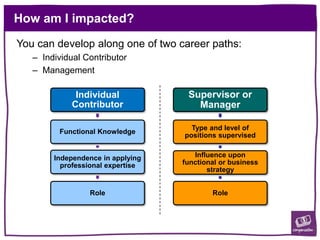
You can develop along one of two career paths:
– Individual Contributor
– Management
Supervisor or
Manager
Type and level of
positions supervised
Influence upon
functional or business
strategy
Role
Individual
Contributor
Functional Knowledge
Independence in applying
professional expertise
Role
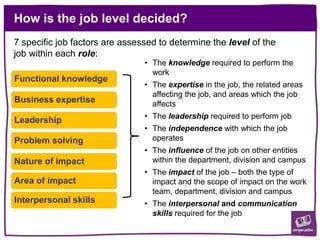
Functional knowledge
Business expertise
Leadership
Problem solving
Nature of impact
Area of impact
Interpersonal skills
• The knowledge required to perform the
work
• The expertise in the job, the related areas
affecting the job, and areas which the job
affects
• The leadership required to perform job
• The independence with which the job
operates
• The influence of the job on other entities
within the department, division and campus
• The impact of the job – both the type of
impact and the scope of impact on the work
team, department, division and campus
• The interpersonal and communication
skills required for the job
7 specific job factors are assessed to determine the level of the
job within each role:
How is the job level decided?
Summary of the process
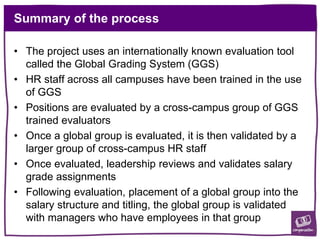
• The project uses an internationally known evaluation tool
called the Global Grading System (GGS)
• HR staff across all campuses have been trained in the use
of GGS
• Positions are evaluated by a cross-campus group of GGS
trained evaluators
• Once a global group is evaluated, it is then validated by a
larger group of cross-campus HR staff
• Once evaluated, leadership reviews and validates salary
grade assignments
• Following evaluation, placement of a global group into the
salary structure and titling, the global group is validated
with managers who have employees in that group
How do jobs fit in the structure?
GRADE
MANAGEMENT
CAREER
PATH
CEO
SUPERVISOR
PROFESSIONAL
TECHNICIAN
CLERICAL / ADMINISTRATIVE
MANUAL
SUBJECT MATTER
EXPERT
MIDDLE
MANAGEMENT
TOP
MGMT
1 2 3 4 5 6 7 8 9 10 11 12 16 18 19
13 14 15 17
1 2 3 4 5 6 7 8 9 10 11 12 16 E1 E2
13 14 15 17
1st. LINE
TOP MGMT
INDIVIDUAL
CONTRIBUTOR
CAREER
PATH
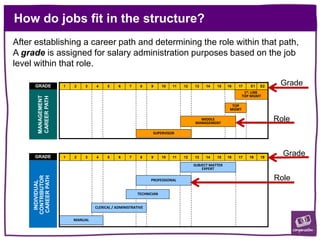
After establishing a career path and determining the role within that path,
A grade is assigned for salary administration purposes based on the job
level within that role.
GRADE
Grade
Role
Grade
Role
What if I disagree with the evaluation?
• If you believe your position has been placed incorrectly:
– Review your position description to ensure that it fairly states
the primary accountabilities and requirements for your job
– Schedule an appointment with your manager to review the
how your job was evaluated
• Note: any requests for re-evaluation must be made by your
manager and local HR
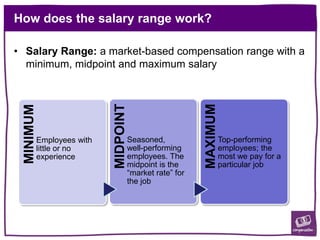
How does the salary range work?
• Salary Range: a market-based compensation range with a
minimum, midpoint and maximum salary
MINIMUM
Employees with
little or no
experience
MIDPOINT
Seasoned,
well-performing
employees. The
midpoint is the
“market rate” for
the job
MAXIMUM
Top-performing
employees; the
most we pay for a
particular job
What does a salary structure do?
• There are several objectives for a salary structure
– External competitiveness – defining the market and aligning
the salary ranges with the market
– Internal equity – aligning positions of common value in the
same salary grade
– Create a hierarchy of jobs in the organization from entry
level positions through the President’s position
– Serve as a basis for communicating to employees how
salary is determined, a path for career development and a
process for increases and promotions
– Allow employee growth and development to be rewarded
How is the salary structure maintained?
• Salary structure is assessed about every two years
– The structure is adjusted according to program objectives
and the university’s ability to make the market adjustment
• Benchmark positions are used to test the structure vs. the
market
– A benchmark position can be matched to a similar position in
the external market
• External market data is used for comparison
– “The Market” is defined as the areas from which the
university competes for employees
• Range adjustment
– Ranges may be adjusted if there is evidence that the
university has fallen behind the external market
– Range adjustment may or may not impact employee pay
What happens now?
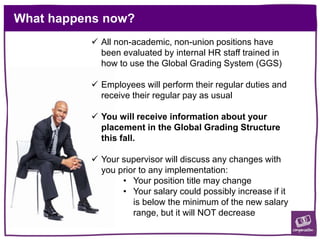
 All non-academic, non-union positions have
been evaluated by internal HR staff trained in
how to use the Global Grading System (GGS)
 Employees will perform their regular duties and
receive their regular pay as usual
 You will receive information about your
placement in the Global Grading Structure
this fall.
 Your supervisor will discuss any changes with
you prior to any implementation:
• Your position title may change
• Your salary could possibly increase if it
is below the minimum of the new salary
range, but it will NOT decrease
What happens now?
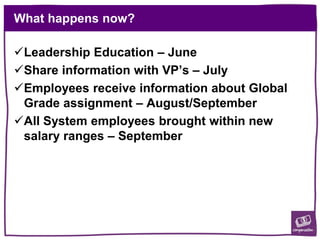
Leadership Education – June
Share information with VP’s – July
Employees receive information about Global
Grade assignment – August/September
All System employees brought within new
salary ranges – September
A few reminders…
• The Global Grading Project only impacts non-academic positions (not
students, faculty or union positions)
• Every position has been evaluated, one global group at a time
• The project creates a basis for communication, visibility and
transparency that will help address both employee and organization
compensation issues over time
• The project ensures the UM compensation program is administered in a
fair and equitable manner
• Position titles may change
• The project is not being done to impact salary; however,
– It could increase salary for employees below the minimum of the
new salary range for their position
– It will not decrease salary
• Staffing levels and budgets are not a part of the project
• Performance assessment is not a part of the job evaluation process
• Employees will be able to identify and select a career path if they
choose

Compensation-GGS-Presentation-Employees.pptx

  • 1.
  • 2.
    What is thisproject? An evaluation of each non-academic job to ensure the university offers an externally competitive and internally equitable salary package at all university locations. Piloted in 2010 Kicked off full project in 2011 Implemented beginning in 2012 Expanding to all campuses throughout 2013
  • 3.
    Global Groups* The evaluationprocess has been completed for each Global Group of positions across the organization: – Administrative and Support Services – Advancement – Business Administration – Communications – Craft Service Maintenance – Executive – Information Technology – Student Support Services – Research and Engineering *This list is not in order of evaluation.
  • 4.
    Why is theproject important? This compensation project allows the university to Recruit, Retain and Reward valuable employees, like you!
  • 5.
    What is thecompensation project philosophy? UM’s compensation philosophy is… • Supportive of the university’s mission and objectives • Fairly and consistently administered • Internally equitable • Externally competitive within the appropriate labor market and the higher education industry (comparison organizations to which we gain or lose employees) • Performance-based • Structured system-wide but flexible to fit campus/hospital strategic priorities
  • 6.
    What was thegoal of the project? The goals of the project were to: • Evaluate each position • Potentially change position titles • Place evaluated positions within salary grades • Create updated position documentation • Create internal equity for salaries • Create a basis for comparing salaries • Create external competitiveness for similar positions • Create a platform for comparing our jobs to those in competitor organizations
  • 7.
    What will thisproject NOT do? This project will not: • Reduce employee pay • Change position duties • Change the organizational structure • Eliminate positions or cause layoffs • Evaluate employee performance
  • 8.
    How am Iimpacted? You can develop along one of two career paths: – Individual Contributor – Management Supervisor or Manager Type and level of positions supervised Influence upon functional or business strategy Role Individual Contributor Functional Knowledge Independence in applying professional expertise Role
  • 9.
    Functional knowledge Business expertise Leadership Problemsolving Nature of impact Area of impact Interpersonal skills • The knowledge required to perform the work • The expertise in the job, the related areas affecting the job, and areas which the job affects • The leadership required to perform job • The independence with which the job operates • The influence of the job on other entities within the department, division and campus • The impact of the job – both the type of impact and the scope of impact on the work team, department, division and campus • The interpersonal and communication skills required for the job 7 specific job factors are assessed to determine the level of the job within each role: How is the job level decided?
  • 10.
    Summary of theprocess • The project uses an internationally known evaluation tool called the Global Grading System (GGS) • HR staff across all campuses have been trained in the use of GGS • Positions are evaluated by a cross-campus group of GGS trained evaluators • Once a global group is evaluated, it is then validated by a larger group of cross-campus HR staff • Once evaluated, leadership reviews and validates salary grade assignments • Following evaluation, placement of a global group into the salary structure and titling, the global group is validated with managers who have employees in that group
  • 11.
    How do jobsfit in the structure? GRADE MANAGEMENT CAREER PATH CEO SUPERVISOR PROFESSIONAL TECHNICIAN CLERICAL / ADMINISTRATIVE MANUAL SUBJECT MATTER EXPERT MIDDLE MANAGEMENT TOP MGMT 1 2 3 4 5 6 7 8 9 10 11 12 16 18 19 13 14 15 17 1 2 3 4 5 6 7 8 9 10 11 12 16 E1 E2 13 14 15 17 1st. LINE TOP MGMT INDIVIDUAL CONTRIBUTOR CAREER PATH After establishing a career path and determining the role within that path, A grade is assigned for salary administration purposes based on the job level within that role. GRADE Grade Role Grade Role
  • 12.
    What if Idisagree with the evaluation? • If you believe your position has been placed incorrectly: – Review your position description to ensure that it fairly states the primary accountabilities and requirements for your job – Schedule an appointment with your manager to review the how your job was evaluated • Note: any requests for re-evaluation must be made by your manager and local HR
  • 13.
    How does thesalary range work? • Salary Range: a market-based compensation range with a minimum, midpoint and maximum salary MINIMUM Employees with little or no experience MIDPOINT Seasoned, well-performing employees. The midpoint is the “market rate” for the job MAXIMUM Top-performing employees; the most we pay for a particular job
  • 14.
    What does asalary structure do? • There are several objectives for a salary structure – External competitiveness – defining the market and aligning the salary ranges with the market – Internal equity – aligning positions of common value in the same salary grade – Create a hierarchy of jobs in the organization from entry level positions through the President’s position – Serve as a basis for communicating to employees how salary is determined, a path for career development and a process for increases and promotions – Allow employee growth and development to be rewarded
  • 15.
    How is thesalary structure maintained? • Salary structure is assessed about every two years – The structure is adjusted according to program objectives and the university’s ability to make the market adjustment • Benchmark positions are used to test the structure vs. the market – A benchmark position can be matched to a similar position in the external market • External market data is used for comparison – “The Market” is defined as the areas from which the university competes for employees • Range adjustment – Ranges may be adjusted if there is evidence that the university has fallen behind the external market – Range adjustment may or may not impact employee pay
  • 16.
    What happens now? All non-academic, non-union positions have been evaluated by internal HR staff trained in how to use the Global Grading System (GGS)  Employees will perform their regular duties and receive their regular pay as usual  You will receive information about your placement in the Global Grading Structure this fall.  Your supervisor will discuss any changes with you prior to any implementation: • Your position title may change • Your salary could possibly increase if it is below the minimum of the new salary range, but it will NOT decrease
  • 17.
    What happens now? LeadershipEducation – June Share information with VP’s – July Employees receive information about Global Grade assignment – August/September All System employees brought within new salary ranges – September
  • 18.
    A few reminders… •The Global Grading Project only impacts non-academic positions (not students, faculty or union positions) • Every position has been evaluated, one global group at a time • The project creates a basis for communication, visibility and transparency that will help address both employee and organization compensation issues over time • The project ensures the UM compensation program is administered in a fair and equitable manner • Position titles may change • The project is not being done to impact salary; however, – It could increase salary for employees below the minimum of the new salary range for their position – It will not decrease salary • Staffing levels and budgets are not a part of the project • Performance assessment is not a part of the job evaluation process • Employees will be able to identify and select a career path if they choose

Editor's Notes

  • #2 Welcome to the leadership presentation that will provide you an overview of the staff compensation structure and administration. Much of the information may be new to you but it should provide a good overview of the program.
  • #3 This project was undertaken to provide the University with an up to date and common platform with which to administer staff salaries and ensure that we can compete for talent. It does not include academic or union titles. The project started as a pilot and has now expanded organization-wide.
  • #4 This is a list of the Global Groups, or job families, that all staff positions are grouped into. A team of certified GGS evaluators have evaluated each job in these Global Groups (job families)
  • #5 In addition to comparing the relative value of one job to another inside the organization, the project allows us to compare ourselves to those with whom we compete for talent. It also provides a way for you to better understand how the compensation program works and how your pay is determined. The focus of all the projects in HR are on the ability to recruit, retain and reward employees.
  • #6 As a part of the project, an organizational compensation philosophy was developed to provide guiding principles around the program. Read bullets…
  • #7 This provides an overview of the project which included evaluating each position in the organization. The evaluation process often identifies like positions that may be titled differently. We identified many jobs that require similar skills and experience (and therefore pay) but have different titles. As a part of the project, these will be consolidated into fewer titles. This may change titles for some employees. Once the evaluation is complete, the position is placed within a GGS salary range. Following evaluation and placement in the structure, updated job descriptions are being completed. The targeted outcome of this process is to create internal equity for salaries and ensure that we are externally competitive. We’ll talk more about how this will happen as we move through the presentation.
  • #8 The project evaluates the positions AS THEY ARE TODAY. It does not change the type of work and will not reduce pay, eliminate positions or cause layoffs. It also does not evaluate the performance of individuals within a job title.
  • #9 One of the key advantages of the project is that once all positions have been evaluated, it will be easier to determine a clearer career path within the organization. There are two primary paths: an individual contributor path and a supervisor/manager path. Because the university has a number of highly specialized positions that are valuable to the organization but do not manage other employees, it was important that there be a career path for the individual contributor role.
  • #10 Once a position is determined to be in either the management or individual career path, these 7 factors are used to evaluate each position. The seven factors are the same for each band (management or individual contributor) but the questions used in the evaluation process are unique to each band. Once the job is evaluated, the Global Grading System assigns a salary grade. Let’s walk through the factors…read factor and descriptions.
  • #11 Before moving on to the structure, here’s a reminder of what the Global Grading System is and how a job is linked to a salary range. Read slide…
  • #12 This is a picture of how jobs are placed within the salary structure and also provides a visual of how you might move further into the pay range in either a management path or an individual contributor path. The grades are listed in the gold bar across the top of the two rectangles and each one represents a salary grade as designated by the number. This graphic is somewhat dated. There are 17 grades for staff and three broad-banded grades, called E1 and E2, that are used for executives. The blocks of color in each represent a salary range for a group of positions. Not all positions are represented in this graphic. Notice that in the top rectangle which represents the management career path, there is a stair step effect that represents how an individual might move from a supervisor to middle management and forward in the management ranks. The bottom rectangle shows how an individual contributor might progress along a different career path but with a similar progression. Most people start in an independent contributor band. Some move into the management band and others choose to stay in the individual contributor band. It is important to note that we are changing from thousands of salary ranges to around 20 ranges. This means that you will stay within the salary range for a much longer period of time because the ranges are much broader from the minimum to the maximum. Salary increases will more commonly occur as a result of range progression to reward performance, experience and skill development, rather than as a change in salary grade.
  • #13 If you feel that your job has not been assigned to the proper grade, and your leadership agrees, the job evaluation may be reviewed by HR leadership, trained to use the GGS. The results of their evaluation will be shared with your leadership and they will share these results with you.
  • #14 Now let’s talk a little more about the structure of a salary range. A range represents the minimum the University pays to an inexperienced person for a particular job. On the far right is the maximum of the range which represents the most the University will pay for a top performing person for a position within this salary range. The midpoint of the salary range is considered to be the average pay or “market rate” for a solid performer with significant experience.
  • #15 The salary grades provide a framework to compare the University’s pay opportunities with the market; allowing the university to fairly administer pay. Using the structure, you can identify a career path and developmental and promotional opportunities to work toward. So, in review, the salary structure has the following objectives…read bullets.
  • #16 Now that we have a salary structure in place, it is important to periodically compare the university’s structure to the market. We have committed to doing this approximately every two years. Benchmark positions, or those that can be matched to a similar position elsewhere, are used to compare to our jobs with the external market or where we compete for talent. This may be local, regional or national, depending on the job. If the assessment finds that our structure has fallen behind the external market, salary ranges or positions within the ranges, may be adjusted, depending on the university’s financial ability to do so. Adjustment of a salary range does not mean that employees within this range will receive a pay increase, however, depending on the circumstances the university could decide to increase pay for some positions.
  • #17 Before we end, I’d like to talk about the next steps in the project. Read bullets…
  • #18 Before we end, I’d like to talk about the next steps in the project. Read bullets…
  • #19 Let’s review the major points again and then I’ll share the project’s next steps and the timeline. Read slide…