Comparison of EAP Models
Staff vs. Affiliate; On-Site vs. Off-Site
Internal vs. External; Session Models
Gary DeFraia, Ph.D.
April 23, 2010
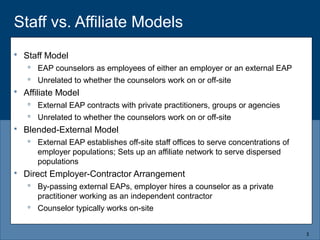
Staff vs. Affiliate Models
 Staff Model
 EAP counselors as employees of either an employer or an external EAP
 Unrelated to whether the counselors work on or off-site
 Affiliate Model
 External EAP contracts with private practitioners, groups or agencies
 Unrelated to whether the counselors work on or off-site
 Blended-External Model
 External EAP establishes off-site staff offices to serve concentrations of
employer populations; Sets up an affiliate network to serve dispersed
populations
 Direct Employer-Contractor Arrangement
 By-passing external EAPs, employer hires a counselor as a private
practitioner working as an independent contractor
 Counselor typically works on-site
2
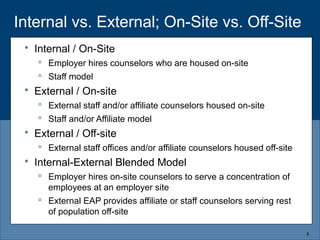
Internal vs. External; On-Site vs. Off-Site
 Internal / On-Site
 Employer hires counselors who are housed on-site
 Staff model
 External / On-site
 External staff and/or affiliate counselors housed on-site
 Staff and/or Affiliate model
 External / Off-site
 External staff offices and/or affiliate counselors housed off-site
 Internal-External Blended Model
 Employer hires on-site counselors to serve a concentration of
employees at an employer site
 External EAP provides affiliate or staff counselors serving rest
of population off-site
3
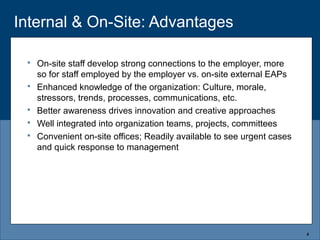
Internal & On-Site: Advantages
4
 On-site staff develop strong connections to the employer, more
so for staff employed by the employer vs. on-site external EAPs
 Enhanced knowledge of the organization: Culture, morale,
stressors, trends, processes, communications, etc.
 Better awareness drives innovation and creative approaches
 Well integrated into organization teams, projects, committees
 Convenient on-site offices; Readily available to see urgent cases
and quick response to management
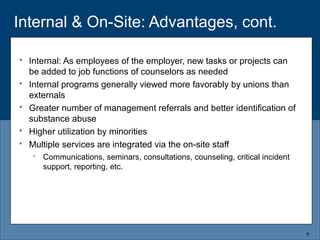
Internal & On-Site: Advantages, cont.
5
 Internal: As employees of the employer, new tasks or projects can
be added to job functions of counselors as needed
 Internal programs generally viewed more favorably by unions than
externals
 Greater number of management referrals and better identification of
substance abuse
 Higher utilization by minorities
 Multiple services are integrated via the on-site staff
 Communications, seminars, consultations, counseling, critical incident
support, reporting, etc.
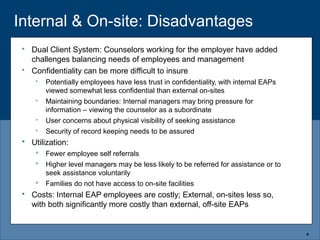
Internal & On-site: Disadvantages
 Dual Client System: Counselors working for the employer have added
challenges balancing needs of employees and management
 Confidentiality can be more difficult to insure
 Potentially employees have less trust in confidentiality, with internal EAPs
viewed somewhat less confidential than external on-sites
 Maintaining boundaries: Internal managers may bring pressure for
information – viewing the counselor as a subordinate
 User concerns about physical visibility of seeking assistance
 Security of record keeping needs to be assured
 Utilization:
 Fewer employee self referrals
 Higher level managers may be less likely to be referred for assistance or to
seek assistance voluntarily
 Families do not have access to on-site facilities
 Costs: Internal EAP employees are costly; External, on-sites less so,
with both significantly more costly than external, off-site EAPs
6
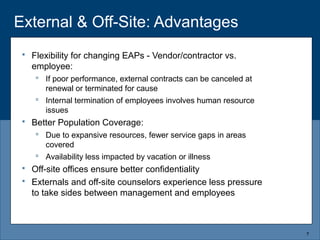
External & Off-Site: Advantages
 Flexibility for changing EAPs - Vendor/contractor vs.
employee:
 If poor performance, external contracts can be canceled at
renewal or terminated for cause
 Internal termination of employees involves human resource
issues
 Better Population Coverage:
 Due to expansive resources, fewer service gaps in areas
covered
 Availability less impacted by vacation or illness
 Off-site offices ensure better confidentiality
 Externals and off-site counselors experience less pressure
to take sides between management and employees
7
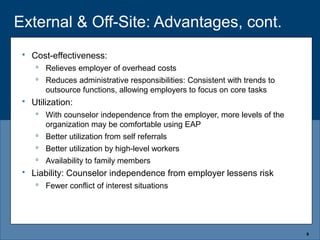
External & Off-Site: Advantages, cont.
8
 Cost-effectiveness:
 Relieves employer of overhead costs
 Reduces administrative responsibilities: Consistent with trends to
outsource functions, allowing employers to focus on core tasks
 Utilization:
 With counselor independence from the employer, more levels of the
organization may be comfortable using EAP
 Better utilization from self referrals
 Better utilization by high-level workers
 Availability to family members
 Liability: Counselor independence from employer lessens risk
 Fewer conflict of interest situations
External & Off-site: Disadvantages
 External EAPs are more challenged in maintaining familiarity with
organizational philosophy, culture, internal issues, job pressures,
activities and needs
 Contractual limitations
 New projects or additional duties require renegotiation of the contract
and may result in increased costs
 Reduced informal accessibility
 Employees cannot “drop in” during breaks, etc.
 Utilization: Fewer management referrals
 Greater emphasis on individual change than organizational
support or change
9
Additional Considerations: Externals
 Where internal programs generally rely on a small group of staff to
provide a limited number of services, external EAPs provide
multiple personnel to deliver a broad range of comprehensive
services
 24-hour emergency coverage, wellness programs, dependent
care, and managed behavioral healthcare, disability
management, etc.
 External EAPs allow a smaller employer to take advantage of an
array of services without incurring the cost of full-time in-house staff
 Utilization: Studies indicate external programs show higher rates of
employee self referrals and increased perception of confidentiality
(Strausser, 1988; Hartwell, 1996; Blair 1987)
 Diversity: Large external affiliate network afford better cultural
competence than small staffs
10
Additional Considerations: Internals
 Performance Management: Internal programs provide better
interventions for making timely interventions at the point of
performance decline
 Internal programs offer greater accessibility
 Internal programs have higher visibility, better outreach, better
coordinated substance abuse services
 Organizational Support: Internal programs provide more rapid
feedback to the organization when systemic issues emerge
 Utilization: Internal programs have three times more management
referrals of employees with performance problems
11
Models: 1 - 8 In-Person Sessions
Allows for full engagement of the employee with short-term
treatment techniques
Average range of cases resolved in the EAP, avoiding benefit-
covered services: 60% - 80%
Cost off-set to either preserved self-insured health care
payments or in lower premiums in a fully insured plan
Employee satisfaction is usually higher than with other models
Potentially regulated under Knox Keene in CA
12
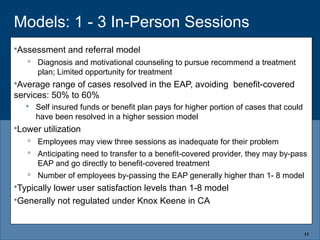
Models: 1 - 3 In-Person Sessions
Assessment and referral model
 Diagnosis and motivational counseling to pursue recommend a treatment
plan; Limited opportunity for treatment
Average range of cases resolved in the EAP, avoiding benefit-covered
services: 50% to 60%
 Self insured funds or benefit plan pays for higher portion of cases that could
have been resolved in a higher session model
Lower utilization
 Employees may view three sessions as inadequate for their problem
 Anticipating need to transfer to a benefit-covered provider, they may by-pass
EAP and go directly to benefit-covered treatment
 Number of employees by-passing the EAP generally higher than 1- 8 model
Typically lower user satisfaction levels than 1-8 model
Generally not regulated under Knox Keene in CA
13
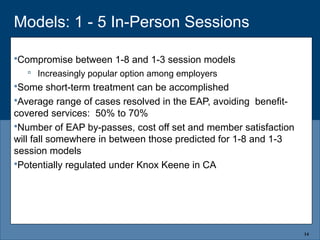
Models: 1 - 5 In-Person Sessions
Compromise between 1-8 and 1-3 session models
 Increasingly popular option among employers
Some short-term treatment can be accomplished
Average range of cases resolved in the EAP, avoiding benefit-
covered services: 50% to 70%
Number of EAP by-passes, cost off set and member satisfaction
will fall somewhere in between those predicted for 1-8 and 1-3
session models
Potentially regulated under Knox Keene in CA
14
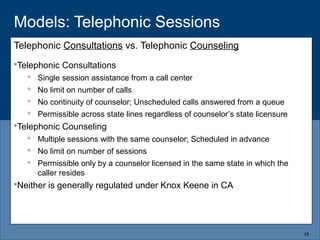
Models: Telephonic Sessions
Telephonic Consultations vs. Telephonic Counseling
Telephonic Consultations
 Single session assistance from a call center
 No limit on number of calls
 No continuity of counselor; Unscheduled calls answered from a queue
 Permissible across state lines regardless of counselor’s state licensure
Telephonic Counseling
 Multiple sessions with the same counselor; Scheduled in advance
 No limit on number of sessions
 Permissible only by a counselor licensed in the same state in which the
caller resides
Neither is generally regulated under Knox Keene in CA
15
Contact Information
Gary S. DeFraia, Ph.D.
gdefraia@hvc.rr.com
845-216-1392
16

Comparison of EAP Models 4-23-10

  • 1.
    Comparison of EAPModels Staff vs. Affiliate; On-Site vs. Off-Site Internal vs. External; Session Models Gary DeFraia, Ph.D. April 23, 2010
  • 2.
    Staff vs. AffiliateModels  Staff Model  EAP counselors as employees of either an employer or an external EAP  Unrelated to whether the counselors work on or off-site  Affiliate Model  External EAP contracts with private practitioners, groups or agencies  Unrelated to whether the counselors work on or off-site  Blended-External Model  External EAP establishes off-site staff offices to serve concentrations of employer populations; Sets up an affiliate network to serve dispersed populations  Direct Employer-Contractor Arrangement  By-passing external EAPs, employer hires a counselor as a private practitioner working as an independent contractor  Counselor typically works on-site 2
  • 3.
    Internal vs. External;On-Site vs. Off-Site  Internal / On-Site  Employer hires counselors who are housed on-site  Staff model  External / On-site  External staff and/or affiliate counselors housed on-site  Staff and/or Affiliate model  External / Off-site  External staff offices and/or affiliate counselors housed off-site  Internal-External Blended Model  Employer hires on-site counselors to serve a concentration of employees at an employer site  External EAP provides affiliate or staff counselors serving rest of population off-site 3
  • 4.
    Internal & On-Site:Advantages 4  On-site staff develop strong connections to the employer, more so for staff employed by the employer vs. on-site external EAPs  Enhanced knowledge of the organization: Culture, morale, stressors, trends, processes, communications, etc.  Better awareness drives innovation and creative approaches  Well integrated into organization teams, projects, committees  Convenient on-site offices; Readily available to see urgent cases and quick response to management
  • 5.
    Internal & On-Site:Advantages, cont. 5  Internal: As employees of the employer, new tasks or projects can be added to job functions of counselors as needed  Internal programs generally viewed more favorably by unions than externals  Greater number of management referrals and better identification of substance abuse  Higher utilization by minorities  Multiple services are integrated via the on-site staff  Communications, seminars, consultations, counseling, critical incident support, reporting, etc.
  • 6.
    Internal & On-site:Disadvantages  Dual Client System: Counselors working for the employer have added challenges balancing needs of employees and management  Confidentiality can be more difficult to insure  Potentially employees have less trust in confidentiality, with internal EAPs viewed somewhat less confidential than external on-sites  Maintaining boundaries: Internal managers may bring pressure for information – viewing the counselor as a subordinate  User concerns about physical visibility of seeking assistance  Security of record keeping needs to be assured  Utilization:  Fewer employee self referrals  Higher level managers may be less likely to be referred for assistance or to seek assistance voluntarily  Families do not have access to on-site facilities  Costs: Internal EAP employees are costly; External, on-sites less so, with both significantly more costly than external, off-site EAPs 6
  • 7.
    External & Off-Site:Advantages  Flexibility for changing EAPs - Vendor/contractor vs. employee:  If poor performance, external contracts can be canceled at renewal or terminated for cause  Internal termination of employees involves human resource issues  Better Population Coverage:  Due to expansive resources, fewer service gaps in areas covered  Availability less impacted by vacation or illness  Off-site offices ensure better confidentiality  Externals and off-site counselors experience less pressure to take sides between management and employees 7
  • 8.
    External & Off-Site:Advantages, cont. 8  Cost-effectiveness:  Relieves employer of overhead costs  Reduces administrative responsibilities: Consistent with trends to outsource functions, allowing employers to focus on core tasks  Utilization:  With counselor independence from the employer, more levels of the organization may be comfortable using EAP  Better utilization from self referrals  Better utilization by high-level workers  Availability to family members  Liability: Counselor independence from employer lessens risk  Fewer conflict of interest situations
  • 9.
    External & Off-site:Disadvantages  External EAPs are more challenged in maintaining familiarity with organizational philosophy, culture, internal issues, job pressures, activities and needs  Contractual limitations  New projects or additional duties require renegotiation of the contract and may result in increased costs  Reduced informal accessibility  Employees cannot “drop in” during breaks, etc.  Utilization: Fewer management referrals  Greater emphasis on individual change than organizational support or change 9
  • 10.
    Additional Considerations: Externals Where internal programs generally rely on a small group of staff to provide a limited number of services, external EAPs provide multiple personnel to deliver a broad range of comprehensive services  24-hour emergency coverage, wellness programs, dependent care, and managed behavioral healthcare, disability management, etc.  External EAPs allow a smaller employer to take advantage of an array of services without incurring the cost of full-time in-house staff  Utilization: Studies indicate external programs show higher rates of employee self referrals and increased perception of confidentiality (Strausser, 1988; Hartwell, 1996; Blair 1987)  Diversity: Large external affiliate network afford better cultural competence than small staffs 10
  • 11.
    Additional Considerations: Internals Performance Management: Internal programs provide better interventions for making timely interventions at the point of performance decline  Internal programs offer greater accessibility  Internal programs have higher visibility, better outreach, better coordinated substance abuse services  Organizational Support: Internal programs provide more rapid feedback to the organization when systemic issues emerge  Utilization: Internal programs have three times more management referrals of employees with performance problems 11
  • 12.
    Models: 1 -8 In-Person Sessions Allows for full engagement of the employee with short-term treatment techniques Average range of cases resolved in the EAP, avoiding benefit- covered services: 60% - 80% Cost off-set to either preserved self-insured health care payments or in lower premiums in a fully insured plan Employee satisfaction is usually higher than with other models Potentially regulated under Knox Keene in CA 12
  • 13.
    Models: 1 -3 In-Person Sessions Assessment and referral model  Diagnosis and motivational counseling to pursue recommend a treatment plan; Limited opportunity for treatment Average range of cases resolved in the EAP, avoiding benefit-covered services: 50% to 60%  Self insured funds or benefit plan pays for higher portion of cases that could have been resolved in a higher session model Lower utilization  Employees may view three sessions as inadequate for their problem  Anticipating need to transfer to a benefit-covered provider, they may by-pass EAP and go directly to benefit-covered treatment  Number of employees by-passing the EAP generally higher than 1- 8 model Typically lower user satisfaction levels than 1-8 model Generally not regulated under Knox Keene in CA 13
  • 14.
    Models: 1 -5 In-Person Sessions Compromise between 1-8 and 1-3 session models  Increasingly popular option among employers Some short-term treatment can be accomplished Average range of cases resolved in the EAP, avoiding benefit- covered services: 50% to 70% Number of EAP by-passes, cost off set and member satisfaction will fall somewhere in between those predicted for 1-8 and 1-3 session models Potentially regulated under Knox Keene in CA 14
  • 15.
    Models: Telephonic Sessions TelephonicConsultations vs. Telephonic Counseling Telephonic Consultations  Single session assistance from a call center  No limit on number of calls  No continuity of counselor; Unscheduled calls answered from a queue  Permissible across state lines regardless of counselor’s state licensure Telephonic Counseling  Multiple sessions with the same counselor; Scheduled in advance  No limit on number of sessions  Permissible only by a counselor licensed in the same state in which the caller resides Neither is generally regulated under Knox Keene in CA 15
  • 16.
    Contact Information Gary S.DeFraia, Ph.D. gdefraia@hvc.rr.com 845-216-1392 16