CUTTING EDGE RESEARCH:
Two Studies of
the Current State of EAPs
in North America & Europe

Funded with support by the
Today’s Presenters
Dirk Antonissen, MS
ISW Limits/Leuven University, Kessel-lo, Belgium

Manuel Sommer, PhD
Clinica CAPA/CIP-UAL, Lisbon, Portugal

Stan Granberry, PhD
National Behavioral Consortium, Baton Rouge, LA

Terry Cahill, LCSW, CEAP
Perspectives LTD, Chicago, IL

Moderator: Bernie McCann, PhD, CEAP
Employee Assistance Research Foundation
What is the EARF...?
The EARF was founded as a 501(c)(3)
nonprofit foundation to stimulate
innovative, rigorous, and theory-based
research activities which demonstrate the
ability of EAPs to maximize employee
contributions to the success of work
organizations.
…and why now?
There is simply not enough existing, credible
research to critically demonstrate the valuable
contribution of EAPs and related services to
workplace productivity.
The EARF seeks to advance the quality of EA
services by sponsoring relevant research and
disseminate these findings to employers, labor
unions, EAP and HR professionals, and other
stakeholders.
Funded Research Projects to Date
EARF funded its first 2 research projects in 2011:
1) The Eureka Project - EAPs in Continental
Europe: State of the Art and Future Challenges,
conducted by ISW Limits & Clinica CAPA
2) National Behavioral Consortium Industry
Profile of External EAP Vendors conducted by
the National Behavioral Consortium
New Research in the Pipeline
• Our next research grant has been awarded to the
OMNI Institute in Denver, CO for the study: The
Impact of Employee Assistance Services on Workplace
Outcomes.
• Study site is the Colorado State EAP, duration is 14
months, and grant amount is $100,000 plus 12% for
overhead costs.
• This research effort will be one of the most complete
EAP outcome studies ever undertaken, with findings
expected in late 2014.
Eureka: An Employee Services
Perception Study in Continental Europe
Introduction to the Study
• Are EA needs in Continental Europe different than in the
US?
– Intervention for prevention & health promotion
– Services are provided for individuals & organizations

• In many countries in Europe EAPs as such are not very
well-known, so to investigate, we asked about employee
support services at the workplace without using the
language “What should an EAP offer?”*

8

*Language similar to that used in Buon & Taylor (2008) A Review of the EAP Market in the United
Kingdom and Europe. Journal of Workplace Behavioral Health 23(4): 425-444
Research Questions
1. What type of EA-related services are
currently available?

2. What type of services should be made
available?
– According to employees
– According to HR managers
9
Methods
Survey Sample
Composed of responses from 6 Eurozone countries:
1) Northern Europe: Belgium, France & The Netherlands
2) Southern Europe: Portugal, Spain & Greece

“Representative” database of respondents from:
• HR and non-HR staff positions
• Companies by size of workforce
• Companies with & without formal EAP services

11
Questionnaire
Based on 2008 Buon & Taylor article*
– Content
– Delivery mode (website, phone, etc.)?

•
•
•
•

Currently present or not?
Satisfaction with?
Externally or internally?
To what extent needed?
*A Review of the Employee Assistance Programme Market in the UK & Europe

12
Description of the Sample
(n = 327)
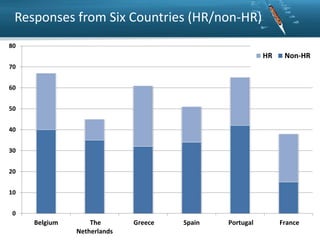
Responses from Six Countries (HR/non-HR)
80

HR

Non-HR

70
60
50

40
30
20
10
0

Belgium

The
Netherlands

Greece

Spain

Portugal

France
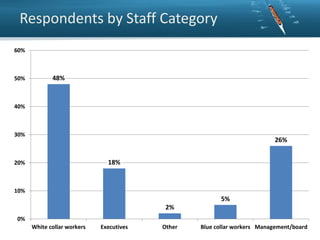
Respondents by Staff Category
60%

50%

48%

40%

30%

26%

18%

20%

10%

5%
2%
0%
White collar workers

Executives

Other

Blue collar workers Management/board
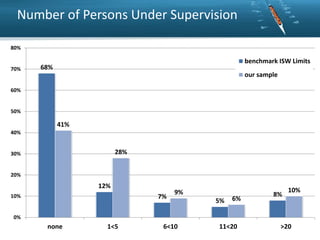
Number of Persons Under Supervision
80%

70%

benchmark ISW Limits

68%

our sample

60%

50%

41%
40%

28%

30%

20%

12%
7%

10%

9%

5%

6%

8%

10%

0%

none

1<5

6<10

11<20

>20
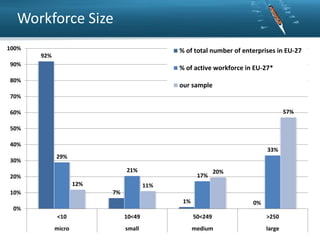
Workforce Size
100%

% of total number of enterprises in EU-27

92%
90%

% of active workforce in EU-27*

80%

our sample

70%
57%

60%
50%
40%
30%

33%
29%
21%

17%

20%
12%

20%

11%
7%

10%

1%

0%

0%
<10

10<49

50<249

>250

micro

small

medium

large
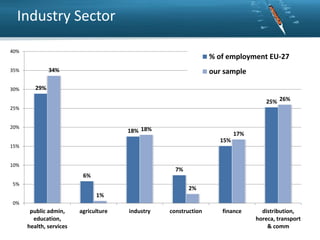
Industry Sector
40%

% of employment EU-27
34%

35%

30%

our sample

29%
25% 26%

25%

20%

18% 18%

17%
15%

15%

10%

7%

6%
5%

2%
1%

0%

public admin,
education,
health, services

agriculture

industry

construction

finance

distribution,
horeca, transport
& comm
Global Results
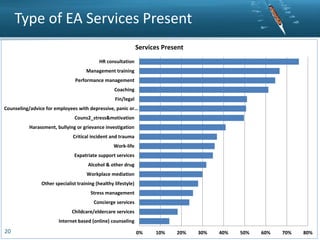
Type of EA Services Present
Services Present
HR consultation
Management training
Performance management
Coaching
Fin/legal
Counseling/advice for employees with depressive, panic or…
Couns2_stress&motivation

Harassment, bullying or grievance investigation
Critical incident and trauma
Work-life
Expatriate support services
Alcohol & other drug
Workplace mediation
Other specialist training (healthy lifestyle)
Stress management
Concierge services
Childcare/eldercare services
Internet based (online) counseling

20

0%

10%

20%

30%

40%

50%

60%

70%

80%
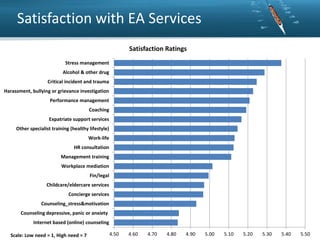
Satisfaction with EA Services
Satisfaction Ratings
Stress management
Alcohol & other drug
Critical incident and trauma
Harassment, bullying or grievance investigation
Performance management

Coaching
Expatriate support services
Other specialist training (healthy lifestyle)
Work-life
HR consultation
Management training
Workplace mediation
Fin/legal
Childcare/eldercare services
Concierge services
Counseling_stress&motivation
Counseling depressive, panic or anxiety
Internet based (online) counseling
Scale: Low need = 1, High need = 7

4.50

4.60

4.70

4.80

4.90

5.00

5.10

5.20

5.30

5.40

5.50
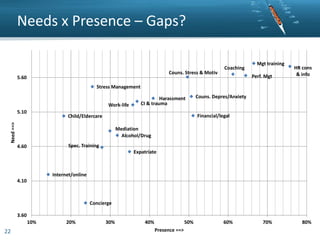
Needs x Presence – Gaps?

Couns. Stress & Motiv

5.60

Mgt training
Perf. Mgt

Coaching

HR cons
& info

70%

80%

Stress Management
Work-life
5.10

Harassment
CI & trauma

Couns. Depres/Anxiety

Financial/legal

Need ==>

Child/Eldercare
Mediation
Alcohol/Drug
Spec. Training

4.60

Expatriate

Internet/online
4.10

Concierge

3.60
10%

22

20%

30%

40%

50%
Presence ==>

60%
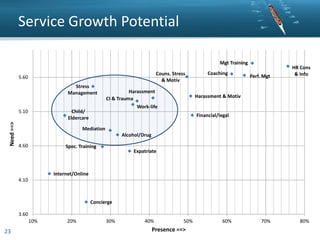
Service Growth Potential
Mgt Training
Couns. Stress
& Motiv

5.60
Stress
Management

Perf. Mgt

70%

80%

Harassment & Motiv

Work-life

Child/
Eldercare

5.10

Need ==>

Harassment
CI & Trauma

Coaching

HR Cons
& Info

Financial/legal

Mediation
Alcohol/Drug
4.60

Spec. Training

Expatriate

Internet/Online
4.10

Concierge
3.60
10%

23

20%

30%

40%

50%

Presence ==>

60%
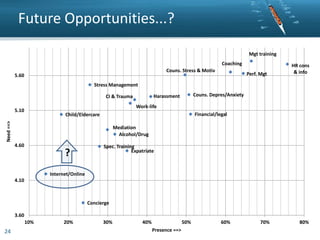
Future Opportunities...?
Mgt training
Coaching
Couns. Stress & Motiv

5.60

Perf. Mgt

HR cons
& info

Stress Management
Couns. Depres/Anxiety

Harassment

CI & Trauma

Work-life

5.10

Financial/legal

Need ==>

Child/Eldercare
Mediation
Alcohol/Drug

4.60

?

Spec. Training
Expatriate

Internet/Online
4.10

Concierge

3.60
10%

24

20%

30%

40%

50%
Presence ==>

60%

70%

80%
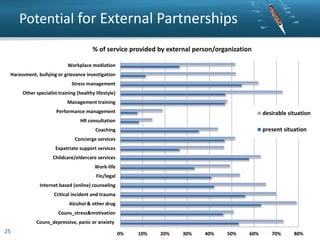
Potential for External Partnerships
% of service provided by external person/organization
Workplace mediation
Harassment, bullying or grievance investigation
Stress management
Other specialist training (healthy lifestyle)
Management training
Performance management

desirable situation

HR consultation

present situation

Coaching
Concierge services
Expatriate support services
Childcare/eldercare services
Work-life
Fin/legal
Internet based (online) counseling
Critical incident and trauma
Alcohol & other drug
Couns_stress&motivation
Couns_depressive, panic or anxiety

25

0%

10%

20%

30%

40%

50%

60%

70%

80%
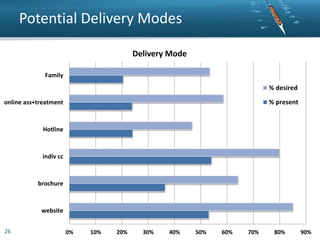
Potential Delivery Modes
Delivery Mode
Family

% desired
% present

online ass+treatment

Hotline

indiv cc

brochure

website
26

0%

10%

20%

30%

40%

50%

60%

70%

80%

90%
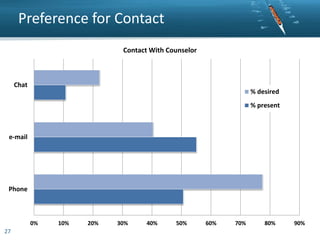
Preference for Contact
Contact With Counselor

Chat

% desired
% present

e-mail

Phone

0%
27

10%

20%

30%

40%

50%

60%

70%

80%

90%
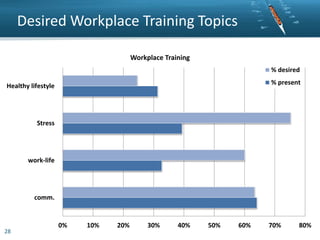
Desired Workplace Training Topics
Workplace Training
% desired
% present

Healthy lifestyle

Stress

work-life

comm.

28

0%

10%

20%

30%

40%

50%

60%

70%

80%
Country-Specific Analysis
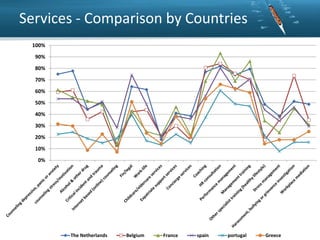
Services - Comparison by Countries
100%
90%
80%
70%
60%
50%
40%
30%
20%
10%
0%

The Netherlands

Belgium

France

spain

portugal

Greece
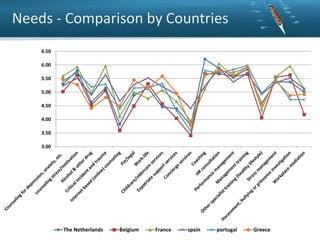
Needs - Comparison by Countries
6.50
6.00
5.50
5.00
4.50
4.00
3.50
3.00

The Netherlands

Belgium

France

spain

portugal

Greece
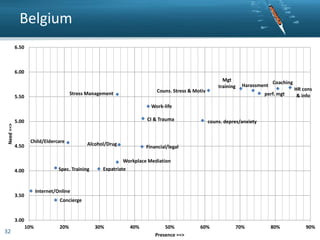
Belgium
6.50

6.00

Couns. Stress & Motiv

Stress Management

5.50

Mgt
training

Harassment

Coaching

perf. mgt

HR cons
& info

Need ==>

Work-life
CI & Trauma

5.00

4.50

Child/Eldercare

Alcohol/Drug

couns. depres/anxiety

Financial/legal
Workplace Mediation

Spec. Training

4.00

Expatriate

Internet/Online

3.50

Concierge

3.00

32

10%

20%

30%

40%

50%
Presence ==>

60%

70%

80%

90%
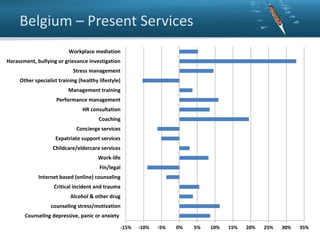
Belgium – Present Services
Workplace mediation
Harassment, bullying or grievance investigation
Stress management
Other specialist training (healthy lifestyle)
Management training
Performance management
HR consultation
Coaching
Concierge services
Expatriate support services
Childcare/eldercare services
Work-life
Fin/legal
Internet based (online) counseling

Critical incident and trauma
Alcohol & other drug
counseling stress/motivation
Counseling depressive, panic or anxiety
-15%

-10%

-5%

0%

5%

10%

15%

20%

25%

30%

35%
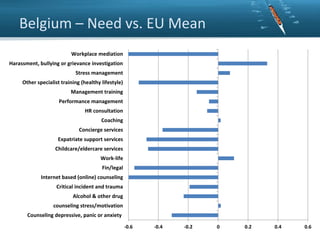
Belgium – Need vs. EU Mean
Workplace mediation
Harassment, bullying or grievance investigation
Stress management
Other specialist training (healthy lifestyle)
Management training
Performance management
HR consultation
Coaching
Concierge services
Expatriate support services
Childcare/eldercare services
Work-life
Fin/legal

Internet based (online) counseling
Critical incident and trauma
Alcohol & other drug
counseling stress/motivation
Counseling depressive, panic or anxiety
-0.6

-0.4

-0.2

0

0.2

0.4

0.6
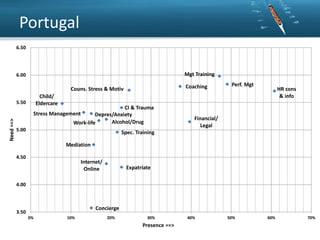
Portugal
6.50

Mgt Training

6.00

Coaching

Couns. Stress & Motiv
Child/
Eldercare

5.50

CI & Trauma
Depres/Anxiety
Belgium:
Alcohol/Drug Need
Work-life

Need ==>

Stress Management
5.00

Perf. Mgt

HR cons
& info

Financial/
vs. EU mean
Legal

Spec. Training
Mediation

4.50

Internet/
Online

Expatriate

4.00

Concierge

3.50
0%

10%

20%

30%

Presence ==>

40%

50%

60%

70%
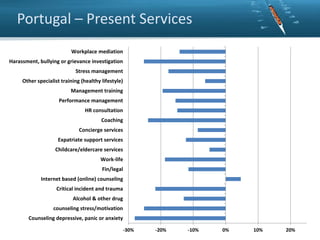
Portugal – Present Services
Workplace mediation
Harassment, bullying or grievance investigation
Stress management
Other specialist training (healthy lifestyle)
Management training
Performance management
HR consultation
Coaching
Concierge services
Expatriate support services
Childcare/eldercare services
Work-life
Fin/legal
Internet based (online) counseling
Critical incident and trauma
Alcohol & other drug
counseling stress/motivation
Counseling depressive, panic or anxiety
-30%

-20%

-10%

0%

10%

20%
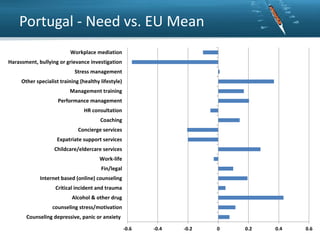
Portugal - Need vs. EU Mean
Workplace mediation
Harassment, bullying or grievance investigation
Stress management
Other specialist training (healthy lifestyle)
Management training

Performance management
HR consultation
Coaching
Concierge services
Expatriate support services
Childcare/eldercare services
Work-life
Fin/legal

Internet based (online) counseling
Critical incident and trauma
Alcohol & other drug
counseling stress/motivation
Counseling depressive, panic or anxiety
-0.6

-0.4

-0.2

0

0.2

0.4

0.6
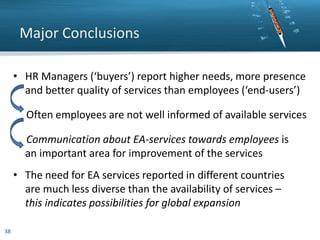
Major Conclusions
• HR Managers (‘buyers’) report higher needs, more presence
and better quality of services than employees (‘end-users’)

Often employees are not well informed of available services
Communication about EA-services towards employees is
an important area for improvement of the services

• The need for EA services reported in different countries
are much less diverse than the availability of services –
this indicates possibilities for global expansion
38
Opportunities and Challenges for
EAPs in Europe
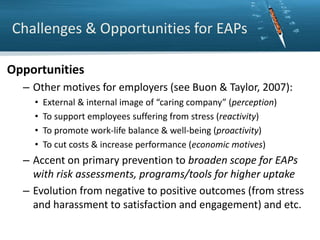
Challenges & Opportunities for EAPs
Opportunities
– Other motives for employers (see Buon & Taylor, 2007):
•
•
•
•

External & internal image of “caring company” (perception)
To support employees suffering from stress (reactivity)
To promote work-life balance & well-being (proactivity)
To cut costs & increase performance (economic motives)

– Accent on primary prevention to broaden scope for EAPs
with risk assessments, programs/tools for higher uptake
– Evolution from negative to positive outcomes (from stress
and harassment to satisfaction and engagement) and etc.
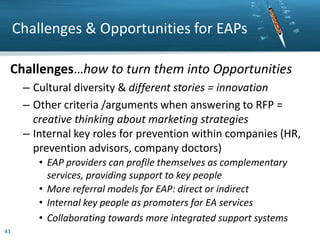
Challenges & Opportunities for EAPs
Challenges…how to turn them into Opportunities
– Cultural diversity & different stories = innovation
– Other criteria /arguments when answering to RFP =
creative thinking about marketing strategies
– Internal key roles for prevention within companies (HR,
prevention advisors, company doctors)
• EAP providers can profile themselves as complementary
services, providing support to key people
• More referral models for EAP: direct or indirect
• Internal key people as promoters for EA services
• Collaborating towards more integrated support systems
41
Challenges & Opportunities for EAPs
Challenges, continued
– External organizations that offer similar services to companies
• the case for Belgium: ESPP
• sickness insurance companies (‘mutualities’)

 When evidence-based approach & best practices permit, shift
from competitors to promoters/partners

– Social dialogue in work organizations cannot be bypassed;
Union representatives may be suspicious, need to be
convinced of the value of EA services
 EAP providers should present themselves as a neutral partner;
Employee representatives can be involved as referral agents
© National Behavioral Consortium

NATIONAL BEHAVIORAL
CONSORTIUM
INDUSTRY PROFILE OF
EXTERNAL EAP VENDORS
Stanford W. Granberry, PhD
Primary Investigator
Mark Attridge, PhD, MA
Terry Cahill, MSW, LCSW, CSADC
Patricia Herlihy, PhD, RN
Co-Authors
2013

www.nbcgroup.org
The NBC study was supported by a $40,000 grant
from the Employee Assistance Research Foundation
(EARF).
The Foundation exists to stimulate innovative,
rigorous, and theory-based research activities in the
field of EAP.
www.eapfoundation.org
44
The NBC study shines a flashlight
in a dark closet, it does not
turn on all the lights in the house.

46
Terry Cahill created the first version of
the NBC EAP Vendor Survey
5 years
ago.

47
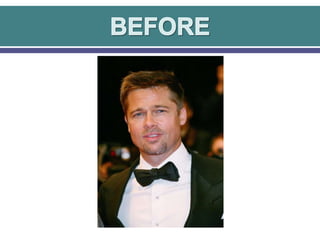
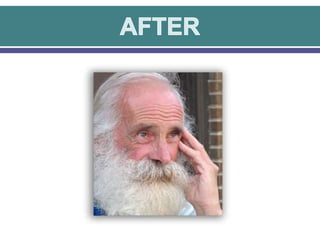
Actual pictures of Terry Cahill
taken before and after the Survey
This is the first study to provide
publicly available, comparative
information based on such a large and diverse
set of External EAP providers.
Originally US Centric
Canada added

Then Global
52
 Panel of Industry Experts
 Generated 71 items

 That was pared down to 44 Items
 Pilot tested & revised
53
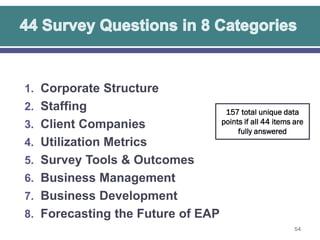
1. Corporate Structure
2. Staffing

3. Client Companies

157 total unique data
points if all 44 items are
fully answered

4. Utilization Metrics
5. Survey Tools & Outcomes

6. Business Management
7. Business Development
8. Forecasting the Future of EAP
54
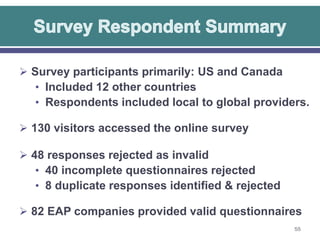
 Survey participants primarily: US and Canada
• Included 12 other countries
• Respondents included local to global providers.
 130 visitors accessed the online survey
 48 responses rejected as invalid
• 40 incomplete questionnaires rejected
• 8 duplicate responses identified & rejected
 82 EAP companies provided valid questionnaires
55
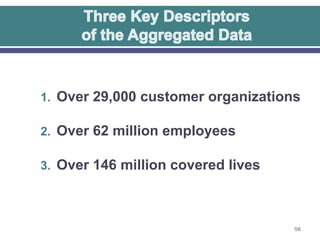
1. Over 29,000 customer organizations
2. Over 62 million employees
3. Over 146 million covered lives

56
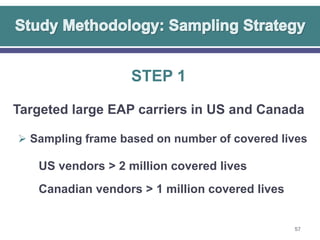
STEP 1
Targeted large EAP carriers in US and Canada
 Sampling frame based on number of covered lives

US vendors > 2 million covered lives
Canadian vendors > 1 million covered lives

57
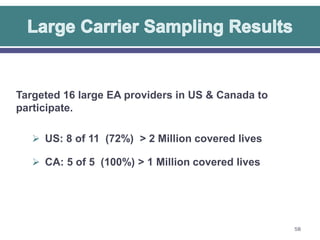
Targeted 16 large EA providers in US & Canada to
participate.
 US: 8 of 11 (72%) > 2 Million covered lives
 CA: 5 of 5 (100%) > 1 Million covered lives

58
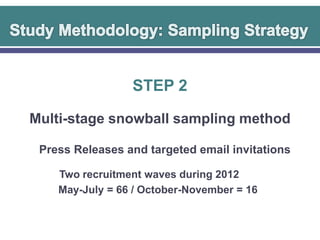
STEP 2
Multi-stage snowball sampling method
Press Releases and targeted email invitations
Two recruitment waves during 2012
May-July = 66 / October-November = 16
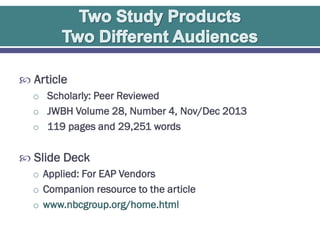
 Article
o Scholarly: Peer Reviewed
o JWBH Volume 28, Number 4, Nov/Dec 2013

o 119 pages and 29,251 words

 Slide Deck
o Applied: For EAP Vendors
o Companion resource to the article
o www.nbcgroup.org/home.html
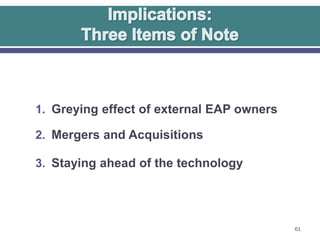
1. Greying effect of external EAP owners
2. Mergers and Acquisitions
3. Staying ahead of the technology

61
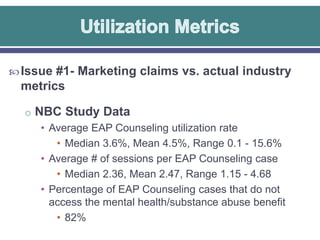
 Issue #1- Marketing claims vs. actual industry

metrics
o NBC Study Data
• Average EAP Counseling utilization rate
• Median 3.6%, Mean 4.5%, Range 0.1 - 15.6%
• Average # of sessions per EAP Counseling case
• Median 2.36, Mean 2.47, Range 1.15 - 4.68
• Percentage of EAP Counseling cases that do not
access the mental health/substance abuse benefit
• 82%
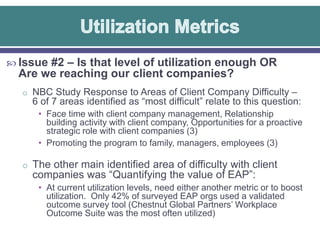
 Issue #2 – Is that level of utilization enough OR

Are we reaching our client companies?
o NBC Study Response to Areas of Client Company Difficulty –

6 of 7 areas identified as “most difficult” relate to this question:
• Face time with client company management, Relationship
building activity with client company, Opportunities for a proactive
strategic role with client companies (3)
• Promoting the program to family, managers, employees (3)

o The other main identified area of difficulty with client

companies was “Quantifying the value of EAP”:

• At current utilization levels, need either another metric or to boost
utilization. Only 42% of surveyed EAP orgs used a validated
outcome survey tool (Chestnut Global Partners’ Workplace
Outcome Suite was the most often utilized)
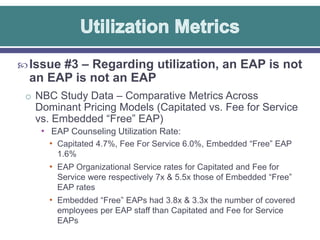
 Issue #3 – Regarding utilization, an EAP is not

an EAP is not an EAP
o NBC Study Data – Comparative Metrics Across

Dominant Pricing Models (Capitated vs. Fee for Service
vs. Embedded “Free” EAP)
• EAP Counseling Utilization Rate:
• Capitated 4.7%, Fee For Service 6.0%, Embedded “Free” EAP
1.6%

• EAP Organizational Service rates for Capitated and Fee for
Service were respectively 7x & 5.5x those of Embedded “Free”
EAP rates

• Embedded “Free” EAPs had 3.8x & 3.3x the number of covered
employees per EAP staff than Capitated and Fee for Service
EAPs
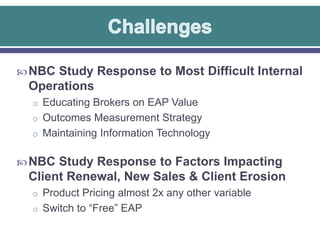
 NBC Study Response to Most Difficult Internal

Operations
o Educating Brokers on EAP Value
o Outcomes Measurement Strategy
o Maintaining Information Technology

 NBC Study Response to Factors Impacting

Client Renewal, New Sales & Client Erosion
o Product Pricing almost 2x any other variable
o Switch to “Free” EAP
 NBC Study Response to Factors Impacting Client

Renewal and New Sales
o
o
o
o

EAP Product Improvements
New Strategic Partnerships
Enhanced Broker Engagement
Enhanced technological delivery capabilities

 NBC Study Response to Level of Optimism For

External EAP Industry
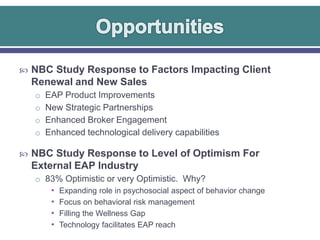
o 83% Optimistic or very Optimistic. Why?
• Expanding role in psychosocial aspect of behavior change
• Focus on behavioral risk management
• Filling the Wellness Gap
• Technology facilitates EAP reach
Audience Questions
• Any questions for our presenters to clarify
any information from their studies?
• Any questions about the EARF?
• Any recommendations for EARF-funded
research in the future?
For further information about the EARF, please
visit our website:
How You Can Help
There are multiple ways you can support the Foundation:
1. Facilitate a contribution from your organization
2. Make a personal contribution
3. Designate a planned contribution or behest
4. Make an in-kind contribution
5. Assist in fundraising and/or publicity efforts

Cutting edge research webinar slidespptx

  • 1.
    CUTTING EDGE RESEARCH: TwoStudies of the Current State of EAPs in North America & Europe Funded with support by the
  • 2.
    Today’s Presenters Dirk Antonissen,MS ISW Limits/Leuven University, Kessel-lo, Belgium Manuel Sommer, PhD Clinica CAPA/CIP-UAL, Lisbon, Portugal Stan Granberry, PhD National Behavioral Consortium, Baton Rouge, LA Terry Cahill, LCSW, CEAP Perspectives LTD, Chicago, IL Moderator: Bernie McCann, PhD, CEAP Employee Assistance Research Foundation
  • 3.
    What is theEARF...? The EARF was founded as a 501(c)(3) nonprofit foundation to stimulate innovative, rigorous, and theory-based research activities which demonstrate the ability of EAPs to maximize employee contributions to the success of work organizations.
  • 4.
    …and why now? Thereis simply not enough existing, credible research to critically demonstrate the valuable contribution of EAPs and related services to workplace productivity. The EARF seeks to advance the quality of EA services by sponsoring relevant research and disseminate these findings to employers, labor unions, EAP and HR professionals, and other stakeholders.
  • 5.
    Funded Research Projectsto Date EARF funded its first 2 research projects in 2011: 1) The Eureka Project - EAPs in Continental Europe: State of the Art and Future Challenges, conducted by ISW Limits & Clinica CAPA 2) National Behavioral Consortium Industry Profile of External EAP Vendors conducted by the National Behavioral Consortium
  • 6.
    New Research inthe Pipeline • Our next research grant has been awarded to the OMNI Institute in Denver, CO for the study: The Impact of Employee Assistance Services on Workplace Outcomes. • Study site is the Colorado State EAP, duration is 14 months, and grant amount is $100,000 plus 12% for overhead costs. • This research effort will be one of the most complete EAP outcome studies ever undertaken, with findings expected in late 2014.
  • 7.
    Eureka: An EmployeeServices Perception Study in Continental Europe
  • 8.
    Introduction to theStudy • Are EA needs in Continental Europe different than in the US? – Intervention for prevention & health promotion – Services are provided for individuals & organizations • In many countries in Europe EAPs as such are not very well-known, so to investigate, we asked about employee support services at the workplace without using the language “What should an EAP offer?”* 8 *Language similar to that used in Buon & Taylor (2008) A Review of the EAP Market in the United Kingdom and Europe. Journal of Workplace Behavioral Health 23(4): 425-444
  • 9.
    Research Questions 1. Whattype of EA-related services are currently available? 2. What type of services should be made available? – According to employees – According to HR managers 9
  • 10.
  • 11.
    Survey Sample Composed ofresponses from 6 Eurozone countries: 1) Northern Europe: Belgium, France & The Netherlands 2) Southern Europe: Portugal, Spain & Greece “Representative” database of respondents from: • HR and non-HR staff positions • Companies by size of workforce • Companies with & without formal EAP services 11
  • 12.
    Questionnaire Based on 2008Buon & Taylor article* – Content – Delivery mode (website, phone, etc.)? • • • • Currently present or not? Satisfaction with? Externally or internally? To what extent needed? *A Review of the Employee Assistance Programme Market in the UK & Europe 12
  • 13.
    Description of theSample (n = 327)
  • 14.
    Responses from SixCountries (HR/non-HR) 80 HR Non-HR 70 60 50 40 30 20 10 0 Belgium The Netherlands Greece Spain Portugal France
  • 15.
    Respondents by StaffCategory 60% 50% 48% 40% 30% 26% 18% 20% 10% 5% 2% 0% White collar workers Executives Other Blue collar workers Management/board
  • 16.
    Number of PersonsUnder Supervision 80% 70% benchmark ISW Limits 68% our sample 60% 50% 41% 40% 28% 30% 20% 12% 7% 10% 9% 5% 6% 8% 10% 0% none 1<5 6<10 11<20 >20
  • 17.
    Workforce Size 100% % oftotal number of enterprises in EU-27 92% 90% % of active workforce in EU-27* 80% our sample 70% 57% 60% 50% 40% 30% 33% 29% 21% 17% 20% 12% 20% 11% 7% 10% 1% 0% 0% <10 10<49 50<249 >250 micro small medium large
  • 18.
    Industry Sector 40% % ofemployment EU-27 34% 35% 30% our sample 29% 25% 26% 25% 20% 18% 18% 17% 15% 15% 10% 7% 6% 5% 2% 1% 0% public admin, education, health, services agriculture industry construction finance distribution, horeca, transport & comm
  • 19.
  • 20.
    Type of EAServices Present Services Present HR consultation Management training Performance management Coaching Fin/legal Counseling/advice for employees with depressive, panic or… Couns2_stress&motivation Harassment, bullying or grievance investigation Critical incident and trauma Work-life Expatriate support services Alcohol & other drug Workplace mediation Other specialist training (healthy lifestyle) Stress management Concierge services Childcare/eldercare services Internet based (online) counseling 20 0% 10% 20% 30% 40% 50% 60% 70% 80%
  • 21.
    Satisfaction with EAServices Satisfaction Ratings Stress management Alcohol & other drug Critical incident and trauma Harassment, bullying or grievance investigation Performance management Coaching Expatriate support services Other specialist training (healthy lifestyle) Work-life HR consultation Management training Workplace mediation Fin/legal Childcare/eldercare services Concierge services Counseling_stress&motivation Counseling depressive, panic or anxiety Internet based (online) counseling Scale: Low need = 1, High need = 7 4.50 4.60 4.70 4.80 4.90 5.00 5.10 5.20 5.30 5.40 5.50
  • 22.
    Needs x Presence– Gaps? Couns. Stress & Motiv 5.60 Mgt training Perf. Mgt Coaching HR cons & info 70% 80% Stress Management Work-life 5.10 Harassment CI & trauma Couns. Depres/Anxiety Financial/legal Need ==> Child/Eldercare Mediation Alcohol/Drug Spec. Training 4.60 Expatriate Internet/online 4.10 Concierge 3.60 10% 22 20% 30% 40% 50% Presence ==> 60%
  • 23.
    Service Growth Potential MgtTraining Couns. Stress & Motiv 5.60 Stress Management Perf. Mgt 70% 80% Harassment & Motiv Work-life Child/ Eldercare 5.10 Need ==> Harassment CI & Trauma Coaching HR Cons & Info Financial/legal Mediation Alcohol/Drug 4.60 Spec. Training Expatriate Internet/Online 4.10 Concierge 3.60 10% 23 20% 30% 40% 50% Presence ==> 60%
  • 24.
    Future Opportunities...? Mgt training Coaching Couns.Stress & Motiv 5.60 Perf. Mgt HR cons & info Stress Management Couns. Depres/Anxiety Harassment CI & Trauma Work-life 5.10 Financial/legal Need ==> Child/Eldercare Mediation Alcohol/Drug 4.60 ? Spec. Training Expatriate Internet/Online 4.10 Concierge 3.60 10% 24 20% 30% 40% 50% Presence ==> 60% 70% 80%
  • 25.
    Potential for ExternalPartnerships % of service provided by external person/organization Workplace mediation Harassment, bullying or grievance investigation Stress management Other specialist training (healthy lifestyle) Management training Performance management desirable situation HR consultation present situation Coaching Concierge services Expatriate support services Childcare/eldercare services Work-life Fin/legal Internet based (online) counseling Critical incident and trauma Alcohol & other drug Couns_stress&motivation Couns_depressive, panic or anxiety 25 0% 10% 20% 30% 40% 50% 60% 70% 80%
  • 26.
    Potential Delivery Modes DeliveryMode Family % desired % present online ass+treatment Hotline indiv cc brochure website 26 0% 10% 20% 30% 40% 50% 60% 70% 80% 90%
  • 27.
    Preference for Contact ContactWith Counselor Chat % desired % present e-mail Phone 0% 27 10% 20% 30% 40% 50% 60% 70% 80% 90%
  • 28.
    Desired Workplace TrainingTopics Workplace Training % desired % present Healthy lifestyle Stress work-life comm. 28 0% 10% 20% 30% 40% 50% 60% 70% 80%
  • 29.
  • 30.
    Services - Comparisonby Countries 100% 90% 80% 70% 60% 50% 40% 30% 20% 10% 0% The Netherlands Belgium France spain portugal Greece
  • 31.
    Needs - Comparisonby Countries 6.50 6.00 5.50 5.00 4.50 4.00 3.50 3.00 The Netherlands Belgium France spain portugal Greece
  • 32.
    Belgium 6.50 6.00 Couns. Stress &Motiv Stress Management 5.50 Mgt training Harassment Coaching perf. mgt HR cons & info Need ==> Work-life CI & Trauma 5.00 4.50 Child/Eldercare Alcohol/Drug couns. depres/anxiety Financial/legal Workplace Mediation Spec. Training 4.00 Expatriate Internet/Online 3.50 Concierge 3.00 32 10% 20% 30% 40% 50% Presence ==> 60% 70% 80% 90%
  • 33.
    Belgium – PresentServices Workplace mediation Harassment, bullying or grievance investigation Stress management Other specialist training (healthy lifestyle) Management training Performance management HR consultation Coaching Concierge services Expatriate support services Childcare/eldercare services Work-life Fin/legal Internet based (online) counseling Critical incident and trauma Alcohol & other drug counseling stress/motivation Counseling depressive, panic or anxiety -15% -10% -5% 0% 5% 10% 15% 20% 25% 30% 35%
  • 34.
    Belgium – Needvs. EU Mean Workplace mediation Harassment, bullying or grievance investigation Stress management Other specialist training (healthy lifestyle) Management training Performance management HR consultation Coaching Concierge services Expatriate support services Childcare/eldercare services Work-life Fin/legal Internet based (online) counseling Critical incident and trauma Alcohol & other drug counseling stress/motivation Counseling depressive, panic or anxiety -0.6 -0.4 -0.2 0 0.2 0.4 0.6
  • 35.
    Portugal 6.50 Mgt Training 6.00 Coaching Couns. Stress& Motiv Child/ Eldercare 5.50 CI & Trauma Depres/Anxiety Belgium: Alcohol/Drug Need Work-life Need ==> Stress Management 5.00 Perf. Mgt HR cons & info Financial/ vs. EU mean Legal Spec. Training Mediation 4.50 Internet/ Online Expatriate 4.00 Concierge 3.50 0% 10% 20% 30% Presence ==> 40% 50% 60% 70%
  • 36.
    Portugal – PresentServices Workplace mediation Harassment, bullying or grievance investigation Stress management Other specialist training (healthy lifestyle) Management training Performance management HR consultation Coaching Concierge services Expatriate support services Childcare/eldercare services Work-life Fin/legal Internet based (online) counseling Critical incident and trauma Alcohol & other drug counseling stress/motivation Counseling depressive, panic or anxiety -30% -20% -10% 0% 10% 20%
  • 37.
    Portugal - Needvs. EU Mean Workplace mediation Harassment, bullying or grievance investigation Stress management Other specialist training (healthy lifestyle) Management training Performance management HR consultation Coaching Concierge services Expatriate support services Childcare/eldercare services Work-life Fin/legal Internet based (online) counseling Critical incident and trauma Alcohol & other drug counseling stress/motivation Counseling depressive, panic or anxiety -0.6 -0.4 -0.2 0 0.2 0.4 0.6
  • 38.
    Major Conclusions • HRManagers (‘buyers’) report higher needs, more presence and better quality of services than employees (‘end-users’) Often employees are not well informed of available services Communication about EA-services towards employees is an important area for improvement of the services • The need for EA services reported in different countries are much less diverse than the availability of services – this indicates possibilities for global expansion 38
  • 39.
    Opportunities and Challengesfor EAPs in Europe
  • 40.
    Challenges & Opportunitiesfor EAPs Opportunities – Other motives for employers (see Buon & Taylor, 2007): • • • • External & internal image of “caring company” (perception) To support employees suffering from stress (reactivity) To promote work-life balance & well-being (proactivity) To cut costs & increase performance (economic motives) – Accent on primary prevention to broaden scope for EAPs with risk assessments, programs/tools for higher uptake – Evolution from negative to positive outcomes (from stress and harassment to satisfaction and engagement) and etc.
  • 41.
    Challenges & Opportunitiesfor EAPs Challenges…how to turn them into Opportunities – Cultural diversity & different stories = innovation – Other criteria /arguments when answering to RFP = creative thinking about marketing strategies – Internal key roles for prevention within companies (HR, prevention advisors, company doctors) • EAP providers can profile themselves as complementary services, providing support to key people • More referral models for EAP: direct or indirect • Internal key people as promoters for EA services • Collaborating towards more integrated support systems 41
  • 42.
    Challenges & Opportunitiesfor EAPs Challenges, continued – External organizations that offer similar services to companies • the case for Belgium: ESPP • sickness insurance companies (‘mutualities’)  When evidence-based approach & best practices permit, shift from competitors to promoters/partners – Social dialogue in work organizations cannot be bypassed; Union representatives may be suspicious, need to be convinced of the value of EA services  EAP providers should present themselves as a neutral partner; Employee representatives can be involved as referral agents
  • 43.
    © National BehavioralConsortium NATIONAL BEHAVIORAL CONSORTIUM INDUSTRY PROFILE OF EXTERNAL EAP VENDORS Stanford W. Granberry, PhD Primary Investigator Mark Attridge, PhD, MA Terry Cahill, MSW, LCSW, CSADC Patricia Herlihy, PhD, RN Co-Authors 2013 www.nbcgroup.org
  • 44.
    The NBC studywas supported by a $40,000 grant from the Employee Assistance Research Foundation (EARF). The Foundation exists to stimulate innovative, rigorous, and theory-based research activities in the field of EAP. www.eapfoundation.org 44
  • 46.
    The NBC studyshines a flashlight in a dark closet, it does not turn on all the lights in the house. 46
  • 47.
    Terry Cahill createdthe first version of the NBC EAP Vendor Survey 5 years ago. 47
  • 48.
    Actual pictures ofTerry Cahill taken before and after the Survey
  • 51.
    This is thefirst study to provide publicly available, comparative information based on such a large and diverse set of External EAP providers.
  • 52.
    Originally US Centric Canadaadded Then Global 52
  • 53.
     Panel ofIndustry Experts  Generated 71 items  That was pared down to 44 Items  Pilot tested & revised 53
  • 54.
    1. Corporate Structure 2.Staffing 3. Client Companies 157 total unique data points if all 44 items are fully answered 4. Utilization Metrics 5. Survey Tools & Outcomes 6. Business Management 7. Business Development 8. Forecasting the Future of EAP 54
  • 55.
     Survey participantsprimarily: US and Canada • Included 12 other countries • Respondents included local to global providers.  130 visitors accessed the online survey  48 responses rejected as invalid • 40 incomplete questionnaires rejected • 8 duplicate responses identified & rejected  82 EAP companies provided valid questionnaires 55
  • 56.
    1. Over 29,000customer organizations 2. Over 62 million employees 3. Over 146 million covered lives 56
  • 57.
    STEP 1 Targeted largeEAP carriers in US and Canada  Sampling frame based on number of covered lives US vendors > 2 million covered lives Canadian vendors > 1 million covered lives 57
  • 58.
    Targeted 16 largeEA providers in US & Canada to participate.  US: 8 of 11 (72%) > 2 Million covered lives  CA: 5 of 5 (100%) > 1 Million covered lives 58
  • 59.
    STEP 2 Multi-stage snowballsampling method Press Releases and targeted email invitations Two recruitment waves during 2012 May-July = 66 / October-November = 16
  • 60.
     Article o Scholarly:Peer Reviewed o JWBH Volume 28, Number 4, Nov/Dec 2013 o 119 pages and 29,251 words  Slide Deck o Applied: For EAP Vendors o Companion resource to the article o www.nbcgroup.org/home.html
  • 61.
    1. Greying effectof external EAP owners 2. Mergers and Acquisitions 3. Staying ahead of the technology 61
  • 62.
     Issue #1-Marketing claims vs. actual industry metrics o NBC Study Data • Average EAP Counseling utilization rate • Median 3.6%, Mean 4.5%, Range 0.1 - 15.6% • Average # of sessions per EAP Counseling case • Median 2.36, Mean 2.47, Range 1.15 - 4.68 • Percentage of EAP Counseling cases that do not access the mental health/substance abuse benefit • 82%
  • 63.
     Issue #2– Is that level of utilization enough OR Are we reaching our client companies? o NBC Study Response to Areas of Client Company Difficulty – 6 of 7 areas identified as “most difficult” relate to this question: • Face time with client company management, Relationship building activity with client company, Opportunities for a proactive strategic role with client companies (3) • Promoting the program to family, managers, employees (3) o The other main identified area of difficulty with client companies was “Quantifying the value of EAP”: • At current utilization levels, need either another metric or to boost utilization. Only 42% of surveyed EAP orgs used a validated outcome survey tool (Chestnut Global Partners’ Workplace Outcome Suite was the most often utilized)
  • 64.
     Issue #3– Regarding utilization, an EAP is not an EAP is not an EAP o NBC Study Data – Comparative Metrics Across Dominant Pricing Models (Capitated vs. Fee for Service vs. Embedded “Free” EAP) • EAP Counseling Utilization Rate: • Capitated 4.7%, Fee For Service 6.0%, Embedded “Free” EAP 1.6% • EAP Organizational Service rates for Capitated and Fee for Service were respectively 7x & 5.5x those of Embedded “Free” EAP rates • Embedded “Free” EAPs had 3.8x & 3.3x the number of covered employees per EAP staff than Capitated and Fee for Service EAPs
  • 65.
     NBC StudyResponse to Most Difficult Internal Operations o Educating Brokers on EAP Value o Outcomes Measurement Strategy o Maintaining Information Technology  NBC Study Response to Factors Impacting Client Renewal, New Sales & Client Erosion o Product Pricing almost 2x any other variable o Switch to “Free” EAP
  • 66.
     NBC StudyResponse to Factors Impacting Client Renewal and New Sales o o o o EAP Product Improvements New Strategic Partnerships Enhanced Broker Engagement Enhanced technological delivery capabilities  NBC Study Response to Level of Optimism For External EAP Industry o 83% Optimistic or very Optimistic. Why? • Expanding role in psychosocial aspect of behavior change • Focus on behavioral risk management • Filling the Wellness Gap • Technology facilitates EAP reach
  • 67.
    Audience Questions • Anyquestions for our presenters to clarify any information from their studies? • Any questions about the EARF? • Any recommendations for EARF-funded research in the future? For further information about the EARF, please visit our website:
  • 68.
    How You CanHelp There are multiple ways you can support the Foundation: 1. Facilitate a contribution from your organization 2. Make a personal contribution 3. Designate a planned contribution or behest 4. Make an in-kind contribution 5. Assist in fundraising and/or publicity efforts