Comparing and
contrasting
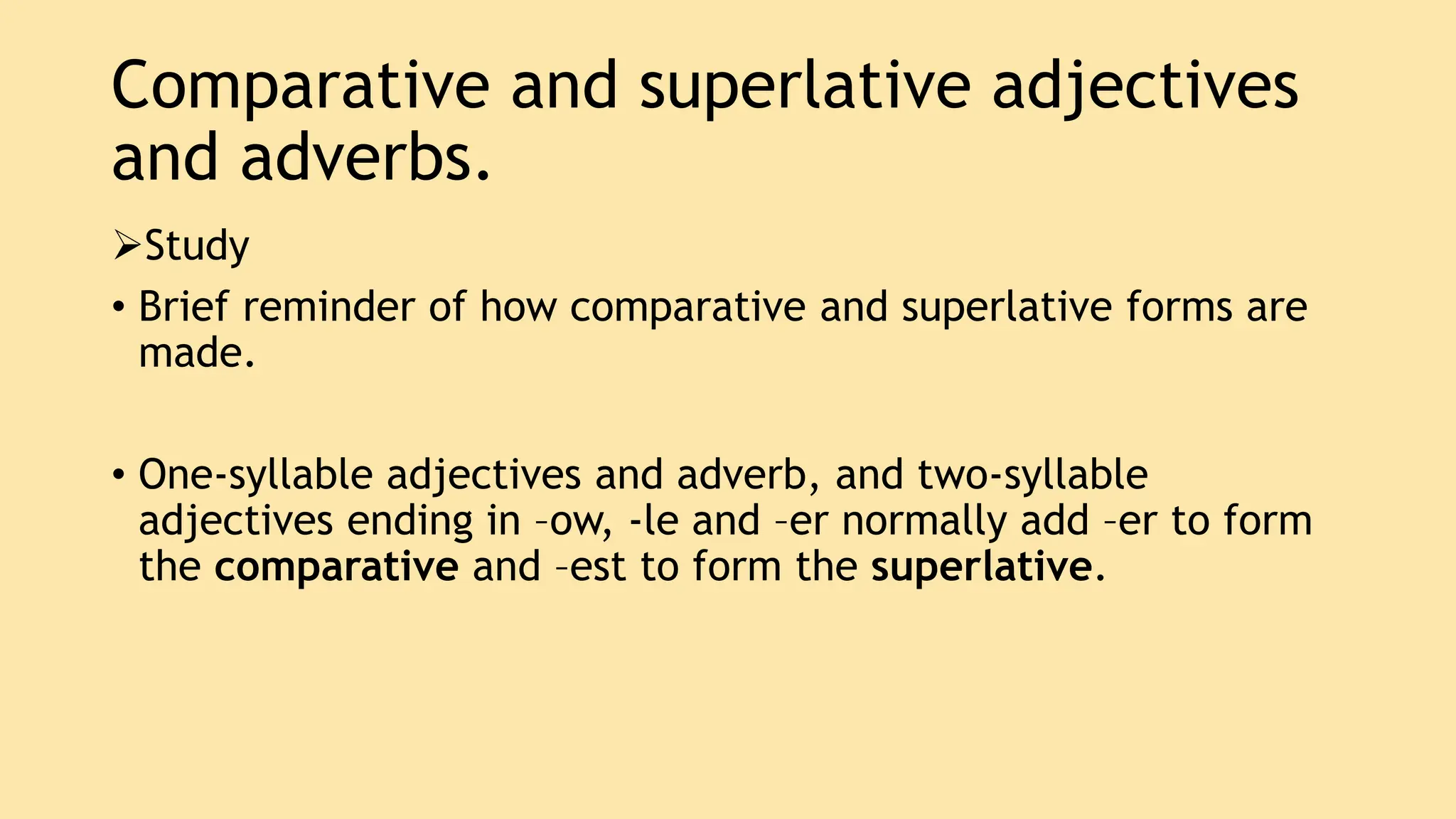
Comparative and superlative adjectives
and adverbs.
Study
• Brief reminder of how comparative and superlative forms are
made.
• One-syllable adjectives and adverb, and two-syllable
adjectives ending in –ow, -le and –er normally add –er to form
the comparative and –est to form the superlative.
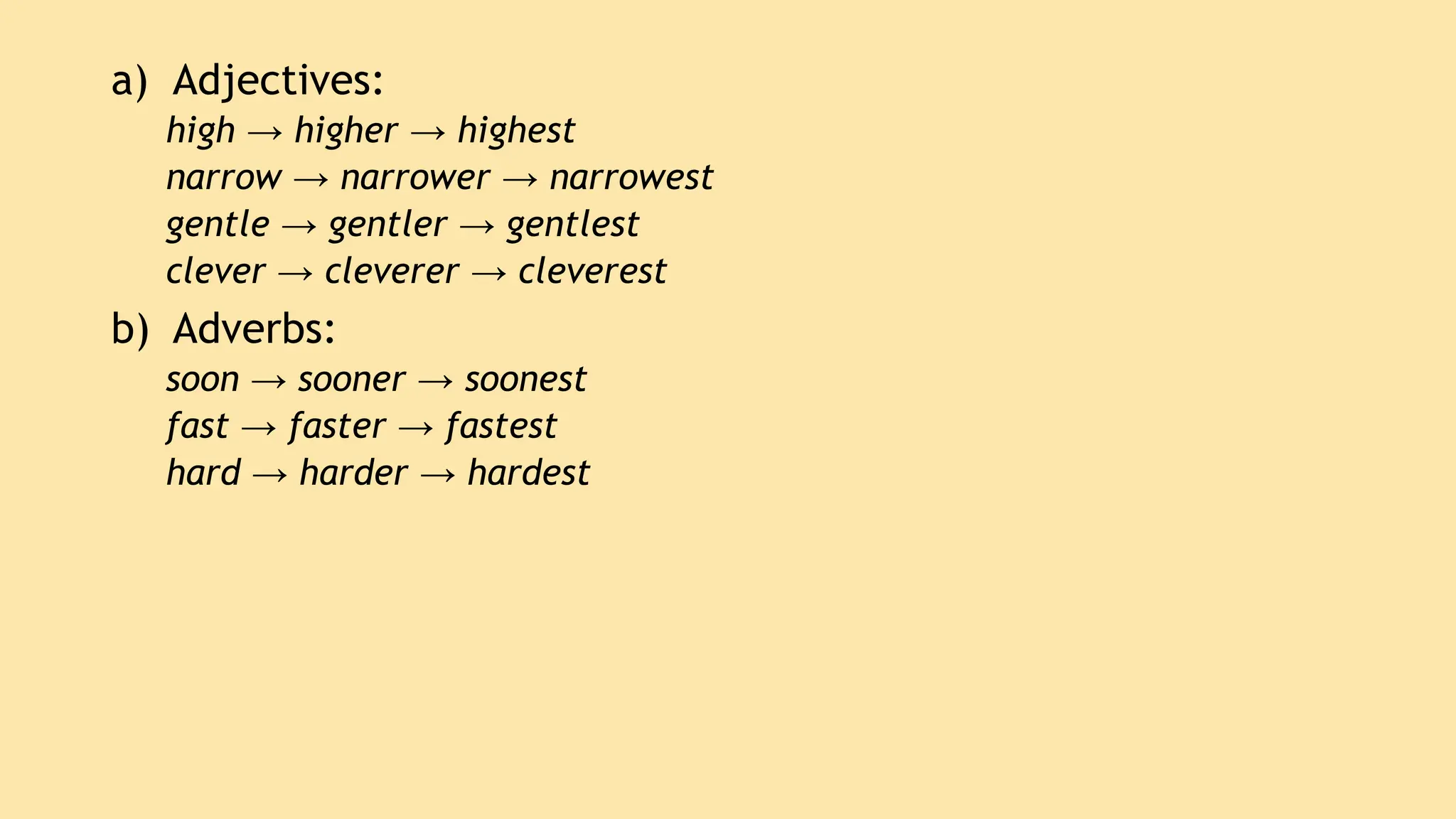
a) Adjectives:
high → higher → highest
narrow → narrower → narrowest
gentle → gentler → gentlest
clever → cleverer → cleverest
b) Adverbs:
soon → sooner → soonest
fast → faster → fastest
hard → harder → hardest
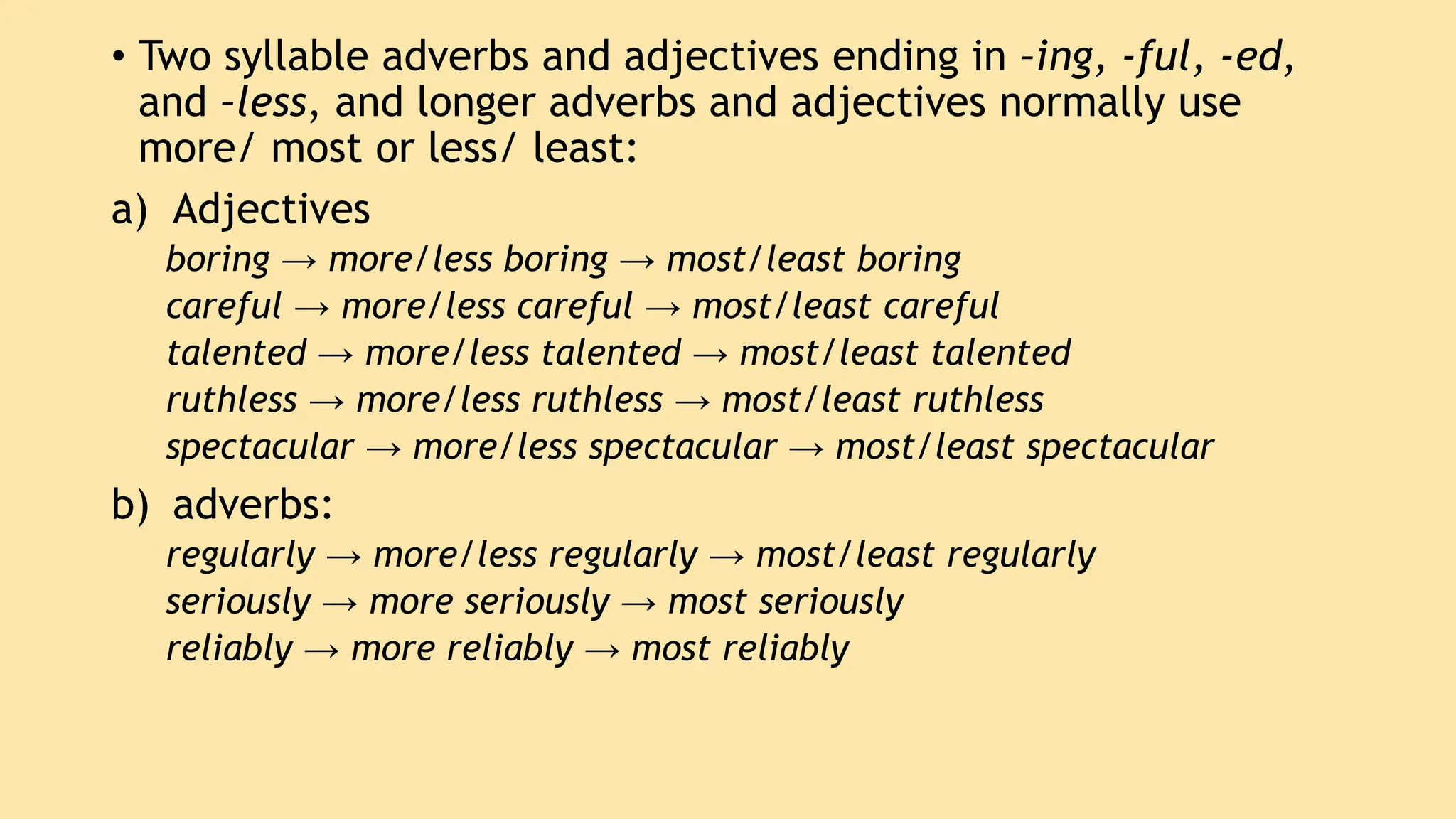
• Two syllable adverbs and adjectives ending in –ing, -ful, -ed,
and –less, and longer adverbs and adjectives normally use
more/ most or less/ least:
a) Adjectives
boring → more/less boring → most/least boring
careful → more/less careful → most/least careful
talented → more/less talented → most/least talented
ruthless → more/less ruthless → most/least ruthless
spectacular → more/less spectacular → most/least spectacular
b) adverbs:
regularly → more/less regularly → most/least regularly
seriously → more seriously → most seriously
reliably → more reliably → most reliably
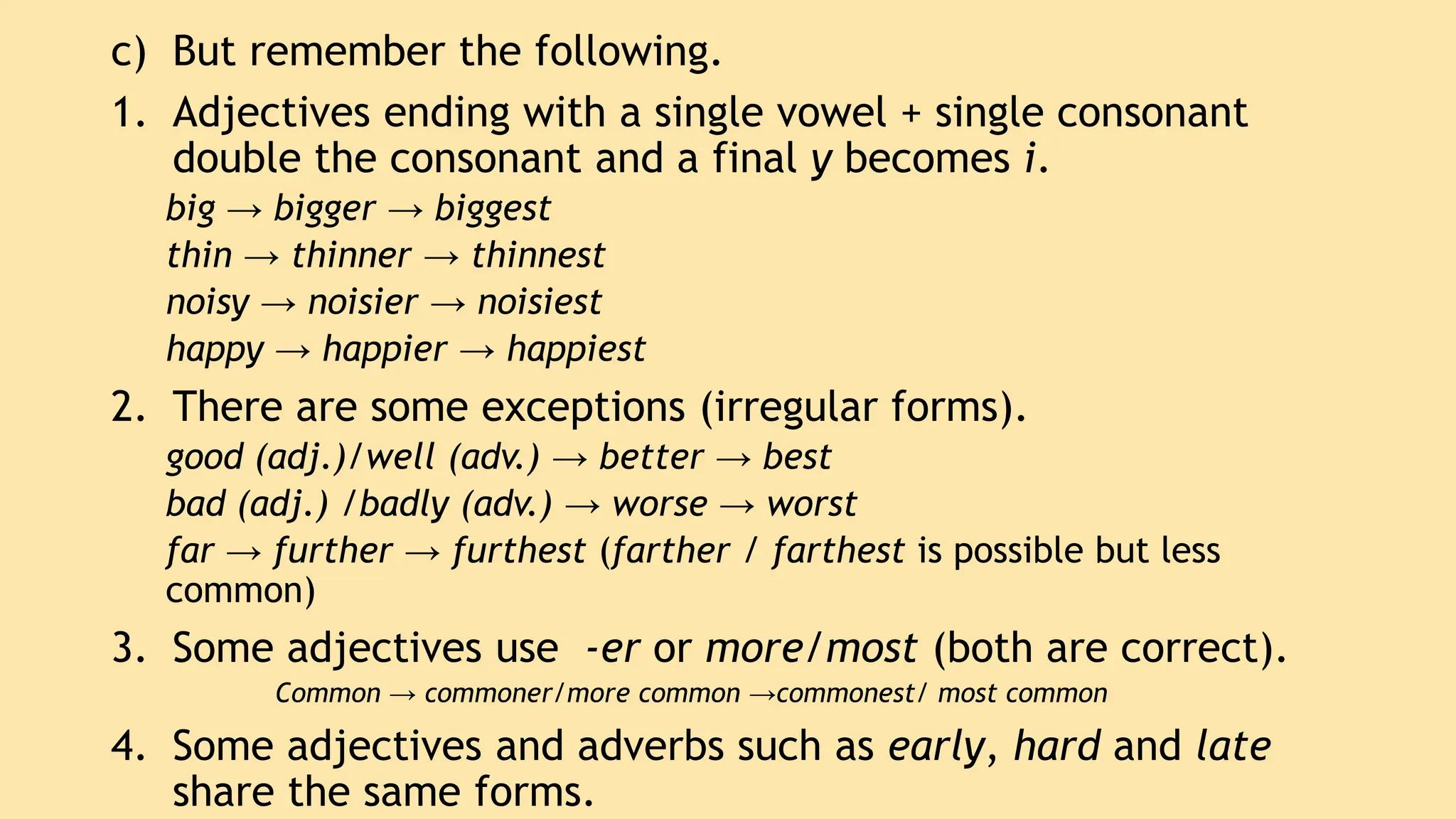
c) But remember the following.
1. Adjectives ending with a single vowel + single consonant
double the consonant and a final y becomes i.
big → bigger → biggest
thin → thinner → thinnest
noisy → noisier → noisiest
happy → happier → happiest
2. There are some exceptions (irregular forms).
good (adj.)/well (adv.) → better → best
bad (adj.) /badly (adv.) → worse → worst
far → further → furthest (farther / farthest is possible but less
common)
3. Some adjectives use -er or more/most (both are correct).
Common → commoner/more common →commonest/ most common
4. Some adjectives and adverbs such as early, hard and late
share the same forms.
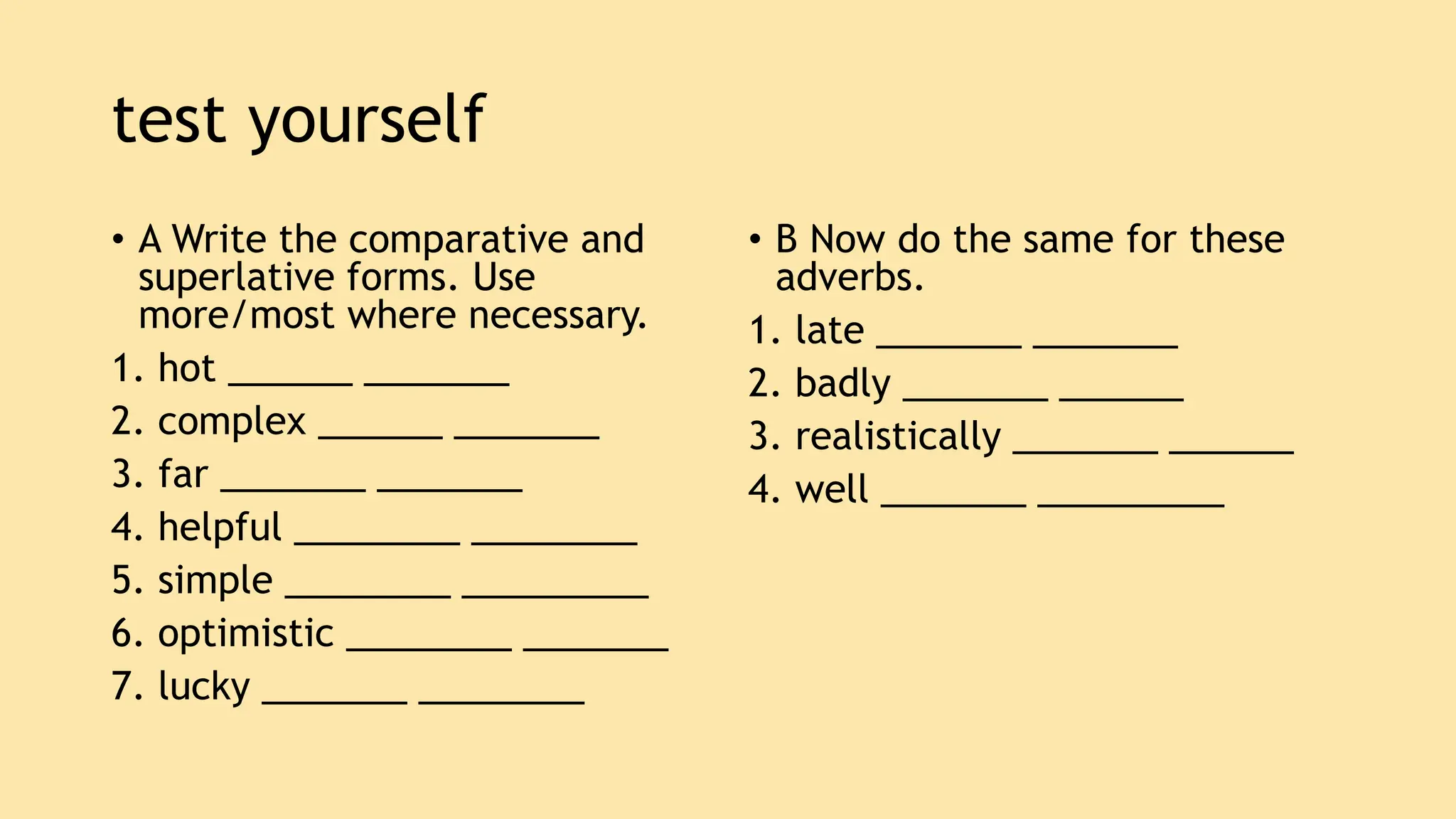
test yourself
• A Write the comparative and
superlative forms. Use
more/most where necessary.
1. hot ______ _______
2. complex ______ _______
3. far _______ _______
4. helpful ________ ________
5. simple ________ _________
6. optimistic ________ _______
7. lucky _______ ________
• B Now do the same for these
adverbs.
1. late _______ _______
2. badly _______ ______
3. realistically _______ ______
4. well _______ _________
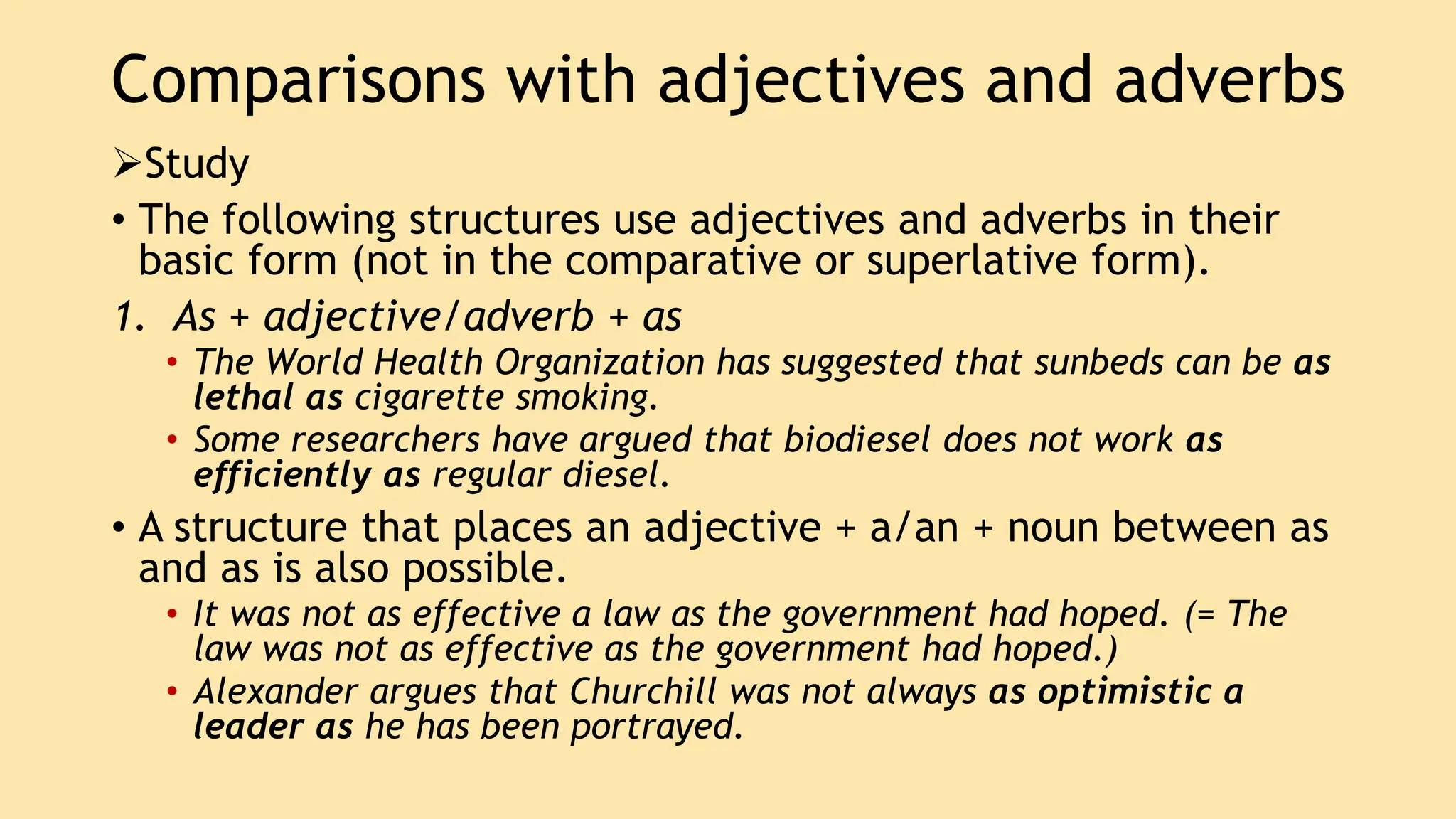
Comparisons with adjectives and adverbs
Study
• The following structures use adjectives and adverbs in their
basic form (not in the comparative or superlative form).
1. As + adjective/adverb + as
• The World Health Organization has suggested that sunbeds can be as
lethal as cigarette smoking.
• Some researchers have argued that biodiesel does not work as
efficiently as regular diesel.
• A structure that places an adjective + a/an + noun between as
and as is also possible.
• It was not as effective a law as the government had hoped. (= The
law was not as effective as the government had hoped.)
• Alexander argues that Churchill was not always as optimistic a
leader as he has been portrayed.
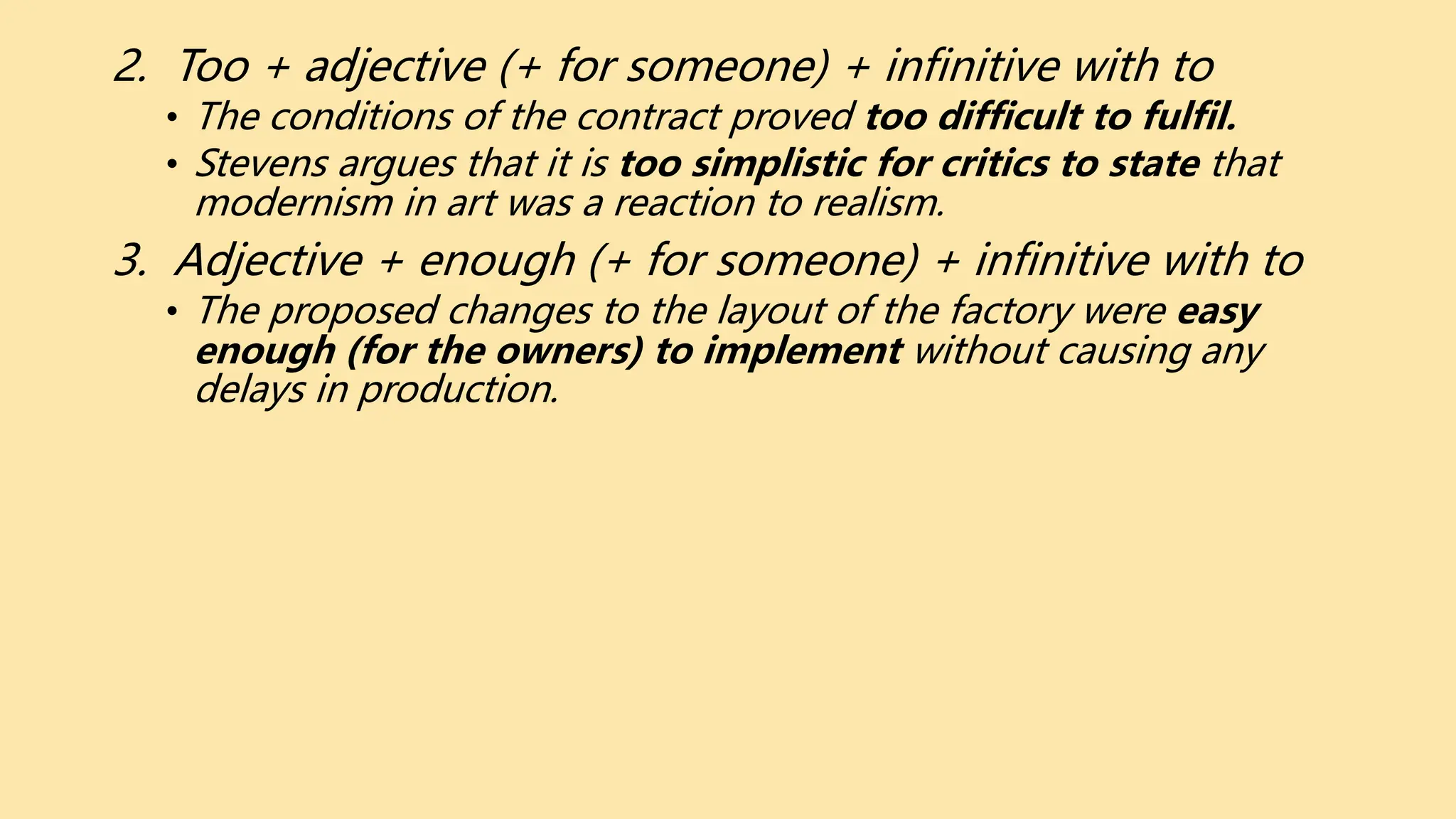
2. Too + adjective (+ for someone) + infinitive with to
• The conditions of the contract proved too difficult to fulfil.
• Stevens argues that it is too simplistic for critics to state that
modernism in art was a reaction to realism.
3. Adjective + enough (+ for someone) + infinitive with to
• The proposed changes to the layout of the factory were easy
enough (for the owners) to implement without causing any
delays in production.
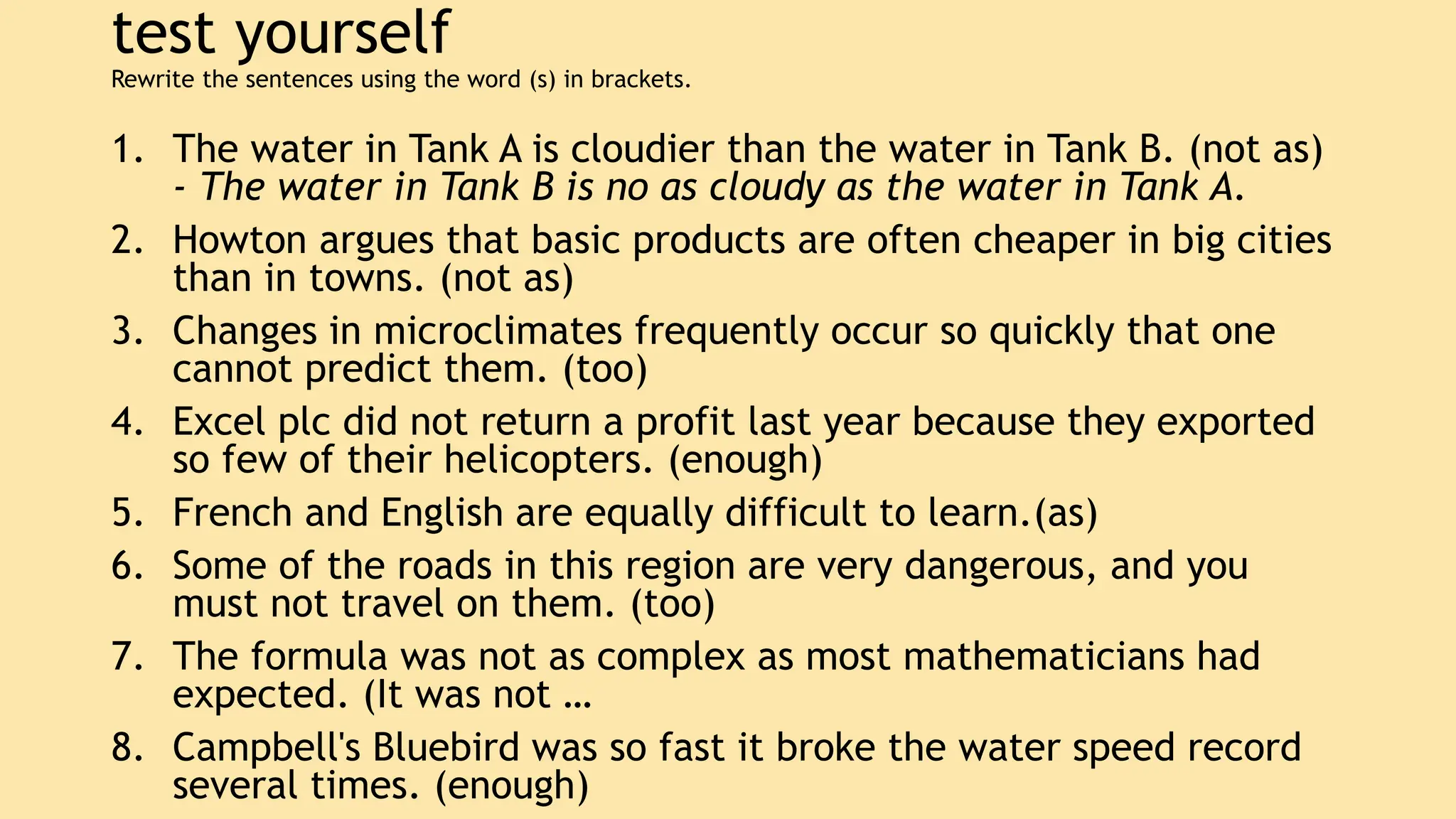
test yourself
Rewrite the sentences using the word (s) in brackets.
1. The water in Tank A is cloudier than the water in Tank B. (not as)
- The water in Tank B is no as cloudy as the water in Tank A.
2. Howton argues that basic products are often cheaper in big cities
than in towns. (not as)
3. Changes in microclimates frequently occur so quickly that one
cannot predict them. (too)
4. Excel plc did not return a profit last year because they exported
so few of their helicopters. (enough)
5. French and English are equally difficult to learn.(as)
6. Some of the roads in this region are very dangerous, and you
must not travel on them. (too)
7. The formula was not as complex as most mathematicians had
expected. (It was not …
8. Campbell's Bluebird was so fast it broke the water speed record
several times. (enough)
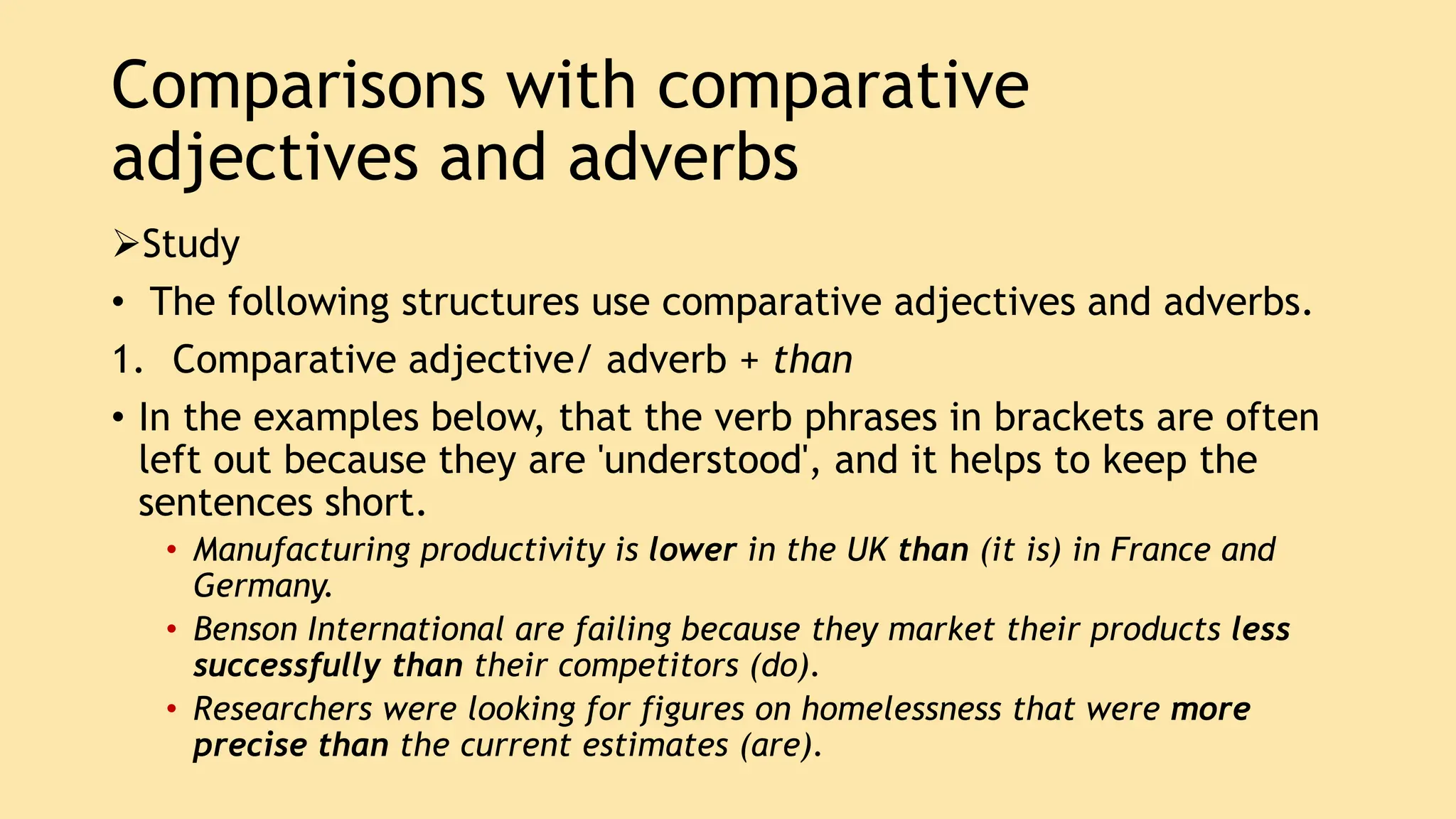
Comparisons with comparative
adjectives and adverbs
Study
• The following structures use comparative adjectives and adverbs.
1. Comparative adjective/ adverb + than
• In the examples below, that the verb phrases in brackets are often
left out because they are 'understood', and it helps to keep the
sentences short.
• Manufacturing productivity is lower in the UK than (it is) in France and
Germany.
• Benson International are failing because they market their products less
successfully than their competitors (do).
• Researchers were looking for figures on homelessness that were more
precise than the current estimates (are).
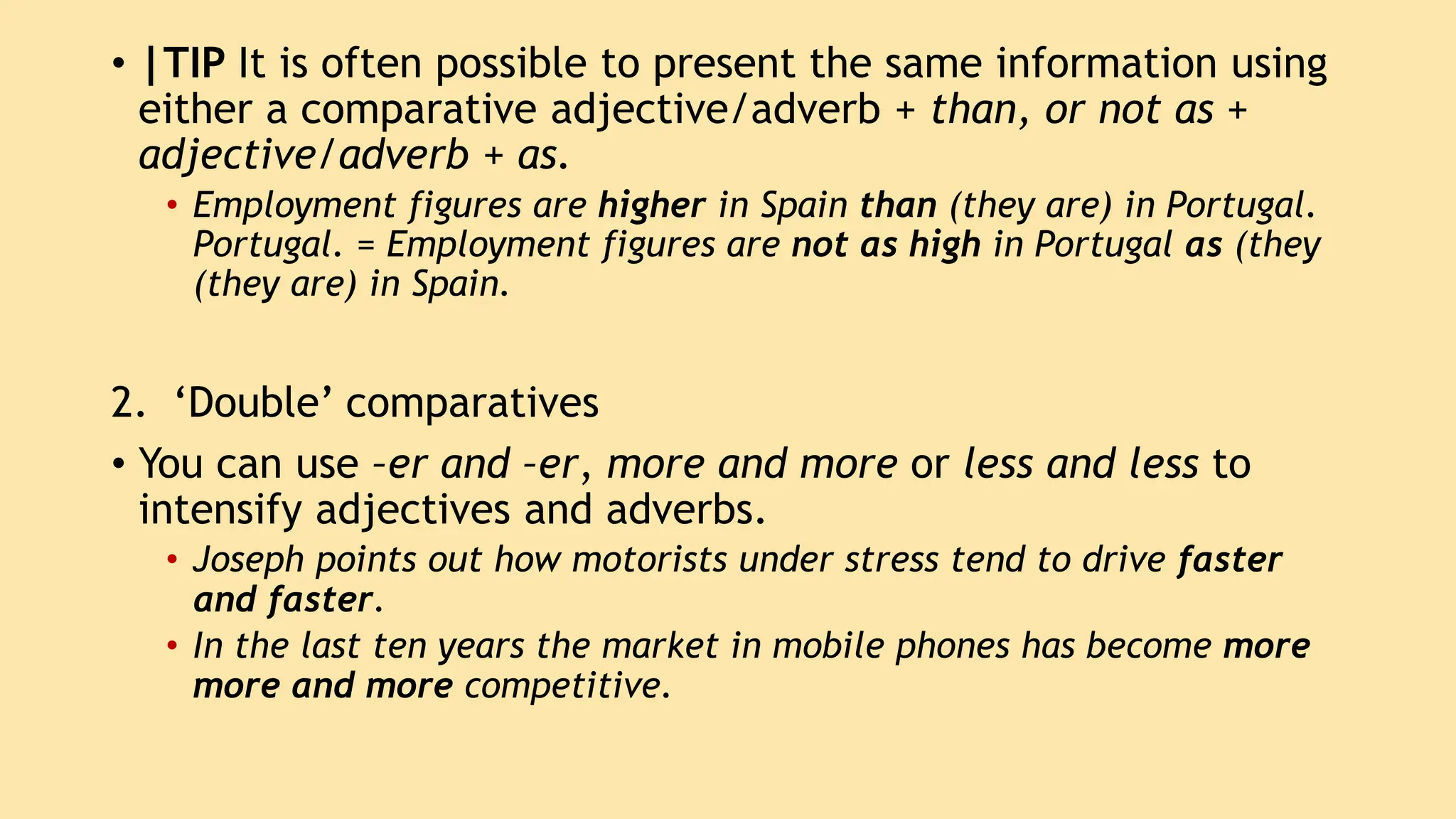
• |TIP It is often possible to present the same information using
either a comparative adjective/adverb + than, or not as +
adjective/adverb + as.
• Employment figures are higher in Spain than (they are) in Portugal.
Portugal. = Employment figures are not as high in Portugal as (they
(they are) in Spain.
2. ‘Double’ comparatives
• You can use –er and –er, more and more or less and less to
intensify adjectives and adverbs.
• Joseph points out how motorists under stress tend to drive faster
and faster.
• In the last ten years the market in mobile phones has become more
more and more competitive.
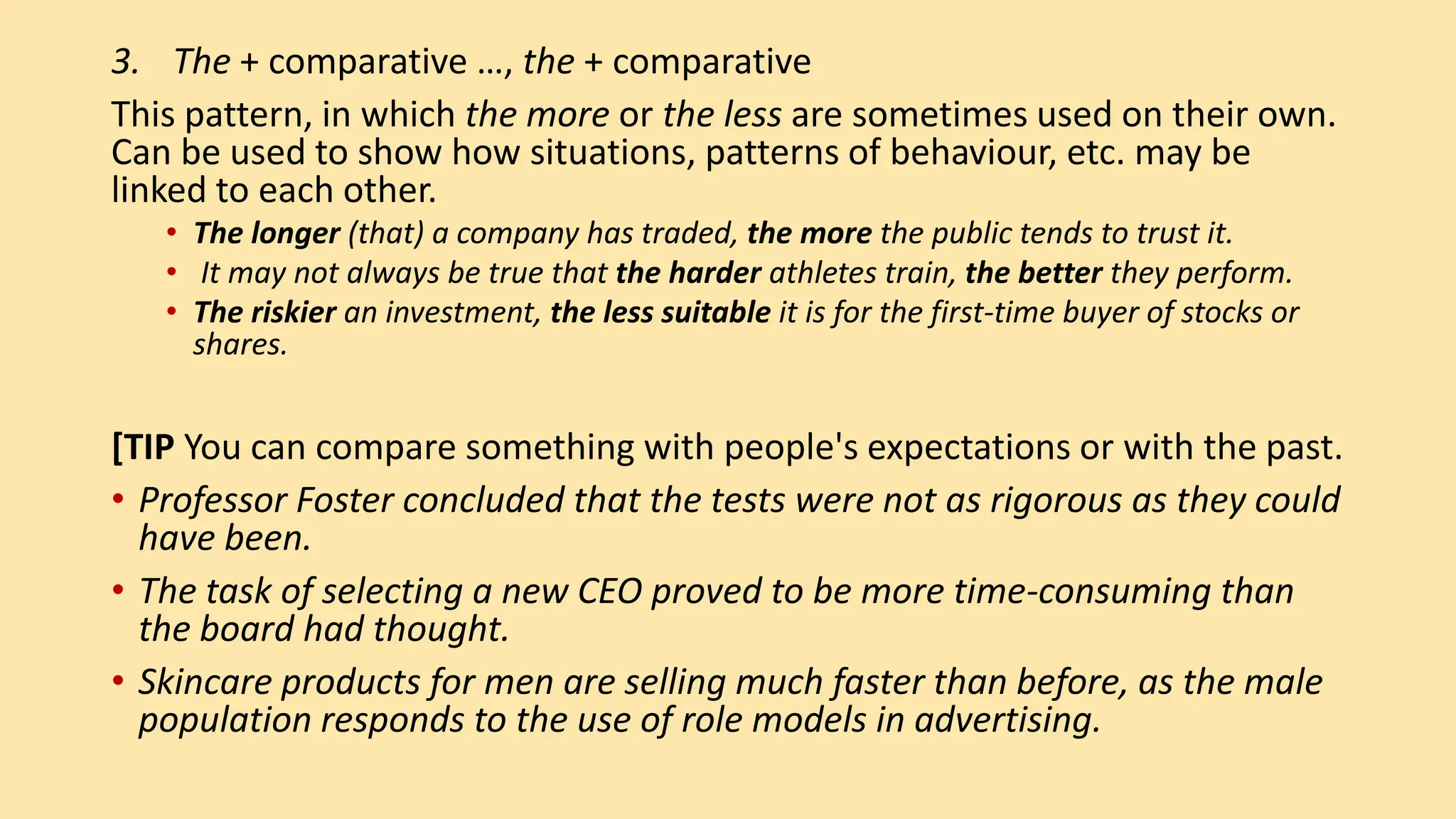
3. The + comparative …, the + comparative
This pattern, in which the more or the less are sometimes used on their own.
Can be used to show how situations, patterns of behaviour, etc. may be
linked to each other.
• The longer (that) a company has traded, the more the public tends to trust it.
• It may not always be true that the harder athletes train, the better they perform.
• The riskier an investment, the less suitable it is for the first-time buyer of stocks or
shares.
[TIP You can compare something with people's expectations or with the past.
• Professor Foster concluded that the tests were not as rigorous as they could
have been.
• The task of selecting a new CEO proved to be more time-consuming than
the board had thought.
• Skincare products for men are selling much faster than before, as the male
population responds to the use of role models in advertising.
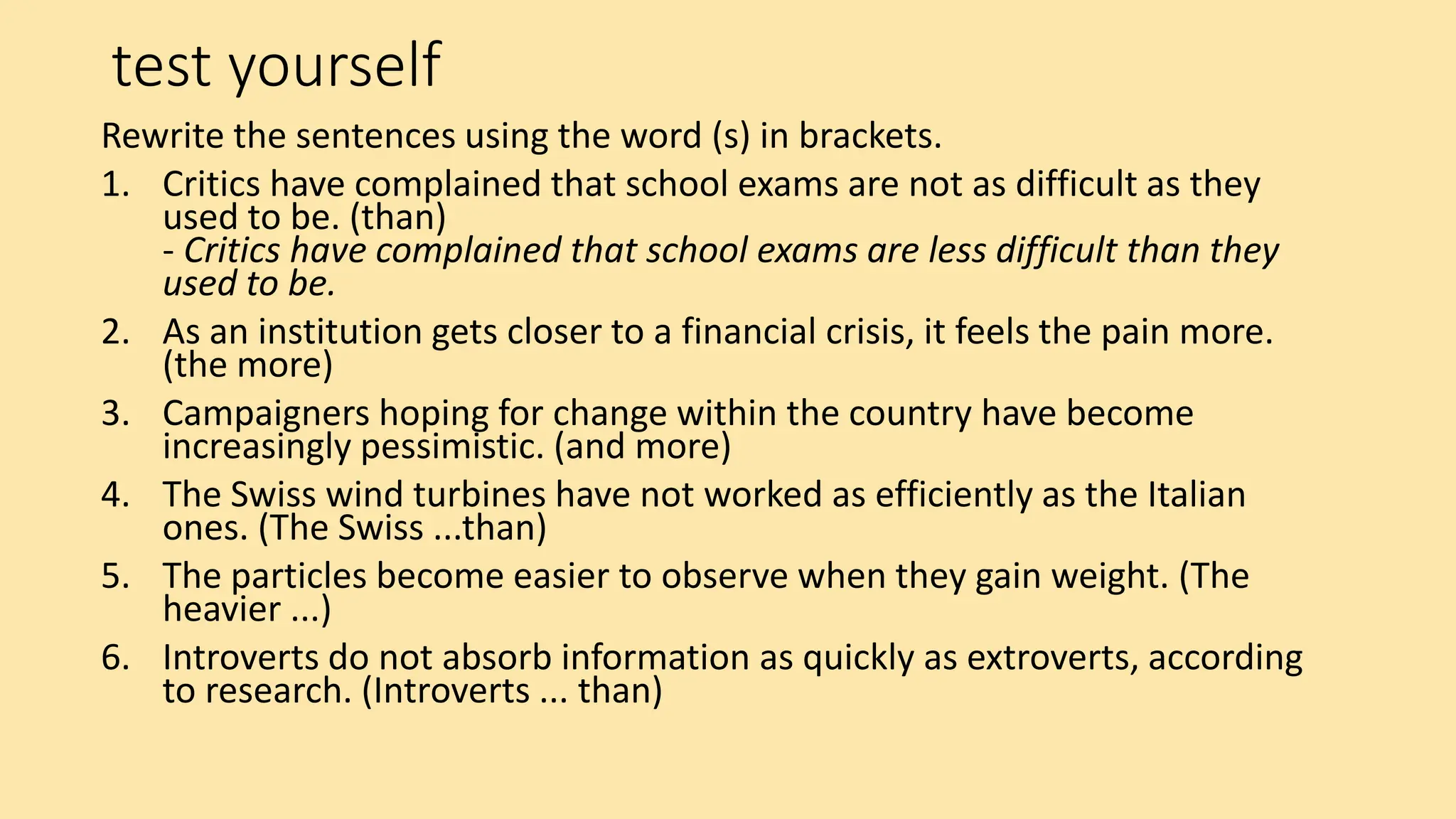
test yourself
Rewrite the sentences using the word (s) in brackets.
1. Critics have complained that school exams are not as difficult as they
used to be. (than)
- Critics have complained that school exams are less difficult than they
used to be.
2. As an institution gets closer to a financial crisis, it feels the pain more.
(the more)
3. Campaigners hoping for change within the country have become
increasingly pessimistic. (and more)
4. The Swiss wind turbines have not worked as efficiently as the Italian
ones. (The Swiss ...than)
5. The particles become easier to observe when they gain weight. (The
heavier ...)
6. Introverts do not absorb information as quickly as extroverts, according
to research. (Introverts ... than)

Comparing and contrasting English grammar

  • 1.
  • 2.
    Comparative and superlativeadjectives and adverbs. Study • Brief reminder of how comparative and superlative forms are made. • One-syllable adjectives and adverb, and two-syllable adjectives ending in –ow, -le and –er normally add –er to form the comparative and –est to form the superlative.
  • 3.
    a) Adjectives: high →higher → highest narrow → narrower → narrowest gentle → gentler → gentlest clever → cleverer → cleverest b) Adverbs: soon → sooner → soonest fast → faster → fastest hard → harder → hardest
  • 4.
    • Two syllableadverbs and adjectives ending in –ing, -ful, -ed, and –less, and longer adverbs and adjectives normally use more/ most or less/ least: a) Adjectives boring → more/less boring → most/least boring careful → more/less careful → most/least careful talented → more/less talented → most/least talented ruthless → more/less ruthless → most/least ruthless spectacular → more/less spectacular → most/least spectacular b) adverbs: regularly → more/less regularly → most/least regularly seriously → more seriously → most seriously reliably → more reliably → most reliably
  • 5.
    c) But rememberthe following. 1. Adjectives ending with a single vowel + single consonant double the consonant and a final y becomes i. big → bigger → biggest thin → thinner → thinnest noisy → noisier → noisiest happy → happier → happiest 2. There are some exceptions (irregular forms). good (adj.)/well (adv.) → better → best bad (adj.) /badly (adv.) → worse → worst far → further → furthest (farther / farthest is possible but less common) 3. Some adjectives use -er or more/most (both are correct). Common → commoner/more common →commonest/ most common 4. Some adjectives and adverbs such as early, hard and late share the same forms.
  • 6.
    test yourself • AWrite the comparative and superlative forms. Use more/most where necessary. 1. hot ______ _______ 2. complex ______ _______ 3. far _______ _______ 4. helpful ________ ________ 5. simple ________ _________ 6. optimistic ________ _______ 7. lucky _______ ________ • B Now do the same for these adverbs. 1. late _______ _______ 2. badly _______ ______ 3. realistically _______ ______ 4. well _______ _________
  • 7.
    Comparisons with adjectivesand adverbs Study • The following structures use adjectives and adverbs in their basic form (not in the comparative or superlative form). 1. As + adjective/adverb + as • The World Health Organization has suggested that sunbeds can be as lethal as cigarette smoking. • Some researchers have argued that biodiesel does not work as efficiently as regular diesel. • A structure that places an adjective + a/an + noun between as and as is also possible. • It was not as effective a law as the government had hoped. (= The law was not as effective as the government had hoped.) • Alexander argues that Churchill was not always as optimistic a leader as he has been portrayed.
  • 8.
    2. Too +adjective (+ for someone) + infinitive with to • The conditions of the contract proved too difficult to fulfil. • Stevens argues that it is too simplistic for critics to state that modernism in art was a reaction to realism. 3. Adjective + enough (+ for someone) + infinitive with to • The proposed changes to the layout of the factory were easy enough (for the owners) to implement without causing any delays in production.
  • 9.
    test yourself Rewrite thesentences using the word (s) in brackets. 1. The water in Tank A is cloudier than the water in Tank B. (not as) - The water in Tank B is no as cloudy as the water in Tank A. 2. Howton argues that basic products are often cheaper in big cities than in towns. (not as) 3. Changes in microclimates frequently occur so quickly that one cannot predict them. (too) 4. Excel plc did not return a profit last year because they exported so few of their helicopters. (enough) 5. French and English are equally difficult to learn.(as) 6. Some of the roads in this region are very dangerous, and you must not travel on them. (too) 7. The formula was not as complex as most mathematicians had expected. (It was not … 8. Campbell's Bluebird was so fast it broke the water speed record several times. (enough)
  • 10.
    Comparisons with comparative adjectivesand adverbs Study • The following structures use comparative adjectives and adverbs. 1. Comparative adjective/ adverb + than • In the examples below, that the verb phrases in brackets are often left out because they are 'understood', and it helps to keep the sentences short. • Manufacturing productivity is lower in the UK than (it is) in France and Germany. • Benson International are failing because they market their products less successfully than their competitors (do). • Researchers were looking for figures on homelessness that were more precise than the current estimates (are).
  • 11.
    • |TIP Itis often possible to present the same information using either a comparative adjective/adverb + than, or not as + adjective/adverb + as. • Employment figures are higher in Spain than (they are) in Portugal. Portugal. = Employment figures are not as high in Portugal as (they (they are) in Spain. 2. ‘Double’ comparatives • You can use –er and –er, more and more or less and less to intensify adjectives and adverbs. • Joseph points out how motorists under stress tend to drive faster and faster. • In the last ten years the market in mobile phones has become more more and more competitive.
  • 12.
    3. The +comparative …, the + comparative This pattern, in which the more or the less are sometimes used on their own. Can be used to show how situations, patterns of behaviour, etc. may be linked to each other. • The longer (that) a company has traded, the more the public tends to trust it. • It may not always be true that the harder athletes train, the better they perform. • The riskier an investment, the less suitable it is for the first-time buyer of stocks or shares. [TIP You can compare something with people's expectations or with the past. • Professor Foster concluded that the tests were not as rigorous as they could have been. • The task of selecting a new CEO proved to be more time-consuming than the board had thought. • Skincare products for men are selling much faster than before, as the male population responds to the use of role models in advertising.
  • 13.
    test yourself Rewrite thesentences using the word (s) in brackets. 1. Critics have complained that school exams are not as difficult as they used to be. (than) - Critics have complained that school exams are less difficult than they used to be. 2. As an institution gets closer to a financial crisis, it feels the pain more. (the more) 3. Campaigners hoping for change within the country have become increasingly pessimistic. (and more) 4. The Swiss wind turbines have not worked as efficiently as the Italian ones. (The Swiss ...than) 5. The particles become easier to observe when they gain weight. (The heavier ...) 6. Introverts do not absorb information as quickly as extroverts, according to research. (Introverts ... than)