Soil Compaction in Alfalfa Fields
Ronald T. Schuler, Professor
Extension Agricultural Engineer
Biological Systems Engineering
University of Wisconsin-
Madison
Soil Compaction
• Causes include combinations of:
Wheel Traffic
Tillage
Precipitation
• Types
Surface
Subsoil
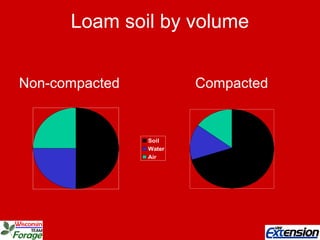
Loam soil by volume
Non-compacted Compacted
Soil
Water
Air
Compaction Issues
• Tires
 Size
 Inflation pressure
 Tire design, radial vs. bias
• Machinery
 Avoid wet soil
 Wheel alignment
 Machine selection

 Machine weight
Compaction Issues
• Tires
 Size
 Inflation pressure
 Tire design, radial vs. bias
• Machinery
 Avoid wet soil
 Wheel alignment
 Machine selection
 Machine weight
Contact Area-Size-Diameter
(Firestone)
Tire Size Tire Dia. Area(in2
)
Radial Tires Flat 3”Sinkage
18.4R34 65.1 320 720
18.4R38 69.0 340 740
18.4R42 73.0 350 760
18.4R46 77.0 365 780
Bias Tires
18.4-34 65.4 284 653
18.4-38 69.3 300 675
Contact Area-Size-Width
(Firestone)
Tire Size Tire Width Area(in2
)
Radial Tires Flat 3”Sinkage
16.9R38 16.9 255 660
18.4R38 18.4 340 740
20.8R38 20.8 390 870
Bias Tires
16.9-38 16.9 252 629
18.4-38 18.4 300 675
Compaction Issues
• Tires
 Size
 Inflation pressure
 Tire design, radial vs. bias
• Machinery
 Avoid wet soil
 Wheel alignment
 Machine selection
 Machine weight
6 psi18 psi
Impact of Tire Pressure
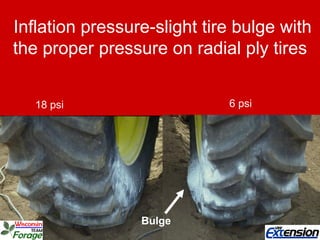
Inflation pressure-slight tire bulge with
the proper pressure on radial ply tires
18 psi 6 psi
Bulge
Top View: Measured soil-tire interface
stress (psi) distribution of an 18.4R38 tire
Compaction Issues
• Tires
 Size
 Inflation pressure
 Tire design, radial vs. bias ply
• Machinery
 Avoid wet soil
 Wheel alignment
 Machine selection
 Machine weight
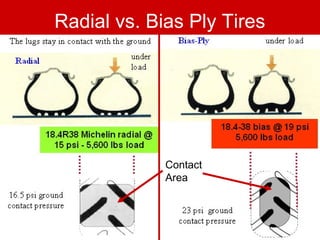
Radial vs. Bias Ply Tires
Contact
Area
At Proper Inflation Pressure, Radials
have greater Contact Area
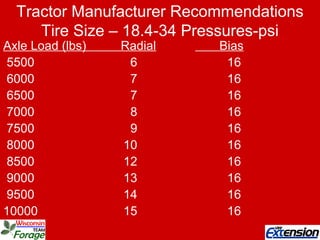
Tractor Manufacturer Recommendations
Tire Size – 18.4-34 Pressures-psi
Axle Load (lbs) Radial Bias
5500 6 16
6000 7 16
6500 7 16
7000 8 16
7500 9 16
8000 10 16
8500 12 16
9000 13 16
9500 14 16
10000 15 16
Compaction Issues
• Tires
 Size
 Inflation pressure
 Tire design, radial vs. bias
• Machinery
 Avoid wet soil
 Wheel alignment
 Machine selection
 Machine weight
Impact of soil moisture on compaction
(depth and sinkage)
Hard dry soil Normal Wet soil
0
4
8
12
16
20
24
28
Depth,
In.
Compaction Issues
• Tires
 Size
 Inflation pressure
 Tire design, radial vs.
bias
• Machinery
 Avoid wet soil
 Wheel alignment
 Machine selection
 Machine weight
Wheels should follow in same track
Wheel alignment-harvester and wagon
Wheel alignment-
tractor and wagon
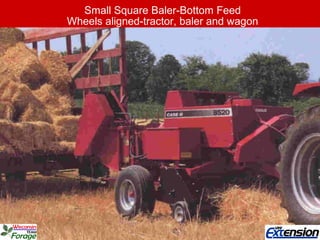
Small Square Baler-Bottom Feed
Wheels aligned-tractor, baler and wagon
Mid-Size Rectangular Baler
Wheels aligned-tractor and baler
Compaction Issues
• Tires
 Size
 Inflation pressure
 Tire design, radial vs.
bias
• Machinery
 Avoid wet soil
 Wheel alignment
 Machine selection
 Machine weight
Sickle Cutterbar-Roll
Conditioner
14-foot width
Self-propelled mower-conditioner
Front self unloading wagon
Wheel Alignment –harvester and wagon
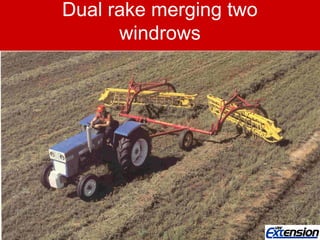
Dual rake merging two
windrows
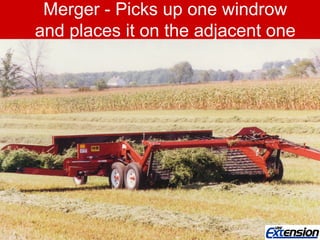
Merger - Picks up one windrow
and places it on the adjacent one
Merging three windrows into one
1
Mower-conditioner-pull or self-propelled
2
Mower conditioner width, feet
3
Rake-to rake, merge or do not rake two windrows together
4
Area covered by wheel traffic if uniformly distributed
5
T-M/A – ton miles per acre
System Comparisons-three cuttings per year
Type1
Width2
(ft) Rake3
Area4
T-M/A5
Pull 13 None 4.0 50
Pull 16 None 3.4 44
Pull 13 Rake 3.2 35
Pull 16 Rake 2.7 33
Self-Prop 16 Rake 3.1 32
Self-Prop 16 Merge 3.0 32
Pull 13 Merge 3.4 37
Self-Prop 13 Merge(Dbl) 2.8 27
Self-Prop 16 Merge(Dbl) 2.3 32
Compaction Issues
• Tires
 Size
 Inflation pressure
 Tire design, radial vs. bias
• Machinery
 Avoid wet soil
 Wheel alignment
 Machine selection
 Machine weight
Tractor ballasting criteria
Towed Load wt. vs. Max.Speed
Towing machine wt. mph
1 to 1 20
2 to 1 10
More than 2 to 1 Do not tow
Concluding Remarks
 Select appropriate tire
 Use proper tire pressure
 Align wheels
 Reduce traffic of large equipment
 Use safe towing machine weight
The End

Compaction schuler3 06

Editor's Notes

  • #2 When harvesting alfalfa forage, machines travel on the plants. Therefore wheel traffic characteristics are very important in minimizing soil compaction and damage to the forage stand. This presentation provides some background on soil compaction and some opportunities for forage producers to minimize the impact of wheel traffic.
  • #3 This photo exhibits the impact of wheel traffic on plant emergence although the crop is not a forage. Note wheel tracks reducing plant populations
  • #4 A background on the causes and types of compaction will provide a better understanding of the solutions for minimizing soil compaction due to tillage and wheel traffic. The primary focus in this presentation will be wheel traffic.
  • #5 The ideal loam soil by volume is 50 percent soil particles, 25 percent moisture and 25 percent air or about 50 percent voids, left pie chart. When soil becomes compacted the soil particles occupy a larger portion of the volume as the voids are decreased in size. In the example, right pie chart, the soil is 70 percent of the volume, while the air and water each occupy 15 percent of the volume. This has the effect of reducing water holding capacity. It also results in the soil becoming saturated more quickly.
  • #6 Some degree of soil compaction is needed for optimum conditions. At planting time, the soil needs to be compacted around the seeds to insure good moisture transfer from the soil for germination. If the soil is too compacted, roots have greater difficulty penetrating the soil to insure good nutrient and water uptake.
  • #7 In managing the impact of forage harvesting operations on alfalfa, the forage producer should evaluate the tire characteristics and the machinery management and operation. Greater detail of the tire and machinery aspects will be discussed in the following slides.
  • #8 When selecting new equipment or replacing worn tires, the forage producer has an opportunity to select tires of a size that will reduce the impact of the wheel traffic directly on the growing crop. Effect of tire size is discussed in the next slide.
  • #9 The table provides data that demonstrates the impact of tire diameter on the tire’s contact area. A larger area of contact means the tire contact pressure in pounds per square inch will be less which reduces the impact of the wheel on the forage plants. The first number in tire size nomenclature indicates the tire width in inches and the second number is the rim diameter. (18.4 R34 has a width of 18.4 inches and a rim diameter of 34 inches and R indicates radial tires.) The tire diameter listed in the second column is the outside diameter. Note the contact area increases as the diameter increases for both cases on a flat surface and a surface where the tire is allowed to sink 3 inches. For the same size of tire, the radial tire will have a larger contact area than the bias ply tires. Radial tires are about 50 percent more expensive than bias ply tires.
  • #10 This table is similar to the preceding table except tire width is changing. The wider tires have greater contact area. Again radials have greater contact area than the bias ply tires.
  • #11 The tire inflation pressure has a direct relation to the tire contact pressure on the soil. The tire manufacturers have tire pressure recommendations based on the load carried by the tire. Note the pressure tables will be very different between the radial and bias ply tires.
  • #12 A test was performed in the outdoor soil bins in 1993 at the USDA Soil Dynamics Laboratory that illustrates the difference that inflation pressure can make. Close up view the tires at the soil surface appears on the slide.
  • #13 These photos are a close up view of the two tires from the preceding slide. Notice the relatively straight sidewall when the inflation pressure is excessively maintained at 18 psi. For 6 psi, the tire has a bulge at the bottom and the tire is deflecting more. This will result in greater contact area.
  • #14 Figure shows the pressure on the soil surface created by the tires traveling from top to bottom of the figure-you are viewing from above the tire looking through the tire Both tires are carrying the same load-weight Left tire is properly inflated at 6 psi-load dependent Right tire pressure at 18 psi which is too high Note large areas (brown & red color) exposed to pressures greater than 12 psi for the right tire(18 psi tire pressure) Also note larger area in contact with the soil surface
  • #15 Some of the differences between radial and bias tires has been shown. Another difference is the recommended pressure which is dependent on the load carried by the tire.
  • #16 This figure show the contact area (gray color zone) for the radial tires is much larger than the bias ply tires where both are carrying the same 5,600 pound load. The recommended pressure for this load is 16.5 psi for the radials and 23 psi for the bias tires.
  • #17 Again showing the larger contact area for the radial tires. Note the wider track pattern.
  • #18 This table demonstrates the lower recommended pressure for the radial tires compared to the bias tires. With lower tire pressure, a lower contact pressure occurs at the tire soil interface.
  • #19 Wet soil is more susceptible to being compacted. Wet soils should be avoided but sometimes that is impossible while maintaining profitable production.
  • #20 This figure shows the pressure distribution in the soil for three soil moisture conditions. Note how the pressure penetrates deeper into the soil the wetter the soil. On hard dry soil the pressure distribution is as deep as about 18 inches and on the wet soil it is 24 inches. Also there is greater sinkage of the tire on the wet soil causing greater damage to the forage plants. Is there a pressure threshhold that causes compaction? Make text on red slide background yellow or white for contrast and ease of reading. I put a white fill background on the UW Extension logo. Consider that for the other logos. Should the Team Forage logo be on this set also? I inserted one here for you to use. Not sure it fits on this slide but you can move to other slides from here if you want.
  • #21 Since harvesting involves numerous trips across the field, aligning the wheels on successive axles will reduce the area covered with wheel traffic (same wheel track). Soil compaction research indicate that about 80 percent of the compaction effects occur on the first of multiple passes of tires.
  • #22 For the self-propelled chopper, the harvester wheels and wagon wheels follow the same path/track.
  • #23 The wagon wheels follow in the same track as the tractor wheels. The forage harvester wheel will most likely not be aligned with the tractor and wagon wheels
  • #24 For some small square baling systems, the baler follows directly behind the tractor. This allows the tractor, baler and wagon wheels to follow in the same track.
  • #25 The mid-size and large square balers track directly behind the tractor which minimizes the area being covered by wheel traffic.
  • #26 Forage producers have numerous options in selecting equipment that impact the wheel traffic intensity.
  • #27 The impact of traffic on the forage crop is dependent on the number of times across the field and the equipment weight. Machine size impacts the wheel traffic intensity in a forage field. Wide machines have lower tire contact area than narrow machines but will have a greater weight.
  • #28 Comparing self-propelled mower-conditioner to pull-type, the self-propelled has fewer tires traveling across the field. For the same cutting width, the tractor and pull type mower conditioner system will have a greater weight than a self-propelled machine.
  • #29 For a pull type forage harvesting system, a minimum of 10 tires traffic the field for each cutting of the forage and only the tractor and wagon wheels follow the same path.
  • #30 With a self-propelled harvesting system eight wheels traffic the field for each cutting. Harvester and wagon wheels follow the same track.
  • #31 One method of reducing the intensity of the wheel traffic is to bring two windrows together to reduce traffic of the heavy harvesting in the field by 50 percent. The addition of the raking has less impact than the harvesting equipment because equipment is lower weight.
  • #32 Merging one windrow onto the adjacent windrow has an impact similar to the dual rake.
  • #33 Merging two windrows onto a third windrow reduces the traffic of the heavy harvesting equipment by 67 percent. For this combination of merger and harvesting equipment, the overall traffic passes is reduced by 33 percent. There are two passes for every three windrows. The previous system (single windrow) required two passes for every two windrows.
  • #34 This table compares several systems with respect to machine traffic. Comparisons that can be made include cutting width, pull vs. self-propelled mower-conditioners, and windrow handling (none, raking and merging). For chopping the same pull-type system was used. The traffic intensity was evaluated with respect to area and ton-miles per acre. The area is the area covered for three cuttings if the wheel traffic was uniformly distributed throughout the field. For example an area equal to 4.0 indicated the field would have been completely covered with wheel traffic if uniformly distributed. The ton-miles per acre were calculated by multiplying the machine weight times the distance traveled for each system to complete one acre. Forage boxes were considered half full on an average. Reviewing the data in the table, wider cutting widths and raking/merging reduce the wheel traffic intensity. Self-propelled has slight improvement over pull type mower-conditioner.
  • #35 Machine weight is important. Unnecessary tractor weight should be removed. Raking is a common field operation where minimal weight should be carried by the tractor. But when towing heavy equipment such as a forage chopper and wagon, some minimum weight is required for safe control of equipment.
  • #36 Table provides guidelines for tractor ballasting when pulling heavy loads. When the towed load and towing machine are of equal weight, the maximum speed is 20 mph. When the towed load weighs two times the towing machine, the speed limit is 10 miles an hour. This is important when towing the forage harvester and full forage box on the highway.