Community Citizenship
Prepared by: Mrs Joan M.
Torreres
Citizenship
- It refers to full membership on a community in which one lives, works, or
was born.
Three dimension of citizenship
1. Legal dimension- a citizen refers to a person who enjoys civil (freedom of
speech and right to own property, political (right to vote and hold public
office), and social rights( right to education, health, and social security).
No 3D Model? No Problem!
Political dimension- a citizen refers to a person who is a political agent
and is actively partipating in society’s political institution and system.
Identity dimension- a citizen is considered a member of political
community (nation-state) that actively shapes his or her cultural identity.
Here, a citizen is expected to demonstrate national pride, loyalty, and love
for his or her own country.
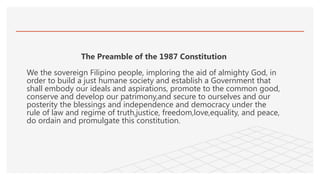
The Preamble of the 1987 Constitution
We the sovereign Filipino people, imploring the aid of almighty God, in
order to build a just humane society and establish a Government that
shall embody our ideals and aspirations, promote to the common good,
conserve and develop our patrimony,and secure to ourselves and our
posterity the blessings and independence and democracy under the
rule of law and regime of truth,justice, freedom,love,equality, and peace,
do ordain and promulgate this constitution.
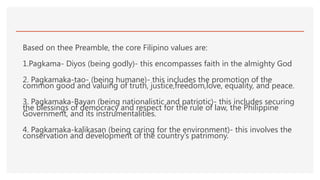
Based on thee Preamble, the core Filipino values are:
1.Pagkama- Diyos (being godly)- this encompasses faith in the almighty God
2. Pagkamaka-tao- (being humane)- this includes the promotion of the
common good and valuing of truth, justice,freedom,love, equality, and peace.
3. Pagkamaka-Bayan (being nationalistic and patriotic)- this includes securing
the blessings of democracy and respect for the rule of law, the Philippine
Government, and its instrumentalities.
4. Pagkamaka-kalikasan (being caring for the environment)- this involves the
conservation and development of the country’s patrimony.
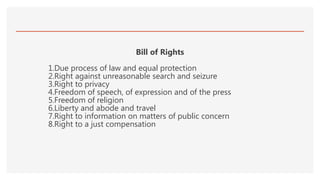
Bill of Rights
1.Due process of law and equal protection
2.Right against unreasonable search and seizure
3.Right to privacy
4.Freedom of speech, of expression and of the press
5.Freedom of religion
6.Liberty and abode and travel
7.Right to information on matters of public concern
8.Right to a just compensation

Community Citizenship- powerpoint presebtation

  • 1.
  • 2.
    Citizenship - It refersto full membership on a community in which one lives, works, or was born. Three dimension of citizenship 1. Legal dimension- a citizen refers to a person who enjoys civil (freedom of speech and right to own property, political (right to vote and hold public office), and social rights( right to education, health, and social security).
  • 3.
    No 3D Model?No Problem! Political dimension- a citizen refers to a person who is a political agent and is actively partipating in society’s political institution and system.
  • 4.
    Identity dimension- acitizen is considered a member of political community (nation-state) that actively shapes his or her cultural identity. Here, a citizen is expected to demonstrate national pride, loyalty, and love for his or her own country.
  • 5.
    The Preamble ofthe 1987 Constitution We the sovereign Filipino people, imploring the aid of almighty God, in order to build a just humane society and establish a Government that shall embody our ideals and aspirations, promote to the common good, conserve and develop our patrimony,and secure to ourselves and our posterity the blessings and independence and democracy under the rule of law and regime of truth,justice, freedom,love,equality, and peace, do ordain and promulgate this constitution.
  • 6.
    Based on theePreamble, the core Filipino values are: 1.Pagkama- Diyos (being godly)- this encompasses faith in the almighty God 2. Pagkamaka-tao- (being humane)- this includes the promotion of the common good and valuing of truth, justice,freedom,love, equality, and peace. 3. Pagkamaka-Bayan (being nationalistic and patriotic)- this includes securing the blessings of democracy and respect for the rule of law, the Philippine Government, and its instrumentalities. 4. Pagkamaka-kalikasan (being caring for the environment)- this involves the conservation and development of the country’s patrimony.
  • 7.
    Bill of Rights 1.Dueprocess of law and equal protection 2.Right against unreasonable search and seizure 3.Right to privacy 4.Freedom of speech, of expression and of the press 5.Freedom of religion 6.Liberty and abode and travel 7.Right to information on matters of public concern 8.Right to a just compensation

Editor's Notes

  • #2 A citizen in this context, also has the right to invoke protection by the law
  • #3 As a political agent, the citizen is expected to participate in influencing the behavior of political decision-makers, in the crafting of laws and policies, and encouraging other citizens to promote the common good.
  • #4 These dimension of citizenship fuel one another. The legal dimension of citizenship, through its provision of political rights, provides the basis for political participation participation stressed under the political dimension. Political dimension, in turn, strengthens and shapes national identity having a strong sense of national identity likewise inspires citizens to recognize and assert their rights. In the said dimensions, it is emphasized and is expected froem citizen to know his or her rigts.
  • #5 In the Philippines every Filipino is expected to be a good citizen based on core Filipino values that are considered integral components in nation building. The core Filipino values can be delivered from the preamble of the 1987 constitution, which states that:
  • #7 Another central feature of the Philippine constitution is the bill of rights. The bill of rights enumerates the filipino people’s basic rights and liberties, which no one, even government, is allowed to violate. Some of the rights grsnted by the constitution are the following: