Creating An EffectiveAnti-HarassmentPolicyPresented By:Diane Garcia-BeckerCombining Content, Argument, and Structure in The Workplace
What is Workplace HarassmentWorkplace harassment is any unwelcome or unwanted conduct that degrades or shows hostility or an aversion toward another person on the basis of any characteristic  that is protected by law, which includes  race, color, gender, ethnic or national origin, age, religion, disability, marital status, sexual orientation, gender identity, or any other personal characteristic protected by law.
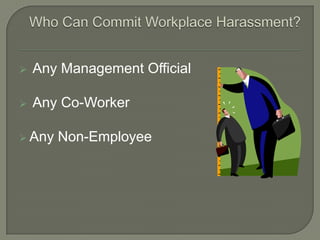
A conduct is unwelcome if the employee did not solicit, instigate or provoke it, and the employee regarded the conduct as undesirable or offensive.Who Can Commit Workplace Harassment? Any Management Official
 Any Co-Worker
Any Non-Employee		How can an employee make sure that his or her conduct is appropriate at all times?Avoid behaviors that degrade, humiliate, abuse or shows disrespect towards any individual.
Be familiar with remarks or gestures that seem acceptable to some people  but may be embarrassing or insulting to or unwanted by others.
Consider how you would respond if the same behavior were directed toward your spouse or family member.
Ask yourself whether you would act the same way in front of your spouse, significant other, or child.
Ask yourself how you would feel if your behavior were captured on video, reported in a newspaper, or featured on the nightly news.Establishing an Effective Anti-Harassment PolicyA policy should be written and well disseminated

Communication Skills Professional Work Sample Psy492

  • 1.
    Creating An EffectiveAnti-HarassmentPolicyPresentedBy:Diane Garcia-BeckerCombining Content, Argument, and Structure in The Workplace
  • 2.
    What is WorkplaceHarassmentWorkplace harassment is any unwelcome or unwanted conduct that degrades or shows hostility or an aversion toward another person on the basis of any characteristic that is protected by law, which includes  race, color, gender, ethnic or national origin, age, religion, disability, marital status, sexual orientation, gender identity, or any other personal characteristic protected by law.
  • 3.
    A conduct isunwelcome if the employee did not solicit, instigate or provoke it, and the employee regarded the conduct as undesirable or offensive.Who Can Commit Workplace Harassment? Any Management Official
  • 4.
  • 5.
    Any Non-Employee How canan employee make sure that his or her conduct is appropriate at all times?Avoid behaviors that degrade, humiliate, abuse or shows disrespect towards any individual.
  • 6.
    Be familiar withremarks or gestures that seem acceptable to some people but may be embarrassing or insulting to or unwanted by others.
  • 7.
    Consider how youwould respond if the same behavior were directed toward your spouse or family member.
  • 8.
    Ask yourself whetheryou would act the same way in front of your spouse, significant other, or child.
  • 9.
    Ask yourself howyou would feel if your behavior were captured on video, reported in a newspaper, or featured on the nightly news.Establishing an Effective Anti-Harassment PolicyA policy should be written and well disseminated

Editor's Notes

  • #2 “A forceful style starts with correct, concise use of the language: accurate grammar, precise words, well-built sentences and paragraphs, active verbs, and a clear thesis or thread that runs from the beginning to the end” (Hattersley, M. 2008 pg 105). Choosing a style of communication for presenting a policy will be important . A clear, vivid, forceful style will generally serve well for this particular presentation. For instance in California any employer with 50 or more employees is required by law to provide two hours of harassment training every two years formanagers and supervisors. All newly hired supervisors or individuals whom are promoted into any supervisory role must be trained within six months of becoming a supervisor. Training must be at least two hours and must be interactive. The passage of AB 1825, made this effective January 1, 2006.
  • #3 Organization: An employer should develop and implement an anti- harassment preventive policy. A policy should describe all types of prohibited behavior, provide complaint procedures to follow, explain an investigation process, provide assurance that prompt and effective corrective action will be taken, and ensure that there will be no retaliation for either filing a complaint or for participating in an investigation.
  • #4 If any management, co-worker or non-employee commits harassment in the workplace. The employer must conduct an immediate and thorough investigation, followed by an appropriate remedy to correct the problem. Which can include disciplining or terminating the harassing employee. If the individual doing the harassing is not an employee, the employer should address the problem directly with that individual and/or organization that he or she may represent, and insure the misconduct should be stopped immediately. The employer’s response must be reasonably calculated to end the harassment and prevent it from happening again.
  • #5 Analysis:Creating an effective anti-harassment policy may limit an organizations liability. In addition can remedy harassing conduct before it becomes pervasive. Having a policy can prevent a company from having a poor public image, avoid lower productivity and morale that maybe associated with harassing conduct. Having an effective policy can also prevent good employees from leaving to work for a better environment in another organization.
  • #6 The policy should be clear and precise. When implementing a policy an organization does not permit harassing conduct by anyone in the workplace. It is a policy of an organization to maintain a work environment free of harassment. The most effective way to limit harassing conduct is to treat it as misconduct even if it does not rise to the level of harassment. Having an anti harassment policy in the workplace and educating all managers and employees about harassment is a fundamental step to eradicate harassment. Having awareness can help people recognize when their own behavior may be harassing. By letting individuals know that harassment will not be tolerated, a policy can improve morale and can minimize the lost efficiency and loss of profits that are caused by stress-related illnesses.
  • #7 An effective policy should also contain a policy in which it incorporates reprisal against any employee for making a good faith report of harassment or for any other policy or procedure or for assisting in any inquisition relating to such reports. A policy should be written and should be easily accessible together with policy directives and in written brochures or posters. An annual notice to remind employees of the harassment policy and procedures for reporting harassment conduct should be considered.
  • #8 The policy should expressly provide that it will consider taking disciplinary action, not only against those who commit harassing misconduct, but also towards managers who did not properly carry out their responsibilities under the organizations policy. Changing behavior and attitudes is the most effective way of ensuring a safe and harassment free work environment.
  • #9 Clarify to that the company's anti-harassment policy does not replace an employees right to file an EEO complaint. In order for an anti-harassment policy to work, it must be: undeniably supported by management; it must be clear; fair; known to everyone, at all levels of an organization and must apply to everyone at all levels of an organization. No matter the size of any organization the principles are all always the same.