Common Tools
Used in
Penetration
Testing
www.digitdefence.com
01
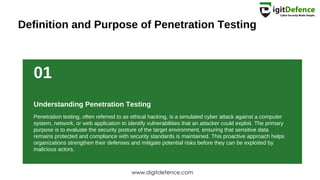
Definition and Purpose of Penetration Testing
Understanding Penetration Testing
Penetration testing, often referred to as ethical hacking, is a simulated cyber attack against a computer
system, network, or web application to identify vulnerabilities that an attacker could exploit. The primary
purpose is to evaluate the security posture of the target environment, ensuring that sensitive data
remains protected and compliance with security standards is maintained. This proactive approach helps
organizations strengthen their defenses and mitigate potential risks before they can be exploited by
malicious actors.
www.digitdefence.com
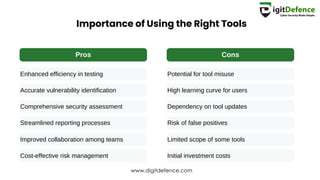
Importance of Using the Right Tools
Pros Cons
Enhanced efficiency in testing
Accurate vulnerability identification
Comprehensive security assessment
Streamlined reporting processes
Improved collaboration among teams
Cost-effective risk management
Potential for tool misuse
High learning curve for users
Dependency on tool updates
Risk of false positives
Limited scope of some tools
Initial investment costs
www.digitdefence.com
01 02 03
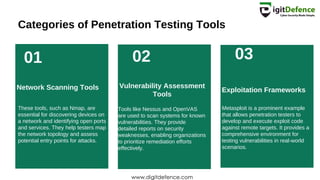
Categories of Penetration Testing Tools
Network Scanning Tools Vulnerability Assessment
Tools
Exploitation Frameworks
These tools, such as Nmap, are
essential for discovering devices on
a network and identifying open ports
and services. They help testers map
the network topology and assess
potential entry points for attacks.
Tools like Nessus and OpenVAS
are used to scan systems for known
vulnerabilities. They provide
detailed reports on security
weaknesses, enabling organizations
to prioritize remediation efforts
effectively.
Metasploit is a prominent example
that allows penetration testers to
develop and execute exploit code
against remote targets. It provides a
comprehensive environment for
testing vulnerabilities in real-world
scenarios.
www.digitdefence.com
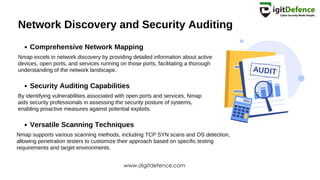
Network Discovery and Security Auditing
Comprehensive Network Mapping
Security Auditing Capabilities
Versatile Scanning Techniques
Nmap excels in network discovery by providing detailed information about active
devices, open ports, and services running on those ports, facilitating a thorough
understanding of the network landscape.
By identifying vulnerabilities associated with open ports and services, Nmap
aids security professionals in assessing the security posture of systems,
enabling proactive measures against potential exploits.
Nmap supports various scanning methods, including TCP SYN scans and OS detection,
allowing penetration testers to customize their approach based on specific testing
requirements and target environments.
www.digitdefence.com
Network Protocol Analysis
Deep Packet Inspection
Protocol Analysis
User-Friendly Interface
Wireshark allows for detailed analysis of network traffic by capturing and inspecting packets in real-time, enabling
users to identify anomalies and troubleshoot network issues effectively.
With support for hundreds of protocols, Wireshark provides insights into the behavior of various network protocols,
helping security professionals understand potential vulnerabilities and communication patterns.
The graphical interface of Wireshark simplifies the process of analyzing complex data, making it accessible for
both novice and experienced users to conduct thorough network protocol analysis.
www.digitdefence.com
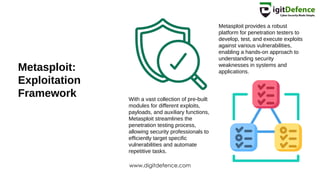
Metasploit:
Exploitation
Framework
Metasploit provides a robust
platform for penetration testers to
develop, test, and execute exploits
against various vulnerabilities,
enabling a hands-on approach to
understanding security
weaknesses in systems and
applications.
With a vast collection of pre-built
modules for different exploits,
payloads, and auxiliary functions,
Metasploit streamlines the
penetration testing process,
allowing security professionals to
efficiently target specific
vulnerabilities and automate
repetitive tasks.
www.digitdefence.com
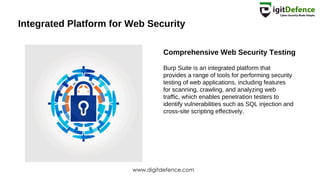
Integrated Platform for Web Security
Comprehensive Web Security Testing
Burp Suite is an integrated platform that
provides a range of tools for performing security
testing of web applications, including features
for scanning, crawling, and analyzing web
traffic, which enables penetration testers to
identify vulnerabilities such as SQL injection and
cross-site scripting effectively.
www.digitdefence.com
Thank You
www.digitdefence.com

Common Tools Used in Penetration Testing.pptx (1).pdf

  • 1.
  • 2.
    01 Definition and Purposeof Penetration Testing Understanding Penetration Testing Penetration testing, often referred to as ethical hacking, is a simulated cyber attack against a computer system, network, or web application to identify vulnerabilities that an attacker could exploit. The primary purpose is to evaluate the security posture of the target environment, ensuring that sensitive data remains protected and compliance with security standards is maintained. This proactive approach helps organizations strengthen their defenses and mitigate potential risks before they can be exploited by malicious actors. www.digitdefence.com
  • 3.
    Importance of Usingthe Right Tools Pros Cons Enhanced efficiency in testing Accurate vulnerability identification Comprehensive security assessment Streamlined reporting processes Improved collaboration among teams Cost-effective risk management Potential for tool misuse High learning curve for users Dependency on tool updates Risk of false positives Limited scope of some tools Initial investment costs www.digitdefence.com
  • 4.
    01 02 03 Categoriesof Penetration Testing Tools Network Scanning Tools Vulnerability Assessment Tools Exploitation Frameworks These tools, such as Nmap, are essential for discovering devices on a network and identifying open ports and services. They help testers map the network topology and assess potential entry points for attacks. Tools like Nessus and OpenVAS are used to scan systems for known vulnerabilities. They provide detailed reports on security weaknesses, enabling organizations to prioritize remediation efforts effectively. Metasploit is a prominent example that allows penetration testers to develop and execute exploit code against remote targets. It provides a comprehensive environment for testing vulnerabilities in real-world scenarios. www.digitdefence.com
  • 5.
    Network Discovery andSecurity Auditing Comprehensive Network Mapping Security Auditing Capabilities Versatile Scanning Techniques Nmap excels in network discovery by providing detailed information about active devices, open ports, and services running on those ports, facilitating a thorough understanding of the network landscape. By identifying vulnerabilities associated with open ports and services, Nmap aids security professionals in assessing the security posture of systems, enabling proactive measures against potential exploits. Nmap supports various scanning methods, including TCP SYN scans and OS detection, allowing penetration testers to customize their approach based on specific testing requirements and target environments. www.digitdefence.com
  • 6.
    Network Protocol Analysis DeepPacket Inspection Protocol Analysis User-Friendly Interface Wireshark allows for detailed analysis of network traffic by capturing and inspecting packets in real-time, enabling users to identify anomalies and troubleshoot network issues effectively. With support for hundreds of protocols, Wireshark provides insights into the behavior of various network protocols, helping security professionals understand potential vulnerabilities and communication patterns. The graphical interface of Wireshark simplifies the process of analyzing complex data, making it accessible for both novice and experienced users to conduct thorough network protocol analysis. www.digitdefence.com
  • 7.
    Metasploit: Exploitation Framework Metasploit provides arobust platform for penetration testers to develop, test, and execute exploits against various vulnerabilities, enabling a hands-on approach to understanding security weaknesses in systems and applications. With a vast collection of pre-built modules for different exploits, payloads, and auxiliary functions, Metasploit streamlines the penetration testing process, allowing security professionals to efficiently target specific vulnerabilities and automate repetitive tasks. www.digitdefence.com
  • 8.
    Integrated Platform forWeb Security Comprehensive Web Security Testing Burp Suite is an integrated platform that provides a range of tools for performing security testing of web applications, including features for scanning, crawling, and analyzing web traffic, which enables penetration testers to identify vulnerabilities such as SQL injection and cross-site scripting effectively. www.digitdefence.com
  • 9.