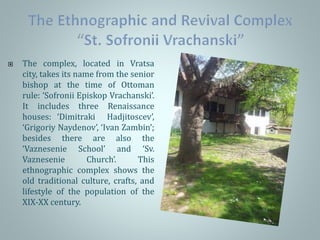
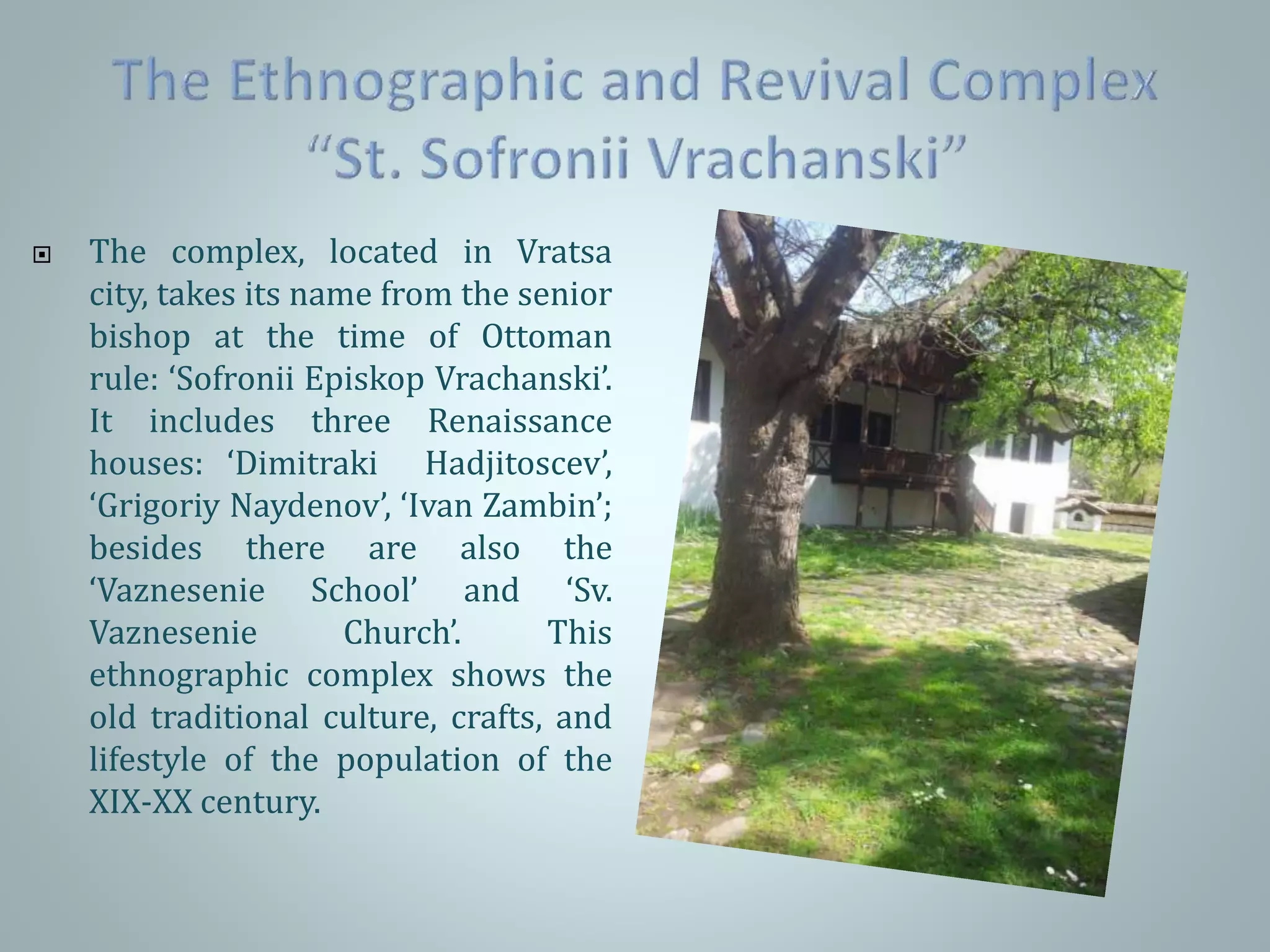
 The complex, located in Vratsa
city, takes its name from the senior
bishop at the time of Ottoman
rule: ‘Sofronii Episkop Vrachanski’.
It includes three Renaissance
houses: ‘Dimitraki Hadjitoscev’,
‘Grigoriy Naydenov’, ‘Ivan Zambin’;
besides there are also the
‘Vaznesenie School’ and ‘Sv.
Vaznesenie Church’. This
ethnographic complex shows the
old traditional culture, crafts, and
lifestyle of the population of the
XIX-XX century.
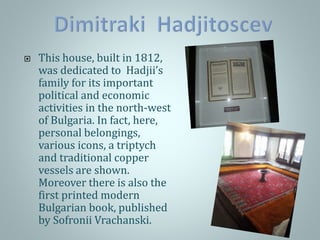
 This house, built in 1812,
was dedicated to Hadjii’s
family for its important
political and economic
activities in the north-west
of Bulgaria. In fact, here,
personal belongings,
various icons, a triptych
and traditional copper
vessels are shown.
Moreover there is also the
first printed modern
Bulgarian book, published
by Sofronii Vrachanski.
Grigoriy Naydenov
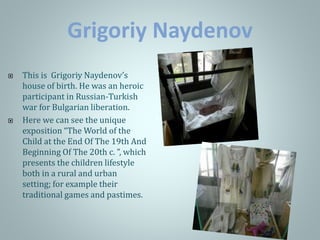
 This is Grigoriy Naydenov’s
house of birth. He was an heroic
participant in Russian-Turkish
war for Bulgarian liberation.
 Here we can see the unique
exposition “The World of the
Child at the End Of The 19th And
Beginning Of The 20th c. ”, which
presents the children lifestyle
both in a rural and urban
setting; for example their
traditional games and pastimes.
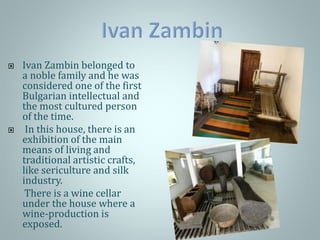
 Ivan Zambin belonged to
a noble family and he was
considered one of the first
Bulgarian intellectual and
the most cultured person
of the time.
 In this house, there is an
exhibition of the main
means of living and
traditional artistic crafts,
like sericulture and silk
industry.
There is a wine cellar
under the house where a
wine-production is
exposed.
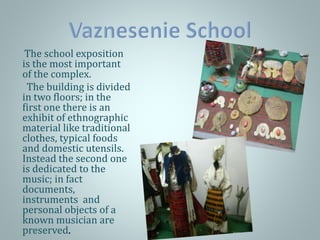
The school exposition
is the most important
of the complex.
The building is divided
in two floors; in the
first one there is an
exhibit of ethnographic
material like traditional
clothes, typical foods
and domestic utensils.
Instead the second one
is dedicated to the
music; in fact
documents,
instruments and
personal objects of a
known musician are
preserved.
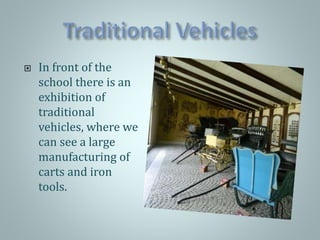
 In front of the
school there is an
exhibition of
traditional
vehicles, where we
can see a large
manufacturing of
carts and iron
tools.
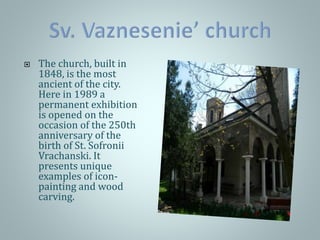
 The church, built in
1848, is the most
ancient of the city.
Here in 1989 a
permanent exhibition
is opened on the
occasion of the 250th
anniversary of the
birth of St. Sofronii
Vrachanski. It
presents unique
examples of icon-
painting and wood
carving.
Comenius Bilateral Partnership:The ethnographic revival complex

Comenius Bilateral Partnership:The ethnographic revival complex

  • 1.
     The complex,located in Vratsa city, takes its name from the senior bishop at the time of Ottoman rule: ‘Sofronii Episkop Vrachanski’. It includes three Renaissance houses: ‘Dimitraki Hadjitoscev’, ‘Grigoriy Naydenov’, ‘Ivan Zambin’; besides there are also the ‘Vaznesenie School’ and ‘Sv. Vaznesenie Church’. This ethnographic complex shows the old traditional culture, crafts, and lifestyle of the population of the XIX-XX century.
  • 2.
     This house,built in 1812, was dedicated to Hadjii’s family for its important political and economic activities in the north-west of Bulgaria. In fact, here, personal belongings, various icons, a triptych and traditional copper vessels are shown. Moreover there is also the first printed modern Bulgarian book, published by Sofronii Vrachanski.
  • 3.
    Grigoriy Naydenov  Thisis Grigoriy Naydenov’s house of birth. He was an heroic participant in Russian-Turkish war for Bulgarian liberation.  Here we can see the unique exposition “The World of the Child at the End Of The 19th And Beginning Of The 20th c. ”, which presents the children lifestyle both in a rural and urban setting; for example their traditional games and pastimes.
  • 4.
     Ivan Zambinbelonged to a noble family and he was considered one of the first Bulgarian intellectual and the most cultured person of the time.  In this house, there is an exhibition of the main means of living and traditional artistic crafts, like sericulture and silk industry. There is a wine cellar under the house where a wine-production is exposed.
  • 5.
    The school exposition isthe most important of the complex. The building is divided in two floors; in the first one there is an exhibit of ethnographic material like traditional clothes, typical foods and domestic utensils. Instead the second one is dedicated to the music; in fact documents, instruments and personal objects of a known musician are preserved.
  • 6.
     In frontof the school there is an exhibition of traditional vehicles, where we can see a large manufacturing of carts and iron tools.
  • 7.
     The church,built in 1848, is the most ancient of the city. Here in 1989 a permanent exhibition is opened on the occasion of the 250th anniversary of the birth of St. Sofronii Vrachanski. It presents unique examples of icon- painting and wood carving.