

Collections FuturesDavid W. LewisAnnual RLG Partnership MeetingChicago, ILJune 10, 2010© 2010 David W. Lewis.  Permission to use this work is granted under the Creative Commons Attribution-NonCommercial-NoDerivs license (2.5).  You are free: to copy, distribute, display, and perform the work Under the following conditions: 1. You must attribute the work; 2. You may not use this work for commercial purposes, and 3. You may not alter, transform, or build upon this work.  For any reuse or distribution, you must make clear to others the license terms of this work.  Any of these conditions can be waived with permission of the copyright holder.  Your fair use and other rights are in no way affected by the above.
Underlying AssumptionsCollections drive library practice because most library resources go into purchasing, organizing, and managing them.  In addition, libraries base much of their identity on their collections.
Unless current collection practices are changed, libraries cannot change, except on the margins.Underlying AssumptionsThis change will be very hardWe need to develop arguments and a vocabulary so we talk about this issue clearlyTo do this we need to have a clear conceptual understanding of what we hope to accomplish
AgendaContext The Big ShiftInterlude with Clay ShirkyA Bit of Disruptive Innovation TheoryCollections in “A Strategy for Academic Libraries in the First Quarter of the 21st Century”What Will Be Easy and What Will Be Hard
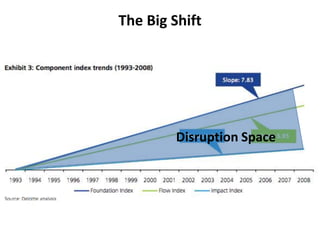
The Big ShiftJohn Hagel III, John Seely Brown, and Lang Davison, “Measuring the forces of long-term change: The 2009 Shift Index,” Deloitte Center for the Edge, 2009.  Available at: http://www.johnhagel.com/shiftindex.pdf
The Big Shift
The Big Shift
The Big ShiftDisruption Space
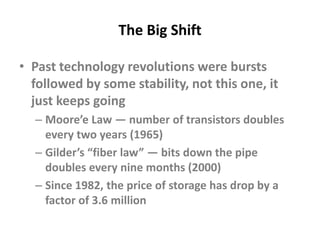
The Big ShiftPast technology revolutions were bursts followed by some stability, not this one, it just keeps goingMoore’e Law — number of transistors doubles every two years (1965)Gilder’s “fiber law” — bits down the pipe doubles every nine months (2000)Since 1982, the price of storage has drop by a factor of 3.6 million
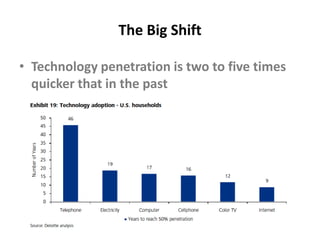
The Big ShiftTechnology penetration is two to five times quicker that in the past
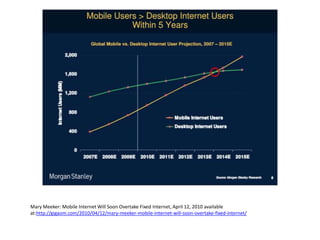
Mary Meeker: Mobile Internet Will Soon Overtake Fixed Internet, April 12, 2010 available at:http://gigaom.com/2010/04/12/mary-meeker-mobile-internet-will-soon-overtake-fixed-internet/
The Big ShiftFirst Order Effect:  Technology substantially reduces barriers to entry and barriers to movement on a global scaleSecond Order Effect: Competition intensifies on a global scaleThird Order Effect: As competition intensifies, instability and uncertainty increase
The Big ShiftOrganizations have generally been unable to apply the capacities made possible by the technology to increase performanceNeed to provide services that are cheaper and betterCreates organizational and personal stress
The Big ShiftPower moves to consumersPower moves to trained and skilled individualsPower moves away from organizations
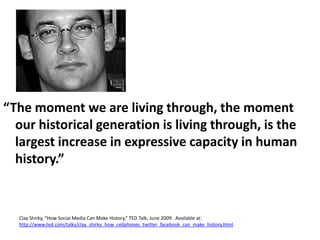
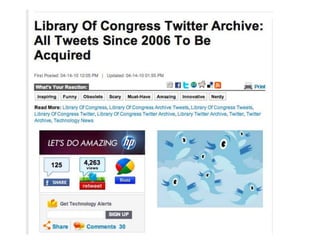
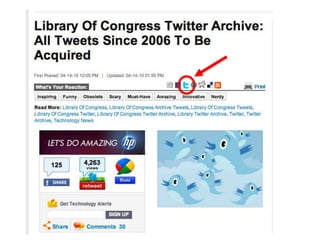
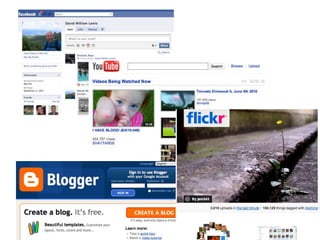
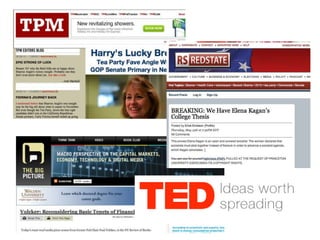
“The moment we are living through, the moment our historical generation is living through, is the largest increase in expressive capacity in human history.”Clay Shirky, “How Social Media Can Make History,” TED Talk, June 2009.  Available at: http://www.ted.com/talks/clay_shirky_how_cellphones_twitter_facebook_can_make_history.html
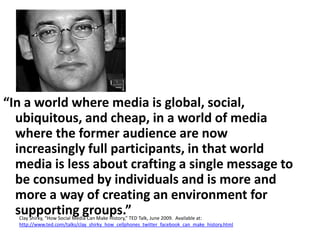
“In a world where media is global, social, ubiquitous, and cheap, in a world of media where the former audience are now increasingly full participants, in that world media is less about crafting a single message to be consumed by individuals and is more and more a way of creating an environment for supporting groups.”Clay Shirky, “How Social Media Can Make History,” TED Talk, June 2009.  Available at: http://www.ted.com/talks/clay_shirky_how_cellphones_twitter_facebook_can_make_history.html
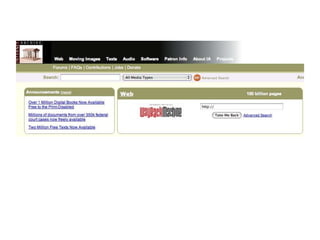
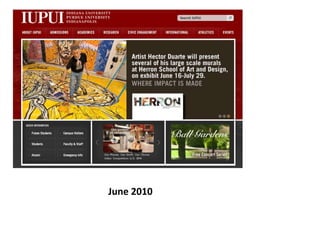
June 2010
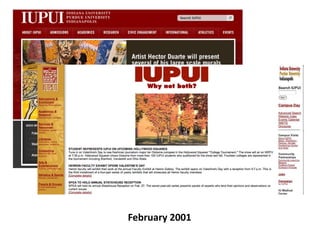
February 2001
“The Largest increase in expressive capacity in human history.”	We’re watching from the sidelines	We don’t have the capacity (or the interest) to be engaged
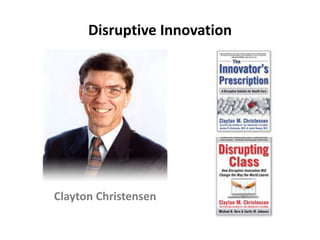
Disruptive InnovationClayton Christensen
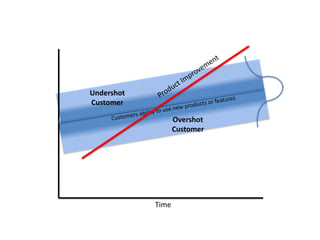
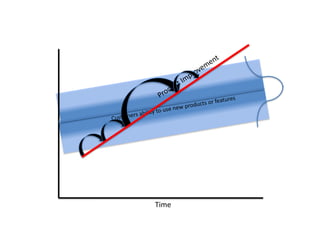
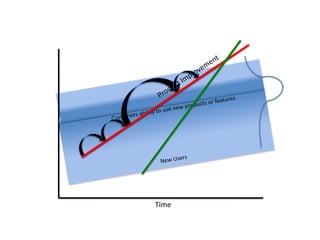
Sustaining and Disruptive InnovationThe capacity for customers to use new products and features increases, but at a slow rateProducts improve faster than customers can use the improvementsProducts that were initially not good enough become to good
Product ImprovementUndershotCustomerCustomers ability to use new products or featuresOvershotCustomerTime
Undershot CustomerWants and will pay new featuresWhere money can be madeOvershot CustomerDoesn’t care about new features – performance oversupplyBasis of competition changesWants product to be cheaper, faster, easierCommoditization
Product ImprovementCustomers ability to use new products or featuresTime
Product ImprovementCustomers ability to use new products or featuresNew UsersTime
Characteristics of Disruptive InnovationStarts off as not being good enough for established customersOften creates a new group of users who did not have the time, expertise, or money to use the established product Begins by competing against non-consumption
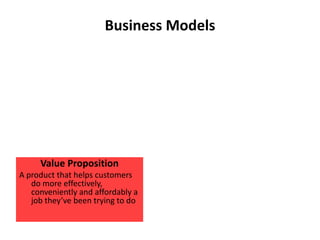
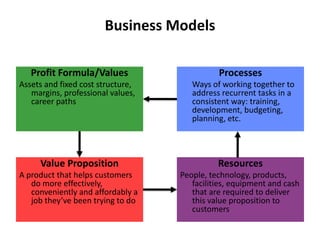
Business ModelsValue PropositionA product that helps customers do more effectively, conveniently and affordably a job they’ve been trying to do
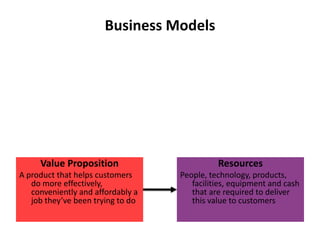
Business ModelsValue PropositionA product that helps customers do more effectively, conveniently and affordably a job they’ve been trying to doResourcesPeople, technology, products, facilities, equipment and cash that are required to deliver this value to customers
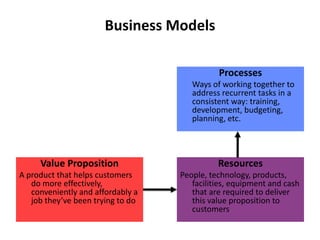
Business ModelsProcesses	Ways of working together to address recurrent tasks in a consistent way: training, development, budgeting, planning, etc.Value PropositionA product that helps customers do more effectively, conveniently and affordably a job they’ve been trying to doResourcesPeople, technology, products, facilities, equipment and cash that are required to deliver this value proposition to customers
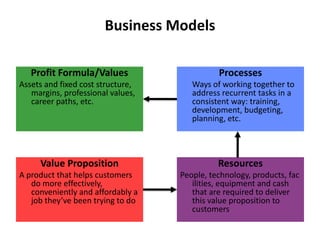
Business ModelsProcesses	Ways of working together to address recurrent tasks in a consistent way: training, development, budgeting, planning, etc.Profit Formula/ValuesAssets and fixed cost structure, margins, professional values, career paths, etc.Value PropositionA product that helps customers do more effectively, conveniently and affordably a job they’ve been trying to doResourcesPeople, technology, products, facilities, equipment and cash that are required to deliver this value proposition to customers
Business ModelsProcesses	Ways of working together to address recurrent tasks in a consistent way: training, development, budgeting, planning, etc.Profit Formula/ValuesAssets and fixed cost structure, margins, professional values, career pathsValue PropositionA product that helps customers do more effectively, conveniently and affordably a job they’ve been trying to doResourcesPeople, technology, products, facilities, equipment and cash that are required to deliver this value proposition to customers
Business ModelsEstablished values make in nearly impossible for organizations to create disruptive innovationSeparation is the only strategy that works
Response to Disruptive InnovationCramming — Try to make the innovation work within old organization processes and culture	This rarely worksMove up market — Focus on more demanding customers and concede lower end customers		Eventually the market tops out
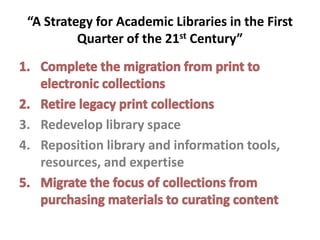
“A Strategy for Academic Libraries in the First Quarter of the 21st Century”Complete the migration from print to electronic collectionsRetire legacy print collectionsRedevelop library spaceReposition library and information tools, resources, and expertiseMigrate the focus of collections from purchasing materials to curating content
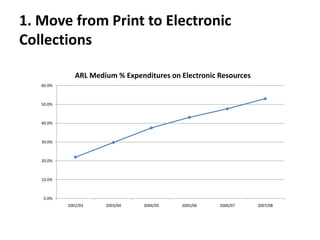
1. Move from Print to Electronic Collections
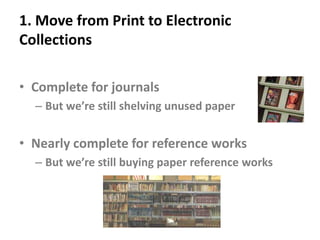
1. Move from Print to Electronic CollectionsComplete for journalsBut we’re still shelving unused paperNearly complete for reference worksBut we’re still buying paper reference works
1. Move from Print to Electronic CollectionsJust beginning for booksTreated early e-books collections like print booksCramming of innovative technology
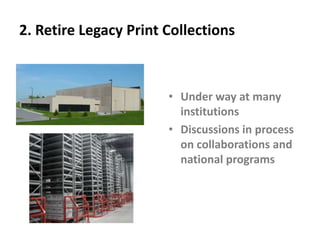
2. Retire Legacy Print CollectionsUnder way at many institutionsDiscussions in process on collaborations and national programs
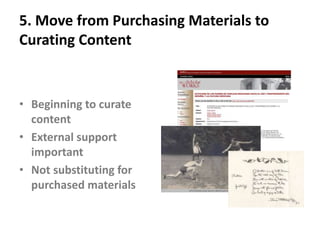
5. Move from Purchasing Materials to Curating ContentBeginning to curate content
External support important
Not substituting for purchased materialsWhat is Easy and What is Hard?Easy — Starting new projects, especially at modest scale and with external fundingHard — Giving up anything	Opportunity Cost of current practice	Competitive advantage to first mover
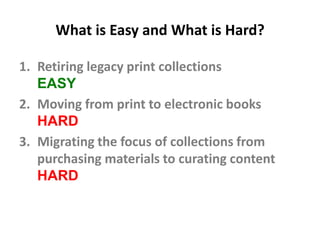
What is Easy and What is Hard?Moving from print to electronic books   HARDRetiring legacy print collections               EASYMigrating the focus of collections from purchasing materials to curating content   HARD
What is Easy and What is Hard?Moving from print to electronic booksRetiring legacy print collectionsMigrating the focus of collections from purchasing materials to curating content
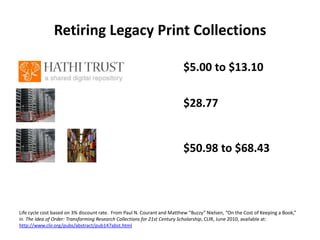
Retiring Legacy Print Collections$5.00 to $13.10$28.77$50.98 to $68.43Life cycle cost based on 3% discount rate.  From Paul N. Courant and Matthew “Buzzy” Nielsen, “On the Cost of Keeping a Book,” in  The Idea of Order: Transforming Research Collections for 21st Century Scholarship, CLIR, June 2010, available at: http://www.clir.org/pubs/abstract/pub147abst.html
Retiring Legacy Print Collections
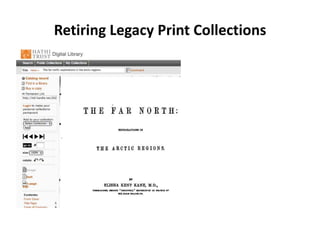
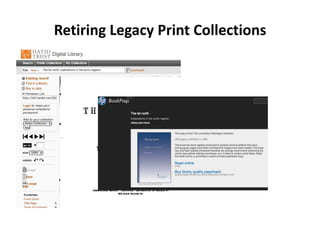
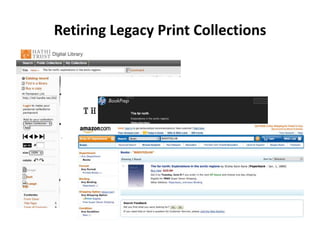
Retiring Legacy Print CollectionsARL libraries archive print copies in long-term storage facilities — collaboratively or notHathiTrust and Google (and others) provide digital archive with print back-upEveryone else free rides on these efforts
What is Easy and What is Hard?Retiring legacy print collections               EASYMoving from print to electronic books   HARDMigrating the focus of collections from purchasing materials to curating content   HARD
What Do We Know About Print Book UseThe 80/20 rule appliesPast use predicts future use (better than anything else)Use declines with ageIn academic print collections users fail to find owned known items 50% of the time Cost to the user is largely in the uncertainty of finding what they want
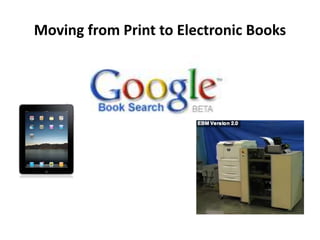
Moving from Print to Electronic Books Most important thing about e-books is that you don’t have to buy then until you need themUser-drive purchasing become possibleIf you want it we have it
Moving from Print to Electronic Books
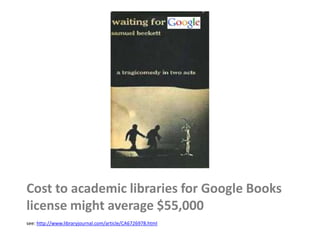
Cost to academic libraries for Google Books license might average $55,000see: http://www.libraryjournal.com/article/CA6726978.html
Moving from Print to Electronic Books Electronic collections — whether delivered electronically or as print-on-demand — eliminate this uncertainty of finding materialOnly buy the part of the long tail that our users actually need — we become much more efficientWill significantly disrupt university presses
Moving from Print to Electronic Books	“Given technical, cultural, policy, and economic obstacles, it is probably premature for most libraries to decide to provide access only to electronic collections, particularly when it comes to monographs.”Lisa Spiro and Geneva Henry, “Can a New Research Library Be All-Digital?” in  The Idea of Order: Transforming Research Collections for 21st Century Scholarship, CLIR, June 2010, page 66.  Available at: http://www.clir.org/pubs/abstract/pub147abst.html
Moving from Print to Electronic BooksNot about print versus electronic — either can be deliveredReally about bibliographer selected just-in-case versus user-drive on-demand
Moving from Print to Electronic BooksNot about print versus electronic— either can be deliveredReally about bibliographer selected just-in-case versus user-drive on-demandWhy it will be HARD
Migrating the Focus of Collections from Purchasing Materials to Curating Content Purchasing Materials = Outside inCurating Content = Inside Out
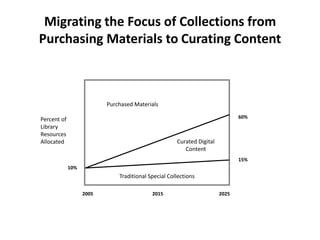
Migrating the Focus of Collections from Purchasing Materials to Curating Content Purchased Materials60%Percent of Library ResourcesAllocatedCurated Digital Content15%10%Traditional Special Collections200520152025
Migrating the Focus of Collections from Purchasing Materials to Curating Content Libraries have always done two things:Purchased materials for local usersCurated content for the worldToday the split is 80/20In 10 to 15 years the split will be 40/60What the library holds that is unique is what will be important
Demand-Side View of the Future of Library CollectionsSee: David W. Lewis, “A Demand-Side View of the Future of Library Collections,” 2004.  Available at: http://hdl.handle.net/1805/172
Migrating the Focus of Collections from Purchasing Materials to Curating Content Develop new balance of library contribution across universityDevelop deeper engagement in research and the distribution of the results of research — this is the transaction cost we will reduce
Open AccessUnless we trade subscription journal costs for support for open access, very little else can be done because this is where ALL the money goes
Cost of Science Journals	“We need to begin with a fundamental fact — the cost of scholarly journals has increased at 10% per year for the last three decades.  This is over six times the rate of general inflation and over two and a half times the rate of increase of the cost of health care.  Between 1975 and 2005 the average cost of journals in chemistry and physics rose from $76.84 to $1,879.56.  In the same period, the cost of a gallon of unleaded regular gasoline rose from 55 cents to $1.82.  If the gallon of gas had increased in price at the same rate as chemistry and physics journals over this period it would have reached $12.43 in 2005, and would be over $14.50 today.”David W. Lewis, “Library Budgets, Open Access, and the Future of Scholarly Communication,” C&RL News, May 2008.  Available at: http://www.ala.org/ala/mgrps/divs/acrl/publications/crlnews/2008/may/ALA_print_layout_1_471139_471139.cfm
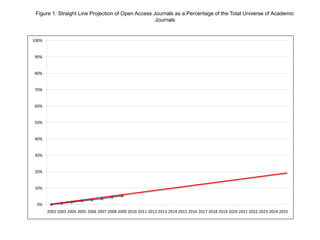
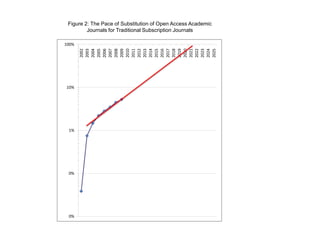
Figure 1: Straight Line Projection of Open Access Journals as a Percentage of the Total Universe of Academic Journals
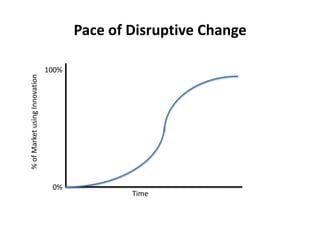
Pace of Disruptive Change100%% of Market using Innovation0%Time
Figure 2: The Pace of Substitution of Open Access Academic Journals for Traditional Subscription Journals
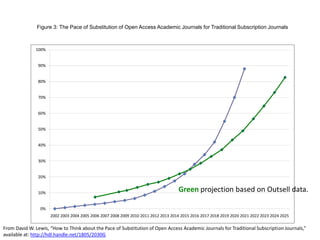
Figure 3: The Pace of Substitution of Open Access Academic Journals for Traditional Subscription JournalsGreen projection based on Outsell data.From David W. Lewis, “How to Think about the Pace of Substitution of Open Access Academic Journals for Traditional Subscription Journals,” available at: http://hdl.handle.net/1805/2030G
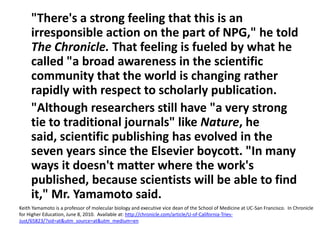
	"There's a strong feeling that this is an irresponsible action on the part of NPG," he told The Chronicle. That feeling is fueled by what he called "a broad awareness in the scientific community that the world is changing rather rapidly with respect to scholarly publication.	"Although researchers still have "a very strong tie to traditional journals" like Nature, he said, scientific publishing has evolved in the seven years since the Elsevier boycott. "In many ways it doesn't matter where the work's published, because scientists will be able to find it," Mr. Yamamoto said.Keith Yamamoto is a professor of molecular biology and executive vice dean of the School of Medicine at UC-San Francisco.  In Chronicle for Higher Education, June 8, 2010.  Available at: http://chronicle.com/article/U-of-California-Tries-Just/65823/?sid=at&utm_source=at&utm_medium=en
What is Easy and What is Hard?Retiring legacy print collections               EASYMoving from print to electronic books   HARDMigrating the focus of collections from purchasing materials to curating content   HARD
Collective Action“Equal Disadvantage”United WayCommunity Source development of infrastructurePlace for the separation strategy
Collective ActionNew Story we can ALLtellMoving collections from purchasing materials to curatingcontentMoving from outside in to inside out
SourcesClayton M. Christensen, Jerome H. Grossman, and Jason Hwang, The Innovator's Prescription: A Disruptive Solution for Health Care, New York: McGraw-Hill, 2009.Clayton M. Christensen, Michael B. Horn, and Curtis W. Johnson, Disrupting Class: How Disruptive Innovation Will Change the Way the World Learns, New York : McGraw-Hill, 2008.Clayton M. Christensen, “The Innovator's Prescription: A Disruptive Solution for Health Care” (video), May 13, 2008, MIT World, Available at: http://mitworld.mit.edu/video/594John Hagel III, John Seely Brown, and Lang Davison, “Measuring the forces of long-term change: The 2009 Shift Index,” Deloitte Center for the Edge, 2009.  Available at: http://www.johnhagel.com/shiftindex.pdfJohn Hegal III, John Seely Brown, and Lang Davison, The Power of Pull: How Small Moves Smartly Made Can Set Big Things in Motion, New York: Basic Books, 2010.Lewis, David W.  “A Strategy for Academic Libraries in the First Quarter of the 21st Century.”  College & Research Libraries 68(5):418-434 September 2007. Available at:http://www.acrl.org/ala/mgrps/divs/acrl/publications/crljournal/2007/sep/Lewis07.pdfand http://idea.iupui.edu/dspace/handle/1805/1592

Collections Futures

  • 1.
    Collections FuturesDavid W.LewisAnnual RLG Partnership MeetingChicago, ILJune 10, 2010© 2010 David W. Lewis. Permission to use this work is granted under the Creative Commons Attribution-NonCommercial-NoDerivs license (2.5). You are free: to copy, distribute, display, and perform the work Under the following conditions: 1. You must attribute the work; 2. You may not use this work for commercial purposes, and 3. You may not alter, transform, or build upon this work. For any reuse or distribution, you must make clear to others the license terms of this work. Any of these conditions can be waived with permission of the copyright holder. Your fair use and other rights are in no way affected by the above.
  • 2.
    Underlying AssumptionsCollections drivelibrary practice because most library resources go into purchasing, organizing, and managing them. In addition, libraries base much of their identity on their collections.
  • 3.
    Unless current collectionpractices are changed, libraries cannot change, except on the margins.Underlying AssumptionsThis change will be very hardWe need to develop arguments and a vocabulary so we talk about this issue clearlyTo do this we need to have a clear conceptual understanding of what we hope to accomplish
  • 4.
    AgendaContext The BigShiftInterlude with Clay ShirkyA Bit of Disruptive Innovation TheoryCollections in “A Strategy for Academic Libraries in the First Quarter of the 21st Century”What Will Be Easy and What Will Be Hard
  • 5.
    The Big ShiftJohnHagel III, John Seely Brown, and Lang Davison, “Measuring the forces of long-term change: The 2009 Shift Index,” Deloitte Center for the Edge, 2009. Available at: http://www.johnhagel.com/shiftindex.pdf
  • 6.
  • 7.
  • 8.
  • 9.
    The Big ShiftPasttechnology revolutions were bursts followed by some stability, not this one, it just keeps goingMoore’e Law — number of transistors doubles every two years (1965)Gilder’s “fiber law” — bits down the pipe doubles every nine months (2000)Since 1982, the price of storage has drop by a factor of 3.6 million
  • 10.
    The Big ShiftTechnologypenetration is two to five times quicker that in the past
  • 11.
    Mary Meeker: MobileInternet Will Soon Overtake Fixed Internet, April 12, 2010 available at:http://gigaom.com/2010/04/12/mary-meeker-mobile-internet-will-soon-overtake-fixed-internet/
  • 12.
    The Big ShiftFirstOrder Effect: Technology substantially reduces barriers to entry and barriers to movement on a global scaleSecond Order Effect: Competition intensifies on a global scaleThird Order Effect: As competition intensifies, instability and uncertainty increase
  • 13.
    The Big ShiftOrganizationshave generally been unable to apply the capacities made possible by the technology to increase performanceNeed to provide services that are cheaper and betterCreates organizational and personal stress
  • 14.
    The Big ShiftPowermoves to consumersPower moves to trained and skilled individualsPower moves away from organizations
  • 15.
    “The moment weare living through, the moment our historical generation is living through, is the largest increase in expressive capacity in human history.”Clay Shirky, “How Social Media Can Make History,” TED Talk, June 2009. Available at: http://www.ted.com/talks/clay_shirky_how_cellphones_twitter_facebook_can_make_history.html
  • 16.
    “In a worldwhere media is global, social, ubiquitous, and cheap, in a world of media where the former audience are now increasingly full participants, in that world media is less about crafting a single message to be consumed by individuals and is more and more a way of creating an environment for supporting groups.”Clay Shirky, “How Social Media Can Make History,” TED Talk, June 2009. Available at: http://www.ted.com/talks/clay_shirky_how_cellphones_twitter_facebook_can_make_history.html
  • 18.
  • 19.
  • 25.
    “The Largest increasein expressive capacity in human history.” We’re watching from the sidelines We don’t have the capacity (or the interest) to be engaged
  • 26.
  • 27.
    Sustaining and DisruptiveInnovationThe capacity for customers to use new products and features increases, but at a slow rateProducts improve faster than customers can use the improvementsProducts that were initially not good enough become to good
  • 28.
    Product ImprovementUndershotCustomerCustomers abilityto use new products or featuresOvershotCustomerTime
  • 29.
    Undershot CustomerWants andwill pay new featuresWhere money can be madeOvershot CustomerDoesn’t care about new features – performance oversupplyBasis of competition changesWants product to be cheaper, faster, easierCommoditization
  • 30.
    Product ImprovementCustomers abilityto use new products or featuresTime
  • 31.
    Product ImprovementCustomers abilityto use new products or featuresNew UsersTime
  • 32.
    Characteristics of DisruptiveInnovationStarts off as not being good enough for established customersOften creates a new group of users who did not have the time, expertise, or money to use the established product Begins by competing against non-consumption
  • 33.
    Business ModelsValue PropositionAproduct that helps customers do more effectively, conveniently and affordably a job they’ve been trying to do
  • 34.
    Business ModelsValue PropositionAproduct that helps customers do more effectively, conveniently and affordably a job they’ve been trying to doResourcesPeople, technology, products, facilities, equipment and cash that are required to deliver this value to customers
  • 35.
    Business ModelsProcesses Ways ofworking together to address recurrent tasks in a consistent way: training, development, budgeting, planning, etc.Value PropositionA product that helps customers do more effectively, conveniently and affordably a job they’ve been trying to doResourcesPeople, technology, products, facilities, equipment and cash that are required to deliver this value proposition to customers
  • 36.
    Business ModelsProcesses Ways ofworking together to address recurrent tasks in a consistent way: training, development, budgeting, planning, etc.Profit Formula/ValuesAssets and fixed cost structure, margins, professional values, career paths, etc.Value PropositionA product that helps customers do more effectively, conveniently and affordably a job they’ve been trying to doResourcesPeople, technology, products, facilities, equipment and cash that are required to deliver this value proposition to customers
  • 37.
    Business ModelsProcesses Ways ofworking together to address recurrent tasks in a consistent way: training, development, budgeting, planning, etc.Profit Formula/ValuesAssets and fixed cost structure, margins, professional values, career pathsValue PropositionA product that helps customers do more effectively, conveniently and affordably a job they’ve been trying to doResourcesPeople, technology, products, facilities, equipment and cash that are required to deliver this value proposition to customers
  • 38.
    Business ModelsEstablished valuesmake in nearly impossible for organizations to create disruptive innovationSeparation is the only strategy that works
  • 39.
    Response to DisruptiveInnovationCramming — Try to make the innovation work within old organization processes and culture This rarely worksMove up market — Focus on more demanding customers and concede lower end customers Eventually the market tops out
  • 40.
    “A Strategy forAcademic Libraries in the First Quarter of the 21st Century”Complete the migration from print to electronic collectionsRetire legacy print collectionsRedevelop library spaceReposition library and information tools, resources, and expertiseMigrate the focus of collections from purchasing materials to curating content
  • 41.
    “A Strategy forAcademic Libraries in the First Quarter of the 21st Century”Complete the migration from print to electronic collectionsRetire legacy print collectionsRedevelop library spaceReposition library and information tools, resources, and expertiseMigrate the focus of collections from purchasing materials to curating content
  • 42.
    1. Move fromPrint to Electronic Collections
  • 43.
    1. Move fromPrint to Electronic CollectionsComplete for journalsBut we’re still shelving unused paperNearly complete for reference worksBut we’re still buying paper reference works
  • 44.
    1. Move fromPrint to Electronic CollectionsJust beginning for booksTreated early e-books collections like print booksCramming of innovative technology
  • 45.
    2. Retire LegacyPrint CollectionsUnder way at many institutionsDiscussions in process on collaborations and national programs
  • 46.
    5. Move fromPurchasing Materials to Curating ContentBeginning to curate content
  • 47.
  • 48.
    Not substituting forpurchased materialsWhat is Easy and What is Hard?Easy — Starting new projects, especially at modest scale and with external fundingHard — Giving up anything Opportunity Cost of current practice Competitive advantage to first mover
  • 49.
    What is Easyand What is Hard?Moving from print to electronic books HARDRetiring legacy print collections EASYMigrating the focus of collections from purchasing materials to curating content HARD
  • 50.
    What is Easyand What is Hard?Moving from print to electronic booksRetiring legacy print collectionsMigrating the focus of collections from purchasing materials to curating content
  • 51.
    Retiring Legacy PrintCollections$5.00 to $13.10$28.77$50.98 to $68.43Life cycle cost based on 3% discount rate. From Paul N. Courant and Matthew “Buzzy” Nielsen, “On the Cost of Keeping a Book,” in The Idea of Order: Transforming Research Collections for 21st Century Scholarship, CLIR, June 2010, available at: http://www.clir.org/pubs/abstract/pub147abst.html
  • 52.
  • 53.
  • 54.
  • 55.
    Retiring Legacy PrintCollectionsARL libraries archive print copies in long-term storage facilities — collaboratively or notHathiTrust and Google (and others) provide digital archive with print back-upEveryone else free rides on these efforts
  • 56.
    What is Easyand What is Hard?Retiring legacy print collections EASYMoving from print to electronic books HARDMigrating the focus of collections from purchasing materials to curating content HARD
  • 57.
    What Do WeKnow About Print Book UseThe 80/20 rule appliesPast use predicts future use (better than anything else)Use declines with ageIn academic print collections users fail to find owned known items 50% of the time Cost to the user is largely in the uncertainty of finding what they want
  • 58.
    Moving from Printto Electronic Books Most important thing about e-books is that you don’t have to buy then until you need themUser-drive purchasing become possibleIf you want it we have it
  • 59.
    Moving from Printto Electronic Books
  • 60.
    Cost to academiclibraries for Google Books license might average $55,000see: http://www.libraryjournal.com/article/CA6726978.html
  • 61.
    Moving from Printto Electronic Books Electronic collections — whether delivered electronically or as print-on-demand — eliminate this uncertainty of finding materialOnly buy the part of the long tail that our users actually need — we become much more efficientWill significantly disrupt university presses
  • 62.
    Moving from Printto Electronic Books “Given technical, cultural, policy, and economic obstacles, it is probably premature for most libraries to decide to provide access only to electronic collections, particularly when it comes to monographs.”Lisa Spiro and Geneva Henry, “Can a New Research Library Be All-Digital?” in The Idea of Order: Transforming Research Collections for 21st Century Scholarship, CLIR, June 2010, page 66. Available at: http://www.clir.org/pubs/abstract/pub147abst.html
  • 63.
    Moving from Printto Electronic BooksNot about print versus electronic — either can be deliveredReally about bibliographer selected just-in-case versus user-drive on-demand
  • 64.
    Moving from Printto Electronic BooksNot about print versus electronic— either can be deliveredReally about bibliographer selected just-in-case versus user-drive on-demandWhy it will be HARD
  • 65.
    Migrating the Focusof Collections from Purchasing Materials to Curating Content Purchasing Materials = Outside inCurating Content = Inside Out
  • 66.
    Migrating the Focusof Collections from Purchasing Materials to Curating Content Purchased Materials60%Percent of Library ResourcesAllocatedCurated Digital Content15%10%Traditional Special Collections200520152025
  • 67.
    Migrating the Focusof Collections from Purchasing Materials to Curating Content Libraries have always done two things:Purchased materials for local usersCurated content for the worldToday the split is 80/20In 10 to 15 years the split will be 40/60What the library holds that is unique is what will be important
  • 68.
    Demand-Side View ofthe Future of Library CollectionsSee: David W. Lewis, “A Demand-Side View of the Future of Library Collections,” 2004. Available at: http://hdl.handle.net/1805/172
  • 69.
    Demand-Side View ofthe Future of Library CollectionsSee: David W. Lewis, “A Demand-Side View of the Future of Library Collections,” 2004. Available at: http://hdl.handle.net/1805/172
  • 70.
    Demand-Side View ofthe Future of Library CollectionsSee: David W. Lewis, “A Demand-Side View of the Future of Library Collections,” 2004. Available at: http://hdl.handle.net/1805/172
  • 71.
    Migrating the Focusof Collections from Purchasing Materials to Curating Content Develop new balance of library contribution across universityDevelop deeper engagement in research and the distribution of the results of research — this is the transaction cost we will reduce
  • 72.
    Open AccessUnless wetrade subscription journal costs for support for open access, very little else can be done because this is where ALL the money goes
  • 73.
    Cost of ScienceJournals “We need to begin with a fundamental fact — the cost of scholarly journals has increased at 10% per year for the last three decades. This is over six times the rate of general inflation and over two and a half times the rate of increase of the cost of health care. Between 1975 and 2005 the average cost of journals in chemistry and physics rose from $76.84 to $1,879.56. In the same period, the cost of a gallon of unleaded regular gasoline rose from 55 cents to $1.82. If the gallon of gas had increased in price at the same rate as chemistry and physics journals over this period it would have reached $12.43 in 2005, and would be over $14.50 today.”David W. Lewis, “Library Budgets, Open Access, and the Future of Scholarly Communication,” C&RL News, May 2008. Available at: http://www.ala.org/ala/mgrps/divs/acrl/publications/crlnews/2008/may/ALA_print_layout_1_471139_471139.cfm
  • 74.
    Figure 1: StraightLine Projection of Open Access Journals as a Percentage of the Total Universe of Academic Journals
  • 75.
    Pace of DisruptiveChange100%% of Market using Innovation0%Time
  • 76.
    Figure 2: ThePace of Substitution of Open Access Academic Journals for Traditional Subscription Journals
  • 77.
    Figure 3: ThePace of Substitution of Open Access Academic Journals for Traditional Subscription JournalsGreen projection based on Outsell data.From David W. Lewis, “How to Think about the Pace of Substitution of Open Access Academic Journals for Traditional Subscription Journals,” available at: http://hdl.handle.net/1805/2030G
  • 78.
    "There's a strongfeeling that this is an irresponsible action on the part of NPG," he told The Chronicle. That feeling is fueled by what he called "a broad awareness in the scientific community that the world is changing rather rapidly with respect to scholarly publication. "Although researchers still have "a very strong tie to traditional journals" like Nature, he said, scientific publishing has evolved in the seven years since the Elsevier boycott. "In many ways it doesn't matter where the work's published, because scientists will be able to find it," Mr. Yamamoto said.Keith Yamamoto is a professor of molecular biology and executive vice dean of the School of Medicine at UC-San Francisco. In Chronicle for Higher Education, June 8, 2010. Available at: http://chronicle.com/article/U-of-California-Tries-Just/65823/?sid=at&utm_source=at&utm_medium=en
  • 79.
    What is Easyand What is Hard?Retiring legacy print collections EASYMoving from print to electronic books HARDMigrating the focus of collections from purchasing materials to curating content HARD
  • 80.
    Collective Action“Equal Disadvantage”UnitedWayCommunity Source development of infrastructurePlace for the separation strategy
  • 81.
    Collective ActionNew Storywe can ALLtellMoving collections from purchasing materials to curatingcontentMoving from outside in to inside out
  • 82.
    SourcesClayton M. Christensen,Jerome H. Grossman, and Jason Hwang, The Innovator's Prescription: A Disruptive Solution for Health Care, New York: McGraw-Hill, 2009.Clayton M. Christensen, Michael B. Horn, and Curtis W. Johnson, Disrupting Class: How Disruptive Innovation Will Change the Way the World Learns, New York : McGraw-Hill, 2008.Clayton M. Christensen, “The Innovator's Prescription: A Disruptive Solution for Health Care” (video), May 13, 2008, MIT World, Available at: http://mitworld.mit.edu/video/594John Hagel III, John Seely Brown, and Lang Davison, “Measuring the forces of long-term change: The 2009 Shift Index,” Deloitte Center for the Edge, 2009. Available at: http://www.johnhagel.com/shiftindex.pdfJohn Hegal III, John Seely Brown, and Lang Davison, The Power of Pull: How Small Moves Smartly Made Can Set Big Things in Motion, New York: Basic Books, 2010.Lewis, David W. “A Strategy for Academic Libraries in the First Quarter of the 21st Century.” College & Research Libraries 68(5):418-434 September 2007. Available at:http://www.acrl.org/ala/mgrps/divs/acrl/publications/crljournal/2007/sep/Lewis07.pdfand http://idea.iupui.edu/dspace/handle/1805/1592

Editor's Notes

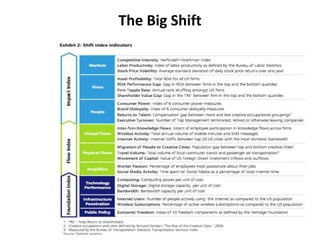
  • #7 The Foundation Index, with an index value of 153 in 2008, has increased at a 10 percent compound annual growth rate (CAGR) since 1993.This index, shown in Exhibit 4, tells the story of a swiftly moving digital infrastructure propelled by unremitting price performance improvements in computing, storage, and bandwidth that show no signs of stabilizing.The Flow Index, with an index value of 139 in 2008, has increased at a seven percent CAGR since 1993.The Flow Index, shown in Exhibit 6, measures the rate of change and magnitude of knowledge flows resulting from the advances in digital infrastructure and public policy liberalization.This index is designed to measure the rate of change and magnitude of the impact of the Big Shift on three key constituencies: Markets, Firms, and People. For People, it attempts to determine how effective they are as consumers and creative talent at harnessing the benefits of knowledge flows unleashed by advances in the core digital infrastructure. Because they are already good at doing this—and are only getting better at it—the index is set to increase as they derive more value from the Big Shift.At least in the short term, however, Markets and Firms appear to be moving in the opposite direction. Partly at the hands of the consumers and talent who are doing so well, pressures on returns are unparalleled, and the traditional way of doing business is increasingly under siege. So as markets grow more volatile, competition intensifies, and firm performance declines, the Impact Index will also increase.
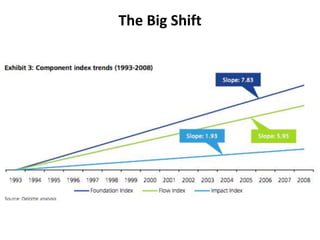
  • #8 Findings from the 2009 Shift Index suggest that deep changes in our economic foundations continue to outpace the flows of knowledge they enable and their impact on markets, firms, and people. Fitting a trend line to each of the three indices, we see that the Foundation Index has moved much more quickly in the past 15 years (with a slope of 7.83) relative to the Flow Index (5.95) and the Impact Index (1.93). These comparative rates of change are shown in Exhibit 3.Comparing the relative rates of change and magnitudes of the three indices reveals telling gaps. The gap between the Foundation Index (153) and the Impact Index (111), for example, defines the scope of the challenges and opportunities that arise from rapidly changing digital infrastructure. Essentially, it measures the economic instability that results from performance potential (reflected by the Foundation Index) rising more quickly than realized performance (reflected in the Impact Index). If realized performance is significantly lower than potential performance, there is growing room for disruptive innovation to narrow this gap.
  • #9 Findings from the 2009 Shift Index suggest that deep changes in our economic foundations continue to outpace the flows of knowledge they enable and their impact on markets, firms, and people. Fitting a trend line to each of the three indices, we see that the Foundation Index has moved much more quickly in the past 15 years (with a slope of 7.83) relative to the Flow Index (5.95) and the Impact Index (1.93). These comparative rates of change are shown in Exhibit 3.Comparing the relative rates of change and magnitudes of the three indices reveals telling gaps. The gap between the Foundation Index (153) and the Impact Index (111), for example, defines the scope of the challenges and opportunities that arise from rapidly changing digital infrastructure. Essentially, it measures the economic instability that results from performance potential (reflected by the Foundation Index) rising more quickly than realized performance (reflected in the Impact Index). If realized performance is significantly lower than potential performance, there is growing room for disruptive innovation to narrow this gap.