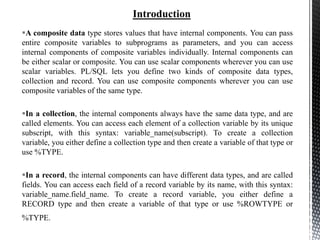
A composite data type stores values that have internal components. You can pass
entire composite variables to subprograms as parameters, and you can access
internal components of composite variables individually. Internal components can
be either scalar or composite. You can use scalar components wherever you can use
scalar variables. PL/SQL lets you define two kinds of composite data types,
collection and record. You can use composite components wherever you can use
composite variables of the same type.
In a collection, the internal components always have the same data type, and are
called elements. You can access each element of a collection variable by its unique
subscript, with this syntax: variable_name(subscript). To create a collection
variable, you either define a collection type and then create a variable of that type or
use %TYPE.
In a record, the internal components can have different data types, and are called
fields. You can access each field of a record variable by its name, with this syntax:
variable_name.field_name. To create a record variable, you either define a
RECORD type and then create a variable of that type or use %ROWTYPE or
%TYPE.
Introduction
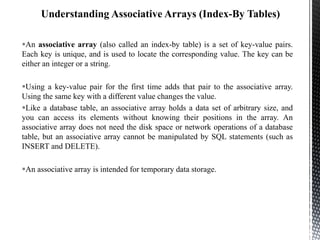
An associative array (also called an index-by table) is a set of key-value pairs.
Each key is unique, and is used to locate the corresponding value. The key can be
either an integer or a string.
Using a key-value pair for the first time adds that pair to the associative array.
Using the same key with a different value changes the value.
Like a database table, an associative array holds a data set of arbitrary size, and
you can access its elements without knowing their positions in the array. An
associative array does not need the disk space or network operations of a database
table, but an associative array cannot be manipulated by SQL statements (such as
INSERT and DELETE).
An associative array is intended for temporary data storage.
Understanding Associative Arrays (Index-By Tables)
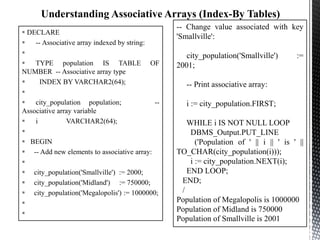
 DECLARE
 -- Associative array indexed by string:

 TYPE population IS TABLE OF
NUMBER -- Associative array type
 INDEX BY VARCHAR2(64);

 city_population population; --
Associative array variable
 i VARCHAR2(64);

 BEGIN
 -- Add new elements to associative array:

 city_population('Smallville') := 2000;
 city_population('Midland') := 750000;
 city_population('Megalopolis') := 1000000;


Understanding Associative Arrays (Index-By Tables)
-- Change value associated with key
'Smallville':
city_population('Smallville') :=
2001;
-- Print associative array:
i := city_population.FIRST;
WHILE i IS NOT NULL LOOP
DBMS_Output.PUT_LINE
('Population of ' || i || ' is ' ||
TO_CHAR(city_population(i)));
i := city_population.NEXT(i);
END LOOP;
END;
/
Population of Megalopolis is 1000000
Population of Midland is 750000
Population of Smallville is 2001
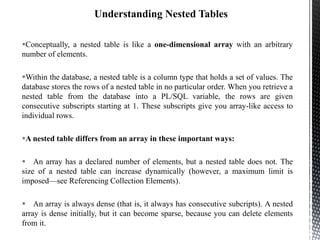
Conceptually, a nested table is like a one-dimensional array with an arbitrary
number of elements.
Within the database, a nested table is a column type that holds a set of values. The
database stores the rows of a nested table in no particular order. When you retrieve a
nested table from the database into a PL/SQL variable, the rows are given
consecutive subscripts starting at 1. These subscripts give you array-like access to
individual rows.
A nested table differs from an array in these important ways:
 An array has a declared number of elements, but a nested table does not. The
size of a nested table can increase dynamically (however, a maximum limit is
imposed—see Referencing Collection Elements).
 An array is always dense (that is, it always has consecutive subcripts). A nested
array is dense initially, but it can become sparse, because you can delete elements
from it.
Understanding Nested Tables
Figure Array and Nested Table
A variable-size array (varray) is an item of the data type VARRAY. A varray has a
maximum size, which you specify in its type definition. A varray can contain a
varying number of elements, from zero (when empty) to the maximum size. A
varray index has a fixed lower bound of 1 and an extensible upper bound. To access
an element of a varray, you use standard subscripting syntax.
Figure shows a varray named Grades, which has maximum size 10 and contains
seven elements. The current upper bound for Grades is 7, but you can increase it to
the maximum of 10. Grades(n) references the nth element of Grades.
Understanding Variable-Size Arrays (Varrays)
Varray of Size 10
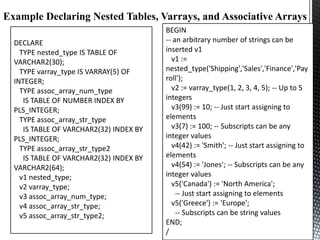
Example Declaring Nested Tables, Varrays, and Associative Arrays
DECLARE
TYPE nested_type IS TABLE OF
VARCHAR2(30);
TYPE varray_type IS VARRAY(5) OF
INTEGER;
TYPE assoc_array_num_type
IS TABLE OF NUMBER INDEX BY
PLS_INTEGER;
TYPE assoc_array_str_type
IS TABLE OF VARCHAR2(32) INDEX BY
PLS_INTEGER;
TYPE assoc_array_str_type2
IS TABLE OF VARCHAR2(32) INDEX BY
VARCHAR2(64);
v1 nested_type;
v2 varray_type;
v3 assoc_array_num_type;
v4 assoc_array_str_type;
v5 assoc_array_str_type2;
BEGIN
-- an arbitrary number of strings can be
inserted v1
v1 :=
nested_type('Shipping','Sales','Finance','Pay
roll');
v2 := varray_type(1, 2, 3, 4, 5); -- Up to 5
integers
v3(99) := 10; -- Just start assigning to
elements
v3(7) := 100; -- Subscripts can be any
integer values
v4(42) := 'Smith'; -- Just start assigning to
elements
v4(54) := 'Jones'; -- Subscripts can be any
integer values
v5('Canada') := 'North America';
-- Just start assigning to elements
v5('Greece') := 'Europe';
-- Subscripts can be string values
END;
/
Summary
• Introduction
• Associative array (or index-by table)
• Nested table
• Variable-size array (varray)

Collection

  • 2.
    A composite datatype stores values that have internal components. You can pass entire composite variables to subprograms as parameters, and you can access internal components of composite variables individually. Internal components can be either scalar or composite. You can use scalar components wherever you can use scalar variables. PL/SQL lets you define two kinds of composite data types, collection and record. You can use composite components wherever you can use composite variables of the same type. In a collection, the internal components always have the same data type, and are called elements. You can access each element of a collection variable by its unique subscript, with this syntax: variable_name(subscript). To create a collection variable, you either define a collection type and then create a variable of that type or use %TYPE. In a record, the internal components can have different data types, and are called fields. You can access each field of a record variable by its name, with this syntax: variable_name.field_name. To create a record variable, you either define a RECORD type and then create a variable of that type or use %ROWTYPE or %TYPE. Introduction
  • 3.
    An associative array(also called an index-by table) is a set of key-value pairs. Each key is unique, and is used to locate the corresponding value. The key can be either an integer or a string. Using a key-value pair for the first time adds that pair to the associative array. Using the same key with a different value changes the value. Like a database table, an associative array holds a data set of arbitrary size, and you can access its elements without knowing their positions in the array. An associative array does not need the disk space or network operations of a database table, but an associative array cannot be manipulated by SQL statements (such as INSERT and DELETE). An associative array is intended for temporary data storage. Understanding Associative Arrays (Index-By Tables)
  • 4.
     DECLARE  --Associative array indexed by string:   TYPE population IS TABLE OF NUMBER -- Associative array type  INDEX BY VARCHAR2(64);   city_population population; -- Associative array variable  i VARCHAR2(64);   BEGIN  -- Add new elements to associative array:   city_population('Smallville') := 2000;  city_population('Midland') := 750000;  city_population('Megalopolis') := 1000000;   Understanding Associative Arrays (Index-By Tables) -- Change value associated with key 'Smallville': city_population('Smallville') := 2001; -- Print associative array: i := city_population.FIRST; WHILE i IS NOT NULL LOOP DBMS_Output.PUT_LINE ('Population of ' || i || ' is ' || TO_CHAR(city_population(i))); i := city_population.NEXT(i); END LOOP; END; / Population of Megalopolis is 1000000 Population of Midland is 750000 Population of Smallville is 2001
  • 5.
    Conceptually, a nestedtable is like a one-dimensional array with an arbitrary number of elements. Within the database, a nested table is a column type that holds a set of values. The database stores the rows of a nested table in no particular order. When you retrieve a nested table from the database into a PL/SQL variable, the rows are given consecutive subscripts starting at 1. These subscripts give you array-like access to individual rows. A nested table differs from an array in these important ways:  An array has a declared number of elements, but a nested table does not. The size of a nested table can increase dynamically (however, a maximum limit is imposed—see Referencing Collection Elements).  An array is always dense (that is, it always has consecutive subcripts). A nested array is dense initially, but it can become sparse, because you can delete elements from it. Understanding Nested Tables
  • 6.
    Understanding Nested Tables FigureArray and Nested Table
  • 7.
    A variable-size array(varray) is an item of the data type VARRAY. A varray has a maximum size, which you specify in its type definition. A varray can contain a varying number of elements, from zero (when empty) to the maximum size. A varray index has a fixed lower bound of 1 and an extensible upper bound. To access an element of a varray, you use standard subscripting syntax. Figure shows a varray named Grades, which has maximum size 10 and contains seven elements. The current upper bound for Grades is 7, but you can increase it to the maximum of 10. Grades(n) references the nth element of Grades. Understanding Variable-Size Arrays (Varrays) Varray of Size 10
  • 8.
    Example Declaring NestedTables, Varrays, and Associative Arrays DECLARE TYPE nested_type IS TABLE OF VARCHAR2(30); TYPE varray_type IS VARRAY(5) OF INTEGER; TYPE assoc_array_num_type IS TABLE OF NUMBER INDEX BY PLS_INTEGER; TYPE assoc_array_str_type IS TABLE OF VARCHAR2(32) INDEX BY PLS_INTEGER; TYPE assoc_array_str_type2 IS TABLE OF VARCHAR2(32) INDEX BY VARCHAR2(64); v1 nested_type; v2 varray_type; v3 assoc_array_num_type; v4 assoc_array_str_type; v5 assoc_array_str_type2; BEGIN -- an arbitrary number of strings can be inserted v1 v1 := nested_type('Shipping','Sales','Finance','Pay roll'); v2 := varray_type(1, 2, 3, 4, 5); -- Up to 5 integers v3(99) := 10; -- Just start assigning to elements v3(7) := 100; -- Subscripts can be any integer values v4(42) := 'Smith'; -- Just start assigning to elements v4(54) := 'Jones'; -- Subscripts can be any integer values v5('Canada') := 'North America'; -- Just start assigning to elements v5('Greece') := 'Europe'; -- Subscripts can be string values END; /
  • 9.
    Summary • Introduction • Associativearray (or index-by table) • Nested table • Variable-size array (varray)